
Your mind rarely quiets on command. It settles when you give it somewhere real to land. That’s what mindfulness journal prompts actually do.
No blank page. No play-by-play of your day. Just your thoughts, your body, the noise in the room, noticed instead of judged. You don’t rush to fix any of it. Not yet.
For Gen Z, that shift matters more than it sounds. Notifications don’t stop. Comparison culture doesn’t stop either. Information just keeps piling on, day after day. Sound exhausting? It is. That’s exactly why a quiet, low-pressure practice works better than another productivity app.
This guide holds 300+ mindfulness journal prompts, real techniques, research backing, and a free printable PDF. If you want a companion for the mental-health side of journaling, the 365 journal prompts for mental health guide pairs well with this one. And if gratitude tends to show up alongside your mindfulness practice, mindfulness and gratitude breaks down exactly how the two connect.
The goal here isn’t a perfect streak. It’s a habit realistic enough that you actually keep it.
Quick Answer: Mindfulness journal prompts are guided questions that pull your attention into right now. Not the past. Not some future worry you’re already carrying. They point you toward your thoughts, feelings, and body sensations as they happen. No judgment attached. Just curiosity.
Used often enough, they build something specific. Self-awareness. Clearer emotions. A calmer daily journaling habit that doesn’t feel like homework.
Table of Contents
Disclaimer
This blog is written and edited with the help of AI, then reviewed by me before publishing. As a result, the content is for general reflection only, not therapy or medical advice, and I’m not a licensed mental health professional. If you’re in crisis, please contact 988 if you’re in US or a local crisis service of your country instead of relying on this site.
What Are Mindfulness Journal Prompts?
Mindfulness journal prompts pull your attention back to right now. Not to yesterday. Not to some future goal.
Ordinary journaling asks you to tell a story. Mindfulness journal prompts ask something smaller. They ask you to notice a thought, a feeling, a sensation in your chest, and just sit with it. No fixing. No judging. Just noticing.
That’s it.
A Simple Definition
Here’s the plain version. A mindfulness journal prompt helps you observe your inner or outer world with a little more awareness than usual. Nothing complicated about it.
A few examples:
- “What physical sensation is strongest right now?”
- “What emotion is present, even if I can’t name it perfectly?”
- “What did I notice during the last five minutes?”
None of these ask for a beautiful entry. They ask for attention. That’s the whole point.
Why Gen Z Often Responds Well to Mindfulness Prompts
Most Gen Z adults live inside a constant scroll. Notifications, short videos, six tabs open, three group chats buzzing. That environment trains the brain to jump fast and land nowhere.
Mindfulness prompts work inside that chaos because they’re short. Specific. Easy to start. You can answer one in two minutes on the bus, between classes, or right after closing TikTok. No retreat required.
Here’s the pattern worth noticing: a lot of Gen Z adults describe feeling connected online and mentally maxed out at the same time. Both at once. A prompt like “What thought has been looping in my head today?” breaks that loop for a second. Just a second is often enough. In practice, that small pause tends to do more than trying to “clear your mind,” which, honestly, rarely works for anyone.
If gratitude feels easier to start with than pure mindfulness, pairing the two is a solid entry point, and it plays into some of the anxiety-focused prompts further down this guide too.
What Makes a Prompt Mindful?
This isn’t about better questions. It’s about a different direction entirely.
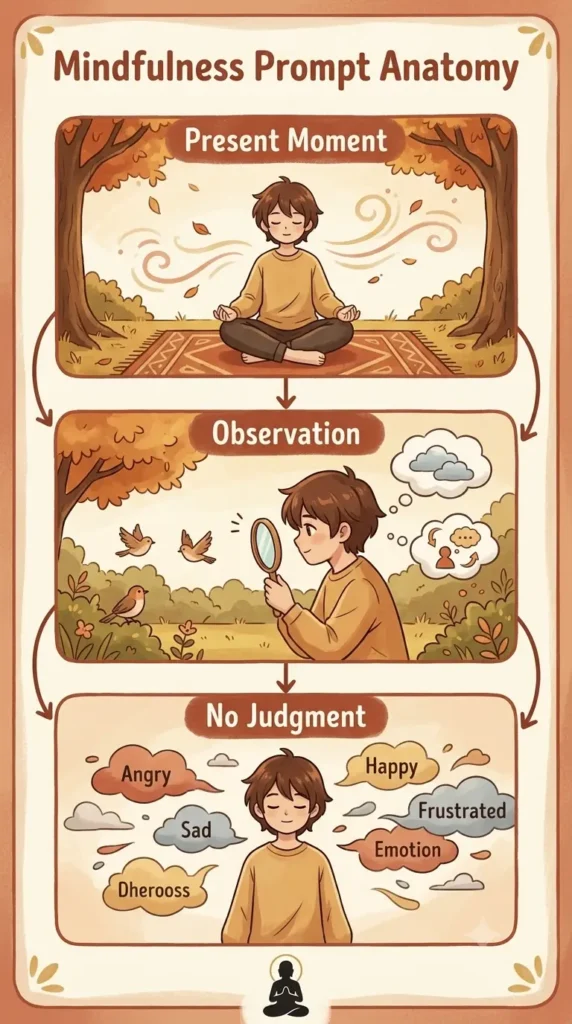
A mindful prompt moves you from analysis toward observation. Analysis asks “why.” Observation asks “what, right now.” Small shift. Big difference in how it feels to write.
| Generic journal prompt | Mindfulness journal prompt |
|---|---|
| “Describe your day.” | “What moment from today is still sitting in my body?” |
| “Why are you stressed?” | “Where do I notice stress physically right now?” |
| “What are your goals?” | “What feels important to me in this moment?” |
Look at the second column again. Every one of those keeps you anchored in the present. None of them pull you into a long mental replay of what already happened. That’s the anatomy of a mindfulness prompt, and it’s worth keeping in mind as we move into specific categories next.
Readers working through anxiety or overwhelm in particular tend to notice this shift fastest, something covered in more depth in gratitude journaling for anxiety.
What Makes Mindfulness Journaling Different From Regular Journaling?
Mindfulness journaling is not about recording your day. It’s about noticing it.
Regular journaling explores memories, events, or plans. Mindfulness journaling watches what’s happening in your mind and body right now, without rushing to fix it or judge it. Both matter. They just train completely different muscles.
The real difference comes down to where your attention lands.
A regular journal works like a diary. You write about what happened, what someone said, what’s on tomorrow’s list. It helps you process the day and clear your head. That’s useful. It’s just not the same skill.
Mindfulness journaling skips the story. It stays with the experience as it’s happening. Instead of writing “I had a terrible day because my meeting went badly,” a mindfulness prompt asks something sharper: what emotion showed up in that moment? Where did the tension sit in your body? What thought passed through right before you reacted?
Sound too small to matter? It isn’t. That gap is where every reaction actually gets decided.
| Mindfulness Journaling | Reflective/Diary Journaling |
|---|---|
| Focuses on the present moment | Often focuses on past events or future plans |
| Observes thoughts and feelings without immediate judgment | Analyses experiences, decisions, and outcomes |
| Uses prompts about sensations, emotions, awareness, and reactions | Uses prompts about memories, goals, stories, and daily events |
| Helps build awareness of automatic patterns | Helps process experiences and document life events |
| Example: “What am I noticing in my body right now?” | Example: “What happened today and how did I feel about it?” |
| Encourages curiosity over self-criticism | Often encourages problem-solving and reflection |
A mindfulness journal doesn’t owe you a big insight every time you sit down with it. Some days the whole entry is just this: your mind keeps drifting, your shoulders are tight, you’re carrying a thought you never actually looked at. That noticing is the work. Nothing more complicated than that.
If gratitude is more your entry point into this kind of awareness, gratitude journaling for anxiety and mindfulness and gratitude both build on the same present-moment muscle from a different angle.
Do Mindfulness Journal Prompts Actually Work?
Short answer: yes, but not the way most people expect. Mindfulness journal prompts work because they train your attention. You start noticing thoughts, feelings, and moments without jumping straight to judging them. Research on mindfulness backs this up. Regular practice with present-moment awareness can build self-observation, sharpen emotional awareness, and strengthen reflective thinking.
That’s not magic. It’s repetition.
How Mindfulness Changes the Way You Pay Attention
Most people think mindfulness means emptying your mind. It doesn’t work like that. Mindfulness means paying attention to right now, with openness, without judging what shows up. Jon Kabat-Zinn, founder of the Center for Mindfulness at UMass Medical School, describes it as awareness that comes from paying attention on purpose, in the present, without judgment.
A mindfulness journal prompt points that attention somewhere specific. So do most mindfulness prompts in general, whatever form they take. Instead of writing whatever pops into your head, you pause. You look at one experience closely. What am I feeling right now? What thought keeps circling back? What do I actually need today?
Small shift. Big difference.
This kind of prompt catches patterns that usually slip by unnoticed in the noise of a regular day.
What Research Says About Mindfulness and Reflection
Here’s an honest take: mindfulness isn’t just a trend dressed up in soft lighting and journaling apps. Studies on mindfulness-based practices show that training attention and awareness changes how people relate to their own thoughts and feelings. A meta-analysis in Clinical Psychology Review found that mindfulness-based interventions link to real improvements in psychological outcomes, including less emotional distress and better overall well-being.
Writing adds another layer to this. It slows your thinking down. A journal gives you a place to watch an experience play out, instead of reacting to it in the moment.
Why does slowing down matter so much? Because reaction skips reflection entirely.
Research indexed on PubMed has also looked at mindfulness-based writing practices and how they connect to attention, self-awareness, and emotional processing.
Mindfulness journal prompts won’t fix every problem you have. Nobody said they would. What they offer is a structured way to practice noticing, and that skill gets more valuable the more you use it. Whether you’re working from a printed sheet, an app, or a mindfulness journal prompts pdf saved on your phone, the noticing is what counts. Not the format.
How to Start a Mindfulness Journaling Practice
Starting a mindfulness journaling practice doesn’t need an expensive notebook. It doesn’t need a flawless routine either. Five honest minutes with the right mindfulness journal prompts beats an hour of forced reflection almost every time.
The goal is small. Slow down. Notice what’s actually happening. Respond with a little more awareness than you had ten seconds ago.
Notebook vs. digital
Paper and screens don’t work the same way. Not even close.
A physical notebook can make the practice feel more real. Writing by hand slows your thoughts down. That’s useful when your mind feels crowded, or when a rough day won’t sit still long enough to think straight.
Some days you’re not chasing insight. You just need the slowdown. That’s the whole point.
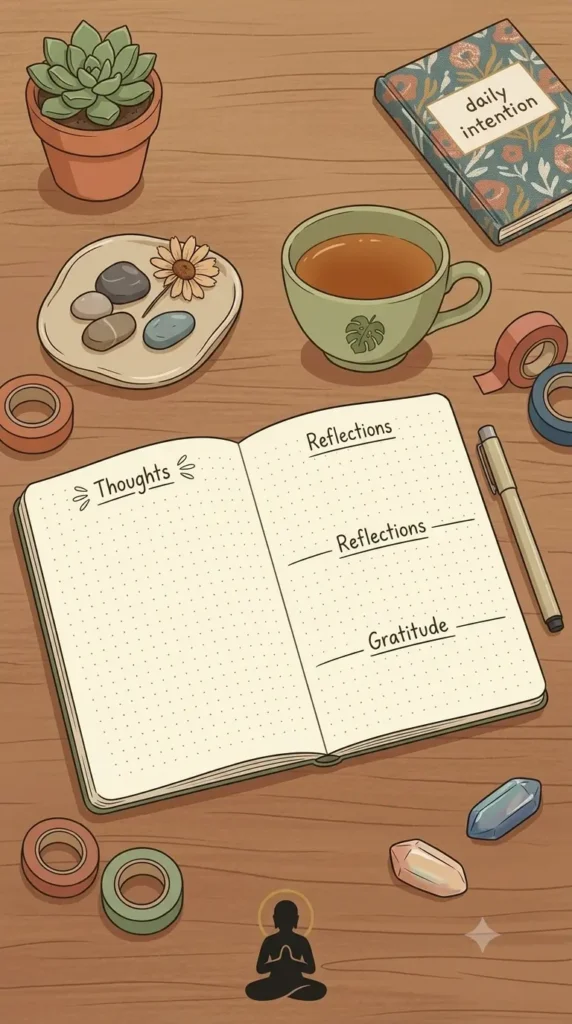
A digital journal might fit better if your whole day already lives on your phone. Apps and notes tools make it easy to grab a quick reflection between classes, meetings, or a late-night scroll session you didn’t plan on. Notes apps also make it painless to save a mindfulness journal prompts pdf you can pull up anywhere, no folder of loose paper required.
The catch? Your journal now competes with notifications. Messages. A dozen small pulls on your attention every time you open the app.
There’s no correct format here. Try both. Notice which one keeps you present, not just recording thoughts on a page. And if your mind tends to spiral before you’ve even opened the notebook, gratitude journaling for anxiety walks through a version built for exactly that kind of overwhelm.
Consistency
Mindfulness journaling isn’t another task for your checklist.
It works best as a small, repeated habit. Five minutes of honest reflection beats an hour of writing once every few weeks. Every single time.
Attach the practice to something you already do. Write after your morning coffee. Or right before bed. Or the second you close your laptop for the day.
Why does the cue matter this much? Because habits get easier when they have a familiar starting point. Not by luck. By structure.
Running out of things to write some nights? A running set of 365 journal prompts for mental health takes the guesswork out of that first sentence, so the habit survives the nights your brain goes blank.
Some days the prompt does the heavy lifting. Other days you won’t need it at all.
Avoiding perfectionism
A mindfulness journal isn’t a performance review.
You don’t need deep insight every time you sit down. Your entries don’t need to sound wise. Or even coherent.
Some days your whole entry might read: “I feel distracted today, and I noticed I kept reaching for my phone.” That noticing? That’s the actual practice.
Sound too simple to count? It is. That’s exactly why it works.
If a blank page feels harder than it should some nights, a few gratitude worksheets can hand you that same structure while you ease into a steady rhythm of mindfulness journal prompts.
The purpose was never perfect pages. It’s noticing your own experience with a little more honesty, and a little more curiosity than yesterday. Mindfulness and gratitude lean on each other more than people realize, and mindfulness and gratitude breaks down exactly how that pairing works in practice.
How to Choose the Right Mindfulness Journal Prompt Today
The deepest prompt isn’t always the right one. Sometimes it’s the wrong one entirely.
A two-minute check-in after your phone buzzes forty times before lunch needs something different than a slow Sunday morning with coffee and nowhere to be. The best mindfulness journal prompts aren’t ranked by depth. They’re matched to the moment.
So before you flip to a random page, ask two questions. How much time do you actually have? And what’s going on in your head right now? Those two answers point you to the right prompt faster than scrolling through three hundred of them ever will.
How Much Time Do You Have?
Be honest about this one. Most people wait for the perfect hour to journal. Quiet room. Clear head. Nothing else pulling at them.
That hour rarely shows up.
So stop waiting for it. Match the prompt to the time you actually have, not the time you wish you had.
2 minutes: grab a quick awareness prompt. Use it between tasks, right after a scroll session, or before you move on to the next thing on your list.
→ Try: Tiny Two-Minute Prompts
10 minutes: go reflective. This is enough time to name a feeling, spot a pattern, or just slow your thoughts down a notch.
→ Try: Emotional Awareness, Self-Awareness, or Overthinking
20+ minutes: now you can go deeper. Values, relationships, identity, where your life is actually headed.
→ Try: Identity, Future Self, or Mindful Reflection
Nobody’s grading the entry. You’re not writing for an audience. The goal is smaller than that: one moment where you actually notice what’s happening inside you and around you. That’s the whole practice.
What’s Your Current Headspace?
Your mood matters more than which prompt list you pick from. Before you write a single word, ask yourself one thing: what do I need right now?
Pick whichever fits:
Feeling anxious or overwhelmed?
Come back to the present. That’s it. Not five steps, just one direction.
→ Try: Anxiety or Present Moment Awareness
If anxiety keeps circling back on a loop, pairing your entry with a gratitude-based approach can help pull your attention out of the spiral and onto something steadier.
Caught in a scroll hole again?
Digital overload has a specific flavor of numbness. These prompts pull you back into your own thoughts instead of someone else’s feed.
→ Try: Digital Life
Wide awake at midnight, brain still running?
Slow reflection prompts work better here than anything that asks you to problem-solve.
→ Try: Sleep
Actually feeling good?
Write that down too. Most people only journal when something’s wrong. Catching what’s already working, using something like gratitude worksheets or a quick list of things to be thankful for, is just as valuable.
→ Try: Gratitude
Stuck? Not sure what’s next?
Use prompts that open up choices instead of narrowing them down.
→ Try: Future Self, Identity, or Mindful Reflection
Here’s what most journaling advice gets backwards: it treats the journal like a task to finish. It isn’t. A mindfulness journal should bend around your day, not add another box to check. For a broader look at how mindfulness and gratitude work together across the day, this piece is worth a read too.
The right prompt isn’t the fanciest one. It’s just the one that gets you to notice what was already there.
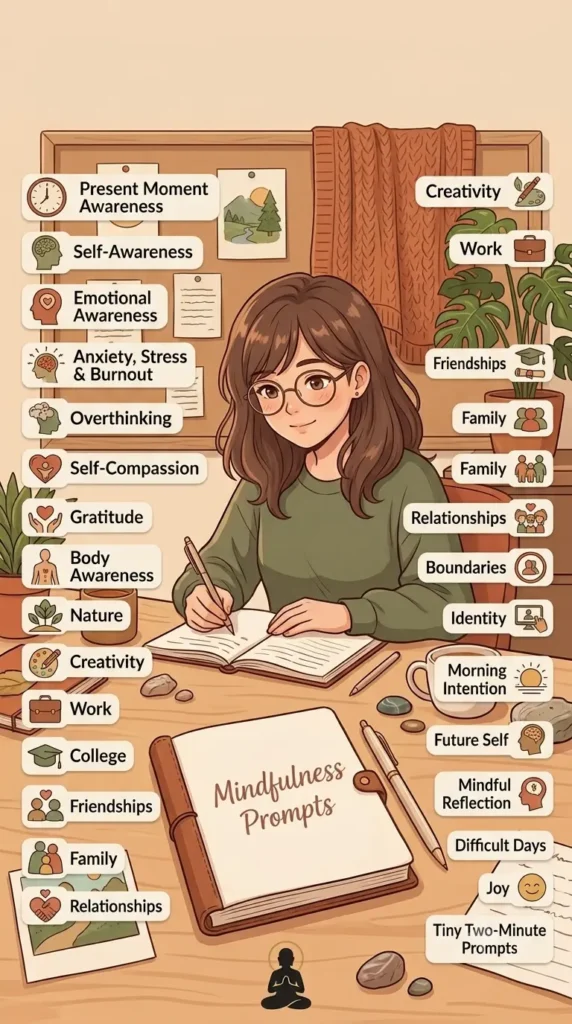
300+ Mindfulness Journal Prompts
Mindfulness journal prompts help you slow down. They pull your attention back to what’s happening inside you, and around you. Not later. Right now.
Use these prompts for emotional clarity, stress relief, and a daily habit that actually sticks.
Present Moment Awareness
Mindfulness starts with noticing. Not fixing. Not analyzing. Just paying attention.
These mindfulness prompts pull your focus back to what’s real right now, your surroundings, your senses, the thought loop running in the background. They help most when your mind is stuck bouncing between unfinished tasks and notifications.
Don’t worry about sounding deep. That’s not the point. Awareness is the point, not a polished journal entry.
- What can I notice around me right now that I usually overlook?
- What sounds can I hear at this exact moment?
- What physical sensations can I feel in my body right now?
- What emotion is present for me today?
- What is one small detail about my surroundings that brings me comfort?
- What does this moment feel like without trying to change it?
- What thoughts keep appearing in my mind today?
- If I paused for one minute, what would I notice?
- What colour, texture, or object around me catches my attention?
- What part of today deserves more appreciation?
- What am I experiencing right now that I will probably forget later?
- How does my breathing feel at this moment?
- What does “being present” mean to me today?
- What is one ordinary moment from today that felt surprisingly meaningful?
- What would change if I gave this moment my full attention?
Self-Awareness
Self-awareness journaling isn’t about landing on a final answer. It’s about spotting patterns.
Maybe certain situations drain you. Maybe one person always leaves you lighter. Maybe a thought keeps circling back because it wants your attention. These prompts help you read your own reactions, habits, and values a little more clearly.
- What has been taking up the most space in my mind lately?
- What pattern have I noticed in my thoughts or behaviours?
- What situations bring out the most authentic version of me?
- What do I pretend not to care about?
- What do I wish people understood about me?
- What personal value matters most to me right now?
- What is something I have changed my mind about recently?
- What do I need more of in my daily life?
- What drains my energy without me noticing?
- What activities make me lose track of time?
- What belief about myself am I questioning?
- What part of myself am I currently learning to accept?
- What decision have I been avoiding?
- What do I know about myself now that I did not know a year ago?
- What version of myself am I growing into?
Emotional Awareness
Mindfulness isn’t about forcing a good mood. It’s about catching an emotion before it steers your choices for you.
These prompts help you name what’s happening inside instead of burying it or letting it pile up quietly.
- What emotion feels strongest today?
- Where do I feel this emotion in my body?
- What might this emotion be trying to tell me?
- What triggered this feeling?
- Have I felt this emotion before in a similar situation?
- What do I usually do when I feel this way?
- What would I say to a friend experiencing this emotion?
- What emotion have I been avoiding lately?
- What feelings are easier for me to express?
- What feelings are harder for me to admit?
- What helped me move through a difficult emotion in the past?
- What does my emotional state need today?
- How can I respond instead of react?
- What feeling do I want to make more room for?
- What emotional habit would I like to understand better?
Anxiety
Anxiety pulls your attention into imagined futures. Conversations that haven’t happened. Problems that may never show up.
Journaling doesn’t erase the anxious thought. But it opens a small gap between the thought and your reaction to it. That gap is where the shift happens.
Pairing this practice with a gratitude journaling for anxiety routine can widen that gap even further, and it’s worth asking whether gratitude and anxiety can exist at the same time before assuming they cancel each other out.
Use these prompts when your mind feels overloaded.
- What am I worrying about right now?
- Is this a current problem or a future possibility?
- What evidence supports this fear?
- What evidence suggests I may be okay?
- What can I control in this situation?
- What is one thing I can do within the next 10 minutes?
- What does my anxious thought want me to notice?
- If my anxiety had a message, what would it say?
- What would I tell someone I care about who had this worry?
- What has helped me feel safe before?
- What small thing feels steady today?
- What expectation is creating pressure for me?
- What would happen if I approached this situation with curiosity instead of fear?
- What does my mind need less of right now?
- What does my mind need more of right now?
Stress & Burnout
Stress isn’t always loud. Sometimes it’s exhaustion. Sometimes it’s checking your phone for no reason, or feeling numb toward things you used to enjoy.
These prompts help you catch low energy early, before it turns into something bigger.
- What is currently creating the most stress in my life?
- What responsibility feels heavier than it should?
- What am I carrying that I do not need to carry alone?
- What signs tell me I need a break?
- When did I last feel genuinely rested?
- What expectation is exhausting me?
- What task can I simplify today?
- What boundary would protect my energy?
- What does rest look like for me beyond sleep?
- What activity helps me feel like myself again?
- What am I saying yes to when I want to say no?
- What is one thing I can remove from my schedule?
- How has stress changed my habits?
- What does a balanced day look like for me?
- What would I do differently if I stopped trying to prove myself?
Overthinking
Overthinking and anxiety overlap, but they’re not the same thing.
Anxiety chases fear and uncertainty. Overthinking replays the same conversation on a loop, or hunts for a perfect answer that was never going to exist. These prompts help you step outside that loop.
- What thought keeps repeating today?
- Why does this thought feel important?
- Am I solving a problem or repeating a problem?
- What decision am I analysing too much?
- What would “good enough” look like here?
- What assumption am I making?
- What else could be true?
- What would I choose if I trusted myself more?
- What conversation am I replaying in my head?
- What do I actually know versus what am I guessing?
- What thought deserves less attention today?
- What helps me return to the present moment?
- What would I tell myself if I were my own friend?
- What uncertainty am I trying to eliminate?
- What can I release without having every answer?
Self-Compassion
Self-compassion isn’t skipping your mistakes or dodging growth. It’s treating yourself with the same patience you’d hand a friend without a second thought.
These prompts help on the days your inner critic won’t shut up.
- What would I say to myself if I spoke with kindness?
- What mistake can I forgive myself for?
- What am I learning from this experience?
- What part of myself needs more understanding?
- When have I handled something difficult well?
- What progress have I made that I rarely acknowledge?
- What pressure can I soften today?
- How can I support myself instead of criticise myself?
- What does kindness toward myself look like today?
- What would my younger self want to hear?
- What achievement am I minimising?
- What expectation can I release?
- What makes me worthy beyond productivity?
- How can I celebrate small progress?
- What do I need to remember when things feel difficult?
Gratitude
Gratitude is one piece of mindfulness. It’s not the whole practice.
Want to go deeper? Skip the recycled “family, friends, health” answers. A proper gratitude list or a structured gratitude worksheet forces more specific answers than a quick daily prompt ever will. If you want the step-by-step version of the habit itself, how to practice gratitude breaks it down. And for the bigger picture of where the two practices meet, see how mindfulness and gratitude connect.
- What is one ordinary thing that made today better?
- Who supported me recently, even in a small way?
- What part of my routine makes life easier?
- What opportunity am I grateful to have?
- What place makes me feel calm?
- What personal strength am I grateful for?
- What lesson from a difficult experience am I thankful for?
- What small moment would I like to remember?
- What ability or skill do I appreciate having?
- What is something I often overlook but value?
Body Awareness
Your body notices things before your mind catches up. Always has.
Body awareness journaling reconnects you with the physical signals you tend to override, tension, tiredness, hunger, that low hum of relaxation you rarely name.
- Where do I feel tension in my body today?
- What does my body need right now?
- How has my energy changed throughout the day?
- What physical sensation am I noticing?
- When do I feel most comfortable in my body?
- What habit helps me feel physically better?
- What does my body do when I feel stressed?
- How can I care for myself today?
- What movement feels enjoyable right now?
- What is my body asking me to slow down and notice?
Nature
Nature-based mindfulness shifts your attention away from constant input. Screens, notifications, noise. Just the physical world instead.
- What natural detail caught my attention today?
- What season of life am I currently experiencing?
- What can nature teach me about patience?
- What outdoor moment recently made me feel peaceful?
- How does spending time outside affect my mood?
- What sounds from nature do I enjoy?
- What place in nature makes me feel grounded?
- What changes in nature remind me that growth takes time?
Creativity
Creativity isn’t just about making something impressive. Sometimes it’s just a way to observe and experiment. To say what words can’t quite explain.
- What idea keeps returning to my mind?
- What would I create if nobody judged it?
- What inspires me lately?
- What creative habit would I like to build?
- What emotion could I express through art, writing, or music?
- What project have I been postponing?
- What makes me feel curious?
- What would I try if I knew I could not fail?
Related reading: if you want a broader set that goes past mindfulness alone, the 365 journal prompts for mental health collection covers a full year of angles worth exploring.
Work
Most people spend more waking hours at work than anywhere else. Career, freelancing, studying while working, or still figuring out the next move, the effort adds up either way.
Mindfulness journaling at work isn’t about squeezing out more output. It’s about noticing your own relationship with effort, ambition, pressure, and purpose. That’s the whole point.
- What part of my work feels meaningful right now?
- What task has been taking more energy than expected?
- What type of work makes me feel focused and engaged?
- What expectations at work are creating unnecessary pressure?
- What skill am I currently developing?
- What accomplishment have I not given myself credit for?
- What does a healthy workday look like for me?
- What boundary would improve my relationship with work?
- When do I feel most confident in my abilities?
- What motivates me beyond external rewards?
- What work habit is helping me grow?
- What work habit is draining my attention?
- What does success mean to me right now?
- What would I change about my current routine if I had more flexibility?
- What is one small action that would make tomorrow easier?
College
Freedom and uncertainty tend to show up together in college. You’re asked to plan a future while still working out who you even are.
These prompts turn that mix into something you can actually sit with. Not fix. Just notice. They cover learning, pressure, friendships, independence, and growth, one question at a time.
- What is something new I learned about myself this semester?
- What subject or topic genuinely interests me?
- What academic pressure am I carrying?
- What helps me feel prepared and confident?
- What lesson from college goes beyond the classroom?
- What kind of student do I want to become?
- What distraction affects my focus the most?
- What study habit actually works for me?
- What opportunity do I want to explore?
- What fear about my future keeps appearing?
- What memory from college do I want to create?
- How have my goals changed since starting college?
- What person or experience has influenced me here?
- What does balance look like during busy periods?
- What advice would I give myself on the first day of college?
Friendships
Mindfulness changes how relationships feel because it asks you to actually pay attention, instead of just reacting on autopilot.
Friendship journaling works the same way. It surfaces connection, communication patterns, and the kind of people you actually want around you. Some of these questions will be easy. A few won’t.
- Which friendship currently brings me the most joy?
- What qualities do I value most in friends?
- When do I feel most understood by others?
- How do I show appreciation for my friends?
- What conversation have I been avoiding?
- What friendship lesson have I learned recently?
- What type of friend do I want to be?
- What makes a friendship feel safe?
- When have I felt supported by someone?
- What friendship pattern would I like to change?
- How do I respond when I feel disconnected?
- What small gesture could strengthen a friendship?
- What boundaries help my relationships stay healthy?
- What memories with friends make me smile?
- What does meaningful connection look like to me?
Family
Family isn’t neutral ground. It carries years of history, old expectations, and emotions you didn’t choose. Mindfulness just gives you a way to watch those patterns without getting pulled straight back into them.
- What is one thing I appreciate about my family?
- What family tradition means something to me?
- What have I learned from my family?
- What family relationship would I like to understand better?
- What communication pattern do I notice in my family?
- What memory makes me feel connected to my family?
- What family expectation do I want to examine?
- What do I wish I could express more openly?
- How has my relationship with my family changed over time?
- What quality from my family do I want to carry forward?
- What difficult family experience taught me something valuable?
- How can I create more patience in family conversations?
- What appreciation have I not expressed?
- What role do I naturally take in my family?
- What does family mean to me now?
If gratitude feels like the missing piece here, this guide on how to practice gratitude breaks it into steps small enough to actually use.
Relationships
How you communicate. How you handle being vulnerable. How you balance closeness with still having your own life. Romantic relationships tend to surface all of it at once.
For a more detailed collection focused on partnerships, couples, and communication, check out relationship journal prompts
This future guide can expand into deeper reflection around trust, emotional intimacy, conflict, shared goals, and journaling prompts for couples.
- What do I value most in a healthy relationship?
- How do I show care to someone I love?
- What helps me feel emotionally safe?
- What relationship pattern am I becoming aware of?
- How do I communicate when I feel hurt?
- What kind of connection do I want to create?
- What does being a supportive partner mean to me?
- What boundary helps me maintain a healthy relationship?
- What have relationships taught me about myself?
- What does love look like in everyday actions?
Boundaries
Boundaries don’t push people away. Not even close. They protect your time, your energy, and your wellbeing, and that’s it.
Mindfulness journaling tends to expose the gap fast. Where you keep saying yes. Where you’re quietly exhausted underneath it. If anxiety around saying no shows up here, it’s worth sitting with rather than rushing past.
- Where do I need a stronger boundary?
- What situation leaves me feeling drained?
- When do I ignore my own needs?
- What do I agree to out of guilt?
- What does a healthy boundary look like for me?
- What boundary feels uncomfortable but necessary?
- How do I communicate my needs?
- What relationship improves when I respect my limits?
- What personal space do I need more of?
- What am I afraid will happen if I say no?
- What commitment deserves less of my attention?
- How can I protect my energy today?
Identity
Most people treat identity like something you find once and finish. It isn’t. New places, new people, new challenges keep reshaping it, whether you notice or not.
These prompts dig at who you are underneath the labels, the achievements, and everyone else’s expectations of you.
- Who am I when nobody is watching?
- What parts of myself feel most authentic?
- What identity labels feel meaningful to me?
- What version of myself am I leaving behind?
- What qualities do I want to strengthen?
- What have I outgrown?
- What influences have shaped who I am?
- What do I want people to remember about me?
- What belief about myself is changing?
- What makes me different from others?
- What values guide my decisions?
- What part of myself deserves more attention?
- What does being myself feel like?
- What expectations do I want to question?
- What am I becoming more comfortable accepting?
Digital Life
For Gen Z, mindfulness isn’t just sitting quietly with a notebook. It’s understanding your relationship with a phone that follows you into every room.
A single day can bring hundreds of tiny interruptions. Notifications. Messages. Endless feeds. Algorithmic recommendations feeding you comparison before you’ve had coffee. A mindful digital life starts by simply noticing what your attention is doing.

- How does social media affect my mood today?
- What apps take more of my attention than I want to give?
- What do I usually feel before opening my phone?
- What emotion am I trying to avoid when I scroll?
- Which digital habits support my life?
- Which digital habits leave me feeling drained?
- What would I do with an extra hour away from screens?
- How does comparing myself online affect my confidence?
- What accounts or content make me feel inspired?
- What online spaces no longer feel healthy for me?
- How do I want technology to fit into my life?
- What notification could I turn off today?
- What does a healthier relationship with my phone look like?
- When do I feel most present without technology?
- What boundaries would improve my digital wellbeing?
- How does AI or new technology affect the way I think, learn, or create?
- What parts of my online identity feel genuine?
- What parts of my online life feel performative?
Sleep
Whatever your mind chewed on all day, it usually shows back up right before you sleep.
Evening journaling isn’t a big production. It’s just a way to shift out of constant motion and into something quieter. Enough to actually rest.
For a deeper collection focused specifically on bedtime reflection, check out night journal prompts.
This article can cover evening journaling prompts for reviewing the day, releasing worries, preparing for sleep, and creating a calming nighttime routine.
- What is still on my mind before sleep?
- What can I let go of from today?
- What moment from today do I want to remember?
- What does my mind need before resting?
- What thought keeps returning tonight?
- What helped me feel calm today?
- What am I proud of from today?
- What would make tomorrow feel easier?
- What emotion am I going to sleep with?
- What intention do I want to carry into tomorrow?
Morning Intention
The first few minutes of your day quietly decide a lot of what follows.
This isn’t about building the perfect morning routine. It’s a quick check-in, before the noise outside grabs your attention first.
For a complete collection of morning writing prompts, check out morning journal prompts.
The guide can expand into intention-setting, goal reflection, gratitude practices, and focused morning routines.
- How do I want to feel today?
- What matters most today?
- What is one thing I can do with intention?
- What energy do I want to bring into my day?
- What thought do I want to remember today?
- What is one small priority for today?
- What would make today meaningful?
- What support do I need today?
- What opportunity am I open to noticing?
- What mindset do I want to practice?
Future Self
Future-self journaling isn’t about pressure. It links what you do right now to the person you’re slowly becoming.
Nothing dramatic. Just small threads between today’s choices and tomorrow’s version of you.
- What kind of person do I want to become?
- What habit would my future self thank me for building?
- What choice today supports my future goals?
- What am I working toward?
- What does my ideal ordinary day look like?
- What skill do I want to develop?
- What fear do I want to move beyond?
- What advice would my future self give me?
- What version of success am I creating?
- What small action today matters long term?
Mindful Reflection
Reflection turns whatever just happened into something you can actually use.
It’s not a recap of the day. Mindful reflection asks why something mattered, what it taught you, and where you go from there. A lot like the practice behind mindfulness and gratitude, just aimed at the bigger picture instead of a single moment.
- What did today teach me?
- What surprised me recently?
- What experience changed my perspective?
- What pattern am I noticing?
- What decision am I glad I made?
- What would I approach differently next time?
- What moment deserves more attention?
- What lesson keeps appearing in my life?
- What personal growth am I noticing?
- What question am I currently exploring?
Difficult Days
Some days, journaling feels impossible. The mind’s already run out of fuel.
On those days, forget a beautifully written entry. A few honest sentences are enough. If the exhaustion feels bigger than a bad day, this list of 365 journal prompts for mental health has more room to sit with it.
- What feels hardest right now?
- What do I need to hear today?
- What is one thing I can handle?
- What support would help me?
- What emotion needs space right now?
- What can wait until tomorrow?
- What small comfort can I give myself?
- What has helped me through difficult moments before?
- What would kindness toward myself look like today?
- What reminder do I need right now?
Joy
Mindfulness isn’t only for solving problems. It also trains you to notice what’s already good, before it slips past unnoticed.
Joy journaling points your attention at the small stuff. The moments that are easy to miss and easy to forget by dinner. Pairing this practice with a running list of things to be thankful for tends to make the good moments stick longer.
- What made me smile today?
- What simple moment brought me happiness?
- What activity makes me feel alive?
- Who brings positive energy into my life?
- What place makes me feel peaceful?
- What experience do I want more of?
- What ordinary thing brings me comfort?
- What am I looking forward to?
- What memory always makes me happy?
- What does joy feel like in my body?
Tiny Two-Minute Prompts
Not every session needs twenty minutes, a nice notebook, and total silence. Sometimes the only realistic practice is the one you’ll actually repeat.
These short prompts work for busy mornings, study breaks, waiting rooms, or those five minutes before you have to move on to the next thing.
- Right now, I feel…
- Today I need…
- One thing I noticed today was…
- My energy level is…
- One thought I want to release is…
- One thing I appreciate is…
- My current priority is…
- Something I want to remember is…
- I can be kinder to myself by…
- This moment matters because…
- Something I learned today is…
- One small step I can take is…
- My mind feels…
- My body feels…
- Tomorrow I want to…
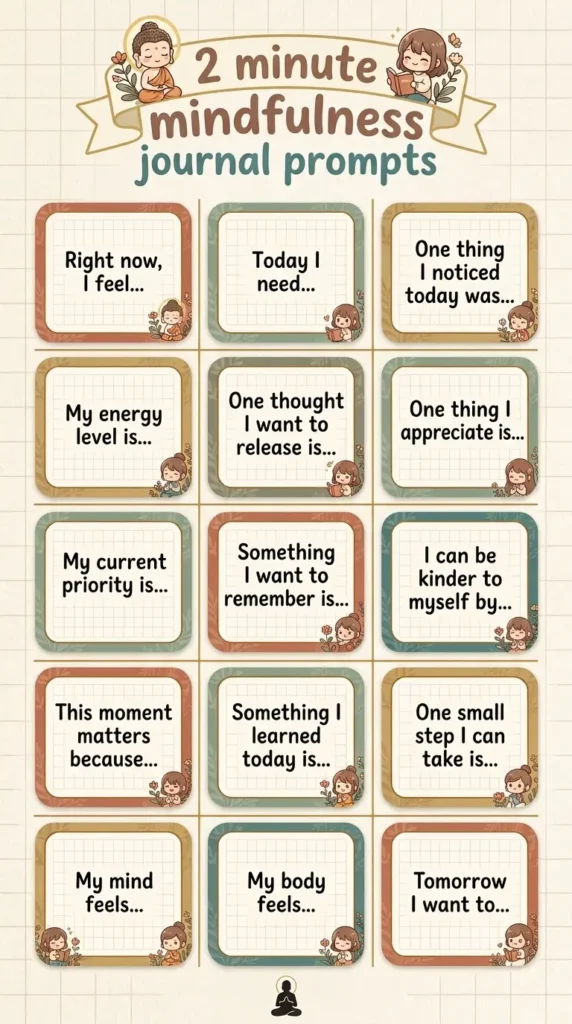
These short prompts work because they remove the biggest barrier to journaling in the first place. Waiting for enough time. Waiting for motivation. Waiting for the perfect words. A two-minute check-in, done consistently, builds more awareness than an hour-long session you only do once a month. If tracking simple wins alongside this feels useful, the gratitude worksheets pair well with these shorter check-ins.
When You Don’t Know What to Write
The blank page isn’t really the problem. Feeling stuck before you even pick up the pen is the actual thing that stops most people. A mindfulness journal prompt doesn’t need to be deep. Just honest. Nobody writes polished insight on the first line. When your mind feels scattered, don’t fight it. Use your mood, your available time, or whatever’s happening around you to choose a starting point instead.
Here’s a simple decision guide.
If you only have 2 minutes
Grab a prompt that pulls you into the present moment. Nothing complicated. Just noticing.
Try:
- What is one thing I can see, hear, or feel right now?
- What emotion is showing up in my body today?
- What is one small moment I don’t want to rush past?
This works well when anxiety is loud and your thoughts won’t slow down. Why does two minutes feel like enough? Because you’re not solving anything yet. You’re just landing somewhere. Anyone who’s tried gratitude journaling for anxiety already knows the goal isn’t a breakthrough. It’s a foothold.
If you have 10 minutes
Choose a prompt that pulls your thoughts into the open, not just a glance at them.
Try:
- What has been taking up most of my mental space lately?
- What thought keeps returning, and what might it be trying to tell me?
- Where am I asking too much of myself?
Ten minutes is enough to spot a pattern. Not enough to spiral over it. That’s the sweet spot.
If you have 20+ minutes
Pick a prompt that digs deeper. This is where the real self-awareness work happens.
Try:
- What version of myself am I growing into?
- What belief about myself am I ready to question?
- What patterns do I keep repeating, and what triggers them?
Sit with these longer than feels comfortable. Some answers don’t show up until page two.
Maybe your mind still feels completely empty, even after picking a time frame. That’s normal too. A random prompt takes the pressure off choosing the “right” question. It works like a gentle nudge. It points you somewhere without deciding what you’ll say once you get there.
It’s 9pm, the notebook’s open, and nothing comes to mind. That’s the exact moment a random prompt earns its place.
A random journal prompts generator helps when you want variety, spontaneity, or just a fast way in. Instead of hunting for the perfect question, you get handed one and see what surfaces. This works especially well for building a habit that actually sticks, because starting is usually the hard part. Not writing.
If you want more structure than this section gives you, the 365 journal prompts for mental health guide breaks prompts down day by day, so you’re never stuck guessing what comes next. And if mindfulness keeps circling back to gratitude for you, that’s not an accident. Mindfulness and gratitude are more tangled together than most people realize.
Mindfulness Journal Prompts vs. Affirmation Prompts
Mindfulness journal prompts and affirmation prompts are not the same tool. One asks you to notice. The other asks you to build. Mindfulness prompts help you observe your thoughts, emotions, and moment-to-moment experience without judging them. Affirmation prompts work differently. They shape your self-talk by reinforcing beliefs you want to strengthen. Both belong in a journaling practice. They just don’t do the same job.
| Categories | Mindfulness Journal Prompts | Affirmation Prompts |
|---|---|---|
| Main purpose | Help you notice what is happening internally right now | Help you intentionally create supportive thoughts and beliefs |
| Focus | Awareness, observation, acceptance | Confidence, encouragement, mindset shifts |
| Typical questions | “What emotion am I noticing right now?” or “What thoughts keep returning today?” | “What positive belief do I want to strengthen?” or “What do I want to remind myself of?” |
| Best used for | Self-awareness, emotional processing, stress, and staying present | Building self-belief, motivation, and a kinder inner voice |
| Writing style | Exploratory and open-ended | More intentional and statement-based |
A mindfulness prompt doesn’t ask you to force a silver lining. It gives you room to sit with whatever’s actually there. Even the ugly stuff. An affirmation prompt takes a different route. It has you practise a belief on purpose, like confidence, self-respect, or bouncing back from a rough week.
Neither one wins. The right pick depends on what your head needs that day. Mind feels crowded and loud? Reach for mindfulness prompts. They slow things down. Got a hard conversation, an exam, or a goal staring you down? Affirmation prompts tend to help more in that moment. If stress or anxiety is the real issue underneath the noise, gratitude journaling for anxiety is worth pairing with either approach.
Affirmation journal prompts. This dedicated guide will dig into affirmation prompts built for confidence, self-worth, motivation, and a more supportive inner voice. Bookmark it for when you need the other half of this practice.
Can Mindfulness Journaling Be Funny?
Yes. Mindfulness journaling can absolutely be funny.
Being present with your thoughts doesn’t require serious reflection every time. It doesn’t need perfect pages either. Sometimes noticing the ridiculous little moments in your day is exactly what pulls you back into the present.
Think about it. Your brain staging a fake argument in the shower is funny. Your dramatic reaction to a lost sock is funny too. So are the strange habits you only do when nobody’s watching. Write those down and you’re still building self-awareness.
Humor creates distance from stressful thoughts. That distance is the whole point. It lets you observe yourself with more kindness instead of judgment.
If traditional journaling feels too heavy, playful prompts fix that. A little curiosity, a bit of laughter, and patterns start showing up that you’d miss otherwise. Serious journaling can bury this stuff. Funny journaling drags it back into view.
This ties into what we cover in mindfulness and gratitude, where noticing small moments, funny or not, builds the same present-moment awareness.
Here is a full list of funny journal prompts. This is a dedicated post packed with playful writing ideas. Expect prompts about everyday moments, personal quirks, awkward situations, and the lighter side of self-awareness. These funny journal prompts turn mindfulness from a task into a habit that actually sticks.
Free Mindfulness Journal Prompts PDF
Want your mindfulness journal prompts ready without opening another app? A printable PDF makes that possible. Keep it beside your journal, your desk, or your nightstand. No scrolling. No searching for inspiration at 11pm.
Paper still works better for a lot of people. Typing feels rushed. Handwriting slows you down, and that’s the point of reflection. A PDF format removes the small friction that kills journaling habits before they start. Print one page. Highlight the prompt that hits. Build your own rotation from what stays with you.
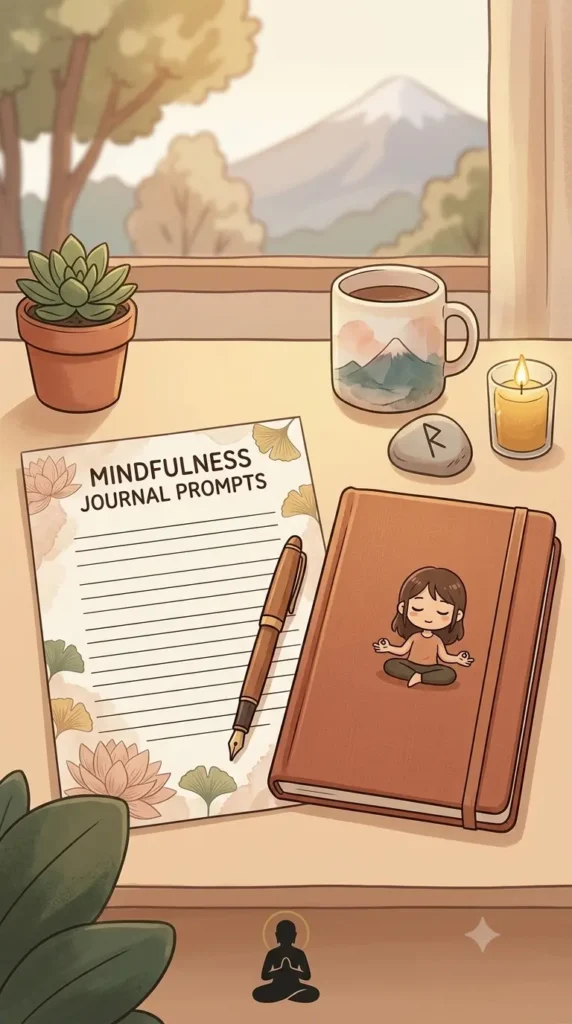
Like structured reflection tools? Our gratitude worksheets cover printable exercises built the same way, and they pair well with this prompt list. If anxiety is part of what brought you here, gratitude journaling for anxiety breaks down how the two connect.
Common Mistakes Beginners Make
Starting mindfulness journal prompts sounds simple. Most beginners still make it harder than it needs to be.
Here’s the pattern. They treat journaling like a performance. Not a moment of honest attention. You don’t need perfect thoughts. Long entries aren’t required either. Neither is a deep insight every single time.
Trying to Write “Something Meaningful” Every Time
One mistake shows up again and again. Beginners believe every entry needs a life-changing realization behind it. That pressure builds fast. You end up staring at a blank page longer than you actually write.
Sound familiar? It should. Almost everyone hits this wall early on.
Mindfulness journaling isn’t about impressing yourself. It’s about noticing. A line like “I feel tension in my shoulders after checking my phone” counts as a real entry. It brings you back to what’s happening right now. That’s the whole point.
Using Prompts as a Checklist Instead of a Reflection Tool
Prompts aren’t homework. You don’t owe yourself ten of them every morning. You don’t have to force categories that don’t match how you’re feeling that day.
Pick what fits your actual state. A rough day might call for an emotional-awareness prompt. A quiet evening suits something closer to gratitude, the kind covered in gratitude journaling for anxiety. Match the prompt to the moment. Not the other way around.
Judging Your Thoughts While Writing
Here’s an honest take: most beginners edit themselves mid-sentence. They dodge certain feelings because those feelings seem negative. Or dramatic. Or “not mindful enough.”
That’s not the job. A mindfulness journal exists to notice thoughts, not fight them. Not analyze them into submission either. Your page is a place to watch your own experience honestly, before you decide what to do with any of it. If you want a deeper structure for that kind of observation, the prompts in 365 journal prompts for mental health work well for this exact habit.
Expecting Immediate Results
Mindfulness journaling is a practice. Not a quick fix. Some entries hit you with insight. Others just log what happened that day. Both count. Awareness builds through repetition, not through one perfect page.
Consistency beats the flawless entry every time. Even a few honest minutes, done often, builds something how to practice gratitude also touches on. Show up. That’s most of the job.
5-Minute Daily Mindfulness Journaling Routine
You don’t need an hour for this. Not even close. Five minutes is enough to pause, notice your thoughts, and land back in the present moment. That’s the whole idea behind this style of mindfulness journal prompts. Not perfect prose. Just attention.
Minute 1: Arrive Before You Write
Most people open a journal and start writing immediately. That’s the mistake.
Put the phone down first. Feel your feet on the floor. Notice your breathing, your posture, the sounds in the room. This isn’t decoration. It’s a small mental doorway between reacting to everything around you and actually watching your own experience.
Try one of these to start:
- What do I notice about this moment?
- What sensations can I feel in my body right now?
- What is my mind naturally drawn to?
You’re not trying to empty your head. That’s not the goal. Mindfulness prompts work by noticing what’s already there, without rushing to judge it.
Minute 2: Name What Is Happening Inside
Minute two is about awareness. Nothing more.
Most people skip straight to fixing the problem. Naming the feeling first creates distance from it. That distance matters more than people think.
Instead of writing “I am overwhelmed,” try something more specific: “I’m noticing overwhelm because three tasks are still sitting unfinished in my head.” Small shift. Big difference. You go from being the emotion to watching it.
A few prompts that help here:
- What emotion feels strongest right now?
- What thought keeps circling back today?
- What am I carrying that I haven’t said out loud?
Minute 3: Reflect Without Fixing
This is where journaling stops being a diary and starts being a practice.
You don’t need to solve anything here. Not yet. Sometimes the most useful thing you can do is just notice the pattern and leave it alone.
Ask yourself:
- What did my mind spend the most energy on today?
- Did I react on autopilot to anything?
- Where did I feel calm, curious, or just present?
Think of it like checking the weather inside your own head. You’re not chasing the storm away. You’re just noticing if it’s clear, cloudy, or somewhere in between. If anxious thoughts keep showing up in this minute, pairing this practice with gratitude journaling for anxiety can soften the loop.
Minute 4: Choose One Small Intention
Mindfulness isn’t only about watching the present. It also shapes how you walk into what’s next.
Pick one intention. Just one. Not a list.
A few examples:
- “I want to listen fully in my next conversation.”
- “I want to pause before opening social media again.”
- “I want to be patient while I’m still learning this.”
Small intentions stick better than big ones. Why? Because they’re specific enough to remember once the day gets loud.
Minute 5: Close With Gratitude or Awareness
End on something positive. Doesn’t need to be dramatic. Small counts.
You might write:
- Something that made today easier was…
- A moment I want to remember is…
- Something I appreciate about myself today is…
- One thing I usually overlook, but noticed today, is…
Still stuck on what to write? A broader list of things to be thankful for can spark ideas beyond the obvious ones. And if gratitude and presence feel like two separate practices right now, mindfulness and gratitude walks through how closely the two are actually linked.
Five minutes works because it lowers the barrier to starting. You’re not building the perfect journaling habit. You’re just building a small daily pause. One where you stop, notice, and come back to yourself.
Build Your Own Mindfulness Journal
A mindfulness journal only works if it feels like yours. Not another box to check.
Build a system that fits your routines, your energy, your goals. Mix flexible templates with rotating mindfulness prompts and themed collections you can return to when your head gets loud.
Create a Simple Mindfulness Journal Template
Your journal doesn’t need fancy layouts. Or color-coded tabs.
Simple structures get used. Complicated ones get abandoned by day five. Start with four pieces:
- Date and time: Notice when you’re writing and what your mind feels like right then.
- Present moment check-in: One sentence. What do you notice in your thoughts, your body, the room around you?
- Mindfulness prompt: One question that opens awareness. It shouldn’t force an answer.
- Reflection: Whatever feels important after you’ve written.
Use a notebook. Use a notes app. Or print a mindfulness journal prompts pdf and keep it by your bed. The best template is the one you’ll actually open tomorrow.
Want a gentler entry point first? A quick gratitude journaling for anxiety practice pairs well with this format, especially on harder days.
Rotate Your Prompts to Avoid Autopilot
Same question every day, same flat answer every day. That’s the trap.
Journaling turns mechanical fast when nothing changes. So rotate categories: awareness, emotions, gratitude, self-reflection, creativity, and future-focused prompts.
One day, try this:
“What emotion is asking for my attention today?”
Another day, try this instead:
“What small detail did I notice that I usually ignore?”
Sound too simple? It is. That’s exactly why it keeps working. A rotating system stops the practice from going stale, and it shows you different corners of your own life week to week. If gratitude is one of your rotating categories, mindfulness and gratitude breaks down why that pairing works so well.
Build Personal Prompt Collections
Over time, save the prompts that actually shifted something. Not every prompt does.
Sort them by what you need, not by what looked good on Pinterest:
- prompts for anxious days
- prompts for morning reflection
- prompts for difficult decisions
- prompts for reconnecting with yourself
- prompts for creative thinking
This is where the real work happens. Your journal stops being a place where you answer random questions. It becomes a reference point. A record of your own patterns.
That’s the whole shift.
For a bigger starting library to pull from, 365 journal prompts for mental health gives you a full year’s worth to sort into your own collections. Pull what fits. Skip what doesn’t. That’s how a personal system gets built.
Explore More Journaling Resources
Mindfulness journaling is a great starting point. It’s not the whole picture, though. Some days call for staying present. Other days ask for something deeper.
Maybe you need to process a hard emotion. Maybe you’re circling a pattern you can’t name yet. Mindfulness journal prompts won’t always get you there. That’s not a flaw. It’s just a different tool for a different job.
For those days, check out our 365 Journal Prompts for Mental Health. It’s a bigger collection. Emotions, self-discovery, healing, growth. All of it lives there.
Here’s the real difference. Mindfulness prompts pull your attention back to right now. The broader prompts go wherever your thoughts take you. Neither one is better. They just work differently.
Why does this matter? Because journaling isn’t one-size-fits-all. Use mindfulness prompts to ground yourself in the moment. Use the broader ones when you want to dig into your patterns, your history, your inner conversations.
If anxiety tends to show up in your reflection, our piece on gratitude journaling for anxiety pairs well with both approaches.
Some weeks you’ll need all of it. Grounding in the morning. Digging deeper at night. That’s not overkill. That’s just having the right tool for the day you’re actually having.
Conclusion
Mindfulness journal prompts aren’t about the perfect entry. They’re not about a flawless daily routine either. That pressure defeats the whole point.
They’re just tools. Tools that help you notice what’s happening inside you, and around you, with a bit more honesty.
Some days you’ll fill pages. Other days, one honest sentence is enough. Both count.
The value isn’t in the word count. It’s in coming back. Showing up again tomorrow, even for two minutes, is what builds the habit.
That’s the real shift.
A noisy world doesn’t quiet down on its own. But a few mindful minutes, repeated often enough, can carve out real moments of awareness inside it. If anxiety tends to hijack your quiet moments, pairing these prompts with gratitude journaling for anxiety can steady the practice even further. And if you want to see how mindfulness and thankfulness work together day to day, mindfulness and gratitude is worth a read too.
Start with a prompt that matches where you are today. Not where you think you should be.
Small steps first. The habit comes later.
Frequently Asked Questions
What are mindfulness journal prompts?
Mindfulness journal prompts are short questions that point your attention at right now. Not your to-do list. Not what happened at 3pm. Just this moment, exactly as it is.
That includes your emotions, your thoughts, the tension sitting in your shoulders, whatever’s actually true when you sit down to write. You’re not summarizing your day here. You’re noticing it, without grading yourself on the answer.
How do you start mindfulness journaling?
Grab a notebook. Or open a notes app, whatever’s actually within reach. Set aside five quiet minutes and pick one prompt. That’s the whole setup. Don’t chase a “good” answer. There isn’t one.
The goal is noticing what you feel, think, and sense right now, not analyzing it into the ground. Most people overthink this part. You don’t need to.
What should I write in a mindfulness journal?
Write whatever’s actually there. Your mood. A thought that won’t leave you alone. The way your body feels in the chair. Something in the room, a worry, a flicker of thanks.
Prompts like “What am I noticing right now?” or “What emotion needs attention today?” work because they’re specific enough to answer without overthinking.
If gratitude keeps showing up in your answers, that’s worth following. Pieces like gratitude journaling for anxiety or mindfulness and gratitude go deeper into that overlap. The point here isn’t polished writing. It’s awareness. Nothing more complicated than that.
How often should I use mindfulness journal prompts?
This isn’t about hitting a quota. Use them daily, a few times a week, or only when things feel loud. Whatever fits. Consistency matters more than frequency, and a five-minute habit you actually keep beats an hour-long one you keep avoiding.
If you want a longer runway of prompts to pull from so you’re never starting cold, the 365 journal prompts for mental health guide covers a full year’s worth.
Are mindfulness journal prompts good for beginners?
Yes, and beginners often do better with them than seasoned journalers. A blank page is intimidating. A single clear question isn’t.
It gives your attention somewhere to land, which makes it easier to build self-awareness, spot your own patterns, and actually stick with the habit past week one. Sound too simple to matter? It is. That’s why it works.
It’s Bhaskar!
Well, I am not a psychologist a monk, or a philosopher by training. I’m just an engineering graduate.
‘The Empty Self’ is where I write about that idea, and what it actually means for ordinary life, anxiety, identity, habits, the stories we tell ourselves about who we are. I don’t have a psychology degree, and I’m not offering therapy or clinical advice. What I do have is thought and clarity, and genuine curiosity about why we suffer the way we do and how much of it might loose once we shed this ‘fixed identity’.
Pingback: 10 Simple Coping Skills Worksheets for Kids (Complete Gen Alpha Guide) | The Empty Self
Pingback: 15+ Coping Skills Group Activities for All Age Groups (Kids, Teens & Adults) | The Empty Self
Pingback: 15 Perfect Guided Journals for Mental Health: Ultimate Gen Z Guide | The Empty Self
Pingback: Emotions Worksheet: 20 Useful Worksheets for Gen Z and Gen Alpha | The Empty Self