
Stress hits fast. So does anger. So does the kind of worry that just sits in your chest and won’t move.
Coping skills give you a way through that. Not a fix. A way through.
Quick Overview: Coping skills worksheets make that process concrete. They give you a clear place to name what you’re feeling, test what actually helps, and build a set of go-to strategies you can reach for later. Not theory. Something you can hold onto when things get hard. This collection covers coping skills worksheets for kids, teens, young adults, and adults. Simple activities. The kind you can use at home, in a classroom, or alongside guided support from a therapist or counselor.
One honest note before you dig in. These are educational and self-help tools. They’re not therapy. They’re not a diagnosis. They don’t replace professional mental health care, and they were never meant to.
So what’s actually inside? These worksheets help you spot what you’re feeling, understand how stress shows up in your body, and explore healthy coping strategies for anger, stress, and grounding. You’ll also find tools for emotional regulation, coping ahead, and options sorted by age group, from simple printable coping skills worksheets for younger kids to more detailed coping skills for adults.
Naming the feeling usually comes first. If that part feels shaky, this emotions worksheet is a good place to start before working through the tools below. And if the hard moments tend to show up in your own head more than out loud, these journal prompts for mental health pair well with the coping ahead worksheets further down.
Table of Contents
Disclaimer
This blog is written and edited with the help of AI, then reviewed by me before publishing. As a result, the content is for general reflection only, not therapy or medical advice, and I’m not a licensed mental health professional. If you’re in crisis, please contact 988 if you’re in US or a local crisis service of your country instead of relying on this site.
What Are Coping Skills?
Coping skills worksheets exist for one reason. Stress needs somewhere to go. When it doesn’t, it builds until a small problem feels unmanageable. A coping skill is a thought, action, or activity you reach for in that moment. Something that calms your body, solves the actual problem, or just buys you enough space to choose your next move instead of reacting on autopilot.
That pause matters more than people admit. It’s the whole game.
A Simple Definition of Coping Skills
Strip away the jargon and coping skills are just the thoughts and actions you use to manage stress. Nothing fancier than that. A walk around the block. A call to someone you trust. Ten minutes of journaling, or a few slow breaths before you respond to something hard.
Sometimes it’s solving the problem directly. Sometimes it’s changing how you’re thinking about it. The APA defines coping as using cognitive and behavioral strategies to manage demands that feel stressful or that outpace what you’ve got left to give.
You’ll see coping skills, coping strategies, coping mechanisms, and coping activities used like they’re the same thing. Mostly, they are. There’s one small split worth knowing. A coping strategy usually points to a specific action or thought process you choose on purpose.
A coping mechanism can also describe something automatic, a response that fires before you’ve decided anything. A coping skills worksheet just gives that whole process some structure. A place to name what you’re doing, practice it, and track what actually works.
If naming your emotional state is part of the struggle, an emotions worksheet can help you get specific before you pick a coping skill at all.
Healthy vs. Unhealthy Coping Skills
Not every method that brings quick relief is doing you any favors. Healthy coping supports your ability to handle a stressor, or at least its emotional weight. Unhealthy coping usually adds a second problem on top of the first one. It can also trap you in the exact loop you’re trying to escape.
Here’s what that looks like in practice. Taking a short break when you’re overwhelmed can help you reset. Skipping every responsibility because anxiety showed up might feel like relief for an hour. Tomorrow, the pile is bigger and the dread is worse.
Healthy coping doesn’t require you to feel good. That’s a myth worth dropping. Sometimes a positive coping skill just helps you tolerate discomfort long enough to make a safer call, or take one useful step forward. That’s the whole bar.
Worksheet #2, the Healthy vs. Unhealthy Coping Skills Worksheet, walks through this split in more depth further down.
Coping Skills vs. Avoidance and Defense Mechanisms
These three get lumped together constantly. They’re not the same thing.
| Response | What it looks like |
|---|---|
| Coping | You feel overwhelmed before an exam, so you take a short walk, breathe, then make a study plan. |
| Avoidance | You feel anxious about the exam, so you keep putting off studying because thinking about it feels uncomfortable. |
| Defense mechanism | You feel threatened by criticism but automatically deny that it affected you, without consciously choosing that response. |
| Problem-focused coping | A conflict at work is stressing you out, so you identify the issue and plan what you want to discuss with the other person. |
Coping strategies are conscious. You choose them, even if it’s a split-second choice. Defense mechanisms run in the background, unconscious responses built to protect you from anxiety or internal conflict you haven’t fully looked at yet.
None of this is about slapping a “bad” label on every hard response you have. A strategy that helps on Monday might backfire by Friday, depending on what’s actually going on. The better question isn’t whether a response looks healthy on paper.
It’s simpler than that: does this get you through what’s happening, or does it just push a bigger problem down the road? If you want to dig into that pattern in writing, these journal prompts for mental health are a solid place to start.
How to Choose the Right Coping Skills Worksheet
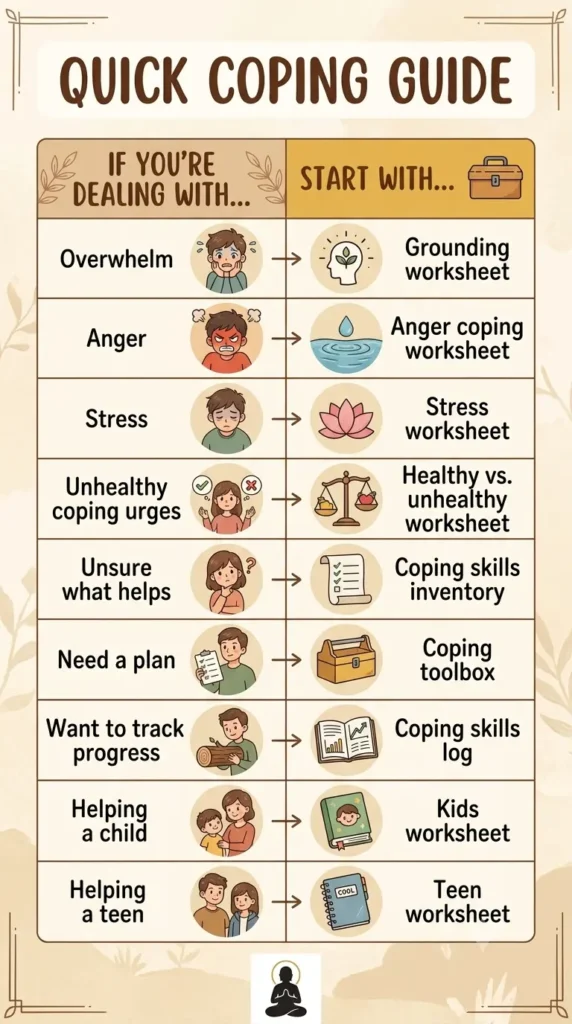
The right worksheet isn’t the fanciest one. It’s the one that matches what you’re facing right now. You don’t need every sheet in the stack. You don’t need a giant list either. Pick the problem first. Then pick one skill. Watch what shifts. The table below gives you a place to start.
| If you’re dealing with… | Start with… |
|---|---|
| Overwhelm | Grounding worksheet |
| Anger | Anger coping worksheet |
| Stress | Stress worksheet |
| Unhealthy coping urges | Healthy vs. unhealthy worksheet |
| Unsure what helps | Coping skills inventory |
| Need a plan | Coping toolbox |
| Want to track progress | Coping skills log |
| Helping a child | Kids worksheet |
| Helping a teen | Teen worksheet |
You can also pick based on energy, not just the problem. Running low? A two-minute grounding exercise beats a long reflection sheet every time. Nobody journals well when they’re maxed out. If you keep circling back to a habit that bites you later, the healthy vs. unhealthy worksheet slows that pattern down. It gives you a second to actually look at it.
Not sure what even works for you yet? Start with a coping skills inventory. There’s no pressure to find the “right” answer immediately. You’re just collecting options. For stress that never really goes away, build a coping toolbox before you need it.
Prep it on a calm day. Use it on a bad one. That’s the whole idea. Naming what you feel first also makes the rest of this easier, which is exactly what an emotions worksheet is built for.
You’re not hunting for a perfect worksheet. Perfect doesn’t exist here. You’re hunting for one that makes the next step obvious. That’s it.
15 Free Coping Skills Worksheets to Try
A hard moment doesn’t wait for the right words to show up. That’s where coping skills worksheets earn their place.
Each one below tackles a different need: spotting the strategies you already lean on, sorting healthy coping habits from the ones that backfire, handling anger, and getting through stress when your head feels too loud to plan anything.
Some of these free printable coping skills worksheets take five minutes. Others reward a slower sit-down. Use the prompts exactly as written. Or bend them until they fit whatever you’re actually dealing with today.
1. Coping Skills Inventory Worksheet
Notice what you already reach for. That’s the whole starting point of a coping skills inventory worksheet. This isn’t about finding the “perfect” coping skill, whatever that would even look like. It’s about seeing what you actually turn to when life gets hard, whether it helps, and what’s worth trying next.
What it helps with: Naming your current coping habits and building a short list of coping skills ideas that fit how you actually live.
Best for: Teens, adults, or anyone unsure which coping strategies work for them. If you’ve ever asked yourself what is the coping strategies you default to without thinking, this worksheet answers it on paper.
How to use it: Pick a recent stressful or emotional situation. List everything you did to handle it, even the small, half-conscious stuff. Then rate how helpful each one really was. It helps to name the feeling first. An emotions worksheet can get you there in a couple of minutes if the emotion itself is still fuzzy.
What to write or do:
- A situation that recently stressed me out: __________
- The emotion I felt was: __________
- What I did to cope: __________
- Did it help? ☐ A lot ☐ A little ☐ Not really ☐ Made things worse
- How intense was the emotion before? 1 2 3 4 5 6 7 8 9 10
- How intense was it afterward? 1 2 3 4 5 6 7 8 9 10
- One coping skill I want to keep using: __________
- One new coping skill I want to try: __________
- What could make it easier to use next time? __________
2. Healthy vs. Unhealthy Coping Skills Worksheet
Quick relief isn’t the same thing as a strategy that actually helps. That’s the gap this healthy vs unhealthy coping skills worksheet sits inside. A habit can feel useful in the moment and still cause a mess later. No judgment needed to see that. Just a closer look.
What it helps with: Spotting coping patterns and finding healthier alternatives when a current go-to strategy has a cost attached.
Best for: Teens and adults working through stress, anger, difficult emotions, or a repeated habit they want to shift.
How to use it: Pick one coping strategy you use when you’re struggling. Look at what happens right after you use it, and what happens later.
What to write or do:
| My coping strategy | What happens right away? | What happens later? |
|---|---|---|
Then answer:
- Does this strategy help me deal with the actual problem? __________
- Does it give me short-term relief? ☐ Yes ☐ No
- Does it create another problem later? ☐ Yes ☐ No
- What need am I trying to meet? __________
- A healthier strategy that could meet the same need: __________
- What might make that alternative easier to try? __________
Example: “I stay up scrolling when I’m overwhelmed.” Short-term: “I stop thinking about the problem.” Later: “I’m exhausted the next morning.” Alternative: “Put my phone down for 15 minutes and take a shower or talk to someone I trust.”
3. Coping Skills Toolbox Worksheet
Most people don’t need one giant list of coping skills. They need a few that are easy to find at 11pm when nothing feels manageable. A coping skills toolbox worksheet sorts your strategies by situation, emotion, or setting, so you’re not scrolling through twenty ideas while already stressed.
What it helps with: Building a set of coping skills toolbox ideas you can actually locate when you need them, not just ones that sound good on a list.
Best for: Teens, adults, and anyone who wants a coping plan that matches their real life instead of a generic one.
How to use it: Fill each section with strategies that feel realistic for you specifically. Include options for home, school or work, around other people, and for the days you have almost no energy left.
What to write or do:
- When I feel overwhelmed: __________
- When I feel angry: __________
- When I feel sad or lonely: __________
- When I need to calm my body: __________
- When I need to clear my head: __________
- When I need support from someone else: __________
- Person I can contact: __________
- What I could say: “__________”
- A coping skill I can use anywhere: __________
- A coping skill that takes less than 5 minutes: __________
A five-minute option earns its spot too. If you’re building toward something slower and more reflective for those calmer stretches, a few gratitude worksheets work well alongside a toolbox like this, since they train the same noticing habit from a gentler angle.
4. Coping Skills Checklist
Sometimes you don’t need a long reflection exercise. You need a coping skills printable you can scan in ten seconds flat. This coping skills checklist is built for the moments your brain is too overloaded to invent an idea from nothing.
What it helps with: Finding a coping skill you can try right now, no blank-page thinking required.
Best for: Teens, adults, classrooms, wellness activities, or anyone who prefers a simple checklist over an open prompt.
How to use it: Read through the list and check anything you’ve tried or would be willing to try. You don’t need to check every box. The goal is a menu of realistic options, not a perfect score.
What to write or do:
Move my body:
- ☐ Take a short walk
- ☐ Stretch
- ☐ Dance to one song
- ☐ Shake out tension
- ☐ Do a few gentle exercises
Calm my senses:
- ☐ Take slow breaths
- ☐ Listen to calming music
- ☐ Hold something comforting
- ☐ Notice five things I can see
- ☐ Step somewhere quieter
Process my emotions:
- ☐ Write down what I’m feeling
- ☐ Name the emotion
- ☐ Draw or doodle
- ☐ Talk to someone I trust
- ☐ Give myself time before reacting
Take constructive action:
- ☐ Break the problem into one small step
- ☐ Ask for help
- ☐ Take a short break
- ☐ Set a boundary
- ☐ Make a simple plan
One skill I want to try today: __________
Notice slow breathing shows up under “calm my senses.” That’s not filler. A minute of it can shift how loud everything else feels. If naming the emotion trips you up more than the checklist expects, a few mindfulness journal prompts can loosen that up before you come back to the checklist.
5. Coping Skills Log
“I think this works” only gets you so far. A coping skills log pushes past that. It’s not about testing ten skills at once. Record one stressful moment, the strategy you used, and what actually changed afterward. That’s it.
What it helps with: Tracking patterns, comparing coping strategies side by side, and noticing which skills are worth repeating.
Best for: Teens and adults who want to track progress over several days or weeks, not just one hard afternoon.
How to use it: Fill out one entry after using a coping skill. A simple 1–10 scale works fine for emotional intensity. No need to overthink the number.
What to write or do:
- Date: __________
- Situation: What happened? __________
- Emotion: __________
- Emotion intensity before: 1 2 3 4 5 6 7 8 9 10
- Coping skill I used: __________
- How long did I use it? __________
- Emotion intensity afterward: 1 2 3 4 5 6 7 8 9 10
- What changed? __________
- How helpful was the skill? ☐ Not helpful ☐ A little helpful ☐ Helpful ☐ Very helpful
- Would I use it again? ☐ Yes ☐ Maybe ☐ No
- What might I try next time? __________
Repeat the log for different situations. A skill doesn’t have to erase an emotion to count as useful. Sometimes it just buys you a pause, drops the intensity a few points, or helps you respond instead of react. If you want a place to unpack what came up in the log a little further, journal prompts for mental health is a solid next stop.
6. Exploring Coping Skills Worksheet
Not every coping skill works for every person. One strategy feels easy for you and impossible for someone else. This exploring coping skills worksheet isn’t about sorting strategies into “good” or “bad.” It’s about figuring out why a strategy feels natural, difficult, helpful, or not, so you actually understand your own patterns instead of guessing.
What it helps with: Understanding your preferences, barriers, and reactions to different coping strategies.
Best for: Teens and adults who’ve tried coping skills before but aren’t sure why some work better than others.
How to use it: Pick one coping skill you’ve used recently. Explore your experience with it honestly.
What to write or do:
- The coping skill I chose: __________
- I usually use it when I feel: __________
- I first learned or started using this strategy because: __________
- This strategy feels natural to me because: __________
- This strategy feels difficult because: __________
- Before using it, I usually expect: __________
- After using it, I usually notice: __________
- Something I like about this strategy: __________
- Something I don’t like about it: __________
- Does it fit the situation I’m using it for? Why or why not? __________
- What could make this strategy more useful for me? __________
- Another strategy I’d like to explore: __________
Try the exercise twice, for two different coping skills. Compare your answers side by side. That’s usually where the real pattern shows up, which strategies fit your needs and which ones need adjusting.
7. Stress Coping Skills Worksheet
Stress rarely arrives out of nowhere. It leaves clues first. A tight jaw. Racing thoughts. Irritability you can’t quite explain. The urge to avoid everything on your list. This worksheet helps you catch those early signs before stress takes over completely, and plan a different response for next time.
What it helps with: Recognizing stress triggers, early warning signs, current coping responses, and possible alternatives.
Best for: Teens, adults, students, and anyone dealing with recurring stress or overwhelm.
How to use it: Start with one recent stressful situation. Trace the chain from trigger to response. Then pick a coping strategy you could try earlier next time.
What to write or do:
- My stress trigger: __________
- What happened? __________
- Early signs I noticed in my body: __________
- Thoughts I noticed: __________
- Emotion I noticed: __________
- What I usually do when this happens: __________
- Does that response help in the long run? ☐ Yes ☐ Sometimes ☐ No
- A different response I could try: __________
- One coping skill I can use within 5 minutes: __________
- One person I can ask for support: __________
- One practical step that could reduce the source of stress: __________
- My plan for next time: __________
8. Anger Coping Skills Worksheet
Anger shows up in the body before you name it. Your heart races. Muscles tense. Suddenly you want to argue, yell, or act fast without thinking it through. This anger coping skills worksheet slows that sequence down. It gives you a beat to choose a response before the impulse takes over.
What it helps with: Recognizing anger triggers, body signals, impulses, and healthier ways to respond.
Best for: Teens and adults who want to understand their anger and practice coping skills for anger.
How to use it: Think of a recent situation that made you angry. Walk through each step. Don’t judge yourself for what you felt.
What to write or do:
- What triggered my anger? __________
- What happened just before I became angry? __________
- What did I notice in my body? ☐ Tight muscles ☐ Fast heartbeat ☐ Hot face ☐ Clenched jaw ☐ Restlessness ☐ Other: ______
- How intense was my anger? 1 2 3 4 5 6 7 8 9 10
- What did I want to do immediately? __________
- If I followed that impulse, what might happen next? __________
- What could help me pause? __________
- A coping skill I can try: __________
- What do I actually need right now? ☐ Space ☐ Support ☐ Rest ☐ To speak up ☐ To solve a problem ☐ Other: ______
- My next helpful action: __________
9. Emotion-Based Coping Worksheet
Different emotions call for different strategies. That’s easy to forget. A walk might settle restlessness. A phone call might do more for loneliness than anything else on your list. This coping skills activity helps you match the strategy to what you actually need, instead of reaching for the same response every single time.
What it helps with: Connecting emotions with coping strategies that fit the situation.
Best for: Teens and adults who want to build more flexible emotional coping habits.
How to use it: Choose an emotion you’ve felt recently. Ask what it might be telling you. Then pick one response that could help.
What to write or do:
- The emotion I’m feeling: __________
- How strong is it? 1–10
- What may have triggered it? __________
- What is this emotion telling me? __________
- What do I need right now? __________
- A coping skill that could match this need: __________
- Why might this skill help? __________
- One small action I can take now: __________
- After trying it, how do I feel? 1–10
- Would I use this strategy again? ☐ Yes ☐ Maybe ☐ No
You can build your own emotion-to-skill map over time. Overwhelm might pair with cutting stimulation. Loneliness might pair with reaching out. Anger might mean pausing and creating space. Restlessness might just mean moving your body. For more on naming and understanding what you’re feeling before you get here, the emotions worksheet is a useful place to start.
10. Grounding and Present-Moment Coping Worksheet
Racing thoughts pull you out of the moment fast. Grounding pulls you back. This worksheet combines sensory awareness, breathing, and present-moment attention into one short coping skills activity you can do almost anywhere.
What it helps with: Stress, overwhelm, racing thoughts, and moments when you need to reconnect with the present.
Best for: Teens and adults who prefer simple, low-preparation coping strategies.
How to use it: Sit or stand somewhere reasonably comfortable. Move through the prompts slowly. Don’t rush to finish them.
What to write or do:
Notice your surroundings
- 5 things I can see: __________
- 4 things I can physically feel: __________
- 3 things I can hear: __________
- 2 things I can smell: __________
- 1 thing I can taste or imagine tasting: __________
Notice your body
- My breathing feels: __________
- I notice tension in: __________
- One part of my body that feels relaxed: __________
Slow down
Take five slow breaths. Afterward, complete:
- Right now, I am feeling: __________
- Right now, I am safe enough to pause and: __________
- The next small thing I need to do is: __________
For more prompts that build this same kind of present-moment awareness, check out these mindfulness journal prompts.
11. Coping Ahead Worksheet
Some stress you can see coming. A hard conversation. An exam. A family gathering. A presentation, an appointment, or a week that’s already stacked too high. Seeing it coming gives you a head start. That’s the whole idea behind this one. Of all the coping skills worksheets in this list, it’s the one built specifically for the moment before the moment.
Use it to plan:
The situation I expect: __________
What might make it difficult: __________
What emotions might come up: __________
How I might notice stress in my body: __________
One coping skill I can use beforehand: __________
One coping skill I can use during it: __________
Someone I can contact if I need support: __________
What I can do afterward to recover: __________
Rough answers still count. You don’t need polished ones. If you’re not sure how stress shows up in your body before it shows up anywhere else, pairing this with a body scan from these mindfulness journal prompts can help you catch it earlier.
12. Positive Coping Skills Worksheet
Positive coping doesn’t mean forcing a smile. It’s not pretending a hard situation is fine. Sometimes healthy coping just means responding to stress in a way that supports you, instead of stacking a second problem on top of the first.
Try this exercise:
Something difficult I’m dealing with: __________
What I’m feeling: __________
What I need right now: __________
One healthy action I can take: __________
One person or resource that could support me: __________
One thing within my control: __________
One small step I can take today: __________
Your answer doesn’t have to sound positive. “I need a break,” “I need help,” or “I need to set a boundary” are all real coping responses. Nothing wrong with any of them. If naming what you actually need is the hard part, a few journal prompts for self-love can help the words show up faster.
13. Coping Skills Worksheet for Teens
Teen stress rarely comes from one direction. School pressure, exams, friendship conflict, family tension, social comparison, and a phone that won’t stop buzzing can all land in the same week. This coping skills worksheet for teenagers helps a teen name what’s actually going on, then choose a response that’s realistic instead of just the loudest one.
Try this exercise:
What’s stressing me out? __________
Where do I feel it in my body? __________
What am I telling myself about the situation? __________
What do I want to do right now? __________
Would that response help me later? ☐ Yes ☐ No ☐ Not sure
One coping skill I could try instead: __________
Someone I could talk to: __________
One thing I can control: __________
That “would it help me later” checkbox does more work than it looks like. It’s the gap between reacting and choosing. For more on catching stress in the body before it turns into a bigger reaction, the body-signal prompts in this emotions worksheet guide pair well with this coping skills activity for teens.
14. Coping Skills Worksheet for Kids
Kids don’t need complicated feelings language. They need pictures. This coping skills worksheet for kids connects emotions to body signals and calming choices, without asking a child to explain something they can’t fully put into words yet.
Try this exercise:
How do I feel?
Draw a face or circle one: 😊 😐 😟 😡 😢 😨
Where do I feel it in my body?
☐ Head ☐ Chest ☐ Tummy ☐ Hands ☐ Whole body ☐ Somewhere else: ______
What happened?
Draw it or write: __________
What could help me right now?
☐ Take slow breaths
☐ Ask a trusted adult for help
☐ Take a quiet break
☐ Hug a pillow or comfort item
☐ Draw
☐ Move my body
☐ Use another calming idea: __________
The choice I want to try: __________
An adult can sit through this one with a child. Naming the feeling together, or explaining a coping idea the child hasn’t tried yet, makes the exercise land better. It works well alongside the kid-friendly prompts covered in journal prompts for mental health.
15. Fun Coping Skills Activity Worksheet
Coping practice doesn’t have to look clinical. Not every exercise needs a checklist and a straight face. This coping skills fun worksheet leans on drawing, matching, brainstorming, and personal choices, building a coping menu you might actually reach for on a bad day.
Try this activity:
My personal coping menu
Draw something that helps you feel calm: __________
Write one activity that makes time pass in a good way: __________
Name someone you enjoy talking to: __________
Write one place where you feel comfortable: __________
Pick one song that changes your mood: __________
Write one thing you can do when you have only 5 minutes: __________
Create your own coping skill: __________
My top three choices:
This format works especially well as a coping skills activity for young adults. It leaves room for personality instead of turning every strategy into something clinical. Short on time? Borrow one line from these five-minute journal prompts and drop it straight into your menu.
Coping Skills by Age
Coping skills worksheets don’t work the same way at every age. A tool that calms a stressed-out adult can fall flat for a nine-year-old. Adults carry work stress, money worries, and strained relationships.
Teens juggle school, friendships, family shifts, and feelings that hit fast. Kids are still learning the words for what they feel at all.
Match the coping skill to the age. That’s what makes it stick.
Coping Skills for Adults
This isn’t about one big fix. Adult stress rarely shows up alone. Work stacks on money worries. Money worries stack on a strained relationship. By Thursday, the pile is real.
Coping skills for adults work best when they match that pile instead of fighting it. Setting a boundary helps. So does a short walk, a grounding exercise, or naming what’s actually stressing you out on paper. Problem-solving helps too, and so does reaching out to someone you trust when the day gets loud.
It’s 9pm and the inbox is still open. The dishes are still in the sink. That’s the exact moment a real break matters more than another task finished. An adult coping skills worksheet can help sort through what’s actually causing the stress, what you can control, and which coping skills activities for adults are worth trying first.
Sound too simple to work? It usually is, and that’s the point. A coping skills list for adults holds up best when each item is small enough to use mid-shift, not just on a free Sunday.
Pairing that list with a few journal prompts for mental health can pull the pressure out of your head and onto the page, where it’s easier to look at. A short gratitude check-in works the same way. It gives the mind somewhere calmer to land.
A printable worksheet or a short list beats trying to remember your strategies mid-crisis. Stress doesn’t wait for you to think clearly. Have the list ready before you need it.
Coping Skills for Teens
Teen stress isn’t smaller than adult stress. It just looks different. School pressure, exams, friendship conflict, family tension, social comparison, and a phone that never stops buzzing. That’s a full plate for anyone, let alone someone still figuring out who they are.
Coping strategies for teens fall flat when they sound clinical. Nobody wants a lecture mid-meltdown. Coping skills activities for teens work better when they’re physical or creative: movement, drawing, music, breathing exercises, a real conversation with someone they trust, or a deliberate break from the screen.
What’s actually within a teen’s control right now? That question alone can cut through a lot of noise. Writing it down helps more than saying it out loud once and forgetting it.
A coping skills worksheet for teenagers can walk through that same question step by step, helping teens spot patterns instead of borrowing someone else’s coping style off social media.
Before a teen can cope with a feeling, they usually need to name it first. That’s where an emotions worksheet earns its place alongside a coping skills list. Naming the feeling comes first. Choosing what to do about it comes second.
Coping Skills for Kids
Kids need something simpler. Not a worksheet full of paragraphs. Coping skills activities for kids work best when they’re visual, short, and easy to try alongside an adult. Naming feelings, noticing body signals, sensory play, drawing, movement, and breathing all fit that bar.
A calm-down plan doesn’t need to be complicated. Three steps is plenty. Notice the feeling. Name it. Pick one thing to do about it, like squeezing a pillow or taking five slow breaths.
Coping skills worksheets for kids work best with clear language and something to physically do, not just read. Circle the face that matches how you feel. Draw where the feeling sits in your body. That kind of prompt sticks with a child far longer than a definition ever will, and it pairs naturally with the same body-awareness questions used in an emotions worksheet built for younger kids.
A coping skills kids PDF gives parents, teachers, and caregivers a printable starting point. Practicing it together matters more than the worksheet itself. Kids learn to cope by watching how the adults around them handle hard feelings, not just by filling in a page alone.
20+ Coping Skills Ideas to Try Without a Worksheet
Not every coping skill needs a worksheet. Sometimes the best coping skills ideas are just small moves you can make mid-stress, no printout required. Still, if you want a place to track what works, our coping skills worksheets pair well with this list. Try these by category. Notice what actually helps you feel steadier.
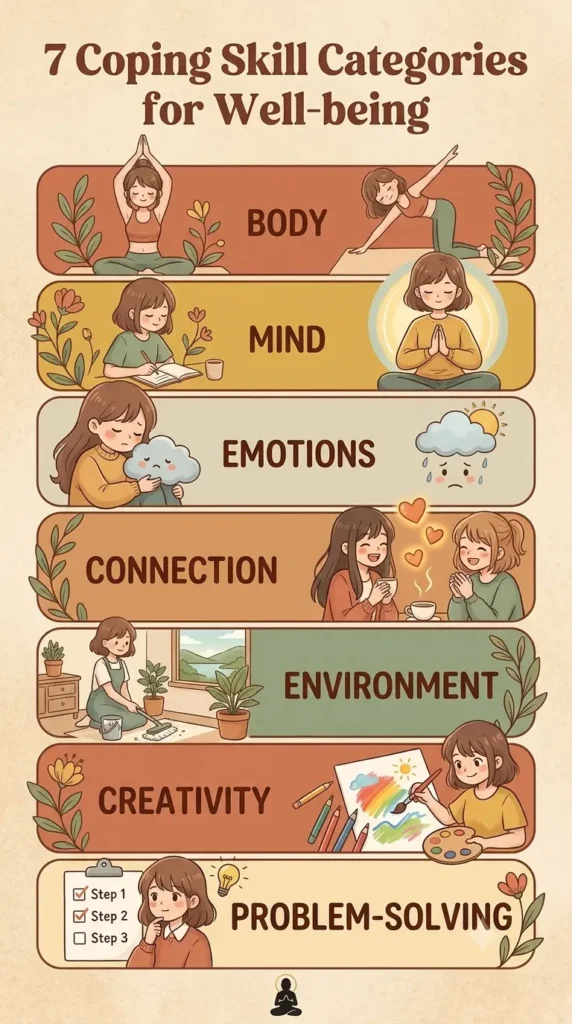
Body
1. Take a Short Walk
Your body needs a change of pace. Not a workout. Not a step goal. Walk around your home, your office, your campus, or outside for five to ten minutes. Feel your feet hit the ground. Notice your breath. That’s it.
2. Try Slow Breathing
Slow breathing buys you a pause. Breathe in gently. Make the exhale a little longer than the inhale. Repeat for a few minutes. Don’t force deep breaths. This isn’t about erasing discomfort. It’s about creating a gap before your next reaction.
3. Stretch or Move Your Body
Stress lives in the body first. Roll your shoulders. Stretch your neck. Shake out your hands. Or put on one song and dance it out. Pick movement that feels supportive, not punishing. Your body isn’t the enemy here.
Mind
4. Use the 5-4-3-2-1 Grounding Method
Scattered thoughts need an anchor. Name five things you see. Four things you feel. Three things you hear. Two things you smell. One thing you taste. Adjust the numbers if that’s easier. There’s no wrong way to ground yourself.
5. Write Down the Problem
A thought stuck in your head grows bigger than it is. Grab paper or open a notes app. Write down what’s bothering you. Then split it: what needs action, and what you can’t control right now.
A vague worry becomes something you can actually look at. If journaling tends to help you process, our journal prompts for mental health go deeper than this one exercise.
6. Challenge One Unhelpful Thought
Pick one stressful thought. Ask if it’s a fact, a prediction, or a guess. Most of the time it’s a guess wearing a fact’s clothes. Write a more balanced version instead. Swap “I’m going to mess everything up” for “I’m worried, but I can handle one part at a time.” Keep it realistic, not falsely cheerful.
Emotions
7. Name What You Feel
A specific name tells you what you actually need. “I feel bad” doesn’t. Try disappointed, tense, embarrassed, lonely, frustrated, overwhelmed. Sometimes more than one shows up at once.
Mixed feelings aren’t a malfunction. They’re normal. Our emotions worksheet has a longer word list if naming feelings doesn’t come naturally to you yet.
8. Rate Your Emotion
Give the feeling a number. “Anger: 7/10.” “Anxiety: 5/10.” Check it again after you try a coping skill. This number isn’t a grade. You’re not being scored on how well you’re coping. It’s just a way to notice movement.
9. Let Yourself Feel Without Immediately Fixing It
Not every emotion needs a fix on the spot. Sit somewhere comfortable. Give yourself a few minutes. Notice the feeling without judging it. Cry if that’s what happens. Write. Sit quietly. Name it out loud. Feeling something isn’t the same as letting it drive.
Connection
10. Text Someone You Trust
One short message breaks the illusion that you have to handle this alone. Try: “Rough day. Can you talk for a few minutes?” You don’t owe anyone a perfect explanation. Pick someone who tends to respond with care, not judgment.
11. Ask for Specific Help
“I need help” is vague. Vague requests are hard to act on. Name the exact thing instead. Ask someone to listen. To help you solve it. To sit with you. To give you a ride. A specific ask makes it easier for someone to actually show up for you.
12. Spend Time With a Supportive Person
Coping doesn’t always mean talking it through. Sometimes it means being near someone safe without saying a word about the problem. Share a meal. Walk together. Study side by side. Play a game. Watch something familiar. Ordinary shared time counts as support too.
Environment
13. Change Your Surroundings
If the room is feeding your stress, leave it. Sit outside. Go to a library. Move to another room. Find a quieter corner. A small shift in surroundings can break a stress loop your brain keeps replaying. Sometimes that’s the whole intervention.
14. Reduce Sensory Overload
Bright lights. Loud sounds. Notifications stacking up. Clutter everywhere. All of it adds weight to a moment that’s already heavy. Dim the lights. Turn the volume down. Silence what you can. Step away from the crowd. You don’t need to fix the whole environment. Just remove one irritant.
15. Make One Small Area Comfortable
You don’t need a clean house when you’re overwhelmed. Pick one spot. Your desk. Your bed. One chair. Clear the obvious clutter. Add something comforting if you want. A small manageable space makes the next task easier to face.
Creativity
16. Draw What You Feel
Forget drawing skills. This isn’t art class. Use shapes, lines, colors, whatever fits the feeling. An angry scribble. A heavy cloud. A tangled knot of lines. The point is expression, not something worth framing.
17. Make a Coping Playlist
Skip the giant everything-playlist. Build one for a specific situation instead.
- One for calming down.
- One for motivation.
- One for sadness.
- One for taking a break.
Choose songs that move you toward the state you want. If a track makes things worse, cut it.
18. Write a Letter You Do Not Send
Say everything you wish you could say, to a person, a situation, even yourself. Don’t worry about sounding polite. You never have to send it.
Writing it gives hard thoughts somewhere to go, and enough distance to decide what, if anything, actually needs saying out loud. This is one of the more common journal prompts for self-love for a reason.
Problem-Solving
19. Break the Problem Into One Step
A huge problem needs one small entry point. Ask: what’s the smallest useful thing I can do right now? Open the assignment. Send the one email. Wash one dish. Book the appointment. One small action shrinks the whole problem down to size.
20. Make a Two-Column Plan
Draw two columns. “I can control.” “I cannot control.” Sort each piece of the situation into one or the other. Then pick one action from the first column. This exercise pulls your focus away from a fight you were never going to win.
21. Make a Backup Plan
Stress grows when you believe there’s only one possible outcome. There’s almost never only one. Think through a realistic backup.
- Miss the deadline? What’s next.
- Conversation goes badly? Where do you go.
- Plan changes? What’s your move.
A backup plan takes the edge off uncertainty.
22. Delay an Impulsive Reaction
You’re about to send the angry text. Quit the job on the spot. Say something you’ll regret in an hour. This is the moment that decides what happens next. Put the phone down. Step away. Breathe. Wait. Delaying isn’t avoiding the problem. It just gives you more say in how you respond to it.
23. Ask What the Situation Needs
Different problems call for different tools. Ask yourself what’s actually needed here.
- Calming your body?
- Understanding a feeling?
- Solving something practical?
- Connecting with someone?
- Or just a break?
Reaching for the same coping skill every time, out of habit, is often less useful than matching the tool to the moment.
Build Your Own Coping Skills Toolbox
A coping skills toolbox is a set of go-to strategies for the moments emotions get loud. It can live in a notebook, a phone folder, or a small box of cards. Simple as that.
The goal isn’t to collect every idea you find. Pick a few that fit you. Ones you’ll actually reach for.
One easy way to build your coping skills worksheets collection is by sorting strategies into “when I feel…” categories. Match the tool to the moment, not the mood board.
- When I feel overwhelmed: try grounding, slow breathing, or a short break.
- When I feel angry: name the trigger, move your body, or step back before reacting.
- When I feel sad: play music, journal, talk to someone you trust, or sit somewhere comforting.
- When I feel anxious: use a sensory activity, focus on what’s in your control, or lean on a calming routine.
- When I don’t know what I feel: start with an emotions worksheet before picking a coping skill.
That last one matters more than people think. You can’t cope with a feeling you can’t name yet.
Your toolbox doesn’t need to be fancy. A notes app folder works. So does a printed coping skills toolbox PDF taped inside a cabinet door. Review it now and then. Cut what isn’t pulling weight.
The best coping skills toolbox isn’t the biggest one. It’s the one you’ll actually open.
Printable Coping Skills Lists, Cards, and Handouts
You don’t always need a full worksheet. Sometimes a quick reference works better. Stress spikes fast. Attention drops with it. A printable list, a coping skills card, or a short handout keeps real strategies within reach, so you’re not building a plan from zero in the middle of a hard moment.
List of Coping Skills Printable
A free printable coping skills list gives you a landing spot. Nothing fancy. Just a place to collect what might help. Circle the ones that feel doable. Highlight your favorites.
Keep the page somewhere you’ll actually see it, not buried in a drawer. A coping skills checklist does something a plain list can’t: it shows you what you’ve already tried and what’s still worth testing.
Want something closer to a list of coping skills pdf free of clutter? This format skips the worksheet steps and keeps only the strategies. Tuck a copy in a journal, a school folder, a desk drawer, or a notes app on your phone.
If you’re already building a habit of writing things down, pair it with these journal prompts for mental health for a fuller reset.
Coping Skills Cards
Cut the list down further and you get coping skills cards. One card. One strategy. That’s it. Instead of scanning a full page while you’re already overwhelmed, you pick a single card and focus on that one suggestion. Nothing else competes for your attention.
Make cards for breathing, a short walk, grounding, calling someone you trust, writing down what’s in your head, stretching, music, or a quiet break. Sort them by moment: “when I feel angry,” “when I feel anxious,” “when I need to calm down.” Why does sorting by moment work better than sorting by type?
Because in the moment, you don’t think in categories. You think in feelings. If naming the feeling is the hard part, these emotions worksheet prompts can help sort that out first.
Coping Skills Handout
A coping skills handout is built for speed. Not a full worksheet session. Just a quick-reference page that explains a few strategies and gets out of the way. Classrooms use them. Support groups use them. Families use them. Therapists hand them out between sessions for exactly this reason.
A solid coping strategies handout covers five kinds of tools: calming, grounding, emotional, social, problem-solving. That’s the whole idea. Something to glance at. Something to choose from. Something to use the moment you need it, not twenty minutes later once you’ve calmed down enough to think straight.
Pair a coping skills handout pdf with a few mindfulness journal prompts and you’ve got a starting kit that covers both the panic moment and the process-it-later moment.
Coping Skills Activities for Different Situations
The right skill depends on what’s actually happening. Anger wants space. Overwhelm wants something smaller and simpler. That’s the whole logic behind good coping skills worksheets. Match the tool to the moment, and the skill stops feeling like homework. Force the wrong one, and it just adds friction.
There’s no single fix that covers every feeling. That’s the trap most lists fall into.
Coping Skills for Anger
Anger moves fast. The goal isn’t to stop it. It’s to build a gap between the spike and whatever you do next.
Step away if you can. Slow your breathing down on purpose. Move your body, even just pacing the hallway. Write down what set you off, word for word, no editing. A short grounding exercise works too, something as plain as naming five things you can see.
None of that erases the anger. It just buys you ten seconds before you say something you’ll walk back later. These coping skills for anger aren’t about staying calm all the time. They’re about responding instead of reacting, which is a very different thing.
Coping Skills for Stress and Overwhelm
Overwhelm shrinks your options. Suddenly even a two-minute task feels impossible. That’s not laziness. That’s your capacity running low.
Useful coping skills activities here stay small on purpose: break one task into a smaller step, take a short screen break, stretch for sixty seconds, put on music that slows your heart rate down. Grounding through your senses helps too, like naming what you can touch, smell, or hear right now. So does texting someone you trust, even a short message.
Pick one. Just one. Trying to fix everything at once is how overwhelm wins. A single small move beats a long list you’ll never finish.
Coping Skills for Difficult Emotions
Hard emotions get easier once you can name them and notice where they land in your body. That’s the whole first move. Not fixing the feeling. Just naming it.
An emotion worksheet helps with exactly that. It walks you through the feeling, the trigger, the body signal, and what you actually need next.
If you’re not sure where to start, an identifying emotions worksheet is a solid first step before you pick a coping strategy. Pairing that with a few journal prompts for mental health can also pull the words out when they won’t come on their own.
Naming the feeling doesn’t make it disappear. It just gives you something to work with instead of a fog with no edges.
Holiday Coping Skills
Holidays stack a lot at once: family gatherings, broken routines, social pressure, loneliness, too much noise and too much light. That’s a real load, not a mood.
A holiday coping skills worksheet helps you plan before you’re standing in the middle of it. Map out the situations that usually get to you. Decide on a boundary ahead of time. Pick one or two calming activities you’ll actually use, maybe a few minutes of mindfulness journal prompts before a big gathering. Know who you’ll text if it gets to be too much.
You don’t have to love every part of the holidays to get through them well. That’s not the bar. Getting through with your footing intact is.
Coping Skills Games and Creative Activities
A coping skill doesn’t need a worksheet to work. Sometimes it needs a deck of cards, a coloring page, or a room full of people trading ideas. Games, art, and shared activities can make coping skills practice feel less like homework. That matters most for kids, teens, and young adults who learn by doing, not by filling in boxes.
Sound too playful to actually help? It isn’t. The skill still lands. It just walks in through a different door.
Coping Skills Games
Coping games turn skill-building into something you actually want to do. Try a card game where each card names one strategy. Or a matching game that pairs an emotion with a helpful response. Scenario games work too, the kind where a player has to choose what happens next.
A simple “choose your coping skill” game does something specific. It trains the brain to match a strategy to a real situation. Not just recite one from memory.
Coping Skills Coloring Pages
Coloring sheets offer a quiet way to slow down. No pressure. Just color and breathe.
Pair the page with one honest question, the kind an emotions worksheet is built around. What am I feeling right now? What would help me feel more settled? Add a breathing prompt in the margin, similar to the grounding cues in these mindfulness journal prompts. Or leave a small space to write down what feels safe and comforting.
That’s it. Nothing complicated about it.
Coping Skills Group Activities
Group activities work well in classrooms, youth groups, and guided sessions. Discussion cards can introduce a new strategy each week. Scenario prompts let the group suggest a healthy response to something common, like a fight with a friend or a bad grade.
Group brainstorming builds something else too. A shared list everyone can practice and compare. The list grows because more people are naming what actually works for them, not because one person filled out a form alone.
Coping Skills Activity for Young Adults
A coping skills activity for young adults has to reflect what this stage of life actually throws at someone. Work pressure. Relationship stress. Comparing yourself to a feed full of strangers. Moving out. Money running low before the month ends. Not knowing what comes next.
Build prompts around those exact situations, the same way CDC’s guide on managing stress points people toward naming their specific triggers before picking a response. A personal coping menu turns each situation into one specific move to try when stress hits.
Not a vague reminder to “cope better.” Pairing that menu with a quick reflection, like a five-minute journal prompt, can help a young adult notice which strategies actually worked once the stress has passed.
How to Use Coping Skills Worksheets Effectively
Coping skills worksheets work best when they help you solve a real problem, not when you fill them out just to have a long list of strategies. Start with what you are dealing with, test one skill, notice the result, and adjust from there.
Start With the Problem, Not the Worksheet
Before choosing a coping skills worksheet, name what is actually bothering you. Are you overwhelmed, angry, stuck in your thoughts, or dealing with a situation you cannot change right now? The answer can point you toward a more useful strategy.
For example, anger may call for a pause and body-based strategy, while exam stress may need planning or problem-solving. You do not need the perfect worksheet. You need one that matches the problem.
Try One Skill Before Building a Huge List
A huge list of coping skills can become another thing to manage. Pick one strategy that feels realistic and try it in a specific situation.
Maybe you take a short walk when your stress starts rising, text someone you trust when you feel isolated, or use a grounding exercise when your thoughts start racing. Give the skill a fair try before deciding whether it belongs in your personal toolkit.
Track What Actually Helps
Not every coping skill will work for you, and that is normal. After trying one, ask: Did my stress change? Did I feel more able to handle the situation? Did the strategy create a new problem?
A simple coping skills log can help you record the situation, emotion, skill you tried, and what happened afterward. Over time, this gives you a more useful list based on your own experience rather than generic advice.
A Coping Skill Does Not Have to Make You Feel Good Immediately
Good coping is not always about feeling better right away. Sometimes the goal is to tolerate an uncomfortable feeling without making the situation worse. Other times, coping means solving a practical problem, asking for help, setting a boundary, or creating enough space to choose your next response.
A skill can be useful even when the difficult feeling is still there.
Coping Skills Worksheets vs. Journaling
Coping skills worksheets and journaling can both help you understand what you feel and decide what to do next. The main difference is structure: worksheets guide you through a specific problem, while journaling gives you more freedom to explore thoughts, emotions, triggers, and patterns.
When a Worksheet Is Better
A worksheet is useful when you need clear direction and a specific next step. It can help you name an emotion, spot a trigger, compare healthy and unhealthy coping choices, or make a plan for a stressful situation.
For example, if you are overwhelmed before an exam, a coping worksheet can walk you through the trigger, body signals, thoughts, coping options, and the action you want to take. You do not have to figure out what to write from scratch.
Worksheets can also be helpful when you are new to emotional reflection or simply do not have the energy for a long journal entry.
When Journaling Is Better
Journaling works well when you need space to think without following a fixed structure. You might write about why a situation keeps bothering you, what you wish you had said, or what you have learned from a difficult experience.
If you want a starting point, try journal prompts for mental health or explore mindfulness journaling to focus on thoughts, emotions, and the present moment.
Journaling can also fit specific goals. Journal prompts for self love can support self-compassion, while journal prompts for self growth can help you reflect on habits, choices, and personal goals.
When You Can Combine Both
You do not have to choose between a worksheet and a journal. A worksheet can help you identify what is happening, while journaling can help you explore why it matters.
For example, complete an emotion or coping worksheet first, then write freely about the trigger or situation. For difficult emotional experiences, healing journal prompts can give you a gentler way to continue the reflection. If you are trying to recognize recurring emotional triggers, journaling for emotional intelligence can take that reflection a step further.
The goal is not to fill out more pages. It is to find a format that helps you understand yourself and choose a response that actually fits the situation.
When a Coping Skills Worksheet Isn’t Enough
Coping skills worksheets do a lot of good. They help you name what you feel. They give you a place to practice healthier responses. But they have a ceiling. Not yet.
They’re self-help tools, not treatment. When distress won’t quit, when it feels heavy, when it feels unsafe, reaching out is the stronger move.
When Distress Keeps Coming Back
Sound too simple? A worksheet can be. If stress, anxiety, sadness, or anger keeps returning for weeks, or gets harder to manage instead of easier, something deeper is driving it.
A sheet of paper won’t find that root. A qualified mental health professional can. They help you spot the pattern. Then they help you choose support that actually fits it.
If you’ve been working through our emotions worksheet and still feel stuck naming what’s underneath the feeling, that’s often the sign a worksheet alone can’t close the gap.
When Daily Life Is Being Disrupted
Sleep gets worse. Work slips. Meals get skipped, or eaten only from habit. Relationships get quiet, then quieter. These are signs, not just moods.
Extra support helps once emotional distress starts touching sleep, school, work, relationships, eating, or basic self-care. You don’t need to wait for a breaking point. Asking early is not asking too soon.
When You Don’t Feel Safe
This isn’t a moment for a worksheet. Not close.
If you feel unable to keep yourself safe, or you’re thinking about hurting yourself or someone else, get help now. A trusted person. A local emergency service. A crisis line. In the U.S., the 988 Suicide & Crisis Lifeline is free by call or text, any hour, for anyone in emotional distress or crisis.
When Symptoms Are Severe or Getting Worse
Some symptoms don’t wait. They get worse fast. Extreme distress. Problems that feel impossible to carry alone.
These deserve professional attention, not another worksheet. Needing more help doesn’t mean your coping skills failed. It means the load got bigger than paper and pen can hold.
When Professional Support Makes Sense
A worksheet and therapy aren’t rivals. Use both.
Coping skills worksheets work well alongside counseling, medical care, or support from people you trust. Think of the worksheet as practice space, a spot for reflection, not a diagnosis and not a treatment plan.
For a broader emotional vocabulary to bring into that space, our emotions worksheet pairs well here. If you want a gentler on-ramp first, journal prompts for mental health is a good next stop too.
Conclusion
Coping skills worksheets can make it easier to understand what you feel, spot what triggers stress, and choose a response that actually helps. The goal is not to find one perfect coping skill.
It is to build a personal set of tools you can use across different situations, whether you are dealing with anger, overwhelm, difficult emotions, or everyday pressure. Start with one worksheet and one strategy that feels realistic for you.
Notice what helps, what does not, and adjust from there. These worksheets are educational self-help tools, not a replacement for professional support when you need it.
Frequently Asked Questions
What are coping skills worksheets?
Coping skills worksheets are guided tools that help you identify, practice, and reflect on ways to handle stress, difficult emotions, or challenging situations.
They may include checklists, reflection questions, coping plans, or tracking pages. You can use them on your own or with a parent, teacher, counselor, or therapist.
What is the difference between healthy and unhealthy coping skills?
Healthy coping skills help you manage stress while supporting your well-being over time. Examples include exercise, talking to someone you trust, journaling, breathing exercises, and taking a short break.
Unhealthy coping may provide quick relief but create more problems later, such as using substances, lashing out, or avoiding every stressful situation.
What are good coping skills for adults?
Good coping skills for adults depend on the situation and the person.
Useful options include
walking,
exercising,
journaling,
mindful breathing,
setting boundaries,
talking with someone you trust,
taking breaks,
solving one small problem at a time, and
getting professional support when needed.
A coping skills worksheet can help you find which strategies actually work for you.
What are good coping skills for teens and teenagers?
Teens can try coping skills such as listening to music, taking a walk, journaling, breathing slowly, talking with a trusted adult, spending time with supportive friends, taking a break from social media, or doing something creative.
The best strategy depends on the source of stress, so teens can experiment with different skills and track which ones help.
What are some coping skills for kids?
Kids can use simple coping skills such as taking slow breaths, drawing, coloring, moving their body, playing, talking to a trusted adult, using sensory activities, or taking a quiet break.
Younger children may need an adult to help name the feeling and choose a coping strategy. Visual worksheets can make this process easier and more engaging.
Are coping skills worksheets a substitute for therapy?
No. Coping skills worksheets are educational and self-help tools, not a replacement for therapy, diagnosis, or professional treatment. They can support skills practice between sessions or help someone reflect on what they are experiencing.
If distress is persistent, seriously affects daily life, or creates a safety concern, professional support is more appropriate than relying on worksheets alone.

It’s Bhaskar!
Well, I am not a psychologist a monk, or a philosopher by training. I’m just an engineering graduate.
‘The Empty Self’ is where I write about that idea, and what it actually means for ordinary life, anxiety, identity, habits, the stories we tell ourselves about who we are. I don’t have a psychology degree, and I’m not offering therapy or clinical advice. What I do have is thought and clarity, and genuine curiosity about why we suffer the way we do and how much of it might loose once we shed this ‘fixed identity’.
Pingback: 10 Powerful Coping Skills Activities for Adults (Gen Z Edition) | The Empty Self
Pingback: 10 Free Coping Skills Activities for Teens (Complete Gen Z Guide)! | The Empty Self
Pingback: 10 Simple Coping Skills Worksheets for Kids (Complete Gen Alpha Guide) | The Empty Self
Pingback: 15+ Coping Skills Group Activities for All Age Groups (Kids, Teens & Adults) | The Empty Self
Pingback: 12 Free and Fun Coping Skills Coloring Pages for Kids (Gen Alpha Guide) | The Empty Self
Pingback: 10+ Fun and Exciting Coping Skills Games for Kids (Gen Alpha Guide) | The Empty Self
Pingback: The Ultimate List of Coping Skills: 100 Healthy Skills for All Age Groups | The Empty Self
Pingback: Coping Skills Log: Free Template & Trackers for Kids, Teens, and Adults | The Empty Self
Pingback: Coping Skills Handout: Free Handouts for Teens and Young Adults | The Empty Self