
Strong emotions work fast. Within minutes, they can change how you think, speak, decide, and act. Ever sent a message you wished you could pull back? That’s the gap these tools fill.
DBT emotion regulation skills give you practical ways to understand what you’re feeling. You check whether the emotion fits the situation. Then you choose a response that helps instead of making things harder.
Quick Overview: DBT emotion regulation skills are tools from Dialectical Behavior Therapy. Use them to understand emotions, reduce emotional vulnerability, and change unhelpful emotional responses. They also teach you to handle feelings without automatically acting on them. Five core skills lead the way. Identify Emotions, Check the Facts, Opposite Action, Problem Solving, and Mindfulness of Current Emotions.
Key Takeaways:
- Emotion regulation isn’t suppressing emotions or forcing calm
- Understand the emotion first. Then decide whether to change it, act on it, or tolerate it
- Check the Facts, Opposite Action, and Problem Solving help most when an emotion drives an unhelpful response
- PLEASE, ABC PLEASE, Accumulate Positive Emotions, Build Mastery, and Cope Ahead reduce vulnerability and prepare you for hard situations
- Adapt these skills into DBT emotion regulation worksheets, activities, and printables for adults, teens, and children
Table of Contents
Disclaimer
This blog is written and edited with the help of AI, then reviewed by me before publishing. As a result, the content is for general reflection only, not therapy or medical advice, and I’m not a licensed mental health professional. If you’re in crisis, please contact 988 if you’re in US or a local crisis service of your country instead of relying on this site.
What Are DBT Emotion Regulation Skills?
DBT emotion regulation skills are practical tools for understanding emotions and lowering emotional vulnerability. They help you respond well instead of acting on autopilot. First, notice what you feel. Next, ask whether the emotion fits the situation. Then pick a skillful response.
What Is Emotion Regulation in DBT?
The label sounds clinical. The idea isn’t. Emotion regulation is the DBT skill set for understanding emotions and changing your response when change is needed.
Most programs teach it as the third module, after mindfulness and distress tolerance. Some don’t. Teaching order and structure vary from program to program. It’s one of four modules in the full DBT skills worksheets guide.
Want a formal definition? The APA Dictionary entry on emotion regulation is a solid place to start. For the training side, see Behavioral Tech’s DBT skills training.
The Four Goals of DBT Emotion Regulation
Linehan’s DBT framework rests on four broad goals. Each one answers a different question. What am I feeling? Should it change? Can I handle it better? Can I hurt less? The full framework appears in the DBT Skills Training Manual, Revised Edition.
Most people chase only the second goal. They want the feeling gone. The other three matter just as much.
- Understand and name emotions: learn what you feel and what may be driving it
- Reduce unwanted emotions: change them when they don’t fit the facts or fuel harmful behavior
- Reduce vulnerability: build your physical and emotional base so intense emotions are easier to handle
- Reduce suffering: feel painful emotions without piling extra struggle on top
Naming comes first, and it’s harder than it sounds. An emotions worksheet can help you get specific.
Regulation vs. Suppression
Regulation doesn’t mean forcing an emotion to vanish. That’s suppression. Suppression pushes down the outward signs of an emotion. Regulation is wider. It can mean understanding, accepting, changing, or expressing the emotion more effectively.
Picture a tense meeting. Someone snaps at you, and you smile and swallow it. That’s suppression. Regulation would be noticing the anger, naming it, then choosing what to say.
| Regulation | Suppression |
|---|---|
| Works with the emotion | Pushes the emotion away |
| Allows awareness | Often requires hiding it |
| Can change behavior or intensity | Focuses on controlling expression |
| Makes room for acceptance | Can increase emotional strain |
Linehan’s materials stress that fighting or suppressing emotions can add to suffering. Research points the same way. Gross and John (2003) found that habitual suppression went with more negative emotion. Reappraisal showed a different pattern. Ever tried hiding a feeling all day? It rarely stays hidden.
Emotion Regulation vs. Distress Tolerance
These two skill sets sound alike. They do different jobs. Emotion regulation is mostly about changing your emotional response when change is possible. Distress tolerance is about surviving and accepting a hard moment without making it worse.
| Emotion Regulation | Distress Tolerance |
|---|---|
| Change-oriented | Crisis-survival oriented |
| Checks whether emotions fit the facts | Helps you get through intense moments |
| Builds longer-term emotional stability | Helps prevent impulsive reactions |
| Includes skills such as Opposite Action | Includes skills such as TIPP |
Mindfulness of Current Emotions sits between the two. It teaches you to notice and allow an emotion without acting on it right away. Acceptance becomes the bridge. You feel the emotion first. Then you decide what to do next. These mindfulness journal prompts give you a place to practice.
Intense distress needs a different tool. The DBT TIPP skill is built for immediate crisis survival. For broader options, browse these coping skills worksheets.
DBT Emotion Regulation Skills at a Glance
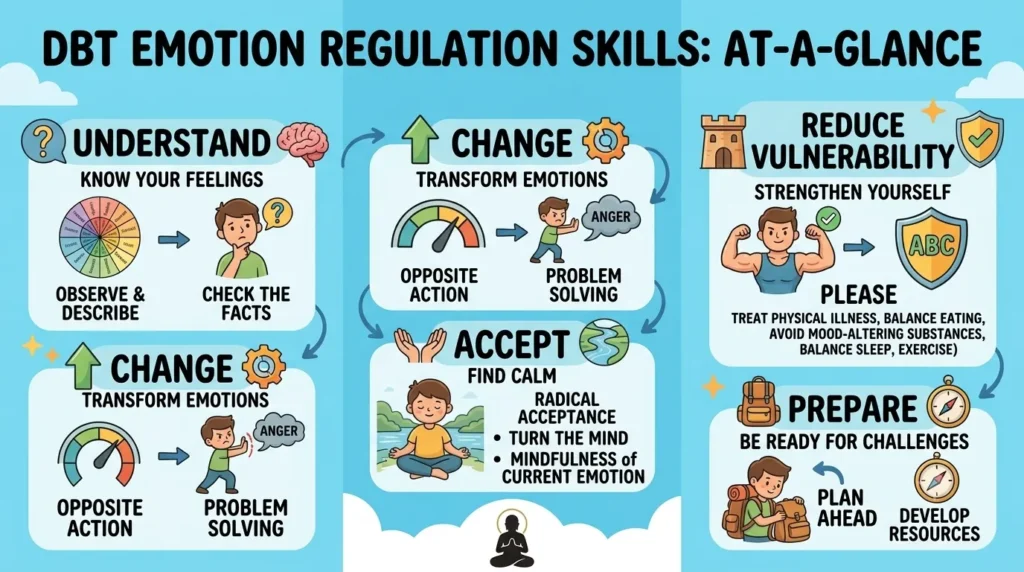
DBT emotion regulation skills help you read what you feel. They also help you judge whether the emotion fits the situation. Then you pick a response that actually helps. Most people skip the middle step and react. These skills slow that down.
The skills fall into five groups: understanding emotions, changing ineffective responses, accepting emotions, reducing vulnerability, and preparing for hard moments. Each one has a worksheet you can print and use.
| Group | Skill | What it does | Use it when | Worksheet |
|---|---|---|---|---|
| Understand | Identify & Name Emotions | Labels the emotion, its intensity, body sensations, and urges. | You feel overwhelmed or can’t tell what you’re feeling. | Emotion Identification Worksheet |
| Change | Check the Facts | Separates observable facts from assumptions and interpretations. | An emotion feels huge or may not match the situation. | Check the Facts Worksheet |
| Change | Opposite Action | Swaps an ineffective emotional urge for a more effective action. | The emotion doesn’t fit the facts, or acting on the urge would make things worse. | Opposite Action Worksheet |
| Change | Problem Solving | Turns a changeable situation into specific, practical steps. | The emotion fits the facts and the situation can change. | Problem Solving Worksheet |
| Accept | Mindfulness of Current Emotions | Lets you notice an emotion without feeding it or fighting it. | The emotion fits the facts, but you can’t change the situation right now. | Mindfulness of Current Emotions Worksheet |
| Reduce Vulnerability | PLEASE / ABC PLEASE | Supports physical and emotional stability. Builds positive experiences and mastery. | You’re depleted, emotionally vulnerable, or need regular prevention skills. | PLEASE & ABC PLEASE Worksheet |
| Prepare | Cope Ahead | Rehearses a hard situation before it happens. | You know a stressful event or conversation is coming. | Cope Ahead Worksheet |
Names shift a little between DBT books and websites. You may see ABC PLEASE, Act Opposite, or Pay Attention to Positive Events used as labels for related skills or parts of a skill. Same toolkit, different packaging.
Which Skill Should You Use?
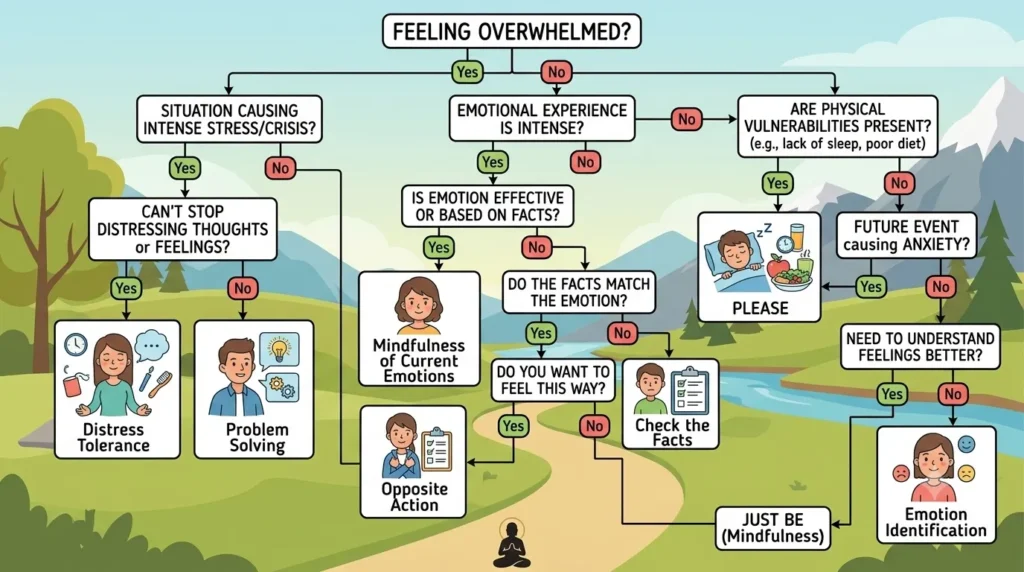
Nobody memorizes every DBT skill before using one. Start with the problem in front of you, then narrow it down. If you want more tools beyond this module, the coping skills worksheets are a good place to browse.
- Crisis-level intensity? Go to distress tolerance first. When emotions run too high for clear thinking, aim to get through the moment safely.
- Can’t name the emotion? Identify and name it. Notice the emotion, its intensity, body sensations, and the urge.
- Does the emotion fit the facts? Is acting on it effective? Those two questions decide what comes next.
- Fits the facts, and the situation can change: Use Problem Solving.
- Doesn’t fit the facts, or acting on the urge won’t help: Check the Facts, then consider Opposite Action.
- Fits the facts, but the situation can’t change right now: Practice Mindfulness of Current Emotions. Stop fighting the feeling.
- Body running on empty? Check the PLEASE factors: physical health, sleep, eating, substances, and activity.
- Hard event coming? Use Cope Ahead. Rehearse the situation and the skills you plan to use.
How Emotions Work in DBT Emotion Regulation Skills
An emotion isn’t a reflex. In DBT, it’s a process with moving parts. A situation can set it off, but vulnerabilities, thoughts, body changes, urges, and actions all shape what comes next. Why does that matter?
Because DBT emotion regulation skills work on the whole chain, not just the feeling. Seeing the chain helps you catch an emotion earlier. Then you can pick a skill instead of reacting on autopilot. That’s the core of the wider set of DBT skills.
The DBT Model of an Emotion
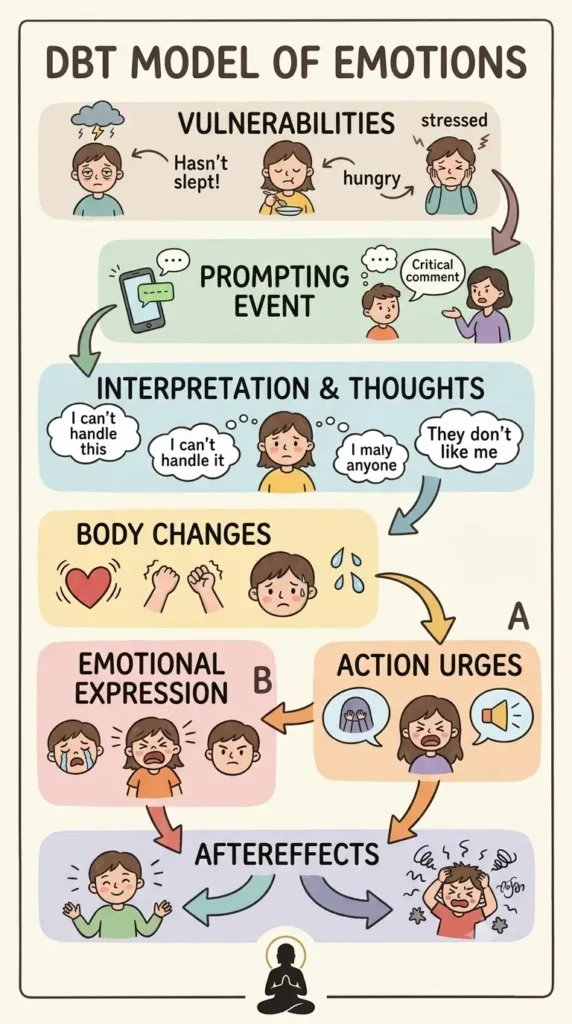
Every DBT emotion builds through a few connected parts.
Vulnerabilities → Prompting event → Interpretation → Body changes → Urges → Expression → Aftereffects
Vulnerabilities come first. These are conditions that make a reaction stronger. Poor sleep, hunger, illness, stress, or an already rough mood all count. Then a prompting event starts the response. Your interpretation of that event shapes what you feel. Your body reacts too, with tension, a racing heart, tears, or changes in breathing.
Next come urges to act. Withdrawing, arguing, avoiding, and seeking reassurance are common ones. Picture it. It’s 11pm, a friend hasn’t replied, and your chest is tight. The urge to send a third text is loud. That’s the moment a skill can still step in.
What you do with the urge is your expression. It feeds the aftereffects, meaning what happens to the situation and how you feel afterward.
What Emotions Do for You
Emotions do real work. They push you to act. They send signals to other people through facial expressions, tone, and behavior. They also show you what matters to you.
That doesn’t make every emotional conclusion accurate. Emotions are real experiences. They aren’t always facts. Feeling certain is not the same as being right, and anyone who has replayed a message for an hour knows it. This split sits at the center of the DBT skill Check the Facts.
Primary vs. Secondary Emotions
A primary emotion is your first response to an event. A secondary emotion grows out of that first feeling, or out of your thoughts about it.
Say you feel anger after being treated unfairly. Then shame shows up. You tell yourself you shouldn’t have reacted that way. The anger is primary. The shame may be secondary. Sound familiar? Spotting both makes the chain much easier to follow.
Why Naming Comes Before Changing
You can’t choose a response to an emotion you haven’t named. Naming gives you a clear starting point. Four questions help. What am I feeling? How intense is it? What is happening in my body? What do I want to do? An emotions worksheet can walk you through them on paper.
Once you can describe the emotion, your options open up. You can check the facts, solve a problem, or use opposite action. You can tolerate the emotion, with help from a few coping skills worksheets. Or you can simply observe it, using mindfulness journal prompts, without making it worse. Most people skip the naming and rush to fix. That’s backwards.
Why It’s Hard, and Four Myths That Get in the Way
Struggling with emotions doesn’t mean you’re bad at them. Biology, stress, mood, missing skills, and past reinforcement all play a part. So do emotional overload and learned beliefs. Together, they affect how fast an emotion builds. They also affect how hard it is to change.
Four myths make it harder still.
| Myth | Reality |
|---|---|
| “I shouldn’t feel this way.” | An emotion can be uncomfortable without being wrong. Start by noticing and understanding it. |
| “I need to get rid of negative emotions.” | The goal isn’t to erase difficult emotions. It’s to respond to them more effectively. |
| “If I’m angry, I should act angry.” | An emotion creates an urge. You still get to choose whether acting on it is effective. |
| “Being regulated means staying calm.” | Regulation can include strong emotions. You respond on purpose and safely. |
Self-compassion makes this process easier. These journal prompts for self-love are a good place to explore self-judgment, difficult emotions, and self-validation.
DBT Emotion Regulation Skills Explained
Feelings show up uninvited. DBT emotion regulation skills give you a way to meet them on purpose instead of by accident. First you name what you’re feeling. Then you check whether it fits what’s actually happening.
From there, you either change an urge that isn’t helping or you fix the problem feeding it. The four skills below move in that exact order: name it, check it, shift it, solve it.
Identify and Name Your Emotions
You can’t work with a feeling you haven’t named. Identify and Name Your Emotions means catching the emotion itself. How strong is it? What’s happening in your body? What are you itching to do about it? Naming it gives the next skill something solid to work with instead of a vague cloud.
When to use it: Reach for this when you feel overwhelmed, foggy, numb, or blindsided by your own reaction.
How to do it:
- Name the emotion as precisely as you can.
- Rate it from 0 to 10. Zero is nothing. Ten is as strong as it gets.
- Notice what’s happening physically. Tight chest, heat, heaviness, shaking, a racing pulse.
- Notice the pull underneath it. Avoiding, arguing, crying, withdrawing, chasing reassurance.
- Write down what happened right before it hit.
Picture this. Tight chest, clenched jaw, an urge to cancel your plans. You name it anxiety and put it at 7 out of 10. Now you’ve got something to work with. “I feel awful” gets you nowhere.
Pitfall: Don’t hunt for the perfect word. Close enough works. You can sharpen it later.
Want a structured way to practice this step? This emotions worksheet walks you through naming and exploring what you feel, and the identifying emotions worksheet goes deeper into labeling specifics.
Check the Facts
What happened and what your mind predicted are two different things. Check the Facts pulls them apart. Name the emotion first. Then look at the actual evidence. Does the feeling, and how strong it is, match what’s really going on? This isn’t about arguing yourself out of a real feeling. It’s about testing the story underneath it.
When to use it: Use this when an emotion feels bigger than the moment calls for, when you’re not sure your read on things is accurate, or when you’re deciding whether to follow an urge at all.
How to do it:
- Name the emotion and rate it from 0 to 10.
- State only what a camera could record. Nothing else.
- List other explanations. What else could account for the same facts?
- Check for an assumed threat. Are you treating a guess as proof?
- Picture the worst case. What would you actually do? What support exists?
- Check the fit. Does the emotion match the facts? Does the intensity?
Here’s a common one. Feedback says your presentation needs “more detail.” Your brain jumps straight to “my manager thinks I’m incompetent,” and shame spikes to 8 out of 10. The fact is smaller. Your manager asked for more detail. That’s it. Other reads fit just as well, a normal revision request, or expectations that weren’t clear from the start. Checking the facts usually brings the intensity back down to size.
Pitfall: This isn’t a tool for proving your feelings wrong. It separates fact from story. Then you choose what to do.
Opposite Action
Sometimes the urge is loud and still wrong. Opposite Action steps in when an emotion doesn’t match the facts, or when following it would only make things worse. Instead of defaulting to the urge, you pick the opposite on purpose. Not halfway. All the way through, your actions, your posture, your face, your tone.
When to use it: Use this after Check the Facts tells you the emotional response isn’t justified, or that the urge behind it won’t help.
| Emotion | Common urge | Opposite action |
|---|---|---|
| Fear | Avoid, escape, or withdraw | Approach the situation gradually, when it’s genuinely safe |
| Anger | Attack, argue, or punish | Step back, soften your tone, move toward understanding |
| Sadness | Isolate, stay in bed, withdraw | Get active, reach out, join something meaningful |
| Unjustified shame | Hide, disappear, avoid people | Stay present, show up, act on your values |
Say fear hits hard before you speak in a small group. You’ve checked the facts. There’s no real danger here. Avoiding the group would only feed the fear further. Opposite Action might mean showing up anyway, keeping your posture open, speaking clearly, and staying for the whole thing instead of bolting early.
Guilt works differently. Check first whether you actually did something wrong. Justified guilt calls for repair, an apology, a change in behavior, not the opposite of what you feel. Envy, jealousy, disgust, and love carry their own action urges too, and those are worth checking against the facts the same way.
Safety first: Never use Opposite Action to override real danger, abuse, coercion, or a protective instinct that’s doing its job. Trauma-linked fear is complicated. That one belongs with a qualified clinician, not a worksheet.
Pitfall: Discomfort alone isn’t the test. The real question is whether the emotion or its urge fits the facts, or whether it’s actually working for you.
For the full walkthrough of this skill, see the Opposite Action section in our complete DBT skills worksheets guide.
Problem Solving
Sometimes the feeling makes total sense, and something real is driving it. Problem Solving is for that. You’re not trying to erase the feeling. You’re naming the problem, generating options, picking one, and taking a step you can actually manage.
That’s what separates it from Opposite Action. One changes the situation. The other changes a response that isn’t working.
Fits the facts, and the situation can change? Problem solve.
Doesn’t fit the facts, or the urge isn’t effective? Check the Facts, then consider Opposite Action.
When to use it: Use this when the emotion makes sense and a specific, changeable problem is behind it.
How to do it:
- Define the problem. What exactly needs to change?
- Describe your goal. What would better actually look like?
- Brainstorm options. List several without judging any of them yet.
- Compare them. Weigh effort, risk, benefit, and what’s really in your control.
- Choose one plan. Pick the option with the best next step.
- Act on it. Start with the smallest useful move.
- Review it. Didn’t work? Adjust, or try a different option.
Three assignments, all due the same week. The stress fits the facts here. Forcing yourself to “feel less stressed” won’t do much. Listing the deadlines will. Break the work into smaller pieces, reach out to a teacher if something’s unclear, and schedule the first task today.
Pitfall: Don’t turn this into endless planning. One small action today usually beats a flawless plan that never leaves the page.
Mindfulness of Current Emotions
Mindfulness of Current Emotions means staying with a feeling instead of acting on it right away. You don’t feed it with extra thoughts. You don’t shove it away either.
Picture an emotion like a wave. It rises, peaks, then changes on its own. Your job isn’t to stop the wave. It’s to give yourself enough room to choose what happens next.
When to use it: Reach for this skill when a feeling needs to be felt, not fixed. That’s especially true the moment you catch yourself fighting it, judging it, or making it louder than it already is.
How to do it:
- Name the emotion. Say it plainly: “This is anger.” “This is fear.” “This is sadness.”
- Notice the body. Heat in your face. Pressure in your chest. A racing heart.
- Rate the intensity, 0 to 10. Don’t try to force the number down.
- Let it be there. Don’t deliberately amplify it, but don’t fight it either.
- Notice the urge without obeying it. You can feel like sending that angry text without sending it.
- Come back to the present. Keep noticing until the emotion shifts, or until you’re ready to choose a next step.
Here’s what that looks like in practice. An argument ends, and your face goes hot. Your fists clench without you deciding to clench them. The old move is replaying the fight in your head, or firing off one more message. Instead, you notice the heat.
You name the anger out loud, even just in your head. Once the intensity drops, you can decide whether Check the Facts, Problem Solving, or something else fits better.
Mindfulness isn’t passive suffering. That’s the part people get wrong. If the emotion gets so loud you can’t use your skills safely, that’s your cue. Shift to a distress-tolerance or crisis-survival skill instead, like TIPP.
Want the full picture? DBT Wise Mind connects this kind of emotional noticing with the balanced decision-making that comes after. Willing Hands and Half Smile pairs well too, since it’s built on the same acceptance-first logic.
And if the wave gets too big to simply observe, the DBT TIPP skill has short-term tools for bringing the intensity down first. One note on that: cold exposure isn’t right for everyone, so check with a healthcare provider if you have a medical condition before trying it.
PLEASE and ABC PLEASE
PLEASE lowers your physical and emotional vulnerability by covering the basics your body needs. ABC PLEASE goes further. It adds habits for building resilience over time. Neither one fixes a hard moment on the spot. What they do is make regulation easier before the hard moment even arrives.
When to use it: Run through PLEASE as a regular vulnerability check. It matters most when emotions feel bigger than the situation calls for, or when regulation keeps slipping no matter what you try.
| Skill | What it means | Everyday application |
|---|---|---|
| P — Treat Physical Illness | Address physical health needs | Follow medical care. Don’t ignore symptoms. |
| L — Balanced Eating | Nourish your body regularly | Eat consistently, not as reward or punishment |
| E — Avoid Mood-Altering Drugs | Cut substances that fight regulation | Notice if alcohol or drugs intensify your reactions |
| A — Balanced Sleep | Keep a sustainable routine | Aim for steady sleep, not catch-up marathons |
| S — Exercise | Move your body | Pick activity you can actually sustain |
| E — Build it in | Make this part of daily life | Treat physical care as emotional care, not an extra |
ABC rounds things out with three longer-term habits: Accumulate Positive Emotions, Build Mastery, and Cope Ahead. Together, ABC PLEASE asks for two things at once. Handle the physical vulnerability in front of you. Build the resilience that makes the next hard day easier.
One safeguard worth saying plainly. PLEASE should never turn into a system for punishing yourself. Not through food restriction. Not through over-exercising. Not through skipping sleep to prove something. Physical care supports regulation. It isn’t another place for control or shame to hide.
For the complete breakdown of every PLEASE and ABC PLEASE skill, see the DBT PLEASE skill guide.
If eating, body image, or food restriction feels like a struggle beyond what this worksheet covers, the National Alliance for Eating Disorders offers a free, therapist-staffed helpline and referrals to appropriate care.
Accumulate Positive Emotions
Accumulate Positive Emotions means making room for good experiences on purpose. Difficult emotions don’t have to leave first. In the short term, that might mean adding one small pleasant moment to your day and actually paying attention while it happens. Over time, it means tying your values to real goals, then taking small steps toward them.
When to use it: This skill fits when your days have filled up with stress, avoidance, or rumination, and there’s no room left for enjoyment or meaning.
How to do it:
- Pick something small. Music, a walk, a call to someone you trust, reading, making something with your hands.
- Stay present for it. Don’t let your attention drift to the next worry.
- Let the experience register. You don’t have to force happiness. Just notice what feels pleasant, interesting, or comforting.
- Reduce the interference. A worry shows up, you acknowledge it, then you come back to the activity.
- Think long term too. Name a value. Turn it into a goal. Break the goal into small steps.
- Repeat it. One good moment barely registers. A pattern of them changes something.
Say connection matters to you. A long-term goal might be rebuilding old friendships. The small step isn’t a grand gesture. It’s sending one honest message this week. The point was never constant happiness. It’s building a life with more things worth showing up for.
This isn’t toxic positivity, and it’s worth saying twice. You can feel grief or anxiety and still make room for something good. The two aren’t in competition.
Want structure around this? Our gratitude worksheets pair well with positive-event tracking, and how to practice gratitude breaks the habit down for everyday use.
Build Mastery
Build Mastery means doing something achievable that still takes effort, then building confidence through repetition. The task itself doesn’t need to impress anyone. What matters is proving to yourself that you can act, tolerate some friction, and get better with practice.
When to use it: Reach for this when avoidance, low confidence, or sheer exhaustion has made ordinary tasks feel heavier than they should.
How to do it:
- Choose one task. Something realistic for today.
- Make it slightly hard. Enough effort to count, not so much that failure is likely.
- Define “done.” Keep it concrete.
- Do the task. Aim for completion, not perfection.
- Record the evidence. What did you manage? What did you learn?
- Adjust tomorrow. Easier, harder, or different, based on what actually happened.
Picture this. Coursework has been piling up, and the full assignment feels impossible to start. So you don’t start the whole thing. You spend twenty minutes outlining one section. That’s it for today. Tomorrow, maybe you expand the outline. Maybe you draft a paragraph. Either way, something moved.
Don’t turn mastery into another scorecard. That’s the real pitfall here. The goal is effective effort, not proof that you were productive every single day.
Cope Ahead
Cope Ahead is a rehearsal skill. You use it before a situation that’s likely to stir up strong emotions, not once you’re already stuck inside one. Instead of waiting until you’re overwhelmed, you walk through the moment in your head first. You pick which skills you’ll lean on. You practice the response before it’s actually needed.
Nobody can predict every detail of a hard conversation. That’s not the goal here. The goal is a workable plan for the moment before it arrives.
When to use it: Reach for Cope Ahead before a difficult conversation, a doctor’s appointment, an exam, a confrontation, or any other trigger you can see coming.
How to do it:
- Describe the situation. Get specific. What’s actually likely to happen? What part of it might set you off?
- Choose your skills. Decide which DBT skills might help. Check the Facts, Opposite Action, Wise Mind, or a distress-tolerance skill could all fit, depending on what’s ahead.
- Picture yourself in the situation. Imagine the setting. Imagine the emotions likely to show up, including the hardest moment.
- Rehearse your response. Mentally practice the skills you picked. Include how you’d respond if the worst realistic outcome happened.
- Relax and let go. End the rehearsal by releasing the tension. Don’t keep replaying the scene.
Example: Say a late-night noise problem with a roommate has been building for weeks. You picture yourself opening the conversation calmly. You notice the urge to get defensive the second it starts. You rehearse a clear, direct request instead.
You imagine what you’ll do if the roommate gets irritated anyway. By the time the real conversation happens, you’re working from a plan, not whatever emotion shows up in the moment. That kind of plan often borrows from DEAR MAN, the DBT skill built for making a direct, effective request.
Pitfall: Don’t turn Cope Ahead into hours of disaster-rehearsal. Preparation should make you more ready. Not another form of rumination.
Self-Validation
Self-validation isn’t the same thing as agreement. It means recognizing that your internal experience makes sense given what you’re dealing with, without automatically signing off on every thought or conclusion attached to it.
It’s commonly taught alongside DBT’s emotion regulation skills. Worth flagging though: it shouldn’t be treated as a core Linehan emotion-regulation handout the way Check the Facts or Opposite Action are.
When to use it: Reach for self-validation when you’re judging yourself for having an emotion, dismissing your own needs, or spiraling further because you believe you “shouldn’t” feel this way.
How to do it:
- Acknowledge what you’re experiencing. Name the emotion. Name what’s happening right now.
- Allow the feeling to exist. You don’t need to approve of an emotion to make room for it.
- Understand the context. Ask what experiences, needs, memories, or circumstances might explain the reaction.
- Separate feelings from facts. “I feel rejected” and “Everyone hates me” are not the same sentence.
- Choose what helps. Once you’ve validated yourself, decide whether another DBT skill is needed next.
Example: Left out of a group plan? That stings, and it’s allowed to. You might tell yourself, “It makes sense that I’m hurt. These friendships matter to me, and being excluded hurts.” That’s validation. It doesn’t require deciding your friends meant to cut you out, or that the friendship is over.
Pitfall: Validation isn’t agreement. You can validate the emotion while still questioning an inaccurate interpretation, or choosing a different behavior entirely.
DBT Emotion Regulation Skills Cheat Sheet
Six moves make DBT emotion regulation skills easier to remember. Notice what is happening, name the emotion, and check the facts. Then choose a skill, act on purpose, and review what happened. Nobody thinks clearly in the middle of an emotional spike. That’s the problem. Use this cheat sheet as a quick reference before you practice a full skill.
The Empty Self’s simplified workflow derived from DBT. Not an official DBT sequence.
| Step | Question to ask | Skill |
|---|---|---|
| Notice | What is happening in my body, thoughts, and urges? | Mindfulness of Current Emotions |
| Name | What emotion am I feeling, and how strong is it? | Identify & Name Emotions |
| Check | Does this emotion fit the facts? Is acting on it effective? | Check the Facts |
| Choose | What response fits this situation? | Opposite Action, Problem Solving, or acceptance |
| Act | What is one skillful action I can take now? | Chosen regulation skill |
| Review | What changed, and what can I learn for next time? | Emotion Log / skills review |
Need help with the Name step? Our emotions worksheet gives you a place to practice putting words to a feeling. For the Notice step, the mindfulness journal prompts build the habit of catching a feeling early.
If X, Then Y
Most skills advice assumes you can think straight while you’re upset. You can’t, not at first. So skip the deciding and follow the rule that fits. Sound too simple? It is. That’s why it works under stress.
- Overwhelmed by an emotion? Pause and notice it before you react.
- Can’t name what you feel? Identify the emotion and rate its intensity.
- Emotion bigger than the facts support? Use Check the Facts.
- Emotion fits the facts, but the situation can change? Try Problem Solving.
- Emotion doesn’t fit the facts, or acting on the urge would be ineffective? Consider Opposite Action.
- Acted skillfully? Review what helped and what you would repeat.
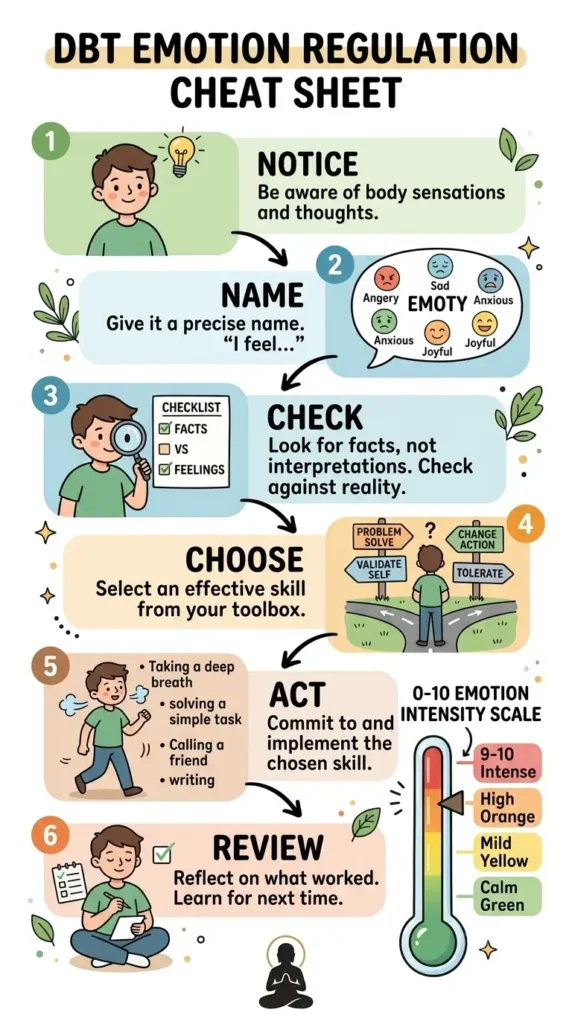
Free PDF: Keep the printable one-page version beside your journal, your desk, your therapy materials, or your skills practice. Want more tools like it? Browse the full DBT skills cheat sheet and worksheets collection, or pair it with these coping skills worksheets for the moments between sessions.
Emotion Regulation Activities for Adults, Teens and Kids
Emotion regulation activities turn DBT emotion regulation skills into small actions you can use in real moments. Which one fits? That depends on your age and how strong the feeling is. It also depends on your goal.
You might need to change the situation, change your response, or ride out the feeling safely. For printable practice pages, browse our full set of DBT skills worksheets.
Adults
Match the scenario to what’s happening right now. Then pick one skill. Not the whole module. Trying to use everything at once is how people end up using nothing.
| Situation | Emotion and urge | Skill | First action |
|---|---|---|---|
| Work stress | Anxiety; rush, avoid, or snap | Check the Facts | Write down what happened versus what you fear will happen. |
| Conflict | Anger; argue or send a harsh message | Opposite Action | Pause before replying and lower your voice. |
| Rejection | Sadness or shame; withdraw | Opposite Action | Stay connected to supportive people instead of isolating. |
| Hard conversation | Fear; avoid the conversation | Cope Ahead | Rehearse what you want to say and how you will respond. |
| Procrastination | Dread; keep scrolling | Build Mastery | Work on the smallest difficult step for five minutes. |
| Overwhelm | Anxiety; shut down | PLEASE + mindfulness | Check sleep, food, movement, and other physical vulnerabilities before choosing your next skill. |
Teens
Teens rarely get one trigger at a time. School demands, friendships, family tension, and constant online comparison all land together. That’s a lot for one week.
Two terms get mixed up here. DBT-A is a clinical adaptation of DBT for adolescents. DBT STEPS-A is a structured, school-based curriculum that teaches DBT-informed skills in educational settings. Neither one is the same as filling out a worksheet alone at home.
| Situation | Emotion and urge | Skill | First action |
|---|---|---|---|
| School pressure | Anxiety; avoid work | Problem Solving | Choose one assignment step you can finish now. |
| Friendship conflict | Anger; send an impulsive text | Check the Facts | Separate what your friend actually said from what you assumed. |
| Rejection | Shame or sadness; hide | Opposite Action | Talk to someone supportive instead of disappearing. |
| Social media | Envy or insecurity; compare yourself | Check the Facts | Step away and name the story you’re telling yourself. |
| Exams | Fear; procrastinate | Cope Ahead | Picture the stressful moment and rehearse your coping plan. |
| Family conflict | Anger; yell or leave abruptly | Mindfulness of Current Emotions | Notice the emotion and body sensations before choosing what to do. |
Kids
For children, these are DBT-inspired adaptations. They are not DBT protocols. Keep each activity concrete and brief, with a caregiver close by.
Emotion cards help a child name a feeling. A DBT-inspired emotion thermometer shows how strong it is. Drawing, or a DBT-inspired body map, shows where the feeling hits hardest. Then there’s a tiny-step version of opposite action. It turns “I don’t want to try” into one small action a child can manage.
Caregivers can also borrow a DBT-inspired Check the Facts prompt. Ask, “What did we see, and what did we guess?” The question helps a child split what happened from what they made of it.
Ready-to-use child activities are collected in these guides: emotions worksheet for kids and coping skills worksheets for kids.
One last distinction. DBT-C is clinician-delivered DBT adapted for children. Don’t confuse it with informal DBT-inspired activities or worksheets.
How to Practice in Daily Life
DBT emotion regulation skills pay off most on ordinary days. Not just in a crisis. Start small, repeat one skill, and track what happens. Then combine skills gradually, so the steps feel familiar when you actually need them. Printable DBT skills worksheets make the repeating easier.
Start With One Skill
Pick one skill that fits a problem you face often. Do you react before thinking? Start with Check the Facts. Does fear keep you avoiding situations? Learn Opposite Action. When low energy or poor routines make emotions harder to manage, start with PLEASE.
You don’t need to master the whole module at once. That’s not the goal. Repeat one skill until it makes sense. Find out when it helps, when it doesn’t, and what makes it easier to apply.
Practice Before You’re Overwhelmed
Hard moments are the worst time to learn a new skill. Steps are tough to recall once emotional intensity is already high. So practice during mild frustration, disappointment, worry, or irritation. Your brain gets familiar with the steps before it needs them.
A difficult email lands in your inbox. Your chest tightens. Don’t wait for a major conflict. Stop right there and name the emotion, using an emotion regulation worksheet if it helps. Later, when a bigger wave arrives, the skill won’t feel completely new.
Keep a Log
Memory is a poor record keeper. A short log shows patterns that are hard to spot after the fact. Jot down the situation, the emotion, and its intensity. Add the urge, the skill you tried, and what happened afterward.
Your coping skills log has room for all of it. Skip the full journal entry. A few honest notes are enough. They show which situations keep triggering the same emotions, and which skills help most.
Review What Worked
Practice isn’t a pass-or-fail test. It’s feedback. Set aside a few minutes to look back at your entries and ask yourself a few things:
- What triggered the emotion?
- Did you check the facts?
- Did you act on the urge?
- Which skill changed something?
- What would you try earlier next time?
A skill that flopped may have come too late. It may have been aimed at the wrong problem. Or exhaustion, a physical vulnerability, may have been working against it. For a deeper look at your patterns, journal prompts for mental health can guide the review.
Combine Skills in a Chain
One skill won’t always be enough. When it isn’t, use several in sequence. Name the emotion. Use Check the Facts. Choose Opposite Action. Then add Mindfulness of Current Emotions to stay present while the feeling changes.
Other situations call for a different order. PLEASE comes first, to reduce physical vulnerability. Cope Ahead follows, for an upcoming stressful event. More skills isn’t the goal. Choose the smallest combination that fits what is happening. When time is tight, five minute journal prompts make a quick way to log the chain afterward.
Common Mistakes
DBT emotion regulation skills work best when you use them to understand emotions, check what is happening, and choose an effective response. They are not meant to erase feelings or give you perfect control. A few common mistakes can make useful skills feel ineffective.
- Suppressing everything. Emotion regulation is not the same as pushing emotions away. Trying to shut down anger, sadness, fear, or shame can add another layer of distress. The goal is to notice the emotion, understand it, and respond skillfully.
- Using Opposite Action without checking the facts. Opposite Action is not a command to do the opposite of every strong feeling. First check whether the emotion fits the facts and whether acting on the urge would actually help. Real danger, justified anger, or valid guilt may call for a different response.
- Treating every emotion as a problem. Some emotions provide useful information. You don’t need to change an emotion simply because it feels uncomfortable. Sometimes the skillful response is to notice, accept, and tolerate the emotion.
- Using too many skills at once. When you’re overwhelmed, a long list of techniques can become another source of stress. Start with the skill that matches the problem, then add another only if needed.
- Expecting instant control. Regulation is a skill that improves through practice. A worksheet or technique may not make an intense emotion disappear. Measure progress by whether you can respond more effectively, even when the emotion is still present.
Also avoid skipping the “is acting on this effective?” question. An emotional urge can feel powerful without being useful. DBT asks you to consider both what the emotion is telling you and what response is likely to work.
Conclusion
DBT emotion regulation skills give you a practical way to understand emotions, reduce emotional vulnerability, and respond more effectively when feelings become intense. You don’t need to master every skill at once. Start by noticing what you feel, naming the emotion, checking the facts, and choosing one skill that fits the situation.
With regular practice, tools such as Opposite Action, Problem Solving, PLEASE, Mindfulness of Current Emotions, and Cope Ahead can become easier to use when you need them most. Use the worksheets in this guide to track what works, learn from difficult moments, and build a personal emotion regulation toolkit you can return to.
Frequently Asked Questions
What are the main DBT emotion regulation skills?
Core DBT emotion regulation skills include identifying emotions, Check the Facts, Opposite Action, Problem Solving, Mindfulness of Current Emotions, and ABC PLEASE.
Other commonly taught skills include Accumulate Positive Emotions, Build Mastery, Cope Ahead, and self-validation. Together, they help you understand, influence, and tolerate emotions more effectively.
What are the four skills on the Therapist Aid worksheet?
The four skills on the Therapist Aid DBT emotion regulation worksheet are Act Opposite, Check the Facts, PLEASE, and Pay Attention to Positive Events. They address different parts of emotional regulation, from checking whether an emotion fits the situation to reducing vulnerability.
Emotion regulation vs. distress tolerance?
Emotion regulation focuses mainly on understanding emotions, reducing vulnerability, and changing emotions or responses when appropriate.
Distress tolerance focuses on surviving intense emotional pain without making the situation worse. In practice, you may use both, depending on whether the priority is changing the problem or getting through a crisis.
How do you use Check the Facts?
To use Check the Facts, name the emotion, identify the observable facts, separate facts from assumptions, and consider other possible interpretations. Then ask whether the emotion and its intensity fit the situation. If they don’t, choose a skill such as Opposite Action.
When should you use Opposite Action?
Use Opposite Action when an emotion does not fit the facts or when acting on its usual urge is ineffective. First identify the emotion and its action urge, then deliberately do the opposite. The goal isn’t to deny feelings; it’s to change an unhelpful emotional pattern.
Can these skills be used for kids and teens?
Yes. DBT emotion regulation skills can be adapted for children and teens using simpler language, visual emotion scales, games, examples, and caregiver support.
Youth programs such as DBT-A use DBT skills with adolescents, while younger children need developmentally appropriate adaptations rather than adult worksheets alone.

It’s Bhaskar!
Well, I am not a psychologist a monk, or a philosopher by training. I’m just an engineering graduate.
‘The Empty Self’ is where I write about that idea, and what it actually means for ordinary life, anxiety, identity, habits, the stories we tell ourselves about who we are. I don’t have a psychology degree, and I’m not offering therapy or clinical advice. What I do have is thought and clarity, and genuine curiosity about why we suffer the way we do and how much of it might loose once we shed this ‘fixed identity’.
Pingback: DBT Self-Validation: Ultimate 2026 Guide With Free Worksheet & Printables | The Empty Self
Pingback: 10 Best DBT Books & Workbooks: Complete List for Teens and Adults | The Empty Self