
DBT techniques & strategies give you a way to handle big emotions without reacting to every single one. That’s the whole point. Dialectical behavior therapy (also called DBT) mixes two things that sound like opposites: accepting where you are and still working to change. You learn to notice what you’re feeling as it happens. Not after the fact.
These DBT strategies work when you’re overwhelmed, when you react before you think, or when saying no feels impossible. Some use mindfulness. Others lean on self-soothing. Each one gives you a different way to meet a hard moment instead of getting swallowed by it. Want to actually practice these instead of just reading about them? These free DBT worksheets walk you through real situations, not theory.
Here’s the short version. DBT breaks into four skill areas: mindfulness, distress tolerance, emotion regulation, and interpersonal effectiveness. A handful of DBT techniques sit under these four areas and do most of the heavy lifting:
- STOP: stops the impulsive reaction before it fires
- TIPP: cools the body down fast when emotion spikes
- Opposite action: moves you against a feeling that isn’t serving you
- Self-soothing: settles the nervous system through the five senses
- DEAR MAN: gets your needs said out loud, clearly
Why does any of this matter? Because emotions move faster than thought. These DBT concepts give you something to do in that gap. If you want a fuller map of what you’re actually feeling before you try to manage it, pair this with an emotions worksheet or the broader coping skills worksheets already on the site.
Table of Contents
Disclaimer
This blog is written and edited with the help of AI, then reviewed by me before publishing. As a result, the content is for general reflection only, not therapy or medical advice, and I’m not a licensed mental health professional. If you’re in crisis, please contact 988 if you’re in US or a local crisis service of your country instead of relying on this site.
DBT Techniques & Strategies: What They Are and How They Help
DBT techniques & strategies help people manage big emotions. They also build skill for coping with distress. And they teach better responses to hard situations.
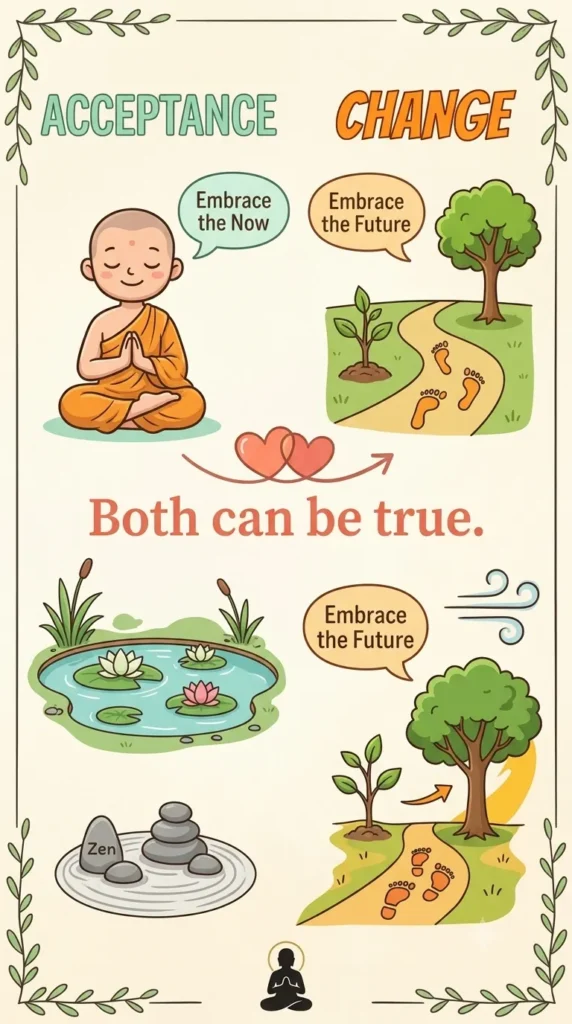
Dialectical behavior therapy (DBT) pairs acceptance of what’s happening right now with real steps toward change. You get to feel something fully. You don’t have to let it run the show.
This article is for learning. It’s not a stand-in for mental health care.
What Is Dialectical Behavior Therapy (DBT)?
Dialectical behavior therapy is a structured form of talk therapy. Psychologist Marsha M. Linehan built it. It teaches skills for handling emotions, riding out distress, and showing up better in relationships.
DBT started out for people with borderline personality disorder (BPD). It’s since been adapted for a wider range of emotional and behavioral struggles. The American Association for Behavioral and Cognitive Therapies breaks down the approach in more depth.
The word dialectical points to holding two opposite ideas at once. In DBT, those ideas are acceptance and change. You see your experience clearly, as it is. At the same time, you work on shifting a behavior once it stops serving you.
That’s the whole balance.
Learning DBT Techniques vs. Comprehensive DBT Treatment
Here’s an honest distinction worth making. Picking up a few DBT skills on your own is not the same thing as full DBT treatment.
You can absolutely practice mindfulness, distress tolerance, and emotion regulation through books, worksheets, or guides like this one. But a complete DBT program usually runs on four parts working together, not one technique borrowed here and there.
- Individual therapy: Targets personal goals and any behavior putting safety or quality of life at risk.
- Skills training: Teaches the practical tools, often in a group setting.
- Between-session coaching: Helps a client use skills in the moment, based on how the therapist has set things up.
- Therapist consultation team: Backs up the clinicians so treatment stays consistent.
The Association for Behavioral and Cognitive Therapies’ DBT fact sheet lays out these four parts. It also draws a clear line between comprehensive DBT and programs that only borrow pieces of it.
Want the structured version for working through these skills yourself? Our DBT skills worksheets walk through the core techniques one at a time.
Who Can Benefit From DBT Skills?
DBT skills tend to help anyone dealing with intense emotions, impulsive reactions, rocky relationships, or trouble coping with distress. Not just people with a BPD diagnosis. Not even close.
That said, the right treatment depends on what a person actually needs. Self-guided exercises are useful. They’re not a replacement for professional support when that support is called for.
The core idea stays simple. Accept what’s happening without assuming you have to accept every behavior that follows it. You can feel angry, say, and still choose to pause before you react.
That’s the balance that makes DBT skills useful far outside the therapy room. If you’re also building a broader coping toolkit, our coping skills worksheets and emotions worksheet pair well with the DBT techniques covered here. behaviour that follows.
You can acknowledge anger, for example, while choosing to pause before responding. That balance is what makes DBT techniques useful beyond the therapy room.
The Four Core DBT Skills and Techniques
DBT techniques & strategies break into four buckets. Mindfulness. Distress tolerance. Emotion regulation. Interpersonal effectiveness. Each one solves a different problem, from staying grounded mid-stress to getting through a hard conversation without blowing it up.
That’s the whole structure behind DBT. A peer-reviewed look at DBT’s core skills backs up what therapists already noticed on the ground: these four areas, practiced together, do more than any single skill working alone.
These DBT techniques & strategies don’t erase hard feelings. They change what you do with them. You stop reacting on impulse. You start choosing instead.
Mindfulness Techniques: Notice Before You React
Notice first. React later.
Mindfulness means paying attention to the current moment. No judgment attached. That part is harder than it sounds.
Three basic skills carry the weight: observe, describe, participate. Observe means noticing a feeling without acting on it yet. Describe means naming it in plain words. Participate means fully showing up once you’ve named it.
Here’s a decision moment. A text lands wrong. Your chest tightens before you’ve even reread it. Observe that tightness. Describe it as anger, or maybe worry. Pause before you type one word back.
You don’t have to make the feeling disappear. You just need to notice it before it drives.
Want practice tools for this part? These mindfulness journal prompts walk through observing and naming feelings step by step, no DBT session required to start.
Distress Tolerance Techniques: Get Through a Difficult Moment
This isn’t about fixing the moment. It’s about surviving it without making things worse.
Distress tolerance skills exist for exactly that: painful emotions, no exit nearby. The STOP skill is a good starting point. Stop. Take a step back. Observe what’s actually happening. Proceed, but proceed mindfully.
TIPP goes further for moments when your body runs hotter than your mind can track. Temperature shifts, cold water on the face. Intense exercise, short bursts. Paced breathing, a slower exhale than inhale. Paired muscle relaxation, tense and release.
Why does this work when nothing else does? It hits the nervous system directly, not just the thought behind it.
Not every option fits every person. Extreme cold and hard exercise carry real risk for some bodies. Skip them if they’re unsafe for you, and bring in a professional if you’re unsure.
A few more DBT practices worth knowing: radical acceptance, self-soothing techniques through the five senses, and the ACCEPTS skills for healthy distraction. These coping skills worksheets cover most of them in one place, with room to actually practice.
Emotion Regulation Techniques: Understand and Respond to Feelings
Feelings aren’t facts. But they’re not noise either.
Emotion regulation means figuring out what a feeling is telling you, what’s feeding it, and picking a response that actually fits. That’s different from suppressing it. It’s also different from acting on every impulse it sends.
Opposite action is one of the sharper DBT concepts in this group. The idea: act against an unhelpful urge when the facts don’t support it. Fear says avoid the party. The facts say it’s safe. So you go anyway, gently, one step at a time. It’s a dialectical behavior therapy example you can actually test this week.
The PLEASE skills handle something people skip constantly: the body. Sleep. Eating. Illness. Exercise. Substances. Neglect those, and no amount of willpower holds a mood steady.
Cope Ahead flips the order. Instead of reacting after a hard event, you plan for it first. Picture the event. Picture the hard part. Rehearse the response before you’re standing inside it.
Not sure where to start naming what you feel? This emotions worksheet is built for exactly that, a simple way to put language to what’s going on before you decide how to respond.
Interpersonal Effectiveness Techniques: Ask for What You Need
Boundaries feel uncomfortable. That’s expected.
Interpersonal effectiveness skills help you say what you need, keep the relationship intact, and still respect yourself in the process. Three acronyms carry most of the weight. DEAR MAN helps you make a request or hold a line. GIVE keeps the relationship steady while you do it. FAST protects your own self-respect in the exchange.
Picture this: a friend keeps making jokes that land wrong. Before you say anything, DEAR MAN has you lay out what happened, how it hit you, and what you’re actually asking for. Not vague. Specific.
These skills were never about winning the argument. They’re about saying your piece clearly, while still weighing the relationship and your own values.
Ready to put this into practice? These DBT skills worksheets cover DEAR MAN, GIVE, and FAST with exercises for the next hard conversation that comes up.
DBT Techniques & Strategies You Can Practise in Everyday Life
DBT techniques work when you match the skill to the actual problem. Not before. These dialectical behavior therapy examples below show you what to do when emotions spike, when a hard conversation is coming, or when the same mess keeps repeating. No theory first. Just the move.
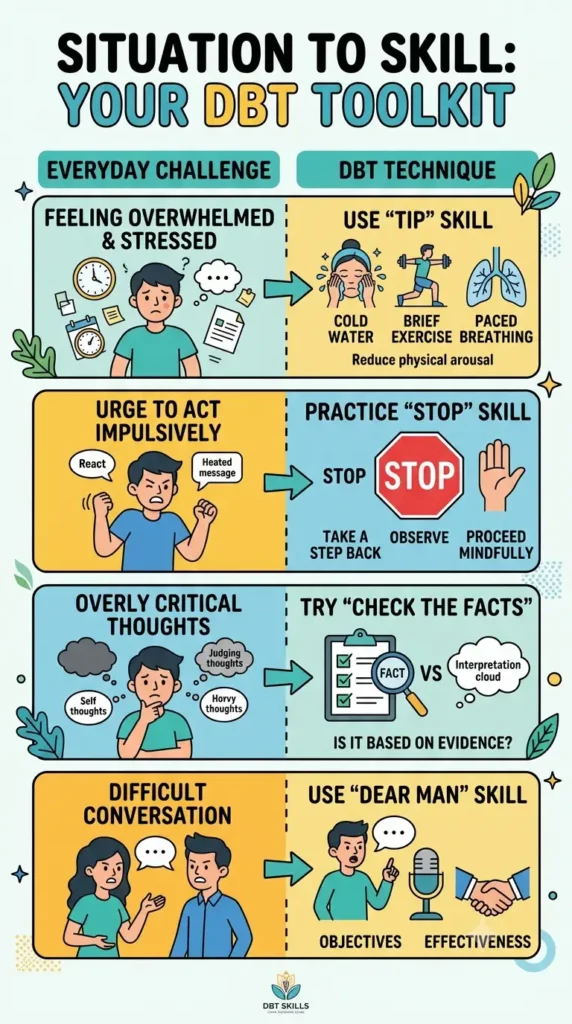
| Situation | DBT skill to try |
|---|---|
| Emotions are rising fast | STOP, grounding, or paced breathing |
| You feel an urge to withdraw or lash out | Opposite action |
| You need to ask for something or set a boundary | DEAR MAN, GIVE, or FAST |
| The same problem keeps happening | Behaviour chain analysis |
When Your Emotions Feel Overwhelming
Use STOP before you act. Stop. Take a step back. Observe. Proceed mindfully. Four words. That’s the whole skill. Grounding helps here too, and so does slow, comfortable breathing, the kind that pulls your attention out of your head and back into the room.
If the problem can wait, let it. Get through the emotional peak first. Solve the actual issue once your head clears, not while you’re still in it.
When You Want to Avoid Someone or React in Anger
Opposite action means doing the thing your urge is telling you not to do, but only when that urge doesn’t match the facts. Sounds backwards? It kind of is. Say a colleague snaps at you and every instinct says snap back.
Opposite action looks more like asking a calm question instead. One clarifying sentence instead of a fight. This isn’t about ignoring real danger. It’s not a pass to tolerate mistreatment either. It’s for urges that don’t fit what’s actually happening.
When You Need to Set a Boundary or Make a Request
DEAR MAN structures the request itself. GIVE protects the relationship while you make it. FAST keeps your self-respect intact once it’s done. Three tools, three jobs.
These are some of the more practical counseling techniques DBT uses, built for people who either go silent or go sharp when they need something. Neither extreme gets you what you actually want. Say what you need, plainly, and stay in the room for the response.
When You Feel Stuck in a Pattern
Behaviour chain analysis breaks a repeated pattern into pieces you can actually see. What happened first. What made you vulnerable that day. The thoughts and feelings that followed. The behaviour itself. What it cost you afterward.
Laid out like that, the pattern stops feeling random. One link usually stands out as the place a different skill could have broken the chain. Find that link, and next time you have a choice point instead of a blind spot.
Want more structured practice? These coping skills worksheets and DBT interpersonal effectiveness skills walk through each of these in worksheet form, the kind you can actually fill out instead of just reading about.
The DBT Model of Emotions: How to Understand What You Feel
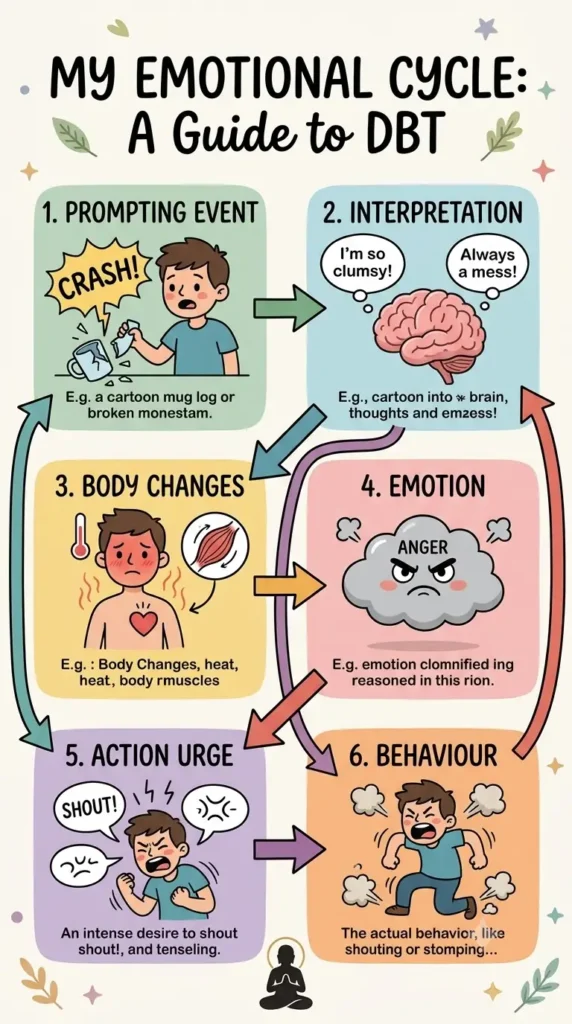
Feelings don’t come out of nowhere. Something happens, your brain adds a story, your body reacts, and then you want to do something about it. The DBT model of emotions maps that whole chain. Separate the event from the story you told yourself about it, and you get room to respond instead of just reacting.
What Is the DBT Model of Emotions?
This model comes straight out of Dialectical Behavior Therapy, or DBT. It explains how a single moment turns into a full-blown reaction. A prompting event happens first. Then your brain adds an interpretation. Your body shifts. A feeling shows up. And right behind it, an urge to act.
These pieces don’t always move in a straight line. Sometimes the body reacts before the thought even finishes forming. That’s normal.
Here’s how it plays out. A friend reads your text and doesn’t reply. Your chest tightens. You tell yourself they’re mad at you, or pulling away. Anxiety creeps in. Suddenly you’re typing a third follow-up message. But look at the actual facts: your friend hasn’t replied yet. That’s it. Everything else, the rejection, the pulling away, is a story your mind built on top of silence.
That gap matters. It’s where most of the suffering lives.
Learning to Separate Fact From Story
Start with the event, nothing else. No meaning attached yet. Then work outward: what did your mind add? What happened in your body? What’s the emotion? What do you want to do about it?
Go back to the unanswered text. Ask yourself three questions. What do I actually know? What am I assuming? What else could explain this? Maybe they’re driving. Maybe their phone died. Maybe they just haven’t opened the app.
This mirrors one of the core DBT skills covered in our full guide, called Check the Facts. It’s built to test whether your emotional reaction actually fits the situation in front of you, or whether it’s running on an old script.
Most people skip this step. They go straight from event to reaction, no stop in between. That’s where the model earns its keep.
A Simple Model-of-Emotions Practice Exercise
Keep it short. One page, five lines, done the moment a strong feeling hits. Writing it down slows the spiral down enough to actually see it.
- Event: What happened, just the facts.
- Interpretation: What you told yourself it meant.
- Body and emotion: What you felt, physically and emotionally.
- Urge: What you wanted to do in that moment.
- Response: What action actually fits the facts, and your values.
Run through this a few times and patterns start showing up. Maybe silence always reads as rejection to you. Maybe tight shoulders always mean anxiety before you’ve even named it. Pair this with a full emotions worksheet if you want to track those patterns over weeks instead of guessing from memory.
Sound too simple to matter? It is. That’s exactly why it works.
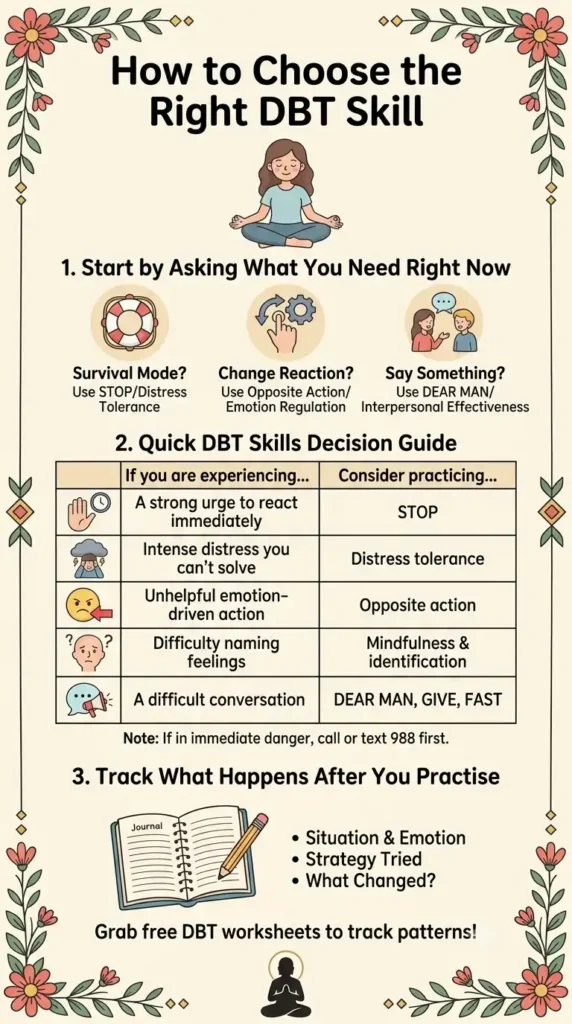
How to Choose the Right DBT Skill for Your Situation
No single DBT skill fixes every problem. Some pull you through a crisis in the moment. Others change a reaction that keeps backfiring on you. A few just keep a hard conversation from falling apart. That’s the real task. Not memorizing every DBT technique on a list. Name the problem first, then match it to the right strategy.
Start by Asking What You Need Right Now
Before reaching for any DBT strategy, ask one question. Am I trying to survive this moment? Change how I’m reacting? Or say something to someone else?
Feelings spiking past what you can manage? Start with a distress tolerance skill. STOP or paced breathing can buy you room before you decide anything else.
Stuck in a reaction that keeps backfiring? That’s emotion regulation territory. Opposite action, used when it actually fits the moment, can shift the pattern.
Need to ask for something, or hold a boundary? Interpersonal effectiveness skills like DEAR MAN help you plan the words before the moment shows up.
Can’t even name what you’re feeling? Slow down with mindfulness. Notice the thought, the feeling, the tight chest. No judging it yet.
One line matters more than the rest of this section. If you’re in immediate danger, skip the coping skill entirely. Call or text 988 and get real help first.
Use This Quick DBT Skills Decision Guide
A table says this faster than a paragraph ever could. Match the feeling in front of you against the skill built for it.
| If you are experiencing… | Consider practicing… |
|---|---|
| A strong urge to react immediately | STOP |
| Intense distress you can’t solve right away | Distress tolerance or self-soothing |
| An emotion pushing you toward an unhelpful action | Opposite action, when appropriate |
| Difficulty naming what you feel | Mindfulness and emotion identification |
| A difficult conversation or boundary | DEAR MAN, GIVE, or FAST |
| A recurring behavior pattern | Behavior chain analysis |
These aren’t rules carved in stone. Starting points, nothing more. Some situations need more than one DBT technique stacked together. Mindfulness to catch the reaction, say, followed by a distress tolerance skill to actually steady yourself.
Track What Happens After You Practise
A skill you never review is a skill you’ll forget works. A simple log fixes that. Write down the situation, the emotion you noticed, the strategy you tried, and what changed afterward. Note what you’d do differently too.
Grab the free DBT skills worksheets for printable tracking tools and diary cards. Go back through old entries every few weeks. Patterns show up that you’d never catch in the moment, and picking the right skill gets easier every time you do.
Free DBT Worksheets, Printables, and Practice Resources
A worksheet turns a DBT technique into a habit. It gives you a place to practice, reflect, and track what’s working. Where you start depends on what’s loudest right now: distress, confusing emotions, a racing mind, or a conversation you keep avoiding.
Free DBT Skills Worksheets for Everyday Practice
Need one place to start? These free DBT skills worksheets cover all four core DBT skill areas. You don’t have to learn everything at once.
Pick one worksheet. Match it to whatever’s actually hard today. Work through it slowly. Then notice what landed and what still feels shaky.
A worksheet isn’t a test. There’s no passing grade. You can come back to the same page next month, next year, whenever a new situation calls for it.
Worksheets for Distress Tolerance and Crisis Survival
Intense emotion makes it hard to remember anything, let alone a skill. That’s the problem distress tolerance worksheets solve. They let you rehearse the move before you’re standing in the middle of a crisis.
Start with the DBT distress tolerance skills guide. It walks through ways to get through distress without making things worse. From there, practice the DBT STOP skill to build a pause between the urge and whatever you do next.
One thing worth saying plainly: these skills help you manage hard moments. They are not a substitute for emergency support if you’re in immediate danger.
Emotion Regulation and Mindfulness Worksheets
Most people can’t name what they’re feeling in the moment. That’s not a flaw. It’s just unpracticed.
Emotion regulation worksheets start there. They help you identify the feeling, spot what’s feeding it, and choose a response instead of reacting on autopilot. Begin with the DBT emotion regulation skills guide, or use this emotions worksheet to practice naming what’s actually going on.
Mindfulness works differently. It’s not about fixing a thought or feeling. It’s about noticing it without chasing it or pushing it away. The DBT mindfulness skills guide builds that muscle over time, one short practice at a time.
Interpersonal Effectiveness Worksheets
Struggling to set a boundary? Ask for what you need without over-explaining it? Handle conflict without shutting down or blowing up?
That’s what the DBT interpersonal effectiveness skills guide is for. Use the worksheets to prep for a real conversation before you have it. Get clear on your priority. Then practice saying it in a way that respects you and the other person.
Can You Practise DBT Techniques Without a Therapist?
Short answer: yes. You can practise plenty of DBT techniques alone, using worksheets, guided exercises, and honest reflection. Self-guided practice helps you notice emotions and build small coping habits. It is not the same thing as full DBT treatment, though. That distinction matters more than it sounds.
What Self-Guided Practice Can Help You Learn
Start small. Mindful breathing, naming the emotion, self-soothing, writing down what happened right before a strong reaction. Nothing fancy. A DBT skills worksheet can help you slow down, spot the pattern, and pick a steadier response next time.
Pick one skill. Not all of them at once. That’s the trap most people fall into. Try the STOP skill the next time an urge pushes you toward a fast reaction, then look back at what shifted afterward. The goal isn’t erasing hard feelings. It never was. It’s responding to them on purpose instead of on autopilot.
When Professional Support Matters
A worksheet handles everyday stress well enough. It can’t do everything. Professional guidance matters more once intense emotions keep disrupting relationships or daily life, or when using a skill safely feels out of reach on your own.
A trained mental health professional can help you figure out what you actually need and whether a structured DBT programme fits. The National Institute of Mental Health has more on borderline personality disorder and its treatment, if you want to read further.
What to Do if You Are in Immediate Danger
This isn’t a moment for a worksheet. If you may hurt yourself or someone else, or you can’t keep yourself safe, get help right now. Contact your local emergency services, or go to the nearest emergency department. Don’t wait it out alone.
In the United States: Call or text the 988 Suicide & Crisis Lifeline.
In other countries: Visit Find A Helpline to locate crisis support where you live.
DBT skills can carry you through a rough moment. That’s real. But a crisis isn’t something to manage solo, and you don’t have to.
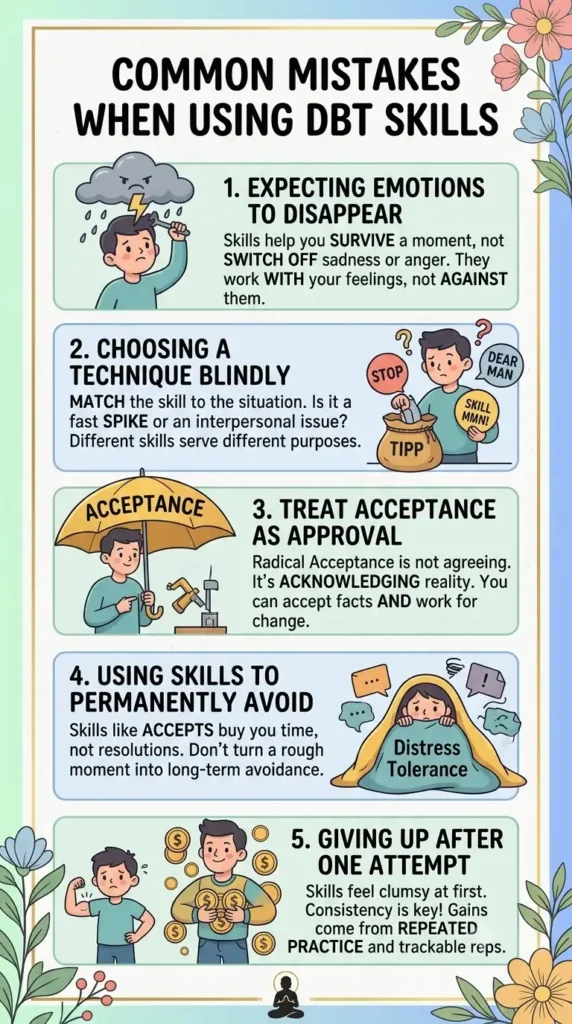
Common Mistakes When Using DBT Skills
DBT skills take practice. Using them wrong at first isn’t failure. It’s the normal shape of learning something new.
The goal was never to make hard emotions vanish. It’s to react with less damage, and make choices that actually fit what you need. Here’s where people usually trip.
Expecting a Skill to Make an Emotion Disappear
This isn’t about switching sadness off. Or anger. Or fear. No DBT technique works that way.
Distress tolerance gets you through a rough moment without making it worse. That’s the whole job, nothing more. Emotion regulation works differently. It helps you understand a feeling and respond to it with intention.
A skill can still be useful while the emotion sits right there with you. Unchanged. That’s not the skill failing. That’s the skill doing exactly what it was built for.
Choosing a Technique Without Considering the Situation
Not every DBT skill fits every problem. Picking blind is where most people go wrong.
Emotions spiking fast, urge to react building? The STOP skill or paced breathing from TIPP can create a pause before anything happens. Need to make a clear request instead, maybe push back on something? DEAR MAN fits that moment better, especially through interpersonal effectiveness skills.
Ask one question first. Am I trying to survive a feeling, change a feeling, or fix a situation with another person? That single question narrows the whole DBT toolkit down to the two or three skills worth trying.
Treating Acceptance as Approval
Radical acceptance isn’t agreement. It’s not saying something was fair, or fine, or okay.
It means acknowledging reality as it stands right now. You can accept that a relationship changed while still setting a hard boundary around it. You can sit with a painful situation while actively working to improve it. Both at once. That’s the dialectical part of DBT, holding two true things that don’t cancel each other out.
Acceptance just means you stop fighting the facts. It says nothing about giving up your right to change what comes next.
Using Distress Tolerance to Avoid Every Problem
Distraction works. Self-soothing works too. Both can pull down an emotional surge fast.
Neither one solves what caused the surge in the first place. The ACCEPTS skill buys you time, not a resolution. So once you feel steadier, ask the harder question. Does this need problem-solving? A boundary? An honest conversation you’ve been putting off?
Skip that step enough times and distress tolerance turns into permanent avoidance. That’s not the skill’s fault. That’s a choice happening underneath it.
Giving Up After One Attempt
A skill often feels clumsy the first time. Worse during intense emotions, when nothing feels like it’s landing right.
Sound discouraging? It’s actually normal. One attempt tells you almost nothing about whether a technique works for you. Practice it on a calmer day. Notice what happened. Adjust, then try again.
A 2024 review of DBT skills training found consistent gains across repeated practice, not single use. Progress here comes from reps, not a flawless first run. Track what you try with a coping skills worksheet or an emotions worksheet, and the pattern of what actually works for you starts showing up on paper instead of staying a guess.
Conclusion
DBT techniques & strategies are most useful when you practise them before you need them most. Start with one skill that fits your current challenge, whether that means using STOP when emotions rise, practising self-soothing during distress, or using DEAR MAN to communicate a boundary.
You don’t have to master every skill at once. Small, repeated efforts can help you notice emotional patterns and choose more thoughtful responses over time.
For guided practice, explore our free DBT skills worksheets and work through one exercise at a time. If emotions feel unmanageable, a qualified mental health professional can help you practise these skills with support.
Frequently Asked Questions
What are the four main DBT techniques or skill areas?
The four DBT core skills are mindfulness, distress tolerance, emotion regulation, and interpersonal effectiveness. Use mindfulness to notice what is happening, distress tolerance to get through a difficult moment, emotion regulation to respond to feelings more effectively, and interpersonal effectiveness to handle requests, conflict, and boundaries.
What is the difference between DBT techniques and comprehensive DBT therapy?
DBT techniques are individual skills you can practise, such as STOP, opposite action, or DEAR MAN. Comprehensive DBT is a structured treatment that typically includes individual therapy, group skills training, between-session coaching, and a therapist consultation team. Self-guided practice can help build skills but is not the same as the full treatment.
Which DBT skill should I use when I feel overwhelmed or emotionally flooded?
Start with STOP if you feel ready to react impulsively: pause, step back, observe what is happening, and proceed mindfully. If your distress remains intense, try paced breathing or a familiar self-soothing technique.
Once the emotional intensity eases, consider whether you need to solve a problem or simply tolerate what cannot be changed right now.
How do you use the DBT model of emotions to understand a feeling?
The DBT model of emotions helps you examine how an event, your interpretation, bodily sensations, and action urges may influence your emotional response. Write down what happened, what you told yourself about it, what you felt in your body, and what you wanted to do. This can help you identify where a more effective response is possible.
Can I practise DBT techniques on my own using free worksheets?
Yes. Free DBT worksheets can help you practise mindfulness, track emotional patterns, and rehearse skills such as distress tolerance or interpersonal effectiveness.
Choose one skill that fits a current challenge and practise it consistently. If distress is severe, harmful behaviours continue, or you struggle to use skills safely, seek support from a qualified mental health professional.
What is the difference between distress tolerance and emotion regulation in DBT?
Distress tolerance helps you endure a painful moment without making it worse, especially when you cannot fix the situation immediately.
Emotion regulation helps you understand emotions, reduce vulnerability to intense reactions, and choose responses that fit your goals. You might use distress tolerance first during a crisis, then emotion regulation to address the pattern afterward.

It’s Bhaskar!
Well, I am not a psychologist a monk, or a philosopher by training. I’m just an engineering graduate.
‘The Empty Self’ is where I write about that idea, and what it actually means for ordinary life, anxiety, identity, habits, the stories we tell ourselves about who we are. I don’t have a psychology degree, and I’m not offering therapy or clinical advice. What I do have is thought and clarity, and genuine curiosity about why we suffer the way we do and how much of it might loose once we shed this ‘fixed identity’.