
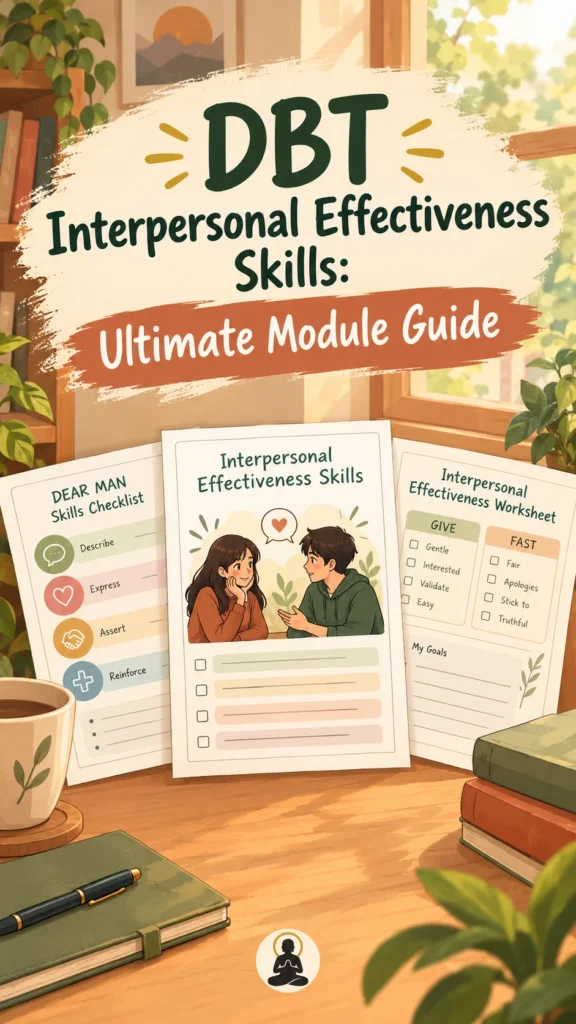
Saying what you need out loud is harder than it sounds. You rehearse the sentence in the shower, then swallow it the second the other person’s face changes. That’s the gap DBT interpersonal effectiveness skills are built for. Not confidence. Not personality.
A set of steps you can run in the room, even while your hands are shaking. DBT interpersonal effectiveness skills help you say what you mean, hold a boundary, and get through conflict without torching the relationship or burying your own needs to keep the peace.
These skills come out of Dialectical Behavior Therapy, a therapy built around teachable, repeatable responses to hard emotional moments. Not theory. Reps. Why does one conversation go fine while the next one wrecks you? Usually it’s not the topic. It’s the lack of a plan.
Three skill sets carry most of the weight here: DEAR MAN, GIVE, and FAST. DEAR MAN gets your actual request across. GIVE keeps the other person in the room with you while you say it. FAST stops you from apologizing your way out of something you had every right to ask for.
You’ll see this called interpersonal effectiveness DBT, interpersonal effectiveness skills, or just “the relationship module.” Same thing. And you don’t need a workbook to start. Simple examples, short practice prompts, and free worksheets below get you using DEAR MAN, GIVE, and FAST in your next real conversation, not someday.
Quick Overview: DBT interpersonal effectiveness skills help you ask for what you need, hold a boundary, and keep your self-respect intact while you do it. Learn DEAR MAN, GIVE, and FAST through plain examples, short reflection exercises, and free printable worksheets built for everyday conversations.
Table of Contents
Disclaimer
This blog is written and edited with the help of AI, then reviewed by me before publishing. As a result, the content is for general reflection only, not therapy or medical advice, and I’m not a licensed mental health professional. If you’re in crisis, please contact 988 if you’re in US or a local crisis service of your country instead of relying on this site.
What Are DBT Interpersonal Effectiveness Skills?
DBT interpersonal effectiveness skills teach you how to speak up without wrecking the relationship. That’s the core of it. You learn to set a boundary. Ask for something. Say no. And still respect yourself when the conversation ends. These tools sit inside the wider DBT skills worksheets library, right alongside the modules for distress and emotion. Here, the lens narrows to one thing. Other people, and how you hold your ground around them.
Most communication advice tells you to “just be confident.” Not much help at 11pm mid-argument. DBT interpersonal effectiveness skills give you an actual structure instead. Something to lean on when your head goes blank and the stakes feel too high to wing it.

What Interpersonal Effectiveness Means in DBT
Interpersonal effectiveness is one of four core modules in Dialectical Behavior Therapy. DBT is a therapy built to manage emotions, survive distress, and fix the way people talk to each other. Four jobs, one framework.
This module handles the relationship piece. You learn to speak clearly. Listen without checking out. Respond instead of react, even mid-conflict. Sound easy? It isn’t, especially when someone’s already raising their voice.
A lot of this starts with noticing your own state before you open your mouth. That’s where mindfulness journal prompts come in handy, since a clear head makes the rest of this module easier to use.
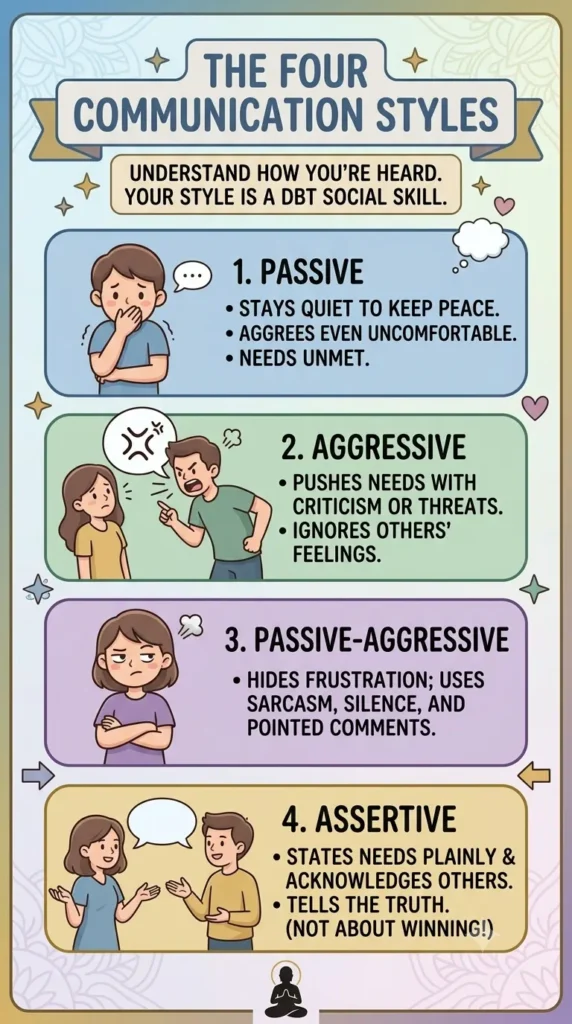
The Four Communication Styles: Passive, Aggressive, Passive-Aggressive, Assertive
Your communication style decides whether people actually hear your needs. Most people default to one pattern without noticing. Naming yours is step one toward better DBT social skills.
Passive means staying quiet to keep the peace. You agree, even uncomfortable. Nothing gets said.
Aggressive pushes needs through with criticism or threats. The other person’s feelings don’t factor in.
Passive-aggressive hides the frustration instead of naming it. Sarcasm. Silence. A pointed comment dropped and left there.
Assertive says what you need, plainly, while leaving room for the other person’s view too.
Here’s the part people miss. Assertiveness doesn’t mean winning every exchange. It means telling the truth without attacking anyone, including yourself. These four patterns show up constantly in DBT communication skills work, and most people recognize their own the second they read the list.
What Are the Three Goals of Interpersonal Effectiveness?
DBT interpersonal effectiveness skills balance three goals at once. Rarely all three fully, and that’s by design.
Objective effectiveness means getting what you need, or at least saying it clearly. This is where DEAR MAN does its work, breaking a hard ask into steps you can actually follow under pressure.
Relationship effectiveness protects the bond while you make your case. GIVE exists for exactly this. Gentle, interested, validating, easy. Four checks that keep the conversation from catching fire.
Self-respect effectiveness means acting in line with your own values, not just keeping everyone comfortable. FAST handles that side. Fair. No over-apologizing. Stick to what you believe. Stay truthful.
These goals compete more than people expect. Want to say no to a friend and keep the friendship intact? Good luck doing both perfectly. DBT doesn’t pretend you can. It just helps you decide, in that specific moment, which goal actually matters most.

When Should You Practice These Skills?
Practice when you’re asking for help. Refusing something. Sitting inside a disagreement that won’t resolve itself. Setting a boundary nobody asked you to set. Repairing something you said badly the first time.
School, work, home, friendships. The skills travel. They don’t care which room you’re standing in.
Start small. Pick a low-stakes conversation first, not the one that’s been looming for weeks. Build the muscle there. Then, when the harder situation shows up, and it will, you’re not learning the skill and using it in the same breath.
Tracking how these conversations land over time helps too. Pairing a worksheet with journal prompts for mental health gives you a record of what actually worked, instead of relying on memory alone.e skills when a more challenging situation arises.
The Three Core DBT Interpersonal Effectiveness Skills at a Glance
DBT interpersonal effectiveness skills solve one problem. How do you ask for what you need without the relationship blowing up? Three skill sets carry that weight. DEAR MAN, GIVE, and FAST. Each one does a different job. DEAR MAN gets you an answer. GIVE and FAST protect the relationship and your self-respect while you get there.
Reading about these skills and actually using them mid-argument are two different things. That’s where a set of structured DBT skills worksheets earns its keep. Especially before a conversation you’re already dreading.
| DBT Skill | Main Goal | What It Helps You Do | Best Used When… |
|---|---|---|---|
| DEAR MAN | Get an objective met | Make requests, say no, explain your needs, and negotiate | You need a clear answer, change, or boundary |
| GIVE | Maintain the relationship | Listen, show interest, validate feelings, and communicate gently | You want to preserve trust or resolve a disagreement |
| FAST | Keep your self-respect | Be fair, avoid unnecessary apologies, stick to your values, and stay truthful | You feel pressured to compromise your values or agree against your wishes |
DEAR MAN / GIVE / FAST
This isn’t three versions of the same skill. Not even close. DEAR MAN gets your point across. GIVE keeps the other person from shutting down. FAST keeps you from betraying your own values just to end the conversation faster. Use them separately, or stack all three in one hard conversation. That’s the real flexibility here.
Picture this: a friend keeps making jokes that land wrong. You’ve asked once already. DEAR MAN hands you the words to name the problem and ask for change. That’s the easy part. GIVE keeps you listening instead of writing your friend off completely. An emotions worksheet can even help you sort out what you’re actually feeling before that talk. FAST is what stops you from laughing along just to keep the peace.
How to Choose the Right DBT Interpersonal Effectiveness Skill
One question settles which skill to reach for. What actually matters most in this conversation? The answer points you straight to DEAR MAN, GIVE, or FAST.
- Need a clear answer or a real change? Start with DEAR MAN.
- Want to protect or repair the relationship? Lead with GIVE.
- Need to hold onto your self-respect? Use FAST.
- Juggling more than one goal at once? Stack the skills instead of picking just one.
Priorities shift mid-conversation. That’s normal. You’re not trying to control how the other person reacts. You’re aiming for something steadier. Your needs. The relationship. Your self-respect. Weighed together, not traded off one for another. That balancing act is the whole idea behind Marsha Linehan’s DBT framework in the first place.t.
DEAR MAN DBT Skill: How to Ask for What You Need
DBT interpersonal effectiveness skills exist for exactly this moment: you need something, and saying so feels harder than it should. DEAR MAN gives you a structure for that. Not a script. A shape to lean on when the right words won’t come.
This is one piece of the wider interpersonal effectiveness toolkit, right alongside GIVE and FAST. Use it to ask, to set a boundary, or to say no without the guilt spiral that usually follows.
What Does DEAR MAN Stand For?
DEAR MAN is a Dialectical Behavior Therapy skill built for two moments. Making a request. Turning one down. Seven letters, seven steps.
- D — Describe: State the facts. No blame attached.
- E — Express: Say what you feel about it.
- A — Assert: Ask directly, or say no directly.
- R — Reinforce: Explain what’s in it for them.
- M — Mindful: Stay on point.
- A — Appear confident: Steady voice. Clear words.
- N — Negotiate: Be open to a fair middle ground.
Nobody nails every letter every time. That’s not the bar. The real goal is saying what you mean, not steering how the other person reacts. You can’t control that part anyway.
How Intensely Should You Ask?
Firmness isn’t one setting. It shifts with four things: priorities, capabilities, rights, and timing.
Priorities come first. How much does this outcome actually matter? A small preference gets a soft ask. A real boundary gets a firm one. Mixing those up is where most requests go sideways.
Capabilities matter too. What can you realistically offer, and what can the other person realistically give back? Asking for something nobody can deliver isn’t assertiveness. It’s just setup for frustration.
Rights are simpler than people think. You get to decline a request. You get to ask for basic respect. What you don’t get is someone else’s agreement. That part was never yours to demand.
Timing can make or break the whole thing. A calm, private moment helps with anything sensitive. But if a boundary is being crossed right now, waiting for the “right time” isn’t an option. Speak up.
Start polite when you can. Raise the firmness only if you’re being ignored. And firmness doesn’t need volume. It doesn’t need threats or a ten-minute explanation either. One clear sentence usually does more than five defensive ones.
DEAR MAN Example: Asking for a Boundary at Home
Say your sibling keeps borrowing your clothes. No heads-up, ever.
- Describe: “You borrowed my jacket yesterday without checking with me.”
- Express: “I feel frustrated. I want to decide when I share my things.”
- Assert: “Please ask me before borrowing my clothes.”
- Reinforce: “That’ll keep us from arguing about it later.”
What if they change the subject mid-conversation? Stay on the ask. Repeat it if you have to. You can still talk through a fair compromise without dropping the boundary that started the conversation.
DEAR MAN Example: Saying No at School or Work
A coworker hands you a task you genuinely can’t take on. Try this: “I already have two deadlines today, so I can’t take this on. I can help you plan the first step tomorrow.”
Three things happen in one sentence. You name your limit. You say no, plainly. You still offer something, without promising more than you can actually give.
How to Practice DEAR MAN With a Worksheet
Write down the situation first. Then the facts, your feelings, your request, and the outcome you’re hoping for. One sentence per DEAR MAN letter. That’s the whole worksheet.
Say it out loud before the real conversation happens. Your mouth needs the reps as much as your head does.
Afterward, check in with yourself. Did you stay on point? Was the request clear? Did you hold your own needs while still leaving room for theirs to respond? None of this is about getting a yes every time. It’s about asking more deliberately than you did last time.
Pairing DEAR MAN with a written emotions worksheet can help before you even start drafting your DEAR MAN steps, since naming the feeling clearly makes the “Express” step a lot easier to write. And if the moment that triggered this still has you rattled afterward, a broader set of coping skills worksheets can help you settle before the next attempt.

GIVE DBT Skill: How to Protect and Strengthen Relationships
A disagreement doesn’t have to cost you the relationship. That’s the whole premise behind GIVE, one of the core DBT interpersonal effectiveness skills. It helps you hold a boundary, raise a problem, or say something hard without burning the bridge in the process. Listening matters here. So does respect. So does responding with some actual empathy instead of defensiveness.
You can use it with a friend, a parent, a classmate, a coworker. Doesn’t matter who.
What Does GIVE Stand For?
GIVE protects the relationship while the conversation is happening, not after the damage is done. Four letters, four moves:
G — Gentle. Skip the insults. Skip the threats. Speak calmly, even mid-upset. Harsh words win the moment and lose the relationship.
I — Interested. Listen without cutting in. Ask a real question. Show the other person you actually want their side, not just a pause before your rebuttal.
V — Validate. Acknowledge what they’re feeling, even where you disagree with their take. This is where self-validation and a plain emotions worksheet earn their keep. Name it before you argue with it.
E — Easy Manner. A relaxed tone. Some well-placed humor. A warm expression when the moment allows it. Tension drops without the issue getting brushed aside.
GIVE doesn’t mean folding. It doesn’t mean swallowing your own needs to keep the peace. You can respect someone’s feelings and still hold a different view. Both at once.
GIVE Example: Handling a Disagreement With a Friend
Your friend cancels last minute. Again. You’re hurt. The easy move is “you never care about my time.” GIVE asks for something harder.
Gentle: “I felt disappointed when our plans changed.”
Interested: “Can you tell me what happened?”
Validate: “I get that things come up out of nowhere sometimes.”
Easy Manner: Keep the tone level. Leave room for them to actually respond.
Nobody gets attacked here. The conversation stays honest instead. You can still say advance notice matters to you. That part doesn’t disappear just because you stayed calm.
GIVE Example: Responding to Conflict at Home
A parent or sibling picks apart how you spend your free time. The defensive urge kicks in fast. GIVE slows it down.
Try this instead: “I hear that you’re worried about how I’m managing my time. Can we talk about what’s actually bothering you?” Then listen. Acknowledge whatever part of their concern holds up. Explain your side without flinching.
Unfair criticism doesn’t get a free pass just because you’re being gentle. If the conversation turns insulting or threatening, pause it. Your safety comes first. Always.
GIVE Practice Worksheet and Reflection Questions
Reading the acronym once won’t make it stick. Run these prompts after a hard conversation, or before one you can already see coming.
- Gentle: What words express the feeling without pointing a finger at the other person?
- Interested: What question would actually open their perspective up?
- Validate: What’s one feeling or concern worth acknowledging, even where you disagree?
- Easy Manner: What would make the tone land as calmer, more respectful?
- Reflect: Did the relationship survive intact, without you disappearing in the process? What changes next time?
Work one step at a time. Perfection isn’t the bar. More awareness is.

FAST DBT Skill: How to Maintain Self-Respect
Say yes when you mean no, and something shifts. A small resentment builds. Do it enough times, and you stop recognizing your own reactions. The FAST DBT skill exists for that exact gap. It’s one piece of the larger toolkit of DBT interpersonal effectiveness skills, built specifically for protecting your self-respect mid-conversation.
FAST keeps you fair. It keeps you honest. No over-apologizing, no bending your values just to avoid friction. Setting a boundary, saying no, handling conflict head-on. Those are the moments this skill was built for.
Being firm isn’t the same as being stubborn. That distinction matters more than it sounds.
What Does FAST Stand For?
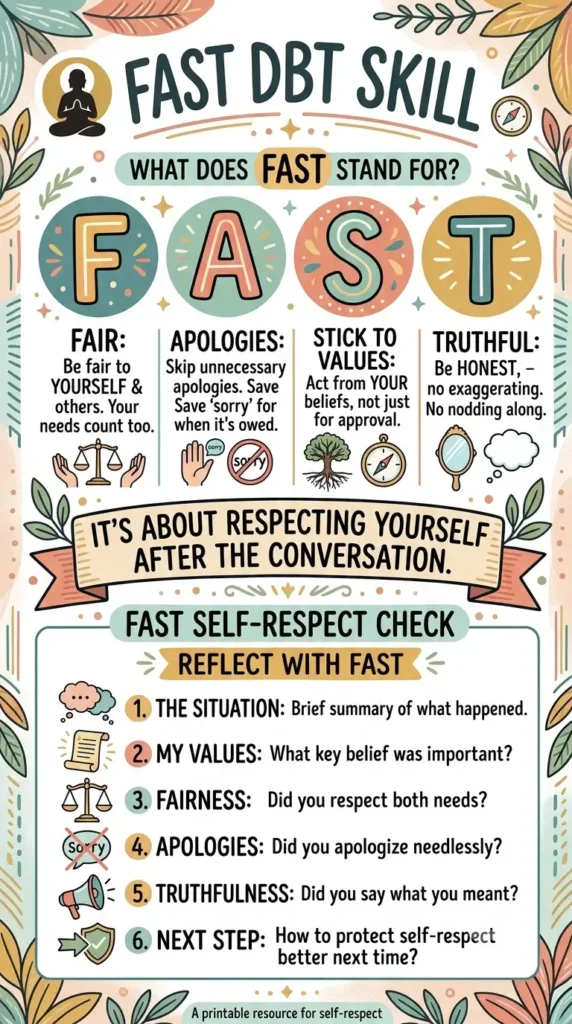
FAST breaks into four parts. Simple on paper. Harder to remember once your heart rate spikes.
F — Fair: Be fair to yourself and the other person. Your needs count too. Not just theirs.
A — Apologies: Skip the apology when you haven’t done anything wrong. Save “sorry” for the moments it’s actually owed.
S — Stick to Values: Act from what you believe. Not from what gets you approval in the next ten seconds. Changing your position just to be liked wears you down over time.
T — Truthful: Be honest, with yourself first. No exaggerating. No excuses. No nodding along when you don’t agree.
Here’s the part people miss. FAST isn’t about winning the argument. It’s about respecting yourself when the conversation’s over.
FAST Example: Saying No Without Feeling Guilty
A friend asks you to finish their assignment. You’ve got your own work piling up. Guilt creeps in anyway, and saying yes starts to feel easier than it should.
Your time matters just as much as theirs. FAST pulls that back into focus. You can say no clearly, without turning it into a three-paragraph apology.
“I can’t complete your assignment for you. I need to finish my own work, but I can explain a question if you’re stuck.”
That’s it. No guilt doesn’t mean this stays simple. It means you said no and still offered something real.
FAST Example: Standing by Your Values During Conflict
Your friends start mocking someone. They expect you to laugh along. The pressure to fit in is real, and mocking someone still goes against everything you actually believe.
FAST keeps you truthful and fair here, without turning you into the enemy. Something like, “I’m not comfortable making fun of them. Let’s talk about something else,” does the job.
No insults needed. No pretending to agree just to smooth things over.
FAST Self-Respect Worksheet
A short reflection after a hard conversation can catch what you missed in the moment. This pairs well with a broader self-validation practice, since both skills ask the same underlying question: did you treat your own reaction as valid?
- Situation: What happened, and who was involved?
- My values: What personal belief mattered here?
- Fairness: Did you respect both your needs and theirs?
- Apologies: Did you apologize when you didn’t need to, or take responsibility for something real?
- Truthfulness: Did you say what you actually thought and felt?
- Next step: What would protect your self-respect better next time?
Winning the conversation was never the goal. Walking away able to respect yourself is. For more structured practice like this, the full coping skills worksheets library and resources like Therapist Aid’s interpersonal effectiveness worksheet cover related ground.
How to Choose Between DEAR MAN, GIVE, and FAST
Three acronyms. Three different jobs. Picking the wrong one mid-argument is how a simple ask turns into a mess. DBT interpersonal effectiveness skills exist so that doesn’t happen.
DEAR MAN gets a request across. GIVE keeps the relationship intact. FAST keeps you looking yourself in the mirror afterward. Your goal in that exact moment decides which one you reach for.
Start With Your Main Goal
Before a hard conversation starts, ask one question. What matters most right now? Not later. Right now.
DEAR MAN is for the moment you need something said plainly. A request. A no. A line drawn and held.
GIVE matters when the relationship is the priority. Trust, care, actually hearing the other person out.
FAST steps in when the pressure is on to cave. It keeps your values intact even when agreeing would be easier.
Need a quieter place to study? DEAR MAN carries that ask. A friend got hurt by something you said? GIVE shapes the response. Neither skill does the other’s job well.
What If You Have More Than One Goal?
Most real conversations don’t hand you a single clean goal. You might want to keep a friendship steady while still turning down something unreasonable. That’s two goals pulling in different directions.
Pick the one that matters most. Let the other two skills support it instead of compete with it. You don’t need a perfect outcome on every front in one sitting. That’s not how this works.
Can You Use DEAR MAN, GIVE, and FAST Together?
Yes. All three stack cleanly.
DEAR MAN carries the actual message. GIVE keeps your tone respectful while you deliver it. FAST stops you from backing off your own values halfway through. Run them together and you get something rare: clear, without turning harsh, and honest, without folding just to end the discomfort.
The DEAR MAN DBT worksheet and GIVE skill breakdown from DBT Tools walks through how these three fit into the wider interpersonal effectiveness framework, if you want the fuller picture beyond this guide.
A Quick Decision Guide for Difficult Conversations
Print this. Use it before you open your mouth, not after.
Ask yourself one thing first: what matters most in this conversation?
- Getting a need met, making a request, saying no, or holding a boundary → DEAR MAN
- Protecting a relationship through listening, validation, and care → GIVE
- Keeping your self-respect and staying true to your values → FAST
- More than one goal at once → combine the skills, with one as the lead
- The conversation isn’t safe → skip the technique. Safety comes first. Always.
Naming an emotion before the conversation even starts can make the whole decision easier. An emotions worksheet helps with that groundwork. And if you want the fuller toolkit these three skills sit inside, the DBT skills worksheets library covers DEAR MAN, GIVE, and FAST alongside every other DBT module.
Free DBT Interpersonal Effectiveness Worksheets and Printables
DBT interpersonal effectiveness skills exist for one reason. Hard conversations. Asking for something. Saying no. Holding a boundary without the relationship falling apart. These free worksheets walk you through DEAR MAN, GIVE, and FAST, plus a reflection sheet for afterward. No theory dump. Just tools you can use before your next tough talk.
This set pairs well with the full DBT skills worksheets library, which covers all four modules if you want the bigger picture.
DBT Interpersonal Effectiveness Skills PDF Cheat Sheet
One page. Three skill sets. That’s the whole idea behind this dbt interpersonal effectiveness skills pdf cheat sheet.
DEAR MAN covers requests and refusals. GIVE protects the relationship while you disagree. FAST keeps your self-respect intact when someone’s pushing you to just go along with it.
Print it. Save it to your phone. Keep it somewhere you’ll actually look before the conversation starts, not after it’s already gone sideways. Why does that timing matter so much? Because nobody reads a full page mid-argument. A glance has to be enough.
One more thing worth saying. These aren’t scripts. Adapt the wording to fit how you actually talk. A worksheet that sounds nothing like you won’t survive contact with a real conversation.
DEAR MAN Worksheet for Requests and Refusals
This is the dear man dbt skill worksheet, and it’s built for the moment you need to ask for something or draw a line.
Start with facts. What actually happened, not your read on it. Then name how the situation affects you. Say what you feel. Get specific about what you’re asking for. Vague requests go nowhere.
From there, the harder part. Stay on topic. Appear confident, even on the days you don’t feel it. Leave room to negotiate if the other person needs it.
Picture this. A classmate keeps forwarding your private messages to the group chat. You’ve hinted at it twice already. Nothing changed. A DEAR MAN worksheet gets you from vague annoyance to a request you can actually say out loud: specific, respectful, done.
GIVE Worksheet for Listening and Validation
DEAR MAN gets your point across. GIVE is what keeps the relationship standing once you’ve said it.
This interpersonal effectiveness dbt worksheet walks you through four moves before a hard conversation. Be gentle. Show genuine interest. Validate what the other person’s feeling, even where you don’t agree. Keep an easy manner where you can.
Afterward, the worksheet flips. Did you actually listen, or were you just waiting to talk? Did you acknowledge their side without pretending to agree with all of it? Those aren’t the same thing, and most people blur them.
Validating someone’s feelings isn’t surrender. It’s just proof you were in the room.
FAST Worksheet for Values and Self-Respect
FAST is different from the other two. DEAR MAN gets you what you want. GIVE protects the relationship. FAST protects you.
Use it whenever you feel the pull to shrink down just to keep someone comfortable. Write the value you’re protecting. List the facts you need to say honestly. Then cross off every apology you don’t actually owe.
Here’s a small example. You decline a weekend invite. No excuse invented. No apology repeated three times for a decision you’re allowed to make. Fair to yourself, fair to them, and the truth stays intact the whole way through.
Interpersonal Effectiveness Reflection Worksheet
Most people skip this step. That’s the mistake.
After a hard conversation, this worksheet asks what your goal was, which skill you reached for, and what actually worked. What would you change next time? How did you feel before the conversation, and how do you feel now that it’s over?
This isn’t about grading yourself. An imperfect outcome still teaches you something, as long as you look at it honestly instead of flinching away.
Pair the reflection with journal prompts for mental health if you want to dig further into what came up for you emotionally. A few lines in journal prompts for self-love can help if the conversation left you second-guessing yourself.
How to Use These Worksheets at Home, in Therapy, or in a Skills Group
Interpersonal effectiveness at home looks different from interpersonal effectiveness at school, and both look different from interpersonal effectiveness in community settings. Same skills. Different stakes.
Practising alone works. Pick a real, low-risk conversation and write it out before it happens. At home, role-play with someone you trust. A sibling, a partner, a friend who won’t mind playing the other side.
In therapy or a DBT skills group, bring your completed worksheet to session. A facilitator can tell you which skill actually fits your goal, not just which one sounds right on paper.
Looking for interpersonal effectiveness activities beyond the worksheet itself? Interpersonal effectiveness games built around role-play scenarios can make the DEAR MAN steps stick faster than reading them cold. Our broader coping skills worksheets collection has more practice tools if you want to build out the rest of your toolkit. For background on how these skills fit into formal DBT skills training, Behavioral Tech is a solid reference point.
One caveat, and it matters. These worksheets are practice tools, not a substitute for professional care. If a relationship feels unsafe, safety comes first. Communication skills can wait.
Interpersonal Effectiveness Activities and Games for Everyday Practice
Reading about DBT interpersonal effectiveness skills won’t change how a hard conversation goes. Practice will. Short role-plays and low-stakes challenges turn DEAR MAN, GIVE, and FAST from theory into muscle memory, so the words are already there when a real moment shows up at home, school, work, or out in the world. If you haven’t worked through the core acronyms yet, the DBT skills worksheets library breaks each one down before you try these.
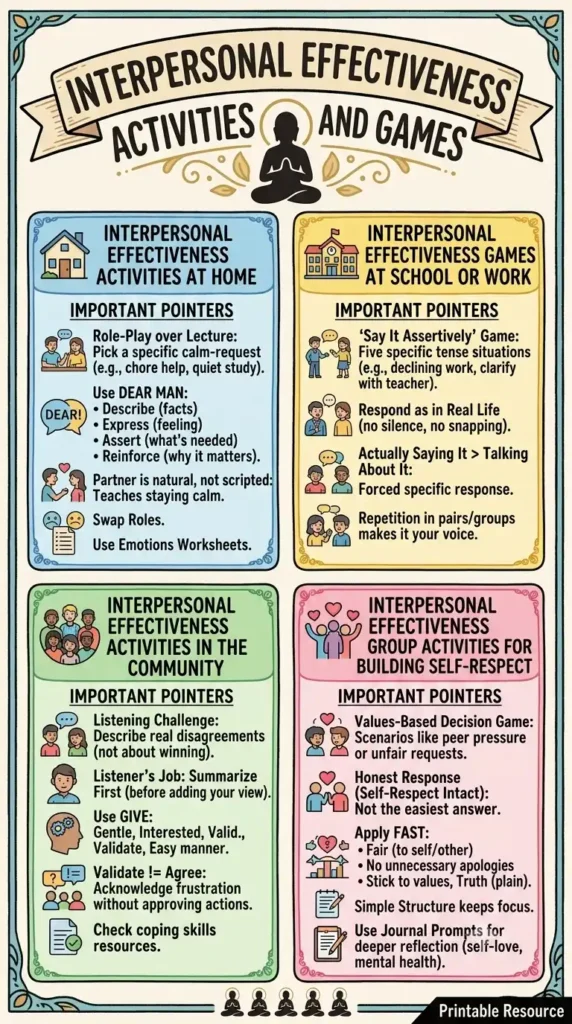
Interpersonal Effectiveness Activities at Home
A role-play works better than a lecture. Pick a calm-request scenario. One person practices asking for something specific, maybe help with chores, maybe an hour of quiet to study. Nothing abstract.
Use DEAR MAN to shape it. Describe the situation in plain facts. Express the feeling behind the request. Assert what’s actually needed, no hedging. Reinforce why it matters to both people.
The other person responds however feels natural. Not scripted. That’s the whole point. A scripted partner teaches you nothing about staying calm when the answer isn’t the one you wanted.
Run it twice if the first attempt felt shaky. Swap roles. An emotions worksheet can help beforehand if naming what you’re feeling is the part that trips you up.
Interpersonal Effectiveness Games at School or Work
Write five tense situations on slips of paper. Declining extra work. Asking a teacher for clarification. Telling a classmate a joke landed wrong. Keep them specific, not generic.
This is the “Say It Assertively” game. Pick a slip. Respond the way you’d want to in real life, not the way you actually would under pressure. Staying silent doesn’t count. Neither does snapping.
Why does this format work better than just talking through it? Because a slip of paper forces a specific response instead of a vague one. “I’d probably say something” isn’t practice. Actually saying it is.
Run it in pairs or small groups. Mix up who goes first each round. Repetition is what makes the DEAR MAN skill feel less rehearsed and more like your own voice by the third try.
Interpersonal Effectiveness Activities in the Community
This isn’t about winning the disagreement. The listening challenge works in any group setting, a club, a class, a support circle. Take turns describing a minor disagreement from real life.
The listener’s job comes first: summarize the speaker’s point before adding a single word of their own view. That order matters. Most people skip straight to rebuttal.
Use GIVE to hold the exchange steady. Stay gentle. Show real interest, not performed interest. Validate what the other person feels, even where you land somewhere different. Keep your manner easy rather than tense.
Validating isn’t the same as agreeing. That distinction trips people up constantly. You can tell someone their frustration makes sense without signing off on how they handled it. For more on separating the two, the coping skills worksheets collection covers validation alongside other practical tools.
Interpersonal Effectiveness Group Activities for Building Self-Respect
Self-respect isn’t selfish, no matter what it feels like in the moment. A values-based decision game puts that to the test. Read a scenario: peer pressure, an unfair request, a conflict between what someone wants and what they actually value.
Each person explains how they’d respond while keeping their self-respect intact. Not the easiest answer. The honest one.
Apply FAST to check the response. Be fair, to yourself and the other person. Skip the unnecessary apology. Stick to what you actually value, even when it’s inconvenient. Tell the truth, plainly.
Sound too simple for a group activity? It is. That’s exactly why it works. The structure keeps people from drifting into over-explaining or caving halfway through.
For deeper written reflection after the exercise, journal prompts for self-love and journal prompts for mental health both pair well with FAST-based practice.
Making the Practice Stick
Reflect after every round. What went well? What felt difficult? What would you try differently next time? Three short questions, nothing more complicated.
Start with low-stakes situations first. A missed text matters less than a real fight, so practice there before the stakes climb. Therapist Aid’s interpersonal effectiveness worksheets offer additional structured scenarios if your group wants more variety.
One caution worth repeating. If a real interaction involves threats, coercion, or abuse, safety comes first. These games are for practicing hard conversations, not confrontations that put anyone at risk.
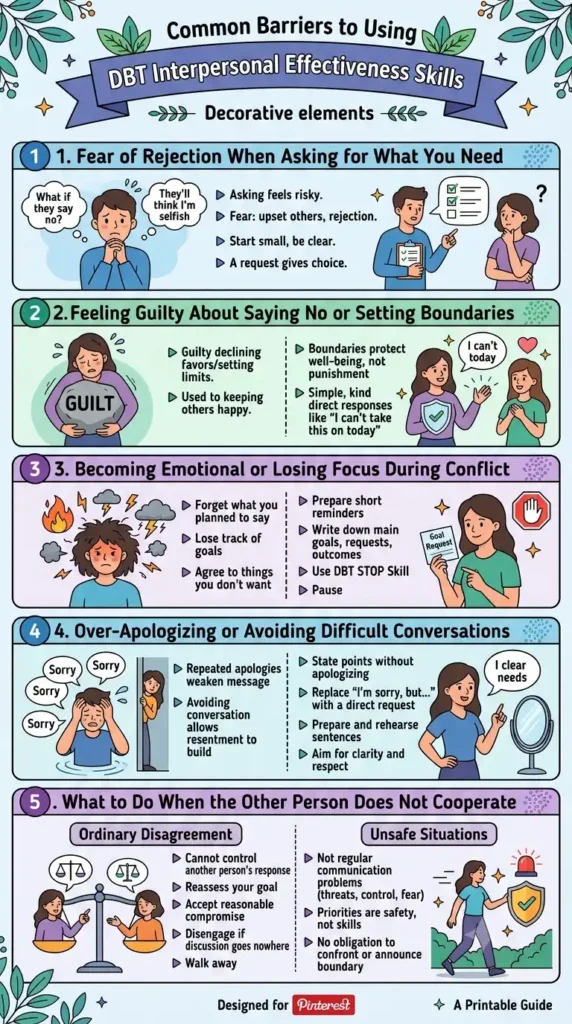
Common Barriers to Using DBT Interpersonal Effectiveness Skills
DBT interpersonal effectiveness skills can help you communicate clearly, set boundaries, and protect your self-respect. Yet fear, guilt, strong emotions, and other people’s reactions can make these skills hard to use. Recognizing your barriers helps you respond with greater confidence and less self-judgment.
Fear of Rejection When Asking for What You Need
Asking for help, expressing a preference, or requesting a change can feel risky when you fear rejection. You might worry that someone will call you selfish, become upset, or stop caring about you.
Start with a small, clear request. Describe what you need without assuming how the other person will respond. For example, say, “Could you let me know before making plans for both of us?” rather than hoping they will guess what bothers you.
Remember that a request gives the other person a choice. They may say yes, no, or suggest another option. Their response does not determine whether your need was reasonable.
Feeling Guilty About Saying No or Setting Boundaries
You may feel guilty when you decline a favor, protect your time, or ask someone to respect your limits. This is especially common if you are used to keeping others happy.
A boundary is not a punishment. It explains what you can accept and what you will do to protect your well-being. You can care about someone and still say, “I can’t take this on today.”
Try replacing lengthy explanations with a kind, direct response. You do not need to prove that you are exhausted or overwhelmed before you can say no. Feeling guilty does not automatically mean you have done something wrong.
Becoming Emotional or Losing Focus During Conflict
Strong emotions can make it difficult to remember what you planned to say. You might lose track of your goal, agree to something you do not want, or respond more sharply than intended.
Prepare a short reminder before a difficult conversation. Write down your main request, the boundary you want to communicate, and the outcome you hope to achieve. If emotions become too intense, pause when it is safe and appropriate to do so.
The DBT STOP skill can help you slow down before reacting, giving you a chance to choose your next action more deliberately.
Over-Apologizing or Avoiding Difficult Conversations
Repeated apologies can weaken a clear message, while avoiding a conversation may allow resentment to build. You might say “sorry” before expressing a reasonable need or keep quiet to prevent temporary discomfort.
Practice stating your point without apologizing for having a preference. Replace “I’m so sorry to bother you, but could you possibly help?” with “Could you help me with this task?”
If a conversation feels overwhelming, prepare one or two sentences and rehearse them beforehand. You do not have to communicate perfectly; you only need to communicate as clearly and respectfully as you can.
What to Do When the Other Person Does Not Cooperate
Your communication matters, but you cannot control another person’s response. What you do next depends on whether you are facing ordinary disagreement or an unsafe situation.
With normal resistance: Reassess your goal. Is the request essential, or could you accept a reasonable compromise? You can clarify your point, offer another option, or disengage if the discussion is going nowhere. Sometimes the healthiest choice is to accept that you cannot reach an agreement.
In unsafe situations: Threats, intimidation, coercive control, and fear of retaliation are not ordinary communication problems. You do not need to use a DBT skill to persuade someone who may harm you, and you should not feel obligated to confront them or announce a boundary.
Prioritize your safety and seek confidential support. In the United States, call or text 988 for crisis support, or contact the National Domestic Violence Hotline at 1-800-799-7233 or text START to 88788 for help with an unsafe partner situation.
Related DBT Skills Worksheets
DBT interpersonal effectiveness skills work best when you practise them alongside other skills that help you manage emotions, handle stress, and build healthier relationships. These resources can help you choose the right tool for different situations.
- DBT skills worksheets: Explore the wider range of DBT skills worksheets, including tools for mindfulness, distress tolerance, emotion regulation, and interpersonal effectiveness.
- DBT self-validation: Learn to acknowledge your feelings and experiences without dismissing or judging yourself.
- DBT values: Clarify what matters to you so you can make choices that protect your self-respect.
- DBT STOP skill: Practise pausing before reacting when a difficult conversation triggers intense emotions.
- Emotions worksheets: Build your ability to identify and understand feelings before communicating them.
- Coping skills worksheets: Find practical activities for managing stress and getting through challenging moments.
You do not need to master every skill at once. Start with one worksheet that matches a current challenge, practise it in a low-pressure situation, and review what you learn. Small, consistent steps can help you communicate more clearly while caring for both your relationships and your own needs.
Conclusion
DBT interpersonal effectiveness skills can help you ask for what you need, protect your relationships, and maintain your self-respect during difficult conversations. DEAR MAN helps you communicate requests clearly, GIVE encourages empathy and connection, and FAST keeps your values at the center of your choices. You do not need to use every skill perfectly.
Start with one small conversation, practice with a worksheet, and reflect on what worked. Progress comes from repetition, not perfection. If a relationship feels unsafe, prioritize your safety over communication techniques. For more practical tools, explore our DBT skills worksheets and keep building skills that support healthier relationships.
Frequently Asked Questions
What are the four main interpersonal effectiveness skills in DBT?
DBT teaches three canonical interpersonal effectiveness skill sets: DEAR MAN, GIVE, and FAST, each serving different communication goals. Some resources group boundary-setting as a fourth related skill. This guide treats boundaries as part of all three, not a separate acronym.
What is the difference between DEAR MAN, GIVE, and FAST?
DEAR MAN helps you ask for what you need or say no. GIVE supports relationships through gentle, validating communication. FAST helps you maintain self-respect by acting fairly, sticking to your values, and avoiding unnecessary apologies or dishonesty.
Where can I find a free DBT interpersonal effectiveness skills PDF?
You can use the free DBT interpersonal effectiveness worksheets and printable guides in this article to practice DEAR MAN, GIVE, and FAST. They are educational tools, not a replacement for official materials or guidance from a qualified therapist.
Can I practice DBT interpersonal effectiveness skills on my own?
Yes. Start with a low-pressure conversation, choose one skill, and write down what you want to say. Review the outcome without judging yourself. If these skills feel difficult during intense conflict, a DBT-trained therapist can help you practise them.
How do I use interpersonal effectiveness skills to set boundaries?
State your boundary clearly, describe what you need, and explain what you will do if the situation continues. DEAR MAN can help you communicate directly, while GIVE protects the relationship and FAST helps you stay true to your values.
What should I do if someone ignores my boundaries even when I communicate clearly?
Restate your boundary if it feels safe, consider a compromise, or limit contact when needed. You cannot control another person’s response.
If you face threats or abuse, prioritise safety; in the US, call the National Domestic Violence Hotline at 1-800-799-7233 or text START to 88788.

It’s Bhaskar!
Well, I am not a psychologist a monk, or a philosopher by training. I’m just an engineering graduate.
‘The Empty Self’ is where I write about that idea, and what it actually means for ordinary life, anxiety, identity, habits, the stories we tell ourselves about who we are. I don’t have a psychology degree, and I’m not offering therapy or clinical advice. What I do have is thought and clarity, and genuine curiosity about why we suffer the way we do and how much of it might loose once we shed this ‘fixed identity’.
Pingback: DBT Skills Cheat Sheet: All You Need to Know With Free Printables | The Empty Self