
A good coping skills group activity does more than fill twenty minutes. It should do real work. Help someone notice what they feel. Show them what sets off their stress. Give them a healthy response they can actually reach for later, outside the group room.
The best coping skills group activities also leave room. Room for choice. Room for talk. Room for people who show up guarded and people who show up ready to share everything. Not every activity fits every comfort level, and that’s fine. That’s the point.
Here’s the catch though. A game that lands perfectly with eight-year-olds can feel babyish to a room of teenagers. Adults need something else entirely, usually more space to talk through real stressors, not games at all. So this guide sticks to practical activities that flex across kids, teens, middle schoolers, and adults without losing what they’re actually for.
Quick overview: these group activities build six skills. Emotional awareness. Grounding. Stress management. Positive thinking. Problem-solving. Healthy support-seeking. You’ll find games, discussion prompts, role-play setups, and printable exercises pulled from real coping skills worksheets and emotions worksheets you can hand out on the spot.
One note before you dive in. These are educational tools built for practicing coping skills. They don’t replace a clinical assessment, professional treatment, or a therapist-led group when someone needs real clinical support.
Table of Contents
Disclaimer
This blog is written and edited with the help of AI, then reviewed by me before publishing. As a result, the content is for general reflection only, not therapy or medical advice, and I’m not a licensed mental health professional. If you’re in crisis, please contact 988 if you’re in US or a local crisis service of your country instead of relying on this site.
What Are Coping Skills Group Activities?
Coping skills group activities are structured exercises that help people build healthy ways to handle stress, hard emotions, and daily friction, together. Not alone. That’s the whole point.
A solo coping exercise happens in your own head, on your own page. A group activity adds other people into the mix, and that changes everything about how the skill lands.
How Group Activities Differ From Solo Coping Exercises
A coping skills group activity is something you do with other people to build real tools for stress, emotions, or tough situations. It might look like a discussion. Or a role-play. Sometimes movement, sometimes drawing, sometimes a calming technique practiced out loud together.
Solo coping work usually stays private. Just you and a worksheet, or you and a breathing exercise. Group work adds a layer that solo practice can’t offer. You get to hear how someone else handles the exact same problem. You try a skill in real time, next to another person. Then you reflect on what actually worked.
Here’s a simple contrast. Writing down five calming strategies by yourself is a solo exercise. Fine on its own. But hand that same task to a group, let them brainstorm together, act one strategy out, then talk through when each one might help? Now it’s a shared learning moment. Something sticks that wouldn’t have otherwise.
If you’re looking for the individual side of this work, our coping skills worksheets cover exercises built for one person to use at their own pace.
Why Peer Practice Actually Helps
Group practice makes coping skills feel less like theory. Less abstract. More real.
Normalization does a lot of the heavy lifting here. When someone hears a peer admit to feeling the same worry, the same flash of anger, it lands differently than a therapist explaining that “this is common.” Stress, anger, frustration. These aren’t rare. Group settings prove that fast.
Modeling matters too. Watching someone else use a skill teaches more than reading instructions ever could. You see the pause before the reaction. You see the shaky first attempt. You see it work.
And accountability creeps in quietly. Once a group commits to trying a strategy between sessions, most people actually try it. Nobody wants to show up empty-handed next week.
None of this requires oversharing. A skilled facilitator can lean on fictional scenarios, anonymous examples, or a simple “pass” option when someone isn’t ready to open up. Nobody gets forced into disclosure they don’t want.
Coping Skills Group vs. General Group Therapy
Not the same thing. Worth knowing the difference before you plan or join one.
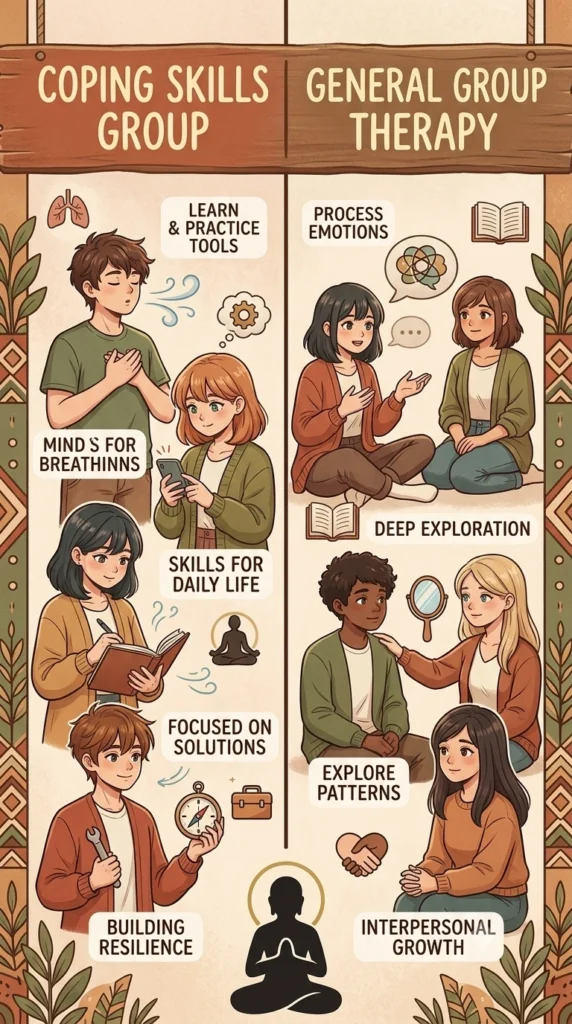
A coping skills group zeroes in on learning and practicing specific strategies. Grounding, emotion regulation, stress management drills. Each session usually has one clear skill-building goal, and the structure stays tight around that.
General group therapy casts a wider net. It might dig into relationship patterns, deeper personal history, or open-ended processing that doesn’t resolve in a single session. Goals shift depending on the therapy style and the group’s needs.
| Coping Skills Group | General Group Therapy |
|---|---|
| Focuses on learning and practicing specific coping strategies | May focus on broader emotional, behavioral, or interpersonal concerns |
| Often includes structured exercises and skill practice | May involve more open-ended discussion or therapeutic processing |
| Examples include grounding, emotion regulation, and stress-management exercises | May include process work, relationship patterns, or deeper personal exploration |
| Usually has a clear skill-building goal for each session | Goals vary depending on the type of therapy and group |
If emotional vocabulary is part of what your group needs to build, our emotions worksheet pairs well with these coping skills group activities as a warm-up or follow-up exercise.
How to Choose the Right Coping Skills Activity for Your Group
The right coping skills group activities depend on your people, not on how good the activity looks in a photo. Fit beats flash. A grounding exercise built for teens can completely miss with a room of six-year-olds.
Flip it around and something playful enough for kids can feel babyish to a group of adults. Match the tool to the room first, then worry about whether it’s fun.
Age
Start with age and where your group sits developmentally. Kids need movement. Drawing, games, and short instructions pull them in faster than a lecture on emotions ever will, which is why so many child group therapy activities lean on play instead of talk. Teens are different.
They respond better to real scenarios, honest discussion, and a bit of role-play, so coping skills group activities for teens tend to work best when they feel less like a worksheet and more like a conversation.
Adults usually want something practical, tied to work stress, relationships, or the daily grind that actually got them into the room.
Running a mixed-age group? Pick one activity with a simple core task. Adapt the examples instead of forcing everyone through the exact same version. That one shift makes middle school group counseling activities and adult sessions coexist without either group checking out.
Goal
Decide what skill you actually want practiced. Are they learning to name a feeling, calm a racing body, challenge a stressful thought, solve a problem, or ask for help? A strong coping skills activity for group therapy has one clear job, not five.
If the room needs grounding, reach for something sensory. Skip the long journaling task. Pair whatever you land on with a set of coping skills worksheets for practice between sessions, and if naming feelings is the goal, a page like the emotions worksheet gives participants language they can actually use.
Size and Time
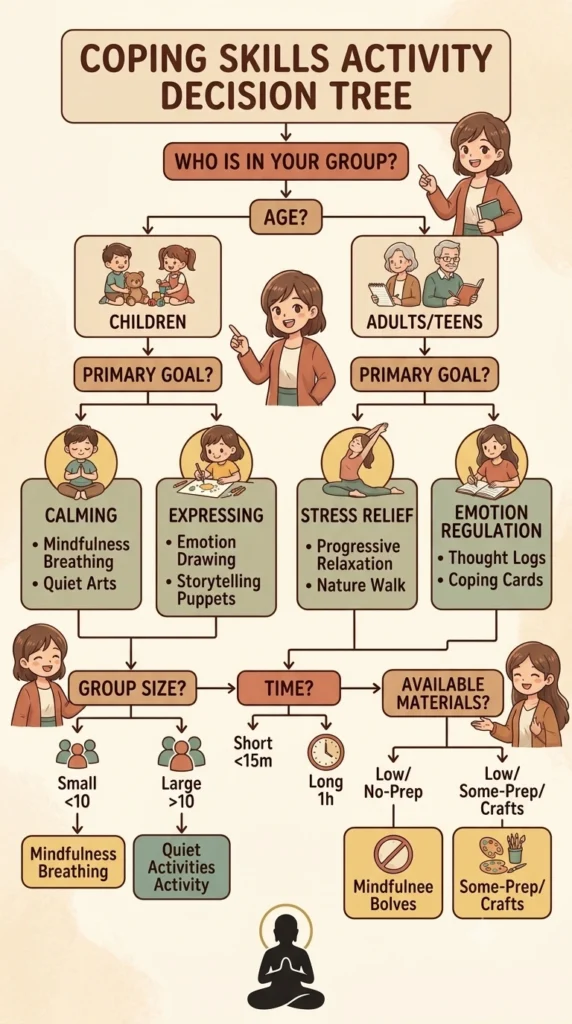
Group size changes how an activity lands. A discussion that feels warm with six people turns awkward fast with twenty. Check your clock, too. Ten minutes is enough for a warm-up. Thirty minutes leaves room for practice and a real debrief afterward. That’s the difference between an activity people forget by lunch and one that sticks.
No-Prep vs. Printable vs. Creative
Choose based on what’s actually sitting in your bag. No-prep group therapy exercises are the move when you need something right now, no printer required.
Printable options work when participants want to take something home, which is exactly why so many facilitators search for a coping skills group activities pdf they can reuse week after week.
Creative formats, drawing, collage, simple crafts, make heavy topics easier to sit with. That matters most with kids, where a crayon does more work than a conversation ever could.
Choice
Give participants some control whenever you can. Offer two options and let them pick which one to practice. Small choice, big shift. It turns a therapeutic group activity from something being done to them into something they’re doing with you.
12 Coping Skills Group Activities for All Ages
Good coping skills group activities do more than fill time on a schedule. They help people notice stress building. Then choose a response. Then test it out loud, in front of others, and talk about what actually worked. That’s the whole point.
The six activities below mix discussion, movement, creativity, and situations that feel close to real life, so they bend easily for kids, teens, and adults. Pair them with printable coping skills worksheets for take-home practice between sessions.
1. Coping Skills Brainstorm Circle
Best age: Kids, teens, and adults
Goal: Build awareness of healthy coping strategies
Time: 10-15 minutes
Materials: Whiteboard, paper, or a large sheet of paper
Write “When I feel stressed…” in the center of the board. Ask everyone to name something they could do about it. Write down every healthy idea. No judging, no correcting, not yet. Once the board fills up, sort the ideas into categories: movement, calming, social support, distraction, problem-solving, emotional expression. Younger kids do better with pictures next to the words.
Debrief with two questions. “Which strategy would you actually use this week?” Then, “Which one might help when your usual strategy isn’t available?” That second question matters more than it sounds. Most people only have one backup plan, if that.
Age adaptation: kids can draw their ideas instead of writing them. Teens tend to open up more when the prompt narrows to school, friendships, or family stress specifically. Adults respond best to strategies that actually fit a real work-and-home schedule, not an idealized one.
2. Feelings Ball: Name It and Cope With It
Best age: Kids, tweens, and teens
Goal: Connect emotions with appropriate coping responses
Time: 10-15 minutes
Materials: Soft ball and marker
Write several emotions around a soft ball: angry, worried, sad, frustrated, lonely, overwhelmed. Participants toss it gently to one another. Whoever catches it names the emotion closest to their thumb and describes one healthy way to handle it. If someone freezes up, a facilitator can offer a realistic example to get them unstuck.
Then ask the group whether the same coping strategy works for every emotion. It won’t, and that’s worth saying out loud. Coping skills are tools for managing difficult situations and emotional responses, not a way to pretend the uncomfortable feeling isn’t there. For groups that need more structure around naming feelings first, an emotions worksheet works well as a warm-up before this game.
Age adaptation: kids need simple emotion words paired with pictures. Teens can handle situations built around exams, friendship conflict, or social pressure, and usually engage harder when the scenario feels specific to their week.
3. Coping Skills Toolbox
Best age: Tweens, teens, and adults
Goal: Help participants build a varied coping toolkit
Time: 15-20 minutes
Materials: Paper, pens, optional index cards or small boxes
Have participants draw four sections: physical, emotional, cognitive, social. Under each one, they list strategies they could reach for under stress. Physical might mean walking or stretching.
Emotional might mean journaling or talking things through, and this is a natural place to bring in journal prompts for mental health if the group already keeps a journal. Cognitive strategies usually involve reframing a thought. Social strategies mean reaching out to someone trusted.
A strong toolbox holds different tools on purpose. One strategy rarely covers every situation, and a group that only practices one response tends to freeze when that one doesn’t fit.
Debrief by asking which category feels easiest and which needs more work. Then have each person pick two strategies to actually practice, not just write down.
Age adaptation: younger participants can cut out pictures instead of writing lists. Teens often prefer building a phone-friendly version they can pull up fast.
4. Stress Scenario Sorting Game
Best age: Kids, teens, and adults
Goal: Practice matching coping strategies to stressful situations
Time: 15-20 minutes
Materials: Scenario cards and coping-skill cards
Prepare cards with everyday stress: a disappointing grade, an argument with a friend, feeling left out, a rough workday, too much noise. Hand the group coping-skill cards and have them match strategies to scenarios.
More than one answer can work for a single card. That flexibility is intentional. The goal isn’t finding the one “correct” coping skill. It’s practicing the act of choosing.
Ask the group why they picked a given strategy. Then push a little further: would it still hold up if the situation got more intense? That question usually surfaces the gap between a strategy that sounds good and one that actually works under pressure.
Age adaptation: kids do well with school and family scenarios. Teens can work through peer and academic stress. Adults tend to get more out of workplace, relationship, or daily-life situations pulled from things they’ve actually dealt with.
5. Emotion Thermometer and Coping Plan
Best age: Kids, teens, and adults
Goal: Recognize rising emotional intensity before it becomes overwhelming
Time: 15-20 minutes
Materials: Paper and colored pencils or markers
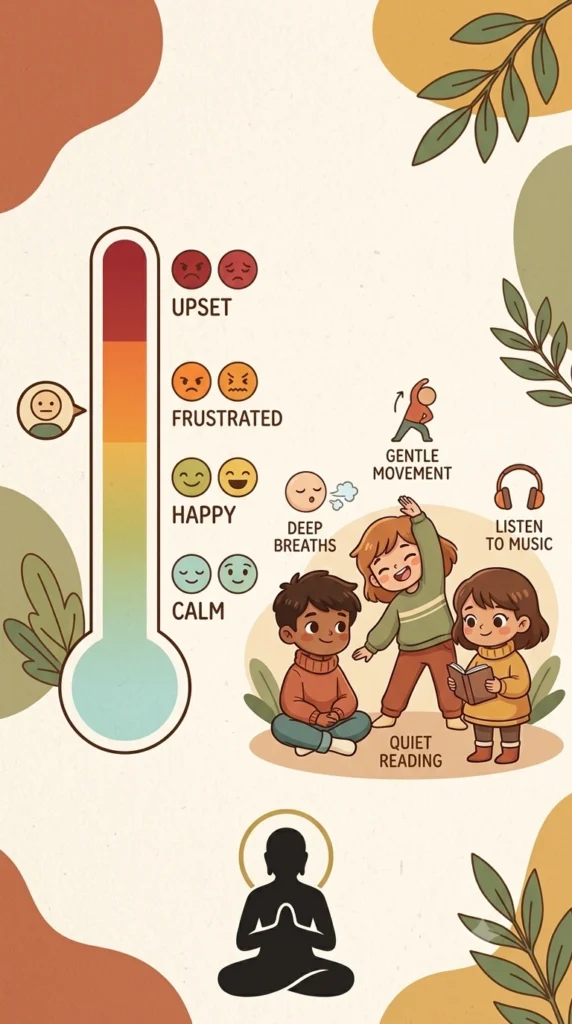
Draw a thermometer numbered 1 to 10. Ask participants what different stress levels feel like in their body, their thoughts, their behavior. Then match a coping strategy to different points on the scale.
Slow breathing might belong at a 4.
A short break at a 6.
Reaching out for support at an 8.
The point isn’t managing a crisis at a 10.
It’s catching the early signs before things get there.
Ask what their earliest warning sign of rising stress actually looks like. Then ask which strategy they could try before hitting a 10, not after.
Age adaptation: kids can use faces or colors instead of numbers for each level. Teens usually connect faster when the levels get tied to school or social situations they recognize.
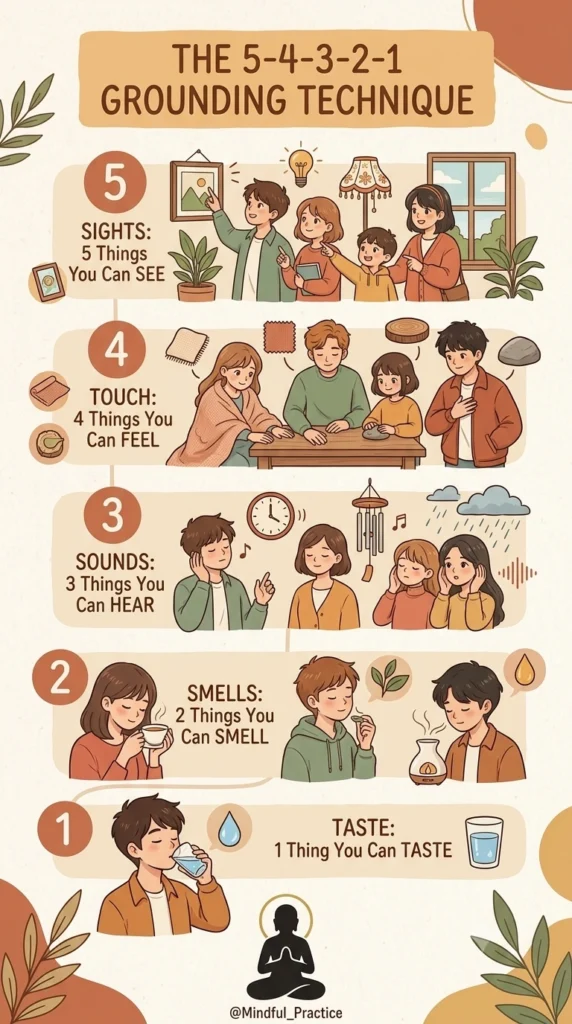
6. Grounding 5-4-3-2-1 Group Challenge
Best age: Tweens, teens, and adults
Goal: Practice sensory grounding during moments of stress or emotional overload
Time: 5-10 minutes
Materials: None
Have the group quietly find
5 things they can see,
4 they can feel,
3 they can hear,
2 they can smell, and
1 they can taste or imagine tasting.
Give real time for each sense instead of rushing the count. Afterward, ask whether their attention feels any different than it did at the start. Usually it does.
Talk about when grounding actually helps: worry spiraling, too much sensory input, a stressful transition between activities. Ask which sense was easiest to focus on, and which one was hardest. The hardest one is usually the most telling.
Age adaptation: turn it into a room-based scavenger hunt for kids. Teens, especially in a counseling setting, often prefer the quieter, more internal version.
7. Coping Skills Charades
Best age: Kids, tweens, and teens
Goal: Practice spotting and using healthy coping strategies through movement
Time: 10–15 minutes
Materials: Small slips of paper and a container
Act it out. Don’t say it. That’s the whole rule behind this one, and it’s what makes it work.
Write coping strategies on slips of paper. Deep breathing. A walk. Journaling. Stretching. Music. Asking for help. A quiet break. One person pulls a slip and acts out the strategy in silence. Everyone else guesses two things: the skill itself, and a situation where it might actually help.
Keep score off the table. The second someone starts counting points, the group stops thinking about the strategy and starts thinking about winning. That defeats the purpose of a coping skills group activity built around recognition, not competition.
Debrief: Ask when this strategy would come in handy. Then ask what could get in the way of using it.
Age adaptation: Kids do well with simple, physical strategies, the kind you can act out with your whole body. Teens can stretch into less obvious ones, like challenging an unhelpful thought or setting a boundary with someone.
8. “What Would You Do?” Coping Role-Play
Rehearsal beats improvisation when stress actually shows up. That’s the idea behind this group coping skills activity, and it’s why role-play earns its spot on this list.
Best age: Teens, middle schoolers, and adults
Goal: Rehearse coping responses before real stress hits
Time: 15–25 minutes
Materials: Scenario cards
Give pairs or small groups a realistic scenario. A bad test grade. Getting left out of a group chat. An argument with a friend. Criticism at work. A pile of responsibilities that won’t stop growing. Ask them to act out the moment, then show a healthier response than the one that probably comes first.
If the first response doesn’t feel believable, let the group suggest another one. Real stress rarely resolves in one clean take.
Debrief: Ask what made the situation harder to sit with. Then ask which response could realistically leave the room and get used somewhere else.
Age adaptation: Middle schoolers do better with school and friendship scenarios. Teens can push into peer pressure and social conflict. Adults can pull from work, family, or relationship stress.
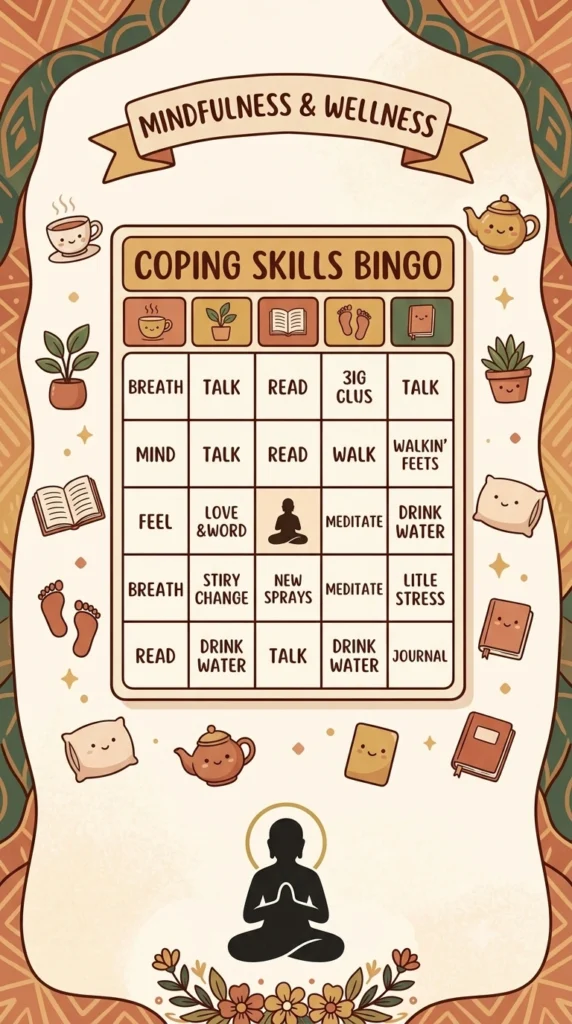
9. Coping Skills Bingo
This isn’t a race to a winning card. It’s a low-pressure way to introduce a wide set of coping strategies without turning the room into a competition.
Best age: Kids, tweens, and teens
Goal: Introduce healthy coping strategies in a playful format
Time: 15–20 minutes
Materials: Bingo cards and pens or markers
Fill the squares with real coping actions: took a break, talked to someone, went outside, used slow breathing, wrote down a feeling, did something creative. Participants mark a square when it applies to them, or when they can explain how they’d use it.
Slow down when a square trips someone up. A quick side conversation about an unfamiliar strategy is worth more than rushing toward a winner.
Debrief: Ask everyone to pick one square they haven’t tried yet, then name a moment this week they could test it.
Age adaptation: Kids respond well to pictures paired with simple phrases. Teens can work with strategies tied to school stress, friendships, sleep, and screen overload.
Printable tip: This one works especially well as a one-page handout, which makes it a natural fit inside a coping skills group activities PDF alongside scenario cards and reflection sheets. Pair it with a few of our coping skills worksheets if the group wants something to keep past the session.
10. Thought Swap: Stressful Thought → Helpful Thought
A thought isn’t a fact. It just feels like one when stress is loud enough.
Best age: Teens and adults
Goal: Practice answering unhelpful thinking with something more balanced
Time: 15–20 minutes
Materials: Paper or prepared thought cards
Hand the group a few stressful thoughts. “I’m going to mess everything up.” “Everyone thinks I’m awkward.” “I can’t handle this.” Ask what makes each one land so hard, then have participants rewrite it into something more balanced and, more importantly, believable.
Forced positivity isn’t the goal here. “Everything will be perfect” rarely holds up under pressure. “This is hard, but I can handle the next step” usually does.
Let pairs write their own examples and trade with another pair for practice.
Debrief: Ask if the new thought actually feels believable. Then ask if it changes what someone might do next.
Age adaptation: Middle schoolers can work with school and friendship worries. Teens can explore social pressure and performance anxiety. Adults can pull from work, relationships, or everyday responsibilities. Anyone who wants more practice naming the thought behind the feeling can lean on these journal prompts for mental health between sessions.
11. Coping Skills Scavenger Hunt
Most coping tools are already in the room. This activity is just about noticing them.
Best age: Kids, tweens, and active teen groups
Goal: Help participants spot coping tools already in their environment
Time: 10–15 minutes
Materials: Scavenger-hunt sheet or checklist
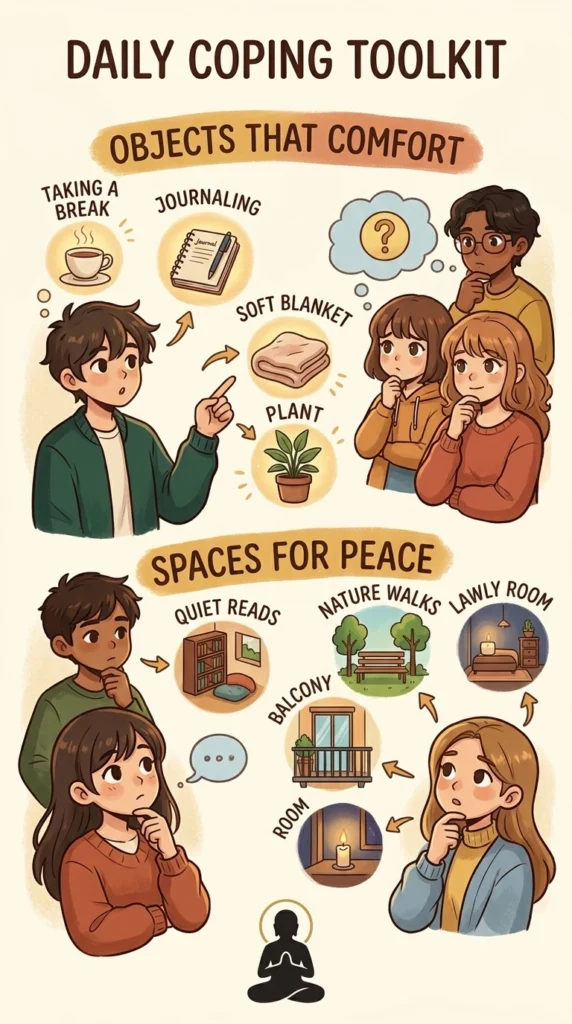
Give the group a list connected to healthy coping. A quiet place. Something soft. A tool for a creative activity. A spot to stretch. A written reminder of someone who supports them. Once the hunt wraps, bring everyone back together and talk through how each item could support emotional regulation or stress management.
No literal object-finding required. In a virtual group, participants can search their own space for anything that helps them feel calm or focused.
Debrief: Ask which coping tool was easiest to find. Then ask what useful tool they could add to their space.
Age adaptation: Kids usually respond well to movement and visual clues. For teens, frame it as a personal coping environment challenge instead of a game, so it doesn’t feel childish.
12. “My Coping Plan” One-Page Activity
An idea isn’t a plan until it’s written down somewhere you’ll actually see it again.
Best age: Tweens, teens, and adults
Goal: Turn coping ideas into a plan participants can use during real stress
Time: 15–20 minutes
Materials: One-page worksheet, pens, and optional colored pencils
Split the page into five sections: my trigger, what I notice, what I can do, who can help, what I’ll try first. Start with one realistic situation that tends to create stress. Then name the early signs, in the body, in thoughts, or in behavior. Finish by choosing a few coping strategies and one person to contact for support.
Keep the plan realistic. A thirty-minute strategy won’t help much if the stress hits during class or in the middle of a shift. This kind of triggers-first planning mirrors what the CDC recommends for managing stress: naming the specific trigger before picking a response.
Debrief: Ask which coping strategy could be used the earliest. Then ask what might get in the way of using the plan at all.
Age adaptation: Kids can use drawings and simple prompts. Teens can build plans around school, friendships, or family stress. Adults can focus on work and daily responsibilities.
Printable tip: This is one of the easiest coping skills group activities to turn into a handout or PDF. For more printable options, browse our coping skills worksheets collection, which covers everything from grounding exercises to a coping-ahead sheet built for exactly this kind of planning.
13-17 Quick-Variation Activities
Short on time? Here are five quick group coping skills activities for a shorter session.
- 13. Calm-Down Kit Challenge: Participants choose or draw items for a personal calm-down kit, then explain when each item might help.
- 14. Music and Mood Coping Activity: Ask the group to name music that helps them relax, focus, or shift their mood, then talk through why different songs work for different situations.
- 15. Group Breathing/PMR: Lead a short round of slow breathing or progressive muscle relaxation. Follow it with a brief check-in about what people noticed in their bodies.
- 16. Support Circle Mapping: Have participants draw themselves in the center of a page, then add people, places, or services they could turn to for support.
- 17. Role-Play Relay: Give small groups different stressful scenarios. Each group demonstrates one healthy coping response, then passes the next scenario along.
None of these need much setup. That’s the point. When a session is tight on time, a five-minute activity that still lands beats a longer one you have to rush through.
Coping Skills Group Activities for Kids
Good coping skills group activities for kids don’t feel like lessons. Kids clock a lecture fast. They check out just as fast. Elementary-age children pick up new skills through movement, play, and drawing. Way faster than through a long talk about feelings.
That’s the whole point.
Keep Activities Playful and Hands-On
Young kids can’t sit still and discuss feelings for twenty minutes. Nobody expects them to. That’s not a problem to fix. It’s a cue to switch the activity.
Reach for games instead. Movement. Colorful cards. Drawing. Music. Simple objects they can hold and turn over in their hands. All of it beats talk.
A feelings ball turns into something real fast. So does coping-skills charades. A quick sensory grounding game works just as well. “Regulate your emotions” means nothing to a seven-year-old. A game he can actually play means everything.
Keep instructions short. Demonstrate first. Let kids join in without asking them to share anything personal.
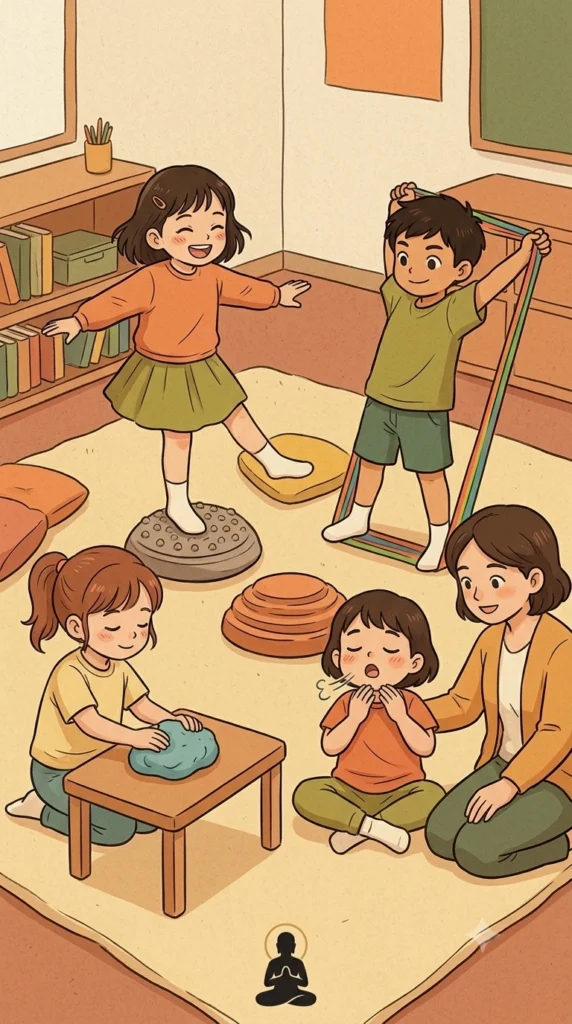
Use Movement and Sensory Activities
Movement helps most when a child is restless. Or can’t sit with a feeling. Stretching, walking to different coping stations, breathing with a visual cue, naming five things they can see and four they can touch. All concrete. All doable.
Sensory activities teach grounding well too. But watch the volume.
Don’t stack ten sounds, ten objects, ten instructions on a kid who’s already overwhelmed. That backfires. A child in real distress needs less stimulation, not a bigger production.
Offer a quieter option instead. Let the child pause. Never force it.
For a full age breakdown of what to run and when, see the Coping Skills Worksheets for Kids guide. It’s a solid next stop if you’re building out a fuller set of group therapy activities for kids, or just want more child group therapy activities to rotate through. You’ll also find playful ways to help kids name and express what they’re feeling in our piece on feelings exercises for Gen Alpha kids.
Coping Skills Group Activities for Teens and Middle School Students
Real life is what teens bring into the room. Exams. Friend drama. Anxiety that won’t let go. The best coping skills group activities for teens and middle school students skip the babyish worksheets. They get specific instead.
Nobody wants an activity built for a nine-year-old. Not at thirteen. Not at fifteen. Middle schoolers spot a watered-down exercise fast. They check out the second it feels beneath them.
School Stress
Exams pile up. Deadlines stack on top of grades. Then a packed schedule adds more weight. Pressure from parents and teachers tightens the whole week.
Good group activities help students sort what they can control from what they can’t. Then they practice a response before the stress actually hits.
Skip the vague prompt. Give the group a real situation instead: “You studied hard, but your mind goes blank the second the test starts.” Let students throw out different reactions. Then talk through which ones are realistic, which ones actually work at school, and which ones just sound good on paper.
That kind of scenario-based coping skills group activity beats a worksheet every time. It mirrors an actual classroom. Not a theory.
Peer Conflict and Anxiety
Friendship drama isn’t rare at this age. It shows up constantly. So does exclusion. So does the quiet worry about what everyone else is thinking.
A solid list of coping skills group ideas makes room for all of it. No assumption that every teen in the circle has lived the same version.
Scenario cards work well here. So do emotion-rating check-ins, grounding exercises, and problem-solving games. None of them ask a student to share something personal just to take part. That matters more than most group leaders realize. A teen who isn’t ready to talk can still learn the skill.
Avoiding “Childish” Framing
Respect goes a long way with this age group. Skip the cartoon worksheets. Drop the babyish language too.
Build every exercise around something teens actually recognize. Group projects. Tests. Social media pressure. A fight with a friend. Family expectations piling up during a busy week.
The skill underneath doesn’t change. Only the wrapper does. A breathing exercise doesn’t need a “calm-down game” label to work. Call it a quick reset instead. Same skill. Better framing. Teens take it seriously either way.
Role-Play Without Forced Disclosure
Role-play teaches coping responses fast. But nobody should hand over a personal story just to practice.
Stick to fictional scenarios. Let each student pick their part: act it out, watch from the side, or just call out a suggestion. Nobody gets cornered into oversharing. The skill still lands the same way.
The same approach works well in middle school group counseling activities built around real situations, not hypotheticals pulled from a textbook.
Some teens carry that stress home long after group ends. That’s where journal prompts for mental health pick up where the session leaves off.
For more ideas built specifically for this age group, see our full guide to coping skills worksheets.
Coping Skills Group Activities for Adults
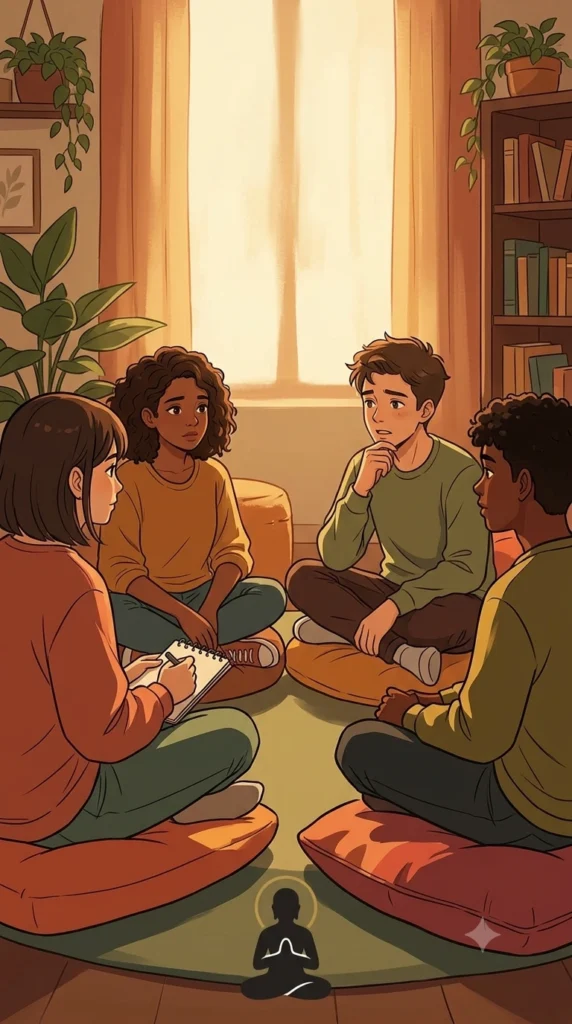
Kids don’t learn to cope in a vacuum. Someone drives them to school after a rough morning. Someone sits across from them at dinner, trying to read the silence. That someone needs their own coping skills, not just a printable for the kid.
These five activities work in a parent support group, a staff meeting, or a living room with two exhausted caregivers and a pot of coffee. They tie to real stress. Real decisions. The kind that show up on a Tuesday, not a hypothetical one.
Stress Management
Start by splitting what’s controllable from what isn’t. That’s most of the skill right there.
Have the group name their common stressors out loud. A kid’s meltdown at pickup. A school email that lands mid-shift. Then ask each person to pick one healthy response they could actually try this week. Not the ideal one. The realistic one.
Why realistic? Because perfect plans die on contact with a bad Monday. A small one might survive it.
Keep the focus on action, not theory. “Ten minutes on the porch before I walk back inside” beats “completely restructure my evening.” Small and specific wins. Every time.
Cognitive Coping
Most people don’t notice how much their thoughts shape their reactions.
Give the group a scenario every parent recognizes: your kid melts down in the grocery store checkout line. Ask them to name the first automatic thought that shows up, then rewrite it into something steadier.
Skip the hunt for one “correct” reframe. Have the group compare a few reasonable ones instead. It proves there’s rarely a single right way to see a hard moment. For structured practice outside the room, our emotions worksheet gives caregivers a way to keep tracking their own reactions too, alongside their kid’s.
Social-Support Activities
Most adults try to carry it all alone. Half of them don’t even notice they’re doing it.
A support map fixes that fast. Have each person sketch the people they could actually call, for emotional support, advice, practical help, or professional guidance. Four columns. Real names, not vague categories.
Then talk about it out loud. Asking for help is a coping skill, not a failure. Worth saying plainly, because most caregivers never hear it stated that way.
Grounding Activities
Stress pulls attention out of the room. Grounding pulls it back.
Practice a few together. Slow breathing. A sensory scan. The 5-4-3-2-1 exercise: five things you see, four you touch, three you hear, two you smell, one you taste.
Afterward, ask which one felt easiest. That short debrief matters more than the exercise did. It’s how people find the grounding tool that’s actually theirs to keep, so they can model it for the kid on the way home.
Action Planning
End with a plan. Not a conversation that fades in the parking lot.
Have each person write down one likely trigger, the early warning sign they notice in themselves, the strategy they want to try, and exactly when they’ll practice it. Written down. Specific. Theirs.
Sound too simple for something as heavy as parenting under stress? It is. That’s also why it holds up on the days therapy language doesn’t.
Want the full library this pairs with? Our complete Coping Skills Activities for Adults guide has a deeper set to draw from, and works well alongside a mindfulness journal prompts practice for any caregiver who wants to keep building the habit once the group ends.
How to Run a Coping Skills Group Session
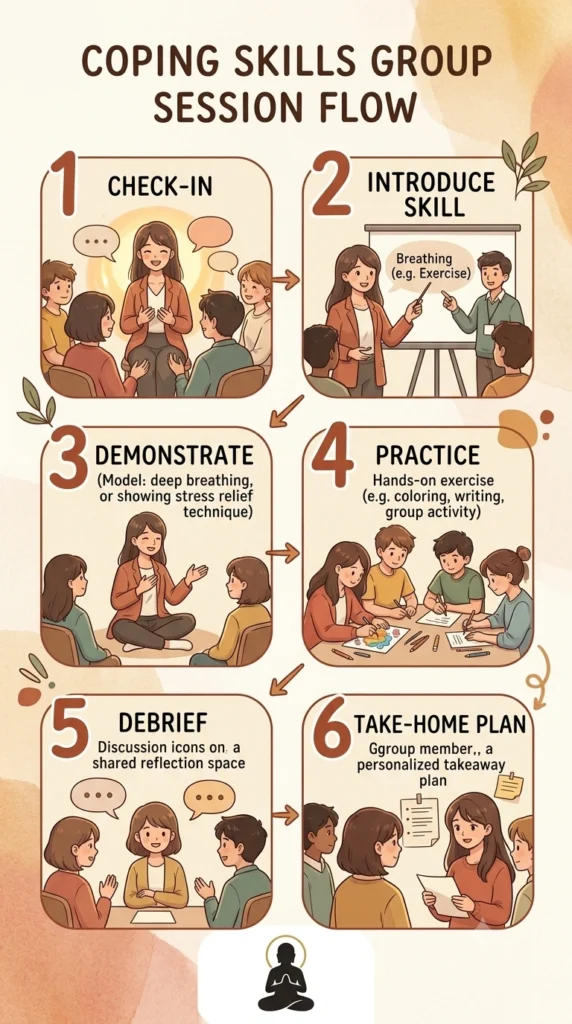
Six moves make or break a coping skills group session. Connect first. Teach one skill. Show it. Let kids try it. Reflect together. Send them home with a plan.
That’s the whole shape. Skip a step and the session turns into a lecture nobody remembers by lunch.
1. Start With a Check-In
Open with something easy to answer. Not a deep question. A quick one.
Ask kids to rate their stress from 1 to 10. Or point to a face on a feelings chart. Or say their mood in one word. A simple feelings poster on the wall helps here, since younger kids often point before they can explain.
Keep sharing optional. That matters more when the group includes children or teens, who don’t always want to go first.
2. Introduce One Coping Skill
Pick one skill. Just one.
Trying to cover an entire list in a single sitting backfires. Kids leave with nothing they can actually use. Choose a skill that matches what the group needs that day. Then explain what it does, when to reach for it, and what problem it actually solves.
Grounding fits well when a group is learning to manage overwhelm. Breathing fits anger. A short cognitive exercise fits racing thoughts. Whatever you pick, this is where solid coping skills worksheets for kids earn their place. A simple sheet gives the skill a shape kids can hold onto once the session ends.
3. Demonstrate the Skill
Show it before you ask for it.
Teaching paced breathing? Breathe with them out loud, so they can copy the rhythm. Teaching a cognitive skill? Walk through one made-up example on a whiteboard first. Don’t skip this part. Kids copy what they see far more than what they’re told.
4. Let the Group Practice
Now hand it over.
This is where a lesson turns into practice. Give the group real time to try the skill, not sixty rushed seconds. Ask them to notice what feels easy, awkward, or just plain weird. No judgment on any answer they give.
Some of the best coping skills activities for kids happen right here. Usually in the ten quiet minutes nobody’s watching the clock.
5. Debrief the Experience
What did they notice?
Ask plainly. “What changed?” “When could you use this?” “Would this work better at home, at school, or somewhere else?” Those three questions do more work than they look like. They’re what turns a short exercise into something a kid actually remembers next week.
6. Create a Take-Home Plan
End with one skill, not five.
Have each participant pick a single coping skill to try before the group meets again. Keep the plan short: when I might need it, what I’ll try, who I can ask for support. Print it. Fold it into a small coping skills booklet for kids to keep in a backpack or a folder. It survives longer than a stack of loose handouts.
Naming a feeling usually comes before choosing what to do about it. If that part still feels shaky for your group, this emotions worksheet is worth working through before the session even starts.
Leaders who want a bigger stash of printable coping skills for kids to pull from between sessions can browse the full coping skills worksheets collection, and pair either one with a few kid-friendly journal prompts for mental health for groups that are ready to write a little more.
Group settings do real work here too. The American Psychological Association describes coping as using cognitive and behavioral strategies to manage stressful demands, and kids tend to pick that up faster watching peers try the same skill and stumble through it too.
How to Turn These Activities Into a Coping Skills Group Activities PDF
A useful coping skills group activities PDF should make facilitation easier, not simply turn a long article into pages of text. Keep each resource focused, printable, and easy to use during a real group session. The goal is to help participants practice a coping skill, reflect on it, and take something useful with them afterward.
One-Pagers
Create a one-page handout for each core coping skill. Keep the instructions short and leave enough blank space for participants to write, draw, or check off responses.
A one-pager for the Coping Skills Toolbox, for example, could have separate spaces for physical, emotional, cognitive, and social coping strategies.
Scenario Cards
Scenario cards work especially well for role-play and discussion. Include short, age-appropriate situations such as feeling overwhelmed before an exam, having an argument with a friend, or dealing with a stressful day at work. Participants can choose a coping response and explain why they selected it.
Coping Menus
A coping menu gives participants options instead of telling them there is one “correct” way to cope. Organize strategies by situation or type, then let each person circle the options they would actually try.
Emotion Scales
Use simple scales to help participants connect emotional intensity with coping choices. A 1–10 scale or color-coded thermometer can show when someone might need a quick grounding strategy versus a longer calming activity.
Personal Plans
A personal coping plan can bring the entire session together. Include spaces for triggers, warning signs, preferred coping strategies, supportive people, and next steps. This turns group discussion into something participants can use outside the session.
Reflection Sheets
End with a short reflection rather than sending participants away immediately after an activity. Ask what they noticed, which strategy felt useful, and where they could realistically use it during the week.
For more printable ideas and ready-to-use resources, explore our Coping Skills Worksheets guide. It can also serve as the foundation for building a more complete coping skills group activities PDF.
When a Coping Activity Is Not Enough
Coping skills group activities can help people practice healthier ways to manage stress, strong emotions, and difficult situations. They are educational and practice tools, though—not a replacement for individualized mental health care when someone needs more support than a group exercise can provide.
Use Coping Activities as Practice Tools
A coping activity might help someone recognize an emotion, slow down during stress, or discover a strategy worth trying later. That’s useful, but it has limits. A worksheet, breathing exercise, role-play, or group discussion cannot diagnose a mental health condition or address every reason someone may be struggling.
The facilitator should also avoid treating participation as proof that a person is “better.” Someone may enjoy an activity and still need additional support. Likewise, a participant who doesn’t want to share during a group exercise should not be pressured into disclosing personal experiences.
Think of these activities as skill practice. They give participants a chance to rehearse coping strategies in a supportive setting so those strategies may feel more familiar when real stress shows up.
Know When Professional Support Is Needed
Professional mental health support is appropriate when distress is persistent, severe, interfering with daily life, or becoming difficult to manage with ordinary coping strategies. A counselor, therapist, doctor, or other qualified professional can assess the situation and recommend appropriate care.
If someone is in immediate emotional distress or feels they may hurt themselves, treat that as a safety concern rather than simply choosing another group activity. In the United States, the 988 Suicide & Crisis Lifeline provides free, confidential crisis support by calling or texting 988. 988 Suicide & Crisis Lifeline
For group leaders, the goal isn’t to solve every problem inside the session. It’s to know what the activity can reasonably do—and recognize when a participant needs support beyond it.
Conclusion
Good coping skills group activities do more than fill time in a counseling session. When chosen well, they give people a safe way to notice emotions, test healthy responses, learn from peers, and build strategies they can use outside the group.
The best activity depends on who is in the room and what they need that day. A playful exercise may work well for children, while teens may respond better to realistic scenarios and adults may prefer practical problem-solving.
Start with one manageable activity, give participants room to pass or adapt it, and always leave time to discuss what they learned. Consistent practice is what turns a coping skill into something people can actually reach for when stress hits.
Frequently Asked Questions
What are good coping skills group activities for teens?
Good coping skills group activities for teens include
stress-scenario role-play,
coping skills brainstorming,
grounding exercises,
thought-swapping activities, and
coping plan worksheets.
Activities work best when they feel relevant to real teen experiences, such as school pressure, friendship conflict, social stress, or feeling overwhelmed.
What are the best coping skills group activities for kids?
The best coping skills group activities for kids are playful, simple, and hands-on.
Feelings games,
coping skills charades,
sensory grounding,
coping skills bingo,
drawing-based activities, and
movement exercises
can help children practice emotional regulation without making the session feel like another classroom lesson.
What is the difference between a coping skills group and group therapy?
A coping skills group focuses specifically on learning and practicing strategies for managing stress, emotions, and difficult situations.
Group therapy is broader and may address mental health concerns, relationships, thoughts, behaviors, or personal experiences through a structured therapeutic process led by a qualified professional.
What coping skills can you practice in a group?
A group can practice grounding, controlled breathing, emotional awareness, positive self-talk, problem-solving, healthy distraction, relaxation, social support, and cognitive coping.
Group practice also lets participants see how other people approach the same stressful situation, which can introduce coping strategies they may not have considered.
What are some quick coping skills group ideas that need no materials?
Quick no-material coping skills group ideas include
guided breathing,
5-4-3-2-1 grounding,
emotion check-ins,
coping skills brainstorming circles,
positive self-talk practice, and
stress-scenario discussions.
These activities are especially useful when a facilitator has only a few minutes or needs an activity that can start immediately.
What age group are coping skills bingo and charades best suited for?
Coping skills bingo and charades are especially well suited to children, tweens, and younger teens, although both can be adapted for older groups.
For teens and adults, use more age-relevant scenarios and coping strategies so the activities feel engaging rather than childish.

It’s Bhaskar!
Well, I am not a psychologist a monk, or a philosopher by training. I’m just an engineering graduate.
‘The Empty Self’ is where I write about that idea, and what it actually means for ordinary life, anxiety, identity, habits, the stories we tell ourselves about who we are. I don’t have a psychology degree, and I’m not offering therapy or clinical advice. What I do have is thought and clarity, and genuine curiosity about why we suffer the way we do and how much of it might loose once we shed this ‘fixed identity’.