

Quick answer: Night journal prompts are questions you use before bed. They help you unpack the day, sort through what you’re feeling, and clear out mental noise before sleep. Most nights, one or two prompts is plenty. This guide has 50+ prompts sorted by mood, a five-minute routine, and a free seven-night challenge.
You don’t need another elaborate bedtime routine. Sometimes you just need somewhere to put the thoughts that keep circling once the lights go off. Night journal prompts slow that down. They help you make sense of the day and separate what actually needs your attention from what can wait.
Here’s the trick, though. Don’t answer every question. Don’t force gratitude either, the way a lot of mindfulness journal prompts end up getting used. Some nights call for reflection. Others just need one annoying conversation dragged out of your head and onto the page.
Pick the prompt that matches the night you actually had. Write it honest. Stop once you’ve said what needed saying.
Table of Contents
Disclaimer
This blog is written and edited with the help of AI, then reviewed by me before publishing. As a result, the content is for general reflection only, not therapy or medical advice, and I’m not a licensed mental health professional. If you’re in crisis, please contact 988 if you’re in US or a local crisis service of your country instead of relying on this site.
What Are Night Journal Prompts?
Night journal prompts ask one simple thing. What’s still sitting in your head? They help you process the day, then decide what can actually wait until morning. This isn’t about becoming a better person. It’s about giving the day somewhere to land. Curious about the wider practice first? Mindfulness journal prompts covers that ground, and night prompts are just one way to bring it into your evening.
What makes a prompt a “night” prompt?
Timing does. A night journal prompt is built around your end-of-day state of mind. It looks backward. It asks what you’re carrying emotionally. Sometimes it just closes a loop before tomorrow opens a new one.
That distinction matters more than it sounds. A generic prompt asks, “What are your biggest goals?” Forward-looking. Vague. A night prompt asks something sharper: “What felt unfinished today, and does it actually need you tonight?”
Most of it doesn’t.
Good night prompts also leave room for an average day. Or a rough one. You don’t need a silver lining. Write about the conversation you keep replaying. The thing you handled badly. The tiny moment that made you laugh despite everything. Or just the task you’re deliberately shoving into tomorrow.
Psychologist James W. Pennebaker’s research on expressive writing helped show something specific. Putting emotional experiences into words changes how people process them. That’s not a diagnosis, and it’s not a cure. It’s just a reason to turn a vague feeling into a specific sentence.
Here’s a decision moment worth picturing. It’s 10pm. You’re replaying an awkward text you sent hours ago. A night prompt doesn’t fix the text. It just asks whether that thought deserves your last hour of the day. Usually, it doesn’t.
Night journal prompts vs. evening journaling prompts vs. bedtime journal prompts
These three terms overlap. The timing still shifts the purpose.
Evening journaling prompts cover the widest window. Use them after work, after class, after dinner, whenever your day slows down enough to look at. They’re good for reviewing what happened while it’s still fresh.
Nighttime journal prompts lean harder into clearing your head. Your day is technically over. Your brain hasn’t caught up yet. It’s still scrolling through conversations, half-finished tasks, and tomorrow’s problems.
Bedtime journal prompts sit closest to sleep. Keep these simple. If answering one turns into an hour-long project, it’s the wrong prompt for the hour.
You don’t need three separate notebooks. Pick the timing that actually fits your life. Here’s the real test: does the prompt help you finish reflecting on today, or does it hand you five new things to worry about tonight? If it’s the second one, close the notebook and try again tomorrow.
If anxious thoughts tend to show up right when you’re trying to wind down, gratitude journaling for anxiety is worth pairing with whichever version you pick.
Why Journal at Night?
Night journaling isn’t about forcing gratitude before bed.
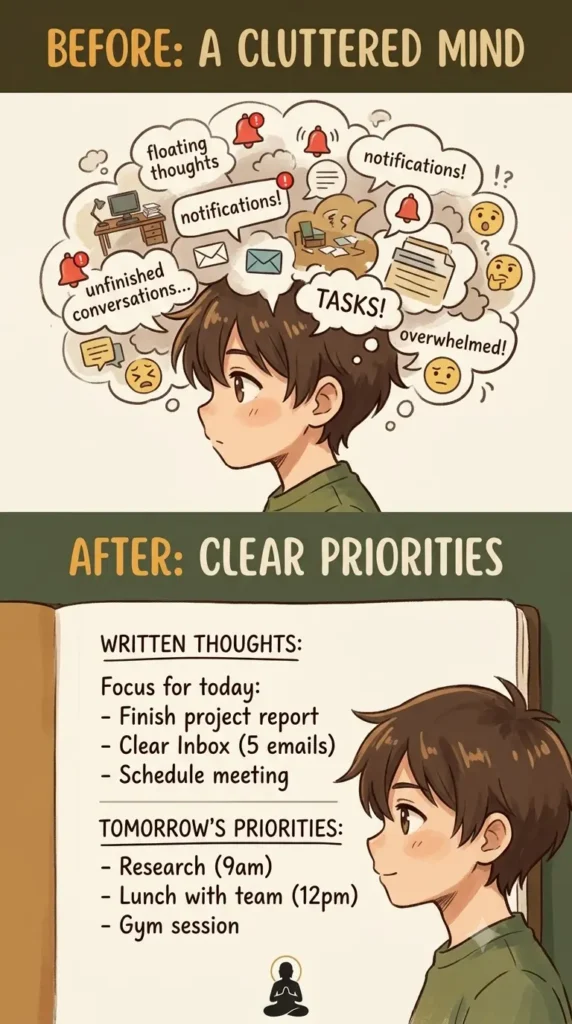
It gives your brain somewhere to put the leftover parts of the day. The awkward conversation. Tomorrow’s deadline. The line you wish you’d said differently. The thought that keeps circling back once everything else goes quiet. Used well, night journal prompts create a stopping point for reflection. Not another task to optimize before sleep.
Put unfinished thoughts somewhere outside your head
Lights off doesn’t mean your brain clocks out.
Not even close.
Once the day’s distractions fade, unfinished tasks and worries get louder, not quieter. Sleep Foundation recommends a relaxing pre-sleep routine, and lists quiet activities like journaling among the options that can ease the transition toward sleep.
That doesn’t mean emptying your entire brain onto a page.
Write down what’s still pulling at your attention. Maybe it’s “email professor tomorrow.” Maybe it’s “I need to decide if I actually want this job.” Once a thought exists somewhere you can see it, you don’t have to keep rehearsing it in your head.
Think of it less as solving the problem. More as taking the problem out of your working memory for the night. Some things can simply wait until morning.
Reflect on what actually happened today
A day can blur into one loud memory if you only replay the loudest parts.
Night journaling slows the timeline down. What happened? What surprised you? When did you feel most like yourself? Was there a moment you handled better than expected?
This matters because reflection isn’t the same as judging the day.
You don’t need to decide if today was good or bad. You can notice you spent three hours procrastinating and still had one conversation that mattered. You can admit work drained you, and still remember the walk home that cleared your head.
That kind of honest accounting beats forcing every entry into a gratitude exercise. If gratitude feels like the missing piece some nights, how to practice gratitude breaks the habit into steps small enough to actually use.
Process emotions before starting tomorrow
Writing can help put hard experiences into words. The research on expressive writing is more nuanced than the internet makes it sound.
James W. Pennebaker’s work helped establish expressive writing as an important area of psychological research, especially around writing through emotional experiences. Later reviews found the effects aren’t universally large or guaranteed. So treat journaling as a reflection practice. Not a promised cure.
Try naming what actually happened emotionally.
I’m still annoyed about that comment.
I felt left out tonight.
I wanted reassurance and didn’t ask for it.
You don’t have to fix the feeling before bed. Sometimes naming it honestly is enough for one entry. A few gratitude worksheets can hand you that same structure on nights when even naming a feeling feels like too much.
And to be clear: night journaling is not an insomnia cure. It cannot guarantee better sleep. If you struggle with sleep or distress regularly, a journal isn’t a stand-in for real support. Gratitude journaling for anxiety walks through a gentler version of this practice, though it’s still not a substitute for a therapist.
Create a mental boundary between today and tomorrow
Your day doesn’t end the moment you close your laptop.
For a lot of people, tomorrow starts mentally while today is still happening. You’re answering messages while thinking about an assignment. Brushing your teeth while planning tomorrow’s meeting. Lying in bed remembering something you forgot to do.
Nighttime journal prompts can draw a deliberate line.
Write what belongs to today. Then what can wait for tomorrow. Sounds simple. It changes the whole purpose of the page. You’re not squeezing more output out of the evening. You’re deciding what no longer needs your attention right now.
That’s a healthier use of a journal than turning every night into a personal performance review.
Prepare tomorrow’s priorities without turning bedtime into a productivity session
Your evening journaling prompts don’t need a seven-item to-do list.
Choose one or two things that actually matter tomorrow. If something’s urgent, write the next concrete action. Not the whole problem rehearsed in your head.
For example:
“Finish the presentation” is vague enough to keep your brain working overtime.
“Open the presentation and finish slides 6 to 8 tomorrow morning” gives tomorrow-you somewhere to start.
Then stop.
The point of nightly journal prompts isn’t squeezing one more productive hour out of yourself. It’s making tomorrow feel less undefined, so tonight can stay right where it belongs. In tonight.
Still stuck on what to write before closing the notebook? Things to be thankful for adds specific ideas that end the day on steadier footing. And for a broader mix of present-moment reflection to pull from, mindfulness journal prompts covers the daytime side of this same habit.
How to Use Night Journal Prompts Without Overthinking It
Night journaling should make your evening lighter. Not heavier. Not one more task stacked on today’s list. The right number of night journal prompts is whatever you can answer honestly, without turning reflection into homework. Some nights that’s one question. Other nights, maybe ten.
Choose one prompt when you’re tired
You don’t need a full session every night. Some nights, exhaustion wins. That’s fine.
Pick one question that actually matches what’s sitting in your head. Write for two or three minutes. That’s it.
Try one of these:
- What is still bothering me about today?
- What do I want to leave behind tonight?
- What do I need to remember about today?
- What can wait until tomorrow?
Don’t chase insight. A messy paragraph about an annoying conversation beats a polished page of generic gratitude most nights. If gratitude is more your thing on quieter nights, a page from gratitude worksheets can hand you that same low-effort structure.
Use three prompts for a five-minute reset
Three nightly journal prompts cover a quick reset. One about today. One about how you feel. One about tomorrow.
Try this order:
- What happened today that is still on my mind?
- What am I feeling about it right now?
- What can I leave for tomorrow instead of carrying it into bed?
Give yourself five minutes. Finish early? Stop. The whole point is a boundary around reflection. Not a session you stretch out until you’ve got nothing left to say.
Use five to ten prompts for deeper reflection
Some nights deserve more room. Maybe you’re still replaying a hard conversation. A decision. A win you haven’t sat with yet. Or the day just felt strange somehow. Those nights, reach for five to ten evening journaling prompts instead of three.
Start with what happened. Then move toward what you felt, what you learned, what you’d change, what comes next.
You don’t need to answer every prompt in order. Follow whichever one makes you pause. That pause is usually where the real reflection lives. For a broader library to pull from on nights like this, the mindfulness journal prompts collection covers a similar kind of slow, present-focused questioning.
You don’t have to finish every prompt
A journal isn’t a worksheet. Nobody’s grading you on completed questions.
Skip what feels irrelevant. Stop mid-answer if you’ve said what needed saying. And if a prompt cracks open something bigger than expected? Stay there. Don’t rush to the next line.
This matters because bedtime journal prompts can quietly turn into another productivity habit. Streaks. Word counts. Checkboxes. Perfect handwriting. None of that is the point. Sound like a small thing to worry about? It isn’t. That’s exactly how a calming habit turns into pressure without you noticing.
What to do when you don’t know what to write
Start with the most boring sentence you can find: “Today, I…”
Then keep going.
Describe what happened. What surprised you. What irritated you. What you avoided. What you keep circling back to. You can even write, “I don’t know what to write tonight, but I’m feeling…” and finish that instead.
That counts. Sometimes the first honest sentence is the only thing you need to find the next one. If some nights call for more structure than a blank page gives you, the 365 journal prompts for mental health guide takes the guesswork out of the first line entirely, and how to practice gratitude works well if your mind keeps drifting toward what went right instead of what’s still bothering you.
If you’d rather not scroll every night, grab the free 7-night printable near the end of this guide.
50+ Night Journal Prompts for Gen Z Adults
Your brain doesn’t care what time it is. It just keeps working.
Night journal prompts help because they give that noise somewhere to go. You don’t need to recap your whole day before bed. Pick one section. Answer what feels useful. Stop when your thoughts feel clearer, not when the page is full.
Choose your starting point:
Night Journal Prompts for a Quick 2-Minute Reset
You don’t need a 30-minute ritual at 11:47 p.m. You need somewhere to put the thought that keeps circling back. Pick one or two prompts. Write without editing yourself. Close the notebook.
- What is taking up the most space in my head right now?
- What happened today that I keep replaying?
- What do I need to stop thinking about for tonight?
- What is one thing I handled better than I expected?
- What am I feeling right now, without trying to change it?
- What can wait until tomorrow?
- What is one small thing I want to remember about today?
- If I could put one thought down and leave it there, what would it be?
- What do I need from myself tonight: rest, honesty, reassurance, or space?
- What would make tomorrow morning feel slightly easier?
The point isn’t a beautiful entry. Messy counts. A few honest lines beat forcing yourself through ten prompts you don’t actually want to answer.
Evening Journaling Prompts for Reflecting on Your Day
Your memory of a day gets distorted at night. One awkward conversation can swallow the whole thing. These evening journaling prompts pull the day back into full view, instead of letting its loudest moment win.
- What actually happened today?
- What part of today felt most like me?
- What was harder than I expected?
- What went better than I expected?
- What conversation has stayed with me?
- What did I spend most of my energy on?
- What did I wish I had more time for today?
- What did I learn about myself today?
- What moment would I happily experience again?
- What would I do differently if I could replay one part of today?
You don’t have to turn every answer into a lesson. Some days are just ordinary. That matters too.

Nighttime Journal Prompts for When Your Mind Won’t Switch Off
When your brain keeps reopening the same tab, “thinking harder” isn’t the fix. These nighttime journal prompts give the thought a definite place to land. Then you can decide if it needs you tonight or tomorrow.
- What thought keeps returning tonight?
- What am I afraid will happen?
- What part of this situation is actually within my control?
- What part is outside my control?
- Is there an action I need to take, or am I mentally rehearsing the same problem?
- What information am I missing before I can make a decision?
- What am I assuming without knowing for sure?
- If I couldn’t solve this tonight, what could I reasonably do tomorrow?
- What would I tell a friend who was thinking about this the way I am?
- What can I give myself permission to leave unfinished?
This isn’t about clearing your mind. It’s about getting specific about the thought. Writing through hard experiences has a long research history. It starts with James Pennebaker and Sandra Beall’s 1986 expressive-writing studies. Later reviews found the effects aren’t universal. They’re not automatic either. That’s exactly why journaling isn’t a guaranteed reset button.
If mindfulness feels like the bigger gap in your evening routine, these mindfulness journal prompts work well as a companion, especially on nights when you want to notice a feeling instead of solving it.
Bedtime Journal Prompts for Letting Go
“Let it go” sounds nice. Try saying it while you’re still angry about a text from 9:12 p.m.
You don’t have to forgive anyone. You don’t need a silver lining. Sometimes letting go just means stopping the mental argument for tonight.
- What am I angry about?
- What disappointed me today?
- What did I wish someone had said or done differently?
- What conversation am I still having in my head?
- What part of today’s situation hurt more than I expected?
- What do I wish I could say without worrying about the response?
- What am I blaming myself for that deserves a more honest look?
- What would I like to stop carrying into tomorrow?
- What boundary might I need to think about later?
- What can remain unresolved tonight?
If the same hard moment keeps showing up night after night, give it attention during the day instead. Bedtime isn’t a deadline for emotional processing.
For prompts built around rougher days specifically, gratitude journaling for anxiety offers a gentler way in when the noise won’t quit.
Night Journal Prompts for Emotional Check-Ins
You don’t need a perfect label for every feeling. Start with what you can actually notice.
- What emotion feels strongest right now?
- Where did I feel most comfortable or at ease today?
- What drained me emotionally?
- What did I need today that I didn’t give myself?
These stay short on purpose. A nightly check-in should help you notice what’s going on. It shouldn’t turn into an interrogation.
Night Journal Prompts for Gratitude Without Toxic Positivity
Gratitude helps. Forced gratitude just wears you out.
If today was rough, you don’t need five things you’re grateful for and a pretend smile over the bad part. Try these instead.
- What was one genuinely good moment today?
- Who made today a little easier?
- What ordinary thing did I appreciate more than usual?
- What do I have now that an earlier version of me wanted?
- What part of my life deserves more attention?
- What am I grateful for without needing to make it bigger than it is?
- What made me feel connected today?
- What small comfort did I almost overlook?
Research on positive expressive writing points to real benefits for wellbeing. The evidence is still mixed across outcomes and methods, though. A 2025 systematic review by Hoult and colleagues found the clearest gains showed up in wellbeing and positive affect. Effects on negative affect and broader psychological outcomes were less consistent.
So use gratitude because it feels honest. Not because you think you’re supposed to.
Want a more structured version of this practice? Gratitude worksheets give you printable exercises to build from. Things to be thankful for helps when your list keeps landing on the same three answers. And how to practice gratitude breaks the whole habit into steps small enough to actually keep.
Night Journal Prompts for Relationships and Social Life
Some of the thoughts keeping you awake aren’t about work. They’re about that text. Or the friend who seemed distant. Or the date that was great, until you replayed every sentence afterward.
- Which conversation stayed with me today?
- Did I feel genuinely understood by anyone today?
- Where did I feel connected to someone?
- Where did I feel disconnected?
- Is there something I wanted to say but didn’t?
- Did I respect my own boundary today?
- Did I agree to something I didn’t really want?
- Am I judging myself based on someone else’s reaction?
- What relationship deserves more of my attention?
- Am I comparing my real relationships with what I see online?
Don’t use a journal to manufacture certainty about someone else’s intentions. You can write “I don’t know what they meant” and stop there. That’s a complete answer.
Night Journal Prompts for Work, College, and Career Stress
You close the laptop. Your brain keeps answering emails anyway. Work and study stress follows you into the evening because there’s rarely a clean stopping point.
- What work or study task is still bothering me?
- What did I actually accomplish today?
- What am I calling “behind” that may simply need more time?
- What task matters most tomorrow?
- What can I deliberately leave unfinished tonight?
- Where did I spend energy without getting much back?
- What expectation am I putting on myself?
- Am I solving a real problem or worrying about a hypothetical one?
- What would “enough” look like tomorrow?
- What do I want my work or college life to make room for?
A good nightly journal shouldn’t become another productivity tracker. If every page ends with a list of things you failed to finish, you’ve basically rebuilt your task manager with worse handwriting.
Night Journal Prompts for Self-Discovery
Self-discovery doesn’t need a dramatic identity crisis. Sometimes it starts small, like noticing you keep saying yes to things you don’t enjoy.
- What felt most natural to me today?
- What did I pretend to enjoy?
- What did I say yes to when I wanted to say no?
- What made me lose track of time?
- What opinion of mine has changed recently?
- What am I outgrowing?
- What am I curious about right now?
- Which version of myself shows up around different people?
- What value did I actually live by today?
- What do I want to understand about myself better?
Want to move from reflection into building a stronger inner voice? Affirmation journal prompts is the natural next step once the noticing part feels steady.
Night Journal Prompts for Tomorrow
Tomorrow doesn’t need a 17-item master plan. You probably just need to know what matters first, and what can wait.
- What is the one thing I want to make time for tomorrow?
- What can I prepare tonight to make tomorrow easier?
- What am I looking forward to?
- What might distract me tomorrow?
- What boundary do I want to keep?
- What deserves my attention before my phone does?
- What can wait until later in the day?
- How do I want to feel when tomorrow evening arrives?
- What is one realistic promise I can make to myself?
- What would make tomorrow feel like a good day, even if it isn’t perfect?
You don’t need to answer all ten. Honestly, you probably shouldn’t.
The best night journal prompts match the problem you actually have at 11 p.m. Use one when you’re exhausted. Use ten when you genuinely want to write. Skip gratitude when it feels fake. Write about the awkward conversation if that’s what your brain keeps replaying.
A journal is allowed to be honest without being optimistic. If you want a broader set of nighttime and mindfulness prompts to rotate through, the mindfulness journal prompts guide is a solid place to keep exploring from here.
Night Journaling in the Age of Doomscrolling
Your phone isn’t always the thing keeping you up. Sometimes it’s what happened on it. A late-night post. An unread message. One more comparison scroll before bed. It follows you long after the screen goes dark. Night journal prompts give those thoughts somewhere else to go, instead of somewhere to sit and spin.
What social media left you feeling tonight
Notice what the app left behind before you close it.
Did it leave you entertained? Connected? Jealous, restless, inspired, numb? Don’t judge the feeling. Just name it. That’s the whole task.
Research on nighttime social media use isn’t as tidy as “screens are bad.” A 2020 experience-sampling study by Das-Friebel and colleagues found no clear evidence that bedtime scrolling hurt sleep or next-day mood in healthy young adults. Other work has tied nighttime social media use to worry, FOMO, a racing mind at lights-out, and worse sleep quality overall.
That mixed evidence is exactly why your own reaction matters more than any study. A feed that relaxes you isn’t the same as one that leaves you comparing your life to a stranger’s at 12:47 a.m.
Try writing:
What did I feel after scrolling tonight, and what triggered it?
What are you still carrying from your notifications?
Notifications create tiny loops that never close.
A message you haven’t answered. A work email you’re avoiding. Someone’s story you saw and wish you hadn’t. A group chat that lit up right when you were trying to switch off.
Write down the notification, or the thought behind it, still taking up space in your head. Then ask if it actually needs a response tonight. Most of the time, it doesn’t. If that loop keeps circling into worry or FOMO, gratitude journaling for anxiety walks through a version of this practice built specifically for that spiral. And for a wider set of prompts on your relationship with screens beyond just bedtime, the digital life journal prompts cover that ground in more depth.
Did you spend tonight doing what you actually wanted?
This isn’t about whether you were productive.
Maybe you planned to read and watched short videos for an hour instead. Maybe you meant to call a friend but kept refreshing your feed. Or maybe scrolling was genuinely what you wanted after a long day. That counts too.
The point isn’t shame. It’s noticing the gap between what you intended and what you actually did.
Write:
If I could replay the last two hours, what would I keep exactly the same?
Then ask what you’d change.
What deserves your attention tomorrow instead?
Don’t solve tomorrow tonight.
Use the page to separate what’s urgent from what’s just loud. One unresolved email can feel enormous at midnight and completely manageable by 9 a.m. Nothing about the email changed. You did.
Write down the one thing you most want your attention on tomorrow. Then leave the rest alone tonight.
What information can wait until morning?
Not every question deserves an answer right now.
You don’t need to research that symptom, check your ex’s profile, read every message, or compare five products before sleep. Some of it matters tomorrow. None of it matters at 1 a.m.
Write:
What am I tempted to find out right now that can safely wait until morning?
Then close the loop in your journal instead of opening another tab. That’s the shift these nightly journal prompts are built around: naming what your mind is holding, so it doesn’t have to hold it alone until sunrise.

A Free 7-Night Journal Challenge
Thirty minutes a night isn’t the answer. That kind of ask turns reflection into one more chore you’ll dodge by Tuesday. This 7-night journal challenge works differently. One direction each evening. Clear your head, understand your day, decide what tomorrow actually deserves.
Think of it as a starter version of a full mindfulness journal prompts practice, just built specifically for the hours before sleep. If a single night of evening journaling prompts works for you, the deeper collection is there whenever you want to go further.
Night 1: Empty Your Mind
Start with the tabs you keep reopening in your head.
Write down everything still taking up space. An unfinished assignment. A message you haven’t answered. A thought that keeps circling back for no clear reason. Don’t organize any of it yet. Offload it first.
Then ask one question: What can wait until tomorrow?
That’s it. Nothing to fix tonight.
Night 2: Reflect on Your Emotions
You don’t owe your feelings a neat explanation.
Ask yourself: What emotion showed up most strongly today? What triggered it? What did I need in that moment?
Not sure? Skip the labeling. Describe what happened instead. The feeling usually gets clearer once you stop hunting for the perfect word for it. This is the kind of nightly journal prompt that works best when you write messy and stay honest.
Night 3: Notice What Went Well
This isn’t a forced gratitude exercise. Nobody’s grading your list.
Think of one moment that genuinely felt good. Meaningful, funny, quiet, satisfying, whatever fits. Write down why it mattered. A good conversation counts. So does finally finishing something you’d been avoiding for a week. If this angle sticks with you, a set of gratitude worksheets can carry the habit further than one prompt a night ever will.
Night 4: Let Something Go
Pick one thing from today that doesn’t deserve another hour of your attention.
Maybe you said something awkward. Maybe someone let you down. Maybe you just made a mistake, and it’s been sitting there since lunch.
Write it out: What happened? What is actually mine to deal with? What can I leave here tonight?
You’re not pretending it didn’t happen. You’re just deciding not to replay it on a loop.
Night 5: Explore Yourself
Here’s an honest take: tonight isn’t about self-improvement. It’s about curiosity.
Ask: What did I learn about myself today? What did I enjoy more than expected? What drained me? What am I changing my mind about?
Good journaling doesn’t always hand you an answer. Sometimes it just hands you a better question, and that’s enough for a bedtime journal prompt to do its job.
Night 6: Reflect on Your Relationships
Most people rate relationships as simply “good” or “bad.” Skip that tonight.
Which conversation stayed with you? Who made you feel understood? Where did you hold back when you probably shouldn’t have? Is there a boundary that needs saying out loud?
Write honestly. Nobody’s reading this but you. You don’t need to send a single message tonight.
Night 7: Set an Intention for Tomorrow
Forget the giant to-do list. It can wait until morning.
Choose one thing you want tomorrow to feel like, and one action that could actually support it. Maybe the intention is staying focused. Maybe it’s being less reactive, protecting your evening, or finally finishing the task you keep pushing to “later.” Small target. Easier to hit.
Save the printable somewhere you’ll actually see it again, not buried three folders deep. This isn’t about a flawless seven-day streak. It’s about a few quiet minutes each night, noticing what happened before you rush straight into whatever comes next. And if these nighttime journal prompts turn into a habit you want to keep, the full mindfulness journal prompts guide has 300+ more to pull from once you’re ready to expand past seven nights.
Common Mistakes to Avoid With Night Journal Prompts
Night journal prompts can turn into one more task on the list. That’s the trap. The goal isn’t a perfect page. It isn’t recording every win either. It isn’t forcing yourself into a better mood before lights out. A good journal gives your thoughts somewhere to land. It doesn’t demand they behave.
Trying to answer too many prompts
Fifteen prompts sitting on a page doesn’t mean you owe all fifteen an answer. Not tonight. Not most nights. If you’re tired, one honest line beats a full checklist.
Start with whatever’s actually loud in your head. Got more to say? Keep writing. Nothing left? Close the notebook. That’s allowed.
Bedtime journal prompts work best as an offer, not an assignment. Treating them like a to-do list is one of the fastest ways beginners burn out on the habit, something covered in more detail in this guide to mindfulness journal prompts.
Turning your journal into another productivity tracker
Your evening notebook doesn’t need to become a second Notion dashboard.
Tracking goals, habits, and daily wins has its place. Nighttime reflection has a different job. Ask “What did I get done?” and “What’s tomorrow’s plan?” every single night, and you’ve just moved your to-do list into a nicer notebook. Same pressure, different cover.
There’s one exception worth keeping, though. Writing down an unfinished plan actually helps. A 2011 study by Masicampo and Baumeister found that making a specific plan for a stalled goal reduced the mental tug that goal tends to leave behind. So jot the plan down. Then let it go for the night.
Forcing positivity when you’re upset
You don’t owe every entry a gratitude line at the bottom.
Someone hurt your feelings? Write that. Wasted the evening scrolling? Say so. Disappointed about something? Leave the page disappointed. Nightly journal prompts aren’t a mood contract.
Expressive writing research, starting with Pennebaker and Beall’s 1986 study, looked at writing through hard experiences rather than reshaping them into something upbeat. The results since then are mixed. So treat journaling as a way to get thoughts out and put them in order, not a guaranteed fix for how you feel. If forced cheer is part of what’s been tripping you up, this breakdown of how to practice gratitude without faking it is worth a look.
Writing only about what you accomplished
A day is bigger than its output.
Maybe you had a hard conversation. Maybe you spotted a boundary you need to set. Maybe you laughed at something dumb with a friend. Maybe you did nothing for an hour and needed exactly that.
Those details say more about your life than another finished-task list ever will.
Staying on your phone longer than you meant to
Digital journaling is convenient. What happens right after isn’t.
You open your notes app. Write for five minutes. Then check Instagram. One notification becomes a message, then a video, then somehow it’s 12:47 a.m. and you’re reading comments.
If your phone makes evening journaling prompts easier to reach for, use it. Just set a clear stopping point once the writing’s done.
Expecting your racing thoughts to switch off instantly
Writing organizes what’s circling. It isn’t an off switch.
Some thoughts will still be there when you close the notebook. That’s normal. Nobody’s journal forces the mind into silence, and expecting instant results is one of the most common ways beginners quit, whether it’s mindfulness journal prompts or nighttime journal prompts specifically. The more realistic win looks smaller: I wrote it down. I don’t have to solve it tonight.
More Journal Prompts to Explore
Night journaling doesn’t have to stay in one lane. Some nights ask for noticing what’s happening right now. Other nights, gratitude gives you an easier place to start. And some nights? You just need a prompt that doesn’t take itself too seriously.
Want a wider net? Start with mindfulness journal prompts, a 300+ collection covering present-moment awareness, emotions, digital life, sleep, and self-reflection. If gratitude fits your headspace tonight, how to practice gratitude walks through building the habit step by step. Prefer something printable instead? Grab the gratitude worksheets, or scan things to be thankful for for a quick list to borrow from.
Thoughts running loud tonight? Gratitude journaling for anxiety gives you a narrower, steadier place to land. And if mindfulness and thankfulness keep overlapping for you anyway, mindfulness and gratitude breaks down exactly why.
The goal was never a pile of unused prompts. Find the one question that matches tonight’s headspace. Then write from there. That’s it.
Conclusion
Night journaling doesn’t have to be one more wellness task you drop by Thursday. The idea is simple. Give your thoughts a place to land before they follow you into tomorrow.
Researchers James Pennebaker and Joshua Smyth spent years studying expressive writing. Their work suggests putting hard experiences into words can help people organize scattered thoughts and feelings. Not for everyone, though. The effects aren’t universal, and that’s worth saying plainly.
So pick one prompt from this list of night journal prompts. Write for a few minutes. Stop when nothing’s left to say.
You don’t need a perfect ending to your day. You just need a place to put it. Mornings can feel just as noisy. These mindful journal prompts help you start the day the same way you end it. With a clear head.
Frequently Asked Questions
What to write in a journal at night?
Write about whatever’s still stuck in your head after the day is supposedly done. That’s it. That’s the whole brief.
Name a feeling. Record a small win. Jot down the one task tomorrow can’t start without. Night journal prompts work best when they’re honest, not impressive. Nobody’s grading the entry.
If your line for tonight is “today was fine, I’m just tired,” that counts. For a wider set of angles to pull from on nights like that, the mindfulness journal prompts collection has plenty to borrow from.
What are journal prompts for sleep?
Journal prompts for sleep are simple questions built to catch loose thoughts before they follow you into bed. Unfinished tasks. Low-grade worry. The stuff your brain keeps rehearsing at 11pm for no clear reason.
They’re not a guaranteed sleep aid, and nobody should market them that way.
A 2018 polysomnographic study led by Michael Scullin found that people who wrote a specific to-do list before bed fell asleep faster than people who wrote about tasks they’d already finished. One study. Real result. Not a promise.
Can night journaling help with overthinking?
It won’t shut overthinking off. Nothing does that reliably.
What it can do is give the looping thought somewhere to land besides your head. Scullin’s 2018 study found that putting tomorrow’s tasks on paper eased the mental load of having to remember them all night.
Earlier expressive-writing research points the same direction. Naming a worry in words seems to help the brain process it instead of just replaying it. Sound too simple to matter? Maybe. It still works often enough to be worth five minutes.
What are good bedtime journal prompts for beginners?
Start small. Nothing profound required on night one.
Try these:
What is still on my mind tonight?
What felt good today?
What felt difficult?
What can wait until tomorrow?
What do I want to remember about today?
One honest answer beats a full page you forced. If you want a bigger rotation once these feel too familiar, gratitude worksheets offer a structured way to keep the habit from going stale, and the guide on how to practice gratitude breaks the habit down step by step if you want the fuller version.
Should I use a journal or my phone at night?
Use whatever you’ll actually stick with. That part matters more than the format.
But be honest about what your phone does once it’s in your hand. Opening a notes app at 10pm rarely stays a notes app. It turns into Instagram, three unread group chats, a YouTube video you didn’t plan on watching. If that’s your pattern, paper wins by default.
Research on nighttime phone use has linked it to higher pre-sleep arousal and later sleep timing, though this varies person to person and isn’t true for everyone equally.
Still stuck for material some nights? A running list of things to be thankful for can fill that gap on the nights your notebook feels like it’s asking too much.

It’s Bhaskar!
Well, I am not a psychologist a monk, or a philosopher by training. I’m just an engineering graduate.
‘The Empty Self’ is where I write about that idea, and what it actually means for ordinary life, anxiety, identity, habits, the stories we tell ourselves about who we are. I don’t have a psychology degree, and I’m not offering therapy or clinical advice. What I do have is thought and clarity, and genuine curiosity about why we suffer the way we do and how much of it might loose once we shed this ‘fixed identity’.