
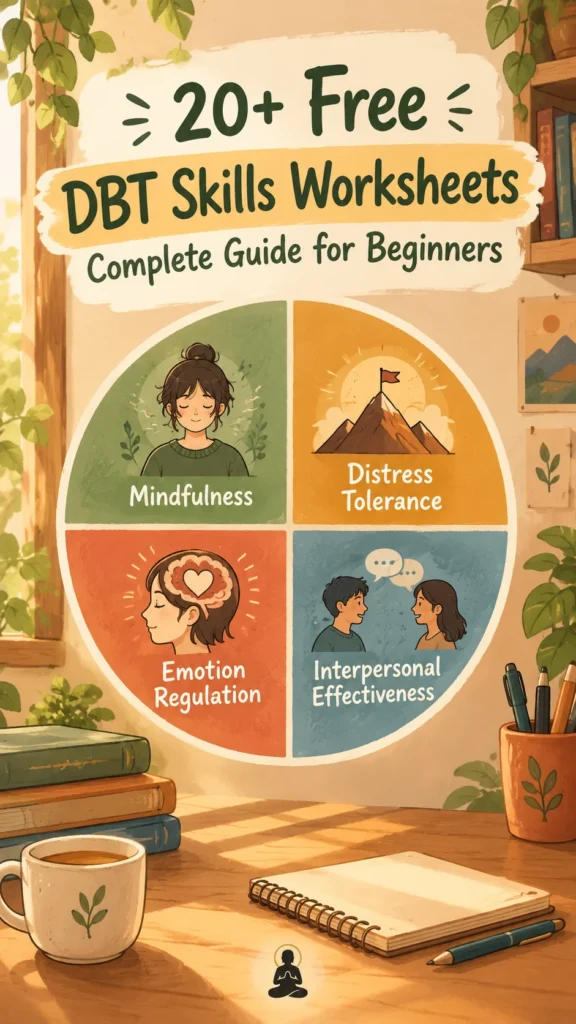
Reading about a skill and using it are two different things. DBT skills worksheets close that gap. They give you a structured way to practice skills, not just read about them. Inside, you’ll find tools for distress tolerance during difficult moments. Emotion regulation tools step in when feelings become intense. Need help with communication and boundaries? That’s interpersonal effectiveness. Mindfulness helps you stay present.
Each section helps you name the skill you need. You learn how it works. Then you apply it to a real situation. You don’t need to master every DBT skill at once. That’s not the goal. Where should you begin? Pick one worksheet that matches what you’re dealing with right now. Then build from there.
Quick Overview: DBT skills worksheets turn core Dialectical Behavior Therapy skills into practical exercises. Use them to understand emotions, handle distress, improve relationships, and build mindfulness. That’s the idea. The library covers the four main DBT modules. It also includes printable tools, tracking sheets, and quick-reference resources.
Need immediate support?
These worksheets are educational tools. They are not a substitute for therapy, professional mental health care, or crisis support. In the U.S., you can call or text 988 if you’re in immediate danger or need crisis support. That reaches the 988 Suicide & Crisis Lifeline. You can also text HOME to 741741 to connect with Crisis Text Line.
Table of Contents
Disclaimer
This blog is written and edited with the help of AI, then reviewed by me before publishing. As a result, the content is for general reflection only, not therapy or medical advice, and I’m not a licensed mental health professional. If you’re in crisis, please contact 988 if you’re in US or a local crisis service of your country instead of relying on this site.
DBT Skills Worksheets at a Glance
DBT skills worksheets let you learn one skill at a time. You can practice it and review it later without finishing a full DBT program. No marathon required. It’s 11pm, your chest is tight, and a full course is the last thing you need. You need one skill. Use this library to find the right module and pick a format. Then jump straight to the skill you need.
The Four DBT Modules
DBT isn’t one skill set. It’s four core modules. Each one covers a different piece of coping, emotional awareness, or relationships. Trying to learn all four at once is a fast way to remember none. Pick one and start there.
Mindfulness builds awareness of your thoughts, feelings, body sensations, and surroundings. The goal is noticing without reacting on autopilot. That’s harder than it sounds. Start with Wise Mind, the What and How skills, and Observe–Describe–Participate. These mindfulness journal prompts pair well with that practice.
Distress Tolerance gets you through intense emotions and hard situations. It keeps the moment from getting worse. That’s the whole job. Explore STOP, TIPP, ACCEPTS, IMPROVE the Moment, Self-Soothe, Radical Acceptance, and related crisis-survival skills. For broader options, browse these coping skills worksheets.
Emotion Regulation helps you understand what you feel and check whether it fits the facts. Loud doesn’t mean accurate. From there, respond in ways that support your goals. Key skills include Check the Facts, Opposite Action, PLEASE, Coping Ahead, and validation. An emotions worksheet helps you name the feeling first.
Interpersonal Effectiveness teaches you to communicate clearly while protecting your relationships and self-respect. Hard to do mid-argument. Start with DEAR MAN, GIVE, and FAST.

Choose Your Worksheet Format
Worksheets aren’t the only format in this library. Printable worksheets and PDFs suit you if you like writing by hand. Interactive worksheets can be completed digitally. Cheat sheets, cards, posters, and flowcharts are quick-reference tools.
Who wants to fill out a full worksheet in the middle of a panic? Not many people. Those tools exist for when you only need a skill reminder. This coping skills handout works the same way.
Not sure where to begin? Use the four module sections below as your starting point. For a specific problem, try the later sections. DBT Worksheets by Situation and How to Choose the Right DBT Worksheet can narrow your options.
Where These Worksheets Come From
A quick note about DBT source materials. These worksheets are original, plain-language tools inspired by DBT skills training. Plain language matters when you’re stressed. They aren’t reproductions of Marsha M. Linehan’s copyrighted manuals or handouts. Want the original source? Linehan’s published books are available in print and authorized digital editions through the publisher. Guilford Press currently publishes the revised editions. Those are the DBT Skills Training Manual and DBT Skills Training Handouts and Worksheets.
DBT Skills Training Manual: Revised Edition and DBT Skills Training Handouts and Worksheets: Revised Edition, both from Guilford Press.
More books and workbooks are coming up. Jump to the Best DBT Books section later in this guide.
What Is DBT and What Are DBT Skills Worksheets?
DBT, or dialectical behavior therapy, is a structured therapy built around skills. Those skills cover managing emotions, tolerating distress, staying present, and handling relationships better. Knowing them isn’t enough.
That’s where DBT skills worksheets come in. Each one turns an idea into a guided exercise you can actually use. It lets you learn, practice, and review a specific skill.
What Does DBT Stand For?
The name is a mouthful. DBT stands for dialectical behavior therapy, and psychologist Marsha M. Linehan developed it. It combines acceptance-based strategies with behavior-change strategies. The word dialectical refers to working with two ideas that can seem opposite. What does that look like? Accepting yourself as you are while also working toward meaningful change. Both can be true.
You may also see DBT therapy, DBT meaning, or dialectical therapy while searching. They all point to the same approach. In standard DBT, skills training is one piece of a bigger treatment structure. It isn’t the whole therapy. Behavioral Tech is the organization tied to the Linehan Institute and DBT training. It describes four core skills modules. Those are mindfulness, distress tolerance, emotion regulation, and interpersonal effectiveness.
What Is a DBT Worksheet?
A DBT worksheet isn’t a reading assignment. It’s a guided practice tool. Use it to apply a specific DBT concept to a real situation. Say it’s late, and an argument with a friend keeps replaying in your head. The worksheet has you examine the facts of what happened. Nothing fancy.
Depending on the skill, a worksheet might also have you identify an emotion. Others help you plan an effective response or practice a communication strategy. Some just record which skill you used.
You’ll see these resources under other names too. Think DBT therapy worksheets, DBT handouts, printable worksheets, or even PDF exercises. They make abstract skills easier to grasp. Ever nodded along to a skill, then lost it by dinner? A worksheet won’t let you just read about it. It makes you work through the steps.
How Worksheets Fit Into DBT Skills Training
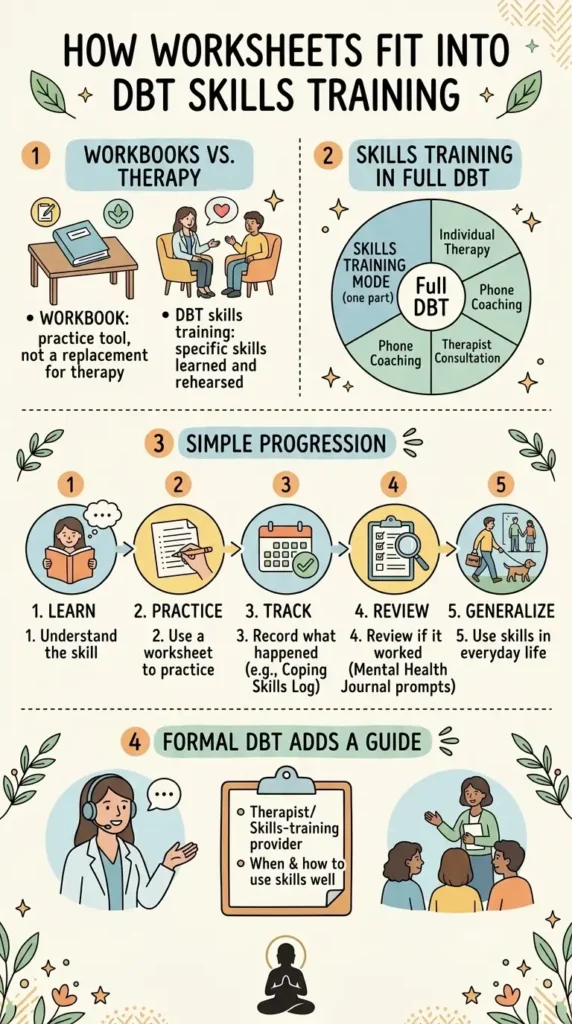
Worksheets and therapy do different jobs. Think of a worksheet as a practice tool, not a replacement for therapy. DBT skills training helps people learn specific skills and rehearse them.
Eventually, people use them in everyday situations. Behavioral Tech describes skills training as one mode within full DBT. Other parts of treatment sit alongside it.
Here’s a simple progression:
Learn → Practice → Track → Review → Generalize
You first learn what a skill is and when it may help. Then a worksheet gives you a structured way to practice it. It also gives you a place to track what happened, like a coping skills log. Tracking sounds dull. But reviewing whether the response worked is how you find out what helps. Journal prompts for mental health can make that review easier.
Formal DBT adds a guide. A therapist or skills-training provider can show you when and how to use skills well.
The 4 Modules of DBT
The four modules of DBT form the backbone of skills training. They are mindfulness, distress tolerance, emotion regulation, and interpersonal effectiveness. Each covers a different set of skills. In practice, they overlap. Real life doesn’t sort itself into tidy boxes. Here’s each one at a glance:
- Mindfulness: paying attention to the present moment with more awareness
- Distress Tolerance: getting through painful, overwhelming moments without making them worse
- Emotion Regulation: understanding your emotions and responding to them better
- Interpersonal Effectiveness: voicing needs, setting boundaries, and keeping relationships while respecting yourself and others
Want a head start? Try these mindfulness journal prompts for the module built around present-moment attention. An emotions worksheet suits emotion regulation. Coping skills worksheets sit close to distress tolerance.
This four-part setup is the basic blueprint behind many DBT therapy modules. Worksheets, handouts, and skills-training resources follow it too. The next section breaks down each module. You’ll see the specific skills you can practice in each one.
This four-part structure is the basic architecture behind many DBT therapy modules, worksheets, handouts, and skills-training resources. The next section breaks down each module and the specific skills you can practice within it.
The 4 Modules of DBT Skills
DBT skills fall into four core modules. Mindfulness, distress tolerance, emotion regulation, and interpersonal effectiveness. Each one handles a different part of emotional and behavioral life.
Together, they give you a practical framework for staying present and handling hard moments. The same framework covers managing emotions and building healthier relationships. Four modules, four jobs.
1. Mindfulness
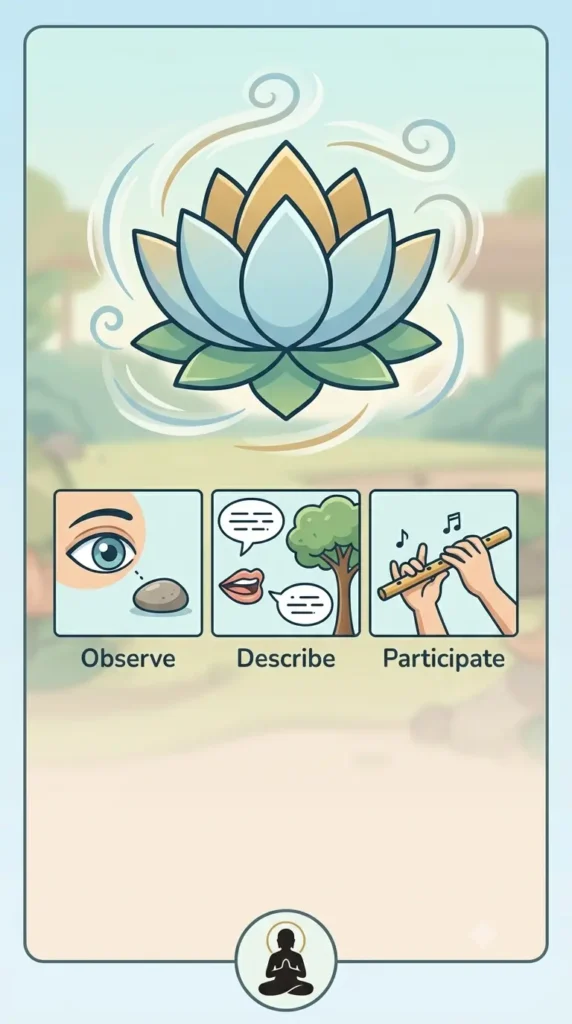
Mindfulness is the foundation of DBT. It helps you pay attention to what’s happening right now. Without reacting to it right away. You learn skills such as Observe, Describe, and Participate. Alongside them sit the broader ideas of being nonjudgmental, one-mindful, and effective. Sounds simple. It isn’t always easy.
[Future cluster: wise mind dbt]
Wise Mind DBT skills help you bring emotional awareness and clear thinking together when a decision is on the table. A dedicated guide can explain Wise Mind in more detail. It can also include a practical wise mind DBT PDF for practice.
[Future cluster: dbt what and how skills]
DBT What and How skills give mindfulness a simple structure. One part covers what you do. The other covers how you do it. A dedicated resource can cover DBT mindfulness skills PDFs in depth. It can also cover DBT mindfulness exercises PDFs and DBT mindfulness worksheets PDFs.
Want a more reflective practice? These mindfulness journal prompts offer journaling exercises you can try.
2. Distress Tolerance
Some moments can’t be fixed right away. Distress tolerance DBT skills are made for those painful, overwhelming moments. Nobody is asking the feeling to disappear.
You learn to get through the moment without making it worse. Sometimes surviving is the whole goal. This module includes crisis-survival and acceptance-based skills.
[Future cluster: dbt distress tolerance skills]
A dedicated guide to DBT distress tolerance skills can break the module into practical skill families. Those include TIPP, ACCEPTS, and Self-Soothe. Each offers a different way to respond when emotions or urges get hard to manage.
Need more coping tools? Browse these coping skills worksheets. They include coping toolboxes, logs, and practical coping activities.
3. Emotion Regulation
Emotions aren’t the enemy here. DBT skills for emotional regulation focus on understanding your emotions. They also make intense emotional reactions less likely. You also learn to choose responses that fit the situation. The goal is to recognize what you’re feeling and build more useful ways to respond. Nothing gets erased.

[Future cluster: dbt emotion regulation skills]
A dedicated DBT emotion regulation skills guide can trace the full process. It starts with understanding an emotion. From there, it moves to checking the facts. Then comes changing an unhelpful response and responding on purpose. The guide can also cover skills such as Coping Ahead, values, validation, and pros-and-cons exercises.
For tools that help you name and understand what you feel, try this printable emotions worksheet. It covers emotion identification and regulation, with exercises for naming feelings. For written reflection, see these journal prompts for mental health.
4. Interpersonal Effectiveness
Interpersonal effectiveness skills help you communicate clearly. They protect both your relationships and your own needs. DBT teaches practical ways to ask for what you need, set boundaries, and handle conflict. No yelling. No caving. The aim is keeping your self-respect without aggression or passive communication.

[Future cluster: dbt interpersonal effectiveness skills]
A dedicated guide can explain the three major skill sets in this module. They are DEAR MAN, GIVE, and FAST. Together, they cover three needs. Making requests, maintaining relationships, and staying aligned with your values and self-respect.
DBT Distress-Tolerance Worksheets for Difficult Moments
DBT distress-tolerance skills help you get through intense moments without making the situation worse. These worksheets focus on short-term crisis survival: pausing before acting, lowering emotional intensity, accepting what you cannot change, and choosing safer ways to cope until the urge passes.
STOP
The STOP skill in DBT is designed for moments when an emotion or urge is pushing you toward an immediate reaction. STOP stands for Stop, Take a step back, Observe, and Proceed mindfully. The goal is not to solve everything instantly. It is to create enough space between the trigger and your response to make a deliberate choice.
- S — Stop: Pause. Do not act on the first impulse.
- T — Take a step back: Physically or mentally create some distance from the situation. Take a breath, step away, or give yourself a moment.
- O — Observe: Notice what is happening inside and around you. What are you feeling? What thoughts, urges, or physical sensations are present?
- P — Proceed mindfully: Choose your next action based on what will help, rather than what the strongest emotion is demanding right now.
For example, imagine receiving a message that makes you angry. Your first urge may be to send an equally angry reply. STOP gives you a chance to put the phone down, notice the anger and urge to respond, and decide what to do next after the intensity has dropped.
A DBT STOP skill worksheet can help you practice each step using a real situation. The more familiar the sequence becomes, the easier it may be to remember when you are under stress.

[Future cluster: DBT STOP Skill — A dedicated guide can explain the STOP skill in greater depth, walk through each step with examples, and provide a printable DBT STOP skill worksheet for practice.]
TIPP
TIPP is a distress-tolerance skill for situations where emotional arousal is extremely high and you need to bring the intensity down before trying to reason through the problem. The four parts are Temperature, Intense Exercise, Paced Breathing, and Paired Muscle Relaxation.
- Temperature: A brief change in temperature, such as using cool water on the face, can be used as part of a crisis-survival strategy. If you have a medical condition that makes cold exposure or similar techniques unsafe, choose another skill or ask a healthcare professional what is appropriate for you.
- Intense Exercise: Short, vigorous physical activity can help shift your body’s level of activation. The goal is not punishment or exhaustion.
- Paced Breathing: Slow your breathing, with a longer and gentler exhale, to help settle physical arousal.
- Paired Muscle Relaxation: Tense and then release muscle groups while breathing slowly, paying attention to the contrast between tension and relaxation.
You may see searches such as tip skills DBT, TIPP skills PDF, TIPP worksheet, or TIPP handout. “TIPP” is the commonly used acronym for this DBT skill. A worksheet can help you record which part you tried, what your emotional intensity was before and afterward, and whether the strategy was useful.

[Future cluster: DBT TIPP Skills — A dedicated resource can explain each TIPP component, safety considerations, examples, and printable practice tools.]
ACCEPTS
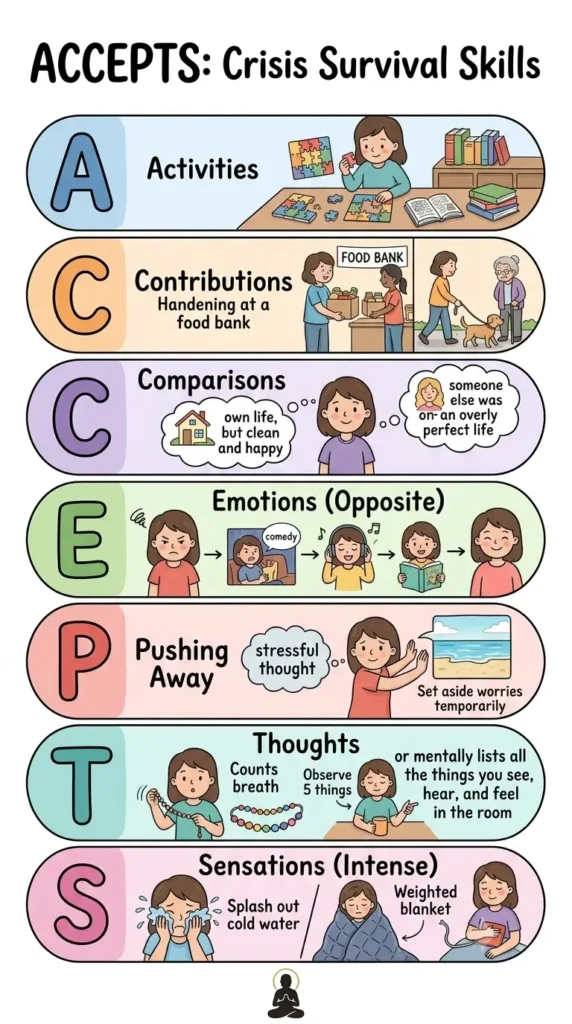
ACCEPTS is a DBT distress-tolerance skill that uses temporary distraction when staying focused on a painful situation is making the emotional intensity harder to manage. The acronym covers Activities, Contributing, Comparisons, Emotions, Pushing away, Thoughts, and Sensations.
The purpose is not to pretend the problem does not exist. Sometimes you need to temporarily redirect your attention so you can get through a difficult period without acting on an urge. You can return to the underlying problem later when you are in a better state to deal with it.
For example, Activities might mean taking a shower, cleaning a small area, walking, drawing, or doing a simple task that requires your attention. Contributing could involve doing something helpful for another person. Thoughts might mean deliberately focusing on a neutral mental task, such as counting backward or describing objects around you.
An ACCEPTS worksheet can turn the acronym into a personal list of options. That matters because it is much harder to brainstorm useful distractions when you are already overwhelmed.
[Future cluster: DBT ACCEPTS Skill — This cluster can cover the ACCEPTS distraction categories in detail, including examples for different situations and a printable practice worksheet.]
IMPROVE the Moment
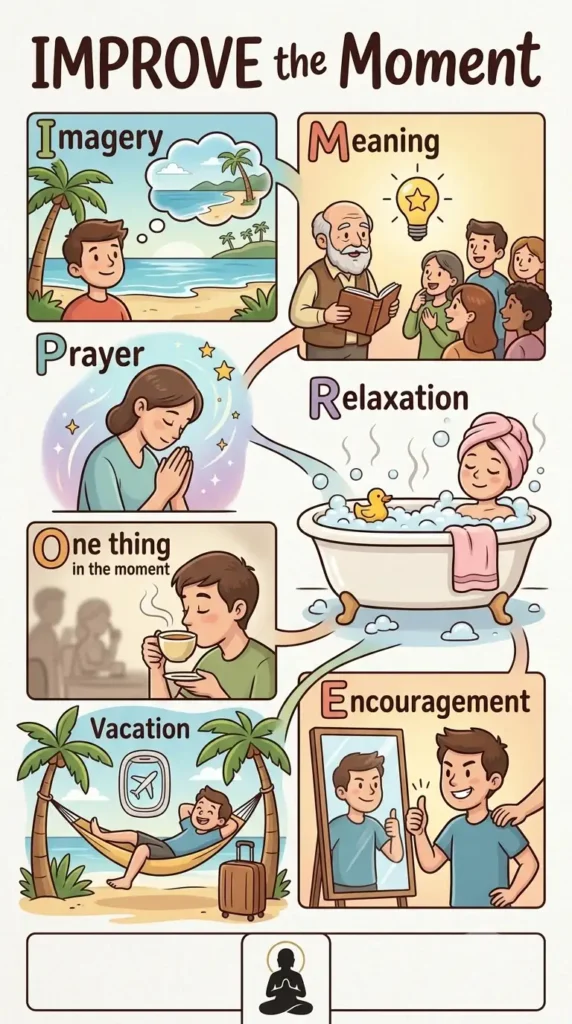
IMPROVE the Moment is another DBT distress-tolerance strategy for making a painful moment more manageable. The acronym represents different ways to change how you experience the moment without requiring the external situation to change immediately.
The skills include Imagery, Meaning, Prayer, Relaxation, One thing in the moment, Vacation, and Encouragement. You can choose the part that fits the situation rather than treating the acronym like a checklist you must complete from beginning to end.
For instance, One thing in the moment can bring your attention back to the specific action in front of you instead of letting your mind race through everything that might happen next. Encouragement can involve using realistic, supportive self-talk such as, “I can get through the next ten minutes without making this worse.”
This is why searches for IMPROVE DBT, improve the moment DBT PDF, and DBT improve skill often overlap with broader distress-tolerance resources.
[Future cluster: DBT Improve the Moment — A dedicated post can break down each part of the skill and provide examples and an original printable worksheet.]
Self-Soothe
Self-soothing in DBT means using your senses intentionally to create a small amount of comfort, grounding, or calm during distress. The five senses provide a simple framework: sight, sound, smell, taste, and touch.
Your list might include listening to a familiar song, taking a warm shower, holding a soft blanket, smelling a calming scent, looking at a comforting photograph, or slowly drinking a favorite non-alcoholic beverage. The best options are personal. What feels soothing to one person may feel irritating or overwhelming to another.
A self-soothe worksheet can help you build a sensory menu before you need it. Write down several safe options for each sense, then keep the list somewhere easy to reach.

If you are looking for broader coping tools, see check out the coping skills worksheets.
[Future cluster: DBT Self-Soothing — This resource can explore self-soothe skills in more detail and provide practical sensory examples and a printable self-soothing worksheet.]
Radical Acceptance and Turning the Mind
Radical acceptance is the practice of acknowledging reality as it is, including circumstances you may strongly dislike or wish were different. It does not mean approving of what happened, saying that something was fair, or giving up on changing what can still be changed.
That distinction matters. You can accept that an argument happened without accepting the way someone treated you. You can accept that a relationship ended while still deciding what boundaries you need next. Acceptance simply starts with dropping the struggle against a fact that has already occurred.
Turning the mind is the repeated choice to move toward acceptance when you notice yourself fighting reality again. In practice, acceptance may not happen once and stay there. You may need to recognize the reality, notice resistance, and turn your mind toward acceptance again.
A DBT radical acceptance worksheet can be useful here because it gives you space to separate three things: what happened, what you wish had happened, and what is actually within your control now.
[Future cluster: DBT Skills Worksheets: Radical Acceptance — A dedicated guide can explain radical acceptance, turning the mind, common misunderstandings, and practical worksheet exercises.]
Validation belongs beside these skills but should remain a separate topic. Self-validation means acknowledging your own emotions and experiences without automatically treating every thought or reaction as accurate or helpful. [Future cluster: DBT Skills Worksheets: Validation]
Willing Hands and Half Smile
Willing Hands and Half Smile are DBT distress-tolerance practices associated with changing your physical posture while facing painful reality.
With Willing Hands, you deliberately relax your hands and arms rather than clenching your fists or holding your body in resistance. The practice is meant to accompany an attitude of willingness toward reality rather than force it to become different.
Half Smile involves gently relaxing the facial muscles rather than deliberately forcing a large smile. It is not about pretending that you are happy. The idea is to experiment with a softer physical posture while you practice acceptance.
These skills can feel unusual at first, particularly if you are accustomed to treating physical tension as a natural response to emotional pain. A worksheet can make the practice more concrete by asking you to notice your posture, emotional intensity, and thoughts before and after trying the skill.
[Future cluster: Willing Hands DBT — A focused resource can explain Willing Hands and Half Smile, how they relate to acceptance, and how to practice them without confusing them with forced positivity.]
Pros and Cons for Crisis Urges
A DBT pros and cons worksheet can help you slow down when you have a strong urge to do something that may provide immediate relief but create additional problems later.
Instead of asking only, “What do I want to do right now?”, write down the short-term and longer-term consequences of acting on the urge and resisting it. For example, you might compare the immediate relief of an impulsive action with what could happen afterward.
The goal is not to shame yourself for having an urge. It is to make the full picture visible while the urge is competing for your attention. This can be especially useful when you already know that an action has helped briefly in the past but caused difficulties later.
When distress is extremely high, start with the simplest safe action you can take. You do not need to use every DBT skill at once. Sometimes the most useful first step is simply creating a little space between the feeling, the urge, and what you do next.
Emotion Regulation DBT Worksheets
A strong emotion can push you into action before you’ve had time to think. These DBT skills worksheets slow that down. They help you see what’s behind it, then choose a response that fits the situation.
The five tools below each cover one piece. You check the facts, change unhelpful emotional patterns, and care for your physical needs. The last two cover preparing for difficult situations and responding to yourself with validation. For more options, browse the DBT emotion regulation worksheets at Choosing Therapy.
Check the Facts
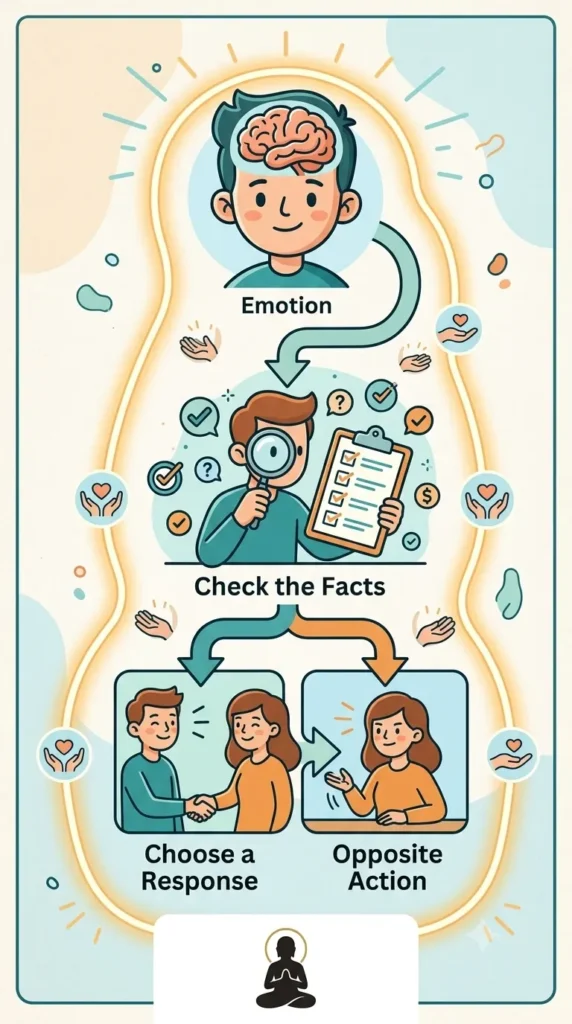
Check the Facts pulls apart what happened and the story your mind may be adding. A DBT worksheet starts with the situation and the facts you can confirm. Next comes the emotion you feel. Then the big question: does that emotion fit the actual circumstances?
Say a friend hasn’t replied to your message. The fact is “They have not replied yet.” Your mind adds a story on top: “They are angry with me.” That gap matters. A loud emotion makes the story feel like fact. Check the Facts gives you space to examine the difference first. Look before you act on the emotion.
This emotions worksheet guide has a trigger worksheet that separates event from interpretation.
[Future cluster: dbt skills check the facts]
Opposite Action
Some urges feel certain and still steer you wrong. Opposite Action is for strong emotions. Acting on the usual urge would make things worse, or keep the emotion going. First, name the emotion and its action urge. Then ask whether a different response would be more effective.
Fear is a clear case. It may tell you to avoid something that is safe but uncomfortable. Do the facts show that avoidance isn’t helping? If so, a gradual, appropriate approach can become the opposite action. Small steps, not a leap.
PLEASE
Start with the body. The DBT PLEASE skill reduces emotional vulnerability by taking care of your physical needs. The acronym is commonly explained as Physical illness, Eating, Avoiding drugs, Sleep, and Exercise. The idea is simple. When your body is run down, emotions can be harder to manage. Basic, yes.

It’s 3pm. Lunch got skipped, and a small email suddenly feels like an attack. Before replying, use a PLEASE worksheet as a quick check-in. Are you dealing with an untreated physical problem? Have you eaten regularly, and are substances making emotions harder to manage? Are you getting enough sleep and movement? For a quick written check-in, try these five-minute journal prompts.
You may also see ABC PLEASE in DBT resources. ABC and PLEASE are related parts of emotion-regulation teaching. They are not interchangeable terms.
[Future cluster: dbt please skill]
Coping Ahead
Waiting until you’re already overwhelmed is the hard way. Coping Ahead means preparing for a situation you expect may be emotionally difficult. Skip the scramble. In your head, rehearse the situation and name the likely emotional triggers. Choose the skills you can use. Then picture yourself responding effectively.
A DBT cope ahead worksheet turns that plan into something concrete. Before a difficult family conversation, you might write down your likely triggers. Next, the skill you’ll use if emotions rise. Last, what you want to do afterward. Nothing fancy. For more planning tools, see these coping skills worksheets.
Validation and Self-Validation
Validation means seeing that an emotion or reaction makes sense given your experience. It doesn’t automatically mean every reaction or behavior is helpful. Self-validation turns the same idea inward. Acknowledge what you’re feeling instead of criticizing, dismissing, or arguing with yourself right away. What good does arguing with a feeling do?
A DBT validation worksheet helps you name the emotion and what may have contributed. Then you respond with understanding. Only after that do you decide what to do next. Validation isn’t the same as agreeing with every thought or approving every behavior.
[Future cluster: dbt skills worksheets validation]
Self-compassion and reflective journaling make a useful bridge to self-validation. Try these journal prompts for self-love or journal prompts for mental health.
Interpersonal Effectiveness Worksheets
Good communication isn’t a personality trait. It’s a skill set. DBT interpersonal effectiveness skills teach you exactly that: how to ask for what you need, hold a boundary, and keep a relationship standing while you do it.
Three tools carry most of the weight here. DEAR MAN, GIVE, and FAST each handle a different piece of the conversation, from the opening ask to the moment you have to answer for how you handled it.
Pair them with the tools in our coping skills worksheet library and you’ve got a fuller toolkit for hard moments with people, not just hard moments alone.
DEAR MAN
DEAR MAN is built for the hard conversations. Making a request. Saying no. Holding your ground when someone pushes back. That’s it. The acronym breaks the process into steps you can follow under pressure. Describe the situation in plain facts.
Express how you feel about it. Assert what you need without hedging. Reinforce why it matters, to you and to them.
Then comes the part most people skip. Stay Mindful and don’t get pulled off track. Appear confident even if you don’t feel it yet. Negotiate when the other person needs room to meet you halfway.
[Future cluster: dbt skills worksheets dear man]
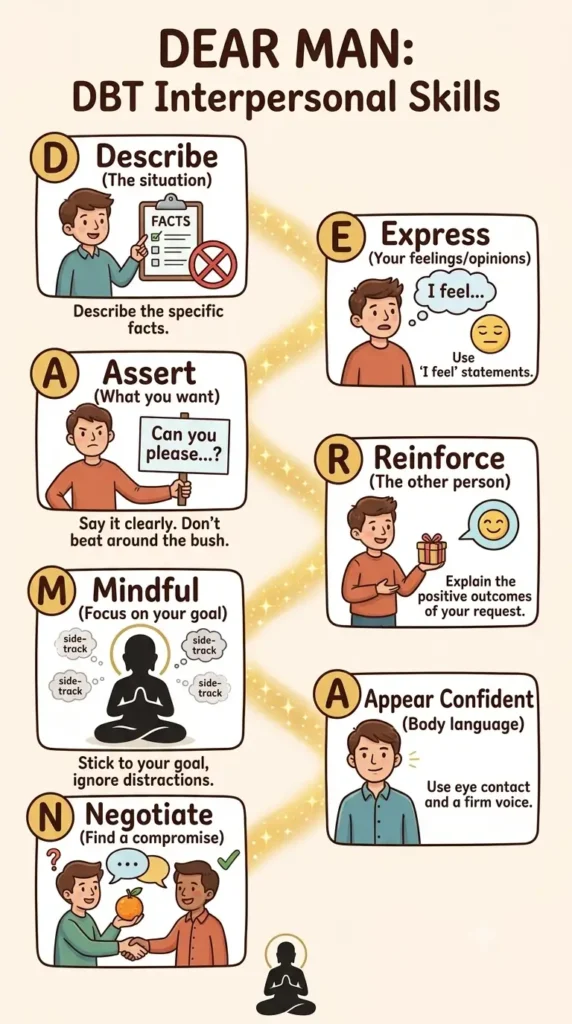
Emotions make people fumble their words. That’s exactly when a printable DEAR MAN worksheet earns its keep. You write out the conversation before you’re in it, so panic doesn’t get to write your lines for you.
GIVE
DEAR MAN gets your point across. GIVE keeps the relationship standing afterward. It stands for Gentle, Interested, Validate, and Easy manner. Reach for it when you need to disagree, raise a problem, or set a limit without lighting a fire.
Validate means acknowledging the other person’s feelings even when you don’t agree with their view. Our emotions worksheet guide can help you name what’s actually going on for both of you before that conversation even starts.
[Future cluster: dbt skills worksheets give]
FAST
FAST protects something different. Your self-respect. Fair, no Apologies, Stick to values, Truthful. Four checks for the moments you’re tempted to just agree and get it over with.
Over-apologizing for a reasonable ask. Bending your values to keep the peace. FAST is the skill that stops you mid-sentence and asks whether you’re being honest, or just easy to deal with.
[Future cluster: dbt skills worksheets fast]
Mindfulness DBT Worksheets
Mindfulness anchors the other three DBT modules. Without it, distress tolerance and emotion regulation skills have nothing to stand on. These mindfulness worksheets help you notice what’s happening right now, put it into words, and respond instead of react. The skills sound simple. They get sharper with repeated practice, not overnight insight.
What Skills
The What Skills name what you actually do when you practice mindfulness: Observe, Describe, Participate. A worksheet slows the process down. You notice what’s there before you judge it, fix it, or push it away. That order matters. Skip straight to fixing, and you never really saw the problem in the first place.
How Skills
The How Skills are about manner, not action. Nonjudgmentally, One-Mindfully, Effectively. Together they shape the way you carry out any mindfulness practice.
Drop the labels of “good” and “bad.” Give your attention to one task at a time. Then pick the response that actually works for the moment you’re in, not the one that just matches how you feel.
Wise Mind
Wise Mind sits between two extremes. On one side, pure emotion. On the other, cold logic with no feeling attached. Neither one alone makes good decisions. A Wise Mind worksheet puts your emotional read next to the facts and your goals, side by side, so you can see where they agree and where they don’t.
Observe, Describe, Participate
These three make up the What Skills. Observing means noticing a thought, a sensation, an urge, without grabbing onto it. Describing means putting words to it using plain, factual language, not a story about what it means.
Participating means throwing yourself into the current activity fully. No half-in, half-out. No narrating your own life while you’re supposed to be living it.
Nonjudgmental, One-Mindful, Effective
These are the three How Skills. Nonjudgmental strips out the “good” and “bad” labels and leaves just what happened. One-Mindful means one thing gets your attention, not five tabs open in your head at once.
Effective means you choose what actually works in this situation, even if it’s not the response that feels most satisfying in the moment. That’s often the hardest one to practice.
For more guided reflection and mindfulness-focused writing exercises, explore our mindfulness journal prompts.
DBT Quick-Reference Tools
Nobody rereads a full worksheet mid-crisis. That’s the problem with most DBT skills. The information is solid, but it’s buried in paragraphs when you actually need it in seconds.
Quick-reference tools fix that. A cheat sheet, a card deck, a poster, a wallpaper, a flowchart. Each one takes a longer skill and shrinks it down to something you can glance at and use. Not a replacement for learning the skill. A shortcut for remembering it once you already have.
DBT Cheat Sheet
A DBT cheat sheet fits the main skills onto one page. Every module, every key term, all in one glance. Tape it beside your desk. Slip it into a journal. Keep it in your therapy folder.
That’s the whole point. When you’re overwhelmed, you don’t want to hunt through pages. You want one sheet that tells you what to do and where to look next, whether that’s a distress tolerance skill or something from the mindfulness list.
[Future cluster: dbt cheat sheet]
DBT Skills Cards
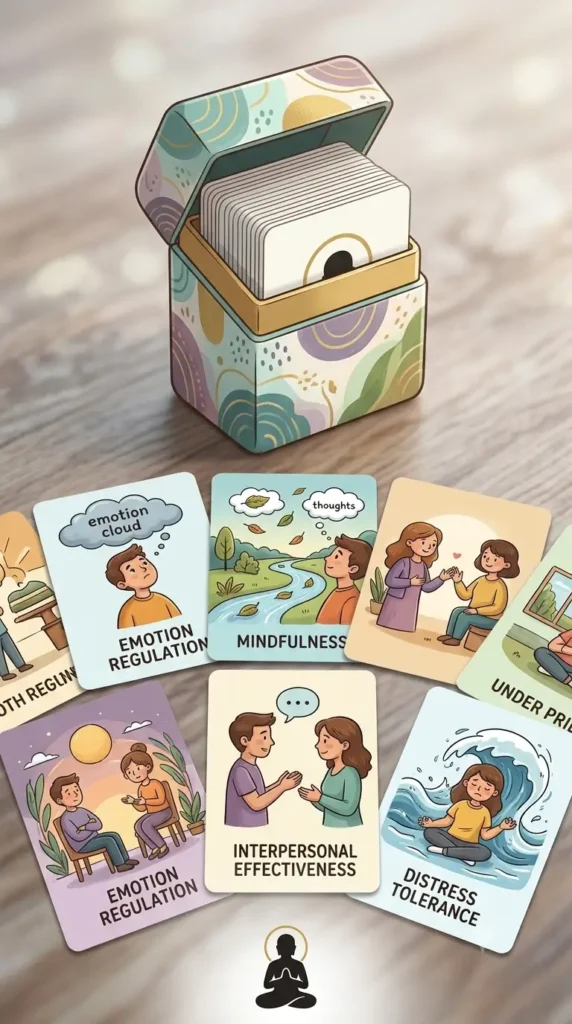
Cards work differently than a cheat sheet. Instead of everything on one page, each skill gets its own card. One for STOP. One for TIPP. One for DEAR MAN.
Why split them up? Because in the moment, you’re not trying to absorb four modules. You’re trying to find the one skill that fits what’s happening right now. A deck lets you flip through fast, pull the card you need, and set the rest aside. Some people shuffle theirs like a mood-based draw. Others sort them by module and keep the distress tolerance ones on top.
[Future cluster: dbt skills cards]
DBT Skills Poster
A poster takes the opposite approach from cards. Everything visible, all at once, all the time. The four modules and their core skills stay in front of you whether you’re reaching for a reminder or just absorbing the list by osmosis.
Put it above a desk. Pin it to a therapy room wall. Use it as a study aid if you’re working through the dialectical behavior therapy material for the first time. A poster won’t walk you through a crisis step by step, but it keeps the full skill set visible enough that you stop forgetting half of it exists.
[Future cluster: dbt skills poster]

DBT Skills Wallpaper
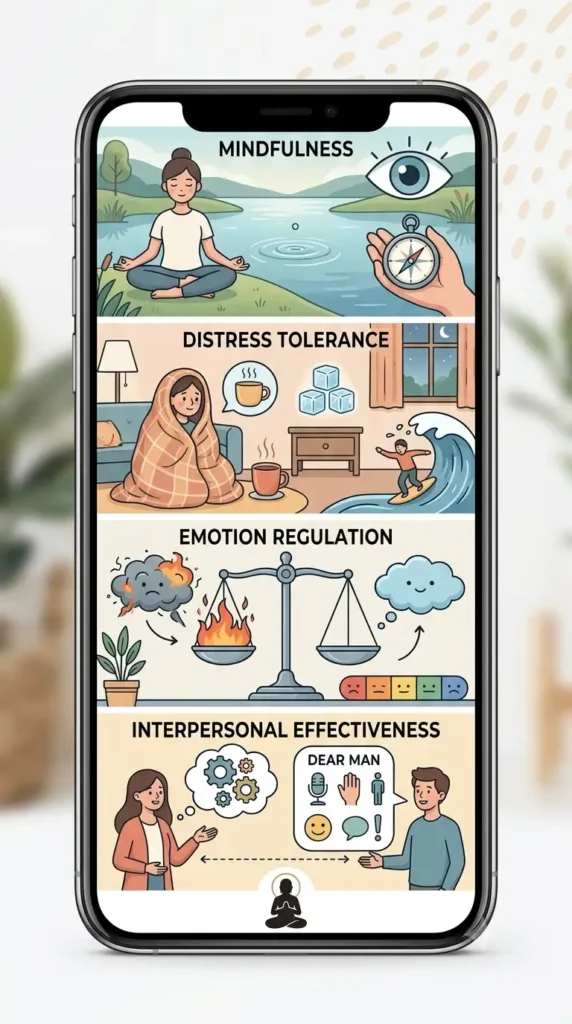
Your phone is already in your hand during most crises. That’s exactly why a wallpaper works. Unlock the screen and the reminder is already there. No app to open, no folder to dig through.
Less is more here. Pick a handful of high-use skills. Keep the prompts short. Make the text big enough to actually read at a glance. A wallpaper crammed with the entire DBT skills list defeats its own purpose. Nobody reads fine print while their hands are shaking.
[Future cluster: dbt skills wallpaper]
DBT Skills Flowchart
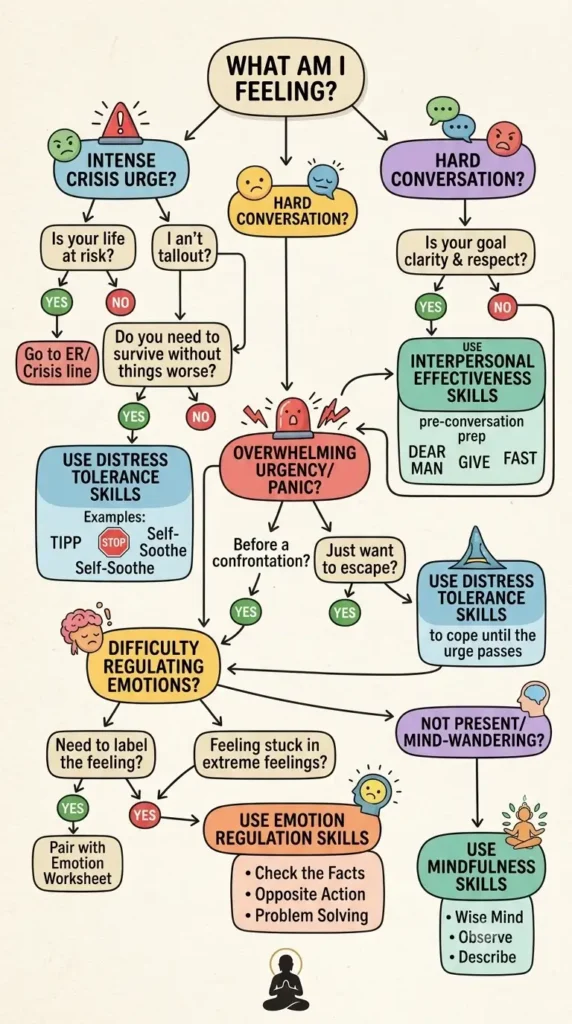
Here’s the question a flowchart actually answers: what am I feeling, and which skill fits it? That’s harder to figure out than it sounds when you’re already upset.
A crisis urge points somewhere different than a hard conversation does. Panic before a confrontation might call for interpersonal effectiveness skills. A spike of overwhelming urgency might call for distress tolerance instead. A flowchart walks you from the feeling to the skill without making you guess, which matters most when guessing is the last thing you have energy for. Pair it with an emotions worksheet if naming the feeling itself is the hard part.
[Future cluster: dbt skills flowchart]
DBT Diary Cards and Skill Tracking
A DBT diary card is not complicated. It’s a simple tracking tool. You write down what happened, how intense it felt, which skill you tried, and what shifted afterward. No memory required. Just numbers, checkboxes, and a few short notes.
What Is a DBT Diary Card?
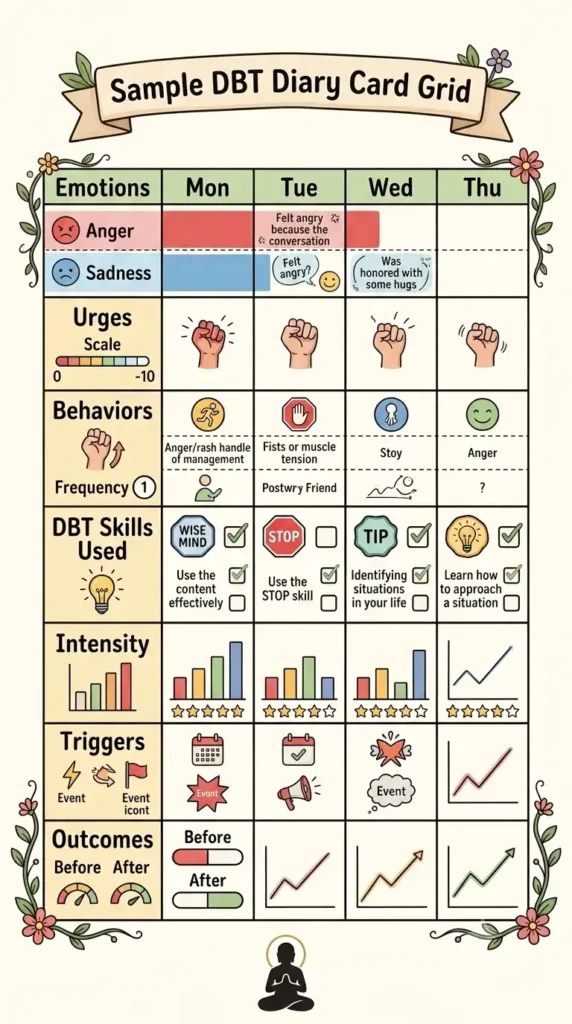
Most people trust their memory to sort out a hard week. It won’t. A DBT diary card is a structured daily or weekly record that tracks your emotions, urges, behaviors, and the DBT skills you actually practiced. That’s the whole point of it.
It doesn’t have to look clinical. A one-page grid works fine. A few ratings, a few boxes, a couple of lines of notes.
The goal isn’t a perfect log of your day. It’s pattern-spotting. Maybe certain situations keep triggering the same spike of anger. Maybe an urge gets louder when you’re running on no sleep. Maybe one particular skill keeps helping you settle faster than the others. A diary card is what makes those patterns visible instead of vague.
DBT diary cards also show up constantly in formal DBT therapy, where they give you and your therapist a shared, specific view of what happened between sessions. Using one on your own? Treat it as a reflection tool, not a stand-in for professional care.
[Future cluster: dbt diary card]
What Can You Track?
A good DBT diary card doesn’t isolate one moment. It tracks the whole chain of an experience, from the first feeling to what happened after.
Here’s what usually goes on it:
- Emotions: What did you actually feel? Anger, sadness, fear, shame, loneliness, sometimes three of these stacked on top of each other.
- Urges: Did you want to avoid something, argue, shut down, act on impulse, or reach for a familiar coping habit?
- Behaviors: What did you really do? Separating the urge from the behavior matters. That gap is where a different choice becomes possible.
- Skill use: Which DBT skill did you reach for? STOP, paced breathing, self-soothing, checking the facts, DEAR MAN — whatever you tried.
- Intensity: How strong was it? A 0–10 scale is usually enough.
- Triggers: What came right before the shift? A conversation, a thought, a physical state. Whatever set it off.
- Outcomes: What happened next? Did the emotion drop? Did the situation change? Did you learn something about whether the skill worked?
One day on a diary card tells you almost nothing. Ten days tell you a lot. That’s the trade. Over time, “I keep losing control” turns into something sharper: “My anger spikes after certain conversations, and pausing before I respond gives me room to choose what I say next.”
If structured reflection works for you, DBT skill tracking pairs well with broader emotional check-ins too. These journal prompts for mental health are a natural next step once the diary card habit sticks. And if naming what you’re feeling is the hard part, the emotions worksheet can make that first column easier to fill in.
DBT Worksheets for Kids, Teens and Adults
One worksheet doesn’t fit every age. A six-year-old and a sixteen-year-old need completely different tools, even when the skill underneath is the same. Kids need pictures and short activities. Teens need real scenarios pulled from their actual lives. Adults need something they can use on their own, without a coach standing over their shoulder.
That’s the whole logic behind splitting DBT skills worksheets by age instead of handing everyone the same page.
For Kids
Keep it simple. Keep it visual. That’s the rule for any DBT worksheet built for a child.
A good kids’ worksheet won’t explain distress tolerance in clinical terms. It’ll ask a smaller question instead: what’s the feeling? What does your body feel like right now? What’s one thing that helps? Can you ask an adult for help?
Skills like mindfulness, naming emotions, self-soothing, and basic coping strategies work best through coloring pages, matching games, short scenarios, or fill-in-the-blank prompts. No lecture. No jargon. Just practice.
Why does this matter so much for younger kids? Because a worksheet that reads like a textbook gets ignored. A worksheet that feels like a game gets used.
Two resources worth pairing with this approach: our coping skills worksheets build out calming strategies kids can actually picture themselves using, and our emotions worksheet helps younger children put a name to what they’re feeling before they try to manage it.

For Teens
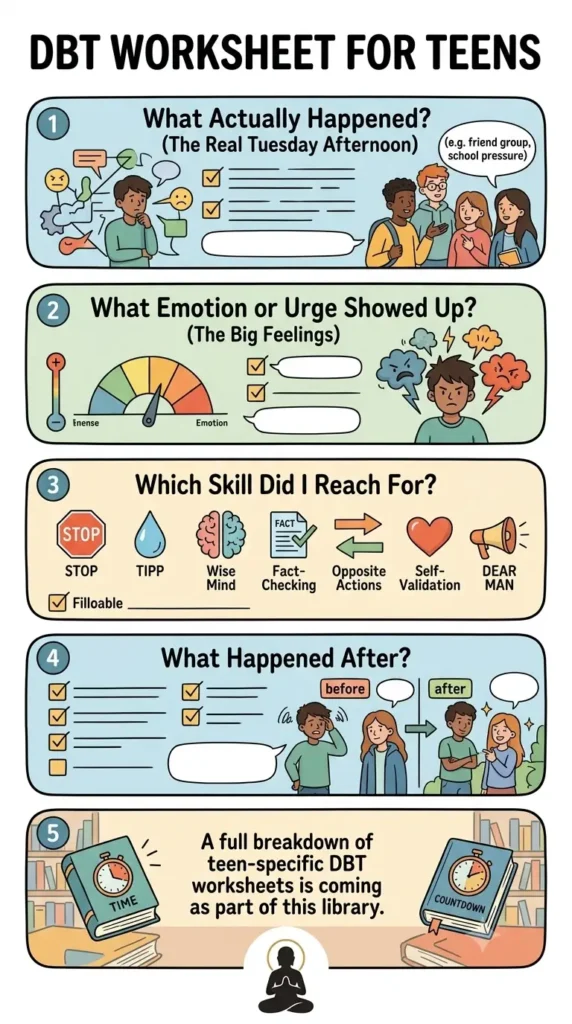
Teenagers aren’t dealing with hypothetical stress. They’re dealing with school pressure, friend group drama, family conflict, and emotions that spike fast and hard. A worksheet that ignores that reality won’t land.
The better format walks a teen through what actually happened, what emotion or urge showed up, which skill they reached for, and what happened after. That sequence turns an abstract concept into something they can trace back to a real Tuesday afternoon.
For teens, the most useful dbt skills worksheets tend to cover STOP, TIPP, Wise Mind, Check the Facts, Opposite Action, self-validation, and interpersonal skills like DEAR MAN. Not every emotional problem has the same root. Good worksheets don’t pretend otherwise.
A full breakdown of teen-specific DBT worksheets is coming soon as part of this library.
For Adults
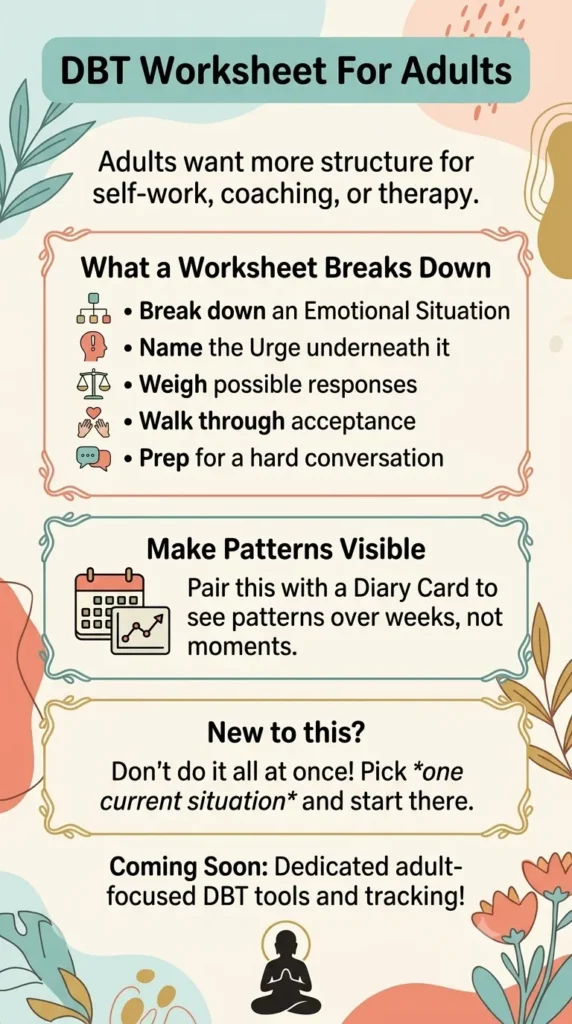
Adults tend to want more structure, whether they’re working through DBT alone, in coaching, or alongside a therapist. A worksheet at this stage might break down an emotional situation, name the urge underneath it, weigh a few possible responses, walk through acceptance, or prep language for a hard conversation.
Pair that with a diary card and the pattern becomes visible over weeks, not just one moment. That’s where the real value shows up.
New to this? Don’t try to complete every worksheet at once. Pick one situation you’re dealing with right now. Start there.
A dedicated set of adult-focused DBT worksheets and tracking tools is also on the way.
DBT Worksheets by Situation
DBT skills don’t hit every problem the same way. A worksheet built for anger control won’t calm a panic spiral. Different struggles need different tools. That’s why DBT skills worksheets get split by situation below, covering anxiety, depression, ADHD, BPD, PTSD, and anger.
DBT for Anxiety
DBT for anxiety comes down to noticing the spiral before it takes over. The goal isn’t to erase anxious thoughts. It’s to tolerate the discomfort without reacting on autopilot.
That’s the whole shift. Worksheets built around mindfulness, checking the facts, and distress tolerance turn that shift into something you can practice. Opposite action does the rest. Pairing it with an emotions worksheet helps you name the feeling first, before you try to manage it.
DBT for Depression
This isn’t about forcing positive thoughts. DBT for depression leans on emotion regulation, mindfulness, and small behavioral changes instead. A worksheet helps you catch what’s happening emotionally and check whether your read on things actually fits the facts.
Withdrawal isn’t the only option. The point is choosing a skill instead of shutting down or giving up. A coping skills worksheet gives you a menu of options for that exact moment.
DBT for ADHD
DBT won’t fix ADHD on its own. It’s not a replacement for diagnosis or treatment. But the skills help with emotional reactions, impulsive responses, frustration, and pausing before acting. That pause matters. Worksheets built around mindfulness, distress tolerance, STOP, and emotion regulation turn those skills into daily reps.
DBT for BPD
DBT started as a treatment for borderline personality disorder. It’s still one of the most researched therapies for it. The National Institute of Mental Health calls DBT a proven therapy for BPD. It builds mindfulness, manages intense emotions, cuts self-destructive behavior, and strengthens relationships. That’s the core of it.
A recent systematic review and meta-analysis on DBT skills training for BPD found solid gains across several outcomes. It also flagged mixed study quality. Stronger comparative research is still needed.
DBT for PTSD
DBT worksheets aren’t a standalone PTSD treatment. Treat them as general skills for coping with intense emotions and distress instead. Not a fix on their own. Mindfulness, distress tolerance, and emotion regulation exercises work best as practice alongside real professional support.
DBT Anger Management
DBT anger management isn’t about swallowing anger. It’s about understanding what triggered it, slowing the reaction down, and choosing a response that fits. That takes practice.
Check the Facts, STOP, opposite action, distress tolerance, and interpersonal effectiveness worksheets all help with that examination. A coping skills worksheet is a good place to start building that habit.
DBT Techniques and Core Skills Explained
DBT techniques are practical strategies. They help you handle hard emotions, stressful moments, urges, and relationship friction with more awareness and intention. Most people expect one skill to fix everything. It doesn’t work that way. DBT hands you a full toolkit instead, one you practice and pull from depending on the situation in front of you.
That’s the whole point of building out a set of DBT Skills Worksheets in the first place. You’re not memorizing theory. You’re rehearsing responses until they become automatic.
The core skills split into four areas: mindfulness, distress tolerance, emotion regulation, and interpersonal effectiveness. Inside these modules you’ll run into terms like Wise Mind, STOP, TIPP, opposite action, DEAR MAN, and radical acceptance. Sound like a lot of jargon?
It is, at first. But each term maps to a specific action you can take in a specific moment. DBT also leans on tracking patterns, checking the facts, validating emotions, and planning ahead for situations you already know are coming.
The DBT model of emotions rounds this out. It’s a way of looking at how an event, your thoughts, body sensations, emotions, urges, and actions all feed into each other. None of these happen in isolation. One triggers the next, and the next triggers the one after that.
Understanding that chain changes how you use the tools. Once you can spot where in the sequence things went sideways, you know exactly which skill actually helps. That’s harder to do without practice, which is why working through structured DBT techniques and skills on paper, rather than just reading about them, tends to stick better.
Other DBT Resources Worth Exploring
A worksheet alone only gets you so far. Books add structure. Groups add practice you can’t get on your own. Related frameworks, like RO DBT and the DBT House, round out the picture. Here’s where to look next once the basics of DBT skills worksheets start to feel familiar.
DBT Books and Workbooks
Want more than a single worksheet? A full DBT workbook walks you through the whole system instead of one skill at a time. Marsha Linehan’s DBT Skills Training Manual, Revised Edition lays out how skills training actually works. It covers mindfulness, interpersonal effectiveness, emotion regulation, and distress tolerance in one place. That’s the whole system in one book.
The companion volume matters just as much. The DBT Skills Training Handouts and Worksheets, Revised Edition holds more than 225 reproducible pages. Most people never touch all 225. That’s fine. Pick the ones tied to what you’re working on right now, whether that’s naming emotions on an emotions worksheet or building out a broader coping skills worksheet practice.
DBT Skills Groups
A worksheet teaches you the shape of a skill. It doesn’t teach you to use it under pressure. That’s what a DBT skills group is for. In standard DBT, the group is one piece of a larger treatment plan, not a replacement for it. Real practice, live feedback, and other people working through the same material do things a page of paper can’t.
So when does a worksheet stop being enough? Usually the moment a skill needs to hold up in a real moment, not just on paper. If distress tolerance or emotion regulation skills matter for your day-to-day, a structured group setting is worth asking a provider about directly.
DBT Learning
Self-study has a ceiling. It’s useful for getting a basic grip on one skill or building a rough daily habit. It doesn’t replace a real learning sequence.
Structured DBT learning goes further. Teaching, guided practice, and feedback all happen in order, not whenever you get around to it. Neither approach is wrong. The question is how much guidance the moment actually calls for. Some weeks, a printable worksheet and a few mindfulness journal prompts are enough. Other weeks call for more structure than a solo worksheet can give.
RO DBT
RO DBT stands for Radically Open Dialectical Behavior Therapy. It sounds like a variation on standard DBT. It isn’t. RO DBT was built around a different treatment focus entirely, aimed at overcontrol rather than the emotional dysregulation standard DBT targets.
That difference matters more than it looks. Mixing RO DBT worksheets into a standard DBT worksheet library without flagging the distinction just creates confusion. Keep the two separate, and be clear about which one you’re actually working from.
DBT House
The DBT House is a visual exercise, not a worksheet in the usual sense. You sketch out a house, and each part stands for something: values, strengths, relationships, goals, sources of support. Seeing it laid out room by room makes the reflection concrete instead of abstract.
A DBT house worksheet or template gives that structure without starting from a blank page. Sometimes a picture does what a paragraph can’t.
How to Choose the Right DBT Worksheet
The right worksheet depends on what’s happening right now. Not on some grand plan to master every DBT skill this month. Start with the problem in front of you. Everything else can wait.
Use the decision path below. Match your situation to a worksheet you can actually use today.

Are You in a Crisis or Intense Distress?
Feeling overwhelmed? Need to get through the next ten minutes without making things worse? Start with distress tolerance. That’s the whole point of this category.
STOP, TIPP, ACCEPTS, IMPROVE the Moment, self-soothing, pros and cons. Pick one. These worksheets exist to slow the moment down. They help you pause, drop the intensity a notch, and choose your next move instead of reacting on autopilot.
Is an Emotion Overwhelming You?
The crisis has passed. The feeling hasn’t. If a strong emotion is still steering your thoughts or your behavior, move to emotion regulation.
Check the Facts, Opposite Action, PLEASE, and Coping Ahead all work here. Each one asks a slightly different question. What’s actually true right now? What would the opposite action look like? What’s pulling my emotional baseline off balance? Once you know what’s driving the feeling, deciding how to respond gets a lot easier.
Do You Need to Accept Something You Cannot Change?
Stuck fighting reality? Caught in “this shouldn’t be happening”? That loop burns energy and changes nothing.
Radical acceptance and Turning the Mind are built for exactly this. They don’t ask you to approve of what happened. They just ask you to stop arguing with it. That’s a different thing entirely, and it’s the part most people skip.
Is the Problem About Another Person?
Asking for something. Setting a boundary. Saying no without the guilt spiral. Handling a conflict that keeps circling back. If the issue involves someone else, this is your category.
DEAR MAN, GIVE, and FAST each handle communication a little differently, balancing what you want, the relationship, and your own self-respect. None of them promise an easy conversation. They just make it more likely you walk away from it in one piece.
Do You Need to Understand a Pattern Over Time?
Some problems aren’t about the moment at all. They’re about the pattern underneath it. Triggers, emotions, urges, behaviors, and which skills actually help when you use them.
A DBT diary card or tracking worksheet turns a vague feeling of “this keeps happening” into something concrete. Something you can point to, hand to a therapist, or use to plan your next round of skills practice. Vague patterns are hard to fix. Written-down ones aren’t.
Want the full set? The coping skills worksheets collection covers a wider range of practical tools beyond DBT alone.
How to Use DBT Worksheets Effectively
DBT worksheets aren’t a test you pass or fail. They’re closer to a gym for your brain. You show up, you practice one move, and you get better slowly, not all at once. Most people quit early because they expect the worksheet to fix things on the first try. It won’t. That’s not how skill-building works.
Treat each DBT worksheet as a rep. Pick a real moment. Try one skill. Check what happened. Do it again next week. That loop is the whole method.
Start With One Real Situation
Don’t try to fix your whole week on one page. Pick a single moment instead.
Say an argument left you shaking and overwhelmed. That’s your material. Use that exact moment to ask what you felt, what you needed, and which skill might have helped. One clear scene beats five vague ones.
It also makes review easier later, since you’re not guessing which situation you meant. If naming the feeling itself is hard, an emotions worksheet can help you get specific before you even open the DBT sheet.
Practice Before a Crisis When Possible
Skills stick better when you’re not already drowning. Learning a new tool mid-emergency is rough. Nobody reads instructions well while panicking.
So practice on the boring days. Use a worksheet during an ordinary stressful moment, a delayed bus, a snippy email, a bad night’s sleep. You’re not waiting for a five-alarm crisis to start. Small stress is safer training ground, and it’s where most people actually build the muscle memory that shows up later when things get harder.
Review What Changed
Finish the worksheet, then stop and ask what shifted.
Did the emotional intensity drop? Did you see the situation differently? Did you choose a different response than you would have on autopilot? Even a small answer counts. That’s data about what works for you specifically, not generic advice.
Writing this reflection down matters more than most people think. A few lines in a journal for mental health right after the worksheet can lock in what you just noticed before it fades.
Repeat Skills Instead of Expecting Instant Mastery
One good attempt doesn’t mean mastery. It means the skill worked once.
You’ll likely need to run the same DBT skill through several different situations before it feels automatic. That repetition isn’t wasted effort. It’s actually the point.
Repeating a skill across contexts teaches you which problems it fits and which ones it doesn’t. Nobody learns that from a single worksheet, no matter how well it goes.
Use Worksheets Alongside Appropriate Professional Support
Worksheets help you learn and reflect. They don’t replace therapy, diagnosis, or crisis care. That line matters.
If you’re working with a therapist, bring your completed worksheets into session. Let them be a starting point for conversation, not the whole conversation. For deeper skills training, Behavioral Tech, the organization founded by Marsha Linehan, remains the reference point most clinicians train through. Pair that structure with something personal on the side, like mindfulness journal prompts, and the worksheets tend to land with more weight.
DBT Worksheets vs. Therapy, Workbooks, Handouts and Diary Cards
DBT resources look alike on the surface. They aren’t the same underneath. A worksheet helps you drill one skill. A diary card tracks what happened over weeks. Therapy does something neither can: it responds to you in real time.
Mixing these up wastes effort. Pick the wrong tool and you end up frustrated, not skilled. Knowing the difference is the whole point before you download another PDF.
How DBT Resources Differ
| Resource | What it is | What you might use it for |
|---|---|---|
| DBT Worksheet | A structured page for learning or practicing a specific DBT skill. | Practicing STOP, checking the facts, DEAR MAN, or another skill. |
| DBT Handout | A teaching or reference page that explains a concept or skill. | Learning what a skill means before you practice it. |
| DBT PDF | A digital file that can contain a worksheet, handout, checklist, or several resources. | Saving, printing, or sharing DBT materials. |
| DBT Workbook | A larger collection of lessons, exercises, and practice activities. | Working through DBT skills in a more structured way. |
| DBT Skills Card | A compact reminder of a skill or strategy. | Keeping a quick prompt nearby when you need a reminder. |
| DBT Cheat Sheet | A condensed reference covering several skills or key steps. | Quickly deciding which skill to try in a difficult moment. |
| DBT Diary Card | A tracking tool for recording emotions, urges, behaviors, and skill use over time. | Spotting patterns and reviewing what happened between sessions. |
| DBT Therapy | A structured form of psychotherapy that teaches DBT skills alongside other treatment strategies. | Receiving professional guidance, practicing skills, and addressing broader treatment goals. |
A DBT therapy worksheet is not therapy. That distinction matters more than it sounds.
A worksheet can’t ask you a follow-up question. It can’t notice your voice shake and adjust course. It hands you structure, not judgment. Real treatment brings both: someone trained to read what’s underneath the page, and a relationship built over time. DBT skills worksheets and other coping skills worksheets support the learning. They don’t replace the therapeutic relationship itself.
So where does that leave you? Somewhere in between, probably. Most people use these resources as a bridge. A handout teaches the concept. A worksheet gives it hands. A diary card shows whether it’s actually working.
Here’s how that might play out. You read a handout on the STOP skill. You practice it with a worksheet the next time you’re triggered. You log the attempt on a diary card that evening, next to a note about the emotion you were feeling at the time (an emotions worksheet helps with naming that part accurately). Then you bring the pattern to your therapist, who helps you see what the page alone couldn’t show you.
That’s the loop. Learn it, practice it, track it, talk it through. Skip a step and the skill tends to fade by week three. Keep the loop running and it sticks.
DBT Skills Worksheets: Free Printable Resource Guide
DBT skills worksheets work best when they’re organized, not scattered across ten different tabs. This free printable resource guide puts the main DBT tools in one place. Pick a module. Find the skill that matches what you’re dealing with. Then grab the format and audience version that fits.
| Module | Skill / Tool | Resource Type | Audience |
|---|---|---|---|
| Distress Tolerance | STOP | Printable Worksheet / PDF | Teens / Adults |
| Distress Tolerance | TIPP | Worksheet / Handout | Teens / Adults |
| Interpersonal Effectiveness | DEAR MAN | Printable Worksheet / PDF | Teens / Adults |
| Emotion Regulation | Diary Card | Printable / Tracking Sheet | Teens / Adults |
| Quick Reference | DBT Skills Cheat Sheet | Printable / PDF | Teens / Adults |
| Mindfulness | Wise Mind | Worksheet / Quick Reference | Teens / Adults |
| Distress Tolerance | Self-Soothe | Worksheet / Handout | Teens / Adults |
| Emotion Regulation | Check the Facts | Printable Worksheet | Teens / Adults |
| Kids | DBT Coping Skills | Worksheets / Activities | Kids |
| Teens | DBT Skills Practice | Worksheets / Handouts | Teens |
| Adults | DBT Skills Practice | Worksheets / Quick References | Adults |
The labels do the sorting for you. A worksheet is built for active practice. A handout is better for learning or reviewing a skill for the first time. A quick reference is the one you keep nearby, for the moment you actually need it.
Start with what’s happening right now, not the skill you think you should learn. Feeling overwhelmed? Start with a distress-tolerance tool like STOP or TIPP. Walking into a hard conversation? DEAR MAN fits better. For the long game, a diary card tracks emotions, urges, behaviors, and skill use over time, so patterns show up instead of staying invisible.
This guide sits inside the full DBT skills worksheets library, the pillar’s main downloadable collection. If distress tolerance alone isn’t enough, the broader coping skills worksheets page covers more general tools and printables.
How to Use This Resource Guide
This isn’t a dump of random PDFs. Every downloadable sits under its most relevant module and skill. You shouldn’t have to dig through unrelated worksheets just to find TIPP. As new DBT resources get added, Kids, Teens, and Adults versions will slot into the same structure. Module, skill, resource type, audience. Nothing more complicated than that.
Need something to glance at mid-crisis instead of reading a full worksheet? The DBT skills cheat sheet is a one-page quick reference covering the main DBT skills, built for exactly that moment.
Conclusion
DBT skills worksheets can make a large set of skills easier to understand, practice, and return to when you need them. You don’t need to master every skill at once. Start with the situation in front of you, choose one practical skill, and give yourself time to practice it.
Over time, worksheets can help you notice patterns, build confidence, and remember what actually works for you. Use them as learning and practice tools, alongside appropriate professional support when needed. The goal isn’t to handle every difficult moment perfectly. It’s to have more useful options when life feels difficult.
Frequently Asked Questions
What are DBT skills worksheets?
DBT skills worksheets are structured practice tools based on Dialectical Behavior Therapy skills. They can help you learn, apply, and review skills such as mindfulness, distress tolerance, emotion regulation, and interpersonal effectiveness.
A worksheet may guide you through a specific skill, help you examine a situation, or track how a skill worked for you.
What are the four modules of DBT?
The four standard DBT skills modules are mindfulness, distress tolerance, emotion regulation, and interpersonal effectiveness. Mindfulness helps you
stay present;
distress tolerance focuses on surviving difficult moments without making them worse;
emotion regulation addresses intense emotions;
and interpersonal effectiveness teaches skills for communicating, setting boundaries, and maintaining relationships.
What is the difference between CBT and DBT techniques?
CBT and DBT are both behavioral therapies, but they emphasize somewhat different skills and strategies. CBT often focuses on identifying and changing unhelpful thoughts and behaviors, while DBT adds a strong emphasis on acceptance, emotion regulation, distress tolerance, mindfulness, and interpersonal effectiveness. DBT also uses the concept of balancing acceptance with change.
Are there DBT worksheets for kids, teens and adults?
Yes. DBT skills can be taught to children, adolescents, and adults, although the language, examples, activities, and level of support may differ by age.
Worksheets for younger people often use simpler instructions and concrete scenarios, while teen and adult resources can address more complex relationships, emotions, responsibilities, and coping situations.
Who created DBT, and what is it based on?
Marsha M. Linehan, PhD, built Dialectical Behavior Therapy. Not a team. Not a committee. One researcher who kept running into clients that existing treatments couldn’t reach.
She developed it to treat severe, complex problems tied to emotion dysregulation and suicidal behavior. That was the starting point. It later grew into a full protocol studied for borderline personality disorder and a range of other conditions.
DBT blends behavioral principles with acceptance-based and mindfulness-oriented strategies. That mix is the whole point. Change methods paired with acceptance methods, running side by side instead of one replacing the other.
You can read more about her work and the organizations she founded through the Linehan Institute, the official resource on Marsha Linehan and DBT.
Is DBT evidence-based?
Yes. This isn’t a fringe claim.
DBT has gone through extensive study, including randomized controlled trials and systematic reviews. Decades of research back it now. The strongest evidence sits with borderline personality disorder, though DBT and its adapted forms have been tested for other mental health concerns too.
A 2024 systematic review, Crotty et al., published in the Journal of Consulting and Clinical Psychology, found low-certainty evidence that DBT worked better than treatment as usual for BPD. Worth noting though: the same review didn’t find evidence that any one psychotherapy beats all the others. DBT holds up. It just isn’t crowned the single best option across the board.
If you’re working through coping skills worksheets or building out an emotions worksheet practice already, DBT’s skills fit naturally alongside that kind of groundwork.

It’s Bhaskar!
Well, I am not a psychologist a monk, or a philosopher by training. I’m just an engineering graduate.
‘The Empty Self’ is where I write about that idea, and what it actually means for ordinary life, anxiety, identity, habits, the stories we tell ourselves about who we are. I don’t have a psychology degree, and I’m not offering therapy or clinical advice. What I do have is thought and clarity, and genuine curiosity about why we suffer the way we do and how much of it might loose once we shed this ‘fixed identity’.
Pingback: DBT STOP Skill: A Complete Guide for Kids, Teens, and Adults | The Empty Self
Pingback: DBT PLEASE Skill: Meaning, Worksheet & How to Use It (Free PDF) | The Empty Self
Pingback: DBT ACCEPTS Skill: Complete 2026 Guide With Worksheets and Exercises | The Empty Self
Pingback: DBT TIPP Skill: The Ultimate 2026 Guide With Worksheets and Exercise | The Empty Self
Pingback: DBT IMPROVE the Moment Skill: Complete 2026 Guide With Free Printable | The Empty Self
Pingback: DBT Wise Mind: Complete 2026 DBT Skill Guide With Worksheets and Exercises | The Empty Self
Pingback: Willing Hands & Half Smile: DBT Acceptance Skill Guide With Printables 2026 | The Empty Self
Pingback: DBT Self-Soothing Skills: Ultimate 2026 Guide With Worksheet and Exercises | The Empty Self
Pingback: The DBT House 2026: Complete Guide With Free PDF and Template | The Empty Self
Pingback: DBT Emotion Regulation Skills 2026: Module Guide With Free Worksheets | The Empty Self
Pingback: Cope Ahead DBT 2026: All You Need to Know With Free Printables | The Empty Self
Pingback: DBT Values 2026: Complete Guide With Printable and Worksheet | The Empty Self
Pingback: DBT Self-Validation: Ultimate 2026 Guide With Free Worksheet & Printables | The Empty Self
Pingback: DBT Distress Tolerance Skills: Complete Guide With Printables and Worksheets | The Empty Self
Pingback: DBT Interpersonal Effectiveness Skills: Ultimate Module Guide | The Empty Self
Pingback: DBT Mindfulness Skills: Module Guide With Free Printables and Worksheets | The Empty Self
Pingback: RO DBT Worksheets: 10 Best Worksheets and Free Printables for Adults | The Empty Self
Pingback: DBT Skills Cheat Sheet: All You Need to Know With Free Printables | The Empty Self
Pingback: 10 Best DBT Books & Workbooks: Complete List for Teens and Adults | The Empty Self