

Morning journal prompts don’t have to open with gratitude, a perfect affirmation, or five pages of brain dump. Sometimes the better question is smaller: what’s taking up space in my head right now?
Morning journaling gives you a quiet minute to notice what you’re carrying. Before notifications, deadlines, and other people’s opinions crowd in. If gratitude usually opens your pages, how to practice gratitude walks through the steps.
Expressive writing research backs this up. Psychologist James Pennebaker and colleagues have studied how words support reflection and processing.
You don’t need to write every morning either. A few honest lines are enough to guide today.
Quick answer: Morning journal prompts are questions or writing cues that help you check in with yourself, set an intention, and decide what deserves your attention today. Use one prompt or several, depending on your time and headspace. The goal is reflection, not a perfect entry. On harder mornings, gratitude worksheets can help.
Table of Contents
Disclaimer
This blog is written and edited with the help of AI, then reviewed by me before publishing. As a result, the content is for general reflection only, not therapy or medical advice, and I’m not a licensed mental health professional. If you’re in crisis, please contact 988 if you’re in US or a local crisis service of your country instead of relying on this site.
How to How to Use These Morning Journal Prompts
Morning journal prompts work best when they stay small. Not another task stacked on your to-do list. Research on expressive writing backs this up. Putting your thoughts into words can support real reflection. It can steady emotional processing too. But the value isn’t in filling pages every single morning. It’s in showing up at all.
Pick Prompts Based on Your Morning, Not a Perfect Routine
You don’t need all 60 morning journal prompts in one sitting. Honestly, that would miss the point entirely.
Your journal should answer to your morning. Not a plan you made last night. Head feels crowded? Pick a question that clears it. Feeling disconnected? Choose something that pulls you back to yourself. Big day ahead? Use a prompt that helps you decide what actually deserves your attention today.
Start with one to three prompts. That’s plenty.
Write a sentence if that’s all you’ve got. Write a page if something needs more room. There’s no prize waiting for two full pages before 7 a.m.
The real goal is smaller than that. Check in with yourself before the day starts making decisions for you. Sound too simple? It is. That’s exactly why it works.
Mornings sometimes spiral before you’ve even opened the notebook. A broader set of mindfulness journal prompts can help. It builds that same present-moment habit from a different angle.
Choose a 2-, 5-, or 10-Minute Morning Journal Session
Your daily morning journal prompts don’t need 30 minutes. Choose the version that actually fits your morning, not the one you wish you had time for.
- 2 minutes: Name how you feel. Note what’s on your mind. Say what you need today.
- 5 minutes: Add one intention, priority, or boundary for the day ahead.
- 10 minutes: Stay with one deeper question. Follow it wherever it leads.
A short entry still counts. A missed morning doesn’t erase the habit either. Consistency matters more than length. That’s especially true once journaling starts competing with sleep, breakfast, and your commute. Or the first hundred notifications of the day.
Need a starting intention beyond the prompt itself? How to practice gratitude breaks the habit into steps small enough to fold into even a two-minute session. Your list of what to appreciate might come up short some mornings. A quick scan of things to be thankful for tends to fix that fast.

60 Refreshing Morning Journal Prompts for Gen Z Adults in 2026
You don’t need a calm morning to journal. Half the time, you won’t have one.
These morning journal prompts meet you where you actually are. Not where you think a “productive” person would be at 7am. They help you check in, set an intention, process whatever’s loud in your head, and protect your attention before your phone claims it first.
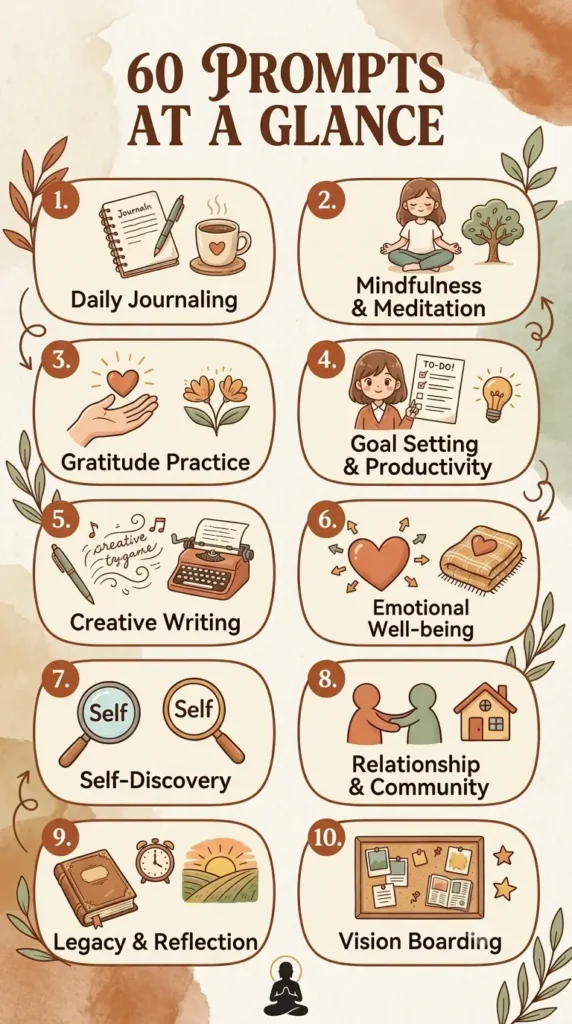
Morning Journal Prompts for a Quick Mental Check-In
The best morning journal questions are the ones you’d rather skip.
Before you plan anything, notice what’s already sitting in your head. Your body too. You don’t need to fix the feeling. Just name it.
- How am I actually feeling this morning, underneath the automatic “I’m fine”?
- What thought has taken up the most space since I woke up?
- What does my body seem to need from me today?
- What emotion feels strongest right now, and where do I notice it?
- What am I carrying from yesterday that I don’t want to drag into today?
- If I were fully honest with myself this morning, what would I admit?
Morning Writing Prompts for Setting Your Intention
An intention isn’t a plan. A plan tells you what to finish. An intention gives you a way to show up, especially on the days your schedule falls apart by 10am.
Use these morning writing prompts when you want direction without turning your journal into another to-do app.
- How do I want to show up for myself today?
- What matters most to me today, even if nobody else notices it?
- What would make today feel meaningful instead of just busy?
- What quality do I want to bring today, patience, courage, curiosity, honesty?
- What deserves my attention today, and what doesn’t?
- What’s one decision I can make today that future me will thank me for?
Want to pair intention-setting with self-belief work? The affirmation journal prompts guide is built for exactly that.
Morning Gratitude Journal Prompts That Go Beyond “Three Things”
You don’t have to manufacture gratitude before you’ve finished your coffee. Good morning gratitude journal prompts just make you notice something specific that’s already worth something.
Your warm bed. A friend who checked on you. Working Wi-Fi. Another shot at learning something. These count.
- What ordinary comfort am I grateful for that I usually overlook?
- Who made my life a little easier or kinder recently?
- What opportunity do I have today that I once wished for?
- What piece of technology actually makes my life better?
- What’s one small thing from yesterday I’m glad happened?
- What am I grateful I get to experience today?
- What tiny detail in my surroundings deserves more appreciation?
To turn gratitude into a full daily practice, how to practice gratitude breaks it into steps you can actually keep. If writing freely feels harder than it should, a structured gratitude worksheet removes some of that friction.
Feeling repetitive with your usual list? Things to be thankful for has more specific ideas to pull from.
Morning Journal Prompts for Productivity Without the Pressure to Optimize
Morning journaling should help you decide what deserves your energy. It shouldn’t convince you every minute needs to produce something.
There’s a real difference here. Choosing what matters is intentional. Squeezing more output out of yourself is not the same thing.
- What’s the one thing that genuinely needs my attention today?
- What actually needs to get done, versus what just feels urgent?
- What can wait until another day without becoming a real problem?
- What would “enough” look like for me today?
- What’s one small action I can take toward a bigger goal?
- What distraction or obligation deserves a boundary today?
Notice the difference between “how can I get more done” and “what’s worth doing.” The second question usually wins.
Morning Journaling Prompts for Anxiety, Overthinking, or an Overloaded Mind
When your mind is crowded first thing, journaling gives those thoughts somewhere to land. Not somewhere to disappear.
The goal isn’t diagnosing the feeling. It’s separating what’s actually happening from what your mind is rehearsing.
- What exactly am I worried about right now?
- Is this a problem happening today, or a possibility my mind is rehearsing?
- What do I know as fact, and what am I assuming?
- Which part of this is actually in my control?
- What thought keeps returning, and what do I want to do with it for now?
- What’s one small next step, instead of trying to solve everything at once?
- If I stopped predicting the whole day, what would I focus on this morning?
There’s a reason this approach holds up. James W. Pennebaker and Sandra K. Beall’s 1986 study on expressive writing helped kick off a whole line of research into writing through difficult experiences. Later work by Joshua M. Smyth found benefits across several health outcomes, though the process can stir up short-term discomfort for some people before it helps.
That’s why these prompts work best as a supportive reflection tool, not a stand-in for professional care. The National Institute of Mental Health lists keeping a journal among the strategies worth trying when stress feels like too much.
If your mind tends to spiral before the pen even hits the page, gratitude journaling for anxiety offers a gentler entry point. And if mindfulness feels like the missing piece under all this, the mindfulness journal prompts guide covers present-moment prompts built for exactly this kind of overload.
Morning Journal Prompts for Self-Compassion
You can be honest with yourself without being cruel about it. Self-compassion journaling isn’t pretending everything’s fine. It’s removing the extra punishment from an already hard situation.
- What am I being unnecessarily hard on myself about?
- What would I tell a close friend dealing with exactly this?
- What progress am I overlooking because I’m focused on what’s unfinished?
- What pressure can I release today without abandoning what matters?
- What awkward moment or mistake can I finally give myself permission to move past?
- What makes me worth something that has nothing to do with productivity or achievement?
You don’t need to turn every morning into a self-improvement project. Sometimes the healthiest entry is just an honest account of what you can handle today.
Morning Journal Questions for Your Digital Life
Your morning can start before your brain forms its own opinion. One notification becomes a message, then a feed, then someone else’s vacation, career update, or five-year plan. By breakfast, you’re comparing your life to twenty strangers.
Sound familiar? These morning journal questions exist for the few minutes before your phone decides what deserves your attention.
- What did I consume on my phone before checking in with myself?
- How is social media affecting my mood right now?
- What deserves my attention before notifications get to choose for me?
- What comparison from my feed am I carrying into this morning?
- What would I do with 30 phone-free minutes today?
- What digital boundary would make today feel lighter?
- What would I notice about my own life if I stopped checking everyone else’s?
Your phone isn’t the villain here. It’s useful. It keeps you connected, gives you directions, holds your music. The problem is letting an algorithm become the first voice you hear every morning.

Want to keep things lighter after a heavier check-in? Funny journal prompts for adults is built for exactly that mood shift.
Morning Journal Prompts for Work, College, and Career Uncertainty
You don’t need your whole career figured out before breakfast. A good morning entry just separates today’s responsibility from the bigger question of where your life is headed.
- What needs my attention today at work, college, or school?
- What am I learning right now, even if it doesn’t feel impressive yet?
- What career pressure am I carrying into today?
- Do I actually want this goal, or do I just want to stop feeling behind?
- What’s one small step I can take today that moves me forward?
- What does success look like for me at this stage of my life?
That last one is worth revisiting often. Your definition of success at 21 doesn’t have to match someone else’s at 25. Neither one has to stay fixed either.
Morning Journal Prompts for Relationships and Boundaries
Your morning journal can also show you where your attention is actually going in your relationships. Sometimes the useful question isn’t “who should I text.” It’s “where am I giving more than I actually have.”
- Who do I genuinely want to connect with today?
- Where am I overextending myself to keep someone else comfortable?
- What boundary would protect my time, energy, or peace today?
- What conversation am I avoiding, and what makes it hard?
- Who makes me feel like myself, not a performance of myself?
- How can I be more present with someone I care about today?
Boundaries don’t need a dramatic conversation. Sometimes it’s just not replying immediately. Or leaving enough space in your day to be a person, not a constantly available contact.
Morning Journal Prompts to Identity Your Future Self
Your twenties involve a strange amount of identity editing. You outgrow old goals. Question old assumptions. Wonder if everyone else got a life roadmap that somehow skipped your inbox.
- Who am I becoming through the choices I’m making right now?
- What version of myself am I starting to outgrow?
- What would I choose today if I stopped comparing my timeline to everyone else’s?
That last question deserves a second look before you close the notebook. Comparison steals more mornings than people realize.
You can also access this complete 60 Great Morning Journal Prompts printable for free.
Which Morning Journal Prompt Should You Choose Today?
There’s no such thing as the “right” morning journal prompt. There’s only the one that actually matches what’s running through your head today. Energy. Mood. Attention span. Match those first, not some flawless routine you think you’re supposed to be running.
If You Feel Anxious
Skip forced gratitude here. It won’t land. Reach for grounding and emotional-awareness prompts instead: What exactly is worrying me right now? What do I know for certain, and what am I only assuming? What’s actually within my control this morning?
Putting a vague worry into specific words does something small but real. It shows you what needs your attention and what doesn’t. Sound too simple to work? It does anyway. Pairing it with something like gratitude journaling for anxiety can widen the gap between the worry and how you react to it.
If You Feel Unmotivated
Feel like today’s plan is already too much? Drop it. Skip the pressure to map out your whole day and reach for one simple prompt instead: What is one tiny thing I can do that would make today easier? Then follow it with: What would I say to a friend who felt this way?
Self-compassion beats self-bullying most mornings. It just does. Trying to shame yourself into productivity rarely survives past day two, and that’s true for most morning writing prompts built around willpower alone.
If You Feel Overwhelmed
Everything’s competing for your attention at once. Use your journal like a dump site first, sort it out second. Write down every task, every half-finished thought, everything pulling at you. Then ask: What actually needs to happen today? What can wait?
Your morning journal doesn’t need to solve every problem on that list. Not even close. It just needs to separate today’s task from tomorrow’s noise. If the list itself feels like too much some mornings, the same sorting logic sits inside our gratitude worksheets, no blank page required.
If You Feel Behind in Life
Don’t turn your journal into another comparison scoreboard. Try this instead: What am I measuring my life against right now? Is that standard even mine?
Then ask what your future self would actually want you focused on today. Progress looks different once you stop borrowing someone else’s timeline. It always does. Rotating in a few identity or future-focused questions from our full mindfulness journal prompts guide works well here too, especially on the mornings this one feels hardest to answer.
If You Feel Good
This is when gratitude actually earns its spot. Morning gratitude journal prompts work best here, the kind that go past listing possessions you already know you have. Write about someone you appreciate. Something you’re looking forward to. A small comfort you usually walk right past.
Want to go deeper than the obvious three answers? A proper list from things to be thankful for or a quick walkthrough on how to practice gratitude pushes past “family, friends, health” and into something more specific.
If You Have Only Two Minutes
Two minutes isn’t much. It’s enough. Ask yourself three morning journal questions, nothing more: How do I feel? What do I need? What matters most today?
That’s it. A two-minute entry you actually write beats a twenty-minute routine you keep postponing. Every time. Even a rotation of the same few daily morning journal prompts, used honestly, builds more than a routine you abandon by Thursday.
How to Start a Morning Journaling Habit That Actually Sticks
You don’t need a flawless morning routine for morning journal prompts to work. That sounds backwards. It isn’t. A habit that lasts is usually smaller than people expect. One useful prompt. Attached to something you already do. No guilt when you miss a day. That’s the whole formula.
Start With One Prompt
Sixty prompts are a menu, not homework. Pick one question. Match it to what you actually need that morning. Write for a few minutes, then stop.
You don’t need a full page. You don’t need a big life lesson either. The entry doesn’t have to sound deep.
Tired? Answer one question in two sentences. Curious? Keep going as long as it feels good. The real goal isn’t length. It’s a habit you’ll actually return to tomorrow.
Attach Your Morning Journal Prompts to a Habit You Already Have
Your journal sticks faster when it rides along with something automatic. Write right after waking up. Or while your coffee cools. Or after brushing your teeth. Or before you open any app that isn’t your notes.
This isn’t about willpower. Not even close. It’s about cutting the number of decisions your brain makes before 8am.
You already know you’re making coffee. Adding five minutes of writing after that beats inventing a brand new ritual from nothing. Want a category built around exactly this? The Morning Intention prompts inside our mindfulness journaling guide are built to slot into a routine you already run.
Keep Your Morning Journaling Prompts Low-Pressure
Missing a morning doesn’t erase the habit. Neither does writing three messy sentences instead of a tidy page.
James Pennebaker’s research on expressive writing looked at this closely. Later studies built on his work too. Together, they suggest that writing about personal experience can support reflection. It can help with emotional processing as well. None of that means every entry needs to be deep, or productive.
Some mornings, “I slept badly and don’t feel like doing much” is a complete entry. Nothing more required.
Does a rough morning tend to spiral before you’ve even opened the notebook? Pairing your prompt with a gratitude journaling for anxiety approach can steady things faster than pushing through alone. It works well for morning gratitude journal prompts specifically, since anxious mornings and grateful ones rarely show up at the same time.
Paper vs. Phone: Which Wins for Morning Journal Prompts?
Paper usually wins if your phone drags you straight into notifications. Messages. Social feeds. It creates real distance from all of that.
Your phone wins on convenience, though. It’s already in your hand. A digital entry is easier to search later. Easier to pull up anywhere too.
Here’s my practical rule: choose the format that removes friction without adding distraction. If opening your notes app turns into twenty-five minutes of scrolling, use paper instead. A printed sheet works just as well. Our gratitude worksheets follow the same low-friction idea. One page. One question. Nothing to unlock or scroll past.
What to Do When You Have Nothing to Write
Use the same four questions every time you get stuck:
- What am I feeling right now?
- What’s taking up space in my mind?
- What do I need today?
- What’s one thing I can do next?
You don’t need a fresh idea every morning. Sound too repetitive to work? It doesn’t feel that way once it’s the thing that actually gets you writing instead of staring at a blank page.
Want a full year of daily morning journal prompts so you’re never stuck again? Our 365 journal prompts for mental health collection covers every angle, day by day. Gratitude usually gets your pen moving fastest on the hardest mornings. A running list of things to be thankful for works well as backup. Even the four questions above run dry sometimes.
A Simple 5-Minute Night Journal Routine
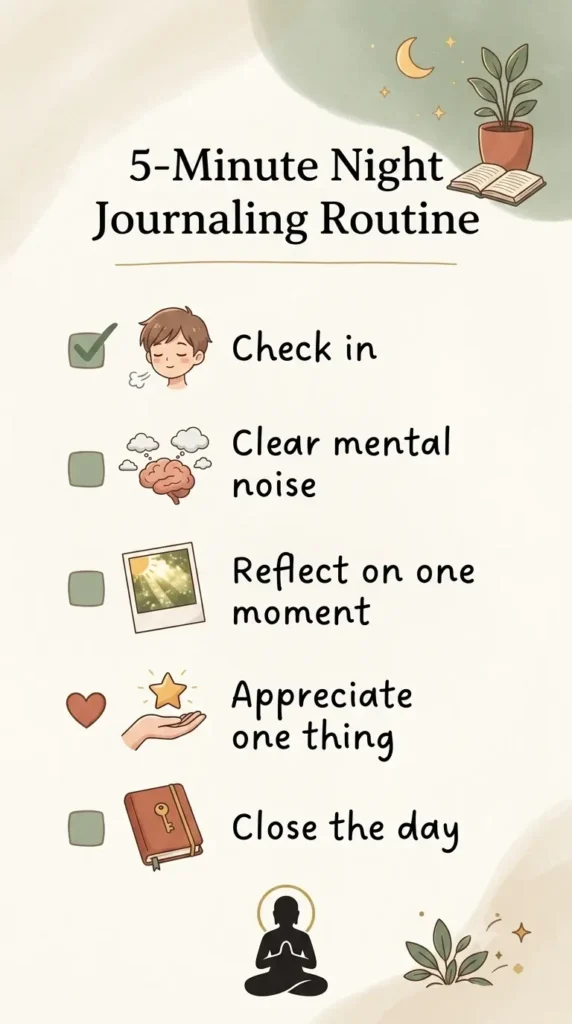
You do not need a 30-minute ritual to make night journal prompts work. Five honest minutes can do it. Check in. Clear the clutter. Name one good thing. Close the day with a little more peace than you opened it with.
Think of this as a wind-down. Not another task stacked on top of an already long day.
Minute 1: Check In With Yourself
Before you reach for any prompt, notice what the day left behind. Check your body. Check your mood. Don’t try to fix either one yet.
Write a sentence or two:
- How does my body feel right now?
- What emotion is loudest tonight?
- What feels heavy, calm, wired, or just tired?
You might feel physically drained but mentally wide awake. That’s common. You might feel fine until you notice your jaw is tight. Both count. This is where most evening journaling prompts start, and for good reason. You can’t release what you haven’t named.
Minute 2: Clear the Mental Noise
Pick one thought that’s taking up too much room. A conversation that didn’t sit right. Tomorrow’s deadline. A comment you’re still turning over three hours later.
Put it on the page. Don’t solve it. Not yet.
Try: “The thought I keep circling back to is…”
Getting it out of your head and onto paper creates some distance. Psychologist James Pennebaker’s research on expressive writing has looked at how naming a difficult experience on paper can help people work through it, though journaling isn’t a fix for everything.
That’s the whole point of nightly journal prompts like this one. They give the noise somewhere to land besides your head at 11pm.
Minute 3: Reflect on One Moment From Today
Skip the full replay. You don’t need a play-by-play of your entire day.
Ask: What moment actually mattered?
Maybe it was a small win. Maybe it was a hard conversation you handled better than expected. Maybe it was nothing dramatic at all, just five quiet minutes with your coffee before the day got loud.
Sound too simple to count? It isn’t. Noticing one real moment beats forcing a summary of twelve hours you’ll forget by Tuesday.
Minute 4: Add Gratitude or Appreciation
Skip the forced list if it feels hollow. Nobody needs three generic lines about health and family every night.
Name one specific thing instead. Your bed felt good tonight. A friend checked in without being asked. The apartment was quiet for once.
Specific beats impressive. Every time.
If gratitude tends to show up in your nighttime pages, the guide on how to practice gratitude breaks the habit down step by step, and a few gratitude worksheets can hand you structure on the nights your brain goes blank. For a longer running list to pull from, things to be thankful for covers ground most people overlook.
Want a broader mindfulness practice beyond bedtime? Our mindfulness journal prompts guide pairs well with these bedtime journal prompts, especially if your mind tends to spiral before it settles.
Minute 5: Decide How You Want to Close the Day
Finish by setting down one thing before you sleep. A worry you’re releasing. An intention for tomorrow. A boundary you’re keeping.
You might write: “I’m letting today be done, even the parts I didn’t finish.” Or: “Tomorrow, I want to start slower.”
That last line turns reflection into something you actually carry into sleep, not just words on a page.
Common Mistakes to Avoid With Night Journal Prompts
Night journaling isn’t supposed to become one more task you fail at. The biggest problems show up when a flexible wind-down habit turns rigid. Answering too many prompts. Planning tomorrow instead of closing today. Forcing gratitude. Waiting for conditions that never arrive. Here’s what actually gets in the way of good night journal prompts, and how to sidestep each one.
Trying to Answer Every Prompt
You don’t need every prompt on the list. Not even close.
A stack of mindfulness journal prompts or nightly journal prompts should work like a menu. Not a worksheet you’re required to finish.
Pick one question that matches how tonight actually feels. Got five minutes before your eyes shut? Answer one prompt well. Don’t rush through six of them just to feel thorough. A short, honest line beats a page you barely thought about.
Turning Your Night Journal Into Tomorrow’s To-Do List
This isn’t the place to plan tomorrow.
Your evening journaling prompts don’t need to double as a second planner. Listing tasks has its place. It just isn’t every single night. If your entry reads “gym, emails, laundry, that email I still haven’t sent,” the reflective part is already gone. Leave room for something quieter instead. What am I actually carrying right now? Or: What am I avoiding because I’m tired, not because I don’t care?
Sound too soft for a productivity brain? Maybe. That softness is the whole point of bedtime journal prompts.
Forcing Gratitude on a Rough Night
Gratitude and pretending you’re fine are not the same thing.
If tonight left you anxious, wrung out, or upset, write that down first. You can still notice one small good thing without turning the page into a performance. Robert Emmons and Michael McCullough’s research found real benefits tied to gratitude practices. That doesn’t mean every night owes the page a silver lining.
Some nights the honest entry is just: today was hard. That counts. If gratitude tends to feel forced more often than not, how to practice gratitude breaks the habit into steps small enough to actually use, and a structured gratitude worksheet can carry some of the weight on the nights your own words won’t come.
Comparing Your Entries to Other People’s Journals
Someone else’s aesthetic journal was never the benchmark.
Your entry might be three messy sentences. It might be a single unfinished thought and bad handwriting. Fine. The point of nighttime journal prompts is noticing what’s actually going on in your head. Not producing something worth posting.
Waiting for the Perfect Night
There probably won’t be one. That’s fine.
You might crawl into bed late, forget until you’re already half asleep, or have somewhere to be in ten minutes. Write anyway. A two-minute entry still counts, and a rough list of things to be thankful for can fill the gap when your brain has nothing else to offer.
Journaling on Your Phone and Getting Pulled Into a Scroll
Scrolling waits right behind your notes app.
A phone makes night journal prompts convenient. It also puts Instagram, texts, email, and every notification one thumb-swipe away, right when your mind is supposed to be winding down instead of lighting back up.
If you journal digitally, cut the temptation first. Open the notes app directly. Turn off notifications. Try airplane mode for ten minutes. Otherwise your quiet nightly reflection quietly turns into twenty-five minutes of scrolling, and the whole reason you picked up the phone gets buried under someone else’s feed.
Frequently Asked Questions
What are good night journal prompts?
Good night journal prompts help you close the day instead of dragging it into bed with you. The best ones ask what drained you, what actually went right, what you’re still holding onto, and what you can set down before you sleep. Not every night needs depth.
Some nights just need honesty. If you want a broader set to pull from beyond bedtime, the mindfulness journal prompts guide covers ones that work any time of day.
What should I write in my journal at night?
Start with what’s actually true right now. Not what sounds reflective. Write down your real mood, what’s still looping in your head, one thing that went okay, and one thing you’re grateful for.
Even three honest lines count more than a full page of forced insight. If gratitude feels hard to access some nights, practicing gratitude gets easier with repetition, not effort.
How many night journal prompts should I use each night?
You don’t need ten prompts to make this stick. One is enough on a hard day. Start with one to three and give yourself five to ten minutes before lights out.
On the nights you’re running on fumes, one honest answer beats rushing through a checklist just to say you journaled. Nobody’s grading this.
What are good nightly journal prompts for anxiety or overthinking?
Pick prompts that separate what happened from what you’re assuming happened. Try: “What actually went wrong today?”, “What am I adding that isn’t real?”, and “What can I let go of before tomorrow?”
A gratitude worksheet can help redirect a spiraling mind toward something concrete. Journaling helps you process. It’s not a stand-in for therapy or professional support.
Is it better to journal in the morning or at night?
Neither wins by default. Evening journaling prompts work well when you need to unload the day before your brain does it for you at 2am.
Morning pages are better if you want to set direction before the day gets loud. If bedtime feels rushed, mornings are just as valid. The right time is whichever one you’ll actually keep doing.
Can I use bedtime journal prompts on my phone?
You can, but your phone will try to turn five minutes of reflection into forty minutes of scrolling. If you’re using a notes app, write before you open anything else. A physical notebook next to the bed removes that fight entirely.
Paper wins when you want distance from screens. Your phone wins when convenience is the only thing keeping you consistent. Reflecting on things to be thankful for works in either format, so use whichever one you’ll return to tomorrow.

It’s Bhaskar!
Well, I am not a psychologist a monk, or a philosopher by training. I’m just an engineering graduate.
‘The Empty Self’ is where I write about that idea, and what it actually means for ordinary life, anxiety, identity, habits, the stories we tell ourselves about who we are. I don’t have a psychology degree, and I’m not offering therapy or clinical advice. What I do have is thought and clarity, and genuine curiosity about why we suffer the way we do and how much of it might loose once we shed this ‘fixed identity’.