
Perfectionism keeps a lot of people stuck. Rigid thinking does too. So does a habit of shutting feelings down before anyone sees them. RO DBT worksheets give you a real way to look at those patterns instead of just naming them.
Radically Open Dialectical Behavior Therapy, or RO-DBT, was built for overcontrol. Not the loud, impulsive kind of struggle most therapy talks about. The quiet kind. The kind where someone looks fine on the outside and feels locked up inside. RO-DBT skills push toward flexibility. Toward openness. Toward connection that actually feels like connection, not performance.
Want to understand why you react the way you do? Start there. Want to get less scared of being seen as imperfect? There’s a worksheet for that too. The right exercise gives you a place to start, not a lecture.
This guide walks through 10 original reflection exercises built on core RO-DBT skills. You’ll also find trusted sources for free printables and published workbooks below. One thing worth saying up front: these tools support self-reflection and therapy. They don’t replace it.
Quick Overview: RO DBT worksheets are guided exercises. They help adults look at overcontrol, practice radical openness, question beliefs that feel too rigid to touch, and build better social connection. Some people use them alongside therapy. Some use them for self-reflection on their own. Either way, the goal is the same: more flexibility, more emotional awareness, relationships that hold up.
If this is your first time exploring DBT-style tools, the DBT skills worksheets guide is a good place to see how RO-DBT fits into the wider DBT picture. And if naming what you feel is the hard part, the emotions worksheet pairs well with the exercises below.
Table of Contents
Disclaimer
This blog is written and edited with the help of AI, then reviewed by me before publishing. As a result, the content is for general reflection only, not therapy or medical advice, and I’m not a licensed mental health professional. If you’re in crisis, please contact 988 if you’re in US or a local crisis service of your country instead of relying on this site.
What Is RO-DBT, and What Are RO-DBT Worksheets?
RO DBT worksheets are structured exercises. They help adults explore overcontrol, emotional expression, rigid thinking, and social connection. Nothing abstract about that.
Inspired by Radically Open Dialectical Behavior Therapy, these worksheets support self-reflection and skills practice. They work best alongside guidance from a trained therapist. That part matters.
What Does Radically Open Dialectical Behavior Therapy Focus On?
Radically Open Dialectical Behavior Therapy, or RO-DBT, treats difficulties tied to excessive self-control. Dr. Thomas R. Lynch developed it as an evidence-based approach. The focus sits on openness, flexibility, emotional expression, and stronger social ties. Four words, one shift.
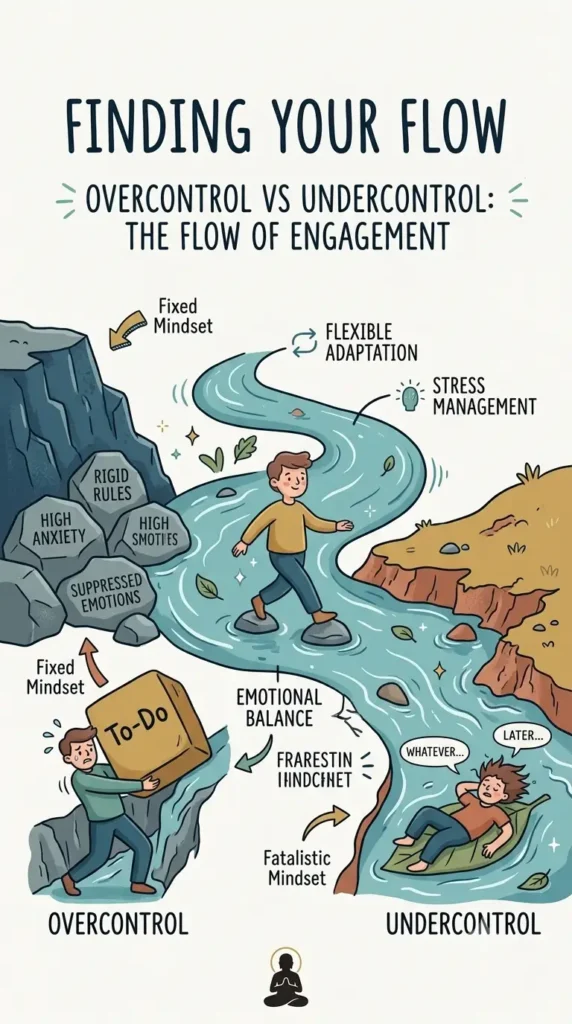
Overcontrol can look like a strength from the outside. You might be organized, dependable, careful with every decision. Still, something’s missing. Expressing feelings feels hard. Accepting unexpected feedback feels harder. Feeling close to other people? That can feel almost impossible.
RO-DBT helps people spot when these patterns turn rigid. When they start blocking relationships instead of protecting them. Its skills build curiosity about unfamiliar experiences. They push a willingness to question personal assumptions. More flexible responses follow.
How Are RO-DBT and Standard DBT Different?
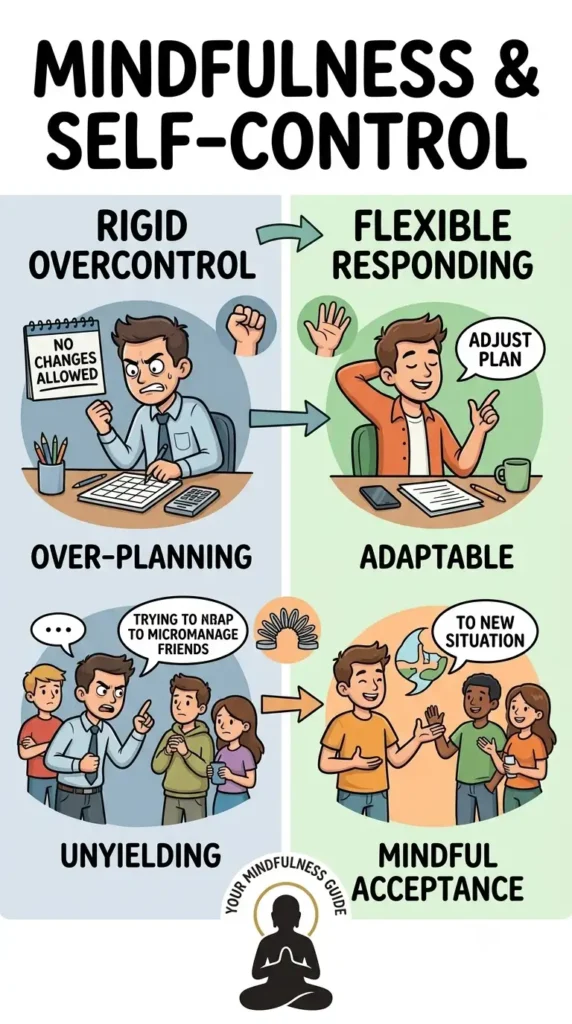
Standard DBT and RO-DBT are not interchangeable. That’s worth saying upfront. Standard DBT leans on emotion regulation, distress tolerance, mindfulness, and interpersonal skills. RO-DBT narrows in on something else. Excessive control. Openness to feedback. Flexible behavior. Social signaling.
Think of it this way. A standard DBT worksheet might help someone manage an intense emotional reaction in the moment. An RO-DBT-inspired exercise does different work. It helps someone who hides distress examine why expressing a feeling feels so uncomfortable. And how that habit quietly reshapes relationships over time.
Want the broader picture? Explore our DBT skills worksheets for the full collection. It covers tools for naming feelings, like this emotions worksheet. And for building a wider coping practice, check these coping skills worksheets.
For a clinical overview, see Dorset HealthCare’s guide to Radically Open Dialectical Behaviour Therapy. It’s official NHS service information.
Who May Benefit From Exploring RO-DBT Worksheets?
Perfectionism. Rigid routines. Trouble naming a feeling out loud. Discomfort with feedback. Struggles with social connection. RO-DBT worksheets may be useful for adults facing any of these. People already in RO-DBT can use them too, to organize reflections between sessions.
Here’s the thing worth remembering. These patterns alone don’t mean someone has a mental health condition. They don’t mean RO-DBT is required. Worksheets are tools for learning and reflection. Not diagnostic tests. Not a substitute for individualized treatment.
If these difficulties cause ongoing distress, or start affecting daily life, talk to a qualified mental health professional. That step matters more than any worksheet.
10 Best RO (Radically Open) DBT Worksheets
RO DBT worksheets exist for one reason. Overcontrol hides well. It looks like competence, like discipline, like someone who has it together. But underneath, there’s often rigid thinking, a struggle with real emotional expression, and a quiet distance from other people.
These 10 reflection exercises pull from core Radically Open Dialectical Behavior Therapy skills. Use them to catch your own patterns in the act. Practice bending where you’d normally stay stiff. Walk into therapy with something already on paper.
One thing to be clear about: these are original exercises built around RO DBT ideas. Not copies of manual worksheets. Not clinical replacements either.
1. Radical Openness Worksheet
Purpose: Stay open when something challenges what you already believe.
Radical openness isn’t about agreeing with everything you hear. It’s about getting curious before you get defensive. That gap between hearing something uncomfortable and reacting to it? That’s where the skill lives.
How to use: Write down a recent disagreement or a comment that caught you off guard. Note your first reaction. Then ask what you might have missed. Pick one alternative explanation worth sitting with.
This is an original reflection exercise built around the radical openness skill. For related material, the Social Workers Toolbox RO DBT resources are worth a look.
2. Flexible Mind DEEP Worksheet
Uncertainty makes most people tighten up. This worksheet asks you to notice that tightening instead of acting on it right away.
Skill: Flexible thinking means questioning your first read on a situation. Not assuming it’s the only read.
How to use: Describe something that felt difficult to accept. Name your initial judgment. List one other way to see it. Then choose a small action that leaves room for not knowing.
This is an original exercise inspired by RO DBT concepts. Verify the exact DEEP terminology against an authoritative source before attaching a specific clinical framework to it.
3. Self-Enquiry Worksheet
Most rigid beliefs don’t announce themselves. They just run in the background, shaping every choice without ever getting questioned.
Skill: Self-enquiry means treating your own assumptions like evidence to examine, not facts to defend.
How to use: Write a belief down. Something like “I must never make mistakes.” Ask what supports it. Ask what challenges it. Then ask whether a more flexible response would actually serve you better.
For structured exercises built on this foundation, the RO DBT workbook from New Harbinger is a solid next step.
4. Flexible Mind SAGE Worksheet
Feedback stings. That’s normal. What matters is what happens after the sting fades.
Skill: Flexible Mind SAGE connects to radical openness and self-enquiry, built specifically around learning from input you didn’t ask for.
How to use: Recall feedback you didn’t like. Write your first reaction, honestly. Identify what’s actually worth learning from it. Decide if any part deserves more thought than you initially gave it.
This is an original reflection exercise, not an official manual worksheet. The Steps2Wellbeing RO DBT PDF covers related material in more depth.
5. Overcontrol and Perfectionism Reflection Worksheet
High standards aren’t the problem. Being unable to bend them is.
Skill: This exercise builds awareness of overcontrolled patterns. It doesn’t treat being organized or careful as a flaw. The flaw shows up when flexibility disappears entirely.
How to use: Describe a time an imperfect result was hard to accept. Name the rule you were following. Note what it cost you. Write one reasonable alternative to try next time it comes up.
For more tools in this direction, see the coping skills worksheets collection, or start from the full DBT skills worksheets pillar guide for the broader skill set these exercises sit inside.
6. Emotional Expression and Vulnerability Worksheet
Purpose: Explore the gap between what you feel inside and what actually comes out of your mouth. That gap is where most of the damage happens.
Skill: Emotional awareness isn’t the hard part. Flexible expression is. This worksheet helps you notice when staying quiet quietly costs you a connection.
How to use: Think of a time you wanted to say how you felt and didn’t. Name the feeling. Name the reason you held it back. Then write one honest, low-risk way you could say it next time. Not perfect. Just real. For a deeper pass at naming what you’re actually feeling before you decide how to say it, pair this with an emotions worksheet.
Availability: This is an original reflection exercise, inspired by RO-DBT concepts. It isn’t an official clinical worksheet, and we’re not claiming it is.
Source: Use it to name the feeling first. The expressing part comes second.
7. Social Signaling and Nonverbal Communication Worksheet
Purpose: Your face says things your mouth never does. This worksheet looks at how expression, tone, and posture shape what people think you meant.
Skill: RO-DBT treats social signaling as its own skill area. It’s built around one idea: people read your body before they read your words.
How to use: Pick a recent conversation. Write down what you said. Then write down how you think you came across, and what you actually wanted the other person to walk away understanding. Those two columns rarely match. That mismatch is the point. Ask someone you trust how you actually landed, instead of guessing. Guessing is where this usually goes wrong.
Availability: Original reflection exercise, inspired by RO-DBT’s social-signaling concepts. Not a licensed worksheet.
Source: The Social Workers Toolbox RO-DBT collection has a fuller handout set if you want the clinical version.
8. REVEALs Worksheet
Purpose: Reflect on the moments you could have opened up and didn’t. REVEALs is about catching those moments before they pass.
Skill: REVEALs is a named RO-DBT skill tied to openness and interpersonal expression. We’re not reproducing the official procedure here. Check that against an authoritative source before you treat this as the real thing.
How to use: Describe a conversation where you kept your thoughts to yourself. What did you want the other person to actually know? Write one respectful way you could have said it. Short is fine. Honest matters more than polished.
Availability: Original reflection exercise, inspired by RO-DBT. Not a reproduction of the published REVEALs worksheet.
Source: For the full framework, go straight to RO-DBT skills training materials, or start with our broader DBT skills worksheets guide for related exercises.
9. ROCKs ON Worksheet
Purpose: Look at the small, everyday moves that either open you up or shut you down in social situations.
Skill: ROCKs ON is a named RO-DBT skill. We’re flagging it, not teaching it. Confirm its exact meaning before you treat any worksheet as official instruction.
How to use: Think of a recent interaction where you fell back on your usual script. What were you hoping would happen? What actually happened? Now write one different response you might try next time the same situation shows up. Just one. Small changes stick better than overhauls, which is also the logic behind most coping skills worksheets.
Availability: Original general reflection exercise, inspired by RO-DBT. Not an official ROCKs ON worksheet.
Source: More related material lives in the Social Workers Toolbox RO-DBT collection.
10. ALLOWs Worksheet
Purpose: Look at one relationship pattern. Trust. How you respond when someone actually tries to get close.
Skill: ALLOWs is a named RO-DBT skill. Its exact definition belongs in authoritative RO-DBT materials, not a casual worksheet. Check before you assign it specific techniques.
How to use: Pick one relationship where you want more honesty between you. Write what makes that hard. Write what you wish the other person understood. Then write one realistic step toward saying it out loud. Not the whole conversation. Just the first line.
Availability: Original reflection exercise, inspired by RO-DBT. Not an official ALLOWs worksheet.
Source: Start with The Radically Open Dialectical Behavior Therapy Workbook from New Harbinger for the structured, published version of this exercise.
How to Choose the Right RO DBT Worksheet for Your Needs
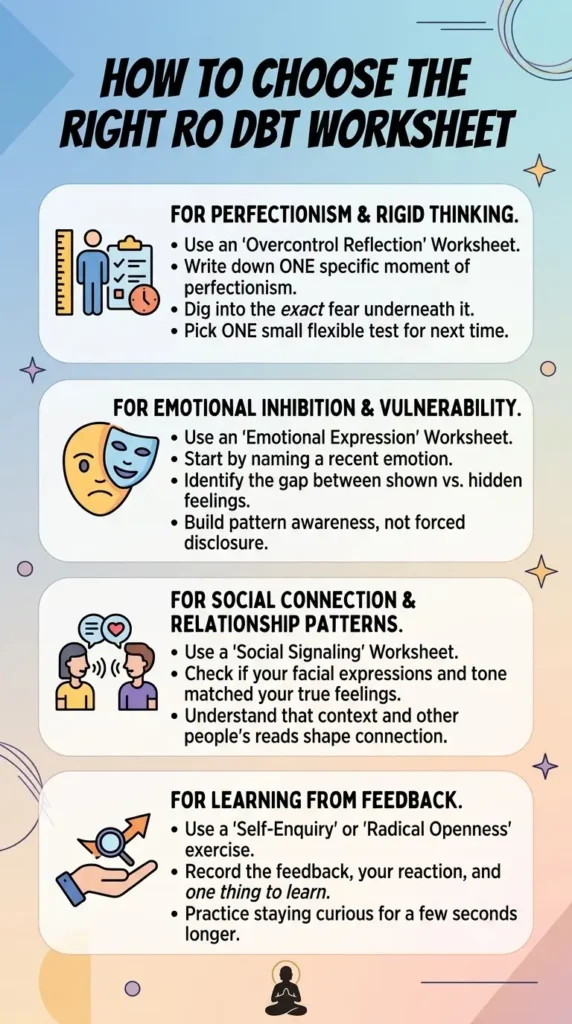
The right RO DBT worksheet depends on one thing: the pattern you’re actually trying to shift. Some exercises target rigid thinking. Others pull at buried emotions, strained relationships, or how you take feedback. Pick one pattern first. Then match the worksheet to it.
For Perfectionism and Rigid Thinking
Struggling with high standards that never let up? Strict personal rules that feel non-negotiable? Start with an overcontrol and perfectionism reflection worksheet. Write down one moment where everything had to go right. Not three moments. One.
Then dig into the fear underneath it. What did you think would happen if things went sideways? Name it specifically. “People would judge me” is vague. “My manager would think I’m careless” is something you can actually work with.
From there, pick a single flexible response to try next time. Just one. Rigid thinking doesn’t loosen because you decided to be more relaxed in general. It loosens one small test at a time. Want more ways to respond to stress beyond this single exercise? These coping skills worksheets give you a wider menu to pull from.
For Emotional Inhibition and Vulnerability
Hiding what you feel and expressing it are two different skills. If the first one comes easy and the second one doesn’t, an emotional expression worksheet is where to go. Start by naming the emotion from a recent situation. Just name it.
Then get specific about the gap. What did you show other people? What stayed hidden? What actually made expression hard in that moment, the setting, the person, the stakes? This emotions worksheet can help if naming the feeling itself is the sticking point.
Here’s the part people get wrong. The goal isn’t forcing full disclosure. It’s building awareness first. Notice the pattern before you try to break it.
For Social Connection and Relationship Patterns
Distance from others isn’t always about effort. Sometimes it’s about signal. A social signaling worksheet looks at how your words, your face, and your body actually land on other people, not just what you meant by them.
Pick one recent conversation. Walk through it. Did your outward signals match what you felt inside, or was there a gap nobody mentioned? Sound like overthinking? It isn’t. Most people never check this at all.
Context shapes every exchange. So does the other person’s read of you, which you don’t fully control. Misreads happen on both sides. That’s not a flaw in the exercise. It’s the whole reason the exercise exists.
For Learning From Feedback
For most people, criticism isn’t really about the feedback. It’s about the flinch that happens before they’ve even heard the whole sentence. If that flinch turns into defensiveness fast, try a self-enquiry or radical openness exercise.
Record three things. The feedback itself. Your first reaction. What you might actually learn from it, even a sliver. You don’t have to agree with the comment. Nobody’s asking for that.
Practice staying curious a few seconds longer than feels comfortable. That’s the entire skill. Long enough to consider another angle before you decide the comment is wrong. For a written outlet afterward, these journal prompts for mental health work well for processing what came up.
If you want the full picture of where RO DBT worksheets fit inside the broader RO DBT model, that’s worth a look before you commit to one worksheet over another. And for the wider DBT skill set this sits alongside, the DBT skills worksheets library covers the other three modules in full.
How to Use RO-DBT Worksheets Effectively
RO DBT worksheets help you catch habits you don’t usually question. They push back on assumptions. They give you room to try a different response than your default one. No perfect answers required. No instant fix either. Pick one skill, move at your own speed, and let what you notice shape your next step.
Choose One Skill and One Reflection Goal
Start small. Pick a worksheet tied to something real you want to look at, maybe perfectionism, maybe how hard it is to show feeling, maybe how you take feedback. Set one clear goal. Something like noticing when you hold yourself to a standard nobody asked for.
Why just one? Working a single skill at a time keeps the reflection manageable. You spot patterns instead of drowning in them. Radically open DBT was built around overcontrol, and overcontrol rarely shows up as one clean problem. It shows up tangled. A single focus cuts through that tangle instead of adding to it.
Record Your Responses Without Trying to Be Perfect
Write what actually happened. Not the version that sounds better. If a reaction hit you hard, name it. What happened, what you felt, how you responded. Skip the edited version.
Sound too raw? That’s the point. A clean, tidy answer usually means you talked yourself out of the real one. Some people pair their RO-DBT worksheets with reflective journaling between sessions, catching the thoughts that keep circling back when the worksheet itself is closed. That combination tends to surface more than either tool alone.
The goal isn’t a flawless entry. It’s noticing more, and loosening your grip a little. Nothing fancier than that.
Review Patterns and Discuss Them With Your Therapist
Once a worksheet is done, step back and look. What keeps repeating? A thought, a feeling, a way you act without meaning to.
Do you dodge disagreement every time it shows up? Does changing a plan on short notice throw you off more than it should? Write the pattern down plainly. Then bring it to your therapist if you have one.
A therapist reads what you can’t always see in your own handwriting. They help connect the pattern to the ro dbt skills worth practicing next. If naming the emotion itself is the sticking point, an emotions worksheet can make that first step less foggy.
What to Do If a Worksheet Feels Confusing or Uncomfortable
You don’t owe the page a finished answer in one sitting. If a prompt reads unclear, go back to the instructions. Or set it down and return later. Nobody’s timing you.
Some exercises bring up more than expected. If that happens, pause. Use a grounding strategy you already trust. Breathe, name five things in the room, whatever has worked before.
A qualified therapist can walk through the harder reactions with you and reshape the exercise so it actually fits. And if writing things out helps you process between sessions, these journal prompts for mental health sit well alongside your ro-dbt practice. For a wider set of tools beyond RO DBT alone, the coping skills worksheets collection covers more ground.

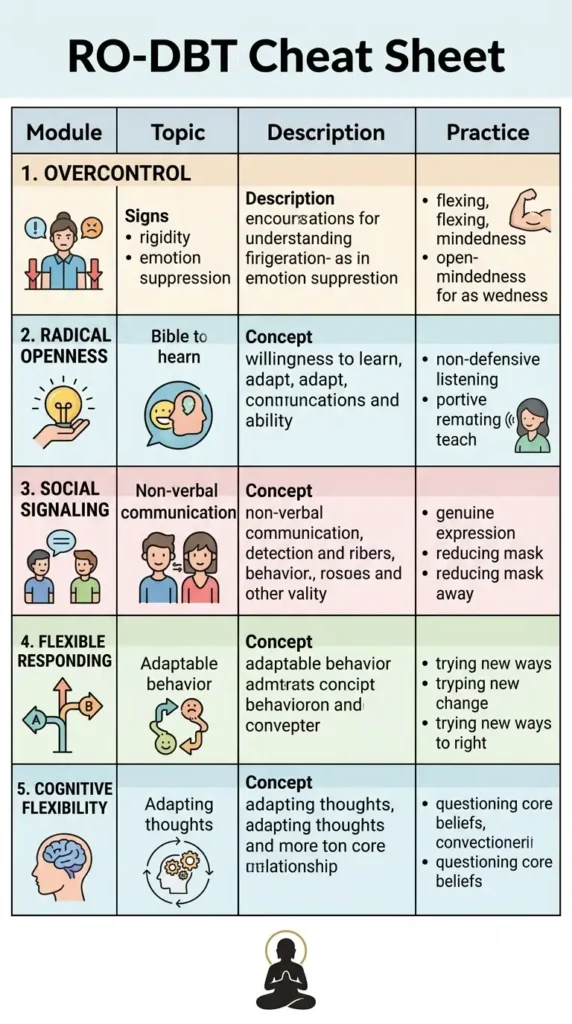
RO-DBT Cheat Sheet: Key Skills to Remember
Rigid thinking feels safe. That’s the trap. RO-DBT skills exist to loosen that grip, open you back up to new information, and help you build connections that actually hold.
This cheat sheet pulls the core concepts from RO DBT worksheets into one quick reference. Keep it next to your worksheets. It’s not a replacement for therapy.
Radical Openness
The focus here is simple: stay receptive. Not agreeable. Receptive.
When does this one matter? When you feel completely certain your view is the only right one. That certainty is the signal, not the proof. Ask yourself what you might be missing. Don’t throw out your own experience to do it. Just leave room for another angle to exist alongside it.
Self-Enquiry
This skill is about catching your own patterns before they run the show.
A situation triggers a strong reaction. You notice the same old groove starting up again. That’s the moment to stop and ask three things: what do you believe right now, what’s that belief actually built on, and what else could be true? Pairing this with an emotions worksheet makes the reaction easier to name before it takes over.
Flexible Responding
Rigid rules feel like safety. They’re usually just a cage with good lighting.
Use this skill when perfectionism, strict personal rules, or a fear of getting it wrong is narrowing your options. Pick one small response that breaks from your usual script. Not a huge leap. One step sideways is enough. Pairing this practice with coping skills worksheets gives you a structured place to test out the new response before it becomes a habit.
Social Signaling
Your face says things before your words do. So does your tone. So does the way you’re standing.
This skill is about noticing how your expressions, posture, and tone land on other people. Why does this matter so much? Because social cues shift with context. The same raised eyebrow can mean two completely different things in two different rooms. There’s no single fixed meaning to chase down.
Social Connection
Trust doesn’t build itself. Neither does openness.
Watch for the moments you pull back, hide what you’re actually feeling, or struggle to feel close to someone. That’s the cue to act, not retreat further. Pick one manageable move: share an interest, name a feeling, reach out to someone you already trust. Small, repeated gestures build connection faster than one big grand effort ever does.
Editorial note: this is an original, simplified overview of RO-DBT concepts, not an official clinical handout. For a deeper breakdown of the model, Social Workers Toolbox is a solid starting point. Use this cheat sheet to guide reflection, and bring your questions to an RO-DBT-trained therapist.
Are Free RO-DBT Worksheets Enough, or Do You Need RO-DBT Therapy?
Free RO DBT worksheets can crack open rigid thinking fast. They help you notice patterns in how you handle emotion and connect with other people. But a page only goes so far. It can’t read your tone of voice.
It can’t push back when you dodge the real issue. RO-DBT therapy, short for Radically Open Dialectical Behavior Therapy, fills that gap. It adds structure, feedback, and support built around your actual life, not a generic script.
What Worksheets Can and Cannot Do
Worksheets are built for reflection, not diagnosis. RO DBT worksheets give you a practical way to question old habits. They help you test more flexible responses, one small moment at a time. They can also surface what you’d rather not see. Maybe you avoid hard conversations. Maybe you hold yourself to standards nobody else could meet. Maybe feedback feels like an attack, even when it isn’t.
Take a self-enquiry exercise. It can help you sit with why criticism stung so much, instead of brushing past it. A social signaling exercise does something different. It has you look at your tone, your face, your posture. Small signals change how a whole conversation lands. If reading feels like a lot, an RO DBT cheat sheet can summarize the same ideas on a single page.
But reflection only goes so far. A worksheet can’t diagnose anything. It can’t give you feedback tailored to your life. It can’t show you the full shape of a relationship problem that keeps repeating. And progress depends on what you actually do with what you learn, not just what you write down. Pair these with coping skills worksheets for the moments that feel too big to sit with alone, and the full set of DBT skills worksheets if you want the bigger picture.
If a worksheet brings up something heavy, stop. Take a break. Talk it through with a qualified mental health professional instead of pushing through alone.
When to Consider Working With an RO-DBT-Trained Therapist
You don’t need to hit a breaking point first. If perfectionism, bottled-up emotion, rigid habits, or isolation keep showing up in your relationships, that’s reason enough.
A trained therapist does things a worksheet never can. They spot patterns you can’t see from inside your own head. They let you practice RO DBT skills in real situations, with real stakes. And they help you notice when an old response has stopped working. RO-DBT treatment leans heavily on interpersonal feedback. That’s something no page can fully give back to you.
You don’t have to wait until things feel unbearable to reach out. If you’re already in therapy, just ask. Ask whether RO DBT skills fit what you’re working toward. Ask whether the worksheets you’ve found actually match your treatment plan.
Start small. Pick one worksheet. Sit with what it brings up, honestly. Then choose one small behavior to practice differently this week. You don’t need to finish every page perfectly. The point is staying open, to yourself and to the people around you.
More DBT Worksheets and Mental Health Resources
RO DBT worksheets dig into overcontrol, emotional expression, and connecting with other people. That’s different ground than standard DBT covers. Other mental health worksheets round out the picture, from everyday stress to naming hard emotions.
Want the wider skill set? Start with our DBT skills worksheets. That guide breaks down the four core DBT modules. It hands you exercises for building emotional awareness and getting through tough moments. Practical stuff, not theory.
Stress piles up fast. Old habits don’t budge easily. Some days a feeling just takes over before you notice it coming. For those moments, our coping skills worksheets are worth a look. They help you spot healthy responses to stress and pick what actually fits your situation.
Naming a feeling sounds small. It isn’t. Our emotions worksheets give you space to practice that, notice patterns, and put words to what you’re carrying.
Here’s the thing worth remembering: standard DBT and RO DBT don’t share the same treatment focus. Not even close. Pick resources that match your actual goal. And when the situation calls for more than a worksheet, a qualified therapist is worth bringing in.
Conclusion
RO DBT worksheets can help you explore overcontrol, question rigid thought patterns, and build more flexible ways to respond to everyday challenges. Whether you start with radical openness, self-enquiry, or social signaling, focus on one skill at a time rather than trying to change everything at once.
Free RO DBT worksheets PDF resources can be a useful starting point, but check their sources and choose exercises that fit your needs. Remember, the goal isn’t to become a different person. It’s to stay open to new experiences, express yourself more freely, and build stronger connections with others.
Frequently Asked Questions
Are there free RO-DBT worksheets available as PDFs?
Yes, free RO-DBT worksheets and handouts are available through resources such as Social Workers Toolbox and the Steps2Wellbeing RO-DBT skills training manual.
These materials cover skills related to radical openness, emotional expression, and social connection. Check the source and usage terms before downloading or printing.
What are the best RO-DBT worksheets for adults with perfectionism and overcontrol?
Worksheets focused on self-enquiry, radical openness, and flexible thinking can help adults examine rigid rules, perfectionistic habits, and reactions to uncertainty. The most suitable exercise depends on your goals. A therapist trained in RO-DBT can help you select skills that fit your needs.
What is the difference between RO-DBT worksheets and standard DBT worksheets?
RO-DBT worksheets focus on patterns linked to overcontrol, such as excessive self-restraint, rigid thinking, and difficulties with social connection.
Standard DBT worksheets often focus on distress tolerance, emotion regulation, mindfulness, and interpersonal effectiveness. Both approaches use skills practice, but their treatment targets differ.
Can I use RO-DBT worksheets on my own without a therapist?
You can use publicly available RO-DBT worksheets for personal reflection and to learn about relevant skills. However, self-guided exercises do not replace individualized treatment, and some concepts may be difficult to apply without support. If possible, discuss your observations with a qualified mental health professional.
What is the Flexible Mind DEEP skill in RO-DBT?
Flexible Mind DEEP is a named RO-DBT skill associated with developing more flexible responses. Before using a worksheet, verify the skill’s exact meaning and instructions against an authoritative RO-DBT source. Avoid confusing DEEP with other similarly named skills or treating an independently created exercise as an official handout.

It’s Bhaskar!
Well, I am not a psychologist a monk, or a philosopher by training. I’m just an engineering graduate.
‘The Empty Self’ is where I write about that idea, and what it actually means for ordinary life, anxiety, identity, habits, the stories we tell ourselves about who we are. I don’t have a psychology degree, and I’m not offering therapy or clinical advice. What I do have is thought and clarity, and genuine curiosity about why we suffer the way we do and how much of it might loose once we shed this ‘fixed identity’.