
Gratitude isn’t a trait you’re born with. It’s a skill. And skills get stronger with reps.
That’s why gratitude exercises work better than telling yourself to “just be more grateful.” A vague mindset shift doesn’t stick. A structured exercise does. It gives your brain something specific to notice, write down, or act on, instead of hoping appreciation shows up on its own.
Sound too simple to matter? It isn’t.
Researchers Robert A. Emmons and Michael E. McCullough studied this closely. Later, Joshua M. Kini and his colleagues built on that work. Their findings point to something specific: regular gratitude practice can retrain where your attention goes. Toward the good stuff. Not just the stress. For a deeper look at the research behind this, the How to Practice Gratitude guide breaks it all down.
Quick Answer
A gratitude exercise is a structured activity. It helps you notice, express, or reflect on what you appreciate. Some take two minutes a day. Others lean on journaling or mindfulness. A few work by strengthening relationships through small, deliberate acts of thanks.
The best gratitude exercise isn’t the fanciest one on this list. It’s the one you’ll actually come back to.
Table of Contents
Disclaimer
This blog is written and edited with the help of AI, then reviewed by me before publishing. As a result, the content is for general reflection only, not therapy or medical advice, and I’m not a licensed mental health professional. If you’re in crisis, please contact 988 if you’re in US or a local crisis service of your country instead of relying on this site.
What Are Gratitude Exercises?
Gratitude exercises are simple, structured actions. You do them on purpose. They help you notice, express, or sit with what you appreciate, instead of waiting for thankfulness to just show up.
That’s the real split. A general “gratitude mindset” is a feeling you’re supposed to summon. A gratitude exercise is a task you complete. Tasks are easier to repeat than feelings. That’s why they stick, especially if you’re new to gratitude, or “thinking positively” never lasted past day three for you.
Definition
A gratitude exercise is a specific, repeatable activity. It’s built to sharpen your attention on the good things already sitting in your life, the ones you’ve probably stopped noticing.
Some take two minutes. Others take twenty. Writing counts. So does reflecting, moving your body, calling someone, or just slowing down enough to notice an ordinary moment properly.
Here’s what it’s not: pretending everything is fine. Nobody’s asking you to erase a hard day. You had one. It happened. What shifts is where you point your attention next, not whether the hard day gets deleted from the record. Difficult days rarely tell the whole story anyway.
Think of it like a workout, not a personality trait. Owning trainers doesn’t make you stronger. Using them does. Gratitude works the same way. Repetition builds the muscle. Intention alone doesn’t.
Exercises vs. Habits
People use “gratitude exercise” and “gratitude habit” like they’re the same thing. They’re not.
A gratitude exercise has a clear start and finish. Writing three good things before bed. Sending a one-line thank-you text. Taking a five-minute walk and naming what you notice along the way. Each one is a complete unit. You can repeat it tomorrow, but tonight’s version is done when it’s done.
A gratitude habit works differently. It’s the showing-up part. When you practice, how often, whether it’s nightly or twice a week. The habit is the frame. The exercise, or gratefulness exercise if you prefer that phrasing, is what fills the frame each time.
Why does this split matter? Habits give you consistency. Exercises give you variety. Most people don’t quit gratitude because it stopped working. They quit because the same three-good-things list every night for six weeks turns into wallpaper. Rotate the exercises. Keep the habit steady underneath. That’s the actual fix, not more willpower.
For the full research breakdown, including the Emmons and McCullough studies and the Kini et al. brain-imaging work, the pillar guide on how to practice gratitude covers it in depth.
How to Choose the Right Gratitude Exercise for You
Not every exercise fits every moment. Some days a journal feels impossible. Other days a two-line thank-you text is all you’ve got in you, and that’s plenty. The right pick depends on your mood, your time, and how your brain actually works. Sticking with something beats hunting for the “perfect” method every single time.
By Mood
Start with how you feel right now. Don’t force yourself through an exercise that feels like homework. Match it instead.
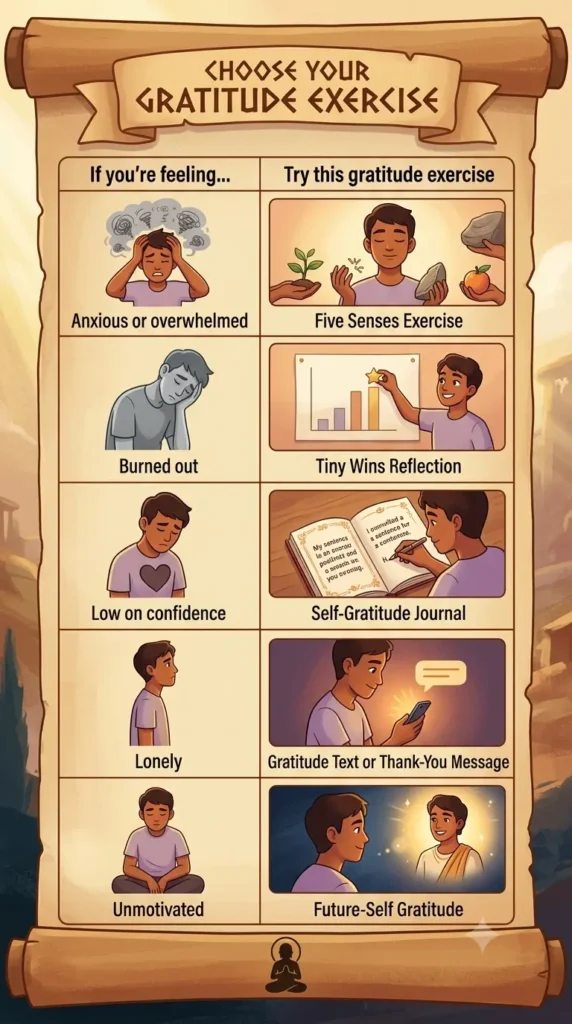
| If you’re feeling… | Try this gratitude exercise | Why it fits |
|---|---|---|
| Anxious or overwhelmed | Five Senses Exercise | Pulls your attention back to right now instead of racing ahead. See Can Gratitude and Anxiety Exist at the Same Time? |
| Burned out | Tiny Wins Reflection | Points you at small wins instead of an endless to-do list. |
| Low on confidence | Self-Gratitude Journal | Moves the focus off what’s missing and onto what you’ve already proven you can do. |
| Lonely | Gratitude Text or Thank-You Message | Reaching out does more for a relationship than quietly appreciating it in your head ever will. |
| Unmotivated | Future-Self Gratitude | Shows you the progress that’s already happening. Even the slow kind. |
By Time Available
You don’t need thirty free minutes to make this work.
- 2 minutes: Send a gratitude text. Write three good things. Snap a quick photo of something you’re thankful for.
- 5 minutes: Take a short gratitude walk. Try the Five Senses Exercise. Run a Tiny Wins Reflection.
- 15+ minutes: Sit down with a gratitude journal. Write a full gratitude letter. Work through a guided gratitude meditation.
Here’s the honest math. A two-minute habit you actually finish beats a twenty-minute one you keep pushing to tomorrow. Every time.
By Personality
Some people think best with a pen moving across paper. Others need to talk it out, walk it out, or build something with their hands. Your personality decides which gratitude exercises feel natural and which ones you’ll drop by next Tuesday.
Don’t lock yourself into one method on day one. Try a few. Notice which one you actually want to repeat, not just the one that looks good on paper. Already know your type? The full personality-fit breakdown lives in How to Practice Gratitude, with picks matched to different styles and daily habits.
20+ Gratitude Exercises to Try
Long journal entries don’t build a habit. Repetition does.
A two-minute pause before work beats an hour of journaling you do once and abandon. Pick the exercise that matches your energy today. Not the one that sounds impressive on paper.
Some of these ideas borrow structure from the exercises outlined in Positive Psychology’s research-backed gratitude collection, adapted here for something you can actually stick with. For a fuller framework on building the habit day to day, the How to Practice Gratitude guide breaks down the underlying approach.
Quick 2-Minute Gratitude Exercises
Your schedule is packed. Your attention is scattered. You don’t need another task on your plate.
These four exercises fit into the cracks of a busy day.
Three Good Things
Write down three things that went well today. Doesn’t matter how small.
Finishing an assignment counts. So does your coffee tasting better than usual.
After each one, ask yourself one question: why did this happen? That single follow-up turns a list into real reflection. Without it, you’re just writing on autopilot.
This one works especially well if your brain likes to replay everything that went wrong the moment your head hits the pillow.
One Deep Breath of Thanks
Pair one slow breath with one thing you’re thankful for. That’s the whole exercise.
Breathe in. As you breathe out, land on one person or moment that made today a little easier. Don’t chase something impressive. Ordinary moments feel more believable, and belief is what makes gratitude stick.
Start here if journaling feels like too much. Or if your mind won’t sit still long enough to write.
Gratitude Snapshot
Skip the notebook. Take a photo instead.
Your dog asleep by the desk. Sunlight on the wall. Dinner you actually cooked yourself. Whatever it is, look at the photo for a moment before you put the phone away. Don’t post it yet.
Do this often enough and your camera roll turns into something else entirely: a visual record of what you noticed. If you want more prompts beyond the obvious, this list of things to be thankful for is a good place to keep pulling ideas from.
Gratitude Text
Send one message. Thank someone for something specific.
Skip “thanks!” That’s the one people scroll past.
Try this instead: “I’ve been thinking about how you checked in after my interview. That meant more than I realized.” Specific beats generic every time.
It’s one of the fastest ways to strengthen a relationship and practice thanks in the same breath.
Five-Minute Exercises (Gratefulness Exercise)
Five minutes is enough to slow down. Not so much that it feels like a commitment.
Each gratefulness exercise below works best with your full attention. Not squeezed between two notifications.
Gratitude Walk
A gratitude walk is just a walk where your to-do list stops running the show.
Notice colors. Sounds. The weather shifting. A stranger holding a door. You’re not forcing yourself to love everything. You’re just catching what usually slips past unnoticed. Mindful.org calls this kind of sensory shift a five-minute gratitude practice, and it holds up outdoors just as well as it does sitting still.
This helps most after hours stuck indoors staring at a screen.
Five Senses Exercise
Use your senses as prompts. Not your thoughts.
Ask yourself:
- What can I see that I’m thankful for?
- What can I hear?
- What can I smell?
- What can I touch?
- What can I taste?
Grounding gratitude in something physical feels more real than forcing positive thoughts. Especially on a rough day.
Gratitude Jar
Write one grateful moment on a scrap of paper. Drop it in a jar.
It doesn’t need to be profound. A good conversation. Finishing a project you’d been dreading. Finding your favorite snack on sale. All of it counts. Read the notes back at the end of the month, or the year.
If you like seeing progress you can actually hold, this one’s satisfying in a way an app never quite manages.
Tiny Wins Reflection
Don’t ask what changed your life today. Ask what made it 1% better.
Maybe you answered the email you’d been avoiding. Maybe you drank enough water. Maybe the laundry finally got folded. Small wins vanish fast because they don’t feel dramatic. But they’re usually what the bigger changes are built on.
Struggling with perfectionism? This one feels far more doable than chasing some huge milestone.
Journaling Exercises
Writing creates distance. Distance is what lets you spot the pattern you’d otherwise miss.
You don’t need pages. Half a page is often plenty.
Prompt Journaling
Use one prompt instead of staring at a blank page.
“What made me smile today?” Or: “Who quietly made my life easier this week?” A concrete question gives your brain somewhere to start. Cap it at five or ten minutes.
Otherwise journaling just becomes one more chore on the list. If blank pages still intimidate you, a printable gratitude journal template removes that first-line pressure completely.
Future-Self Gratitude
Picture yourself six months from now, looking back at today.
What would that version of you thank you for? Starting therapy. Saving a little money. Applying for the course. Sleeping enough for once. Gratitude doesn’t only look backward. Sometimes it recognizes the decision you’re making right now, before you even know how it turns out.
This one helps most when progress feels painfully slow.
Self-Gratitude
Most gratitude exercises point outward. This one points at you.
Write down something you appreciate about your own effort. Your resilience. How far you’ve actually come. Keep it factual. You’re noting something real, not talking yourself into feeling perfect.
Mindfulness-Based Exercises
Mindfulness and gratitude overlap. They’re not the same thing.
Mindfulness notices the moment. Gratitude notices what makes that moment worth keeping.
Gratitude Meditation
Sit somewhere comfortable. Bring one person or place to mind.
Stay there. Don’t rush off looking for the next thing to appreciate. If your attention wanders, bring it back gently. No judgment needed.
Prefer quiet over writing? This is your exercise.
Body-Scan Gratitude
Move your attention slowly from your head down to your feet.
Instead of hunting for discomfort, notice what each part of you actually lets you do. Legs that carried you through the day. Hands that made breakfast. Eyes that watched the sunset without you even asking them to.
It’s a quiet reminder: gratitude includes the ordinary abilities we barely notice until something takes them away.
Loving-Kindness Gratitude
Start by wishing yourself well. Then extend that wish outward, one person at a time. Someone you love. Someone neutral. Eventually, someone you find difficult.
This isn’t about excusing bad behavior. It’s about practicing shared humanity without dragging resentment into every interaction.
Won’t suit everyone. That’s fine. Come back to it another time if it feels forced today.
Relationship Exercises
Gratitude gets stronger the moment it leaves your notebook and reaches somebody else.
Thank-You Message
Pick one person. Thank them for one specific thing they did.
Say what they did. Say why it mattered. Specific messages get remembered. Some people keep them for years.
Appreciation Conversation
Next conversation you have, say one true thing you appreciate about that person.
Keep it natural. Don’t turn it into a speech. One sincere sentence is enough.
Works with friends, partners, coworkers, family. All the same.
Gratitude Challenge With a Friend
Ask a friend to trade one grateful moment every evening for a week.
No scoring. No competition. Just a little accountability, which usually makes the habit stick better than doing it solo.
Family Gratitude Ritual
Build a small ritual that fits how your household actually runs.
Some families share one good moment over dinner. Others keep a notebook on the kitchen table. The format matters less than the repeating. Do it often enough, and it just becomes part of the week. For more ways to phrase it out loud without sounding stiff, browse these gratitude examples.
Digital Gratitude Exercises for Gen Z
Your phone isn’t the enemy of gratitude. How you use it is what matters.
These exercises work with the technology you already have open. Not against it.
Camera Roll Gratitude
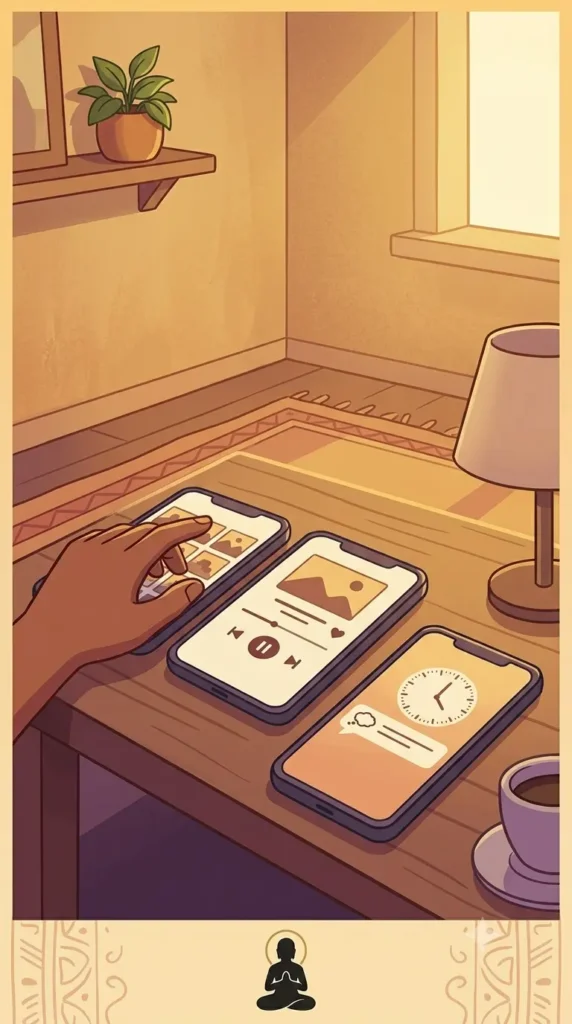
Scroll your recent photos with one question in mind: which moment would I happily relive?
Pick three. Spend a minute remembering what happened beyond the frame. The conversation. The mood. The feeling you’d forgotten you had. You’ll often find good moments you didn’t even realize you’d lost track of.
Writing not your thing? Start here instead.
Playlist Gratitude
Build a playlist out of songs tied to real memories. Not just whatever’s trending.
As each track plays, think about the person or place it brings back. Music reaches places words sometimes can’t touch.
This one works best if emotion gets you further than a blank page ever does.
Lock Screen Reminder
Swap your lock screen for one simple prompt.
Try:
- What went well today?
- Who helped you this week?
- What’s one thing you’d miss if it disappeared tomorrow?
You’ll see it dozens of times a day. That repetition builds the habit quietly, without needing another app.
Gratitude-Before-Scrolling Pause
Before you open TikTok or Instagram, pause. Ten seconds is enough.
Name one thing you’re already glad about, before anyone else’s highlight reel gets a chance to compete with it. That small pause cuts down the automatic comparison a lot of people feel while scrolling.
It’s one of the easiest habits to keep. It just rides along with something you already do.
Social Media Appreciation Pause
When you’re done scrolling, ask one last question.
Did I see something that actually inspired or encouraged me?
Save the post. Send it to a friend. Thank the creator if it genuinely added something to your day. End on appreciation instead of comparison, and social media starts to feel different over time. Not instantly. But it does.
Common Mistakes to Avoid With Gratitude Exercises
Most people who quit gratitude exercises didn’t pick the wrong one. They just expected the wrong thing from it.
A good gratitude exercise should leave you more aware, not more pressured. That’s the whole point. Somewhere between “give it a try” and “give up,” most people fall into the same three traps: forcing positivity when they feel none, repeating the same gratefulness exercise until it goes numb, or chasing a flawless routine instead of a real one. A messy habit you actually keep will beat a perfect plan you drop after three days. Every time.
Trying to Force Gratitude
Gratitude isn’t about pretending things are fine when they’re not.
If you’re annoyed, disappointed, or just tired, sit with that first. Don’t skip it. Name the feeling before you try to shift past it. Then, once that’s out of the way, look for something small and real to appreciate. A supportive text. A quiet cup of coffee before the day gets loud. That’s enough.
Research from Robert A. Emmons and Michael E. McCullough backs this up directly: gratitude works best when it’s rooted in something you actually felt, not something you performed. Forced positivity doesn’t fool your nervous system. It just adds another task to your day.
Sound too simple? It is. That’s exactly why it works.
Repeating the Same Gratefulness Exercise Every Day
Write the same three things every night and something predictable happens. Your brain checks out.
It starts filling in blanks without paying attention. The exercise turns into a formality, and formalities don’t change how you feel. This is where most gratitude exercises quietly lose their power, not because the method was wrong, but because it went stale.
Mix it up. Try a few formats and rotate them:
- Written journaling, three lines, no more
- A slow gratitude walk with no phone
- A short appreciation message sent to someone specific
- A quick voice note or digital log at the end of the day
New format, fresh attention. That’s the trade.
Chasing the “Perfect” Routine
Here’s where most people quit. They miss one day, and suddenly they’ve “failed.”
That’s not how this works. Gratitude behaves more like fitness than like a streak count. Missing a workout doesn’t erase the muscle you built. Missing a day of noticing what’s good doesn’t erase the habit either. What matters is coming back to it, not keeping a spotless record.
A two-minute exercise is often enough. Not a journal entry. Not a whole ritual. Just enough to reset your attention for the next hour.
Want a deeper look at these patterns, including forced positivity, gratitude fatigue, and the mistakes almost every beginner makes? Check out the full breakdown in How to Practice Gratitude.
How to Make These Exercises Stick
Gratitude exercises only work if you keep coming back to them. Not if you try one, then forget it by Thursday. The goal here isn’t finishing every item on this list. Find one or two that fit your actual day. Then repeat them.
Often enough that they stop feeling like a task.
Habit-Stack Gratitude Instead of Relying on Motivation
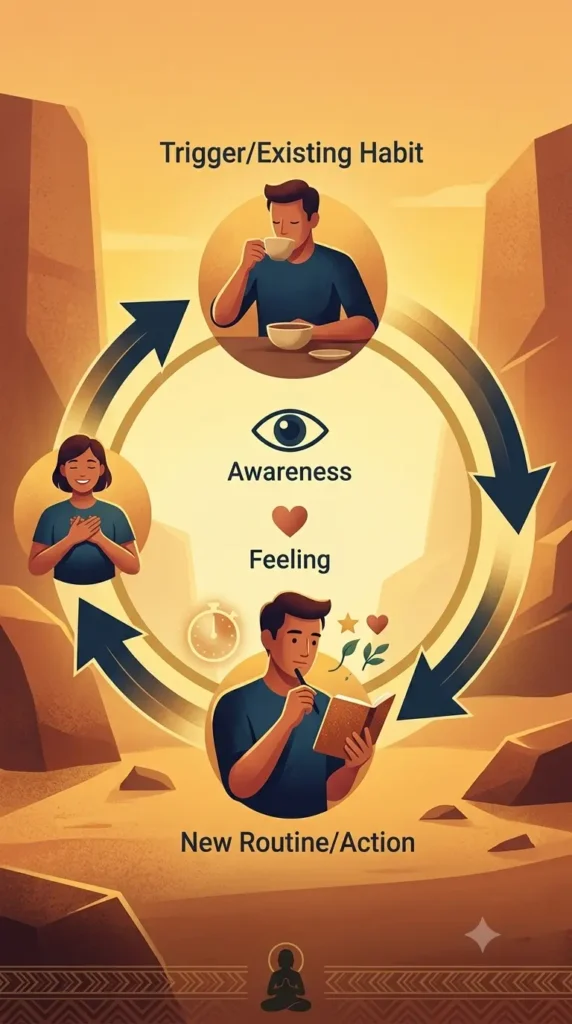
Motivation fades fast. Habits are what stick around. The simplest way to make gratitude exercises last? Attach them to something you already do without thinking.
Write down one thing you’re thankful for while your coffee brews. Do a quick gratefulness exercise before you open social media. Or take a 30-second pause after brushing your teeth. That’s it. The existing routine becomes your reminder. No memory required. No willpower needed either.
Behaviour scientist B.J. Fogg argues tiny behaviours are easier to keep up. They ask almost nothing of you. That’s the whole point. A two-minute exercise beats a 20-minute journaling session you’ll abandon by next week. Every time.
Sound too simple to work? It is. That’s exactly why it does.
Want the full breakdown? Head to our step-by-step habit loop guide for how habit stacking actually works day to day. You can also grab the 7-Day Gratitude Challenge Tracker if you’d rather build consistency without overthinking the process.
Final Thoughts
Stop hunting for the “perfect” gratitude exercise. That thing doesn’t exist. What you need is one you’ll actually return to tomorrow.
Some people connect with journaling. Others feel more from a five-minute walk. Or a quick thank-you text sent on a whim. Nothing fancy required.
If an exercise starts feeling like a chore, switch it up. That’s allowed. Gratitude works best when it stays on purpose. Not when it turns into background noise you barely notice.
Robert Emmons and Michael McCullough, two psychologists who’ve studied this closely, found something worth sitting with. Consistent practice beats flawless practice. Not perfect. Just consistent.
So experiment instead of chasing some ideal version. Keep what actually helps. Drop what doesn’t. Build a routine that fits your life, not someone else’s Instagram feed.
Why does this matter more than people admit? Because most advice skips the boring part. The showing up on a Tuesday when you don’t feel thankful for anything. That’s the whole game.
Frequently Asked Questions
What is the 10 finger gratitude exercise?
Ten fingers. Ten thanks. That’s the whole idea. You touch each finger and name something you’re grateful for. By the tenth touch, you’ve pulled ten good things out of your head.
No journal needed. No quiet room. Just your hands and whatever’s actually good right now, even on a rough day.
What are 5 ways you can practice gratitude?
Not every method fits every person. A journal suits a writer. A walk suits someone who thinks better on their feet. The best one is whichever you’ll actually repeat.
Keep a gratitude journal. Three lines a night.
Take a gratitude walk. Notice what you’d normally miss.
Write a thank-you message. Send it, don’t just think it.
Reflect on three good things daily. Small counts.
Try a five-senses gratitude exercise. One grateful thing per sense.
What are the six pillars of gratitude?
There isn’t one official version. Different psychologists frame it differently. Most overlap on the same core moves: noticing the good, appreciating people, saying thanks out loud, reflecting regularly, acting with generosity, and staying grateful during hard weeks, not just easy ones.
That last part is the one people skip.
What are the 7 benefits of gratitude?
Seven show up again and again: stronger emotional resilience, better stress management, deeper sleep, more satisfying relationships, a more optimistic outlook, sharper self-awareness, and higher life satisfaction.
None of it arrives overnight. One list on a bad day won’t rewire anything. It builds through repetition, not intensity.
Are gratitude exercises backed by research, or just wellness trend content?
Yes. Gratitude research goes back decades, sitting inside positive psychology and neuroscience long before it became a trend.
Robert A. Emmons and Michael E. McCullough compared groups tracking gratitude versus hassles or neutral events, and found gratitude groups showed better well-being across several measures. Read the 2003 study here.
Prathik Kini and colleagues later found that a short gratitude-writing exercise was tied to greater, longer-lasting brain sensitivity to gratitude, still visible three months later on scans. Full details in the 2016 NeuroImage paper.
It’s Bhaskar!
Well, I am not a psychologist a monk, or a philosopher by training. I’m just an engineering graduate.
‘The Empty Self’ is where I write about that idea, and what it actually means for ordinary life, anxiety, identity, habits, the stories we tell ourselves about who we are. I don’t have a psychology degree, and I’m not offering therapy or clinical advice. What I do have is thought and clarity, and genuine curiosity about why we suffer the way we do and how much of it might loose once we shed this ‘fixed identity’.