

You can know exactly what you should do and still feel pulled toward doing something completely different. DBT Wise Mind offers a way to hold both realities at once: your emotions matter, and so do the facts. Rather than forcing you to choose between feelings and logic, this skill helps you consider both before deciding how to respond.
Wise Mind is especially useful when emotions are intense, a decision feels complicated, or your first impulse may not match your longer-term goals. The goal isn’t to become emotionless or perfectly calm. It is to respond in a way that is thoughtful, effective, and consistent with what matters to you.
Quick Overview: DBT names three states of mind. Emotion mind runs on feeling alone. Reasonable mind runs on logic alone, cold and calculated. Wise mind sits between them, pulling from both.
Think of it less as a mood and more as a skill you build. It’s less about feeling peaceful and more about doing the thing that actually works, given everything you know and everything you feel.
If you’re working through other emotional regulation tools alongside this one, our emotions worksheet pairs well here, and our full DBT skills worksheets collection covers the rest of the skill set wise mind belongs to.
Table of Contents
Disclaimer
This blog is written and edited with the help of AI, then reviewed by me before publishing. As a result, the content is for general reflection only, not therapy or medical advice, and I’m not a licensed mental health professional. If you’re in crisis, please contact 988 if you’re in US or a local crisis service of your country instead of relying on this site.
What Is Wise Mind in DBT?
DBT Wise Mind is the state where feeling, logic, and gut sense work together. Not one winning over the other. All three, at once, pointing toward action that actually fits the moment.
Here’s an honest take on what wise mind is not. It’s not choosing calm over upset. It’s not picking logic and shutting the feeling down. Wise mind holds what you feel and checks it against the facts, your values, and what’s likely to actually work. Both streams stay open. Neither one gets silenced.
Dialectical Behavior Therapy (DBT) groups wise mind under its core mindfulness skills. It’s taught alongside two other states of mind: Reasonable Mind and Emotion Mind. Reasonable Mind runs on logic and planning. Emotion Mind runs on feeling, full stop. Wise mind sits where the two overlap, and that overlap is where the useful decisions live.
Forget finding a perfectly calm answer. That’s not the goal. The real goal is making room for the whole picture, feelings included. You might feel hurt, angry, or scared and still decide not to send that message.
That’s wise mind working. Or you might look at the logical choice on paper and realize it doesn’t fit who you are. That’s wise mind too. It weighs both kinds of information before you act, not after the damage is done.
Want the bigger picture? Our DBT skills worksheets guide covers the full skill set wise mind belongs to.
The Three States of Mind in DBT
Emotion and logic don’t run the show alone in DBT. Three states of mind take turns instead. DBT calls them Emotion Mind, Reasonable Mind, and Wise Mind. You can shift between all three in one afternoon, sometimes in minutes.
Nothing wrong with that. The goal isn’t killing off feeling or logic. It’s about noticing which one has the wheel, then reaching for something steadier when neither one fits alone.
What Is Emotion Mind?
Emotion Mind in DBT runs on feeling, not fact. Urges and reactions grab the wheel. Whatever you feel loudest shapes what you think and do next. That doesn’t make the feeling wrong. It just means intensity can convince you that acting right now is the only option. Facts or not.
Picture an argument that just ended. Emotion Mind might say, “They don’t care about me. I’m done with this relationship.” The feeling is real.
But that conclusion may have landed before the facts got a say. If naming what you’re actually feeling is the hard part, an emotions worksheet can help you get specific before you try to talk yourself down.
What Is Reasonable Mind?
Reasonable Mind swings the other way entirely. Facts, logic, and planning drive this DBT state, not feeling. One question runs underneath it: what actually makes sense here? Used alone, though, it can skip right past what you need emotionally. Cold, but not wrong exactly. Just incomplete.
Search around and you’ll see this called rational mind or logic mind too. Same idea, different label. DBT terminology sticks with Reasonable Mind, so that’s the term worth remembering when you’re working through DBT skills worksheets.
What Is Wise Mind?
Wise Mind isn’t a middle ground between the other two. It’s the DBT state that brings emotional experience and reasonable thinking together, so you can respond well.
That doesn’t mean splitting the difference between feeling and logic. You hold both instead. Then you weigh what actually fits the situation, your values, and what you need down the road.
That’s the wise mind definition in one line: emotion and reason working together, not fighting for control. Behavioral Tech, the training organization Marsha Linehan founded, places Wise Mind inside the mindfulness module for this exact reason. Want to see the idea on paper?
A wise mind worksheet lays your emotional read next to the facts, side by side, so you can spot where they agree and where they don’t. Pairing that practice with mindfulness journal prompts can make the noticing part easier too.
Wise Mind vs. Emotion Mind vs. Reasonable Mind
Here’s the same idea as a wise mind diagram, laid out as a quick table instead.
| State of Mind | Primarily Guided By | Typical Question | Everyday Example |
|---|---|---|---|
| Emotion Mind | Feelings and urges | “What do I feel like doing right now?” | Sending an angry text immediately |
| Reasonable Mind | Facts and logic | “What makes the most sense?” | Listing the practical reasons for staying in a job |
| Wise Mind | Emotion + reason + deeper knowing | “What response is both true to me and effective?” | Acknowledging you’re hurt, checking the facts, then deciding whether and how to respond |
None of these states makes you good or bad. Emotion Mind flags what matters. Reasonable Mind sizes it up. Wise Mind pulls both together before you act.
Wise Mind Diagram: How Emotion, Reason, and Wisdom Fit Together
A wise mind diagram matters because the three DBT states of mind don’t split evenly. They’re not equal boxes. They’re not a clean fifty-fifty blend either. Emotion Mind carries feelings, urges, and gut reactions.
Reasonable Mind carries the facts and the cold analysis. Wise Mind pulls from both, then adds something neither one offers on its own: values, and a kind of intuitive knowing that doesn’t show up on a spreadsheet.

Picture it less like choosing between your heart and your head. Think of it as feeding both into the same decision. Say you feel hurt after an argument.
Somewhere under that sting, you also know an angry text will only make things worse. Wise Mind doesn’t ask you to erase the hurt. That’s not the deal. It asks you to hold the hurt, the facts, and what actually matters, then decide from there.
This is the same balance the DBT skills worksheets on this site are built around, including the emotions worksheet many people use to sort out what Emotion Mind is actually picking up on before they try to reason with it.
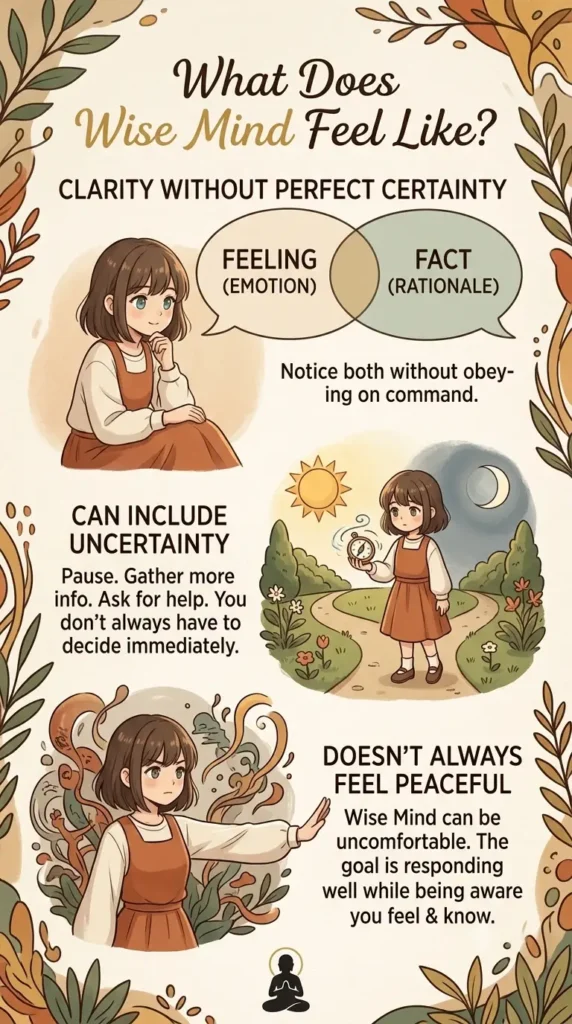
What Does Wise Mind Feel Like?
Wise Mind rarely shows up as a lightning-bolt moment of certainty. It feels more like a grounded kind of clarity. Anger can still be there. So can fear, sadness, or plain confusion. What shifts is the balance. Feeling and reasoning both get a seat at the table, and neither one shoves the other out the door.
Clarity Without Perfect Certainty
Wise Mind feels like seeing the situation more clearly. It doesn’t hand you the answer on a plate. You might notice, “I’m hurt, and I still need to respond thoughtfully.” Or something simpler: “I really want to quit, but I should look at what happens if I leave.”
That clarity comes from letting feeling and fact sit in the same room. You aren’t erasing the emotion before deciding anything. You’re giving it enough space to be noticed instead of obeyed on command.
Sound too simple? It is. That’s often why it works.
Wise Mind can also feel like alignment, a moment where what you feel, what you know, and what actually matters to you stop pulling in three directions. That overlap between emotion mind and rational mind is the whole point of the skill. If naming that overlap feels hard at first, an emotions worksheet can help separate the feeling from the fact before you even reach for Wise Mind.
Wise Mind Can Include Uncertainty
Being in Wise Mind doesn’t mean you suddenly become certain. Not even close.
Sometimes the most honest Wise Mind response is “I don’t have enough information yet.” You might stay torn between two choices for a while, especially when both come with real upsides and real costs.
Why does that matter? Because people sometimes treat Wise Mind like an answer machine you consult and obey. It isn’t one. Wise Mind can just as easily tell you to pause. Gather more information. Ask for help.
Wait before deciding anything at all. A printable Wise Mind worksheet can make that pause more concrete, giving you a place to write down what you know and what you’re still missing.
Wise Mind Doesn’t Always Feel Peaceful
Wise Mind and calm are not the same thing. You can be in Wise Mind and still feel nervous before setting a boundary. Angry mid-conversation. Sad while accepting that a relationship needs to change.
The goal was never a perfectly calm nervous system. Wise Mind is about responding well while staying aware of what you feel and what you know, both at once.
Here’s the part that trips people up. The Wise Mind choice is often uncomfortable precisely because it asks for something that matters, not something that hands you instant relief. That discomfort isn’t a sign you got it wrong.
Wise Mind Is Not the Same as “Trust Your Gut”
This isn’t about following your gut. Not exactly. Wise Mind in DBT means taking your emotions seriously, but it also means checking the facts, your values, and what actually happens next if you act.
Intuition plays a part. It has to. But a strong urge, a jolt of fear, or a sudden impulse can dress itself up as intuition when it’s really just emotion grabbing the wheel.
Emotion vs. Impulse vs. Intuition
These three get lumped together constantly. They’re not the same thing.
Emotion is the feeling itself. An impulse is the urge to act on it. Intuition is quieter. It’s a sense of knowing that shows up without you working through the logic step by step. They overlap sometimes. That doesn’t make them interchangeable.
Say you get a rude text. The anger you feel? That’s the emotion. The urge to fire back something worse? That’s the impulse. Intuition is different. It’s the softer signal underneath, the one telling you something about this relationship needs a real conversation.
That difference matters more than it looks like it does. Wise Mind doesn’t ask you to push the anger down. It also won’t let the impulse drive the car.
When Intuition Can Be Useful
Sometimes intuition earns its keep. It points your attention at something worth a second look before you can even explain why.
You’ve felt this before. A room feels off. A conversation feels wrong. You can’t name the reason yet, especially if you’ve been in a similar spot before and your brain quietly filed it away. That’s intuition doing its job.
The move here isn’t to obey it blindly. Treat it as a clue, not a verdict. Ask what’s underneath it. What facts are in play? What needs aren’t being met? What value is getting stepped on? If you’re working through your own patterns, an emotions worksheet can help you name what’s underneath before you decide what to do with it.
When a Strong Gut Feeling Needs a Fact Check
Not every gut feeling deserves the same trust. A strong one needs a fact check the moment you’re activated, scared, angry, or backed into a corner.
Here’s the practical part. Name the emotion out loud, even just to yourself. Then separate what you actually know from what you’re assuming is true. That gap is bigger than most people expect. This is one of the reasons Wise Mind sits at the center of most DBT skills worksheets, since so much of the work comes down to slowing that gap down long enough to see it.
Wise Mind ACCEPTS: Two Skills, One Confusing Name
People search “Wise Mind ACCEPTS” like it’s a single tool. It isn’t. Wise Mind and ACCEPTS come from different corners of DBT and do different jobs. Wise Mind lives in the mindfulness module.
It’s about blending emotion with reason. ACCEPTS sits in distress tolerance. It’s a short-term way to survive an emotion that’s too loud to think through right now.
Is Wise Mind ACCEPTS a DBT Skill?
No. That’s the short version. “Wise Mind ACCEPTS” isn’t one combined skill, no matter how often the two names show up side by side in a list.
Wise Mind asks you to pause. Step back from whatever’s happening and weigh both the feeling and the facts before you act. ACCEPTS doesn’t ask that much of you. It’s a distraction skill. A set of quick moves for when an emotion is too big to sit with directly, at least for now.
Why the confusion? Both skills get lumped into the same “DBT skills” roundups. Both get pulled out when someone’s overwhelmed. That’s where the overlap ends, though. One skill helps you think. The other helps you not think, briefly, on purpose.
What Is the DBT ACCEPTS Skill?
ACCEPTS is an acronym: Activities, Contributing, Comparisons, Emotions, Pushing Away, Thoughts, and Sensations. Seven categories. Each one gives you a way to redirect your attention when a feeling is too intense to sit with directly.
Watch a rerun you’ve seen ten times. Help a neighbor carry groceries. Think back to a different moment, one with a different feeling attached. Press an ice cube into your palm and notice nothing but that. These aren’t distractions in the dismissive sense. Nobody’s asking you to pretend the emotion isn’t real. The point is space. Enough room to get through the next twenty minutes without making things worse.
Want the full breakdown, with a worksheet you can actually use? See the complete DBT skills guide for exercises on ACCEPTS and the rest of the distress tolerance toolkit.
How Wise Mind and ACCEPTS Work Together
These two aren’t rivals. They just show up at different points in the same rough moment.
Say the emotion is too loud to reason with. That’s ACCEPTS territory. Use it first. Once the intensity drops, and it will, Wise Mind takes over. That’s the moment to ask what you actually want to do next, not just what the feeling is screaming at you to do.
Distraction buys the time. Wise Mind spends it.
If you’re working through emotional overwhelm more broadly, the emotions worksheet and coping skills worksheets pair well with both of these.
How to Access Wise Mind Step by Step
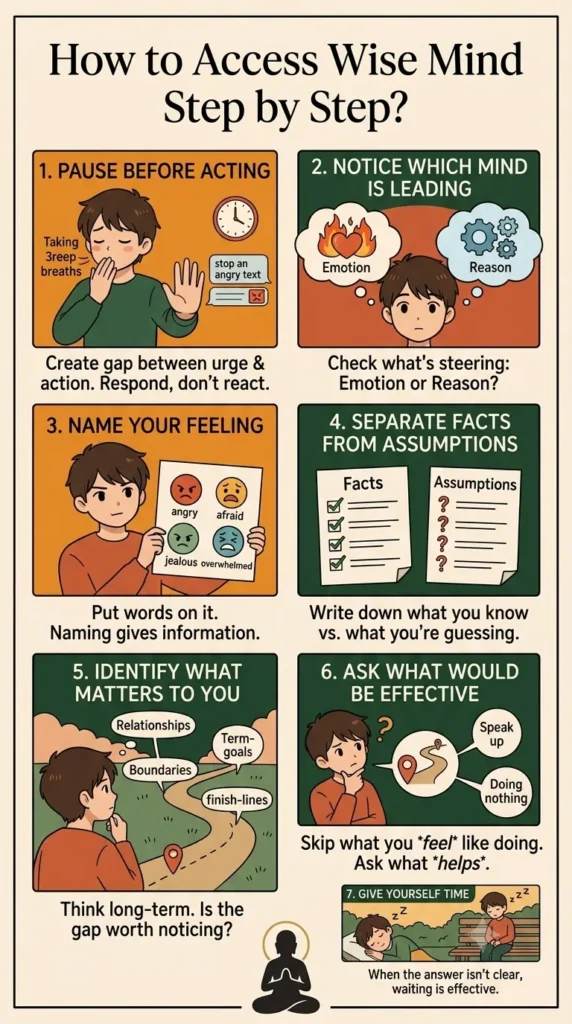
Finding wise mind dbt isn’t about hunting for total calm. It’s about slowing down long enough to hear the feelings and the facts before you move. This checklist gives you something to actually use in the moment. Pause, read the situation, then pick a response that works.
Pause before acting
Leave a gap between the urge and the action. Want to fire off an angry text? Quit on the spot? Decide something big while you’re upset? Stop first. Even three slow breaths buy enough room to respond instead of react.
Not sure how to build that pause? The DBT STOP skill walks through it step by step.
Notice which mind is leading
Ask yourself what’s steering right now. Emotion mind sounds like “I can’t take this anymore.” Reasonable mind sticks to bare numbers: “the data says this is the sensible choice.” Neither voice is wrong by default. The job here is just to notice which one has the wheel.
Name what you’re feeling
Put words on it before you decide anything. Angry, embarrassed, disappointed, afraid, relieved, jealous, overwhelmed. Naming it doesn’t mean obeying it. It just hands you better information about what’s actually going on inside.
Can’t pin down the feeling? That’s common. A feelings list makes it easier. The emotions worksheet is built for exactly this step.
Separate facts from assumptions
Write down what you know. Then write down what you’re guessing at. “They haven’t replied in six hours” is a fact. “They’re ignoring me because they’re mad” is a guess dressed up as one. Wise mind dbt needs both channels open, the emotional read and the accurate one. Don’t let a hunch quietly pass as truth.
Identify what matters to you
Think past the moment. What do you actually want long-term? Maybe it’s protecting a relationship. Maybe it’s holding a boundary. Maybe it’s finishing something you started or just treating yourself decently. A choice can feel good for ten minutes and still pull you away from what matters. That gap is worth noticing before you act.
Notice what your body is telling you
Your body talks even when your head won’t stop spinning. A tight jaw. A locked chest. Restless legs. A sinking gut. A wave of relief. Treat these as clues, not orders. Physical signals can come from emotion, stress, old habit, or real intuition, so they still need context around them.
Ask what would be effective
Skip “what do I feel like doing” for a second. Ask instead: what response actually helps here? Sometimes that’s speaking up. Sometimes it’s waiting. Sometimes it’s setting a boundary, gathering more information, or doing nothing at all for now.
This same effectiveness lens helps when you’re choosing how to cope in the moment. The coping skills worksheets build on this exact idea.
Give yourself time when the answer isn’t clear
Wise mind doesn’t always show up with a tidy answer ready to go.
6 Wise Mind Exercises You Can Practice
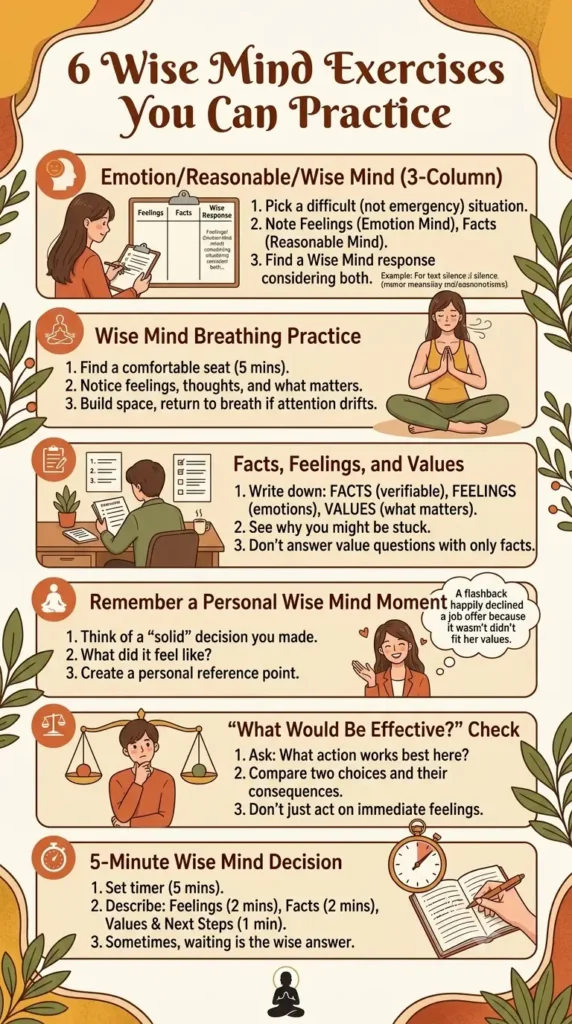
Wise Mind stops being an abstract label once you practice it outside a crisis. These wise mind exercises work as standalone practice. Try them on an ordinary Tuesday. That familiarity is what makes the skill usable later, when a real decision is on the table and nothing is calm.
Emotion Mind / Reasonable Mind / Wise Mind Three-Column Exercise
Pick a situation that still stings a little, but isn’t an emergency. Grab a page. Split it into three columns:
- Emotion Mind — What am I feeling or wanting to do?
- Reasonable Mind — What facts do I actually know?
- Wise Mind — What response considers both?
Say a friend has gone quiet on your texts.
Emotion Mind: “They’re ignoring me. I should message again and ask what their problem is.”
Reasonable Mind: “I don’t know why they haven’t replied yet. They could just be busy.”
Wise Mind: “I’m hurt, and I want an answer. But I don’t have enough information to assume the worst. I’ll give it some space and check in later.”
The Wise Mind column doesn’t need to sound calm or polished. That’s not the target. You’re practicing how to hold emotional information and factual information at the same time, without one shouting over the other.
The Wise Mind Breathing Practice
Set aside five minutes when you’re reasonably settled. Sit somewhere comfortable. Bring your attention to your breath. You don’t need to force your mind blank. That’s not how this works.
As you breathe, notice what you’re feeling. Don’t try to fix it yet. Then notice what your mind is saying underneath it. You might silently ask:
- “What am I feeling?”
- “What do I know?”
- “What matters to me right now?”
Let the answers arrive on their own. Don’t act on them immediately. If your attention drifts, come back to the breath and start again.
This isn’t about landing an instant Wise Mind answer. It’s about building enough space to notice a thought, a feeling, or an urge without following it automatically. Small gap. Big difference.
Facts, Feelings, and Values
Pick a decision you’ve been avoiding. Write down three things:
- Facts: What can you actually verify?
- Feelings: What emotions, urges, fears, or hopes show up?
- Values: What matters to you here?
Say you’re weighing whether to end a friendship. The facts might include repeated arguments and missed plans. The feelings might stack up fast: anger, sadness, guilt, even relief. The values underneath might be honesty, self-respect, and kindness.
Putting these three side by side can explain why a decision feels stuck. Sometimes the problem isn’t that you don’t know what you want. You’re answering a values question with facts alone. Or a practical question with emotion alone. Neither one gets you there by itself.
Remember a Time You Used Wise Mind
Think back to a moment that felt solid afterward. Not a huge life choice. Just a decision that held up.
Maybe you apologized after a fight instead of firing off an angry text. Maybe you turned down something impressive-looking because it didn’t fit what you actually wanted.
Write down what happened. What you felt. What facts you weighed. What tipped your response one way. Then ask yourself: what did Wise Mind actually look like, in that specific moment?
This gives you a personal reference point. Wise Mind can stay a vague DBT term until you tie it to something you’ve lived through yourself.
The “What Would Be Effective?” Check
Stuck between what you want to do and what you think you should do? Ask one question:
“What action is most likely to work here?”
That question pulls your attention off winning the argument, proving a point, or grabbing quick relief. It doesn’t mean your feelings stop mattering. They’re still part of the information. They just aren’t the only input anymore.
Try this: write two possible responses. List the likely consequences of each. Then check which one fits your values and actually moves things forward, not just which one feels satisfying right now.
The 5-Minute Wise Mind Decision Practice
Pick something small, not something life-changing. Set a five-minute timer. Write without stopping.
For the first couple of minutes, describe what you’re feeling. Then switch to the facts you know. Spend the rest of the time on what matters to you and what an effective next step might look like.
The point isn’t to force a decision before the timer runs out. Sometimes Wise Mind tells you to wait. To gather more information. To circle back later. That’s still an answer.
You can turn this into a regular habit alongside these mindfulness journal prompts or these five-minute journal prompts, especially on days when you’re not sure which DBT skill to reach for.
If naming the feeling itself is the hard part before you even start, an emotions worksheet can help you get specific first. And if Wise Mind is one skill among several you’re working through, the full DBT skills worksheets library covers the other modules too.
Wise Mind Worksheet and PDF
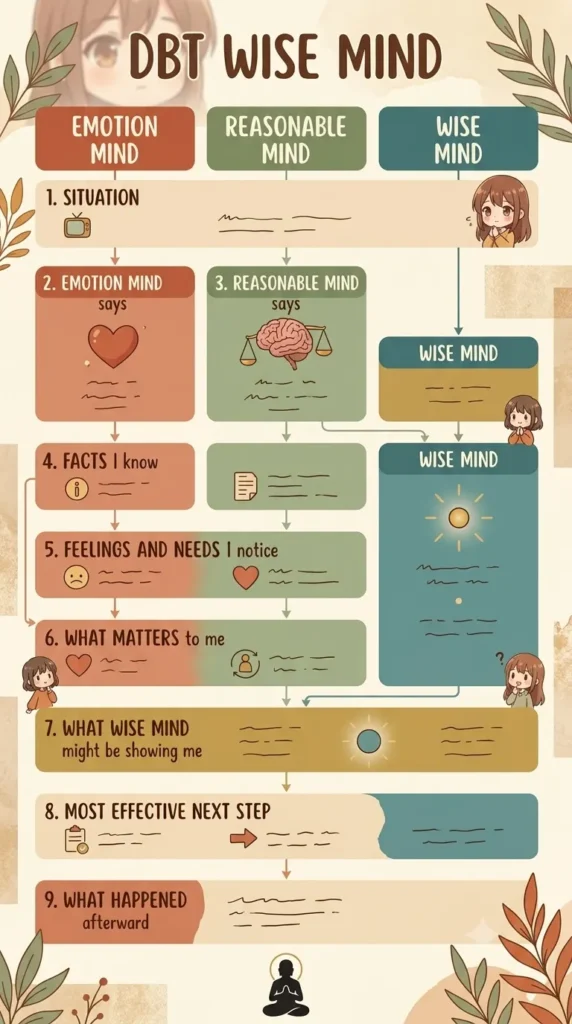
This isn’t about picking emotion or logic. A wise mind worksheet gives you a structured way to slow down a hard decision instead. Rather than telling yourself to “just be rational,” you write what each part of your mind says. Then you compare the two. No guessing required.
The worksheet moves through nine short prompts, one after another:
Situation → Emotion Mind says → Reasonable Mind says → Facts I know → Feelings and needs I notice → What matters to me → What Wise Mind might be showing me → Most effective next step → What happened afterward
Nothing hidden in that sequence. You name the situation first. Then you let Emotion Mind and Reasonable Mind each say their piece, on paper, before Wise Mind gets a turn. That order matters. Skip straight to “what should I do,” and you never really hear either side out first.
For more structured tools like this one, the full DBT skills worksheets library covers every module, not just mindfulness.
Use it wherever a decision feels loaded. Conflict. Uncertainty. A strong emotion that won’t sit still. A choice you know matters. It also works well as a review tool. Go back through old entries later. Patterns show up that a single entry never reveals, things like your usual emotional urges, the thinking traps you fall into, and which responses actually worked.
This wise mind dbt worksheet is free to download and reusable for as many situations as you need. A simplified version of the same prompts can work for kids too, with shorter, more concrete questions in place of the full nine-step flow.
Download the Wise Mind Worksheet PDF
Wise Mind Examples in Real-Life Situations
Wise Mind clicks once you see it in real moments. An angry text. A friendship that stings. A job you want to quit. A fear telling you to back out. The goal isn’t silencing Emotion Mind. It isn’t obeying Reasonable Mind either. Wise Mind means hearing both, then choosing what actually works.
When You Want to Send an Angry Text
Emotion Mind: “They disrespected me. Send the message now and make them understand how angry you are.”
Reasonable Mind: “Wait. Sending an angry message could make things worse. Say nothing.”
Wise Mind: “I’m genuinely hurt and angry, and that matters. I also don’t want to send something I’ll regret. I’ll wait until I’m calmer, then decide whether a direct conversation or a measured message works better.”
Wise Mind doesn’t ask you to pretend you’re fine. It gives the anger a seat at the table. It just doesn’t hand it your phone.
When a Friend Hurts Your Feelings
Emotion Mind: “If they really cared about me, they wouldn’t have done that. I’m done with them.”
Reasonable Mind: “There may be another explanation. One incident doesn’t prove they don’t value the friendship.”
Wise Mind: “What happened hurt me, and I need to understand it before deciding what to do. I’ll talk to them and pay attention to how they respond.”
One bad moment isn’t the whole story. It’s also not nothing. That’s the tension Wise Mind sits inside.
When You Want to Quit Your Job or Course
Emotion Mind: “I hate this. I can’t take another day.”
Reasonable Mind: “Quitting immediately could create financial or academic problems.”
Wise Mind: “Something about this situation isn’t working for me. Before I quit, I’ll identify what needs to change, check my options, and decide what supports my longer-term goals.”
Burnout talks fast and loud. Wise Mind asks one more question before you act on it.
When Fear Is Telling You to Avoid Something
Emotion Mind: “This is terrifying. Don’t go. You’ll embarrass yourself.”
Reasonable Mind: “There is no evidence that something terrible will happen.”
Wise Mind: “I’m scared, but fear doesn’t automatically mean I should avoid this. I’ll take the smallest reasonable step and see what happens.”
Fear isn’t proof. It’s just loud. Wise Mind still lets you move.
When Logic Says “Stay” but Your Values Say Something Else
Emotion Mind: “Leave now. I can’t stand this anymore.”
Reasonable Mind: “Staying is financially safer and more convenient.”
Wise Mind: “Those practical concerns matter, but so do my values and the kind of life I want. I’ll consider both before choosing what I can live with long-term.”
Safe isn’t always right. Convenient isn’t always sustainable. Wise Mind weighs both against what you can actually live with.
If these scenarios feel familiar, a DBT wise mind worksheet can help you slow down and run through this same three-column exercise with your own situations. Pairing it with an emotions worksheet makes it easier to name what Emotion Mind is actually feeling before you try to balance it out.
And on the harder days, a set of coping skills worksheets gives you something concrete to lean on while you find your Wise Mind. For a clinical breakdown of the three states of mind, Therapist Aid’s Wise Mind worksheet is a solid reference point.
How Do You Know If a Decision Came From Wise Mind?
Wise Mind decisions weigh four things. What you feel. What you know. What your body says. What actually works.
Comfort isn’t the test. Wise Mind can point you toward a choice you’d rather dodge. That’s exactly why reflection matters more than a gut check.
Reflection Checklist
No test can prove a decision came from Wise Mind. Not a scan. Not a quiz. Nothing clinical exists for this. So treat the questions below as a mirror, not a scorecard.
The Manhattan Center for Cognitive Behavioral Therapy recommends something similar: check whether you were aware of the facts, your feelings and needs, your body’s signals, and what would actually be effective.
Ask yourself these six questions.
- Did I consider the facts? What you actually know, not what you fear or assume.
- Did I acknowledge my feelings? Room for anger, sadness, fear, or excitement, without letting any one of them drive. An emotions worksheet can help if naming the feeling itself is the hard part.
- Did I notice my body? Tension, restlessness, heaviness, calm. The signals are there if you check.
- Did I consider what matters to me? Whether the decision fits your values and your longer-term priorities, not just today’s mood.
- Did I focus on effectiveness? Choosing what actually helps, not what gives the fastest relief.
- Am I willing to reconsider? Whether new information can change your mind without that counting as failure.
Keep that last question close. Wise Mind isn’t stubborn certainty. A decision can be thoughtful and still need revision once new facts show up.
Working through all six at once can feel like a lot to hold in your head. A DBT skills worksheet gives the checklist somewhere to live outside your thoughts, which makes it easier to spot the pattern over time instead of guessing in the moment.
Circumstances change. Being willing to reconsider is part of staying responsive to reality rather than becoming attached to the first answer that felt right.
A Few Words on Wise Mind
People search for wise mind DBT quotes for one reason. A short phrase can hold an idea that normally takes a whole session to unpack. That’s the appeal.
Marsha Linehan’s DBT materials keep circling back to the same core. Wisdom is already inside you. It takes more than pure logic. And reaching it takes practice, not talent.
A few of her core ideas, put here in plain words rather than exact wording:
Everyone carries the capacity for wise mind, even on days it feels completely out of reach. DBT treats this as built-in, not something only calm, together people get to have. That distinction matters more than it sounds like it should.
Wise mind blends practical judgment with gut-level knowing. It’s not just facts. It’s not just feelings either. It’s the overlap, where both are talking and you’re actually listening to both.
Here’s the part worth sitting with longer than the rest. Wise mind isn’t manufactured. You don’t force it into existence through effort alone. You learn to access what’s already there, the same way you’d learn to hear a quiet sound in a loud room.
So picture the moment it usually gets tested. A heated argument. A scary decision with a deadline attached. That instant where your chest tightens and your first response is already halfway out of your mouth. If wise mind doesn’t show up right then, that doesn’t mean you failed the skill.
DBT treats wise mind as a place you return to, not a switch you flip once and keep forever. Some days it’s a five-second pause before you speak. Other days it’s barely a flicker. Both count.
Practicing it through tools like a DBT skills worksheet or a few minutes of mindfulness journaling builds the muscle for the moments you can’t plan for. already available within you; mindfulness practice is partly about becoming better at accessing it when emotion or rigid reasoning gets in the way.
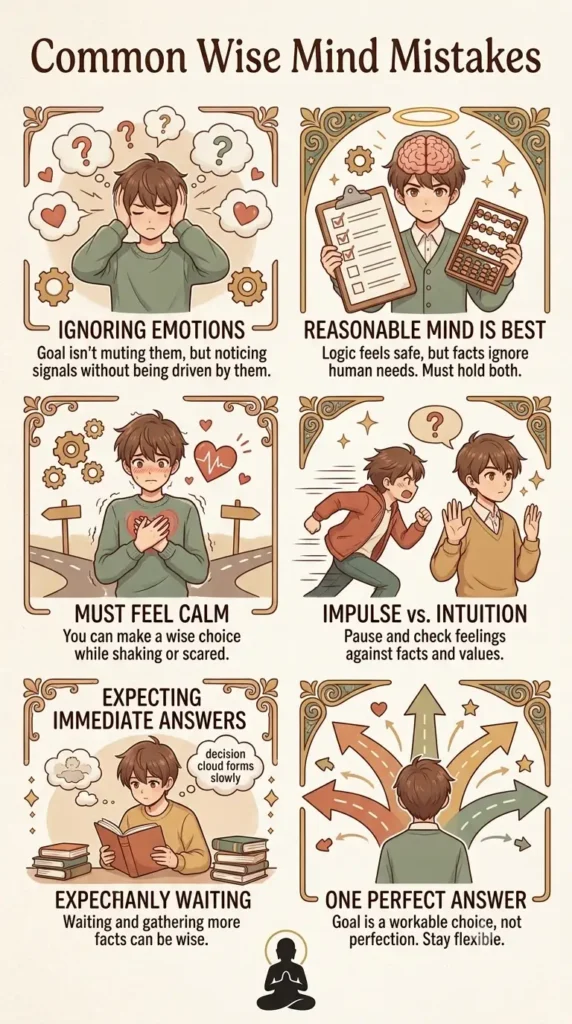
Common Wise Mind Mistakes
Wise Mind sounds simple. Then a real argument starts, or a hard choice lands in your lap, and the theory falls apart fast. Most people get DBT Wise Mind wrong in the same handful of ways. None of them are about suppressing feelings. None of them are about obeying logic either. And none of them promise a perfect answer, every time.
Thinking Wise Mind Means Ignoring Emotions
Wise Mind isn’t about shutting emotions out so you can “think clearly.” That’s a myth. Your emotions carry information. They tell you what matters, what hurts, what you actually need.
The goal isn’t to mute the signal. It’s to notice it without letting it drive the car. Anger, for instance, often means a boundary got crossed. That’s useful. Wise Mind is what helps you decide what to actually do with it. For a deeper look at reading your own emotional signals, this emotions worksheet breaks the process down step by step.
Treating Reasonable Mind as Always Better
Logic feels safer than emotion. Especially when the feeling is intense. That doesn’t make Reasonable Mind the better answer.
Facts alone miss things. You can have solid reasons to stay in a friendship and still feel hurt every time you talk. Wise Mind doesn’t ask you to pick facts over feelings. It asks you to hold both at once.
According to Dialectical Behavior Therapy’s guide on Wise Mind, this balance between the emotional and reasonable minds is the entire point of the skill, not a side effect of it.
Assuming Wise Mind Must Feel Calm
Calm isn’t the test. You can access Wise Mind while your hands are shaking. While you’re furious. While you’re scared out of your mind.
Sometimes the wise choice gets made with your heart still pounding. What matters isn’t how steady you feel. It’s whether you can name what’s happening, weigh the facts in front of you, and pick a response that actually works instead of just reacting on impulse.
Confusing Impulse With Intuition
A strong gut feeling isn’t automatically Wise Mind. Not even close. Impulses show up fast and feel completely convincing, especially when fear or anger or excitement is running the show.
Wise Mind gives you a beat to pause first. Check the feeling against the facts. Check it against your values. Ask what actually happens if you act on it right now. That pause is the whole difference between a reaction and a choice.
Expecting an Immediate Answer
Wise Mind doesn’t hand you instant clarity. Some situations don’t come with enough information yet. Sometimes you’re too worked up to think straight, let alone decide anything.
Waiting can be the wise move. Take a break. Gather more facts. Come back to the decision once your head and your gut aren’t fighting each other. Sound too passive to count as a skill? It isn’t. Knowing when not to decide is still a decision.
Thinking Every Decision Has One Perfect Wise Mind Answer
Here’s an honest take: Wise Mind was never built to spit out one flawless answer. Two choices can both carry real upside and real cost. That’s not a flaw in the method. That’s just life.
The goal was never perfection. It’s making the most workable choice you can, given the facts, the feelings, the values, and the circumstances sitting in front of you right now, while staying open to changing course if something shifts. Pairing this practice with broader DBT skills worksheets or a set of coping skills worksheets can make that flexibility easier to build day to day.
DBT Wise Mind for Kids and Teens
Wise Mind works for kids too, once you drop the DBT language. No jargon needed. The whole idea comes down to three moves: notice the feeling, check the facts, then pick a response that actually fits the moment.
A Simple Way to Explain Wise Mind to a Child
Think of it as two voices in one kid’s head. One voice runs on feelings. The other one looks at what’s actually happening. Wise mind for kids just means letting both voices talk before anything gets decided.
Picture a birthday party invite that never showed up. Emotion Mind jumps straight to “They hate me.” Reasonable Mind shrugs and says “I don’t know why I wasn’t invited.”
Neither one has the full picture on its own. Wise Mind holds both, then asks a simple question instead of storming off or writing the friendship off completely. That’s the whole shift.
Wise Mind Examples for School and Friendships
School hands kids plenty of practice. A bad grade. A friend who cancels plans. A teacher’s correction that stings more than it should.
Take a teenager staring at a disappointing test score. “I’m just bad at this” is the easy thought. It’s also the wrong one to act on. Wise Mind lets the disappointment sit there while also asking what actually went wrong, and what to try differently next time. Emotion mind dbt work isn’t about shutting feelings down. It’s about not letting them steer the whole car.
Friendships run on the same track. A feeling shows up, gets noticed, then gets checked against what’s true. It doesn’t get the final vote.
A Simple Wise Mind Activity for Kids
Worksheets make this concrete for a kid who can’t yet name what’s happening internally. A three-box format works well because it mirrors the three-part idea without ever using the words “dialectical” or “synthesis.”
Try this wise mind worksheet layout:
- My Feelings — What am I feeling right now?
- The Facts — What do I know for sure?
- My Wise Choice — What response would actually help here?

Stick to situations a kid already knows. Losing a board game. An argument with a sibling over the remote. Getting corrected in front of the class. Younger kids can draw their answers instead of writing them out, and that works just as well.
Looking for more wise mind exercises and other DBT tools built for this age group? The DBT skills worksheets pillar page rounds up printable options for emotion regulation, distress tolerance, and mindfulness, alongside a free wise mind worksheet from Therapist Aid if you want a ready-made version to start with today.
Conclusion
Wise Mind isn’t about choosing feelings over logic, or logic over feelings. It is about making room for both and deciding what is most effective for the situation in front of you.
With practice, you can become better at noticing when Emotion Mind or Reasonable Mind is taking over, pausing before reacting, and checking what matters to you.
A DBT Wise Mind worksheet can make that process easier to practice on paper, especially when a situation feels too messy to sort out in your head. Start with one small decision today. Pause, notice, reflect, and give yourself enough space to choose your next step deliberately.
Frequently Asked Questions
What is Wise Mind in DBT?
Wise Mind is a DBT state of mind that integrates emotional experience with reasonable thinking so you can respond effectively. It does not mean suppressing feelings or ignoring facts. Instead, you notice both and use a deeper sense of understanding to decide what action fits the situation.
What is the difference between Wise Mind, Emotion Mind, and Reasonable Mind?
Emotion Mind is strongly influenced by current feelings and urges, while Reasonable Mind focuses on facts, logic, and analysis. Wise Mind brings these ways of knowing together without automatically obeying either one. It also includes intuitive understanding, which DBT describes as a form of direct knowing.
What should you do if you cannot access your Wise Mind?
You do not need to force an answer. Pause, slow your breathing, observe what is happening internally, and give yourself time if the situation allows it.
DBT materials emphasize that accessing Wise Mind can take practice; difficulty finding it in one moment does not mean you do not have it.
Is “Wise Mind ACCEPTS” a real DBT skill?
“Wise Mind ACCEPTS” is not a separate DBT skill that combines Wise Mind with ACCEPTS. Wise Mind is part of DBT mindfulness, while ACCEPTS is a distress-tolerance skill involving distraction strategies. They can both appear in DBT skills materials, but they serve different purposes and should not be treated as one technique.
Can children and teenagers use the Wise Mind DBT skill?
Yes. The basic idea can be simplified for younger people without losing its meaning. A child might ask, “What are my feelings telling me, what are the facts, and what would be a wise choice?” Simple examples involving friendships, school, frustration, and family conflict can make the skill easier to understand and practice.
What are some well-known Wise Mind quotes from Marsha Linehan?
Marsha Linehan’s DBT Skills Training Manual describes Wise Mind as the part of a person that can “know and experience truth” and says that “wise mind is free of conflict.” The manual also compares Wise Mind with intuition and explains that finding it consistently can require practice.

It’s Bhaskar!
Well, I am not a psychologist a monk, or a philosopher by training. I’m just an engineering graduate.
‘The Empty Self’ is where I write about that idea, and what it actually means for ordinary life, anxiety, identity, habits, the stories we tell ourselves about who we are. I don’t have a psychology degree, and I’m not offering therapy or clinical advice. What I do have is thought and clarity, and genuine curiosity about why we suffer the way we do and how much of it might loose once we shed this ‘fixed identity’.
Pingback: DBT Distress Tolerance Skills: Complete Guide With Printables and Worksheets | The Empty Self
Pingback: DBT Mindfulness Skills: Module Guide With Free Printables and Worksheets | The Empty Self
Pingback: DBT Skills Cheat Sheet: All You Need to Know With Free Printables | The Empty Self