

Your inner voice doesn’t get kinder just because you told it to. Not once. Not after ten pep talks in the mirror either. That’s where affirmation journal prompts actually earn their place.
If you’ve already worked through our guide to mindfulness journaling, think of this as round two. Mindfulness prompts teach you to notice. Affirmation prompts teach you to build. One watches your thoughts without judging them. The other shapes the ones worth keeping around.
Used often enough, affirmation journaling can strengthen self-awareness, confidence, and how well you bounce back from a rough week. This isn’t just a wellness trend either. Social psychologist Claude Steele first proposed Self-Affirmation Theory back in 1988, and the idea still holds up. Reflecting on values that actually matter to you can help you respond to setbacks without going straight into defense mode.
This guide brings together 50+ affirmation prompts built specifically for Gen Z adults. Social comparison. Career uncertainty. Burnout that won’t quit. Or just the plain habit of trading harsh self-criticism for something more useful. It’s all in here.
One honest note before diving in. Affirmation journal prompts are a self-reflection tool. Not a therapist. Not a substitute for professional mental health support. Think of them as daily reps for building better thought patterns, not a fix-all for everything that’s weighing on you. If anxiety or burnout is the real thing underneath the self-talk, our piece on gratitude journaling for anxiety is worth pairing with this practice.

Table of Contents
Disclaimer
This blog is written and edited with the help of AI, then reviewed by me before publishing. As a result, the content is for general reflection only, not therapy or medical advice, and I’m not a licensed mental health professional. If you’re in crisis, please contact 988 if you’re in US or a local crisis service of your country instead of relying on this site.
What Are Affirmation Journal Prompts?
Affirmation journal prompts are guided questions that turn a positive belief into personal proof. They don’t ask you to repeat a line you don’t buy yet. They ask you to dig through your own life and find where that line already happened once. If mindfulness journal prompts teach you to notice a thought without judging it, affirmation prompts do something different. They rewrite the story running in your head, one honest entry at a time.
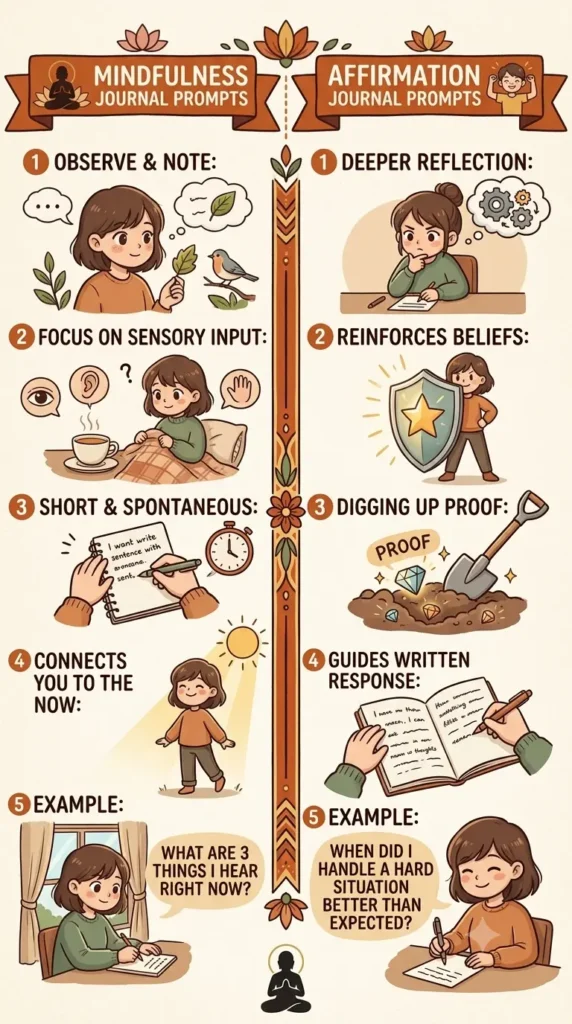
Difference Between Affirmations and Journal Prompts
People swap these two terms constantly. They shouldn’t. An affirmation is the message. A journal prompt is the question that gets you to actually believe it.
| Affirmations | Affirmation Journal Prompts |
|---|---|
| Positive statements you repeat. | Guided questions you respond to in writing. |
| Focus on reinforcing a belief. | Focus on digging up proof for that belief. |
| Usually one sentence long. | Pulls you into deeper reflection. |
| Can feel fake if repeated without reflection. | Makes affirmations feel more real and personal. |
| Example: “I am capable of handling challenges.” | Example: “When did I handle a hard situation better than expected?” |
Why does this split matter? Because your brain trusts a believable story more than forced optimism. Saying “I’m confident” on repeat, while ignoring every time you actually showed up confident, creates friction instead of belief. Writing about the presentation you survived, the boundary you finally held, or the hard conversation you got through anyway, gives that affirmation a place to stand.
Some of this is backed by Self-Affirmation Theory, first outlined by psychologist Claude M. Steele in 1988. The theory argues that reflecting on values you actually care about helps you respond to hard moments with less defensiveness and more steadiness. Not a hack. Just how the mind seems to work.
Why Combining Them Creates Better Self-Talk
Affirmations tell you what you want to believe. Journal prompts show you why that belief was already partly true.
That gap matters. Positive self-talk was never about pretending everything’s fine. It’s about collecting proof that pushes back against your inner critic. This combo tends to stick better in practice, mostly because you’re not trying to talk yourself into something with empty words. You’re just reminding yourself what already happened.
Take an example. Instead of writing “I deserve success” ten times in a row, try answering this: “What win have I been brushing off lately?” By the last line, the affirmation carries more weight. It’s tied to something real now, not floating.
Think of affirmation journal prompts as the bridge between wishful thinking and actual self-belief. They don’t ask you to ignore your doubts. Not even close. They ask you to check whether your doubts missed something. That’s usually where steadier self-talk begins.
Want the reverse version of this practice, one built entirely around thankfulness instead of confidence? Grateful affirmations walks through exactly that. And if you’d rather start from scratch with a simple daily habit, how to practice gratitude breaks the whole process into steps small enough to actually keep. Stuck for material some nights? A running gratitude worksheet or a plain list of things to be thankful for hands you a starting point without the blank-page pressure.
Benefits of Using Affirmation Journal Prompts Every Day
Affirmation journal prompts don’t work by making every thought positive. That’s not the mechanism. They work because they push you to question the automatic negative stories running in your head, and swap them for something more balanced.
Pair an affirmation with actual written reflection and something shifts. You’re not pretending your week went great. You’re training your attention to notice the evidence your inner critic conveniently skips. Small shift. But weeks of showing up like that can change how you respond the next time something goes sideways.
Some of this lines up with what expressive writing research from the APA has found about journaling and wellbeing, work built largely on psychologist James Pennebaker’s studies. Writing regularly, even briefly, tends to support how people process stress.
Reduce Negative Self-Talk
Negative self-talk sounds convincing for one reason. You’ve heard it a thousand times already.
Writing slows that voice down long enough to actually look at it.
Instead of accepting a thought like “I’m always behind” or “I’m not good enough,” an affirmation journal prompt asks you to check the evidence. Pair the affirmation “I am learning at my own pace” with a prompt like “What have I handled better this month than I could six months ago?” and your focus moves. Away from assumption. Toward what actually happened.
Here’s where most people notice the real change. Not that the negative thoughts vanish. They just stop sounding like fact.
Build Self-Confidence
Confidence rarely shows up before you act. It builds after, once you’ve stacked up enough proof that you can handle hard things.
Affirmation journaling gives those small wins somewhere to live, the ones you’d otherwise forget by dinner. Maybe you spoke up in a seminar. Sent an application while your stomach was in knots. Finally told someone where your boundary sits. Writing it down reinforces the identity you’re building. You stop waiting to “feel confident enough” first.
Feels too small to count? It isn’t. For Gen Z adults juggling school, work, and a feed that never stops comparing you to someone else, that habit builds a steadier kind of confidence, one that doesn’t depend on someone else’s approval.
Improve Emotional Awareness
Emotional awareness means recognising, naming, and understanding your emotions instead of just reacting to them on autopilot.
That’s the whole reason effective affirmation journaling includes reflection, not just repeating a line back to yourself. Say today’s affirmation is “My feelings deserve attention.” The prompt that pairs with it might ask, “What emotion have I been avoiding this week?”
One question. But it opens a gap between the feeling and how you respond to it. Over time you start spotting patterns. What drains you. What actually restores you. Which situations tend to wake up your inner critic. Those insights are what make tomorrow’s affirmation feel earned instead of borrowed.
If mindfulness feels like the missing half of this practice, mindfulness journal prompts walks through how observing your thoughts without judgment strengthens exactly this kind of awareness.
Support Mindfulness Habits
Mindfulness journal prompts teach you to watch your thoughts without judging them. Affirmation prompts teach you what you’d rather those thoughts become. Different jobs. They complement each other well.
Mindfulness builds awareness. Affirmation journaling adds direction on top of it. Together, they help you catch the unhelpful pattern and gently practise a different story instead, one line at a time.
Building a rotation of both? Grateful affirmations is worth folding in here too. It leans on gratitude specifically, but the same reflection-first approach carries over.
How to Use Affirmation Journal Prompts Effectively
Affirmation journal prompts work best as a quiet daily habit, not another task stacked on your to-do list. The goal isn’t forcing constant positivity. Not even close. It’s noticing your thoughts, questioning the ones that don’t serve you, and slowly building a steadier inner voice through regular writing. If you’d rather sit with what’s happening right now instead of shaping self-talk, mindfulness journal prompts cover that side of the practice.
Choose One Prompt Daily
Skip the habit of collecting dozens of prompts. Most people do this, then rarely sit with a single one long enough to learn anything from it. You don’t need a fresh affirmation every morning. You need one question that gives your mind somewhere real to go.
Match the prompt to what you’re actually feeling. Uncertain about the future? Write with a confidence prompt. Comparing yourself to strangers online? Reach for a self-worth prompt instead.
One thoughtful answer beats three unfocused pages. Every time.
Showing up daily matters more than how deep you go. A five-minute practice, done consistently, builds more self-awareness than an occasional two-hour journaling binge.
Write Evidence, Not Perfection
Affirmations were never about pretending everything’s fine. A line like “I am successful” can feel hollow when you’re actually struggling. Nothing wrong with that reaction. It just means the affirmation needs a base to stand on.
Try grounding the statement in something real instead.
Skip this:
“I never fail.”
Try this instead:
“I am learning to trust myself because I have handled hard situations before.”
That single shift, evidence over fantasy, changes how believable the sentence feels once you read it back. Self-affirmation theory, first developed by psychologist Claude Steele in 1988, suggests people cope better with setbacks when they can point to values and strengths that already matter to them. Not invented ones. Real ones. If self-worth keeps circling back as the thing you’re actually writing about, gratitude journaling for anxiety tackles that same territory from a slightly different angle.
Repeat Your Affirmation Afterwards
Writing pulls your thoughts into the open. Repeating the line afterward is what makes it stick.
Treat the affirmation like a reminder, not an order. It should feel believable enough that your mind doesn’t immediately argue back.
Once you’ve answered the prompt, read the affirmation slowly. Then ask yourself one thing: what action today would actually support this belief?
That small link between the words on the page and what you do next is what makes the whole practice worth repeating. Pairing an affirmation with something you’re thankful for tends to make it land harder too, something grateful affirmations walks through in more depth.
Track Small Wins
Your journal shouldn’t only log what needs fixing. It should catch what’s already shifting, even in small ways.
Write these moments down:
- You spoke up in a meeting.
- You rested without guilt.
- You finished something you’d been avoiding.
- You handled a hard conversation better than last time.
Tracking wins like these builds awareness of progress that’s easy to miss when your attention stays fixed on the big goal at the end. Struggling to spot them? A structured gratitude worksheet or a running list of things to be thankful for can prompt you toward the wins your mind glosses over on its own.
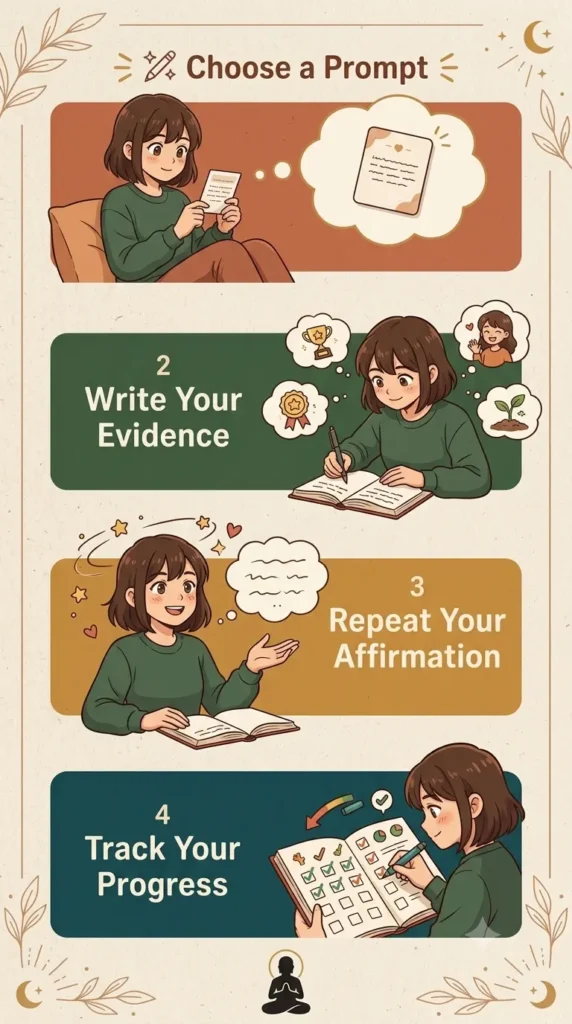
50+ Affirmation Journal Prompts for Every Area of Life
Affirmation journal prompts work best when they meet you where you actually stand. Not where you think you should be by now.
These prompts build self-trust. They challenge the thoughts that don’t serve you. Slowly, they replace automatic self-criticism with something steadier.
You don’t need pages every day. A few honest sentences do the job. The goal was never forced positivity or pretending everything’s fine. It’s noticing your inner dialogue and nudging it toward balance.
Pick a category that matches what you’re carrying right now. Write the affirmation first. Then answer the reflection question honestly. Some days your answer will feel confident. Other days it’ll just show you what still needs attention. If you’d rather sit with the present moment than rework your self-talk, mindfulness journal prompts covers that other half of the practice.
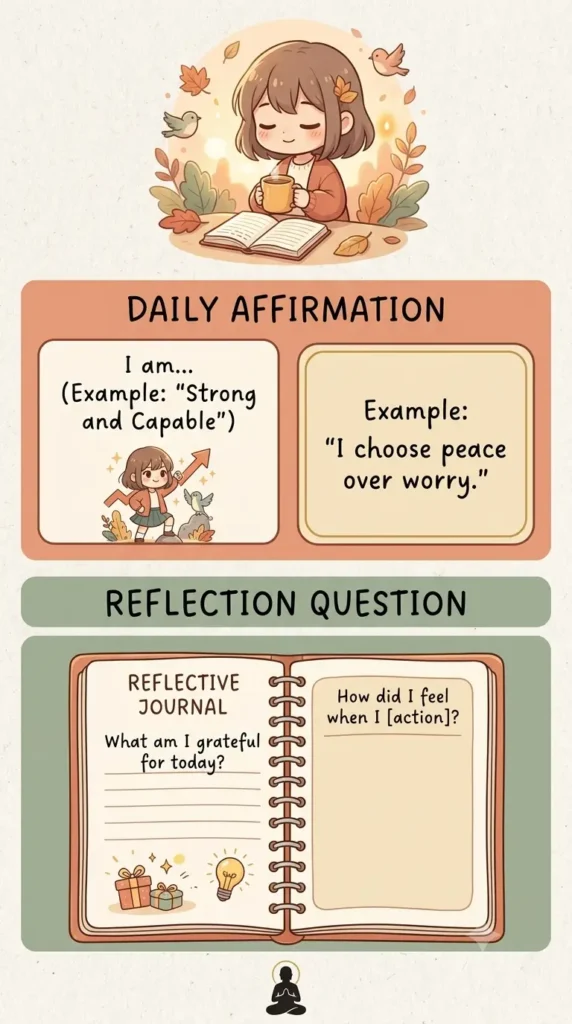
Self-Love Affirmation Journal Prompts
Self-love journaling isn’t about convincing yourself everything about you is perfect. It’s about building a kinder relationship with yourself. Especially on the days your inner critic gets loud.
These prompts pull you away from constant comparison. They open space for acceptance instead.
- I am learning to appreciate myself beyond my achievements. What qualities do I value about myself that have nothing to do with success, productivity, or approval?
- I deserve the same kindness I offer to others. How would I speak to myself differently if I treated myself like a close friend?
- My worth does not depend on how others see me. When have I felt confident without needing external validation?
- I am allowed to grow at my own pace. Where am I putting unnecessary pressure on myself?
- I accept myself while continuing to improve. What part of myself am I trying to “fix” instead of understand?
If this category resonates, the broader collection of grateful affirmations pairs self-worth with gratitude in a way that tends to stick.
Confidence Affirmation Journal Prompts
Confidence gets treated like a trait you’re born with. You either have it or you don’t.
That’s not how it works. Confidence grows through evidence. Moments where you show up, try again, and actually notice your own progress.
Try these when self-doubt starts running the show.
- I trust myself to handle challenges. What difficult situation have I already managed better than I expected?
- My opinions and ideas deserve space. When do I hold back from expressing myself, and why?
- I can learn skills instead of waiting to feel ready. What is one thing I can practise instead of avoiding?
- I am becoming someone I can rely on. What promise to myself can I keep this week?
- I recognise my progress, even when it feels slow. What is something I do today that past me would be proud of?
Anxiety & Overthinking Affirmation Journal Prompts
Affirmation journal prompts can’t make anxious thoughts vanish. That’s not the goal.
A better goal: learning to respond to those thoughts instead of automatically believing every fear that shows up.
Psychologist James Pennebaker’s research on expressive writing has looked at how putting thoughts and feelings into words helps people process what they’re carrying and organise the mess inside their heads. Writing doesn’t erase the anxiety. It just gives it somewhere to land besides your chest.
If your mind loops on the same worry most nights, gratitude journaling for anxiety walks through a version of this practice built specifically for that spiral. And if the anxiety is more about staying present than reframing thoughts, mindfulness and gratitude breaks down that connection too.
Try these when your mind feels stuck in a loop:
- I can handle uncertainty one moment at a time. What uncertainty am I trying to control right now?
- My thoughts are experiences, not always facts. Which thought has been repeating lately, and what evidence supports or challenges it?
- I am safe to slow down and breathe. What does my body need from me today?
- I don’t need to solve everything immediately. What problem can wait until I have more information?
- I can choose a calmer response. How would I respond if I approached this situation with patience?
Career & Study Affirmation Journal Prompts
Career pressure looks different for Gen Z. Some people are questioning their first job. Others are switching lanes entirely, building a side project at midnight, or measuring their progress against strangers online.
These prompts shift the focus from comparison to actual growth.
- I am building my future through small consistent actions. What small step can I take today toward my goals?
- My current situation does not define my entire future. What possibilities am I ignoring because I feel behind?
- I am capable of learning what I need. What skill would I like to develop next?
- My path does not need to look like everyone else’s. Whose timeline am I comparing myself to?
- I can be ambitious without burning myself out. What does a healthier version of success look like for me?
Relationships & Boundaries Affirmation Journal Prompts
Healthy relationships need more than connection. They need you to know what you require, say it clearly, and understand where your responsibility actually ends.
These prompts help when you’re learning to balance closeness with limits.
- My needs deserve to be acknowledged. What need have I been avoiding communicating?
- I can care about people without abandoning myself. Where do I give more than I receive?
- I am allowed to set respectful boundaries. Which boundary would improve my peace right now?
- The right relationships allow me to be myself. Around whom do I feel most authentic?
- I can release relationships that no longer support my growth. What connection am I holding onto out of fear?
Gratitude Affirmation Journal Prompts
Gratitude journaling isn’t about ignoring problems. It’s not about forcing a silver lining onto everything either.
It’s about training your attention to notice what’s also there. Support. Progress. Small joys that usually fade into the background before you clock them.
For more specific starting points than the usual “family, friends, health” answers, a full list of things to be thankful for and a structured set of gratitude worksheets both push you further. And if you want the step-by-step version of building the habit itself, how to practice gratitude covers exactly that.
- I notice the good moments already present in my life. What is one ordinary thing today that made my life easier?
- I appreciate the people who support me. Who has positively influenced me recently?
- I recognise how far I have come. What past challenge reminds me of my strength?
- I am grateful for opportunities to learn. What lesson has a difficult experience taught me?
- I choose to notice progress, not only problems. What small win deserves recognition today?
Morning Affirmation Prompts to Start Your Day
Morning journaling creates a pause. Just a few minutes before notifications, messages, and other people’s opinions start shaping your mood for you.
These affirmation prompts help you decide how to approach the day before you’re reacting to everything around you.
A morning practice works best when it’s realistic. “I will become the most successful person alive today” won’t land anywhere. “I can take one meaningful step toward my goals” gives you something you can actually act on.
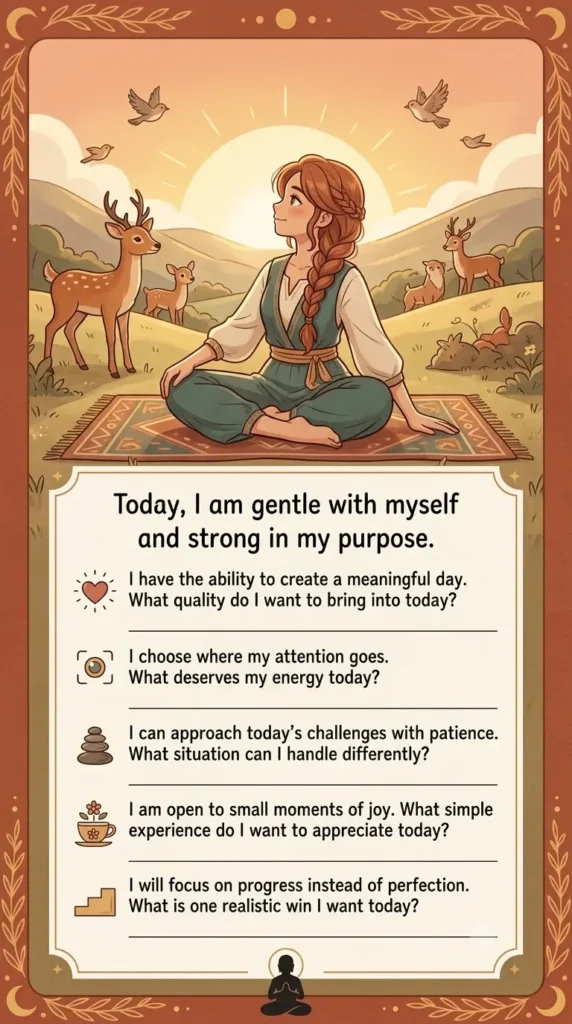
- I have the ability to create a meaningful day. What quality do I want to bring into today?
- I choose where my attention goes. What deserves my energy today?
- I can approach today’s challenges with patience. What situation can I handle differently?
- I am open to small moments of joy. What simple experience do I want to appreciate today?
- I will focus on progress instead of perfection. What is one realistic win I want today?
Evening Reflection Affirmation Prompts
Evening journaling isn’t a scorecard for how productive your day was. It’s closer to understanding yourself.
These affirmation prompts help you close the day through reflection, not by dragging every unfinished thought into tomorrow with you.
- I am proud of how I showed up today. What is one thing I handled well?
- I can learn from today without judging myself. What experience taught me something useful?
- I release the pressure to have everything figured out. What expectation can I let go of tonight?
- I trust myself to continue growing. What progress did I make that I almost ignored?
- I deserve rest without needing to earn it. What would help me end today peacefully?
Creativity & Motivation Affirmation Journal Prompts
Creative confidence disappears fast when you’re waiting for the perfect idea. Or comparing your rough draft to someone else’s finished product.
These prompts bring you back to curiosity instead of pressure.
- My ideas are worth exploring. What idea have I been postponing because I fear it won’t be perfect?
- I can create before I feel completely ready. What would I start if judgment was not a concern?
- My creativity grows through practice. What creative habit can I build?
- I allow myself to experiment and learn. What mistake could actually help me improve?
- I can find inspiration in everyday experiences. What caught my attention recently?
Healing & Emotional Growth Affirmation Prompts
Emotional growth isn’t about becoming a different person entirely. It’s about understanding your patterns, responding differently, and getting more intentional about your choices.
These prompts sit well alongside a broader collection like 365 journal prompts for mental health if you want a bigger library to draw from once these run out.
- I can acknowledge my feelings without being controlled by them. What emotion have I been avoiding?
- I am allowed to move forward at my own pace. What part of my growth needs more patience?
- I can learn from my past without living in it. What lesson do I want to carry forward?
- I choose understanding over self-judgment. What would I say to myself during a difficult moment?
- I am becoming more aware of what I need. What has my recent experience taught me about myself?
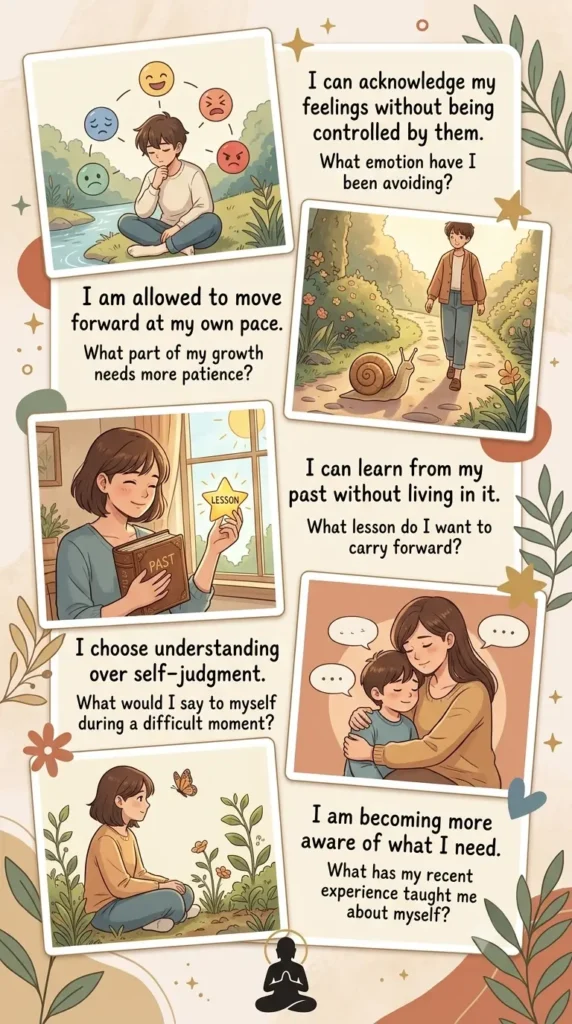
Affirmation + Journal Prompt Examples
Affirmations get boring fast when they’re just nice sentences on repeat. The strongest affirmation journal prompts don’t stop at repetition. They turn a single belief into a two-way conversation with yourself. State what you want to build. Then answer a question that checks it against real evidence, real feelings, real choices behind it.
That’s the whole difference.
A good affirmation shouldn’t feel like faking happiness. Not even a little. It should feel like a direction you’re choosing to walk toward, one honest line at a time. Already worked through broader mindfulness journal prompts? This is where the practice gets more specific.

1. Affirmation: “I am allowed to grow at my own pace.”
Reflection Prompt:
What part of my life feels rushed right now, and what would change if I gave myself more patience?
Why It Works:
Growth gets treated like a race most days. Social media doesn’t help. Someone’s always posting a milestone you haven’t hit yet. This affirmation pushes back against that comparison. It pulls your attention back to your own progress, nobody else’s timeline. The reflection prompt is what makes the line believable. You’re not forcing instant confidence. You’re tying the words to one real situation you’re actually in.
2. Affirmation: “I can handle uncertainty without losing trust in myself.”
Reflection Prompt:
What difficult situation have I already handled that proves I am more capable than I think?
Why It Works:
This one leans on evidence. Not empty positivity. Psychologist Claude Steele’s self-affirmation theory, first laid out in 1988, argues that people protect their sense of self by returning to values and strengths that matter to them. Naming a past win does exactly that. It’s proof, not a pep talk.
3. Affirmation: “My worth is not measured by my productivity.”
Reflection Prompt:
When do I feel most valuable outside of achievements, grades, work, or online validation?
Why It Works:
Productivity quietly becomes an identity for a lot of people. Without anyone deciding that on purpose. This prompt makes room to notice what’s underneath the output. Kindness. Curiosity. Resilience. The stuff that doesn’t show up on a resume, similar to what shows up when you sit with things to be thankful for instead of things achieved.
4. Affirmation: “I can create a life that feels meaningful to me.”
Reflection Prompt:
What is one small action I can take this week that matches the person I want to become?
Why It Works:
Big life changes rarely arrive in one big moment. They build from small, repeated choices. Turning an affirmation into one concrete action moves it out of wishful thinking. It becomes a decision instead. Something closer to how gratitude worksheets work: less about the feeling, more about the follow-through.
Affirmation journaling works best when the words feel honest enough to believe. Challenging enough to push you, too. The goal was never to convince yourself everything’s fine. It’s to build a steadier relationship with your own thoughts, one affirmation prompt at a time. Want prompts that lean more toward gratitude specifically? Grateful affirmations covers that ground, and the gratitude journal template gives you a ready structure to start from.
7-Day Affirmation Journaling Challenge for Gen Z
Forget “think positive.” That’s not what this week is about. This challenge changes how you talk back to your own thoughts. Seven days. One theme each day. No pressure to get it perfect.
Each day gives you a fresh angle and a handful of affirmation journal prompts to work through. Miss a day? Pick it back up tomorrow. That’s still progress.
Day 1: Self-Worth – “I Am More Than My Achievements”
Notice how often you grade yourself. Grades, income, likes, a stranger’s opinion. None of that is who you are.
Write an affirmation that pulls your worth away from your output. Not what you produce. Just you.
Journal prompt:
What qualities do I like about myself that have nothing to do with what I achieve?
Day 2: Confidence – “I Trust Myself More Than My Doubts”
Confidence doesn’t show up first. Action comes first. Confidence follows, built from proof you can actually handle things.
Journal prompt:
What’s one hard thing I handled better than I expected?
Day 3: Anxiety Relief – “I Can Create Space Between Thoughts and Reality”
You won’t erase every uncomfortable thought this week. Not the goal. The goal is slowing down the automatic stories your mind keeps writing.
If anxiety tends to hijack your gratitude practice too, these prompts for anxious days work alongside this challenge without adding pressure.
Journal prompt:
What thought has been taking up too much space lately, and what’s a more balanced way to see it?
Day 4: Career & Study – “My Progress Does Not Need to Be Perfect”
Career uncertainty hits most Gen Z adults at some point. Comparing your timeline to someone else’s highlight reel? That’s where the pressure actually comes from.
Journal prompt:
What small step today moves me closer to the person I want to become?
Day 5: Relationships – “I Deserve Healthy Connections”
This affirmation isn’t about convincing yourself everyone stays. It’s about naming your boundaries. Your needs. What you actually value in the people around you.
Journal prompt:
What kind of communication and respect do I want in my relationships?
Day 6: Gratitude – “I Notice What Is Already Good”
Specific beats vague every time. “I’m grateful for life” barely registers. The friend who texted first, the meal that hit right, five quiet minutes alone. Those land.
Need a running list to pull from on days your brain goes blank? Things to be thankful for covers everyday moments worth naming, from small wins to the people who show up.
Journal prompt:
What ordinary moment recently made my day better?
Day 7: Reflection & Integration – “I Am Becoming More Aware of Myself”
Look back over the last six days. What kept repeating? Which affirmation actually felt true when you wrote it, not just nice on paper?
Journal prompt:
Which belief about myself do I want to carry forward?
How to Stay Consistent With Your Affirmation Journaling Practice
Consistency beats intensity. Every time. Five minutes a day for months does more than one two-hour session you never repeat.
Attach the habit to something you already do. Morning coffee. Winding down before bed. Keep the notebook visible. Cut the friction. A missed day isn’t failure, it’s just a gap you close tomorrow.
Research on habit formation backs this up. Repeating a behavior in the same context, at the same time, makes it stick faster. Mindfulness journal prompts work the same way if you want to pair this challenge with a slower, more present style of writing.
Keep it simple enough to return to, even on the days that feel like too much.
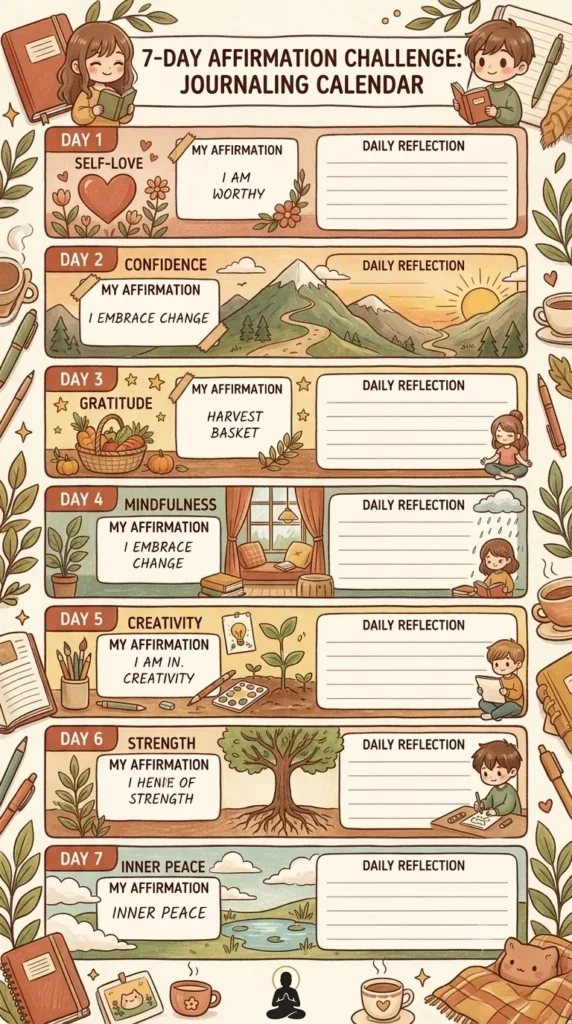
Download the Free 7-Day Affirmation Journaling Challenge PDF
Want a version you can print and just follow? Grab the downloadable 7-day affirmation journaling challenge PDF. Daily themes, space for your affirmations, and a reflection prompt for each day.
Prefer a longer format with room to expand? These gratitude worksheets pair well with this challenge if you want to keep the habit going past day seven.
The printable version removes one decision from your day. No blank page staring back at you. Open it, reflect, write. That’s the whole ask.
Common Mistakes When Using Affirmation Journal Prompts
This isn’t about repeating positive lines until your brain believes them. Affirmation journal prompts fail the moment they turn into a shortcut. Not a tool. A good prompt should stir reflection. Not add pressure on top of an already full day. Here’s where most people go wrong.
Writing Affirmations You Don’t Actually Believe
Most affirmation prompts backfire in one specific way. They aim too high, too fast. Writing “I am the most confident person in every room” when your hands shake before every presentation won’t build confidence. It builds resistance instead.
Try something you can actually stand behind. “I am learning to trust myself in uncomfortable situations” works better. It doesn’t fake certainty you don’t have. It just opens a door. The goal was never pretending everything’s fine. It’s building a thought your real experiences can slowly back up.
Using Affirmations Without Reflection
Repetition without meaning is just noise. Writing the same sentence ten times without asking why it matters turns a journal into a checklist item. Nothing sinks in.
Pair every affirmation with a question. Something that connects the words to your actual life. For example:
Affirmation: I deserve relationships where I can be myself.
Journal prompt: What boundaries help me feel respected and understood?
That pairing does the real work. It links self-talk to something you can act on, the same way mindfulness journal prompts tie a thought to the present moment instead of leaving it floating.
Expecting Instant Changes in Your Mindset
Affirmation journal prompts won’t replace hard conversations. Or real effort. Or the slow work of actually growing. They’re not built for that. They work as a repeated practice, one that helps you catch patterns and build sturdier thoughts over time.
Sound too slow? Maybe. But that’s the whole point. Claude Steele’s self-affirmation theory, dating back to 1988, suggests that affirming values you actually hold can support psychological flexibility. Repeating words alone won’t fix every hard week, though. Nothing does that on its own, not even grateful affirmations when they’re used without any reflection behind them.
Making Journaling Feel Like Another Obligation
Your journal isn’t a scoreboard. Missing a day doesn’t mean you failed at this. Some weeks, you’ll write daily. Other weeks, one honest entry is plenty.
The best affirmation journaling routine is the one you’ll actually return to. Not the perfect one. Focus on showing up, not on getting it right every single time. That’s really the whole shift, and it’s the same idea behind learning how to practice gratitude without turning it into pressure.
Continue Your Mindfulness Journey
Affirmation journaling doesn’t stand alone. It works best inside a bigger reflection habit. Mindfulness teaches you to notice a thought. Affirmations teach you what to do with it next. Put them together and your journaling routine gets sharper, not softer.
Keep Building Your Mindfulness Practice
This isn’t about forcing a good mood onto the page. Not even close. Mindfulness just asks you to notice what’s happening inside, before you judge any of it. Once that noticing happens, affirmation journaling gives you somewhere to point it.
Mindfulness prompts help you pause and watch an emotion. Affirmation prompts help you pick the belief you want to strengthen instead. Small difference. It changes the whole entry.
Want the fuller picture first? The mindfulness journal prompts guide lays the groundwork this practice builds on. And if gratitude tends to slide into your mindfulness sessions anyway, mindfulness and gratitude breaks down why the two keep showing up together.
Explore More Gratitude and Reflection Tools
Different days need different tools. That’s just how self-reflection works.
Some mornings call for a confidence boost. Other nights call for something quieter, a reminder of what’s already going right. Gratitude covers that second half.
Want to go deeper? A few places worth exploring:
- Grateful affirmations for statements built around appreciation and daily perspective shifts.
- How to practice gratitude for the actual steps, not just the theory.
- Gratitude worksheets for structured exercises when a blank page feels like too much.
- Things to be thankful for for fresh ideas once the obvious answers run out.
Thoughts feel repetitive some weeks. Overwhelming, other weeks. Pairing gratitude journaling with affirmation prompts tends to balance both. If anxiety is part of what’s driving the loop, gratitude journaling for anxiety is worth reading alongside this piece. Need a bigger library to pull from? 365 journal prompts for mental health covers a full year of angles.
No one’s grading the streak here. The goal is smaller. Come back to the page. Understand yourself a little better each time you do.
Conclusion
Affirmation journaling is not about convincing yourself that everything is perfect. It is about creating a more intentional relationship with your thoughts. The right affirmation journal prompts help you slow down, question old patterns, and build self-talk that feels honest rather than forced.
You do not need a complicated routine. A few minutes of reflection, a realistic affirmation, and consistent practice can change how you respond to everyday challenges. Start with one prompt that feels relevant today, write openly, and let the process grow with you.
Frequently Asked Questions
What to write in an affirmation journal?
An affirmation journal is a place to connect positive statements with personal reflection. Write an affirmation that feels meaningful, then explore why you need it, what evidence supports it, and what action matches it.
For example, instead of only writing “I am confident,” reflect on moments when you showed courage.
What is the 3-3-3 journaling method?
The 3-3-3 journaling method usually involves writing three things you are grateful for, three thoughts or feelings you notice, and three intentions or actions for the day.
It creates a simple structure for reflection without making journaling feel like another task on your schedule.
What are 5 positive affirmations?
Five examples of positive affirmations are:
“I am learning and growing every day,” “I trust myself to handle challenges,” “I deserve kindness from myself,” “My progress matters,” and “I can take small steps toward my goals.”
Effective affirmations work best when they feel believable and personally relevant.
What is the 3 3 3 manifestation method?
The 3-3-3 manifestation method is a journaling practice where you write a desired intention or affirmation three times in the morning, three times in the afternoon, and three times at night.
While some people use it for manifestation, it works best as a repetition and focus exercise rather than a guarantee of outcomes.
How do I write my own affirmations?
Write affirmations around the mindset or behaviour you want to strengthen. Use present-tense language, keep the statement realistic, and avoid writing something that feels completely disconnected from your current experience.
A stronger affirmation sounds like “I am becoming more confident through practice” rather than a phrase your mind immediately rejects.

It’s Bhaskar!
Well, I am not a psychologist a monk, or a philosopher by training. I’m just an engineering graduate.
‘The Empty Self’ is where I write about that idea, and what it actually means for ordinary life, anxiety, identity, habits, the stories we tell ourselves about who we are. I don’t have a psychology degree, and I’m not offering therapy or clinical advice. What I do have is thought and clarity, and genuine curiosity about why we suffer the way we do and how much of it might loose once we shed this ‘fixed identity’.