

The DBT House is a visual self-reflection exercise. Each part of the house stands for one piece of your inner world. The foundation can represent your values. The walls show your support system.
Other parts carry weight too: the roof, door, chimney, and four inner levels. They help you explore safety, emotions, coping, relationships, and your vision for a life worth living.
This guide covers what the DBT House means and how to complete it. You’ll see a fictional completed example. You’ll also find a free printable DBT house PDF and template.
Want more tools like this one? Browse these DBT skills worksheets. The emotions worksheet and coping skills worksheets pair well with the emotion and coping levels of the house.
Quick note: this is a reflection exercise. It isn’t a diagnostic tool, and it doesn’t replace therapy. If the exercise stirs up thoughts of self-harm, suicide, or distress that feels like too much, pause. Reach out to a qualified mental health professional. In the U.S., call or text 988. Elsewhere, FindAHelpline.com can help you find a local crisis service.
Table of Contents
Disclaimer
This blog is written and edited with the help of AI, then reviewed by me before publishing. As a result, the content is for general reflection only, not therapy or medical advice, and I’m not a licensed mental health professional. If you’re in crisis, please contact 988 if you’re in US or a local crisis service of your country instead of relying on this site.
What Is the DBT House?
The DBT house is a reflection exercise that puts your whole life on one page. You map your values, supports, protective habits, emotional outlets, strengths, struggles, and hopes onto a house-shaped frame. The goal is self-awareness. It isn’t a diagnosis or a test.
Think of it as a personal map. Start with the foundation, which can stand for the values that keep you grounded. Walls hold the people, places, and routines that support you. Up top, the roof represents protection. The chimney highlights healthy ways to release emotional pressure.
Other parts give you room to dig deeper. The door, billboard, and four inner levels add more space. Use them to explore privacy, strengths, and current struggles. They also make room for everyday happiness and the life you want to build.
Seeing the whole picture at once is the point. You may notice strong values but very little support. Or plenty of coping outlets but few long-term goals. Or strengths you rarely acknowledge. Those links hide when you think about each issue alone. A drawing pulls them into view.
Not to be confused with
A few look-alikes float around, so here’s the sorting. The burning-house metaphor is a different idea. It shows up when people discuss DBT treatment stages. For those stages, Linehan and Wilks (2015) is the primary source.
HeartLife Holistic’s proprietary DBT House™ framework is also separate. So is dbthouse.com, which is a DBT training organization. Neither one is the name of this exercise.
This one is a flexible reflection tool, much like other DBT skills worksheets. Versions vary. Some use slightly different house parts or prompts. There’s no single DBT house drawing you have to copy.

Is The DBT House an Official DBT Skill?
No. The DBT House isn’t an official DBT skill or a treatment module your therapist pulled from a manual. Think of it as a reflective exercise instead. It uses a house shape, walls, a roof, rooms, a foundation, to help you sort through your values, your support system, your emotions, the coping patterns you lean on, your strengths, and where you’re trying to go. Simple as that.
The design isn’t locked down either. One clinician’s version of the DBT house worksheet might look nothing like another’s. It depends on who built it and how the person using it wants to apply it.
Straight Answer: No
The DBT House doesn’t belong to the four formal DBT skill modules. Those are mindfulness, distress tolerance, emotion regulation, and interpersonal effectiveness. Full stop.
What it actually is: a reflective tool some clinicians and mental health professionals use so people can look at different parts of their life inside one visual. That’s it. It isn’t a standardized protocol. It isn’t a diagnostic tool. Don’t treat it like one.
Looking for something more structured instead? The DBT skills worksheets cover exercises built around the four core skill areas directly, no house metaphor required.
Why Diagrams Differ: Some Sources Call the Walls “Supports,” Others “Boundaries”
There’s no single standardized DBT house template that every practitioner has to follow. None. One worksheet calls the walls supports. Another calls them boundaries, or protection, or whatever holds your life together. Some versions tack on a chimney. Others add a door, a billboard, or extra floors inside the house.
Why does this happen? Because the house is a metaphor, not a formula. Different clinicians stretch it to fit different goals.
That variation doesn’t make one version correct and the rest wrong. It just means the prompts matter more than the shape. Before you fill out any dbt house printable, actually read what each section is asking. A “wall” labeled boundaries will ask something different than a wall labeled supports, even if the drawing looks almost identical.
Reflective Exercise v/s Structured Treatment
A DBT House and comprehensive DBT are not the same thing. Not close.
The dbt house activity can get you reflecting. It can surface patterns you hadn’t named yet. But it isn’t a replacement for actual treatment, and it was never meant to be. Comprehensive DBT runs on four parts working together: individual therapy, a skills training group, phone coaching between sessions, and a consultation team that supports the therapists themselves.
The house exercise can sit alongside that work. It just can’t stand in for it.
Want the real thing? Behavioral Tech covers formal DBT training and treatment for anyone looking past the worksheet stage.
The DBT House at a Glance: What Each Part Means
Think of the DBT house as a floor plan for your inner life. Not a diagram you fill in and forget. A tool that asks you something different at every level.
What guides you. What backs you up. What keeps you safe. What you keep to yourself. How you let pressure out. What you’re actually proud of.
Six questions. One house.
Here’s the thing about a DBT house template: it doesn’t need straight walls or a perfect roofline. Nobody’s grading the drawing. A rough sketch, five minutes, a pencil that wanders outside the lines, that’s enough. The value isn’t in the artwork. It’s in what the shape forces you to notice.
Look at your own DBT house example once it’s done. Patterns show up fast. Maybe the foundation is packed with values but the door is empty, meaning you haven’t thought much about what you hide. Maybe the walls list one name and nothing else. That’s useful information, not a failing grade.
Below is a breakdown of every part, what it stands for, and the question it’s really asking.
| Part | Represents | Reflection Question | Example Answer |
|---|---|---|---|
| Foundation | Values and beliefs | What matters most to me? | Honesty, kindness, independence |
| Walls | Support and connection | Who or what supports me? | My sister, friend, therapist |
| Roof | Protection and safety | What helps me feel safe? | A calm home and steady routine |
| Door | Privacy and hidden parts | What do I keep private? | My worries about disappointing others |
| Chimney | Emotional outlets | How do I release stress? | Walking, journaling, breathing exercises |
| Billboard | Strengths and achievements | What am I proud of? | I kept going through a difficult semester |
| Four levels | Growth, emotions, quality of life, and goals | What am I working through and toward? | Managing reactions and building a meaningful life |
Each row earns its own honest answer. Skip one and the picture stays half finished.
That chimney row matters more than people give it credit for. Stress without an outlet just sits there, building pressure until something else cracks under it. If you’re short on ideas for that part specifically, this emotions worksheet and this set of coping skills worksheets give you concrete options beyond “journaling,” which is where most people’s chimney list stops and stalls.
The billboard row trips people up too. Not because they lack achievements. Because naming them out loud feels strange. Write it anyway. “I kept going through a difficult semester” counts as much as any bigger win.
Want a blank version to work from instead of sketching freehand? A printable DBT house worksheet gives you the frame already drawn, so all that’s left is filling in your own answers to each question above.
The Foundation: What Values Guide Your Life?
Values hold up everything else in the DBT house. They’re not rules. Rules tell you what to do. Goals name something you’re chasing. Values run deeper than either one.
They’re the quiet reasons behind your choices. In the DBT house foundation, that’s the layer worth digging into first.
Think relationships. Honesty. Learning. Faith, or whatever gives your life meaning. Health, too.
Write “being present for people I love.” Not “call my family every Sunday.” See the difference? One is a feeling you’re building toward. The other is a task you’ll eventually skip.
There’s no perfect list here. You can write these straight onto a DBT house template, or a blank page works just as well. Pick values that actually mean something to you, ones you want showing up in your daily life, not someone else’s.
The Walls: Who or What Supports You?
The walls of your DBT house are the people, places, routines, and professional support holding your life together. A trusted friend counts. So does a therapist, a support group, a favorite park bench, or a steady sleep routine.
Support doesn’t mean round-the-clock access to someone. That’s not realistic, and it’s not the goal. A healthy support system has boundaries built in. You can care about someone and still limit what you share with them. Limit how often you talk. Limit what behavior you’ll accept. Both things are true at once.
Feel like your walls are thin right now? Start small.
Ask yourself a few questions:
- What’s one small support I could add? Maybe texting one trusted person once a week.
- Is there an online or community option? A moderated support group, a hobby group, a class, even a local meetup can count.
- What routine could become a support? A regular walk. A journaling habit. A steady meal routine or a calming bedtime ritual. Small structure adds stability, and pairing it with a few coping skills worksheets can make that structure stick.
If gratitude already has a place in your routine, our gratitude worksheets can help you notice the people, places, and everyday supports you may already have standing behind you. And if you want the fuller picture of your DBT house, our DBT skills worksheets walk through every wall, room, and beam.
The Roof: What Protects You?
The roof of the DBT house stands for whatever keeps you steady when things get hard. Not perfect. Not bulletproof. Just steady enough to function.
Think about the people you’d actually call at 2 a.m. The place you go when your chest feels tight. The routine that resets you after a bad day. That’s your roof.
Safe People, Places, Routines, Resources
Your roof might include a friend who doesn’t flinch when you’re a mess. A therapist. A quiet room with the door shut. A sleep schedule you protect like it matters, because it does. A walk you take without needing a reason. A crisis line saved in your phone.
Practical resources count too. A list of grounding techniques. A coping skills worksheet tucked in a drawer. Anything that makes the next hard moment feel less like free fall.
Here’s the thing people get wrong about this part of the dbt house worksheet. Protection doesn’t mean dodging every hard feeling. Sadness shows up anyway. So does anger. So does fear. That’s not failure. That’s being alive.
A strong roof doesn’t block the weather. It just means you’re not standing in it with nothing over your head. The feeling still happens. You’re just not alone in it, and you’re not drowning in it either.
The Door: What Do You Keep Hidden?
The door is the part of the house most people overthink. It stands for whatever you keep private, on purpose.
Privacy isn’t a red flag. You’re allowed to hold certain memories close. Certain fears. Certain relationships you’re not ready to explain to anyone, including yourself some days.
The real question isn’t whether you have a door. Everyone does. It’s whether that door is protecting you or quietly boxing you in.
A boundary that gives you control? That’s a door doing its job. Hiding every hard emotion from the people who’ve actually earned your trust? That’s different. That one tends to end in loneliness, not safety.
So sit with it for a second. What does your door protect right now. What’s it costing you to keep it shut. Is there anything behind it you’d want to open, even just a crack, down the line. Working through an emotions worksheet alongside this part can help name what’s actually sitting behind that door before you decide what to do with it.
Nothing here requires disclosure. You can leave the door blank. You can write “private” and move on. You can draw a closed door and call it done.
An empty door is still a true answer. That’s allowed in any DBT house template, printable or not. For more structured practice with this exercise, the full DBT skills worksheets collection walks through every room of the house, not just this one.
The Chimney: How Do You Blow Off Steam?
Every DBT house activity needs somewhere for pressure to go. That’s the chimney.
Think of it as your outlet system. What helps you settle down? What creates enough room to respond instead of react? Smoke needs somewhere to go. So does stress.
Healthy outlets show up in plain ways. Talking to someone you trust. A walk around the block. Journaling for ten minutes before bed. Paced breathing when your chest feels tight. A DBT skill like self-soothe or TIPP when the pressure builds fast.
But not every coping habit earns its spot on the chimney. Some work fast and wreck you later.
Picture this. It’s 11pm, your phone glows, and you’ve been scrolling for two hours straight. You feel nothing. That’s not rest. That’s avoidance wearing a nap costume.
Snapping at someone. Ignoring messages for three days straight. Staying busy enough that the feeling never catches up. Write these down too. Not to shame yourself. Just to notice them.
The goal isn’t sorting coping strategies into “good” and “bad.” That’s too simple, and it misses the point.
Ask instead: does this help me handle the feeling? Or does it just make the feeling easier to dodge for a while?
Need more ideas for your chimney? Try these coping skills worksheets for practical exercises you can print and use today. Curious which habits actually help versus which ones just feel like they do? This breakdown of positive vs. negative coping skills compares the two side by side.
The Billboard: What Are You Proud Of?
This isn’t about big wins. The billboard is where you give yourself credit for the stuff you’d normally brush past.
No trophy required. No impressive resume line. Just the quiet kind of growth that only you would notice.
Maybe you got out of bed on a hard day. Maybe you remembered a friend’s birthday when your own week was falling apart. Maybe you said no and didn’t spiral into guilt for an hour afterward. That counts. All of it.
Some progress doesn’t come with a finish line, either. Getting more patient. Asking for help instead of white-knuckling through it alone. Treating yourself with a little more kindness than you used to. Small shifts. Still worth the billboard.
Working from a DBT house template? The billboard usually sits right above the chimney, close enough to remind you the hard stuff and the good stuff live in the same house.
Stuck on what to write? These journal prompts for self-love pull out self-reflection without turning it into a performance review. Or start smaller. This list of things to be thankful for gathers everyday positives you can pull from fast.
Your billboard doesn’t need to impress anyone walking by. It just needs to remind you, on the days you forget, that your growth counts.
The Four Levels of the DBT House
The four levels loosely echo the four stages of treatment from Linehan’s work. They are not the same thing. Don’t confuse them.
This house is a reflection tool. It’s something you fill in on paper, alone or with a therapist. Formal DBT staging is a clinical call. Only a qualified clinician makes that call, based on your full history and symptoms.
| House Level | Reflection Focus | Related Formal Stage Language |
|---|---|---|
| Level 1 | Behaviors you want to gain control over | Stage 1: behavioral control and safety |
| Level 2 | Emotions you want to experience more healthily | Stage 2: experiencing emotions more fully |
| Level 3 | Happiness, connection, and everyday quality of life | Stage 3: ordinary happiness and living effectively |
| Level 4 | Your vision for a meaningful life | Stage 4: a deeper sense of meaning and fulfillment |
The clinical stages carry a much narrower, more specific meaning than anything on this worksheet. They deserve their own read. Don’t treat the DBT house as a stand-in summary for formal DBT treatment stages.

This four-stage framework traces back to Linehan and Wilks’ work on the course and evolution of dialectical behavior therapy.
Level 1: Behaviors You Want to Gain Control Over
Start at the bottom. Name a behavior that’s getting in your way.
Maybe it’s “staying up late scrolling when I need sleep.” Maybe it’s “avoiding messages when I feel overwhelmed.” Write it plainly. Naming it isn’t the same as judging yourself for it.
That distinction matters more than it sounds. People often freeze at Level 1 because writing the behavior down feels like a confession. It’s not. It’s just data.
One line here needs to be said directly: if what shows up at this level includes self-harm or suicidal thoughts, this worksheet is not a substitute for care. Reach out to a qualified clinician or a crisis service.
That’s not optional. For more on working with urges like this, the DBT STOP skill walks through a concrete way to pause before acting on impulse.
Level 2: Emotions You Want to Experience More Healthily
This level isn’t about getting rid of hard feelings. That’s not the goal, and it never was.
Instead, you’re asking a narrower question. How do you want to notice, express, and ride out an emotion without it running the show? “Feel anger without exploding.” “Let sadness in without shutting down completely.” Specific. Not vague.
Struggling to name what you’re actually feeling? That’s common, and it’s exactly what the emotions worksheet and the identifying emotions worksheet are built for. They give you sharper words than “fine” or “bad.”
Level 3: What Brings You Happiness?
Most DBT content skips straight to crisis skills. Ordinary happiness barely gets mentioned.
That’s a gap. Linehan’s own framing puts quality of life on equal footing with reducing crises. Not a nice extra. A real target.
So this level asks something simple. What makes an afternoon feel worth having? Friendships. A hobby you lose time in. Rest that actually feels like rest. A conversation that mattered. None of it needs to be dramatic.
Can’t think of anything right now? Start smaller than you think you need to. The how to practice gratitude guide offers a practical way to catch these small positives before they slip past unnoticed.
Level 4: What Would a Life Worth Living Look Like?
Here’s where the house points forward instead of just managing what’s in front of you.
Picture it across categories. Relationships. Work or learning. Health. Growth. Whatever else actually matters to you, not what’s supposed to matter. This is the core DBT idea of building a life worth living, translated into something you can sketch on paper.
Vague goals don’t move anywhere. “Be happier” sounds nice and does nothing.
So get specific. Say you value creativity. Instead of “be happier,” try “two evenings a week making art, eventually share it.” The value stays the anchor. The goal just gives it legs.
How to Complete a DBT House Step by Step
Build it in layers. Don’t try to answer everything at once.
Start with what grounds you. Add the people and habits that hold you up. Then move into emotions, coping patterns, strengths, and what a life worth living actually looks like for you.
That’s the whole sequence behind this DBT house exercise.
Step 1: Draw or Download Your House
Grab a blank sheet first. Or sketch your own dbt house drawing freehand, no template needed. Prefer less setup? Print a dbt house template instead.
A basic house needs a foundation, walls, a roof, a door, a chimney, and a billboard. Add four interior levels on top. Simple shapes work fine. Leave room for short words and phrases, not paragraphs.
Some people prefer a dbt house pdf they can fill in digitally. Others want a blank dbt house printable taped to a wall. Either works. The structure matters more than the format.
Step 2: Start With the Foundation
The foundation holds everything else up.
Write down the values, beliefs, traditions, or principles that give your life direction. Honesty. Family. Creativity. Kindness. Independence. Learning. Faith. The list is yours, not one borrowed from somewhere else.
Focus on what matters to you, not what you think should. That gap trips up a lot of people on their first dbt house worksheet.
Step 3: Add Your Supports and Protection
Walls and roof do different jobs here.
Fill the walls with people, places, communities, routines, and resources that support you day to day. A friend who answers the phone. A Tuesday therapy session. A walking route that clears your head.
Then use the roof for protection. What keeps your well-being covered? A safe home. Healthy routines. Professional support. A trusted person you can call when things get hard. Write it plainly.
Step 4: Work Through the Four Levels
This isn’t about perfect answers.
Move bottom to top through the four levels. Start with behaviors you want more control over. Then emotions you want to handle differently. Then sources of ordinary happiness, the small stuff, not grand achievements. Finish with your longer-term vision of a life worth living.
Some levels feel easier than others. That’s normal. A rough dbt house example rarely looks tidy, and it isn’t supposed to.
Step 5: Add Your Door, Chimney and Billboard
Here’s the part most people rush.
The door holds what you keep private or hidden. Write honestly, even if it’s just a word. The chimney represents how you release emotional pressure. Healthy coping skills belong there, alongside habits that help briefly but cause problems later.
The billboard is different. That’s for strengths, achievements, qualities, moments you’re proud of. Let it be loud.
Step 6: Step Back and Look at the Whole House
What connects, and what doesn’t?
Scan the house for patterns. Does something on your chimney conflict with a Level 4 goal? Does a foundation value show up nowhere else? Do the people in your walls actually support the life you described upstairs?
These connections raise good questions. That’s the real use of a dbt house activity. The goal was never a balanced-looking house or a cheerful one. It’s a clear look at the patterns already there.
Give yourself 20 to 40 minutes for the full exercise. No need to finish in one sitting. Pause whenever you need to.

For more guided reflection, pair this exercise with mindfulness journal prompts. They’re built for noticing thoughts and patterns as they surface. Want something shorter? Try these five-minute journal prompts for a quick daily check-in instead.
Struggling to name what you feel on Level 2? A dedicated emotions worksheet can help first. If the chimney section raises coping patterns worth exploring, start there. The full DBT skills worksheets library covers that ground in more depth.
DBT House Example: A Completed House
A DBT house example can make the exercise much easier to understand. Below is a fictional completed house for Maya, a 27-year-old, showing how values, support, emotions, coping habits, strengths, and long-term goals can connect.
Maya, 27: A Fictional Completed DBT House
Maya is entirely fictional. Her answers are meant to show the level of detail you might use—not to suggest there is one “correct” way to complete a DBT house.
| Part of the house | Maya’s example |
|---|---|
| Foundation — Values | Kindness, independence, honesty, creativity, staying connected to family |
| Walls — Supports | Her sister, two close friends, her therapist, a weekly art class, her favorite local park |
| Roof — Protection | A regular sleep routine, keeping emergency contacts saved, taking breaks when overwhelmed, spending time with safe people |
| Door — What she keeps private | Worry that she is disappointing people; uncertainty about her career |
| Chimney — Ways she releases pressure | Drawing, walking, journaling, listening to music, taking a shower, talking to her sister |
| Billboard — What she is proud of | Completing a difficult course, being a dependable friend, returning to art after years away |
| Level 1 — Behaviors to gain control over | Staying up late scrolling, avoiding important messages, snapping at family when overwhelmed |
| Level 2 — Emotions to experience more healthily | Anger without lashing out; sadness without completely withdrawing; anxiety without immediately avoiding things |
| Level 3 — Happiness and everyday life | Weekend art sessions, cooking with her sister, visiting the park, reading before bed |
| Level 4 — Life worth living | Meaningful work, close relationships, financial stability, creative projects, and enough free time to enjoy them |
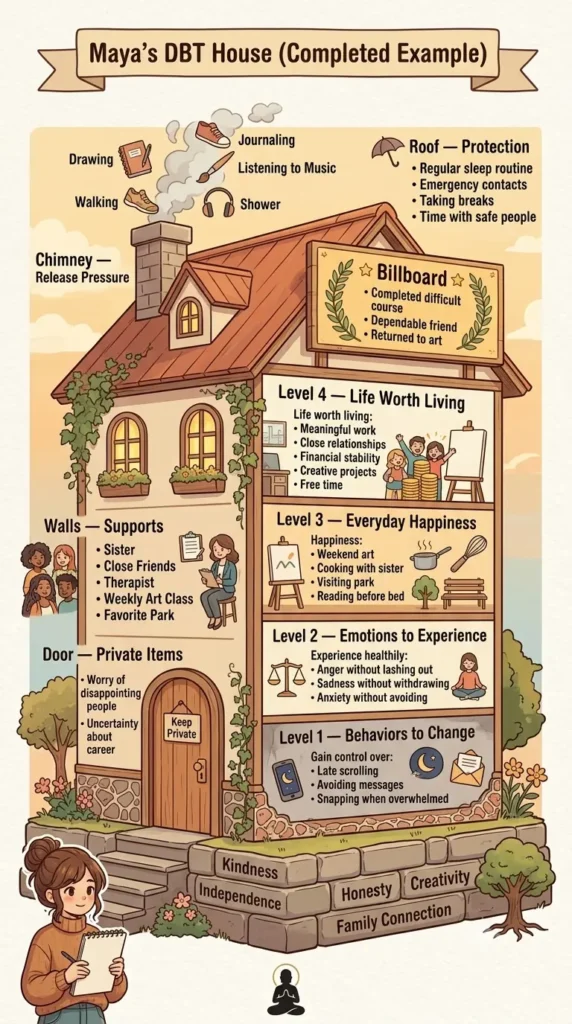
What Maya Notices When She Looks at Her House
The completed house helps Maya notice connections that are easy to miss when each problem is considered separately.
First, her foundation and Level 4 point in the same direction: independence and creativity matter to her, so meaningful work and creative projects fit her idea of a life worth living.
Second, her chimney and Level 1 are connected. Drawing, walking, and talking to her sister give her healthier ways to handle pressure, which may help her rely less on late-night scrolling or avoidance.
Finally, her walls and roof remind her that support is not only about people. Her routines and safe places also help create stability.
Text Version of the DBT House Example
Maya, 27: Fictional Example
Foundation — Values
Kindness, independence, honesty, creativity, and staying connected to family.
Walls — Supports
Her sister, two close friends, her therapist, a weekly art class, and her favorite local park.
Roof — Protection
A regular sleep routine, emergency contacts, breaks when overwhelmed, and time with safe people.
Door — What She Keeps Private
Worry that she is disappointing people and uncertainty about her career.
Chimney — Ways She Releases Pressure
Drawing, walking, journaling, listening to music, taking a shower, and talking to her sister.
Billboard — What She Is Proud Of
Completing a difficult course, being a dependable friend, and returning to art.
Level 1 — Behaviors to Gain Control Over
Staying up late scrolling, avoiding important messages, and snapping at family when overwhelmed.
Level 2 — Emotions to Experience More Healthily
Anger without lashing out, sadness without withdrawing completely, and anxiety without immediate avoidance.
Level 3 — Happiness and Everyday Life
Weekend art sessions, cooking with her sister, visiting the park, and reading before bed.
Level 4 — Life Worth Living
Meaningful work, close relationships, financial stability, creative projects, and enough free time to enjoy them.
Free DBT House PDF and Printable Template
A good DBT house PDF should make the exercise easier, not turn it into another complicated worksheet. These free printable templates give you different ways to complete the DBT house, whether you prefer a blank drawing, guided prompts, or a simpler version for kids and teens.
Blank DBT House PDF
The blank printable DBT house gives you the full house structure without pre-filled answers. Use it when you want to draw, write, or personalize each part in your own way.
Prompted DBT House Worksheet
Prefer a little guidance? This DBT house template includes short prompts inside each section to help you decide what belongs in the foundation, walls, roof, door, chimney, billboard, and four levels. It also includes a “Look at the Whole House” reflection box for noticing patterns after you finish.
Black-and-White Printer-Friendly Version
This free printable DBT house uses a simple black-and-white design that works well with standard home or office printers. It is also useful if you want to add your own colors, shading, notes, or drawings by hand.
Kids and Teens DBT House
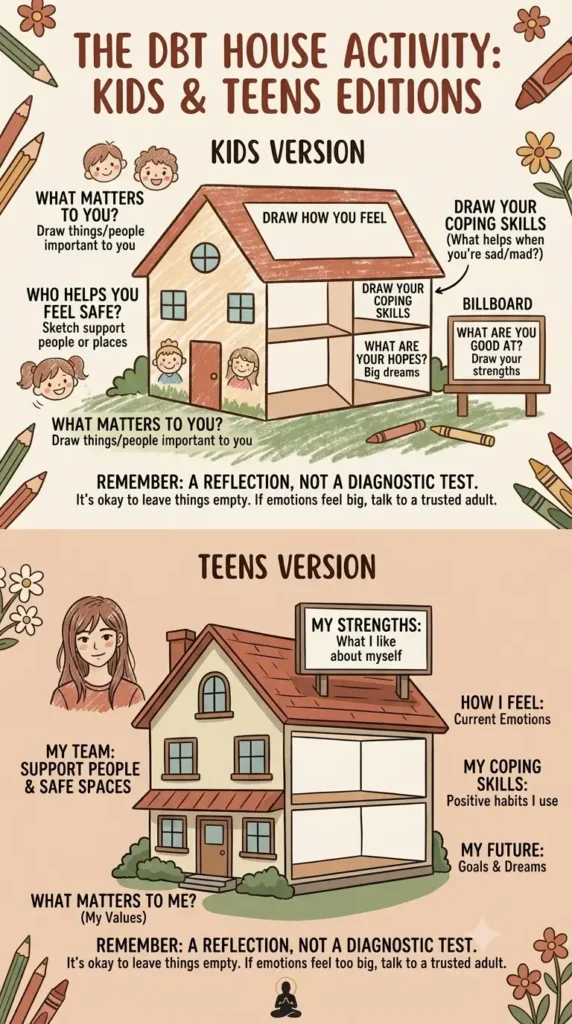
The kids and teens version uses simpler language and provides more room for drawing and personal examples. A short facilitator prompt strip gives parents, teachers, counselors, or therapists optional questions to help a young person complete the activity without turning it into a test.
File Specifications
Each DBT house template free download is designed in both US Letter and A4 sizes. The files are fillable-friendly, use an original design, and are kept under 1 MB where practical so they are quick to download and share.

The DBT House Activity for Kids and Teens
Long self-reflection worksheets lose most kids by line three. The DBT house activity for kids fixes that. Instead of paragraphs, a child draws, colours, and answers one short prompt per room. Strengths, support people, feelings, coping habits, hopes. All of it fits inside a house they built with a crayon.
Use Simple Words and Creative Prompts
Drop the clinical language first. “What are your positive qualities?” means nothing to a seven-year-old. “What are you good at?” does. Put that on the billboard. The foundation can ask, “What matters to you?” The walls can ask, “Who helps you feel safe?”
Leave room to draw. Not just write. A child might sketch their grandmother on the walls, a football field under the roof, or themselves doing something they love on the billboard. That’s the whole point. Teens usually go a different direction. Short phrases. Song titles. A goal. The name of one person they trust.
Adults should prompt, not push. Try, “Want to tell me why you chose that?” Or, “Anything you’d like to add?” Nothing more pointed than that. The young person stays in charge of what gets shared. Always.
This pairs naturally with other low-pressure reflection tools, like coping skills worksheets for the coping-habits room or an emotions worksheet for the feelings section. Both work well as a lead-in before a child sits down with the house.
Remember: It Is Not a Diagnostic Test
Here’s what the DBT house activity is not. A diagnostic tool. A mental health assessment. A pass-or-fail exercise. It’s a reflection activity, nothing more. An empty section doesn’t mean something is wrong with a child. There are no correct answers here.
Some kids will hit a wall they didn’t expect. The exercise can stir up intense emotion, trauma, self-harm, or suicidal thoughts a child isn’t equipped to sit with alone. When that happens, an adult or therapist needs to guide the room, not a worksheet. That’s non-negotiable.
DBT itself was built for adults, then adapted. Youth-focused programs now use age-appropriate skills training alongside caregiver involvement, and a 2021 systematic review found that DBT adapted for adolescents was linked to measurable drops in self-harm and suicidal ideation among teens aged 12 to 19.
That’s part of why the house format exists. It takes a clinically grounded approach and makes it something a kid can actually sit down and do. For more structured options built on the same model, the full set of DBT skills worksheets covers the other core skills alongside this one.
How the DBT House Connects to DBT Skills
The DBT House is not a DBT skills worksheet by itself. It’s a whole-person picture instead. A DBT house template can help you sketch that picture, room by room. Four modules map onto four parts of the house: mindfulness, distress tolerance, emotion regulation, and interpersonal effectiveness.

Mindfulness
Mindfulness means noticing without reacting right away. In the DBT House, it’s the skill that lets you step back. You take in the whole structure: values, supports, emotions, coping habits, goals. Nothing to fix yet. Just observe.
Wise Mind fits especially well here. It helps you look at the house without judging what you find. That’s harder than it sounds. Especially when the roof needs work. These DBT skills worksheets cover Wise Mind. Along with the rest of the mindfulness skill set.
Distress Tolerance
The chimney isn’t just a chimney. It stands for the ways you release emotional pressure before it builds past the point of control. Some strategies only need to get you through one rough moment.
TIPP is built for exactly that. Cold water, short exercise, paced breathing. Short-term tools for a short-term spike. The house does something different. It shows the broader coping pattern sitting underneath that one spike. TIPP alone can’t reveal that. Pair it with the wider coping skills worksheets if the chimney keeps working overtime.
Emotion Regulation
Every level of the house can hide something that needs attention. Emotions. Behaviors. Quality-of-life goals quietly stacking up unexamined. Emotion regulation skills help with all three. They clarify what’s triggering a reaction. They lower your vulnerability to it. Then they build a response that actually fits.
The PLEASE skill covers the vulnerability piece directly: sleep, food, illness, exercise. Basic stuff. The roof plays a similar role here. Think of it as a protective routine. It keeps hard emotions from flooding the floors below before they start. A DBT house worksheet makes that roof easier to name.
Interpersonal Effectiveness
The walls and door carry most of this module’s weight. Walls represent the people who hold you up. Those are the relationships that actually support the structure. The door is different. It raises a quieter question: what do you choose to share, and with whom? Boundaries live there. So does privacy.
DBT’s interpersonal effectiveness skills help you protect those walls while still saying what you need out loud. Not an easy balance. Worth building anyway.
Common Mistakes When Completing a DBT House
A DBT house is a reflection exercise, not a test you can pass or fail. A few common mistakes can make the activity less useful:
- Trying to give the “right” answer: There is no perfect foundation, door, chimney, or life goal. Write what is true for you.
- Making everything positive: Your house can include fear, conflict, uncertainty, or habits you want to change. Honest answers are more useful than cheerful ones.
- Treating it like a personality test: The finished house does not define your personality or diagnose anything. It is simply a snapshot of what you notice right now.
- Rushing through it: Give yourself enough time to think. You can pause and return later.
- Confusing coping with avoidance: A coping strategy may bring short-term relief while creating problems later. Notice both sides without judging yourself.
- Writing vague goals: “Be happier” is hard to act on. “Call my friend once a week” gives you something concrete to explore.
- Seeing difficult answers as failing at DBT: Hard answers do not mean you are bad at DBT. They may show where you need support, practice, or a different skill.
- Sharing before you are ready: You do not have to show your house to anyone. Share only when it feels safe and useful.
DBT House vs. Other DBT Worksheets
The DBT House gives you a whole-person map. Most other DBT worksheets focus on one skill, behavior, emotion, or situation. The house helps you step back and see how your values, supports, coping patterns, emotions, and goals fit together.
| DBT worksheet | Main focus | Best used for |
|---|---|---|
| Diary cards | Daily symptoms, urges, emotions, and skills | Tracking patterns over time |
| Coping skills worksheets | Ways to manage difficult moments | Building a practical coping plan |
| Emotion regulation worksheets | Understanding and changing emotional responses | Managing intense emotions |
| Self-soothing worksheets | Using the senses to reduce distress | Calming yourself during hard moments |
| Wise Mind worksheets | Balancing emotion and reason | Making grounded decisions |
Think of the DBT House as the map, while these worksheets are more like individual tools you use along the way.
Conclusion
The DBT House gives you a simple way to look at your life as a whole rather than focusing on one problem at a time. Your foundation shows what matters to you, your walls and roof reveal sources of support and safety, and the four levels help you notice where you are now and where you want to go.
There is no perfect DBT house. An empty section, a messy answer, or a difficult truth can all be useful starting points. Take your time with the exercise, return to it when your circumstances change, and use what you discover to choose one small, values-based step forward.
Frequently Asked Questions
What is the DBT house and what is it used for?
The DBT house is a guided reflection exercise that uses a house drawing to explore your values, supports, coping patterns, emotions, strengths, and goals. It can help you see how different parts of your life connect and identify areas you may want to work on.
What do the four levels represent?
The four levels explore different areas of change, from behaviors you want to gain control over to emotions, everyday happiness, and a life worth living.
They loosely echo the priorities described in DBT treatment stages, but the house levels are a reflective framework rather than a formal staging tool.
What do you write in each part?
You write short, honest answers based on your own life. The foundation can hold your values, the walls your supports, the roof your protective factors, the door what you keep private, the chimney your ways of releasing emotional pressure, and the billboard your strengths or achievements.
Is the DBT house the same as the four stages of DBT treatment?
No. The DBT house is a reflective exercise, while the four stages of DBT treatment are part of a formal clinical framework. The levels may draw on similar ideas, but they should not be treated as a one-to-one map of your clinical treatment stage.
Can I use a worksheet without a therapist?
Yes, you can use a DBT house worksheet for personal reflection if you feel comfortable doing so. However, it is not a substitute for therapy or crisis support.
If the exercise brings up intense distress, trauma, self-harm urges, or suicidal thoughts, stop and reach out to appropriate professional or crisis support.

It’s Bhaskar!
Well, I am not a psychologist a monk, or a philosopher by training. I’m just an engineering graduate.
‘The Empty Self’ is where I write about that idea, and what it actually means for ordinary life, anxiety, identity, habits, the stories we tell ourselves about who we are. I don’t have a psychology degree, and I’m not offering therapy or clinical advice. What I do have is thought and clarity, and genuine curiosity about why we suffer the way we do and how much of it might loose once we shed this ‘fixed identity’.