
DBT Distress Tolerance Skills exist for one reason. They keep a bad moment from turning into a worse one. Anger spikes. Fear takes over. Sadness feels like it won’t lift. In that state, most people either explode or shut down. Neither one helps.
These skills do something different. They buy you time. A pause, a breath, a concrete next move instead of a reaction you’ll regret by morning. They come from Dialectical Behavior Therapy, built originally for people in real crisis. The core techniques go by names like STOP, TIPP, ACCEPTS, self-soothing, and radical acceptance. Each one works differently. All of them share a goal: survive the moment without making it worse.
Here’s when they actually matter. Mid-argument. Mid-panic. The second an urge hits and you can feel yourself about to do something you can’t undo. Also in the harder cases, the ones where nothing you do will change what’s happening. That’s where radical acceptance earns its place.
This guide walks through each core skill. It covers how to pick the right one for the moment you’re in, and how DBT skills worksheets and printables turn a one-time read into an actual habit.
Quick Overview: Short version, if you need it now: these skills aren’t about fixing the problem. They’re about getting through it without making things harder on yourself. STOP interrupts the impulse before it becomes an action. TIPP resets your body when your nervous system is running the show. ACCEPTS gives you something else to focus on until the wave passes. Self-soothing calms you down through your five senses. Radical acceptance deals with what you genuinely cannot change.
Not therapy. Not a cure. Just a way to stay steady long enough to think straight. Pair them with broader coping skills worksheets or tools for naming what you’re feeling, like an emotions worksheet, and you’ve got a real toolkit, not just one trick. For the clinical framework behind all of it, Dialectical Behavior Therapy’s distress tolerance page lays out the original model these techniques come from.
Table of Contents
Disclaimer
This blog is written and edited with the help of AI, then reviewed by me before publishing. As a result, the content is for general reflection only, not therapy or medical advice, and I’m not a licensed mental health professional. If you’re in crisis, please contact 988 if you’re in US or a local crisis service of your country instead of relying on this site.
What Are DBT Distress Tolerance Skills?
DBT distress tolerance skills help you survive pain. Not erase it. They give you a way through stressful situations without making things worse. You learn to get through safely. You accept what you cannot change, then choose how you respond.
What distress tolerance means in DBT
This isn’t about forcing good feelings. Not even close. DBT distress tolerance skills teach you to endure emotional pain. You do it without acting on impulse or making things worse. In Dialectical Behavior Therapy, the goal isn’t wiping out every painful feeling. That’s not realistic. The goal is helping you handle distress while it passes. Or while you figure out what comes next.
Pain and suffering aren’t the same thing. That distinction matters. Pain might come from rejection, grief, conflict, or disappointment. Fighting the reality of what happened adds a layer of suffering on top. Acceptance doesn’t mean you like the situation. Not even a little. It means acknowledging reality so you can respond more effectively.

Why these skills matter during emotional crises
Emotions surge fast, and clear thinking disappears with them. You might fire off an angry text. Or pull away from someone you actually care about. Or reach for a habit that feels good for ten minutes. It causes real problems later.
Sound familiar? Distress tolerance skills create a pause between the urge and the action. That pause is everything. These skills won’t fix the problem itself. What they do is keep you safe and cut down on impulsive reactions. They buy you time until you’re calm enough to choose.
Distress tolerance vs. emotion regulation vs. mindfulness
These three DBT skill areas overlap. But each one does a different job. Distress tolerance helps you survive a hard moment without making it worse. That’s the whole job. Emotion regulation goes deeper. It helps you understand your emotions and shape how you respond to them. Mindfulness sits underneath both. It helps you notice thoughts, feelings, and body sensations without reacting on autopilot.
Want the bigger picture? The DBT skills worksheets overview breaks down all four DBT skill areas, distress tolerance included. For the next module, see this guide to DBT emotion regulation skills.
A quick note on sources. dbt.tools files STOP under emotion regulation, not distress tolerance. Categories shift depending on who’s writing them.
The Main DBT Distress Tolerance Skills at a Glance
Pain doesn’t wait for a good moment. DBT distress tolerance skills exist for exactly that: the moment you can’t fix, change, or escape, but still have to survive. Some skills get you through a crisis right now. Others help you stop fighting a reality you can’t change. Picking the right one depends on what’s actually happening in your body and your head.
| Skill | Purpose | Best used when | Related guide |
|---|---|---|---|
| STOP | Pause before reacting | You feel ready to act impulsively | Full guide → |
| TIPP | Lower intense physical arousal | Your body feels overwhelmed | Full guide → |
| ACCEPTS | Shift attention away from distress | You need to ride out a difficult urge | Full guide → |
| Self-Soothe | Use the senses for comfort | You feel upset, tense, or emotionally raw | Full guide → |
| IMPROVE | Make a painful moment more bearable | You cannot resolve the problem right now | Full guide → |
| Pros and Cons | Weigh the consequences of an action | You’re tempted to act on an urge | — |
| Radical Acceptance | Acknowledge reality as it is | Fighting what happened is adding to your pain | — |
| Turning the Mind | Recommit to acceptance | You keep returning to resistance | — |
| Willingness vs. Willfulness | Choose an effective response over rigid resistance | You’re struggling to cooperate with reality | — |
| Half Smile and Willing Hands | Practise a posture associated with acceptance | You want to support a more accepting stance | Full guide → |
Crisis-Survival Skills
STOP buys you one thing: a gap. A gap between the trigger and whatever you’d normally do next. Anger shows up. Shame shows up. The urge to fire off a text or slam a door shows up right behind it. STOP is what sits in that gap. Full guide →
TIPP works on the body, not the thoughts. Temperature, intense movement, paced breathing, and paired muscle relaxation. That’s the whole toolkit. None of it is subtle. It’s meant for the moments when your nervous system has already hijacked the conversation, so check in with your own health limits before you push into intense exercise. Full guide →
ACCEPTS is distraction, used on purpose. Not avoidance for its own sake. It’s a bridge you build to get across an emotional wave without acting on the urge underneath it. Nothing fancy. Just something else to hold your attention until the wave actually passes. Full guide →
Self-Soothe leans on the senses. A blanket. A song you know by heart. A smell that pulls you somewhere calmer. This one isn’t about stimulation. It’s about comfort, plain and simple, especially on the days when everything already feels like too much. Full guide →
IMPROVE the Moment doesn’t solve anything. That’s not the job. Imagery, meaning, prayer if that’s part of your life, relaxation, encouragement — these make a bad moment survivable. They don’t make it disappear. Full guide →
Pros and Cons is the slow-down skill. Quick relief now, bigger mess later. That’s the trade most urges offer. Writing it out, side by side, makes the trade harder to ignore. Try it the next time an impulsive choice starts sounding reasonable.
Reality-Acceptance Skills
Radical Acceptance means you stop arguing with what already happened. Not approving of it. Not liking it. Just no longer spending energy pretending it isn’t true. Turning the Mind is what you do when the resistance creeps back in, which it will, probably more than once. Y
ou choose acceptance again. Then again. Willingness means doing what actually works instead of digging in out of pride or fear. None of this asks you to excuse harm or give up on change. It just asks you to stop fighting what you can’t undo.
Half Smile and Willing Hands bring the body into it. A slightly relaxed jaw. Open palms instead of clenched fists. Small physical shifts that nudge the mind toward acceptance instead of resistance. Full guide →
Other Distress-Tolerance-Adjacent Practices
Grounding pulls you back into the room you’re actually in. Name five things you see. Feel your feet on the floor. Urge surfing works the same angle from a different direction: you watch an urge rise, peak, and fall, without jumping to act on it. Both help.
Neither one is a formal skill from Marsha Linehan’s original framework, though. Most practitioners file these under DBT-adjacent rather than DBT proper, alongside broader coping skills and grounding tools like mindfulness journal prompts.
If you want the full breakdown of each skill with scripts and step-by-step instructions, the original DBT distress tolerance skill set is a solid outside reference to cross-check against. And if naming what you’re actually feeling is half the battle, an emotions worksheet pairs well with any of the skills above.

How to Choose the Right Distress Tolerance Skill
Not every rough moment needs the same fix. The right dbt distress tolerance skills depends on what’s happening to you right now. Are you about to react? Does your body feel wired?
Are you being pulled toward something unsafe? Or are you stuck fighting something you can’t change? A simple decision process gets you moving in the right direction fast.
Close to Reacting Impulsively? Try STOP
Emotions push you to act before you think. That’s the moment STOP earns its name. Pause. Step back. Notice what’s happening inside you. Then proceed mindfully instead of firing off that angry text or making a decision you’ll regret by dinner.
Body Feels Overwhelmed? Try TIPP
Sometimes the mind isn’t the problem. The body is. A racing heart. Tight muscles. That rising sense of panic. TIPP works on the body directly, using shifts in temperature, brief intense movement, paced breathing, and paired muscle relaxation to bring physical arousal back down.
A quick safety note here matters. Adapt TIPP to your own health and limits. Cold exposure and intense exercise aren’t right for everyone, especially with certain heart or breathing conditions. Skip the extreme temperatures. Check with a healthcare professional first if you’re not sure what’s safe for you.
Need to Get Through an Urge Safely? Try ACCEPTS or Self-Soothing
An urge is pulling you toward something that’ll make things worse. This is where ACCEPTS comes in, offering ways to redirect your attention until the urge loosens its grip. Distraction buys you time. Self-soothing works differently, using comfort through the senses, like calming music or wrapping up in a soft blanket.
Pick something that keeps you safe without creating a second problem. These skills aren’t about erasing the issue underneath. They’re about surviving the next few minutes without making the hole deeper.
Can’t Change What Happened? Practice Radical Acceptance
Some situations sit outside your control completely. Fighting that reality over and over just stacks more pain on top. Radical acceptance means admitting what happened. It doesn’t mean liking it, approving of unfair treatment, or giving up on the parts you can still change.
Say a friend ends a relationship with you. That hurts. Acceptance starts with admitting the relationship has changed, not spending hours insisting it shouldn’t have. You can still grieve. You can still set boundaries, ask questions, or work toward repair if that door stays open.
Ask yourself one question: what’s true about this right now, even if you wish it weren’t? You don’t need to feel peaceful about it today. Turning toward reality is sometimes a choice you make more than once.
Printable Distress Tolerance Flowchart
Thinking clearly feels hard in the middle of distress. This text-based decision tree works as a shortcut, and it doubles as the accessible text version of the visual flowchart below.
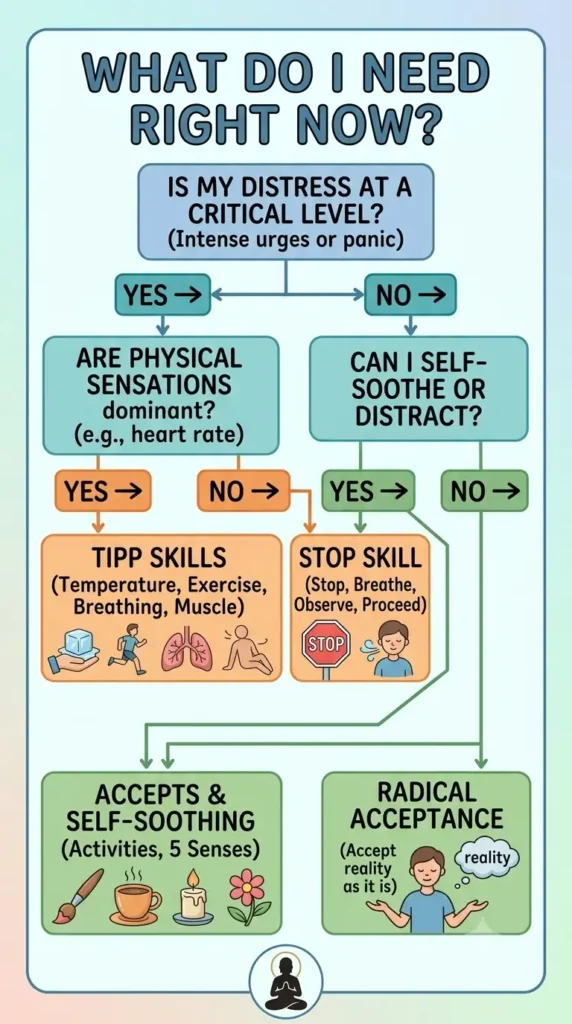
- Am I about to react impulsively? Pause and try STOP.
- Is my body highly activated? Consider TIPP, choosing a safe option for your health.
- Am I struggling with an urge or just need to get through the next few minutes? Try ACCEPTS or self-soothing.
- Am I fighting something that’s already happened or can’t change right now? Practice radical acceptance.
- Is there immediate danger, or a risk I might harm myself or someone else? Prioritize safety. Seek emergency or crisis support instead of relying on a worksheet alone.
You don’t need to choose perfectly. Start with whatever fits your most urgent need. Reassess after a few minutes. The goal is getting through the moment without making it worse, not feeling better instantly.
Radical Acceptance, Turning the Mind, and Willingness vs. Willfulness
Radical acceptance is one of the harder DBT distress tolerance skills to practice. It asks you to face painful facts without pretending they’re fair. Not fair, not okay, just real. Turning the mind and willingness work alongside it. Together they help you stop fighting what can’t be changed. Then you choose what comes next.
Radical Acceptance: Accepting Reality Without Approving of It
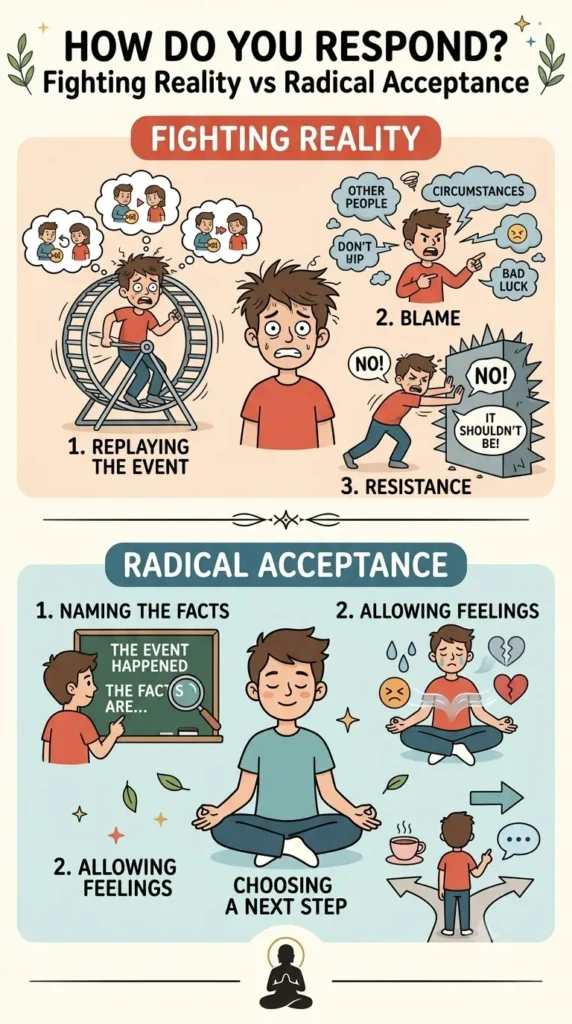
Radical acceptance means naming reality as it is. Even the parts you wish were different. It doesn’t mean liking what happened. It doesn’t mean agreeing with someone’s behavior. It doesn’t mean nothing can ever improve.
It means something simpler. You recognize what already happened. Only then can you respond to the situation actually in front of you.
Picture this. You studied hard for an exam. The grade came back lower than you expected. You replay every question. You blame yourself. “This should not have happened” loops on repeat. Disappointment is natural here. Arguing with the result in your head won’t change it, though. Not one bit.
Radical acceptance sounds closer to this: “I’m disappointed with my grade. I wanted a different result. This is the result I got. I can decide what to learn from it.”
You don’t need to feel calm after saying that. You can still be upset. That’s fine. The shift is smaller than it sounds. You stop burning energy wishing the facts were different. Then you make room for your next move.
Turning the Mind: Acceptance as a Repeated Choice
Acceptance rarely sticks after one try. You might accept something painful in the morning. By afternoon, you’re resisting it again. Normal. Turning the mind is the repeated choice to turn back toward acceptance once you catch yourself fighting what’s true. A practice, not a one-time win.
Try this sequence:
Notice the resistance. Catch thoughts like “this cannot be happening” or “I refuse to deal with this.”
Name the reality. Describe what you know is true. No blame added on top.
Choose acceptance again. “I may not like this, but I can acknowledge it.”
Return to the next useful action. Ask what the situation actually calls for now.
Does your mind swing back to anger or denial? That’s not failure. Notice it. Turn your mind toward acceptance again. Same move, every time.
Willingness vs. Willfulness
In DBT distress tolerance, willingness means participating in reality and doing what works. Even when you hate the circumstances. Willfulness is the opposite. It resists the moment. It refuses a needed change. It gives up when action is still possible, or insists everything unfold your way.
Here’s an example. You know an honest conversation could repair a misunderstanding. But embarrassment keeps you frozen. Willfulness sounds like, “I’m not saying anything. They should know what they did.” Willingness sounds different: “I still feel hurt, but I can explain what happened and ask to talk.”
Willingness isn’t blind compliance, by the way. You can face a hard conversation and still hold firm boundaries at the same time. The goal is doing what works. Not making everyone else comfortable.
Half Smile and Willing Hands
Half Smile and Willing Hands are physical distress tolerance techniques tied to accepting reality. They ask you to soften a tense face or open your hands instead of locking your body into a defensive posture. Small, physical, deliberate.
They won’t erase distress on their own. Nothing does that instantly. What they give you is a concrete way to practice a more accepting stance, one muscle at a time. For the full walkthrough, see our guide to willing hands and half smile.
Pros and Cons Before Acting on an Urge
Distress spikes fast. Suddenly you feel the pull to send an angry message, quit a commitment, pull away from someone, or reach for a coping behavior that costs you later. The DBT Pros and Cons skill forces a pause. It compares what happens if you act on the urge against what happens if you resist it.
Grab a piece of paper. Make four headings: pros of acting on the urge, cons of acting on it, pros of not acting, cons of not acting. Be honest here. An impulsive response might bring quick relief. What does it cost an hour later? A week later?
This isn’t about judging yourself for having the urge. It’s about choosing based on more than the emotion of the moment.
When Acceptance Isn’t the Whole Answer
Radical acceptance is not passivity. Not even close. Accepting that someone mistreated you doesn’t mean staying in an unsafe relationship. Accepting a diagnosis doesn’t mean refusing treatment. Accepting that a decision has been made doesn’t stop you from appealing it, asking questions, or building a different path forward.
Acceptance deals with facts. It never requires approving of injustice or harm. If a situation can change, go work on changing it. In danger? Prioritize safety first. Seek real support instead of using acceptance as a reason to endure harm.
DBT’s approach stays practical through all of this. Acknowledge what’s happening. Tolerate the feelings that come with it. Choose the most effective action you have available. Want the foundational source behind these skills?
See Marsha M. Linehan’s DBT Skills Training Manual from Guilford Press. For the full library of practice tools across every module, browse our DBT skills worksheets guide, or pair this section with the broader coping skills worksheets collection.st effective action available. For a foundational explanation of these skills, see Marsha M. Linehan’s DBT Skills Training Manual resources from Guilford Press.
Free DBT Distress Tolerance Worksheets and Printables
DBT distress tolerance skills work best before the crisis hits, not during it. The free distress tolerance worksheets help you choose a skill, ride out a hard moment, and look back on what actually helped.
DBT Distress Tolerance Skills PDF Cheat Sheet
One page. That’s the whole idea. A cheat sheet should fit everything you need on a single sheet you can glance at fast: when to use STOP, when TIPP makes more sense, and where ACCEPTS, self-soothing, and IMPROVE actually apply. Reality-acceptance skills belong here too.
Why does this matter so much? Because when your thinking gets foggy, you won’t read paragraphs. You’ll scan. So the sheet has to be built for scanning, not studying. Short labels. Clear triggers. Nothing buried.
Distress Tolerance Skills Worksheet
This one’s for after the storm passes, not during it. Write down what happened. Write down what you felt. Note the urge that followed, which skill you reached for, and whether it worked. No judgment. Just the facts.
Do this enough times and a pattern shows up. Maybe TIPP works when your anger runs hot but falls flat for anxiety. Maybe you keep skipping the worksheet entirely when things get bad, and that’s worth noticing too. The log doesn’t lie, even when you want it to.
Printable Distress Tolerance Flowchart
Sometimes you don’t need to think. You need to be told where to go. A flowchart does that. Feeling the urge to react before you’ve thought it through? It points you toward STOP. Stuck fighting something you can’t change? It routes you to radical acceptance instead. See the flowchart above for the full decision path.
This isn’t about having the perfect answer every time. It’s about having an answer when your brain refuses to produce one on its own.
Crisis-Survival Plan Worksheet
Build this plan on a calm day. That’s the whole point. List your early warning signs first, the small shifts that show up before things spiral. Then list the skills you actually want to try, not the ones that sound impressive. Add the people you’d call, the ones who pick up. Add what makes your space feel safer, even something as plain as clearing the room.
Keep it realistic. A plan you can’t follow at your worst isn’t a plan. It’s a wish list.
Distress Tolerance Skills Practice Log
Not every skill works every time. That’s normal, and this log is built around that fact. Track when you practice, how you felt going in, and what shifted after. Some entries will show no change at all. Keep them anyway.
Over weeks, the pattern tells you something your memory can’t. Which skills earn a place in your emotions toolkit and which ones you can quietly drop. That’s worth more than any single good day.

Distress Tolerance Activities for Adults, Teens, and Kids
Distress tolerance skills work because they buy you time. That’s the whole point. A hard feeling doesn’t need to turn into a bad decision, and these activities build the gap between the two.
The right distress tolerance activity depends on age, comfort level, and what the moment actually calls for. Start simple. Practice before the storm hits, not during it. And let each person pick what feels doable, not what looks good on paper.
For adults
Adults often reach for structure first. Writing out the pros and cons of acting on an urge works because it slows the impulse down. Just enough to think clearly. Self-soothing helps too, whether that’s a favorite playlist or a scent that feels grounding. A short exercise can reset a stressful afternoon in under five minutes.
Here’s the part most people skip. Rehearse one skill before the hard conversation starts. Not after things go sideways. A skill practiced ahead of time is the one that actually shows up when you need it.
For teens and youth
Teens don’t want a worksheet taped to the fridge. They want something private that fits around school and friend drama. A crisis-survival playlist works because it’s already in their pocket.
The ACCEPTS skill is another solid option. It shifts attention safely during a rough moment, without requiring anyone to explain themselves. A small coping card helps too. Something to glance at before sending that angry text. Before reacting on impulse. That pause is often all it takes.
Why does this matter for teens specifically? Because the stakes feel different. One text, one post, one reaction can follow them for weeks. A ten-second pause changes that outcome completely.
For kids
Keep it short. Keep it concrete. A kid doesn’t need theory. They need something they can do right now.
That might mean naming what they’re feeling out loud. It might mean a few slow breaths, counted together. Drawing what happened works for kids who don’t have the words yet. A comforting object helps too, especially with a trusted adult nearby.
For more ideas sized to this age group, these coping skills worksheets for kids are a solid starting point, alongside this emotions worksheet for naming feelings before they build up.
Group activities
This isn’t about making anyone perform their feelings. In a classroom, therapy group, or workshop, the goal is exposure to options, not confession.
Try building a shared coping-skills menu as a group. Or practice picking a skill for a made-up stressful scenario, something with no real stakes attached. Sharing stays optional the entire time. Nobody owes the room their personal story to take part.
Adapting activities to different needs
One technique never works for everyone. That’s not a flaw in the method. It’s just how people are built.
Offer choices instead of insisting on a single approach. Sensory exercises land differently depending on the person. So do breathing practices and movement-based ones, like the TIPP skill. Adjust for age, disability, sensory needs, and cultural background. And if distress climbs instead of easing off, stop. Switch. Try something else.
A DBT distress tolerance skills worksheet can help track which techniques actually work for a given person over time. Not every skill fits every day. That’s expected, not a failure.

How to Practice Distress Tolerance Skills Every Day
Distress tolerance skills get easier with daily reps, not emergency use only. Build the habit now. Then it’s there when you actually need it. Small, repeated exercises teach you to spot your triggers, pause before reacting, and pick a response that doesn’t make things worse. That’s the real point of DBT distress tolerance skills. Practice when things are calm, so you’re ready when they’re not.
This Isn’t Just a Crisis Tool
Waiting for a crisis to try a skill sets you up to fail. Use STOP the next time you’re mildly annoyed. Practice grounding while you’re stuck waiting for an appointment. Low-stakes moments like these let you get familiar with a tool before your emotions take over.
The goal isn’t to kill the discomfort. It’s to get through it without making things worse.
Build a Routine You’ll Actually Keep
Give yourself five minutes a day. Rehearse a breathing exercise. Write out the pros and cons of acting on an urge. Pick a couple of self-soothing activities to use on a rough day.
Keep it realistic. One skill, practiced daily, beats a long plan you abandon by Thursday.
Review What Worked, and What Didn’t
After you try a skill, write it down. Log the situation, what you felt, the urge, the skill you used, and what shifted afterward. An emotions worksheet can help you name the feeling part clearly.
A skill that worked Monday might fall flat Tuesday. That’s normal. Reviewing your notes shows the pattern. Over time, you build your own shortlist: the skills that actually hold up for you.
When Skills Aren’t Enough
Distress tolerance skills help you cope. They don’t replace a therapist when the distress won’t let up. A DBT-trained therapist can help you fit distress tolerance worksheets to your actual life, not a textbook version of it.
If you’re in the US and in crisis, call or text 988 to reach the 988 Suicide & Crisis Lifeline. You can also text HOME to 741741 to reach a counselor through Crisis Text Line. Outside the US, contact your local crisis line or emergency number right away.

More DBT Worksheets and Related Resources
Distress tolerance is only one piece of DBT distress tolerance skills work. Four modules, not one. Found a skill that actually clicked? There’s more where that came from.
Start with the DBT Skills Worksheets pillar page. It maps the whole library, printables included. Need just one tool right now instead? Go straight to the DBT STOP Skill, DBT TIPP Skill, DBT ACCEPTS Skill, or DBT IMPROVE the Moment. Each guide breaks the acronym into steps you can actually run through. Not just read and forget.
Want something quieter? DBT Self-Soothing Skills works through the five senses. Willing Hands and Half Smile does something similar through posture instead of thought. Same goal. Different door in.
Distress tolerance gets you through the moment. It doesn’t finish the job. Once the crisis passes and the feeling lingers, DBT Emotion Regulation Skills picks up where it left off. DBT Wise Mind helps when logic and emotion are pulling in opposite directions before a hard decision. Pair either one with the broader Coping Skills Worksheets library for more everyday tools.
Pick one skill. Practice it today, while things are calm, not mid-crisis. That’s the trick nobody mentions. A skill you’ve already rehearsed is a skill your brain can find later, right when the room gets loud.
Conclusion
DBT distress tolerance skills help you get through painful moments without making them harder through impulsive reactions. Whether you use STOP to pause, TIPP to manage intense physical arousal, ACCEPTS to shift your attention, or Radical Acceptance to face what you cannot change, the goal is to respond with greater care rather than react on autopilot.
You won’t master every skill overnight, and not every technique will work in every situation. Start with one that feels manageable, practice it when you’re calm, and notice what helps. With practice, distress tolerance can become a useful part of how you handle life’s hardest moments.
Frequently Asked Questions
What are the main DBT distress tolerance skills?
The main DBT distress tolerance skills help you survive emotional crises without making the situation worse. They include STOP, TIPP, ACCEPTS, Self-Soothe, IMPROVE, Pros and Cons, Radical Acceptance, Turning the Mind, and Willingness. Each skill serves a different purpose during distress.
What is the difference between distress tolerance and emotion regulation?
Distress tolerance helps you get through painful situations without acting impulsively or worsening the problem. Emotion regulation focuses on understanding, managing, and changing emotional responses over time. Both are core DBT skill areas, and they often work together during difficult moments.
Which DBT distress tolerance skill should I use when I feel overwhelmed?
The best skill depends on what you are experiencing. Try STOP when you feel ready to react impulsively, or TIPP when intense physical arousal makes thinking difficult. If the situation cannot be changed, Radical Acceptance may help you face reality without adding unnecessary suffering.
Where can I find DBT distress tolerance skills worksheets and free PDFs?
You can find DBT distress tolerance worksheets through reputable mental health education websites, therapist-created resources, and DBT skills guides.
Look for practical printables, such as a skills cheat sheet, a distress tolerance flowchart, or a practice log. Check usage terms before downloading or sharing materials.
How can I teach distress tolerance skills to children and teenagers?
Teach distress tolerance skills using simple language, relatable examples, and short practice activities. Help young people identify their feelings and notice urges before choosing a coping strategy. Adults can model the skills, practise them during calm moments, and offer support without dismissing the child’s distress.
How often should you practice DBT distress tolerance skills?
Practise DBT distress tolerance skills regularly, including when you feel calm, rather than waiting for a crisis. A few minutes of daily practice can help you become more familiar with each technique. Review what works for you and adjust your approach as your needs change.

It’s Bhaskar!
Well, I am not a psychologist a monk, or a philosopher by training. I’m just an engineering graduate.
‘The Empty Self’ is where I write about that idea, and what it actually means for ordinary life, anxiety, identity, habits, the stories we tell ourselves about who we are. I don’t have a psychology degree, and I’m not offering therapy or clinical advice. What I do have is thought and clarity, and genuine curiosity about why we suffer the way we do and how much of it might loose once we shed this ‘fixed identity’.