
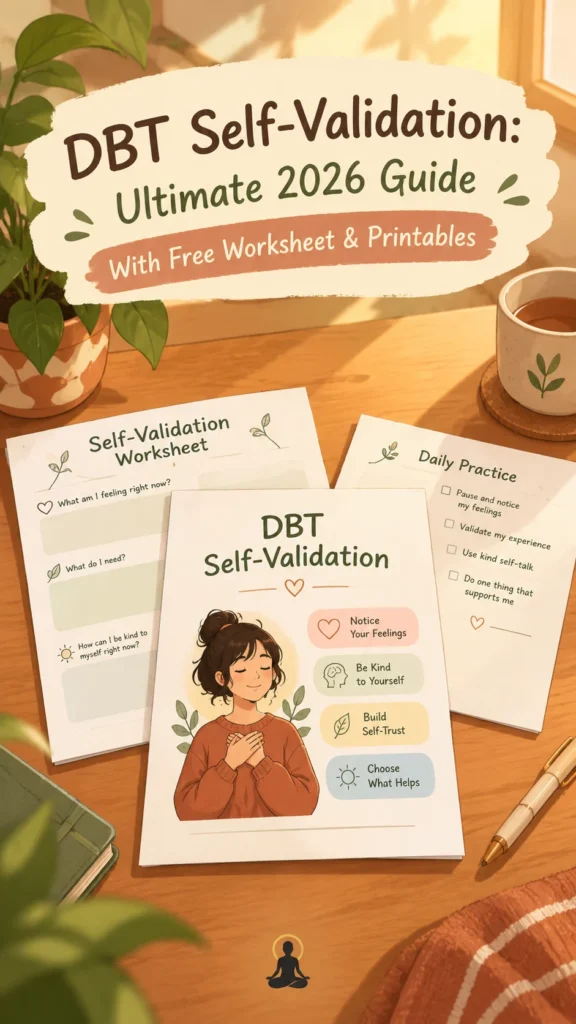
DBT self-validation means noticing an emotion and letting it stay there, without the pile-on of self-judgment. You feel anxious. You don’t call yourself weak for it. You feel hurt. Shame doesn’t get to join the party. Instead, you learn to name the feeling and trace why it actually makes sense, given what you walked through.
This guide breaks down how DBT self-validation works, step by step. You’ll get the three core moves, real self-validation statements you can say out loud, and exercises that fit into a normal day. There’s also a self-validation worksheet built to help you practice until it sticks. Not a quick fix. A different way of talking to yourself.
Quick Overview: Self-validation means three things happen at once. You acknowledge the emotion. You let it exist, full stop. You understand where it came from, without turning it into a character flaw. This guide covers the how, the printable worksheet, emotion-specific language, and daily exercises. Sound simple? It is. That’s exactly why most people skip it and stay stuck.
Validation isn’t the same as agreement, and that distinction trips people up constantly. You can feel something is unfair and still choose not to act on the anger. Related tools like gratitude worksheets and journal prompts for self-love work from the same root idea: how you talk to yourself shapes what you do next.
Table of Contents
Disclaimer
This blog is written and edited with the help of AI, then reviewed by me before publishing. As a result, the content is for general reflection only, not therapy or medical advice, and I’m not a licensed mental health professional. If you’re in crisis, please contact 988 if you’re in US or a local crisis service of your country instead of relying on this site.
What Is DBT Self-Validation?
DBT self-validation means something simple. You notice how you feel. You don’t rip yourself apart for feeling it.
That’s the whole idea, really. No big reveal here. The skill asks you to recognize your emotional experience and accept it, instead of treating it as proof something’s wrong with you. It doesn’t mean trusting every thought that shows up. It doesn’t mean acting on every urge either. It just means you stop using your own reaction as a weapon against yourself.
Here’s what changes once this clicks. A feeling starts making sense. Even the uncomfortable ones. Context explains almost everything, once you go looking for it.
Self Validation Meaning in Simple Terms
What does self validation actually sound like in your head? Something close to this: “My feelings are real. I can notice them without tearing into myself.”
That’s it. No speech. No performance.
Say a friend cancels plans last minute. You feel hurt. Under DBT self-validation, you don’t spiral into “I’m too sensitive” or “I’m overreacting.” You let the hurt sit there. You name it. Then you move on, without piling criticism on top of an already rough moment.
Sound too simple? It is. That’s exactly why it works.
How DBT Self-Validation Works
In Dialectical Behavior Therapy, self-validation supports emotional regulation directly. It trains you to meet your feelings with awareness, not judgment. Why does this matter before we get to the how? Because skipping straight to technique is how most self-help advice fails people. Three steps carry the skill.
- Acknowledge: Notice what you feel. Skip the labels like “weak” or “irrational.”
- Allow: Let the emotion sit there. Don’t force it down. Don’t act on every urge it sends you.
- Understand: Ask why the emotion makes sense, given what you’ve lived through and what you need right now.
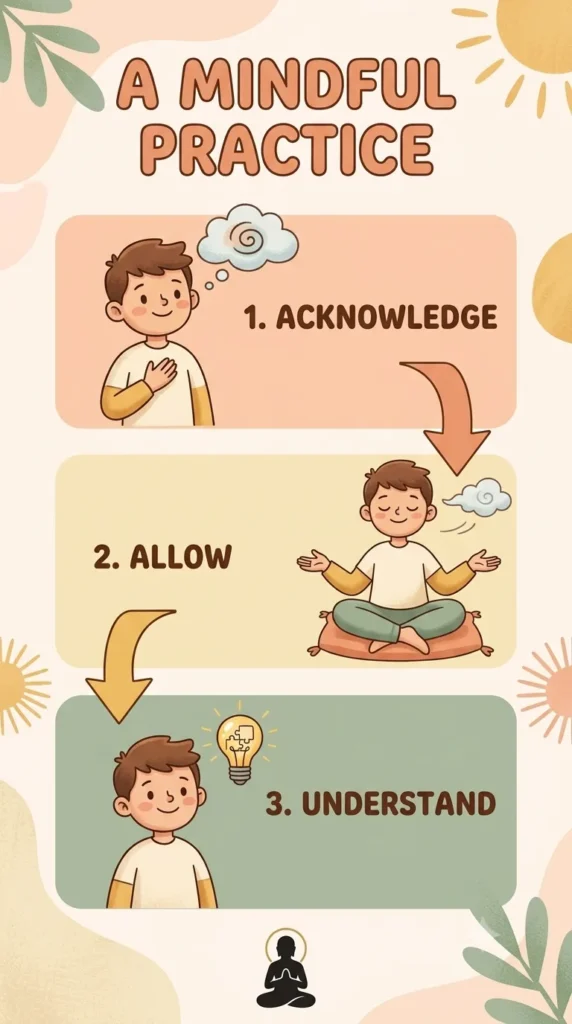
This isn’t a hack. It’s just noticing, and noticing takes practice before it feels automatic. If naming the feeling is the hard part, an emotions worksheet can help you find the right word faster than guessing on your own.
Self-validation is one piece of a bigger toolkit. The rest lives in DBT emotion regulation skills, which cover what to actually do once you’ve named the feeling. For a clinical breakdown of how self-validation differs from self-compassion, Sheppard Pratt lays it out well.
What Self-Validation Is, and What It Isn’t
This isn’t about agreeing with every thought you have. Not even close.
Self-validation doesn’t excuse harmful behavior. It won’t convince you a bad situation is fine. You can feel angry without lashing out at anyone. You can notice anxiety while still checking whether your fears line up with the facts in front of you.
Why does this distinction trip people up so often? Because validating a feeling and agreeing with it get confused constantly. They aren’t the same move.
It’s 11pm. You’re replaying an argument from six hours ago. The easy path is telling yourself you shouldn’t still be upset. The harder, better path is letting yourself be upset, then asking what the anger is actually pointing at.
The real goal is smaller than people expect. Stop stacking self-criticism on top of an already hard experience. Accept the feeling first. Decide what to do about it separately.
Want to practice this instead of just reading about it? A self validation worksheet gives you space to run through all three steps on paper, which makes the habit stick faster than thinking it through in your head.
Pair it with the broader coping skills worksheets on this site if you want exercises for the moment right after you’ve named what you feel.
Why Is Self-Validation Important in DBT?
DBT self-validation means naming a hard emotion without piling shame on top of it. That’s the whole point. It builds self-trust. It also opens a gap between feeling something and deciding what to do about it. You can accept what you feel and still choose your next move.
Reduces Self-Criticism and Secondary Emotions
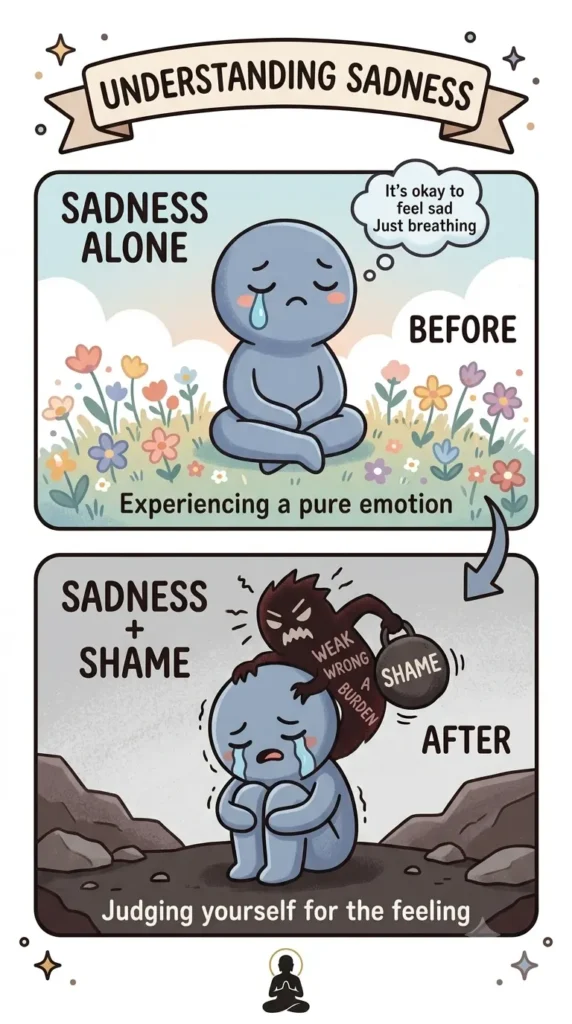
Your friend cancels plans last minute. Sadness hits first. Then a second voice shows up: “I’m too sensitive. I shouldn’t care this much.” Now you’re carrying two things, the sadness and the shame about feeling it at all.
That second layer has a name. Secondary emotions are reactions that pile on top of the first, real feeling. Self validation helps you catch the original emotion before the pile-up starts. Skip the judgment. Try this instead: “I feel disappointed because I wanted that time together.”
Why does naming it help? You don’t have to force the sadness away. Just naming it is often enough to make the whole thing easier to sit with.
Supports Emotional Awareness and Self-Trust
Self validation means taking your own feelings seriously. Not brushing past them. Do this enough and naming what you actually need starts to feel automatic instead of forced.
Still can’t put a word to what you’re feeling? That’s common, and it’s exactly where most people get stuck. The emotions worksheet is built for this. A few rounds with it, and you’ll have a real vocabulary to reach for instead of just “fine” or “stressed.”
Helps You Respond Rather Than React
When emotions spike, people send the angry text. Or go quiet for three days. Or make a call they regret by morning. Self-validation buys you a pause, just long enough to feel the thing before you decide what to do with it.
Say criticism lands hard. You don’t have to argue back or shut down right away. Admit it stung first. That’s it.
Why does the pause matter so much? Because it’s where the choice actually lives. Pair that pause with the DBT STOP skill, a distress tolerance tool built for exactly this moment, and you respond on purpose instead of on impulse.
How to Practise Self-Validation Using the Three DBT Steps
Most people were taught to argue with their feelings. Catch the panic, call it dumb, try to think your way out of it. DBT self-validation works the other way. You notice the emotion first. Then you let it sit there without a fight. That’s the whole starting point.
In DBT, self validation has three moving parts: naming what you feel, letting it exist, and understanding why it showed up at all. Skip any one of the three and the exercise falls apart.
Step 1: Acknowledge
Name the feeling. Don’t dress it up.
Notice the emotion, the thought underneath it, and whatever your body is doing with it. Tight chest. Clenched jaw. Racing thoughts. All of it counts.
“I’m so weak for feeling nervous” is judgment wearing an emotion’s clothes. “I feel nervous about this conversation” is just the fact. That’s the difference. Naming the feeling without blaming yourself for having it is most of what what is self validation actually means in practice.
Step 2: Allow
You don’t have to like the feeling. You just have to stop fighting it.
Anxious, embarrassed, furious, whatever it is, the feeling gets to exist for a minute without a verdict attached. Try this instead of arguing: “I don’t like this feeling, but I don’t need to fight it or judge myself for having it.” Short. Honest. Done.
Sound too passive to actually help? It isn’t. Resisting an emotion usually makes it louder, not quieter.
Step 3: Understand
Now ask why the reaction makes sense.
Past experiences shape this. So does current stress, unmet expectations, tiredness, whatever else is stacked underneath the moment. Understanding the reaction is not the same as agreeing with every thought attached to it. You can see why you feel something and still decide not to act on it.
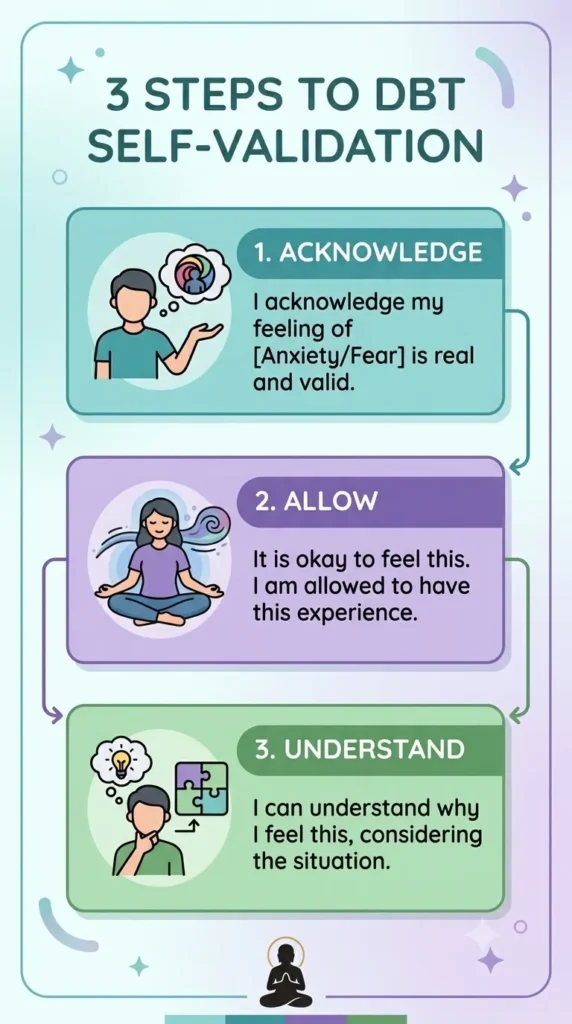
A Complete Example
Your manager gives you critical feedback in front of the whole team. Your face goes hot. The thought lands fast: “I’m terrible at my job.”
Here’s the three-step self validation worksheet in action, right in that moment:
- Acknowledge: “I feel embarrassed and worried about my performance.”
- Allow: “It’s uncomfortable to receive criticism, but I’m allowed to feel upset.”
- Understand: “I care about doing good work, and getting feedback in front of colleagues caught me off guard.”
That’s it. That’s the whole practice.
You’re not deciding the meeting proves you’re incompetent. You’re just letting the feeling pass through instead of fighting it on the way out. Once it settles, you can look at the feedback with a clear head and decide what’s actually worth changing.
Want more structured self validation exercises to work through on your own? Pair this with the coping skills worksheets and the full set of DBT skills worksheets for a complete practice routine.
DBT Self-Validation Worksheet PDF: Free Printable and How to Use It
A DBT self-validation worksheet gives you a structured way to name what you feel, see why that reaction makes sense, and skip the harsh self-judgment that usually follows.
What is self validation, really? It’s acknowledging your own experience instead of arguing with it. Use this worksheet in everyday situations, after a hard conversation, or days later when a moment is still stuck in your head.
Practice it enough and self validation meaning stops living in a worksheet. It becomes something you just do.
What the Worksheet Helps You Practise
Self validation sounds abstract until it’s on paper. A self validation worksheet makes it concrete. Describe what happened. Name the emotion. Catch the self-critical thought that shows up uninvited. Then ask the harder question: does the reaction actually fit what you were dealing with?
Nobody’s claiming every thought is correct here. That’s not the point. The point is acknowledging the experience first. Decide what to do with it after. DBT-UK’s guide on how to self-validate frames this the same way, as a skill that interrupts self-criticism long enough for you to actually think straight.
Struggling to name the feeling at all? Start smaller. An emotions worksheet helps you put a word to what you’re feeling before you try to validate it.
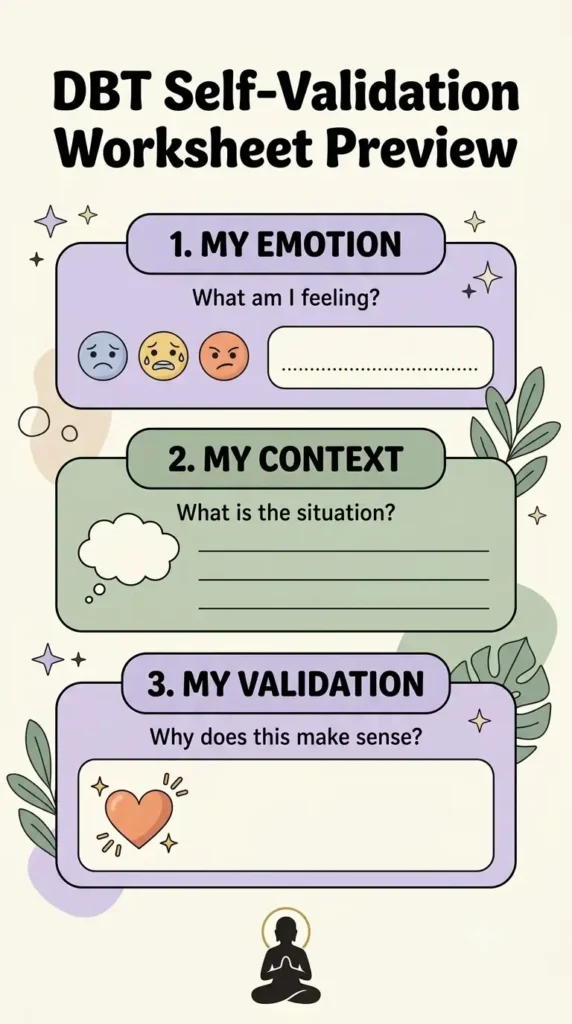
How to Complete It Step by Step
This isn’t complicated. Five steps, one real situation, a few honest minutes.
- Describe the situation: Write what happened. Facts only, no assumptions stacked on top.
- Name your emotions: What do you feel? Notice any physical sensations too, a tight chest, a dropped stomach.
- Notice self-judgment: Write down the critical thought. “I shouldn’t feel this way” counts.
- Understand the context: Why might this reaction make sense, given what you care about or what just happened?
- Write a validating response: Say it in words that sound believable to you. Not a script. Your own words.
Skip straight to step five and the exercise falls flat. The earlier steps are what make the validating response land instead of sounding hollow.
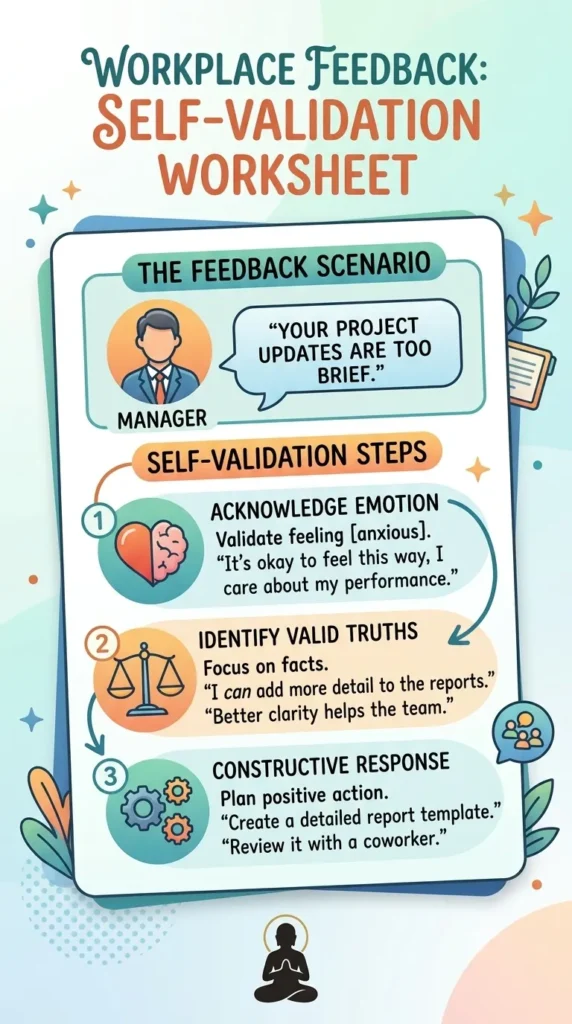
Completed Example
Situation: Your manager gives you critical feedback.
Emotion: Embarrassment and anxiety.
Self-judgment: “I’m terrible at my job.”
Context: You care about doing well. That’s exactly why criticism stings.
Validating response: “I’m upset because this matters to me. One hard conversation doesn’t define my ability.”
Notice what that last line isn’t doing. It’s not denying the feedback happened. It’s not pretending the sting away either. It’s just refusing to let one moment become the whole verdict.
Blank Printable for Repeated Practice
Download the blank self-validation worksheet PDF and keep it somewhere you’ll actually reach for it. Use it the moment a difficult emotion shows up, or later, when you want to look back at something that already happened.
Start with smaller, manageable situations first. The instinct to save it for a crisis is understandable. It’s also the wrong move. These self validation exercises work better as a habit than as emergency triage.
Want to pair the practice with reflective writing? These journal prompts for self-love and journal prompts for mental health build the same muscle from a different angle.
And if self-judgment tends to show up alongside a bigger wave of distress, the broader coping skills worksheets collection has more tools worth having on hand.
Self-Validation Statements for Different Emotions
DBT self-validation starts with one honest sentence. Not a pep talk. Just a true statement that says your feeling makes sense. That’s what is self validation in practice — you name the emotion instead of arguing with it.
The words won’t make the feeling vanish. They just stop you from piling judgment on top of it. Pick phrases you can actually believe. Forced positivity falls apart the moment you need it most.
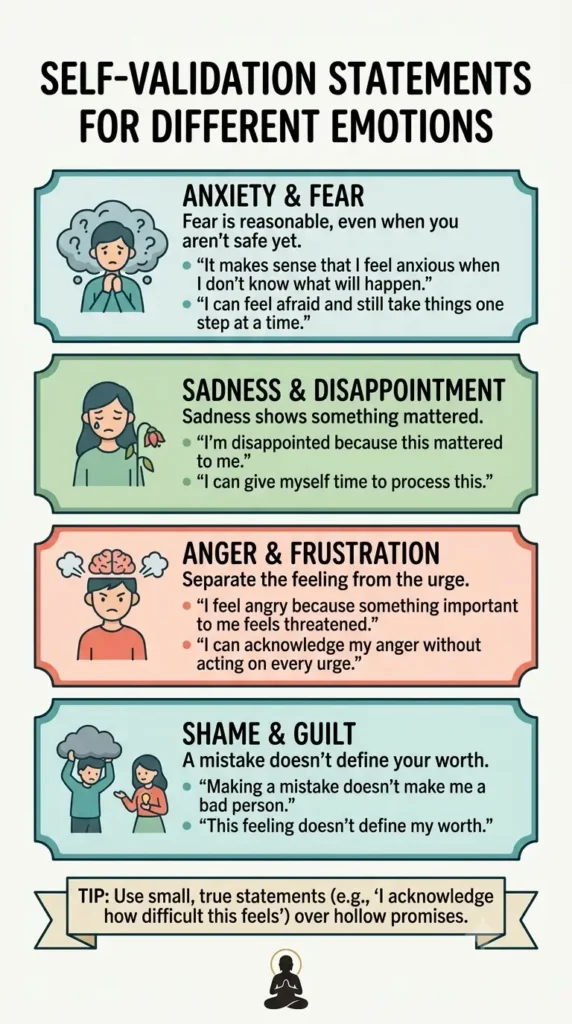
Anxiety and Fear
Anxiety hates uncertainty. So does your nervous system. A self validation statement here doesn’t promise safety. It just admits the fear is reasonable, even when nothing’s actually wrong yet.
- “It makes sense that I feel anxious when I don’t know what will happen.”
- “I can feel afraid and still take things one step at a time.”
- “I don’t need to solve everything right now.”
Sadness and Disappointment
Sadness shows up when something mattered and didn’t go your way. That’s not weakness. That’s attachment doing its job. Say the plain version out loud, and the grief gets a little less tangled.
- “I’m disappointed because this mattered to me.”
- “It’s okay to feel sad about something I hoped would work out.”
- “I can give myself time to process this.”
Anger and Frustration
Anger isn’t the problem. Acting on every spike of it is. A good self-validation DBT statement separates the two. Feel it fully. Choose your response separately. For a broader toolkit that pairs well with this split, these coping skills worksheets walk through the same idea in more depth.
- “I feel angry because something important to me feels threatened.”
- “My frustration deserves attention, but I can choose how I respond.”
- “I can acknowledge my anger without acting on every urge.”
Shame and Guilt
Shame says you’re bad. Guilt says you did something bad. Mixing them up keeps people stuck for years. One mistake doesn’t rewrite your worth, no matter how loud the feeling gets.
- “Making a mistake doesn’t make me a bad person.”
- “I can take responsibility for my actions without attacking myself.”
- “I feel ashamed right now, but this feeling doesn’t define my worth.”
Making a Statement Feel Natural
A self-validation worksheet only works if the words ring true. “Everything will be okay” sounds hollow when you’re mid-crisis. Swap it for something smaller. Try: “I don’t know how this will turn out, but I can acknowledge how difficult it feels.” That version survives contact with a bad day.
You can also anchor the statement to something you actually care about. Say honesty matters to you. Then try: “I’m nervous about admitting my mistake, but I want to respond honestly.”
That’s the whole trick behind how to self validate without it sounding fake. Want to build more of these around what actually drives your choices? Explore DBT values to see how they connect emotional acceptance to the decisions that follow.
Self-Validation Exercises and Activities for Daily Practice
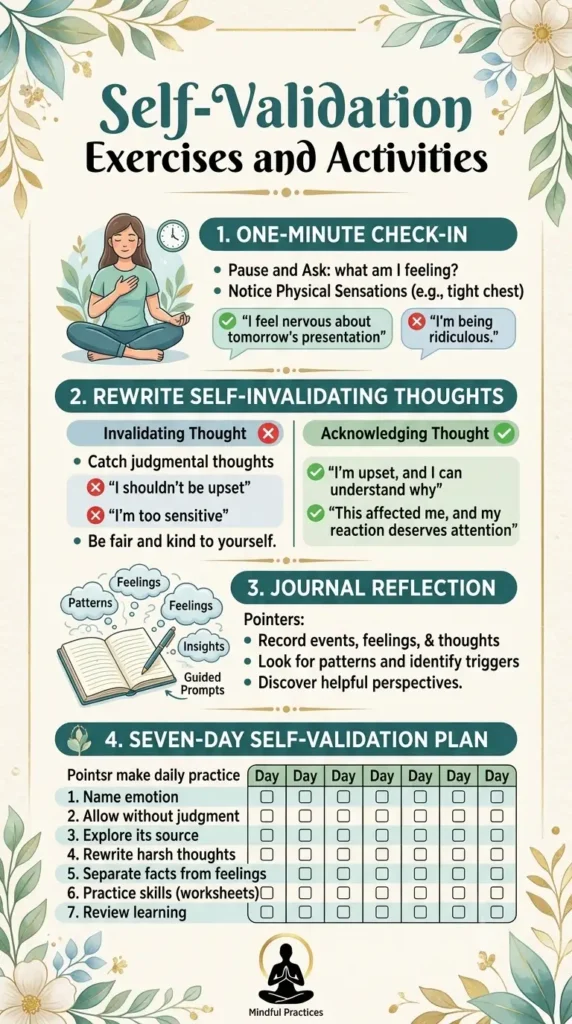
Self-validation gets easier with reps. Not from one big breakthrough. Small, everyday moments beat waiting for a crisis to force the issue. The exercises below help you notice what you feel, soften the inner critic, and respond with more understanding. Pick one. Practice it at your own pace.
One-Minute Check-In
Sixty seconds. That’s all this takes. Pause and ask: what am I feeling right now, and what caused it? Notice the physical stuff too, a tight chest, tense shoulders, a clenched jaw. Then name the emotion. No judging it.
“I feel nervous about tomorrow’s presentation” works. “I’m being ridiculous” doesn’t. One names the feeling. The other argues with it.
Rewrite Self-Invalidating Thoughts
Your inner voice dismisses feelings sometimes. Catch it in the act. Then swap the harsh judgment for something that actually acknowledges what you’re going through.
Instead of “I shouldn’t be upset,” try “I’m upset, and I can give myself time to understand why.” Instead of “I’m too sensitive,” try “This affected me, and my reaction deserves attention.”
You don’t need to convince yourself everything’s fine. That’s not the goal. Fairness is the goal. Respond to yourself the way you’d respond to someone you actually liked.
Journal Reflection
Patterns hide in the moment. Writing drags them into view. Record what happened, how you felt, what you told yourself, and what might help now.
Need a starting point? These journal prompts for mental health offer guided questions built for exactly this kind of emotional check-in.
Seven-Day Self-Validation Plan
One small practice a day. That’s the whole structure.
- Name an emotion
- Allow it without judgment
- Explore where it came from
- Rewrite a self-critical thought
- Separate feelings from assumptions
- Complete a worksheet
- Review what you learned
Seven days, seven reps. Nothing more complicated than that.
Know a stressful event is coming? Plan for it instead of scrambling in the moment. The Cope Ahead DBT skill walks you through preparing a response before you need it. Pair that with the broader coping skills worksheets collection, and your self-validation practice has real backup when things get hard.
Common Self-Validation Mistakes and How to Overcome Them
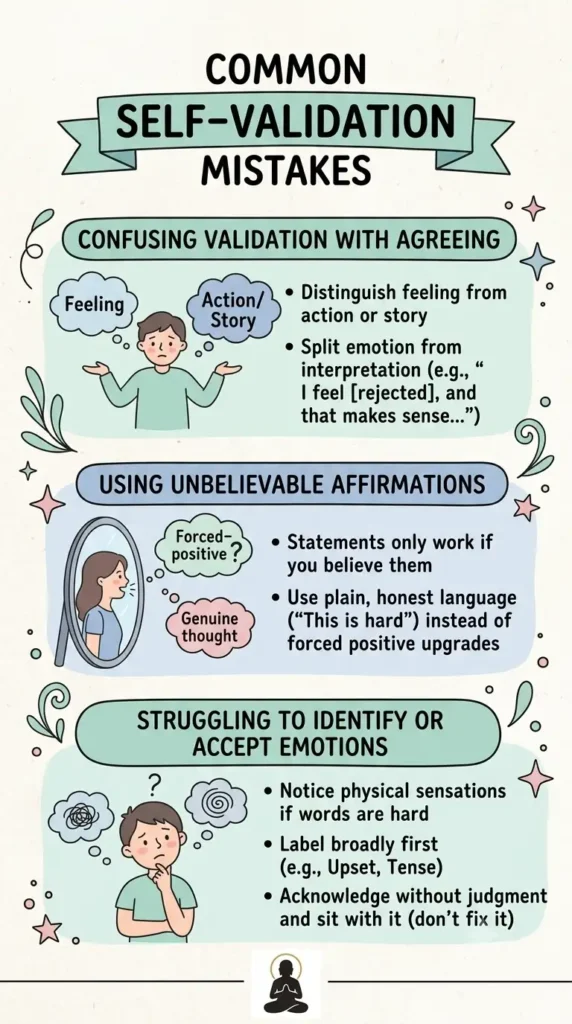
Self-validation sounds simple until you actually try it. Most people trip over the same three spots. You mix up accepting a feeling with agreeing with the thought behind it.
You reach for an affirmation that rings false the second you say it. Or you just can’t find the word for what you’re feeling in the first place. None of that means the skill is broken. It means a few small fixes are overdue.
Confusing Validation With Agreeing
This isn’t about agreeing with every thought that shows up. Validating a feeling and approving an action are two different moves. You can feel hurt after a friend cancels plans without deciding they’ve stopped caring about you. The feeling is real either way.
Try splitting the emotion from the story you’re telling about it. Say something closer to this: “I feel rejected, and that makes sense, because I was looking forward to seeing them.”
Then check what you actually know before you decide what to do next. Short pause. Real difference. This keeps your feelings respected while leaving room for other explanations to exist.
Naming the gap between emotion and interpretation gets easier with repetition, and it’s one of the core moves covered across DBT skills worksheets built for exactly this kind of practice.
Using Unbelievable Affirmations
Self-validation statements only work if you believe them. Tell yourself “everything is fine” while you’re clearly not fine, and your own inner voice stops trusting you. That’s the opposite of the point.
Start lower. Use plain, honest language instead of a forced upgrade. Try “this situation is hard for me” or “I’m disappointed, and I can give myself time with that.”
You don’t need to feel good to validate yourself. Naming what’s actually happening usually beats trying to talk yourself into a better mood. Reality first. Mood second, if it comes at all.
If you want ready-made language to practice with instead of building it from scratch every time, a coping skills worksheet can give you a starting script for harder days.
Struggling to Identify or Accept an Emotion
Sometimes the feeling is there before the word is. You know something’s off, but you can’t name it. Start smaller than the word. Notice the tight chest. The restless thoughts. The urge to just leave the room. Then reach for a broad label: upset, tense, overwhelmed. Close enough beats nothing at all.
If accepting the feeling feels uncomfortable, remind yourself that having an emotion isn’t a personal failure. Why does this part trip people up so often? Because most of us were taught to fix feelings, not sit with them. You can acknowledge an emotion without judging yourself for having it, and without acting on every urge attached to it.
With practice, naming it gets faster. Accepting it gets easier too. For a more structured way to build that vocabulary, the emotions worksheet breaks feelings down into categories that make the labeling step less of a guessing game.
Outside sources, including this breakdown of validation methods, point to the same pattern: naming comes before acceptance, not after.
Self-Validation vs. External Validation, Reassurance, and Self-Compassion
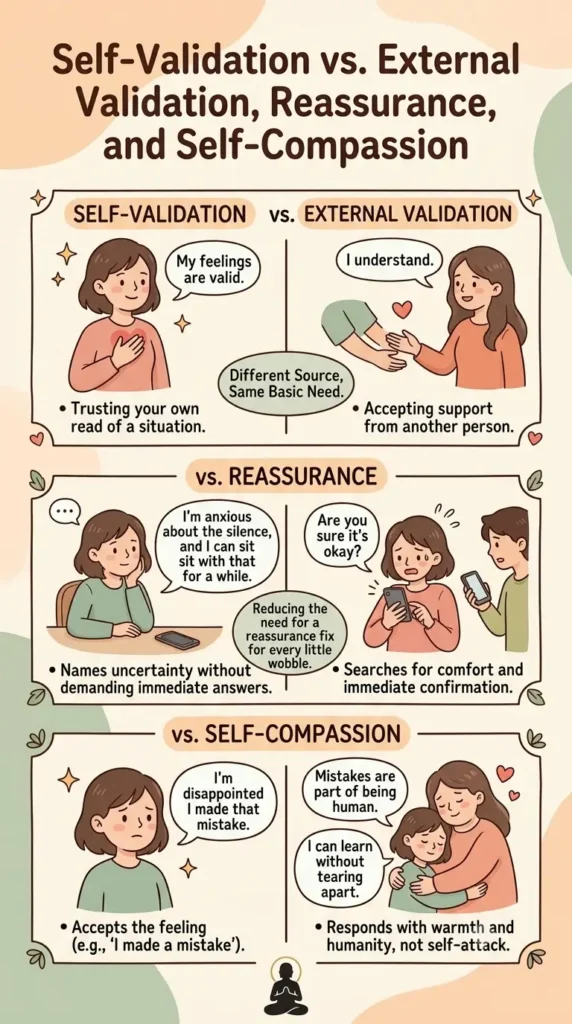
DBT self-validation means noticing your own feelings without judging them first. That’s the whole definition. External validation comes from other people. Reassurance chases comfort or certainty. Self-compassion adds kindness on top of all three. Four different tools. Four different jobs.
People mix them up constantly. Here’s where they actually split.
Self-Validation vs. External Validation
Self-validation says your feelings matter, even when nobody else gets it. External validation is someone else saying that back to you. Different source. Same basic need.
Say a friend cancels plans. The hurt is real either way. You can sit with that disappointment on your own. You can also tell your friend it stung. Neither cancels the other out. Trusting your own read and accepting support from someone else aren’t opposites. They just work at different layers.
Self-Validation vs. Reassurance
Reassurance hunts for comfort or confirmation, usually when something feels uncertain. Self-validation does something quieter. It names the uncertainty and whatever feeling comes with it, without demanding an answer right now.
Someone hasn’t replied to your text. The silence sits there. You might say, “I’m anxious because I don’t know what’s going on. I can sit with that for a while.” That’s self-validation doing its job. You can still ask for clarity later. Nothing wrong with that. The goal isn’t cutting out reassurance completely. It’s not needing it for every single wobble.
Self-Validation vs. Self-Compassion
Self-validation accepts what you’re feeling. Self-compassion goes further. It responds to that feeling with warmth instead of a lecture. Psychologist Kristin Neff has spent years researching this exact distinction, and her self-compassion research frames it as meeting your own struggles without the usual self-attack.
Picture the difference in one sentence each. Self-validation: “I’m disappointed I made that mistake.” Self-compassion adds the next line: “Mistakes are part of being human. I can learn from this one without tearing myself apart.”
Does Validating Mean You’re Always Correct?
No. Not even close. A feeling can be completely real while your read on the situation is still off. You can validate feeling rejected and still check whether rejection was ever the intent.
What is self-validation worksheet (the worksheet, not the skill)? It’s a guided way to practice the distinction above. Self-validation accepts the experience. It doesn’t let you skip checking the facts or choosing how you respond next.
Want a concrete starting point? Our emotions worksheet helps you name what you’re feeling before you try to sort out whether the story behind it holds up. Pair that with DBT emotion regulation skills like Check the Facts when the line between feeling and interpretation gets blurry.
What to Do When Self-Validation Does Not Seem to Work
Self-validation doesn’t always bring instant relief. That doesn’t mean you’re doing it wrong. Some days the ache just sits there, even after you’ve named it honestly. The goal was never to flip an off-switch on painful emotions. It’s to stop piling judgment on top of what you already feel.
When distress sticks around anyway, pair validation with a practical coping skill, or bring in extra support. Below are the three spots where people usually get stuck, and what to try at each one.
“I Still Feel Overwhelmed”
You can understand exactly why you’re upset and still feel wrecked by it. Both things happen at once. That’s normal. Self-validation isn’t a switch that turns off pain. It’s more like putting your arm around the feeling instead of fighting it.
If the distress feels intense, slow your breathing first. Ground yourself in the room you’re actually sitting in. Or reach for a dedicated distress-tolerance skill built for exactly this moment.
The DBT TIPP skill can bring down intense emotional arousal fast, using body-based tools like temperature change and paced breathing. Get the arousal down first. Decide what to do next only after that.
“I Keep Telling Myself I Shouldn’t Feel This Way”
Notice that thought. Don’t treat it as fact. “I shouldn’t feel anxious about this” sounds like truth, but it’s just a thought about a feeling. Swap it for something closer to reality: “I’m feeling anxious, and I can try to understand why.”
You don’t have to like an emotion to acknowledge it. You don’t have to agree with every thought that rides along with it either. Noticing the self-critical voice, without obeying it, is most of the work right there.
“I Don’t Know What to Do Next”
Once you’ve named what you’re feeling, ask a different question. What would actually help right now? Sometimes it’s rest. Sometimes it’s a calm conversation. Sometimes it’s just checking the facts before you react to a story your mind built on the fly.
If a situation tends to set off the same strong emotions again and again, don’t wait for it to ambush you. The DBT Cope Ahead skill lets you plan your response before the moment arrives, so you’re not scrambling for words in the middle of it.
When Additional Support May Help
Sometimes a worksheet and a breathing exercise aren’t enough. If emotional distress keeps feeling unmanageable, or it’s getting in the way of daily life, that’s worth bringing to a mental health professional trained in DBT. Self-validation works well alongside therapy. It was never meant to replace it, and you don’t have to carry all of this alone.
If you’re in the United States and you’re in a mental health crisis right now, call or text the 988 Suicide & Crisis Lifeline. It’s free. It’s confidential. It’s there for exactly this.
Conclusion
DBT self-validation is a skill that helps you acknowledge your emotions without judging yourself for having them. Whether you’re dealing with anxiety, shame, anger, or disappointment, you can learn to recognize what you feel, allow the emotion to exist, and understand why it makes sense in your situation.
You don’t have to agree with every thought or act on every urge to validate your experience. Start small, use a self-validation worksheet to reflect on difficult moments, and practise with patience. The goal isn’t to stop feeling difficult emotions; it’s to respond to them with greater understanding, self-trust, and care.
Frequently Asked Questions
1. What is self-validation in DBT, and how does it work?
DBT self-validation is the practice of acknowledging your emotions, thoughts, and experiences without judging yourself for having them.
It involves recognizing what you feel, allowing the emotion to exist, and understanding why your response makes sense in context. This can help you respond more thoughtfully.
2. How do you practise self-validation when you feel anxious or ashamed?
Start by naming the emotion without criticizing yourself. For example, say, “I feel anxious about this situation, and it makes sense that uncertainty is affecting me.” Then consider what triggered the feeling and what you need to respond effectively. A self-validation worksheet can help you practise.
3. Is there a free DBT self-validation worksheet PDF?
A DBT self-validation worksheet can guide you through identifying emotions, recognizing triggers, and writing validating statements. You can use a printable worksheet to practise with current feelings or reflect on past experiences. Check that the PDF is available for free before downloading it.
4. What is the difference between self-validation and external validation?
Self-validation means acknowledging and accepting your own emotional experiences, while external validation involves receiving understanding or recognition from other people.
Both can be valuable. Practising self-validation doesn’t mean you must handle everything alone or stop seeking support from trusted people.
5. Does self-validation mean accepting that your thoughts and actions are correct?
No. Self-validation means recognizing that your emotional experience is real and worth understanding, not assuming every thought is accurate or every action is appropriate. You can acknowledge feeling angry while questioning your interpretation of an event and choosing not to act on an unhelpful urge.
6. What should you do when self-validation does not make you feel better?
Self-validation doesn’t always reduce emotional distress immediately. If you still feel overwhelmed, try pairing it with a DBT distress-tolerance skill, such as TIPP or ACCEPTS, where appropriate. If intense emotions persist or interfere with daily life, consider seeking support from a qualified mental health professional.

It’s Bhaskar!
Well, I am not a psychologist a monk, or a philosopher by training. I’m just an engineering graduate.
‘The Empty Self’ is where I write about that idea, and what it actually means for ordinary life, anxiety, identity, habits, the stories we tell ourselves about who we are. I don’t have a psychology degree, and I’m not offering therapy or clinical advice. What I do have is thought and clarity, and genuine curiosity about why we suffer the way we do and how much of it might loose once we shed this ‘fixed identity’.
Pingback: DBT Interpersonal Effectiveness Skills: Ultimate Module Guide | The Empty Self
Pingback: DBT Mindfulness Skills: Module Guide With Free Printables and Worksheets | The Empty Self
Pingback: DBT Skills Cheat Sheet: All You Need to Know With Free Printables | The Empty Self