
You can see it coming. The family dinner. The performance review. The phone call you’ve been dreading. You know the day. You know the room. You know who’s going to be sitting across from you.
Planning the logistics is the easy part. What shows up in your chest when you’re actually there? That’s the piece most people never plan for.
Cope Ahead DBT closes that gap. It’s an emotion regulation skill. You use it to mentally rehearse your response. Before anxiety, anger, or guilt takes the wheel. Not after.
This guide covers all five steps. You’ll build a real cope ahead plan, pick the DBT skills with worksheets that support it, and grab the free printable worksheets waiting below.
Table of Contents
Disclaimer
This blog is written and edited with the help of AI, then reviewed by me before publishing. As a result, the content is for general reflection only, not therapy or medical advice, and I’m not a licensed mental health professional. If you’re in crisis, please contact 988 if you’re in US or a local crisis service of your country instead of relying on this site.
What Is Cope Ahead in DBT?
Cope Ahead DBT is a skill for getting ready before a hard moment hits. You name what’s coming. You pick a response. Then you rehearse it in your head, before the feelings show up and take over.
Cope Ahead Definition in Simple Terms
Think of it as a dress rehearsal for trouble you can already see coming. Most people wait until anger or fear or guilt is already running the show. Cope Ahead flips that order. You plan while you’re still calm enough to think straight.
Here’s the part people skip. You rehearse the response, not the event itself. Picture the criticism landing. Notice the urge to get defensive. Now practice the pause. Practice the calm voice. Practice the specific skill you’d actually use. That rehearsal is what makes the response available later, when your brain isn’t cooperating.
New to DBT skills? This one pairs well with the tools in our DBT skills worksheets collection, especially if you’re also working through emotion regulation worksheets.
What Is the Goal of the Cope Ahead Skill?
The goal is simple. Less uncertainty, more readiness. Rehearsing before the intensity spikes means the words or the actions feel familiar when you actually need them. Not brand new. Not something you’re inventing mid-crisis.
This isn’t a promise that things go smoothly. It’s not magic. It’s a bet that you’ll handle the discomfort better than you would have cold. That’s it.
When Is Cope Ahead Most Useful?
This skill earns its keep with predictable stress. A hard conversation. A presentation. An exam. A medical appointment. Thanksgiving dinner with the relative who always starts something. Anywhere you already know your reaction tends to run hot or shut down.
It also helps with repeat patterns. Maybe you always avoid. Maybe you always snap, or give in, or go quiet. Sound familiar? If you can name the situation ahead of time, you can prepare for it.
And if your usual coping skills tend to disappear under pressure, pair this with a broader coping skills worksheet practice, so you’re not relying on willpower alone when it counts.
Cope Ahead vs. Ordinary Planning
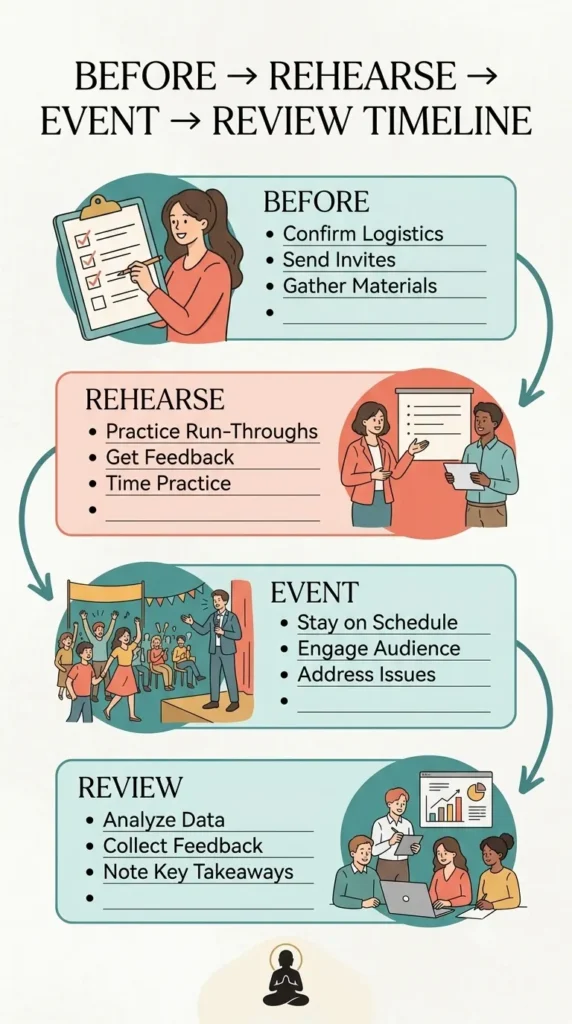
Ordinary planning gets the logistics right. Cope Ahead DBT does something else entirely. It rehearses how you’ll feel and react once you’re actually in the moment. Not just what to bring or say. You walk through anxiety, anger, guilt, and sudden urges before any of them show up for real.
It Prepares You for Your Emotional Response, Not Just the Event
Check the time. Pick an outfit. Decide what you’ll say first. That’s planning. Those steps matter. They don’t matter enough. None of them touch the feeling that can wreck the whole plan halfway through.
Cope Ahead covers that feeling and the urge riding behind it. Picture a presentation. You expect your mind to go blank halfway through the second slide. So you rehearse what happens next, not just the slides themselves. Before a hard conversation, you expect guilt to creep in. You rehearse holding the boundary anyway, instead of folding the second it gets uncomfortable.
It Includes Rehearsing Difficult Moments
Thinking “I’ll handle it” isn’t Cope Ahead. Not even close. You actually run the scene in your head. That includes the exact moment most likely to knock you sideways.
Use the “now, not watching yourself” rule. Picture the event from your own eyes, as if it’s happening right now, not like you’re watching a replay of yourself. Notice what you see, what you hear, what’s happening in your chest and jaw, and what you say next. Then rehearse your chosen response, inside that same scene.
Why bother with this much detail? A vague mental note doesn’t hold up under real pressure. A rehearsed scene does.
It Does Not Mean Imagining Everything Goes Perfectly
A good Cope Ahead exercise isn’t a daydream where everyone reacts exactly how you hoped. That’s a fantasy, not a skill. Build in the complication. Rehearse your response to that too.
Researchers split mental rehearsal into two types. Process rehearsal walks through the steps you’ll take and how you’ll respond. Outcome rehearsal mostly pictures success and stops there.
UCLA research on envisioning the future found real benefits from process-based rehearsal, since it makes the actual steps toward a goal concrete instead of vague. Newer work adds a wrinkle. Frontiers in Psychology research on mental simulation suggests process and outcome rehearsal can work together, depending on the situation.
The 5 Steps of Cope Ahead DBT
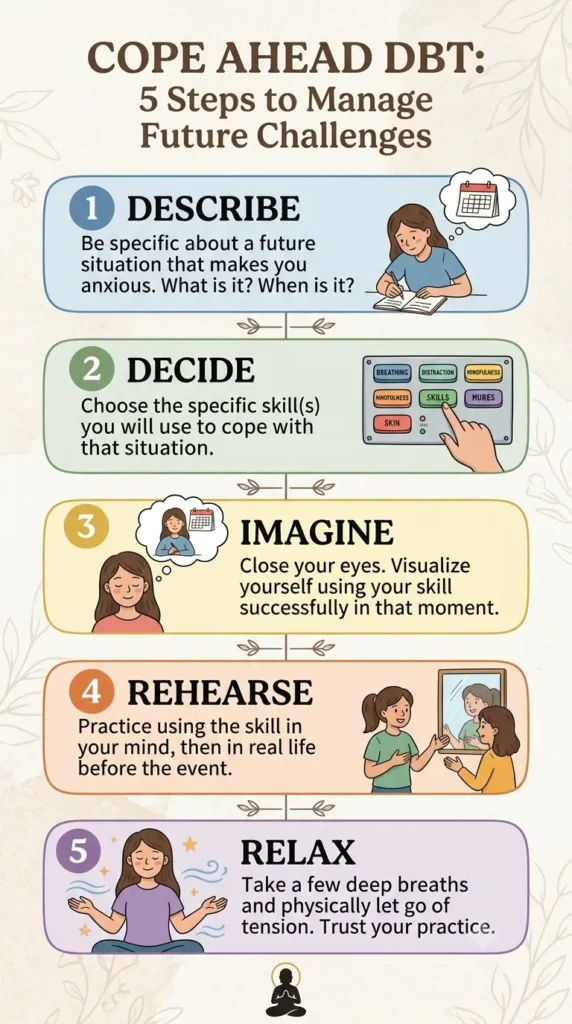
Cope Ahead DBT breaks into five steps, not six. You describe the situation, decide how you’ll cope, imagine it, rehearse it, and relax afterward. That’s the whole sequence.
Naming your emotions and the urges riding along with them happens inside Step 1. It’s not a separate step tacked onto the end. Some write-ups split it out anyway. That’s not how the skill actually works.
A simple way to remember it: Describe, Decide, Imagine, Rehearse, Relax.
That’s a memory aid, nothing more. It isn’t an official DBT acronym. A few AI-generated summaries turn emotion identification into a sixth bullet. The real Cope Ahead skill has five steps. Stick with five.
Step 1: Describe the Situation and Check the Facts
Start with the situation you’re bracing for. Get specific. Who’s going to be there? Where does it happen? When?
Vague planning produces vague results. “A hard conversation with my sister” doesn’t give you much to work with. “Calling my sister Thursday at 7pm about the holiday schedule” does.
Next, name what you expect to feel, and the urge riding along with it. Anxiety might show up with an urge to avoid. Anger might bring an urge to argue. Guilt often drags in an urge to just give in. An emotions worksheet can help you get more precise about which feeling you’re actually naming, since anger and hurt get mixed up more often than people think.
Then split fact from prediction. “My manager will meet with me at 10am” is a fact. “My manager thinks I’m incompetent” is a guess dressed up as one. Your brain won’t flag that difference on its own. You have to do it manually. That’s exactly what the Check the Facts skill is built for, and it pairs naturally with this first step of Cope Ahead.
Step 2: Decide Which Coping Skill You Will Use
This isn’t the moment to wing it. Decide your response now, while you’re calm, not later while you’re already overwhelmed.
“I’ll stay calm” isn’t a plan. It’s a hope. A real plan sounds more like: “I’ll say X, then pause before responding.” Specific enough to run on autopilot if you need to.
Match the skill to the actual problem, too. A tense conversation calls for something from interpersonal effectiveness. A body flooded with adrenaline calls for a distress tolerance skill instead. Different problems need different tools. Grab the wrong one and the rehearsal goes to waste.
Writing it down on a cope ahead worksheet turns the plan into something concrete, instead of a thought you’ll lose by tomorrow.
Step 3: Imagine the Situation as Vividly as Possible
Picture this from inside your own eyes. Not from above, like you’re watching a movie of yourself.
Where are you sitting? Who’s around? What happens right before the trigger hits? Maybe you’re at the kitchen table, coffee gone cold, and your dad finally says the thing you knew was coming. Pull in the real details: what you hear, what gets said, what your body does. A tight chest. Tense shoulders. A racing heart. The urge to bolt for the door.
Sound like overkill? It isn’t. Specific scenes are what make the rehearsal stick.
Step 4: Rehearse Coping Effectively
This is the longest part of Cope Ahead, and for good reason. You’re not just picturing the moment anymore. You’re practicing the exact response you want to use when it happens for real.
Run the scene and rehearse everything: what you’ll do, what you’ll say, how you’ll say it. Tone. Body language. The self-talk running underneath it. The coping skill you picked back in Step 2.
Don’t stop at the easy version. Add a problem. Maybe the other person interrupts you. Maybe they get defensive, ask something you weren’t ready for, or flat out refuse your request. Practice holding your plan anyway.
Then go further and rehearse the outcome you’re actually afraid of. Scared of being criticized? Imagine hearing it. Practice responding to that, not to a version where everyone behaves perfectly. The point was never to convince yourself nothing will go wrong. It’s to practice what’s actually in your control when something does.
That’s also why rehearsing the process beats rehearsing a successful outcome. You’re drilling the steps you’ll take, not just picturing yourself feeling confident or getting the result you wanted.
Step 5: Practice Relaxation After Rehearsal
Relaxation goes last, not first. Vivid rehearsal can spike your arousal before it settles it. Once you’re done practicing, give your nervous system room to come back down.
Paced breathing works. So does progressive muscle relaxation, or self-soothing, or any relaxation strategy that already works for you.
Here’s a practical suggestion of mine, not a rule from Linehan: time-box the rehearsal to roughly 10 to 15 minutes. A clear stopping point keeps Cope Ahead focused on preparation. Without it, “what if” thinking can quietly turn into rumination. That’s not the goal here.
How to Choose the Right DBT Skill for Your Cope Ahead Plan
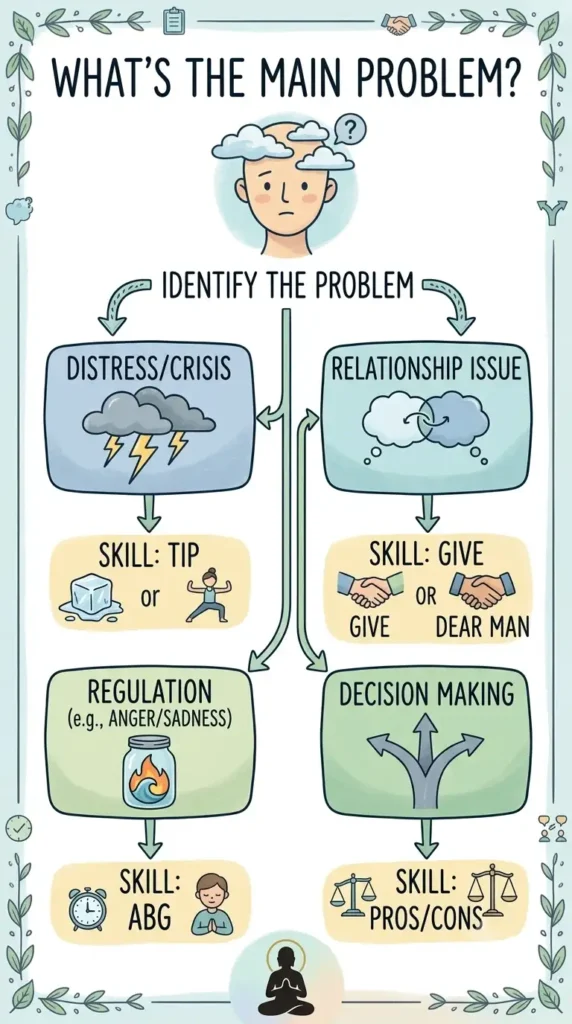
Most people pick a Cope Ahead DBT skill by topic. Wrong move. The skill has to match the problem, not the subject. A deadline and a doctor’s appointment can both call for different tools even though both feel stressful. Figure out what actually needs to change first. Then pick the skill. Keep the plan short, specific, and doable.
Problem Solving
Use this one when the situation has a fix. A real fix, not a feeling to manage. Running late on a deadline? Rehearse the actual moves. Email your manager. Cut the task list down. Pick a start time and stick to it. That’s the whole plan.
Opposite Action
Use this when the emotion doesn’t match reality. Anxiety says skip the party. You actually want to go, and nothing dangerous is waiting there. So rehearse the opposite. Walk in. Stay in the room. Talk to someone. The urge fades once you’re already moving.
Distress Tolerance
Some situations can’t be fixed right now. Waiting on test results is one of them. Your only job is getting through the wait without making it worse. Instead of refreshing your phone every four minutes, rehearse a crisis-survival skill. Ice water. A walk. Counting backward from 100.
Interpersonal Effectiveness
Use this when another person is the stressor. A hard conversation. A line you need to hold. Picture asking a family member to respect a boundary without caving and without blowing up. Rehearse DEAR MAN out loud, even once, before the real conversation happens.
Grounding and Self-Soothing
Sometimes the body gets loud before the mind does. Racing heart. Shallow breath. Before a medical appointment, rehearse naming five things you see, slowing your exhale, and holding something textured in your hand. Small. Physical. Repeatable.
One more rule, and it comes before all five. Check the Facts first. If the emotion doesn’t match what’s actually happening, start there. Everything downstream depends on getting that right.
Can You Combine More Than One DBT Skill?
Yes, and most real plans do. A single Cope Ahead worksheet can chain several skills together, one after another, each handling a different slice of the problem. Check the Facts, then DEAR MAN, then paced breathing if your body spikes mid-conversation. Nothing wrong with stacking them.
Want the broader toolkit behind this? The DBT skills worksheets hub has the full set, and the emotions worksheet pairs well with Check the Facts if naming the feeling is where you get stuck.
Free DBT Cope Ahead Worksheet (PDF)
The Cope Ahead DBT skill turns worry into a plan. Instead of just bracing for a hard moment, you walk through it first, on paper, while you’re calm. That’s the whole point.
This dbt cope ahead worksheet gives that skill a shape you can actually use. It walks you through naming the situation, predicting your emotions and urges, picking a response, rehearsing what could go wrong, and closing with something that settles your body down. Pair it with the full set of DBT skills worksheets if you want more tools for the same toolkit.
What the Cope Ahead Worksheet Helps You Plan
Most people picture coping ahead as a one-step thing. Think about the event, feel ready, done.
Not quite.
A solid cope ahead plan prepares you for two things: the situation you expect, and the moment that throws you sideways anyway. Because something usually does. Use the fields below to build the plan step by step.
| Cope Ahead Field | DBT Step | What to Write |
|---|---|---|
| Situation and facts | 1. Describe | What will happen, who will be there, when it happens, and what you actually know for sure. |
| Expected emotions | 1. Describe | Name the emotions you expect. Rate the intensity 0–10. |
| Action urges | 1. Describe | What you’ll feel pulled to do. Avoid. Argue. Apologize. Leave. Shut down. |
| Chosen skill | 2. Decide | Pick the DBT skill that matches the real problem, not the easiest one. |
| Exact response | 3–4. Imagine + Rehearse | The actions you’ll take, the self-talk that helps, the words you plan to say. |
| Complication plan | 4. Rehearse | What you’ll do if the situation gets harder than expected. |
| Worst-case rehearsal | 4. Rehearse | Picture the feared response. Practice handling it well. |
| Relaxation strategy | 5. Relax | Paced breathing, self-soothing, progressive muscle relaxation, or whatever calms you. |
| After-event review | Review | What happened. What worked. What didn’t. What changes next time. |
Here’s an honest take on that 0–10 rating: don’t expect it to hit zero. Rate your expected emotional intensity before you start. Rehearse. Relax. Then rate it again.
The second number isn’t a grade. It just shows whether the prep moved your arousal or your confidence at all.
If naming the feeling itself is the hard part, the emotions worksheet can help you get more specific before you fill in this one.
Free Printable Cope Ahead Worksheet PDF
Use the full worksheet when you’ve got real time to prepare. Maybe it’s a family dinner next week. Maybe it’s a hard conversation you’ve been avoiding for a month.
It includes space for the situation, the emotions, the urges, the skill you chose, your exact response, your complication plan, the worst-case rehearsal, your relaxation strategy, and the after-event review.
The printable cope ahead worksheet pdf fits both Letter and A4 paper. It prints fine in black and white too. Grab a paper copy for handwriting, or fill it in digitally if typing suits you better.
Want more structured tools in the same style? The coping skills worksheets collection covers situations beyond what Cope Ahead is built for.
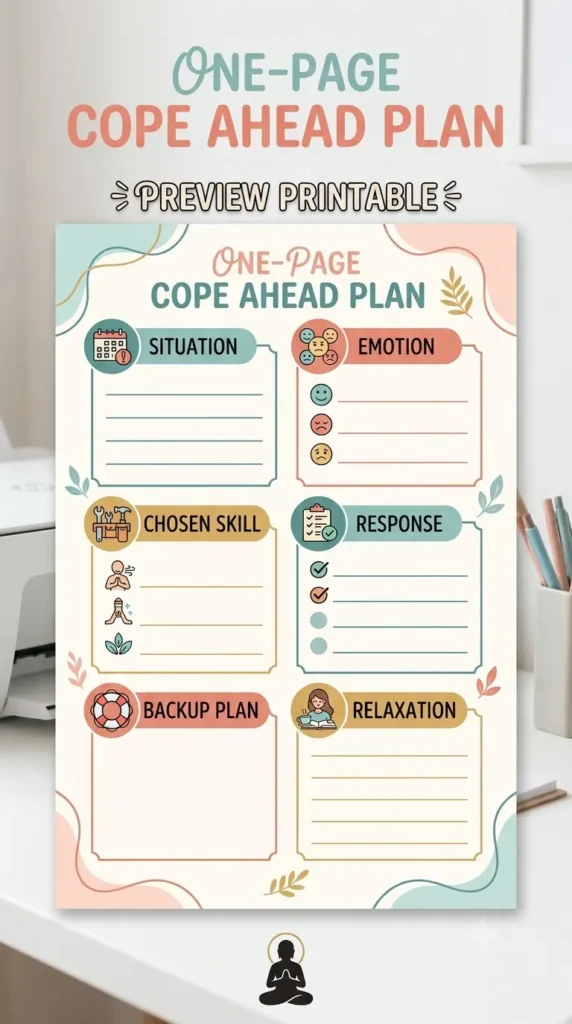
One-Page Cope Ahead Plan
Sometimes there’s no week to prepare. There’s an hour.
The one-page version is built for exactly that. It’s a shortened cope ahead worksheet for reviewing right before the event. Not everything makes the cut. Just the situation, the emotion and urge you expect, the skill you picked, your exact response, a backup plan, and one relaxation strategy.
Cope Ahead Worksheet Example: Filling It Out Step by Step
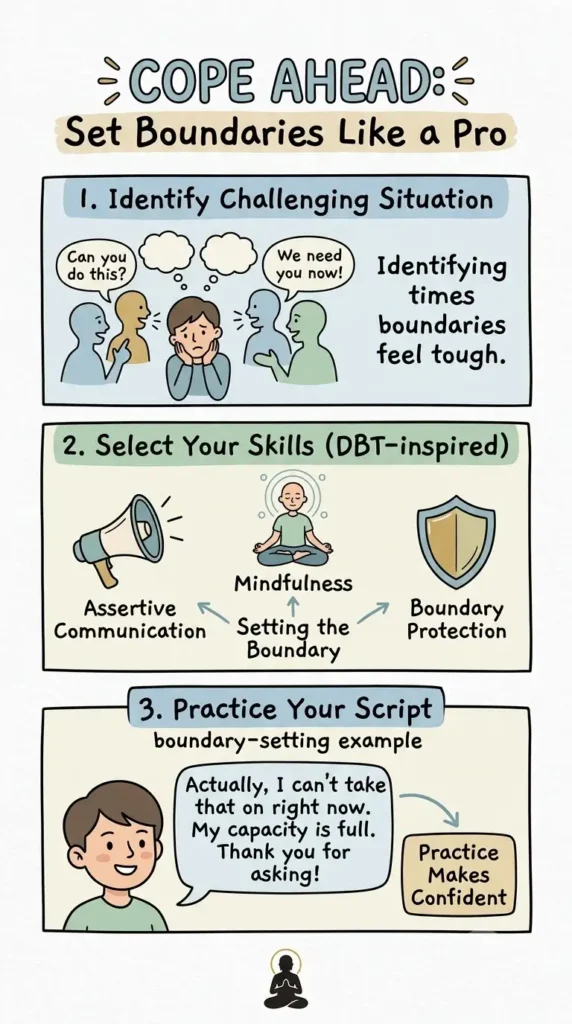
A blank Cope Ahead worksheet looks simple. Staring at it is the hard part. It gets easier once you stop treating it like a checklist of skills and start filling it out for one real situation. Below is a full walkthrough using a common one: setting a boundary with a family member.
Situation: Setting a Boundary With a Family Member
Say you’ve hosted the monthly family dinner for years. You can’t keep doing it. The task is simple to write down and hard to say out loud: tell a family member you’re stepping back from hosting.
Before the conversation, write down the facts. Not predictions. Not worst-case scripts. You can prepare for a hard response without deciding ahead of time that it’s coming.
Expected Emotions and Urges
Anxiety shows up first. Guilt follows close behind. And the urges that come with them are predictable: over-apologize, cave to the request, or skip the conversation entirely.
Writing these down isn’t about making the feelings go away. That’s not the goal of coping ahead. The goal is spotting what guilt and anxiety usually push you to do, then choosing a different move before you’re standing in the moment.
Choose Your DBT Skills
Don’t list every skill you know. Pick three and stop there.
- Check the Facts: Is saying no actually harmful, or does it just feel that way?
- DEAR MAN: How will you say the boundary clearly, without burying it in apologies?
- Paced breathing: What’s your plan if your body reacts before your words do?
A worksheet built around your emotions ahead of time makes this step faster. You already know which feelings tend to show up.
Rehearse the Conversation
Picture the conversation from your own eyes, not from above like a movie scene. Rehearse the opening line. Rehearse your tone. Rehearse the ask itself.
Something like: “I wanted to let you know I won’t be able to host the monthly dinner anymore.”
Then rehearse the thought that follows it. Guilt will show up uninvited. Let it. Just don’t let it drive. “Guilt is not proof I’m wrong” works as a quiet rebuttal.
Rehearse What Could Go Wrong
Now picture the version where it doesn’t go smoothly. The family member gets angry. Or goes quiet instead, which can feel worse. Your plan stays the same either way: stay mindful, repeat the point calmly, pause if you need to, come back to it later if things get too heated.
Rehearse the worst line too. “After everything I’ve done for you.” Sting first, then respond. Your job isn’t to win that sentence. It’s to acknowledge the feeling behind it without handing back the boundary you just set.
Review and Rate Your Intensity
After rehearsing, run a relaxation strategy. Paced breathing works. So does any calming technique you already trust. Then rate your emotional intensity before and after, on a 0–10 scale.
Maybe anxiety sits at an 8 before you practice. After, it drops to a 5. That’s enough. Zero isn’t the target here. You’re checking whether the rehearsal left you more ready to walk into the actual conversation, not whether it erased the nerves completely.
One more thing worth saying plainly: if the person you’re setting a boundary with is unsafe, threatening, or controlling, this worksheet isn’t built to carry that weight alone. Loop in a qualified mental health professional before you plan the conversation.
Cope Ahead Examples for Common Stressful Situations
Cope Ahead DBT works best when you match the skill to the actual problem. Not every detail needs a script. You just need the likely emotion, one skill pair, and a short rehearsal. That’s the whole method. Below are six situations where a cope ahead worksheet actually earns its keep.
Job Interview or Presentation
Anxiety doesn’t announce itself politely. It shows up as an urge to blank, rush through your answers, or skip the thing entirely. Pair Check the Facts with paced breathing. Check the Facts separates what’s realistic from what your nerves are predicting. Paced breathing settles the body while you do it.
Rehearse one hard question, then answer it slowly. Stay with the breath while you talk. Heart already racing before you walk in? The TIPP skill can bring the intensity down first.
Difficult Family Conversation
Anger wants to snap, interrupt, or say the one thing you’ll regret by dinner. Coping ahead means catching that urge before the conversation even starts. Pair DEAR MAN with GIVE. DEAR MAN gets your point across.
GIVE keeps the relationship standing afterward. Rehearse your main point out loud, once, calmly. Then picture the moment it gets tense. What do you say next? Hold the boundary. Don’t abandon it just because the room got uncomfortable.
Social Event or Social Anxiety
Fear tells you to skip it, leave early, or go quiet in the corner. That’s the urge talking, not the plan. Opposite Action flips the script. You rehearse walking in instead of rehearsing the exit. Picture yourself arriving.
Staying for a reasonable stretch. Saying something ordinary to a stranger even while your stomach is in knots. The anxiety doesn’t have to leave first. You just have to move with it in the room.
School Exam or Performance
Most advice assumes you’ll feel ready before you start. You won’t. Dread shows up as procrastination, scrolling, or the urge to quit before you’ve started. Combine Problem Solving with PLEASE. Problem Solving clears the practical roadblocks.
PLEASE protects sleep, food, and the basics your brain needs to function under pressure. Rehearse starting with one small task. Ten minutes. Not the whole chapter. Motivation shows up after you start, not before.
Medical or Dental Appointment
Fear can make canceling feel like the only reasonable option. It isn’t. Try Self-Soothing paired with Opposite Action.
Rehearse the whole sequence: arriving, noticing the anxious sensations, and staying anyway. The goal isn’t eliminating every uncomfortable feeling in the room. It’s taking the next step while the feeling is still there. One step. Then the next one.
Waiting for Difficult or Uncertain News
Helplessness breeds rumination. You check your phone again. You imagine the worst outcome, then the next worst one. Radical Acceptance paired with ACCEPTS is built for exactly this stretch of limbo.
You can’t rehearse the outcome. Nobody can. So rehearse the waiting instead. Rehearse how you’ll respond once an answer arrives, whichever direction it comes from.
What to Do If Your Cope Ahead Plan Stops Working
A Cope Ahead plan is a guide. It’s not a script. Real situations shift. Emotions spike higher than you planned for. People respond in ways you never rehearsed. When that happens, adjust the plan. Don’t treat the exercise as a failure. The actual skill isn’t perfect prediction. It’s responding well when things don’t go how you pictured them.
Your Emotion Is Stronger Than Expected
You get to the situation and the emotion hits harder than you braced for. Don’t force yourself through the original plan anyway. Pause first. Use the [STOP skill] to create space before you react. If your body feels wound up, add the [TIPP skill] or slow, paced breathing before you try to continue.
Here’s the reframe: a strong emotion means you need another skill first. It doesn’t mean your Cope Ahead plan failed.
The Situation Changes
Conversations shift. Settings change. The problem you rehearsed for might not be the problem in front of you anymore. Take thirty seconds. Check the facts. Name what’s different, then adjust your response to match it. You don’t need to restart the whole exercise.
A flexible plan beats a perfect one. Every time.
The Other Person Reacts Unexpectedly
You expected calm. What you got was anger, or silence, or someone shutting down completely. Don’t match their intensity right away. Pause instead. Validate what you honestly can, then repeat your main point without raising your voice. Return to the communication approach you already built, using tools like [DEAR MAN and GIVE].
You can only control how you communicate. Not how someone else reacts to it. That’s the whole point.
You Forget Your Planned Skill
Stress has a way of wiping out a plan you thought was locked in. The fix isn’t memorizing harder. Write a one-word cue instead. Try an index card, a lock-screen note, or a phone reminder that just says “Breathe,” “STOP,” “DEAR,” or “Pause.” That single word only needs to point you toward the next move.
You don’t have to remember the whole plan. Just the next skill in line.
You Start Ruminating Instead of Rehearsing
Rehearsal has a finish line. You picture the moment, practice the response, and stop. Rumination doesn’t stop. It loops through “what if” without ever landing anywhere useful. So time-box it.
Give the rehearsal a hard end point. Shift the question from “what if this goes badly?” to “what will I actually do if it does?” Then close it out with something calming, like a short relaxation exercise.
If the looping doesn’t let up and starts getting in the way of daily life, that’s worth bringing to a qualified mental health professional. Not a sign you’re doing it wrong, just a sign to get support.
Rehearsal exists to prepare you for one response. Not to predict every version of how the day could go.
The goal was never flawless emotional control. It’s giving yourself a real shot at responding skillfully when the moment turns out harder, messier, or just different than what you imagined.
For more structured tools to build that skill, the DBT skills worksheets hub and the coping skills worksheets guide are good next stops, especially if naming what you’re feeling in the moment is part of the struggle, which is where an emotions worksheet can help.
Cope Ahead vs. DBT Pros and Cons Worksheet
Cope Ahead and Pros and Cons get mixed up constantly. They’re not the same tool. Pros and Cons helps you decide whether to act on an urge mid-crisis. Cope Ahead helps you rehearse a response before the stressful moment even arrives. One is a decision. The other is a rehearsal. Once you see that split, picking the right worksheet gets easy.
What Pros and Cons Does in DBT
Pros and Cons is a Distress Tolerance skill. You pull it out when an urge is pulling you toward something that might backfire. Maybe it’s sending an angry text. Maybe it’s skipping a hard conversation altogether.
The worksheet makes you weigh it out. Short-term benefits of acting on the urge. Long-term costs. Short-term benefits of resisting it. Long-term costs of that too. Four boxes, one clearer picture. It’s not about feeling better in the moment. It’s about seeing past the moment.
When Pros and Cons May Be Useful Before Cope Ahead
Sometimes you’re not stressed about how to handle something. You’re stuck on whether to handle it at all.
Say you’ve got a hard conversation on the calendar and half of you wants to cancel. That’s not a rehearsal problem yet. That’s a decision problem. Pros and Cons is built for exactly this. Lay out what happens if you cancel. Lay out what happens if you show up. The short-term relief of avoiding it rarely holds up against the long-term cost.
Once you’ve decided to go through with it, that’s your cue to switch tools. Now you need a plan for staying grounded in the moment, and that’s where Cope Ahead takes over.
Why Pros and Cons and Cope Ahead Are Not the Same Skill
Here’s the whole difference in one line: Pros and Cons weighs a decision. Cope Ahead rehearses a response. Neither one replaces the other, and using the wrong one usually means walking away more confused, not less.
If what you actually need is the printable itself, grab the DBT Pros and Cons worksheet PDF. A quick comparison like this one can only take you so far. A full breakdown of the Pros and Cons worksheet, with a dedicated download, is the better place to land if that’s the skill you’re working on.
How to Practice the Cope Ahead Skill Effectively
Cope ahead DBT doesn’t work if you wait for the crisis to start it. The whole point is rehearsal before stress takes over, not damage control once it has. You’re not trying to predict every detail of what’s coming. You’re building a response flexible enough to survive contact with the real thing.
Practice Before the Event
Do this while you’re still calm. Not mid-argument, not five minutes before the appointment. Pick a quiet stretch, even just a few minutes, and picture the situation clearly. Then walk through the response you’ve chosen, step by step, like you’re already in it.
Calm is the ingredient most people skip. Try to plan a coping strategy while your nervous system is already flooded and the plan falls apart before you finish writing it.
Be Specific Rather Than Vague
“I’ll stay calm” isn’t a plan. It’s a wish.
Vague intentions dissolve the moment things get hard, because there’s nothing concrete to grab onto. Decide exactly what you’ll say, what you’ll do, and what you’ll remind yourself in the moment.
“I’ll pause, take one slow breath, and state my boundary” gives you something to actually follow. Your brain under stress doesn’t reach for abstractions. It reaches for the script you already rehearsed.
Rehearse the Expected and Unexpected
Start with the likely version of events. That’s the easy part.
Then go further. Picture one complication, one way the conversation goes sideways or the result lands differently than you hoped. What happens if the other person doesn’t play their expected role? Rehearse that version too.
This is where a cope ahead worksheet earns its place, since writing out the curveball forces you to plan past the best-case scenario. Real situations rarely follow the script exactly. The point isn’t to cover every branch. It’s to prove to yourself you can adjust without falling apart.
Repeat When Things Change
Plans go stale fast. A cope ahead plan built around yesterday’s situation won’t hold up if the trigger shifts, the stakes change, or new information lands. Update it. Don’t treat the first draft as final just because you already did the work once.
This isn’t failure. It’s maintenance.
Review What Worked Afterward
After the event, look back honestly. Compare what you rehearsed against what actually happened. Where did the plan hold? Where did it crack?
Write it down somewhere you’ll actually find it again, like a coping skills log where you track which strategies held up and which ones didn’t. If the experience left a heavier emotional residue, working through it with journal prompts for mental health can help you process what came up before the next time you need to cope ahead. Every round of practice, even the messy ones, makes the next plan sharper.
Where Cope Ahead Fits in DBT Emotion Regulation
Cope Ahead DBT doesn’t work alone. It’s one piece of a bigger emotion regulation toolkit, built for a specific job: rehearsing a hard moment before it happens. Not during. Not after.
That timing is the whole point. You spot a stressful situation coming. A family dinner, a tough review at work, a conversation you’ve been putting off. Cope Ahead gives you a way to walk through it in your head first, so the real version doesn’t catch you off guard.
Knowing how this skill connects to the others around it matters too. Pick the wrong worksheet for the problem in front of you, and you’re just adding another unfinished page to the pile.
Cope Ahead and Other Emotion Regulation Skills
This skill rarely stands by itself. Cope Ahead pairs naturally with Check the Facts, Opposite Action, and the PLEASE skill, and each one answers a different question.
Does the emotion actually fit the facts of the situation, or is your mind adding a story on top? That’s Check the Facts. Is the urge pulling you toward something that won’t help, fear telling you to avoid a safe but uncomfortable moment?
Opposite Action steps in there. And when your body is already running on empty, skipped meals, no sleep, PLEASE gets your physical baseline back under you before the emotional work even starts.
Here’s an honest take: most people try to use Cope Ahead in isolation and wonder why it feels thin. It isn’t meant to carry the whole load. Combine it with Check the Facts for accuracy and PLEASE for stability, and the plan you build actually holds up once the real situation arrives.
For the complete picture of how these skills fit together inside the module, the DBT emotion regulation skills guide breaks down the full sequence, and the broader DBT skills worksheets library covers every module beyond this one.
When to Use a Different DBT Worksheet Instead
Cope Ahead isn’t built for every emotional situation. Not even close.
It’s a preparation skill. It needs a future event to aim at, a dinner next Saturday, a meeting tomorrow morning. If you’re already underwater, mid-crisis, chest tight, thoughts racing, planning ahead isn’t what the moment calls for.
Distress tolerance skills are built for that instead. They’re designed to get you through the next ten minutes without making things worse, not to help you prepare for next week.
So match the worksheet to where you actually are. Prepare ahead when you have the time and the warning. Focus on surviving the crisis when it’s already landed on you. Mixing the two up wastes the one thing you don’t have enough of in either case: time.
Conclusion
Cope Ahead DBT gives you a practical way to prepare for stressful moments before they happen. Instead of hoping you will know what to do when emotions rise, you can identify the situation, choose a useful skill, rehearse your response, and practice settling your body afterward.
A cope ahead plan does not need to predict every detail or make anxiety disappear. Its purpose is to give you a clearer path when the moment arrives. Use the worksheet to turn an upcoming challenge into a specific plan, then review what worked afterward. With practice, coping ahead can make difficult situations feel more manageable and intentional.
Frequently Asked Questions
What is Cope Ahead in DBT?
Cope Ahead is a DBT emotion-regulation skill for preparing to handle an anticipated stressful situation effectively. You mentally rehearse the event, identify likely emotions and urges, and practice how you want to respond before the situation happens. The goal is preparation, not perfect emotional control.
What are the 5 steps of the DBT Cope Ahead skill?
The five steps are Describe, Decide, Imagine, Rehearse, and Relax. You describe the situation and check the facts, decide how you will cope, imagine the event clearly, rehearse your planned response, and finish with relaxation. Naming your expected emotions and urges happens within Step 1.
How do you use a DBT Cope Ahead worksheet?
Use a DBT Cope Ahead worksheet before the stressful event to turn your plan into specific actions. Record the situation, facts, emotions, urges, chosen skills, and planned responses. Rehearse the situation, rate your emotional intensity before and after, then review what worked once the event is over.
What is the difference between coping ahead and simply planning for a stressful event?
Coping ahead prepares you for your emotional response as well as the practical details of an event. Ordinary planning might cover where to go or what to bring. Cope Ahead also has you mentally rehearse triggers, emotions, urges, self-talk, words, and skillful actions you may need.
Which DBT skill should you use during a Cope Ahead exercise?
Choose the DBT skill that matches the main problem you expect to face. You might use Problem Solving for a practical issue, Opposite Action when an emotion does not fit the facts, or DEAR MAN for a difficult conversation. You can also combine skills when the situation calls for it.
Can I use a Cope Ahead worksheet for anxiety, difficult conversations, or social situations?
Yes, Cope Ahead can be used for anxiety, difficult conversations, social situations, appointments, and other predictable stressors. However, it should not be used to help you tolerate an unsafe or abusive situation. If trauma or personal safety is involved, consider planning with a qualified mental health professional.

It’s Bhaskar!
Well, I am not a psychologist a monk, or a philosopher by training. I’m just an engineering graduate.
‘The Empty Self’ is where I write about that idea, and what it actually means for ordinary life, anxiety, identity, habits, the stories we tell ourselves about who we are. I don’t have a psychology degree, and I’m not offering therapy or clinical advice. What I do have is thought and clarity, and genuine curiosity about why we suffer the way we do and how much of it might loose once we shed this ‘fixed identity’.
Pingback: DBT Self-Validation: Ultimate 2026 Guide With Free Worksheet & Printables | The Empty Self