

Self love advice often asks you to fake feelings you don’t have. Force a smile. Repeat a line you don’t believe yet. That’s not self love. That’s performance.
These journal prompts for self love work differently. No script to follow. Just honest questions that help you understand yourself, respect what you actually need, rebuild confidence, and make peace with the parts of you still hard to accept.
Quick overview: this guide holds 100+ self love journal prompts, sorted by purpose. Pick what fits your headspace right now. Skip the scroll through one giant list. Inside, you’ll find gentle prompts, deep ones, confidence builders, relationship prompts, body-acceptance prompts, growth prompts, morning and night prompts, and a set written specifically for Gen Z.
No forced positivity here. No diagnosis either. Just honest reflection you can actually use. Use the table of contents below and jump straight to the prompts you need right now.
Table of Contents
Disclaimer
This blog is written and edited with the help of AI, then reviewed by me before publishing. As a result, the content is for general reflection only, not therapy or medical advice, and I’m not a licensed mental health professional. If you’re in crisis, please contact 988 if you’re in US or a local crisis service of your country instead of relying on this site.
What Is Self Love, Really?
Self love isn’t about feeling amazing all the time. It’s about building a relationship with yourself that runs on respect, not hype. That’s the whole point of good journal prompts for self love. Journaling helps with that. It shows you how you talk to yourself. It surfaces what you need and where your boundaries sit. Some beliefs about your worth deserve a second look too.
Self love isn’t liking everything about yourself
Self love doesn’t mean liking every part of yourself. It means treating yourself with care, even after a mistake. Even when you’re disappointed in how you handled something. Even when you spot a habit you actually want to change.
That distinction matters. Forced positivity makes journaling feel fake. Writing “I love everything about myself” when you don’t believe it rarely helps. A more honest line works better:
“I don’t like how I handled that situation, but I can understand why I reacted that way, take responsibility, and decide what I want to do differently next time.”
That’s self love with some backbone.
Self-compassion fits right in here. Psychologist Kristin Neff’s research describes it as meeting your own pain with kindness instead of judgment. She names three parts to it. Kindness toward yourself. Seeing struggle as something everyone goes through. And staying aware of pain without letting it take over.
Self-compassion and self-esteem aren’t the same thing either. That same body of research treats them as two different ways of relating to yourself. If your inner critic tends to run the show, our journal prompts for mental health guide goes deeper on working through that pattern.
Self love vs. self-esteem vs. confidence vs. self-acceptance
These four words get used like synonyms. They’re not interchangeable. Each one describes something different about how you relate to yourself.
- Self love is the practice of treating yourself with care, respect, patience, and consideration.
- Self-esteem is how much value you feel you have overall.
- Confidence is trusting you can handle or learn one specific thing.
- Self-acceptance is owning who you are right now, strengths and flaws, without making that conditional on changing first.
You can feel confident giving a presentation and still struggle with self-esteem. That’s normal. You can accept that you’re introverted without loving every part of it. Both can be true. You can practice self love while working on habits you want to change.
That’s why the prompts ahead don’t all chase positive thinking. Some help you appreciate yourself. Others challenge your inner critic or help you name what you actually need. Some are about setting boundaries. Some are about making peace with your past. That kind of awareness overlaps with mindfulness work too, which we cover in our mindfulness journal prompts guide.
We go deeper on confidence in our upcoming confidence journal prompts guide.
How Journaling Supports Self Love
Journaling supports self love in a specific way. It helps you notice your needs. It helps you question harsh self-talk. It helps you spot patterns and make choices that actually respect who you are. This isn’t about filling pages with positive thoughts you don’t believe. It’s about building a relationship with yourself that’s honest first, kind second.
What journaling can help you notice
Journaling gives you a place to slow down. Not slow down in general, but slow down long enough to notice what’s happening under the noise. Patterns show up here that you’d otherwise miss. The way you talk to yourself when you mess up. The situations that drain you every single time. The boundaries you keep setting and then quietly ignoring. The wins you brush off before they even land.
Write one honest line, like “why did that conversation bother me so much,” and you’ll often learn more than a forced affirmation could ever teach you. Maybe you felt dismissed. Maybe you agreed to something you didn’t want. Maybe an old insecurity got poked.
That noticing matters because self love gets easier once you know what you actually need. Not what you’re supposed to need. What you need. Your journal becomes a record you can return to, something steadier than whatever emotion happens to be loudest on a given day. For prompts built specifically around that kind of noticing, journal prompts for mental health is worth a look.
What journaling cannot do on its own
Journaling helps you reflect. It doesn’t fix everything by itself. Writing about a painful conversation won’t rewrite how someone else treats you. It won’t erase a hard emotion just because you named it. And it’s not a stand-in for professional support when that’s what you actually need.
There’s also a line worth watching. Analyze the same thought too many times and reflection turns into another form of self-criticism. You’re not learning anymore, you’re just circling. If your entries leave you more distressed, more stuck, more overwhelmed than when you started, that’s the signal to stop. Switch to something gentler. Talk to someone you trust instead.
Why honest reflection beats forced positivity
Honest reflection wins because it gives you something to work with. Forced positivity doesn’t. Write “I love everything about myself” when you don’t believe a word of it, and you’ve just built a gap between what you feel and what you think you’re supposed to feel. That gap doesn’t close on its own.
A more useful line looks different. Something like, “I don’t feel confident about this part of myself yet, but I want to understand why.” Small. Honest. Actually true.
Self love was never about pretending insecurity, anger, jealousy, disappointment, or regret aren’t there. They’re there. Sometimes the most self-respecting thing you can put on the page is the plain truth. Then give yourself the patience to sit with what that truth is actually asking for.
How to Use These Prompts
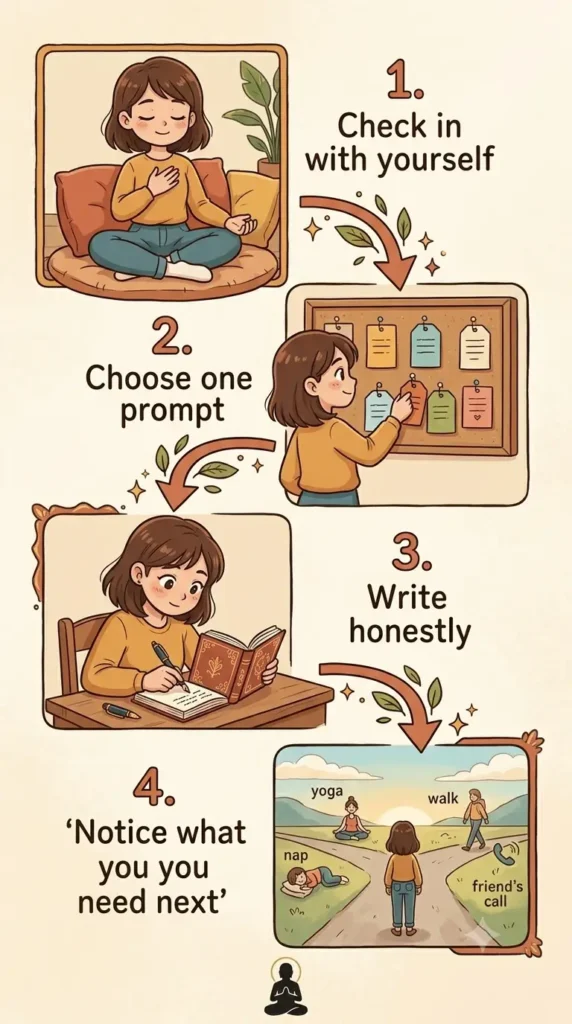
Self love journaling doesn’t need a rulebook. Treat these journal prompts for self love as invitations, not homework. Pick a question that matches your mood today. Give yourself room to answer honestly. Stop when you’ve said what needed saying. There’s no quota here. You don’t need to finish ten prompts for the session to count.
Pick one, not twenty
Start with one prompt. Just one. A single question can fill an entire page if you follow the thought instead of racing toward the next one. Sound like too much to plan out? It isn’t. Feeling overwhelmed? Choose the easiest prompt in the section that matches your mood. That’s allowed.
Write for 2, 5, or 10 minutes
There’s no perfect length for this. Two minutes works when you’re slammed. Five minutes covers a normal check-in. Ten minutes gives you room when there’s more to unpack. If sitting with your thoughts that long still feels unfamiliar, mindfulness journal prompts are a gentler place to start. When the timer ends, stop. Even mid-sentence. Even if the thought feels unfinished.
Skip the prompt that doesn’t land
Not every prompt will click, and that’s fine. A question that feels forced rarely leads anywhere useful. It’s 11pm, the page is blank, and the only prompt that feels true is the one you’ve been avoiding all week. Write that one instead. Rewrite a prompt in your own words if it helps. Answer “I don’t know yet” and move on. Or skip it completely. No prompt owns you.
Paper vs. digital journal
Both work. A paper journal slows things down. It makes the whole process feel more deliberate. A notes app catches thoughts the moment they show up, even at inconvenient times. The best self love journal isn’t the fancier one. It’s the one you’ll actually open again.
Revisiting old entries without judgment
Old entries aren’t a report card. They’re a record of where you were, not proof you were doing journaling “right.” Look for recurring needs. Notice which boundaries kept showing up, or how your self-talk shifted over time.
For a broader look at how reflection supports mental health over the long run, our journal prompts for mental health guide goes deeper into that kind of pattern-spotting. You’re reviewing a past version of yourself. Not grading them.
100+ Journal Prompts for Self Love
Self love journaling works best when the prompt actually matches what you need that day. Not what you wish you needed. This collection sorts 100+ journal prompts for self love by purpose, easy self-appreciation questions, deeper self-acceptance work, and the self-esteem prompts that build a steadier view of yourself.
Easy Self Love Journal Prompts
Feels awkward to start? Begin with questions you can answer honestly in under a minute. You don’t need a revelation. Noticing one thing you genuinely value about yourself is enough.
- What is one thing I like about myself today?
- What is something I handled well recently?
- What is one quality I have that makes my life better?
- What is something about myself that I often overlook but deserve to appreciate?
- When do I feel most comfortable being completely myself?
- What is one small thing I can do today that would make me feel cared for?
- What is something I have learned about myself recently?
- What is one decision I’ve made that I’m proud of?
- What is something I don’t need to be perfect at?
- If I treated myself like someone I genuinely cared about today, what would I do differently?
Self-Appreciation Journal Prompts
This isn’t about proving you’re better than anyone else. Self-appreciation just means noticing your qualities, your effort, your progress. Reach for these when your attention has drifted toward everything you haven’t done.
- What are five qualities I genuinely appreciate about myself?
- What is something difficult I’ve made it through that deserves more recognition?
- What personal strength has helped me during a challenging period?
- What is something about my personality that I wouldn’t want to change?
- What accomplishment am I tempted to dismiss as “not a big deal”?
- What do people who know me well tend to appreciate about me?
- What is something I do for others that comes naturally to me?
- What part of my personality becomes more visible when I feel safe?
- What is one skill I’ve developed that younger me would be proud of?
- What effort have I made recently that deserves credit, even if the outcome wasn’t perfect?
Appreciation gets easier once you widen the lens past yourself. If gratitude feels like the missing piece here, things to be thankful for is a solid place to take that practice further.
Self-Acceptance Journal Prompts
Self-acceptance isn’t pretending everything’s fine. It’s making room for who you are right now, imperfections included. Not fixed. Not finished. Just less at war with the parts you wish were different.
- What part of myself am I currently finding difficult to accept?
- What would change if I stopped treating this part of myself as something that needs to be fixed immediately?
- Which mistake from my past do I still use as evidence against myself?
- What expectation about who I “should” be is making it harder to accept who I actually am?
- Which of my personality traits have I criticized even though they can also be strengths?
- What is something I cannot change about my past but can choose to understand differently?
- When do I feel pressured to hide parts of myself?
- What would accepting myself today look like in an ordinary, practical situation?
- Which personal limitation can I acknowledge without turning it into an insult?
- If I stopped comparing my life to someone else’s, what would become easier to appreciate about my own?
Want prompts built specifically around self-compassion and quieting that inner critic? The self-esteem and self-compassion section of journal prompts for mental health picks up right where this one leaves off.
Self-Esteem Journal Prompts
Self-esteem shapes how you read a mistake, a compliment, a setback. These prompts build a grounded view of yourself. Not confidence manufactured through affirmations you don’t buy.
- What evidence do I have that I am capable of handling difficult situations?
- Which accomplishments do I rarely give myself credit for?
- What criticism from someone else have I accidentally turned into a belief about myself?
- When do I feel most competent and capable?
- What qualities remain valuable even when I fail at something?
- What standards do I use to decide whether I am “good enough”?
- Whose approval do I rely on most, and what happens when I don’t receive it?
- What would I say to a friend who judged themselves for the exact mistake I’ve made?
- What is something I can respect about myself even if I am still working to improve it?
- What would a more realistic and fair opinion of myself sound like?
What if I don’t believe the positive answer?
Don’t force it. If “I am amazing at everything I do” feels ridiculous on the page, it probably is. Write something you can actually defend instead. “I handled that conversation better than I would have a year ago.” Or, “I’m still learning, but I didn’t give up.” That’s it. Self love journaling holds up better when the reflection is honest enough to trust, not polished enough to impress no one but yourself.
Ready to build on this? A dedicated guide on self esteem journal prompts is coming next, with prompts built specifically around self-belief and the moments that quietly chip away at it.
Confidence: A Starting Point
Confidence and self-esteem get treated like synonyms. They’re not. Self-esteem is how you value yourself, full stop, no situation required. Confidence is narrower. It’s how capable you feel in one specific moment, one specific skill, one specific room. Want to work on confidence specifically?
Our journal prompts for mental health guide has a section on self-esteem that overlaps here, and a dedicated confidence journal prompts guide is coming soon to take these questions much further.
Self-Compassion and Inner Critic Prompts
This isn’t about becoming “better.” Not the point.
Self-compassion journaling earns its place when your inner voice gets harsher than the situation actually deserves. Skip the usual question.
Instead of asking how to improve, these self love journal prompts ask something different: are you speaking to yourself with the same fairness you’d offer someone you actually care about? Most people wouldn’t dream of talking to a friend the way they talk to themselves at 1am over one bad decision.
- What am I saying to myself about a recent mistake?
- Would I speak to someone I love the way I have been speaking to myself?
- What does my inner critic seem most afraid will happen if I make a mistake?
- Which part of myself needs understanding rather than criticism right now?
- What would a fairer interpretation of my recent failure or setback sound like?
- When did I first learn that being hard on myself was supposed to make me better?
- What expectations am I holding myself to that I wouldn’t place on someone else?
- What do I need to hear when I’m disappointed in myself?
- What is one mistake I can learn from without using it to define my character?
- If my inner critic had to provide evidence instead of insults, what would actually be true?
If staying present with that inner voice feels like the harder skill, mindfulness journal prompts can help you notice the critic without immediately believing it.
Self-Forgiveness Prompts
Forgiving yourself doesn’t mean pretending the mistake didn’t matter. It never meant that.
It means something smaller and harder. Acknowledge what happened. Take responsibility where it’s actually yours to take. Learn what there is to learn. Then stop using the past as a life sentence. That’s it. No dramatic reframe required, no forced closure by Friday.
- What am I still holding against myself?
- What exactly do I wish I had done differently?
- What did I know then, and what do I know now?
- What part of this situation was actually within my control?
- What responsibility belongs to me, and what responsibility doesn’t?
- What have I learned from this experience?
- If I could speak to the version of myself who made that mistake, what would I want them to understand?
- What would making peace with this part of my past look like?
- Am I seeking accountability, or am I repeatedly punishing myself?
- What is one way I can honor what I learned without continuing to hurt myself over it?
Carrying an old pattern instead of one clear mistake? Our healing journal prompts guide goes deeper into forgiveness work that a single prompt list can’t fully hold.
Body Acceptance and Appreciation Prompts
Body acceptance isn’t about loving every inch by Tuesday. Nobody does that.
It’s a more respectful relationship with your body, minus the pressure to rank it against anyone else’s. These prompts skip the usual traps on purpose. No numbers. No measurements. No before-and-after thinking dressed up as growth.
- What does my body allow me to experience, create, enjoy, or participate in?
- How has my body supported me through a difficult period?
- What messages about bodies have I absorbed from family, culture, advertising, or social media?
- When do I feel most disconnected from my body?
- What helps me feel more comfortable and present in my body?
- How would my relationship with my body change if appearance were not the main focus?
- What physical needs have I been ignoring lately?
- What does treating my body with respect look like today?
- Which body-related thoughts make me more critical of myself, and where did I learn them?
- What would body neutrality mean for me if I didn’t have to feel positive about my appearance every day?
Sound too small to count as progress? It isn’t. The goal was never to swap every hard thought for “I love my body.” For a lot of people, the more believable line is simpler: “My body deserves care and respect, even on days when I don’t feel good about how I look.” That’s still real self love.
Boundaries and Self-Respect Prompts
Self love gets real the moment it touches your actual limits. Boundaries are what you’ll accept, give, or take part in. Self-respect is what makes you hold that line once you’ve drawn it. Not just believe in it. Hold it. That’s the whole difference.
- Where in my life am I saying “yes” when I really want to say “no”?
- What am I afraid might happen if I set a reasonable boundary?
- Which situations consistently leave me feeling resentful, drained, or uncomfortable?
- What boundary do I already know I need to communicate?
- Where do I over-explain myself when a simple “no” would be enough?
- What behavior from other people am I tolerating because I don’t want to disappoint them?
- What does respecting my own time look like this week?
- Which of my needs do I tend to treat as less important than everyone else’s?
- How can I communicate one boundary clearly without apologizing for having it?
- What would change if I trusted myself to handle someone else’s disappointment?
A boundary doesn’t turn unreasonable just because someone dislikes it. That’s not the test. The real question is simpler: is it clear, does it fit the situation, and are you actually prepared to hold it?
Self-Care and Rest Prompts
Self-care isn’t a reward you unlock after finishing everything else. It’s not something you earn on the good days and skip on the bad ones. These self love journal prompts exist to help you notice what your mind and body need before exhaustion forces you to pay attention.
- What do I need more of right now: rest, connection, quiet, movement, play, or something else?
- What kind of rest actually helps me feel restored?
- When was the last time I allowed myself to rest without feeling that I had to earn it?
- Which responsibilities are taking more energy than I expected?
- What is one small act of care I can realistically give myself today?
- What do I keep postponing because I tell myself I should be productive instead?
- How can I make my usual routine a little kinder to myself?
- What signs tell me that I am approaching burnout or emotional exhaustion?
- Which activities genuinely recharge me, rather than simply distracting me?
- What would caring for myself look like if I stopped measuring its value by productivity?
If you want more prompts built specifically for slowing down and settling your mind, this mindfulness journal prompts guide picks up right where this section leaves off.
Gratitude fits naturally here too. It’s really just noticing what’s already holding you up. If you want to build that into your reflection, how to practice gratitude walks through the full approach.
Prefer something more structured than a blank page? Gratitude worksheets give you a simple, printable starting point for appreciation-focused journaling.
Relationships, Validation, and People-Pleasing Prompts
Self love isn’t something you build off in a bubble. How you show up with friends, family, partners, and coworkers is where it actually gets tested. That’s where approval-seeking shows up. That’s where needs quietly get dropped. That’s where being liked gets confused with being worthy.
- Whose approval matters most to me, and why?
- When do I find myself changing my personality to make someone else comfortable?
- What do I do when I worry that someone is disappointed in me?
- Where am I giving more than I genuinely have the energy to give?
- What am I afraid people will think if I stop being helpful all the time?
- Which relationships allow me to be honest without constantly managing how I am perceived?
- Do I ever agree with someone simply because disagreeing feels uncomfortable?
- What kind of treatment do I consider acceptable from people I care about?
- What relationship pattern keeps repeating even though I know it leaves me unhappy?
- How would I behave differently if I believed I could be worthy without being useful, agreeable, or constantly available?
People-pleasing looks generous from the outside. From the inside, it’s just tiring. You don’t need to slap a label on yourself here. “People pleaser” isn’t the point.
The point is noticing which choices come from real care and which ones come from fear of rejection. If these patterns feel bigger than a journal entry can hold, journal prompts for mental health goes further into that.
Social Media, Comparison, and Gen Z Self-Worth Prompts
Social media turns someone else’s carefully chosen highlight reel into a running commentary on your own life. These journal prompts for self love zero in on that specific problem: feeling behind in your career, appearance, relationships, finances, social life, or personal growth because of what showed up in your feed.
- What kind of social-media content makes me feel most inadequate or behind?
- Whose life do I compare mine with most often, and what am I assuming about their reality?
- Which parts of my life feel less valuable when I compare them with what I see online?
- What achievement do I want because it genuinely matters to me, and what achievement do I want because it looks impressive?
- How does my mood change after scrolling through content focused on appearance, productivity, money, or relationships?
- What parts of myself do I perform differently online than I do in private?
- If nobody could see my progress, what goals would I still want to pursue?
- What does “being behind” actually mean to me, and who taught me that timeline?
- Which parts of my life would I probably appreciate more if I stopped documenting or comparing them?
- What would I choose today if I weren’t trying to make my life look successful to someone else?
- Which accounts consistently leave me feeling grounded, inspired, or genuinely happy?
- What would a healthier relationship with social media look like for me without requiring me to disappear from it completely?
For Gen Z adults, this distinction matters. Comparison isn’t always about wanting someone else’s whole life. Sometimes it’s just one visible piece of their life used to judge the uncertain piece of your own.
A career announcement can trigger doubts about your career. A relationship post can make you question being single. A polished morning routine can turn an ordinary Tuesday into “proof” that you’re doing life wrong.
Your journal can interrupt that before it becomes a verdict. Write down what you actually know about your life. Not what someone else’s feed talked you into believing about it.
Inner Child and Younger-Self Prompts
This isn’t about diagnosing your childhood. Not even close. It’s about noticing what younger you needed to hear and never got. Journaling to your younger self surfaces old beliefs, unmet needs, and habits that still shape how you treat yourself now.
You don’t need a dramatic breakthrough. Sometimes the whole point is just noticing.
- What did younger me need to hear more often?
- What did I believe about myself as a child that I no longer believe today?
- Which parts of my personality did I learn to hide to feel accepted?
- What did I need permission to do, feel, or say when I was younger?
- What childhood experience still influences the way I respond to criticism?
- What would I tell the younger version of me who felt left out, misunderstood, or not good enough?
- Which expectations from childhood am I still carrying into adulthood?
- What did younger me enjoy before worrying about whether it was productive or impressive?
- What would make younger me feel proud of the person I’ve become?
- What is one way I can give myself the patience or encouragement I needed back then?
Future-Self and Growth Prompts
Self love and growth aren’t opposites. You can accept yourself fully and still want your habits, relationships, or choices to look different. These prompts build growth from self-respect, not from the idea that you have to earn your worth first.
Picture it. You’ve just closed your laptop after a long day, and instead of scrolling, you sit with one question: what would future me thank me for starting today? That’s the shift these prompts are after. Not “fix yourself.”
Something closer to making choices that already match who you value being. If you want a gentler entry point into that kind of reflection, pairing these with gratitude journaling can make the growth feel less like pressure and more like noticing.
- What kind of person do I want to become, and why?
- Which future goal actually feels like mine rather than something I think I should want?
- What would future me thank me for starting today?
- Which habit would make my everyday life feel more aligned with my values?
- What am I ready to stop carrying into the next chapter of my life?
- What does personal growth mean to me when nobody else can measure it?
- Where have I changed more than I give myself credit for?
- What part of my life needs patience rather than pressure?
- If I trusted that I didn’t have to have everything figured out, what would I explore next?
- What would growing into myself look like instead of trying to become someone else?
Growth holds up better when it isn’t built on self-rejection. “I need to fix myself” is a losing goal. “I want to make choices that fit the person I already value being” isn’t. You can check out the journal prompts for self growth to get amazing prompt ideas.
Deep Journal Prompts for Self Love
These questions don’t always have comfortable answers. That’s the point. Use them when you actually have the emotional space for honesty, not when you’re running on empty.
Skip anything that feels too raw, especially if it stirs up something you’re not ready to sit with alone. And if a prompt opens a door that feels bigger than journaling can hold, the journal prompts for mental health guide is a better starting point than pushing through here.
- What part of myself am I most afraid other people will reject?
- What do I believe I have to accomplish before I deserve to feel proud of myself?
- Where have I confused being needed with being loved?
- What am I still trying to prove, and to whom?
- Which version of myself am I exhausted from trying to maintain?
- What would I have to admit if I stopped pretending that something doesn’t bother me?
- Which fear has influenced more of my decisions than I would like to admit?
- What do I believe would happen if I stopped criticizing myself?
- What part of my identity is built around an old version of me that no longer exists?
- Where am I abandoning my own values to avoid disappointing someone else?
- What would self-respect require me to acknowledge right now?
- If I believed I was already worthy, what choice would I make differently?
Deeper isn’t automatically better. If a prompt leaves you spiraling instead of understanding yourself, close the journal. Go do something grounding instead, maybe a few rounds of mindfulness journal prompts to bring you back into your body. Self love includes knowing when to stop digging.
Fun and Whimsical Self Love Prompts
Not every entry needs to turn into a serious excavation of your childhood, your insecurities, or your five-year plan. Sometimes the most useful thing you can write is something a little ridiculous.
- If my personality were a cozy café, what would it look and feel like?
- What three things would I put in a “starter pack” for being me?
- If I could give myself a completely unnecessary but delightful gift today, what would it be?
- What fictional character would probably understand me unusually well?
- If my current personality had a playlist, what kind of songs would belong on it?
- What tiny, weird, or ordinary thing makes me happier than it probably should?
- If I could plan an entire day with no concern about productivity, how would I spend it?
- What would my ideal “do absolutely nothing” day look like?
- If my younger self could choose one adventure for us to have together, where would we go?
- What is something about me that is delightfully odd?
- If I had to describe my current life as a book title, what would I call this chapter?
- What is one thing I want to do simply because it sounds fun, even if it isn’t useful or impressive?
You can also download the complete 100+ journal prompts for self love combining all of the above.
Why bother with whimsy at all? Because it gives you room to notice parts of yourself that aren’t achievements, problems, or projects. That’s rare, and it matters.
If light-hearted reflection is more your speed right now, things to be thankful for and a set of gratitude worksheets are good next stops, low-pressure, playful, and still working in your favor.
Morning and Night Journal Prompts for Self Love
Morning and night journaling solve different problems. Morning prompts catch your needs, your intentions, and your self-talk before the day gets loud. Night prompts do the opposite job. They give you room to look back, notice what actually went right, and drop the judgment you’ve been carrying since lunch.
Morning Journal Prompts for Self Love
A good morning prompt should survive being answered half-asleep, coffee in hand, five minutes before the day takes over. That’s the whole test. If a prompt needs twenty quiet minutes and a candle, it’s not a morning prompt. Try one of these before you check your phone:
- What do I need from myself today?
- How can I speak to myself more kindly today?
- What is one thing I appreciate about myself right now?
- What boundary would help me protect my energy today?
- What would make today feel meaningful to me?
Most people skip the “boundary” question. It feels like the odd one out next to the softer prompts. But naming a boundary before 8am changes how you respond at 2pm, when someone asks for something you don’t have the energy to give. For a longer list built around this exact window, see morning journal prompts.
Night Journal Prompts for Self Love
Night prompts aren’t a scorecard. That’s the mistake most people make with them. Reviewing your day isn’t about grading it, it’s about noticing what you got right without needing a reason to feel guilty about the rest. Sit with these before bed:
- What did I handle better than I expected?
- Where was I unnecessarily hard on myself?
- What do I want to forgive myself for today?
- What is one thing my body, mind, or effort did for me today?
- What can I leave unfinished without criticizing myself?
That last one matters more than it looks. Most days end with something undone, an email, a workout, a hard conversation. Deciding what you can leave alone tonight, without turning it into evidence against yourself, is its own kind of self love.
For a fuller nighttime routine built around these questions, check out night journal prompts. And if you want prompts that work either time of day, mindfulness journal prompts is a solid next stop.
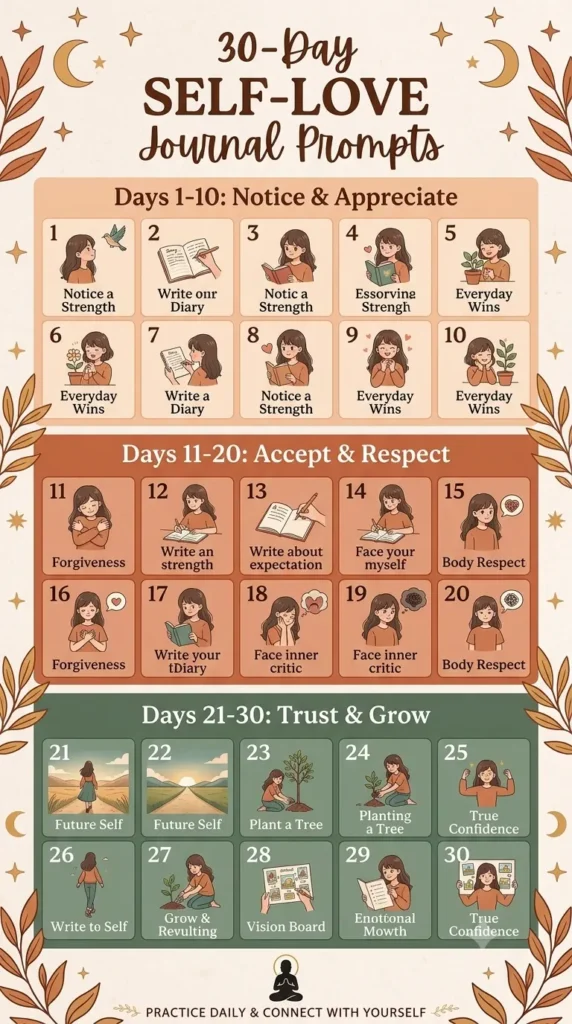
A 30-Day Self Love Journaling Challenge
Thirty days. One page a day. That’s the entire deal.
A 30-day self love journaling challenge gives you a reason to open the notebook again tomorrow, without turning the habit into another thing you’re failing at. Skip the constant positivity.
Nobody feels good every single day, and pretending otherwise defeats the purpose. Instead, you move through three stages: noticing yourself, accepting yourself, then making choices that actually reflect self-respect.
How the structure works
Set aside 5 to 10 minutes a day. Answer one prompt. Honestly.
You don’t need to fill a page. A few real sentences beat two paragraphs of filler every time. Write “I felt proud when I finished that email” and you’re done for the day. That counts.
The prompts get more reflective as the month moves on. Early days ask what you notice. Later days ask what you’re ready to accept. If you skip a day, don’t restart the whole thing and don’t try to cram two prompts into one sitting. Just pick up on the next question. A challenge that punishes you for missing a day isn’t self love. It’s just another streak to lose sleep over.
Grab a notebook, a notes app, or a dedicated self love journal. Whatever you’ll actually open again tomorrow. And if a prompt pulls up something you’re not ready to sit with yet? Skip it. Choose a gentler one instead. That’s not quitting. That’s pacing yourself, and pacing matters more than most journaling advice admits.
Some of these prompts pull from a much bigger well. Our full journal prompts for mental health guide covers similar emotional ground if you want more than 30 questions to draw from once the month ends.
Days 1–10, 11–20, 21–30
Days 1–10: Notice and appreciate. Start small. Your qualities, your everyday wins, the things you actually like about yourself without qualifying them. This stage borrows heavily from plain noticing, the same muscle behind how to practice gratitude. Notice a strength today. Notice a need tomorrow.
Days 11–20: Accept and respect. This is the harder stretch. Mistakes, boundaries, negative self-talk, forgiveness, body respect. What expectations have you quietly placed on yourself? Write about one. Then ask why it’s still there.
Days 21–30: Trust and grow. Finish by looking forward. Your values, your future self, your relationships, your confidence. What kind of life are you actually building, separate from your résumé or your last win? That question matters more than any goal-setting worksheet.
Sound too simple to work? It is. Simple is why people finish it.
Seasonal Self Love Journal Prompts
Three months get searched more than any other for self love work: January, February, July. That’s not random. January hands you a fresh page. February turns the spotlight from other people back to you.
July gives you room to catch your breath before the year runs out. Use these journal prompts for self love as check-ins, not one big overhaul of who you are.
January / New Year
January isn’t about becoming someone new. It’s about deciding what deserves your attention this year. Not a total reset, just a shift in focus. These new year journal prompts work best when they support who you already are. Not just your goals. Ask what needs care instead of what needs fixing.
Where have you been measuring your worth by output alone? That question alone can shift how the whole year feels. Pairing this kind of reflection with practicing gratitude tends to work better than chasing whatever’s next on the list.
- What part of myself do I want to understand better this year?
- What am I proud of carrying with me into this new year?
- Which expectation about myself am I ready to let go of?
- What would a kinder version of my goals look like?
- Where have I been measuring my worth by productivity?
- What do I want to make more room for this year?
- What boundary would make this year feel healthier for me?
February
Love doesn’t have to come from someone else first. February can turn strange fast, whether you’re single or seeing someone. Valentine’s Day makes love feel like something you win or lose. These february journal prompts for self love flip that. They aim the question back at you. How do you love yourself first?
Where have you been waiting for approval you could hand yourself? Small shifts here beat a card or a bouquet. If you want to keep the reflection going past February, these journal prompts for mental health pick up where this list leaves off.
- How do I want to feel loved by myself this month?
- What do I appreciate about the way I show up for people?
- What does being a good friend to myself actually look like?
- Where am I seeking validation that I could begin giving myself?
- What part of myself deserves more patience right now?
- What kind of love or attention do I no longer want to chase?
July Mid-Year Check-In
You’re halfway through the year already. That happens fast. July sits at a strange spot: far enough in to notice patterns, early enough to still change course. A self love journal check-in here beats waiting until December to ask what happened. Skip the scorecard. Don’t ask whether you’ve done enough.
Ask whether your choices still match what actually matters to you. That’s a different question, and it usually gets a more honest answer. Mindfulness helps here too.
These mindfulness journal prompts work well alongside a mid-year reset, especially if the point is noticing rather than judging. If one check-in isn’t enough, a 30 day self love journal prompts challenge can carry this reflection into the following month.
- What has changed about me since January?
- Which goal still feels meaningful, and which one no longer does?
- Where have I been treating myself with more respect?
- What has been draining me that I need to address?
- What do I want the second half of this year to feel like?
- What would I change if I stopped worrying about being behind?
Self Love Prompts
If you want a more focused collection of self love prompts, start with questions that help you notice what you appreciate, accept, need, and want to change without turning reflection into self-criticism.
These self love journal prompts can cover everything from confidence and boundaries to self-forgiveness and personal values. A dedicated guide can take these categories much further with prompts for specific situations and emotional states.
Self Love Journaling
Self love journaling is the broader practice of using regular writing to understand yourself with more honesty and compassion. Instead of answering random questions whenever inspiration strikes, you can use journaling prompts for self love to notice recurring thoughts, clarify your needs, recognize patterns, and turn useful insights into everyday choices.
A dedicated self love journaling guide can walk you through creating a sustainable practice, choosing prompts, and knowing what to do with what you discover.
Turning a Prompt Into an Actual Practice
A prompt does one job. It gets a pen moving. Journal prompts for self love only earn their keep after that, in the noticing that comes next.
That’s the part most guides skip.
Answering a question isn’t the finish line. Spotting the pattern is. Deciding what that pattern means is. Making one small change because of it is. Think of your notebook less like homework and more like a conversation with yourself that occasionally needs a follow-up.
Skip the follow-up and even the best self love journal prompts turn into a stack of pages nobody reads twice.
Answer → Insight → Action
Three steps. Nothing fancier than that.
Answer the prompt honestly. Not the version that sounds good. The real one. Insight comes next: look at what your own words just handed you. Action closes the loop. Is there one small thing worth doing differently this week?
Say you write, “I keep saying yes because I don’t want people disappointed in me.” Sit with that a second. The insight might be that approval is quietly running your boundaries. The action could be as small as pausing five seconds before agreeing to anything.
Five seconds. That’s the whole ask.
Not every entry needs a step three. Some days, just naming what you feel is enough. Force an action out of every page and journaling prompts for self love stop feeling honest. They start feeling like a checklist.
Turning Repeated Themes Into Habits or Boundaries
One entry rarely tells you much. Ten entries do.
If exhaustion keeps showing up. If resentment follows every time you help someone. If rest makes you feel guilty more often than not, stop treating each page like its own isolated thought. Read them together instead.
Ask one question: what keeps coming back?
A theme that repeats points somewhere specific. A boundary you haven’t set. A conversation you’ve been avoiding. A belief about your own worth that’s earned some pushback. Your journal was never built to hand down orders. It’s built to collect enough evidence so you can make a more informed call.
This is where self esteem journal prompts tend to earn their place. Not as a one-off exercise, but as a running record you check back against. If gratitude entries are part of your rotation too, gratitude worksheets work the same way, giving you a structured place to spot what actually lifts your mood instead of guessing.
When Entries Keep Turning Negative
Some prompts stop helping. They just hand you another reason to pick yourself apart.
If that’s what’s happening, don’t push harder. Change the question. Try, “What would I say to a friend in this exact situation?” Or, “What am I overlooking about myself right now?”
Notice the shift. Same honesty, less punishment.
Self love journaling should make room for the truth without turning that truth into a weapon against yourself. If writing consistently leaves you more rattled than when you started, that’s the signal. Step back from the deep prompts. Pick something grounding instead. Naming five things you can see. Naming one thing your body did well today.
Struggling to separate honest reflection from spiraling? The journal prompts for mental health guide walks through exactly that difference, including when a prompt is doing its job and when it’s time to close the notebook.
There’s real research on self-compassion showing that treating yourself with the same kindness you’d offer a friend tends to build steadier confidence than harsh self-judgment ever does.
Reviewing a Month of Entries
Thirty days of pages hold more than any single one does.
At month’s end, read a handful together. Don’t grade the answers. Look for the shape of the month instead. What did you need again and again? What actually got better? What kept catching you off guard? Which situations pulled out your harshest self-talk?
Then write one last question: “What do I want to carry forward from what I’ve learned about myself?”
That answer becomes next month’s starting line.
Want a gentler entry point before diving into deeper reflection? How to practice gratitude and a running list of things to be thankful for both pair naturally with a monthly review, especially on the weeks self-criticism gets loud.
And if presence feels like the missing piece, mindfulness journal prompts can slow the noticing down before you even pick up the pen.
When Journaling Starts Feeling Like Self-Criticism
Journaling should open a door, not build another wall. But it can slide into judgment fast. Every entry turns into a list of what you got wrong. Every “should” becomes a rule you’re breaking. When that starts happening, the practice needs a softer hand, not a stricter one.
Signs you’re turning journaling into self-punishment
Self-criticism rarely announces itself. It hides inside prompts that sound honest. You reread the same mistake five times and land nowhere new. You use words like “lazy” or “not good enough” as if they were facts instead of feelings. That’s the tell.
Here’s what it tends to look like on the page:
- Rewriting the same mistake without reaching a new insight
- Treating labels like “lazy,” “behind,” or “stupid” as objective truth
- Turning every prompt into a performance test you can fail
- Feeling worse after most sessions, not lighter
- Writing what you think you should feel instead of what’s actually there
A self love journal doesn’t need to sound positive on every page. Honesty holds value. Self-punishment doesn’t. Those are two different things wearing the same handwriting.
When to stop digging and choose something gentler
Some prompts pull you down instead of forward. If a question keeps sending you deeper into shame or spiraling thought, close the notebook. You don’t owe the page a finished entry.
Shift toward something grounding instead. Make tea. Take a shower. Step outside for ten minutes. Or write about something neutral you can observe right now, like the sound of traffic or the color of the sky. Small, mindful noticing resets the nervous system faster than another hard question ever will.
You can also swap the demanding prompt for a kinder one. Try this: “What would I say to someone I care about who was going through this?” Sound too simple to matter? It isn’t. That single shift in perspective is often enough to make the whole exercise useful again.
When journaling isn’t enough on its own
Journaling helps you notice patterns. It puts hard-to-name experiences into words you can actually look at. But it was never built to replace professional support, and it won’t. If writing leaves you distressed most of the time, or everyday functioning feels harder because of it, that’s a signal worth listening to. Reach out for real support instead of trying to write your way through everything alone.
For a wider set of prompts built around emotional wellbeing, see this guide to journal prompts for mental health.
Conclusion
Self love journaling isn’t about convincing yourself everything’s fine. Not even close.
It’s about getting honest. Honest about what you need, what you value, what you’ve survived, and how you actually want to treat yourself going forward. That’s the whole point of picking up a pen for this kind of work.
The right journal prompts for self love do something specific. They surface patterns that usually stay buried under comparison, self-criticism, or just a packed schedule. You start writing about one bad morning and end up seeing a habit you never named out loud.
You don’t need to answer every prompt either. Skip the ones that don’t land today. Come back to them later, or never.
Start with whatever question feels true right now. Don’t try to sound wise. Let the answer be messy, half-formed, unfinished. That’s allowed. If you want a slower, more grounded way in, pairing this with mindfulness journal prompts can help you notice what you’re feeling before you try to explain it.
Sometimes self love starts small. Smaller than a breakthrough. It starts with finally giving yourself permission to tell the truth on the page, and leaving it there.
Frequently Asked Questions
How to write a self love journal?
A self love journal is simply a private space for reflecting on how you treat, understand, and support yourself. Choose one prompt, write honestly for a few minutes, and avoid judging your answer.
You can write about your strengths, needs, boundaries, emotions, mistakes, relationships, or hopes for the future.
What are 10 ways to love yourself more?
Ten practical ways to practice self love include
speaking to yourself with compassion,
setting boundaries,
resting without guilt,
acknowledging your accomplishments,
accepting imperfections,
caring for your body,
spending time alone,
asking for help,
choosing relationships that respect you, and
making decisions based on your values rather than constant outside approval.
What are some examples of self love?
Self love can look surprisingly ordinary.
Saying no when you are exhausted, taking a break instead of pushing through, forgiving yourself for a mistake, eating when you’re hungry, leaving a disrespectful situation, celebrating your progress, or allowing yourself to change your mind are all practical examples of self love.
What are the 7 steps to loving yourself?
There isn’t one universal seven-step formula for self love, but a useful framework is to
notice your inner voice,
understand your needs,
accept your imperfections,
practice self-compassion,
set healthy boundaries,
care for yourself consistently, and
make choices that respect your values.
Self love develops through repeated behavior, not one breakthrough moment.
Why is self love so important?
Self love matters because it shapes how you respond to mistakes, relationships, boundaries, rest, and personal growth.
When your sense of worth isn’t entirely dependent on achievement or other people’s approval, it becomes easier to treat yourself with patience while still taking responsibility for the things you want to change.

It’s Bhaskar!
Well, I am not a psychologist a monk, or a philosopher by training. I’m just an engineering graduate.
‘The Empty Self’ is where I write about that idea, and what it actually means for ordinary life, anxiety, identity, habits, the stories we tell ourselves about who we are. I don’t have a psychology degree, and I’m not offering therapy or clinical advice. What I do have is thought and clarity, and genuine curiosity about why we suffer the way we do and how much of it might loose once we shed this ‘fixed identity’.
Pingback: 15 Free Coping Skills Worksheets for Kids and Adults | The Empty Self
Pingback: 10 Free Coping Skills Activities for Teens (Complete Gen Z Guide)! | The Empty Self
Pingback: DBT ACCEPTS Skill: Complete 2026 Guide With Worksheets and Exercises | The Empty Self
Pingback: DBT Interpersonal Effectiveness Skills: Ultimate Module Guide | The Empty Self