
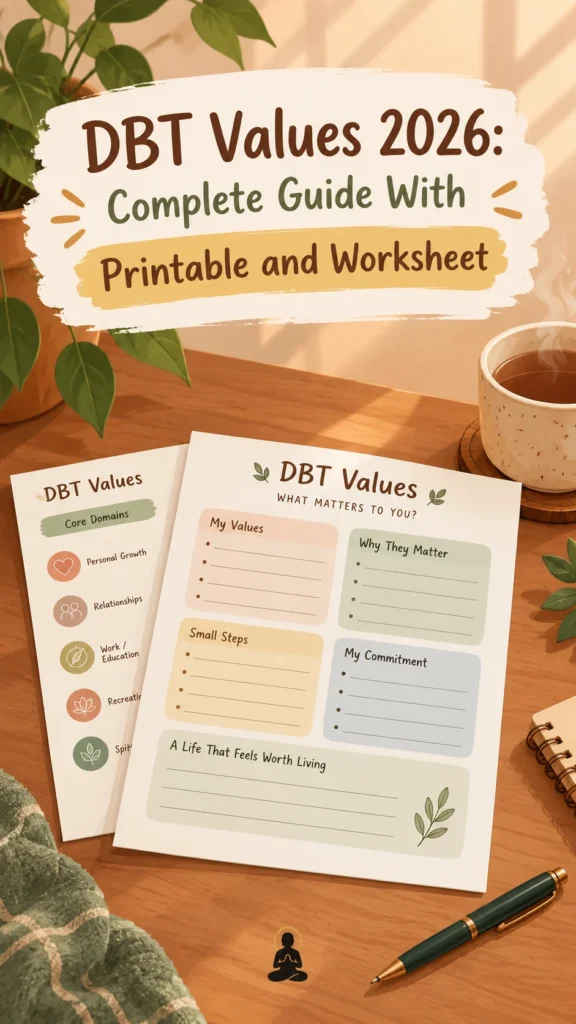
DBT values tell you what actually matters. In Dialectical Behavior Therapy, values work like a compass when stress clouds your thinking. That’s the whole point. Hard emotions make decisions messy. Competing priorities pull you one way while your values pull toward another.
Knowing your values isn’t the hard part. Living them is. You might value honesty, then stay quiet in the one chat that needed honesty most. Or you care about your health and still put others first. That gap is normal.
Why does that gap stay open? Usually because nobody ever taught you to name the value first. DBT writers call this the space between a stated value and real values-based action, and closing it is most of the work.
A DBT values list makes that gap visible. You see what you claim to care about. Then compare it to Tuesday. The mismatch between the two is the data.
Quick Overview: DBT values are personal principles that shape your choices day to day. A DBT values list helps you name what matters, set real priorities, and act in line with what you believe. A DBT values worksheet turns that list into something you practice, not just read.
This guide covers a full DBT values list and real examples. A printable DBT values worksheet rounds it out, inside the wider DBT skills worksheets library. Pair it with the coping skills worksheets collection for harder moments. Or use the emotions worksheet to name a feeling before you act on it.
Table of Contents
Disclaimer
This blog is written and edited with the help of AI, then reviewed by me before publishing. As a result, the content is for general reflection only, not therapy or medical advice, and I’m not a licensed mental health professional. If you’re in crisis, please contact 988 if you’re in US or a local crisis service of your country instead of relying on this site.
What Are DBT Values?
DBT values are the rules you live by. They shape how you treat people. They shape how you handle the hard moments too.
Emotions spike. Plans fall apart. Your values still point the way. You don’t need to feel good to act on what matters. That’s the whole point.
What values mean in Dialectical Behavior Therapy
In Dialectical Behavior Therapy, values are ongoing principles behind your actions. Honesty. Compassion. Independence. Learning. These are personal values, and they never really finish.
Goals have a finish line. Values don’t. You can finish a degree. You can’t finish being curious. You just keep choosing it, day after day, for the rest of your life.
That’s the real difference most people miss. A dbt values list isn’t a checklist. It’s a direction you walk in, over and over.
Why values matter when building a life worth living
DBT leans on one big idea: building a life worth living. Values point the way when anxiety, anger, or self-doubt makes the next step foggy.
They won’t erase the pain. They won’t promise an easy outcome either. What they do is simpler. They help you pick a response that actually sounds like you.
Here’s an honest take: most people skip this step. They react first and think later. A clear dbt values worksheet gives you something to check against before you act, not after.
Want more ways to put values into practice? Our DBT skills worksheets cover the full toolkit, not just this one piece.
Are DBT values the same for everyone?
No. Not even close.
One person values adventure and going it alone. Another leans toward stability, family, or community. Neither list wins. Both are valid.
Your values should reflect what actually matters to you. Not what a therapist expects. Not what your sister would pick. Not what looks good online.
Why does this trip people up? Because borrowed values feel hollow the moment things get hard. They crack under pressure because they were never really yours.
Where does the DBT values list actually come from?
This surprises a lot of people. There’s no single, official values dbt list from Marsha Linehan’s original model.
The life-domain exercise taught in distress-tolerance skills borrows from values-clarification work tied to Acceptance and Commitment Therapy, including the Valued Living Questionnaire. You can see this exercise laid out directly in Actions Based on Values.
So the dbt values and priorities list you’ll find online is really a blend. Different sources, same goal: helping you name what counts.
If a hard moment is testing your values right now, pairing this with coping skills worksheets can help you act on them instead of just naming them.

DBT Values List: Examples by Life Domain and Personal Value
A DBT values list isn’t a worksheet you fill out once and forget. It’s a map of what actually matters to you, not what you think should matter. Some people value family above everything.
Others build their whole week around work, or faith, or quiet time alone. Neither is wrong. A values and priorities DBT list just helps you name the difference, so your choices start lining up with what you say you care about.
The lists below split into two parts. One covers broad life domains. The other gets into the personal values, like honesty, curiosity, and compassion, that show up inside those domains. Use them side by side with a DBT skills worksheet if you want to turn reflection into practice.
The core DBT life-domains list
Ten domains show up again and again in DBT values work. They’re not exhaustive. They’re a starting point, a way to scan your life and notice where the gaps are.
Here’s where to start:
- Relationships: Building trust and meaningful connections.
- Family: Caring for and connecting with family members.
- Work: Finding meaning in your work and responsibilities.
- Friends and socializing: Developing friendships and enjoying social connections.
- Education: Learning, gaining knowledge, and developing skills.
- Spirituality: Exploring faith, purpose, or a sense of connection.
- Health and self-care: Supporting your physical and emotional well-being.
- Community: Contributing to the people and places around you.
- Parenting: Raising children with care, patience, and responsibility.
- Recreation: Making room for hobbies, fun, and relaxation.
Notice anything? Most people are strong in two or three of these and running on empty in the rest. That’s normal. The point of a core values DBT list isn’t balance across all ten. It’s honesty about which ones you’re actually living.
Personal values within each domain
Inside each domain sits a smaller, more personal layer. This is where the real texture is. Two people can both value “family” and mean completely different things by it, one leaning on loyalty, the other on freedom to be who they are even inside that family.
Here’s an illustrative breakdown:
- Personal growth: Curiosity, courage, wisdom, learning, and self-awareness.
- Relationships: Love, trust, loyalty, kindness, and belonging.
- Honesty and integrity: Authenticity, fairness, accountability, and self-respect.
- Health and well-being: Balance, resilience, patience, and self-compassion.
- Work and education: Reliability, creativity, achievement, and responsibility.
- Freedom and creativity: Independence, adventure, imagination, and flexibility.
- Community and compassion: Empathy, generosity, justice, and service.
- Spirituality and meaning: Purpose, gratitude, faith, and reflection.
- Joy and leisure: Humor, playfulness, enjoyment, and relaxation.
Pairing this with an emotions worksheet can help too. Values and emotions aren’t the same thing, but they talk to each other constantly. Notice which values keep surfacing when you’re angry, or disappointed, or genuinely at peace. That pattern tells you something a values list alone can’t.
If naming your values stirs things up, that’s worth tracking. Some people find coping skills worksheets useful alongside this work, especially when a gap between a stated value and daily life gets uncomfortable to look at.
For a deeper, structured dive into how values work inside the official DBT framework, Dialectical Behavior Therapy’s guide on values-based action is a solid reference point.
DBT Values and Priorities: What Is the Difference?
DBT values and priorities work together. They aren’t the same thing though. Values describe how you want to live. Priorities decide what gets your attention this week. Mixing the two up is where most people get stuck.
Values describe how you want to live
Values are the principles behind your behavior. Over time, not just today. They shape the kind of person you’re trying to be.
Think honesty. Think learning. Think family, or compassion toward people who’ve hurt you. None of these finish. You don’t check honesty off a list and move on. You practice it again tomorrow, and the day after that.
Priorities identify what needs attention now
Priorities work differently. They point to where your time and energy go right now, given what’s actually happening. Your values hold steady. Your priorities shift week to week, sometimes day to day.
Say you value both education and health. An exam is coming up. For a few days, studying takes the lead. After the exam? Sleep and exercise climb back to the top of the list.
Neither choice means you dropped the other value. You just moved your attention. That’s the whole mechanism.
How to create your own values and priorities list
Building a DBT values list starts with one line, said to yourself honestly:
“In my own Wise Mind, I believe it is important to…”
From there, four steps:
- List: Write down what matters, without editing yourself as you go
- Select: Narrow it to the values that actually feel true in your life
- Rate: Notice how important each one is, and how much real attention it’s getting right now
- Prioritize: Pick one value and give it a single small, doable action this week
Wise Mind, the DBT concept that brings feeling and reason to the same table, is what makes this list honest instead of aspirational.
It keeps you from writing down values you think you should have, and closer to the ones you actually live by. If you want to slow down and work through this reflection properly, our mindfulness journal prompts pair well with the listing step above.
Example: Balancing family, education, and self-care
Picture a college student who values family, learning, and health. Exams are a week out. A family gathering lands on the exact same weekend the study plan called for.
Nobody has to lose here. The student blocks real study time, trims the family visit down instead of skipping it, and still protects enough sleep to function. Every value stays honored. Nothing gets abandoned, just resized for the week.
That’s the real goal. Not equal attention to every value, every single day. Just choices that actually reflect what matters, given whatever week you’re standing in. If you want a structured place to track how your values and priorities shift month to month, a DBT skills worksheet can hold that reflection alongside your other practice.

DBT Values vs. Goals: How to Tell Them Apart
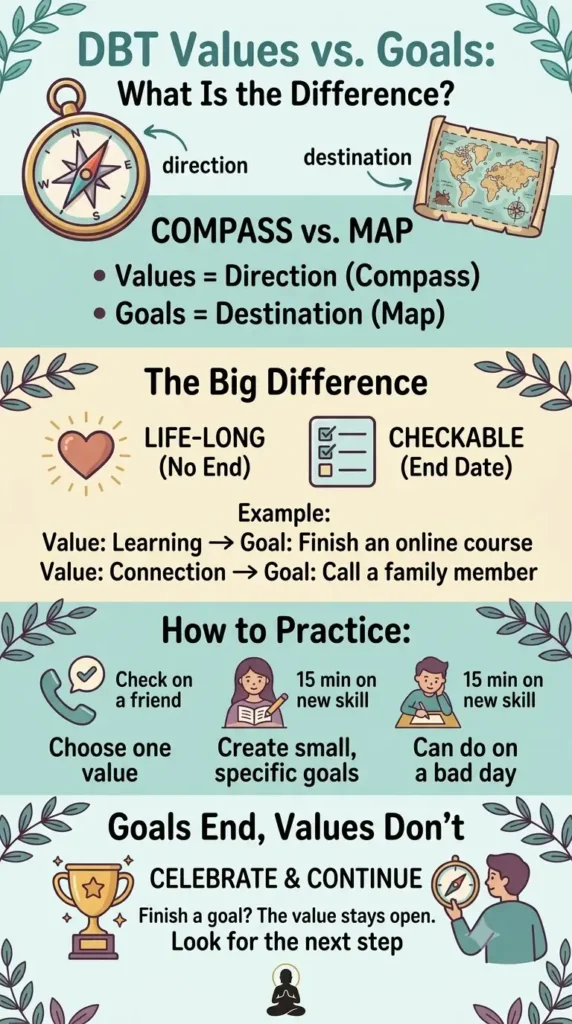
DBT values and goals get confused constantly. That’s the first problem worth fixing. A value points you in a direction. A goal is something you finish. Knowing the difference changes how you handle a stalled plan or a slow week. It stops you from mistaking a missed goal for a failed life.
Values and goals are not the same thing
Picture a compass next to a map. The compass is the value. The map’s destination is the goal. One tells you which way to walk. The other tells you when you’ve arrived.
Honesty works as a value you carry for life. You don’t finish being honest. A single honest conversation with a friend, though? That’s a goal. You can complete it, check it off, move on. Once it’s done, honesty is still sitting there, waiting for the next situation that calls for it.
A few pairs from a typical DBT values list make the pattern obvious:
Value: Learning. Goal: Finish an online course this month.
Value: Connection. Goal: Call a family member every Sunday.
Value: Self-care. Goal: Take a 20-minute walk four days this week.
Notice something? Every goal has an end date. Every value doesn’t. That’s the whole test.
Start by picking one value that actually matters
Choose a value first. Then ask one question: what would living this out look like this week? Not this year. This week.
Value compassion? Check in on a friend who’s been struggling. Value personal growth? Spend fifteen minutes on a new skill before bed. Small, specific, doable.
Don’t overhaul your whole routine to match a value. That’s not the assignment. Keep the goal small enough that you’d actually do it on a bad day.
Some actions need more setup than others. A hard conversation. A tough decision. A situation you can already see coming. When that happens, the DBT cope ahead skill helps you plan for it before the moment shows up and your nerves take over.
Finishing a goal doesn’t mean you’re done living that value
Goals end. Values don’t. That’s the part people forget.
Finish an online course and you haven’t stopped valuing learning. Hit a fitness target and health doesn’t suddenly stop mattering. The goal closes. The value stays open.
So what now? Celebrate the win. Then look for the next small choice that fits the same direction. Nobody needs a flawless life here. The aim is staying pointed the right way, one decision at a time.
A DBT values worksheet can make this easier to track. Lay your values and priorities side by side with the goals attached to them, and the pattern from this section gets a lot easier to see on paper, not just in your head. Pair it with the broader DBT skills worksheets library if you want more tools for the modules behind this one.
How to Identify Your Core Values Using DBT
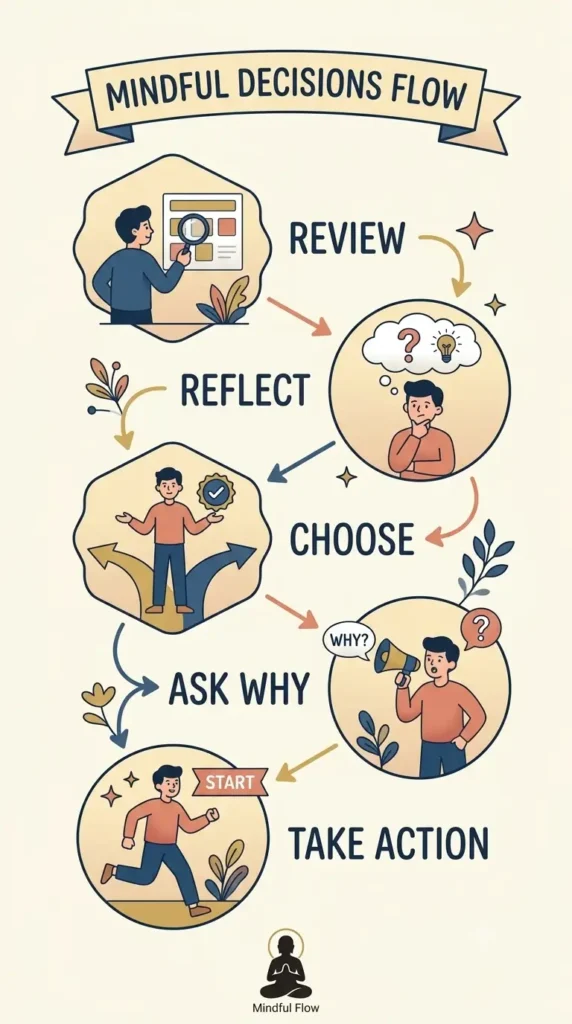
Figuring out your DBT values isn’t about building a perfect list. It’s about catching what already matters and giving it a name. You don’t need everything figured out. Start honest. Pick what feels true. Turn it into something small you do today.
Step 1: Review the list without judging your choices
Pull up a DBT values list and circle whatever catches your eye. Honesty. Independence. Kindness. Creativity. Security. Don’t grab a word just because your family rates it highly. That’s their value, not yours. Notice what pulls at you, even the ones that surprise you. Why does one word stand out more than the rest?
Step 2: Think about moments when you felt fulfilled or proud
Go back to a moment that stuck. A time you felt proud, connected, or settled with how you handled something hard. What made it matter? Maybe you stood your ground.
Maybe you showed up for a friend who needed you. Maybe you kept going after a setback that should’ve stopped you. These moments hold clues. Sit with one for a minute. For more guided reflection, these self-love journal prompts can help pull the thread further.
Step 3: Choose three to five values that matter most
Narrow it down. Three to five, not fifteen. You can always revisit this later. Nothing here is permanent. The goal isn’t ranking your whole personality on a page.
It’s naming a few things that can steer a decision when you’re stuck. Your values and priorities will keep shifting a little until you test them against real life, and that’s fine.
Step 4: Ask why each value matters to you
For every value on your short list, ask why. Just why. If independence made the cut, is it really about freedom? Or is it confidence? Or just wanting to make your own calls without someone else’s voice in your head? This step separates what’s actually yours from what you inherited. Most people skip it. Don’t.
Step 5: Identify one action for each value
Pick one small move for each value. Something realistic. If connection matters, call a friend tonight. If health matters, take a ten-minute walk or let yourself rest without guilt.
A value on paper does nothing on its own. Working through a DBT values worksheet alongside this step turns the value into a habit instead of a one-off. Core values in DBT only earn their keep when they shape what you do. Not what you write down once and forget.
DBT Values Worksheet: Printable Exercise to Identify Your Priorities
A DBT values worksheet isn’t a personality quiz. Not even close. It’s a structured way to name what matters, rate it, and act on it. Guided reflection. Not a test. Nobody passes or fails a worksheet about their own life.
Values work like this sits close to the DBT emotion regulation module, where checking what you feel against the facts matters just as much as naming what you value.
What the DBT values worksheet includes
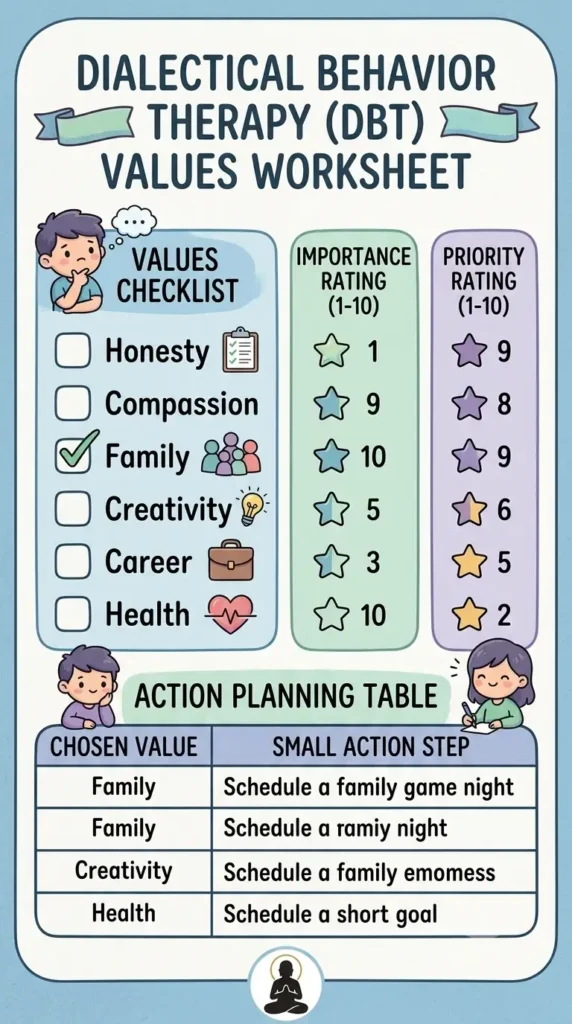
This one goes further than the standard three-value handout some DBT programs use. Formats vary. Some run looser, some run tighter. Here, you get a checklist, reflection prompts, and ratings for importance and priority. Plus an action plan and a review section. Five pieces, one page, nothing missing.
That matters more than it sounds. A values and priorities list alone tells you what you care about. It doesn’t tell you where to put your energy today. The ratings handle that part. The action step turns reflection into something you actually do, not something you read once and forget by Thursday.
This worksheet also sits inside the wider DBT skills worksheets library. Worth a look if the full module breakdown would help too.
How to complete the worksheet step by step
Five steps make up the whole process. Nothing hidden, nothing skipped.
First, scan the DBT values and priorities list. Mark whatever feels true, not whatever sounds impressive on paper.
Second, rate each one. Score how important it is, and how much attention it’s pulling right now. Those two numbers won’t always match. That gap is useful information on its own.
Third, reflect. Write why each core value actually matters to you. A line or two is enough. Skipped something? Say why, briefly.
Fourth, plan one action. Just one. Pick something small enough to finish this week. If the action involves a hard conversation or something coming up, Cope Ahead pairs well with this step.
Fifth, review. Note what helped, what got in the way, and what you’d change next time.
Completed DBT values worksheet example
Picture a student working through this worksheet. She picks learning, health, and connection as her three core values. Learning turns into twenty minutes of studying after class. Health becomes a short walk, nothing dramatic. Connection means calling a friend, not just texting back a thumbs up.
It’s Tuesday night, the walk never happened, and health slides down the list again. That’s the whole trick, though. An abstract value gets a real, physical spot in an ordinary day. “Health matters to me” sounds nice and does nothing on its own. A ten-minute walk after dinner actually happens.
Naming why a value matters can be the hardest step. These journal prompts for self-love help with exactly that.
How to review and update your values over time
Values don’t expire. Priorities do.
Check back on the worksheet every few weeks, or sooner if life shifts hard. Health might stay important for years while the attention it needs changes by the month. That’s normal. It’s not a sign you got it wrong the first time.
For the clinical source behind worksheets like this, Guilford Press publishes Marsha Linehan’s DBT Skills Training Handouts and Worksheets. Pair this one with an emotions worksheet if naming what you feel is still the hard part.
These journal prompts for mental health work well for the review step too. For bigger action plans tied to other values, the coping skills worksheets library has more structured options.
How to Put DBT Values Into Practice in Everyday Life
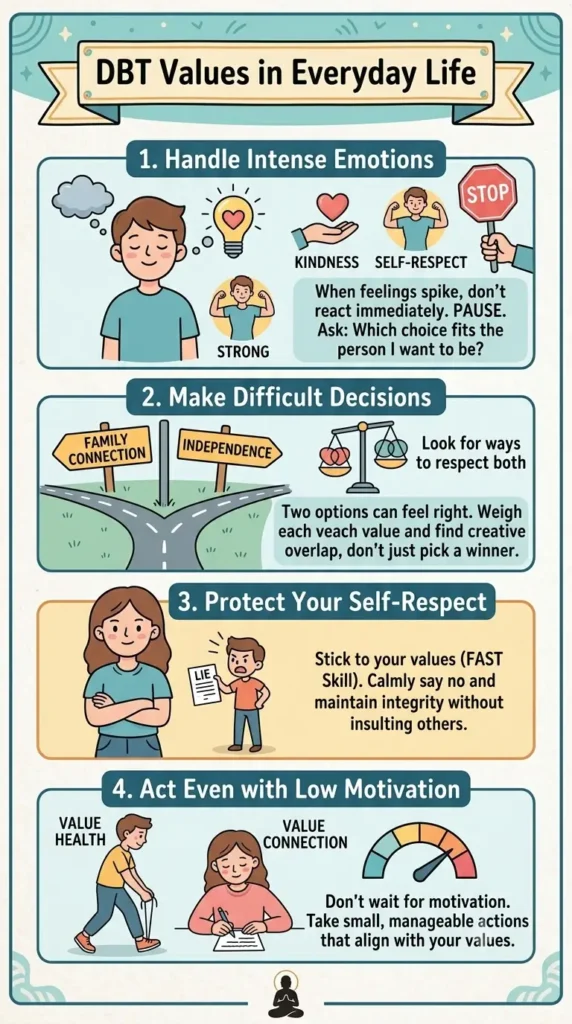
Values matter the moment they shape a real choice. You don’t need a complete overhaul. You don’t need confidence either. Small, deliberate moves get you closer to what matters. That holds even when feelings run hot. Or when the whole day falls apart.
Use values when emotions feel intense
Strong emotions push you to react before you’ve thought things through. That’s the trap. Pause right there. Ask yourself one question: what response fits the person I want to be?
Say you value kindness. Explain why you’re upset instead of firing off an angry message. Say you value self-respect instead. Step away from a conversation that’s turned hurtful. Your feelings still count. They just don’t get to run the whole show.
DBT calls this acting from your values instead of your urges, and it works the same way whether the stakes are small or huge. If you can’t tell what you’re actually feeling yet, an emotions worksheet can help you name it first.
Use values to make difficult decisions
This isn’t about picking one value over another. Two choices can feel equally hard. When that happens, look at which values each option actually supports.
Take someone who values both family connection and independence. Moving away for college can feel like a betrayal of one or the other. Neither side has to win. They can look for ways to stay close to family while still building a life on their own terms.
A DBT values worksheet makes this kind of weighing concrete. Write out what each option protects. Then look for the overlap instead of forcing a winner.
Use the FAST skill to protect self-respect
The FAST skill protects something specific: self-respect. One part of it, Stick to your values, means you act with integrity. Not bend your beliefs just because someone’s pushing.
Say a friend wants you to lie for them. You can say no calmly. No insults, no abandoning your own boundaries either.
The DBT FAST skill and other interpersonal effectiveness worksheets walk through the rest of it.
Take small actions when motivation is low
Motivation and action aren’t the same thing. You don’t have to feel ready before you move. Value health? Take a short walk. Value connection? Send someone a message that actually means something. Keep the action small enough to manage today.
When emotions turn overwhelming, these coping skills worksheets offer practical ways to manage distress while staying close to what matters.
What to Do When Your Values Conflict or Feel Unclear
Your values won’t always point the same way. You might crave independence and still want closeness with family. Or you might chase achievement while your body is begging for rest. Both can be true.
DBT values work isn’t about picking the “right” choice. It’s about naming what matters, accepting that needs compete, and choosing your next step with care. If you’re already working through a DBT skills worksheets practice, this is the piece most lists skip.
When Two Important Values Compete
Sometimes two values carry equal weight. You might want to grow your career and still want more time with your family. Neither one makes you selfish. Neither makes you unambitious.
Skip the question of which value wins. Ask what each one needs from you right now instead. Could you study for an hour and still make it to dinner? Maybe so. Could you take today off and pick the project back up tomorrow? A DBT values worksheet can make the trade-off easier to see on paper.
Look for a workable balance, not an all-or-nothing answer. Some situations call for a real trade-off. One decision doesn’t have to define your whole life. Not one bit. DBT’s own material on turning values into action lays out a similar approach. Worth a look if you want more examples.
When You Cannot Identify What Matters to You
Start by looking at the moments that stuck. When did you feel proud, connected, or really interested in something? What were you actually doing? What made that moment mean something?
You don’t need to map out your whole life at once. Small steps work. Try a few mental health journal prompts instead. They help you explore your feelings, your experiences, and what actually matters to you. Don’t judge the answers while you’re at it.
When Your Values Differ From Other People’s Expectations
Your family might want stability. You might want room to breathe instead. Friends might push for achievement when what you actually need is a slower pace. Not your call. You can respect someone’s opinion without adopting it as your own.
So ask yourself the real question. Does this choice reflect what matters to you? Or is it mostly about avoiding someone’s disappointment? That’s the line worth checking.
When Your Actions Do Not Match Your Values
Nobody lives up to their values every time. Maybe you value kindness, then snapped at a friend anyway. Shame won’t fix that. Curiosity will.
Start by naming the emotion underneath the gap. Were you exhausted? Hurt? Anxious? Just plain overwhelmed? An emotions worksheet can help you sort that out before you decide what to do next.
Treat the mismatch as information, not a verdict on your character. Acknowledge what happened. Make amends where it’s needed. Choose a more aligned action next time. A coping skills worksheet can help you plan a steadier response before the next hard moment hits.
How DBT Values Fit Into Other DBT Skills
DBT values tie every skill back to one question. What kind of life do you actually want? They give you a reason to try the harder response instead of the easy one. They protect your self-respect in tough conversations. And they point you toward choices that match what matters, even when your emotions are loud.
DBT Values and Interpersonal Effectiveness
Interpersonal effectiveness skills help you speak up, keep relationships intact, and hold onto your self-respect. DBT values give those skills a direction to aim at.
Take the FAST skill. It stands for Fair, no Apologies, Stick to values, Truthful. Say you value honesty. FAST pushes you toward real disagreement instead of a nod just to dodge conflict. DEAR MAN picks up right after that. It helps you state the disagreement clearly and ask for what you actually need.
Want to build both skills side by side? Explore FAST and DEAR MAN in our DBT Skills Worksheets.
DBT Values and Distress Tolerance
Distress tolerance gets you through a painful moment without making it worse. Your values decide what happens next.
Picture this. An argument just ended. Anger is still hot. Your thumb is hovering over a reply you’ll probably regret. A pause buys you time. That gap lets you choose a response that actually fits a value, like respect or honesty, instead of whatever urge is loudest in the room.
One DBT skill turns this idea into daily practice. It’s built around taking action based on values, turning personal principles into real behavior even when life feels hard. See how that works in Actions Based on Values.
DBT Values and Emotion Regulation
Emotion regulation helps you understand what you feel and respond with more skill. Values add a second question to that process. Not just “how do I feel better,” but “what fits the person I’m trying to be.”
Value health? Rest might beat pushing through exhaustion. Value connection? Reaching out to a trusted friend might beat sitting alone with the isolation.
For more ways to build this skill, explore our guides to DBT Emotion Regulation Skills and DBT Skills Worksheets.
Conclusion
Understanding your DBT values can help you make choices that reflect the person you want to be, even when life feels difficult. You don’t need to follow every value on a list or change your habits overnight. Start by choosing a few values that genuinely matter to you, then connect each one to a small, realistic action.
Your priorities may shift as your circumstances change, and that’s okay. The goal isn’t perfection; it’s to live with greater awareness and intention. Use your DBT values worksheet to identify what matters most and find practical ways to bring those values into your everyday life.
Frequently Asked Questions
What are the core values in DBT?
DBT values are explored through life domains such as relationships, family, work, education, friendships, spirituality, health and self-care, community, parenting, and recreation. These domains help you identify what matters most in your life and choose actions that reflect your personal principles.
Is there an official DBT values list?
There is no single standardized values list authored by Marsha Linehan that every DBT program must use. Many DBT values exercises draw on a version of the ACT-based Valued Living Questionnaire, adapted for use in DBT distress-tolerance skills training. Specific lists may vary across programs and worksheets.
How do I choose my top three DBT values?
Start by reviewing a values list and marking the words that feel personally meaningful. Narrow your choices by asking which principles you want to guide your everyday decisions, especially during difficult moments. Choose three to begin with, but remember that your selections can change as you learn more about yourself.
What is the difference between DBT values and priorities?
Values describe how you want to live over time, while priorities reflect what needs your attention right now. For example, you may value family connection but prioritize rest this week because you’re exhausted. Your immediate priorities can change without making your underlying values less important.
How do you use a DBT values worksheet?
Review the values list, select the principles that matter to you, and reflect on why you chose them. Then identify which values need attention and write down one small action for each. Revisit your worksheet periodically to notice progress, reconsider priorities, and adjust your actions without judging yourself.
What should I do when two of my personal values conflict?
Start by naming both values and understanding what each means to you. If independence conflicts with family connection, for example, consider a boundary that protects your autonomy while allowing meaningful contact. You may not satisfy both values equally in every situation, but you can choose a thoughtful next step rather than reacting automatically.

It’s Bhaskar!
Well, I am not a psychologist a monk, or a philosopher by training. I’m just an engineering graduate.
‘The Empty Self’ is where I write about that idea, and what it actually means for ordinary life, anxiety, identity, habits, the stories we tell ourselves about who we are. I don’t have a psychology degree, and I’m not offering therapy or clinical advice. What I do have is thought and clarity, and genuine curiosity about why we suffer the way we do and how much of it might loose once we shed this ‘fixed identity’.