
Stress rarely waits for a good moment. Racing thoughts don’t care that you have a meeting in ten minutes, or that your evening was supposed to be quiet. Knowing you should calm down means nothing without an actual next move.
A five-minute brain dump, a short walk, a grounding exercise, or just setting your phone down can interrupt the spiral before it eats your evening. Sound too simple? Sometimes that’s exactly why it works.
The best coping skills activities for adults aren’t complicated. Not even close. They’re practical tools for the moments your thoughts race, your emotions get too loud, or you just need a reset button. This guide sticks to what actually fits busy adult life. That includes the very modern problem of feeling swamped while still tethered to a phone.
Disclaimer: this article is for education and self-help only. It’s not a stand-in for therapy, diagnosis, or professional mental health care.
Quick overview: coping skills activities for adults are simple actions you can lean on to manage stress, tough emotions, or mental static when it hits. Think grounding, movement, journaling, creative outlets, real connection, and deliberate breaks from your screen. None of it needs to be fancy. It just needs to work when you actually need it. If you want something to write on while you practice, our printable coping skills worksheets pair well with everything below.
Table of Contents
Disclaimer
This blog is written and edited with the help of AI, then reviewed by me before publishing. As a result, the content is for general reflection only, not therapy or medical advice, and I’m not a licensed mental health professional. If you’re in crisis, please contact 988 if you’re in US or a local crisis service of your country instead of relying on this site.
Quick-Pick Guide
Stress doesn’t wait for the perfect self-care plan. It shows up right now, mid-day, mid-meltdown. And it wants an answer right now, not a 10-step routine.
The right coping skill depends on what’s actually happening in your body. Racing thoughts. Anger. Loneliness. Exhaustion. Digital overload. Different problem, different fix. Use this guide to grab something that fits the moment you’re in.
| Coping Activity | Best For | Time |
|---|---|---|
| 5-Minute Brain Dump | Racing thoughts, overwhelm, mental clutter | 5 min |
| 5-4-3-2-1 Grounding Reset | Anxiety, overthinking, feeling disconnected | 2–5 min |
| “What Can I Control?” Exercise | Uncertainty, worry, stressful situations | 5–10 min |
| 10-Minute Movement Reset | Restlessness, tension, frustration | 10 min |
| Emotion Naming Check-In | Emotional confusion, numbness, mood shifts | 3–5 min |
| Personal Coping Playlist | Stress, low mood, emotional transitions | 5–15 min |
| Phone-Free Reset | Doomscrolling, comparison, digital overload | 10–20 min |
| “Text Someone” Connection Exercise | Loneliness, isolation, needing support | 2–10 min |
| Creative Release | Emotional buildup, stress, difficult feelings | 10–20 min |
| Build Your Personal Coping Toolbox | Preparing for future stressful moments | 15–30 min |
Think of this as a working coping skills list for adults, not a checklist to clear top to bottom. Pick the one that matches your current state. Nothing fancier than that.
If your mind is racing, writing beats exercise. A 5-minute journal prompt can catch the thoughts before they spiral. If you’re stuck mid-scroll comparing your life to a stranger’s highlight reel, another mindfulness exercise probably won’t cut it. What you need is distance from the screen, not more reflection.
Struggling to even name what you’re feeling? That confusion is common. Pairing the Emotion Naming Check-In with an emotions worksheet gives the feeling a shape you can actually work with.
Want the grounding exercise to go deeper? These same techniques show up, expanded, in these mindfulness journal prompts built for anxious, overthinking moments.
The goal here isn’t to erase every uncomfortable feeling. It never was. It’s to hand you a practical next step while you figure out what you actually need. That’s the whole point of coping skills activities for adults. Not perfection. Just movement.
What Are Coping Skills for Adults?
Coping skills activities for adults aren’t complicated. They’re just moves you make when stress or a hard feeling shows up and won’t leave. A short walk. Naming what you feel. Writing down thoughts that keep racing. Calling someone you trust.
That’s it.
Some days it’s smaller than that. Five minutes and a quiet corner does the job.
A Short Definition of Coping Skills
Coping skills aren’t a magic trick. They’re thoughts, actions, and small activities that help you manage stress and emotional discomfort. People often call these mental health coping skills. Nothing more mystical than that.
The goal isn’t always to make a hard feeling vanish. Sometimes a good coping skill just gets you steady enough to figure out your next move. That’s the whole point.
Here’s where it gets specific. The APA’s definition of coping frames it as managing demands that feel stressful or hard to handle. Not making the difficulty disappear. Coping means responding to something real. It isn’t pretending the hard part isn’t there.
Want the deeper version? One broken into categories, a full coping skills list for adults, and exercises you can actually print? Our coping skills worksheets guide covers all of that.
Positive vs. Negative Coping
Not all coping is created equal. Positive coping strategies help you get through a problem or emotion without stacking a new one on top. Journaling. Grounding. Exercise. A real conversation with someone who has your back. A deliberate break. Working through what’s actually within your control.
Negative coping works fast and fades faster. It buys quick relief while the real problem sits untouched, sometimes bigger than before. Ducking every hard conversation. Scrolling for hours when you’re already maxed out. Leaning on a habit that leaves you worse off an hour later. None of it fixes what needed fixing.
Distraction isn’t the enemy here, either. Sometimes distraction is exactly the right move.
So how do you tell the difference? Ask yourself one question: did this help me cope, or did it just help me escape for a few minutes?
That question does more work than any list of positive coping strategies ever could.
How to Choose the Right Coping Skill for the Moment
Not every coping skill works for every moment. That’s the part most lists skip.
A grounding trick calms a wired body. Journaling untangles looping thoughts. Different problem, different fix. So start with what you’re actually feeling, not the skill you saw first. Then match it.
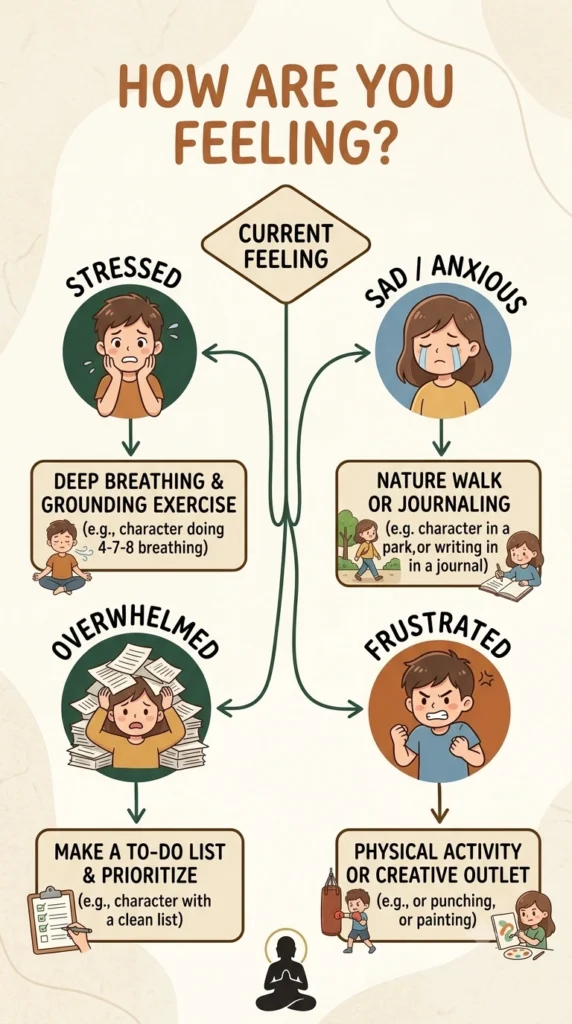
If You Need to Calm Down
Your chest is tight. Your leg won’t stop bouncing. Your brain feels loud.
That’s your body on high alert, not your mind being dramatic. When you’re wired like this, present-moment tricks work best. Slow breathing. Grounding through your senses. A stretch. Cold water on your wrists. Small, physical, fast.
You don’t need to fix the whole problem right now. Not yet. Your nervous system just needs proof that you’re safe first. The thinking can wait five minutes.
Thoughts Won’t Stop? Try This
Replaying the same conversation for the tenth time? Predicting every version of how tomorrow could go wrong?
That’s not a calming problem. It’s a thinking problem, and it needs a cognitive fix, not a breathing exercise. A brain dump works well here. So does one blunt question: what can I actually control right now?
Writing it down does something breathing can’t. It moves the loop out of your head and onto paper, where you can actually look at it. If your mind tends to spiral at night specifically, these [journal prompts for mental health] were built for exactly that pattern.
If You’re Angry or Frustrated
Anger has energy behind it. Real, physical energy.
Sitting still and forcing calm rarely works here, and honestly, it can make the anger worse. Move it instead. Walk fast. Shake out your hands. Write down the uncensored version nobody else will read. Let the heat burn off before you decide what to actually do.
Here’s the thing worth remembering: anger isn’t the problem. Acting on it before it cools down usually is.
If You’re Emotionally Drained
Some days you’re not overwhelmed. You’re just empty.
That calls for low-effort, not another task. A shower. Quiet music. Ten minutes with your phone somewhere else. Rest isn’t laziness here. It’s the actual coping skill.
Trying to push through exhaustion with productivity tricks usually backfires. Give yourself the smaller thing instead.
If the Problem Needs Action
Not every stress dissolves with rest. Sometimes there’s a real problem sitting there, waiting.
Relaxing won’t move a deadline. It won’t answer an unread email. When the stress has a clear cause, name what’s actually in your control. Then pick the smallest useful next step, and do that one piece first. Just one.
It’s 11pm and the email is still unanswered. You could keep scrolling past it, or you could type two sentences and hit send. That choice is the whole difference between stress that lingers and stress that lifts.
If You Feel Lonely or Disconnected
Loneliness tempts you to distract instead of connect. Don’t take the bait.
Send a low-pressure text. Sit with someone you trust, even in silence. Or turn inward first with reflective practices like these [journal prompts for self-love], which help you reconnect with yourself before you reach out to anyone else.
Connection doesn’t have to be big. A single honest message counts.
10 Coping Skills Activities for Adults
Good coping skills activities for adults don’t need to be complicated. The right one matches what you need in the moment. Sometimes that’s calming your body. Sometimes it’s clearing your head.
Sometimes you just need a word for what you’re feeling, or a reason to text someone back. Below are five practical coping skills activities for adults you can actually use, without turning self-care into another task on your list.
1. 5-Minute Brain Dump
Best for: Racing thoughts, overwhelm, decision fatigue, or emotional clutter.
Time: 5 minutes
Steps: Grab paper or open a blank note. Write whatever’s taking up space in your head. Don’t organize it. Don’t fix the grammar. Just keep writing until the timer runs out. After that, circle anything that actually needs action and leave the rest alone for now.
Most people try to think their way out of overwhelm. That rarely works. A brain dump works differently: it moves the noise out of your head and onto paper, where you can actually look at it. You’re not solving anything yet. You’re just making the clutter visible.
Say you’ve spent the last hour bouncing between work messages, social media, and three unfinished tasks. Sit down and write out every thought competing for your attention, one after another, no order required.
For more structured prompts, mental-health-focused journaling prompts can give you a starting point when a blank page feels like too much.
2. 5-4-3-2-1 Grounding Reset
Best for: Feeling anxious, overwhelmed, scattered, or stuck in your own head.
Time: 2 to 5 minutes
This isn’t about breathing exercises or affirmations. It’s simpler than that. Look around and name 5 things you can see, 4 you can touch, 3 you can hear, 2 you can smell, and 1 you can taste. Go slow. Notice the actual details, not just the categories.
Why does this work when scrolling or distraction usually doesn’t? Grounding pulls your attention out of your thoughts and back into your body, right where you are. That matters most when your mind keeps replaying a conversation, or spinning out over something that hasn’t even happened yet.
Picture this: you just read a stressful text and your stomach drops. Put the phone face down. Work through the five senses before you type a single word back.
It’s one of the simplest coping skills exercises for adults, and it costs you nothing but a few minutes. For more ideas rooted in the present moment, check out these mindfulness and present-moment exercises.
3. “What Can I Control?” Exercise
Best for: Uncertainty, overthinking, work stress, relationship problems, or anything you can’t fully fix.
Time: 5 to 10 minutes
Most advice tells you to just let go of what you can’t control. Easier said than done. Here’s a version that actually works: write down what’s bothering you, then draw two columns, “within my control” and “outside my control.” Put your energy into the first one. Pick one small action for today. Send the email. Set the boundary. Ask the question you’ve been avoiding.
Stress grows fast when you spend your energy on outcomes that were never yours to decide. Splitting influence from uncertainty turns a vague worry into something you can actually do. That’s the whole shift.
You can’t control whether a recruiter replies. You can control whether you follow up, apply somewhere else, or stop refreshing your inbox every ten minutes. This is one of the more overlooked positive coping strategies, mostly because it feels too simple to be useful. It works anyway.
4. 10-Minute Movement Reset
Best for: Restlessness, frustration, tension, low energy, or stress after sitting for hours.
Time: 10 minutes
Step away from your desk. Ten minutes is enough. Walk around the block. Stretch your shoulders and hips. Do a few bodyweight movements, or put on a song and move around your room. The goal isn’t a workout. It’s just movement.
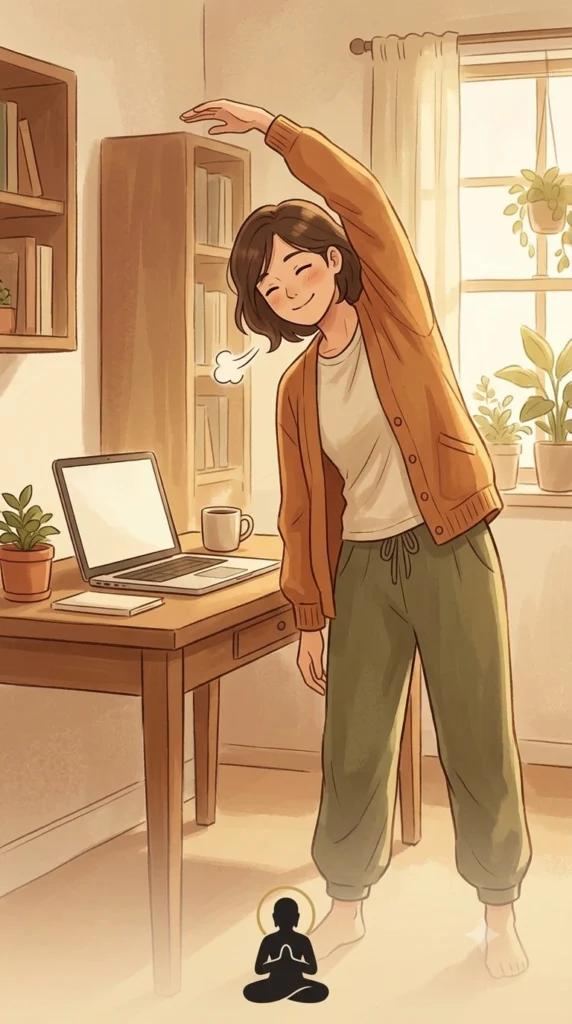
Your body holds stress the same way your mind does. Moving it can loosen some of that tension, even without a real workout. You don’t need a gym membership for this to count, and you don’t need to perform for anyone.
Three hours hunched over a laptop leaves your shoulders somewhere near your ears. Don’t open another productivity app to fix it. Stand up. Stretch. Walk to the end of the hallway and back. Come back to the task with a little more space between you and the stress.
5. Emotion Naming Check-In
Best for: Feeling “off,” emotionally confused, irritated, numb, or unable to explain what’s going on.
Time: 5 minutes
Here’s an honest take on emotional check-ins: most people stop at “fine” or “bad” because naming anything more specific feels uncomfortable. Push past that. Pause and ask yourself what you’re actually feeling. Disappointment. Embarrassment. Loneliness. Resentment. Relief. Sometimes more than one at once. Then finish this sentence: “I feel ___ because ___, and right now I need ___.”
Why does naming a feeling matter more than just sitting with it? Because vague feelings lead to vague reactions. Specific feelings give you information you can actually use. You don’t have to fix anything yet. Get specific first. Everything else comes after.
“I’m angry” might really be “I’m embarrassed because I felt ignored in that group chat, and I need some space before I respond.” That one shift in wording can completely change what you do next.
This kind of check-in is one of the more useful mental health coping skills because it slows down the jump from feeling to reacting. For more structured support with identifying feelings, these emotion-identification worksheets and this closer look at naming and understanding emotions are worth a look.
6. Personal Coping Playlist
Best for: stress, low mood, emotional overload, or those moments when you need a change of atmosphere without disappearing into your phone.
Time: 5 to 10 minutes to build. A few minutes to use.
Music doesn’t fix anything by itself. It just gives your brain somewhere else to go. Build a few short playlists based on what you need, not what genre you like. One for calming down. One for getting unstuck. One for processing a rough day.
One for getting out the door. When you need a coping skill and don’t have the energy to think, pick the playlist that matches your mood. Then listen without scrolling at the same time.
Why it may help: music shapes attention, mood, and how you experience emotion in the moment. Giving yourself a deliberate listening activity draws a line. On one side, using your phone on purpose. On the other, getting pulled into content you never chose. That line matters more than people think.
Gen Z example: instead of opening TikTok after a stressful shift, put on your reset playlist and take a ten-minute walk. The goal isn’t to force a better mood. It’s to give your brain something intentional to focus on instead.
7. Phone-Free Reset
Best for: doomscrolling, social comparison, notification overload, and feeling wiped out after too much screen time.
Time: 10 to 20 minutes.
Put your phone somewhere you can’t casually grab it. Another room works well. Set a timer if that helps you commit. During the break, pick one low-effort offline task. Make tea. Shower. Stretch. Sit outside. Tidy one small area. Or just rest. When the timer ends, check whether you actually want the phone back.
Why it may help: sometimes the problem isn’t that you need more stimulation. It’s that you’ve had too much already. A short break interrupts the automatic loop of reaching for an app the second you feel bored, anxious, lonely, or uncomfortable. That loop runs on autopilot. Breaking it takes stepping away, not scrolling harder.
Gen Z example: you open Instagram to check one message. Thirty-five minutes later you’re comparing your career, your apartment, your relationship, and your whole existence against strangers online. That’s the moment for a phone-free reset. Put the device away before you try to “scroll yourself calm.” It won’t work. It never does.
This is one of the more useful coping skills activities for adults because it costs nothing. No app to download. No relaxation turned into a productivity project.
8. “Text Someone” Connection Exercise
Best for: loneliness, isolation, a hard day, or needing another person without the energy for a full conversation.
Time: 2 to 10 minutes.
Think of one person who usually feels safe to talk to. Send a short message instead of waiting until you can explain everything perfectly. You’re allowed to reach out without a plan. You don’t owe them a full story, and they don’t owe you a solution.
Try:
- “Hey, having a rough day. Don’t need advice, just wanted to say hi.”
- “Can you distract me for five minutes? My brain is doing too much.”
- “Got a minute to talk later? Nothing urgent.”
Why it may help: connection is one of the more overlooked coping strategies, especially since stress tends to make people withdraw instead of reach out. A low-pressure message lowers the effort it takes to make contact. That’s the whole trick. Small ask, real relief.
Gen Z example: if you’ve spent an hour replaying an awkward interaction, don’t spend another hour deciding whether you’re “allowed” to text someone. Send the simple version. The real conversation can happen from there.
9. Creative Release: Draw, Color, Write, or Make Something
Best for: strong emotions, emotional clutter, self-expression, or days when talking about your feelings feels like too much work.
Time: 10 to 20 minutes.
Pick one creative activity and drop the pressure to make something good. Scribble while music plays. Color a page. Write an uncensored journal entry. Rearrange old photos. Make a collage. Doodle whatever shows up. The finished product doesn’t need to be useful. It doesn’t even need to make sense.
Why it may help: creative activities give you another route to process and express emotion when regular conversation falls short. Writing especially can slow your thinking down enough to turn a vague, heavy feeling into actual words. That shift, from fog to language, is where a lot of the relief comes from.
Gen Z example: skip the carefully edited “healing” story for your feed. Open a private journal instead and write what you’re actually thinking. Need something to keep the pen moving? These journal prompts for self-love are built for exactly that.
10. Build Your Personal Coping Toolbox
Best for: repeated stress, emotional ups and downs, or anyone stuck thinking, “I know I need to cope better, but what am I supposed to do right now?”
Time: 15 to 20 minutes to build. Use whenever needed.
Write down the coping skills that have actually helped you before, not the ones that sound good on a wellness account. Sort them by situation: quick calming, emotional release, physical reset, connection, distraction, and problem-solving.
Add how long each one takes. Keep the list somewhere you can reach fast, because inventing a coping strategy mid-meltdown is harder than it sounds.
Why it may help: a coping toolbox turns coping from something you improvise under pressure into something you can simply choose from. Keep testing what you’ve got. A strategy that works great during work stress might do nothing when you’re lonely or running on empty. That’s normal. Swap it out and move on.
Gen Z example: your toolbox might hold a five-minute brain dump, a short walk, one trusted person to text, a phone-free break, and a playlist for the hard days. Want something more structured? These coping skills worksheets turn the whole toolbox idea into a printable resource you can actually use.
Once you’ve found a few strategies that fit your life, the next move is simple. Put them into a coping skills list for adults you can save, print, and grab when your brain has zero interest in making decisions.
Healthy Coping Skills vs. Unhealthy Coping Mechanisms
Healthy coping skills help you handle stress without adding a bigger mess later. Unhealthy coping mechanisms can feel good for a minute. Then the stress creeps back, usually worse. That’s the trade nobody warns you about.
Finding solid coping skills activities for adults isn’t about doing it perfectly. It’s about finding what actually helps you get through the moment without wrecking tomorrow.
What healthy coping can look like
Healthy coping is often boring. Nothing dramatic about it.
A walk after a rough meeting. Writing down what’s bothering you. Logging off social media for an hour. Calling someone who actually listens. Ten quiet minutes before you answer a message that stressed you out.
There’s no single coping skills list for adults that works for every person, every time. What helps depends on what’s happening and what you need right then.
The CDC recommends physical activity, relaxation, journaling, time outdoors, breaks from news and social media, and leaning on people you trust. Simple stuff. Not flashy. Still works.
Want a structured place to start? Our coping skills worksheets walk through several of these step by step, and pairing them with journal prompts for mental health gives you something to actually write during that quiet ten minutes.
When distraction becomes avoidance
This isn’t about banning distraction. Not even close.
Sometimes you need a break before you can think straight. Watching an episode, playing a game, scrolling for five minutes, all of that can give your brain some room to breathe.
The trouble starts when distraction becomes the only move you make. Skip a hard conversation enough times, ignore a problem long enough, use an activity to shove away every uncomfortable feeling, and the original issue just sits there. Waiting.
Naming what you’re avoiding is half the battle. Our emotions worksheet can help you spot the feeling you’re dodging before it turns into a bigger one.
For a closer look at what separates adaptive coping from the unhelpful kind, check the Healthy vs. Unhealthy Coping Worksheet.
Signs a coping strategy is making things worse
A coping strategy needs a second look when it keeps leaving you worse off. When it messes with your job, your relationships, or keeps you circling the same problem.
Heavy substance use. Chronic avoidance. Other harmful habits. They can feel like relief in the moment. They’re not reliable long term.
The CDC’s guidance on stress also points out something worth remembering: everyone responds to stress differently, and finding the right mix of positive coping strategies takes trial and error. Nobody gets it right the first try.
That mindset matters more than people admit. A coping skill doesn’t need to feel perfect to count. It just needs to get you through today without making tomorrow harder.
Coping Skills List for Adults: On-Page Checklist
Stress doesn’t wait for a good time. A useful coping skills list for adults has to work when you’re already overwhelmed. Not just look neat on a page.
Use the checklist below to pick coping skills activities for adults that fit your time, energy, and situation right now. You don’t need every strategy today. Start with one. See how it feels.
2-Minute Coping Skills
Two minutes is enough to break a stress spiral. Your nervous system doesn’t need a full plan. It needs one small signal that you’re safe right now. These coping skills exercises for adults work fast because they’re small enough to actually finish.
- ☐ Take 5 slow, steady breaths.
- ☐ Name 5 things you can see.
- ☐ Unclench your jaw and drop your shoulders.
- ☐ Drink a glass of water.
- ☐ Step away from your screen and look outside.
- ☐ Write down one thought that’s bothering you.
5–10 Minute Coping Skills
Some days two minutes isn’t enough. That’s fine. If you’ve got a little more room to breathe, these positive coping strategies give your body and mind more to work with.
- ☐ Take a short walk.
- ☐ Journal without editing yourself.
- ☐ Try a short mindfulness exercise.
- ☐ Listen to one calming song.
- ☐ Stretch your neck, back, and legs.
- ☐ Text someone you trust.
- ☐ Tidy one small area around you.
Longer Coping Activities
Some stress needs more than a quick fix. When you’ve got the energy, these coping skills exercises for adults go deeper than a reset. They actually process what’s going on.
- ☐ Exercise or go for a longer walk.
- ☐ Make something creative.
- ☐ Spend time in nature.
- ☐ Cook a nourishing meal.
- ☐ Work through a difficult problem on paper.
- ☐ Take a proper break from social media.
Social Coping Skills
Most coping skills lists skip the social ones. That’s a mistake. Connection is one of the most reliable mental health coping mechanisms there is, and it’s easy to forget when you’re already stressed.
- ☐ Call a friend or family member.
- ☐ Ask someone to spend time with you.
- ☐ Tell someone honestly that you’re having a difficult day.
- ☐ Join a hobby, class, or community activity.
Physical Coping Skills
Move your body and the stress often follows it out. Physical coping skills work because stress lives in the body first, not just the mind. Give it somewhere to go.
- ☐ Stretching
- ☐ Walking
- ☐ Dancing
- ☐ Deep breathing
- ☐ A warm shower
- ☐ Progressive muscle relaxation
Cognitive Coping Skills
Not every coping skill is physical. Sometimes the problem is what’s happening in your head, and no walk is going to fix a thought spiral. These cognitive coping mechanisms examples target the thinking itself.
- ☐ Write down what you can and cannot control.
- ☐ Challenge an unhelpful assumption.
- ☐ Name the emotion behind the thought.
- ☐ Break one overwhelming task into a smaller step.
- ☐ Replace “I have to solve everything” with “What is the next useful step?”
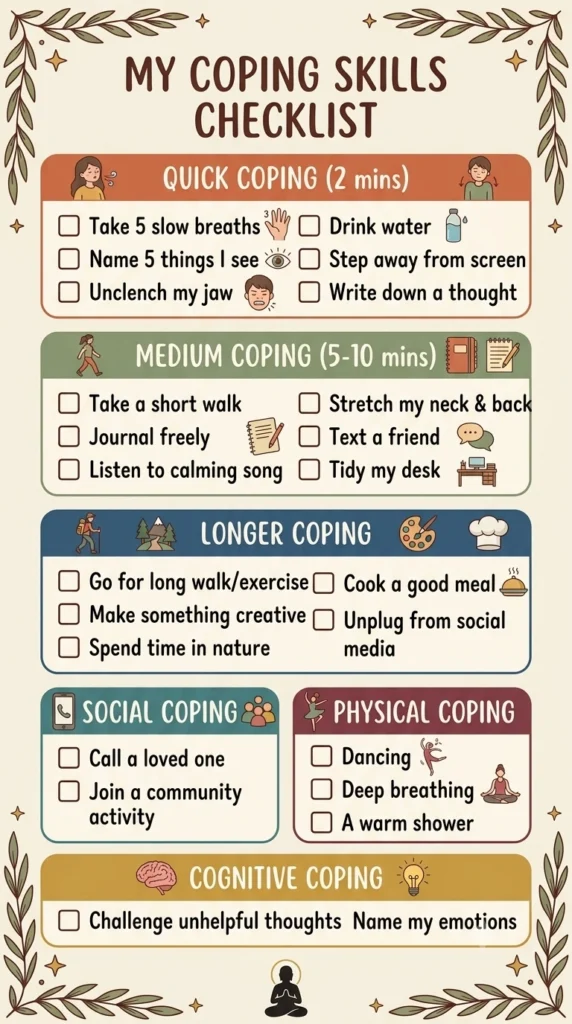
Want more than a checklist? Grab the Coping Skills Checklist Worksheet on our full worksheets guide for a downloadable version with more categories.
How to Turn Coping Skills Into a Consistent Habit
Coping skills fall apart when you only remember them mid-crisis. That’s the real problem. Real coping skills activities for adults aren’t a list you memorize once and forget about.
They’re small moves you’ve already tested, ready the second stress shows up. You don’t need ten techniques. You need three that work, practiced enough times that reaching for them takes no thought at all.
Pick Three Go-To Coping Skills
Start small. Build a coping skills worksheets for adults list that actually fits your life, not one pulled off a wellness account with forty items on it. Pick three that cover different situations. A grounding exercise for anxiety. A short walk for the tension that sits in your shoulders. Journaling for the nights your thoughts won’t untangle.
That’s it. Three is enough.
Keep them somewhere you’ll actually see. A phone note. A journal page. A printed checklist taped inside a cabinet. Not a complicated system with an app and a login you’ll forget exists by March.
Practice Before You’re Overwhelmed
This isn’t about waiting for the bad day to test something new. Try a coping skill when you’re relatively calm. You want to know how it feels before you need it to work.
Here’s why that matters. Stress wrecks decision-making. It narrows your options right when you need more of them, not fewer. A strategy you’ve already practiced skips that struggle. You don’t have to think it through. You just do it.
Sound too simple? It is. That’s the whole point.
Track What Actually Works
Not every coping mechanism lands, and that’s normal. Some help. Some barely touch the moment. Some just kill five minutes without changing anything underneath.
After you try one, ask yourself something specific. Did the intensity actually drop? Did your thinking clear up, even a little? Or did it just distract you for a while, which still counts, but differently.
A simple log makes the pattern visible over time. Pair it with an emotions worksheet and you’ll start noticing which strategy fits which feeling, not just which one you reach for out of habit. The Empty Self’s coping skills log can help you record what you tried and what happened next.
Update Your Coping List Over Time
Your life changes. So does what helps. A coping skills list for adults that worked during a rough semester might do nothing during a hard year at work. That’s not failure. That’s just how it goes.
Revisit your list every few months. Cut what’s stopped helping. Add what fits where you are now. If journaling feels stale, swap in something else, maybe a round of journal prompts for mental health to shake it loose again.
The goal was never a perfect routine. It’s a handful of positive coping strategies you actually trust, sitting ready for the next hard moment. Nothing more complicated than that.
When Coping Skills Aren’t Enough
Coping skills help in the moment. That’s their job. They’re not built to replace professional care once distress turns persistent, severe, or unsafe.
Here’s an honest take: if your coping skills aren’t giving you enough relief to function, that’s not a sign you’re doing them wrong. It’s a sign you need more support than a technique can offer. Reach out to a qualified mental health professional.
When You May Need More Support
Stress interferes with sleep. Anxiety eats into work. Low mood pulls at relationships and the basic stuff — showering, eating, showing up. When any of that keeps happening, it’s worth getting help.
You don’t have to wait until things become unbearable. Waiting isn’t required.
Coping skills are tools. Not a test.
They’re not there to prove you can white-knuckle your way through everything alone. Nobody’s handing out a badge for suffering in silence.
What to Do If You Feel Unsafe
If you’re in immediate danger, or you think you might hurt yourself or someone else, a coping exercise isn’t enough. Don’t rely on one alone.
Move somewhere safer. Call someone you trust. Get urgent help through your local emergency services.
In the United States, call or text 988 to reach the 988 Suicide & Crisis Lifeline. It’s free. It’s confidential. Outside the U.S.? Use your country’s emergency or crisis service instead.
Reaching out isn’t a failure of your coping skills.
Sometimes the most useful coping strategy is another person. Getting someone else involved — that still counts.
If you’re working through a hard stretch, these journal prompts for mental health can help you process alongside professional support, not instead of it.
Conclusion
The right coping skill isn’t always the most impressive one. Sometimes you need five quiet minutes to clear your head; other times, you need movement, connection, or a break from your phone.
The goal is to build a coping skills list for adults that fits your actual life and gives you options for different kinds of difficult moments. Start with one activity that feels realistic today, notice how it affects you, and keep the strategies that genuinely help.
Over time, those small choices can become a reliable personal toolkit for handling stress, difficult emotions, and everyday overwhelm.
Frequently Asked Questions
What are some fun activities to teach coping skills?
Fun coping activities can include drawing, coloring, dancing, making a mood playlist, taking a mindful walk, or playing an emotion-themed card game.
For adults, activities work best when they feel realistic rather than forced. A five-minute creative activity can be enough to interrupt stress and give your mind a useful change of focus.
What are the 7 types of coping skills?
Seven commonly used categories of coping skills are problem-focused, emotion-focused, cognitive, physical, social, sensory, and spiritual coping.
These categories overlap, and one activity can fit more than one type. For example, walking can provide physical and sensory coping, while talking with a trusted person provides social and emotion-focused coping.
What are the 5 C’s of coping?
The 5 C’s of coping are commonly described as calm, clarity, connection, control, and coping. They can be used as a simple framework for deciding what you need during a stressful moment.
The exact wording and meaning of the five C’s can vary between coping-skills programs, so it is best treated as a practical framework rather than a universal clinical model.
What are some effective coping activities for adults?
Effective coping activities for adults include grounding exercises, journaling, slow breathing, physical movement, calling someone you trust, creative activities, and taking a deliberate break from social media.
The right choice depends on the situation. If you are overwhelmed, calming your body may help first; if a specific problem is causing stress, taking one manageable action may be more useful.
What are some good coping skills games for adults?
Coping-skills games can include emotion charades, coping-skills bingo, “would you rather” stress scenarios, mindfulness scavenger hunts, and card-based prompts about emotions or self-care.
For adults, the game should have a clear purpose rather than feeling childish. A simple prompt game that helps you identify an emotion and choose a coping response can be surprisingly useful.

It’s Bhaskar!
Well, I am not a psychologist a monk, or a philosopher by training. I’m just an engineering graduate.
‘The Empty Self’ is where I write about that idea, and what it actually means for ordinary life, anxiety, identity, habits, the stories we tell ourselves about who we are. I don’t have a psychology degree, and I’m not offering therapy or clinical advice. What I do have is thought and clarity, and genuine curiosity about why we suffer the way we do and how much of it might loose once we shed this ‘fixed identity’.