
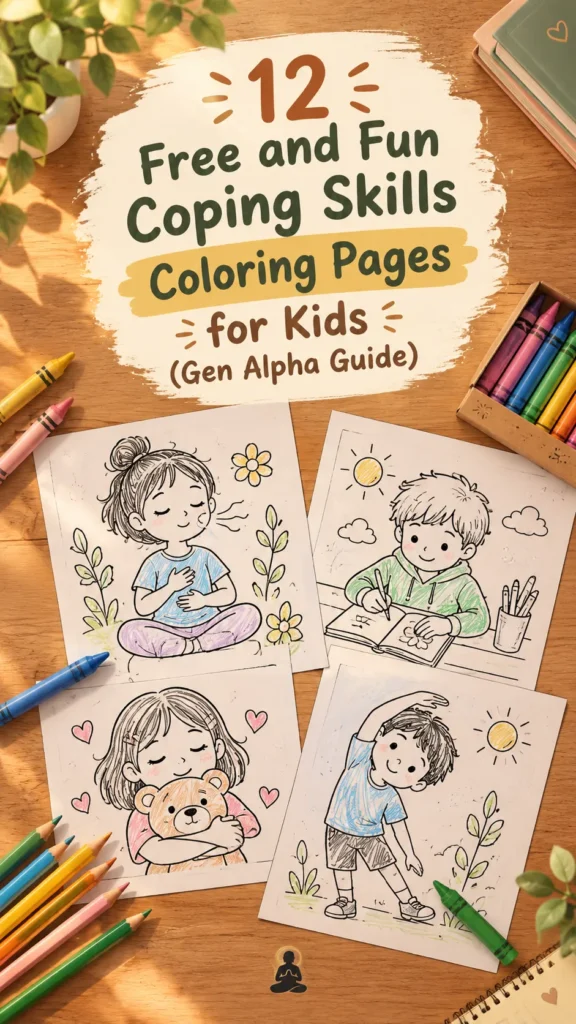
A coloring page can do more than keep little hands busy. The right coping skills coloring pages show kids what to do when anger, worry, or sadness hits. That’s the real value.
Each page ties to one skill a kid can actually use, deep breathing, grounding, asking for help, plain and simple stuff, taught early instead of explained later when it’s too late to land.
This collection is built for parents, teachers, counselors, and caregivers. People who want simple, screen-free ways to teach healthy coping skills. No app required.
Every activity zeroes in on one practical strategy, from deep breathing and grounding to using positive self-talk. If your family already leans on tools like emotions worksheets to name feelings first, these pages are the natural next step.
These coping skills coloring sheets work best for elementary-age kids. Especially the ones who learn through pictures and hands-on activities, not lectures. Pictures stick. Use them during calm moments, so the skill feels familiar long before emotions spike and a kid actually needs it.
Quick overview: these coping skills coloring pages for kids mix creativity with real emotional-regulation skills. They fit home, classrooms, counseling sessions, or small groups equally well. No special setup. Color the page. Talk about the strategy. Then practice it together. Want the full toolkit behind this idea? Our coping skills worksheets go deeper into each strategy these pages introduce.
Table of Contents
Disclaimer
This blog is written and edited with the help of AI, then reviewed by me before publishing. As a result, the content is for general reflection only, not therapy or medical advice, and I’m not a licensed mental health professional. If you’re in crisis, please contact 988 if you’re in US or a local crisis service of your country instead of relying on this site.
12 Free Coping Skills Coloring Pages for Kids
These coping skills coloring pages do more than keep little hands busy. Each one focuses on a single, practical way a child can respond to stress, frustration, worry, sadness, or feeling overwhelmed.
The goal isn’t to erase a hard feeling. It never is. It’s to hand a kid one simple move they can recognize and reach for when they need it.
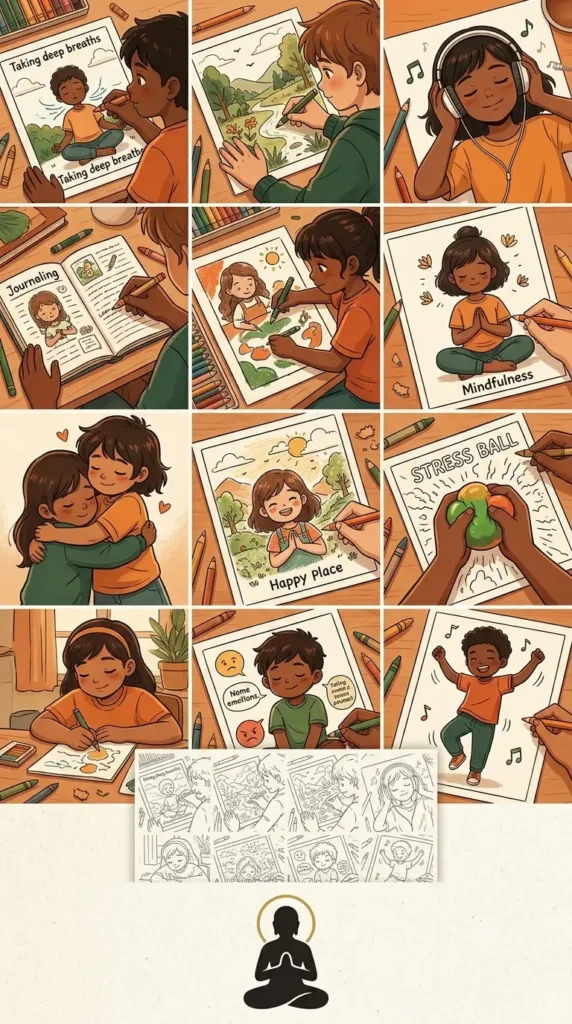
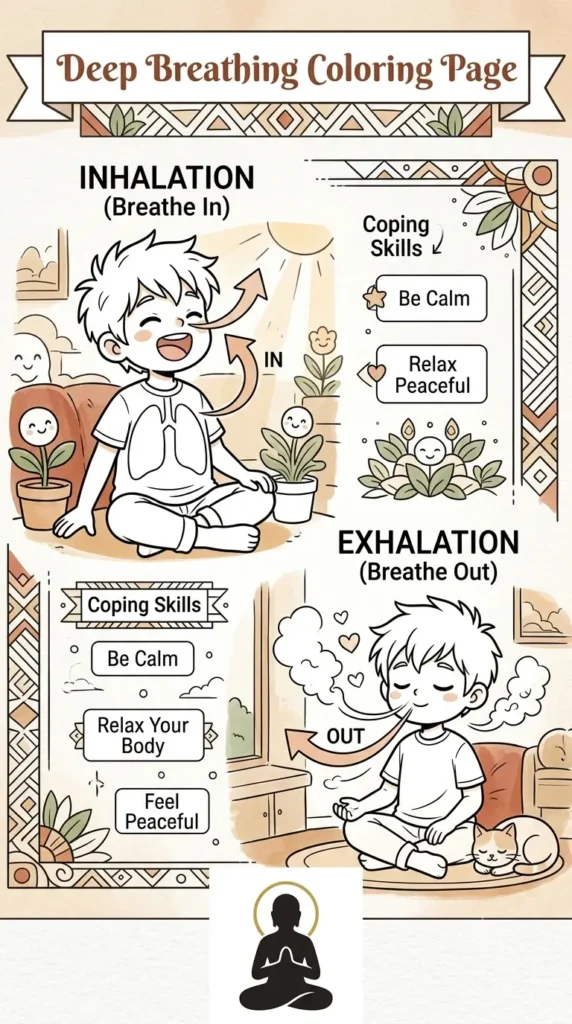
1. Deep Breathing Coloring Page
Slow the breath down and the body usually follows. That’s the whole logic behind a deep breathing coloring page. It gives kids a visual cue to slow their breathing right when emotions start running hot.
The page could feature a balloon, a flower, or a simple breathing character that guides a slow inhale and a longer exhale. Nothing complicated. Just a picture that matches the rhythm you want the child to copy.
Best for: anger, worry, frustration, or feeling overwhelmed.
Adult prompt: “Can we practice the breathing exercise once before you finish coloring?”
Why it works: Slow, controlled breathing can calm the body’s stress response. Pediatric guidance on meditation breaks for kids points to mindful breathing as a practical way for kids to decompress, which is exactly what this page is built to practice.
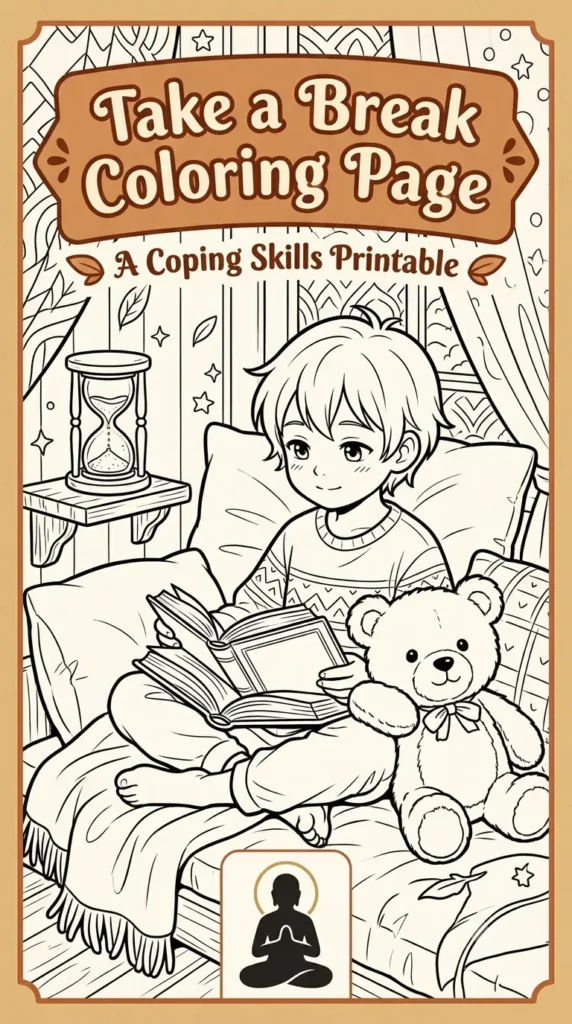
2. Take a Break Coloring Page
Sometimes the most useful coping skill is just stepping away. Nothing fancier than that.
This coping strategies coloring page can show a child moving to a quiet corner, sitting somewhere comfortable, or choosing a short break before going back to a hard task. Small moment. Big difference.
Best for: frustration, arguments, sensory overload, and schoolwork that feels too hard.
Adult prompt: “What could a helpful break look like for you?”
Why it works: A planned pause buys a child time to settle before they react on impulse. This matters most when emotions are already running high, since self-regulation is a skill kids build gradually, not one they’re born knowing.
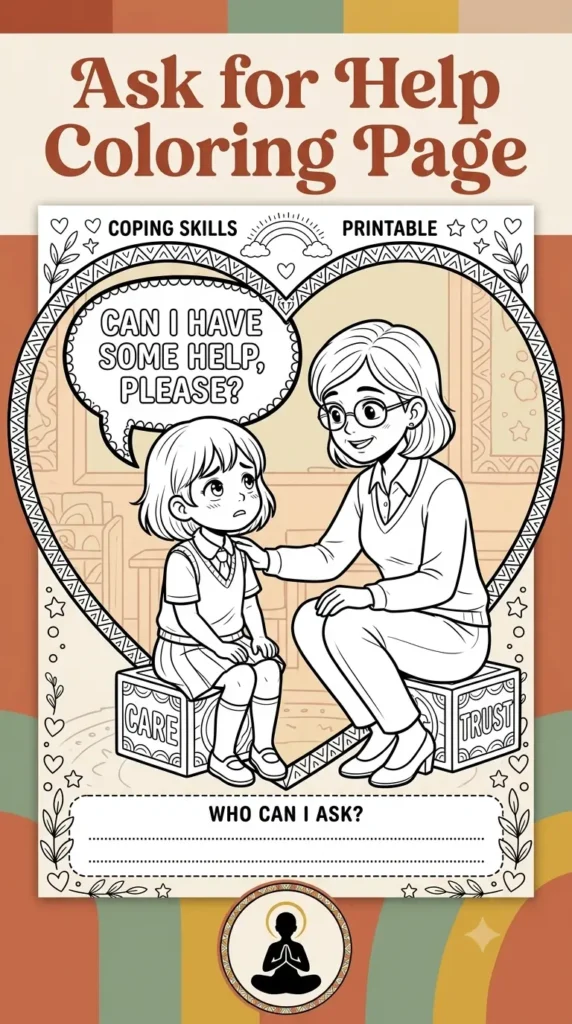
3. Ask for Help Coloring Page
Asking for help counts as a coping skill too. Kids just don’t always believe that.
This page can show a child approaching a parent, teacher, counselor, or another trusted adult instead of trying to carry a problem alone. That’s the whole message.
Best for: school worries, friendship problems, confusing situations, and moments when a child feels stuck.
Adult prompt: “Who are two people you could ask for help when something feels too big?”
Why it works: Kids are still building the language, planning, and self-regulation skills a hard situation actually needs. Supportive adults fill that gap. If your child struggles to name what’s going on before they can ask for help, this emotions worksheet is worth pairing with the page.
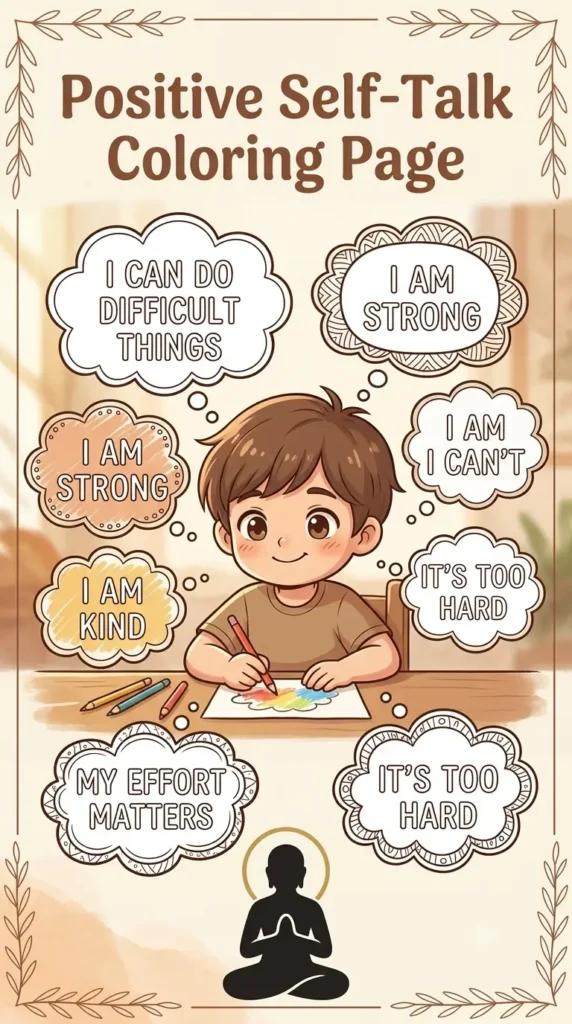
4. Positive Self-Talk Coloring Page
Kids talk to themselves constantly. Most of them just never hear it out loud.
A coping skills coloring activity about self-talk helps a child notice the messages they give themselves when something goes wrong. Skip the overly cheerful lines. Use realistic ones instead: “I can try again.” “I can ask for help.” “I don’t have to get it right the first time.”
Best for: mistakes, frustration, low confidence, and hard school tasks.
Adult prompt: “What would you say to a friend who made the same mistake?”
Why it works: Supportive self-talk gives a child something steadier to reach for when frustration or worry starts shaping their thoughts. It’s a small shift. It still counts.
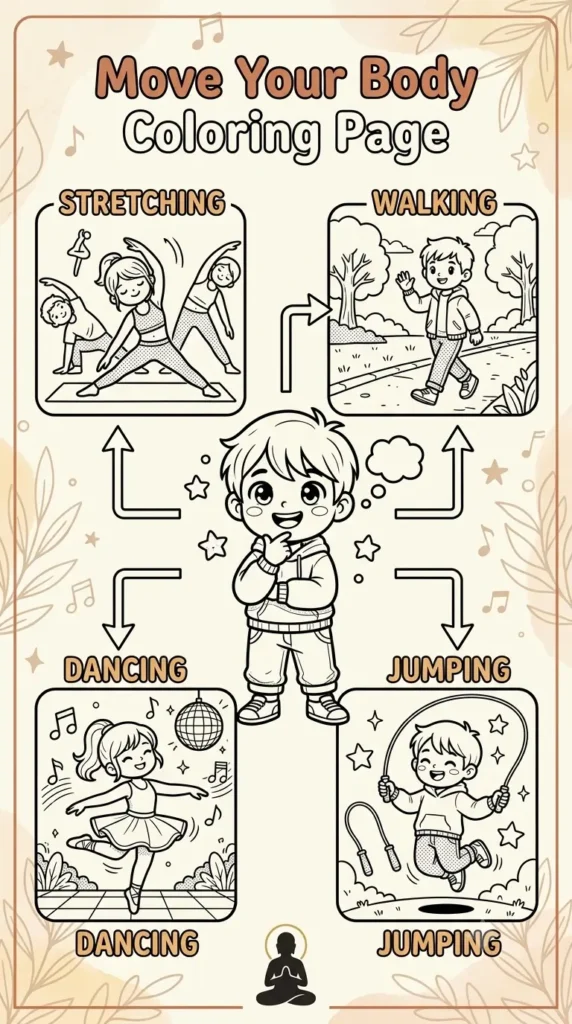
5. Move Your Body Coloring Page
Not every upset kid wants to sit still. Some need the opposite.
A movement-themed page can introduce walking, stretching, dancing, jumping, or another safe physical outlet as a way to work through built-up stress or restless energy. Let the body do some of the work.
Best for: restlessness, frustration, irritability, and kids who settle better through movement than through sitting quietly.
Adult prompt: “Which movement helps your body feel more settled?”
Why it works: Physical movement gives stress energy somewhere to go. The same pediatric guidance on meditation and movement breaks notes that regular breaks like this calm the nervous system and lower stress hormones.
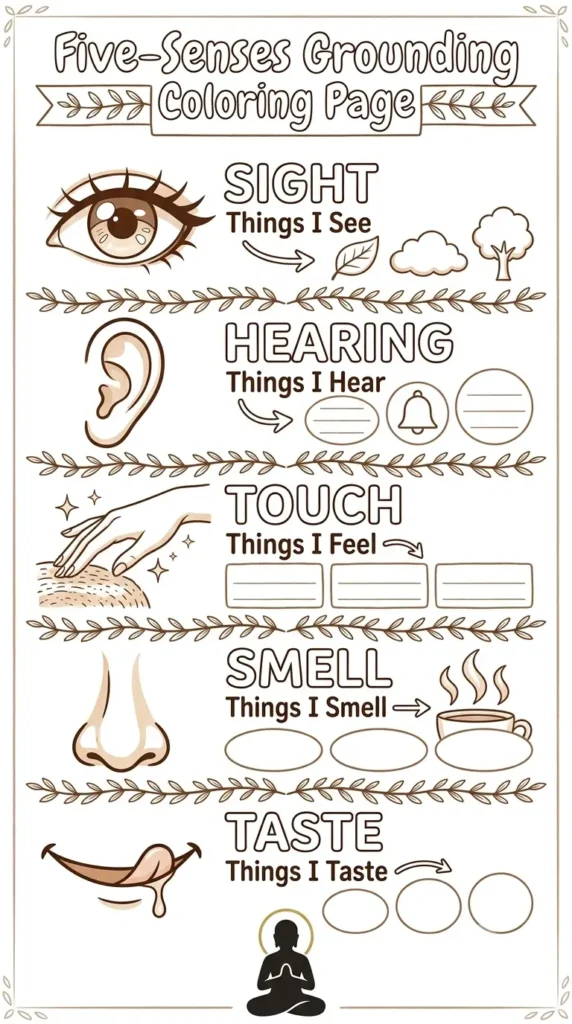
6. Five-Senses Grounding Coloring Page
Racing thoughts don’t wait for permission to spiral. A five-senses grounding page gives a child something else to do instead.
Kids color pictures for what they can see, hear, touch, smell, and taste. Then they use those senses to notice what’s actually around them. Not later. Right now.
Best for: worry, overwhelm, racing thoughts, and moments when a child feels disconnected or unsettled.
Adult prompt: “What is one thing you can notice around you right now?”
Why it works: Why does noticing five things around you calm a racing mind? Grounding uses sensory attention to pull a spiraling thought back to the room a child is standing in. It’s simple. That’s the whole reason it works. This kind of coping skills coloring activity tends to click with kids who like structure. Our coping skills worksheets collection includes a longer grounding worksheet if that’s your child.
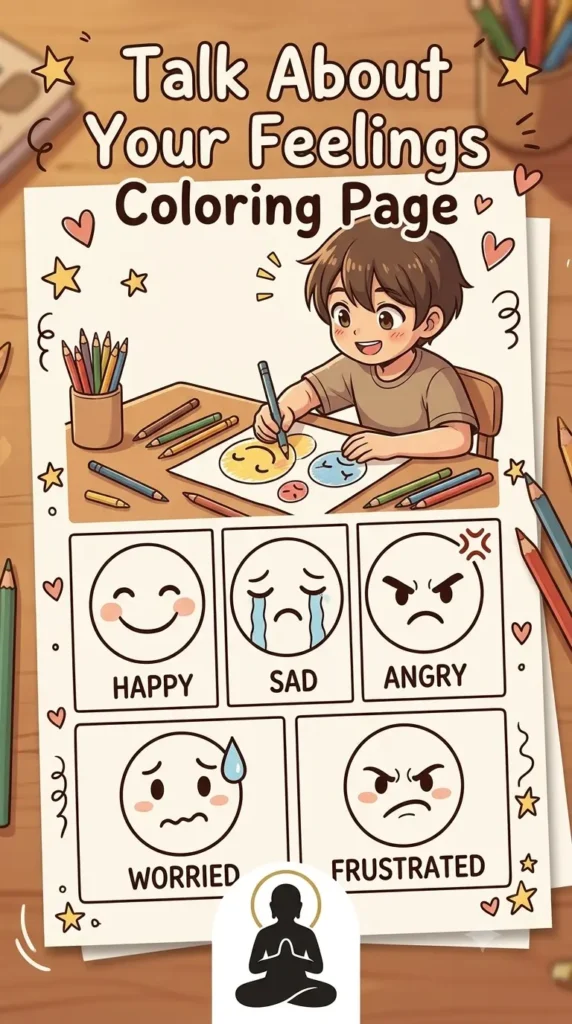
7. Talk About Your Feelings Coloring Page
Naming a feeling comes before deciding what to do about it. Not after. A feelings-focused coloring page gives kids faces, speech bubbles, or small scenes to work with. They can point at an emotion instead of writing a paragraph about it.
Best for: sadness, anger, embarrassment, worry, and friendship problems.
Adult prompt: “What feeling would you put in this picture, and what made you feel that way?”
Why it works: Naming an emotion helps a child recognize what’s happening inside them. That’s step one. It also makes it easier for an adult to respond in the right way, according to HealthyChildren.org. Pair this coping skills coloring sheet with our emotions worksheet if your child needs more vocabulary for feelings.
8. Spend Time With Someone Safe Coloring Page
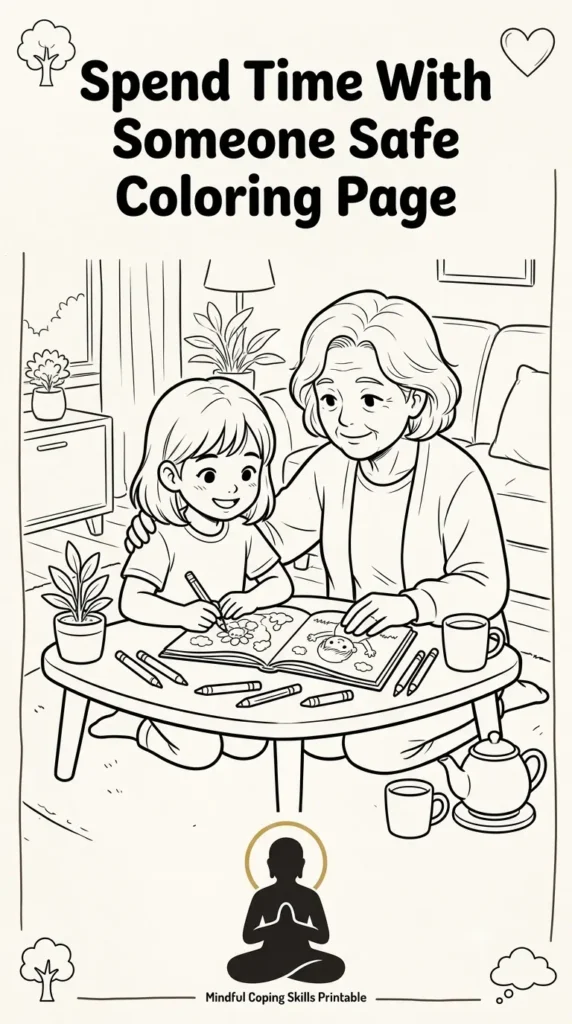
Coping doesn’t always mean handling a problem alone. This coloring page reminds kids of that. It can show a child talking, reading, playing, or just sitting beside someone they trust. That’s enough.
Best for: loneliness, sadness, worry, family changes, and difficult school days.
Adult prompt: “Who helps you feel safe, heard, or supported when you’re having a hard day?”
Why it works: Supportive relationships buffer how kids respond to stress. They give a child a safe place to process what’s hard, according to HealthyChildren.org. Sometimes that matters more than any coping skills coloring sheet on its own.
9. Draw, Write, or Create Coloring Page
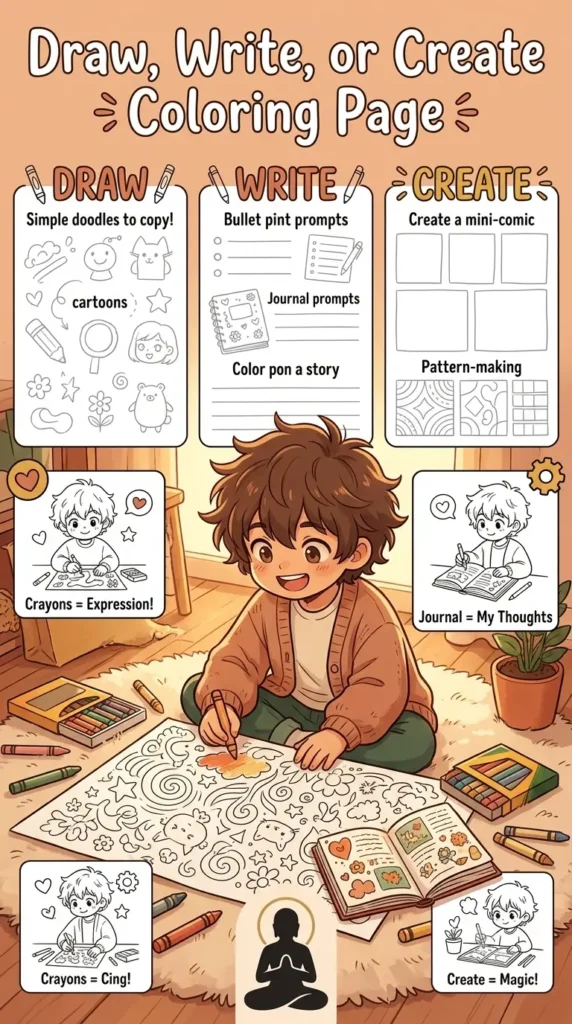
Talking about a feeling isn’t the only way to get it out. Creative expression gives a child another option when words feel too hard. That’s the point. A coping coloring sheet can invite kids to draw, doodle, or write a few words. They might make music instead, or simply color a picture of how they feel.
Best for: sadness, frustration, worry, boredom, and big feelings that are hard to explain.
Adult prompt: “If your feeling could become a picture, what would it look like?”
Why it works: Creative activities give kids a safe outlet for what they’re feeling. No explanation required, at least not right away, per HealthyChildren.org. If your child likes putting feelings into words once they’re ready, that’s a natural next step. Our journal prompts for self-love collection is a good place to go from there.
10. Go Outside and Notice Nature Coloring Page
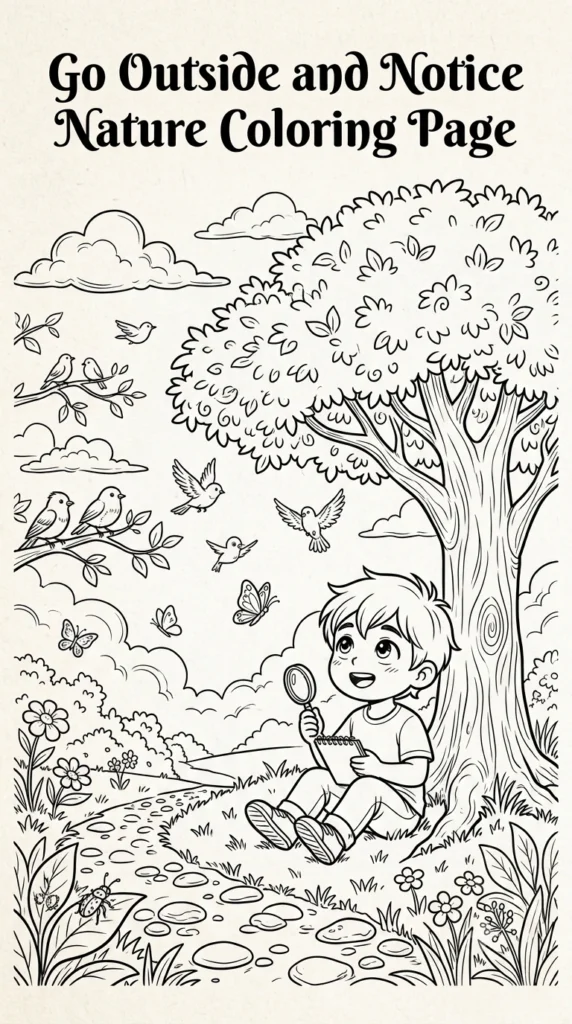
Fresh air isn’t a cure. It still helps. A nature-themed page turns an ordinary outdoor break into a grounding exercise. Kids color trees, clouds, flowers, or birds they notice outside. The finished page becomes a reminder to step outdoors when they need a change of scenery.
Best for: restlessness, overwhelm, frustration, and screen-fatigue moments.
Adult prompt: “What is one thing outside that you notice with your eyes, ears, or hands?”
Why it works: Paying attention to sensory details brings a child’s focus back to the present. Gentle movement outdoors gives them another way to work off stress, according to HealthyChildren.org.
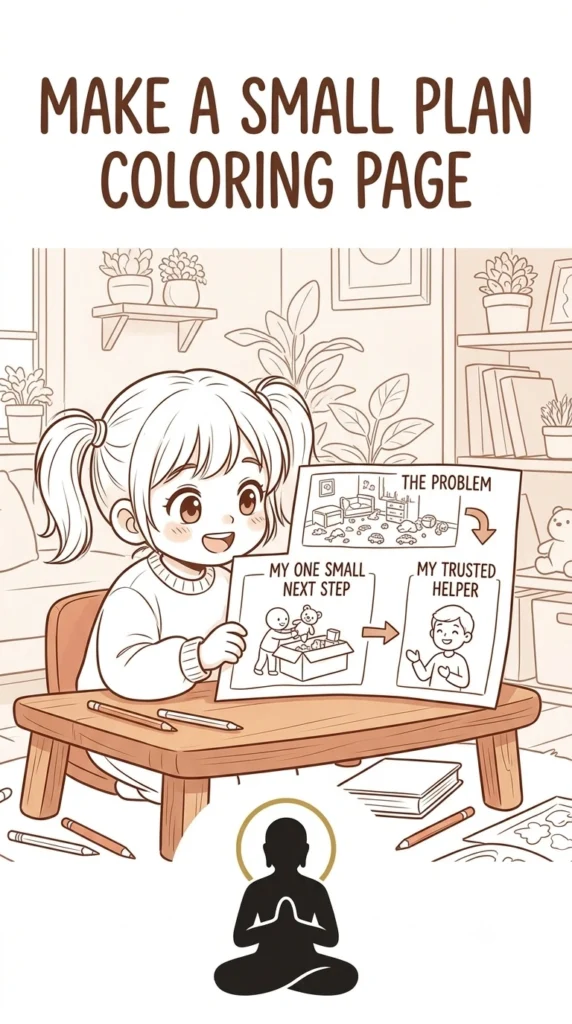
11. Make a Small Plan Coloring Page
A big problem doesn’t need a big solution. It needs one step. Kids get stuck when a problem feels enormous, because they don’t know where to start. This coping strategies coloring page breaks it into one small step. Name the problem. Choose one action. Decide who can help if needed.
Best for: homework frustration, friendship conflicts, mistakes, and problems that feel overwhelming.
Adult prompt: “What’s one small thing you can do next instead of trying to solve everything at once?”
Why it works: Problem-solving moves a child from an overwhelming situation toward one specific action. That beats reacting to the emotion alone, according to HealthyChildren.org.
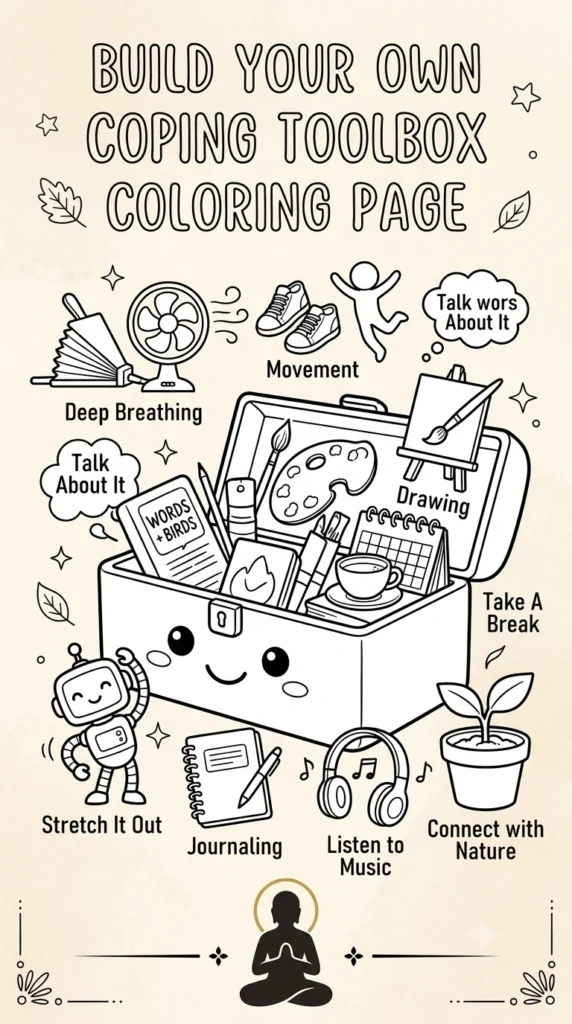
12. Build Your Own Coping Toolbox Coloring Page
The best coping skill is the one a kid actually reaches for. That’s why the final page shouldn’t hand a child one answer. Just space. Instead, it shows an empty toolbox. Kids add pictures or words for breathing, movement, talking, drawing, taking a break, or whatever else feels safe.
Best for: building a personalized set of coping tools kids can revisit at home or school.
Adult prompt: “Which coping skills would you want in your toolbox for your next difficult day?”
Why it works: Practicing a skill while a child is calm makes it easier to remember under stress, according to HealthyChildren.org. Looking for more coping skills coloring pages and worksheets to add to that toolbox? Our coping skills worksheets collection is a good place to start.
A Different Approach From the A–Z Coloring Books You’ll Find Elsewhere
Most alphabet coping books stick a skill under every letter. That’s a fun format. It’s just not always the right one.
Here’s the problem. A child in the middle of a hard moment isn’t thinking about letters. They’re thinking one thing: what do I do right now?
That’s the gap these 12 coping skills coloring pages are built to close. Feeling first. Tool second.
Why We Chose 12 Curated Coping Skills
We didn’t set out to fill 26 slots. That was never the goal.
An alphabet coloring book can work well as a full collection to flip through for fun. But it doesn’t answer the question a kid is actually asking in the moment. “What can I do when I feel like this?” A letter doesn’t answer that. A feeling does.
So these pages are sorted by situation instead. A child who feels overwhelmed might reach for a grounding page first. Someone frustrated may need to pause, move, or work through a small problem instead. A lonely kid usually needs a person, not another “calm down” reminder stuck on a page somewhere.
Sound too simple? It is. That’s exactly why it works.
Each page in this set has one job. Not twenty-six jobs split thin across an alphabet. One.
If your child struggles to name the feeling before picking a page, our emotions worksheet is a solid place to start first.
Feeling First, Coping Skill Second
Think toolbox, not dictionary.
You don’t need all 12 tools every time. You need the right one for right now. That’s the whole shift.
That’s also why this set mixes different kinds of coping instead of repeating the same idea in 12 outfits. Physical tools like breathing and movement. Emotional tools like naming a feeling out loud. Thinking tools like a small shift in self-talk. Connection tools like asking a trusted adult for help.
Four categories. One page each does the job well.
For parents and teachers, that makes the whole set easier to use. Don’t hand a child all 12 pages and hope one sticks. Pick one based on what’s actually happening. Color it together. Then practice the skill for real, not just on paper.
Want a deeper version of this same idea for older kids? Our coping skills worksheets for kids walk through the same feeling-first approach with more writing and less coloring.
And if you’re building out a fuller toolbox at home, the complete coping skills worksheets collection covers every age, from grounding pages to coping logs.
How These Coping Skills Coloring Pages Help Kids Practice, Not Just Color
A coloring page can do more than end up on the fridge. Add a little talk and a little practice, and coping skills coloring pages turn into something else. They become a low-pressure way to introduce kids to real tools for stress, big emotions, and tough moments, well before those tools get used in a hard moment.
Color, Talk, Try: A 3-Step Activity
Want more out of a coping skills coloring sheet? Turn it into a Color, Talk, Try activity. It’s a simple coping strategies coloring page routine, and it works for almost any age.
Color first. Let the child finish the page their own way. No rushing. No correcting which colors go where. The coloring itself works like a quiet pause.
Talk next. Ask one question tied to the skill on the page. A deep-breathing page might get, “When does your body feel like it needs a break?” An asking-for-help page might get, “Who could you talk to when something feels too big to handle alone?”
Try last. Practice the skill while it’s still fresh. Take a few slow breaths. Name five things you can see. Rehearse asking a trusted adult for help.
Why bother with all three steps? Because coping is not the same as calming down. The APA Dictionary of Psychology defines a coping strategy as an action, a series of actions, or a way of thinking used to handle a stressful situation, or to change how someone reacts to it.
Why Practice Before the Big Feeling Hits
Most kids can’t pick a new strategy mid-meltdown. Not when they’re already angry, scared, or on the edge of tears. Practice gives a coping skill a starting point that already feels familiar.
That’s why I like using these coping coloring sheets on ordinary days, not just after something goes wrong. A child can color a breathing page on a slow Tuesday afternoon. Then, when the next hard homework problem or playground fight shows up, the skill is already halfway learned.
Sound too simple? It is. That’s exactly why it works.
The American Psychological Association also encourages parents to teach kids healthy coping strategies and to let them build their own problem-solving skills, instead of stepping in to fix every small bump. Pairing a coloring page with a few coping skills worksheets gives that practice somewhere to go once the crayons are put away.
A coloring page alone won’t erase a child’s stress. But it opens a door. It gives kids language for what they’re feeling, and it makes one coping skill easier to remember, right when they need it most.
Match the Coloring Page to the Feeling
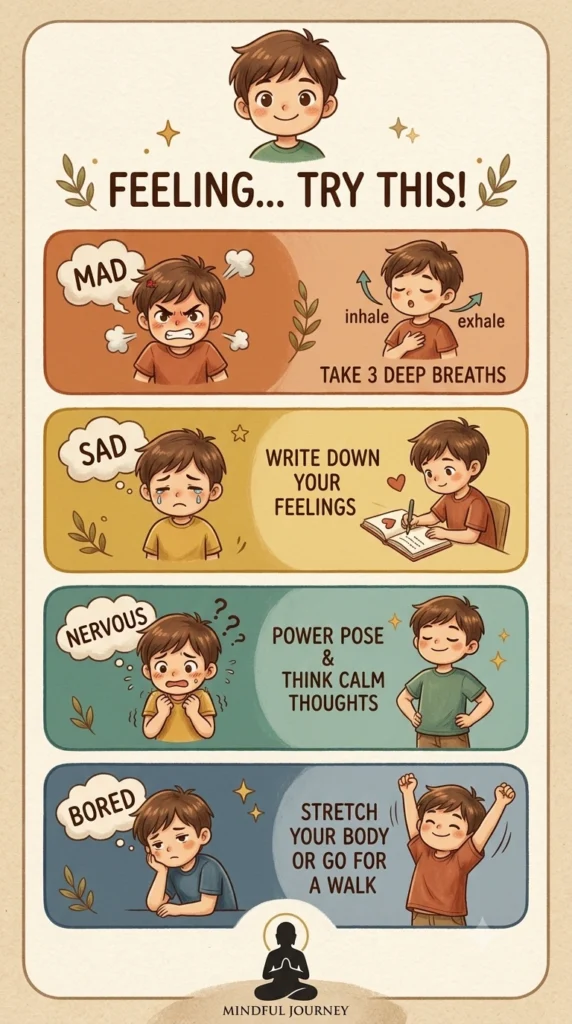
Not every coping page works for every mood. A breathing page fits worry or anger. A page built around talking things out helps more with friendship trouble. Kids don’t need the “perfect” worksheet.
They need a few safe strategies to try, and matching the right coping skills coloring page to the moment is what makes the tool actually work. Our coping skills worksheets guide covers this same idea across a wider set of tools, not just coloring pages.
Anger and Frustration
Anger needs a pause before it needs a fix. A kid mid-meltdown doesn’t want a lecture. Deep breathing, a short break, moving the body, or repeating a calm phrase all work here. Why?
Because they slow the reaction down before it turns into a bigger blowup. A child who’s already upset may not want to talk. Not one word. A quiet coloring activity hands them a way in without demanding an explanation first.
Worry and Overwhelm
Worry traps a kid inside their own head. Overwhelm does something different. It makes a tiny task feel impossible. Pick a page built around slow breathing, grounding, or asking a trusted adult for help. Sensory grounding earns its spot here.
It pulls attention off the racing thoughts and back onto what’s actually happening in the room. A cold glass of water. The texture of a crayon. Five things they can see. Small anchors, real relief.
Sadness and Loneliness
Sad kids don’t need cheering up. Not right away. Sometimes coping just means sitting with the feeling for a minute. A page built around connection, feelings, creative expression, or a trusted person can crack the door open.
Our emotions worksheet works the same territory for kids who need help naming what they feel before they can talk about it. No pressure to explain everything at once. Just a start.
School and Friendship Problems
Homework stress and friend drama aren’t anger problems. Not usually. They’re communication problems. Choose a page that supports talking it out, pausing before reacting, asking for help, or building a small plan.
Telling a kid to “calm down” rarely works here. What actually helps? Naming the skill, then practicing it somewhere low stakes, like a coloring page, instead of in the middle of recess.
Are Coping Skills Coloring Pages Right for Every Child?
Not every child needs the same coping tool. Coping skills coloring pages help a lot of kids learn to calm down. They’re not the right fit for every kid, or every moment. The best fit depends on age, mood, and what kind of support actually helps right then.
That’s the real question behind any coping skills coloring sheets. Does this page suit this child, right now?
When It’s a Good Fit
Coloring works when a child already likes it. A coping skills coloring activity fits best when a kid enjoys drawing and can sit with a simple task, no pressure attached. Nothing timed. Nothing forced. These pages shine as a low-key coping strategies coloring page, something to try before a hard moment hits, not during one.
A teacher might hand out a breathing-themed sheet during an SEL lesson. A parent might tuck a few coping skills coloring sheets into a calm-down basket. A counselor might use one as a conversation starter, not busywork to fill silence.
Not a worksheet. A doorway.
Younger kids benefit most. A kindergartner can’t always explain what “regulate your emotions” means. Pair that idea with a picture to color, and coping skills coloring kindergarten pages suddenly click.
If a child is still learning to name what they feel, these free printable coping skills coloring pages work well next to an actual emotions worksheet, the kind built to help a kid land on the right word first.
When to Offer Something Else
Coloring isn’t automatically calming. Some kids just don’t like it. A child who’s already melting down probably has zero patience left for a worksheet, colored or not.
That’s fine. Offer something else.
Movement helps some kids more. Quiet space helps others. A sensory activity, a trusted adult, or a different coping skill already in the toolbox can beat a crayon in that exact moment.
If a child needs more than one page can give, a fuller set of coping skills worksheets for kids or the ideas in these feelings exercises and activities might fit better. Both pair naturally with the wider list of coping skills worksheets this guide sits inside.
One hard line matters here. If a child is facing serious or ongoing distress, coloring pages for safe coping are never a stand-in for real support. Not from a coloring sheet. Not ever.
The goal isn’t one tool for every kid.
It’s helping each child find what actually settles them. Some kids color. Some need to move, talk, or just sit next to someone who gets it. All of it counts as coping.
Coping Skills Coloring Pages by Age
Age matters more than most people think. A five-year-old and a ten-year-old process a feeling in totally different ways. Pick the wrong coping skills coloring pages for the age, and the page just sits in a drawer.
Younger kids need one picture, one word, one idea. Older kids can handle a scene, a choice, even a follow-up question. Match the page to the stage. That’s the whole trick.
Kindergarten / Early Elementary
Keep it simple. That’s the rule for coping skills coloring kindergarten pages, full stop.
One big picture. One clear idea. A child taking a deep breath. A child asking for help. A child sitting quietly with a stuffed animal. Nothing crowded, nothing wordy.
Too much text loses them fast. A worksheet full of instructions isn’t a coloring page anymore. It’s homework in disguise, and five-year-olds can smell the difference.
An adult should read the strategy out loud here. Model it, right alongside the child. Finish a breathing page, then breathe together. Slow. A few rounds is enough.
The goal isn’t understanding. Not yet. The goal is familiarity. Kids learn coping strategies the same way they learn songs, through repetition, not lecture.
Grades 2–3
This age group starts connecting a feeling to a moment. That’s new, and it matters.
A child in second or third grade can look at a coping strategies coloring page and recognize themselves in it. Frustrated over homework. Nervous before show-and-tell. Upset after a fight with a friend. The scene clicks because they’ve lived it.
Add a short prompt here. “What could you try?” “Who could help?” Small questions like these turn coping skills coloring sheets into something closer to a mini problem-solving exercise. Not a lecture. Not another assignment.
Keep the prompts short. One sentence, max. Anything longer starts to feel like school again, and that kills the whole point of the activity.
For families who want to build this habit further, the coping skills worksheets on our site pair well with this age group. Same idea, just a step up in format.
Grades 4–5
Older elementary kids can go further. They don’t just color a scene anymore. They evaluate it.
At this age, kids can name what they’re feeling, pick a strategy, then check if it actually worked. That last step is huge. Most coping tools skip it entirely.
Pages built around positive self-talk work well here. So do grounding exercises, small action plans, and a personal “coping toolbox” kids fill in themselves. Let them compare strategies side by side. Which one would they actually use, on a bad day, for real?
This is also a good stage to pair coloring with a few journal prompts for mental health. A quick sentence about how the strategy felt adds a layer the coloring alone can’t reach. Some kids also respond well to naming the feeling first, which is where an emotions worksheet can help before the coloring even starts.
Not every kid needs all three. But having options on hand, for stressed, angry, worried, or overwhelmed moments, means there’s always one that fits.
Try a Color-by-Coping-Skills Activity
Coloring pages don’t usually teach anything. This one does.
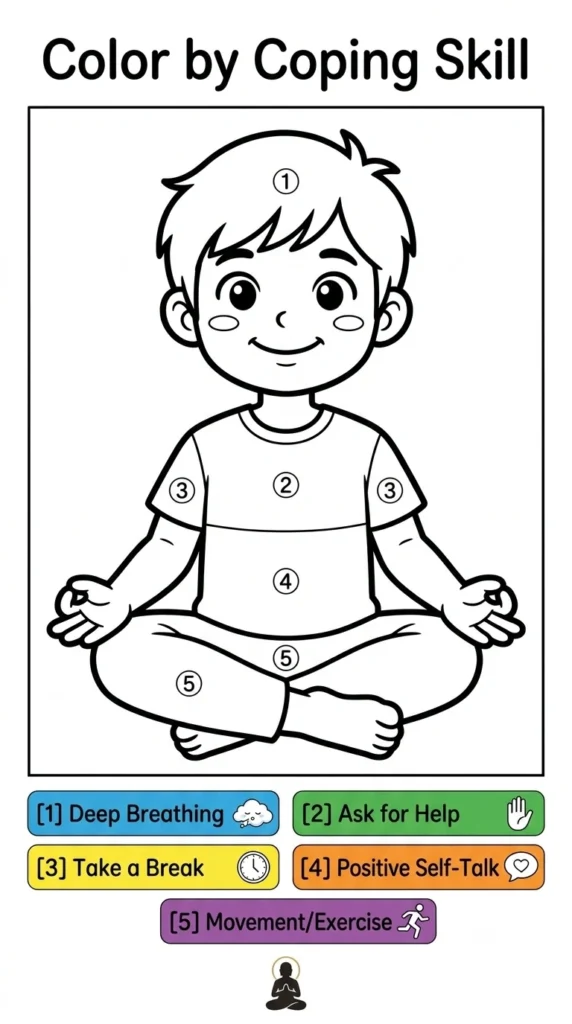
A color-by-coping-skills activity turns a plain page into a small lesson on handling big feelings. Each color stands for one coping strategy. A kid isn’t just filling in shapes.
They’re connecting a visual task to real ways of managing worry, frustration, anger, or that overwhelmed feeling that shows up out of nowhere. Out of all the coping skills coloring pages floating around online, this format tends to stick because it asks a child to do something, not just look at something.
How It Works
The setup is simple. A color key matches each color to one coping skill. The child follows that key instead of picking colors at random.
Here’s what a typical key might say:
- Blue: Take five slow breaths
- Green: Ask a trusted adult for help
- Yellow: Take a short break
- Purple: Use positive self-talk
- Orange: Move your body
The child finds each section in the picture and colors it to match. Nothing complicated about it. Once the page is done, ask two questions. Which strategy do you already use? Which one do you want to try next? That second question does most of the work.
Why Structured Coloring Works for Some Kids
Talking about feelings is hard. A defined coloring task is not.
That’s the real reason these coping skills coloring sheets work for certain kids. A color key gives a child something concrete to follow, not an open-ended conversation they don’t have words for yet. Repetition does the rest. The child sees the same coping strategies again and again, without writing a single sentence or explaining anything out loud.
It won’t land for every kid. Some would rather draw freely, run around, or just talk it out. But a child who likes puzzles, patterns, or following visual steps? This kind of coping skills coloring activity gives them a low-pressure way to rehearse coping choices while their body is already calm.
That timing matters more than people realize. Kids don’t learn coping skills well in the middle of a meltdown. They learn them before one, when nothing’s actually wrong yet.
If your child struggles to name what they’re feeling before reaching for a coping skill at all, pairing this activity with an emotions worksheet can help that part click first.
And if coloring pages turn out to be a hit, our full set of coping skills worksheets for kids has more printable options built the same way, simple, visual, and easy to use without a lecture attached..
Ways to Use Coping Skills Coloring Sheets at Home and School
A coloring page isn’t a filler activity. Not when you use it right.
Coping skills coloring pages work best as practice tools, not busywork. The same sheet can do three different jobs depending on where it shows up. A quiet reset at home. A structured SEL activity in class. A conversation starter in counseling.
At Home
Home is where the routine gets built.
Coping coloring sheets fit naturally into a kid’s calm-down routine, right alongside a coping skills toolbox. Offer one before things get hard. After a rough school day, not once the meltdown has already started. That timing matters more than most parents expect.
Let the child pick the page too. A sheet that matches how they feel lands differently than one handed over at random.
Younger kids do better with company. Sit close. Talk through the coping skill while the crayons move. Older kids often want space first, then a conversation once the page is done. Don’t force the order. Follow the kid.
Struggling to name the feeling before picking a page? An emotions worksheet can get that part sorted first.
In the Classroom
This isn’t about adding one more worksheet to the pile.
Teachers can slot coping skills coloring pages for kids into SEL lessons, morning work, quiet transitions, or the ten minutes after a rough moment in class. A page about deep breathing. Or asking for help. Or taking a break. Each one introduces a real strategy without a single written paragraph.
That’s the appeal. Low effort, real skill.
These sheets also earn their spot in a calm-down corner. Especially when a child gets a choice of two or three activities instead of one assigned task. Choice lowers the resistance. It almost always does.
For a version built specifically for younger classrooms, this coping skills worksheet for kids pairs well alongside the coloring sheets on a rough day.
Counseling & Small Groups
Counseling rooms can feel heavy fast. A coloring sheet lightens that.
Coping coloring sheets open a conversation that might otherwise feel stiff or too serious for a nine-year-old. Ask what situations could make a coping skill useful. Then let the child actually practice it once the page is done. Not just talk about it. Practice it.
Group settings add another layer. Each child picks a different strategy and explains when they’d use it. Simple as that.
This is also where the activity crosses into social skills coloring pages territory. Kids start naming things out loud. Asking for support. Saying what they feel. Working through a disagreement without it turning into a bigger fight. A group activity guide can help a counselor structure that discussion further, and an identifying emotions worksheet works well as a lead-in before the coloring even starts.
Older kids and teens benefit from this format too. If the group skews older, these coping skills activities for teens build on the same idea with a bit more depth.
How to Make a Coping Skills Coloring Activity More Useful
Coloring alone won’t teach a kid to cope. That’s the honest part nobody puts in the intro.
A coping skills coloring activity works best when the page is just the opener. The real work happens after the crayons come out: naming the feeling, picking a strategy that fits, practicing it while calm, then keeping it somewhere the child can actually find again.
Here’s how to get more out of every page in this set.
Start With the Feeling, Not the Worksheet
Don’t hand over a coloring page first. Ask what’s going on.
A breathing-themed page makes sense for a worried kid. Restless or frustrated? Reach for something movement-based instead. Match the skill to the feeling. Not the other way around.
Not sure what a child is actually feeling yet? Start there first. An emotions worksheet can help put a name to it before any page gets picked at all.
Let Kids Choose Between Strategies
Kids use what they understand. Force a strategy on them and it usually gets ignored the next time it matters.
Offer a small choice instead. “Slow breaths, or draw for a bit?” Either one works. The choosing is the point.
This teaches something bigger too. There’s no single perfect coping skill for every moment. Some days call for movement. Other days call for quiet. Letting a child pick builds that judgment early, and it’s a habit worth reinforcing through other coping skills worksheets for kids as they grow more comfortable naming what they need.
Practice After Coloring
Don’t stop when the crayons go back in the box. That’s the easy part to skip and the part that actually matters.
Breathing page? Take a few slow breaths together. Grounding page? Pause and notice what’s around you right now.
Sound like extra work? It is, a little. But a strategy practiced while calm sticks better when a hard moment actually shows up. That’s the whole reason rehearsal beats reading about it.
Keep a Small Coping Toolbox
A finished coloring page doesn’t have to end up in the recycling bin. Save a few favorites. Add other calming activities alongside them.
A folder works. So does a small box. Keep it somewhere a child can reach without asking for help first.
Want a fuller version of this idea, built out with worksheets and more toolbox strategies? This coping skills toolbox guide covers it in depth, and pairs well with any of the coping skills coloring sheets in this list.
Free Coping Skills Coloring Pages PDF: What to Print and Keep
A coping skills coloring pages PDF works best when you print only what a child actually needs. Keep the favorites in one place. Pull them out again when a familiar strategy would help.
That’s the whole system. A small stack of printed pages can turn into part of a kid’s everyday coping toolkit, the kind they reach for without being told to.
Practical Printing Guidance
You don’t need fancy paper or special equipment for most coping skills coloring sheets. Plain printer paper handles crayons, colored pencils, and washable markers just fine. Planning to reuse a page often? Print it on slightly heavier stock. It’ll hold up longer.
Skip printing the whole set at once. Pick a few pages that match what the child is dealing with right now. A kid who melts down over school frustration might do better with pages about taking a break, breathing, asking for help, and making a small plan. That’s more useful than twelve random sheets nobody opens twice.
Store the finished pages somewhere easy to grab. A folder. A binder. A calm-down basket or a personal coping box works too. The goal isn’t decoration. It’s familiarity. A coping strategy coloring page only helps if the child already knows where to find it before the hard moment shows up.
Coloring works well alongside other tools too. Pair a page with the simple prompts in our emotions worksheet, or build a bigger routine using ideas from our full coping skills worksheets collection.
If you’re working with a group instead of one child, these coping skills group activities turn the same idea into something a whole classroom can use together.
Download the Free Coping Skills Coloring Pages
Ready to print? Grab the free printable set below. It gives kids a simple, screen-free way to learn and practice coping strategies through coloring, no lecture required.
FREE PRINTABLE
12 Coping Skills Coloring Pages for Kids
Download the printable PDF, choose the pages that fit your child or group, and start coloring.
[DOWNLOAD THE FREE COPING SKILLS COLORING PAGES PDF]
For classroom or counseling use, print several copies of the pages you reach for most. Saves time later. For home use, one copy of each page is usually enough to start. You can always print more once you know which ones stick.
More Coping Skills Worksheets and Activities
Coloring is a good start. It’s not the whole toolkit.
A child needs more than one way to practice coping. The right worksheet can help a child name a feeling, pick a strategy, then actually use it when things get hard. That’s the real test.
Not the page itself, but what happens after it’s finished. These related resources round out a broader coping skills toolkit, one your child (or you) can lean on beyond just coloring pages coping skills alone.
Coping Skills Worksheets
Start with the full coping skills worksheets collection for a wider mix of worksheets, activities, and practical exercises. It’s the natural next step once coloring pages coping skills stop being enough on their own.
Coping Skills Worksheets for Kids
Younger kids need something built around how they actually learn. Coping skills worksheets for kids covers exactly that, with age-appropriate activities designed for how young children process and practice emotional coping skills.
Coping Skills Activities for Teens
Older kids want less paper, more action. That’s fair. Coping skills activities for teens fits better here, with strategies a teen can actually use at school, at home, or wherever everyday stress shows up.
Coping Skills Activities for Adults
Parents need coping tools too. Nobody talks about that enough. Coping skills activities for adults helps caregivers build their own toolkit while they’re busy supporting a child through hard moments.
Feelings Exercises and Activities
Sometimes the first job is just figuring out what a child is feeling. Nothing more complicated than that. Feelings exercises and activities can turn a vague, foggy feeling into something a child can actually name and talk through.
Identifying Emotions Worksheet
Some kids struggle to put a feeling into words. That’s where an identifying emotions worksheet earns its place. Naming the feeling first makes it a lot easier to pick a coping strategy that actually fits.
Emotions Worksheet
Want broader emotional-learning practice beyond coloring kindergarten pages? The emotions worksheet gives kids another way in, one built for exploring feelings rather than just coloring them.
Journal Prompts for Mental Health
Parents and older kids can benefit here too. Journal prompts for mental health works well once a child or teen is ready to move past naming feelings and start reflecting on patterns, experiences, and the coping choices behind them.
Conclusion
Coping skills coloring pages can be a simple way to help kids slow down, think about their feelings, and practice strategies they can use when emotions get big. The key is to treat the coloring sheet as a starting point, not the whole activity.
Let your child choose a page, talk about when that coping skill might help, and practice it while they’re calm. Some children will love coloring; others may prefer movement, talking, or hands-on activities. Keep a few different options available so coping feels like a choice rather than another task.
Frequently Asked Questions
What are coping skills coloring pages for kids?
Coping skills coloring pages are printable activities that teach children simple ways to handle difficult feelings or stressful situations. A page might focus on deep breathing, taking a break, asking for help, positive self-talk, or grounding. They combine a familiar coloring activity with basic emotional-regulation practice.
How can coloring help children practice coping skills?
Coloring gives children a quiet, hands-on way to focus while learning about a coping strategy. When an adult pairs the page with a short conversation and lets the child practice the strategy, coloring becomes more than a worksheet. It can help make the coping skill easier to remember when they need it.
What are good coping skills for kindergarten children?
Good coping skills for kindergarten children should be simple, concrete, and easy to practice with an adult. Deep breathing, asking a trusted adult for help, taking a short break, naming feelings, stretching, and using a calm space are useful starting points. Coping skills coloring kindergarten activities work best when they use pictures and very little text.
What is a color-by-coping-skills activity?
A color-by-coping-skills activity is a structured coloring worksheet where different colors represent different coping strategies. For example, a child might use one color for breathing, another for asking for help, and another for taking a break. The activity combines following directions with learning and reviewing coping skills.
Is there an A–Z / alphabet coping skills coloring book?
Yes. Alphabet-style coping skills coloring books and A–Z printable resources are available, with each letter connected to a coping strategy or related activity.
They can be useful when you want a larger collection, but a smaller set of carefully chosen coping skills coloring pages for kids can be easier to match to a child’s actual needs.

It’s Bhaskar!
Well, I am not a psychologist a monk, or a philosopher by training. I’m just an engineering graduate.
‘The Empty Self’ is where I write about that idea, and what it actually means for ordinary life, anxiety, identity, habits, the stories we tell ourselves about who we are. I don’t have a psychology degree, and I’m not offering therapy or clinical advice. What I do have is thought and clarity, and genuine curiosity about why we suffer the way we do and how much of it might loose once we shed this ‘fixed identity’.