
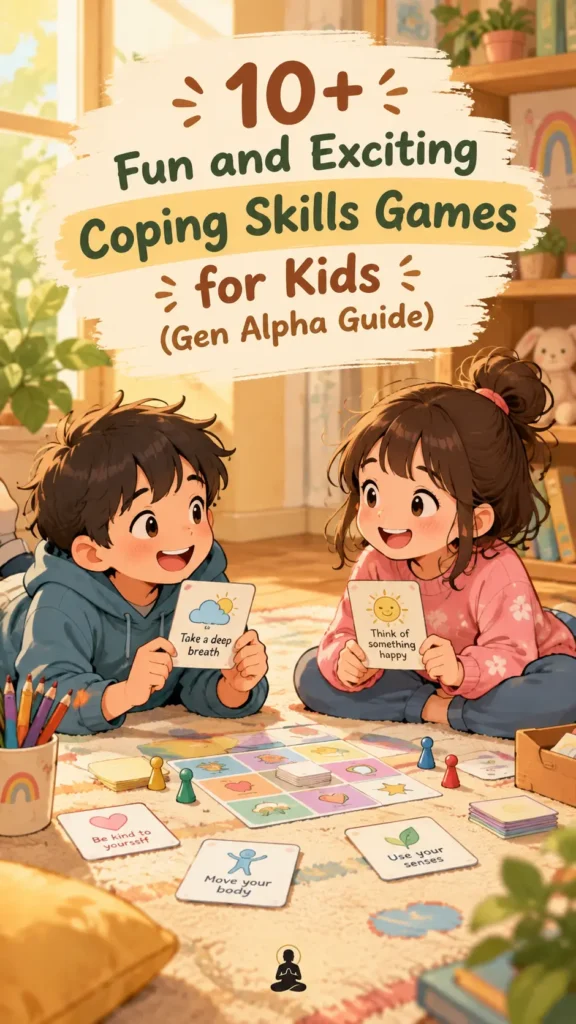
Ask a kid how they’re feeling, and most times you get a shrug. Maybe a blank stare. Maybe a fast “fine” and nothing else. Coping skills games open a different door. Through play, kids practice calming down. They handle frustration. They learn to name emotions that used to feel too big to name, and they start figuring out what to do next. No lecture required.
The trick is picking games that feel like games first. Not lessons in disguise. From Coping Skills Jenga to UNO, dice challenges, scavenger hunts, and even a video-game-style coping challenge, these activities let kids build real skills. Nothing forced. Nothing that turns an emotional moment into a therapy session.
Quick Overview: These coping skills games help kids build emotional awareness, calming strategies, frustration tolerance, problem-solving, and healthy responses to stress. Expect familiar games, printable activities, movement-based challenges, and screen-friendly options for different ages and settings.
Table of Contents
Disclaimer
This blog is written and edited with the help of AI, then reviewed by me before publishing. As a result, the content is for general reflection only, not therapy or medical advice, and I’m not a licensed mental health professional. If you’re in crisis, please contact 988 if you’re in US or a local crisis service of your country instead of relying on this site.
What Are Coping Skills Games?
Coping skills games are just play with a job to do. A kid rolls dice, draws a card, or takes a turn, and somewhere in that turn, they practice managing a big feeling. That’s the whole idea.
Talking about coping only goes so far. A lecture on deep breathing fades by dinner. A game where a kid actually breathes before their next move? That sticks.
These games work because they don’t feel like a lesson. A child isn’t sitting through a worksheet. They’re playing UNO, and the loss of a turn becomes a chance to practice patience instead of a meltdown trigger.
That’s the shift. Coping games for kids turn rehearsal into something fun, not something forced.
What Can Kids Learn From Coping Skills Games?
Kids build real skills without knowing they’re building them. Emotional awareness. Calming tools. Frustration tolerance. Problem-solving. The kind of decision-making that doesn’t show up until a real moment demands it.
Picture this. A child loses a round. Instead of throwing the pieces, they name what they’re feeling first. “I’m mad.” Then they take three slow breaths before their next turn.
That’s not scripted. That’s practiced.
A coping skills game might ask a child to pick a grounding technique on the spot. Another might ask them to decide, mid-play, whether this is a moment to ask for help. Small choices. Repeated often enough that they start to feel automatic.
Nobody wants every game to feel like therapy homework. Not the point. The point is repetition. Give a child enough low-stakes tries at naming a feeling or calming their body, and the skill shows up later, when it actually matters.
A few things a good coping skills activity tends to build:
- Spotting and naming emotions in the moment
- Slowing the body down before reacting
- Sitting with frustration instead of exploding at it
- Asking for help instead of going quiet
- Choosing a response instead of defaulting to one
Fun coping skills games don’t replace those reps. They just make kids want to show up for them.
Are Coping Skills Games the Same as Therapy Games?
Not quite. They overlap, but the setting changes everything.
A licensed mental health professional might use a structured therapy game to assess how a child is doing, teach one specific skill, or move a treatment goal forward. That’s clinical work, guided by training most of us don’t have.
At home, it looks different. You turn Jenga into a coping skills jenga game by writing a prompt on each block. You adapt UNO so a color match means naming an emotion instead. Cards, dice, ordinary games, repurposed for a specific job.
Useful? Very. A substitute for therapy? No. And that gap matters more than it sounds like it should.
If a child’s big feelings keep circling back no matter how many rounds of a coping skills for kids game you play, that’s a sign worth taking seriously, not a reason to add another game to the shelf.
Pairing games with something quieter helps too. Our coping skills worksheets give kids a slower way to sit with what they just practiced, once the dice are put away. And if naming the feeling is still the hard part before any game even starts, this emotions worksheet is a good place to build that piece first.
For a wider look at the skills kids build around emotions and relationships, CASEL is a solid framework to check against.
How to Choose the Right Coping Skills Game for a Child
The flashiest game rarely wins here. What matters is matching the game to the skill a kid actually needs to build. Age and attention span play into it too. So does whether the child likes to talk, move around, draw, or solve small problems. Get that match right, and practice stops feeling like a lesson. It just feels like play.
Start with the need. Not the shelf.
A child who freezes up when worried needs something calming, a grounding game that slows the body down. A child who melts down over losing needs the opposite: quiet reps at losing small and staying okay.
Neither kid needs a complicated setup. A familiar game with the right prompt can beat a brand-new activity that eats twenty minutes just explaining the rules.
Choose by Need
| If the child needs help with… | Try these coping skills games |
|---|---|
| Anxiety or worry | Coping Skills Spinner; Coping Skills Scavenger Hunt |
| Anger or frustration | Coping Skills Jenga; Stop, Think, Choose |
| Big emotions | Coping Skills Dice Game; Video Game Controller Coping Challenge |
| Identifying emotions | Coping Skills Matching Game; Coping Skills Bingo |
| Impulse control | UNO Coping Skills Game; Coping Skills Jenga |
| Talking about feelings | “What Would You Do?” Coping Scenarios; Coping Skills Charades |
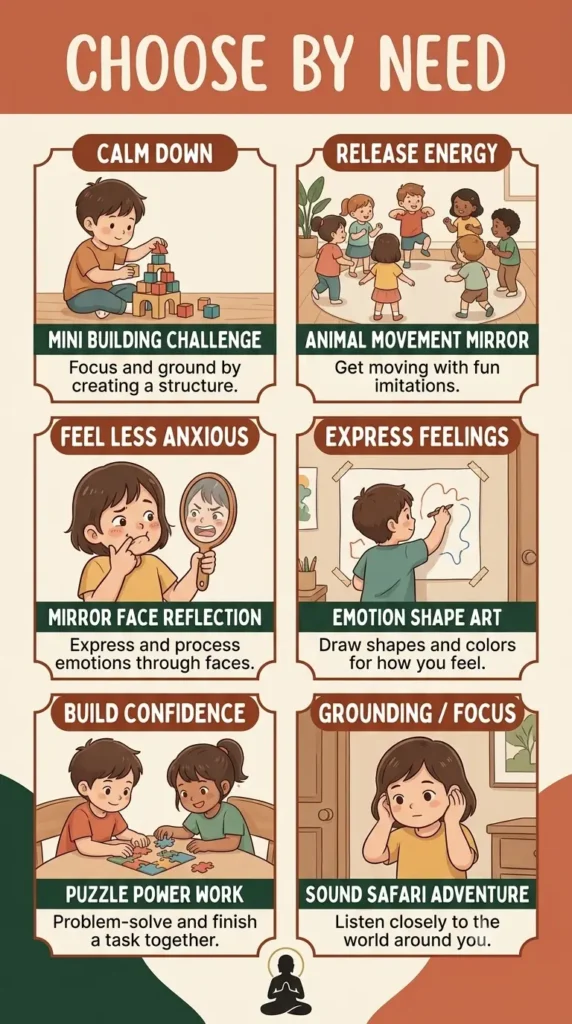
Treat that table as a starting point. Not a rulebook.
Some kids hate competition on principle. Hand that kid Jenga and watch frustration spike instead of settle. A matching game or a slow scenario card does more good. The point was never to win.
It’s to practice, safely, until the response starts to feel familiar. For a deeper library of prompts and printable tools that pair well with these games, the coping skills worksheets guide is worth a look.
10+ Fun Coping Skills Games for Kids
A worksheet asks a child to sit still and write. Most kids won’t. Coping skills games work because they skip that step entirely.
The good ones don’t feel like homework wearing a costume. A child names a feeling, pauses before reacting, tries a calming move, or works through a tricky moment, all while they think they’re just playing.
That’s the whole trick. If you want the paper-and-pencil version for quieter moments, our coping skills worksheets cover that side in more depth.
1. Coping Skills Jenga
- Age: 6+
- Players: 2–6
- Time: 10–20 minutes
- Materials: Jenga-style block tower, numbered blocks, paper with matching prompts
- Best coping skill: Frustration tolerance, calming, problem-solving
- Free/DIY or paid: DIY if you already own wooden blocks; any stacking-block game works
Turn a regular tower into something more useful. Give each numbered block a coping prompt. Pull a block, answer the prompt, place it on top. That’s the whole game.
Mix up what the prompts ask for. One number might mean five slow breaths. Another might ask a child to name five things they can see right now. Others can cover positive self-talk, taking a break, asking for help, or thinking through a problem out loud.
The falling tower matters just as much as the blocks. Don’t rush to smooth it over when it collapses. Let the frustration show up. That’s the real practice, stopping, breathing, and trying again with the tower still on the floor.
Example prompt: “The tower fell and you’re annoyed. What could you do before starting again?”
2. UNO Coping Skills Game
- Age: 6+
- Players: 2–6
- Time: 10–20 minutes
- Materials: A regular UNO deck, or homemade colored cards
- Best coping skill: Emotional awareness and choosing a coping response
- Free/DIY or paid: DIY with paper cards; no special deck needed
Give each color a category. Red can mean anger. Blue can mean sadness or worry. Green can mean calming strategies. Yellow can mean positive thoughts, or things that help a child feel better.
When a player puts down a colored card, hand them a prompt from that category. A red card might ask, “What could you do when you’re really angry?” A green card could mean, “Show us a calming strategy you could use at school.”
Action cards work too. A Skip card might mean “name something you can do when you need a break.” A Reverse card could ask the player to turn an unhelpful reaction into a helpful one on the spot.
No UNO deck on hand? Four piles of colored paper cards do the exact same job.
Example prompt: “You get a red card. Name one healthy way to handle anger before you say something you regret.”
3. Video Game Controller Coping Challenge
- Age: 7+
- Players: 1–4
- Time: 10–15 minutes
- Materials: Paper controller diagram, printed cards, or a real controller as a visual prop
- Best coping skill: Self-regulation and making intentional choices
- Free/DIY or paid: Free/DIY
Telling a child to “control their emotions” doesn’t mean much to a kid who thinks in game mechanics. This one does. It connects coping to commands a child already understands: pause, choose what happens next, restart after a mistake, ask for a power-up.
Create five command cards:
- PAUSE: Stop and take a breath before reacting.
- SELECT: Pick a coping skill that fits the situation.
- RESTART: Think about what you could try differently.
- POWER-UP: Identify someone who can help you.
- LEVEL UP: Name a coping skill you’ve been practicing.
Hand the child a situation card. Let them pick the controller command they need. Nobody’s pretending emotions have an off switch here. The goal is smaller than that: a bit of space between feeling something and acting on it.
Example prompt: “Your friend says something that makes you angry. Which button do you need first, and what would you do?”
4. Coping Skills Matching Game
- Age: 5–10
- Players: 1–4
- Time: 10–15 minutes
- Materials: Paper or index cards
- Best coping skill: Identifying emotions and matching responses to situations
- Free/DIY or paid: Free/DIY
Some kids already know they’re upset. They just don’t know what to do next. This game skips the giant memorized list and gets straight to connecting a situation, a feeling, and a response.
Make three types of cards: Situation, Feeling, Coping Skill. For example:
- “I have to give a presentation” → worried → slow breathing
- “Someone won’t let me join the game” → left out → talk to a trusted person
- “I made a mistake on my homework” → frustrated → take a short break and try again
- “The classroom is very noisy” → overwhelmed → move somewhere quieter
Shuffle everything. Ask children to build complete three-card matches. Older kids can leave the coping-skill card open and suggest their own answer instead.
Flexibility is the point here. There’s rarely one perfect skill for a feeling. Different strategies work for different kids, and this game should teach that, not hide it. Our emotions worksheet pairs well here if a child needs more practice naming the feeling before picking the skill.
Example prompt: “You feel overwhelmed because the room is noisy. Which coping skill could help, and why?”
5. Coping Skills Dice Game
- Age: 5–10
- Players: 1–6
- Time: 5–15 minutes
- Materials: One standard six-sided die and a list of six coping actions
- Best coping skill: Practicing coping strategies through repetition
- Free/DIY or paid: Completely free if you already have a die
No board. No deck. No printable required. One die becomes the whole game.
Assign one coping action to each number:
| Roll | Coping action |
|---|---|
| 1 | Take five slow breaths |
| 2 | Name three things you can see |
| 3 | Stretch your arms and shoulders |
| 4 | Say one kind thing to yourself |
| 5 | Name someone you can ask for help |
| 6 | Choose your own healthy coping skill |
Take turns rolling. Each player completes whatever they land on. Demonstrate the action alongside younger kids. For older ones, add situation cards so they have to decide whether the rolled skill actually fits.
Swap the six actions out whenever a child gets bored. That’s what keeps this a five-minute activity instead of one that demands a whole afternoon.
Example prompt: “You rolled a 2. Look around the room and name three things you can see without judging them.”
6. Coping Skills Bingo
- Age: 6+
- Players: 2–8
- Time: 10–20 minutes
- Materials: Homemade or printable bingo cards, pencil or small markers
- Best coping skill: Emotional awareness and practicing healthy coping choices
- Free/DIY or paid: Free/DIY
Bingo mechanics turn into repeated practice with healthy stress responses here. It works especially well in small groups, since no child has to share a personal story just to take a turn.
Fill each square with a coping skill: take five slow breaths, ask for help, take a short break, stretch, name how you feel, listen to music, think of a safe place. Call out a situation instead of reading the skill straight off the card. Try: “You feel nervous before a test.” Kids mark whichever square could actually help.
Want a more active version? Have the child demonstrate the skill before marking the square. Otherwise this turns into a word-recognition game, and that’s not the point.
A center “free space” called My Go-To Coping Skill works well too, and it doubles as a quick window into which strategy actually sticks for that child. For teachers running this with a full class, our coping skills group activities guide has more formats built for that setting.
Example prompt: “You are getting frustrated because you keep making the same mistake. Which square could help you handle that feeling?”
7. “What Would You Do?” Coping Scenarios
- Age: 6–12
- Players: 1–6
- Time: 10–20 minutes
- Materials: Situation cards or slips of paper
- Best coping skill: Problem-solving and choosing appropriate coping strategies
- Free/DIY or paid: Free/DIY
A six-year-old and a twelve-year-old don’t need the same scenarios. That’s the whole appeal here. This is one of the more flexible coping skills games for kids because you write the situations yourself, so the game bends to fit whatever a child is actually facing.
How to play: Write everyday situations on cards. Keep them real. A friend doesn’t invite you to play. You lose a game. Homework feels impossible. Someone laughs at your mistake. Plans change without warning. You have to speak in front of the class.
The child draws a card and answers four questions:
- What might you feel?
- What might you want to do immediately?
- What could you do that would help?
- Who could you ask for support?
For older kids, add a second round. Have them come up with two possible responses and decide which one actually helps more.
There’s no perfect answer here. Not the point. The point is helping a child pause long enough to notice they have more than one option.
Example prompt: “Your best friend is playing with someone else at recess. What might you feel, and what could you do instead of getting angry right away?”
If naming the feeling is the part that trips a child up, an emotions worksheet is worth pulling out before this game. It gives them the vocabulary this scenario game assumes they already have.
8. Coping Skills Spinner
- Age: 5–10
- Players: 1–6
- Time: 5–15 minutes
- Materials: Paper spinner or a free digital spinner
- Best coping skill: Choosing and practicing coping strategies
- Free/DIY or paid: Free/DIY; can also be played digitally
Kids like surprise. They also need repetition to actually build a skill. A spinner gives them both at once.
How to play: Divide the spinner into categories: breathing, movement, grounding, positive self-talk, taking a break, asking for help. The child spins and does whatever it lands on. A paper plate and a pencil work fine. So does a free digital spinner if you’re already on a screen.
Give a situation first for more meaning. Try, “Imagine you’re really nervous because you have a test tomorrow.” Then let them spin and act out whatever strategy shows up.
Looking for coping skills games online free? A digital spinner is the easiest entry point. Nothing to cut out, nothing to prep. Just check that the tool doesn’t require an account before you hand it to a child.
Example prompt: “You spun ‘grounding.’ Imagine you’re worried about tomorrow. Show me one grounding strategy you could use right now.”
9. Coping Skills Scavenger Hunt
Age: 5–12
Players: 1–6
Time: 10–20 minutes
Materials: Scavenger-hunt list, household or classroom objects
Best coping skill: Grounding, sensory awareness, and healthy distraction
Free/DIY or paid: Completely free
Some kids can’t sit still and talk about feelings. Fair enough. This one skips the sitting entirely.
How to play: Hand the child a list of things to find using their senses. Something soft. Something with an interesting texture. Something that makes a pleasant sound. Something blue. An object that reminds them of a calm place.
For a grounding-focused round, shift the prompts toward noticing instead of collecting: “Find five things you can see,” “Find four things you could touch,” “Find something that smells nice.” This mirrors the 5-4-3-2-1 grounding technique therapists use with anxious kids, just dressed up as a game.
Turn it into a team challenge for a classroom or counseling group. Afterward, ask which items actually helped the child slow down.
This isn’t about distracting a child from every hard feeling. Grounding works best when it settles a child enough to respond thoughtfully, not when it just makes the feeling disappear.
Example prompt: “Find something you can touch that has an interesting texture. Describe how it feels without saying whether you like it.”
10. Stop, Think, Choose
- Age: 6–12
- Players: 1–6
- Time: 10–15 minutes
- Materials: Situation cards, plus three signs labeled Stop, Think, and Choose
- Best coping skill: Impulse control and deliberate decision-making
- Free/DIY or paid: Free/DIY
One idea holds this whole game together: a strong feeling doesn’t have to run the show. The child practices building a pause between what happens and what they do about it.
How to play: Give the child a situation card. First, STOP. They hold up the sign and physically pause. Then THINK: What am I feeling? What happened? What do I need? Finally, CHOOSE: which response helps, instead of making things worse?
Start easy. Mildly annoying situations, not devastating ones. Open with something overwhelming and the whole exercise turns abstract fast, especially for a younger child.
Once the pattern sticks, pull the cards away. Can they still remember the sequence? You can even run it live, mid board game, the second someone loses a turn.
Example prompt: “You lose your turn because you weren’t paying attention. Stop. What are you feeling? Now choose what you could do next.”
11. Coping Skills Charades
- Age: 5–12
- Players: 2–8
- Time: 10–20 minutes
- Materials: Coping-skill cards or slips of paper
- Best coping skill: Recognizing and practicing healthy coping behaviors
- Free/DIY or paid: Free/DIY
Some kids will do anything to avoid a sit-down talk about emotions. Charades solves that. Nobody has to explain a coping skill. They act it out instead.
How to play: Write coping strategies on cards. Pick ones easy to mime: deep breaths, stretching, listening to music, drawing, counting slowly, asking for help, taking a quiet break, positive self-talk.
One child draws a card and acts it out silently. Everyone else guesses. Once someone gets it right, ask a fast follow-up: “When might you use that?”
Younger kids can add sounds or simple gestures. Older kids can raise the difficulty by acting out the situation first, then the coping response.
That short discussion afterward matters more than the charade itself. Skip it, and kids remember the game but miss the skill underneath it.
Example prompt: “Act out a coping skill you could use when you’re feeling overwhelmed, but don’t say its name.”
If you want a wider net of coping skills activities to rotate through, our full coping skills worksheets guide covers checklists, logs, and printable tools for every age group. Running this in a classroom or therapy group?
The coping skills group activities guide has more options built for a room full of kids at once. And for the days a child wants something quieter, coping skills coloring pages pair well with any of the five games above as a wind-down.
Free Printable Coping Skills Games You Can Make at Home
You don’t need a therapy kit for this. Paper works. So does a die, a printer, or a plain deck of cards sitting in a drawer somewhere.
With those, you can build free printable coping skills games that teach kids to spot big feelings and practice what to do about them. No clinic required. Just a kitchen table and ten minutes.
Free Coping Skills Card Game
Grab index cards. Write one skill per card: deep breathing, taking a break, stretching, grounding, asking for help. A child draws a card, reads it out loud, then acts it out.
That’s the whole game. Nothing to set up, nothing to explain twice.
Want more structure? Pair the cards with coping skills worksheets for reflection once the round ends. It turns a quick coping skills activities pdf into something with a little more depth, without losing the part kids actually enjoy.
Printable Coping Skills Matching Game
Here’s a twist on a familiar format. Instead of matching identical pairs, connect a situation to a feeling and a response. “I lost a game” pairs with “frustrated,” which pairs with “take five slow breaths.”
Three cards, one chain, one lesson.
A coping skills matching game built this way does more than test memory. It trains a kid’s brain to link what they feel with what they can actually do next. That link is the skill. Everything else is just packaging.
Not sure your child can name the feeling part yet? An emotions worksheet fills that gap fast, before the matching game even starts.
Printable Coping Skills Dice Game
Assign each number on a die its own coping action. One might mean “name your feeling.” Another might mean “show a calming strategy.” Roll, complete it, roll again.
Simple as that.
A basic printable version turns into a coping skills game free printable you can pull out anywhere, home, car, waiting room, classroom corner. No screen involved. One die does the job.
Coping skills dice games work especially well for kids who fidget through longer activities. Short bursts. Fast turns. Nobody has time to get bored.
DIY Coping Skills Board Game
Draw a path on paper. Add spaces like “Name an emotion,” “Try a coping skill,” “What would you do?” Players move forward by answering the prompt or acting it out.
Keep the rules loose. The board is a container, not the point. The point is the practicing.
This format also works well as a group activity for siblings or a small class. If you want more group-friendly formats to rotate through, that’s a whole category worth exploring on its own.
Turn a Regular Deck of Cards Into a Coping Game
No printer? No problem. Grab any deck of cards sitting in a closet. Assign each suit a category: feelings, calming skills, problem-solving, support. Draw a card every turn.
This is the fastest fix on the list. A coping skills game without printing anything, ready in under a minute.
For younger kids, pair the cards with an emotions worksheet so the feeling vocabulary sticks alongside the game. Older siblings can run the deck solo. Little ones usually need a hand naming the category first, and that’s fine. That’s the whole reason the pairing helps.
Free Coping Skills Games Online for Kids
A few minutes of screen time can turn into something real. Free online coping skills games do that. They build calm, sharpen emotional awareness, and sneak in decision-making practice without feeling like a lesson.
The good ones ask for nothing upfront. No account. No download. Just enough flexibility that a parent, teacher, or counselor can drop in their own coping prompts and make the game theirs.
If you want a fuller toolkit to pair with these games, our coping skills worksheets collection covers the paper-and-pen side of the same practice.
Online Spinners and Dice
Spin a wheel. Pick a skill. That’s the whole mechanic, and it works. A digital spinner is one of the easiest ways to build a coping skills game online, no design skills required.
Put six coping choices on the wheel. Deep breathing, stretching, grounding, positive self-talk, taking a break, asking for help. Let the child spin. Whatever lands, that’s the move.
Dice work the same way. Assign each number a coping action, one through six. Roll it and go.
A free browser-based dice roller like Toolseq’s free dice roller needs no account at all. Open it, roll, done. That’s the whole barrier to entry, which is to say there isn’t one.
Matching and Quiz Games
Matching games build a skill most kids never practice directly. Spotting a feeling, then choosing a response that actually fits it.
Pair “I feel worried before a test” with “take slow breaths.”
Or flip it into a quiz question: “Which coping skill could help here?” Same idea, different format.
Here’s the part that matters most. Keep the questions about real situations. Not coping terms. Not vocabulary drills. A kid who can define “grounding” but can’t use it under stress hasn’t actually learned anything. If naming feelings is still shaky for your child, the body-and-face prompts in our emotions worksheet make a solid warm-up before a matching game.
Online UNO-Style Games
This isn’t about buying a special therapy deck. You don’t need one. An ordinary online card game can carry the whole exercise.
Assign each color a category instead. Red means anger. Blue means calming. Green means positive self-talk. Yellow means asking for support.
The adult brings the coping prompts. The game brings the structure, the turns, the fun of playing at all. Kids stop noticing it’s practice somewhere around round two.
Virtual Scavenger Hunts
Passive scrolling versus active grounding? No contest. A scavenger hunt pulls a kid out of the screen and into the room around them.
Call out prompts. “Find something soft.” “Find something that makes you smile.” “Find three things you can see from where you sit.” Simple instructions, real sensory work underneath.
Younger kids do best with visual, concrete finds. Older kids can take it further, turning each object into a short conversation about memory, safety, or what grounding actually feels like in the body.
Digital Drawing and Emotion Games
Some feelings won’t come out in words. Drawing gets around that wall.
Ask a child to draw what stress looks like. Or sketch a “calm place.” Or invent a character whose one special power is a coping skill they’re learning to use themselves.
What does stress even look like to a nine-year-old? Ask, and you might be surprised by the answer.
For a no-login option, Adobe’s Aqua lets kids draw and color right in the browser. No sign-in required. Another simple choice is OnlineWhiteboard.org, a basic browser whiteboard that states no login or installation is needed to start.
Free tools like these let you open a tab and play immediately. Paid or account-gated platforms often ask for registration, a subscription, or premium access before certain games unlock.
Worth knowing before you commit an afternoon to one. For more visual, low-pressure options in the same spirit, check out our coping skills coloring pages and the activity ideas in feelings exercises for kids.
How to Turn Any Board Game Into a Coping Skills Game
You don’t need a special therapy game to practice coping skills. Almost any familiar board or card game can become a games for coping skills activity by adding simple prompts, emotional choices, and short practice moments to the normal rules.
Add Coping Prompts to Any Turn
The easiest approach is to attach a coping prompt to each turn. When a child rolls, draws, or moves, they answer a question or demonstrate a skill before continuing. In Jenga, for example, a player could name one thing that helps when they feel angry. In UNO, a card color could trigger a different coping prompt.
Keep prompts short enough that they don’t interrupt the fun. The goal is practice, not a quiz.
Use Colors as Emotional Categories
Colors can give children a visual way to connect emotions with coping choices. You might make red cards about anger, blue about sadness, yellow about worry, and green about calm or positive feelings.
This works especially well with UNO, but you can adapt the idea to almost any game with colored pieces, spaces, or cards. A child landing on a red space might name one healthy way to cool down when frustrated.
Add “Pause and Practice” Spaces
Choose a few spaces on a board and turn them into Pause and Practice spaces. When a player lands there, everyone stops for a few seconds to practice one coping skill.
Try slow breathing, a five-senses grounding exercise, stretching, positive self-talk, or simply naming the feeling in their body. Candy Land and Connect 4 can both be adapted this way.
Turn Losing Into Frustration-Tolerance Practice
Losing can become useful coping practice when the child is ready for it. Instead of immediately cheering them up or changing the rules, help them notice the frustration and choose what to do with it.
Ask, “What could help you handle that feeling?” Taking a breath, saying “I can try again,” or asking for a short break turns an ordinary game moment into real-life practice.
Add a “Choose Your Coping Skill” Card
Create a small stack of Choose Your Coping Skill cards. Whenever someone draws one, they pick a coping strategy they would use in a stressful situation and explain why.
This gives children some control over the activity, which matters. Coping isn’t about memorizing the “right” answer; it’s about learning which strategies feel useful in different situations.
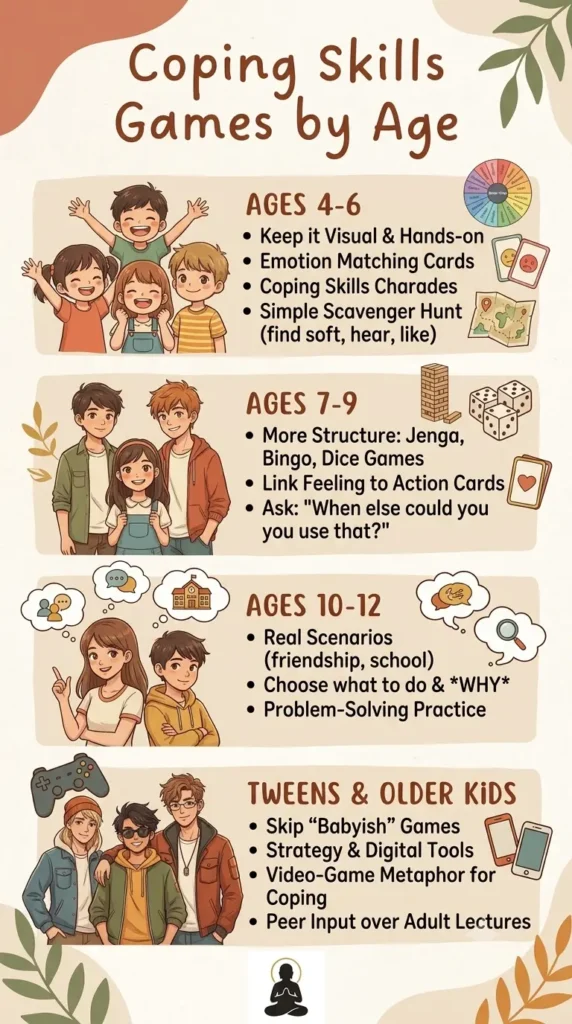
Coping Skills Games by Age
Not every coping skill game works for every kid. A five-year-old needs pictures and movement. A twelve-year-old needs a real scenario to chew on. The trick is matching the game to what a child can actually handle, not what looks impressive on a worksheet.
That’s the whole point of good coping skills group activities: they meet a kid where they are, not where the lesson plan wants them to be.
Ages 4–6
Keep it short. Keep it visual. Keep it hands-on. Little kids are still learning the words for what they feel, so the game has to do some of that work for them. Naming a feeling, copying a calming action, picking between two simple choices. That’s plenty at this age.
Emotion matching cards work well. So does coping skills charades, a spinner with a few easy options, or a scavenger hunt where kids find something soft, something they like, something they can hear. Nothing complicated.
One rule worth following: if a game takes 20 minutes to explain, skip it. A preschooler checked out ten minutes ago.
Ages 7–9
This isn’t the same crowd anymore. Kids ages 7–9 can sit with more structure: Jenga, bingo, dice games, matching games, “What Would You Do?” scenarios. These hold up as solid coping skills group activities for kids, especially in a classroom or small group setting.
This is also the age to start linking a feeling to an action. A kid draws an “angry” card, rolls a die, and lands on the coping skill they’re supposed to try. Simple enough.
But the game gets sharper when you ask one more question afterward: when else could you use that? That single question is what turns a game into something that sticks past the session.
Ages 10–12
Raise the bar here. Real scenarios work better than pretend ones. Friendship drama. School pressure. Losing a game in front of people. A fight with a sibling. Feeling left out of the group chat. These kids know exactly what that feels like.
The games can carry more weight now too. Not just naming an emotion, but choosing what to do about it. Ask: “Which coping skill fits here, and why?” That why matters.
It pushes a kid to check whether a strategy actually fits the moment, instead of grabbing the first one that comes to mind. This is where group counseling activities start looking a lot more like problem-solving practice than a feelings lesson.
For Tweens and Older Kids
Tweens can smell a “lesson for little kids” from across the room. Skip anything that feels babyish. Strategy games, digital tools, scenario challenges, even a video-game-controller metaphor for coping, these land better because they don’t feel like a worksheet in disguise.
This age group also works well in a middle school group counseling setting, where peer input carries more weight than an adult explaining a concept solo. Kids this age often trust each other’s answers more than a printed sheet.
As they move toward the teen years, it’s worth branching into more coping skills group activities for teens, which hand over more independence in choosing and practicing what actually works for them.
How to Make Coping Skills Group Activities Actually Work
Coping skills group activities only work under a few conditions. Kids need to practice while they’re calm. They need some say in which strategy they use. And they need room to talk about it afterward. That’s the real formula behind coping skills group activities that stick.
The point isn’t to turn playtime into a therapy session. It’s to make the skill familiar enough that a child can find it later, when things get harder to manage.
Practice Skills Before a Child Is Overwhelmed
A child mid-meltdown isn’t ready to learn. Not a coping skill. Not anything new. Practice belongs in ordinary moments instead.
Try a breathing game after school. A grounding challenge before bed. A Jenga prompt when everyone’s relaxed and in a decent mood. Repetition builds the memory before the child actually needs it. That’s what separates group coping skills activities that get used from ones that get forgotten by week two.
Let Kids Choose Their Coping Strategy
Give children some control over the activity whenever you can. Some would rather draw than breathe. Others need to move, not sit still. Let them.
Coping skills are personal. What works beautifully for one child might annoy the kid sitting right next to them. A small menu of choices teaches something bigger, too: kids get to decide how they respond to hard feelings. That decision-making matters as much as the emotions worksheet or worksheet you hand them.
Don’t Turn Every Game Into a Therapy Session
A coping game can just be a game. Not every turn needs a deep conversation about feelings. Push too hard on that, and kids check out. Or start avoiding the activity altogether.
Keep it playful. Follow the child’s lead. The skill still gets practiced without turning every answer into an interview.
Debrief With One or Two Simple Questions
A short conversation after the game is usually enough. Ask which coping skill they’d actually try. Or when it might help them. No need to dissect every move.
The goal is connecting the game to something real: school, home, or friends. If a child struggles to put the moment into words, a few journal prompts for mental health can open that door later, on their own time.
Know When a Game Isn’t Enough
Group coping skills activities help kids practice emotional skills. They’re not a replacement for professional support. Not when distress is persistent, severe, or getting in the way of daily life. The CDC recommends talking with a child’s healthcare provider or mental health professional when concerns come up, and getting help early tends to support kids at home, at school, and in their relationships.
If a child is in immediate emotional crisis, or at risk of harming themselves or someone else, don’t try to manage it with a game. In the U.S., call or text 988 for the Suicide & Crisis Lifeline. Outside the U.S., use your local emergency or crisis service.
For families building a broader toolkit, our coping skills worksheets pair well with these group activities and give kids something concrete to return to between sessions.
Coping Skills Games vs. Coping Skills Worksheets
Games and worksheets aren’t competing tools. They’re two different jobs. One gets a kid moving through a skill in real time. The other slows everything down so the skill actually sticks. In coping skills group activities, you usually need both, not one or the other.
Games Build the Reflex. Worksheets Build the Memory
A game hands a kid something to do. Maybe it’s slow breathing between dice rolls. Maybe it’s picking a calming strategy right after a frustrating turn. That’s the whole point. The body learns the move before the mind has to think about it. And when a real stressful moment hits later, the reflex is already halfway built.
Worksheets work differently. There’s no timer, no turn order, no pressure to react fast. A child can sit with a feeling and actually name it. What sets it off? What usually helps?
Writing it down turns a vague feeling into something concrete enough to use later. For a full breakdown of that process, this coping skills worksheets guide walks through exactly how to move a child from playful practice into that kind of structured reflection.
Combine Both for Better Practice
Don’t pick one. Run a game first. Then hand over a worksheet to capture what came up. Simple as that. After a coping-skills matching game, for instance, a child might write down one situation that stresses them out and the exact strategy they’d try next time it happens.
That single step turns a fun activity into something with staying power. The game creates the practice. The worksheet turns that practice into a plan the child can actually return to.
Conclusion
Coping skills games give kids a chance to practice what they can do when emotions start getting too big. The best games aren’t complicated or expensive. A Jenga tower, a few homemade cards, a dice, or a simple digital spinner can turn coping practice into something a child actually wants to do. The key is to connect the game to a real skill: breathing, grounding, asking for help, handling frustration, or choosing a healthier response.
Try one game when your child is calm, keep the first round light, and let them choose the coping strategy they like best. With practice, those skills become easier to reach for when they really need them.
Frequently Asked Questions
What are the best coping skills games for kids?
The best coping skills games for kids are simple, engaging, and connected to a skill they can use outside the game.
Jenga, UNO,
coping skills bingo,
matching games,
dice games, and
scenario games work
well because children can practice calming, problem-solving, emotional awareness, and frustration tolerance while playing.
How do you turn Jenga into a coping skills game?
To turn Jenga into a coping skills game, write a coping prompt on each block or assign different prompts to numbered blocks. When a child pulls a block, they answer the prompt or practice the skill. Include breathing exercises, grounding, positive self-talk, and questions about handling frustration.
How can I make a free printable coping skills game at home?
You can make a free printable coping skills game with paper, a printer, scissors, and simple prompts. Create cards that pair common situations with feelings and healthy coping responses. You can also make a matching game, dice game, bingo board, or simple board game using skills your child already knows.
What games can help kids practice emotional regulation?
Games that involve identifying feelings, pausing before reacting, choosing responses, and managing frustration can help children practice emotional regulation.
Coping skills bingo,
emotion matching games,
scenario cards,
charades,
Jenga, and
“Stop, Think, Choose”
are useful because they let children rehearse coping responses in a low-pressure setting.
Can ordinary games like UNO or board games be used to teach coping skills?
Yes. Ordinary games can become coping skills games when you add prompts or rules that encourage children to practice emotional regulation. UNO, Jenga, Candy Land, and other turn-based games can create natural moments to practice patience, handling disappointment, taking a breath, making choices, and recovering after losing.

It’s Bhaskar!
Well, I am not a psychologist a monk, or a philosopher by training. I’m just an engineering graduate.
‘The Empty Self’ is where I write about that idea, and what it actually means for ordinary life, anxiety, identity, habits, the stories we tell ourselves about who we are. I don’t have a psychology degree, and I’m not offering therapy or clinical advice. What I do have is thought and clarity, and genuine curiosity about why we suffer the way we do and how much of it might loose once we shed this ‘fixed identity’.