
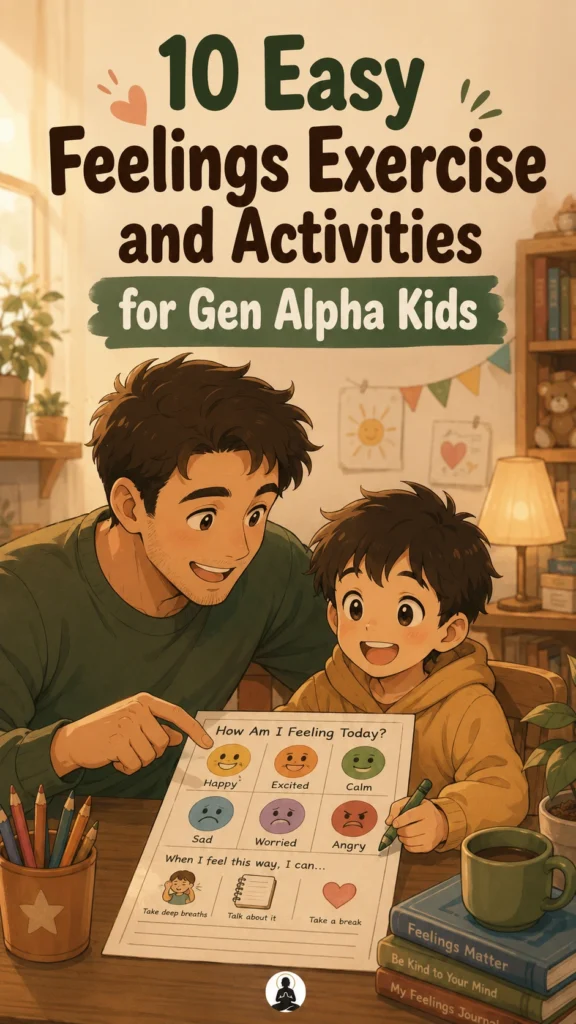
Kids know when something feels off. Naming it is the hard part.
A child can say “I’m upset.” That word hides a lot. Frustrated? Embarrassed? Worried? Left out? Disappointed? Five different feelings, one flat label. That small gap in vocabulary is what makes it so hard for a kid to explain what’s actually going on.
This is where feelings exercise and activities step in. They give kids a low-pressure way to notice, name, and express what they feel, through play, conversation, movement, or a bit of creativity. Nothing clinical about it. Just practice.
Gen Alpha kids already think in these formats. Emojis. Games. Comics. Visual scales. Lean into what’s familiar, and emotional learning stops feeling like a lesson and starts feeling like something they’d actually do on their own.
Here’s the honest goal, though. It isn’t to erase every hard feeling a kid has. That’s not realistic, and chasing it usually backfires. The real goal is recognition. Help a child spot what they’re feeling, then choose a response that actually helps. That’s it.
Quick overview: feelings exercises and activities help kids identify emotions, build a working feelings vocabulary, express themselves, read other people better, and practice regulation. Games, drawing, scenarios, emotion scales, and a few simple conversation prompts turn emotional learning into something practical, something kids enjoy, and something they’ll actually repeat.
For a deeper library of prompts and printables to pair with these activities, this emotions worksheet guide is a solid next stop, and these journal prompts for mental health work well once a child is ready to put feelings into writing.
Table of Contents
Disclaimer
This blog is written and edited with the help of AI, then reviewed by me before publishing. As a result, the content is for general reflection only, not therapy or medical advice, and I’m not a licensed mental health professional. If you’re in crisis, please contact 988 if you’re in US or a local crisis service of your country instead of relying on this site.
What Are Feelings Exercises and Activities for Kids?
Feelings exercises and activities help kids notice what’s going on inside them. They give kids the words for it too. Then comes the why. Then comes the tricky part: what to actually do when a big emotion shows up.
The best feelings exercise and activities don’t feel like a lesson. They feel like play.
What Is a Feelings Exercise?
A feelings exercise is a guided practice. It walks a child through exploring or responding to one emotion. Name it. Rate it. Notice where it lives in the body. Practice what comes next when it gets loud.
Point to where nervousness sits in your stomach. That’s a feelings exercise.
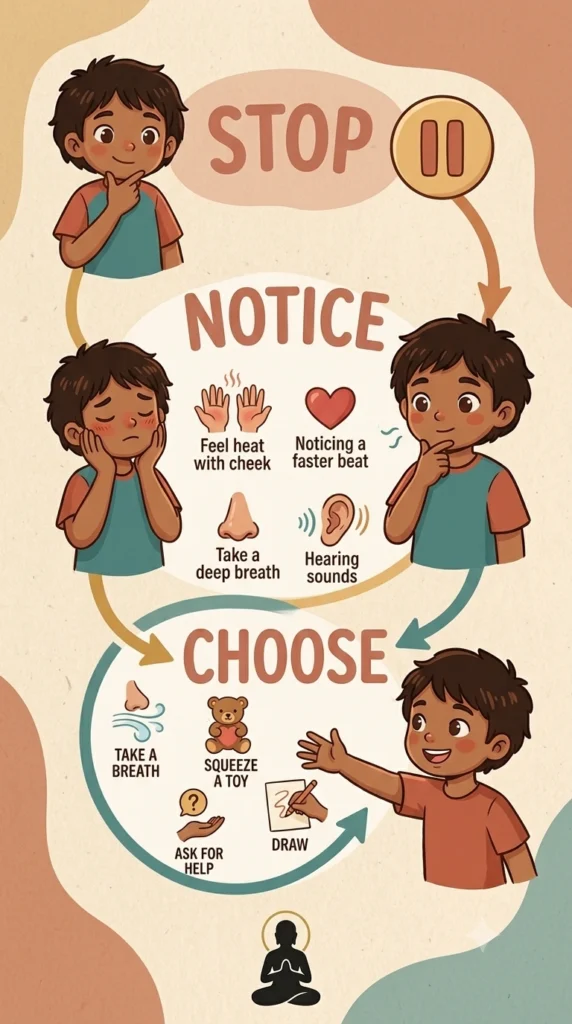
Talk through anger, then practice a short “stop, notice, choose” routine. That’s one too. Small, specific, repeatable. That’s the whole design.
What Is a Feelings Activity?
A feelings activity is looser. It builds emotional awareness through play, through talk, through drawing, through moving around the room. Less structure, more mess. That’s the point.
Emotion charades works. So does drawing a feeling with nothing but color and squiggles. So does matching emoji faces to emotion words. These are the feelings activities for kids that stick because they don’t feel like work.
Here’s the real difference. An exercise usually has one skill in mind. An activity can wander. Both matter. Kids need both.
How Are Feelings Worksheets Different?
A feelings worksheet is more structured. Visual, written, built for tracking a pattern or growing a vocabulary word by word. Worksheets earn their place when a child needs to work through something specific and see it on paper.
Want the full breakdown? Our emotions worksheet guide covers that format in depth, from printable pages to what actually belongs on them.
This piece is the companion to that guide. Not another stack of worksheets. Instead, actual things kids can do: games, drawing, role-play, honest conversation, and simple ways to calm a body that’s running hot.
Why Feelings Exercise and Activities Matter for Gen Alpha Kids
A kid doesn’t wake up knowing the word “disappointed.” They just feel it. Feelings exercise and activities give that vague, stuck feeling somewhere to go, into words, pictures, choices, actions.
Gen Alpha kids already speak in emojis and game logic. So formats built around those, matching games, visual scales, short stories, land faster than a straight-up “how do you feel?” ever will. The learning still counts. It just doesn’t feel like a lesson.
They Make Emotions Easier to Name
Something feels wrong. That much a child knows. Frustrated, embarrassed, left out, worried? That part is harder. Feelings exercises give kids repeated reps at matching an internal state to an actual word.
And the research backs this up: emotion-specific vocabulary is tied to stronger emotion understanding, including spotting emotions in others and knowing what to do about them.
Here’s why an emotion-matching game beats a blank “how do you feel?” question. It gives the child something to point at. A face. A word. A scenario. Not an open void they have to fill on their own.
They Build Emotional Vocabulary
“Happy,” “sad,” “angry.” That’s the starter pack most kids arrive with. Not enough. Not by a long shot. A child stuck on three words has three words for everything happening inside them. Feelings exercises for kids slowly stretch that list, nervous, annoyed, disappointed, lonely, overwhelmed, one activity at a time.
A 2022 study of children ages 4 to 11 found something worth sitting with: kids produced more emotion words as they got older. Emotional language isn’t fixed at birth. It grows. Slowly, and mostly through practice, not lectures.
They Help Children Understand Other People’s Feelings
Ask a kid how a character felt after losing a game. Or getting left out of a group chat. Or getting praised out of nowhere. That’s perspective-taking, dressed up as a story question. The child has to separate “how I’d feel” from “how they might feel.” That gap is where empathy actually lives.
It matters beyond the activity itself. Emotion knowledge tracks with how kids handle social situations and school. One caveat, though. No single feelings activity is a guaranteed upgrade to a child’s emotional intelligence. Nothing works that cleanly.
They Create Practice Before a Big Emotion Happens
Waiting until a meltdown to teach emotional skills is backwards. Rehearsal works better before the storm, not during it. A good feelings exercise walks a kid through the sequence ahead of time: notice it, name it, size it up, decide what’s next.
Emotion knowledge and self-regulation are linked in meaningful ways, research shows. That’s real. But it’s not the whole story. A worksheet won’t stop a tantrum on its own, and no exercise here claims to.
If you want a deeper structure to build on, our emotions worksheet guide breaks identifying and naming feelings down step by step, and it pairs well with the activities below. Parents looking to build their own noticing habit alongside their kid’s might also like these journal prompts for mental health or a few mindfulness journal prompts for slowing down together.
10 Easy Feelings Exercise and Activities for Gen Alpha Kids
Good feelings exercise and activities don’t need a classroom or a therapist’s office. They need five minutes and a kid willing to play along. The list below moves in order. First noticing an emotion, then naming it, then expressing it, then actually doing something useful with it.
Think of this as a hands-on companion to a full emotions worksheet. The worksheet gives structure. These activities give movement, color, and a reason to laugh along the way.
1. Feelings Check-In: “How Do I Feel Right Now?”
A check-in doesn’t need to turn into a big conversation. That’s the whole appeal. Hand your child a feelings chart, a card set, or just a short list of words. Ask them to pick one. Then ask, “What made you feel this way?”
Pictures help younger kids get there faster. Older ones can reach past “good” or “bad” toward something sharper. Frustrated. Nervous. Disappointed. Proud. That precision is where identifying emotions for kids actually starts to click.
Gen Alpha differentiation: Let your child post a personal “status update” for their emotions, the same way they’d update a profile. An emoji goes up first. Then it gets swapped for a real feeling word. A familiar digital habit becomes an offline my feelings exercise without any of it feeling like a lesson.
2. Emotion Detective: Match Faces, Words, and Situations
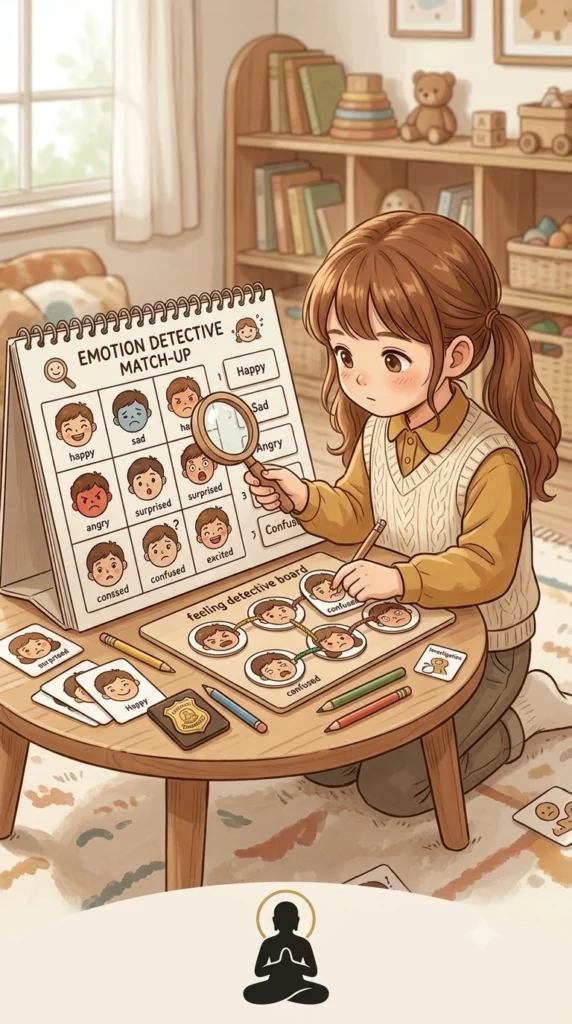
Turn identifying emotions into a small detective game. Write feeling words on cards: excited, worried, angry, calm, embarrassed. Then show a face or describe a short situation. Your child matches it to the word they think fits.
Here’s the part that actually teaches something. Talk through the answer together. A child might call a face “angry” when the person is really just concentrating hard. That’s not a wrong guess. It’s an opening. We can’t always read someone’s feelings just by looking at them, and that’s worth saying out loud.
Gen Alpha differentiation: Swap the flashcards for character-style avatars. Your child designs the avatar, gives it an expression, then challenges someone else to name the emotion. It plays more like customizing a game character than sitting through an emotions activity for kids.
3. Feelings Thermometer: How Big Is the Emotion?
Not every feeling is the same size. A thermometer teaches that fast. Draw a scale from 1 to 5. One is barely-there. Five is huge. Give your child a situation and ask where the emotion would land.
Forgetting a pencil might sit at a 1 or 2. Losing something precious might hit a 4 or 5. There’s no correct answer here. The goal is noticing the size of the reaction, not grading it.
Gen Alpha differentiation: Call it a mood meter. Or a loading bar. The same visual feedback kids already see in games and apps. Ask, “How full is your frustration bar right now?” Suddenly an abstract idea like emotional intensity has a shape a kid can actually picture.
4. Emoji-to-Emotion Game
Emojis are a decent launchpad for a richer feelings vocabulary. Pick a few familiar ones. Ask your child to name the emotion behind each. Then push further: does this emoji really mean just one thing?
A smiling face could be happiness. Or relief. Or excitement. Sometimes even nervousness, depending on what’s going on. Encourage your child to skip the emoji shortcut and land on a specific word instead.
Gen Alpha differentiation: Start with symbols your child already knows. Then build a “real feeling word” upgrade for each one. Heart-eyes becomes admiring. A worried face becomes anxious. An annoyed face becomes frustrated. The screen-inspired format turns into a bridge, not a distraction.
5. “I Feel ___ When ___” Sentence Builder
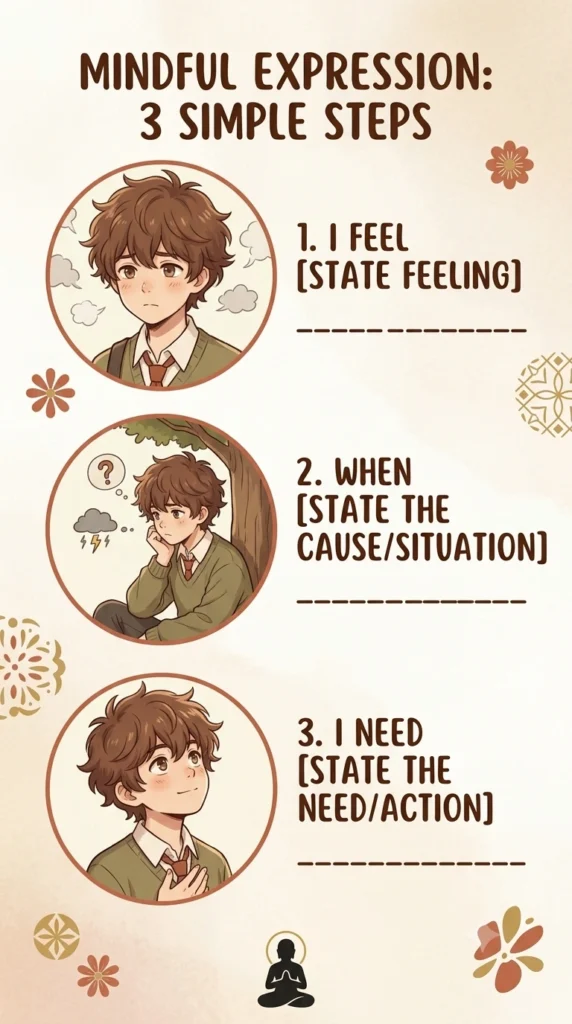
Some kids know they’re upset. They just can’t explain why. This sentence structure fixes that without turning it into a blame game. Start simple: “I feel ___ when ___.”
Use everyday moments. “I feel frustrated when my game doesn’t load.” Or “I feel left out when everyone makes plans without me.” Once that feels comfortable, add a second line: “What I need is ___.”
This might be the single most useful of these feelings exercises for kids, because it links the emotion to what actually caused it. That’s language they can carry into a real conversation, not just a worksheet.
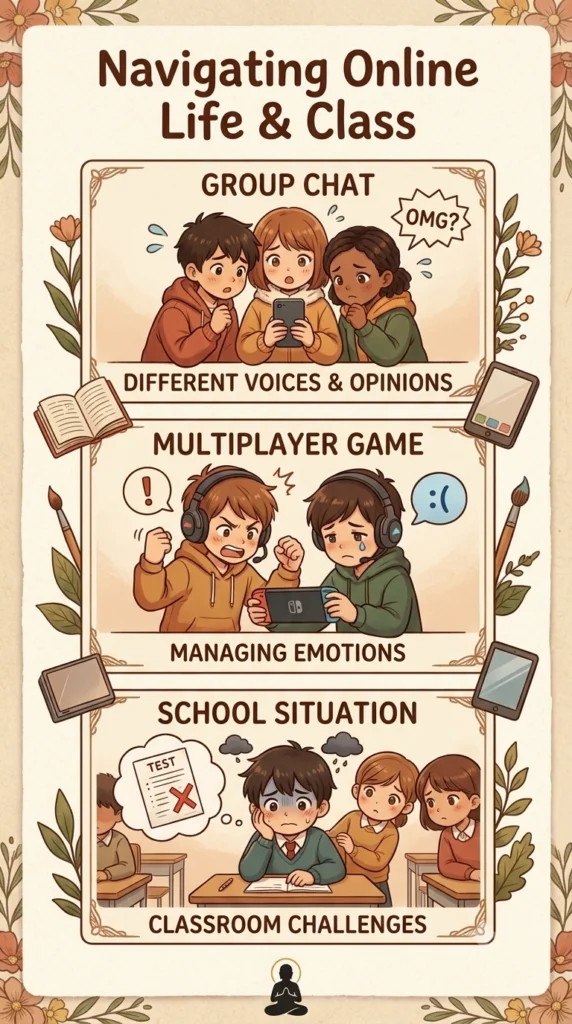
Gen Alpha differentiation: Pull situations straight from your child’s actual world. Group chats. Online games. School projects. Waiting for a reply that never comes. Keep the focus on the feeling itself, not on deciding who’s right.
6. Draw Your Feeling
Some kids don’t want to talk about a feeling out loud. Drawing gives them another way in. Ask your child to draw what an emotion looks like. A face. A place. A color-filled shape. A storm. A character. Something with no clear shape at all works too.
Resist the urge to explain the drawing back to them. Just ask, “Tell me about this part.” Let the child decide what it means. That’s the whole point.
Gen Alpha differentiation: Invite them to build an emotion avatar instead. Expression, colors, accessories, surroundings, even a special “emotion power.” Then ask what the avatar does once the feeling gets stronger. Still playful. Still genuine reflection underneath.
7. Emotion Charades: Show It Without Saying It
This one moves the whole exercise onto its feet. Write feeling words on small cards. One person acts out an emotion without speaking. Everyone else guesses.
Once that’s easy, raise the difficulty. Add a situation. Instead of acting out plain “nervous,” try nervous-before-speaking-in-front-of-class. That small shift teaches something bigger: emotions show up through posture, movement, and behavior, not just a word on a card.
Gen Alpha differentiation: Give each emotion a “character mode.” Your child acts out how their avatar behaves when it’s excited, jealous, confused, or embarrassed. Let them invent a character whose whole personality shifts with the feeling.
8. “How Would You Feel If…?” Scenario Cards
Scenario cards work because they hook a feeling word to a situation kids actually recognize. Write short prompts: “Your friend doesn’t invite you to a game.” Or “You practiced something for a week and finally got it right.”
Ask which emotion fits and why. Then change one small detail and ask if the answer shifts. That’s the lesson hiding underneath: two people can feel completely different things in the same situation, and neither reaction is the “correct” one.
Gen Alpha differentiation: Pull from digital life too. A character gets removed from a group chat. Muted mid-game. Loses progress in Minecraft. Disagrees with a friend over a Roblox build. Keep it recognizable, but don’t assume every kid plays the same games.
9. Make an Emotion Comic
A comic links an event to a feeling, then to what happens next. Split a page into four panels. What happened? What did the character feel? What did they do? What could they do next?
That last panel does the heavy lifting. It shifts the whole exercise from naming an emotion toward choosing a response. There’s no single “right” ending here. Asking for help, taking a break, saying how they feel, trying again later — any of it counts.
Gen Alpha differentiation: Let the comic look like a short digital story. Speech bubbles, reaction icons, character names, a “next move” panel. Push it further with two endings: one impulsive, one more thought-out. Comparing the two says more than either ending alone.
10. Feelings Pause: Stop, Notice, Choose
This is a simple way to practice what happens when a feeling gets big. Pause before reacting. Notice the emotion and whatever the body is doing. Then choose the next move.
A child who’s angry might notice clenched fists or a hot face right before deciding to step away and talk later. Anger doesn’t need to disappear for this to work. The goal is smaller than that: a gap between the feeling and the reaction.
Gen Alpha differentiation: Use a screen-pause metaphor. A game freezes and nobody keeps smashing the same button. You pause, check what’s happening, then decide. Same sequence works for big emotions: Pause, Notice, Choose. It’s a cue kids can actually remember once things get loud.
None of these need a perfect setup. Pick one, try it for a week, then swap in another. That’s how emotional intelligence exercises actually stick for kids, a little at a time, not all at once.
Pair a few of these with a gratitude worksheets routine or a short list of things to be thankful for, and you’ve got a well-rounded emotional check-in that covers more than just the hard feelings.
Feelings Exercises English for Kids: Turn Emotions Into Vocabulary Practice
A feelings exercise does two jobs at once. It builds emotional vocabulary. It also gives kids real practice with everyday English. Nobody needs a long word list for that.
Here’s the real goal. Kids connect feeling words to faces, situations, and short sentences. Then they reach for sharper words when the old ones stop fitting. That’s it.
Start With Basic Feeling Words
Younger kids and English learners need a small, sturdy set first. Happy. Sad. Angry. Scared. Excited. Worried. Calm. Seven words, nothing fancy.
Ask the child to match each word to a face, a picture, or a quick situation. A cartoon with a scrunched-up face? That’s angry. A kid holding a balloon? Probably excited.
From there, turn it into a quick my feelings exercise. Ask “How do you feel today?” Then follow with “Why do you feel that way?”
Even a short answer works. “I feel excited because I have a game” already puts the vocabulary to use. That’s the whole point of feelings exercises for kids at this stage. Not perfect grammar. Just real use.
Move From Basic to More Precise Words
Once the basics stick, push further. Introduce words that separate emotions that used to feel identical. This is where identifying emotions for kids gets interesting.
Why does this matter? Because “sad” and “angry” become junk-drawer words otherwise. Every uncomfortable feeling gets shoved into one of the two. A kid who’s actually lonely says “sad.” A kid who’s furious says “angry.” Neither word tells you what’s really going on.
| Basic word | More precise words |
|---|---|
| Happy | Pleased → cheerful → delighted |
| Sad | Disappointed → lonely → upset |
| Angry | Annoyed → frustrated → furious |
| Scared | Nervous → worried → frightened |
| Excited | Eager → thrilled → enthusiastic |
These emotions and feelings exercises land best when each word gets tied to something real. A frozen game is annoying. A big fight with a sibling is something closer to furious. Same rough emotion. Completely different weight.
Use Simple Feelings Sentences
Sentence frames matter more than most parents assume. Kids don’t have to build a sentence from nothing every single time. The frame carries the weight. The child just fills the gap.
Sound too simple to work? It is. That’s exactly why it works.
A few frames worth keeping on hand:
- “I feel ___.”
- “I feel ___ when ___.”
- “I felt ___ because ___.”
- “I think ___ feels ___.”
Each one turns a single word into a full thought. A child who says “I feel frustrated when my brother touches my stuff” isn’t reciting vocabulary. They’re using it.
For kids who need more repetition talking through emotions, pair these frames with talking about feelings worksheets. They give kids more room to sit with a feeling before turning it into a sentence, and they work well alongside the identifying emotions worksheet collection for kids who are still learning to name what they feel in the first place.
How to Choose the Right Feelings Activity for Your Child
There’s no single right answer here. It depends on what your child needs in that moment, not what worked for the kid down the street.
Some children need help finding the word for a feeling. Others need practice saying it out loud, reading someone else’s face, or settling down after a rough afternoon. Start with the skill that’s weakest right now. That’s the whole trick.
Sound too simple? It is. That’s exactly why it works.
Below is a quick way to match the moment to the right feelings activities for kids.
| If you… | Try… |
|---|---|
| Your child has trouble naming what they feel | Emotion Detective: Help them match facial expressions, situations, and feeling words. Start with familiar words such as happy, sad, angry, and scared before introducing more precise emotions. |
| Your child uses only “good” or “bad” to describe feelings | Feelings Vocabulary Practice: Expand their emotional vocabulary with words such as disappointed, frustrated, nervous, proud, lonely, or relieved. |
| Your child struggles to explain why they feel a certain way | “I Feel ___ When ___” Sentence Builder: Use simple sentence starters to connect an emotion with an event or situation. |
| Your child finds it difficult to read facial expressions or body language | Emotion Charades: Take turns acting out feelings without saying the emotion. Ask your child which clues helped them guess. |
| Your child has trouble understanding how someone else might feel | “How Would You Feel If…?” Scenario Cards: Use everyday situations involving friends, school, games, or group chats and discuss different possible reactions. |
| Your child experiences emotions that feel very intense | Feelings Thermometer: Let them rate an emotion from low to high and identify what their body feels at different levels. |
| Your child doesn’t like talking directly about feelings | Draw Your Feeling: Let them use colors, shapes, characters, or pictures to represent an emotion without needing to explain it out loud. |
| Your child loves stories, games, or creative projects | Emotion Comic: Create a short comic showing what happened, how the character felt, and what they could do next. |
| Your child needs practice pausing before reacting | Feelings Pause: Practice noticing the feeling and body response, then choosing what to do next before jumping back into the situation. |
The goal was never to land on one perfect emotions activity and call it done. Rotate them based on what’s actually happening that day.
A child who can already name “frustrated” may still stumble when it’s time to say it calmly. Another kid might read faces just fine and still freeze the moment it’s their own feeling on the page.
Watch the moment, not the age or the calendar. That’s what tells you which activity to grab.
If your family wants something a little more structured to lean on alongside these, an emotions worksheet walks through the same skills in a printable, fill-in-the-blank format, useful for kids who like a page to work from rather than an open-ended game.
How to Make Feelings Activities Work Better
Feelings activities work best when a child feels safe first. Heard comes next. Free to answer in their own way matters too. Keep the goal simple. Help your child notice what they feel.
Then help them say it out loud. No judging the answer. Short, repeated practice beats one long sitdown almost every time, especially with feelings activities for kids who lose interest fast.
Don’t Force a Child to Share
A good feelings exercise opens a door. It doesn’t push a kid through it. Maybe your child won’t explain why they feel angry, worried, or sad. That’s fine. Let them pick a quieter way to answer.
Picture this: it’s bedtime, the feelings chart is out, and your child just shrugs at the angry face. That shrug counts. A pointed finger works too. So does a quick drawing. Or just naming the feeling and stopping there.
That choice changes everything. It turns feelings activities into practice, not an interrogation.
Accept Different Emotional Answers
There’s rarely one correct feeling for any situation. Two children can lose the same game and react in totally different ways. One feels disappointed. Another gets angry instead. A third might even feel relieved it’s over.
Skip the correcting. Ask instead, “What makes you feel that way?” That question teaches something bigger than the exercise itself. Emotions shift from person to person. Both answers can be true at once. Identifying emotions for kids isn’t about landing on the “right” one.
Avoid Labeling Feelings as “Good” or “Bad”
Feelings aren’t good. They aren’t bad either. They’re just information about what a child is going through right now. Anger might point to frustration. Nervousness might mean something feels uncertain, or new.
You can still teach a child that some actions help. Some hurt. That’s a different lesson. Having a feeling, any feeling, is never the problem.
Use Everyday Situations Instead of Abstract Questions
Kids get emotions faster when they connect to something real. Skip the abstract question. Reach for school, a friendship, family dinner, or the last game they played instead.
Try asking, “How would you feel if your friend didn’t invite you to play?” That beats a flat “What makes people sad?” every time. One is a scene a five-year-old can picture. The other is a philosophy question.
Repeat Activities Instead of Expecting One Session to Teach Everything
Emotional vocabulary doesn’t build from one sitting. It builds from repetition, plain and simple. Why does repetition work when one long lesson doesn’t? Because kids forget words they only heard once.
Revisit the same emotions activity in different shapes. A quick check-in one day, borrowed straight from a journal prompts for mental health routine. A drawing exercise the next. A short scenario a week later.
The point was never to finish a worksheet. It’s to give kids regular chances to notice what they feel. Enough practice, and saying it out loud stops feeling so strange.
Feelings Exercises vs. Emotions Worksheets vs. Emotion Journal
These three tools get lumped together. They shouldn’t be. A feelings exercise gets a kid moving and doing something. A worksheet hands them a clear frame to fill in. A journal gives blank space and lets the reflection happen on its own clock.
Same goal. Three different roads there.
Emotions Worksheet
An emotions worksheet works because it shrinks the task. It doesn’t ask a child to “talk about your feelings.” That’s too big and too vague for most kids. Instead it gives one clear job. Name this emotion. Match a feeling to a situation. Notice what the body is doing. Pick a next step.
One task at a time.
That narrow frame is what makes it doable alone. Worksheets shine when a kid needs a feelings activity for kids that finishes start to finish. No adult required, though one can sit in. Ten minutes. One page. Done.
Want more ideas than a single sheet can hold? Our comprehensive emotions worksheet guide has a full stack of printable options sorted by age and skill.
Emotion Journal
A journal skips the fixed prompts entirely. A child writes what happened. How it felt. What their body did. What actually helped.
Nothing scripted about it.
That openness is the whole point. Over a few weeks, patterns show up on the page that no single worksheet would ever catch. A kid who spirals every Sunday night before school. A feeling that keeps circling back around the same trigger.
Journals also fit kids who’d rather draw a stormy cloud than fill in a blank line. If your family already leans on reflective writing, our mindfulness journal prompts guide has prompts worth borrowing for emotional check-ins too.
Feelings Exercise
A feelings exercise moves. Acting out an emotion. Sorting feeling words into piles. Using an emotion thermometer. Talking through a scenario. Pausing mid-task to notice what the body is doing right now.
For younger kids, this hands-on version matters more than the other two combined. Sitting still and writing feels like school. Acting out “frustrated” with your whole face does not.
So which one do you actually pick? Use an exercise to practice identifying emotions for kids in the moment. Use a worksheet when structure helps. Use a journal when the goal is spotting patterns over time. Most families end up rotating through all three, not just picking one and sticking with it.
When a Feelings Activity Isn’t Enough
A feelings exercise and activities routine teaches kids something useful. Naming an emotion. Noticing it in their body. Saying it out loud instead of swallowing it.
But a worksheet isn’t a therapist. It’s a starting point, not the whole plan.
Activities Are Not a Replacement for Therapy
Feelings activities for kids open doors. They don’t diagnose anything, and they don’t treat it either.
Your child might love an emotion matching game on Tuesday and still carry real anxiety, sadness, or anger into Wednesday. One doesn’t cancel out the other.
Treat these tools as practice, not a cure. An emotions activity builds the vocabulary a child needs to talk about what’s going on inside. It was never meant to fix what’s going on.
If you’re building a home routine around this, an emotions worksheet can add more structure once your child is ready for something beyond a quick game.
Pay Attention to Persistent Changes
A blowup after a hard day is normal. That’s just childhood.
Watch for the pattern instead. Not one rough afternoon. Weeks of it.
Look for these signs:
- Fighting you every morning about going to school
- Pulling away from friends they used to run to
- Sadness or worry that doesn’t lift after a day or two
- Sleep or appetite that’s shifted and stayed that way
- Emotions that feel too big for the moment, again and again
One or two of these, on their own, might mean nothing. Several together, lasting weeks, mean something.
Talk to a pediatrician. Or a school counselor. Or a child psychologist. Someone trained to look past the behavior and see what’s driving it.
The American Academy of Child and Adolescent Psychiatry lays out clear signs that it’s time to bring in a professional, and it’s worth reading before you second-guess your own instincts.
Give Your Child Space to Talk
Not every hard feeling needs a worksheet. Sometimes it just needs you to sit still.
A child doesn’t always want a lesson. Sometimes they just want to be heard.
Try this instead: “I can see that this was really hard for you. Do you want to tell me what happened?”
No prompts. No emotion wheel. Just a quiet, calm response.
That single sentence can do more than another feelings exercise ever could. Kids remember being listened to. They rarely remember the worksheet.
Conclusion
Feelings exercises give kids a practical way to understand what is happening inside them and communicate it to others. The best activities are not about making difficult emotions disappear.
They help children notice a feeling, find the right words for it, understand what may have caused it, and choose what to do next. For Gen Alpha kids, familiar formats such as emojis, games, comics, and visual scales can make that practice feel natural.
Keep activities short, repeat the ones your child enjoys, and let conversations happen without pressure. Over time, these small moments can make talking about feelings feel much easier.
Frequently Asked Questions
What are the best feelings exercises for kids?
The best feelings exercises for kids are simple, interactive activities that help children notice, name, and express emotions.
Feelings check-ins, emotion charades, drawing activities, scenario cards, and feelings thermometers can make emotional learning easier without turning it into a formal lesson.
How do you teach children to identify and name their emotions?
Start with familiar emotion words for kids, such as happy, sad, angry, scared, excited, and worried, then gradually introduce more precise words.
Use faces, situations, body sensations, and everyday experiences to help children connect a feeling word with what they are actually experiencing.
What is a fun emotions activity for kids who don’t like talking about feelings?
Creative emotions activities for kids can work well when direct conversation feels uncomfortable.
Try drawing an emotion, playing emotion charades, creating a comic about a character’s feelings, or using emoji cards so the child can explore emotions without having to talk about themselves right away.
What are simple feelings exercises in English for kids?
Simple feelings exercises in English for kids can combine emotion vocabulary with short sentences.
Ask children to match feeling words with pictures, complete “I feel ___ because ___,” or build word ladders such as
sad → disappointed → lonely
to develop both emotional awareness and English vocabulary.
How can feelings activities help children build emotional intelligence?
Emotional intelligence activities give children practice with skills such as recognizing emotions, understanding different perspectives, expressing needs, and choosing responses.
A single activity won’t create emotional intelligence, but repeated practice can give children more opportunities to connect feelings with thoughts, actions, and social situations.
What is the difference between a feelings exercise and an emotions worksheet?
A feelings exercise is usually interactive and may involve talking, moving, drawing, acting, or playing, while an emotions worksheet provides more structured written or visual prompts.
A worksheet can support individual reflection, whereas an activity often works better when a child learns through conversation or hands-on practice.

It’s Bhaskar!
Well, I am not a psychologist a monk, or a philosopher by training. I’m just an engineering graduate.
‘The Empty Self’ is where I write about that idea, and what it actually means for ordinary life, anxiety, identity, habits, the stories we tell ourselves about who we are. I don’t have a psychology degree, and I’m not offering therapy or clinical advice. What I do have is thought and clarity, and genuine curiosity about why we suffer the way we do and how much of it might loose once we shed this ‘fixed identity’.
Pingback: 10 Simple Coping Skills Worksheets for Kids (Complete Gen Alpha Guide) | The Empty Self