
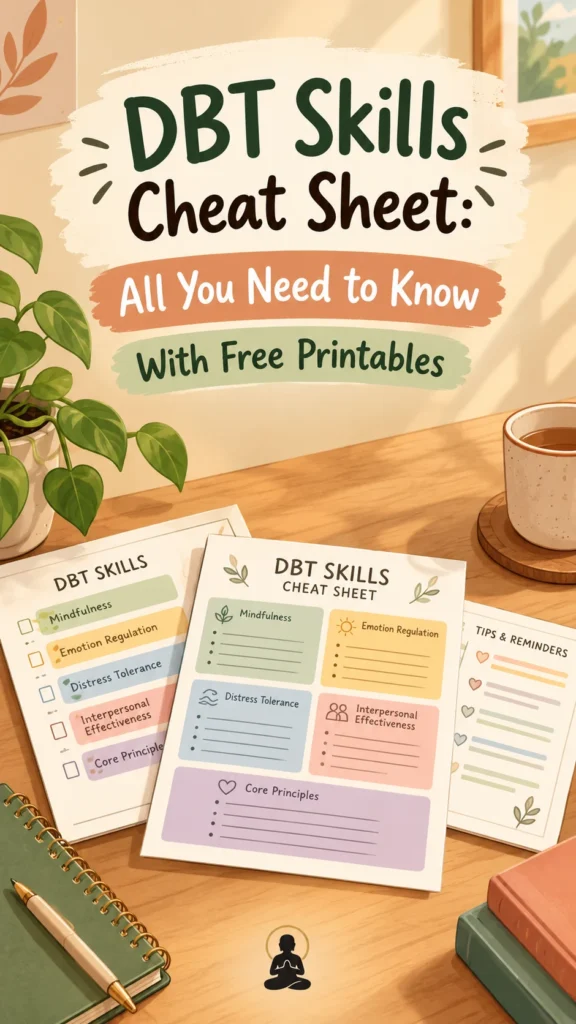
A DBT Skills Cheat Sheet gives you a fast way to pull up tools for hard emotions. Stress spikes. Relationships get messy. Dialectical Behavior Therapy, or DBT, teaches skills that help you pause before reacting. You respond instead of react. That’s the whole point.
Four modules make up the system: mindfulness, distress tolerance, emotion regulation, and interpersonal effectiveness. Each one solves a different problem. Mindfulness grounds you in the moment. Distress tolerance gets you through a crisis without making it worse. Emotion regulation shifts the intensity of what you’re feeling. Interpersonal effectiveness helps you say what you need without the conversation falling apart.
Why keep a reference nearby? Because the moment you’re overwhelmed is the worst moment to try remembering a therapy framework from memory. A quick-glance guide fixes that. You scan it, pick the right skill, and use it. If you’ve already worked through DBT skills worksheets, this cheat sheet works as the companion you keep open while you practice.
This guide covers the core DBT acronyms, explains when each skill actually applies, and links out to free printables you can use today. Pair it with tools like a coping skills worksheet or an emotions worksheet for a fuller practice routine. For a deeper breakdown of the modules themselves, DBT Academy’s skills overview is worth a look too.
Quick Overview: A DBT Skills Cheat Sheet condenses the four core modules, their key acronyms, and when to use them into one easy-to-scan reference. Keep it close. Use it to pick the right skill under pressure, and to find free printables for regular practice.
Table of Contents
Disclaimer
This blog is written and edited with the help of AI, then reviewed by me before publishing. As a result, the content is for general reflection only, not therapy or medical advice, and I’m not a licensed mental health professional. If you’re in crisis, please contact 988 if you’re in US or a local crisis service of your country instead of relying on this site.
What Is a DBT Skills Cheat Sheet?
A DBT Skills Cheat Sheet pulls every core Dialectical Behavior Therapy skill into one page. No digging through old session notes. No scrolling through an app at 2am looking for the right tool.
It covers the four main DBT skill groups: distress tolerance, emotion regulation, mindfulness, and interpersonal effectiveness. Each one gets boiled down to its acronym and a one-line reminder of what it actually does.
That’s the whole point. You’re mid-crisis, not mid-study-session. A good DBT cheat sheet pdf gets you from “what do I do right now” to an actual skill in under ten seconds. Not a lesson plan. A lookup table.
Most people print one and keep it in a wallet, a bag, or taped inside a kitchen cabinet. Some turn it into a full DBT cheat sheet poster for the wall. Doesn’t matter where it lives. It just has to be somewhere you’ll actually see it when things get loud in your head.
Who Can Use a DBT Skills Cheat Sheet?
Not just people in formal treatment. That’s a common misread.
A cheat sheet works at different points in the process, and the way someone uses it changes depending on where they’re starting from.
- People in DBT therapy. Keep it between sessions. Use it to back up whatever your therapist assigned that week, not replace it.
- People practicing on their own. No therapist required to want fewer meltdowns. A cheat sheet hands you a starting menu of DBT acronyms and techniques you can test against your own stress, your own patterns, your own bad days.
- Therapists and educators. Useful as a teaching shortcut. Hand it out, point to a skill name, explain it on the spot.
Here’s the catch though. A cheat sheet is a memory aid, not a treatment plan. It won’t diagnose anything. It won’t replace a clinician who knows your history. Think of it as a flashlight, not a map.
If you want to go beyond recall and actually build the habit, our DBT skills worksheets walk through each skill step by step. And if distress tolerance specifically is what you’re after, the coping skills worksheets dig into that in more depth.
DBT Cheat Sheet vs. Workbook vs. Worksheet
People use these three words like they’re interchangeable. They’re not.
A cheat sheet is a summary. One page, acronyms, quick recall, nothing more.
A workbook is structured. Lessons build on each other. There’s room to practice, track progress, repeat sections you’re stuck on.
A worksheet sits in the middle. It isolates one skill, one task, and asks you to actually apply it instead of just reading about it.
So which one do you need? Depends on the moment. Trying to remember what TIPP stands for mid-panic? Cheat sheet. Trying to build a long-term skill around naming what you feel? Our emotions worksheet does that work. Want the full curriculum, start to finish? That’s a workbook’s job.
A printable DBT skills cheat sheet free download works best as the entry point. Not the destination. Once a skill name clicks, the worksheet library is where you actually practice it until it sticks.
How This Guide Was Prepared
This guide follows standard DBT skills training concepts. Nothing invented, nothing reinterpreted.
It’s built for learning. Not for diagnosis, and not as a stand-in for a licensed mental health professional who actually knows your situation.
Use it as a starting point. Pair it with real support when you need more than a quick reminder. That’s not a disclaimer tacked on for show. It’s the honest boundary of what one page can do.
DBT Acronyms at a Glance
Four letters can save you mid-meltdown. That’s the whole point of a DBT skills cheat sheet.
Each acronym below locks onto one DBT module: mindfulness, distress tolerance, emotion regulation, or interpersonal effectiveness. Say the letters in your head. The skill comes back with them.
| DBT Acronym | Module | What It Means |
|---|---|---|
| STOP | Distress Tolerance | Stop, Take a step back, Observe, Proceed mindfully. Pause before reacting. |
| TIPP | Distress Tolerance | Temperature, Intense exercise, Paced breathing, Paired muscle relaxation. Cool down an intense moment fast. |
| ACCEPTS | Distress Tolerance | Activities, Contributing, Comparisons, Emotions, Pushing away, Thoughts, Sensations. Distract yourself through the worst of it. |
| IMPROVE | Distress Tolerance | Imagery, Meaning, Prayer, Relaxation, One thing in the moment, Vacation, Encouragement. Shrink a hard moment down to something you can handle. |
| PLEASE | Emotion Regulation | Treat Physical illness, balanced Eating, avoid mood-altering substances, balanced Sleep, Exercise. Your body runs your mood more than you’d like to admit. |
| ABC | Emotion Regulation | Accumulate positive experiences, Build mastery, Cope ahead. Stack good days before the hard ones arrive. |
| DEAR MAN | Interpersonal Effectiveness | Describe, Express, Assert, Reinforce, stay Mindful, Appear confident, Negotiate. Ask for what you need without the conversation falling apart. |
| GIVE | Interpersonal Effectiveness | Gentle, Interested, Validate, Easy manner. Keep the relationship intact while you say the hard thing. |
| FAST | Interpersonal Effectiveness | Fair, (no unnecessary) Apologies, Stick to values, Truthful. Hold your ground without losing yourself. |
Why does an acronym work when a whole worksheet doesn’t? Because panic kills your ability to read a page. It doesn’t kill your ability to remember four letters.
Here’s the catch. This DBT skills cheat sheet is a trigger, not a fix. STOP means nothing if you’ve never practiced stopping. TIPP won’t cool you down the first time you try it under real pressure. That takes reps, the same way the coping skills worksheets on this site are built to give you.
Pin this list somewhere you’ll actually see it. Your phone lock screen. Taped inside a cabinet door. Then open the full DBT skills worksheets guide and practice one acronym at a time, starting with whichever module keeps tripping you up. If you’re not sure which one that is, the emotions worksheet is a decent place to find out.
An acronym gets you through the next five minutes. Practice is what makes it work on minute six.
The Four Core DBT Skills Modules at a Glance
DBT isn’t one skill. It’s four modules, each doing a different job: managing emotions, riding out distress, staying present, dealing with people. Alone, each one helps.
Together, they cover almost everything life throws at you. That’s the real value of a DBT skills cheat sheet. It puts all four in front of you at once, so you can pick the right tool fast instead of guessing.
| DBT Module | Main Purpose | Key Skills |
|---|---|---|
| Mindfulness | Stay present and notice without judging | Wise Mind, Observe, Describe |
| Distress Tolerance | Get through hard moments without making them worse | STOP, TIPP, ACCEPTS, IMPROVE |
| Emotion Regulation | Understand emotions and respond to them better | PLEASE, ABC, Check the Facts, Opposite Action |
| Interpersonal Effectiveness | Say what you need and keep your self-respect | DEAR MAN, GIVE, FAST |
Mindfulness
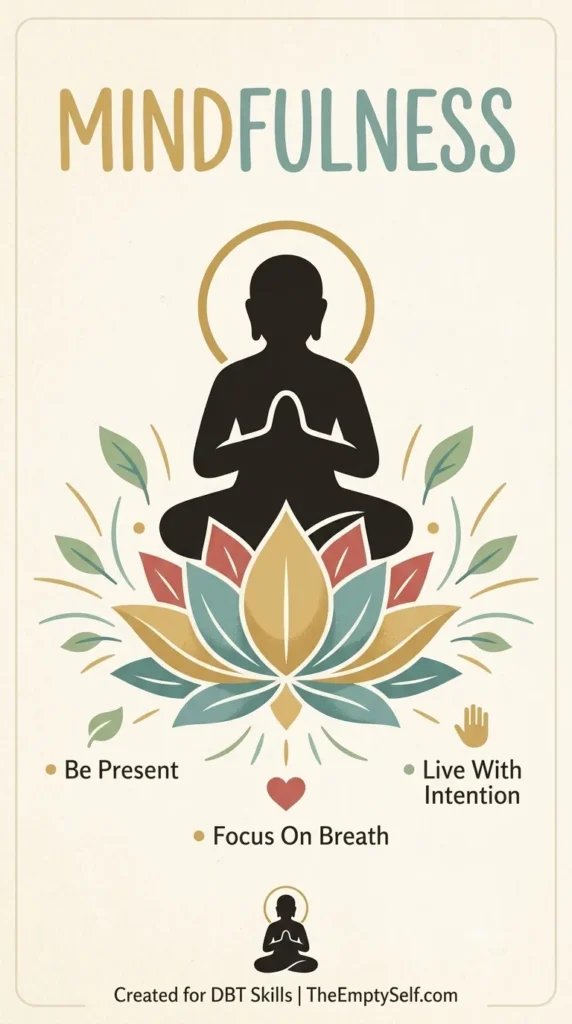
Mindfulness isn’t about clearing your head. It’s about noticing what’s already there before you react to it. Wise Mind, Observe, and Describe are the entry points. You name what’s happening. You feel the anger without letting it drive. Sounds small. It changes a lot.
Want the full breakdown? Our DBT Mindfulness Skills guide walks through each skill with exercises you can actually use. These mindfulness journal prompts pair well with the practice too.
Distress Tolerance
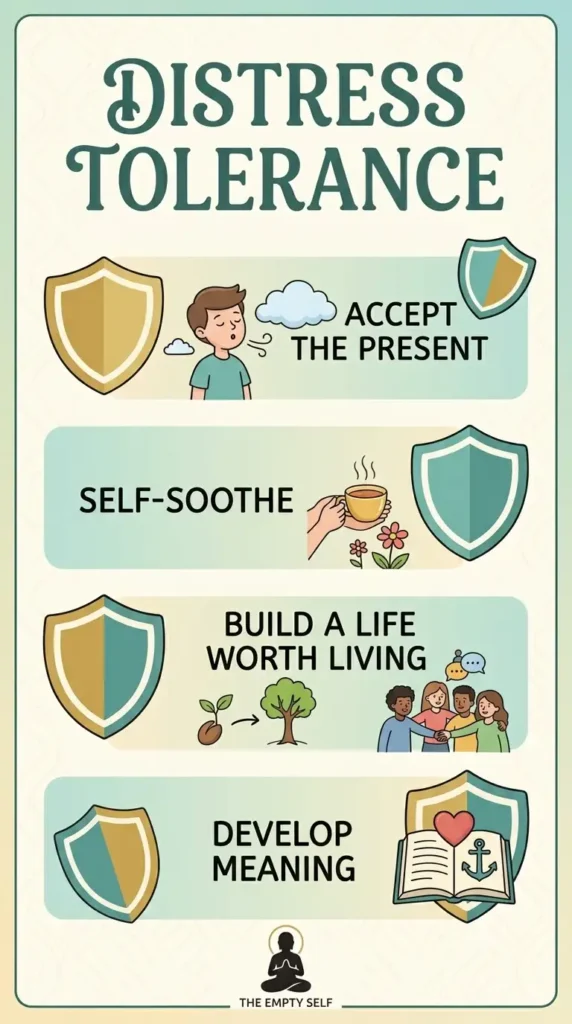
Some moments can’t be fixed on the spot. Distress tolerance skills get you through them anyway. STOP buys you a pause before you act. TIPP brings down a body running too hot to think straight. ACCEPTS and IMPROVE round out the toolkit for whatever’s left.
Nothing here erases the problem. It just keeps you from making it worse while you’re in it. The DBT Distress Tolerance Skills guide covers each one in detail, and these coping skills worksheets give you more tools for the same kind of moment.
Emotion Regulation
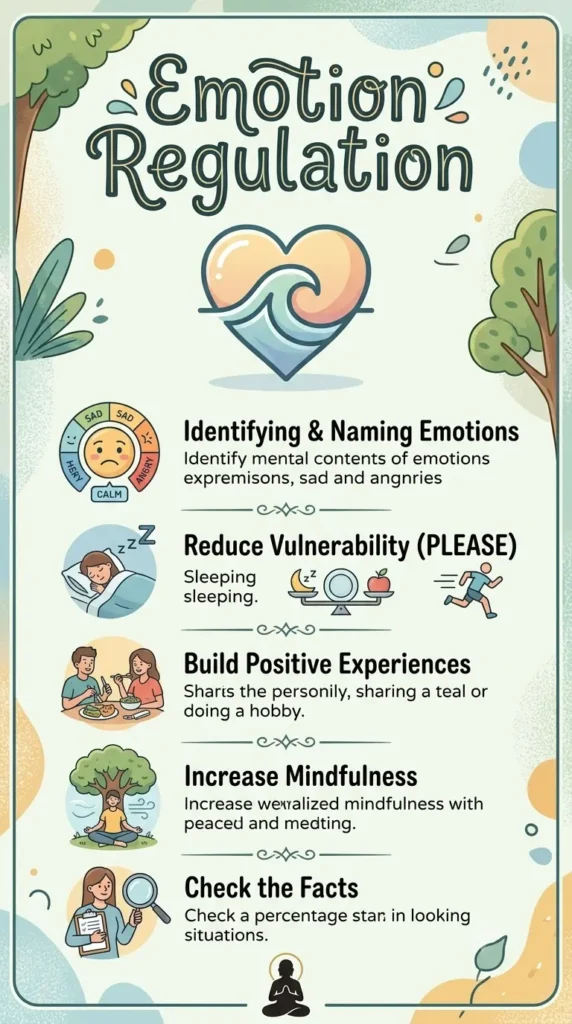
Emotions aren’t the enemy. This module just helps you figure out what’s actually driving one, and whether your response fits the facts. PLEASE handles the physical side, sleep, food, illness, the stuff that quietly makes everything worse. Check the Facts separates what happened from the story your mind bolted on. Opposite Action steps in when the urge and the situation don’t match.
See the DBT Emotion Regulation Skills guide for the full process, and try an emotions worksheet if naming the feeling is the hard part.
Interpersonal Effectiveness
Most people either cave in a hard conversation or come in swinging. Neither protects the relationship or your self-respect. DEAR MAN structures the ask itself. GIVE keeps the other person in the room with you. FAST keeps you honest about what you actually believe, even under pressure.
Our DBT Interpersonal Effectiveness Skills guide breaks down exactly how to use all three in a real conversation, not just on paper.

Free Printable DBT Skills Cheat Sheet
A DBT skills cheat sheet is built for one thing. You forget the right skill right when you need it most. That’s the problem it solves. Pick a format that matches how you actually use it: one page, a longer guide, or a poster you can see from across the room.
Download the One-Page DBT Cheat Sheet PDF
The one-page version is built for speed. It fits the four modules onto a single page: mindfulness, distress tolerance, emotion regulation, and interpersonal effectiveness. The core DBT acronyms sit right beside each one, from STOP to Wise Mind. No digging through a workbook mid-crisis.
Tuck this dbt cheat sheet pdf into a journal, a folder, or wherever you’ll actually find it again. That’s the whole function. A quick check, not a deep read.
DBT Cheat Sheet Poster Version
A DBT cheat sheet poster works differently than a page you fold into a pocket. Hang it on a study wall, an office board, or a therapy-room wall. Use a bigger layout. Clear module headings. Text you can actually read from across the desk.
Keep the long explanations in the expanded guide. The poster’s job is different. It’s for scanning, not reading. Just the most-used skills, front and center.
For more guided practice, explore our DBT skills worksheets, or pair your cheat sheet with coping skills worksheets, an emotions worksheet, or these journal prompts for mental health for deeper reflection.
Which DBT Skill Should You Use in a Difficult Moment?
Picking the right skill isn’t about memorizing a list. It’s about reading the moment first. Some situations call for a pause. Others call for a plan. This DBT skills cheat sheet section gives you a fast way to match what you’re feeling to what actually helps, drawn from the full DBT skills worksheets library.
Not every tool fits every moment. An urge to snap back needs something different than a quiet, nagging assumption. That’s the whole reason this cheat sheet exists.
| If you are experiencing… | Try this DBT skill | Main purpose |
|---|---|---|
| An urge to react immediately | STOP | Pause before acting |
| Intense emotional or physical distress | TIPP | Manage acute distress |
| Repetitive thoughts or overwhelming urges | ACCEPTS or IMPROVE | Shift attention or improve the moment |
| Strong feelings based on assumptions | Check the Facts | Separate facts from interpretations |
| An urge to avoid something because of fear | Opposite Action, when appropriate | Choose a more effective response |
| Difficulty asking for what you need | DEAR MAN | Communicate a request clearly |
| Conflict with someone you care about | GIVE | Protect the relationship |
| Pressure to compromise your values | FAST | Maintain self-respect |
When You Feel Overwhelmed or Reactive
Start with STOP the second you notice the urge to shout, fire off an angry text, or act before thinking it through. Pause. Step back. Observe what’s actually happening in your body and your head. Then proceed mindfully.
That pause isn’t nothing. It’s the whole skill.
It creates just enough room to choose your next move instead of letting the first impulse choose it for you.
When You Need to Calm Down Without Acting on an Urge
TIPP earns its place when distress spikes fast and hard. Paced breathing works for some people. Paired muscle relaxation works for others. Neither is mandatory.
Pick the one that feels safe for your body right now. Don’t push past your limits to prove a point. The goal is calm, not endurance.
When Your Feelings Are Based on an Assumption
A thought isn’t the same as a fact, even when it feels true. Check the Facts walks you through what actually happened, what you assumed on top of it, and whether the evidence holds up. Most strong feelings survive that check. Some don’t.
If your emotional urge still doesn’t match the facts once you’ve looked, Opposite Action can help you respond differently anyway. Fear tells you to avoid something safe. Opposite Action says try it anyway, in small steps.
When You Need to Set a Boundary or Have a Hard Conversation
Three tools cover most of what a hard conversation throws at you. DEAR MAN helps you make a clear request without burying it in apology. GIVE keeps the relationship intact while you say the hard thing. FAST keeps your own self-respect from quietly slipping away mid-conversation.
Need all three at once? Combine them. A single conversation can carry more than one goal, and nothing says you have to pick just one skill to get through it. For a deeper breakdown of how these three work together, the interpersonal effectiveness module covers it in full, and Guilford Press’s DBT Skills Training Manual remains the original source these skills come from.
How to Use a DBT Skills Cheat Sheet in Daily Life
A DBT skills cheat sheet works best as a practical reminder, not a list you must memorize. Keep it somewhere easy to reach and use it to choose a skill that fits the moment. With regular practice, these skills can become easier to recall during stressful situations.
Start With One Skill at a Time
You do not need to learn every DBT acronym at once. Choose one skill that fits a current challenge, such as STOP when you feel ready to react impulsively or Check the Facts when an assumption triggers a strong emotion. Focus on understanding and practicing that skill before adding another.
Practice Skills Before You Need Them
DBT skills can be easier to remember when you practice them during calm moments. Try paced breathing, mindful observation, or a short grounding exercise as part of your daily routine. Rehearsing a skill gives you a chance to learn its steps before a difficult situation arises.
Keep Your Printable Somewhere Easy to Reach
Save your DBT skills cheat sheet PDF on your phone or print a copy for your journal, desk, or study space. A visible reference can help you find a useful skill without searching through lengthy notes. Choose a format you can read quickly when you feel overwhelmed.
Track What Helps and Adjust Your Approach
After practicing a skill, briefly note what happened, how you felt, and whether the skill helped you respond more effectively. If it did not help, consider trying a different skill or adjusting your approach. The goal is to build a flexible set of coping tools, not to make every difficult feeling disappear.
Common Mistakes When Using DBT Skills
DBT skills become more useful with practice, but a few common mistakes can make them harder to apply. Learning every acronym at once, expecting instant relief, or choosing a skill that does not fit the situation can limit their effectiveness.
Trying to Memorize Every Acronym at Once
DBT includes many skills and acronyms, so trying to learn everything at once can feel overwhelming. Start with one or two skills that match your current needs, such as STOP for pausing before reacting or TIPP for managing intense distress.
Practice them in everyday situations until you feel more comfortable using them. You can gradually add other skills as you become familiar with the four DBT modules.
Expecting Difficult Emotions to Disappear Immediately
DBT skills are not designed to erase every difficult emotion instantly. Their purpose is to help you respond more effectively, tolerate distress, and make choices that align with your goals.
You may still feel anxious, angry, or sad after using a skill, and that does not mean you have failed. Focus on whether the skill helped you pause, avoid an impulsive reaction, or handle the situation more safely.
Confusing Acceptance With Approval
Radical Acceptance means acknowledging reality as it is, even when you dislike it. It does not mean approving of harmful behavior, agreeing with unfair treatment, or giving up on making changes.
For example, accepting that a difficult conversation happened allows you to decide what to do next without becoming stuck in wishing it had never occurred. Acceptance can make room for action rather than prevent it.
Using a Skill That Does Not Match the Situation
Different DBT skills serve different purposes, so choosing the right one matters. STOP can help you pause before reacting, while Check the Facts helps you examine whether your emotional response fits the situation.
DEAR MAN can help you make a clear request, whereas GIVE focuses on maintaining a relationship. If a skill does not seem helpful, reconsider what you need in that moment and try a more suitable approach.
More DBT Skills Worksheets and Printables
One cheat sheet won’t cover everything. Not even close. The real practice lives in the full DBT skills worksheets collection, built for working through each skill one at a time. Want mindfulness first? Start with DBT Wise Mind and DBT mindfulness skills. Both cover the module this cheat sheet only summarizes.
Distress hits different on different days. Some moments need a quick pause. Others need a full reset. That’s the job of the DBT STOP skill, the DBT TIPP skill, the DBT ACCEPTS skill, and DBT Improve the Moment. Four tools, four flavors of overwhelm.
Emotional balance works on the same logic. Nobody balances on willpower alone. The DBT PLEASE skill handles the basics your body needs first. Cope Ahead preps you for what’s coming next. DBT values and DBT self-validation round out the rest, giving you something steadier to stand on when a feeling gets loud.
Still want more? There’s plenty. Browse DBT distress tolerance skills, DBT self-soothing skills, Willing Hands and Half Smile, DBT emotion regulation skills, and DBT interpersonal effectiveness skills. Dozens of worksheets. One shared goal. Turning an idea into something you actually practice.
For related tools, check out the coping skills worksheets and emotions worksheet collections. Curious about The DBT House? It’s a visual exercise, not a worksheet, and it pairs well with the list above. RO DBT worksheets sit nearby too, but they’re built for overcontrol, not the emotional swings standard DBT targets. Worth knowing that difference before mixing the two.
Conclusion
A DBT skills cheat sheet can make it easier to remember practical tools when emotions feel hard to manage. Start with one skill that fits your current situation, whether you need to pause before reacting, regulate an intense emotion, or communicate a boundary.
You don’t have to memorize every acronym or use every technique at once. Practice the skills that help you most, and give yourself time to learn them. When you’re ready to move beyond quick reminders, explore our DBT skills worksheets for more ways to practice each skill and build a routine that works for you.
Frequently Asked Questions
What should a DBT skills cheat sheet include?
A DBT skills cheat sheet should cover the four core modules: mindfulness, distress tolerance, emotion regulation, and interpersonal effectiveness.
It should also explain key skills and acronyms, such as STOP, TIPP, PLEASE, DEAR MAN, GIVE, and FAST, with brief definitions to help readers recall when to use them.
Where can I download a free DBT skills cheat sheet PDF?
You can download a free DBT skills cheat sheet PDF from a website that offers accessible DBT learning resources and printables. Look for a guide that covers all four core modules, defines the main acronyms, and provides clear instructions. Choose an ungated download if you prefer not to share your email address.
What are the four main DBT skills modules?
The four main DBT skills modules are mindfulness, distress tolerance, emotion regulation, and interpersonal effectiveness.
Mindfulness builds present-moment awareness,
distress tolerance helps you handle difficult moments,
emotion regulation supports healthier responses to feelings, and
interpersonal effectiveness teaches communication, boundary-setting, and relationship skills.
What do the most common DBT acronyms stand for?
Common DBT acronyms include STOP, TIPP, ACCEPTS, IMPROVE, PLEASE, ABC, DEAR MAN, GIVE, and FAST. Each acronym represents a group of skills designed for a particular purpose, such as managing distress, regulating emotions, or communicating effectively. A printable DBT cheat sheet can help you remember their meanings.
Which DBT skill should I use when I feel overwhelmed?
The best DBT skill depends on what you are experiencing. Try STOP when you need to pause before reacting, or consider TIPP when intense distress feels difficult to manage. If your thoughts are driving your emotional response, mindfulness or Check the Facts may help you respond more deliberately.
Can I use a DBT skills cheat sheet without attending DBT therapy?
Yes, you can use a DBT skills cheat sheet to learn basic concepts and practice coping skills independently. However, a cheat sheet is an educational aid, not a substitute for individualized treatment.
If emotional difficulties persist or interfere with daily life, a qualified mental health professional can help you choose and practice appropriate skills.

It’s Bhaskar!
Well, I am not a psychologist a monk, or a philosopher by training. I’m just an engineering graduate.
‘The Empty Self’ is where I write about that idea, and what it actually means for ordinary life, anxiety, identity, habits, the stories we tell ourselves about who we are. I don’t have a psychology degree, and I’m not offering therapy or clinical advice. What I do have is thought and clarity, and genuine curiosity about why we suffer the way we do and how much of it might loose once we shed this ‘fixed identity’.