
Your thoughts don’t leave your head on their own. You already know that. So you open a blank page, and somehow your mind gets louder instead of quieter. That’s the exact moment where journal prompts for mental health earn their spot. A good prompt doesn’t just tell you to “write it out.” It gives your thoughts somewhere specific to land.
This guide holds 120+ mental health journal prompts, sorted by mood and purpose. Not dumped into one long list nobody actually reads.
You’ll find prompts for anxious thoughts, stress, and low moods. Self-esteem. Emotional awareness. Mindfulness. Relationships. Personal growth. Thanks. Even those off days where something feels wrong and you can’t quite name it.
No fancy journal required. No perfect morning routine either. A notes app and five honest minutes is enough to start.
One boundary matters, though. Journaling can support your mental health. It isn’t a replacement for professional care or crisis support. Not even close.
If you’re in the U.S. and need support right now, reach out. Call or text the 988 Suicide & Crisis Lifeline. You can also text HOME to 741741 to reach Crisis Text Line’s free, confidential service. It runs 24/7 in the U.S. (988 Lifeline)

Table of Contents
Disclaimer
This blog is written and edited with the help of AI, then reviewed by me before publishing. As a result, the content is for general reflection only, not therapy or medical advice, and I’m not a licensed mental health professional. If you’re in crisis, please contact 988 if you’re in US or a local crisis service of your country instead of relying on this site.
Journal Prompts for Mental Health: What Are They?
Journal prompts for mental health are guided questions. They help you turn thoughts, feelings, or a rough day into actual words on a page. No blank stare. No wondering where to start. The question gives your mind a place to land. Use them for daily check-ins, stress, anxiety, self-reflection, or just untangling a day that went sideways.
A prompt is not a diary entry. It’s not freewriting either. A diary records what happened. “I had a rough day at college and argued with my friend.” That’s it. A prompt digs underneath it. “What part of that argument is still bothering me, and why?” Different question. Different depth.
Freewriting drops the structure completely. You write whatever surfaces, no target question required. That works when your thoughts are already moving. It can also backfire hard when you’re tired, overwhelmed, or stuck in your own head.
That’s where structured journaling ideas for mental health step in. Topics. Questions. A direction. The goal was never beautiful writing. You’re just pointing your attention somewhere useful.
Why prompts make journaling easier
A blank notebook hands you a decision you didn’t ask for. Where do I even start? A prompt removes that first hurdle entirely. Instead of picking a topic, deciding what matters, and figuring out your wording all at once, you answer one focused question.
Here’s why that matters. Too many choices creates choice overload. Decisions get harder, not easier. Researchers from Georgia Tech, Chapman University, Virginia Tech, and the University of Connecticut found that larger sets of options can reduce decision quality.
Journaling works the same way. You don’t need fifty possible topics when you’re already running on empty. One good question is enough. Sometimes it’s more than enough.
A solid prompt also builds structure into reflection itself. The University of Cincinnati frames reflection as thinking critically about an experience to gain more clarity or understanding, and it points to guiding questions as the way to keep that thinking focused.
So if you’ve opened a fresh page, written the date, and then just… stopped? You’re not bad at journaling. You probably just need a better starting point.
Can Journaling Actually Support Mental Health?
Short answer: yes. Writing down what you’re carrying helps you put messy feelings into words, spot patterns you’d otherwise miss, and get a little distance from whatever’s weighing on you. Research on expressive writing points to small but real benefits for some people, especially around depression, anxiety, and stress. Results vary person to person. And no, journaling is not a treatment for mental illness. It never claimed to be.
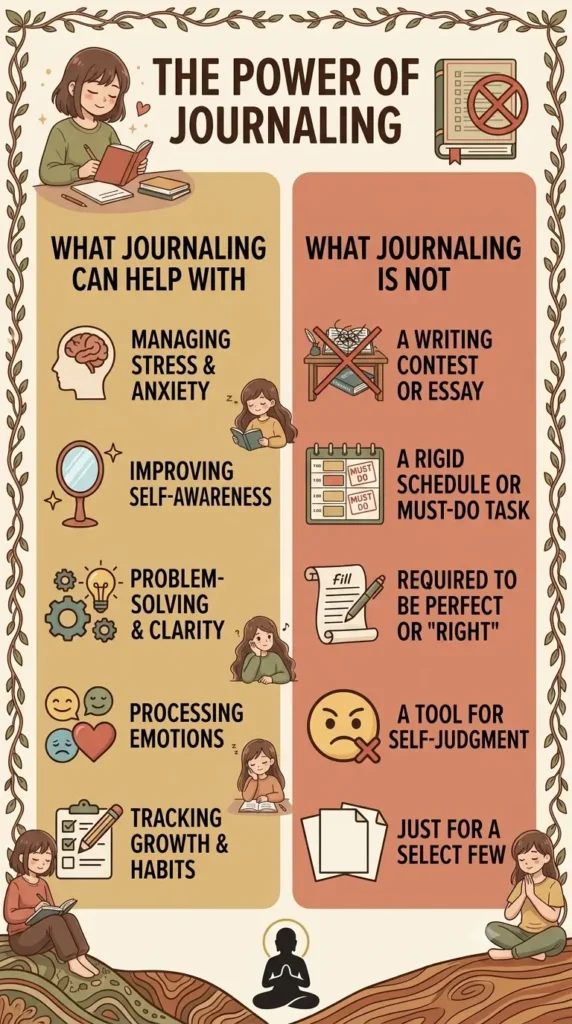
What journaling can help with
Think of journaling as a tool for reflection. Not a diagnosis. That distinction matters more than it sounds.
Write down what happened. What you felt. What you actually needed in that moment. Suddenly an overwhelming day gets smaller. Easier to look at, one piece at a time.
Here’s where it tends to help most:
- Emotional processing: naming a feeling beats carrying a vague sense that something’s off.
- Self-awareness: regular entries surface which people, habits, or situations quietly shift your mood.
- Pattern recognition: looking back reveals triggers and habits that are nearly impossible to catch in the moment.
- Stress and anxiety relief: racing thoughts finally have somewhere to go, and a real problem starts looking different from a prediction about one.
- Self-compassion: a journal is where you catch your own harsh self-talk and practice answering it more fairly.
- Resilience and problem-solving: writing through a hard situation shows you what’s actually in your control, and what your next move could be.
This is part of why so many people search for journal prompts for mental health in the first place. A blank page with no direction is hard to sit with. A prompt gives your attention somewhere to land.
Here’s an honest take on the research: the strongest name attached to this field is psychologist James W. Pennebaker, whose decades of work on expressive writing looked at how writing about emotionally heavy experiences affects both mind and body. Later meta-analyses landed on modest effects, not miracle ones. That’s not a letdown. It’s exactly why journaling works best as a support, not a cure.
If mindfulness feels like a better entry point than open reflection, mindfulness journal prompts walk through prompts built specifically for staying present instead of spiraling. And when anxious thoughts are the real issue underneath everything, gratitude journaling for anxiety shows how pairing the two practices can widen that gap between a thought and your reaction to it.
What journaling cannot replace
A notebook is not therapy. Not psychiatric care. Not medical treatment. Not crisis support. Journaling can sit alongside professional care. It can’t stand in for it.
If anxiety, depression, trauma symptoms, or anything else is seriously getting in the way of your ability to function, writing it down shouldn’t be the only plan on the table.
You don’t have to wait until things feel unbearable to ask for help either. A journal can actually prepare you for that conversation. Use it to organize what you’ve been feeling, or to write down questions before an appointment. Building the daily habit itself, one small gratitude worksheet or reflection at a time through practicing gratitude, or a running list of things to be thankful for, can make that eventual conversation easier to start.
If you’re in immediate distress, or thinking about suicide or harming yourself, please reach out for support right away. In the U.S., call or text 988 to reach the 988 Suicide & Crisis Lifeline. You can also text HOME to 741741 to connect with the Crisis Text Line’s free, confidential, 24/7 support.
How to Choose the Right Journal Prompt for How You Feel
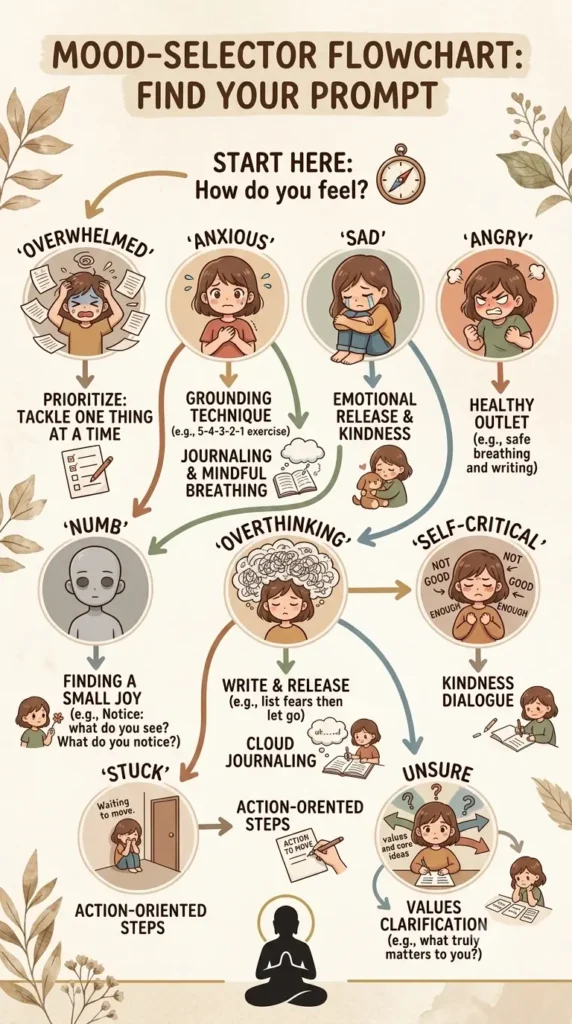
The right prompt isn’t the deepest one on the list. It’s the one that matches what’s happening in your head right now.
Skip the random scroll through fifty questions. Start with your mood. Then pick something that helps you notice it, sit with it, or actually move through it. That’s the whole method behind good journal prompts for mental health.
If You Feel Overwhelmed
Start small. Not with your whole life. Just today.
Overwhelm doesn’t need a prompt that maps out everything at once. It needs one that clears a little mental clutter and leaves the rest alone. Ask what actually needs attention in the next hour, not the next decade. One thread pulled loose is enough.
If You Feel Anxious
Anxiety blurs the line between fact and prediction. Fast.
Good prompts pull that line back into focus. What’s actually happening right now, versus what your mind is guessing might happen? Bring your attention toward what you can control today, however small that circle is. Skip anything that invites more spiraling. Anxiety journal prompts built around evidence and control tend to work better than open-ended ones here, and pairing them with a gratitude-based approach can widen that gap between the fear and the reaction even further.
If You Feel Sad or Emotionally Drained
Keep it gentle. Nothing forced.
This isn’t the moment for toxic positivity dressed up as a prompt. Ask about small comforts instead. What’s one unmet need sitting underneath the sadness? What would make today slightly easier, not perfect, just easier? That’s usually more useful than chasing a mood you don’t have yet.
If You Feel Angry
Anger needs somewhere to go before you decide what to do with it.
Don’t skip straight to fixing the situation. Explore what actually happened first. What boundary got crossed? What do you need right now that you’re not saying out loud? Sit with the answer before reacting to it. That order matters more than people think.
If You Feel Numb or Disconnected
Start with the body, not the feeling. The feeling might not even have a name yet.
Notice sensations. Notice your surroundings. A memory, a small preference, anything concrete works better than trying to force an emotional label that isn’t there. Numbness usually loosens through the physical world before it loosens through analysis.
If You’re Overthinking
The loop needs an interruption, not another lap around it.
Write the thought down exactly as it is. Then ask what evidence actually backs it up. Name one thing that’s genuinely within your control. Three steps. Nothing more elaborate than that. Overthinking prompts built this way tend to break the cycle faster than open reflection does.
If You’re Self-Critical
Self-compassion prompts aren’t about pretending everything’s fine. It isn’t.
They’re about challenging the voice that says you’re the exception to basic kindness. Ask what you’d say to someone you love in the same exact situation. Then ask why you’re not saying it to yourself.
If You’re Stuck
Reflection alone won’t move you. It needs to turn into motion somewhere.
Ask what’s actually keeping you stuck, not the vague version, the real one. What have you already tried? What’s the smallest next step that feels realistic today, not the ambitious one you’d write on a vision board? Start there.
If You Simply Don’t Know What You Feel
That’s a valid place to start. Genuinely.
Describe what happened. Notice what showed up in your body. Name what you wanted or needed in that moment. Don’t worry about finding the “right” emotion first. The naming can come later, or not at all. Either way, you’ve already started.
If none of these quite fit today, the broader journal prompts for mental health collection below covers more ground, sorted by category instead of mood.
100+ Journal Prompts for Mental Health
The following 120 journal prompts for mental health are organized by purpose, so you can find a useful starting point without scrolling through a random list. Choose the section that matches what you need today, reflection, emotional clarity, anxiety support, self-compassion, mindfulness, gratitude, or overall wellness.
Daily Journaling Prompts for Mental Health
Daily journaling doesn’t need to become a detailed diary entry. These prompts are designed for quick check-ins that help you notice what’s happening mentally and emotionally before the day runs away with you.
- What emotion feels strongest for me right now, and what might be contributing to it?
- What is taking up the most space in my mind today?
- What do I need more of today?
- What do I need less of today?
- What is one thing I handled better than I expected?
- What has been draining my energy lately?
- What has given me even a small amount of energy today?
- What is one thing I can realistically do today that would make me feel a little better?
- What thought keeps returning today?
- Is there anything I am avoiding because it feels uncomfortable?
- What would make today feel meaningful, even if it isn’t particularly productive?
- What do I want to remember about how I feel today?
Emotional Check-In Prompts
An emotional check-in is less about finding the “right” feeling and more about getting specific. If “fine” is the only word coming to mind, use these prompts to slow down and look underneath it.
- If my current mood had a name more specific than “good” or “bad,” what would I call it?
- Where do I notice this emotion in my body?
- What happened shortly before I started feeling this way?
- What does this emotion seem to be asking me to notice?
- What thought is connected to this feeling?
- Is the intensity of this emotion changing, staying the same, or building?
- What do I wish someone understood about how I feel right now?
- What do I need emotionally that I haven’t been giving myself?
If you want to go deeper into naming, understanding, and expressing emotions, an emotions journal can give you a more structured place to track feelings, triggers, physical sensations, and responses. A dedicated guide can also cover emotion journaling, feelings journals, and practical examples of how to journal your feelings.
Self-Awareness and Self-Reflection Prompts
Self-awareness grows when you become curious about your patterns instead of automatically judging them. These prompts are useful when you want to understand why you keep reacting, thinking, or behaving in certain ways.
- What situation has been triggering the same reaction in me repeatedly?
- What do I usually do when I feel rejected or misunderstood?
- Which situations make me feel most like myself?
- What am I pretending not to know about a situation in my life?
- What personal value do I want my choices to reflect more clearly?
- What expectation am I holding myself to that I would never place on a friend?
- What have I learned about myself from a recent mistake?
- When do I feel most confident, and what conditions make that confidence easier?
- What behavior in other people tends to bother me most, and why might it affect me so strongly?
- What is something I have outgrown but still feel attached to?
- What part of my personality do I tend to hide around other people?
- What would I understand differently about myself if I stopped judging my reactions?
Anxiety and Overthinking Journal Prompts
When anxiety is loud, writing can help separate an actual problem from a prediction your mind is treating like a fact. The goal isn’t to argue yourself out of every uncomfortable thought; it’s to examine the thought more clearly.
- What exactly am I worried will happen?
- What evidence do I have for this fear, and what am I assuming?
- What part of this situation is actually within my control?
- What part is outside my control?
- If my worst-case scenario happened, what support or resources could I turn to?
- What is the most likely outcome, rather than the most frightening one?
- Am I trying to solve a problem that hasn’t happened yet?
- What would I tell a friend who was having this exact worry?
- What physical sensations tell me that my anxiety is increasing?
- What happened the last time I felt this level of uncertainty?
- What would help me feel 5% more grounded right now?
- What thought can I return to when my mind starts spiraling again?
Stress and Burnout Journal Prompts
Stress can make everything feel equally urgent, while burnout can make even small tasks feel exhausting. These prompts help you identify what is actually consuming your capacity instead of simply telling yourself to “manage your stress.”
- What has been demanding the most mental energy from me lately?
- Which responsibility feels heavier than it should?
- What am I saying yes to that I genuinely don’t have capacity for?
- What signs tell me that I need rest rather than more motivation?
- When was the last time I felt genuinely rested?
- What part of my routine is helping me recover?
- What part of my routine is quietly making things harder?
- What boundary would protect my energy this week?
- What am I afraid will happen if I slow down?
- Which task can wait until tomorrow?
- What would a realistic low-energy day look like for me?
- What is one small thing I can remove, postpone, delegate, or simplify?
Journal Prompts for Depression and Low Mood
Journaling during a low period should feel gentle rather than demanding. You don’t need to force gratitude, positivity, or a five-year plan; sometimes the most useful entry simply names what today feels like and identifies one manageable need.
- What does “getting through today” realistically look like for me?
- What feels hardest right now?
- What is one thing I managed to do despite feeling this way?
- What would I say to myself if I stopped treating my low mood as a personal failure?
- What basic need might I be neglecting right now?
- Who is one person I feel safest being honest with?
- What has brought me even a brief moment of comfort recently?
- What expectation can I temporarily release while I’m having a difficult day?
- What would make the next hour slightly easier?
- What is one reason I deserve patience from myself today?
- What would I want someone I trust to know about how I’ve been feeling?
- What small sign of change, however subtle, have I noticed recently?
If your low mood includes thoughts of harming yourself or you don’t feel safe, journaling isn’t the place to handle that alone, reach out to a mental-health professional or an appropriate crisis service for immediate support.
Self-Esteem and Self-Compassion Prompts
Self-esteem journaling works better when it isn’t reduced to writing a list of positive affirmations you don’t believe. These prompts encourage a more honest relationship with yourself, including your strengths, mistakes, limits, and imperfections.
- What is something I respect about the way I handled a difficult situation?
- Which qualities do I value in myself that have nothing to do with achievement?
- What mistake am I still using as evidence that I’m not good enough?
- What would a compassionate response to that mistake sound like?
- When do I compare myself with other people most often?
- What does that comparison make me believe about myself?
- Which compliment have I had trouble accepting, and why?
- What would I notice about myself if I stopped measuring my worth through productivity?
- What is something my younger self would be proud that I can do now?
- How do I speak to myself when nobody else is listening?
- What part of myself deserves more patience?
- What would treating myself like someone I genuinely care about look like this week?
Mindfulness Journal Prompts
Mindfulness journaling brings attention back to what is happening right now, rather than automatically replaying the past or predicting the future. If you want a much larger collection, see 300+ mindfulness journal prompts.
- What can I notice right now without trying to change it?
- What are five things I can see around me?
- What sounds have I been ignoring because I’m used to them?
- What physical sensation is most noticeable in my body right now?
- What emotion is present without needing to become my entire identity?
- What am I doing right now, and how fully am I actually doing it?
- What thought keeps appearing without requiring me to act on it?
- What does my body feel like when I take one slow breath?
- What small detail around me would I normally overlook?
- What can I let be unfinished for now?
- What would it feel like to experience this moment without immediately judging it?
- What is one thing I can pay attention to for the next five minutes?
Gratitude Journal Prompts for Mental Health
Gratitude can support reflection, but it shouldn’t become a way of pretending difficult feelings don’t exist. The more useful approach is specific: notice something you genuinely appreciate while allowing the rest of your emotional experience to remain real.
- What is one ordinary part of my day that I usually take for granted?
- Who made my life slightly easier recently?
- What is something my body allowed me to experience today?
- What small comfort am I grateful for right now?
- What relationship has taught me something valuable about myself?
- What is something difficult that helped me discover a strength or boundary?
- What place makes me feel calmer or more like myself?
- What is one thing I have access to today that my younger self once wanted?
- What recent moment would I happily experience again?
- What is something about my current life that I don’t want to overlook?
For more specific gratitude ideas, explore things to be thankful for. For practical ways to turn gratitude into a habit, see how to practice gratitude.
Wellness Journal Prompts and Ideas
Mental health doesn’t exist separately from the rest of your life. Sleep, movement, relationships, screen habits, food, rest, boundaries, and the amount of time you spend doing things that actually matter to you can all become useful journaling topics for mental health.
- How has my energy changed throughout the day recently?
- What does my body seem to need more of right now?
- How has my sleep affected my mood?
- Which daily habit makes me feel more stable?
- Which habit leaves me feeling worse afterward?
- How much time am I spending online when I’m actually trying to avoid a feeling?
- What activity makes me lose track of time in a healthy way?
- Where in my life do I need a clearer boundary?
- What does rest look like when I don’t have to earn it first?
- Which relationship currently feels nourishing, and which feels draining?
- What would a healthier version of my normal week look like?
- What is one realistic wellness change I could maintain even during a stressful week?
If you prefer writing with structure rather than starting with a completely blank page, free gratitude worksheets and printable journaling resources, printable worksheets for guided reflection can give you another format to experiment with.
Journal Prompts for Healing and Personal Growth
Healing doesn’t move in a straight line. Some days you feel lighter. Other days the same old wound shows up again, uninvited.
Journaling won’t fix that. But it gives you a private place to slow down, name what still hurts, and notice how far you’ve actually come. This isn’t about forcing yourself to “get over it.” Why does that matter? Because most advice skips straight to moving on, and skips the part where you actually sit with things first.
Healing Journal Prompts
Healing journal prompts push you toward the harder stuff. Old patterns. Forgiveness you haven’t given yet. Experiences you know are shaping you but can’t quite put into words.
That’s exactly when journaling prompts for healing help most. When something is clearly affecting you and you don’t have the language for it yet.
Try these:
- What am I still carrying that I don’t need to carry alone?
- What did a difficult experience teach me about what I need now?
- What would I say to the version of myself who was going through that experience?
- What am I ready to forgive myself for?
- What would healing look like if I stopped comparing my timeline to someone else’s?
Sound simple? It is. A journal doesn’t need to be complicated to work.
Our upcoming healing journal prompts guide will go further. Self healing journal prompts, journal prompts for self growth and healing, all of it, gathered in one dedicated place once it’s published.
Self Healing Journal
A self healing journal works differently. It’s not one perfect question and done. It’s an ongoing record of what you feel, what you’re learning, and what’s shifting underneath the surface.
Not every one of the journals for healing out there fits every person. This kind is meant to flex. Use it after a rough day. Use it mid-transition, when nothing feels solid yet. Use it the moment an old pattern creeps back in.
Start here:
- What does my mind and body need from me today?
- Which part of myself have I been neglecting lately?
- What boundary would make my life feel a little safer or calmer?
- What is one small way I can take care of myself today?
- What evidence do I have that I’m growing, even if I don’t feel “healed” yet?
Journaling to heal isn’t about fixing yourself overnight. It’s repetition. Page after page, most days, whether you feel like it or not.
Want the full walkthrough? Our upcoming self healing journal guide will cover how to journal for healing, how to start journaling for healing, and how to build a routine that actually lasts.
Prefer to start somewhere gentler first? Our mindfulness journal prompts guide is a good entry point before diving into healing-focused work.
Therapy-Informed Journal Prompts
Therapy-informed journaling borrows questions from real therapeutic thinking. It helps you spot patterns, name what you’re feeling, and question thoughts before they spiral. It’s useful between sessions. It’s useful on your own too. But let’s be clear about one thing: journaling and psychotherapy are not the same practice.
Where This Goes Next
We’re building a full guide on therapy journal prompts as its own piece. Keep an eye out for it.
Good therapy journal prompts give you a structured place to land. What happened between sessions? What’s still bothering you? What do you want to say out loud next time but keep avoiding? The best prompts ask precise questions. What triggered the reaction. What you actually needed in that moment. What thought kept looping. What you wish someone else understood without you having to explain it.
Already seeing a therapist? Your journal becomes something else entirely. A bridge.
Write down the question you don’t want to forget by Thursday. Note the shift you noticed this week. Flag the situation you want to bring up next session. Track the pattern that keeps resurfacing no matter how many times you think you’ve dealt with it. Post-session prompts work the same way in reverse. They help you sit with what you just learned and figure out how it applies once you’re back in your regular life, away from the therapist’s office.
Here’s the part people blur too often. Journaling asks you to reflect. That’s it. Psychotherapy is different. It’s a professional treatment where a trained therapist works with you, collaboratively, to address real psychological and emotional concerns. The American Psychological Association describes it as communication between patient and therapist aimed at relieving distress and changing patterns that no longer serve you.
So where does that leave your notebook?
Use therapeutic writing prompts to support the work. Not to replace it. If you need professional care, a journal was never built to stand in for it.
Journaling for Emotional Intelligence
Emotional intelligence starts with noticing what you feel before you react to it. Journaling gives you a place to do that noticing, slowly, on paper, with no one watching. You’re not just recording what happened. You’re catching your own emotions in the act, then asking what they actually want from you.
Journaling for emotional intelligence
This kind of journaling focuses on understanding your emotions, not judging them. That distinction matters more than it sounds. A strong entry might dig into what triggered a reaction, where you felt it in your body, what you actually needed in that moment, or how your response landed on someone else. Do this often enough and the patterns start showing up before they run your behavior for you.
It also builds emotional regulation and supports emotional release. Writing creates a gap between feeling something and acting on it. That gap is everything. It’s especially useful right after an argument, a tense call, or any decision made half in anger. The point isn’t to bury the hard emotions. It’s to understand them well enough to respond on purpose instead of on impulse.
Why does slowing down on paper work when talking it out sometimes doesn’t? Writing forces you to name the feeling instead of just carrying it around. That naming is where emotional awareness actually starts.
If you’re building a wider reflective practice, this pairs well with something like mindfulness journal prompts, where the focus shifts from analyzing what you felt to simply staying present with it as it happens.
A future guide on journaling for emotional intelligence will go deeper into emotional awareness, regulation, empathy, and reflection. It’ll include dedicated emotional intelligence journal prompts and real examples of emotional intelligence in psychology. For now, start smaller. Ask yourself one question: what am I feeling, what triggered it, and what might this feeling be trying to tell me?
Guided Journals vs. Free Journaling: Which Should You Use?
A blank page can feel like a dare. Some days you want a map. Other days you just want to walk.
That’s the real split between guided journals and free journaling. Neither wins outright. The right pick depends on your energy that day, your mood, and whether you need direction or room to roam.
Guided Journals for Mental Health
Guided journals for mental health work well when you don’t want to decide what to write from scratch. Prompts, check-ins, a repeatable structure. That’s the whole appeal. New to journaling? Emotionally maxed out? Trying to build a habit that actually sticks? A guided format carries you through the parts where motivation runs out.
Free journaling flips the setup. You might open with “I feel awful today” and just follow that thread wherever it goes. No sections to fill in. No pressure to land on some big insight by the end. Messy is fine. Unfinished is fine too.
Here’s an honest take: most people don’t need to pick a side. Reach for a guided prompt when your mind feels crowded or you’re stuck on where to start. Switch to freewriting when one specific thing needs more room than a prompt gives it. Your journal doesn’t owe anyone a single method, not even you.
If you want a middle ground, mindfulness journal prompts offer some structure without locking you into a rigid format, useful on the days when a fully blank page feels like too much and a full workbook feels like too little.
A future guide on this site will go deeper into guided journals for mental health, covering guided therapy journals, different structured formats, and what to actually look for before picking one. No single format gets crowned “best” there either. Some tools just fit some days better than others.
365 Journal Prompts for Mental Health: A Year-Long Practice
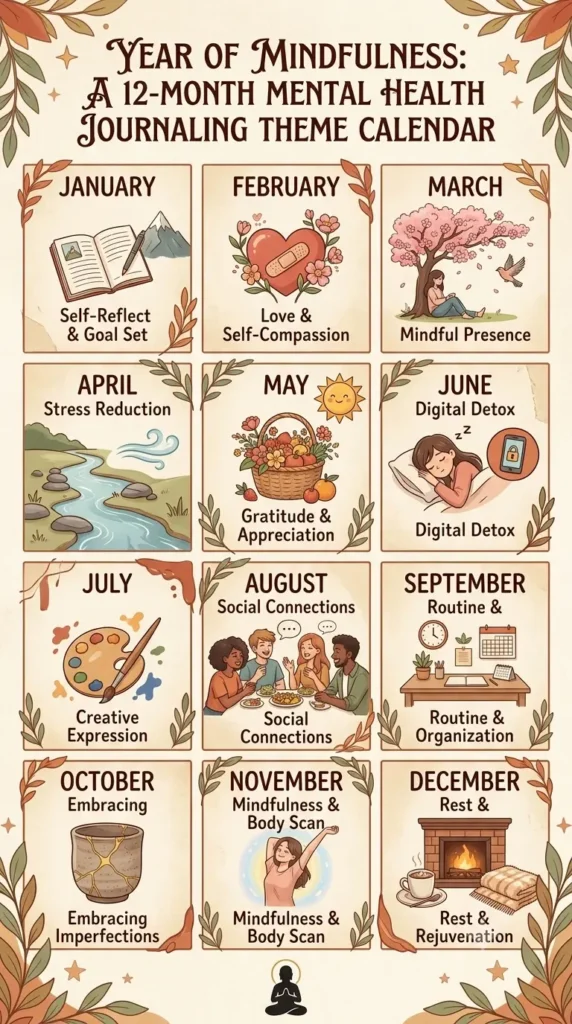
You don’t need to write every day for a 365-day practice to work. Give each month a theme instead. Then pick prompts that match your energy, your mood, whatever’s going on that week. Consistency beats a perfect streak.
Here’s the thing about most journal challenges: they collapse by week three. Not because people lack discipline. Because the prompts don’t shift with them. A theme-based approach fixes that.
| Month | Mental Health Theme | What to Explore |
|---|---|---|
| January | New Beginnings | Intentions, fresh starts, routines, hopes, and what you want to leave behind |
| February | Self-Compassion | Self-talk, mistakes, kindness toward yourself, boundaries, and accepting imperfection |
| March | Self-Awareness | Values, habits, triggers, needs, strengths, and recurring patterns |
| April | Emotional Awareness | Naming emotions, identifying what you feel, body signals, and emotional triggers |
| May | Relationships | Friendship, communication, boundaries, trust, connection, and relationship needs |
| June | Stress & Rest | Burnout, workload, overstimulation, recovery, sleep, and what actually helps you recharge |
| July | Identity & Confidence | Self-image, comparison, identity, strengths, insecurity, and becoming more comfortable with yourself |
| August | Goals & Direction | Priorities, drive, uncertainty, progress, setbacks, and realistic next steps |
| September | Mindfulness | Presence, sensory awareness, slowing down, appreciation, and noticing thoughts without automatically following them |
| October | Healing & Release | Difficult experiences, forgiveness, acceptance, emotional baggage, and what you’re ready to let go of |
| November | Gratitude & Perspective | Appreciation, meaningful moments, support systems, small positives, and what matters most |
| December | Reflection & Renewal | Lessons learned, personal growth, proud moments, unfinished feelings, and intentions for the next year |
Treat each month as a pool, not a to-do list. Found a question that hits close to home? Repeat it. Feels too heavy today? Skip it. A good journal practice leaves room to answer honestly. It shouldn’t turn into one more box to check.
A few months lean on ideas worth their own deep dive. September’s theme pulls straight from mindfulness journal prompts if you want to slow down and notice what’s actually happening in your body and thoughts. November works the same way with gratitude worksheets and a closer look at how to practice gratitude when appreciation feels forced instead of real. And if December’s reflection prompts leave you stuck on what to even feel thankful for, things to be thankful for is a solid place to start.
How to Journal for Mental Health Without Making It Another Chore
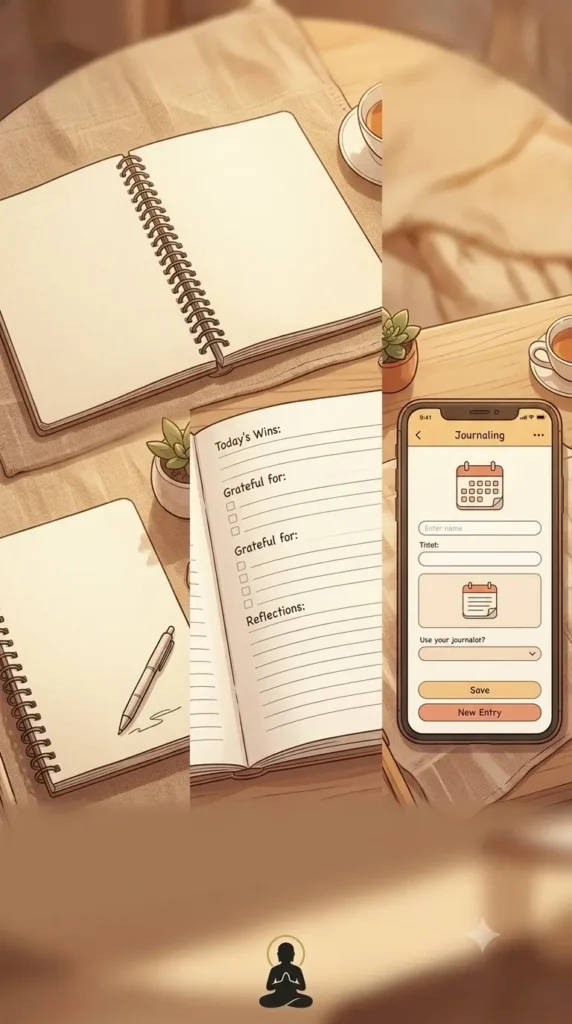
Journal prompts for mental health work best when they slide into your day. Not another task on the list. You don’t need a perfect notebook. You don’t need a long evening ritual. You don’t need a big insight every single time. Keep the process loose enough that you’ll actually come back to it.
Start With 2 to 5 Minutes
Two minutes counts. So does five. Pick one prompt, write whatever shows up, then stop. No need to keep going once you’ve said what needed saying. Here’s the honest math: a short check-in you repeat beats an ambitious 30-minute routine you quit after three days. Every time. If you want prompts built for exactly this kind of quick pause, our mindfulness journal prompts collection has a few that work in under five minutes.
Use Paper, Your Phone, or a Computer
There’s no correct format. That idea is a myth. Grab a notebook if handwriting slows your brain down enough to notice things. Grab your phone if a thought needs capturing right now, mid-commute, mid-anything. Type on a computer if your hands move faster than your pen. The best format is whichever one removes friction. Nothing more complicated than that.
Write Badly on Purpose
Your journal isn’t an essay. Nobody’s grading it. Spelling doesn’t matter. Grammar doesn’t matter. Structure and eloquence don’t matter either. Write half-sentences. Repeat yourself. Complain. Change your mind three lines in. Start with “I don’t even know what to write” if that’s really where you’re at. That kind of honesty usually beats polished reflection anyway.
Don’t Force Yourself to Answer Every Prompt
Treat prompts like invitations, not assignments. Skip the ones that feel irrelevant today. Stay with the one that pulls something out of you instead of rushing to the next item on the list. Why does this matter? Forcing an answer to a question that means nothing to you right now just turns journaling ideas for mental health into homework. And homework is exactly what this isn’t supposed to be.
Use Bullet Points When Your Energy Is Low
Full paragraphs aren’t required. Not even close. A few bullets can carry real weight:
- What happened today
- How you feel about it
- What you need right now
- One thing that might help
That’s genuine journaling. Four lines, maybe less.
Know When to Stop
Sometimes writing digs a hole instead of building a ladder out of one. If a prompt pulls you deeper into rumination instead of helping you understand what’s going on, stop. Ground yourself first. Switch to a gentler question, or just close the notebook and come back another day. There’s no prize for pushing through.
Keep Useful Prompts Easy to Reach
A journal prompts for mental health printable sheet can sit right beside your notebook. A mental health journal prompts pdf free download version can live on your phone for the days you’re out and about. Keep a small stack ready. That way, wellness journal prompts are there the moment you actually sit down to write. Ready and waiting.
A 5-Minute Mental Health Journaling Routine
Five minutes is enough. Not five minutes of forcing insight, not five minutes of hunting for the right words. Just five honest minutes with a pen and a page.
You don’t need a fancy notebook. You don’t need silence, coffee, or a moment of clarity to get started. You need five minutes and a willingness to write down whatever shows up.
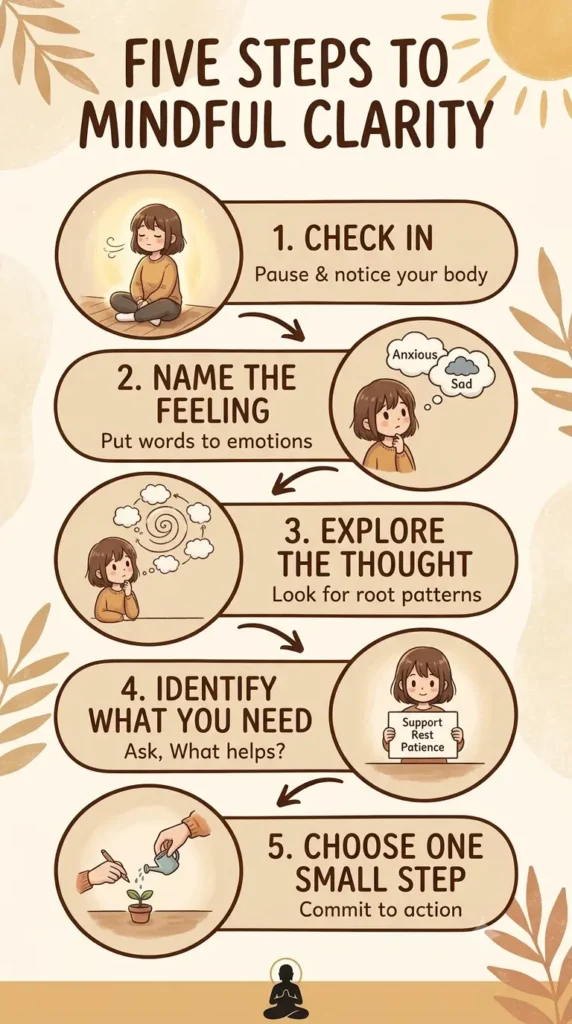
This routine breaks into five short stretches. Each one takes about sixty seconds. Together, they build a habit anyone can stick to, even on the days motivation is nowhere to be found.
Minute 1: Check In
Start simple. Ask yourself: how am I doing right now?
Write a few words about your mood. Your energy. Whatever’s sitting in your head. Don’t dress it up. Don’t try to sound put-together.
You might write “restless and distracted.” Or “tired, but better than yesterday.” There’s no right answer here. You’re just marking your starting point, the same way a runner checks their pace before a race.
Minute 2: Name What You’re Feeling
Vague feelings stay stuck. Naming them moves them.
Skip “I feel bad.” Get specific. Frustrated. Lonely. Anxious. Disappointed. Numb. Relieved. Each word points somewhere different, and somewhere different needs a different response.
Can’t find the word? Check your body instead. A tight chest. A clenched jaw. Heavy shoulders. Restless legs that won’t sit still. The body often names what the mind can’t.
Minute 3: Explore the Thought
What’s been taking up the most space in your head?
Write about it. The situation, the conversation, the worry looping on repeat. You’re not solving anything yet. You’re just getting it out of your skull and onto paper, where it’s easier to look at and harder to automatically believe.
This step alone does a lot of the work. A thought written down loses some of its grip. It stops being the loudest voice in the room.
Minute 4: Identify What You Need
Now shift from thinking to caring for yourself. Ask: what do I actually need right now?
Rest. Reassurance. A boundary. A hard conversation. Food. Movement. Quiet. Permission to stop pushing so hard. Keep it real. You’re not planning your whole life here, just naming one need you can actually meet.
Sound too small to matter? It isn’t. Most people skip this step entirely, and it’s the one that turns a vague morning into a workable one.
Minute 5: Choose One Small Next Step
Close by picking one action you can manage in the next few hours.
Send the message. Take the shower. Step outside for ten minutes. Put your phone in another room. Write down the one thing you don’t want to forget. Nothing complicated.
The point was never to fix everything in five minutes. It’s to leave the page a little clearer than when you sat down. That’s the whole win.
If this five-step shape feels useful, it pairs naturally with a slower practice too, one built around presence instead of speed. Our mindfulness journal prompts guide walks through exactly that, for the days you have more than five minutes to give yourself.
When a Journal Prompt Makes You Feel Worse
Journal prompts for mental health should help you understand what you’re going through. Not trap you inside it. A hard prompt can stir up rumination, anxiety, or real distress. If writing leaves you shakier than before you started, stop. Ground yourself first. Then reach for a real person, not another page.
Reflection vs. Rumination: Know the Difference
Reflection moves you somewhere. Rumination just spins.
One helps you understand what happened. The other keeps you circling the same wound, no closer to relief. Take “Why did that conversation hurt me, and what did I need in that moment?” That question creates distance. It gives you room to think. Now compare it to writing the same angry paragraph about someone for thirty straight minutes. No new insight shows up. Your nervous system just stays lit up the whole time.
Notice the pattern. Replaying the same scene. Predicting disaster. Tearing yourself apart page after page. Feeling worse with every line. That’s your signal to change direction, not push through.
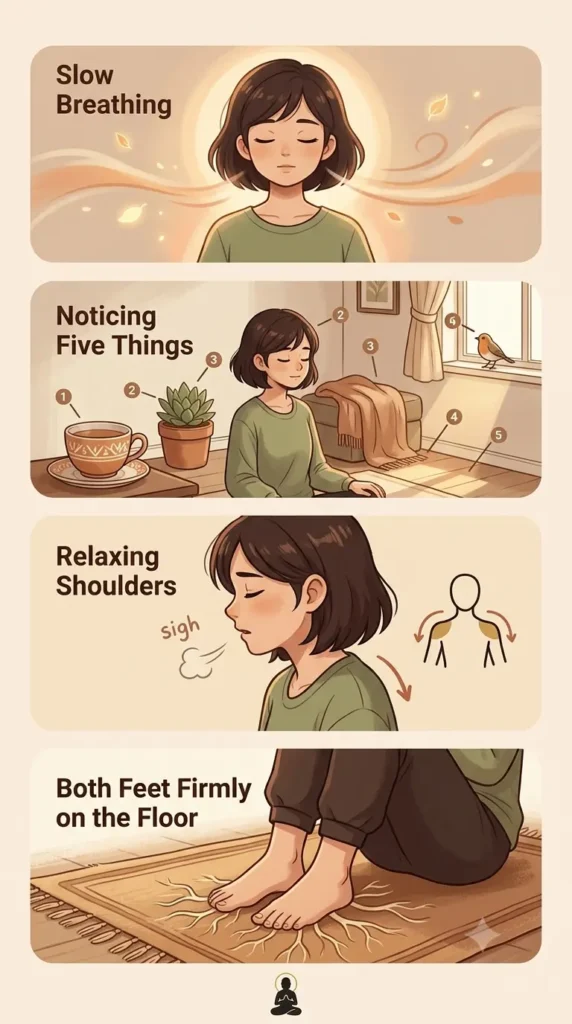
Try a grounding prompt instead:
- What can I see, hear, and physically feel right now?
- What is one thing I know for certain?
- What do I need in the next hour, not the next year?
- Who could I talk to about this?
You don’t get extra credit for suffering on the page. If you want a lower-stakes way to build this reflective habit before tackling harder material, our guide to mindfulness journal prompts is a gentler starting point.
When to Stop Journaling and Get Support
Some prompts don’t just sting. They spiral.
Stop the second you notice escalating panic, urges to hurt yourself, or a sense that you can’t stay safe. Not after you finish the entry. Now. Close the journal. Move somewhere that feels safer. Call someone you trust, or a mental health professional who can actually help in real time.
If you’re in the U.S. and you’re in crisis or thinking about suicide, call or text 988 to reach the 988 Suicide & Crisis Lifeline. You can also text HOME to 741741 to reach Crisis Text Line, which offers free, confidential support around the clock.
Outside the U.S.? Use your country’s local crisis or emergency service instead.
Journaling can support your mental health in real ways. But a crisis isn’t something you’re meant to write your way out of alone.
Free Printable Mental Health Journal Prompts PDF
A blank notebook can feel like too much some nights. A printable mental health journal fixes that fast. It gives you something concrete to return to. Print a fresh sheet. Save it to your phone. Or write straight onto the page.
Looking for a mental health journal prompts pdf free download you can actually keep? This is built for exactly that.
7-Day Mental Health Journal Prompts Printable
New to journaling? Start small.
A seven-day set beats diving into hundreds of prompts at once, especially when your attention and energy are already stretched thin. Each day covers one simple angle. How you feel. What you need. What’s weighing on you. What helped. What you want to carry forward.
Five minutes a day. That’s it.
Grab the full sheet here: mental health journal prompts printable.
30-Day Mental Health Journal Prompts PDF
Occasional journaling turns into a routine somewhere around day thirty.
Don’t expect pages every day. One prompt is enough. Treat it like a five-minute check-in, not a homework assignment. Miss a day? Keep going. Skip the guilt entirely. Just continue with the next prompt instead of restarting from day one.

Sound too easy? It is. That’s exactly why it works.
365 Journal Prompts for Mental Health
Want something that lasts all year? 365 journal prompts for mental health gives you a different starting point for every single day, while still leaving room to repeat whatever genuinely helps.
A perfect streak was never the goal. Neither is finishing it in order.
The real goal is smaller than that. Build a resource you’ll actually return to. Through the good stretches. Through the rough ones too. If anxiety tends to show up in your entries, gratitude journaling for anxiety pairs well with a longer prompt set like this one.
Conclusion
A good mental health journal isn’t about perfect writing. There’s no right answer to chase. It’s a place to slow down, notice what’s stirring inside, and put messy thoughts into words before they pile up in your head.
Start with one prompt. Just one that fits how you feel today.
Write for five minutes. Answer in bullet points. Come back to the same question tomorrow if that’s what it takes. None of that matters as much as this: the practice should feel useful, not like one more task on your list.
Some days the words will flow easy. Other days you’ll stare at the page. Both are fine.
If you want a gentler starting point, mindfulness journal prompts can help you slow your thinking down before you write. And if gratitude feels like the missing piece, these gratitude worksheets are worth a look too.
One more thing. If journaling stirs up feelings that feel too heavy to carry alone, reach out for professional support. That’s not failure. That’s strength.
Frequently Asked Questions
What are good journal prompts for mental health?
Good journal prompts for mental health help you understand what you’re feeling, notice recurring thought patterns, identify what you need, or reflect on what could help next.
Useful prompts are specific enough to guide you but open enough for an honest answer. Start with whichever question feels easiest to answer.
How do I start journaling for my mental health?
Start small: choose one prompt, set a timer for five minutes, and write without worrying about grammar or making your answer sound insightful.
You don’t need a special notebook or a perfect routine. If a prompt feels too heavy, skip it and choose something more manageable.
Can journaling help with anxiety and overthinking?
Journaling can help you put anxious thoughts into words, separate facts from predictions, identify triggers, and consider what is actually within your control.
It isn’t a cure for anxiety, though. If writing repeatedly sends you deeper into rumination rather than helping you understand your thoughts, pause and try a grounding activity instead.
Is journaling a replacement for therapy or mental health treatment?
No. Journaling is a self-reflection practice, not a substitute for psychotherapy, psychiatric care, or crisis support.
It can complement professional care by helping you organize thoughts and observations, but persistent or severe symptoms deserve appropriate professional attention. If you’re in immediate danger, seek urgent local help rather than relying on a journal.
How many journal prompts do I need to start?
You only need one journal prompt to begin. Having 100 or even 365 journal prompts for mental health can give you variety, but you don’t need to answer a new question every day.
A single prompt that helps you understand what you’re feeling is more valuable than a huge list you never open.

It’s Bhaskar!
Well, I am not a psychologist a monk, or a philosopher by training. I’m just an engineering graduate.
‘The Empty Self’ is where I write about that idea, and what it actually means for ordinary life, anxiety, identity, habits, the stories we tell ourselves about who we are. I don’t have a psychology degree, and I’m not offering therapy or clinical advice. What I do have is thought and clarity, and genuine curiosity about why we suffer the way we do and how much of it might loose once we shed this ‘fixed identity’.
Pingback: Talking About Feelings Worksheets: 10 Great Worksheets for Kids and Adults | The Empty Self
Pingback: 10 Easy Feelings Exercise and Activities for Gen Alpha Kids You Can't Miss! | The Empty Self
Pingback: 15 Free Coping Skills Worksheets for Kids and Adults | The Empty Self
Pingback: 15+ Coping Skills Group Activities for All Age Groups (Kids, Teens & Adults) | The Empty Self
Pingback: 12 Free and Fun Coping Skills Coloring Pages for Kids (Gen Alpha Guide) | The Empty Self
Pingback: 15 Perfect Guided Journals for Mental Health: Ultimate Gen Z Guide | The Empty Self
Pingback: Emotions Worksheet: 20 Useful Worksheets for Gen Z and Gen Alpha | The Empty Self
Pingback: 20+ Free DBT Skills Worksheets: Complete Guide for Beginners | The Empty Self
Pingback: DBT STOP Skill: A Complete Guide for Kids, Teens, and Adults | The Empty Self
Pingback: DBT PLEASE Skill: Meaning, Worksheet & How to Use It (Free PDF) | The Empty Self
Pingback: DBT IMPROVE the Moment Skill: Complete 2026 Guide With Free Printable | The Empty Self
Pingback: Willing Hands & Half Smile: DBT Acceptance Skill Guide With Printables 2026 | The Empty Self
Pingback: DBT Values 2026: Complete Guide With Printable and Worksheet | The Empty Self
Pingback: 10 Best DBT Books & Workbooks: Complete List for Teens and Adults | The Empty Self