

You don’t need to turn every hard experience into a lesson. That pressure helps nobody.
Healing journal prompts do something different. They slow you down. They help you name what you’re feeling. Figure out what you actually need. Make sense of the stuff still sitting heavy on you. Journaling isn’t a requirement to fix yourself. It’s not proof you’re “okay” either. It’s just reflection. Nothing more complicated than that.
Quick Answer: Healing journal prompts help you process emotions, understand your needs, release what you can’t change, and rebuild trust in yourself. Start with one prompt. Write honestly for 5 to 15 minutes. Stop once you’ve said what needed saying.
Scroll any feed today and someone looks perfectly happy. Productive. Fully “healed.” It’s easy to feel behind. Here’s the thing: your journal was never meant to look that polished. It just needs to be honest.
Psychologist James W. Pennebaker spent decades on this exact question. His research on expressive writing looked at how putting hard experiences into words supports emotional processing. That’s part of why structured journaling is worth trying, even on the days nothing feels resolved. If mood and mental health prompts feel like a better fit than healing work specifically, the broader journal prompts for mental health guide sorts through those by feeling instead.
Table of Contents
Disclaimer
This blog is written and edited with the help of AI, then reviewed by me before publishing. As a result, the content is for general reflection only, not therapy or medical advice, and I’m not a licensed mental health professional. If you’re in crisis, please contact 988 if you’re in US or a local crisis service of your country instead of relying on this site.
Healing Journal Prompts: What Can They Actually Help You Explore?
Healing journal prompts aren’t about pretty pages. They’re not about convincing yourself everything happens for a reason either. What they actually do is smaller than that, and more useful. They give you a place to put confusing feelings into words, notice patterns, and figure out what you actually need. For Gen Z, that matters. Social feeds already turn “being healed” into another aesthetic to perform.
Healing Doesn’t Mean Feeling Positive All the Time
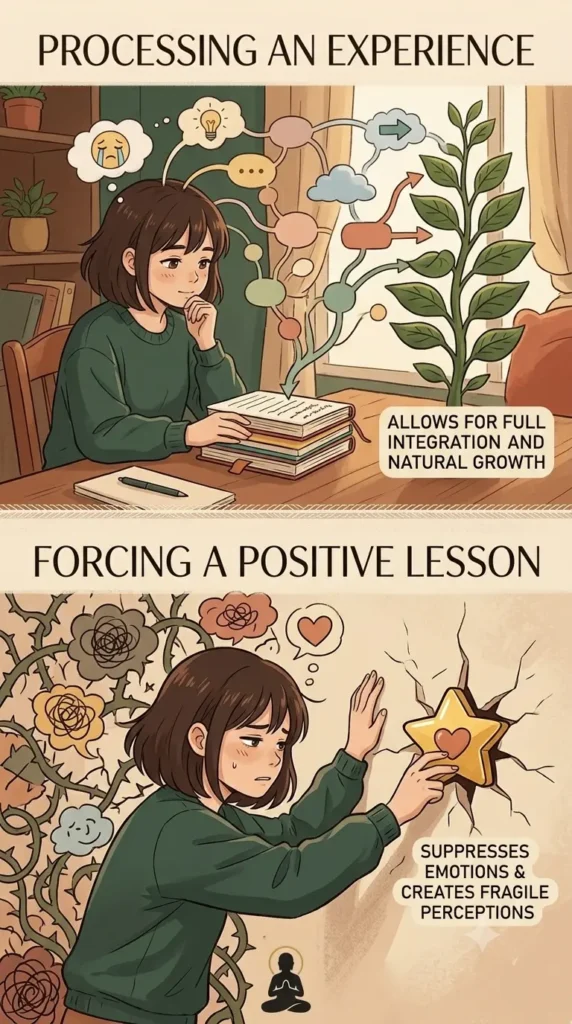
Healing journaling means making space for what’s actually happening. Not forcing yourself to feel better before you’re ready. If you’re angry, write angry. If you’re disappointed, let it sit on the page. You don’t owe every hard experience a lesson, a growth arc, or a stack of positive journal prompts pretending everything’s fine.
That distinction matters. Positivity can quietly become avoidance. Writing “I’m grateful for the lesson” while you’re still hurting might look healthy on the page. It doesn’t always help you understand what happened, or what you need right now.
Research on expressive writing starts with James W. Pennebaker’s work on writing through difficult thoughts and feelings. Later studies came back mixed. That’s exactly why journaling works better as a reflective practice than a guaranteed fix.
The goal was never to perform healing. It’s to notice. To process. To actually understand.
If forced positivity is the pattern you keep falling into, working through how to practice gratitude without skipping the hard feelings first can make the difference between honest reflection and another performance.
How to Use These Prompts Without Overthinking Them
There’s no correct answer to a journal prompt. Two sentences count. So does a full page, a messy list, or stopping halfway because you’ve already said enough.
Think of a prompt as a door, not an assignment. Open it. See what shows up.
You don’t need to write about your deepest pain every time either. A good set of journal prompts for self growth can just as easily help you notice a boundary you keep ignoring, understand why a friendship feels different lately, or admit you’re exhausted from comparing your life to a feed.
Some days the gentler move is starting with self care journal prompts before working up to the heavier stuff healing usually asks of you. Other days, naming one thing you’re not sick of yet through things to be thankful for is enough of a start.

50+ Healing Journal Prompts for Different Stages of Your Journey
Healing rarely happens in one clean break. It moves in stages. Naming what you feel. Sitting with pain. Rebuilding trust in yourself. Learning to care for yourself again. Then, slowly, imagining what comes next.
Use whichever stage fits today. You don’t need to force progress.
Research on expressive writing, starting with the work of James W. Pennebaker and Sandra Beall in 1986, suggests putting hard experiences into words can help. Not everyone, though. Later studies found the effects aren’t universal. So treat journaling as a reflective practice, not a guaranteed fix. The point here is simpler. Give your thoughts somewhere honest to land.
If you want a bigger picture first, our guide to journal prompts for mental health covers reflection more broadly, sorted by mood instead of stage.
Prompts for Understanding What You’re Feeling
You can’t work with a feeling you keep shoving into the background. Name it first.
These journal prompts for healing are built to help you notice what’s happening underneath the obvious emotion. Not the surface version. The one hiding behind it.
- What am I feeling right now, and what makes me call it that?
- If this feeling could speak, what would it want me to know?
- What happened immediately before I started feeling this way?
- What might be underneath the emotion I can identify most easily?
- What do I need right now that I haven’t been giving myself?
- Is this feeling about today, or is something older being stirred up?
Prompts for Processing Difficult Emotions
You don’t have to turn anger into gratitude. Sadness doesn’t need to become a life lesson either.
Sometimes the useful work is just telling the truth about what hurts. Nothing more polished than that.
- What am I angry about that I haven’t fully admitted?
- What am I sad about, even if I think I should be “over it”?
- What am I afraid might happen next?
- What disappointment am I still carrying?
- What emotion do I find hardest to express, and why?
- If I stopped judging this feeling as good or bad, what would I notice about it?
Prompts for Healing From a Difficult Experience
A painful experience doesn’t need to become a beautiful story to matter. It just happened. That’s enough.
These prompts help you look at what happened without forcing a lesson before you’re ready.
- What happened, in my own words, without minimizing or exaggerating it?
- How did that experience change the way I see myself?
- What did I need at the time that I didn’t receive?
- What do I need from myself now that I needed back then?
- What part of this experience still feels unfinished for me?
- What have I learned from this experience without pretending I’m thankful it happened?
Prompts for Letting Go, Forgiveness, and Acceptance
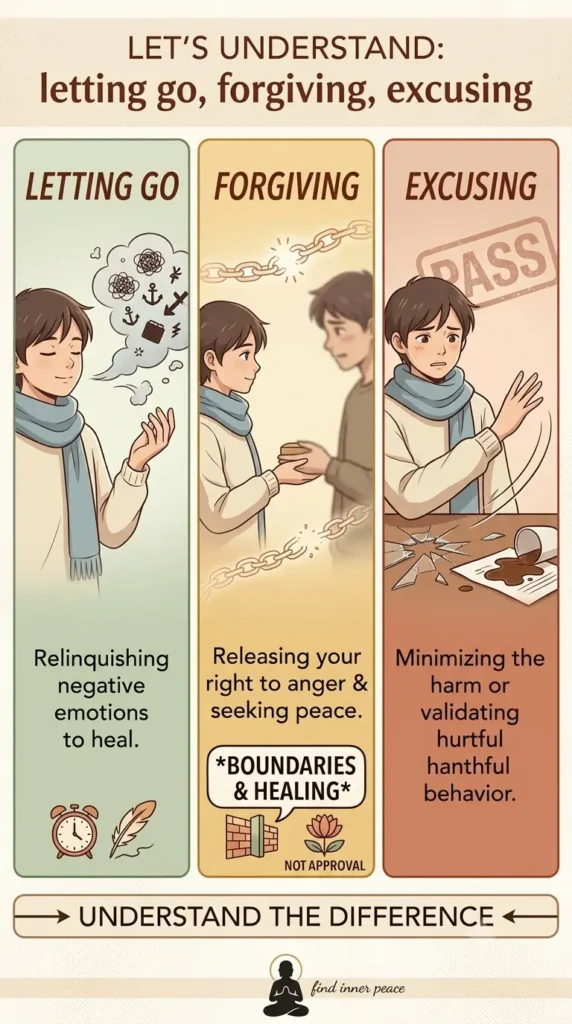
Letting go doesn’t mean pretending something didn’t matter. And forgiving someone isn’t the same as excusing what they did.
You can loosen your grip on an experience while still deciding the behavior was unacceptable. Both things can be true at once.
- What am I holding onto because letting go feels like losing something?
- What resentment keeps taking up space in my mind?
- What is within my control here, and what is completely outside it?
- What would I like to stop carrying into my next chapter?
- What would forgiving myself look like without pretending I made no mistakes?
- Is there someone I can forgive without giving them access to me again?
Forgiving is about how you carry what happened. Excusing is about calling the behavior acceptable. They’re not the same thing. You can forgive and still keep a boundary. You can accept that something happened without approving of it.
Prompts for Self-Love and Self-Compassion
Self-love isn’t convincing yourself everything about you is amazing. It’s usually less glamorous than that.
Most days it just looks like refusing to speak to yourself in a way you’d never speak to someone you actually care about.
- What would I say to a close friend who was going through what I am going through?
- Where has my inner critic been louder than my own voice?
- What is something about myself I have been unfairly judging?
- What strength have I shown recently that I almost overlooked?
- What part of myself am I learning to accept instead of constantly fix?
- What would treating myself with more patience look like this week?
Self-Care Journal Prompts for When You’re Emotionally Drained
When you’re emotionally drained, another ambitious self-improvement task is the last thing you need.
These self care journal prompts help you figure out what would actually make today more manageable. Not perfect. Just lighter.
- What is draining most of my energy right now?
- What am I saying yes to when I really want to say no?
- What kind of rest do I actually need: physical, mental, social, or emotional?
- Which basic need have I been ignoring lately?
- What is one small act of care I could give myself today without earning it first?
- What could I temporarily remove from my schedule, expectations, or mental load?
Prompts for Boundaries, Relationships, and People-Pleasing
This is where healing gets uncomfortable. You can understand your feelings perfectly and still abandon your own needs to avoid disappointing someone else.
Sound familiar? Start here.
- Who do I feel most afraid of disappointing, and why?
- Where in my life am I saying “yes” because I’m afraid of someone’s reaction?
- What boundary do I already know I need but keep avoiding?
- Which relationship currently feels mutual, and which one feels one-sided?
- What has changed about a friendship that I am having trouble accepting?
- What would healthy support look like in my relationships right now?
For Gen Z, this can also mean digital boundaries. You don’t have to reply immediately, explain every decision, stay available all day, or keep watching someone’s life online after the relationship has changed.
If anxious thoughts tend to fuel the people-pleasing, gratitude journaling for anxiety is worth pairing with this section. It widens the gap between the fear of disappointing someone and your actual reaction.
Prompts for Healing Your Relationship With Yourself
It’s hard to build self-trust while constantly measuring your life against everyone else’s highlight reel. Your timeline was never supposed to match someone else’s.
- Who am I when I am not trying to meet someone else’s expectations?
- Where have I been comparing my behind-the-scenes with someone else’s carefully edited version?
- What does “being behind” actually mean to me, and who taught me that definition?
- When have I trusted myself recently, even in a small decision?
- What would I attempt if I stopped requiring myself to be perfect first?
- Which parts of my identity feel chosen by me, rather than inherited from other people’s expectations?
Positive Journal Prompts for Rebuilding Hope
Positive thinking isn’t a substitute for processing pain. It never was.
Positive journal prompts work best as rebuilding tools. They help you notice evidence that life holds more than the thing currently hurting.
- What is one small thing that went better than expected recently?
- What is still good in my life, even while something else feels difficult?
- What quality in myself has helped me get through a hard period?
- What is something I can look forward to without needing it to solve everything?
- What progress have I made that my current mood is making difficult to see?
- What ordinary moment has brought me a little peace lately?

Journal Prompts for Self-Growth and Your Future Self
Growth doesn’t mean becoming a completely different person. Usually it means getting more deliberate about what you keep, what you change, and what you no longer want to carry.
- What values do I want my daily choices to reflect more clearly?
- Which habit is helping the person I want to become, and which one keeps pulling me backward?
- What would my future self thank me for starting now?
- What goal matters to me even when nobody else knows about it?
- What kind of person do I want to be when life becomes difficult again?
- What does a healthier version of my life look like in ordinary, everyday details?
These journal prompts for self growth aren’t about designing a flawless future version of yourself. They’re about making your next choices a little more intentional.
You now have 60 prompts. You don’t need all 60. Pick the section that matches what’s actually happening inside you today. If a prompt makes you want to write for ten minutes, stay with it. If another feels like performing an answer for an imaginary audience, skip it.
The goal was never to fill pages. It’s to get a little more honest with yourself.
For a gentler entry point before the harder material, our mindfulness journal prompts guide is worth trying first.
And if part of your healing includes rebuilding a gratitude practice, how to practice gratitude and gratitude worksheets offer a structured place to start once you’re ready.
Which Healing Journal Prompt Should You Choose Today?
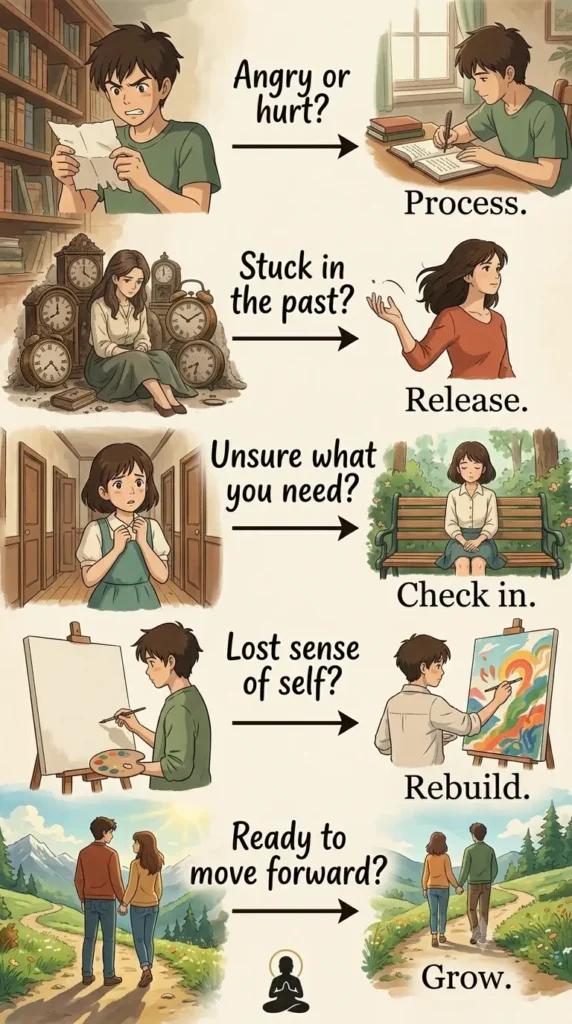
Not every healing journal prompt fits every day. The deepest prompt isn’t always the right one. Match the prompt to what you’re actually carrying today, not where you think your healing should be by now. Start where you are. These healing journal prompts help you sort between processing, releasing, rebuilding, and moving forward.
“I’m Still Angry or Hurt”
Don’t reach for forgiveness prompts yet. Start with the anger. Ask yourself: What boundary was crossed, and what do I wish I had said? Anger points somewhere. Writing about it helps you see where. It’s uncomfortable, sure. But it’s also information. Use this space to name what you need now to feel safer, or simply more respected.
“I Can’t Stop Thinking About the Past”
This isn’t a problem you solve by rewriting the memory. Try prompts about acceptance instead. What can you control today? What are you finally ready to put down? The goal isn’t a cleaner version of what happened. It’s understanding what still has its hook in you. That’s it.
“I Don’t Know What I Need Right Now”
Go smaller. Much smaller. Ask: What am I feeling in my body right now? What’s draining me? What would make the next hour slightly easier? No profound answer required. Sometimes healing starts with admitting you need rest. Or food. Or a boundary you’ve been avoiding. Pairing a body-scan style question with a mindfulness journal prompt can help you notice what your body already knows before your mind catches up.
“I Want to Feel Like Myself Again”
Use identity prompts here. Self-compassion prompts too. Look at what you’ve muted while trying to meet everyone else’s expectations. Here’s an honest take: your old self might not even be the destination. You may be becoming someone new, not returning to someone old.
“I’m Ready to Move Forward”
Growth-focused prompts belong here, not before. Explore your values. Your future habits. The person you’re building toward. Moving forward doesn’t mean pretending the past didn’t hurt. It means choosing where your energy goes next. For a broader set of options once you’re in this stage, this mood-based prompt guide for mental health is worth a look.
How to Turn Healing Journal Prompts Into a Real Practice
Healing journaling isn’t a dramatic breakthrough moment. It’s small and repeatable. Pick one useful prompt. Write honestly for a short stretch. Come back later and notice what you see. Then give yourself permission to stop the second writing starts doing more harm than good.
Start With One Prompt, Not Ten
More prompts don’t mean more healing. Not even close. Pick one question that matches what you actually need today, and stay with it.
Angry? Don’t force a gratitude exercise. Exhausted? Skip the deep dive into your past and reach for something need-based instead.
The goal was never to finish the list. It’s to notice something you hadn’t put into words before. If you’re not sure which prompt fits your mood right now, journal prompts for mental health breaks them down by feeling instead of topic, so you’re not guessing.
Write for 5 to 15 Minutes Without Editing Yourself
Give yourself a short window. Write without worrying about grammar, structure, or whether your thoughts sound wise. You can repeat yourself. You can contradict yourself. You can write “I don’t know” five times if that’s honestly where you are.
Sound too loose to count as real journaling? It isn’t. That’s the whole point.
Psychologist James W. Pennebaker built decades of research around this idea. His work on expressive writing suggests that putting stressful experiences into words helps people organize and make sense of what happened. Venting alone isn’t the full story, though. Meaning and changing perspective matter too, according to the American Psychological Association.
Notice Patterns When You Revisit Old Entries
Don’t reread everything every night. Once a week is plenty. Every few weeks works too.
Look for repeated themes. The same boundary you keep avoiding. The situation that drains you every time. The need that keeps showing up in different words. Your journal starts to look less like a diary and more like a map of what keeps asking for your attention.
Create a Weekly Healing Check-In
Set aside 10 to 15 minutes once a week. Ask yourself:
- What felt heavier than usual this week?
- What helped, even a little?
- What am I still carrying?
- What do I need more or less of next week?
Keep the answers simple. The value comes from returning regularly, not from producing profound entries. If a repeatable check-in like this appeals to you, how to practice gratitude walks through a similar weekly rhythm built around noticing the good instead of the heavy.
Know When to Put the Journal Down
Journaling isn’t supposed to leave you worse off with no sense of space afterward. That’s not what it’s for.
Research on expressive writing backs this up. Writing about upsetting experiences can raise distress at first, and results aren’t equally positive for everyone, according to the same APA research.
If a prompt starts pulling you into memories or emotions that feel too heavy to handle alone, stop writing. Close the journal. Do something ordinary and grounding instead. Talk to someone you trust if you need it. You don’t have to finish a prompt just because you started it.
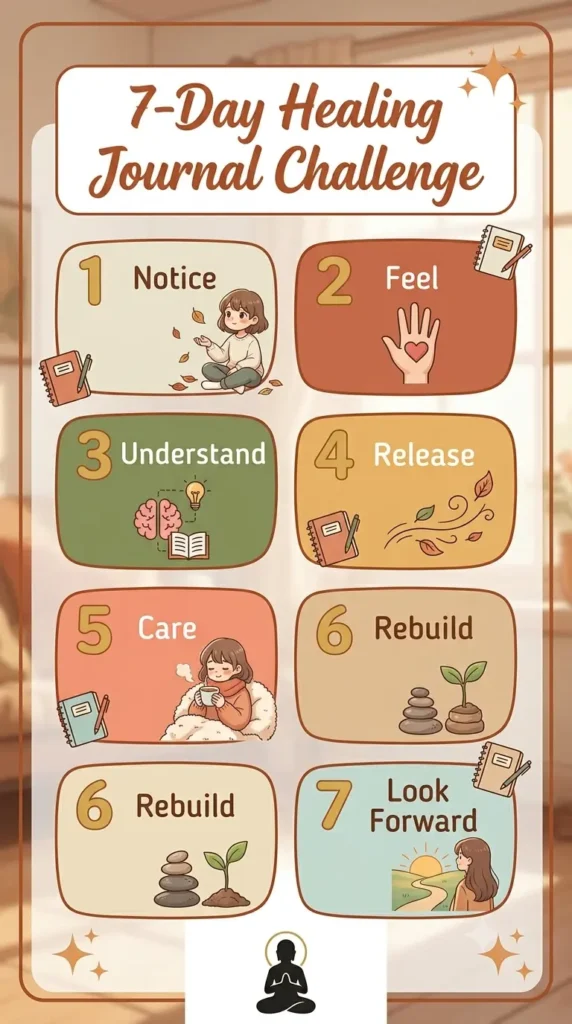
A Simple 7-Day Healing Journaling Challenge
Pages every night? Not required. This seven-day challenge hands you one focused prompt each day. Notice what hurts. Understand it. Care for yourself. Then decide what’s next. Keep every entry honest. Keep it short too.
Day 1: Notice
Pay attention first. Don’t try to fix anything yet. What emotion keeps circling back lately? What might it be trying to tell you?
Prompt: What have I been feeling lately that I haven’t fully acknowledged yet?
Day 2: Feel
Today isn’t about finding a lesson. Not yet. Just describe the feeling as it actually is, without judging whether you “should” still feel it.
Prompt: If I let myself feel this emotion without judging it, what would I want to say?
Day 3: Understand
Look past the obvious reaction. Sometimes anger is hiding hurt underneath. Sometimes exhaustion just means a boundary got ignored one too many times.
Prompt: What happened, and how has it changed the way I see myself, other people, or my life?
Day 4: Release
Releasing something doesn’t mean pretending it never mattered. You can forgive someone without excusing what they did. You can stop carrying something without approving of it either.
Prompt: What am I still carrying that I no longer want to carry into the next chapter of my life?
Day 5: Care
Healing means noticing what you actually need right now. Rest, maybe. Space. A hard conversation you keep putting off. Less screen time. Or just permission to stop being productive for one evening. This is where most self care journal prompts start anyway, with one honest need instead of a whole routine.
Prompt: What is one need I’ve been ignoring, and what would caring for it look like this week?
Day 6: Rebuild
Once you’ve made room for what you feel, look at what’s left standing. Confidence. Self-trust. Old routines. Your sense of who you are. Some of it needs rebuilding. Not all at once.
Prompt: What is one thing about myself I want to learn to trust again?
Day 7: Look Forward
Seven days won’t hand you every answer. That’s not the point. The point is noticing whether your relationship with yourself shifted, even slightly.
Prompt: What do I want the next version of my life to feel like, and what small choice could move me toward it?
This kind of gradual approach has real roots in expressive-writing research. Psychologist James W. Pennebaker asked participants to write about upsetting experiences across several short sessions. That work helped build the entire research tradition around putting hard experiences into words instead of just avoiding them.
Want a gentler entry point before Day 3 gets harder? The mindfulness journal prompts guide is built for staying present instead of digging into old wounds right away. And if this seven-day shape feels useful, the wider journal prompts for mental health collection has more prompts sorted by mood, not just by day.
When Journaling Isn’t Enough
Healing journal prompts can help you make sense of a hard chapter. That’s real. But a notebook isn’t a cure for trauma. It’s not a stand-in for mental health treatment either.
Writing is a self-care tool. Not a substitute for real support. That line matters more than it sounds.
So don’t force yourself to keep digging just because a prompt says “go deeper.” That instruction was never a rule.
Keep feeling worse after journaling? Pause. Same goes for feeling overwhelmed by what surfaces, or not feeling safe continuing. Close the notebook. Talk to someone you trust. Or reach out for real support instead.
In the U.S. and in immediate emotional crisis? Call or text 988 to reach the 988 Suicide & Crisis Lifeline. You can also text HOME to 741741 to reach Crisis Text Line’s free, confidential support.
Your journal doesn’t need to hold everything. Sometimes the healthiest line you can write is this: I need support with this.
Want a gentler way in first? Mindfulness journal prompts slow things down without asking you to relive anything. And if the mental health side of writing is what you’re actually navigating, journal prompts for mental health walks through where journaling helps, and where it stops.
Explore More Journal Prompts for Mental Health
Healing rarely stays in one lane. Some nights you need to sit with something painful. Other nights you just need to notice what’s already there, without digging into it. The resources below cover both. Pick whichever fits where you’re standing right now.
Journal Prompts for Mental Health
Not sure where to even start? Begin with the wider journal prompts for mental health guide. It covers more ground than any single list of healing journal prompts could on its own, anxiety, low mood, self-esteem, burnout, all sorted by what you’re actually feeling.
That matters more than it sounds. Some days your feelings won’t fit into one neat box. General overwhelm isn’t the same as one specific wound, and forcing “healing work” onto a day that just needs a check-in usually backfires. This pillar gives you room to pick the right lane instead of guessing.
Mindfulness Journal Prompts
Sometimes a painful memory is too much to look at directly. That’s real. Mindfulness offers a softer way in.
Mindfulness journal prompts pull your attention toward thoughts, feelings, and physical sensations without asking you to fix anything yet. Small shift. Big difference.
You get to observe first. Decide what it means later. That order matters more than people give it credit for, especially on days when self care journal prompts feel like too heavy a lift.
Gratitude Worksheets and Gratitude Practice
Once you reach the rebuilding stage, gratitude earns its place. Not to paper over the hard stuff. Just to notice what’s still standing.
Gratitude worksheets give that noticing some structure. Want a habit that sticks past one good week? How to practice gratitude walks through building consistency without turning it into another chore.
Neither approach asks you to ignore what hurts. Positive journal prompts and difficult ones can share the same notebook. The goal is room, not replacement.
Gratitude Journaling for Anxiety
Anxiety changes the math. When it’s the loudest thing in the room, a scattered approach won’t cut it. You need something aimed.
Gratitude journaling for anxiety targets exactly that. It pairs the two practices so the gap between a fearful thought and your reaction to it gets a little wider, one page at a time.
365 Journal Prompts for Mental Health
Looking for something longer than a single week? The 365 journal prompts for mental health resource hands you a prompt for every day of the year. No decision fatigue before you’ve even picked up the pen.
Some months lean into healing directly. Others lean into growth, or gratitude, or plain reflection. You don’t have to follow it in order. Skip what doesn’t land. Repeat what does. That’s the whole system, and it’s built to outlast any single burst of motivation.
Conclusion
Healing doesn’t mean you stop getting hurt. Ever.
Sometimes it just means admitting something still stings, without beating yourself up over it. Putting hard experiences into words helps people sort through tangled emotions. Not guaranteed, though. Benefits shift from person to person.
So skip the hunt for the “right” thing to write. Pick one of these healing journal prompts that feels honest today. Write what’s true. Stop the second you need to.
Not sure where to start? These journal prompts for mental health sort things by mood. Useful on the days healing feels tangled up with anxiety or a low mood. Want something gentler first? Mindfulness journal prompts can slow your thinking down before the harder stuff. And if gratitude feels like the missing piece, these gratitude worksheets are worth a look too.
Let healing stay a process. Not another version of perfectionism.
Frequently Asked Questions
What should I write in a healing journal?
Start with what’s true right now. Not what sounds wise. Not what sounds positive.
Write about the emotion you keep dodging. The thing you wish had gone differently. A boundary you need to set. What you need from yourself today. There’s no perfect entry here.
Sound too open-ended? Maybe. But that’s the point. Healing journal prompts work because they don’t demand a tidy answer. They just ask you to notice what you think, feel, need, and want to understand a little better.
Can journaling help you process difficult emotions?
Yes. A journal gives you a private spot to put hard thoughts into words. Some distance too.
Psychologist James W. Pennebaker spent decades studying this. His research on expressive writing looked at how writing about emotionally heavy experiences affects both mind and body. Not a miracle fix, though. Journaling shouldn’t replace professional support or get treated as a guaranteed cure.
Want the deeper research breakdown, sorted by mood and purpose? Our journal prompts for mental health guide covers that ground in full.
What should I journal about when I feel emotionally overwhelmed?
Don’t start with the deepest thing on your mind. Start smaller.
What am I feeling right now? What’s making it heavier? What do I need in the next hour? Three questions. Nothing more elaborate than that.
A simple check-in beats trying to explain your entire emotional life in one sitting. It really does. If mindfulness feels like a gentler entry point before tackling heavier material, our mindfulness journal prompts guide walks through prompts built for exactly that kind of pause.
Can journal prompts help with self-growth and self-discovery?
They can. Especially when you use them to examine patterns instead of just listing goals.
Journal prompts for self growth push you toward your values, boundaries, habits, relationships, fears, and strengths. The kind of person you’re becoming too. The goal was never inventing a flawless future version of yourself.
It’s simpler than that. Understand your current choices well enough to make different ones when you need to.
What should I do if journaling brings up painful memories?
You don’t have to finish a prompt just because you started it. Not ever.
If writing leaves you more distressed, stop. Ground yourself with something familiar. Something practical. Then talk to someone you trust, or a qualified mental-health professional if it’s serious.
Journaling is a reflective practice. It was never a requirement to relive painful experiences alone.

It’s Bhaskar!
Well, I am not a psychologist a monk, or a philosopher by training. I’m just an engineering graduate.
‘The Empty Self’ is where I write about that idea, and what it actually means for ordinary life, anxiety, identity, habits, the stories we tell ourselves about who we are. I don’t have a psychology degree, and I’m not offering therapy or clinical advice. What I do have is thought and clarity, and genuine curiosity about why we suffer the way we do and how much of it might loose once we shed this ‘fixed identity’.