

Therapy gives you a room to talk in. Your journal gives you the words before you walk through the door. That’s the real difference.
Most people sit down for a session and go blank. Not because nothing’s going on. Because they never named it first. Joshua Smyth’s 1998 research synthesis on expressive writing found something worth noting here: structured emotional writing shows up alongside real gains in psychological well-being. It can also stir up some short-term distress along the way. Both things are true at once.
Quick answer: Therapy journal prompts are guided questions you use before, between, or after sessions. They help you put thoughts into words, spot patterns, and remember what you actually meant to bring up. They support therapy. They don’t replace it.
Nobody needs a perfectly insightful page here. One honest sentence counts. Write about something that happened yesterday. Write about the thought you keep circling back to at 2am. Write about the thing you almost said last session, then swallowed instead.
The American Psychological Association describes psychotherapy as a collaborative process between you and a trained professional. So treat therapy journaling as the prep work and the reflection that happens around that process. Not a version of therapy you’re supposed to perform solo. That’s not what this is for.
Table of Contents
Disclaimer
This blog is written and edited with the help of AI, then reviewed by me before publishing. As a result, the content is for general reflection only, not therapy or medical advice, and I’m not a licensed mental health professional. If you’re in crisis, please contact 988 if you’re in US or a local crisis service of your country instead of relying on this site.
What Are Therapy Journal Prompts?
Therapy journal prompts are specific questions. They turn thoughts, emotions, and therapy takeaways into actual words. Not a vague feeling stuck in your head. Something you can look at.
A diary just records the day. A prompt gives you somewhere to start instead. Use them before a session, between appointments, or after, when something a therapist said is still sitting with you and won’t let go.
Therapy journaling vs. regular journaling
Regular journaling has no destination. You write whatever’s loudest. A bad day, an argument, a memory you can’t shake. Three pages, no map.
Therapy journaling works differently. It’s intentional. A prompt points your attention somewhere specific instead of leaving you to wander.
Take this example. Instead of writing “Today sucked,” a therapy writing prompt might ask:
What happened today that changed my mood, and what did I tell myself about it?
That shift is small. It still matters. You’re not chasing a perfect entry here. You’re just giving yourself something concrete to notice.
Good therapeutic journal prompts also catch what regular memory drops. A reaction that caught you off guard. A thought that keeps circling back. A hard conversation. Something you meant to tell your therapist and couldn’t quite say out loud.
Can journal prompts actually help during therapy?
Yes, with one condition. They have to support therapy, not replace it.
The American Psychological Association describes psychotherapy as a professional, collaborative process involving communication between a person and a trained therapist to address concerns and work toward change.
A prompt can’t give you that relationship. It can’t replace a therapist’s judgment either. What it can do is help you walk in with something specific to say.
That line matters. Keep it clear. Writing helps you notice a pattern. Your session is where you actually work out what that pattern means, and what to do about it.
When should you use therapy journal prompts?
There’s no fixed schedule here. Use therapy journal prompts whenever writing helps you notice, remember, or want to talk something through.
Before a session, they help you figure out what’s actually worth bringing up. Between sessions, they catch moments that would otherwise blur together by Thursday. After a session, they help you sit with an uncomfortable question or an insight that hasn’t settled yet.
You don’t need a full page either. Sometimes one honest sentence does the whole job.

If you want a wider entry point before narrowing into therapy-specific questions, the full journal prompts for mental health guide sorts prompts by mood instead of setting. And when a prompt surfaces something older that needs more room than a single session allows, healing journal prompts picks up where a therapy-informed entry tends to leave off.
How to Use a Therapy Journal Without Making It Another Task
A therapy journal should make therapy easier to carry. Not harder. Keep it small. Attach it to something you already do. Let the format shift with your energy that day.
Consistency beats a perfect entry. Every time.
Write for 5–10 minutes instead of forcing long entries
You don’t need three pages for this to count. Five honest minutes is enough. Enough to capture what happened, what you felt, or what you want to bring up next session.
Habit researcher Phillippa Lally and her colleagues found that repeating a behavior in the same setting can make it more automatic over time, though the timeline swung wildly from person to person. Missing a day didn’t really throw the process off course.
So don’t turn “journal every night” into a test you can fail. Got two sentences today? Write two sentences. That’s the whole practice.
Use your phone, notebook, or therapy journal PDF
The best journal is the one you’ll actually open.
Your Notes app works fine. So does a cheap notebook, a dedicated journal, or a printable therapy journal prompts PDF sitting beside your desk. You don’t need a curated setup before you’re allowed to start writing.
Already keeping general reflections somewhere? You don’t need a second system for it. Fold therapy notes into your existing routine instead of building an entirely new one, and if you want a gentler entry point first, how to journal without turning it into a chore covers the low-pressure habits worth borrowing.
You don’t have to answer every prompt
Treat therapy journal prompts as doors, not assignments. One question might crack something open, something worth raising with your therapist. Another might do nothing.
Skip it.
Forcing your way through a whole list turns useful reflection into homework you’ll resent by day three. Pick whichever question matches what’s actually going on in your life today. Nothing more elaborate than that.
Write the messy version first
Your journal doesn’t need to sound reasonable.
Write the thought you’d normally edit out before saying it to another person. Come back later, if you want, and make sense of it then. The first draft is for noticing. The later read-through is for understanding.
A simple shape helps here too: what happened, what I noticed, what I want to ask about. That’s it.
Stop when reflection turns into rumination
More writing isn’t automatically better. If you’re circling the same thought, rereading old pages, or trying to out-think a feeling through sheer analysis, close the journal.
Why does that matter? A useful therapy journal helps you spot patterns. It was never meant to keep you staring at the same painful thought until you’re wrung out.
If a session already left you sitting with something heavy, this isn’t the moment to dig further alone. Set the notebook down and bring it to your next session instead.
50+ Therapy Journal Prompts for Mental Health
Most journal-prompt lists sort everything by how you feel. Anxiety prompts. Depression prompts. Self-esteem prompts. Neat categories. Therapy doesn’t work that way.
These therapy journal prompts are sorted by what you actually need to do. Prepare for a session. Notice a pattern. Process what just happened. Question a thought. Figure out why you feel stuck. That’s it.
For a broader set of prompts covering mental health more generally, the journal prompts for mental health guide is a good starting point.
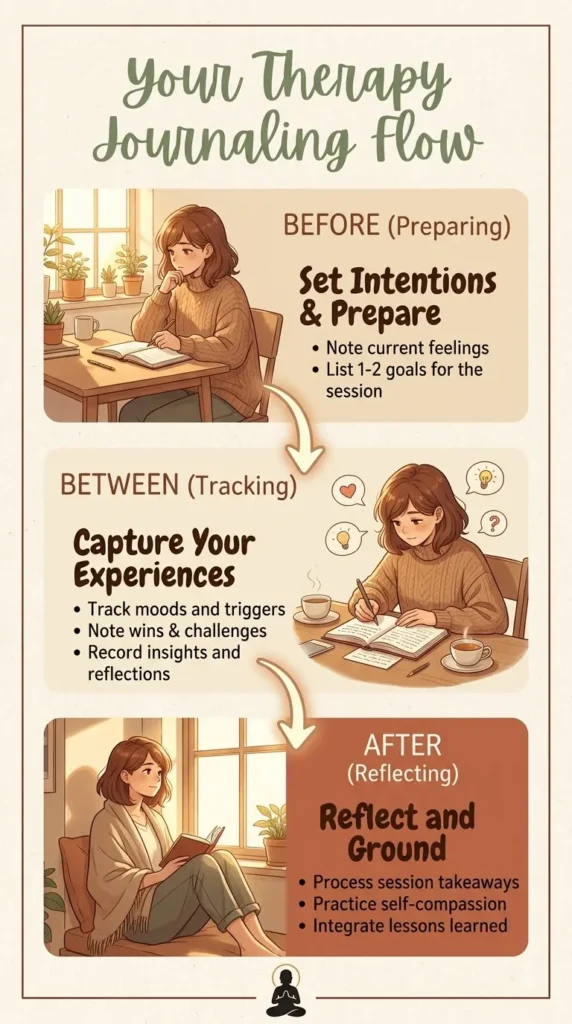
Before Your Therapy Session
You don’t need a polished story walking into therapy. You need somewhere to start. These journaling prompts for therapy help when your mind goes blank the second your therapist asks, “What would you like to talk about today?”
1. What has been taking up the most space in my mind since my last session?
2. What happened this week that I keep replaying, even if it seems small?
3. What emotion have I noticed most often lately, and when does it usually show up?
4. Is there something I want to tell my therapist but keep finding reasons not to mention?
5. If I could leave today’s session understanding one thing better, what would it be?
Here’s a useful trick. Don’t try to write your whole week. Write the moments that made you think, I need to talk about this.
That could be an argument with your partner. A weird reaction to a text. A day when getting out of bed felt harder than it should have. Or something your friend said that won’t leave you alone.
Your journal isn’t a report card for therapy. It’s a place to catch what you’d otherwise forget.
Between Sessions: Tracking Patterns
You rarely see a pattern while you’re standing inside it. Therapeutic journal prompts help you record what happened while it’s still fresh, so you and your therapist get something more useful than “I don’t know, I was just off.”
You don’t need to log every hour. Look for what repeats.
6. What happened right before my mood or energy changed today?
7. What thought kept returning today, and what was happening when it appeared?
8. Did I avoid anything today because I expected it to go badly? What happened afterward?
9. What interaction made me feel unusually calm, irritated, rejected, pressured, or understood?
10. What did I do differently today, even if the change was tiny?
The goal isn’t to turn yourself into a full-time observer. That’s exhausting.
Think of your journal as a pattern catcher instead. If you keep shutting down after certain conversations, feel overwhelmed after an hour of scrolling, or get harsh with yourself after a mistake, write it down.
You don’t have to explain the pattern yet. That’s part of what therapy is for.

Post-Therapy Journal Prompts
Most journaling advice stops before the session even happens. That’s a missed opportunity. Post therapy journal prompts capture what stuck with you afterward, especially on days the conversation keeps replaying in your head.
You don’t need to summarize your therapist’s words. Focus on your reaction.
11. What part of today’s session has stayed with me the longest?
12. What did I feel during the session that I didn’t fully understand at the time?
13. Was there anything my therapist said that I resisted, disagreed with, or immediately wanted to dismiss?
14. What did I understand differently about myself after today’s conversation?
15. What do I want to remember or bring back up at my next session?
Sometimes the most useful thing you write after therapy isn’t an insight. It’s a sentence like:
“I didn’t like that question.”
Write that down anyway.
You’re allowed to have reactions to therapy itself. Feeling uncomfortable doesn’t mean something went wrong. Feeling relieved doesn’t mean you’ve solved anything. Either one gives you something worth bringing back.
This is also where journaling solves something frustratingly common. You leave a session knowing something mattered, and a few hours later you can’t remember what.
Write the fragment down while it’s still there.
Emotional Awareness
Naming an emotion gets hard fast when you’re already overwhelmed. These therapeutic writing prompts slow the moment down without forcing you to explain or fix it right away.
Start with what you can actually observe.
16. What emotion am I feeling right now, and where do I notice it in my body?
17. What happened immediately before this feeling appeared?
18. If this feeling could tell me what it needs, what might it ask for?
19. Am I feeling one emotion, or several emotions at the same time?
20. What am I tempted to do because of this feeling, and what might happen if I waited before acting?
You don’t need the “correct” emotion. Irritated might actually be hurt. Numb might be overwhelmed. “Fine” might mean fine, or it might just be the fastest answer you had ready.
Your body offers another clue. Tight shoulders. A heavy chest. Restlessness. A clenched jaw. A stomach that suddenly has opinions.
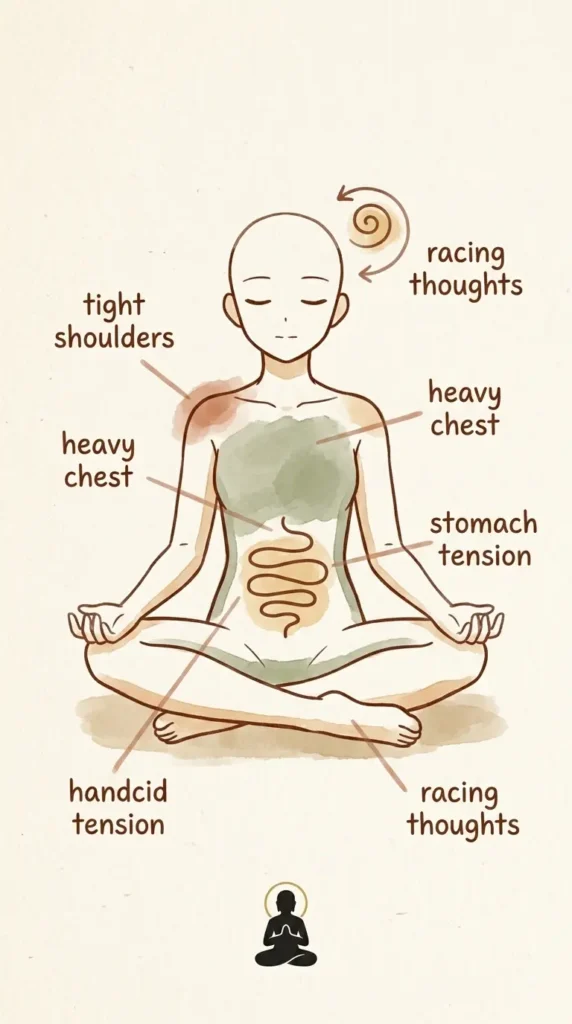
Anxiety & Overthinking
More thinking doesn’t mean more clarity. Sometimes it just sends the same worry around for another lap. These therapy writing prompts split what actually happened from what your mind predicted would happen.
21. What do I know for certain about this situation, and what am I assuming?
22. What am I predicting will happen, and what evidence do I actually have?
23. What part of this situation is within my control today?
24. What am I trying to get certainty about that may not have a guaranteed answer?
25. If someone I cared about had this exact thought, what would I say to them?
This isn’t about forcing positive thinking. If your brain says they haven’t replied because they hate me, you don’t need to swap it for they definitely love me and everything is perfect.
A steadier question works better: what else could explain the silence?
That shift matters. You’re not arguing with yourself. You’re making room for information you ignored because the first explanation felt emotionally convincing.
Depression & Low Mood
When your energy is low, a five-page journal exercise feels like one more thing you’re failing at. So keep this section small. Therapy journaling prompts for low mood work best when they help you notice what happened without demanding a breakthrough.
26. What is one thing I managed to do today that took more effort than it looked like?
27. What made today slightly harder, and what made it slightly easier?
28. What did I need today that I didn’t give myself?
29. When did I feel even briefly more present, interested, connected, or comfortable?
30. What would I like to tell my therapist about how my energy or motivation has changed since our last session?
A win doesn’t need to look impressive.
Showering when you wanted to stay in bed counts as information. Answering one message counts. Eating because you noticed you hadn’t counts too. So does noticing you spent the afternoon disconnected, and writing that down.
The point isn’t turning every hard day into a gratitude exercise. It’s making the hard day visible.
For more general prompts to use during difficult stretches, the healing journal prompts collection covers similar ground.
Self-Esteem & Self-Compassion
Low self-esteem rarely sounds like “I hate myself.” It sounds like a running commentary. I should have known better. Everyone else handles this. Why am I like this? These therapeutic journal prompts help you examine that voice instead of believing it automatically.
31. What am I saying to myself about a mistake that I would never say to someone I care about?
32. What achievement, effort, or quality am I dismissing because it doesn’t feel impressive enough?
33. Whose standards am I using to decide whether I am doing “well enough”?
34. What would change if my worth did not depend on being productive, useful, attractive, or easy to be around?
35. What part of myself am I trying hardest to hide from other people, and what am I afraid would happen if they saw it?
Self-compassion doesn’t mean pretending every choice you made was fine.
You can admit I handled that badly without turning it into I am a bad person. Two different sentences.
That distinction is worth bringing into therapy. Accountability and self-respect can sit in the same sentence just fine.
Relationships, Boundaries, People-Pleasing
Sometimes the problem isn’t that you don’t know what you want. You know exactly what you want. You just don’t know how to want it without worrying who it disappoints.
These therapy prompts exist for that exact tension.
36. What do I agree to when I actually want to say no?
37. What am I afraid would happen if I set a boundary with this person?
38. In which relationships do I feel most like myself, and where do I feel like I am performing a version of myself?
39. Am I taking responsibility for someone else’s feelings when they are actually responsible for expressing and managing them?
40. What do I need from this relationship that I haven’t clearly asked for?
Pay attention to the word need.
Plenty of people are comfortable writing about what they did wrong in a relationship. Fewer are comfortable writing I needed reassurance, I needed space, I needed consistency, or I didn’t feel respected.
Those sentences reveal more.
Identity, Values, Life Direction
Therapy isn’t only about getting through the week. Sometimes the harder question is what you actually want your life to look like once you stop building it around everyone else’s expectations.
41. What parts of my current life feel chosen, and what parts feel inherited?
42. What do I say I value, and does my current behavior reflect it?
43. What version of myself am I trying to become, and who taught me that this is what I should want?
44. What am I outgrowing but reluctant to admit?
45. If nobody could judge my decision, what would I choose differently?
Be careful with that last one. “Nobody could judge me” doesn’t mean your first impulse is automatically right.
It just removes one layer of noise.
From there, your therapist can help you look at what’s left. Your values. Your fears. Your obligations, relationships, and actual priorities.
CBT-Informed Prompts
Cognitive Behavioral Therapy looks at how thoughts, feelings, and actions connect, and it often leans on structured exercises to break down a hard situation. A 2012 review by Stefan G. Hofmann and colleagues, which examined meta-analyses of CBT across a wide range of conditions, found solid evidence supporting its use, though outcomes still vary by problem and approach.
CBT disclaimer: These are reflective prompts inspired by CBT concepts, not a substitute for CBT with a licensed clinician.
You don’t need to turn your journal into a worksheet every night. But when one thought won’t quit, a more structured approach helps.
46. What happened, exactly, without adding my interpretation of what it meant?
47. What automatic thought did I have when this happened?
48. What evidence supports that thought, and what evidence doesn’t support it?
49. What is another explanation that is realistic, even if I don’t fully believe it yet?
50. How did my thought affect what I felt and what I did next?
A thought record is a well-known CBT exercise for breaking down a situation into feelings, thoughts, evidence, and alternatives. The NHS’s Every Mind Matters thought record exercise walks through a seven-step version you can do on paper or digitally.
The point isn’t winning against your own thoughts.
Write everyone is judging me, then force yourself to write nobody is judging me, and you’ve just built a more cheerful version of the same argument.
Try something more precise instead:
“I noticed three people looking at me. I don’t know why. I felt embarrassed and assumed they were judging me.”
Now that’s something you can actually examine.
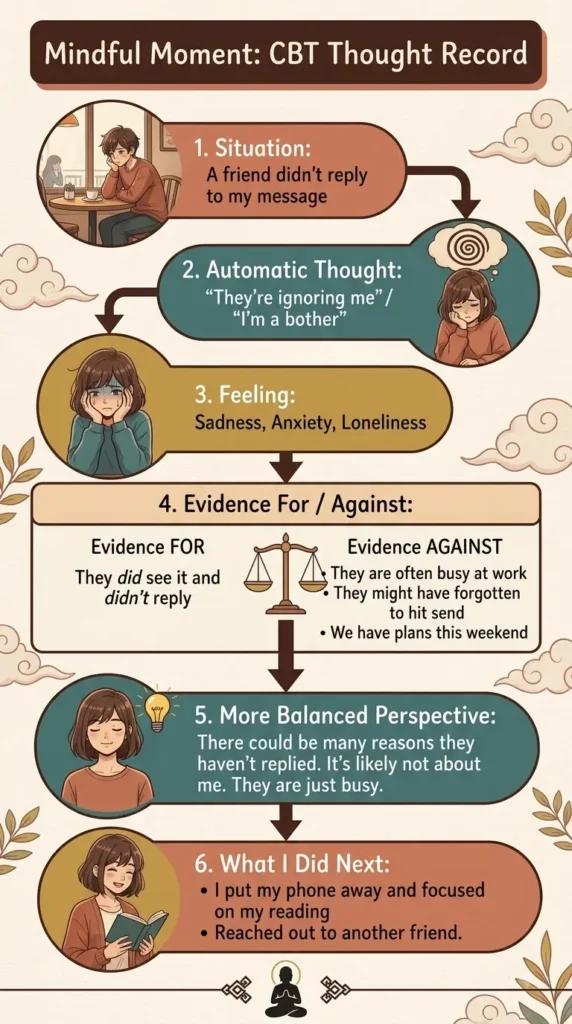
Mindfulness & Acceptance-Based Prompts
You don’t have to make an uncomfortable thought disappear before you respond to it. Mindfulness-based reflection works better when it helps you notice what’s happening without immediately obeying it.
51. What am I noticing right now without trying to change it?
52. What thought is asking for my attention, and can I let it be there without acting on it immediately?
53. What matters to me in this situation, even though I feel uncomfortable?
These pair well with broader mindfulness journaling, since both pull attention away from endlessly analyzing why you feel something and toward noticing what’s actually happening. The mindfulness journal prompts guide goes deeper on this approach.
That difference can be subtle.
You notice: I am anxious about sending this message.
Then: My mind is predicting rejection.
Then ask: if rejection is possible and you can’t control the other person’s response, how do you want to behave anyway?
That last question isn’t about erasing anxiety. It’s about deciding what you’ll do while anxiety is still in the room.
When Therapy Feels Stuck: Resistance
Therapy isn’t supposed to feel productive every single week. Sometimes you’re stuck because the same conversation keeps circling back. Sometimes you don’t know what you want. And sometimes you know exactly what to bring up and keep avoiding it anyway.
These prompts are for those moments.
54. What topic do I keep steering away from in therapy, and what makes it difficult to approach?
55. What am I expecting therapy to fix for me that I haven’t said out loud?
56. What part of therapy currently frustrates me, and have I told my therapist?
57. If I stopped trying to give the “right” answer in therapy, what might I say instead?
You don’t need to solve the resistance before your next appointment.
Bring it with you instead.
“I keep avoiding this.”
“I don’t know why that question bothered me.”
“I think I’m telling you what I think you want to hear.”
“I don’t feel like we’re getting anywhere.”
None of those are failed therapy notes. They’re useful material.
Psychotherapy runs on communication between a person and a trained therapist, shaped around that person’s own concerns and goals, according to the American Psychological Association. Your journal can help you notice what to bring into that conversation. It shouldn’t become a private replacement for it.
That’s really the whole point of these prompts.
You’re not writing the perfect answer. You’re noticing something honest enough to carry into the next session.
How to Turn Journal Entries Into Useful Therapy Conversations
A full journal isn’t the win. Noticing what repeats is. Most people fill page after page and stop right there, treating the writing itself as the goal. That’s the gap.
Good therapy journal prompts exist to close it, turning scattered entries into something you can actually bring into session. Think of the page as a rough draft. Not the conversation itself.
Bring Patterns, Not Every Single Page
You don’t need to hand your therapist a 40-page memoir. Look for repetition instead. The same argument. The same fear. The same reaction showing up again, in a different outfit.
Research on expressive writing, including decades of work from psychologist James Pennebaker, suggests that putting experience into words helps organize it. Therapy is where you explore what that pattern actually means for you.
If a theme keeps returning, mark it. That’s the whole method behind useful journaling prompts for therapy. Not volume. Recognition.
For deeper pattern-tracking between sessions, healing journal prompts push further into the recurring stuff, old wounds, forgiveness you haven’t gotten to yet, and reflection you can build on over time.
Highlight Recurring Emotions or Situations
Circle the entries where your reaction felt too big for the moment. Maybe a short text left you feeling rejected. Maybe one conversation kept replaying on a loop. Maybe you spent a week quietly avoiding something and only noticed on day six.
Those details beat a perfectly composed entry every time. Why? Because they hand your therapist something concrete to ask about, instead of a mood with no edges.
Turn a Journal Entry Into One Therapy Question
Don’t walk in with a problem wrapped in ten paragraphs. Pull out one question instead.
Skip this: “I had a terrible week.”
Try this instead: “Why do I shut down whenever someone disagrees with me?”
That gives the session somewhere to go. One sharp question does more work than three pages of context ever could.
What to Do When You Wrote Something You Don’t Want to Share
You don’t have to hand over the notebook. That writing belongs to you, full stop.
Summarize the entry instead. Read one sentence out loud. Or just say it plainly: “I wrote something this week I’m not ready to show you, but I think it matters.” That sentence alone can become useful material for the room, even without a single word of the original page.
How to Track Progress Between Appointments
Write down small shifts right next to the hard moments. What felt different this time? What did you handle a little better? What still feels stuck in the exact same place?
Psychotherapy is a collaborative process. The American Psychological Association points to active participation, setting goals, and talking honestly about how therapy is going, as part of what makes it work. A journal makes that participation easier. It hands you something specific to bring into the room instead of a vague “things have been hard.”
Post-session, the same habit works in reverse. A few lines jotted down after each appointment, what landed, what you want to sit with, what to bring up next time, turn one-off insight into something that actually sticks between visits.
What to Do If a Therapy Journal Prompt Makes You Feel Worse
Not every notebook page helps. That’s the honest part nobody says out loud. A therapy journal prompt can dig up something you weren’t ready to hold alone, especially right after a hard session. The goal is understanding. Not reliving every rough detail until you feel worse than when you sat down.
Reflection vs. Rumination
Reflection moves you somewhere. Rumination just loops.
One shows you what happened and why. The other keeps replaying the same scene with no new information showing up. That gap matters most right after therapy. Spending an hour replaying your therapist’s exact words isn’t automatically deeper work. Sometimes it’s just static.
Ask yourself this: am I learning something new here, or proving the same painful point again? Rewriting the same event. Hunting for what you “should have said.”
Picking apart every sentence from the session word by word. Notice that pattern once. Write it down. Then save the rest for your next appointment instead of your notebook.
When to Stop a Prompt
You don’t owe a prompt a finished answer.
If writing leaves you more overwhelmed, disconnected, panicky, or unable to settle, that’s your signal. Close the notebook. Not later. Now.
Shift toward something plain and present. Drink some water. Look around the room and name what you see. Put your attention on what’s happening right now instead of pushing further into the material.
If grounding techniques like this are new to you, mindfulness journal prompts walks through a few that work well in exactly this kind of moment.
Why Deeper Isn’t Always Better
There’s a strange belief floating around that good journaling means unearthing something profound every single time.
It doesn’t.
Sometimes the most useful entry is short. “This conversation bothered me, and I don’t know why yet.” That’s a complete entry. You’re allowed to leave the question open. You don’t have to solve everything on paper before your next session shows up on the calendar.
When to Bring a Difficult Reaction to Your Therapist
If a prompt surfaces something too heavy to carry alone, write down what you noticed. Bring it in. You can even show your therapist the exact sentence that stopped you cold.
Working through something older and harder to name? Our healing journal prompts guide covers that ground too, for whenever you’re ready.
If you’re in immediate danger, or thinking about hurting yourself, a journal isn’t the right tool to lean on by itself. In the U.S., you can call or text the 988 Suicide & Crisis Lifeline for free, confidential support, including its online chat.
You can also reach the Crisis Text Line by texting HOME to 741741, free and confidential, 24/7.
Therapy Journal Prompts PDF: Free Printable Resource
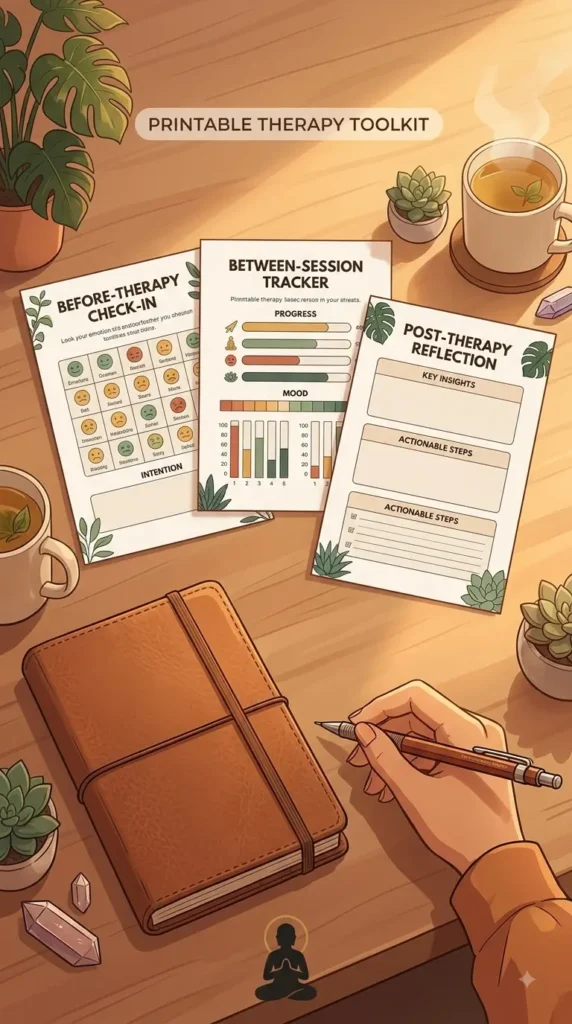
Want the whole collection in one place?
The master PDF holds all 50+ therapy journaling prompts, sorted by purpose so you’re not hunting for the right section mid-scroll.
We will also build a combined master PDF with every worksheet above included. Print just the page you need today, or keep the full therapy journal workbook together for whenever the rest comes up.
For a wider set of prompts that go beyond therapy specifically, the journal prompts for mental health guide covers more ground by mood and purpose.
How Often Should You Use Therapy Journal Prompts?
You don’t need to write every day for this to work. That’s not the real question. The real question is simpler: did the writing help you notice something? Filling a page means nothing on its own. Some weeks call for an entry after every session. Other weeks, one honest paragraph does the job.
Daily vs. Weekly: What Actually Makes Sense?
There’s no universal schedule here. None.
If you’re using therapy journaling prompts to prep for sessions or catch patterns, a few times a week beats forcing yourself into a nightly ritual. Nobody sticks to that long term.
Daily writing earns its place when something keeps repeating. Maybe the same thought resurfaces after every call with your partner. Maybe your mood dips the second you open Instagram.
A quick note captures that pattern in the moment. Way easier than trying to rebuild your whole week from memory on Thursday night. But frequency isn’t the same as effectiveness. Don’t confuse the two.
Use Prompts After Therapy When Something Sticks With You
Your session doesn’t actually end when the call drops or you leave the office.
Sound familiar? One sentence keeps replaying. A question you meant to ask stays stuck in your head. That’s your cue to reach for post therapy journal prompts.
Give it five minutes right after:
- What part of today’s conversation stayed with me?
- What did I understand differently?
- What do I want to ask about next time?
- Did anything make me uncomfortable or defensive?
- What do I want to pay attention to this week?
Skip the polish. The goal is catching the thought while it’s still warm, not crafting a tidy entry.
Journal Only When Something Happens
Probably the most underrated approach on this whole list.
You don’t need “journaling time” set aside on a calendar. Something happens, it feels worth keeping, you open your Notes app. Two sentences. Done. That still counts.
Here’s a rule worth keeping: journal when you notice a pattern, a strong reaction, a question, or a shift you want to remember. Nothing fancier than that.
This approach works especially well for journaling prompts for therapy, because your therapist gets the real, unfiltered version of your week instead of a version you reconstructed three days later and smoothed over.
And no, not every feeling needs to become an assignment. Sometimes the whole entry is: “I felt weirdly angry after that conversation, and I don’t know why yet.” Leave it there. That’s enough.
Don’t Turn Therapy Journaling Into Another Thing to Be “Good” At
The moment journaling starts feeling like homework you can fail, back off.
That’s the trap. The research backs this up too. A 2006 meta-analysis by Pasquale G Frisina reviewed a wide set of expressive-writing studies and found real benefits overall, but the size of those benefits swung a lot depending on the outcome measured and how each study was built. More writing isn’t automatically better writing.
So give yourself permission. Three minutes instead of thirty. Bullet points instead of paragraphs. Skip a prompt entirely if it doesn’t land. Write once this week, five times the next. Nobody’s counting.
Your therapy journal prompts exist as tools for reflection, not a productivity streak you have to protect. If you’re building out a broader practice alongside this, the wider journal prompts for mental health collection covers reflection prompts beyond the therapy context too, useful on weeks when nothing session-specific is pulling at you.
If you’re working with a therapist, loop them in on this. They can help you figure out whether writing between sessions actually fits what you’re working through right now. And if revisiting something on paper repeatedly leaves you more shaken rather than clearer, that’s not a sign to push harder.
Bring it into your next session instead. That reaction is useful information on its own, especially if you’re working through something closer to healing journal prompts territory, where older, heavier material tends to surface.
Conclusion
Therapy journaling isn’t about the perfect entry. It’s not about some big breakthrough every time you open the notebook. Sound too simple? It is. Sometimes the most useful thing you write is just the line you couldn’t say out loud in the room.
Use these prompts to notice patterns. Use them to prep for a hard conversation before it happens. Use them to process what stays with you after a session ends. If something specific is still raw, conflict, grief, an old wound, that’s where healing journal prompts pick up where this list leaves off.
Writing can support emotional processing. It can support self-reflection too. But it depends on how you use it. Scribble a page on autopilot and nothing moves. Sit with it on purpose, and something usually does.
You don’t need to journal every day. Not even close. You don’t need to hand every page to your therapist either. Pick the therapy journal prompt that feels true right now. Write it honest. Let the rest wait.
Frequently Asked Questions
What do I write in my therapy journal?
Write whatever’s actually loud in your head. Not the version that sounds smart. A messy paragraph about a fight with your sister beats a polished insight you don’t even believe yet.
Record a hard interaction. A thought stuck on repeat. A mood swing you can’t explain yet. Something you want to bring up next session works too. So does a reaction that confused you in the moment.
If you want a bigger pool of angles to pull from, our journal prompts for mental health guide breaks prompts down by exactly what you’re feeling.
What are some good prompts for a therapy session?
Good prompts push you toward specifics. Vague ones just circle.
Try these: What have I been avoiding saying out loud? What changed since my last session? What thought keeps looping? What do I wish my therapist understood? What do I actually want help with today?
Pick one. Answer it honestly. That’s the whole job.
What is the best therapy journal?
There isn’t one. Sounds disappointing? It’s actually good news.
The best therapy journal is whichever one you’ll open again tomorrow. A cheap notebook works. So does your Notes app, or a printable page pulled from our journal prompts for mental health guide.
Look for three things. Private. Easy to reach. Loose enough for messy thoughts. Polished entries were never the goal.
Do therapists suggest journaling?
Some do. It helps track thoughts, moods, and triggers between sessions.
Whether it fits you depends on what you’re actually working through. Anxiety homework looks nothing like grief homework. Curious if it’s right for you? Just ask your therapist, especially if writing tends to send you spiraling instead of settling you down.
The American Psychological Association frames therapy itself as a collaborative process between you and a trained professional. Journaling works best when it supports that process, not when it tries to replace it.
Is journaling good for CPTSD?
It can help. For some people, not everyone.
Journaling with CPTSD tends to work best for tracking patterns, naming emotions, or noting boundaries and therapy insights. That’s the safer lane.
Writing in raw detail about painful memories is a different story. It can flood you fast, and it isn’t always the healing moment it looks like on paper.
Talk your approach through with a qualified professional first. Don’t force yourself to relive anything alone just because a prompt told you to. NAMI’s guidance on complex PTSD is a solid place to start if you want to understand the condition better before deciding how, or whether, to write about it.

It’s Bhaskar!
Well, I am not a psychologist a monk, or a philosopher by training. I’m just an engineering graduate.
‘The Empty Self’ is where I write about that idea, and what it actually means for ordinary life, anxiety, identity, habits, the stories we tell ourselves about who we are. I don’t have a psychology degree, and I’m not offering therapy or clinical advice. What I do have is thought and clarity, and genuine curiosity about why we suffer the way we do and how much of it might loose once we shed this ‘fixed identity’.
Pingback: 15 Perfect Guided Journals for Mental Health: Ultimate Gen Z Guide | The Empty Self