

You can feel off. Not always sure why though.
Disappointed, overwhelmed, embarrassed, lonely, angry, just plain exhausted, the feeling and the name for it rarely show up together. That gap is exactly where an emotions journal earns its place. Most journals ask what happened today. This kind asks something harder. What did you actually feel? What set it off? What did your body notice before your mind caught up? What did you need in that moment?
Answer those questions enough times and something starts to show. Patterns. The kind you’d never spot mid-week, buried in a normal Tuesday. Not the drama. Just the shape of it.
Here’s the part people get wrong about this. The goal was never getting rid of hard feelings. It’s understanding them well enough that you respond instead of react.
Quick overview: An emotions journal helps you name, track, and actually understand what you feel, not just log your day. Emotion journaling works this way. So does a feelings journal, or an emotional journal, whatever name you land on. This guide covers how to start, what to write, how to spot your own patterns, and how journaling feelings builds real emotional awareness over time.
Table of Contents
Disclaimer
This blog is written and edited with the help of AI, then reviewed by me before publishing. As a result, the content is for general reflection only, not therapy or medical advice, and I’m not a licensed mental health professional. If you’re in crisis, please contact 988 if you’re in US or a local crisis service of your country instead of relying on this site.
What Is an Emotions Journal?
An emotions journal is a place to name what you feel and figure out where it came from. A regular diary tells you what happened. This does something different. It tracks what you felt, what set it off, how it landed in your body, and what you did next.
Sound like the same thing? It isn’t.
Emotions Journal vs. Feelings Journal vs. Regular Journal
A feelings journal usually stops at naming the feeling. An emotional journal pushes further. Triggers, body sensations, thoughts, needs, patterns, all of it.
A regular journal covers everything. Your weekend. A fight with a friend. Something you finished. Whatever’s loudest in your head that day. An emotions journal narrows that down to one question: what happened emotionally, and what can this teach me?
What an Emotions Journal Actually Helps You Notice
This kind of journal makes vague feelings specific. “I had a terrible day” doesn’t tell you much. Written differently, it becomes something you can work with: disappointed after a phone call, tight shoulders, a nagging worry that someone’s upset with you.
That detail isn’t decoration. It’s the whole point.
Over time, tracking these small moments surfaces patterns you’d otherwise miss. The same trigger. The same reaction. Easy to overlook when every hard moment feels random and disconnected. Harder to ignore once it’s written down five times in a row.
If you want prompts built specifically for this kind of noticing, journal prompts for mental health has a full set organized by mood, including several aimed at emotional check-ins.
Mood Tracking vs. Emotional Journaling
Mood tracking asks one question: how did I feel today, and how bad was it? Emotional journaling asks what came before that.
A mood tracker logs “anxious, 7/10.” Done. An emotional journal digs into what happened right before the anxiety hit, what thoughts were looping, where it sat in your body, what you did about it after. Neither one beats the other. They’re just built for different jobs.
Want both? Pair a quick mood log with a slower entry once a week. That’s usually enough.
Who Actually Benefits From This
Beginners use it as a starting structure. People who already journal use it to go deeper. And people who struggle to name what’s going on inside them, this is often where it clicks.
Take alexithymia. It’s a term for difficulty identifying or putting emotional experience into words. Journaling gives that a slower lane. No pressure to land on the right word immediately. Neurodivergent readers often find the same relief here, a concrete structure standing in for emotional labeling that doesn’t come naturally on demand.
It also works well between therapy sessions. Jot down an observation. A question for your therapist. A pattern that keeps resurfacing. If therapy is already part of your routine, a more structured version of this exists in therapy journal prompts.
One thing it’s not, though. Not a replacement for therapy. Not a diagnostic tool. It’s a self-reflection habit, nothing more, nothing less. If low mood is the main thing showing up in your entries, journal for depression prompts are built specifically around that.
Want a version that leans more structured, with built-in questions instead of a blank page? Guided journals for mental health covers exactly that trade-off. And if you’re aiming to build emotional intelligence over time rather than just track a single mood swing, journaling for emotional intelligence picks up where this leaves off.
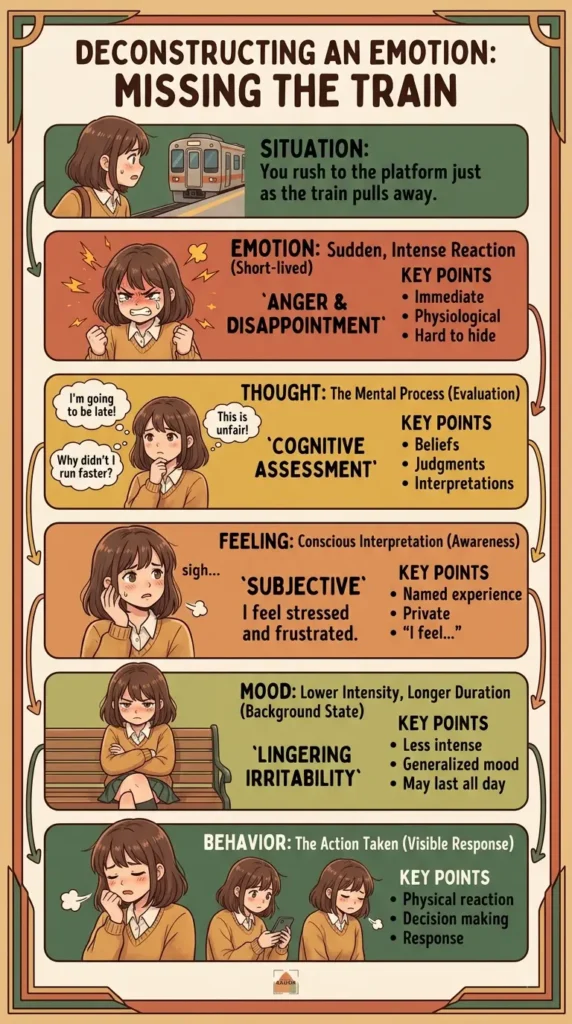
Learn the Difference Between Emotions, Feelings, Thoughts, Moods, and Behaviors
Five words get used like one word. Emotion. Feeling. Thought. Mood. Behavior. People swap them mid-sentence and never notice.
That’s a problem for an emotions journal. Not a small one either. If every entry blends what happened with what you told yourself about it, your journal stops showing you anything useful. Separate the pieces first.
The event. The reaction. The story you attached to it. The response you chose. That’s what makes emotion journaling actually work, instead of just producing pages of vague venting.
Emotion vs. Feeling
An emotion fires first. It’s the raw response, body and brain reacting to something before you’ve even named it. A feeling comes next. It’s your conscious read on that reaction, the label you slap onto what just happened inside you.
Day to day, nobody separates these two words. Your journal doesn’t need to either. What matters more? Catching the experience accurately. Not policing vocabulary.
Emotion vs. Thought
A thought isn’t an emotion. It’s an idea. A guess. A verdict you’ve handed down about a situation.
“They don’t care about me” is a thought. Not a feeling. Underneath it might sit sadness. Anger. Rejection, maybe all three at once. Write the thought and the emotion on separate lines in your feelings journal.
Something shifts. You start seeing where your interpretation stops and your actual emotional experience begins. That gap matters more than people realize.
Mood vs. Emotion
Emotions attach to something specific. A trigger. A moment. A mood doesn’t work that way. It lingers. It spreads out over hours, sometimes without one clear cause you can point to.
Irritated after an argument? That’s an emotion. Irritable for the entire afternoon, snapping at things that don’t deserve it? That’s a mood, and it’s a different animal entirely.
Emotion vs. Behavior
Here’s the part people mix up most. An emotion lives inside you. Behavior is what you do with it once it shows up.
Anger doesn’t pick your next move for you. It just shows up and waits. One person fires off a sharp text. Another goes quiet. Someone else laces up their shoes and walks it off. Same emotion, three completely different outcomes. Nothing about the feeling forces your hand.
Why Confusing Thoughts With Feelings Makes Journaling Harder
“I feel like everyone hates me.” Sounds like one sentence. It’s actually two different things tangled into one.
“I feel rejected” names an emotion. That’s real, and it deserves space on the page. “Everyone hates me” is a claim, and claims can be examined, questioned, even proven wrong.
Blur the two together and every thought starts masquerading as fact. Pull them apart and something opens up. Curiosity, instead of automatic belief. That single shift is most of what separates a journal that helps from one that just repeats the loop in your head.
A Simple Example of Separating the Pieces of One Emotional Experience
A friend cancels plans last minute. Ten seconds before your phone buzzed, you were fine.
Break down what actually happened.
- The event: the cancellation, plain and simple.
- The emotion: disappointment, maybe loneliness underneath it.
- The body sensation: that heavy pull in your chest you almost didn’t notice.
- The thought: “I guess I’m not important to them.” The mood: flat and low for the rest of the night.
- The behavior: you stop replying to texts, even ones that have nothing to do with any of this.
Six pieces. One moment. Record them separately and your emotional journal stops being a diary of what happened. It becomes a map of how you actually work. And that map is worth more than any single entry ever could be on its own.
If distinguishing thoughts from feelings feels shaky at first, mindfulness journal prompts are a solid place to practice noticing without judging. And once naming emotions starts feeling more automatic, journaling for emotional intelligence picks up right where this leaves off, turning that awareness into something you can actually act on.
How to Start Emotion Journaling When You Don’t Know What You Feel
Not knowing what you feel doesn’t make you bad at this. Most people trying an emotions journal for the first time hit the same wall. The honest answer is “I don’t know,” and the page just sits there.
That’s normal. Start with what you can actually observe, your body, the moment before, your first urge, or your thoughts. The feeling word can come later.
Start With Your Body Instead of a Feeling Word
Skip the label. Describe the sensation first. Is your chest tight? Stomach unsettled? Jaw clenched shut? Sometimes your whole body just feels heavy for no clear reason. None of that needs a name yet.
Body sensations give you a starting point when the emotion itself won’t come into focus. This is also where a slower, mindfulness journal prompts approach helps, since noticing physical sensation without judging it is most of the skill.
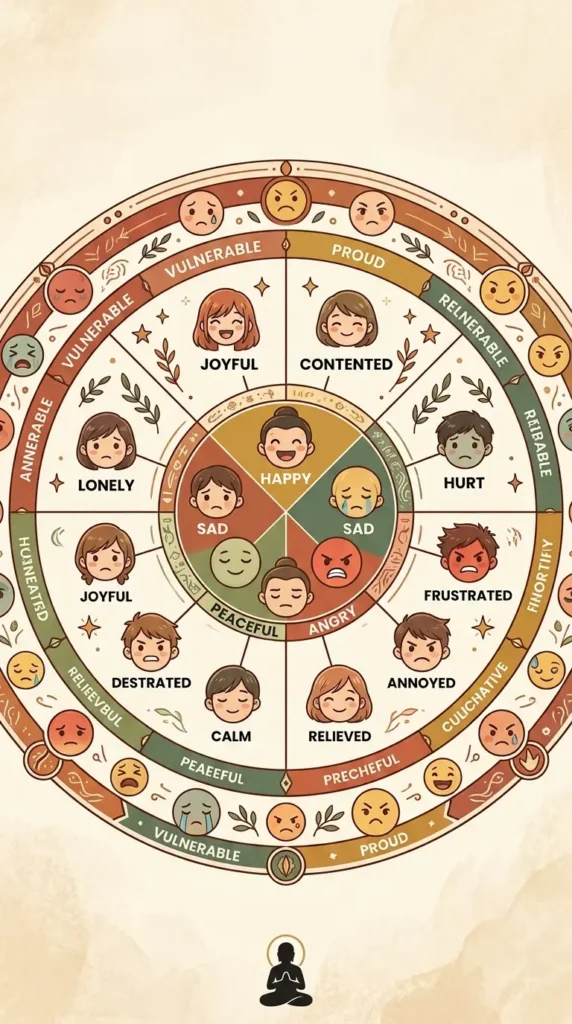
Use an Emotion Wheel to Expand Your Vocabulary
“Bad” and “stressed” cover too much ground. Those two words could mean fifty different things depending on the day. An emotion wheel pushes you toward something sharper: irritated, disappointed, embarrassed, uneasy, overwhelmed.
The sharper the word, the more useful the entry. Vague words keep your feelings journal vague too.
Ask “What Happened Right Before I Felt Different?”
You don’t have to start with what am I feeling. Try this instead: what happened right before my mood shifted? A text left on read. An awkward exchange. A piece of criticism you weren’t ready for. Even a change in the room you’re sitting in.
That one question often does more work than staring at a blank page waiting for a label to show up. It’s the same move behind journaling for emotional intelligence, tracing the trigger before you name the feeling.
Look at Your First Impulse
Your first urge is a clue too. Did you want to pull away? Defend yourself? Cry? Argue? Ask for reassurance? Just leave the room? An impulse isn’t proof of any single emotion. But it narrows the field fast, and narrowing the field is most of the battle when everything feels like static.
Separate “I Feel…” From “I Think…”
“I feel like nobody respects me” isn’t really a feeling. It’s a thought wearing a feeling’s clothes. Split it apart. “I feel hurt. I think they don’t respect me.”
Two different sentences, two different jobs. That small split is a technique borrowed straight from therapy journal prompts, and it makes the rest of your entry easier to write honestly.
When “I Don’t Know” Is the Most Honest Answer
Sometimes I don’t know is the whole truth, and that’s fine. For some people, including those with alexithymia, a trait that makes identifying and describing emotions genuinely harder, naming a feeling takes real time. Not everyone gets there in one sitting. Write down what you notice right now.
Come back to it later. The broader journal prompts for mental health collection has more entry points if this one doesn’t click today, whether you need emotion journaling structure or just a different question to sit with.
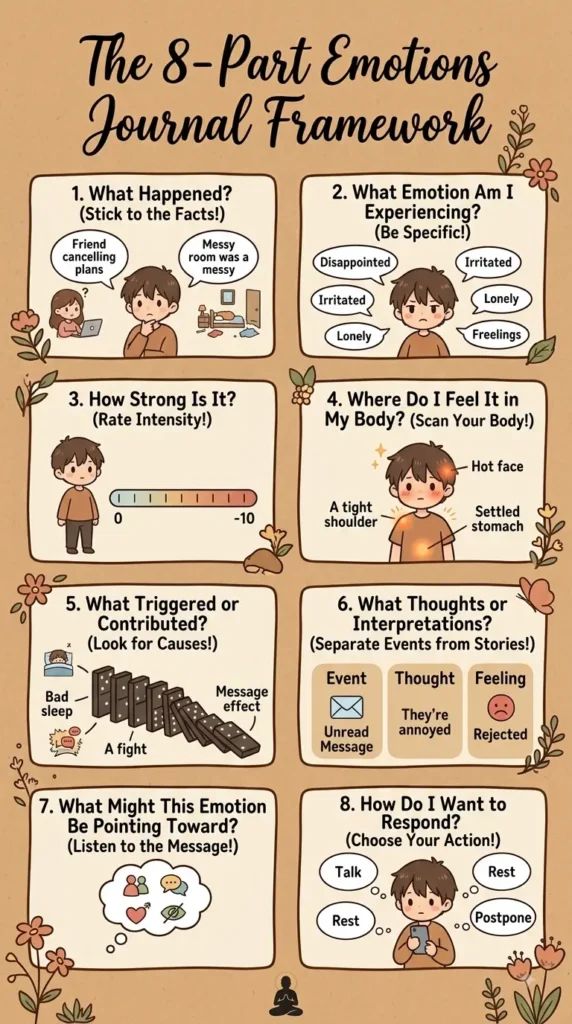
The 8-Part Emotions Journal Framework
Most feelings journal entries stop at one word. Happy. Angry. Fine. That’s not enough. An emotions journal built on this eight-part structure pushes past the label and into the event, the body, the need underneath, and the response you actually choose.
This isn’t a mood tracker with cuter font. It moves you from what happened to what you do next, one deliberate step at a time.
1. What Happened?
Start with the facts. Not your read on them.
Write the situation in a few plain sentences before you touch what you think it meant. Skip the interpretation for now. That comes later, in its own step.
Take this example: “My friend cancelled our plans two hours before we were supposed to meet.” Useful. Now compare it to “My friend doesn’t care about me.” That second line isn’t a fact. It’s a story your mind built in under a second.
This first step gives the rest of your entry some ground to stand on. It doesn’t need to replay your whole day. Three or four sentences is plenty.
2. What Emotion Am I Experiencing?
Name it as precisely as you can.
“Bad” tells you almost nothing. “Disappointed” tells you something you can work with. So does rejected, embarrassed, irritated, lonely, or anxious. The more specific the word, the more useful the entry.
Feelings rarely show up one at a time. Write down every emotion present, even the ones that seem to contradict each other. Relief and guilt after cancelling something. Anger and hurt after the same fight. Both can be true at once.
Can’t find the word yet? Write “I don’t know” and move on. This step of journaling feelings doesn’t require a perfect label before you’re allowed to continue.
3. How Strong Is It?
Rate the intensity. Zero to ten works. So does mild, moderate, intense, whatever scale sticks for you.
The number isn’t science. It’s comparison. A 3/10 irritation and a 9/10 rage might share a name, but they don’t call for the same response. Not even close.
Come back to that number later in the entry. Ask if it moved. Sometimes just writing the first four steps drops the intensity before you’ve finished the page.
4. Where Do I Feel It in My Body?
An emotional journal isn’t only a mental record. Your body carries the feeling too.
Tight shoulders. An unsettled stomach. A hot face. Shallow breath. Notice it. You don’t need to explain the sensation, just name where it sits.
This step earns its place most when the emotion won’t name itself. The body often points to something before your vocabulary catches up. Pay attention there first.
5. What Triggered or Contributed to It?
Look for what set this off.
Sometimes it’s obvious. Sharp feedback from a manager. A fight. A message you didn’t expect. A cancelled plan.
Other times it builds slowly. Bad sleep for a week. A stack of small disappointments. One rough stretch after another until something ordinary finally tips it over.
Here’s an honest take: you don’t need one clean cause. Emotional responses usually have more than one contributing factor, and forcing a single explanation onto a messy week just adds another layer of fiction to your entry.
6. What Thoughts or Interpretations Came With It?
Now split the feeling from the story attached to it.
Try this structure:
- “They ignored my message.” — the event
- “They must be annoyed with me.” — the interpretation
- “I feel rejected.” — the emotion
Why separate them? Because a thought can matter without being a fact. Writing “they must be annoyed with me” as its own line, instead of folding it into what happened, gives you room to question it. Is that actually true, or is it just the loudest guess your mind made under stress?
Therapy-style journaling leans on exactly this split, and if you want more structured prompts built around it, the therapy journal prompts guide walks through the same event-thought-feeling separation in more detail.
7. What Might This Emotion Be Pointing Toward?
Don’t just ask how to make the feeling go away. Ask what it’s pointing at.
Resentment might flag an unequal split of responsibility. Loneliness might reveal a need for real connection. Anxiety might be circling uncertainty you haven’t dealt with yet.
An emotion isn’t an order you have to follow. It’s information. Sometimes useful, sometimes outdated, but worth a look before you dismiss it.
This is also where emotion journaling starts to overlap with emotional intelligence work. If you want to go further into reading your own patterns this way, journaling for emotional intelligence covers how to catch a reaction before it runs your behavior for you.
8. How Do I Want to Respond?
Close by choosing, not defaulting.
Picture it. It’s late, the message is still unread, and your thumb is hovering over a reply you’d regret sending. That pause, right there, is the whole point of this step.
You might decide to have the conversation. Set a boundary. Rest. Gather more information before deciding anything. Postpone the decision entirely. Or just let the feeling sit without acting on it tonight.
An emotions journal was never about erasing hard feelings. It’s about building enough space between feeling and action that you get to choose what happens next.
If you’re working through a harder stretch and this framework feels like the wrong entry point, the healing journal prompts guide leans further into old patterns and unresolved weight. And for a wider set of prompts sorted by mood instead of structure, the journal prompts for mental health collection is worth keeping close by.
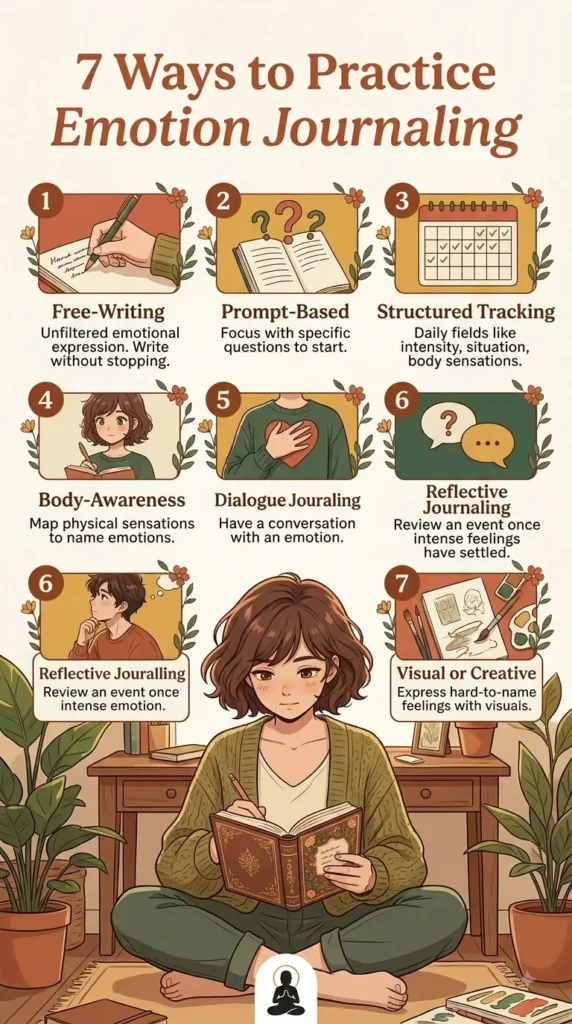
7 Ways to Practice Emotion Journaling
There’s no single right way to keep an emotions journal. Some days call for messy, unfiltered pages. Other days you need a prompt, a tracker, a body check-in, or something more visual. The format matters less than you’d think. What matters is whether it helps you actually notice what’s going on inside you, not just perform reflection for its own sake.
Here’s an honest take on emotion journaling: most guides push one method like it’s the only one that counts. It isn’t. Different moods call for different tools. Below are seven ways to build a feelings journal, and each one works for a different kind of day.
Free-Writing for Unfiltered Emotional Expression
Write without stopping. Don’t worry about grammar. Don’t worry about whether your thoughts sound reasonable.
Free-writing works best when an emotion feels tangled, the kind where you can’t explain it yet even to yourself. Getting the thoughts onto the page comes first. Making sense of them comes later.
Some resources, like Day One’s guide to emotional journaling, frame this as removing the edit button entirely for a few minutes. That’s the whole point. No filter, no structure, just output.
Prompt-Based Journaling for Specific Feelings
This isn’t about staring at a blank page hoping something shows up.
A focused prompt gives you somewhere to start. Try a question like “What happened just before I felt this way?” or “What do I wish someone understood about this feeling?”
If a blank page feels intimidating, structured prompt work through resources like our journal prompts for mental health guide can carry you through the moment where motivation runs dry.
Structured Emotion Tracking
This isn’t freewriting, and it isn’t meant to be.
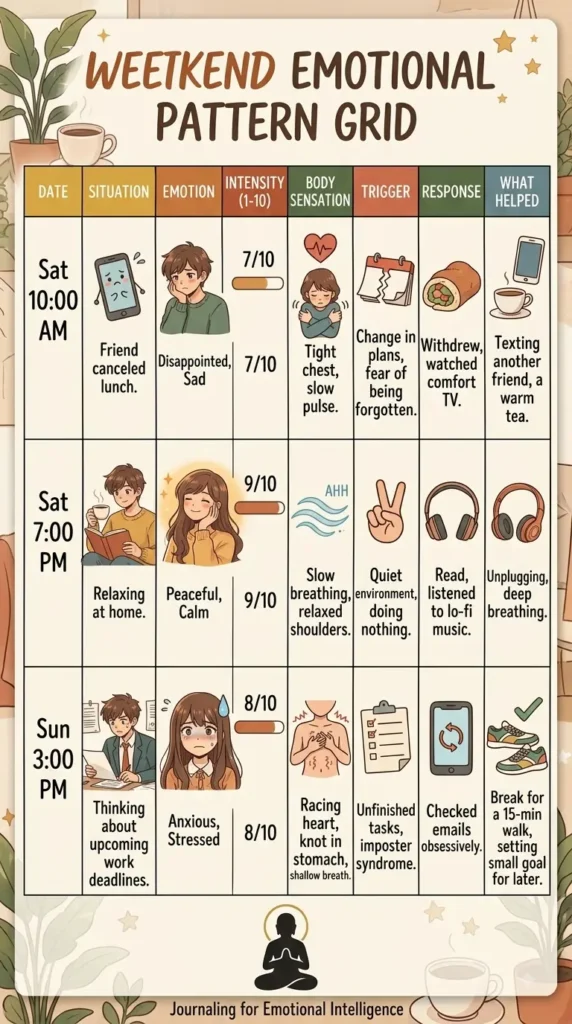
Structured tracking uses the same fields every entry: situation, emotion, intensity, body sensations, thoughts, and response. Repeat that format daily and patterns start showing up on their own.
This works best when the goal is spotting recurring triggers, not simply releasing what you’re feeling in the moment. Some guided formats, like the ones outlined by Give Yourself Kindness, build entire journals around this kind of consistent tracking.
Body-Awareness or Somatic Journaling
The feeling doesn’t always come first. Sometimes the body gets there before the mind does.
Instead of starting with an emotion word, describe what’s happening physically. Tension in your shoulders. A tight chest. Restless energy. Heaviness, warmth, a change in your breathing. Notice it first, name it second.
Once you’ve mapped the sensation, ask what emotion might sit underneath it. If this style resonates, our mindfulness journal prompts collection leans on the same body-first approach.
Dialogue Journaling With an Emotion
Most people treat their emotions like background noise. This method doesn’t.
Write as though you’re having an actual conversation with the emotion itself. Ask it something direct: “What are you trying to tell me?” Sit with whatever answer shows up. Sometimes it reveals a concern you hadn’t named. Sometimes a boundary, a fear, or a need that felt too hard to say out loud any other way.
This kind of practice overlaps closely with journaling for emotional intelligence, where the goal is understanding a feeling well enough to respond to it on purpose.
Reflective Journaling After an Emotional Event
This one comes after, not during.
Once the intensity has settled, revisit what happened. What did you notice? What influenced your reaction? What would you want to do differently next time? That’s reflection, not an instruction to relive something distressing on repeat.
If the event connects to something deeper, therapy-style questions from our upcoming therapy journal prompts guide can help structure that follow-up thinking, and research from behavioral health writers, like this piece from Grand Rising Behavioral Health, points to reflection playing a real role in emotional processing over time.
Visual or Creative Emotional Journaling
Not every feeling has a word attached to it.
Colors, shapes, sketches, collages, or a short piece of creative writing can give shape to something hard to describe in sentences. These are journaling formats, not automatically therapeutic interventions.
Their value depends entirely on what actually helps you understand and express what you’re carrying. That’s true of every method on this list. An emotional journal only works if it fits how your mind processes things, not the other way around.
How to Journal About Difficult Emotions Without Getting Stuck in Them
More writing is not always the fix. Sometimes it’s the problem.
An emotions journal helps you name what’s going on inside you. It gives a hard feeling somewhere to land instead of looping in your head all day. But there’s a real difference between writing that clears things up and writing that just keeps you circling the same pain. The goal was never to relive an experience until it “feels resolved.” That rarely happens on page twelve. The goal is clarity.
The Difference Between Emotional Processing and Rumination
Processing moves you somewhere. Rumination doesn’t.
One helps you understand what happened, what you felt, what you needed, and what comes next. The other sounds like the same painful question, asked again and again, going nowhere new. A useful feelings journal entry gets more specific over time. Not more stuck.
Not sure which one you’re doing? Our full breakdown of reflection versus rumination walks through exactly how to tell them apart.
When Writing Helps You Move Forward
Good writing makes a feeling smaller and clearer. Not bigger.
You might start with “I’m angry.” Underneath that, though, there’s often something else. Disappointment. Embarrassment. A boundary that got ignored and nobody noticed it happen. That kind of digging is what emotion journaling is actually for. It hands you something to work with, not just something to sit in.
Signs Your Journal Entry Is Becoming Circular or Self-Critical
Watch the shape of your own entries. It tells you a lot.
Blame that keeps repeating. The same conversation, replayed line by line. Worst-case predictions dressed up as facts. Questions with no real answer, asked over and over. Finished three paragraphs and feel more trapped than when you started? That’s the signal.
An emotional journal that just keeps replaying the same scene isn’t helping. It’s stalling. If self-criticism is the pattern you keep landing on, our therapy-informed journal prompts are built to interrupt exactly that loop.
How to Shift From “Why Am I Like This?” to “What Is Happening Here?”
Drop the identity question. It never actually answers anything.
“Why am I like this?” invites judgment, not insight. Try something more concrete instead.
“What happened right before this feeling showed up?”
Or: “What am I telling myself about this situation?”
Small shift. Big difference. Sound too simple? It is.
That’s exactly why it works. It pulls some of the self-blame out of the picture and leaves you with something you can actually examine.
When to Pause and Seek Additional Support
You don’t have to work through every hard feeling alone.
If journaling your feelings keeps making things worse, brings up memories that feel too big to hold, or stops feeling safe to manage by yourself, stop. A licensed mental-health professional can help in ways a blank page can’t. When old wounds are what keep surfacing, our healing journal prompts offer a gentler way in. Journaling can support reflection. It was never built to replace real care, and it still isn’t.
Need immediate mental-health support in India? Tele-MANAS offers free, 24/7 support at 14416. Reach them through the Tele-MANAS portal.
How to Use an Emotions Journal to Find Patterns Over Time
One entry in an emotions journal won’t tell you much. Ten entries will. That’s the real difference between tracking feelings for a day and tracking them for a month. A single anxious morning looks random on its own. Line up a few weeks of mornings like it, and the shape starts to show.
Reviewing old entries surfaces triggers, body signals, and relationship patterns you’d never catch mid-moment. That’s what separates casual emotion journaling from a feelings journal that’s actually working for you. Not just a record of rough days. A map of what keeps causing them.
If you want the full prompt list behind this kind of practice, the journal prompts for mental health guide is a solid place to start.
What to Track Besides the Emotion
“I felt anxious” doesn’t tell you much on its own. Not months later, anyway. Add the situation. The intensity. What your body was doing. The thought underneath it. What you did next, and what happened after that.
This is where journaling feelings turns useful instead of just cathartic. Write down enough detail and a pattern gets impossible to miss. Anxiety keeps showing up before certain conversations. Or after a bad night’s sleep. Or anywhere you’re stuck waiting on an outcome you can’t control.
Look for Repeated Triggers
One hard day proves nothing. Repetition does.
That’s the whole logic behind pattern spotting in an emotional journal. A single blowup after a criticism could be a fluke. Five blowups after five different critiques? That’s data.
Watch for situations that keep leading to the same emotional response: conflict, deadlines, social pressure, feeling ignored in a conversation. When the same trigger shows up three or four times, it stops being a coincidence.
Look for Body Patterns
Your body usually knows first.
Emotions announce themselves physically before your mind catches up and names them. Tight shoulders. A racing heart. A knotted stomach. Restlessness that won’t settle.
Shallow breathing you didn’t notice until someone pointed it out. These internal bodily signals play a real role in how emotional states form in the first place, which is part of why they show up before the feeling has words.
Track these sensations alongside the emotion itself. Over time, they become early warnings. A tight jaw might start showing up two hours before you consciously register you’re angry. Catch the signal early enough, and you get to choose your next move instead of reacting on autopilot.
Look for Relationship and Situational Patterns
Not every version of you shows up the same way. Who you’re with changes things. Where you are changes things. So does the role you feel like you’re supposed to play in that room.
Compare entries across different settings. You might notice you’re relaxed and funny with friends, then quietly self-critical the second you walk into a work meeting. That gap is worth sitting with.
It usually points to something specific: an old dynamic, an unspoken expectation, a person whose opinion carries more weight than it should. Journaling for emotional intelligence leans on exactly this kind of comparison, and it’s worth digging into further if this pattern keeps repeating.
Notice What Helps the Emotion Change
This isn’t about making hard feelings disappear. It never was.
Track what happens after the emotion shows up. Did talking to someone help? Did a walk take the edge off? Did sleep, or setting a boundary, or just giving it an hour do more than you expected?
Some entries will show you that nothing helped, and that’s useful information too. The goal is understanding what shifts the intensity, not eliminating the emotion altogether.
How Often Should You Review Your Entries?
Weekly works for most people. Once a week is usually enough to catch what’s repeating, without turning your journal into another task on the list. Look across a handful of entries and ask three questions. What keeps showing up? What feels different than last week? What actually seemed to help?
Monthly reviews add a second layer. Patterns that don’t show up in seven days often surface across four weeks instead, especially around bigger shifts like a stressful season at work or a relationship going through changes.
If you’re already seeing a therapist, this kind of review makes a useful bridge between sessions. The therapy journal prompts guide covers how to carry what you find here into that conversation.
How to Build an Emotions Journaling Habit That Doesn’t Become a Chore
Most advice about starting an emotions journal skips the part that actually matters. It has to fit your life. Not the other way around. The goal isn’t a perfect streak. It’s a habit that survives a busy week, a bad mood, and the two days you just didn’t feel like opening the notebook.
Guilt kills more journaling habits than laziness ever does. Miss one day and suddenly the whole thing feels broken. It isn’t. A sustainable emotions journal works because it bends. It doesn’t demand daily perfection to prove it’s working.
How Often Should You Journal Your Feelings?
There’s no magic number for journaling feelings. None.
Some people do best with a short daily check-in. Others get more out of writing two or three times a week, or only after something emotionally loud happens. Both work. Neither is more “correct” than the other. Why chase someone else’s rhythm when yours works fine?
Start with a pace you can actually keep. Not the one that sounds impressive.
A good starting point: five minutes, three days a week. That’s it. Once that feels automatic, not forced, adjust from there. Add a day. Stretch the time. Or don’t. Plenty of people stay at three days a week for years and it still works fine.
How Long Should an Entry Take?
An emotions journal entry doesn’t need to read like a college essay.
Five to ten focused minutes covers what happened, what you felt, and what might have set it off. That’s the whole job. Nothing more elaborate required.
Hard days will run long on their own. You won’t have to force it. Ordinary days might get three sentences, and three sentences still count. A feelings journal isn’t graded on word count.
Morning vs. Evening Emotional Check-Ins
Neither time is objectively better. Context changes everything.
Morning entries catch your emotional starting point before the day piles on. You notice the mood you’re carrying in, before meetings and messages start reshaping it. Evening entries work differently. They’re better for looking back at what shifted, and why.
Picture it: 9pm, phone still buzzing, and the choice is between scrolling for ten more minutes or opening the notebook for two. That small decision, repeated most nights, is what actually builds the habit. Not the time of day you picked in theory.
If neither morning nor evening fits your routine, pick something else. A lunch break. Right after the gym. Consistency matters more than the clock.
What to Do When You Miss Several Days
Don’t turn a missed streak into a second problem.
Skip the guilt spiral. Skip trying to reconstruct every day you missed, hour by hour. Open the journal and write one line: “What has been happening lately?” That’s the whole re-entry point. Why does two skipped days feel like failure instead of just two skipped days?
Most people quit emotion journaling right here, not because the habit failed, but because they treated a gap as proof it did.
Why You Don’t Need to Write Every Emotion Every Day
This isn’t about logging every emotional blip like a spreadsheet.
Focus on what feels unusually strong, confusing, sticky, or revealing. The stuff that stays with you past lunch. Everything else can just pass through unrecorded, and that’s fine.
You can also use your emotional journal as a deliberate check-in the moment you notice a pattern repeating. A recurring fight. The same knot in your stomach before certain calls. That’s when writing earns its place, not because a calendar told you to. That’s exactly the kind of moment journaling for emotional intelligence is built for, catching a reaction before it runs the whole day instead of after.
If keeping any reflective habit alive feels hard, the fix is usually the same one: make it small enough that coming back doesn’t take convincing. Our guide to practicing gratitude walks through that exact idea for a different kind of daily practice, and the same logic carries over here.
Frequently Asked Questions
What is an emotions journal and how is it different from a regular journal?
An emotions journal is a journal used to notice, name, and understand your emotional experiences.
A regular journal may record events, ideas, or daily memories, while an emotions journal focuses more closely on what you felt, what triggered it, how it showed up in your body, and how you responded.
How do you journal your feelings when you don’t know what you’re feeling?
Start with what you can identify rather than forcing an emotion label. Write about what happened, what changed in your body, what thoughts are repeating, and what you wanted to do next.
An emotion wheel can also help you move from vague words like “bad” or “off” toward something more specific.
What should I write in an emotions journal every day?
You can record what happened, the emotions you noticed, their intensity, physical sensations, thoughts, possible triggers, and what you needed in that moment.
You do not need a long entry every day. A few honest sentences can be more useful than filling several pages just to maintain a streak.
Can journaling help you understand emotional triggers and patterns?
Yes. Reviewing emotions journal entries over time can help you notice recurring situations, relationships, thoughts, physical sensations, or behaviors associated with particular emotions.
The useful part is the pattern review, not simply collecting entries. Looking across several entries can reveal connections that are easy to miss while you’re caught up in the moment.
Is emotional journaling the same as mood tracking?
No. Mood tracking usually records your overall emotional state, often with a rating, color, or short label. Emotional journaling goes deeper by exploring specific emotions, triggers, thoughts, body sensations, and responses.
Mood tracking can show you that your mood changed; journaling can help you investigate what may have contributed to that change.

It’s Bhaskar!
Well, I am not a psychologist a monk, or a philosopher by training. I’m just an engineering graduate.
‘The Empty Self’ is where I write about that idea, and what it actually means for ordinary life, anxiety, identity, habits, the stories we tell ourselves about who we are. I don’t have a psychology degree, and I’m not offering therapy or clinical advice. What I do have is thought and clarity, and genuine curiosity about why we suffer the way we do and how much of it might loose once we shed this ‘fixed identity’.