

You know exactly what happened in the argument. Word for word, sometimes. What you can’t explain is why you reacted the way you did. That gap right there? That’s where journaling for emotional intelligence earns its place.
Putting emotions, triggers, thoughts, and reactions into words creates space. Real space. Enough to catch yourself before you snap back on autopilot. For Gen Z, that space covers real ground. Comparison spirals. Friendship drama. Dating uncertainty. Boundaries you’re still learning to hold. The low hum of everyday stress that never fully quits.
Quick overview: Journaling for emotional intelligence helps you notice emotions as they happen. It helps you understand where they come from. It helps you regulate your reactions and consider someone else’s side. Then you choose your next move on purpose, not by instinct. The prompts below turn those skills into something you can actually practice. One entry at a time. Want the bigger picture first? Our guide to journal prompts for mental health covers the full range, mood by mood.
Table of Contents
Disclaimer
This blog is written and edited with the help of AI, then reviewed by me before publishing. As a result, the content is for general reflection only, not therapy or medical advice, and I’m not a licensed mental health professional. If you’re in crisis, please contact 988 if you’re in US or a local crisis service of your country instead of relying on this site.
What Is Journaling for Emotional Intelligence?
Journaling for emotional intelligence means using your notebook to study yourself. Not just record your day. You write to catch patterns, build self-awareness, and respond to real situations with a clearer head.
That’s different from a diary. A diary logs events. This kind of journal asks what’s underneath them.
What Emotional Intelligence Actually Includes
Emotional intelligence is your ability to notice emotions and work with them well, yours and everyone else’s. Psychologist Daniel Goleman built one of the most cited frameworks in the field around five parts: emotional self-awareness, self-regulation, social skills, empathy, and motivation.
Here’s what each one actually means:
- Self-awareness means noticing what you feel and why.
- Self-regulation means managing a reaction without pretending it isn’t there.
- Motivation means understanding the values pushing your behavior.
- Empathy means picking up on what someone else might be feeling.
- Social skills mean using all of that to talk, argue, and connect better.
That’s a lot more than “write about your feelings.” An emotional intelligence journal goes past “I had an argument with my friend.” It asks why that argument hit so hard. What were you feeling right before you snapped? What did you assume they meant?
One entry records an event. The other one teaches you something.
New to prompt-based journaling? Our journal prompts for mental health guide covers the wider practice. Want to stay closer to the present moment instead of dissecting it? Mindfulness journal prompts is built for exactly that.
One thing worth saying plainly. Journaling is reflection. It is not therapy. It can build emotional awareness. It can’t replace professional mental-health care, and it was never meant to.
How Journaling Trains These Skills
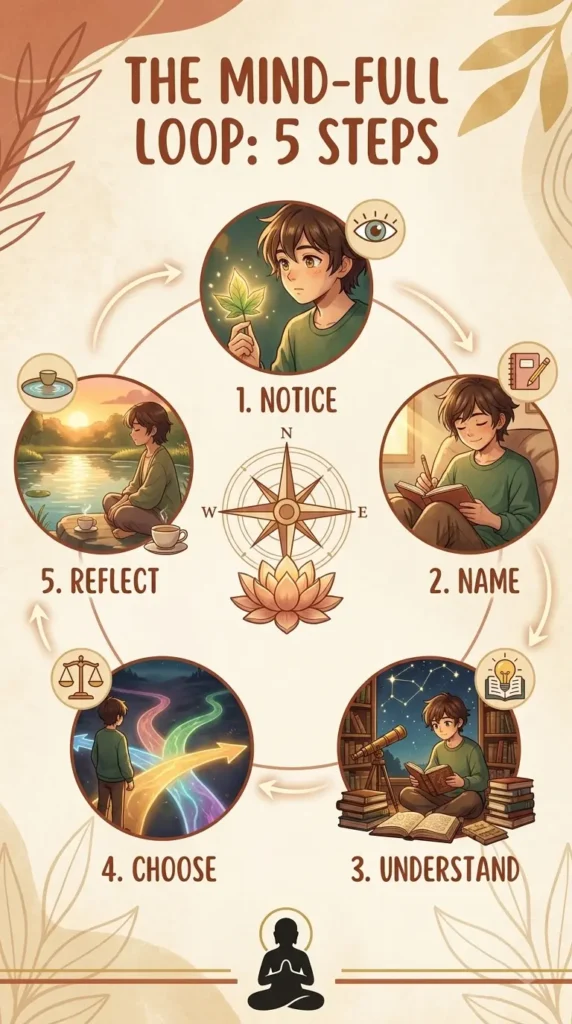
Journaling takes an emotional moment and slows it down enough to actually look at. Here’s the shape most entries fall into:
Notice → Name → Understand → Choose → Reflect
First you notice what’s happening in your body and your head. Then you name the emotion, as precisely as you can manage. Next comes understanding: the trigger, the assumption, the need sitting underneath it. Then you choose your response instead of handing that job to your first impulse. Last, you reflect on what actually happened.
Sound like a lot of steps for one feeling? It is, at first. It gets faster with reps.
Keep the loop going and patterns start surfacing on their own. Maybe one type of text message makes you defensive every time. Maybe comparison always leaves you flat. Maybe you go quiet in hard conversations the moment you’re already stretched thin.
The goal was never permanent calm. Nobody gets that. It’s noticing what’s happening inside you before it quietly becomes what you do next.
Can Journaling Really Improve Emotional Intelligence?
Yes, but only partly. That’s the honest answer. Journaling for emotional intelligence can sharpen the skills EQ actually runs on: naming what you feel, reflecting on your own reactions, and seeing a situation from someone else’s angle.
What the research does not show is that keeping an emotional intelligence journal automatically bumps your overall EQ score.
What the Research Supports vs. What’s Inferred
Expect the strongest evidence around expressive writing and affect labeling. Not journaling as a packaged EQ training program. That distinction runs through everything below.
| Study | What It Found | What That Means for Journaling |
|---|---|---|
| Lieberman and colleagues’ 2007 study in Psychological Science | Putting a feeling into words lowered amygdala and other limbic activity when people viewed upsetting images. | Naming an emotion may calm reactivity. That supports the awareness side of EI. |
| Pennebaker and Beall’s 1986 study in the Journal of Abnormal Psychology | Students who wrote about traumatic events made fewer health-center visits in the following months, even though short-term mood and arousal dipped first. | Expressive writing can pay off later. It isn’t always pleasant while you’re doing it. |
| Baikie and Wilhelm’s review in Advances in Psychiatric Treatment | Writing about stressful or emotional experiences produced psychological and physical benefits, though results shifted by outcome and population. | There’s a real research base for writing as reflection and emotional processing. |
| Schutte and colleagues’ 2002 study in Cognition and Emotion | Higher trait EI tracked with more positive mood and higher self-esteem across their studies. | EI links to well-being. It does not prove journaling causes higher EI. |
See the gap there? Research backs the pieces: putting emotions into words, expressive writing, reflection, the tie between EI and well-being. The inference is that practicing those pieces on purpose, through journaling, might help you get better at them.
Plausible. Not proven. Those aren’t the same thing, and self-help content blurs them constantly.
So if you’re keeping an emotional intelligence journal, treat it as a training space. Not an EQ hack. A journal won’t replace the deeper work either. Our breakdown of what journaling cannot replace covers where the boundary actually sits.

Journaling and Emotional Awareness
Vague feelings stay vague until you name them. Journaling for emotional awareness pushes you past lazy labels like “bad,” “stressed,” or “fine,” toward what’s actually going on underneath. Sounds basic. It’s usually where useful reflection starts.
Try moving from “I’m annoyed” to something sharper: “I’m embarrassed because I felt ignored, and now I’m reading the silence as rejection.” Notice what just happened. You separated the emotion from the story wrapped around it.
That split gives you something to work with. You can question the story. The feeling still gets to be real.
Lieberman and colleagues’ 2007 affect-labeling research fits here. Naming a feeling out loud, or on paper, tracked with lower amygdala response to upsetting images. Journaling isn’t a lab experiment.
Nobody’s hooking your brain up to a scanner mid-entry. But an emotions journal builds the same underlying skill through repetition: catch the feeling, put honest language around it, move on.
Journaling and Emotional Regulation
This isn’t about deleting an emotion. Journaling for emotional regulation is closer to buying yourself distance, enough room to choose your next move instead of just reacting.
Picture a text that lands wrong. Your first instinct might be firing back instantly, typing a paragraph you’ll regret, or ghosting the person for three days straight. Writing first breaks that reflex. Even ninety seconds helps.
Try recording:
- What actually happened
- What emotion showed up
- What you wanted to do right away
- What you assumed the situation meant
- What response would actually serve you
That last question is where emotional journaling stops being venting and starts being useful. You’re studying the gap between feeling something and acting on it. Why does that gap matter so much? Because most damage gets done in the three seconds before anyone thinks it through.
Baikie and Wilhelm’s review backs the broader case for writing through stress. It doesn’t promise that every single session improves your regulation. Nothing does. The real goal is practice. Spot the pattern in your reactions often enough, and next time the same trigger shows up, you’ve actually got options.
Journaling and Empathy
Empathy needs more than good intentions. Journaling can hand you a structured way to sit with someone else’s side of a situation, without abandoning your own first.
After a fight, write down your version of what happened. Just yours, no editing. Then try rebuilding the other person’s likely experience. What might they have noticed that you missed? Where could they have misread you? What did you quietly assume they already knew?
This isn’t about deciding they were right all along. It’s about testing where your own read on things might be thin.
That matters because emotional intelligence was never only about you. Understanding your own reaction is one skill. Recognizing that someone else lived through the exact same moment completely differently, that’s the harder one. And arguably the one that actually changes relationships.
Want more structured journal prompts for emotional intelligence like these? A full guide with 30+ prompts covering awareness, regulation, and empathy is coming to this pillar soon.
Before You Start: The 5-Step Emotional Intelligence Journal Method
An emotional intelligence journal does one job well. It moves you past “here’s what happened” and into what you actually felt, why, and what you’re going to do about it. Five questions carry the whole thing: what happened, what did I feel, what story did I attach, what did I need, and what response actually fits who I want to be.
Already using the 5-minute mental health routine? Think of this as its sibling. Same bones. Short, structured, no massive daily commitment required. The difference is aim. That routine supports mental health broadly. This one exists to build emotional intelligence specifically, by tracing the line between what you feel, what you tell yourself, what you need, and what you do next.
What Happened → What Did I Feel → What Story Did I Attach → What Did I Need/Value → What Response Reflects Who I Want to Be?
Get the facts down first. Before your brain fills the blanks in for you.
1. What happened? Describe it plainly. No spin yet.
2. What did I feel? Name the emotions. Rate how strong they hit.
3. What story did I attach? Find the meaning you slapped onto the event.
4. What did I need or value? Dig under the emotion. A need’s usually hiding there. Sometimes a boundary.
5. What response fits who I want to be? Pick the action that matches your values. Not just your first impulse.
That fifth question is the whole point. Emotional intelligence was never about staying calm all the time. Anger still shows up. So does jealousy, embarrassment, hurt. The skill is understanding the reaction well enough to choose what happens after it.
Emotion vs. Thought vs. Interpretation
These three blur together the second you’re upset. Pull them apart and your journaling actually starts working.
An emotion is what you feel. A thought is whatever crosses your mind. An interpretation is the meaning you bolt onto the event.
Take this:
- Event: Your friend hasn’t replied in eight hours.
- Emotion: Anxious. Disappointed. Maybe a little irritated.
- Thought: “They’re probably ignoring me.”
- Interpretation: “I must not matter to them.”
That interpretation might be true. You don’t know that yet, though. Not from what’s actually in front of you. Writing the three pieces separately gives you room to question the story. Without pretending the feeling underneath it isn’t real.
Why Naming the Emotion Precisely Matters
Precise language gives you something to work with. “I feel bad” tells you almost nothing. Rejected, embarrassed, resentful, lonely, disappointed, overwhelmed? Each one points somewhere different. Different need. Different next move.
This lines up with the affect-labeling research mentioned earlier. You don’t need to memorize the studies to use the principle. Name the emotion more precisely, and you’ve already got a cleaner starting point for the rest of the entry. This is where journaling for emotional awareness actually starts to pay off, one accurate word at a time.
Add the Body Check-In
Your body sometimes clocks an emotion before your conscious mind gets around to naming it. Worth paying attention to while you’re writing.
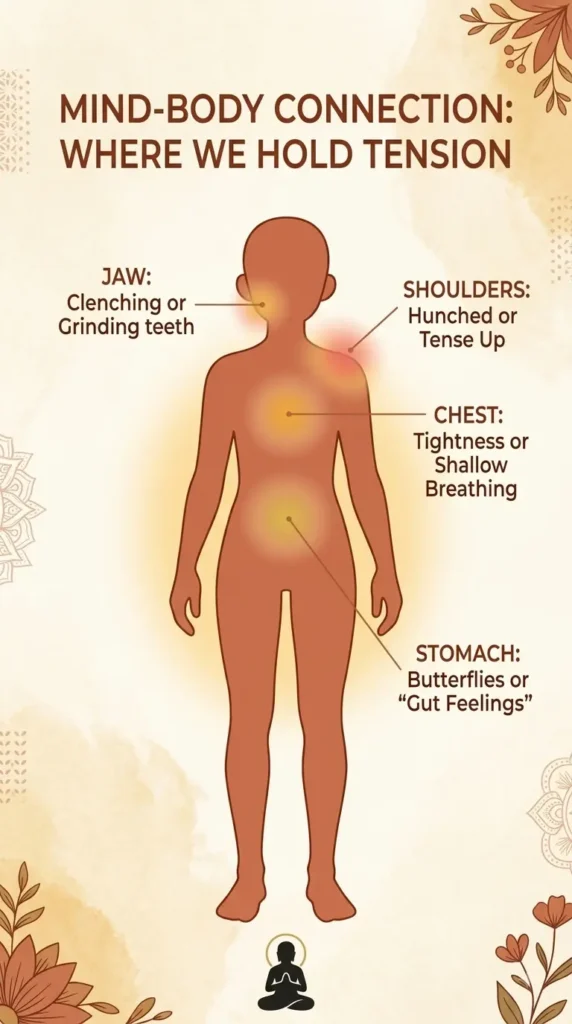
Jaw clenched? Shoulders tight? Chest feels tight, stomach unsettled? Then ask: what emotion might connect to this sensation.
This isn’t about diagnosing a feeling from a sensation alone. It’s one more data point. Combine the physical signal with the situation, the thoughts, the feelings you’ve already written down, and the whole picture gets sharper.
This layered approach is also what separates journaling for emotional regulation from just venting on a page, and it’s part of what gives writing its emotional release on the harder days.
30+ Emotional Intelligence Journal Prompts for Gen Z
Emotions don’t wait for a convenient moment. They show up mid-class, mid-scroll, mid-argument, and most of the time you’re expected to just handle it. That’s where journaling for emotional intelligence actually earns its place. Not as another self-help checkbox. As a way to catch a feeling before it drives.
These emotional intelligence journal prompts aren’t assignments. Pick one. Write three sentences or fill the whole page. Either way, you’ve noticed something you might have otherwise reacted to blind.
Below, you’ll find prompts sorted by what they actually do: naming what you feel, understanding what’s underneath it, regulating your response, releasing what’s stuck, reading other people better, and communicating without the guesswork.
1. Emotional Awareness Journal Prompts
Naming a feeling is step one. Most people skip it entirely.
- What emotion am I feeling right now, and where do I notice it in my body?
- What happened today that changed my mood noticeably?
- If I couldn’t use the words good, bad, fine, stressed, or upset, how would I describe what I’m feeling?
- What emotion have I been avoiding lately, and what makes it uncomfortable to acknowledge?
- What situations tend to bring out the strongest emotional reactions in me?
- What emotion keeps showing up in my journal entries, conversations, or thoughts lately?
2. Journaling for Emotional Regulation
Regulation isn’t about shutting the feeling down. It’s about not letting it drive the car.
- What happened immediately before I reacted more strongly than I expected?
- What did I want to do in that moment, and what did I actually do?
- What thought made my emotion feel stronger?
- If I could pause for five minutes before responding, what would I want to understand first?
- What is one response to this situation that protects my boundaries without making the situation worse?
- When I’m overwhelmed, what coping habit helps me recover, and which habit usually makes things harder?
3. Journaling for Emotional Release
Some things get heavier the longer you carry them quietly. Writing them down is one way to put them down.
- What am I carrying emotionally that I haven’t allowed myself to say out loud?
- If I could write an uncensored letter about this situation that I would never send, what would I say?
- What am I angry, hurt, disappointed, or sad about beneath the emotion I show other people?
- What do I wish someone had understood about my experience?
- What can I accept about this situation even if I don’t like what happened?
If a specific experience keeps resurfacing no matter how many times you write about it, the healing journal prompts guide goes further into processing that kind of weight.
Reflection vs. rumination: Reflection moves you somewhere. Rumination just spins. If you’re replaying the same event without learning anything new, without naming a need, without deciding on a next step, stop. Pause the session. The point was never to live inside the feeling forever. It’s to hear what the feeling is actually telling you.
4. Empathy and Perspective-Taking Journal Prompts
Empathy isn’t a personality trait you either have or don’t. It’s a habit of asking one more question before you decide what someone meant.
- What might the other person have been feeling during our interaction?
- What part of their perspective am I most likely to be missing?
- What assumptions have I made about someone’s intentions without actually checking them?
- If someone I care about described this exact situation to me, what would I tell them?
- How might my words or actions have affected the other person, even if that wasn’t my intention?

5. Relationships, Boundaries, and Communication Journal Prompts
Most conflict isn’t really about the thing you argued about. It’s about what nobody said clearly beforehand.
- Where in my relationships do I say “yes” when I actually want to say “no”?
- What conversation am I avoiding because I’m afraid of how the other person might react?
- When I feel criticized, what do I usually hear, and what might the other person actually be saying?
- What boundary do I need to communicate more clearly?
- After my last disagreement with someone, what would I change about the way I communicated?
Want prompts built specifically around communication and the harder relationship patterns underneath it? The therapy journal prompts guide covers that in more depth.
6. Motivation, Values, and Self-Trust Journal Prompts
Procrastination usually isn’t laziness. It’s often an emotion wearing a disguise.
- What emotion tends to show up when I procrastinate, and what might it be protecting me from?
- Am I pursuing this goal because I genuinely value it or because I want approval from other people?
- What does success mean to me when I remove social media, comparison, and other people’s expectations?
- What recent decision made me feel proud of how I handled myself emotionally?
- What is one emotional pattern I want to understand better over the next month?

Bonus: Emotional Intelligence Journal Prompts for When You Don’t Know What You Feel
“I don’t know what I feel” is a real answer. Start there instead of forcing yourself to pick a label that doesn’t fit yet.
- If I had to describe my mood as a weather pattern, what would it be, and why?
- What has been taking up the most space in my mind today?
- What happened today that I keep replaying?
- Do I want comfort, space, reassurance, clarity, control, connection, or something else right now?
- What does my body seem to be telling me that I haven’t put into words yet?
- If this feeling could speak without judgment, what would it want me to know?
Want to download the complete 30+ Journaling Prompts for Emotional Intelligence? Here is a printable that’ll serve you well.
6 Gen Z Situations Where EI Journaling Helps
Emotional intelligence journaling only works when it touches something real. Not another worksheet. Not one more “self-improvement” checkbox. A tense group chat, a text left on read, a comparison spiral. Any of these can turn into a chance to catch what you’re feeling, trace where it came from, and pick a response you actually meant to give.
When Social Media Makes You Compare Your Life
Comparison sneaks in before you notice it happening. One scroll and someone’s internship post sits next to a vacation photo, then a “perfect” morning routine video. You feel behind. Before you’ve even named what triggered it. That gap between someone’s highlight reel and your actual Tuesday is exactly where this feeling lives, and Pew Research Center found that 48% of U.S. teens surveyed in 2024 saw social media as mostly negative for people their age, with 27% saying it made them feel worse about their own life.
Skill: Emotional awareness and self-regulation.
Prompt type: Identify the emotion, comparison trigger, and assumption behind it.

When You’re Left on Read
This isn’t about the message. Not really. You send it, watch it get read, and twenty minutes turns into two hours. Your brain fills the silence with a full story anyway: they’re annoyed, I said something wrong, they don’t care. None of that is confirmed. It’s just the fastest explanation your mind could grab. A quick emotions journal entry can slow that story down before you act on it.
Skill: Separating facts from interpretations.
Prompt type: Write what you know happened, what you assume it means, and what other explanations are possible.
After a Friendship or Dating Conflict
Most people replay the fight, not the feeling underneath it. Journaling flips that order. Write what happened first, then what you actually felt, then what you needed and never said out loud. That’s the whole method. Being “right” can wait. If the same wound keeps reopening around a certain person, the healing journal prompts collection goes further into patterns like that.
Skill: Empathy and emotional regulation.
Prompt type: Perspective-taking and relationship reflection.
Before a Difficult Conversation
Rehearsing an argument in your head rarely helps. It just rehearses the anger. Before asking for a boundary, naming a misunderstanding, or giving someone hard feedback, use the page to split the issue from the emotional charge sitting on top of it. Two questions do most of the work: what do I want them to understand, and what am I assuming about their intentions? If you want a more structured version of this kind of pre-conversation clarity, therapy journal prompts borrow the same approach.
Skill: Social awareness and communication.
Prompt type: “What do I want them to understand?” and “What am I assuming about their intentions?”

When College or Work Stress Makes You Snappy
The person who gets the sharp reply usually isn’t the real problem. That’s the part most people miss. Stress builds somewhere else entirely, then leaks out on whoever’s closest. Journaling traces the actual chain: stress, then emotion, then impulse, then response. Catch it early enough and the impulse never becomes a second problem. A short mindfulness journal prompts session works well right before this kind of entry, since it slows the reaction down enough to actually see it.
Skill: Self-awareness and self-regulation.
Prompt type: Trigger mapping and reaction review.
When You Feel Behind Everyone Else
Career uncertainty. Money stress. Friendships that keep shifting shape. Watching someone else hit a milestone you haven’t. All of it can make your own progress feel invisible, even when it isn’t. An emotions journal helps separate two very different things: are you actually unhappy with your life, or reacting to somebody else’s timeline? Worth sitting with. Grounding this in what you already have, through things to be thankful for or a simple pass at how to practice gratitude, tends to make “enough” feel less abstract.
Skill: Motivation and self-awareness.
Prompt type: Values clarification, comparison tracking, and defining what “enough” means to you.
How to Journal When You’re Emotionally Overwhelmed
Big feelings don’t wait for a good time. Emotional journaling slows things down enough to notice what’s actually happening inside you. Not to fix it. Not yet.
The goal isn’t a tidy entry. It’s space. Enough room to see what you feel, what set it off, and what you need next. That’s it. Nothing fancier than that.
Free Writing vs. Prompt-Based
Got a lot to unload and no idea what it even is yet? Try free writing. Set a timer for five to ten minutes. Write without stopping to edit yourself.
Skip the grammar checks. Skip the “does this make sense” checks too. Repeat yourself if you need to. The messy version is often the honest one, and the honest one usually points straight at the real issue.
Prompt-based journaling does something different. It works better when your thoughts feel scattered, or when you’re stuck replaying the same mental loop for the fifth time today. One clear question can do what ten minutes of rambling can’t.
Try this: “What happened, and what am I telling myself it means?” Two different things get tangled together fast when you’re overwhelmed. That question pulls them apart.
Already flooded? Don’t push through a long journaling session anyway. That’s how journaling for emotional regulation turns into one more thing you failed at today.
If a prompt starts making things worse instead of clearer, the journal prompts for mental health guide covers exactly when that’s happening and what to do about it.
When to Stop and Do Something Else
Journaling should put a little distance between you and the emotion. Not seal you inside it.
Watch for these signs. You’re more distressed than when you started. You’re replaying the same scene without learning anything new from it. You feel pressured to solve everything before you’re allowed to stop writing. Any of those show up? Close the notebook.
Then do something grounding instead:
- Take a short walk
- Drink water
- Breathe slowly, on purpose
- Talk to someone you trust
- Step away from the situation completely
None of that is giving up. It’s the whole point. Emotional journaling is a tool for processing, not a requirement to analyze yourself until you feel better. Sometimes the most useful entry is three lines and a walk around the block.
Common Mistakes That Make Emotional Journaling Less Useful
Emotional journaling can untangle a messy day fast. It helps you spot patterns, sit with hard feelings, and respond instead of react. But the practice turns on you just as easily. Repeat the same rant on paper enough times and it stops being reflection.
It becomes rumination. Or self-criticism. Or a quiet way to dodge what’s actually going on. A handful of habits can flip a useful practice into something that leaves you worse off. Watch for these five.
Writing Only When Something Goes Wrong
Only opening the notebook after a fight, a rejection, or a brutal day adds up fast. Your entries start reading like a running list of everything that hurt. Nothing else gets logged. Make room for the neutral stuff too. Calm. Excitement. Relief. Confidence.
Even boredom counts. Noticing the good and the flat moments, not just the bad ones, builds a fuller picture of what you actually feel day to day.
Calling Every Thought a Feeling
“I feel like they don’t respect me” isn’t a feeling. It’s an interpretation wearing a feeling’s clothes. Split the two apart instead. Try this: I feel hurt, embarrassed, and angry, because I read their silence as rejection.
That small shift changes everything about journaling for emotional intelligence. Now you’re examining what actually happened. Not treating a guess like a fact.
Turning Journaling Into Rumination
Writing about the same fight for the tenth time, with zero new insight? That’s not reflection anymore. That’s a loop. Real reflection surfaces a pattern, clarifies a need, or points toward a different response next time. Stuck replaying the same scene? Stop. Close the notebook.
Go do something that pulls your attention somewhere else entirely. Knowing reflection versus rumination matters here, because the line between the two is thinner than it looks, and that gap is exactly what makes journaling for emotional regulation work in the first place.
Trying to Force a Positive Mindset
Not every hard emotion needs to become a lesson. “I’m grateful this happened” isn’t automatically healthier than “that really hurt me.” Sometimes the second one is just true. Honest awareness comes first. Forced positivity comes never, if it isn’t real.
Using Journaling as a Substitute for Professional Support
A journal is a reflection tool. It was never built to replace therapy or other professional support. If writing consistently leaves you more shaken, stirs up more than you can hold, or isn’t enough to help you function day to day, stop leaning on the page alone. Want prompts closer to therapeutic work?
Therapy journal prompts can sharpen what you bring to a session. Still, that’s support, not treatment. For a fuller look at where the limits sit, and when it’s time to reach for more, see what journaling cannot replace.
7-Day Emotional Intelligence Journaling Challenge
Naming a feeling is easy. Understanding why it showed up is not. That gap is exactly what therapy journal prompts are built to close, and this 7-day challenge walks you through it one layer at a time. You’ll move from simply noticing an emotion to spotting your patterns, choosing better responses, and looking honestly at how you show up with other people.
Five to ten minutes a day. That’s the whole ask.
One rule matters more than the rest. Honest beats polished. Every time.
Day 1: Name What You’re Feeling
Start with one emotion. Just one, from today.
Write down what happened right before it. Where you feel it in your body. How strong it is on a scale that makes sense to you. What might be sitting underneath it, the thing the surface feeling is covering for.
Skip “fine.” Skip “stressed.” Skip “bad.” Those words hide more than they say. Reach for something sharper instead, disappointed, wired, embarrassed, relieved. The more specific the word, the more useful the entry becomes.
Day 2: Find the Trigger
Something shifted your mood today. Find the exact moment.
What happened right before it? Not five minutes before, the actual second. What did you notice yourself thinking? Feeling? Wanting to do next?
Don’t judge the reaction yet. That’s not today’s job. Today’s job is just spotting the trigger, clean and unfiltered, before your brain rewrites the story around it.
Day 3: Separate the Emotion From the Story
This isn’t about what happened. It’s about what you told yourself happened.
Write about something that upset you today. Then split it into two columns. One column holds the facts, the things a camera would have caught. The other holds the story your mind built on top of them.
“They haven’t replied” is a fact. “They don’t care about me” is a story. Most emotional spirals live entirely in that second column, and most people never notice the switch. This is one of the core moves in therapy journal prompts, and it’s also one of the harder ones to catch in real time.
Day 4: Practice a Different Response
Think back to a moment you reacted harder than you meant to.
What were you actually protecting? Avoiding? Trying to say without saying it? Most overreactions are a smaller feeling wearing a bigger one’s clothes.
Write one response you could try next time. Something that respects what you feel and still fits the situation. Not a script. Just an option you didn’t have in the moment, ready for the next time this pattern shows up.
Day 5: Take Someone Else’s Perspective
Here’s an honest take on empathy: it’s harder than it sounds, and most advice makes it sound easy.
Pick a recent disagreement, or just an awkward exchange that’s still bugging you. Describe what the other person might have felt going into it. What they might have needed. Where the misunderstanding may have started on their end, not yours.
Agreement isn’t the goal. Consideration is. Perspective-taking is closely tied to what researchers call theory of mind, our ability to model what someone else is thinking or feeling, and it’s one of the skills most closely linked to emotional intelligence as understood in psychology today. You’re not required to like what you find. Just look at it honestly.
Day 6: Examine a Relationship Pattern
Most people have one move they make on repeat.
Look across your friendships, your dating life, your family, your work. Do you withdraw? Over-explain? People-please until you’re resentful? Get defensive the second something feels like criticism? Avoid the hard conversation entirely, hoping it resolves itself?
Name the pattern without flinching from it. Then write what a healthier response might actually look like, specific enough that you’d recognize it if you did it tomorrow. If this pattern traces back to something older, our healing journal prompts guide goes further into that kind of work.
Day 7: Identify Your Biggest Emotional Pattern
Now go back and read all six entries in one sitting.
What keeps showing up? A trigger that repeats. An emotion that circles back more than the others. A thought pattern doing the same job every time, or a reaction you keep defaulting to without choosing it.
Pick one small change. Not a life overhaul, one shift you can actually practice this week. That’s the entire point of running this as therapeutic writing prompts instead of a single journal entry: patterns only become visible with repetition, and repetition is where the real change happens.
Want to keep going? Grab the printable 7-Day Emotional Intelligence Journal to record each day’s prompt and reflection in one place, or explore the full journal prompts for mental health collection for more journaling prompts for therapy and beyond.
How to Tell If Your EI Is Improving
Emotional intelligence doesn’t announce itself. It shows up in small shifts: catching a reaction before it runs the show, staying steady in a messy group chat, saying what you need instead of hinting at it. You’ll usually see the change before you feel it.
You Notice Your Triggers Earlier
Here’s the clearest sign. You catch the reaction while it’s happening, not three hours later when you’re replaying the whole thing in your head.
Maybe a delayed text sends your stomach into knots before you fire off a second follow-up message. Maybe you notice one group chat always leaves you irritated, every single time. That pause is the whole point.
You don’t need to stop feeling it. Progress just sounds like, “Okay, this is getting to me. What am I actually reacting to?”
You Pause Before Reacting
Better EI isn’t about becoming unbothered. Nobody manages that. It’s about building space between feeling something and acting on it.
Read the annoying text. Put the phone down. Journal for five minutes. Skip the reply until the anger cools off. Sound too simple? It is. That gap is where the real work happens.
You’ll also start telling the difference between a fight that needs an actual conversation and one that just needs a vague “k” and silence. That’s a practical form of regulation, not avoidance dressed up as maturity.
You Communicate Your Needs More Clearly
Self-awareness grows. Your communication gets less indirect right along with it.
Instead of waiting for a friend to somehow guess you’re upset, you say what happened, how it landed, and what you need now. You get better at saying no without a five-paragraph apology attached. You also get better at hearing someone else’s boundary without immediately taking it as rejection.
That shift is worth more than it looks on paper.
You Recover From Conflict With Less Rumination
You’ll still replay an awkward exchange. Improving EI doesn’t erase that. It just makes the replay useful instead of punishing.
After a disagreement, ask yourself something specific. “What was my part in this? What did I misread? What would I do differently next time?” That question does more than an entire night spent reconstructing every text message ever could.
Self-judgment spirals. Honest reflection doesn’t. Watching that shift happen in real time is worth paying attention to.
You Recognize Patterns in Your Journal
Your journal remembers what you couldn’t see in the moment.
Give it a few weeks. You might notice you go defensive the second criticism lands. Or withdraw the moment you’re disappointed. Or start comparing yourself to everyone else right when you’re already running on empty. Seeing the pattern gives you something specific to actually work on.
That’s a far better measure of growth than counting filled pages. If you want prompts built specifically for spotting these patterns, journal prompts for mental health walks through emotional check-ins designed to surface exactly this kind of self-awareness. And for the moments where a pattern points back to something older, unresolved, healing journal prompts picks up where this leaves off.
Frequently Asked Questions
What are the 5 C’s of emotional intelligence?
The 5 C’s are commonly described as self-awareness, self-regulation, empathy, social skills, and motivation. Different frameworks use different labels, so there is no single universally accepted “5 C’s” model.
These skills broadly describe how well you recognize emotions, manage reactions, understand others, and respond effectively in relationships.
What are 7 signs of low emotional intelligence?
Seven common signs include difficulty identifying emotions, frequent emotional outbursts, poor listening, defensiveness, trouble accepting feedback, blaming others, and difficulty understanding other people’s perspectives.
Having one of these traits occasionally does not mean you have low emotional intelligence. The more useful question is whether the same patterns repeatedly create problems in your relationships or decisions.
What is the 3/2-1 method of journaling?
The 3/2-1 journaling method is a short reflection exercise built around three things you noticed, two things you learned or appreciated, and one intention for what comes next.
The exact format varies between journaling systems. Its main value is keeping reflection structured enough to complete without turning it into a lengthy writing session.
What type of journaling is best for mental health?
There isn’t one best journaling style for everyone. Prompt-based journaling can help when you don’t know what to write, while free writing can be useful for emotional expression.
Reflective journaling is particularly useful for noticing patterns in thoughts, emotions, and behavior. Choose the format you can use consistently without increasing rumination.
Who has high IQ but low EQ?
A person can have a high IQ and comparatively low emotional intelligence because cognitive ability and emotional skills measure different things.
A person might excel at analytical reasoning while struggling with emotional awareness, empathy, communication, or self-regulation. IQ does not reliably predict EQ, so there is no definitive list of people who fit this description.

It’s Bhaskar!
Well, I am not a psychologist a monk, or a philosopher by training. I’m just an engineering graduate.
‘The Empty Self’ is where I write about that idea, and what it actually means for ordinary life, anxiety, identity, habits, the stories we tell ourselves about who we are. I don’t have a psychology degree, and I’m not offering therapy or clinical advice. What I do have is thought and clarity, and genuine curiosity about why we suffer the way we do and how much of it might loose once we shed this ‘fixed identity’.