
Five minutes is enough. Enough to pause before your phone takes over. Enough to notice what you’re feeling before the day buries it. These five minute journal prompts give you a starting point. Not a blank page staring back at you.
Use them to name what’s going on inside. To clock what’s already good. To clear the noise. To decide what actually deserves your attention today.
This guide isn’t locked to one brand. It covers the five-minute journaling practice broadly, not just the branded Five Minute Journal from other websites. Grab a notebook. Use your notes app. Build your own template. The prompts bend to fit your life, not the other way around.
AI disclosure: This article was created with AI assistance and reviewed for accuracy, clarity, and reader usefulness.
Need immediate help? If you’re in the U.S. or Canada and in a mental-health crisis, call or text 988. Outside the U.S. or Canada, contact your local emergency or crisis service.
Quick Overview: Most people don’t skip journaling because they hate it. They skip it because the blank page feels like homework. Five minute journal prompts fix that. You get a clear entry point instead of a wall of nothing.
Table of Contents
Disclaimer
This blog is written and edited with the help of AI, then reviewed by me before publishing. As a result, the content is for general reflection only, not therapy or medical advice, and I’m not a licensed mental health professional. If you’re in crisis, please contact 988 if you’re in US or a local crisis service of your country instead of relying on this site.
How the Five Minute Journal Format Works
Five minute journal prompts run on one simple structure. Write for a few focused minutes before your day starts. Then again after it ends. That’s it. Gratitude, intention, self-belief, reflection. The exact wording shifts from version to version, but the shape stays the same.
Morning Questions
Mornings center on three things: gratitude, intention, and a small affirmation. You don’t need to copy the wording from the commercial version. Write your own five minute journal prompts instead.
- Gratitude: What is one thing in my life I actually appreciate right now?
- Intention: What would make today feel worthwhile?
- Affirmation: What quality do I want to carry into today?
Sound too simple? It is. That’s the point. Nobody needs a perfect mood before breakfast. “I have one friend I can call when I’m overwhelmed” beats a forced, poetic answer every single time.
Specific wins. Vague loses. If you want more prompts built around this same idea, our gratitude worksheets and how to practice gratitude guides go deeper.
Evening Questions
This isn’t about grading your day. The evening side of these five minute journal questions moves from planning to reflection. Not judging whether you were “productive.” Just noticing what actually happened.
Ask yourself:
- What was one good moment from today?
- What did I notice about myself?
- What did today teach me that I want to remember?
Why does this matter more than it sounds? Because a daily positivity habit fades fast. A daily record of patterns doesn’t. These questions build the second one. For prompts that lean further into self-awareness, our journal prompts for mental health and journal prompts for self-love posts pair well here.
A Simple 5-Minute Timing Method
You don’t need a stopwatch for this. A rough split works fine: one minute for gratitude, one for intention, one for your affirmation or a quick self-check-in, and two minutes for evening reflection. That’s the whole method.
It’s 10pm and the notebook is still closed. The day was long, and the couch feels heavier than the pen. This is the moment that decides whether the habit survives the week. Pick it up anyway. One line is enough.
If an answer needs more time, let it run over. Five minutes is a boundary, not a test you can fail. Some nights you’ll write for two minutes. Some nights for eight. Both count. For prompts that slow things down even further, check out our mindfulness journal prompts.
30+ Five Minute Journal Prompts for Improving Mental Health
Good five minute journal prompts do one job. They make you pause. They make you notice what’s actually going on, then put it into words. Nothing fancier than that.
Below you’ll find prompts for gratitude, emotional clarity, self-worth, mindfulness, daily focus, evening reflection, and the days that feel harder than usual.
Morning Five Minute Journal Prompts
Morning journaling works best when it points your day somewhere. It doesn’t need to predict how the day goes.
You don’t need a sunny mindset at 7 a.m. You need a little clarity about what matters today. That’s it.
Try these five minute journal prompts as soon as you wake up:
- What is one thing I am grateful to have in my life right now?
- What would make today feel meaningful, even if it isn’t perfect?
- What is one thing I want to give my attention to today?
- How do I want to feel when I look back on today tonight?
- What is something I can do today that my future self will appreciate?
- What do I need more of today: rest, focus, connection, patience, or something else?
- What is one thing I can let go of before my day begins?
- What is something I am capable of handling, even if it feels uncomfortable?
These questions go wider than a typical gratitude-only routine. Some mornings, thanks come easy. Other mornings your brain is already stuck on an unfinished assignment, an awkward text you haven’t sent, or everything due by noon. A journal worth using has room for that too.
Fold Focus and Productivity Into Your Morning Routine
Mind already on your notifications? Deadlines? An endless list? Add one or two focus questions to your morning entry:
- What is the one task that deserves my best attention today?
- What can wait until later?
- What distraction am I most likely to fall into today?
- What would “enough” look like today?
- Where can I make today’s expectations more realistic?
Keep that last one close. Productivity journaling can turn into another way to pressure yourself without you noticing. You’re not trying to cram every task into five minutes. You’re deciding what deserves your energy.
Five Minute Journal Gratitude Prompts
Gratitude is the most familiar part of five-minute journaling. It’s also the part that goes stale fastest.
“My family, my friends, my health” might be true every single day. But writing it on autopilot doesn’t make you stop and notice anything.
Specific beats generic. Every time.
Use these five minute journal gratitude prompts when you want more than the usual answers:
- What is one small thing that made today easier?
- Who did something kind for me recently, even if they probably didn’t think much of it?
- What ordinary part of my routine would I miss if it disappeared?
- What is something I have access to today that I once wished for?
- What place makes me feel comfortable or safe? Why?
- What is one recent memory I am glad I have?
- What did someone teach me that I still use?
- What is something about my current life that deserves more appreciation?
- What is one thing my body helped me do today?
- What small moment would I like to remember from this week?
You can write about something unremarkable too. A quiet bus ride. A song that hit at exactly the right second. A friend sending a ridiculous meme when you needed it. Twenty uninterrupted minutes to yourself. All of it counts.
Here’s the point. Gratitude journaling isn’t a contest for the biggest win of the day. It’s training your attention to catch what’s already there.
For more ways to build gratitude into a daily habit, check our guide on how to practice gratitude. And if you’d rather work from a printable format, our gratitude worksheets walk through structured prompts you can revisit anytime.
Five Minute Journal Prompts for Anxiety and Overthinking
Anxious? Journaling can slow things down. It separates what’s actually happening from what your mind predicts might happen.
Use it to organize your thoughts. Not to replay the same worry for another hour.
Try these prompts:
- What is taking up the most space in my mind right now?
- What part of this situation is actually within my control today?
- What do I need right now rather than what do I think I should do?
- What is one small action that could make this situation feel more manageable?
- If someone I cared about had this worry, what would I say to them?
- What can I give myself permission not to solve today?
- What would I like to remember when my mind starts spiraling about this again?
Don’t interrogate yourself hunting for a perfect explanation. Sometimes “I don’t know yet” is the honest answer. And it’s enough.
Want a deeper set built specifically around anxious thoughts? Our full list of journal prompts for mental health covers overthinking in more detail.
A five-minute entry should leave you with more clarity, not five more pages of analysis. Notice yourself circling the same thought again? That’s your cue to stop writing, change activities, ground yourself, or reach out for support.
Five Minute Journal Prompts for Self Worth
This isn’t about convincing yourself you’re amazing every morning. That feels fake fast, especially mid-comparison spiral or a bad self-doubt day.
A better move: collect evidence. Proof that your worth is bigger than your grades, your appearance, your output, or anyone’s approval.
Try these prompts:
- What is something I handled better than I would have a year ago?
- What quality in myself do I sometimes overlook?
- What is something I respect about the way I treat other people?
- When do I feel most like myself?
- What mistake can I stop using as evidence that I am not good enough?
- What boundary would show myself more respect?
- What would I say to myself if I spoke with the same kindness I use with a close friend?
- What part of my identity exists completely outside achievement or productivity?
Look for specific proof, not empty affirmations. “I’m confident” won’t land on a rough morning. “I spoke up even though I was nervous yesterday” gives your brain something real to chew on.
For a wider set of self-worth prompts, see our journal prompts for self-love collection.
Five Minute Journal Prompts for Mindfulness
Mindfulness journaling pulls your attention back to right now. Not yesterday’s mistake. Not tomorrow’s maybe. These prompts are built to make you notice, not analyze.
- What am I noticing in my body right now?
- What emotion is most noticeable at this moment?
- What can I see, hear, smell, or feel around me?
- What has my attention right now, and is it where I want my attention to be?
- What is one ordinary moment from today that I usually rush past?
- What happens when I sit with this feeling without immediately trying to change it?
- What do I need to notice before I move on to the next thing?
No paragraph required. One honest sentence is plenty.
For more of this style, our full set of mindfulness journal prompts goes deeper into present-moment exercises.
Five Minute Evening Journal Prompts
Evening journaling closes the mental tabs still open at the end of the day. It’s not a performance review. A rough day doesn’t need a grade attached to it.
Use these five minute journal questions before bed:
- What was one good moment from today?
- What surprised me today?
- What did I learn about myself today?
- When did I feel most present?
- What was harder than I expected?
- What did I handle well, even if the outcome wasn’t perfect?
- Is there anything I need to forgive myself for today?
- What can I leave unfinished without carrying it into tomorrow?
- What is one thing I want to remember from today?
- What would I like to do differently tomorrow?
Look closely at that last one. Differently. Not “better.”
Small word, real difference. Journaling wears you down fast when every night turns into a list of failures and corrections. Reflection should teach you something, not put you on trial.
Five Minute Journal Prompts for Difficult Days
On a hard day, your journal doesn’t owe you a pep talk. Sometimes the healthiest entry just admits today is hard. Full stop.
Try these gentler prompts:
- What feels hardest right now?
- What do I need in the next hour, rather than for the rest of my life?
- What is one thing I can make easier for myself today?
- What am I asking myself to handle that may not need to be solved right now?
- Who or what helps me feel a little less alone?
- What can I give myself permission to postpone?
- What is one neutral fact about today that I can accept without judging it?
- What would kindness toward myself look like for the next five minutes?
- What do I want to remember if this feeling passes?
- Would writing more help me right now, or would stepping away from the journal help more?
That last question matters more than it looks. More journaling isn’t automatically better journaling. If writing keeps you stuck in the same painful loop, close the notebook. Do something that brings you back to your surroundings instead.

If journaling brings up thoughts of hurting yourself, or you feel unable to stay safe, don’t lean on a prompt to get you through it. Reach out to a trusted person or a crisis service instead. In the U.S. and its territories, the 988 Suicide & Crisis Lifeline offers free, confidential support by call, text, or chat.
For fuller guidance on difficult emotions, reflection, and mental-health support, our journal prompts for mental health guide covers this in more depth. And if gratitude is where you’d rather start, our list of things to be thankful for is a gentler entry point.
A five-minute journal isn’t chasing a perfect page. Some entries will be thoughtful. Some will be messy. Some days you’ll write one sentence and stop. That still counts, as long as it helped you notice what you needed.
How to Use Five Minute Journal Prompts Without Turning Them Into Homework
Five minute journal prompts work best when they feel like a small pause. Not another task on your list. You don’t need to answer every question. You don’t need polished paragraphs either. Skip the streak. The goal is useful reflection, not more pressure stacked on your day.
One Prompt Beats Ten
Pick the question that matches your headspace right now. Anxious? Use a prompt that sorts out what you can actually control. Feeling steady? A gratitude or growth prompt fits better. One honest answer beats ten rushed ones. Every time.
Bullet Points Work Fine on Low-Energy Days
Full sentences are optional here. Some nights you just don’t have them in you, and that’s fine. A few words say enough:
- “Tired, but proud I finished the assignment.”
- “Need less screen time tonight.”
- “Grateful my friend checked in.”
Your journal isn’t an English assignment. Nobody’s grading the grammar. Write however helps you think clearly, even if that’s three fragments and a typo.
A Missed Day Isn’t a Failure
Skip Tuesday? Pick it back up Wednesday. No explaining the gap. No frantic catch-up session trying to cover what you missed. A real habit survives exams, late shifts, travel, bad moods, and the kind of busy that eats your whole week. If yours can’t survive one skipped day, it wasn’t built right in the first place.
Swap the Prompt When It Goes Stale
Repetition kills a good prompt eventually. That’s normal, not a sign you’re doing this wrong. Reword it. Switch categories. Ask something sharper.
If “What are you grateful for?” feels like a script now, try “What made today slightly easier?” instead. Same idea, new angle, and suddenly you’ve got something to actually say.
Watch for the Line Between Reflection and Rumination
Journaling should move your thoughts somewhere. It shouldn’t trap you inside the same loop, replaying the same five minutes over and over. If you’re circling what went wrong without landing anywhere new, that’s your cue to stop and redirect.
For a closer look at where reflection turns into rumination, and how to catch it early, check the reflection vs. rumination breakdown in our full guide to journal prompts for mental health.
If gratitude-style prompts tend to be your go-to on good days, our piece on how to practice gratitude has more ways to keep that one from going flat too.
A Simple Five Minute Journal Template You Can Reuse
A blank page kills momentum before you even open it. A good five minute journal template fixes that fast. Keep it short. Keep it repeatable. Flexible enough for a rushed morning or a wiped-out evening. Copy the structure into a notebook, a notes app, or a printed page. Nothing fancy required.
Five Minute Gratitude Journal Template
Here’s a simple five minute gratitude journal template you can start tonight.
- Today, I’m grateful for: One specific person, moment, place, or small comfort. Nothing vague.
- Why it matters to me: One sentence on why it stuck with you.
- Today, I want to notice: Pick one thing to pay attention to.
- One thing I need: Name it. Emotional, physical, practical. Doesn’t matter which.
- One small intention: How do you want to show up today?
Five lines. Five minutes. That’s the whole point.
Want to build the habit further? Pair this template with these gratitude worksheets for more printable exercises, or read how to practice gratitude for techniques that go past a single page.
Want this pre-formatted? A five minute journal pdf saves you the setup work. One consistent page, ready to print, no design decisions needed. A dedicated printable version helps on the days you’d rather journal than build a template from scratch.
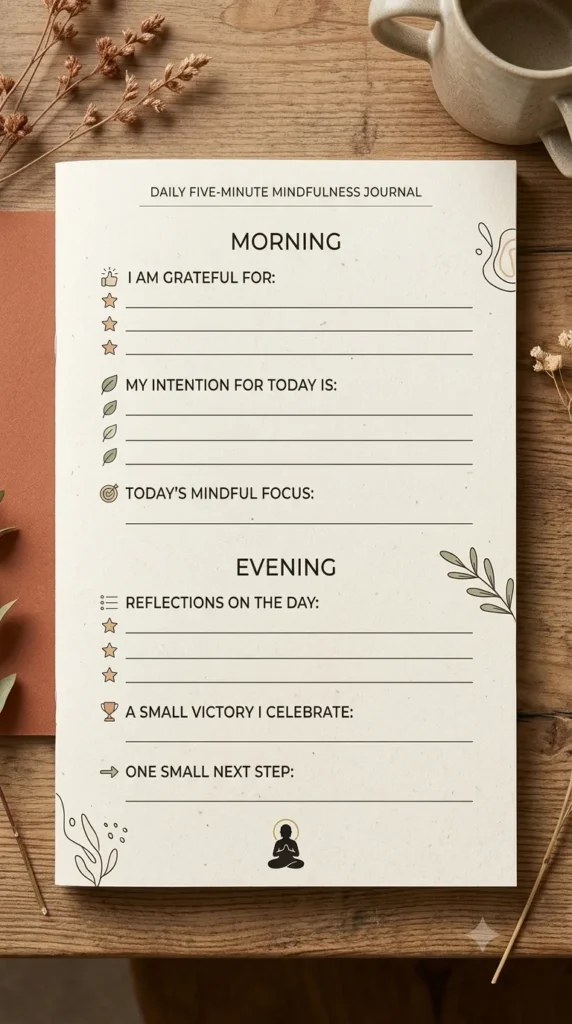
If you’re seeking some inspiring and great affirmations for your five minute journal, check out this guide on five minute journal quotes. They offer you everything you need for a great beginning.
Five Minute Journal Prompts for Christmas and the Holiday Season
December moves fast. Somewhere between wrapped gifts and family dinners, the actual feeling of the season gets buried. Five minute journal prompts exist for exactly that gap. They give you one small pause on a loud day, without turning journaling into another item on the holiday to-do list.
Here’s an honest take on the holidays: gratitude, pressure, loneliness, and excitement often show up in the same afternoon. Sometimes the same hour. A short set of five minute journal questions won’t sort out every feeling.
It just gives them somewhere to land. If you want prompts built around thankfulness specifically, things to be thankful for is a solid companion list to pull from too.
Christmas Gratitude Prompts
Forced cheer doesn’t work. Not in December, not ever. These one-line prompts skip the pressure to feel merry and just ask you to notice something real. A single sentence is enough. No essay required.
Use them on the days that feel warm, and on the days that mostly feel like errands and traffic. Both count. That’s the whole idea behind practicing gratitude as a habit instead of a performance.
- What is one small Christmas moment I genuinely appreciate today?
- Who made this holiday season feel a little warmer?
- What Christmas tradition am I glad I still have?
- What ordinary thing made today better?
- What is one memory from past Christmases that still makes me smile?
- What comfort or kindness did I receive today?
- What is something about this season that I don’t want to take for granted?
Stuck on where to start? Pick the shortest one. A gratitude list works well alongside these, especially if you want a running record instead of a single daily line.
Holiday Reflection Prompts
This isn’t about fixing your whole December in five minutes. Not even close. It’s about slowing down long enough to notice how you actually feel underneath the schedule.
The holidays move fast on purpose. Parties, travel, family, deadlines before the new year starts. A quick check-in cuts through that noise. Even one honest line can tell you more than an hour of scrolling ever will.
- What part of the holiday season feels most meaningful to me right now?
- What expectation about Christmas can I let go of?
- Where did I say yes when I really wanted to say no?
- What boundary would make the rest of the holiday season easier?
- When did I feel most like myself today?
- What emotion has been showing up most often this week?
- What do I need more of during this holiday season?
Some of these questions dig into boundaries and self-trust. If that’s the part that’s hardest for you right now, journal prompts for self-love go deeper into that specific work.
And if racing thoughts make even five minutes feel like too much, a slower approach like mindfulness journal prompts can help settle things first.
End-of-Year Journal Prompts
You don’t need a dramatic life review to close out the year. Nobody does. A few honest lines are enough to notice what actually changed between January and now.
Most people either skip this entirely or turn it into a giant essay. Neither works well. Somewhere in between, five short minutes, is where the real noticing happens. Print these out as a 5 minute journal pdf or just jot them straight into a notebook. Either way works.
- What am I proud of myself for getting through this year?
- What did this year teach me about myself?
- What do I want to leave behind before the new year begins?
- Which small moment from this year deserves to be remembered?
- What became clearer to me this year?
- What do I want to give more attention to next year?
- What is one intention I want to carry into January?
If a few of these open up something bigger than five minutes can hold, that’s fine. Journal prompts for mental health is built for exactly that kind of deeper reflection, and it’s worth keeping close through the rest of winter.
How to Build a Five-Minute Journaling Habit That Actually Lasts
Most journaling habits die in the first two weeks. Not because people lack discipline. They just never plan for the boring days, the ones where five minutes feels like a chore instead of a reset.
A habit built around five minute journal prompts survives those days because it asks for almost nothing. Keep the setup simple. Attach it to something you already do. Care more about returning to the page than protecting a streak.
Attach It to an Existing Habit
Your journal needs a trigger. Not motivation. A trigger.
Write while your coffee brews. Write after brushing your teeth. Write right after your usual evening scroll, before the phone goes down for the night. If you already check your phone in bed, put your journal reminder right there beside that habit. Don’t rely on remembering. Rely on the routine that’s already running on autopilot.
For Gen Z especially, stacking a new habit onto an old one beats building a whole new ritual from scratch. You don’t need a curated morning routine with candles and playlists. You need one reliable cue. That’s it.
Keep the Journal Visible
A journal in a drawer might as well not exist. Out of sight really does mean out of mind here.
Leave a notebook and pen by your bed. Or on your desk. Or wherever you already sit for a few quiet minutes each day. The goal is friction, or rather, the removal of it.
Journaling digitally works the same way. Keep the app or note pinned somewhere you’ll actually see it. Every extra tap between you and the first prompt is a reason to skip the entry.
Fewer taps, more consistency. If you’re pulling from a bank of five minute gratitude journal template prompts, save your favorites somewhere you can reach in seconds, not minutes.
Use the Same Time and Place
Pick a time. Any time. Just make it the same one.
A consistent slot turns journaling from a decision into a routine, and decisions are exactly what burn out willpower fastest. Morning entries work well for setting intentions.
Evening entries work better for reviewing the day and noticing what actually happened in it. Neither is more correct. Pick whichever one your schedule can actually hold.
Location matters too. Your desk. Your bedside table. That one chair you always end up in anyway. Repetition turns the spot itself into a cue, and eventually you’ll sit down and start writing before you’ve even decided to.
Don’t Chase a Perfect Streak
Missing Tuesday doesn’t erase Monday.
That sounds obvious written down, but it’s the exact thought that kills most journaling habits by week three. Treat this as something you return to, not a score you’re defending. The moment daily journaling starts feeling like another productivity metric, drop the pressure immediately.
One honest entry after a rough week beats five forced ones written just to keep a streak alive. Sound too easy? It is. That’s the whole point of keeping it small.
Review Your Entries Occasionally
Every few weeks, skim back through what you wrote.
Look for repeats. A situation that keeps draining you. An activity that keeps lifting your mood. The same worry showing up in three different weeks, wearing three different outfits. You’re not analyzing every page here, just glancing for patterns.
A quick review is what turns short daily check-ins into something closer to self-awareness. If you want a more structured way to reflect, prompts built around gratitude or ones designed specifically as journal prompts for mental health give the reviewing process an actual shape instead of a blank scroll of old entries.
Physical vs. Digital Five Minute Journaling
Pick a notebook or pick an app. That’s the real decision here, not which one wins on paper.
Forget “best.” Ask which one gets out of your way. Some people are already living inside their phones. For them, digital is one less thing to fight. Other people can’t open their phone without three notifications hijacking the next ten minutes. For them, paper works better.
Physical Five Minute Journaling
A notebook draws a hard line. Screen on one side, journal on the other. Nothing bleeds between them.
You leave it by the bed. Write a few lines. Close it. No Instagram scroll sneaking in on the way out. That’s the whole appeal.
It also slows you down on purpose. Pen and paper force a pace phones don’t. When you’re trying to actually feel something instead of just logging a task, that pace matters.
But paper has a cost. You have to carry it. Remember where you put it. Find a pen that actually works. Small stuff, sure. Enough small stuff kills a habit fast.
Digital Five Minute Journaling
Digital wins on one thing: it’s already in your pocket. Your journal prompts for mental health can live right inside the notes app you already open forty times a day. Commute, class break, five minutes before bed. Doesn’t matter where. It’s there.
Searchability helps too. Duplicate a 5 minute journal template, fill it in daily, and every entry stays in one place you can actually find later. No flipping through months of pages hunting for that one entry about your mom.
Here’s the catch, though. Your phone is the journal. It’s also the thing pulling you toward Instagram the second you unlock it. Open the notes app to write three lines, end up replying to texts for twenty minutes instead. If that’s your pattern, paper wins by default.
Whichever format you land on, the prompts matter more than the platform. A short list of mindfulness journal prompts or a few lines from a 5 minute gratitude journal template will do more for you than a fancy app with nothing to write about.
Still deciding between the two formats for deeper journaling work? This breakdown of guided journals for mental health compares physical and digital options side by side.
When Five Minute Journal Prompts May Not Be Enough
Five minute journal prompts can slow you down. They help you name what you’re feeling. That’s real value. But there’s a ceiling.
If writing makes things worse, if your thoughts feel unmanageable, or if daily life keeps getting harder to handle, journaling alone won’t cut it.
Reflection vs. Rumination
Journaling works when it moves you somewhere. Rumination is different. It keeps you circling the same painful thought without landing anywhere.
Here’s the difference in practice. Writing “I’m worried about tomorrow’s exam, and I can prepare for 30 minutes tonight” points you toward action. Rewriting the same fear across five pages does not. It just feeds the worry more oxygen.
Notice a pattern? If journaling consistently leaves you more distressed than before you started, that’s information. Give yourself permission to stop. Try a grounding activity instead. Talk to someone you trust. Or switch to a different kind of prompt entirely.
Not every entry needs to dig deep. For a broader, mental-health-focused approach to journaling safely, see this guide on journal prompts for mental health.
When a Prompt Makes You Feel Worse
Not every prompt fits every day. That’s worth saying plainly.
A question about childhood, relationships, grief, self-worth, or old memories can surface more than you were ready for. It happens more than people admit.
You don’t owe a prompt your full attention just because you started it. Skip it. Rewrite it. Swap it for something more neutral, like “What do I need right now?” or “What is one thing I can control today?”
A five minute journal should bend to you, not the other way around. It’s a tool, not a chore you have to push through.
Journaling Is Not a Replacement for Mental Health Care
Journaling supports self-reflection. It doesn’t replace professional care, and it was never meant to.
If anxiety, depression, hopelessness, intrusive thoughts, or emotional distress start interfering with how you function, or with staying safe, that’s the moment to reach a qualified mental health professional. Or a trusted person who can help you get there.
One more thing, and it matters: if you’re in immediate danger or thinking about harming yourself, don’t lean on a journal prompt to carry you through it. Reach out to local emergency services or a crisis line instead. For fuller guidance on mental health support and safety resources, see journal prompts for mental health.
Conclusion
Five minutes won’t fix everything. It was never built for that.
What it can do is smaller, and better. It gives you a spot to notice what’s happening. To appreciate what matters. To decide what earns your attention next.
The best five minute journal prompts are the ones you’ll actually reach for on a bad day. Not prompts that feel like homework. Not another box to check.
Start with one question. Write it straight, no editing for anyone else’s eyes. Let the answers shift day to day.
Some entries will hit deep. Others will be three flat sentences and nothing more. Both count.
If gratitude keeps showing up in your answers, that’s worth following. Take a look at how to practice gratitude for ways to build on it. Or if today’s five minutes stirred up more than expected, these journal prompts for mental health go deeper.
Frequently Asked Questions
Is the 5 Minute Journal good?
The 5 Minute Journal can be useful if you prefer a short, structured routine instead of starting with a blank page. Its morning and evening format makes reflection easier to maintain.
That said, you don’t need the commercial journal to get the same basic benefit; a notebook and consistent five-minute practice can work well too.
What are some good prompts for a 5-minute journal?
Good five minute journal prompts should be specific enough to guide you without requiring a long answer.
Try asking what you’re grateful for, what would make today meaningful, how you want to feel, what went well, and what you learned. On difficult days, prompts about your needs or one manageable next step can be more useful.
What can I write in my daily journal?
You can write about your mood, thoughts, goals, relationships, challenges, small wins, or anything you want to remember.
If you only have five minutes, choose one focused question rather than trying to document your entire day. Even a few honest sentences can help you notice patterns in your emotions, habits, and priorities.
What are some good journal prompts for self-reflection?
Useful self-reflection prompts help you examine your thoughts, choices, emotions, and values without judging yourself.
Try asking: “What has been taking up most of my mental space lately?” or “Did my actions today match what matters to me?”
You can also reflect on what you learned from a difficult situation and what you would approach differently.
What are some good journal prompts to encourage positivity?
Positive journal prompts work best when they encourage realistic appreciation rather than forcing you to ignore difficult feelings.
Try writing about something that made your day easier, a person you appreciate, a small thing you handled well, or something you’re looking forward to. Positivity becomes more meaningful when it leaves room for honest emotions too.

It’s Bhaskar!
Well, I am not a psychologist a monk, or a philosopher by training. I’m just an engineering graduate.
‘The Empty Self’ is where I write about that idea, and what it actually means for ordinary life, anxiety, identity, habits, the stories we tell ourselves about who we are. I don’t have a psychology degree, and I’m not offering therapy or clinical advice. What I do have is thought and clarity, and genuine curiosity about why we suffer the way we do and how much of it might loose once we shed this ‘fixed identity’.
Pingback: DBT STOP Skill: A Complete Guide for Kids, Teens, and Adults | The Empty Self
Pingback: DBT Wise Mind: Complete 2026 DBT Guide With Worksheets and Exercises | The Empty Self
Pingback: The DBT House 2026: Complete Guide With Free PDF and Template | The Empty Self