
DBT for BPD isn’t another self-help buzzword. It’s a structured therapy built for people whose emotions move too fast to manage alone. Developed for Borderline Personality Disorder, Dialectical Behavior Therapy teaches skills for the moments that used to end in a blowup, a shutdown, or a decision you regret by morning.
Why does DBT work when other therapies don’t? Most talk therapy assumes you can sit calmly and reflect. BPD often doesn’t allow that. The emotional spike hits first. Thought comes later, if it comes at all. DBT for BPD was built around that exact problem.
It teaches you to handle distress in real time. Not after the fact. Not in theory. It also helps you read your own triggers before they take over, and respond to hard moments with something other than panic or shutdown.
Here’s the part most explanations skip. DBT runs on a contradiction, and the contradiction is the whole method.
You accept yourself exactly as you are right now. At the same time, you work to change. Both things, at once. Sounds impossible?
It isn’t. Acceptance and change aren’t opposites in DBT. They’re pulled together on purpose. That tension is what makes the skills stick instead of feeling like one more thing you’re failing at.
This guide breaks down how DBT works for BPD specifically. You’ll get the four core skill areas, real ways to use them day to day, and free worksheets to practice with. If you want the full worksheet library first, the DBT skills worksheets collection covers all four skill sets in one place.
Quick overview: DBT for BPD builds practical skills for distress, trigger awareness, and relationships. It reduces impulsive behavior by pairing acceptance with active change. That pairing is the entire point. Most people expect one or the other. DBT asks for both.
Table of Contents
Disclaimer
This blog is written and edited with the help of AI, then reviewed by me before publishing. As a result, the content is for general reflection only, not therapy or medical advice, and I’m not a licensed mental health professional. If you’re in crisis, please contact 988 if you’re in US or a local crisis service of your country instead of relying on this site.
DBT for BPD: What It Is and How It Helps
DBT for BPD isn’t some vague wellness buzzword. It’s a structured therapy. It helps people manage intense emotions, cut back on harmful behaviors, and build relationships that actually hold up.
How does it do that? It blends acceptance with real, practical change. You learn to sit with hard thoughts and feelings instead of being run by them. That’s the whole shift.
What Is Borderline Personality Disorder (BPD)?
BPD affects how a person feels emotions, sees themselves, and connects with others. That’s the short version.
It can show up as sharp mood swings. Fear of being left. Impulsive choices made in the heat of a moment. Relationships that feel unstable, on and off. Distress that’s hard to manage once it starts. Sound like a lot? It is. And every person carries a different mix of it.
What Is Dialectical Behavior Therapy?
DBT is a structured, skills-based therapy. It teaches people how to manage emotions, tolerate distress, stay mindful, and talk to others without everything falling apart.
Its center holds two ideas at once: acceptance and change. You accept what you feel right now. You also learn better ways to respond to it. Not one or the other. Both. Learn what DBT is if you want the fuller breakdown.
Why Was DBT Originally Developed for BPD?
Psychologist Marsha M. Linehan built DBT for people with chronic suicidal thoughts and behaviors. Many of them also had borderline personality disorder.
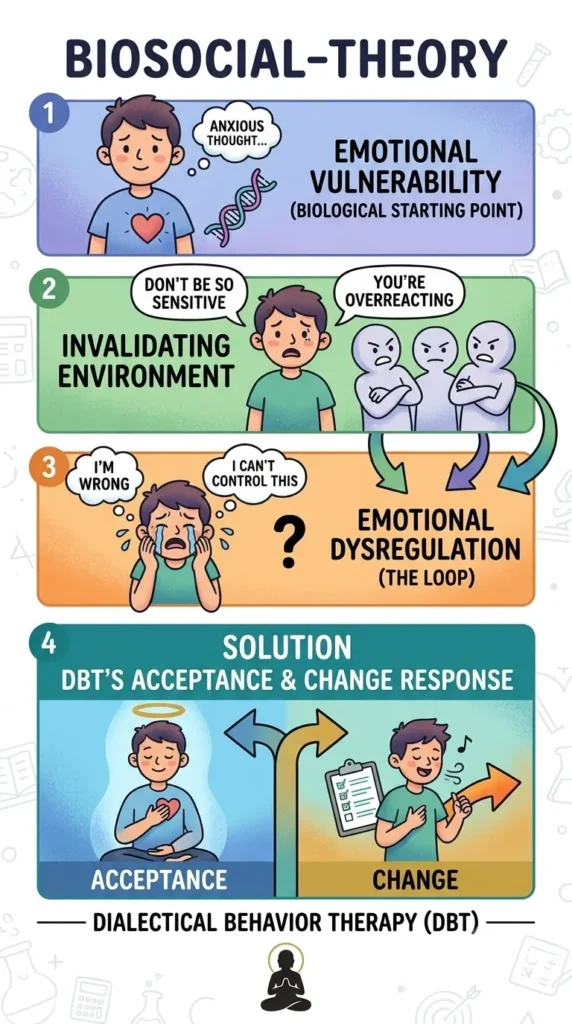
Her thinking leaned on biosocial theory. Emotional sensitivity plus an invalidating environment, the theory goes, can feed ongoing struggles with managing emotion. That’s one lens. It’s not the whole story. Not every person’s BPD traces back to the same roots.
How Does DBT Help People With Borderline Personality Disorder?
DBT helps people with BPD spot emotional triggers early. It teaches a pause before acting on an urge. Then it hands them a response that actually supports where they want to go, not just what the moment is screaming for.
It tackles emotional dysregulation. Impulsivity. Relationship strain. Self-destructive patterns. The skills work on all of it, one piece at a time.
Does it work for everyone the same way? No. A review by May, Richardi, and Barth describes DBT as a structured outpatient treatment originally developed for parasuicidal behavior in women with borderline personality disorder. Research reviews generally treat DBT as a well-established approach for BPD. Outcomes still vary person to person. That part never changes. kglmeridian
DBT information and worksheets here are educational. They’re not a stand-in for assessment or treatment from a qualified mental health professional.
How DBT Works for Borderline Personality Disorder
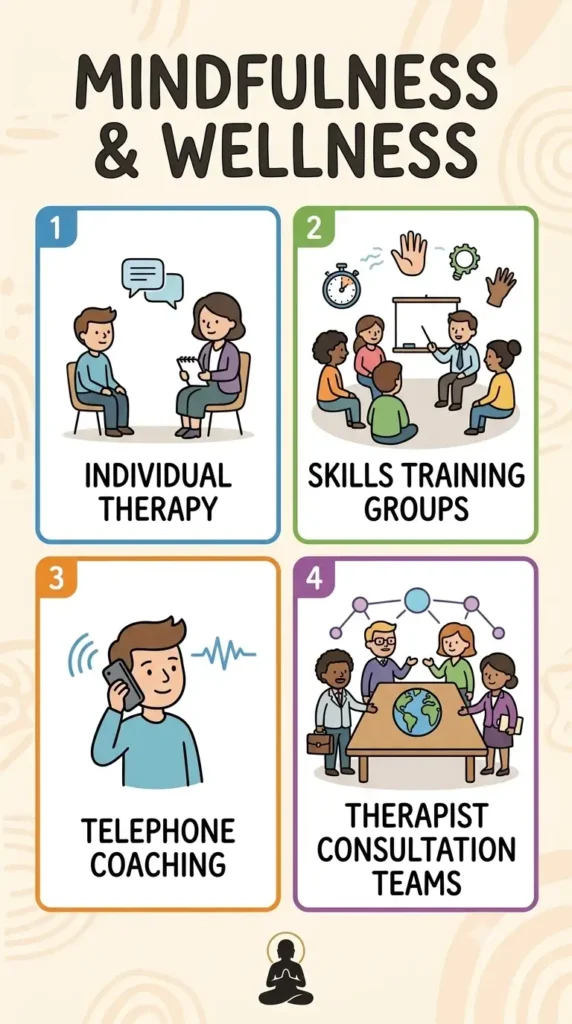
Dialectical behavior therapy (DBT) is a structured treatment for borderline personality disorder (BPD) that combines individual therapy, group skills training, between-session telephone coaching, and therapist consultation teams. These four components work together to help people manage intense emotions, build healthier relationships, and practise new behaviours in daily life.
Individual DBT Therapy Sessions
Individual DBT therapy sessions give you a private space to work with a trained therapist on personal challenges and treatment goals. You may discuss emotional triggers, relationship conflicts, impulsive behaviours, or situations that lead to distress.
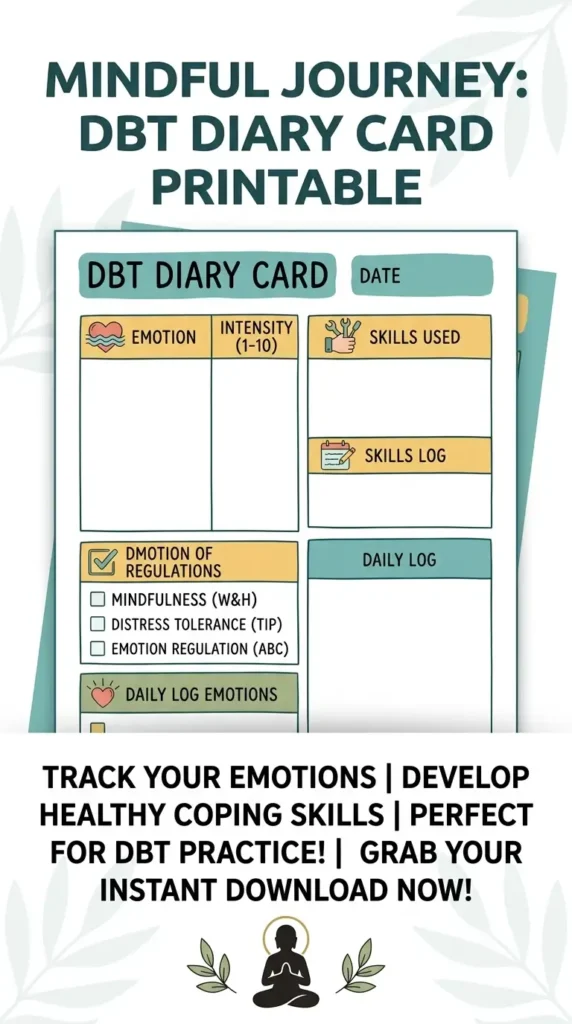
A key part of these sessions is the DBT diary card. It helps you track emotions, urges, behaviours, and the skills you use between appointments. Your therapist can review these patterns with you, identify what needs attention, and help you find more effective ways to respond.
[INTERNAL LINK: DBT diary card and skills worksheets — https://theemptyself.com/blogs/dbt-skills-worksheets/]
DBT Skills Training Groups
DBT skills training groups teach practical skills in a structured setting. Although they are often called group therapy, they work more like a class: participants learn, discuss, and practise skills rather than using the group mainly for individual processing.
The four core modules are mindfulness, distress tolerance, emotion regulation, and interpersonal effectiveness. These skills complement individual therapy. While individual sessions help you apply DBT to your personal challenges, group training gives you a broader set of tools to use when those challenges arise.
Between-Session Telephone Coaching
Between-session telephone coaching helps you use DBT skills in real-life situations, rather than waiting until your next appointment to discuss them. For example, you might contact your therapist for brief guidance when you are struggling to apply a skill during an emotionally difficult moment.
The purpose is to support skill use and encourage independence. Telephone coaching is not intended to replace emergency services or provide unlimited crisis support; therapists set clear boundaries around when and how it is available.
Therapist Consultation Teams
DBT therapists often work as part of a consultation team. These regular meetings allow clinicians to discuss treatment challenges, support one another, and stay consistent with DBT principles.
The team helps therapists maintain a balance between acceptance and change while reducing the risk of burnout. This component supports the quality and consistency of treatment, even though clients do not usually attend these meetings.
How Long Does DBT Treatment Take?
A DBT skills training cycle typically takes around six months to cover all four core modules. Some programmes repeat the cycle so participants have more time to learn and practise the skills.
Comprehensive DBT treatment often lasts a year or longer, depending on a person’s needs, treatment goals, and programme structure. The timeline varies, so six months should not be treated as a guaranteed completion point.
It is also important to understand that learning DBT skills on your own or attending a skills group alone is not the same as receiving comprehensive DBT. Comprehensive treatment includes all four components working together. A workbook or printable can support practice, but it cannot replace individualised care from a qualified DBT provider.
For a closer look at the treatment approach and its core skills, see what is DBT.
Research source: May et al. (2016), Dialectical Behavior Therapy as Treatment for Borderline Personality Disorder. Read the research review.How DBT Works for Borderline Personality Disorder
Dialectical behavior therapy for BPD is not one single technique. It’s four parts working together. Individual therapy, group skills training, phone coaching between sessions, and a consultation team behind the therapist. Each piece does something the others can’t.
Skip one part and the whole thing wobbles. That’s the honest truth about DBT for BPD. People manage big emotions. They build relationships that hold up. They practise new moves in real life, not just in the therapy room.
The Four Core DBT Skills for BPD
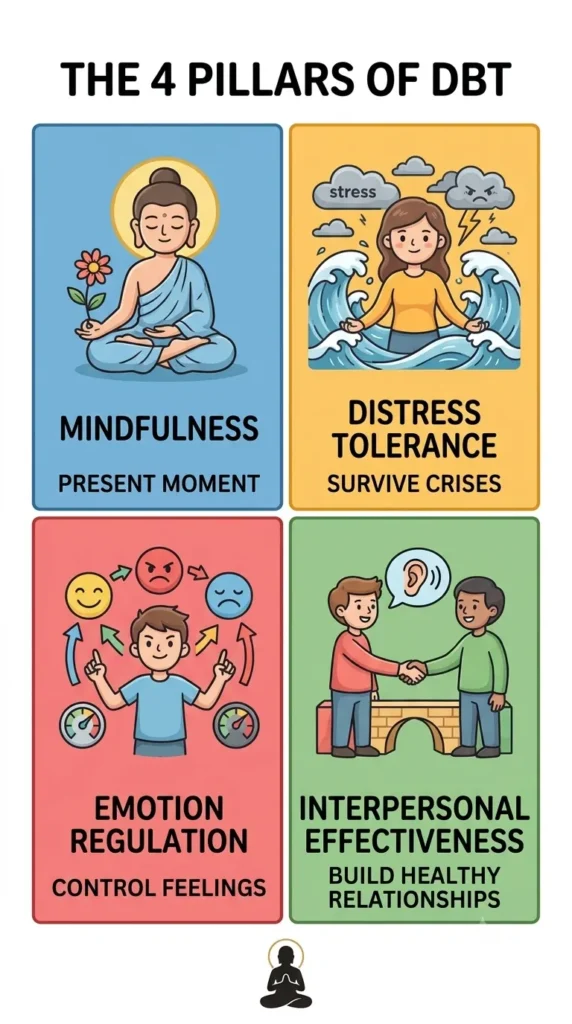
Four skills make up DBT for BPD treatment. That’s it. Not forty techniques. Just four modules, each built for a different kind of struggle. One covers the moment before you react. Another gets you through the moment itself. The third works on mood over weeks, not minutes. The last one covers people.
Most people with borderline personality disorder don’t lack intelligence or insight. They lack a gap between feeling and acting. These four skill sets exist to build that gap back.
1. Mindfulness Skills
Mindfulness isn’t sitting cross-legged for twenty minutes. Not in DBT. It’s noticing an emotion before it drives the car. A trigger hits. A thought spikes. An urge builds. Mindfulness is the half-second where you catch all three before they turn into a text you’ll regret sending.
That half-second is the whole game.
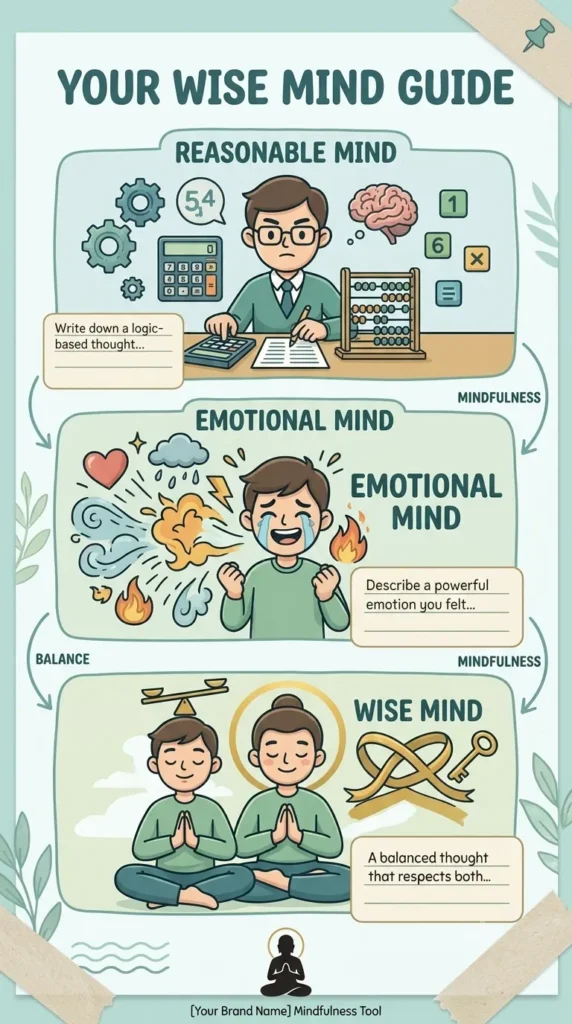
Wise Mind is the core tool here. It sits between pure emotion and pure logic, pulling from both without being ruled by either. Think of it this way: emotion mind wants to scream. Reason mind wants to pretend nothing happened. Wise mind picks the response that actually helps tomorrow-you, not just right-now-you.
Sound too simple to matter? It isn’t. The pause is the skill. Everything else sits on top of it.
Explore DBT mindfulness skills and learn how Wise Mind works when a feeling takes over fast.
2. Distress Tolerance Skills
This isn’t about fixing the crisis. It’s about surviving it without making things worse. Big difference. Distress tolerance skills for BPD are built for the ten minutes where the urge to self-harm, lash out, or flee feels unbearable.
You don’t solve a flooded house while it’s still flooding. You get out first.
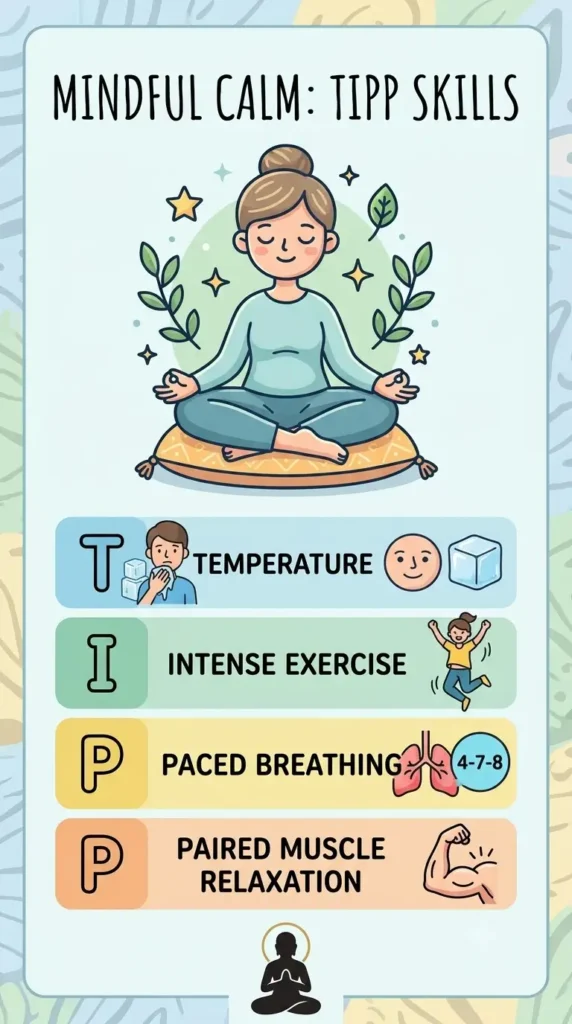
That’s the whole logic behind STOP, TIPP, and ACCEPTS. STOP interrupts the first impulsive move. TIPP changes body chemistry fast, cold water on the face, intense exercise, paced breathing, the kind of thing that resets a nervous system in minutes. ACCEPTS distracts on purpose, not to avoid the problem forever, just long enough to think straight again.
Self-soothing rounds it out. Five senses, one at a time. A candle. A blanket. A song that doesn’t match the mood but calms it anyway.
None of this fixes the underlying issue. It isn’t supposed to. It buys time until wise mind can show up.
Learn practical DBT distress tolerance skills, including the STOP skill, TIPP skill, ACCEPTS skill, and self-soothing techniques built for crisis moments.
3. Emotion Regulation Skills
Here’s an honest take: most people with BPD aren’t “too emotional.” They feel things faster, bigger, and longer than most nervous systems are built for. Emotion regulation doesn’t try to shrink that. It works on the pattern underneath it.
First step is naming the emotion correctly. Anger that’s actually hurt. Panic that’s actually grief. Get the label wrong and every coping tool after it misses the target.
Second step looks at vulnerability. Poor sleep, skipped meals, no movement all week, these stack the deck before a trigger even shows up. That’s where PLEASE comes in: treating the Physical iLlness, balancing Eating, avoiding mood-Altering substances, balancing Sleep, getting Exercise. Boring list. Works anyway.
Cope Ahead handles the stuff you can see coming. A holiday dinner with a difficult parent. A performance review. You rehearse the hard moment before it happens, so the nervous system has a script instead of a blank page.
Explore DBT emotion regulation skills, practice Cope Ahead, and see how PLEASE supports a more stable mood. An emotions worksheet also helps with naming and tracking what’s actually happening underneath the reaction.
4. Interpersonal Effectiveness Skills
Relationships are where BPD symptoms show up loudest. Fear of abandonment. Rejection sensitivity that reads a late text as proof someone’s leaving. Interpersonal effectiveness skills exist to keep a person’s voice in the room without blowing the relationship up to keep it.
That’s harder than it sounds.
DEAR MAN structures a hard ask or a boundary, so it lands without an apology attached to every sentence. GIVE keeps a relationship intact during the conversation, gentle, interested, no attacks. FAST protects self-respect once the conversation ends, no groveling, no backing down from your own values just to smooth things over.
Most advice about boundaries skips the part where you’re terrified while setting one. This doesn’t. The scripts exist because the moment itself is hard, not despite it.
Learn practical DBT interpersonal effectiveness skills and see how core DBT values guide steadier choices in relationships, paired with coping skills worksheets for working through conflict in real time.
DBT Techniques for BPD: Which Skill Should You Use?
The right skill depends on what’s happening right now. Not on what worked last week.
Some skills calm a spiking nervous system. Others help you pause before a decision you’ll regret, say what you need out loud, or sit with something you can’t fix. Think of what follows as a starting point. Not a formula.
When You Feel Overwhelmed by Intense Emotions
Emotions spike fast. Sometimes too fast to think straight.
When that happens, TIPP or STOP can help. TIPP works on the body first, cooling down physical arousal before you even try to think your way out. STOP does something different. It forces a gap between the urge and the action: stop, step back, observe, proceed.
Say a text lands and your stomach drops. Don’t answer yet. Let the wave pass before you type a single word.
When You Feel Rejected or Fear Abandonment
A late reply can feel like proof someone’s leaving. A canceled plan can feel like the end of something.
That’s where self-validation comes in. It’s not about forcing a feeling away. It’s about naming it without treating it as fact. Feeling rejected and being rejected are two different things.
Picture this: a friend goes quiet for a day. Instead of sending four follow-up messages, you notice the anxiety. You name it. You let it sit there without acting on it yet.
When You Feel an Urge to Act Impulsively
An urge hits, and your hand is already reaching for the phone.
This is exactly what STOP was built for. It inserts a pause between the impulse and the action, right when you need it most. An angry text. A sudden decision. Walking out mid-conversation. STOP buys you a few seconds to reconsider.
Had a rough meeting and want to quit on the spot? Stop. Breathe. Give the consequences a minute to catch up with the feeling.
When You Experience Anger or Emotional Outbursts
Anger doesn’t knock first. It just shows up.
STOP works here too. Once you’ve paused, notice what’s underneath: the thoughts, the tight chest, the specific thing that set it off. Too activated to talk calmly? Step away. Come back when your body isn’t running the conversation anymore.
Something like “I need a few minutes before we keep going” can do more than any perfectly worded comeback.
When You Struggle With Relationships and Communication
Saying no doesn’t come naturally to everyone. Neither does asking for help.
Interpersonal effectiveness skills exist for exactly this gap. They help you state a boundary, ask for what you need, and still respect the other person in the room. Respect goes both directions here.
Instead of agreeing to plans you dread, try naming the boundary plainly. No apology tour required.
When You Cannot Change a Painful Situation
Some things don’t move no matter how hard you push.
Distress tolerance skills help you stay steady in those moments. Radical acceptance is one of them. It means facing reality exactly as it is, not pretending it’s fine and not approving of it either. Those are different things.
You can’t undo an argument that already happened. But you can stop replaying it and ask what’s next instead.
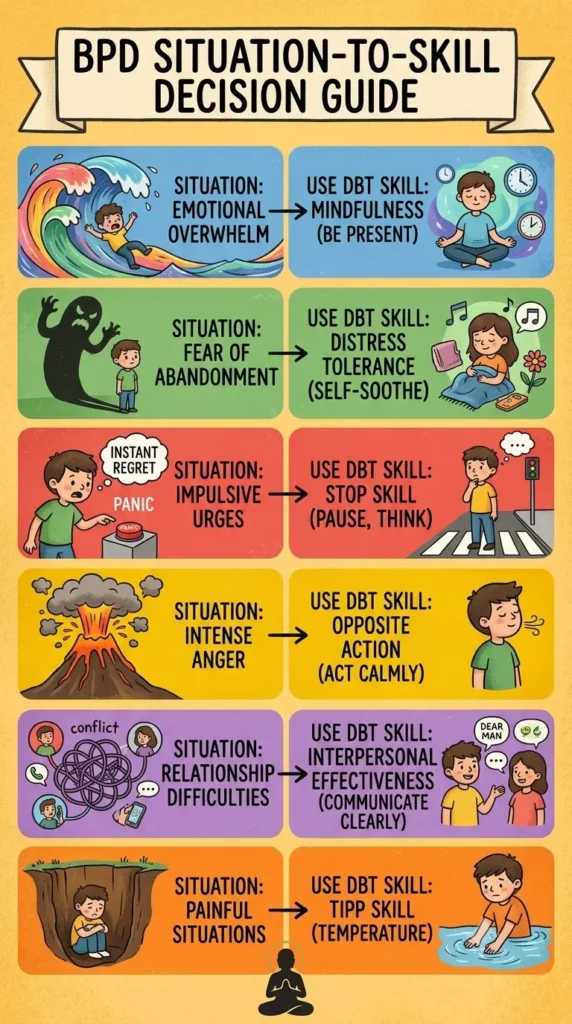
DBT Skills: A Quick Situation-to-Skill Guide
| Situation | DBT skill to try | Practical example |
|---|---|---|
| Intense emotions or emotional overwhelm | TIPP or STOP | Pause during an upsetting moment and use TIPP to manage high emotional arousal. |
| Fear of rejection or abandonment | Self-validation | Acknowledge your anxiety without assuming a delayed reply means rejection. |
| Urge to act impulsively | STOP | Pause before sending an angry message or making a sudden decision. |
| Anger or emotional outbursts | STOP and distress tolerance | Step away briefly before responding to a hurtful comment. |
| Relationship or communication difficulties | Interpersonal effectiveness | State your needs or boundaries clearly and respectfully. |
| A painful situation you cannot change | Radical acceptance | Acknowledge what happened and focus on your next available choice. |
These aren’t magic switches. They’re tools for practicing a steadier response, nothing more.
No skill here guarantees an outcome. What helps on Tuesday might fall flat on Friday, and that’s normal, not failure. With repetition and support from a qualified mental health professional, you’ll start to notice which ones actually fit your life.
How to Practise DBT Skills for BPD Step by Step
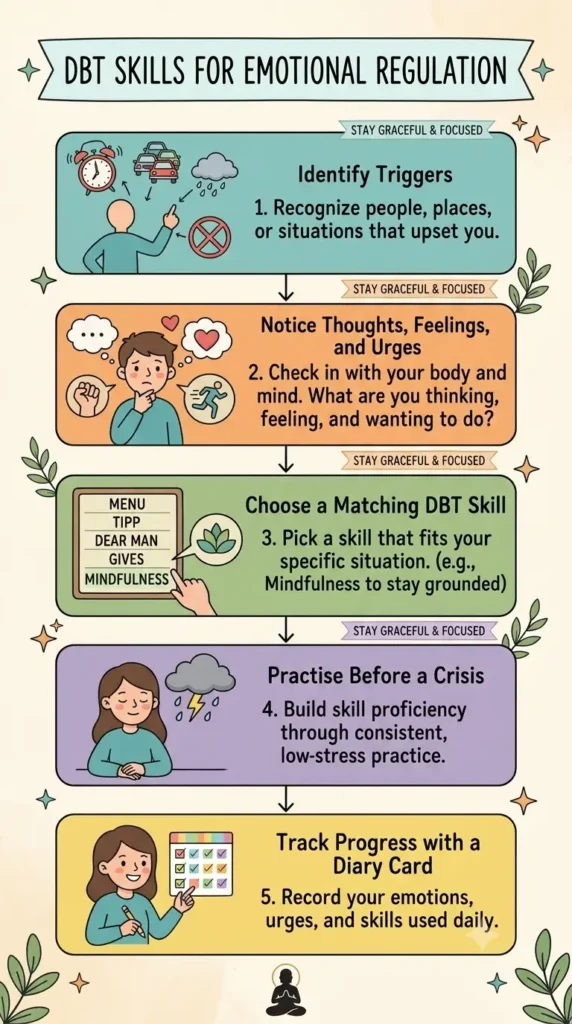
DBT for BPD is not a quick fix. It works through repetition, not insight alone. You notice what sets off intense emotions, name the thought and urge underneath, then pick a skill that actually fits the moment.
Nobody gets this right on the first try. Small, regular reps are what make dialectical behavior therapy for borderline personality disorder stick over months, not days.
Step 1: Identify Your Emotional Triggers
Start by noticing the situations that set off intense emotions. For many people with BPD, that’s feeling rejected, catching criticism, sitting inside conflict, or sensing someone might leave. Write down what happened. Who was there.
What you felt right before you reacted. That last part matters most. Patterns hide in the gap between the trigger and the reaction, and you can’t interrupt a pattern you haven’t written down yet.
Step 2: Notice Your Thoughts, Feelings, and Urges
A trigger is not the same as a thought. One is the event. The other is the story you tell about it. Say a friend doesn’t reply to your text. The thought might be “they’re ignoring me.” The feeling: anxious, maybe hurt. The urge: send four more messages in a row. Your thumb is already hovering over the screen.
That’s the moment. Naming the thought, the feeling, and the urge separately, before you act on any of them, is what creates the pause. Without that pause, the urge just drives the behavior.
Step 3: Choose a DBT Skill That Matches the Situation
Different moments call for different skills. When emotions spike fast, STOP or TIPP works better than talking it through. When you’re not sure your read on a situation is accurate, Check the Facts is the move.
When the issue is a conversation you need to have with someone, lean on an Interpersonal Effectiveness skill instead. Matching the skill to the moment, rather than reaching for whatever’s familiar, is most of what makes DBT skills for BPD effective over time.
Step 4: Practise the Skill Before an Emotional Crisis
You don’t need to wait until you’re overwhelmed to practise. That’s actually the worst time to learn something new. Rehearse during the calm stretches instead, so the skill feels familiar by the time distress shows up.
Run through mindful breathing on an ordinary Tuesday. Review the STOP steps when nothing’s wrong. Plan out how you’d set a boundary before the hard conversation happens, not during it. Skills practised cold, under real pressure, rarely hold.
Step 5: Track Your Progress With a DBT Diary Card
Most people skip tracking because it feels tedious. Here’s why it’s worth doing anyway: a pattern you don’t record is a pattern you’ll keep missing. A diary card gives you a place to log emotions, urges, behaviors, and the skills you actually tried, day by day.
After an argument, or a wave of abandonment fear, jot down the trigger, how intense it felt, what skill you reached for, and what happened next. The point isn’t grading yourself. It’s spotting what’s repeating.
Printable: Use a DBT emotional trigger and skills-practice tracker to log situations, thoughts, feelings, urges, the skill you chose, and a short reflection afterward.
Pair it with the diary card inside our free DBT skills worksheets, or combine it with an emotions worksheet if naming feelings is the part that trips you up. Working through a coping skills worksheet alongside your tracker can also help you build out a fuller BPD workbook over time, one you can return to whenever a new trigger shows up.
Does DBT Work for Borderline Personality Disorder? What Research Says
Here’s a direct answer: DBT for BPD has real research behind it. Not a cure-all. Not magic. But solid evidence, specifically for self-harm, suicidal behavior, and the emotional storms that come with borderline personality disorder (BPD).
Outcomes still vary person to person. DBT isn’t the only treatment that works for BPD, either. How much it helps depends on treatment quality, the person’s specific needs, and whether they can access consistent professional support over time. That last part matters more than most guides admit.
What Clinical Studies Say About DBT Effectiveness
Multiple clinical trials point the same direction. DBT skills for BPD reduce emotional instability. They cut down on impulsive behavior. They lower rates of self-harm. Structured DBT programs also build a person’s ability to sit with distress instead of acting on it immediately, and swap in coping strategies that actually hold up.
May and colleagues (2016) describe dialectical behavior therapy for borderline personality disorder as an evidence-based treatment, grounded in the core DBT structure and its treatment targets. Worth flagging: this is a review article, not a single clinical trial. It maps out how DBT works rather than testing it directly.
That distinction matters for reading research honestly. A review tells you what the field has learned so far. It doesn’t replace the individual trials underneath it. And not every person responds the same way, even to a well-supported treatment.
How DBT Affects Self-Harm and Suicidal Behaviours
Reducing life-threatening behavior sits at the center of DBT. That includes suicide attempts. It includes self-harm. The approach teaches people to catch emotional triggers early, build tolerance for distress, and pause before an urge turns into an action.
A 2024 systematic review by Hernandez-Bustamante and colleagues looked at 18 randomized controlled trials of DBT, covering 1,755 participants in total. The review tracked outcomes across suicidality, general psychopathology, depressive symptoms, impulsivity, and mood instability. Improvement showed up across most of those measures. The review’s authors were also clear that the underlying studies differed in method and in who they studied, so the findings need that context attached.
If you or someone else is in immediate danger, contact local emergency services right away. In the United States, the 988 Suicide & Crisis Lifeline is available by calling or texting 988. The Crisis Text Line, based in the US, can be reached by texting HOME to 741741. Outside the United States, contact your local emergency or crisis support services.
Can DBT Improve Emotional Regulation and Relationships?
This part of DBT doesn’t get the same attention as crisis skills. It should. DBT helps people name an emotion, trace what triggered it, and choose a response that won’t make things worse. The emotion regulation and interpersonal effectiveness skills work together here. Clearer communication. Firmer boundaries. Steadier responses mid-conflict.
Picture it concretely. A partner cancels plans at the last minute. The old pattern might be a flood of anger, then withdrawal for days. DBT skills for BPD give a different path: notice the emotion, check whether the story around it fits the facts, then respond instead of react.
These skills can reshape how someone handles relationships. They can’t promise that every relationship becomes stable. They can’t make emotional distress disappear either. That’s not the claim, and a guide that promises otherwise isn’t being straight with you.
What Are the Limitations of DBT Research?
DBT has a deep research base. Deeper than most therapies get. But studies still differ in method, in what they compare DBT against, in who took part, and in which outcomes they measured. Some have small sample sizes. Some struggle to separate which specific DBT component drove the improvement.
Crotty and colleagues (2024) reviewed several psychotherapies for BPD, DBT included, and found they may outperform treatment as usual. Here’s the catch. The evidence wasn’t strong enough to say one therapy beats the others. DBT holds up well. It isn’t crowned the single best option for everyone.
One more caution worth naming directly: don’t mistake remission figures from long-term BPD studies for DBT success rates. Many people with BPD see symptoms ease over time regardless of treatment type. That’s the condition’s natural course, not proof that a specific DBT trial worked.
When Should You Consider Professional Support?
Struggling with self-harm urges, suicidal thoughts, impulsive behavior, or relationships that keep breaking down? That’s worth bringing to a licensed mental health professional. Not eventually. Now. A qualified clinician can assess what’s actually going on and talk through whether comprehensive DBT, or a different evidence-based borderline personality disorder therapy, fits your situation.
Worksheets and skills exercises support learning between sessions. They’re not a substitute for individual assessment or real treatment. A BPD workbook or a printable worksheet can help someone practice a skill they’ve already learned. It can’t replace the judgment of a trained clinician, and it was never built to. If you’re at risk of harming yourself, seek urgent help. Don’t try to manage that alone with a worksheet.
DBT vs. Other Borderline Personality Disorder Therapies
DBT isn’t the only path forward for borderline personality disorder (BPD). It’s one option among several. Cognitive Behavioral Therapy (CBT), Mentalization-Based Treatment (MBT), and Schema Therapy all target the same patterns from different angles. Each one uses its own methods, focuses on different pieces of the puzzle, and helps people manage emotions and relationships in its own way.
DBT vs. Cognitive Behavioral Therapy (CBT)
Both DBT and CBT help people change thought and behavior patterns that aren’t serving them. That’s where the overlap ends. DBT leans harder into emotional regulation, distress tolerance, and acceptance.
Traditional CBT works by questioning thoughts. It helps people spot the beliefs driving their feelings and actions, then challenge them. For anxiety, depression, and the negative beliefs that feed emotional distress, this approach holds up well.
DBT takes those same behavioral and cognitive tools and builds on them. It adds something CBT doesn’t emphasize as much: specific skills for managing intense emotions, getting through a crisis, and repairing relationships.
It also holds acceptance and change together at the same time. That balance matters most for people whose emotional reactions run hot or whose urges feel impulsive and hard to slow down.
DBT vs. Mentalization-Based Treatment (MBT)
MBT works on a different problem entirely. It helps people understand their own thoughts and feelings, and just as important, the thoughts and feelings of others. The goal is recognizing that behavior, yours and everyone else’s, comes from mental states that aren’t always visible on the surface.
That makes MBT useful for untangling relationship conflicts, misread signals, and the sharp reactions that show up after perceived rejection. DBT takes a more structured route. It hands people a toolkit of skills for responding to distress and managing hard moments as they happen.
Neither approach wins outright. Both can support someone with BPD, just through different mechanisms. And the research comparing them doesn’t crown one as universally better. It depends on the person.
DBT vs. Schema Therapy
Schema Therapy digs into something older. It identifies deep-rooted beliefs and emotional patterns, often formed in childhood, and works to change them. These patterns, called schemas, shape how someone sees themselves, reacts to others, and navigates relationships.
DBT stays closer to the present. It focuses on building practical skills: managing emotions, tolerating distress, and responding well to whatever the day throws at someone. Schema Therapy, by contrast, spends more time tracing where the recurring difficulties actually started.
Neither is more “correct.” They’re just aimed at different layers of the same problem.
How to Choose a Suitable Treatment Approach
No single therapy works best for every person with BPD. That’s not a hedge. It’s what the evidence actually shows. A 2017 meta-analysis by Cristea and colleagues reviewed 33 trials of psychotherapies for BPD, and Barnicot and Crawford’s 2018 research examined DBT and MBT specifically.
These studies add to the evidence base. They don’t settle the question for any one individual. Treatment choice still comes down to personal needs, preferences, symptoms, and access to a therapist trained in the method.
A qualified mental health professional can help sort through the options. Ask about their experience treating BPD. Ask how the program is structured. Ask how they’ll track progress over time.
Before that conversation, it helps to understand the basics of what you’re walking into. You can read more in what is DBT, and if you want to start practicing skills directly, the DBT skills worksheets are a solid place to begin.
| Therapy | Main Focus |
|---|---|
| DBT | Emotional regulation, distress tolerance, mindfulness, and relationship skills |
| CBT | Identifying and changing unhelpful thoughts and behaviors |
| MBT | Understanding your own and other people’s mental states |
| Schema Therapy | Changing deep-rooted beliefs and emotional patterns |
Research references: Cristea et al. (2017), JAMA Psychiatry; Barnicot & Crawford (2018), Psychological Medicine.gical Medicine.
Free DBT Worksheets and Printables for BPD
A weekly session isn’t where DBT skills get built. It’s where they get checked. DBT for BPD works the same way. Practice happens between appointments, not during them. Free DBT worksheets and printables give adults with borderline personality disorder a way to rehearse dbt skills for bpd on an ordinary afternoon, not just inside a therapist’s office.
NIMH lists dialectical behavior therapy for borderline personality disorder among the better-studied borderline personality disorder therapies available right now. That matters, but a worksheet still isn’t the treatment itself. Use it as practice. Pair it with real support. Don’t swap one for the other.
Mindfulness and Wise Mind Worksheets
Intense feelings don’t leave much room to think. Mindfulness worksheets build that room back. They train you to notice a thought, an emotion, or a physical sensation without reacting to it right away.
Wise Mind sits at the center of this module. It asks you to hold emotion and logic side by side before deciding anything. Not one or the other. Both.
Why does that matter here specifically? Emotions can spike fast with BPD, and a decision made mid-spike rarely ages well. A mindfulness skills worksheet slows that moment down enough to actually choose. Pair the practice with these mindfulness journal prompts for more reflective writing.
Distress Tolerance Worksheets
Some moments can’t be fixed on the spot. Distress tolerance worksheets aren’t trying to. The goal is smaller: get through the moment without making it worse.
These are core dbt techniques for bpd work, especially during a crisis. STOP interrupts the urge to react first and think later. TIPP brings the body’s emotional intensity down before anything else can happen. ACCEPTS offers temporary distractions for when the pain is too loud to sit with directly.
Start with the DBT STOP skill worksheet, the DBT TIPP skill worksheet, or the ACCEPTS skill worksheet to see how each one works. For the full module, the distress tolerance skills guide covers what comes next.
Emotion Regulation Worksheets
Emotion regulation worksheets ask a different question. Not “how do I survive this,” but “what’s actually driving this feeling, and does it fit the facts.”
Patterns show up here too. A worksheet can help you catch a trigger before it fully lands, and notice what tends to push your mood off balance in borderline personality dbt work specifically.
The PLEASE skill is a solid starting point. It’s physical, not emotional. Eat. Sleep. Move. Treat illness. Skip the substances that make regulation harder. Basic stuff, but basic stuff gets skipped constantly. Explore the DBT PLEASE skill worksheet for a guided version, or the full emotion regulation skills module for everything else.
Interpersonal Effectiveness Worksheets
Conversations get harder when fear of rejection is already loud in the background. Interpersonal effectiveness worksheets exist for exactly that gap.
They walk you through asking for something, holding a boundary, or handling conflict without losing the relationship or your own self-respect. Use one to prep before a hard conversation. Use another afterward to look back at how it actually went.
That prep work matters more than people expect. See the full interpersonal effectiveness skills module for the complete set.
DBT Diary Card and Emotional Tracking Worksheet
A DBT diary card isn’t complicated. Emotions, urges, behaviors, skills used. Write it down through the week instead of trusting memory to sort it out later.
That record does the heavy lifting. A pattern that feels invisible day to day gets obvious once it’s on paper, and that makes the conversation with your therapist sharper too.
Looking for a complete bpd workbook pdf to work through at your own pace? The full DBT skills worksheets library covers every module above in depth, with printable tools built around all four core DBT modules.
Conclusion
DBT offers practical skills to help people with BPD understand intense emotions, manage distress, and build healthier relationships. Progress takes time, and learning these skills does not mean you have to handle every challenge alone. Working with a trained DBT therapist can help you apply the techniques safely and consistently.
Free DBT worksheets and printables can also support your practice between sessions, helping you track triggers, recognise patterns, and notice small improvements. You do not need to master every skill at once. Start with one manageable step, practise regularly, and keep building a life that feels more stable and meaningful.
Frequently Asked Questions
Is DBT the best therapy for borderline personality disorder?
Dialectical behavior therapy (DBT) is one of the most researched and widely used treatments for borderline personality disorder (BPD).
It can help people manage intense emotions, reduce harmful behaviours, and improve relationships. However, no single therapy works best for everyone. Treatment choice should reflect a person’s needs and preferences.
How long does DBT take to work for BPD?
DBT is a gradual process, and progress varies from person to person. A standard skills-training cycle often takes around six months, while comprehensive DBT treatment may continue for a year or longer. Some people notice changes earlier, but lasting improvement usually requires consistent practice and support.
Can you practise DBT for BPD on your own without a therapist?
You can practise DBT skills independently using workbooks, worksheets, and exercises. These resources can help you build mindfulness, distress tolerance, emotion regulation, and communication skills.
However, self-guided practice is not a substitute for comprehensive DBT, especially if you experience self-harm urges, suicidal thoughts, or severe emotional distress.
What are the four main DBT skills for borderline personality disorder?
The four core DBT skill modules are mindfulness, distress tolerance, emotion regulation, and interpersonal effectiveness. Together, they help people notice emotional experiences, cope with difficult situations, manage intense feelings, and communicate more effectively. A DBT programme teaches these skills through structured practice and real-life application.
Does DBT help with fear of abandonment and unstable relationships?
DBT can help people manage the intense emotions and reactions associated with fear of abandonment and relationship difficulties. Interpersonal effectiveness teaches communication and boundary-setting, while emotion regulation and distress tolerance help people respond to rejection or conflict without acting on every emotional urge.
Can borderline personality disorder go into remission with DBT?
Some people with BPD experience substantial symptom improvement over time, and many can build stable, fulfilling lives. DBT may support this progress by teaching practical coping and relationship skills. However, outcomes vary, and research does not support promising a particular remission rate from DBT alone.

It’s Bhaskar!
Well, I am not a psychologist a monk, or a philosopher by training. I’m just an engineering graduate.
‘The Empty Self’ is where I write about that idea, and what it actually means for ordinary life, anxiety, identity, habits, the stories we tell ourselves about who we are. I don’t have a psychology degree, and I’m not offering therapy or clinical advice. What I do have is thought and clarity, and genuine curiosity about why we suffer the way we do and how much of it might loose once we shed this ‘fixed identity’.
Pingback: DBT for Teens & Adolescents: All You Need to Know With Free Printables | The Empty Self