
Anxiety can turn a five-minute decision into an hour of circling thoughts. You rehearse conversations that haven’t happened yet. You brace for conflict that never shows up. Then stress builds, and calming your mind feels impossible.
That’s where DBT for anxiety comes in. Dialectical Behavior Therapy was built to help people manage intense emotions, ride out distress, and meet anxious thoughts with something steadier than panic.
DBT started as a treatment for people in serious emotional crisis, not everyday worry. Severe difficulties. That was the original target. But plenty of its skills carry over to regular anxiety too.
This guide covers how DBT for anxiety actually works, which dbt skills for anxiety are worth practicing, and how free DBT worksheets can turn those skills into daily habits.
Quick Overview: DBT for anxiety leans on four skill sets, mindfulness, distress tolerance, emotion regulation, and interpersonal effectiveness, to help you respond to anxious thoughts instead of getting swept up in them. These tools make hard moments easier to manage. They won’t cure anxiety outright. Nothing does.
Table of Contents
Disclaimer
This blog is written and edited with the help of AI, then reviewed by me before publishing. As a result, the content is for general reflection only, not therapy or medical advice, and I’m not a licensed mental health professional. If you’re in crisis, please contact 988 if you’re in US or a local crisis service of your country instead of relying on this site.
DBT for Anxiety: What It Is and How It Helps
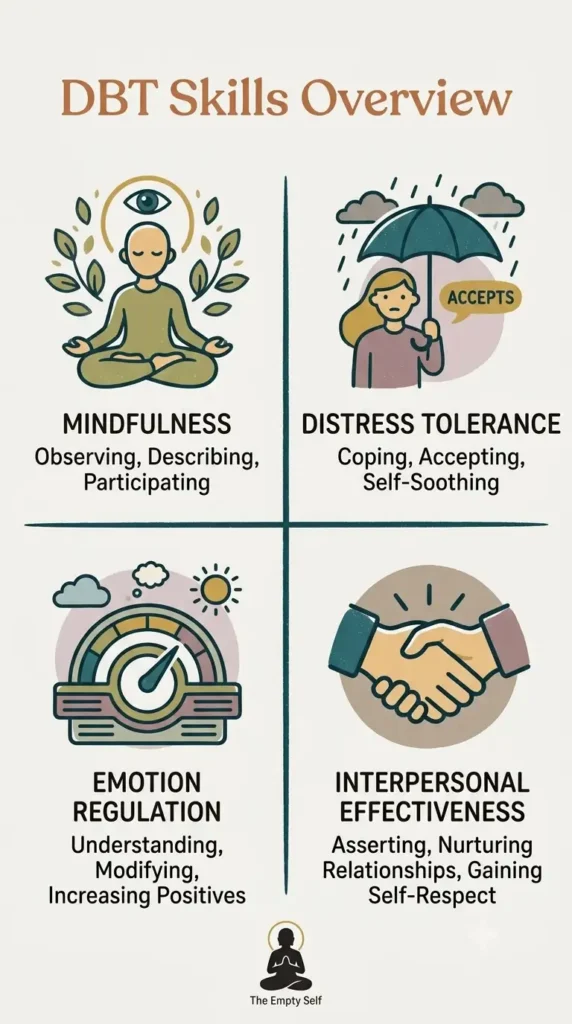
DBT for anxiety leans on four skill sets: mindfulness, distress tolerance, emotion regulation, and interpersonal effectiveness. Worry doesn’t vanish. You just stop letting it drive every move. DBT can support anxiety management. It isn’t proven better than every other treatment for every anxiety disorder, though. That claim goes too far.
What Is DBT?
Dialectical behavior therapy, or DBT, is structured. It teaches people to manage emotions, sit with distress, stay present, and say what they need out loud. Acceptance on one side. Change on the other. DBT holds both at once.
Psychologist Marsha M. Linehan built DBT, and most people know it for treating borderline personality disorder. That’s its roots. But the skills travel further than that one diagnosis. Anyone wrestling with intense emotional reactions, anxiety included, can put them to use. Curious what DBT actually involves session by session? This guide on what DBT is breaks it down further.
How Does DBT Help With Anxiety?
Uncertainty feels dangerous when you’re anxious. Even when nothing is actually wrong. That’s the trap. DBT skills teach you to notice an anxious thought without chasing it down every rabbit hole it offers. Tolerate the discomfort. Then pick a response instead of reacting on autopilot.
Anxiety disorders aren’t rare. Far from it. The National Institute of Mental Health tracks how common they are among U.S. adults, along with more background on the different types.
DBT won’t erase every anxious thought you have. Nobody’s promising that. What it does instead is build skills for carrying anxiety without handing it the wheel.
Is DBT Good for Anxiety?
Here’s an honest take: DBT might help with anxiety, but the evidence backing that up is still thin. A 2022 randomized trial followed 72 adults with generalized anxiety disorder. Both DBT and CBT groups saw anxiety and depression symptoms drop.
CBT edged out DBT on symptom reduction specifically. The same trial also looked at executive functioning gains, which added another layer to what the researchers were measuring.
Sound like a win for DBT? Not quite. The trial was small. It drew from one specific population in Iran. And it only looked at generalized anxiety disorder, not the full range of anxiety conditions. One study doesn’t settle much on its own.
One more thing worth flagging here. An earlier, frequently cited study on DBT versus CBT, this one with 68 participants, was later retracted. That study had reported DBT pulling ahead of CBT specifically in mindfulness and emotion regulation.
The retraction means that particular finding shouldn’t be treated as solid ground. You can read more about the retracted study’s original claims on Springer’s site, with that context in mind.
So where does that leave you? DBT is worth exploring, especially if intense emotions, distress, or trouble sitting with uncertainty are tangled up in your anxiety. Not everyone’s anxiety looks like that, though. A qualified mental health professional can help you sort out whether DBT, CBT, or something else actually fits what you’re dealing with.
The Four Core DBT Skills for Anxiety
DBT breaks down into four skill sets for anxiety. Each one tackles a different piece of the cycle. Racing thoughts. Tight shoulders. The urge to cancel plans and hide. Even the hard conversation you’ve been avoiding for weeks.
That’s the whole appeal of DBT for anxiety. You don’t need one magic fix. You need four different tools, used in the moment they’re actually built for.
Mindfulness: Notice Anxiety Without Getting Swept Away
Anxiety drags your attention into tomorrow. What might go wrong. What someone really meant by that text. What you should have said differently an hour ago. Mindfulness pulls you back to right now.
It teaches you to notice thoughts, feelings, and body sensations. Not react to them on autopilot. It’s one of the simplest DBT skills for anxiety to start practicing today.
Picture the thought: “something terrible is going to happen.” Instead, try naming it: “I’m having a worried thought, and my chest feels tight.” That’s it. Sound too simple? It works anyway. You don’t have to force the thought away. You don’t need to convince yourself everything will be fine either. The goal is simpler: observe first, decide what to do next.
Practice this enough and anxious thoughts stop feeling like facts. They start feeling like thoughts again, loud but not true. Explore DBT mindfulness skills for exercises you can use today. Or learn how Wise Mind balances emotional reactions with reason.
Distress Tolerance: Get Through an Anxious Moment
You can’t solve a problem mid-panic. Distress tolerance skills aren’t about solving anything right away. They’re about getting through an anxious moment without making it worse. That’s the whole job.
DBT’s TIPP skill uses four tools: Temperature, Intense exercise, Paced breathing, and Paired muscle relaxation. Together they bring down intense emotional arousal fast. Cold water is the tricky one. It can shift your heart rate and other body responses.
That means it isn’t right for everyone. Skip ice-water immersion or extreme cold exposure if you have a heart condition. Same goes for other relevant medical concerns. Not sure? Ask a healthcare professional first. This is one of those DBT techniques for anxiety that genuinely needs that caution attached.
Read more on the DBT TIPP skill, or try self-soothing skills for a gentler way to cope. For the full picture, see DBT distress tolerance skills.
Emotion Regulation: Understand What Fuels Your Anxiety
Anxiety isn’t random, even when it feels that way. Emotion regulation skills help you spot the pattern behind it. Then you respond in ways that fit your real goals. Opposite Action is the skill for when anxiety says avoid something that matters. Fear says cancel the plan. You take one small, safe step toward it instead.
Explore DBT emotion regulation skills and Cope Ahead to prepare for stressful situations before they hit. You can also learn Opposite Action in more depth. One thing to remember: real danger calls for protection, not exposure.
Interpersonal Effectiveness: Handle Anxiety in Relationships
Anxiety makes asking for help feel risky. It’s still a skill you can learn. Setting a boundary. Saying what you actually disagree with. Interpersonal effectiveness skills teach you to say it clearly. No steamrolling the other person. No losing yourself either.
The DBT DEAR MAN technique gives you structure for making requests and raising concerns. Even when your hands are shaking. Practise it through DBT interpersonal effectiveness skills, or walk through the DEAR MAN steps one at a time.
DBT Techniques for Anxiety: Which Skill Should You Try?
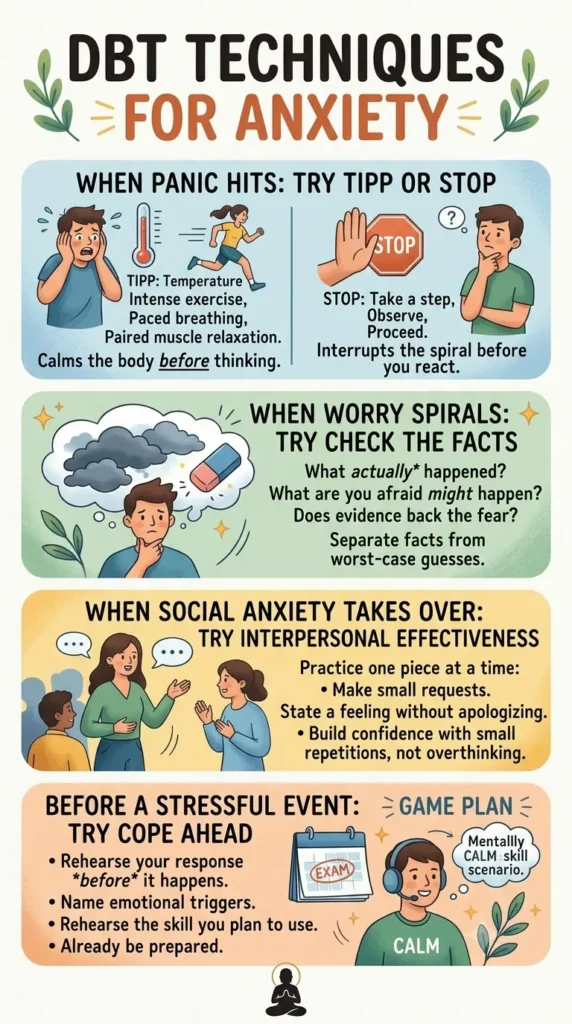
DBT for anxiety isn’t one skill. It’s a toolbox. The right tool depends on what’s actually happening right now. A panic spike calls for something different than a worry loop. A hard conversation calls for something different than both.
TIPP steps in when panic takes over the body. Check the Facts steps in when the mind won’t stop guessing. Interpersonal effectiveness handles the social stuff. Cope Ahead gets you ready before the dread even starts.
When Panic Hits: Try TIPP or STOP
Panic doesn’t ask permission. It shows up mid-meeting, mid-drive, mid-anything. Clear thinking goes first. The TIPP skill exists for exactly that moment. It uses temperature, intense exercise, paced breathing, and paired muscle relaxation to bring the body’s arousal down before you try to think your way out of anything. Pick whatever is safe for your own health and fitness level. Not every approach suits every body.
Need to interrupt the spiral before you react? STOP helps there. Stop. Take a step back. Observe what’s actually happening. Then proceed, deliberately, instead of on autopilot. One pause. A different outcome.
Walk through the exact steps in the DBT TIPP Skill guide, or get the slower, structured version in the DBT STOP Skill breakdown.
When Worry Spirals: Try Check the Facts
Worry doesn’t deal in facts. It deals in worst-case guesses dressed up as certainty. Check the Facts pulls the two apart. What actually happened? What are you afraid might happen next? Write both down and the gap gets obvious fast.
Ask what evidence backs the fear. Ask what evidence points the other way. Then ask one more question. Does the emotional reaction fit the facts in front of you, or is it running on a story your mind built on top of them? That’s the whole exercise.
The Check the Facts worksheet walks through it step by step, with an example you can borrow for your own situation.
When Social Anxiety Takes Over: Try Interpersonal Effectiveness
Social anxiety isn’t really about looking foolish. It’s about losing your own voice in the room. Fear of judgment. Trouble saying no. Replaying a conversation hours later, picking apart every word. Interpersonal effectiveness skills target all three.
Practice one piece at a time. Make a small request without over-explaining it. State a feeling without apologizing for having it. Small reps, repeated, build the kind of confidence that overthinking never will.
The DBT Interpersonal Effectiveness Skills guide breaks the module down further, with scripts for the conversations that usually feel hardest.
Before a Stressful Event: Try Cope Ahead
Stress loves surprises. Cope Ahead takes that away. An exam, an appointment, a conversation you’ve been dreading for weeks. Cope Ahead lets you rehearse your response before any of it actually happens.
Picture the situation first. Name the emotional triggers you expect to hit. Then rehearse, in your head, the skill you plan to use when they show up. By the time the real moment arrives, you’ve already been through it once.
See the full Cope Ahead DBT guide for a step-by-step planning template.
How to Practise DBT Skills for Anxiety Step by Step
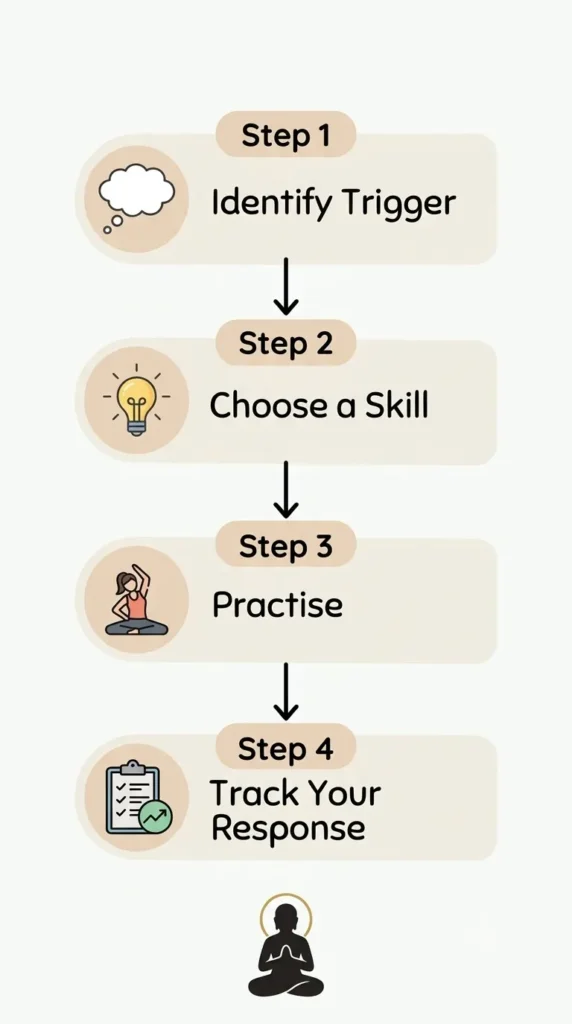
DBT for anxiety works as a routine, not a single trick. Notice the trigger. Pick a skill that fits the moment. Practise it. Track what happens. That loop is the whole method, and it gets easier with repeats.
Step 1: Identify Your Anxiety Triggers
Start by watching for when anxiety shows up. Before an exam? Mid-conversation? Walking into a room full of strangers? Sometimes it’s just a worry about something that hasn’t happened yet.
Write it down. What happened, what you felt, how intense it got. A number from 0 to 10 works fine.
Patterns matter more than any single entry. One anxious Tuesday tells you little. Ten entries start to show a shape. No judgment required here, just notice.
Step 2: Choose a DBT Skill That Fits the Moment
Match the skill to what the moment actually needs. Different anxiety calls for different tools. Guessing wastes energy you don’t have to spare.
Panic that feels like too much, too fast? Reach for a distress-tolerance skill like STOP or TIPP. TIPP uses cold water and paced breathing to bring intensity down fast. Go gently with any temperature-based technique. Check with a doctor first if you have a heart condition. Or another reason cold exposure isn’t safe for you.
Is the worry built on a story rather than a fact? Check the Facts slows that down. You separate what actually happened from what your mind added on top.
Got an event coming up that already has your stomach in knots? Rehearse it ahead of time with Cope Ahead. Picture the trigger, pick the skill, picture yourself using it well.
These aren’t the only tools available. Our free DBT skills worksheets library covers the full set. It’s organised by module, so you’re not stuck guessing which page applies.
Step 3: Practise the Skill and Track Your Response
Try the skill for a few minutes. Then stop and notice.
Anxiety might drop right away. It might barely move. Sometimes it takes longer to settle, and that’s still useful information. Even a flat response tells you something about what works for you.
Practising DBT exercises for anxiety only pays off if you track what happens afterward. A simple tracker makes that visible. Trigger, anxiety level, skill used, outcome, that’s the whole format.
Our DBT Diary Card section inside the worksheets guide is a solid starting point. Use it if you want a ready-made layout.
Printable resource note: Add a downloadable, one-page anxiety trigger and skill-practice tracker once the PDF is ready. Host it using the same PDF-upload pattern as the site’s existing DBT worksheets, and place the download link directly below this section’s instructions.
DBT vs. CBT for Anxiety: What Is the Difference?
Both DBT and CBT help with anxiety. They just attack it from different angles.
CBT works on the thoughts. Find the distortion, test it against the facts, change the behavior underneath it. Dialectical behavior therapy for anxiety takes a wider net. It pairs acceptance with change, and leans hard on mindfulness, distress tolerance, and emotion regulation. Not either-or. Both at once.
Which one fits you? That depends on what you’re actually dealing with, and what a therapist thinks will move the needle fastest.
How Do DBT and CBT Differ?
CBT is a thought-first approach. You name the anxious thought, check it against the evidence, then shift the behavior that’s been keeping it alive. Gradual exposure often comes with it. Structured homework too.
DBT for anxiety works differently. It teaches you to sit with distress instead of fighting it. Observe a thought without grabbing it. Ride out an intense emotion instead of letting it drive. That matters most when anxiety spikes fast and pushes you toward something impulsive.
Neither one is the “correct” choice on paper. Both hand you real, practical tools. A therapist trained in both can help you figure out which skill set, or which blend, actually fits your situation.
For a deeper breakdown of specific skill families, this guide to DBT techniques walks through each one. Pairing that with an emotions worksheet can help you name what you’re feeling before choosing a skill at all.
What Does Research Say About DBT vs. CBT for Anxiety?
Here’s one trial worth knowing about. A randomized controlled trial out of Iran enrolled 72 adults diagnosed with generalized anxiety disorder and split them between 16 sessions of CBT and 16 sessions of DBT. Both groups improved. That part’s not in question.
Where they split is more interesting. CBT produced a bigger drop in anxiety and depression symptoms, while DBT came out ahead on executive-function measures, including cognitive flexibility and problem-solving. Two different therapies, two different kinds of wins.
Is DBT good for anxiety, then? Partly. The study doesn’t crown one treatment the winner across the board. One trial, 72 people, one country. That’s a start, not a verdict. And it says nothing about whether DBT beats CBT specifically for improving mindfulness or emotion regulation. A single study can’t carry that kind of claim.
DBT skills for anxiety still lean heavily on mindfulness and emotion regulation, and that combination tends to help when anxiety already feels unmanageable. Worth remembering: this doesn’t mean DBT works for every anxiety disorder. It means it worked for one group, under one protocol, in one trial.
Want the wider lens? The American Psychiatric Association’s overview of psychotherapy walks through how different therapy models approach mental health care generally.
For hands-on practice with the skills themselves, the DBT distress tolerance and DBT emotion regulation modules are the two that show up most often in anxiety work, and both sit inside the full DBT skills worksheets library if you want to try them yourself.
Does DBT for Anxiety Work? What the Research Says
Dialectical behavior therapy (DBT) may help people manage anxiety by building mindfulness, distress tolerance, and emotion regulation skills. However, research specifically on DBT for anxiety is still limited. Early findings are promising, but DBT has not been shown to outperform established anxiety treatments in every measure.
What Research on DBT and Generalized Anxiety Suggests
A randomized controlled trial involving 68 participants in Iran compared DBT with cognitive behavioral therapy (CBT) for generalized anxiety disorder (GAD). The findings were mixed: CBT produced greater reductions in anxiety and depression symptoms, while DBT led to larger improvements in emotion regulation and mindfulness. This suggests DBT may offer useful skills, but it does not establish that DBT is more effective than CBT for anxiety.
The study also had important limits. Its sample was small, participants came from one country, and the research focused on GAD rather than anxiety disorders as a whole. More research is needed before drawing broad conclusions about dialectical behavior therapy for anxiety.
Anxiety disorders can affect daily life, relationships, sleep, and concentration. The National Institute of Mental Health (NIMH) provides current information on their prevalence and impact.
When to Consider Professional Support
A DBT workbook can help you practise coping skills, but consider professional support if anxiety regularly disrupts your sleep, relationships, work, studies, or daily routines. A qualified mental health professional can help you decide whether DBT, CBT, medication, or another approach fits your needs.
If you are in emotional crisis in the United States, call or text 988 to reach the 988 Suicide & Crisis Lifeline. You can also text HOME to 741741 to connect with Crisis Text Line.
DBT can be a useful part of anxiety management, particularly when intense emotions make coping harder. The key is to treat current research as encouraging but limited, and choose support based on your individual needs.
Free DBT Worksheets and Printables for Anxiety
Free DBT worksheets can help you turn anxiety-management skills into practical exercises you can use in daily life. These resources cover mindfulness, distress tolerance, and emotion regulation, giving you a structured way to practise skills when worry or stress feels overwhelming.
Mindfulness and Wise Mind Worksheets
Mindfulness helps you notice anxious thoughts without automatically reacting to them. Explore our DBT Wise Mind exercises and DBT mindfulness skills to practise observing thoughts and returning your attention to the present.
Distress Tolerance Worksheets: TIPP and STOP
When anxiety feels intense, distress tolerance skills can help you pause before reacting. Learn how to use the DBT TIPP skill and the DBT STOP skill to manage difficult moments and choose your next step more deliberately.
Emotion Regulation and Check the Facts Worksheets
Anxiety can make a feared outcome feel certain, even when the evidence is unclear. Explore DBT emotion regulation skills, practise Check the Facts, or use our emotions worksheet to identify feelings and examine what may be driving them.
Anxiety Practice Tracker
Use an anxiety practice tracker to record your triggers, the DBT skill you tried, and what happened afterward. Reviewing these notes can help you recognise patterns and identify which skills you want to practise more often.
Explore More Free DBT Skills Worksheets
Visit our free DBT skills worksheets collection for additional exercises and printable resources covering the core DBT modules.
Conclusion
DBT for anxiety offers practical ways to respond to worry, panic, and overwhelming emotions without letting them dictate your next move. Skills such as mindfulness, distress tolerance, emotion regulation, and interpersonal effectiveness can help you face difficult moments with greater awareness and control.
You don’t need to master every technique at once. Start with one skill, practise it during manageable situations, and notice what works for you. For more structured practice, explore our free DBT skills worksheets. If anxiety regularly disrupts your daily life, consider working with a qualified mental health professional to find the right support.
Frequently Asked Questions
Can DBT help with anxiety?
Yes, Dialectical Behavior Therapy (DBT) may help people manage anxiety by teaching mindfulness, distress tolerance, and emotion regulation skills.
Research on DBT for anxiety is still developing, and evidence varies by condition. A mental health professional can help determine whether DBT fits your needs.
What is the best DBT skill for anxiety?
The most useful DBT skill depends on what you experience. Mindfulness can help you notice anxious thoughts without getting caught up in them, while distress tolerance skills can help you manage intense feelings. Cope Ahead may be useful when you feel anxious about an upcoming situation.
How do you use DBT skills during an anxiety or panic attack?
Start by noticing what is happening without judging yourself. Try grounding your attention in the present, slowing your breathing if comfortable, or using a distress tolerance skill to get through the immediate wave of anxiety. If symptoms are new, severe, or feel medically concerning, seek medical help.
Is DBT better than CBT for anxiety?
Not necessarily. Cognitive Behavioral Therapy (CBT) has an established evidence base for anxiety disorders. A study comparing DBT and CBT for generalized anxiety disorder found greater symptom reductions with CBT, while DBT showed stronger gains in emotion regulation and mindfulness. The best approach depends on individual needs and treatment goals.
How does Opposite Action help with anxiety?
Opposite Action involves choosing a behavior that counters an emotion’s unhelpful action urge when that emotion or its intensity does not fit the facts.
For anxiety, this may mean taking a manageable step toward a safe situation you have been avoiding. Learn more in the DBT Opposite Action section.
Where can I find free DBT worksheets for anxiety?
You can start with the free DBT skills worksheets. It covers core DBT skills that may support anxiety management, including mindfulness, distress tolerance, and emotion regulation. Choose worksheets that match the skill you want to practise, and work through them at a manageable pace.
It’s Bhaskar!
Well, I am not a psychologist a monk, or a philosopher by training. I’m just an engineering graduate.
‘The Empty Self’ is where I write about that idea, and what it actually means for ordinary life, anxiety, identity, habits, the stories we tell ourselves about who we are. I don’t have a psychology degree, and I’m not offering therapy or clinical advice. What I do have is thought and clarity, and genuine curiosity about why we suffer the way we do and how much of it might loose once we shed this ‘fixed identity’.