
Depression doesn’t always show up as sadness. Sometimes it’s just… nothing. A flat, gray version of your week where even small tasks feel heavy. DBT for depression offers something concrete for that. Not a pep talk. Real skills.
Dialectical behavior therapy was built around four skill sets: mindfulness, distress tolerance, emotion regulation, and interpersonal effectiveness. Four modules. Four different jobs. Together they cover a lot of ground. Respond to a hard thought instead of spiraling with it. Ride out a wave of feeling too big to sit with. Take one small step toward something that matters, even on a slow day.
Here’s an honest take: DBT for depression won’t replace therapy. It’s not a cure, and nobody should treat it like one. What it can do is sit alongside other treatment and give you something to actually practice between sessions. That’s the real value.
This guide walks through how DBT skills for depression work in practice, when to reach for which technique, how dialectical behavior therapy stacks up against CBT, and where to grab free worksheets you can start using today.
Quick Overview: DBT for depression teaches practical ways to manage hard emotions, cut down on unhelpful reactions, and build better daily habits. Four core skill areas make up the approach: mindfulness, distress tolerance, emotion regulation, and interpersonal effectiveness. Used well, DBT can complement professional depression treatment. It isn’t a replacement for it.
Table of Contents
Disclaimer
This blog is written and edited with the help of AI, then reviewed by me before publishing. As a result, the content is for general reflection only, not therapy or medical advice, and I’m not a licensed mental health professional. If you’re in crisis, please contact 988 if you’re in US or a local crisis service of your country instead of relying on this site.
DBT for Depression: What It Is and How It Helps
DBT for depression hands you practical skills, not a theory to memorize. Use them to manage painful emotions. Cut back on patterns that keep you stuck. Take small steps toward a life that actually feels worth living. It balances two things at once. Accepting what you feel right now. Still working toward change. Think of it as support for professional mental health care, not a stand-in for it.
What Is Dialectical Behavior Therapy?
Dialectical behavior therapy, or DBT, is a type of psychotherapy. It teaches skills for managing emotions. It helps you cope with distress. It builds mindfulness and sharper relationships too.
DBT blends two ideas most people treat as opposites. Acceptance means noticing what you feel without judging yourself for it. Change means taking real steps that support your well-being. Both happen together. Not one after the other.
Curious how the full method fits together? Our guide to what DBT actually is walks through it piece by piece.
How Does DBT Help With Depression?
Depression isn’t just sadness. Not even close. It can bring rumination that loops for hours. Harsh self-criticism that won’t let up. Emotional overwhelm that shows up out of nowhere. Skipped daily tasks. Pulling away from people you actually care about.
DBT skills for depression target these exact patterns. They help you notice them and respond in ways that work, instead of on autopilot.
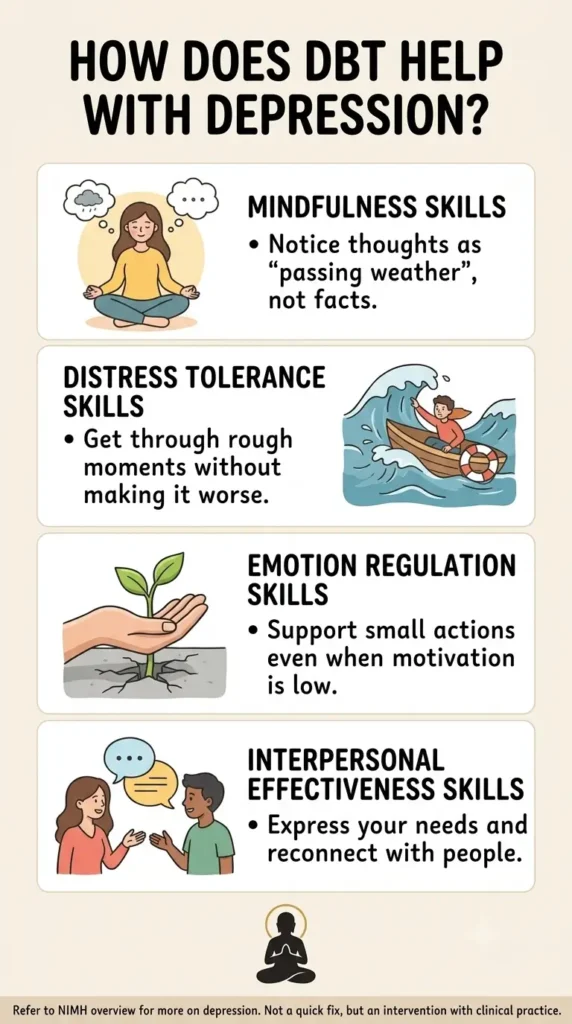
Take mindfulness. It helps you notice a negative thought without treating it as fact. That thought is weather passing through, not a verdict. Distress-tolerance skills get you through a rough moment without making it worse. Emotion-regulation skills support small actions even when motivation has checked out. Interpersonal-effectiveness skills help you say what you need and reconnect with people you’ve drifted from.
Sound too simple? It isn’t, really. These are dbt interventions for depression built from years of clinical practice, not a quick fix pulled from a worksheet.
The National Institute of Mental Health describes depression as a common but serious mood disorder. One that can affect how a person feels, thinks, and handles daily activities. Read its overview of depression for symptoms and treatment information.
Who May Benefit From DBT for Depression?
DBT therapy for depression isn’t built for one type of struggle. It tends to help adults who deal with intense emotions. People stuck in repeated negative thought patterns. People who avoid things that matter, or keep landing in the same conflicts in close relationships. It can also support anyone who finds it hard to act on their own goals when mood runs low.
This is one option among several. Not the only effective approach out there. A qualified mental health professional can assess your symptoms and talk through what fits, whether that means dialectical behavior therapy for depression, another form of therapy, or medication alongside it.
Working through DBT skills for depression on your own? Pair it with structured practice tools like these DBT skills worksheets to turn what you learn into something you actually use.
Please remember: these resources are an educational tool. Not therapy. Not a substitute for professional care. If you’re in the U.S. and need immediate emotional support, call or text 988 to reach the 988 Suicide & Crisis Lifeline. You can also text HOME to 741741 to reach the Crisis Text Line.
The Four Core DBT Skills for Depression
Depression doesn’t respond to one trick. DBT for depression works differently. Dialectical behavior therapy for depression doesn’t hand you a single fix. It hands you four skill sets instead. Mindfulness, distress tolerance, emotion regulation, interpersonal effectiveness.
Each targets a different piece of what depression does. Your thoughts. Your urges. Your relationships. None of them erase symptoms overnight. That’s not the promise. What they offer is a way to respond with more awareness, one small moment at a time.
Mindfulness: Working With Rumination and Negative Thoughts
Depression lies well. It turns a rough afternoon into proof you’re broken. The thought feels airtight. Mindfulness interrupts that. You learn to notice a thought instead of living inside it. Not fighting it. Not believing it outright either. You bring your attention back to right now, instead of replaying yesterday’s mistake or rehearsing tomorrow’s disaster.
Say “I always mess everything up” shows up again. Pause. Label it: a self-critical thought, not a verdict. Then find one thing you can see, hear, or feel around you right now. That’s it.
Our DBT mindfulness skills guide breaks this practice down further, and these mindfulness journal prompts pair well with it.
Distress Tolerance: Getting Through Difficult Days
Some days don’t need solving. They need surviving. Distress tolerance skills step in when the problem can’t be fixed right away. That includes days when getting out of bed feels impossible. Or starting just one task. You’re not managing a crisis in the clinical sense. You’re managing a Tuesday that feels like one.
Too low to run your usual routine? Try a short grounding exercise. A few slow breaths work too. Stop aiming for the whole day. Aim for the next ten minutes instead.
Why does this work when nothing else does? Because it lowers the bar to something you can actually clear. These dbt skills for depression work best when matched to the day in front of you, not forced onto every day the same way. Our DBT distress tolerance skills guide covers more of these tools in depth.
Emotion Regulation: Responding to Depressive Urges
Emotion regulation isn’t about feeling less. It’s about seeing the pattern underneath what you feel. Then choosing a response that actually supports you. That includes the urge to withdraw. Or skip basic needs. Or quietly give up on things that used to matter.
Want to cancel every plan because you feel down? Before you do, consider one smaller alternative. Ten minutes with a trusted friend. A short walk around the block. Small, not heroic.
This isn’t willpower. It’s the heart of dialectical behavior therapy for depression, a slightly different choice at the exact moment the old pattern kicks in. Our DBT emotion regulation skills guide walks through the full process, including Check the Facts and Opposite Action.
Interpersonal Effectiveness: Reconnecting With Others
Depression doesn’t just steal energy. It steals connection too. Asking for support gets harder. Explaining what you need gets harder still. Relationships start slipping, and nobody meant for that to happen. Interpersonal effectiveness skills help you speak up clearly while still respecting what other people need.
Instead of withdrawing without a word, try naming it directly. “I’ve had a difficult week. I don’t have much energy to talk, but could we check in briefly?” That’s not weakness. That’s just honest.
Explore the full approach in our DBT interpersonal effectiveness skills guide.
These four dbt interventions for depression support coping and real behavior change. They aren’t a cure, and nobody should expect them to be one. A 2024 review found DBT outperformed treatment as usual.
The evidence stayed modest, not sweeping. Pair these skills with dbt therapy for depression when professional support fits your situation. Pick one skill that matches what you’re facing today. Start there.
DBT for Depression: Which Skill Should You Try?
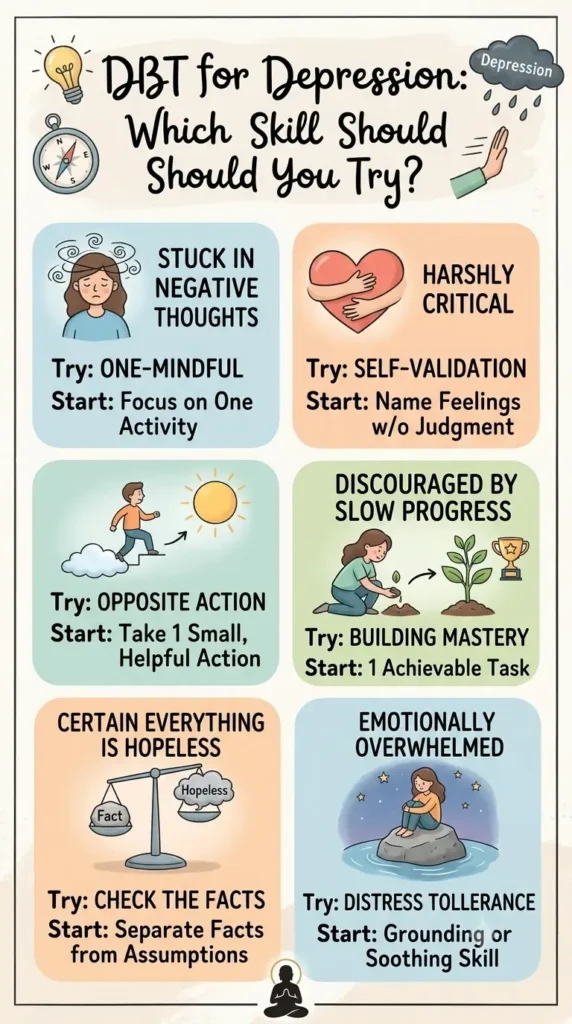
Depression doesn’t show up the same way twice. Some days it’s a loop of harsh thoughts you can’t climb out of. Other days it’s dead weight, and getting off the couch feels impossible. DBT skills for depression work because different moments call for different tools. Think of these as coping skills, not a cure for every depressive symptom.
| If you feel… | Try this skill | Start with… |
|---|---|---|
| Stuck in negative thoughts | One-Mindful | Focus on one small activity |
| Harshly critical of yourself | Self-Validation | Name your feelings without judgment |
| Unable to get started | Opposite Action | Take one small, helpful action |
| Discouraged by slow progress | Building Mastery and Accumulating Positives | Choose one achievable task |
| Certain that everything is hopeless | Check the Facts | Separate facts from assumptions |
| Emotionally overwhelmed | Distress Tolerance | Use a grounding or soothing skill |
Stuck in Negative Thoughts: One-Mindful
One-Mindful means giving your attention to one thing at a time. Not three tabs open in your head. Just one. Say you’re making breakfast and the same mistake keeps replaying. Narrow in on each step instead: the toast browning, the smell of coffee, that first bite.
Try it: spend two minutes on one ordinary task. Bring your attention back gently every time it wanders. That won’t be enough when rumination has taken over your whole day. Professional support can help there too. These mindfulness journal prompts are a good next step if this skill clicks for you.
When Self-Criticism Takes Over: Self-Validation
This isn’t about agreeing with every harsh thought you have. Self-validation means acknowledging what you feel without treating it as proof something’s wrong with you. “I’m useless, I got nothing done” becomes “I’m struggling today, and that’s frustrating.”
Try it: name the feeling, then name one reason it makes sense given your day. Validation won’t erase severe depressive symptoms on its own. It just stops you from piling judgment on top of pain. Our guide on the emotions worksheet walks through this in more depth.
When Motivation Won’t Show Up: Opposite Action
Motivation lies. It tells you to wait until you feel ready, and ready never comes. Opposite Action means doing the thing that counters an unhelpful urge, when that urge doesn’t fit the facts. Sadness says stay in bed and cancel everyone. You send one message instead, to one person you trust.
Keep the step small. Safe, not heroic. This skill can’t replace care when depression makes basic tasks feel out of reach. Practice it with the Opposite Action worksheet in our full DBT skills worksheets guide.
When You Need Small Wins: Building Mastery and Accumulating Positives
Building Mastery means doing something manageable that reminds you what capable feels like. Accumulating Positives means leaving room for small, good moments on purpose. A long walk might feel impossible today. A five-minute tidy-up or one favorite song doesn’t.
Try it: pick one doable task and one small positive for today. That’s it. These are things to practice, not a worksheet to download. Fatigue and other symptoms may mean adjusting the activity, and that’s fine.
When Everything Feels Hopeless: Check the Facts
Your friend doesn’t text back, and your brain decides they’re done with you. Check the Facts is how you catch that jump before it sticks. It separates what you actually know from what you’re assuming.
Try it: write the situation, your interpretation, and two other explanations that could also be true. This skill won’t solve every real problem or guarantee things turn out fine. It helps you meet uncertainty with something closer to accuracy. Pair it with these journal prompts for mental health if writing helps you slow down.
When Emotions Feel Like Too Much: Distress Tolerance
Distress Tolerance skills get you through the worst five minutes without making them worse. You want to fire off an angry text. Pause instead. Slow your breathing, or run a grounding exercise before you respond.
Try it: pick one calming skill and stay with it for a few minutes. It helps you survive the moment. It doesn’t treat depression on its own, and it was never meant to. Browse more coping skills worksheets for backup options when one skill isn’t landing.
No single DBT skill resolves every depressive symptom, and research on DBT skills training backs that up. Match the skill to the moment you’re actually in. If depression persists, worsens, or starts running your days, bring in professional support alongside these tools.
How to Practise DBT Skills for Depression Step by Step
Practising DBT skills for depression does not take much time. Or much energy. Pick one small step. Choose a skill that fits where you are right now, and watch what happens next.
Steady practice is the goal here, not perfection. Not instant relief either. Research on dialectical behavior therapy backs this slow, skill-by-skill approach for depression, and the steps below walk you through it.
Step 1: Notice and Describe What You Are Experiencing
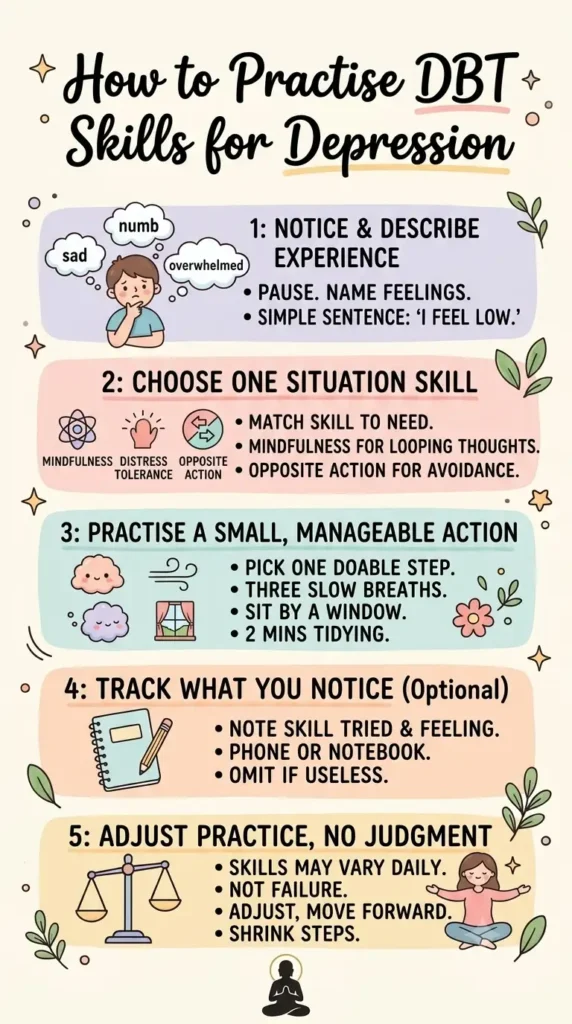
Pause. Name what you notice without judging it. Sad, numb, tired, overwhelmed. Any of those count. Try one plain sentence: “I feel low, and getting started seems hard.” That’s it.
Naming the experience, even roughly, helps you pick your next move. An emotions worksheet can make this step easier if putting feelings into words doesn’t come naturally yet.
Step 2: Choose One Skill That Matches the Situation
You don’t need every DBT skill at once. Not even close. Thoughts looping? Try mindfulness. Emotions running hot? Reach for a distress-tolerance skill. Avoiding something that would actually help? That’s where Opposite Action comes in. Browse the full set of DBT skills worksheets to find the one that fits your day, not someone else’s.
Step 3: Practise a Small, Manageable Action
Pick something doable even on a rough day. Three slow breaths. Sitting near a window. A short message to someone you trust. Two minutes tidying one surface. Small actions count.
You don’t need motivation first; the action can come before the feeling does. If you want a wider menu of low-effort options, the coping skills worksheets are worth a look.
Step 4: Track What You Notice
If it feels useful, jot down the skill you tried, what was happening before, and how you felt after. A notebook works. So does a note on your phone. No special tracker required, and you can skip this step entirely when recording feels like one task too many. Some people find it easier inside a mindfulness journal they’re already using.
Step 5: Adjust Your Practice Without Judging Yourself
A skill that works one day might fall flat the next. That’s not failure. Notice what helped, shrink the next step if it needs shrinking, and try a different skill when the old one stops fitting. DBT practice supports coping. It does not replace professional care for depression.
DBT vs. CBT for Depression: What Is the Difference?
DBT and CBT are both forms of psychotherapy that can help people manage difficult emotions and change unhelpful patterns. CBT focuses on the links between thoughts, feelings, and behaviors, while DBT emphasizes acceptance, mindfulness, emotion regulation, distress tolerance, and relationship skills.
How CBT Approaches Depression
Cognitive behavioral therapy (CBT) helps people identify and question negative thought patterns that may contribute to depression. It also targets behaviors that maintain low mood, such as withdrawing from others or avoiding daily activities.
With a therapist, someone might learn to challenge thoughts like “I always fail” and plan small, meaningful activities even when motivation is low. The American Psychological Association explains CBT as an approach to changing unhelpful thinking and behavior patterns.
How DBT Approaches Depression
Dialectical behavior therapy (DBT) emphasizes accepting emotions without judgment while learning skills to respond to them more effectively. It teaches mindfulness, distress tolerance, emotion regulation, and interpersonal effectiveness. For someone experiencing depression, these skills may help them cope with intense feelings, manage difficult moments, and communicate their needs.
Can DBT and CBT Be Used Together?
A therapist may draw on approaches from both therapies when clinically appropriate, based on a person’s needs and treatment plan. Their focus differs:
| CBT | DBT |
|---|---|
| Identifies and reframes unhelpful thoughts | Balances acceptance with change |
| Uses behavioral activation to reduce avoidance | Builds mindfulness and emotion regulation skills |
| Helps change patterns linked to low mood | Teaches distress tolerance and interpersonal effectiveness |
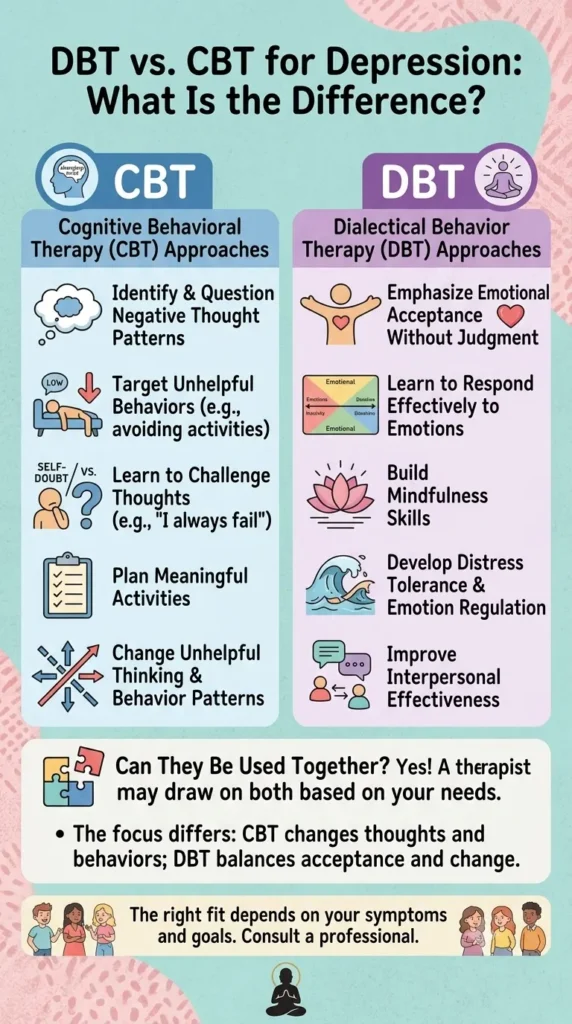
Neither therapy is universally better. The right fit depends on symptoms, personal history, treatment goals, and preferences. A qualified mental health professional can help determine which approach—or combination of approaches—makes sense for an individual.
Free DBT Worksheets and Printables for Depression
Free DBT worksheets let you practice DBT skills for depression at your own pace. No therapist appointment required. Just you, a quiet five minutes, and a sheet of paper. These printables focus on mindfulness, emotion regulation, and taking small steps when motivation disappears. That’s the real challenge with depression. Motivation doesn’t show up on schedule.
Pick one worksheet. The one that matches what you’re dealing with today. Trying to finish all of them at once usually backfires.
Mindfulness and One-Mindful Practice Sheet
Mindfulness means noticing a thought without judging yourself for having it. Simple to say. Harder to do when your brain won’t stop narrating. The One-Mindful skill strips it back further: focus on one task, and only one. Eating a meal. Washing a cup. Nothing else competing for attention.
Use the existing Nonjudgmental, One-Mindful, Effective or What Skills PDF to guide the practice. Start with something small and physical. The mental stuff gets easier after that.
Emotion Identification and Regulation Worksheet
Depression blurs emotions together. Everything just feels like “bad,” and that’s not useful information. An emotion worksheet forces more precision than your mood wants to give you. What am I actually feeling? What triggered it? What do I need right now?
Pair the emotions worksheet with DBT emotion-regulation skills. Naming the feeling is step one. It sounds small. It isn’t.
Check the Facts Worksheet
Low mood lies convincingly. Thoughts start sounding like facts even when they’re built on assumptions. That’s the trap. Check the Facts pulls the two apart: what actually happened, versus what you decided it meant.
Use the existing Check the Facts worksheet on one distressing thought. Write down other explanations, even ones that feel unlikely. Often one of them fits better than the story you were already telling yourself.
Opposite Action and Building Mastery Practice
Sometimes an emotion pushes you toward the worst possible move. Sadness says stay in bed, cancel everything, go quiet. Opposite Action means doing the reverse, on purpose. If sadness urges withdrawal, send one short message to someone you trust. That’s it. Not a long call. One message.
Use the existing Opposite Action PDF for guided practice. Building Mastery works differently: one small, manageable task, completed daily. No downloadable worksheet exists for this one yet. A sticky note works fine.
DBT Skill-Practice Tracker
A written note does more than memory ever will. Record the situation, the skill you tried, and what shifted afterward, even slightly. Nothing changed? Write that too. It still counts as data.
More Free DBT Skills Worksheets
Depression rarely shows up alone. Mindfulness, distress tolerance, emotion regulation, interpersonal effectiveness, they overlap more than people expect. For the full set, visit the DBT skills worksheets hub.
Start with one skill. Practice it badly if you have to. Return for the rest once this one feels familiar. These worksheets support the work. They don’t replace professional mental health care.
Conclusion
DBT for depression can help you respond to difficult emotions, manage negative thought patterns, and take small steps toward a more balanced life. Skills such as mindfulness, Opposite Action, Check the Facts, and distress tolerance may make challenging days easier to manage. You do not need to practise every skill at once.
Start with one that fits your current needs and build from there. Free DBT worksheets can support your practice, but they are not a substitute for professional care. If depression affects your daily life, consider speaking with a qualified mental health professional about treatment options that suit you.
Frequently Asked Questions
Can DBT help with depression?
Yes, dialectical behavior therapy (DBT) may help some people manage depression-related challenges, such as intense emotions, negative thought patterns, and difficulty coping.
Research on DBT for depression is still developing, so results may vary. DBT can complement other treatments recommended by a qualified mental health professional.
What are the best DBT skills for depression?
Useful DBT skills for depression include mindfulness, emotion regulation, distress tolerance, and interpersonal effectiveness. Opposite Action may help when sadness or low motivation leads to unhelpful withdrawal.
The best skill depends on your situation, symptoms, and needs. Start with one small, manageable practice rather than trying every skill at once.
Is DBT or CBT better for depression?
Neither dialectical behavior therapy (DBT) nor cognitive behavioral therapy (CBT) is always better for depression. CBT often focuses on changing unhelpful thought patterns and behaviors, while DBT emphasizes mindfulness, emotional regulation, acceptance, and coping skills. A mental health professional can help you choose an approach based on your symptoms and treatment goals.
Can I practise DBT skills on my own without a therapist?
You can practise some DBT skills independently using reliable worksheets, guided exercises, and self-reflection. However, self-guided practice is not the same as comprehensive DBT treatment, which may include structured therapy and skills training. Seek professional support if symptoms persist, worsen, or interfere with daily life.
How does Opposite Action help with depression?
Opposite Action involves choosing a behavior that goes against an unhelpful emotional urge when that urge does not fit the facts or acting on it would be ineffective.
For example, taking a short walk or contacting a trusted friend may help counter withdrawal. Start small and adjust the action to your energy and circumstances. Explore the Opposite Action section in our DBT skills worksheets guide.
Where can I find free DBT worksheets for depression?
You can find free DBT worksheets in The Empty Self’s DBT skills worksheets guide. The collection covers skills such as mindfulness, distress tolerance, emotion regulation, and interpersonal effectiveness.
Choose worksheets that match the skill you want to practise, and check that each linked printable is available before downloading.

It’s Bhaskar!
Well, I am not a psychologist a monk, or a philosopher by training. I’m just an engineering graduate.
‘The Empty Self’ is where I write about that idea, and what it actually means for ordinary life, anxiety, identity, habits, the stories we tell ourselves about who we are. I don’t have a psychology degree, and I’m not offering therapy or clinical advice. What I do have is thought and clarity, and genuine curiosity about why we suffer the way we do and how much of it might loose once we shed this ‘fixed identity’.