
DBT for ADHD uses skills from Dialectical Behavior Therapy to help adults handle big emotions, quick reactions, and rocky relationships. That’s the short version. ADHD brings a specific kind of overwhelm. Feelings hit fast. Words come out before you’ve thought them through. DBT for ADHD was never built for that exact problem, but its four skill sets line up with it anyway.
DBT was first built for other mental health struggles. Not ADHD. But mindfulness, distress tolerance, emotion regulation, and dealing with people pulled it into ADHD care almost by accident. Therapists noticed the overlap. The skills stuck.
Here’s what that looks like day to day. You pause before snapping back. You ride out a wave of frustration instead of drowning in it. You say what you mean without the conversation blowing up. Small shifts. They add up.
Dialectical behavior therapy for ADHD won’t fix everything, though. Attention still wanders. Deadlines still sneak up. Time still disappears in ways that make no sense. DBT doesn’t touch any of that directly. It sits next to your ADHD-focused care instead of replacing it. So is DBT good for ADHD? For the emotional side, often yes. For the attention side, not really. That’s the honest answer.
Quick overview: DBT for ADHD leans on four core skills, mindfulness, distress tolerance, emotion regulation, and interpersonal effectiveness, and points them at everyday friction. It can ease intense emotions, impulsive choices, and relationship strain. It won’t replace full ADHD treatment, and it was never meant to.
Table of Contents
Disclaimer
This blog is written and edited with the help of AI, then reviewed by me before publishing. As a result, the content is for general reflection only, not therapy or medical advice, and I’m not a licensed mental health professional. If you’re in crisis, please contact 988 if you’re in US or a local crisis service of your country instead of relying on this site.
DBT for ADHD: What It Is and How It Helps
DBT for ADHD takes practical tools from Dialectical Behavior Therapy. The goal is specific. Manage big emotions, pause before reacting, get through hard moments without making them worse.
DBT wasn’t built for ADHD. Not originally. But some of its skills fit the emotional side of the condition anyway. For the clinical basics on ADHD itself, NIMH’s overview of ADHD is a solid starting point.
What Is Dialectical Behavior Therapy?
Dialectical Behavior Therapy, or DBT, is a structured therapy. It teaches people to manage emotions and cope with distress. It also covers staying present and communicating without things falling apart. Two ideas hold the whole thing together: acceptance and change.
Acceptance means naming your thoughts and feelings without judging yourself for having them. Change means learning a different response when the old one isn’t working. Sound contradictory? It isn’t. Both run at once.
Psychologist Marsha Linehan built DBT decades ago. She designed it for people with chronic suicidal thoughts and BPD symptoms. ADHD wasn’t the target. Not even close. But the skills travel well beyond their original use case. They can also help people who struggle to regulate emotion and manage impulsive reactions.
Want the fuller picture? Our guide to what DBT actually is breaks down the therapy and its core principles.
How Does DBT Help Adults With ADHD?
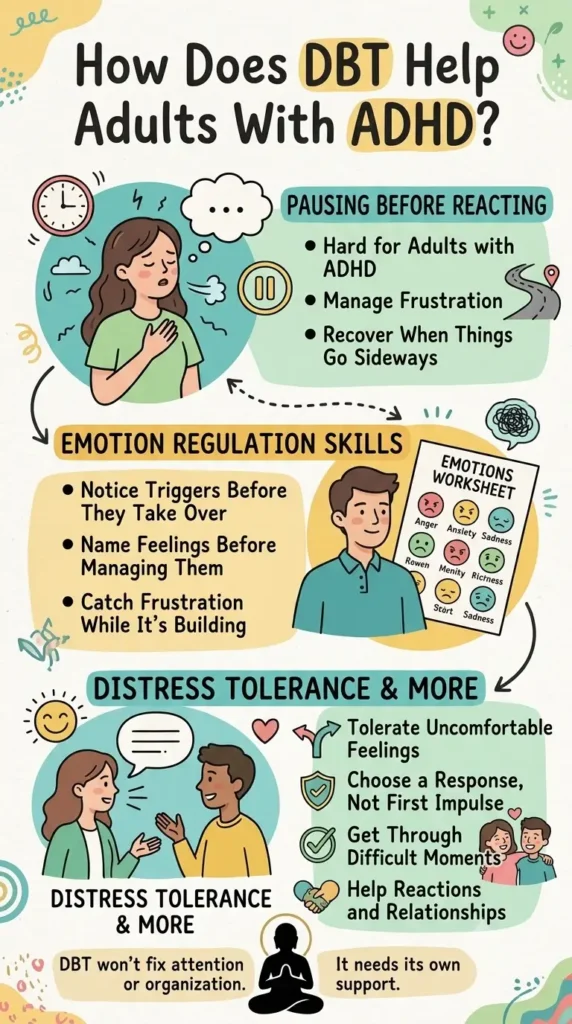
Pausing before reacting is hard for a lot of adults with ADHD. So is managing frustration, or recovering once a moment has already gone sideways. Some also deal with rejection sensitive dysphoria, often shortened to RSD.
It describes intense emotional pain triggered by perceived criticism, rejection, or failure. RSD isn’t a formal ADHD diagnosis. Doesn’t matter. The pain it describes is real, and it can derail a whole day.
DBT skills work by teaching you to notice a trigger before it takes over. What does that pause actually buy you? Room to tolerate an uncomfortable feeling instead of acting on it. Then you choose a response, rather than reaching for the first impulse. Mindfulness helps you catch frustration while it’s still building.
An emotions worksheet can make that easier, since naming the feeling comes before managing it. Distress tolerance skills get you through that moment. No angry message sent. No task abandoned halfway through.
DBT doesn’t treat every ADHD challenge. Not even most of them. Skills for emotion regulation can help your reactions and your relationships. They won’t fix attention, organization, or time management on their own. Those need their own kind of support.
Is DBT Good for ADHD?
DBT isn’t a cure for ADHD, and nobody should sell it as one. For adults who deal with emotional swings, impulsivity, or rough interactions, it can still help. Research is still catching up. DBT shouldn’t be presented as a proven standalone treatment for ADHD.
There’s a real difference between DBT-informed skills and a full DBT program. Most adults with ADHD only need the first one. Mindfulness, STOP, TIPP, emotion regulation. Many people learn these through individual therapy or a skills group.
Others start with self-guided DBT skills worksheets. A full DBT program is a bigger commitment. It was built for people with severe, complex emotional difficulties. ADHD alone doesn’t automatically call for that level of treatment.
Thinking about trying DBT? Talk it through with a mental health professional who actually understands adult ADHD. They can help you decide if DBT skills fit your existing ADHD treatment. DBT should add to that plan. Not replace it.
The Four Core DBT Skills for ADHD
DBT for ADHD breaks down into four skill areas. Each one targets a different piece of daily life. Together, they give you a way to respond instead of just reacting.
That’s the whole point.
Racing thoughts. A flash of anger. The urge to walk away mid-task. DBT doesn’t erase any of that. It gives you a pause button first. For the full picture, check out the complete list of DBT techniques and strategies.
Mindfulness: Becoming More Aware of Your Thoughts and Actions
Mindfulness means noticing what’s happening before you act on it. For ADHD brains, that’s harder than it sounds.
Racing thoughts. Emotional triggers. The pull to act right now, before you’ve even decided to. Mindfulness slows that gap down.
Say you’re mid-task and frustration creeps in. Normally you’d abandon it and open six new tabs. With mindfulness, you catch the feeling first. You pause. You notice it. Then you choose what comes next.
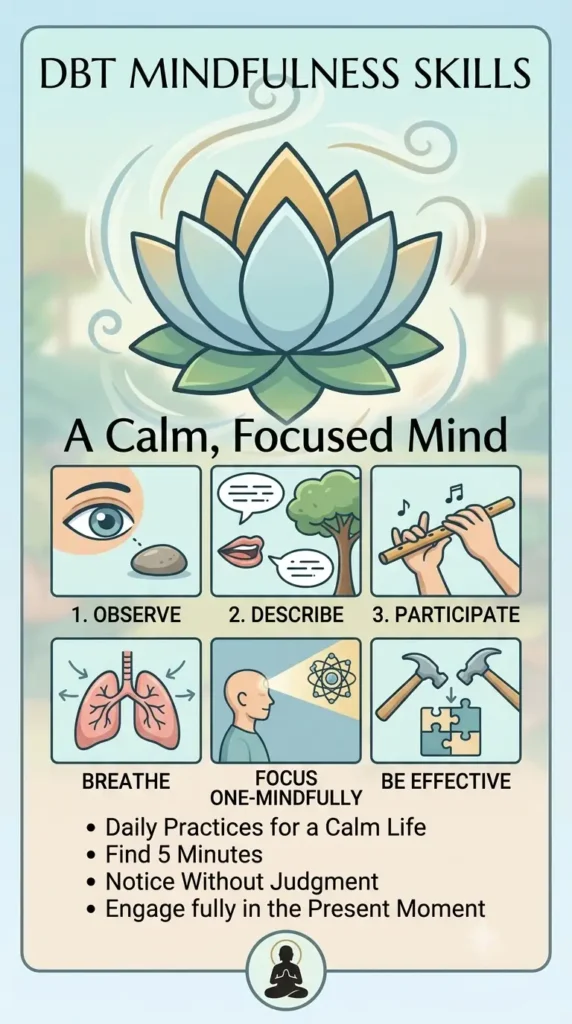
DBT mindfulness isn’t about clearing your head. It’s about staying with what’s actually there, without judging yourself for it. Three skills do the heavy lifting here: observing, describing, and participating. Practice those, and your thoughts stop running the show.
Want the full breakdown? Here’s a closer look at DBT mindfulness skills.
There’s also Wise Mind, which blends emotional reaction with practical reasoning. Useful when a decision feels urgent but isn’t. Read more about the Wise Mind skill here.
Distress Tolerance: Managing Emotional Overwhelm Without Reacting Impulsively
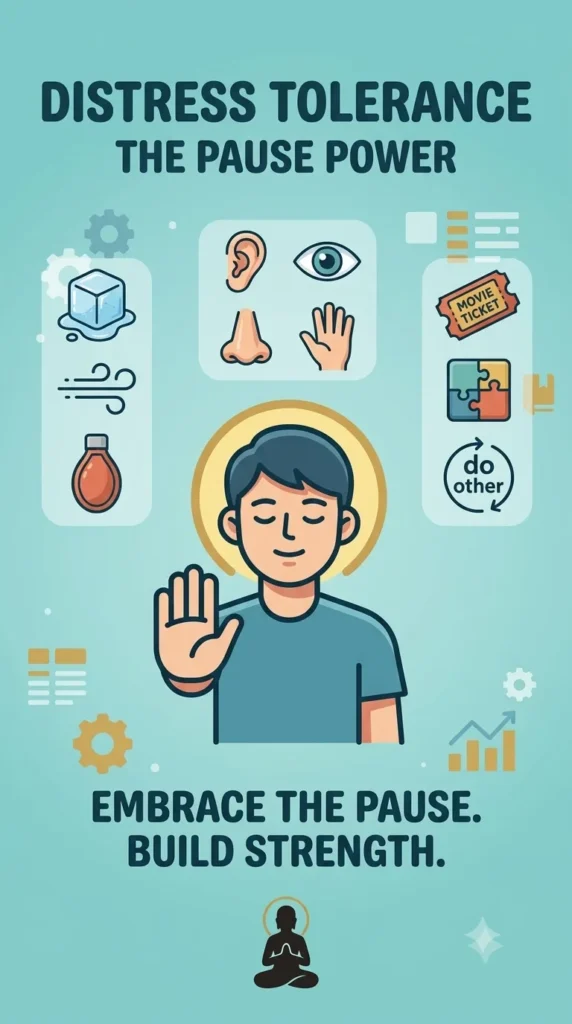
Distress tolerance skills help you survive a bad moment without making it worse. Frustration spikes. Anxiety spikes. Disappointment hits harder than it should.
This is where those skills step in.
Picture this: you get a piece of unexpected criticism. Your first instinct is to fire off an angry reply, or just vanish from the conversation entirely. A distress tolerance skill buys you time. It lets the intensity drop before you decide anything.
The STOP skill breaks it into four moves: stop, take a step back, observe, proceed mindfully. TIPP works differently. It changes your body’s arousal level directly, which matters because you can’t think your way out of a nervous system that’s already flooded.
More on these here: DBT distress tolerance skills, the STOP skill, and the TIPP skill.
Emotion Regulation: Understanding and Managing Intense Feelings
Emotion regulation isn’t about shutting feelings down. It’s about understanding them well enough to respond on purpose.
For ADHD especially, this matters. Emotional dysregulation can turn ordinary frustration, excitement, or disappointment into something that takes over the whole day.
DBT doesn’t ask you to suppress the emotion. It asks you to name it. Where did it come from? What would actually help right now? Spotting your own patterns over time makes it easier to see the overwhelm coming before it lands.
A few specific tools do this work: checking the facts, opposite action, building positive experiences. An emotions worksheet helps too, since putting a feeling into words is half the battle.
See the full guide to DBT emotion regulation skills, and try this emotions worksheet to get started.
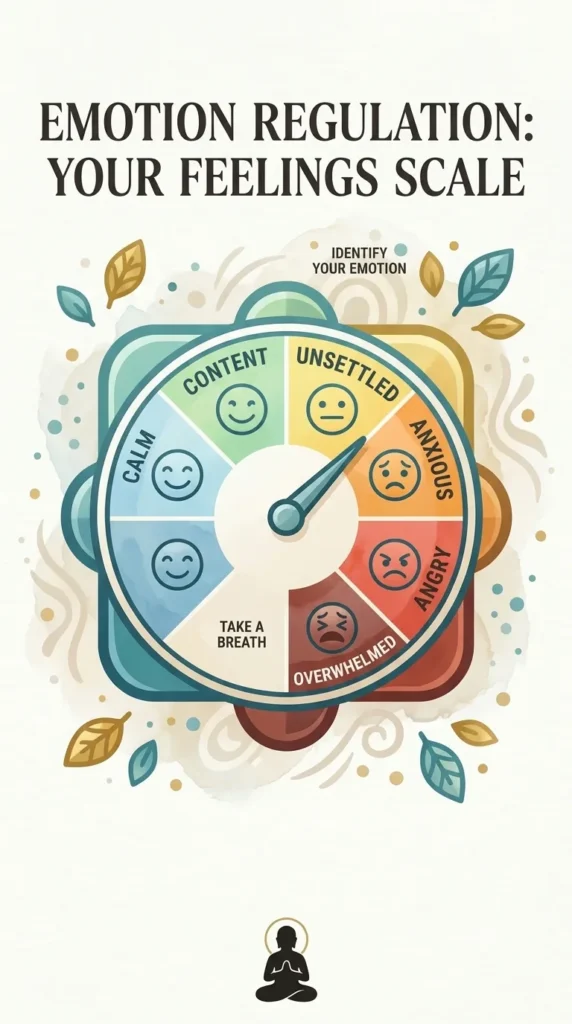
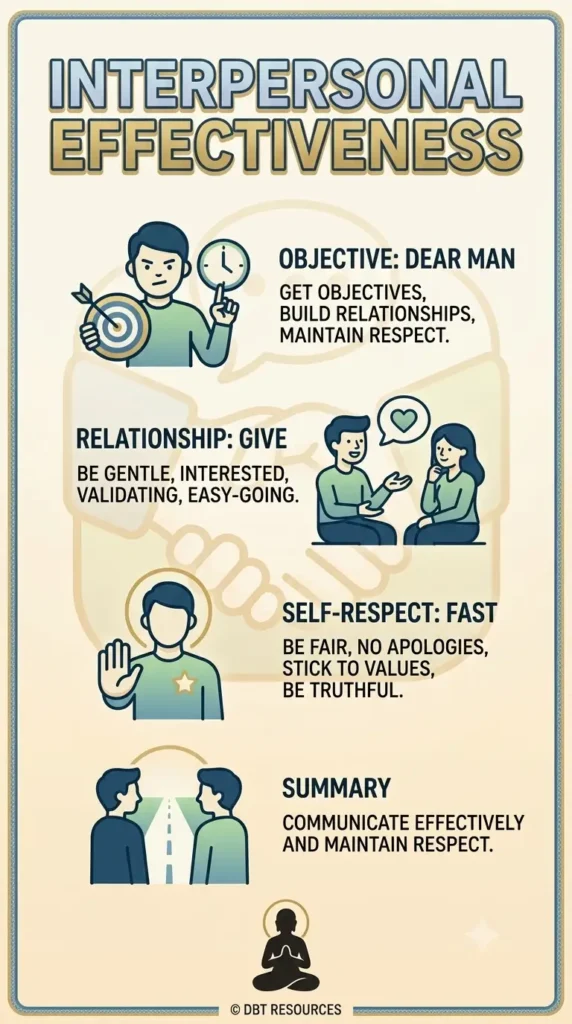
Interpersonal Effectiveness: Communicating Clearly and Managing Relationships
This isn’t about becoming a different person in conversations. It’s about saying what you actually need, clearly, before resentment builds.
Impulsive comments. Sudden emotional swings. Trouble asking for what you want in the moment. All of it creates friction with other people, and ADHD makes the pattern more frequent, not less.
Here’s an example. A request comes in and you feel instantly overwhelmed. Instead of agreeing on the spot and quietly resenting it for a week, you ask for more time. That’s the whole shift. DEAR MAN gives this a structure: how to make a request, how to say no, how to explain your side without the conversation falling apart.
Cope Ahead handles a different problem. It lets you mentally rehearse a hard conversation before it happens, so you’re not improvising under pressure.
Explore DBT interpersonal effectiveness skills in more depth, or learn how Cope Ahead works.
DBT Techniques for ADHD: Which Skill Should You Try?
The right skill depends on the moment, not the diagnosis. Maybe you fire off a reply before you think it through. Maybe a feeling swallows you whole. Maybe you keep dodging one phone call. Each of those moments has its own tool. DBT for ADHD works best when you treat it that way. One skill, one moment, not a whole binder you memorize in order.
When You React Before Thinking: Try the STOP Skill
An impulse doesn’t ask permission. It just fires. The STOP skill exists for that exact gap between the urge and the action. Four steps. Nothing fancy.
S — Stop. Freeze. Don’t act on the first impulse.
T — Take a step back. Breathe. Move away from the situation for a second.
O — Observe. Notice your thoughts, your body, what’s actually happening around you.
P — Proceed mindfully. Pick your next move based on the situation. Not the emotion screaming loudest.
Why does this matter more for ADHD brains specifically? Because the gap between urge and action is already thin. STOP widens it, even just slightly. That’s often enough.
When Emotions Become Overwhelming: Try TIPP and Self-Soothing
Some feelings don’t fade on their own. Frustration spikes. Anxiety climbs. Anger takes the wheel. TIPP is built for exactly that spike. It uses temperature, intense exercise, paced breathing, and paired muscle relaxation to pull your body down from the ledge. The body calms first. The mind follows.
Self-soothing works a different angle. Engage your senses instead. A familiar song. A warm drink. A soft blanket against your skin. Small, but it adds up.
Neither skill fixes the trigger. That’s not the job. They just buy you enough calm to choose your next step instead of reacting on autopilot.
When You Feel Rejected or Criticized: Try Check the Facts
A short text. A delayed reply. One piece of feedback. Any of these can set off a spiral that has nothing to do with what actually happened. Check the Facts pulls the real event apart from the story your mind built on top of it.
Ask yourself three questions. What do I know for certain? Am I assuming someone’s upset with me? Is there another explanation that fits just as well? This isn’t about dismissing how you feel. It’s about checking whether the feeling matches the evidence in front of you.
When You Keep Avoiding Difficult Tasks or Conversations: Try Cope Ahead and DEAR MAN
Avoidance feels like relief. It isn’t. Cope Ahead gets you ready before the moment hits instead of scrambling once you’re already in it. Picture the situation. Name the obstacles. Rehearse the skill you’ll actually use.
For a hard conversation specifically, DEAR MAN gives you the script. Describe the situation. Express how you feel. Assert what you need. Reinforce why it matters. Stay mindful, sound confident, and negotiate if the moment calls for it.
Sound like a lot to hold at once? It is, the first few times. Most people only need two or three of those steps to actually get through the conversation.
DBT Skill Decision Table for ADHD
| If You’re Experiencing… | Try This DBT Skill | How It Helps |
|---|---|---|
| Acting before thinking | STOP | Creates a pause before you react |
| Intense anger, anxiety, or frustration | TIPP | Lowers emotional arousal fast |
| Feeling overwhelmed and needing comfort | Self-Soothing | Uses your senses to support calm |
| Feeling rejected or criticized | Check the Facts | Separates evidence from assumption |
| Avoiding a stressful situation | Cope Ahead | Preps you for likely challenges |
| Struggling with a difficult conversation | DEAR MAN | Supports clear, direct communication |
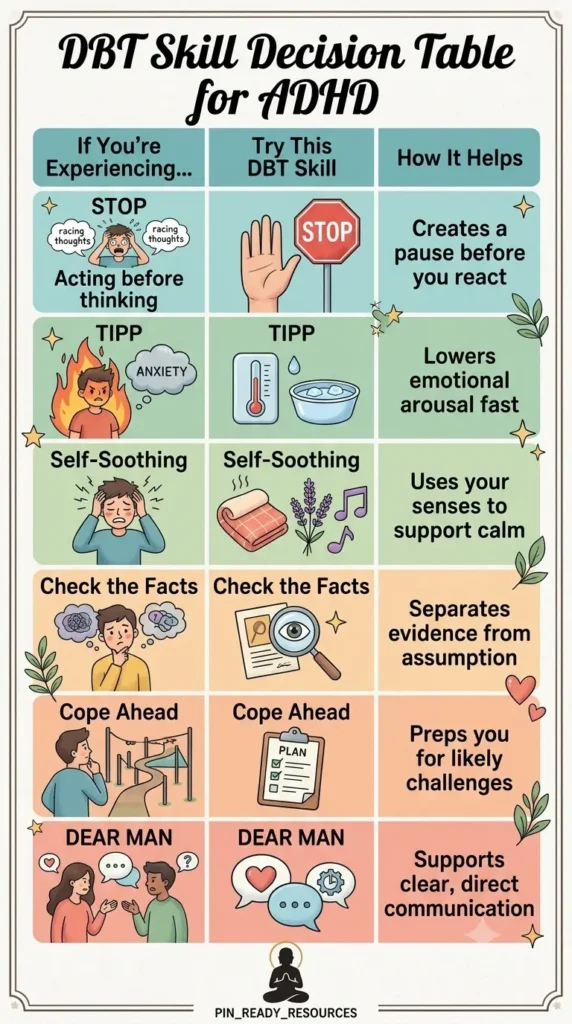
This chart is a starting point, not a diagnosis. Not every skill clicks for every person. Try a few. See what sticks. A qualified therapist can help you practice the ones that don’t come easy on your own, and our full DBT skills worksheets library has printable versions of each one covered here.
How to Practise DBT Skills for ADHD Step by Step
DBT for ADHD works best as a small, repeatable loop. Not a rulebook. Notice what sets off the reaction. Pick one skill that fits the moment. Track what happens next. That’s it. The goal is steady practice, not a perfect response every time.
Step 1: Identify Your Emotional Triggers
Before you reach for a DBT skill, find out what sets you off. Maybe plans change and you feel overwhelmed. Maybe a task runs long and frustration creeps in. Maybe feedback from someone close stings more than it should.
Watch four things: the situation, your thoughts, what your body does, and the emotion that follows. A delayed reply is a good example. The thought shows up first: “they’re ignoring me.” Then your chest tightens. Then comes the urge to send three more messages, back to back.
This is where an identifying emotions worksheet earns its place. Name the feeling. Look for the pattern underneath it. You don’t need to break down every single reaction you have. Start with what shows up often, or what costs you the most.
Step 2: Choose a DBT Skill That Matches the Situation
Once you’ve spotted a trigger, match it to a skill, not the other way around. Feel like you’re about to react on impulse? Try STOP. It buys you a pause. Body wound tight and overwhelmed? TIPP brings the intensity down fast. Bracing for criticism or rejection? Check the Facts slows you down enough to test the story before you respond to it.
Is DBT good for ADHD if you try to memorize every skill at once? Not really. That’s one more task to manage mid-crisis. It defeats the purpose. Pick one or two skills first. Let them become familiar. Add more later, once the first ones stick.
Step 3: Practise the Skill and Track Your Response
DBT therapy for ADHD works through repetition, not analysis. Use the skill the moment a familiar trigger shows up, even if all you manage is one small step. That still counts. Afterward, write down what happened: the situation, the emotion, the skill you tried, and whether anything shifted.
A simple diary-card-style tracker helps patterns surface over weeks instead of staying invisible. Build your own version. Don’t copy Linehan’s original diary card line for line. That one’s protected. Keep your version short. A few clear prompts, a little space for a few words, nothing more.
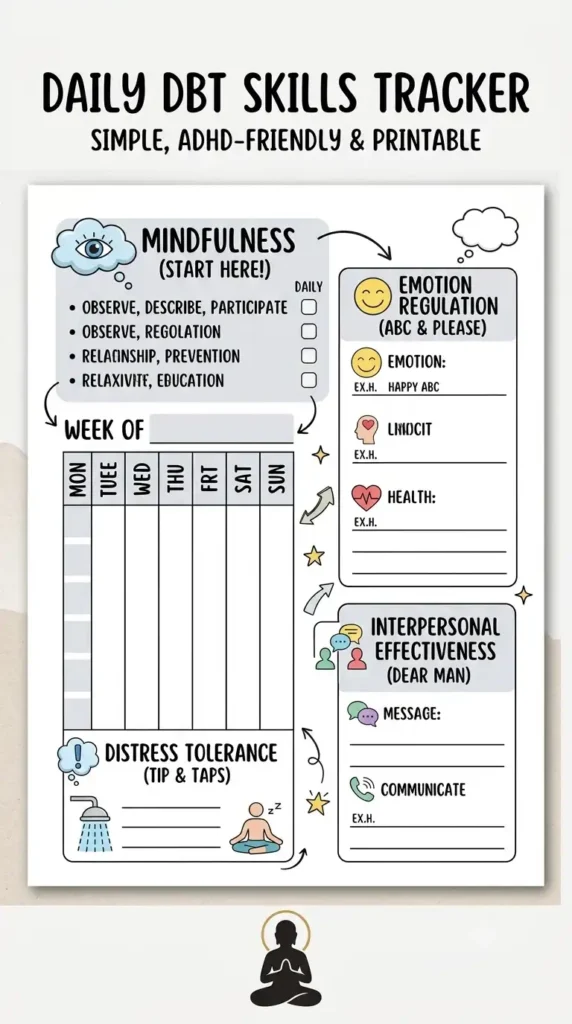
Not ready to build one from scratch? Our coping skills worksheets and DBT skills worksheets give you a ready-made starting point.
Step 4: Review Your Progress Without Judging Yourself
Once a week, sit down with your notes. Look at what helped. Look at what’s still hard. Look for triggers you missed the first time around. A skill that didn’t work right away isn’t useless. It might just need more reps, or a different angle entirely.
Treat each entry as information. Not a grade. Progress with dialectical behavior therapy for ADHD rarely looks dramatic. It looks like pausing half a second before you reply. Noticing the emotion a beat sooner. Bouncing back from frustration a little faster than last week. Small shifts. They count.
DBT vs. CBT for ADHD: What Is the Difference?
DBT and CBT aren’t the same tool. People lump them together anyway.
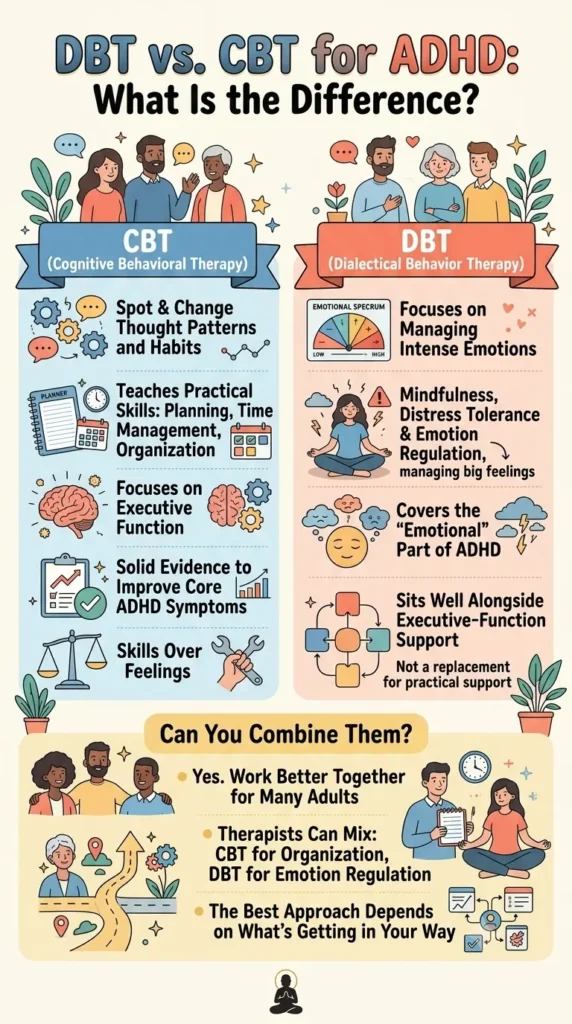
Both can support adults with ADHD. They just aim at different problems. CBT usually goes after unhelpful thinking and the practical stuff: planning, deadlines, follow-through. DBT leans harder into emotional regulation, distress tolerance, mindfulness, and relationship skills. That’s dialectical behavior therapy for ADHD in one sentence.
Sound too neat? It is, a little. In practice, the two overlap more than any clean split suggests.
How CBT Helps Adults With ADHD
CBT goes straight for the thinking. Cognitive behavioral therapy helps adults with ADHD spot and change the thought patterns and habits that keep getting in the way. It also teaches blunt, practical skills: planning, time management, organization, finishing what you start.
Here’s the evidence. A meta-analysis of 14 randomized trials found that CBT improved core ADHD symptoms and executive function. Results shifted depending on the treatment format and what was measured. Not a clean sweep. Still solid.
That’s the trade CBT makes. Skills over feelings.
How DBT Helps Adults With ADHD
DBT skips the to-do list. It goes after the nervous system instead.
Dialectical behavior therapy for ADHD focuses on managing intense emotions and responding with intention under stress, not on structuring your day. Its mindfulness, distress-tolerance, and emotion-regulation skills can matter most when frustration, impulsive reactions, or relationship friction make ADHD harder to manage.
Is DBT good for ADHD on its own? Not entirely. DBT doesn’t replace practical support for executive-function struggles. Nobody said it would. But it sits well alongside that support, covering the part CBT tends to leave on the table.
Can You Combine DBT and CBT for ADHD?
Yes. Most people never try.
A therapist might use CBT for planning and organization and DBT for emotion regulation and distress tolerance, in the same course of treatment.
A 2026 randomized trial compared 12 weeks of group DBT and group CBT in 98 adults with ADHD. Both groups improved. The trial didn’t establish that DBT was non-inferior to CBT though, so that result doesn’t prove the two are equal.
Why mix them at all? Because ADHD rarely shows up as one clean problem. For a lot of adults, DBT and CBT work better together than apart. The right combination depends on what’s actually getting in your way, what you want out of treatment, and what you’ll stick with long enough to matter. A qualified clinician can help sort that out, whether the answer is one approach or both.
Want to go deeper on the DBT side specifically? The full DBT skills worksheets guide breaks down distress tolerance, mindfulness, emotion regulation, and interpersonal effectiveness, with printables for each module. Pair it with these coping skills worksheets if you want more tools for the emotional side of ADHD specifically.
Does DBT for ADHD Work? What the Research Says
DBT for ADHD is still a young field of study. The early numbers look good. But “promising” and “proven” are two different words.
Treat DBT as one tool in the ADHD toolbox. Not a replacement for medication. Not a cure-all. Just one option worth a real look.
What the 2025 Meta-analysis Found
A 2025 meta-analysis changes the conversation here. Zhang and colleagues pulled together randomized controlled trials on dialectical behavior therapy for adults with ADHD, published in Psychiatry Research. Eight trials. 850 participants. Follow-up data came in for 533 of them.
The results were specific. ADHD symptoms dropped by a moderate margin (SMD = −0.51). Quality of life went up (SMD = 0.41), compared with control groups. That’s a real signal.
It’s not a universal one, though. The analysis doesn’t say DBT works the same for every adult with ADHD. It doesn’t say DBT should replace standard treatment either. Those are two different claims, and the study only supports the first.
Want to read it yourself? You can find the Zhang et al. meta-analysis on PubMed or search for the article on ScienceDirect.
What Earlier Clinical Trials Suggest
Before the meta-analysis, there was Hirvikoski. A multicenter randomized controlled trial, run across seven outpatient clinics, tested a DBT-based group program for adults with ADHD. 121 people signed up. The program ran 14 weeks, a skills-training format, compared against treatment as usual.
104 people finished it. That’s a solid completion rate for a multi-month program.
The results favored the DBT group. Executive functioning improved. So did ADHD symptoms and quality of life, across several measures. Most of those gains held up at the six-month mark.
Not everything improved, though. Anxiety symptoms showed no significant difference between groups. Emotion-regulation scores didn’t separate either, not right after treatment ended. That matters. It means this specific program helped with some things and not others.
One more caveat: this trial tested one format of DBT. A 14-week group skills program. Not every version of DBT looks like that one. Curious about the details? The full trial is published on PubMed.
What DBT May Not Address in ADHD
Here’s an honest take. DBT is strong with emotions. It helps with distress, with impulsive reactions, with relationships that keep hitting the same wall.
It’s not built for everything ADHD throws at a person, though. Chronic distractibility. Time blindness. A working memory that drops the ball mid-task. DBT skills weren’t designed to fix those directly.
So what fills the gap? Often it’s ADHD-specific strategies, practical accommodations, medication, or other therapy types layered on top. If you want structured tools to practice the emotional-regulation side, our DBT skills worksheets walk through that step by step. For the planning and daily-structure side, a set of coping skills worksheets can help round things out.
Who Should Be Cautious
Not everyone should jump into a DBT program solo. Active crisis. Untreated substance use. A more acute co-occurring condition sitting underneath the ADHD. Any of those call for an assessment by a qualified professional first.
Safety comes before skill-building. That’s the order that matters.
When to Consider Professional Support
Is ADHD messing with your work? Your relationships? The basic stuff, like getting through a Tuesday without everything falling apart? That’s the signal to talk to someone.
A clinician can sort through the options with you. DBT, CBT, medication, ADHD coaching. Sometimes it’s one. Sometimes it’s a mix.
Worksheets help. Our emotions worksheet and other self-guided tools can support the practice between sessions. They’re a supplement, though. Not a stand-in for actual care.
If you’re in the U.S. and in crisis, call or text 988 to reach the 988 Suicide & Crisis Lifeline. You can also text HOME to 741741 for the Crisis Text Line. Outside the U.S., reach out to your local crisis or emergency service.
Free DBT Worksheets and Printables for ADHD
Therapy ends. The hard moments don’t. That’s the gap free DBT worksheets for ADHD are built to close.
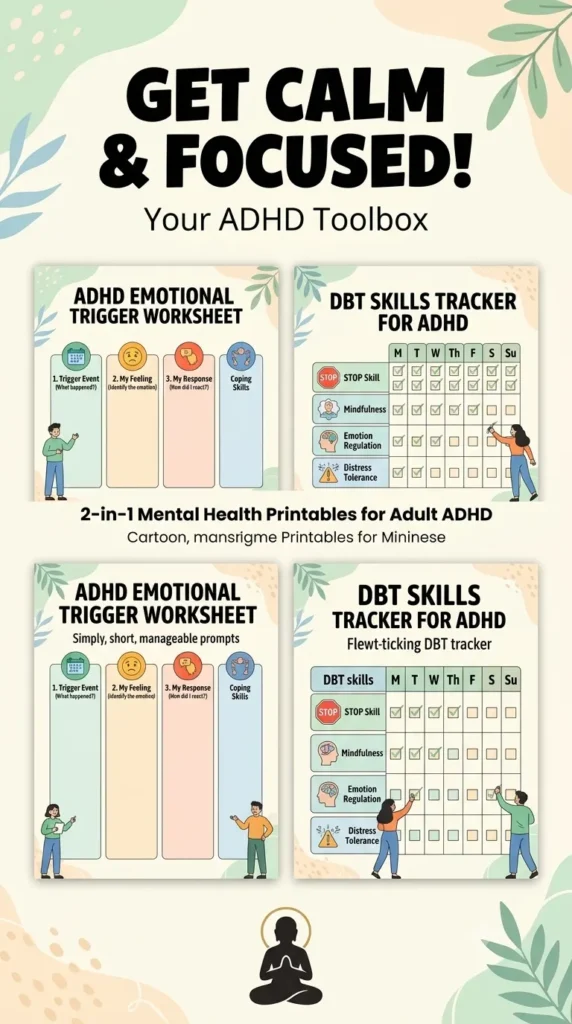
These printables use short, clear prompts. Spot the trigger. Pick a skill. Track what happens next. No new routine to learn, no extra app, just paper and a pen when things get loud in your head. Research on DBT for ADHD backs up why this structure works so well for a brain that struggles with the pause between feeling and reacting.
ADHD Emotional Trigger Worksheet
Frustration spikes fast with ADHD. So does the urge to snap, shut down, or bail on a conversation mid-sentence. The ADHD Emotional Trigger Worksheet exists for that exact moment, the one between the trigger and the reaction where everything usually falls apart.
Write down what happened. What you felt. How you responded. Then name one DBT skill worth trying next time. That’s it.
Keep the answers short. One line is enough. This isn’t about perfect self-analysis. It’s about catching the pattern, not grading your reaction.
DBT Skills Tracker for ADHD
A skill you never track is a skill you’ll forget you have. The DBT Skills Tracker for ADHD fixes that with three quick notes: the situation, the skill you reached for, and what shifted afterward.
No daily streak required. No guilt if a week goes by untouched. Pick it up when tracking actually helps, and put it down when it doesn’t.
For more printable exercises, visit the DBT skills worksheets resource hub.
Conclusion
DBT for ADHD can offer practical tools for managing intense emotions, impulsive reactions, rejection sensitivity, and relationship challenges. Skills such as mindfulness, STOP, TIPP, and DEAR MAN can help adults pause, understand their responses, and choose more helpful actions.
However, DBT is not a standalone treatment for every aspect of ADHD, particularly executive function difficulties such as planning, organisation, and time management.
It may work best alongside appropriate ADHD treatment and professional support. Start with one skill, practise it in everyday situations, and give yourself time to build consistency. Progress comes from practice, not perfection.
Frequently Asked Questions
Is DBT effective for adults with ADHD?
DBT may help adults with ADHD manage emotional dysregulation, impulsive reactions, stress, and relationship difficulties. Research suggests it can be a useful complementary approach, but evidence is still developing. DBT does not replace ADHD-specific treatment or directly address every challenge, such as time management and inattention.
What are the best DBT skills for ADHD?
The most useful DBT skills depend on the challenge you are facing. Mindfulness can help you pause before reacting, distress tolerance can support you during emotional overwhelm, and emotion regulation can help you understand intense feelings. Interpersonal effectiveness skills may also improve communication and relationships.
Can DBT help with ADHD emotional dysregulation?
DBT can help adults with ADHD recognise emotional triggers, tolerate distress, and respond to intense feelings more deliberately. Skills such as Check the Facts, STOP, and TIPP may be useful during difficult moments. They take practice, and their effectiveness can vary from person to person.
Is DBT better than CBT for ADHD?
Neither DBT nor CBT is automatically better for every adult with ADHD. CBT often focuses on practical challenges such as planning, organisation, and unhelpful thought patterns.
DBT places greater emphasis on emotional regulation, distress tolerance, and relationships. A therapist can help you decide which approach fits your needs.
Can you practise DBT for ADHD on your own?
You can start practising basic DBT skills independently with reliable guides, worksheets, and regular exercises. However, self-guided practice is not the same as a structured DBT programme. A trained therapist can help you choose suitable skills, work through difficulties, and adapt practice to your ADHD-related needs.
Does DBT help with ADHD-related rejection sensitivity?
DBT may help you manage the intense emotions that can follow perceived criticism, exclusion, or rejection. These experiences are sometimes described as rejection sensitive dysphoria (RSD), although RSD is not a formal ADHD diagnosis. Skills such as Check the Facts, self-validation, and distress tolerance may help you respond more thoughtfully.

It’s Bhaskar!
Well, I am not a psychologist a monk, or a philosopher by training. I’m just an engineering graduate.
‘The Empty Self’ is where I write about that idea, and what it actually means for ordinary life, anxiety, identity, habits, the stories we tell ourselves about who we are. I don’t have a psychology degree, and I’m not offering therapy or clinical advice. What I do have is thought and clarity, and genuine curiosity about why we suffer the way we do and how much of it might loose once we shed this ‘fixed identity’.