
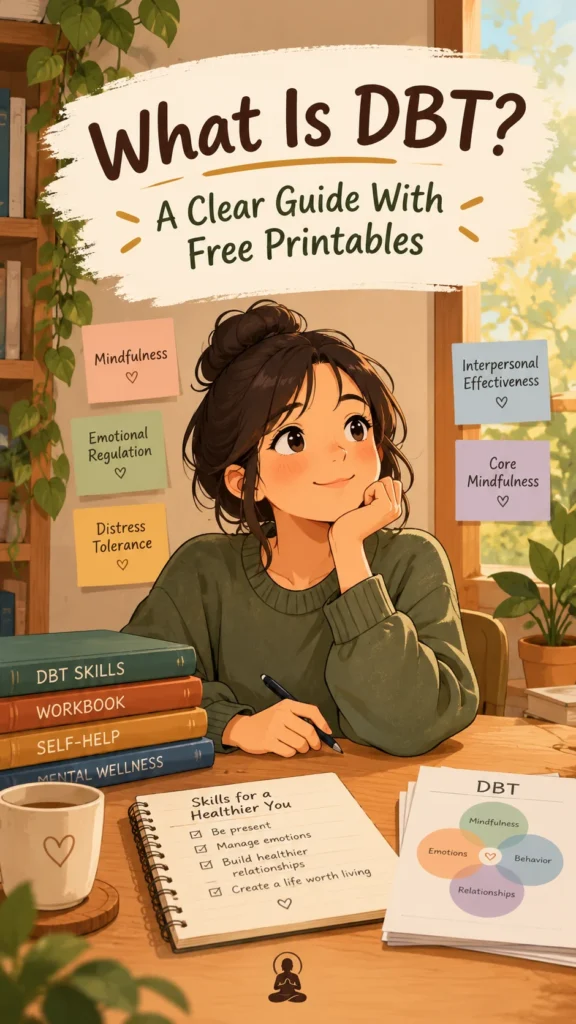
What is DBT? Short for Dialectical Behavior Therapy. A therapy approach, not Direct Benefit Transfer. Not the data build tool either. Different world entirely. If you landed here chasing those instead, this isn’t your stop.
So what does DBT actually do?
It steps in when feelings run too hot to think straight. When a conflict spirals and won’t stop. When stress fogs up your head and the next move disappears. Most advice tells you to just calm down. That’s not advice. That’s noise.
DBT works differently. It holds two things at once: accepting what you feel, and changing how you respond to it. Not one or the other. Both. You learn to actually understand what’s happening inside you first. Then you build better ways to act on it. This guide walks through how DBT works, its four core skills, who tends to benefit, and how free DBT skills worksheets and printables can back up the practice at home.
Quick overview: DBT is a structured psychotherapy built by psychologist Marsha M. Linehan. It pairs acceptance-based strategies with real behavior change. Four skill areas sit at the center: mindfulness, distress tolerance, emotion regulation, and interpersonal effectiveness. That’s the whole framework.
One more thing, and it matters. If you or someone near you is in immediate danger, contact local emergency services right away. In the United States, call or text 988 for suicide or mental health crisis support. Don’t wait on that.
Table of Contents
Disclaimer
This blog is written and edited with the help of AI, then reviewed by me before publishing. As a result, the content is for general reflection only, not therapy or medical advice, and I’m not a licensed mental health professional. If you’re in crisis, please contact 988 if you’re in US or a local crisis service of your country instead of relying on this site.
What Is DBT? Understanding Dialectical Behavior Therapy
DBT stands for dialectical behavior therapy. So what is DBT, exactly? It’s a structured kind of psychotherapy. People use it to manage intense emotions, cope with distress, and improve relationships. Psychologist Marsha M. Linehan built it.
DBT grew out of cognitive behavioral therapy, or CBT. But it adds something CBT alone didn’t have. It blends practical behavior-change tools with acceptance-based skills. That combination is the whole point.
If you’re already working through the full DBT skills worksheets library, this section is the foundation underneath every module in it.
What Does Dialectical Behavior Therapy Mean?
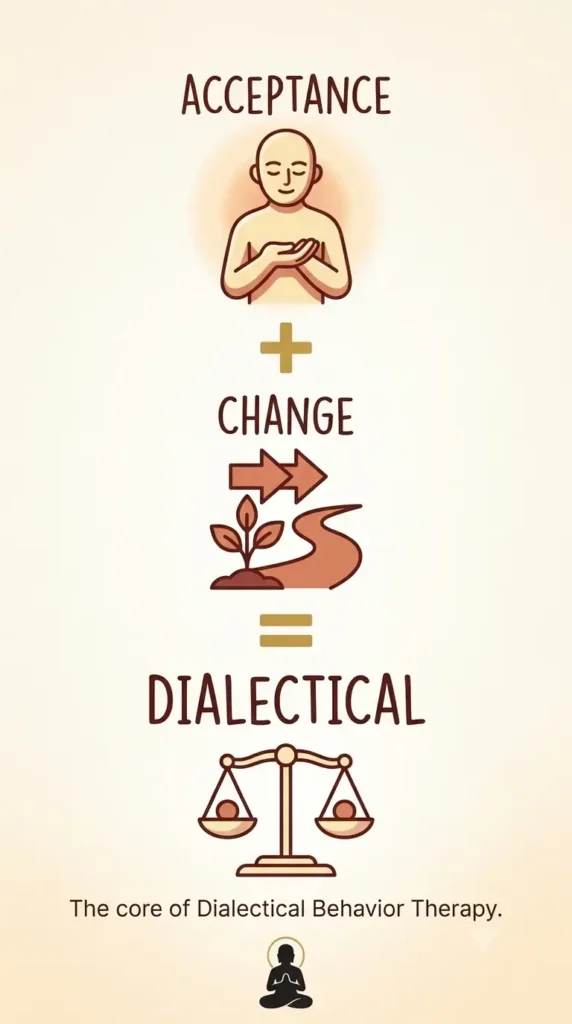
The word “dialectical” sounds like jargon. It isn’t, not really. It just means holding two ideas together that seem to clash. In DBT, those two ideas are acceptance and change. You learn to accept yourself and your current experience. At the same time, you work to change behaviors that cause harm or distress. Both at once. Not one after the other.
Here’s what that looks like in real life. Feeling rejected hurts. That’s real. No amount of positive thinking erases it. But you can still learn to respond without lashing out or shutting everyone out. Both things are true at the same time. That’s dialectical thinking in a single moment, not a textbook definition.
DBT was first built for people with chronic suicidal thoughts and borderline personality disorder. That’s BPD, for short. It didn’t stay there. Clinicians now use dialectical behavior therapy for other struggles involving emotional regulation too. Want the source material straight from the people who built it? The Linehan Institute breaks down DBT and its core skills in more depth.
Is DBT a Therapy or Just a Set of Skills?
DBT is a therapy. Not a worksheet packet. Not a list of acronyms you memorize and move on. Full DBT treatment usually combines several parts. Individual therapy. Skills training. Practice between sessions. Phone coaching, when it’s available. A consultation team for the therapists themselves. Five parts, working together.
Some programs only teach selected DBT skills, without the rest of that structure. That’s fine for some people. It just isn’t the same thing as dbt therapy in its complete form. Worth knowing the difference before you commit time to either path.
Why do people seek this kind of dialectical therapy out in the first place? Usually it’s one of four reasons. Overwhelming emotions that won’t settle. Harmful behavior patterns that keep repeating. Distress that feels impossible to sit with. Relationships that keep breaking down the same way.
The goal was never to erase difficult feelings. It’s to respond to them differently. That shift, from fighting a feeling to working with it, is most of what DBT teaches. Pairing that work with tools like coping skills worksheets or an emotions worksheet helps. It makes the practice concrete instead of abstract.
What Is DBT Therapy Used For?
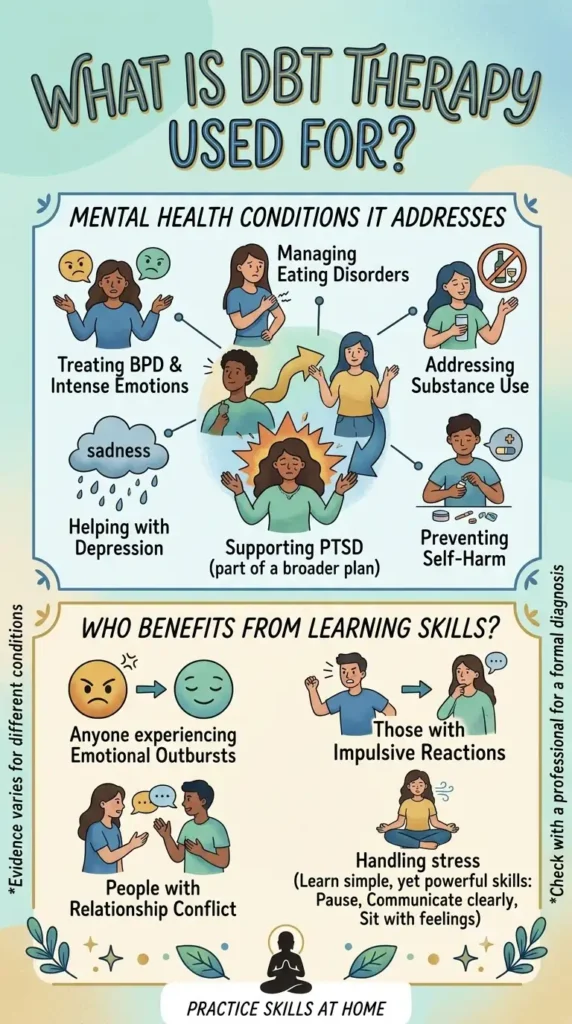
What is DBT, exactly? Short answer: a skills-based therapy for people whose emotions run hot and fast. Dialectical behavior therapy (DBT) helps people manage intense emotions. It also cuts down on harmful behaviors.
And it rebuilds relationships that keep breaking down. DBT is most closely tied to borderline personality disorder (BPD). But that’s not the whole story. DBT skills also support people facing other emotional and behavioral struggles.
Mental Health Concerns DBT May Help Address
DBT wasn’t built for everyone. It was built for people who feel too much, too fast, and don’t yet have the tools to handle it. Marsha Linehan developed dialectical behavior therapy DBT specifically for that gap.
It’s widely used to treat BPD. It can also address suicidal behaviors and self-harm, inside an appropriate treatment plan. Not as a stand-alone fix.
DBT-based treatments have been adapted further, for:
- Eating disorders: managing the emotions and urges tangled up in eating behaviors.
- Substance use disorders: riding out distress without reaching for the usual escape.
- Depression: building skills for emotions and behaviors that feel too big to manage.
- Post-traumatic stress disorder (PTSD): developing emotion regulation and distress tolerance skills, as part of a broader treatment approach.
Does DBT work equally well for all of these? No. The evidence varies by condition. DBT isn’t the right fit for everyone. For more on BPD specifically, the National Institute of Mental Health’s guide to borderline personality disorder is a solid place to start.
Want to practice the skills themselves? Our DBT skills worksheets walk through exercises organized by skill and situation.
Who Might Benefit From Learning DBT Skills?
Emotional outbursts. Impulsive reactions. Conflict that won’t stay resolved. Trouble coping with stress. Sound familiar? DBT skills were built for exactly this list.
They teach something simple but hard: pause before acting. Say what you need, clearly. Sit with an uncomfortable feeling without making the situation worse by reacting to it.
Here’s the part people miss. Feeling things intensely doesn’t mean something is wrong with you. It doesn’t automatically mean a diagnosis. Anyone can learn mindfulness. Anyone can learn distress tolerance. Anyone can learn emotion regulation. These aren’t locked behind a clinical label.
So when does it become something more formal? That’s a call for a mental health professional, not a worksheet. If emotional or behavioral difficulties keep showing up and start interfering with daily life, that’s the signal to ask.
A professional can help you figure out whether full DBT treatment makes sense, or whether the skills alone are enough for now. Our coping skills worksheets and emotions worksheet are good starting points either way.
How Does DBT Work?
Dialectical behavior therapy doesn’t start by asking you to feel different. It starts with the feelings you already have. DBT helps you name them, sit with them, and then shift what you do next. It blends one-on-one sessions, hands-on skills practice, and real-world practice for applying that practice when life gets messy.
The Balance Between Acceptance and Change
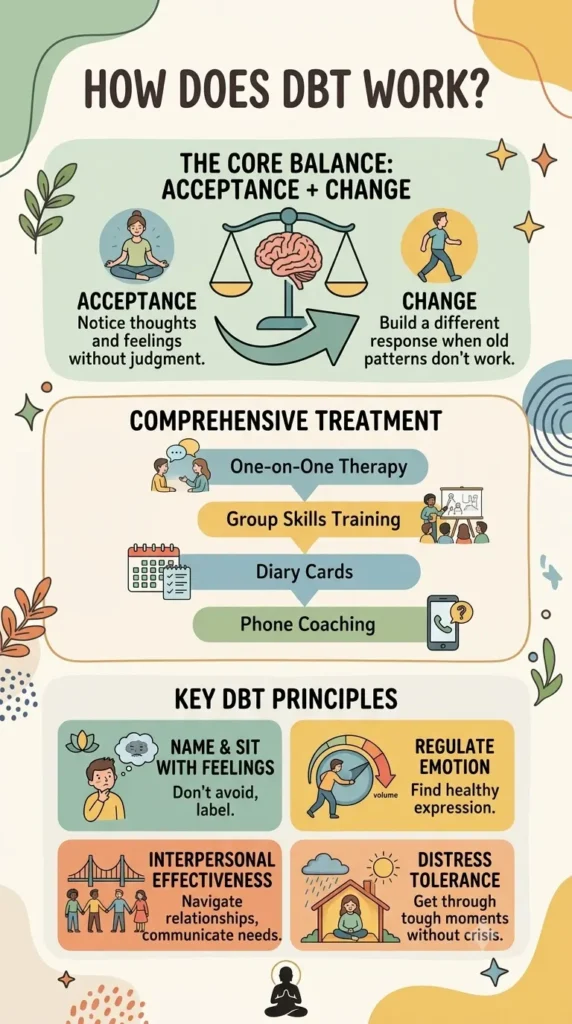
Two words hold up the whole model: acceptance and change. Not one or the other. Both, at once.
Acceptance means you notice a thought or a feeling without scoring yourself on it. No “I shouldn’t feel this way.” Just the feeling, sitting there, real. Change is the second half. It means building a different response when your old one keeps backfiring.
Say a fight with a friend leaves you hurt. Acceptance is admitting the hurt is real instead of arguing yourself out of it. Change is choosing what happens next, not snapping back, not going silent for three days.
That’s the whole shift dialectical behavior therapy is built on. You can hold the hurt and still move toward something better. Kindness toward yourself and change aren’t opposites. DBT just finally says that out loud.
What Happens During DBT Treatment?
A full DBT program rarely runs on one piece alone. It layers things together on purpose.
Individual therapy digs into what’s happening in your life week to week. Group skills training teaches the actual tools. Diary cards track your emotions and behaviors so patterns stop hiding. Phone coaching, when a provider offers it, gives you a lifeline between sessions.
A comprehensive program commonly includes:
- One-on-one therapy sessions
- Weekly group skills training
- Daily diary cards for tracking emotions
- Phone coaching between appointments, where available
- A therapist consultation team working behind the scenes
Most structured programs run six months to a year. Some run longer. It depends on the provider and what you walked in needing. Expect regular sessions. Expect homework between them too.
Not every clinic runs the full model. Some offer pieces of it. Ask directly what’s included before you commit, because “DBT” on a brochure doesn’t always mean the whole package.
How Is DBT Different From CBT?
Cognitive behavioral therapy targets the thought. Catch the distorted thinking, swap it out, change the behavior that follows. Useful, direct, and it’s helped a lot of people.
DBT grew out of that model. Then it added weight to acceptance, to riding out intense emotion without drowning in it, to fixing how people actually relate to each other. Think of CBT as the foundation and DBT as the addition built for people whose emotions run hot and fast.
Neither one wins outright. The right fit depends on what you’re carrying and what you want out of treatment. Our DBT vs. CBT comparison breaks down the differences in more depth if you want to go further.
What Are the Four Core DBT Skills?
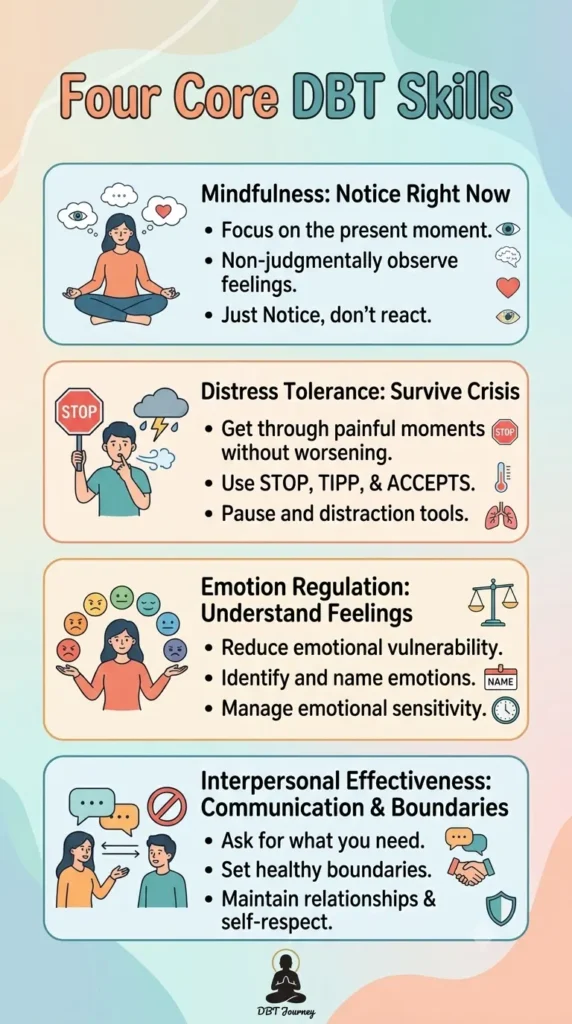
Dialectical Behavior Therapy, or DBT, teaches four core skills. Mindfulness. Distress tolerance. Emotion regulation. Interpersonal effectiveness. Four jobs, four modules.
Together they help you notice a feeling, get through a rough moment, settle an emotional spike, and say what you need out loud. You don’t have to learn all four at once. Pick one. Practice it this week.
Mindfulness: Notice What Is Happening Right Now
Mindfulness means paying attention to right now. Not judging it. Not reacting to it. Just noticing. In DBT, it’s the skill that sits under the other three. Without it, you’re guessing at what you feel instead of seeing it clearly.
DBT mindfulness splits into “What” skills (observe, describe, participate) and “How” skills (nonjudgmentally, one-mindfully, effectively). Here’s what that looks like in practice. Instead of “I’m terrible at handling stress,” you notice, “My shoulders are tense, and I’m worried about tomorrow.” Small shift. Big difference.
That shift buys you a pause before you act. For more ways to build it, our guide to DBT mindfulness skills breaks down each technique on its own, and these mindfulness journal prompts give you a place to practice it on paper.
Distress Tolerance: Get Through Difficult Moments
This isn’t about fixing the problem. Not yet, anyway. Distress tolerance skills get you through a painful moment without making it worse. That’s the entire job description. Nothing more complicated than that.
Three tools carry most of the weight here. STOP helps you pause before you react. TIPP uses body-based moves, temperature, breathing, muscle work, to bring intensity down fast. ACCEPTS leans on distraction when staying focused on the problem is only feeding it.
Picture this. An upsetting text lands, and your thumb is already moving toward an angry reply. STOP buys you ten seconds. Step back, notice the urge, choose something other than the first thing your gut wants to send. Want the full breakdown? Our guide to DBT distress tolerance skills walks through STOP, TIPP, and the rest in more depth.
Emotion Regulation: Understand and Manage Emotions
Emotion regulation isn’t about erasing hard feelings. That’s not the goal, and it never was. The goal is understanding them well enough that they stop running the show.
Start by naming what you feel. Then ask what triggered it. Bad sleep, skipped meals, a stretch of ongoing stress, these all make emotions louder and harder to manage. Check those first. A loud feeling isn’t always an accurate one.
Why does naming it even matter? Because a feeling you can’t name is a feeling you can’t work with. Our guide to DBT emotion regulation skills covers the full process, and this printable emotions worksheet gives you a place to start naming what you feel.
Interpersonal Effectiveness: Communicate and Set Boundaries
Most people treat saying no as a character flaw. It isn’t. Interpersonal effectiveness skills help you ask for what you need, hold a boundary, and keep the relationship standing while you do it. Three goals, held at once: get the outcome, keep the relationship, keep your self-respect.
Here’s a decision moment. Someone asks for a favor you don’t have time for. Instead of agreeing out of habit, you say, “I care about helping you, but I can’t take this on today.” No attack. No apology spiral. Just the truth, stated plainly.
That line does three things at once, and that’s the whole point of the skill. For techniques you can use in your next hard conversation, see our guide to DBT interpersonal effectiveness skills.
A DBT skill vs. a DBT activity: A skill is the technique itself, observing your thoughts without judgment, for instance. An activity is how you rehearse it, like spending two quiet minutes just watching your breath. The Linehan Institute, founded by the psychologist who created DBT, is a good reference point if you want to go deeper on where these skills come from.
How to Use DBT Skills in Everyday Life
Reading about a DBT skill and actually using one are two different things. The gap closes in real moments, not on the page. Pick one hard moment. Match it to a skill. Watch what shifts.
Small reps beat big plans. Do this enough times and you respond with more thought, not less.
Example: When a Message From a Friend Upsets You
A friend reads your text. No reply comes back. Hurt shows up. Maybe anxiety too, or anger, and your thumb is already hovering over a second message.
Here’s where the four DBT modules earn their keep:
- Mindfulness: Notice the thought and the feeling. Don’t assume you know why they haven’t replied yet.
- Distress tolerance: Pause. Breathe slow a few times. Give yourself room before you respond.
- Emotion regulation: Name what you’re feeling. Ask what might be turning the volume up on it.
- Interpersonal effectiveness: Still bothering you later? Say how you feel, ask for clarity, skip the blame.
The goal was never to stop feeling upset. It’s to put space between the feeling and whatever you do next.
Start With One Skill Instead of Trying Everything at Once
You don’t need all four DBT modules running at once. Pick the one that matches today’s problem. Racing thoughts call for mindfulness. An emotion that feels too big calls for distress tolerance instead.
Practice on the calm days too. That’s when you actually learn a skill, before you need it under pressure. One approach falls flat? That’s information. Not proof you failed.
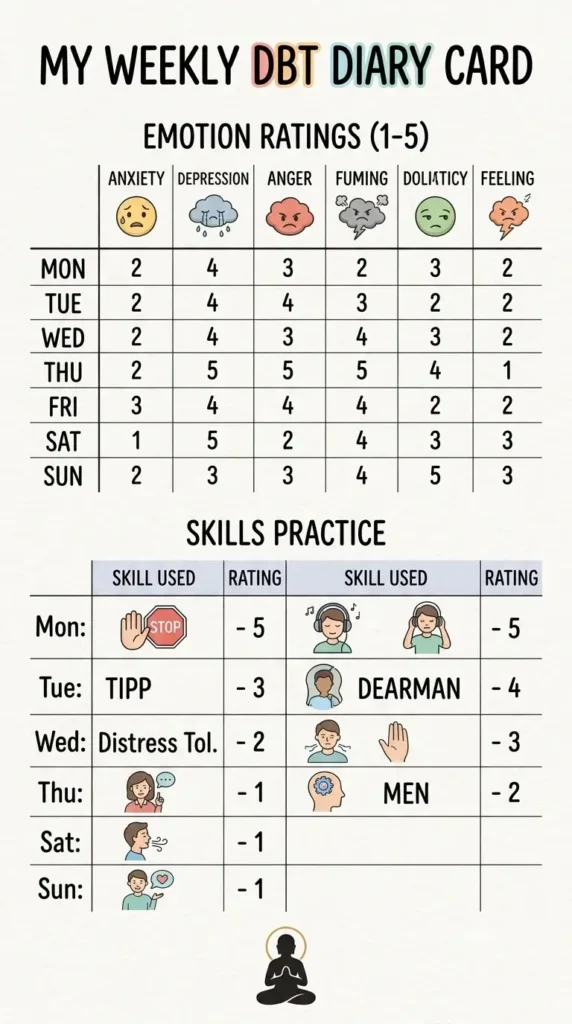
Track Patterns With a DBT Diary Card
A DBT diary card records the pattern your memory keeps losing: emotions, urges, behaviors, and which skill you actually reached for. Look back over a few weeks and the triggers start to show themselves, along with the skills that keep working for you.
Free DBT Skills Overview Printable
One page. Four modules. That’s the whole idea behind this free DBT skills overview printable.
Dialectical behavior therapy packs a lot into four modules: mindfulness, distress tolerance, emotion regulation, and interpersonal effectiveness. Keeping all four straight in your head isn’t easy.
Nobody manages it under stress. This printable puts them in one spot so you don’t have to try. Grab it when you need to pick a skill fast, not relearn the whole system from scratch.
What’s in This Printable
It’s 9pm. Something just went sideways, and you’ve got maybe ten minutes before it gets worse. This is exactly the moment this sheet was built for.
One page. All four DBT modules, side by side. Each one gets a short, plain-language description, just enough to remind you what it does and when it actually helps. No paragraphs to dig through.
There’s also a mini diary-card built into the sheet. Note the emotion. Note the situation. Note which skill you tried. That’s it.
Why bother tracking any of it? Patterns. One entry tells you almost nothing on its own. A few weeks of entries start pointing at something real, like which skill you keep reaching for and which ones you keep skipping. That’s worth knowing.
Keep the sheet somewhere you’ll actually see it. Inside your journal. Beside your desk. Think of it as a glance, not a program. It’s a quick reference, nothing more, and it’s not built to replace a full DBT skills worksheets practice.
Want to Go Deeper?
One page only goes so far. For worksheets that dig into a specific skill, from STOP to DEAR MAN, our full DBT skills worksheets collection covers the whole set, plus kid, teen, and adult versions.
Need something to glance at mid-crisis instead? The DBT skills cheat sheet condenses the same four modules into a single quick-reference page.
Prefer a structured book instead of loose sheets? Marsha M. Linehan’s own DBT Skills Training Handouts and Worksheets goes further than any printable can. Want more options first? Our guide to the best DBT books and workbooks breaks down a handful worth comparing.
How to Use a DBT Worksheet Effectively
Pick one worksheet. The one that actually fits what you’re dealing with today, not five that sound useful. Read the instructions. Work through it at your own pace.
Perfection isn’t the goal here. Practicing the skill is. One honest attempt beats a worksheet filled out perfectly.
Want the full breakdown? The “How to Use DBT Worksheets Effectively” section in our DBT skills worksheets guide walks through it step by step.
Is DBT Effective? Benefits and Limitations to Understand
DBT isn’t a cure-all. It’s a toolkit, and like any toolkit, it only works if you actually pick it up. Dialectical Behavior Therapy can help people manage intense emotions, cope with distress, and improve relationships.
How much it helps depends on your needs, the quality of the treatment, and whether you’re willing to practice the skills outside of session. Most people find it useful. Nobody finds it fast.
Potential Benefits of DBT
Learn the skills, and reacting on autopilot gets a little harder to default to. DBT teaches practical tools for responding to hard moments with more awareness and less whiplash. It’s an established treatment for borderline personality disorder (BPD), especially when emotional instability, impulsive behavior, or self-harm are part of the picture.
With practice, DBT may help you:
- Recognize emotions before reacting to them
- Handle distress without making things worse
- Communicate needs and set boundaries that hold
- Reduce harmful patterns and build habits that actually work
Research backs DBT for several mental health concerns. Results still vary person to person. A qualified mental health professional can help you figure out whether it fits your situation, not a blog post.
What DBT Requires From You
This isn’t a program you skim. DBT takes practice, patience, and showing up even when the old habit feels easier. You may need to track emotions, finish homework between sessions, and try a response that feels unnatural at first. Sound uncomfortable? It usually is, at the start.
Progress here isn’t a straight line. Some weeks feel like nothing’s moving. Finding a skill difficult doesn’t mean you’re failing at this. It usually just means you need more reps, or a bit more guidance. Worksheets for checking emotions or working through coping skills worksheets can give that practice some structure between sessions.
When a Worksheet or Self-Help Book Is Not Enough
Worksheets teach. They don’t treat. Free DBT skills worksheets and self-help books are a solid way to learn the basics. They can’t replace a professional assessment or full treatment once your needs go past the basics.
If intense emotions, self-harm urges, or everyday difficulties start feeling unmanageable, that’s the signal to reach out to a qualified mental health professional. Not a worksheet. Not another article.
If you may act on suicidal thoughts or are in immediate danger, contact your local emergency services. In the United States, call or text 988 to reach the Suicide & Crisis Lifeline.danger, contact your local emergency services. In the United States, call or text 988 to reach the Suicide & Crisis Lifeline.
How to Get Started With DBT
Starting dialectical behavior therapy doesn’t mean signing up for a full program on day one. Pick one skill first. Find the right level of support second. That’s the real order.
Books and worksheets can teach you the shape of a skill. They can’t watch you use it under pressure. A trained therapist can. That gap is the whole reason this section exists.
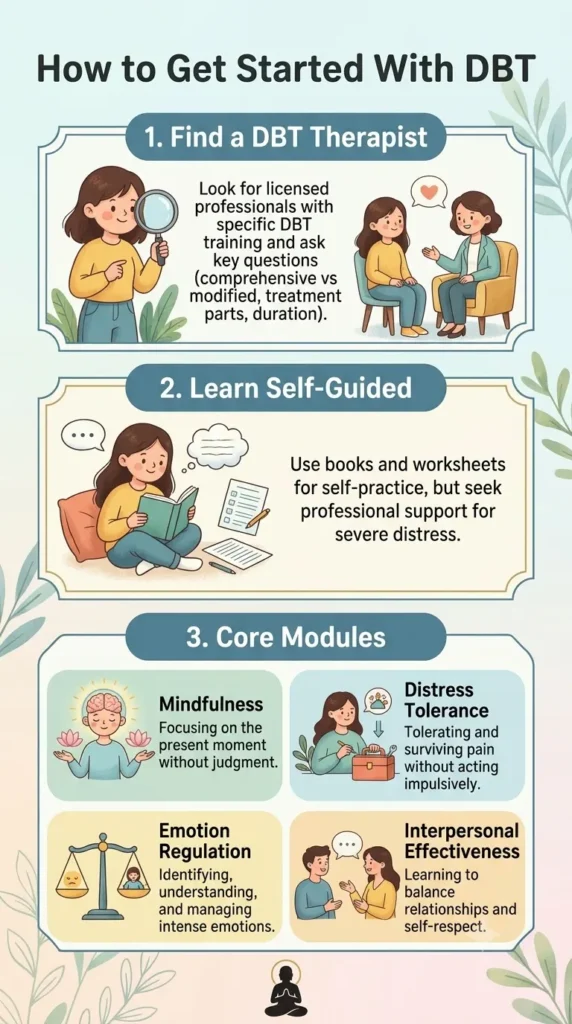
How to Find a DBT Therapist or Program
Not every therapist who mentions DBT actually runs it. Look for a licensed mental health professional with specific training in dialectical behavior therapy, not someone who borrowed a worksheet once. Credentials matter here more than comfort.
Ask before you commit. Is this comprehensive DBT, or a modified version built around one piece of it? What does treatment actually include? How long should you expect to stay? Three questions. Ask all three.
Comprehensive DBT usually has four parts. Individual therapy. Group skills training. Between-session coaching. A therapist consultation team. Most programs skip at least one.
That’s not automatically a problem. It just means you need to know what you’re signing up for. A program heavy on group work but light on coaching serves a different need than one built around weekly individual sessions.
The DBT-Linehan Board of Certification directory lists clinicians trained to deliver DBT with fidelity to the original model. It’s a reasonable starting point if you’re not sure where to look. Confirm training directly with any provider you’re considering, since directories aren’t guarantees.
Can You Learn DBT Without a Therapist?
Yes. You can learn the basics and practice individual skills on your own. Books, worksheets, and other self-guided resources do real work here.
Self-guided practice builds awareness. It lets you try new ways to manage emotions, sit with distress, and communicate differently. None of that requires a therapist sitting across from you.
Reading about dialectical behavior therapy isn’t the same as receiving it, though. That gap matters most when things get hard. If you’re facing severe emotional distress, repeated urges to self-harm, or trouble managing daily life, self-guided practice isn’t enough on its own. Reach out for professional support instead.
What does that distinction actually look like in practice? A worksheet can explain the STOP skill in detail. It can’t notice your voice shake and adjust course mid-conversation the way a trained clinician can. Keep both tools. Just don’t mistake one for the other.
What to Read Next
Start with the DBT Skills Worksheets collection for printable, structured practice across all four modules. That’s the fastest way to find the one skill that fits what you’re dealing with right now.
From there, narrow by module. Each one covers different ground:
- DBT Mindfulness Skills: notice thoughts and emotions without reacting on autopilot.
- DBT Distress Tolerance Skills: get through a hard moment without making it worse.
- DBT Emotion Regulation Skills: understand what you’re feeling and respond with more than instinct.
- DBT Interpersonal Effectiveness Skills: ask for what you need without losing the relationship.
Need something fast, not a full lesson? The DBT Skills Cheat Sheet fits the core skills onto one page. Keep it nearby for the moments a full worksheet feels like too much.
Want a more structured path through all of it? The Best DBT Books and Workbooks compares options built for beginners, teens, and adults, including the dialectical behavior therapy skills workbook most clinicians point people toward first.
Conclusion
DBT (Dialectical Behavior Therapy) offers practical ways to manage intense emotions, tolerate distress, and build healthier relationships. Its four core skill areas—mindfulness, distress tolerance, emotion regulation, and interpersonal effectiveness—give you tools to respond to difficult moments with greater awareness. You don’t have to master every skill at once.
Start with one that fits a challenge you’re facing, then practice it regularly. Free DBT worksheets can help you learn the basics and track your progress. For ongoing or severe emotional difficulties, consider working with a qualified mental health professional. Small steps and consistent practice can help you build skills that support a more balanced life.
Frequently Asked Questions
What does DBT stand for in mental health?
DBT stands for Dialectical Behavior Therapy, a structured form of psychotherapy developed by psychologist Marsha M. Linehan. It combines acceptance-based strategies with behavior change techniques to help people manage intense emotions, cope with distress, and build healthier relationships.
What is the difference between DBT and CBT?
Cognitive Behavioral Therapy (CBT) helps people identify and change unhelpful thoughts and behaviors. Dialectical Behavior Therapy (DBT) builds on behavioral principles while placing particular emphasis on emotional regulation, acceptance, mindfulness, and interpersonal skills. Both approaches can be helpful, but the best fit depends on a person’s needs and treatment goals.
What is DBT therapy used for?
DBT was originally developed to treat people experiencing chronic suicidal behaviors and difficulties associated with borderline personality disorder (BPD). It is also used for other concerns involving intense emotions, impulsive behaviors, and distress. Depending on the person’s needs, clinicians may use DBT or adapted DBT approaches to address additional mental health conditions.
What are the four core DBT skills?
The four core DBT skills are mindfulness, distress tolerance, emotion regulation, and interpersonal effectiveness. Mindfulness helps you notice the present moment, distress tolerance helps you cope with difficult situations, emotion regulation builds awareness and management of feelings, and interpersonal effectiveness supports clear communication and healthy boundaries.
Can you learn DBT from a book or worksheet without therapy?
Yes, books and worksheets can help you learn DBT concepts and practice individual skills independently. However, self-guided learning is not the same as comprehensive DBT treatment.
If you experience severe emotional distress, self-harm urges, or persistent mental health difficulties, consider seeking support from a qualified mental health professional.
What is a DBT diary card, and how do you use it?
A DBT diary card is a tracking tool used to record emotions, urges, behaviors, and DBT skills practiced over time. You typically complete it regularly, often daily, to identify patterns and review progress with your therapist. The exact format varies depending on your treatment plan and individual goals.

It’s Bhaskar!
Well, I am not a psychologist a monk, or a philosopher by training. I’m just an engineering graduate.
‘The Empty Self’ is where I write about that idea, and what it actually means for ordinary life, anxiety, identity, habits, the stories we tell ourselves about who we are. I don’t have a psychology degree, and I’m not offering therapy or clinical advice. What I do have is thought and clarity, and genuine curiosity about why we suffer the way we do and how much of it might loose once we shed this ‘fixed identity’.
Pingback: DBT for Anxiety: All You Need to Know With Free Printables | The Empty Self
Pingback: DBT for Depression: Complete Guide for Adults With Free Printables | The Empty Self