
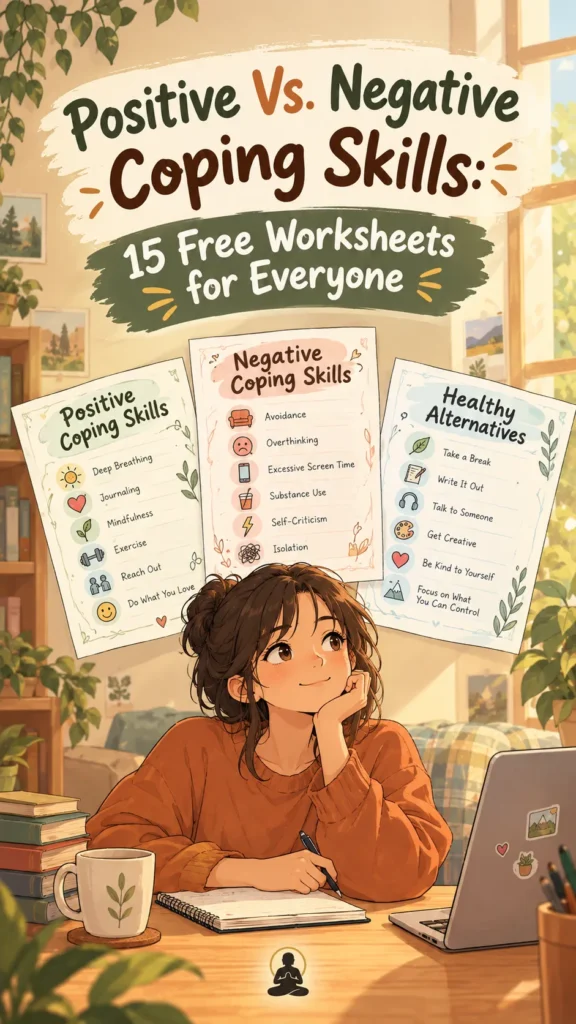
Stress doesn’t wait for a convenient moment. It shows up mid-meeting, mid-argument, mid-bedtime meltdown. The coping skill you grab in that instant matters. It can make the next hour lighter. Or it can hand tomorrow-you a bigger mess.
Positive vs. negative coping skills isn’t about sorting behavior into good and bad piles. That framing misses the point. What matters is simpler. Does the response you reach for actually help you handle the situation and the emotion, without leaving more damage behind?
This guide walks through the difference between healthy coping mechanisms and the unhealthy kind. You’ll see what that split looks like in real, messy situations. Not a lecture, just the actual difference. And you’ll walk away with a clearer way to choose your next move.
Below, grab 15 free positive coping skills worksheets and printables built for kids, teens, young adults, and adults. There’s also a quick activity for spotting your own patterns. And for swapping out the ones that aren’t working.
Quick overview: Positive coping skills help you manage stress, emotions, or problems. They back your well-being instead of fighting it. Negative coping skills? They might feel like relief in the moment. But they tend to pile up and worsen problems. And the longer they stick around, the more they crowd into daily life.
Table of Contents
Disclaimer
This blog is written and edited with the help of AI, then reviewed by me before publishing. As a result, the content is for general reflection only, not therapy or medical advice, and I’m not a licensed mental health professional. If you’re in crisis, please contact 988 if you’re in US or a local crisis service of your country instead of relying on this site.
Positive vs. Negative Coping Skills: What’s the Difference?
Positive vs. negative coping skills come down to one thing. What happens after.
Healthy coping helps you handle a hard feeling, fix a real problem, or get through a rough stretch without leaving a bigger mess behind. Unhealthy coping works too, for about an hour. Then the bill comes due.
What Are Positive Coping Skills?
Positive coping skills are the moves that ease stress without costing you something bigger later. Journaling counts. So does calling someone you trust. A walk. A purposeful break. A grounding exercise. Splitting one stressful problem into a single small step.
Feeling better right away isn’t the test. Not even close. That’s the trap most people fall into.
A real coping skill does something else too. It leaves you better able to face whatever caused the mess in the first place.
Take anger. A short walk gives your body time to cool off before you respond. That’s positive coping in action. Going quiet on everyone for four days might feel like relief at first. By day two, you’re isolated, and the actual problem hasn’t moved an inch.
What Are Negative Coping Skills?
Negative coping skills ease pain in the moment. Then they hand you a second problem.
Substance misuse fits here. So does constant avoidance, lashing out, pulling away from everyone, or leaning on food, sleep, or a screen mainly to dodge a feeling you don’t want to sit with.
That doesn’t turn every quiet night in with a movie into a red flag. Context decides that, not the activity itself.
A movie can be real rest. Reaching for a movie every single time a hard emotion shows up? That’s avoidance wearing a comfortable disguise.
Psychologists Richard Lazarus and Susan Folkman built a coping framework researchers still lean on today. Later research sorts coping into three types. Problem-focused, like planful problem solving. Emotion-focused, like positive reappraisal. And escape avoidance, wishful thinking that skips the stressor entirely. Worth knowing which one you’re actually making.
Want the clinical definition? The APA Dictionary of Psychology lays out coping in plain psychological terms.
Naming what you’re actually feeling usually comes first, before you can pick the right coping skill. If that part feels shaky, start with an emotions worksheet. And for the full breakdown of healthy vs. unhealthy patterns, plus 15 free tools to practice with, our coping skills worksheets guide covers exactly that split.
Healthy vs. Unhealthy Coping Skills at a Glance
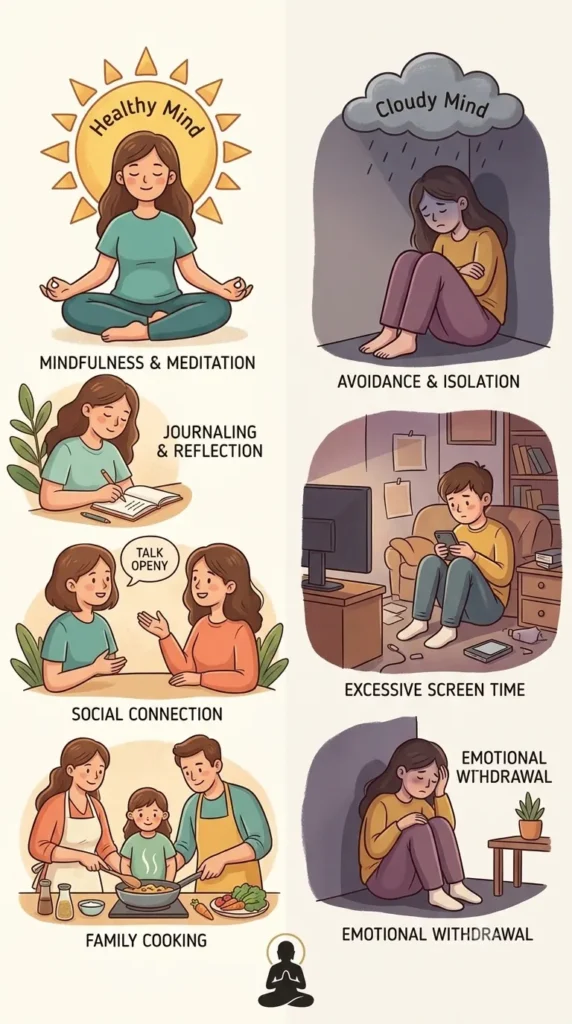
Some coping skills help. Some just numb the moment. That’s the whole difference between positive coping skills and unhealthy ones, and it rarely shows up right away.
Healthy coping skills support your well-being without adding new problems on top of the old one. Unhealthy coping mechanisms do the opposite. They take the edge off right now, then hand you a bigger mess later.

| Healthy coping skills | Unhealthy coping skills |
|---|---|
| Helps manage emotions without causing additional harm | May create new problems or increase distress |
| Can improve your ability to handle the situation | Often avoids or delays dealing with the situation |
| Supports physical, emotional, or social well-being | Can interfere with health, relationships, school, or work |
| Leaves you with useful skills or insight | May provide short-term relief followed by worse feelings |
| Can be adjusted when circumstances change | May become a rigid habit or automatic response |
What Healthy Coping Usually Does
Healthy coping mechanisms help you manage stress without wrecking your longer-term well-being. A walk when you’re tense. Naming what you feel out loud. Asking someone for help. Breaking one huge task into one small step you can actually finish today.
None of that feels great in the moment. Talking through a painful problem is often harder than just avoiding it. That’s the catch most people miss.
Here’s the real difference. Healthy coping gives you a way forward. Unhealthy coping just moves the discomfort somewhere else and calls it handled.
Want a starting point? These coping skills worksheets walk through specific exercises you can try today, and pairing them with a few journal prompts for mental health gives you somewhere to put the thoughts once they surface.
What Unhealthy Coping Often Does
Unhealthy coping skills work fast. That’s the problem. They quiet the discomfort in minutes, then quietly stack up consequences behind it.
Skipping responsibilities. Snapping at people who didn’t deserve it. Reaching for a drink instead of a conversation. Shutting the door and staying there. Each one changes how you feel for a while. None of them touch what actually caused the distress.
Does that mean every hour alone is unhealthy? Not even close. Context decides that, not the behavior itself.
Watching a show to decompress after a brutal day is fine. Reasonable, even. Using that same show to dodge every hard feeling that shows up all week is a different pattern entirely, and it’s worth naming honestly. If you’re not sure which one you’re doing, an emotions worksheet can help you track the pattern instead of guessing at it.
Positive and Negative Coping Skills
Positive and negative coping skills can look almost identical from the outside. Two people scroll their phones after a bad day. One resets. One spirals. The real split shows up later, in whether the response actually moves you through the situation or just buries it for a few hours.
That’s the whole test for positive vs. negative coping skills. Not how the moment feels. What happens next.
These paired examples show that gap in plain, everyday situations.
Avoidance vs. Problem-Solving
A project is due in two days. Even thinking about it makes your chest tight. So you check your phone again. You tell yourself you’ll start later. The anxiety drops for a bit, then the deadline creeps closer and the dread gets louder.
Problem-solving works differently. Shrink the task until it stops feeling like a mountain. Open the document. List the first three steps. Work on one small piece instead of running from the discomfort.
Here’s the part people miss. A short break isn’t the enemy. A short break can be one of the more useful positive coping skills you have. The trouble starts when avoidance becomes your only move, the default setting that keeps you from ever touching the thing that needs your attention.
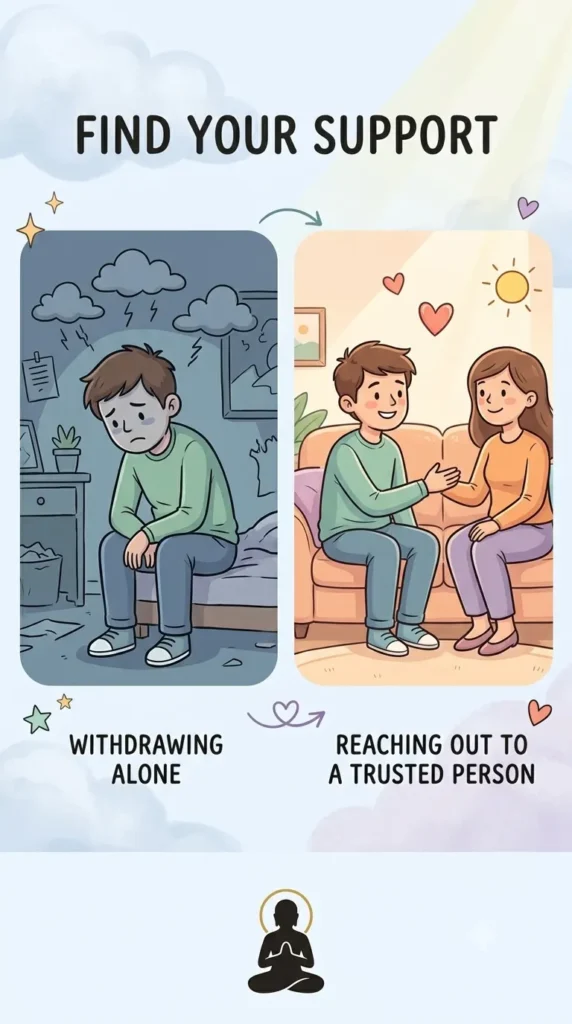
Isolation vs. Healthy Social Support
After a rough argument with a friend, you shut everyone out. Explaining what happened feels like too much. Being alone feels easier at first. Give it a few days, though, and that silence usually turns into something heavier: disconnection stacked on top of the original hurt.
A healthier move looks smaller than people expect. Pick one person you trust. Say something like, “I’m having a rough week. I don’t want advice, just some company.” That’s it.
Healthy coping mechanisms don’t always mean talking everything through. Sometimes quiet is exactly right. The real question is whether you’re taking deliberate space to recover, or repeatedly cutting yourself off because connection itself feels uncomfortable. If you’re not sure which one it is, a quick pass through an emotions worksheet can help you name what’s actually driving the withdrawal before you decide.
Numbing vs. Processing Emotions
Disappointing news lands, and you’re three hours into a video binge before you notice. Distraction can offer real relief. Nothing wrong with that on its own. The trouble starts when it becomes the only response every time sadness or disappointment shows up, and the feeling itself never actually gets looked at.
Processing looks less dramatic than people assume. Name what happened. Write down what you’re feeling. Talk to someone. Or just let yourself sit with being upset for a few minutes instead of outrunning it.
Not every hard emotion needs a deep conversation, either. Sometimes a funny show is the right call. The concern only kicks in when distraction is the only tool you know how to reach for. If putting words to the feeling is the hard part, journal prompts for mental health can give you a starting sentence when your own head comes up blank.
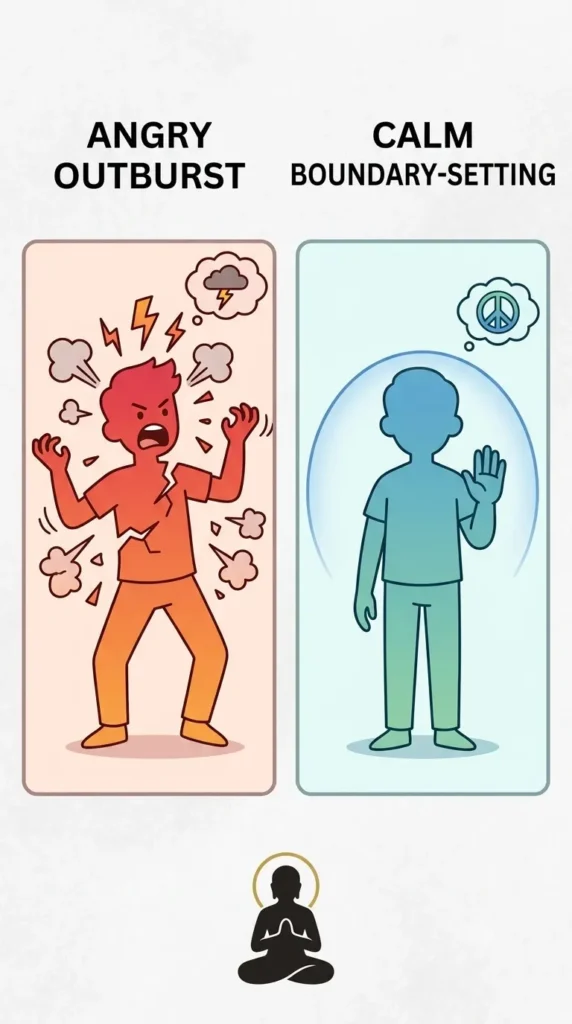
Aggression vs. Healthy Anger Expression
Someone keeps talking over you during a group project. You snap. Voice raised, then a sharp message sent the second you’re alone. It feels powerful for about ninety seconds. Then the conflict is worse than it was before you opened your mouth.
Healthy coping skills for anger aren’t about staying calm and pleasant no matter what. They’re about drawing the boundary without turning the anger into a weapon. Pause first. Let your body settle. Then say plainly what behavior needs to change.
Anger itself isn’t a negative coping mechanism. It’s information. It’s telling you something feels unfair, unsafe, or frustrating, and that’s worth listening to. The coping response is what actually matters here.
Walking away for a few minutes, moving your body, journaling, or using calm and direct language all let you act on that signal without leaving damage behind.
Emotional Eating vs. Meeting the Need Directly
A stressful day ends, and reaching for snacks feels like comfort. Nothing wrong with that by itself. Comfort food is part of an ordinary life for most people. The issue shows up when eating turns into your automatic answer for every uncomfortable feeling, especially while the actual need underneath goes completely untouched.
Ask yourself what you actually need in that moment. Hungry? Exhausted? Lonely? Overstimulated? Desperate for a break? If it’s loneliness, texting someone might help more than the snack ever could. If it’s exhaustion, rest beats pushing through one more task.
This isn’t about labeling food “good” or “bad.” It never was. It’s about understanding what the behavior is actually trying to solve.
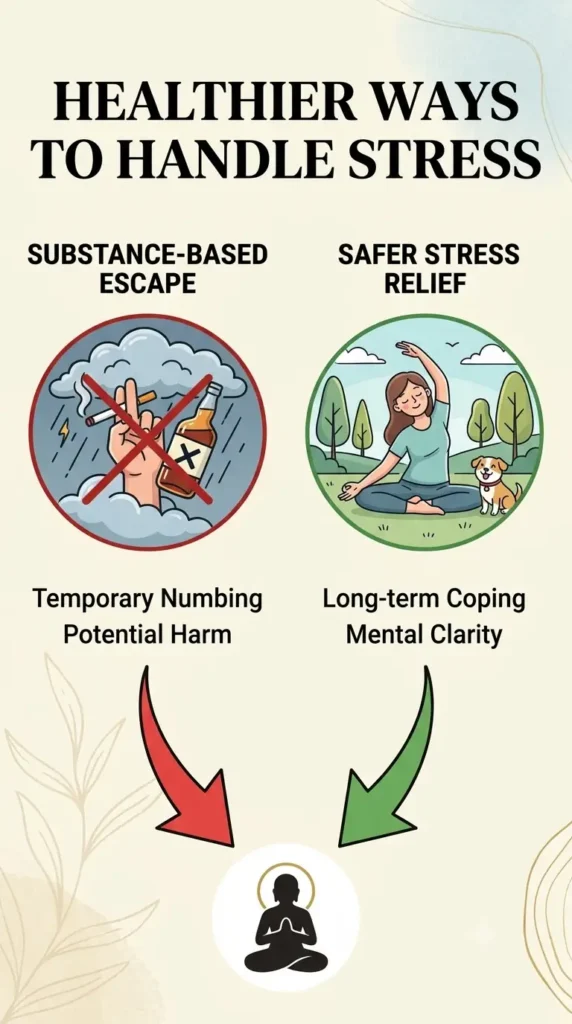
Substance Use vs. Safer Stress Strategies
After a brutal week, someone reaches for alcohol or drugs because the relief is fast. Racing thoughts quiet down. Tension eases, at least for a while. That immediate payoff is exactly what makes the behavior feel effective, even though repeated substance use as a coping response tends to create more health, relationship, and daily-life problems than it solves.
A safer response might mean movement, talking with someone, deliberate relaxation, changing your environment, or reaching out for professional support. The Substance Abuse and Mental Health Services Administration points to exactly this kind of shift, replacing the substance with something that meets the same need for relief.
This is one reason unhealthy coping mechanisms deserve more than a flat “don’t do this” warning. When a behavior delivers a strong short-term payoff, you can’t just remove it. You have to find another way to meet the need for relief, connection, rest, or emotional regulation that was driving it in the first place.
Procrastination vs. Taking a Manageable First Step
An uncomfortable email needs to go out. So you reorganize your desk. Scroll social media. Find five other things that suddenly feel urgent. Avoiding the email buys temporary relief, because you don’t have to sit with the discomfort of writing it.
A positive coping skill shrinks the task down to something almost too small to resist. Open the email. Write one sentence. Give yourself permission to stop right there if you need to.
Sound too easy to actually work? It is, and that’s exactly why it works. This isn’t about forcing productivity every time stress shows up. Sometimes postponing something really is the sensible call. The healthier pattern is knowing the difference between a deliberate delay and a habit of escaping the moment a task creates anxiety.
Suppressing Feelings vs. Making Space for Them
A dismissive comment stings, and you immediately tell yourself you’re “fine.” Life goes on as if nothing happened. That can keep you functioning for the rest of the day. The feeling doesn’t just vanish, though. It tends to resurface later as irritability, rumination, or quiet withdrawal from people who had nothing to do with it.
Healthy coping skills here mean acknowledging the feeling without letting it steer your behavior. Write down what happened. Name why it bothered you. Talk to someone you trust about it.
Processing an emotion doesn’t require acting on it. You can be angry without sending the message. Sad without pulling away from everyone. Hurt without turning the moment into a verdict about your own worth. A few rounds of journal prompts for self-love can help separate the feeling from the story you’re tempted to build around it, and if you want a slower, gentler way to sit with what came up, mindfulness journal prompts work well right after a moment like this.
How to Tell If a Coping Skill Is Healthy or Unhealthy
Relief right now doesn’t tell you much. Real judgment comes later. A coping skill that’s actually healthy helps you handle a hard moment without stacking a new one on top of it. Use the Morning-After Check to see what a coping response really does once the moment passes.
What happens after the immediate relief?
Don’t ask how it felt in the moment. Ask how you feel an hour later. Or the next morning.
A coping skill earns its keep if it helps you settle and get back to your day. That’s it. Nothing fancier than that.
If you’re left feeling worse, ashamed, wiped out, or stuck in the same loop again, something’s off. Look closer.
Does it solve, manage, or avoid the problem?
Not every problem gets solved. Some just get lived with. That’s fine.
Some situations call for acceptance. Others call for calming down, not fixing anything. The trouble starts with avoidance on repeat, when a problem could actually be handled and isn’t.
Healthy coping deals with what’s in front of you. It doesn’t make avoiding things your default setting.
Is the behavior flexible, or becoming your only option?
Healthy coping leaves you choices. Maybe you write it out in a journal one day, call a friend the next, and go for a walk when you need space.
Picture it: it’s 9pm, you’re wound up, and the only thing that calms you down is the one habit you know is doing damage. That’s the moment worth paying attention to.
If you can’t cope without one specific behavior, especially one that hurts you, the pattern is drifting into unhealthy territory.
Does it create new problems?
Zoom out. Does the coping response mess with your sleep? Your relationships? Work, school, money, your body?
Healthy vs unhealthy coping skills are usually easier to spot by what they leave behind than by how they feel in the first five minutes. The five-minute feeling lies. The aftermath doesn’t.
Are you processing the emotion, or just numbing it?
Numbing isn’t processing. They’re not the same thing, even when they feel similar in the moment.
Distraction has its place. A short break from a hard emotion is reasonable. But leaning on distraction every single time a feeling shows up keeps the real issue buried.
Why does this matter? Because the goal was never to feel good all the time. It’s to have ways to sit with hard emotions without those emotions running the show.

Positive Coping Skills for Kids, Teens, Young Adults, and Adults
Stress doesn’t wear one face. It looks different at seven than it does at seventeen, and different again at forty. A grounding game that settles a second grader would bore a teenager half to death. An adult juggling a job and a household needs something that fits between meetings, not a slow afternoon ritual.
Positive vs. negative coping skills isn’t really about finding the “correct” list. It’s about matching the tool to the person using it. A five-year-old and a fifty-year-old are not solving the same problem. So the fix can’t be identical either.
There’s no single perfect skill waiting to be discovered. There’s a small, flexible set you actually reach for when things go sideways. That’s the real goal here.

Healthy Coping Skills for Kids
Kids don’t need a lecture. They need something they can do with their hands. That’s the whole starting point for healthy coping skills for kids.
A child often can’t name what they’re feeling yet, let alone decide what to do about it. Naming has to come first. Drawing, moving, breathing, talking to an adult they trust, a sensory activity, or a short quiet break can all work once the feeling has a name attached.
Nobody calms down on command. Not adults, and definitely not kids. The goal is recognizing the feeling and picking a safe response, not flipping a switch.
Picture a kid mid-meltdown over a broken toy. Telling them to “calm down” does nothing. Handing them a face chart and asking which one matches does something.
For more age-appropriate activities and printable resources, see our coping skills worksheets for kids.
Healthy Coping Skills for Teens
This isn’t about handing teenagers a script. It’s about giving them some say in how they respond. Healthy coping skills for teens work best when a teen picks the tool, not when an adult assigns it.
School pressure, friend drama, family conflict, comparing themselves to everyone on their feed, not knowing what’s next. Generic advice bounces right off all of that. Journaling, exercise, music, grounding, a real conversation with someone they trust, an intentional break, or splitting an overwhelming task into smaller steps land better when matched to the actual moment.
Why does matching matter so much? Because a breathing exercise won’t touch friend-group drama, and a walk won’t fix an overdue project. Different problems need different tools.
Teens also need to hear this once, clearly: asking for support is a coping skill. Not a failure.
For more teen-focused ideas, explore our coping skills activities for teens.
Healthy Coping Skills for Young Adults
Young adulthood stacks stress differently. College or a new job. Rent. Relationships shifting. Friendships changing shape. Figuring out how to run a life without anyone checking your work.
Healthy coping skills for young adults have to survive a packed schedule. They can’t require a perfectly calm room, because that room rarely exists at twenty-three. A five-minute grounding exercise. A short walk. A quick journal entry. A realistic task list. A conversation with someone who actually gets it. A deliberate hour with the phone off.
None of that needs a whole evening. That’s the point.
It’s 11pm and the laundry’s still in the dryer, the inbox is still full, and sleep needs to happen anyway. That’s not the moment for an elaborate self-care routine. It’s the moment for the one tool that’s quick enough to actually use. Naming your specific trigger, the way the CDC’s guide on managing stress recommends, makes picking that tool a lot faster.
The most useful strategy is usually the one you can repeat when life is messy. Not the one that looks best on paper.
You can also explore our coping skills activities for adults.
Healthy Coping Skills for Adults
Adult stress doesn’t show up one problem at a time. Work stacks on a strained relationship. A strained relationship stacks on money worries. By Thursday it’s a pile, not a single stressor.
Healthy coping skills for adults need to work around that pile, not require it to disappear first. A long workday, a fight with a partner, a tight budget, a full house. None of it leaves much space for a lengthy routine.
That’s why the practical stuff matters most: setting a boundary, actual problem-solving, movement, journaling, slow breathing, leaning on people you trust, and recovery time you actually plan for instead of hoping it shows up. If naming the stressor first helps, these journal prompts for mental health are a solid place to start before picking a strategy.
Here’s the part most lists skip. A coping habit can quietly shift from occasional relief into a pattern that builds its own problems. Staying up late scrolling feels fine on a Tuesday. By Friday, the exhaustion is its own separate mess. Worth noticing before it becomes the new normal.
For a broader collection of practical exercises, visit our coping skills activities for adults.
Healthy Coping Skills for Women
Healthy coping skills for women aren’t a separate category with separate rules. The tools are the same ones everyone else has access to. What shifts is the terrain around them.
Work demands. Caregiving. Relationship stress. Social expectations that never quite let up. Sometimes just too little uninterrupted time in a day to think straight. All of it shapes which coping skill actually feels doable.
Journaling. Boundaries. Movement. Staying connected to people who show up. Naming an emotion out loud instead of swallowing it. Grounding. Asking for practical help instead of carrying everything solo.
The point isn’t adding one more task to an already full plate. It’s matching the strategy to what’s actually causing the stress. That’s a much smaller ask.
How to Replace an Unhealthy Coping Mechanism With a Healthy One
Telling yourself to just stop rarely works. Understanding positive vs. negative coping skills does. The unhealthy behavior is doing a job for you, whether you notice it or not. Find that job, then find a safer way to do it. Here’s the process.
1. Identify the trigger
Start with what happens right before the behavior kicks in. An argument. Loneliness. Pressure from school. Anger. Boredom. That heavy, overwhelmed feeling. Name it. Once you can name the trigger, the pattern gets a lot easier to interrupt.
2. Ask what the behavior gives you
Every unhealthy coping mechanism is solving something, even when it wrecks things later. Procrastination buys you a break from anxiety. Isolating buys you a break from social pressure. Neither fix lasts. But understanding that short-term payoff is what lets you swap in something that meets the same need without the damage.
3. Choose a healthier replacement
Don’t grab a random idea off some long list of healthy coping skills. Match the tool to the actual need. Need to calm down? Try breathing or grounding. Need support? Text someone you trust. Got a problem you can actually solve? Break it into one small, doable step.
4. Make the healthier option easy to use
A coping skill only works if you can grab it fast, before you’ve talked yourself out of it. Keep a coping skills worksheet somewhere close. Save a short grounding exercise on your phone. Write down two people you’d actually call when things get hard.
5. Practice before the next difficult moment
You don’t need to be falling apart to learn this. Proactive coping means preparing for stress before it shows up, not after. Research on future-oriented coping backs this up: proactive and preventive coping are both future-directed approaches to managing stress, according to a study published in ScienceDirect. Practice on a calm Tuesday. Not during the crisis.
6. Review what actually worked
Afterward, check in with yourself. Did it lower the distress? Did it touch the real problem, or just distract you for five minutes? Journaling through this can help you spot the pattern over time; a few prompts from journal prompts for mental health work well for this kind of check-in. Keep what genuinely helps. Drop or adjust what doesn’t.
That’s the whole loop: notice, understand, replace, practice, review. Repeat it enough times and the healthy option stops feeling like effort. It just becomes the thing you do.
Worksheets and Printables to Practice
A worksheet turns a vague idea about coping into something you can actually use. These free printables help you spot your patterns, compare healthy vs. unhealthy coping skills, prepare for stressful moments ahead, and build coping options that fit your age and situation.
All 15 worksheets below live on our coping skills worksheets library. Here’s which ones match what you just read. Rather than repeating the full worksheets here, use this table to jump straight to the resource that fits your current need.
1. Coping Skills Inventory Worksheet
| Worksheet | Best for | Direct PDF link |
|---|---|---|
| Coping Skills Inventory Worksheet | Figuring out which coping mechanisms you already use, and which ones actually help | Download the Coping Skills Inventory Worksheet |
Not sure what belongs in your toolkit yet? Start here. The worksheet looks at your existing habits instead of assuming you need to build one from scratch.
2. Healthy vs. Unhealthy Coping Skills Worksheet
| Worksheet | Best for | Direct PDF link |
|---|---|---|
| Healthy vs. Unhealthy Coping Skills Worksheet | Comparing short-term relief with longer-term consequences | Download the Healthy vs. Unhealthy Coping Skills Worksheet |
Some habits feel helpful in the moment. Then they create a second problem later. Use this one to catch that gap. It’s built for spotting the line between healthy and unhealthy coping skills without turning the exercise into self-judgment.
3. Coping Skills Toolbox Worksheet
| Worksheet | Best for | Direct PDF link |
|---|---|---|
| Coping Skills Toolbox Worksheet | Building a personalized collection of strategies for different emotions and situations | Download the Coping Skills Toolbox Worksheet |
A toolbox only works if you’d actually reach for what’s in it. Fill it with real options. Anger, overwhelm, sadness, loneliness, and the days you’ve got almost nothing left in the tank all need their own entry.
4. Coping Skills Checklist
| Worksheet | Best for | Direct PDF link |
|---|---|---|
| Coping Skills Checklist | Quickly choosing a coping strategy when you don’t want a longer exercise | Download the Coping Skills Checklist |
This is the low-effort pick. Scan the list. Choose something manageable. Try it. You don’t need every strategy on the page, just one that fits the moment.
5. Coping Skills Log
| Worksheet | Best for | Direct PDF link |
|---|---|---|
| Coping Skills Log | Tracking which coping mechanisms actually help over time | Download the Coping Skills Log |
A coping skill doesn’t have to erase an emotion to count as useful. That’s easy to forget. Tracking what happens before and after you use one shows you which strategies genuinely make a hard moment easier to carry.
6. Exploring Coping Skills Worksheet
| Worksheet | Best for | Direct PDF link |
|---|---|---|
| Exploring Coping Skills Worksheet | Understanding why certain strategies feel natural, difficult, helpful, or unhelpful | Download the Exploring Coping Skills Worksheet |
Ever tried plenty of positive coping skills and had a few never stick? This worksheet is for that. It’s less about ranking strategies and more about the fit between the strategy and the person using it.
7. Stress Coping Skills Worksheet
| Worksheet | Best for | Direct PDF link |
|---|---|---|
| Stress Coping Skills Worksheet | Identifying stress triggers, early warning signs, and alternative responses | Download the Stress Coping Skills Worksheet |
Use it after a stressful stretch. Or better, use it while you’re calm enough to actually notice the pattern. Catching your early signs makes it easier to act before stress takes the wheel.
8. Anger Coping Skills Worksheet
| Worksheet | Best for | Direct PDF link |
|---|---|---|
| Anger Coping Skills Worksheet | Understanding anger triggers, body signals, impulses, and healthier responses | Download the Anger Coping Skills Worksheet |
This one lives in the space between feeling angry and acting on the first impulse. That pause is where healthy coping skills for anger stop being theory and start being something you can actually use.
9. Emotion-Based Coping Worksheet
| Worksheet | Best for | Direct PDF link |
|---|---|---|
| Emotion-Based Coping Worksheet | Matching a coping response to the emotion and need you’re experiencing | Download the Emotion-Based Coping Worksheet |
There isn’t one coping skill that works equally well for every emotion. This activity helps you consider whether you need calming, connection, movement, problem-solving, space, or something else.
If identifying the emotion itself is difficult, start with the emotions worksheet before choosing a coping response.
10. Grounding and Present-Moment Coping Worksheet
| Worksheet | Best for | Direct PDF link |
|---|---|---|
| Grounding and Present-Moment Coping Worksheet | Racing thoughts, overwhelm, stress, and reconnecting with the present moment | Download the Grounding and Present-Moment Coping Worksheet |
Grounding works especially well when your thoughts are moving too quickly to solve anything. The worksheet uses sensory awareness, breathing, and present-moment attention to give you something concrete to focus on.
For a more reflective approach to present-moment awareness, you can also explore these mindfulness journal prompts.
11. Coping Ahead Worksheet
| Worksheet | Best for | Direct PDF link |
|---|---|---|
| Coping Ahead Worksheet | Preparing for situations you already expect to be stressful | Download the Coping Ahead Worksheet |
Coping doesn’t have to begin once you’re already overwhelmed. This worksheet lets you think through a difficult event beforehand and decide what you’ll do if stress, anger, anxiety, or another strong emotion shows up.
12. Positive Coping Skills Worksheet
| Worksheet | Best for | Direct PDF link |
|---|---|---|
| Positive Coping Skills Worksheet | Choosing a healthier response without forcing yourself to “think positive” | Download the Positive Coping Skills Worksheet |
Positive coping isn’t about pretending everything is fine. Sometimes the healthiest response is asking for help, taking a break, setting a boundary, or admitting that something hurts.
For readers who find gratitude helpful as one part of their coping routine, the site’s gratitude worksheets offer another structured way to reflect.
13. Coping Skills Worksheet for Teens
| Worksheet | Best for | Direct PDF link |
|---|---|---|
| Coping Skills Worksheet for Teens | School pressure, friendship conflict, family stress, social comparison, and everyday teen overwhelm | Download the Coping Skills Worksheet for Teens |
Teenagers often need coping strategies that are practical enough to use around school, friends, family, and a busy digital life. This worksheet provides a more age-appropriate starting point rather than simply handing teens an adult worksheet.
14. Coping Skills Worksheet for Kids
| Worksheet | Best for | Direct PDF link |
|---|---|---|
| Coping Skills Worksheet for Kids | Helping children name feelings, notice body signals, and choose simple calming strategies | Download the Coping Skills Worksheet for Kids |
For children, simpler is usually better. Visual choices, drawing, movement, breathing, and asking a trusted adult for help can make healthy coping skills for kids much easier to understand and practice.
15. Fun Coping Skills Activity Worksheet
| Worksheet | Best for | Direct PDF link |
|---|---|---|
| Fun Coping Skills Activity Worksheet | Younger users, young adults, classrooms, or anyone who prefers creative coping activities | Download the Fun Coping Skills Activity Worksheet |
Not every positive coping skills activity needs to feel like homework. Drawing, brainstorming, music, movement, and creating a personal coping menu can make the practice feel more natural.
The useful part isn’t having all 15 printed and sitting in a folder. Choose the worksheet that matches the problem you’re actually facing. If you’re unsure where to start, the Coping Skills Inventory is a sensible first step; if you already know your pattern, go directly to the worksheet that addresses it.
A Simple Healthy vs. Unhealthy Coping Skills Activity
Most coping skills advice tells you to just “choose better.” That skips the part where you actually see the pattern first.
This activity walks you through one stress response, start to finish, without judging yourself for having it. You’ll look at what set you off, what you did, what it cost you, and which healthy coping skill could meet that same need next time.
Step 1: Name the stressful situation
Write down one recent moment that left you stressed, angry, sad, anxious, or just wrecked. Be specific. “I had a bad day” tells you nothing. “I got critical feedback on my work and felt embarrassed” does.
Struggling to get the words out? A few journal prompts for mental health can help loosen up the memory before you write.
Step 2: Notice your automatic response
What did you actually do when the feeling hit? Maybe you avoided the task. Shut someone out. Snapped at whoever was closest. Scrolled for an hour. Ate for comfort. Called someone you trust.
Don’t clean up the answer to sound healthier than it was. That defeats the point. You’re not grading yourself here, you’re just watching the pattern play out. If naming the emotion itself feels fuzzy, an emotions worksheet can help you pin down what you actually felt before you reacted.
Step 3: Ask what the response gave you
Every coping mechanism, healthy or not, pays out something in the short term. That’s why it happens. Did it help you escape a thought you couldn’t stand? Calm your body down? Make you feel less alone? Hand you back a sense of control?
An unhealthy coping mechanism sticks around because it works, at least for a minute. The relief is real. It’s just borrowed.
Step 4: Check what happened afterward
Here’s the real test. Did you feel better later, or did the original problem get heavier?
Look past the first ten minutes. Check your mood a few hours out. Your relationships. Your responsibilities. Your body. This is where positive coping skills and negative ones actually split apart, not in how they feel in the moment, but in what they leave behind.
Step 5: Choose a healthier replacement
Pick one realistic swap that meets the same need. Wanted to escape overwhelm? Try a short walk, then break the task into one small piece. Needed connection? Text the person you trust instead of scrolling past their name.
This is the step most healthy vs. unhealthy coping skills worksheets skip. They hand you a list of positive coping skills without asking what you were actually chasing. Match the replacement to the need, not just to the behavior.
Step 6: Make your next-time plan
Finish this sentence:
“When ___ happens again, I will try ___ before I use my usual coping response.”
Keep it small. Small enough to use while you’re still upset, not after you’ve calmed down and don’t need it anymore. For more structure, browse the full set of coping skills worksheets, or pair this exercise with five-minute journal prompts to check in on how the plan actually held up.

When Unhealthy Coping Becomes a Bigger Problem
Coping skills aren’t supposed to leave a mess behind. That’s the line worth remembering here. An unhealthy coping mechanism deserves a closer look once it stops being occasional and starts touching your safety, your relationships, your health, or your ability to function at work or school. A real coping skill gets you through a hard moment. It shouldn’t build a harder one behind it.
Signs a Coping Behavior Is Interfering With Daily Life
Notice this pattern first. You feel unable to stop, even when you want to. You keep leaning on the same negative coping skill despite what it costs you. The original problem gets harder to manage, not easier.
That’s the tell.
Increasing substance use is worth taking seriously. So is pulling away from everyone around you, lashing out, or avoiding the same thing week after week. These aren’t small quirks. They’re signs the coping strategy has stopped coping and started compounding.
You don’t need a crisis to ask for help. A therapist, a doctor, a counselor, a trusted adult, or anyone steady in your corner can help you understand what’s actually driving the behavior.
Naming what you’re feeling first, using something like this emotions worksheet or a few honest journal prompts for mental health, often makes that conversation easier to start. From there, healthier coping skills that actually fit your life get a lot easier to find.
When to Involve a Trusted Person or Professional
Worksheets and coping skills activities are useful for practice. They’re not built for everything.
When distress runs deep or won’t let up, a worksheet has a ceiling. If coping feels impossible, if your daily functioning is slipping, or if you’re worried about what you might do to yourself or someone else, reach out. Don’t try to carry it alone.
If you’re in the United States or its territories and dealing with suicidal thoughts, a mental health crisis, or a substance-use crisis, call or text 988 to reach the 988 Suicide & Crisis Lifeline. It’s free, confidential, and open every hour of every day.
Why Worksheets Aren’t Always Enough
A good coping skills worksheet can help you spot triggers, catch a pattern, and try a different response next time. It can’t provide emergency care. It can’t replace treatment when someone is facing a serious mental health crisis.
That’s not a flaw in the worksheet. It was never built to do that job. If you want a fuller set of tools to build from once things feel steadier, this coping skills worksheets collection is a good place to start.
If there’s immediate danger or a medical emergency, contact your local emergency services right away. For anyone in the U.S. and its territories, the 988 Lifeline can also connect you with crisis support and further resources.
More Coping Skills Resources
One coping skill is never enough. Different days call for different tools, and The Empty Self has more of them.
Start with the coping skills worksheets hub. It’s the full library of printables, organized so you’re not hunting through random PDFs. From there, pick the version that fits your life. Try coping skills activities for adults, coping skills activities for teens, or coping skills worksheets for kids.
Not sure what you’re even feeling yet? Start there instead. The identifying and naming emotions worksheet helps you name it first. A coping skill works better once you know what it’s actually responding to.
Journaling is its own coping skill, and a quiet one. Use mental health journaling prompts when you need to process something specific. Use mindfulness journaling prompts when you want to slow down and notice instead of fix. And when the goal is just being kinder to yourself, self-compassion and self-love journal prompts do that job.
Some people don’t want to write. That’s fine. If you’d rather do something with your hands, there’s a whole other lane:
Still want more? The ultimate list of coping skills rounds up nearly everything in one place. Bookmark it. You’ll come back to it more than once.
Conclusion
Healthy coping isn’t about handling every difficult moment perfectly. It’s about noticing what you reach for when stress, anger, sadness, or overwhelm shows up, then asking whether that response helps you recover or creates another problem later. Positive vs. negative coping skills can look very different depending on the situation, which is why practicing a few flexible options matters.
Start with one small change: replace an automatic unhealthy response with a safer one that meets the same need. Then keep practicing. Our free coping skills worksheets can help you identify your patterns, build a personal coping toolkit, and find strategies you’re more likely to use when you actually need them.
Frequently Asked Questions
What is the difference between positive and negative coping skills?
Positive coping skills help you manage stress or emotions without creating bigger problems later. Negative coping skills may provide quick relief but can worsen stress, relationships, health, or daily functioning over time. The key difference is often the longer-term effect, not whether the behavior feels good immediately.
Is avoidance always unhealthy?
No. Briefly stepping away from a stressful situation can be a healthy way to calm down before responding. Avoidance becomes more concerning when it repeatedly prevents you from dealing with important problems, emotions, responsibilities, or situations you need to face. Context, frequency, and consequences all matter.
How long does it take to replace a coping habit?
There is no fixed timeline for replacing an unhealthy coping habit. It depends on how long you’ve relied on it, what need it meets, and how consistently you practice an alternative. Expect some trial and error. A replacement becomes more useful when it’s realistic enough to use during actual stressful moments.
Can a coping skill be healthy for one person and unhealthy for another?
Yes. A coping strategy can work differently depending on a person’s situation, frequency of use, and consequences. Spending time alone might help someone recharge, for example, while prolonged isolation could worsen another person’s loneliness. A useful coping skill should support functioning rather than repeatedly create additional problems.
What are some examples of healthy coping skills for anger?
Healthy coping skills for anger can include taking a short break, slowing your breathing, walking, writing down what triggered you, or talking through the issue once you’re calmer. The goal isn’t to pretend you’re not angry; it’s to reduce the intensity enough to respond without causing unnecessary harm.
How can I replace an unhealthy coping mechanism with a healthier one?
Start by identifying the trigger and asking what the unhealthy behavior provides, such as distraction, relief, control, or emotional release.
Then choose a safer behavior that meets a similar need. Practice the replacement during manageable stress first, so it becomes easier to access when emotions are intense.

It’s Bhaskar!
Well, I am not a psychologist a monk, or a philosopher by training. I’m just an engineering graduate.
‘The Empty Self’ is where I write about that idea, and what it actually means for ordinary life, anxiety, identity, habits, the stories we tell ourselves about who we are. I don’t have a psychology degree, and I’m not offering therapy or clinical advice. What I do have is thought and clarity, and genuine curiosity about why we suffer the way we do and how much of it might loose once we shed this ‘fixed identity’.