
“I feel bad” can mean almost anything. Maybe you got left out of a group chat. Maybe an exam has you anxious, or an awkward moment left you embarrassed, or someone crossed a line and now you’re angry. The hard part isn’t feeling something. It’s naming it.
That’s where an identifying emotions worksheet comes in.
Instead of stopping at “I’m upset,” you slow down. You notice what your body is doing. You find a sharper word for the feeling. You trace back what set it off. Sounds too simple? It is. That’s why it works.
This guide sticks to that one step: naming the feeling. The worksheets here are built for Gen Z and Gen Alpha, with language that actually sounds like something a teen or twenty-something would say out loud. Want to go further, into regulating emotions, expressing them, journaling through them? Our full emotions worksheet library covers that ground.
Quick Overview: An identifying emotions worksheet gives a clear name to what you’re feeling. It moves you from vague words like “bad” or “off” toward something specific, while pointing out body signals, intensity, triggers, and patterns you might not notice on your own.
Table of Contents
Disclaimer
This blog is written and edited with the help of AI, then reviewed by me before publishing. As a result, the content is for general reflection only, not therapy or medical advice, and I’m not a licensed mental health professional. If you’re in crisis, please contact 988 if you’re in US or a local crisis service of your country instead of relying on this site.
What Is an Identifying Emotions Worksheet?
An identifying emotions worksheet puts a name on what you’re feeling. It stops you at “I feel bad” and pushes further. Disappointed. Anxious. Embarrassed. Frustrated. Relieved.
That’s the whole job. Nothing fancier than that.
Identifying vs. Expressing vs. Regulating
These three steps aren’t the same thing. People mix them up constantly.
Identifying means naming the emotion you’re actually in. Expressing means getting that emotion out, through words, writing, your face, or what you do next. Regulating means choosing your response instead of letting the feeling drive.
Want to work on what comes after the naming part? Our emotional regulation worksheet covers that. Need help putting the feeling into words someone else can hear? Try the emotional expression worksheet instead.
Who Uses an Identifying Emotions Worksheet?
Kids use this. So do teens, Gen Z adults, parents, teachers, and therapists. The tool doesn’t change. The format does.
A child might pick a feeling from a row of faces. Simple as that. A teenager connects a feeling to a friendship fight or something that happened online. An adult runs the same basic process after a tense meeting or a conversation that left them unsettled. Therapists lean on these worksheets too, either as a discussion prompt or something to fill out between sessions.
Match the format to the person. That’s really it.
What Can It Help You Notice?
A good worksheet notices more than the emotion itself. You start with a word. Then you look closer. How strong is it? Where do you feel it in your body? What happened right before? What thoughts or urges showed up alongside it?
Do this enough times and patterns start showing up on their own. Uncertainty tends to bring anxiety. Criticism triggers shame. Feeling left out turns into anger faster than you’d expect. The point was never a perfect label. It’s getting more specific, more honest, about what’s actually going on inside you.
Tracking those patterns over weeks tends to reveal more than any single entry can. An emotions journal is built exactly for that kind of long view.
Emotion vs. Feeling vs. Thought vs. Body Sensation
Emotion and feeling get used like they’re the same word. Sometimes they are, depending on who’s talking. But an emotion is a distinct psychological response. A thought is your interpretation, the story you tell yourself. A body sensation is physical, something you’d notice even if you couldn’t name the feeling behind it.
Context decides which word fits. The APA Dictionary of Psychology lays out the formal lines if you want to split these terms more carefully.
Here’s what that looks like after a friend goes quiet on you:
- Emotion: anxiety
- Feeling: “I feel anxious and unsettled.”
- Thought: “Maybe they’re upset with me.”
- Body sensation: a tight feeling in your stomach
That distinction matters more than it seems. A worksheet should help you label the emotion. Not every thought that crosses your mind. Not every twinge in your stomach. For the fuller breakdown of how these four pieces fit together, the main emotions worksheet guide covers it in more depth.
How to Identify What You’re Feeling When You Don’t Have the Words
You can’t name an emotion by staring at it. Start with the event instead.
Notice what happened. Notice what your body just did. Then reach for the first broad feeling that fits, even a clumsy one. Narrow the word after. Rate how strong it is. Check if a second feeling is hiding under the first. Ask what it might be pointing you toward.
That’s the whole approach behind a good Identifying Emotions Worksheet. No pressure to land on the exact word first try.
Why “I Feel Bad” Isn’t Specific Enough
“I feel bad” tells you something’s off. That’s it. It doesn’t tell you what kind of off.
You might be hurt. Or embarrassed. Rejected, anxious, frustrated, guilty, lonely. Sometimes just wiped out.
That distinction isn’t academic. Different emotions point toward different needs. Feeling rejected usually wants reassurance or contact with someone. Feeling frustrated points at a blocked goal. Guilt nudges you to repair something.
Sound too small a difference to matter? It isn’t.
When you’re working through an Identifying Emotions Worksheet, don’t chase the perfect word on the first pass. Start broad. “Angry” still earns its keep, even if the real word turns out to be disappointed, or resentful, or something closer to grief. The goal is movement. From something feels wrong toward a label that actually lands.
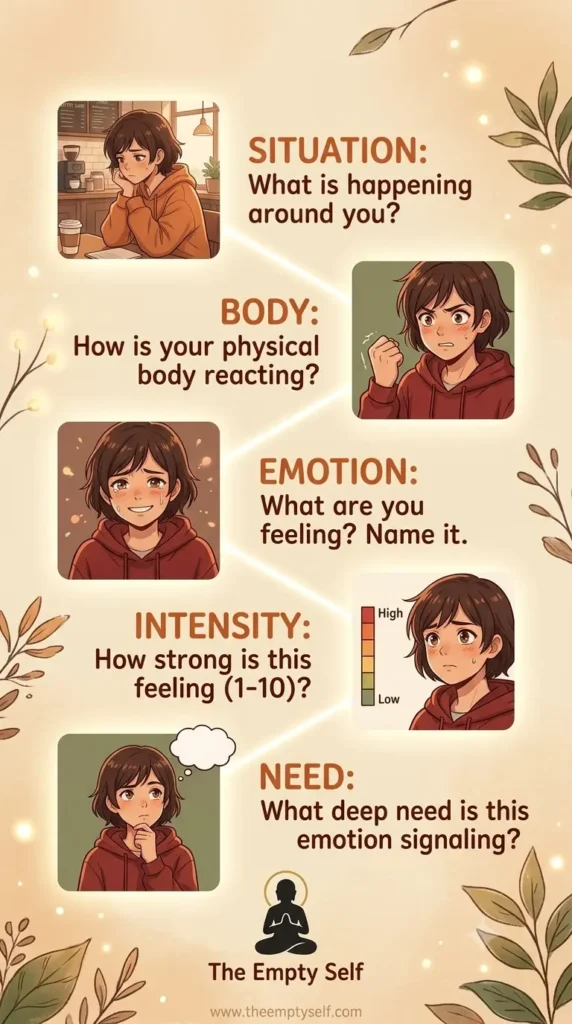
The Emotion-Labeling Formula: Situation → Body → Emotion → Intensity → Need
Here’s a five-step way to work through it:
Situation → Body → Emotion → Intensity → Need
Situation: What happened right before you noticed the feeling?
Body: What’s your body doing? Tight shoulders, a heavy chest, a racing heart, restlessness that won’t sit still.
Emotion: What word best matches this. Start broad. Narrow it after.
Intensity: Rate it 0 to 10, right now.
Need: What might this feeling be asking for? Rest, reassurance, space, safety, connection, or a boundary.
This sequence does something else too. It separates a feeling from a thought. “They don’t like me” is a thought. “I feel rejected” is the emotion underneath it. Different animals entirely.
None of this has to turn into a production. A body scan and one honest word can do more than twenty minutes of overthinking, especially when you pair it with something like these mindfulness journal prompts to catch the sensation while it’s still fresh. And if naming the feeling opens up something bigger, a slower journal prompt for mental health gives it somewhere to go.
8 Identifying Emotions Worksheets
The right identifying emotions worksheet should make naming a feeling easier, not turn emotional awareness into another chore. These eight options focus on different identification needs, from finding the right word to separating similar emotions and recognizing mixed feelings.
1. Emotion Identification Worksheet
Best for: People who know they feel something but struggle to put a name to it
Difficulty: Easy
Age group: Teens and adults
An Emotion Identification Worksheet is a good starting point when “I feel bad” is as specific as you can get. Instead of asking you to explain everything about the experience, it helps you move from a broad emotional category toward a more precise label.
A useful worksheet can begin with a simple question: What am I feeling right now? From there, you might choose a broad category such as sadness, anger, fear, joy, or surprise, then narrow it down.
For example, “sad” might become:
Sad → disappointed → rejected → hurt
Or:
Angry → frustrated → ignored
The goal isn’t to find the one perfect word. Emotional experiences are often messy, and sometimes the closest label is good enough. What matters is moving from a vague reaction toward a word that actually describes your experience.
A simple identifying emotions worksheet can include prompts such as:
- What happened?
- What emotion feels closest?
- What other emotion could describe it?
- How strong does the emotion feel?
- What do I need right now?
This makes the worksheet useful for a quick personal check-in, journaling session, or conversation with a therapist.
2. Feelings Vocabulary Worksheet
Best for: Anyone who relies on words like “fine,” “bad,” “stressed,” or “upset” for almost every emotional experience
Difficulty: Easy
Age group: Kids, teens, and adults
A Feelings Vocabulary Worksheet helps expand the number of words you can use to describe an emotional experience. This matters because “angry” can mean several different things. You might actually be irritated, frustrated, resentful, betrayed, overwhelmed, or disappointed.
The same applies to sadness. You could be lonely, homesick, rejected, discouraged, heartbroken, or simply disappointed.
The worksheet can work like a vocabulary map. Start with a familiar word, then look for more specific alternatives.
For example:
Angry: irritated → frustrated → resentful → furious
Sad: disappointed → lonely → discouraged → heartbroken
Afraid: nervous → worried → uneasy → terrified
Happy: content → hopeful → excited → joyful
This kind of feelings identification is especially useful for younger people who are still building emotional vocabulary. But adults can benefit from it too. Having a larger emotional vocabulary gives you more options when “I’m stressed” doesn’t quite explain what’s happening.
A good feelings vocabulary worksheet should also leave room for personal language. You don’t have to choose from a fixed list if another word fits better.
For Gen Z and Gen Alpha, that can be particularly useful when an emotional experience starts with something ordinary, such as being left out of a group chat or getting unexpected feedback from a teacher. The first reaction might be “I’m annoyed,” but the deeper feeling could be embarrassment, rejection, disappointment, or insecurity.
The more precise label can change what you do next.
3. Feelings Wheel Worksheet
Best for: People who can identify a general emotion but want help finding a more precise feeling
Difficulty: Easy to moderate
Age group: Teens and adults
A Feelings Wheel Worksheet helps you narrow a broad emotion into a more specific label. The key is to use the wheel for identification rather than treating it as a test with one correct answer.
Try a simple three-pass approach.
Pass 1: Find the broad emotion.
Start with the feeling that seems closest. Maybe you’re angry.
Pass 2: Move toward the specific experience.
Look at the related words around that emotion. You might notice frustration, irritation, resentment, or rage.
Pass 3: Choose the word that fits your experience best.
Ask yourself which word describes what is actually happening, rather than which word sounds most dramatic.
Suppose someone cancels plans at the last minute. “Angry” might be the first label. But after looking more closely, they may realize they’re actually disappointed because they were looking forward to seeing that person. They might also feel rejected if this keeps happening.
That distinction is useful.
A feelings wheel doesn’t tell you what you feel. You use it to explore possible labels until one feels reasonably accurate. If two words fit, keep both. Emotional identification doesn’t require forcing a complicated experience into a single category.
This version is intentionally narrower than a general emotions worksheet. The focus is simply on moving from broad → related → specific.
4. Emotion Differentiation Worksheet
Best for: People who can name an emotion but have trouble telling similar feelings apart
Difficulty: Moderate
Age group: Teens and adults
An Emotion Differentiation Worksheet tackles a problem that basic feelings charts often overlook: sometimes you know the general feeling, but two or more labels seem equally plausible.
Are you angry or frustrated?
Guilty or ashamed?
Nervous or excited?
Lonely or rejected?
Disappointed or hurt?
These pairs can overlap, but they aren’t interchangeable.
The worksheet can place two similar emotions side by side and ask you to compare them against the situation. For example, imagine you studied for an exam and received a lower grade than expected. You might feel disappointed because the result didn’t match what you hoped for. If you’re also thinking, “I’m not good enough,” shame may be part of the experience.
The point isn’t to diagnose the “real” emotion. It’s to notice the difference between nearby emotional labels.
A useful worksheet might ask:
| Question | Emotion A | Emotion B |
|---|---|---|
| What happened? | ||
| What word fits first? | ||
| What thoughts come with it? | ||
| What happens in my body? | ||
| What do I want to do? |
You can then circle the label that fits best, choose both, or write a different word altogether.
This is one of the more valuable forms of emotion recognition because emotional vocabulary becomes more useful when you can distinguish between feelings that look similar on the surface.
For example, nervousness and excitement can both involve a racing heart and restless energy. The physical sensation alone won’t always tell you which emotion you’re experiencing. The situation, interpretation, and other clues matter too.
5. Body-to-Emotion ID Worksheet
Best for: People who notice physical sensations before they can name the emotion behind them
Difficulty: Moderate
Age group: Kids, teens, and adults
A Body-to-Emotion ID Worksheet starts with a simple idea: sometimes your body gives you a clue before you have the right emotional word. You may notice a tight chest, clenched jaw, heavy stomach, shaky hands, or restless energy and only later realize what you might be feeling.
This worksheet reverses the usual process. Instead of starting with an emotion, you start with the physical sensation and work toward a few possible emotion labels.
For example:
Tight chest → uneasy, anxious, worried, scared
Clenched jaw → irritated, angry, frustrated
Heavy body → sad, discouraged, exhausted
Butterflies in stomach → nervous, excited, uncertain
The important word here is possible. A body sensation does not prove that you are experiencing a particular emotion. A racing heart, for example, can happen because you’re anxious, excited, exercising, drinking caffeine, or simply overheated. The worksheet is an identification aid, not a diagnostic tool.
A practical version can ask:
- What sensation do I notice?
- Where do I feel it?
- What emotion words could fit?
- Which word feels closest?
- Is there another emotion that might fit too?
This makes the exercise especially useful for identifying feelings when your emotional vocabulary isn’t immediately available.
It can also help younger users understand that emotions aren’t purely “in your head.” They can show up through changes in posture, muscle tension, breathing, energy, and other physical experiences.
6. Therapy Identifying Emotions Worksheet
Best for: Therapy clients who need a structured way to identify and discuss emotions between sessions
Difficulty: Moderate
Age group: Teens and adults
A Therapy Identifying Emotions Worksheet gives clients a structured place to record an emotional experience before bringing it into a therapy session. It works best as a conversation starter, not as a substitute for the therapist’s assessment or guidance.
One common problem in therapy is knowing that something affected you without knowing exactly how. A client might say, “I don’t know. I just felt weird after it happened.” A worksheet can slow that moment down and make the experience easier to describe.
A therapy-focused worksheet might include:
- Situation: What happened?
- First reaction: What did you notice immediately?
- Body: What physical sensations appeared?
- Emotion: What feeling seems closest?
- Intensity: How strong did it feel?
- Other possibilities: Could another emotion fit?
- What I’d like to discuss: What part of this experience stands out?
The last prompt is particularly useful. Not every worksheet entry needs to be fully understood before a therapy session. Sometimes the most useful result is simply, “I noticed I keep feeling rejected when this happens, and I want to understand why.”
7. Mixed Emotions ID Worksheet
Best for: People who feel two emotions at the same time and don’t want to force themselves to choose just one
Difficulty: Moderate
Age group: Teens and adults
A Mixed Emotions ID Worksheet helps you name multiple emotions that are happening at once. Its purpose is simple: you don’t have to pick a single feeling when two feelings genuinely fit.
Imagine getting accepted into a college you really wanted while knowing you’ll be moving away from your closest friends. You might feel excited and sad at the same time. Neither emotion cancels the other out.
The same thing can happen after a relationship ends. You could feel hurt about the breakup and relieved that an unhealthy situation has ended.
A short worksheet can use two columns:
Emotion 1
- What feeling comes up?
- What seems connected to it?
- How strong is it?
Emotion 2
- What other feeling is present?
- What seems connected to it?
- How strong is it?
Then add one final prompt:
“If I could describe the whole experience in one sentence, what would I say?”
For example:
“I’m excited about the change, but I’m also scared of leaving what feels familiar.”
That sentence is often more useful than trying to decide whether you are “really” happy or “really” anxious.
This approach is also helpful for feelings identification because complicated situations rarely produce neat emotional categories. Naming both emotions can give you a more accurate picture without requiring you to solve the conflict between them.
This worksheet is intentionally lighter than a full mixed-emotions or emotional-processing exercise. The goal here is simply to recognize and label what’s present.
8. Daily Emotion Identification Log
Best for: People who want a quick daily practice for noticing and naming emotions
Difficulty: Easy
Age group: Teens and adults
A Daily Emotion Identification Log is a lightweight version of an emotion journal. Instead of asking you to analyze every thought, trigger, and behavior, it gives you a few minutes to identify what you felt during the day.
A simple entry might look like this:
| Prompt | Example |
|---|---|
| What happened? | My friend didn’t reply |
| What did I feel? | Disappointed |
| What else? | A little rejected |
| How strong? | 6/10 |
| What did I need? | Reassurance |
The value comes from repetition. One entry may not tell you much. After several entries, you may start noticing that certain situations repeatedly bring up the same emotions.
Keep the identification process short. You don’t need to write a page every evening. A few honest words are enough.
You can also use the log at different points during the day. A morning entry might capture how you feel before school or work, while an evening entry can help you identify the emotion that stayed with you after a difficult conversation.
If you want to go beyond identification and examine triggers, emotional intensity, thoughts, urges, or behavior patterns, use the more detailed resources in the broader emotions worksheet collection rather than turning this simple log into another lengthy assignment.
You can check out our full emotion intensity worksheet.
The same applies when you want to examine what happened before an emotion or how an emotion influenced your response. A dedicated trigger worksheet or emotion → thought → urge → action worksheet is better suited to that deeper work.
To know more, you can check out the emotion → thought → urge → action worksheet.
Identifying Emotions Worksheets by Age
Match the worksheet to the age, or watch it flop. A six-year-old, a sixteen-year-old, and a twenty-five-year-old don’t feel things the same way. They don’t talk about feelings the same way either. So the language has to shift. The examples have to shift. Even the pace has to shift.
One-size-fits-all doesn’t work here. Not even close.

For Kids
Little kids don’t need theory. They need words.
The best identifying emotions worksheet for kids leans on pictures. Faces. Matching games. Small, everyday moments, like losing a favorite toy or meeting a new friend at recess. Skip the deep analysis. A six-year-old isn’t ready to untangle “ambivalence.” What they can do is point at a face and say “that’s how I feel.”
That’s the real goal. Connect the expression to the word. Happy. Worried. Frustrated. Proud. Four words, said out loud, do more than a paragraph of explanation ever could.
Want the full breakdown for younger kids? The Gen Alpha emotions worksheets section covers it in more depth.
For Teens
Teenagers usually know something’s off. Naming it is the hard part.
An identifying emotions worksheet for teens should live in their actual world. Peer pressure. Group chats that spiral. Friendships that shift overnight. School stress that never lets up. Identity questions nobody handed them a manual for.
One structure works especially well here: separate what happened from what the teen assumed, then name the feeling underneath both. That extra step matters. “I’m angry” is rarely the whole story. Sometimes it’s rejection. Sometimes it’s just feeling unseen.
More examples and prompts live in the Teens emotions worksheets section.
For Adults
Adults rarely need a vocabulary lesson. They need nuance.
An identifying emotions worksheet for adults usually points somewhere heavier. Work stress. Burnout that crept in slowly. Boundaries nobody respected. Relationship conflict that won’t resolve cleanly. And often, more than one feeling at once, sitting there together, refusing to simplify.
There’s no single “correct” emotion to land on. The goal is honesty, not precision. These worksheets help you spot the pattern and give it language that actually fits, instead of forcing a messy week into one tidy word. If check-ins like this feel useful, a broader set of journal prompts for mental health pairs well alongside them.
For the full adult-focused breakdown, see the Gen Z adults emotions worksheets section.
Therapy Identifying Emotions Worksheet: How Therapists Use Them
A therapy identifying emotions worksheet gives a client a simple structure for something hard to say out loud. It puts words next to feelings that otherwise stay stuck.
Therapists use these worksheets a few different ways. Between sessions. During a session. Or just as a prompt for noticing what keeps repeating. The American Psychological Association describes psychotherapy as a collaborative process, one where clients actively work through problems alongside their therapist, not just listen to one.
Homework
Think of an identifying emotions worksheet as practice for the week between appointments. A therapist might ask you to record one hard moment. Name the emotion. Rate how strong it hit. Then bring the sheet back next time.
Nobody’s chasing a perfect emotional diagnosis here. That’s not the goal. The point is smaller: give the next conversation something real to work with, instead of trying to reconstruct a whole week from memory.
Homework like this is a common piece of psychotherapy, used specifically to help clients practice new skills outside the room where they learned them.
Vocabulary-Building
Some people know they feel “off.” They just can’t get more specific than that. This is where an emotion identification worksheet earns its place.
A worksheet stretches that vocabulary. Frustration. Disappointment. Embarrassment. Loneliness. Guilt. Anxiety. Each one is a different animal, even when they show up feeling like the same vague fog.
Sharper words make sharper conversations. That’s the trade. A therapy session built around “I felt disappointed when my sister canceled again” moves faster than one built around “I don’t know, I just felt bad.”
Session Discussion Starters
A completed Identifying Feelings Worksheet doesn’t just sit in a folder. It can open a session.
Instead of trying to remember every detail from the week, a client and therapist can pull up one entry and dig in. What happened? What did you feel first? What did you actually need in that moment?
That’s a lot easier than starting from a blank page. One entry, three questions, and a vague week turns into something you can actually talk through.
Pattern Tracking
Used more than once, an Emotion Recognition Worksheet starts to reveal something bigger than any single entry. Recurring situations. Recurring emotions. Recurring responses.
A therapist might notice the same client reports anxiety before every social event. Or frustration after the same kind of conversation, week after week. Those patterns rarely show up in a single session. They show up on paper, over time.
That’s the shift a Labelling Emotions Worksheet makes possible. One entry tells you what happened once. A stack of entries tells you what keeps happening.
A Worksheet Does Not Replace Professional Care
A worksheet is a supporting tool. Not a substitute.
It can organize thoughts. Sort feelings into something readable. What it can’t do is diagnose a mental-health condition or decide what treatment fits. That part still needs a licensed professional, not a printable PDF.
If a worksheet ever brings up distress that feels like too much, stop. Pause the exercise. Reach out for real support instead of pushing through alone.
This applies whether you’re working from a general Identifying Emotions Worksheet PDF, a version built for adults, or one handed to you directly by a therapist. The worksheet supports the work. It was never meant to carry it alone.
Looking for something to fill the space between worksheet entries? Journal prompts for mental health can work alongside any Feelings Identification Worksheet, especially on days when a checkbox doesn’t capture enough. And if therapy homework is already part of your week, our guide to therapy journal prompts covers the writing side of that same practice.
How to Use an Identifying Emotions Worksheet Effectively
Most people open a worksheet expecting instant clarity. That’s not how it works. An identifying emotions worksheet is built for slow noticing, not fast answers. Read the situation first. Then treat your first answer as a draft, not a verdict.
Choose the Closest Emotion, Not the Perfect Emotion
You don’t need the exact word on the first try. Closer is enough. Start with the feeling that seems nearest, then narrow it down from there. “Angry” rarely tells the whole story. Look closer and it might turn into frustrated, hurt, resentful, or disappointed.
This is where an Emotion Identification Worksheet earns its name. The goal is clarity. Not the one correct label. Precision beats perfect accuracy on this kind of page. Ask better questions. Don’t guess harder.
Pay Attention to Body Signals
Your mind isn’t always first to know. Sometimes the body speaks before the word arrives. A tight jaw can mean tension building. A heavy chest, restless hands, or a racing heart often point toward something bigger.
Treat these as clues, not proof. A tight chest doesn’t hand you a diagnosis. Read it alongside the situation and your thoughts, not on its own. One sensation, taken by itself, tells you almost nothing.
The APA Dictionary of Psychology treats emotion as a full-body response, not just a feeling in your head, which is exactly why the body is worth checking. Pairing this kind of body check with a few mindfulness journal prompts can catch these signals while they’re still happening, not twenty minutes later.
Separate Facts From Your Interpretation
Write down what happened before you decide what it means. That order matters. Skip it, and your story starts posing as the fact.
Take a simple example. Your friend goes quiet for six hours. Here’s how the layers split apart:
- Fact: My friend didn’t reply for six hours.
- Interpretation: My friend is angry with me.
- Possible emotion: Anxious, rejected, or uncertain.
This one split is what makes a Feelings Identification Worksheet actually work. Thoughts feel like facts when you’re already upset. That’s the trap this step catches. If separating fact from story feels hard on your own, a few journal prompts for mental health can slow that gap down enough to see it clearly.
Allow Yourself to Have Multiple Emotions
Real emotions don’t take turns. You can feel excited and nervous about the same news. Relieved and sad about the same ending. Proud and embarrassed, in the same breath.
If two emotions fit, write down both. Don’t force a complicated week into one box. A Recognizing Emotions Worksheet should capture what’s actually happening, not tidy it up for you.
If you want to track these combinations over several weeks, an emotions journal keeps them in one place instead of scattered across single check-ins.
Review Without Judging Yourself
Most worksheets stop at the writing. This step matters just as much. Once you’ve filled the page, read it back with curiosity, not criticism. Ask yourself two things. Does this label still fit? Is there a sharper word underneath it?
Therapists use a version of this same page too. A Therapy Identifying Emotions Worksheet usually follows this same order. Name it. Locate it. Separate fact from story. Review.
The same read-back works for an Emotion Recognition Worksheet or a Labelling Emotions Worksheet. Want more ways to build this habit? Our full emotions worksheet library covers naming, tracking, and regulating what you feel. It includes options built for adults, for teens, and for kids.
You can also explore our emotions worksheet for more information.
How to Choose the Right Emotion Identification Worksheet
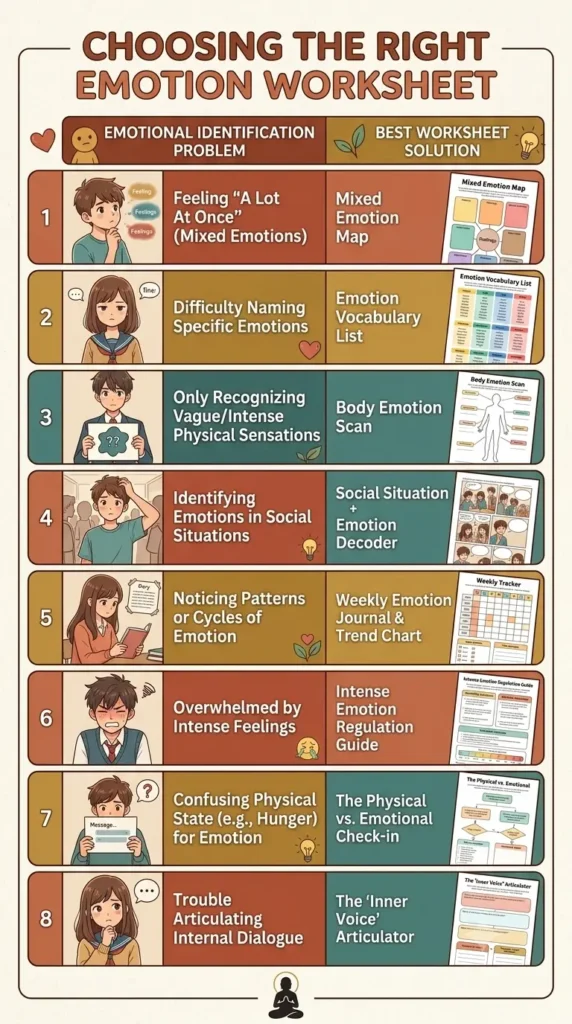
Not every emotion identification worksheet works the same way. The right one depends on where you actually get stuck. Struggling to find any word at all? Start with vocabulary. Notice your chest tighten before you can name why? Try a body-based worksheet. The goal is a tool that clears things up, not one that adds another layer of confusion on top of feelings you’re already unsure about.
Here’s the trap: most people grab whatever identifying emotions worksheet shows up first in a search, then wonder why it doesn’t help. It won’t. A worksheet built for someone who already knows they’re “upset” but wants precision does nothing for someone who can’t locate a feeling in the first place. Different problems need different entry points.
Decision Table
| If you… | Try this worksheet | Why it helps |
|---|---|---|
| Can’t figure out what you’re feeling | Emotion Identification Worksheet | Guides you from a broad feeling toward a specific one |
| Only know basic words like happy, sad, or angry | Feelings Vocabulary Worksheet | Builds a wider emotional vocabulary |
| Know you’re upset but can’t find the exact word | Feelings Wheel Worksheet | Narrows a broad emotion into a precise label |
| Keep confusing similar emotions | Emotion Differentiation Worksheet | Separates feelings like guilt vs. shame or nervousness vs. excitement |
| Notice physical symptoms before an emotion | Body-to-Emotion ID Worksheet | Uses body sensations as clues for identifying possible emotions |
| Want to discuss emotions during therapy | Therapy Identifying Emotions Worksheet | Gives you a structured way to record and discuss feelings with a therapist |
| Feel several emotions at once | Mixed Emotions ID Worksheet | Helps you name multiple emotions without forcing a single choice |
| Want to notice what you feel each day | Daily Emotion Identification Log | Makes regular feelings identification quick and repeatable |
That table isn’t decoration. Match your actual sticking point to the row above it, and skip the guesswork.
Someone who says “I don’t know what I’m feeling” needs a completely different starting point than someone who already knows they’re angry but suspects hurt or disappointment is sitting underneath it. Treating those two people the same is exactly why generic advice fails. One needs a wider net. The other needs a sharper knife.
If daily tracking sounds more useful than a one-time worksheet, pair this with a short journaling habit for mental health, naming a feeling once a day builds the same recognition skill faster than doing it only when things already feel overwhelming.
What Makes a Good Identifying Emotions Worksheet?
An identifying emotions worksheet does more than ask you to circle a smiling or sad face. Good ones push you toward accurate words for what you’re feeling. They leave room to think. And they work for the person actually holding the pencil, not some imagined average user. The best ones feel useful. Not restrictive.
Uses Specific Emotion Words
A strong worksheet gives you more than happy, sad, angry, and scared. Those four words cover almost nothing. Words like frustrated, rejected, overwhelmed, disappointed, embarrassed, relieved, or uneasy get you closer to what’s actually going on.
Here’s why that matters. “I feel bad” tells you nothing useful. “I feel disappointed and embarrassed” gives you somewhere to start. That’s the whole difference between a worksheet that helps and one that just sits there. The APA Dictionary of Psychology treats emotions as distinct, specific states, not one blurry category, and a good worksheet reflects that.
Leaves Enough Reflection Space
A worksheet shouldn’t squeeze a complicated feeling into a tiny box. Not ever. Look for enough room to write what happened, name the feeling, rate how strong it is, or add a second emotion if the first answer misses something.
Cramped worksheets rush you. And rushing defeats the point. Give yourself space the way you would in a slower mindfulness journal prompt, where the point is noticing, not finishing fast.
Is Age-Appropriate
A worksheet built for a seven-year-old and one built for a thirty-year-old should never read the same. An identifying emotions worksheet for kids needs simple language, clear visuals, and short situations they actually recognize.
A identifying emotions worksheet for teens can dig into friendships, school pressure, identity, and social media instead. Adults usually need more room for mixed emotions, relationships, work, and boundaries all tangled together.
The right worksheet meets you where you are. It doesn’t hand a teenager the same page a six-year-old gets.
Goes Beyond Faces
Faces help. Especially for younger kids. But they shouldn’t be the whole exercise. A real emotion recognition worksheet also asks about body sensations, the situation, how intense the feeling is, and which words actually fit. A smiley face can start the conversation. It can’t finish it.
Works on Paper or Digitally
A good worksheet holds up whether you print it or fill it out on a phone. Clear spacing matters more than fancy design. Readable text matters more than clever layout. Simple prompts beat busy ones every time, on screen or off.
Doesn’t Force a “Correct” Answer
Emotions aren’t a multiple-choice test. A good labelling emotions worksheet should leave room for uncertainty, for more than one feeling at once, and for an answer that shifts as you sit with it longer.
If “anxious” feels close but “overwhelmed” turns out to fit better after a minute of thinking, the worksheet should make space for that discovery instead of locking you into your first guess.
When an Emotion Worksheet Isn’t Enough
An identifying emotions worksheet can make feelings easier to name, but it isn’t designed to solve every emotional or mental-health concern. If identifying emotions repeatedly feels impossible, causes significant distress, or leaves you feeling less stable rather than more understood, it may be time to pause the worksheet and seek additional support.
Repeated Inability to Identify Emotions
Occasionally thinking, “I have no idea what I’m feeling,” is normal. But if you regularly struggle to identify or describe your emotions—even when using an emotion wheel, feelings list, or guided worksheet—don’t treat that as a personal failure. A worksheet is a tool, not a test you can pass or fail.
Try starting with something simpler, such as describing what happened or what you noticed in your body. If the difficulty persists and affects your relationships, school, work, or daily life, talking with a qualified mental-health professional may give you more useful support than completing more worksheets.
When the Exercise Feels Overwhelming
Emotional reflection can sometimes bring up memories, thoughts, or sensations that feel difficult to manage. If completing a worksheet makes you increasingly distressed, anxious, numb, or overwhelmed, stop and give yourself permission not to finish it.
You don’t need to force yourself to find the “right” emotion. Taking a break, grounding yourself, or talking with someone you trust can be more appropriate in that moment.
When Professional Support May Help
Consider reaching out to a therapist, counselor, doctor, or another qualified professional if emotional difficulties are persistent, interfere with daily functioning, or feel increasingly difficult to manage on your own. SAMHSA provides information and treatment-support resources for mental-health concerns in the United States. (SAMHSA)
An emotion worksheet can support reflection, but it is not a diagnostic or treatment tool. The Empty Self is not a licensed mental-health professional, and this content is for educational purposes rather than clinical advice.
If you or someone you know is experiencing a mental-health crisis or needs immediate emotional support in the United States, you can call or text 988 or use the 988 Lifeline’s online chat. The service provides free, confidential, 24/7 support from trained crisis counselors. (988lifeline.org)
Conclusion
An identifying emotions worksheet can make an unclear feeling easier to understand by giving you a place to slow down, name what is happening, and notice what may be behind it. You do not need to find the perfect word every time.
Start with the closest feeling, pay attention to your body, and allow mixed emotions when they show up. For Gen Z and Gen Alpha, this simple practice can be especially useful when emotions get tangled with school, relationships, social media, or everyday stress.
The goal is not to judge what you feel. It is to become more familiar with your emotional world, one feeling at a time.
Frequently Asked Questions
What is an identifying emotions worksheet used for?
An identifying emotions worksheet helps you recognize, name, and describe what you are feeling. It may guide you through emotion words, body sensations, situations, intensity, or mixed feelings.
The goal is to move beyond vague labels like “bad” or “fine” and identify the specific emotion you are experiencing.
What is the difference between an emotion identification worksheet and a feelings worksheet?
An emotion identification worksheet focuses on recognizing and naming an emotional state. A feelings worksheet may have a broader purpose, such as exploring emotional triggers, thoughts, behaviors, or ways to express feelings.
In practice, the terms overlap, but an identification worksheet puts more emphasis on finding the right words for your experience.
How can I identify an emotion when I don’t know what I’m feeling?
Start by describing what happened, then notice what you feel in your body. Choose a broad label such as anger, sadness, fear, or joy before looking for a more precise word.
You can then rate the intensity and consider whether another emotion is present at the same time.
What should an identifying emotions worksheet for adults include?
An identifying emotions worksheet for adults should include space to name an emotion, describe the situation, notice physical sensations, and rate emotional intensity.
A useful worksheet should also allow for nuanced or mixed emotions rather than limiting adults to basic labels such as happy, sad, angry, or scared.
Are identifying emotions worksheets useful for kids and teens?
Yes. Identifying emotions worksheets can help kids and teens build emotional vocabulary and connect feelings with situations and body signals.
For younger children, visual prompts and simple words often work best. Teen worksheets can use more relevant situations, such as friendship conflict, academic pressure, social media, identity, and changing relationships.
Can an identifying emotions worksheet be used in therapy?
Yes, an identifying emotions worksheet can be used as a therapy support tool. Therapists may use one as homework, a session discussion starter, or a way to help clients build emotional vocabulary and notice patterns.
A worksheet is not a diagnosis or replacement for professional mental health care.

It’s Bhaskar!
Well, I am not a psychologist a monk, or a philosopher by training. I’m just an engineering graduate.
‘The Empty Self’ is where I write about that idea, and what it actually means for ordinary life, anxiety, identity, habits, the stories we tell ourselves about who we are. I don’t have a psychology degree, and I’m not offering therapy or clinical advice. What I do have is thought and clarity, and genuine curiosity about why we suffer the way we do and how much of it might loose once we shed this ‘fixed identity’.
Pingback: Emotions Worksheet: 20 Useful Worksheets for Gen Z and Gen Alpha | The Empty Self
Pingback: Coping Skills Handout: Free Handouts for Teens and Young Adults | The Empty Self
Pingback: DBT ACCEPTS Skill: Complete 2026 Guide With Worksheets and Exercises | The Empty Self
Pingback: The DBT House 2026: Complete Guide With Free PDF and Template | The Empty Self
Pingback: DBT Emotion Regulation Skills 2026: Module Guide With Free Worksheets | The Empty Self