

A blank journal page doesn’t ask you anything. That’s the problem. You want to grow. You want to understand yourself. You want to stop repeating the patterns that keep tripping you up. But nobody hands you a place to start.
That’s where journal prompts for self growth come in. A good prompt gives your thoughts somewhere specific to land. It doesn’t tell you what to feel. It just opens a door.
For Gen Z adults, journaling can be a real space to sit with identity and relationships. Career pressure. Boundaries. Habits. The expectations you picked up from people you never chose. Still working through how you feel about yourself? These journal prompts for self love are a good pairing.
The goal isn’t to become someone else. It’s to know yourself well enough to grow on your own terms. Sound too simple? It is, and that’s exactly the point.
Quick Overview: Journal prompts for self growth are guided questions. They help you look at your thoughts, habits, values, relationships, and goals without judgment. Use them to notice patterns, process what you’re carrying, and build self-awareness. Small shifts add up over time, not overnight. Pair them with mindfulness journal prompts on quiet days. Reach for journal prompts for mental health when things feel heavier than usual.
Table of Contents
What Are Journal Prompts for Self Growth?
Journal prompts for self growth are questions. They show you where you stand right now. They help you pick where to go next. And they name the beliefs or habits quietly holding you back.
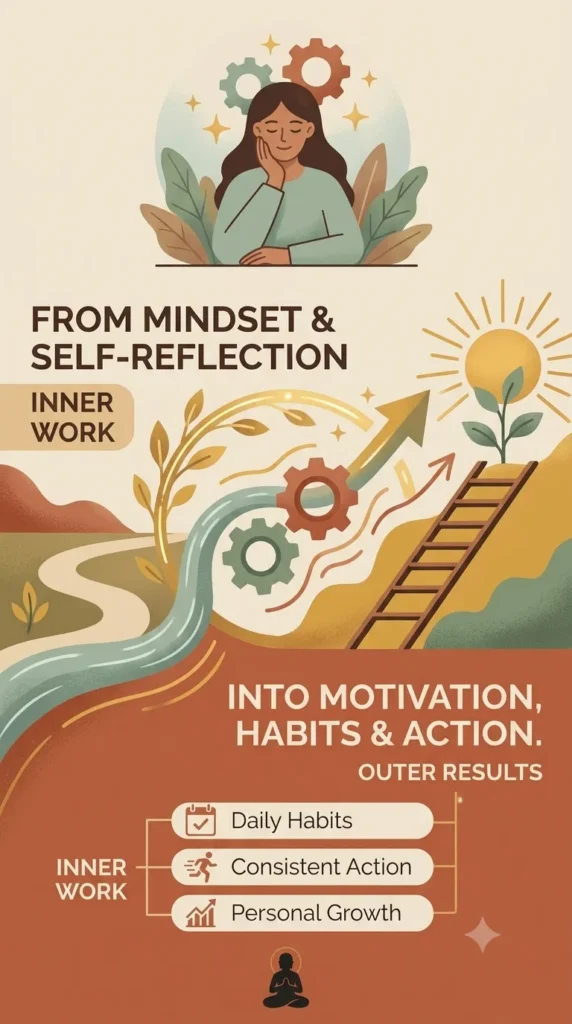
Regular journaling just records your day. Self-growth journaling does more. It turns reflection into the start of real change.
Define Self-Growth Journaling
Self-growth journaling leans on pointed questions, questions that dig into your values, habits, beliefs, strengths, challenges, and goals. The goal isn’t to judge who you are today. It’s to spot patterns clear enough to act on.
Take a bad day. Most people write “I had a bad day” and stop there. A self-growth prompt pushes further: “What did today’s experience teach me about how I handle stress?” That’s the shift. Journaling stops being a record. It becomes a tool for learning.
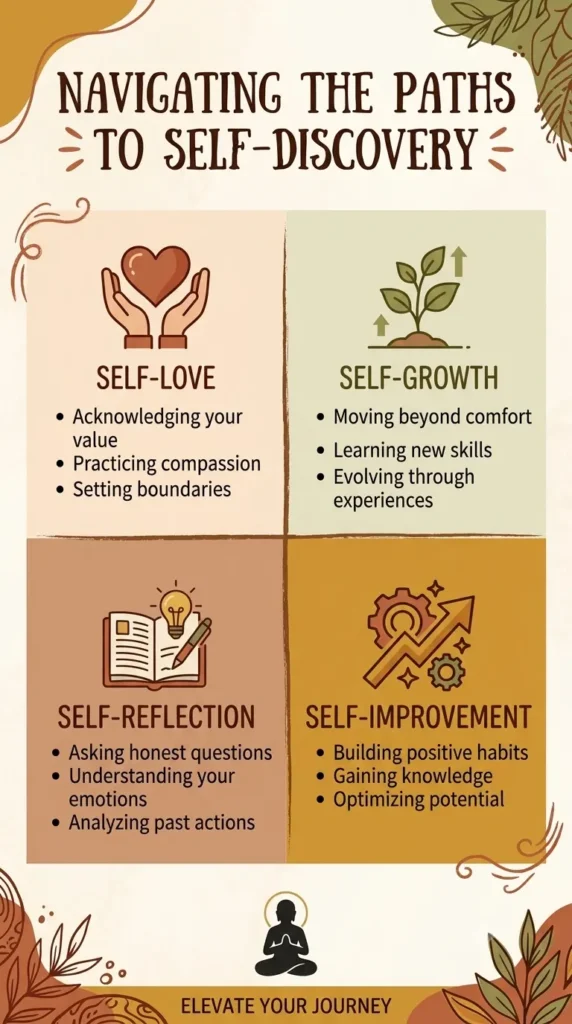
Self-Growth vs. Self-Love
Self-love means accepting yourself. Caring for yourself as you are. Self-growth uses that acceptance as ground to build on. You don’t need to dislike yourself first. Wanting something different from your life is enough on its own.
Working on self-acceptance first? If that’s the real goal, our journal prompts for self-love guide is a better fit. Come back here once you’re ready to move toward change, while still treating yourself with some compassion along the way.
Self-Growth vs. Self-Improvement vs. Self-Reflection
These three overlap. They aren’t the same thing, though.
Self-reflection helps you see what’s happening. Self-improvement zeroes in on getting better at one specific skill or behavior. Self-growth is the wider lens. It links what you learn about yourself to the life you actually want to build.
Good journal prompts for personal growth can move through all three stages. What happened? What does it reveal? What do I want to do differently?
How to Use Journal Prompts for Self Growth
Journal prompts for self growth work best when they move you from a vague feeling to something you can actually name and act on. Skip the urge to fix everything in one sitting. Pick one prompt. Notice what’s happening. Then choose a next step small enough to actually do.
Choose One Growth Area at a Time
Trying to cover your career, your relationships, your confidence, your habits, and your future in a single entry usually creates noise, not clarity. Pick one growth area instead. Just one.
Maybe you’re struggling to trust yourself at work. Maybe you keep comparing your life to people you follow online. Or maybe something feels off and you can’t quite name what.
Start there.
A focused prompt gives your mind one thing to chew on. You don’t need to solve the whole problem today. You just need to see one piece of it more clearly.
Write Without Trying to Sound Wise or Positive
Your journal isn’t a college essay. It’s not a motivational post either. Nobody else has to read it. So let yourself write the awkward version.
Jealous? Write jealous. Angry about a rejection? Put that down too. Proud of yourself but weirdly uncomfortable admitting it? That’s worth a few lines as well.
Honest journaling beats forced positivity almost every time. You can’t work with a feeling you edited out before you even admitted it was there.
Turn Reflection Into One Small Action
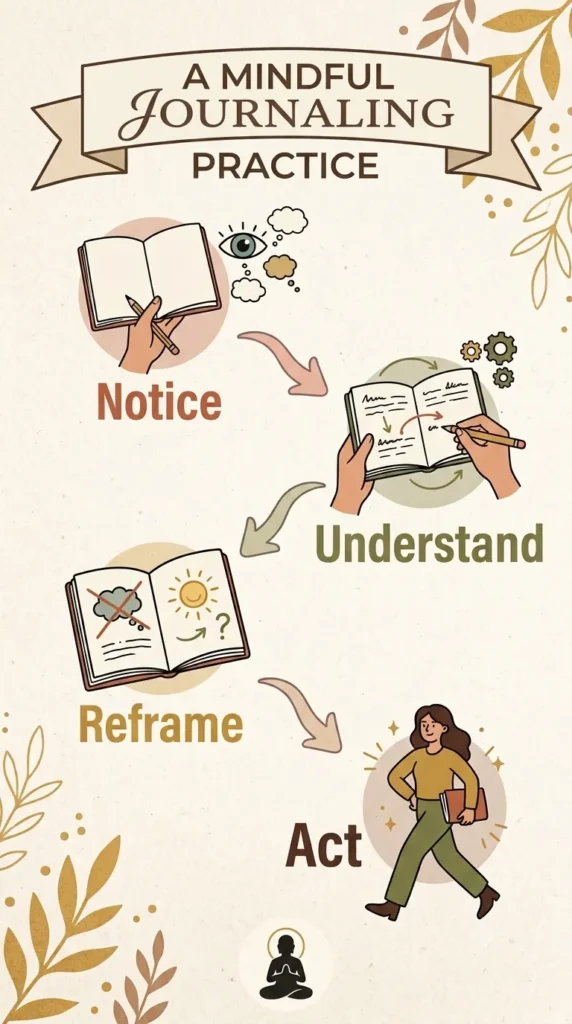
Use this framework any time a prompt leaves you with something worth exploring:
Notice → Understand → Reframe → Act
- Notice: What am I feeling, thinking, or doing?
- Understand: Why might this be happening? What belief, fear, or old pattern sits underneath it?
- Reframe: Is there a more accurate or kinder way to read this?
- Act: What’s one small thing I can do differently?
Say you notice you keep checking a friend’s achievements and feeling behind. Understand that you’re measuring your progress against someone else’s timeline, not your own. Reframe success around what actually matters to you. Then act by spending the evening on one goal that’s genuinely yours.
Reflection needs somewhere to go. That’s the whole point. Vague good intentions rarely hold up on their own, and the research backs that up. Goal-setting studies have repeatedly found that specific, well-defined goals outperform vague “do your best” goals, especially when paired with feedback and a real plan.
How Long Should You Journal? (5–15 min)
A self growth journal shouldn’t turn into one more task you feel guilty about skipping. For most everyday reflection, 5 to 15 minutes covers it. That’s enough room to sit with one useful question without spiraling.
Five minutes? Answer one prompt. Fifteen? Explore the answer, then land on one small action.
The goal was never to fill pages. It’s to close the journal knowing yourself a little better than you did when you opened it.
How to Choose the Right Prompt for Right Now
Don’t grab a prompt at random if you already know what’s bothering you. Start from the feeling instead:
- “I feel stuck.” → Jump to the prompts on values, goals, and your future self.
- “I lack motivation.” → Start with confidence, courage, and self-trust.
- “I keep comparing myself.” → Go to comparison, social media, and feeling behind.
- “I don’t know what I want.” → Start with values, goals, and your future self.
- “I need to change a habit.” → Begin with confidence, courage, and self-trust, then run it through the Notice → Understand → Reframe → Act framework above.
- “I feel overwhelmed.” → Try failure, rejection, and setbacks, or pick the prompt that helps you separate what’s in your control from what isn’t.
- “I want to understand myself.” → Begin with strengths and good qualities or self-acceptance and imperfection.
- “I want to plan my future.” → Go straight to values, goals, and your future self.
You don’t need the perfect prompt. You need one that gives you somewhere real to start.
If self-doubt keeps showing up alongside the stuck feeling, our guide to self esteem journal prompts picks up that thread in more depth. And when a prompt pulls up something heavier than a quick reflection can hold, journal prompts for mental health is a better place to sit with it.
80+ Journal Prompts for Self Growth
These journal prompts for self growth are designed to help you understand yourself, challenge old patterns, build healthier habits, clarify your direction, and make meaningful changes. Choose the section that fits where you are right now instead of forcing yourself through every prompt.
Journal Prompts for Self-Reflection and Self-Awareness
- What emotion have I been feeling most often lately, and what might it be trying to tell me?
- What situation keeps repeating in my life, and what pattern do I notice in how I respond?
- What are three strengths I rely on when life gets difficult?
- What is one weakness or habit I keep avoiding, and how does it affect my life?
- What situations tend to trigger a strong emotional reaction in me?
- When do I feel most authentic, and what am I doing differently in those moments?
- How do I usually describe myself to other people, and is that description fair to who I am?
- What is something I understand about myself now that I didn’t understand a year ago?
- Which parts of myself do I hide to gain approval, avoid conflict, or fit in?
- What belief about myself deserves a second look?
Journal Prompts for Personal Growth and Life Direction
- What does personal growth mean to me at this stage of my life?
- Which area of my life feels most ready for change right now?
- What kind of person am I trying to become, beyond career titles or achievements?
- Which values do I want my daily choices to reflect more clearly?
- What would I change about my current life if I stopped worrying about other people’s expectations?
- What skill would make the biggest difference in the life I want to build?
- Where am I making progress that I haven’t given myself credit for?
- What decision would my future self thank me for making now?
- What currently feels like a setback but could eventually become a valuable lesson?
- If my life felt more aligned with who I am, what would look different six months from now?
Journal Prompts for a Self-Growth Mindset
- What is something I currently believe I am “just not good at,” and what evidence challenges that belief?
- When I make a mistake, do I see it as information or as proof that I am incapable?
- What failure am I still afraid of, and what am I assuming that failure would say about me?
- What is one recent mistake I can examine without turning it into a judgment about my character?
- Where have I improved through practice, even though I wasn’t naturally good at something at first?
- What kind of feedback makes me defensive, and what useful information might be hidden inside it?
- What would I attempt if I believed my abilities could grow with time and effort?
- What self-doubting thought has been holding me back, and how could I reframe it more realistically?
- Where am I expecting immediate results from something that naturally requires patience?
- What challenge could I approach as an opportunity to learn rather than a test of my worth?
Want prompts that dig further into how you value yourself day to day? The self esteem journal prompts guide picks up right where this list leaves off.
Self-Improvement Journal Prompts for Habits and Routines
- Which daily habit currently has the biggest positive effect on my mood, energy, or focus?
- What habit do I keep trying to build, and what usually causes me to stop?
- What part of my current routine feels unnecessarily difficult?
- What is one small habit I could make easier by changing my environment?
- Which habit am I maintaining because it genuinely helps me, rather than because I think I “should”?
- What usually happens immediately before I fall into a habit I want to change?
- What is one routine I could simplify so that consistency feels more realistic?
- How do my sleep, movement, food, screen time, or work habits affect the way I show up each day?
- What would a sustainable version of my ideal routine actually look like on a busy day?
- Which habit deserves patience instead of perfection from me?
Journal Prompts for Motivation and Inspiration
- What gives me genuine energy instead of simply distracting me from what I need to do?
- What goal am I excited about, even if I’m not ready to pursue it perfectly?
- Who inspires me, and what specific quality of theirs would I like to develop in myself?
- What is something I accomplished before that proves I can keep moving when things get difficult?
- What small win from this week deserves more appreciation?
- What am I grateful for right now that makes pursuing my goals feel worthwhile?
- What would I work toward if I stopped waiting to feel completely motivated first?
- What is one meaningful action I can take today that my future self will appreciate?
Gratitude and motivation feed each other more than people realize. If you want to go deeper on that link, how to practice gratitude breaks down simple ways gratitude can support motivation and daily growth. And if you’re stuck on where to even start counting your blessings, things to be thankful for offers plenty of everyday ideas to spark that shift.
Self-Care Journal Prompts for Sustainable Growth
- What does genuine rest look like for me when I remove guilt from the equation?
- Which part of my life is demanding more energy from me than I can sustainably give?
- What signs tell me that I need to slow down before I become completely drained?
- Which self-care practice actually helps me recover rather than simply distracting me?
- Where am I treating exhaustion as something to be proud of?
- What boundary would protect my time, energy, or attention right now?
- How can I make my growth goals fit my real life instead of an imaginary perfect routine?
- What would taking care of myself look like on a difficult day?
Journal Prompts About Goals, Dreams, and Your Future Self
- What dream keeps returning to my mind, even when I try to dismiss it?
- What would I want my life to look like if I focused on what matters to me rather than what looks impressive?
- What does my ideal ordinary day look like five years from now?
- Which goal feels exciting enough to pursue and realistic enough to begin?
- What qualities will my future self need to develop to create the life I want?
- What am I willing to learn, change, or sacrifice to move closer to that future?
- What is one action I can take this month that moves a meaningful dream forward?
- If I stopped comparing my timeline with everyone else’s, what would I choose to work toward?
Journal Prompts for Letting Go and Learning From the Past
- What past experience am I still carrying into situations that don’t actually resemble it?
- What lesson from my past do I want to keep, and what part am I ready to leave behind?
- What mistake do I need to forgive myself for?
- What would I tell my past self about the situation I now understand differently?
- What expectation about how my life “should” have gone am I ready to release?
- What memory still affects the way I see myself today?
- What did a difficult experience teach me about my needs, values, or boundaries?
- What would letting go look like in practice rather than simply telling myself to move on?
Journal Prompts for Relationships, Boundaries, and Outside Expectations
- Which relationships encourage me to become more like myself rather than less like myself?
- Where am I saying yes because I genuinely want to, and where am I saying yes because I fear disappointing someone?
- What boundary have I been avoiding because I am worried about how another person will react?
- Whose expectations have the strongest influence on the decisions I make?
- What do I need from the people closest to me that I haven’t clearly communicated?
- Where have I confused being liked with being accepted?
- What would change if I stopped measuring my growth by someone else’s timeline?
- Which relationship pattern am I ready to handle differently?
Gen Z Journal Prompts for Self Growth
Self growth turns vague fast. Your feed pulls one way. Career pressure pulls another. Relationships add their own weight, and attention gets split before you even open a notebook. These journal prompts for self growth work like a pause button.
They help you check what’s actually influencing you, what you want underneath the noise, and what a meaningful life looks like on your own terms. Not whoever’s ahead on Instagram this week.
Think of this as a companion to broader self reflection journal prompts work. Same honesty. Different angle.
Prompts for Social Media Comparison
Comparison rarely announces itself. It just shows up as a heavy feeling after fifteen minutes of scrolling. Why does someone else’s Tuesday feel like proof you’re behind? These personal development journal prompts pull that reaction into the light so you can see what’s actually driving it.
- Who am I comparing myself to lately, and what do I assume they have that I don’t?
- What does someone’s social media feed make me believe about their life that I can’t actually know?
- Which accounts leave me feeling inspired, and which ones consistently make me question my worth?
- If I stopped comparing my life to people online, what would I feel more satisfied with?
Notice how many of these questions end with an assumption. That’s on purpose. Most comparison runs on guesswork, not fact. If this pattern feels bigger than a quick check-in, journal prompts for mental health goes further into where that guesswork comes from.
Prompts for Feeling Behind in Life
“Behind” is a strange word. Behind what, exactly? Whose clock are you even reading? Most people never chose that timeline. They absorbed it somewhere between school, family expectations, and a feed full of milestones with zero context attached.
- What does “being behind” mean to me, and who taught me that timeline?
- Which part of my life am I rushing because I think I should have figured it out already?
- What have I learned or experienced that wouldn’t show up on a résumé or Instagram post?
- If my life didn’t have to look impressive right now, what would I want it to look like?
Sound too simple to matter? It isn’t. Naming where a timeline came from is often enough to loosen its grip.
Prompts for Career, Purpose, and Uncertainty
Not knowing what you want isn’t a character flaw. Most career advice skips that part. It assumes you already have a five-year plan and just need better habits to run it.
- What kind of work would feel meaningful to me even if nobody praised me for doing it?
- What am I curious enough about to explore without needing to know where it will lead?
- Am I pursuing this career goal because I want it or because it seems impressive?
- What would I try if I knew I was allowed to change my mind later?
That last one carries more weight than it looks. Most people cling to a fixed plan because reversing course feels like failure. It isn’t. It’s just information.
Prompts for Digital Boundaries and Attention
Your phone knows what you reach for it to avoid. Boredom. A hard conversation. A feeling you haven’t named yet. These self growth journal prompts ask you to notice that pattern instead of running from it again.
- What do I usually reach for my phone to avoid feeling?
- Which digital habits leave me distracted, drained, or disconnected from myself?
- What deserves more of my attention than my notifications currently receive?
- What is one digital boundary I could test this week without making my life feel restrictive?
Start small here. One boundary. One week. Not a full digital detox you’ll abandon by Thursday. If attention and presence feel like the harder skill, mindfulness journal prompts picks up right where this leaves off.
Prompts for Defining Success on Your Own Terms
Strip away money, status, and other people’s opinions. What’s left? For most people, that question is uncomfortable precisely because they’ve never asked it without an audience in mind.
- If money, status, and other people’s opinions disappeared from the equation, what would success mean to me?
- What would a successful ordinary Tuesday look like in the life I actually want?
- Which achievement am I chasing mainly because I think it will make me feel worthy?
- What do I want to be proud of about the person I become, beyond what I accomplish?
Worth pairing these with a wider gratitude practice too. Noticing what already feels like enough tends to quiet the chase for more of it. How to practice gratitude walks through that approach in full, and things to be thankful for gives you a running list to pull from when you need one.
These journal prompts for self growth stay useful regardless of gender. Men working through comparison, purpose, confidence, or personal values will find the same questions apply, no rewording required.
For a deeper look at confidence and self-worth specifically, self esteem journal prompts picks up several of these threads and takes them further.
Journal Prompts for Self Growth in the Morning
Morning journaling claims your attention first. Before the scroll does. Before the inbox does. That’s the whole point of doing it early.
These journal prompts for self growth morning sessions work because they force an early choice. Set an intention. Build some drive. Or meet the day’s first hard task with curiosity instead of dread. Pick one lane below and start there.
Morning Prompts for Intention and Focus
This isn’t about planning every hour. Not even close.
It’s about picking one thing to actually pay attention to. Not letting your mind scatter across ten tabs by 9am. Use these when the day already feels foggy before your first coffee.
- What matters most to me today, and why?
- What is one thing I want to give my full attention to today?
- How do I want to feel when I look back on today tonight?
- What can I let go of this morning so I have more mental space?
- What is one small action that would make today feel meaningful?
Morning Prompts for Motivation
Motivation rarely shows up first. Action does. Most people wait for the feeling before they start. Why wait to feel ready? That’s backward.
Picture it. The alarm goes off. The task you’ve been avoiding is still sitting there. Exactly where you left it yesterday. Writing down one small, realistic next step is often enough to get moving. The drive tends to catch up after.
- What am I looking forward to today?
- What is one task I’ve been avoiding, and what would make starting it easier?
- What personal goal deserves some attention today?
- What would I attempt today if I wasn’t worried about doing it perfectly?
- What small win would make me proud of myself tonight?
Morning Prompts for a Growth Mindset
Most self growth advice skips the moment right before a hard conversation. Or a task you’re bad at. That’s exactly where these prompts earn their place.
Sound too simple to matter? It isn’t. A growth mindset just treats a mistake as information. Not a verdict on your worth. Reach for these before an exam, a difficult meeting, or anything unfamiliar.
- What challenge might teach me something useful today?
- What skill am I currently developing, even if I’m not good at it yet?
- What mistake could become useful information instead of a reason to criticize myself?
- Where can I choose progress over perfection today?
- What would I try if I viewed setbacks as part of learning?
Want a longer list built specifically for this window? The morning journal prompts guide goes deeper into questions for the first hour of the day.
Journal Prompts for Self Growth at Night
Night is different from morning. The day is done. There’s nothing left to plan, only what to notice. Journal prompts for self growth at night work in that quiet gap, right before sleep pulls the day closed for good.
This isn’t another task to get right. Skip the pressure. Answer honestly, or don’t answer at all.
Reflect on What You Learned Today
Skip the mistakes first. Start with what the day actually taught you. Growth hides in ordinary places. A hard conversation. A choice you made without thinking twice. A moment you handled better than last time.
Try these:
- What did I learn about myself today?
- What situation challenged me, and what did it show me?
- Did I react differently today than I would have before?
- What is one thing I want to understand better tomorrow?
Nobody needs a big lesson every night. Sometimes the only honest line is “I need more time before responding when I’m frustrated.” That counts. Write it down and move on.
Recognize Progress Without Perfection
Self growth wears you out fast when every day feels like a test. Stop grading yourself. Look for small signs instead, proof you’re moving somewhere you actually value.
Ask yourself:
- What did I handle well today?
- What small choice am I proud of?
- Where did I show myself patience or kindness?
- What did I do today that would have stumped me a year ago?
Progress rarely shouts. Setting a boundary counts. Asking for help counts. Finishing something you’d been avoiding for weeks counts. So does choosing not to measure your day against someone else’s highlight reel.
Decide What to Carry Into Tomorrow
Good night reflection does one more thing. It helps you put some things down. Choose what deserves tomorrow’s attention, and let the rest go tonight.
Write about:
- What thought or lesson do I want to carry into tomorrow?
- What can I let go of tonight?
- What is one small action that would make tomorrow feel better?
- How do I want to treat myself tomorrow?
Not sure where to start? A full evening routine built around this exact window lives in our night journal prompts guide. Pair it with a few mindfulness journal prompts if your mind tends to race once the lights go off.
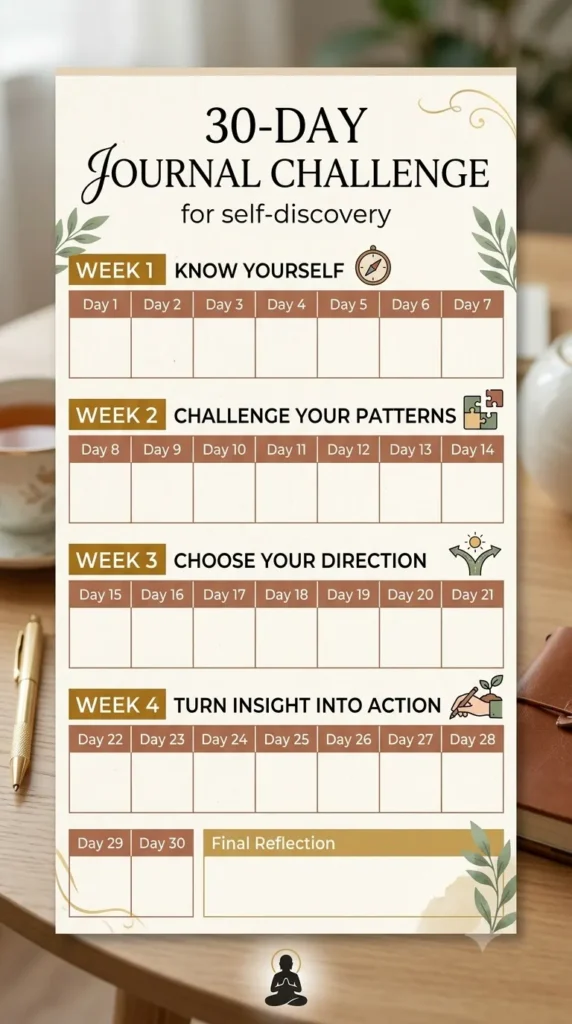
A 30-Day Journal Challenge for Self Growth
A 30-day journal challenge gives you enough structure to build a habit without making journaling feel like another task to complete. These journal prompts for self growth 30 days move from self-awareness to patterns, direction, and action, so each week builds on the one before it.
Days 1–7: Know Yourself
Start by getting curious about who you are now, not who you think you should be. Spend a few minutes each day exploring your strengths, values, interests, emotions, and the moments when you feel most like yourself.
- Day 1: What are five qualities you genuinely like about yourself?
- Day 2: What comes naturally to you that you sometimes take for granted?
- Day 3: When do you feel most confident and comfortable being yourself?
- Day 4: What values matter most to you?
- Day 5: What is one experience that taught you something important about yourself?
- Day 6: What do the people closest to you appreciate about you?
- Day 7: What part of yourself do you want to understand better?
Days 8–14: Challenge Your Patterns
Once you know yourself better, look at the habits and beliefs that shape how you see yourself. Notice recurring self-criticism, comparison, people-pleasing, perfectionism, or the need for approval without judging yourself for having them.
- Day 8: What negative thought about yourself keeps coming back?
- Day 9: Whose approval do you find yourself seeking most?
- Day 10: When do you compare yourself with other people?
- Day 11: What mistake are you still using as evidence against yourself?
- Day 12: What would you say to a friend who had the same insecurity?
- Day 13: What expectation of yourself feels impossible to maintain?
- Day 14: Which pattern would you most like to change, and why?
Days 15–21: Choose Your Direction
Reflection becomes more useful when it helps you decide what comes next. Think less about having your entire future figured out and more about identifying the kind of person you want to become.
- Day 15: What does a meaningful life look like to you?
- Day 16: Which goal actually matters to you, rather than simply looking impressive?
- Day 17: What kind of person do you want to be when things get difficult?
- Day 18: What would you try if you weren’t worried about looking inexperienced?
- Day 19: Which relationship, habit, or commitment deserves more of your energy?
- Day 20: What do you want your future self to thank you for starting?
- Day 21: What is one direction you feel ready to explore?
Days 22–30: Turn Insight Into Action
The final nine days are about proving to yourself that reflection can lead somewhere. Choose small actions you can actually complete. Self-growth becomes easier to trust when you can point to something you did, not just something you thought about.
- Day 22: What is one small action you can take toward your chosen direction?
- Day 23: What boundary would protect something important to you?
- Day 24: What uncomfortable conversation have you been avoiding?
- Day 25: What is one thing you can do without asking for anyone else’s approval?
- Day 26: What recent action made you proud of yourself?
- Day 27: What setback can you respond to differently this time?
- Day 28: What habit would make the person you want to become easier to recognize?
- Day 29: What have the past 29 days taught you about yourself?
- Day 30: What is one promise you want to make to yourself for the next 30 days?
Shadow Work Journal Prompts for Self Growth
Shadow work journal prompts self growth can help you look at parts of yourself that are easy to avoid, judge, or hide. The goal isn’t to criticize yourself. It’s to notice patterns with enough honesty and compassion to understand what may be underneath them.
Exploring Traits You Hide From Others
What parts of yourself do you work hard to keep private? Maybe you worry about being needy, controlling, insecure, competitive, or overly sensitive. Instead of labeling these traits as “bad,” ask what they might be protecting.
- What is one part of my personality I rarely show people? Why do I hide it?
- When do I feel the strongest need to appear confident, calm, or unaffected?
- What would I fear people might think if they saw the less polished version of me?
Questioning Patterns You Don’t Like in Yourself
Some behaviors become so familiar that you stop questioning them. Journaling can create enough distance to examine them without immediately defending or condemning yourself.
- What behavior in myself keeps repeating even though I don’t like its effects?
- What usually happens right before I fall into this pattern?
- What need might I be trying to meet through this behavior?
Exploring Jealousy, Anger, Shame, or Fear
Uncomfortable emotions aren’t automatically signs that something is wrong with you. They can point toward an unmet need, insecurity, boundary, fear, or belief worth examining.
- What situation recently made me jealous, angry, ashamed, or afraid?
- What did that emotion make me believe about myself?
- What might this emotion be asking me to notice rather than eliminate?
What Your Reactions May Be Trying to Tell You
A strong reaction can sometimes reveal more than the event itself. Ask what felt threatened: your sense of belonging, competence, safety, identity, or worth.
- What reaction of mine recently felt bigger than the situation seemed to warrant?
- What did I need in that moment but struggle to ask for?
- If my reaction could speak honestly, what would it say?
If these prompts open something bigger than a page can hold, it’s okay to pause and seek additional support; journaling isn’t a substitute for professional care. You can also explore journal prompts for mental health for gentler, broader reflection.
How to Turn Your Journal Answers Into Real Personal Growth
Writing honest answers is useful, but the bigger benefit comes from noticing what those answers reveal about your habits, beliefs, and choices. Treat your journal as a place to spot patterns, choose one area to work on, test a small change, and see what actually shifts.
Find the Pattern
Don’t judge each journal entry on its own. After a week or two, look back and notice what keeps appearing. Maybe you repeatedly write about comparing yourself to friends, avoiding difficult conversations, or feeling guilty whenever you put yourself first. Repeated themes are often more useful than any single answer.
Name the Growth Area
Once you spot a pattern, give it a clear name. Instead of writing “I need to feel better about myself,” try “I rely too much on other people’s approval” or “I turn small mistakes into proof that I’m not capable.” A specific growth area gives you something you can actually work with.
Pick One Small Experiment
Don’t try to rebuild your entire self-esteem at once. Choose one behavior to test for the next few days. You might stop checking someone’s social media when comparison starts, speak up once during a meeting, or write down one thing you handled well each evening. The goal is evidence through action, not instant confidence.
Review What Changed
Return to your journal after several days and ask what felt different. Did you trust yourself more? Did the same trigger feel less powerful? Did the experiment reveal something unexpected? Keep what works and adjust what doesn’t.
Know When a Prompt Is Not Helping
A journal prompt should create useful reflection, not trap you in the same painful thought loop. If you repeatedly finish an exercise feeling more ashamed, anxious, or stuck, pause it. Try a gentler prompt focused on self-compassion, grounding, or something you can control.
Conclusion
Building better self-esteem isn’t about convincing yourself that you’re perfect. It’s about learning to see yourself more honestly: recognizing your strengths, accepting your imperfections, questioning harsh self-talk, and noticing the ways you’ve already grown. The right self esteem journal prompts can help you slow down enough to notice those things.
You don’t need to answer every prompt at once. Pick one that matches what you’re dealing with today and give yourself a few honest minutes with it. Over time, those small reflections can become a record of your progress, resilience, values, and growing self-trust. Your journal doesn’t need to make you feel confident every day. It just needs to help you understand yourself a little better.
Frequently Asked Questions
What is a good journal for self-improvement?
A good self-improvement journal is one you’ll actually use consistently. Choose a notebook or digital journal with enough space for honest reflection, rather than one that feels too formal.
A simple journal with dated entries works well for tracking habits, thoughts, goals, challenges, and personal growth over time.
How to start journaling for self-growth?
Start with five minutes and one honest question. Write about something you want to understand, change, or handle better. Don’t worry about grammar or making each entry insightful.
The goal is to notice patterns, clarify your thoughts, and identify small actions that move you toward the person you want to become.
What are some good journal prompts for personal growth?
Useful personal-growth prompts focus on self-awareness and action.
Try asking:
What am I learning about myself right now?
What habit is helping or holding me back?
What challenge taught me something valuable?
What would I do differently next time? What is one small change I can make this week?
What are some good journal prompts for developing a growth mindset?
Try prompts that help you examine effort, setbacks, and learning.
Ask yourself:
What did this mistake teach me?
Where have I improved through practice?
What feels difficult because I’m still learning?
How could I approach this challenge differently?
What evidence shows that my abilities can develop with time and effort?
How to journal for personal growth?
Use journaling to move from reflection toward action. Start by describing what happened, explore how you felt and what you learned, then consider what you want to do next.
Reviewing older entries can also reveal patterns, progress, recurring challenges, and changes in how you understand yourself.

It’s Bhaskar!
Well, I am not a psychologist a monk, or a philosopher by training. I’m just an engineering graduate.
‘The Empty Self’ is where I write about that idea, and what it actually means for ordinary life, anxiety, identity, habits, the stories we tell ourselves about who we are. I don’t have a psychology degree, and I’m not offering therapy or clinical advice. What I do have is thought and clarity, and genuine curiosity about why we suffer the way we do and how much of it might loose once we shed this ‘fixed identity’.