

Depression tangles even ordinary thoughts. Getting them onto a page creates room to breathe. That’s the whole case for a journal for depression.
It won’t fix anything on its own. Not even close. A depression journal isn’t therapy, and it isn’t treatment. What it does is simpler. It helps you notice emotions, catch recurring thoughts, spot patterns, and see small signs of progress you’d otherwise miss.
Researcher James W. Pennebaker’s decades of work on expressive writing found modest but real benefits for people processing heavy emotional experiences. Modest, not miraculous. That’s exactly why journaling emotions works best as a support, not a fix.
For Gen Z adults, that support looks different day to day. A notebook some mornings. The Notes app on a rough commute. One prompt answered between classes, shifts, everything else pulling at your attention. Journaling for depression was never about beautiful entries. It was never about forcing yourself to feel positive either.
Some days three honest sentences are enough. Genuinely enough.
Quick Overview: This guide holds 50 depression-focused journal prompts. Understanding emotions. Challenging harsh self-talk. Managing low-energy days. Recognizing patterns. Asking for support. Noticing small steps forward, without forcing positivity anywhere.
For a wider set of prompts covering anxiety, stress, and self-esteem too, the complete journal prompts for mental health guide is worth a look. And if low mood keeps circling back to the same old wounds, the healing journal prompts collection picks up right where this one leaves off.
Table of Contents
Disclaimer
This blog is written and edited with the help of AI, then reviewed by me before publishing. As a result, the content is for general reflection only, not therapy or medical advice, and I’m not a licensed mental health professional. If you’re in crisis, please contact 988 if you’re in US or a local crisis service of your country instead of relying on this site.
Journal for Depression: What It Can Actually Help You Do
A journal for depression isn’t about writing something profound. Not on command, anyway. For Gen Z adults, it’s a private place to slow down, name what’s happening, and catch a pattern before it repeats somewhere other than your Notes app or a half-finished DM.
That’s it. That’s the whole job description.
Turn a Mess of Thoughts Into Something You Can See
When your head feels crowded, writing gives those thoughts somewhere to land. Start anywhere. A sentence that makes no sense. Five straight minutes complaining about the same problem. Or just, “I don’t even know what’s wrong.”
That’s still journaling.
Sound too messy to count? It isn’t. The point was never a polished entry. It’s getting enough distance from your thoughts to notice what’s actually happening. I’m exhausted. I keep replaying that conversation. I’ve been avoiding everyone. I haven’t felt like myself this week.
That kind of emotional awareness can beat forcing yourself into a positive mindset you don’t actually feel. Research on expressive writing, most closely tied to psychologist James W. Pennebaker’s work, points to modest but real benefits for people managing low mood. Not a cure. Just a support worth having. If naming what you feel is the part that trips you up, journaling for emotional intelligence breaks that skill down further.
Notice Patterns You Miss While You’re Living Them
One bad day tells you almost nothing. A month of entries tells you plenty.
Here’s why that matters. Looking back surfaces the recurring situations, thoughts, routines, and energy dips that are nearly impossible to catch in real time. Your depression journal becomes a record of what you’ve actually lived through, not a guess pieced together from memory three weeks later.
Memory edits itself. A page doesn’t.
Give Yourself a Place to Be Honest
A journal doesn’t need to be polished. Doesn’t need to be aesthetic. Doesn’t need to be shareable either.
It can hold the thoughts you don’t want to turn into another carefully worded text, the ones that never quite make it into a DM. If structure helps you get honest faster than a blank page does, guided journals for mental health walk through a few formats worth trying. Journaling emotions doesn’t have to mean facing a blank page alone every time.
And sometimes, that’s the whole point.
If low mood keeps circling back to something heavier, like thoughts of harming yourself or not feeling safe, that’s not something to sit with alone. Reach out to a mental health professional, or in the U.S., call or text 988 to reach the Suicide & Crisis Lifeline.

Can Journaling Help With Depression?
A journal for depression gives hard thoughts somewhere to land. That part is true. Selling it as a cure for depression? That’s not honest.
Here’s the fair version. Journaling may support emotional awareness and coping for some people. Established treatments, psychotherapy and medication, stay central when depression needs clinical care. That doesn’t change just because you bought a nice notebook.
What the Research Suggests
Expressive writing research traces back to James Pennebaker’s early writing paradigm. Putting stressful experiences and emotions into words can bring real benefits. In some circumstances. Not all of them.
The effects are modest. And inconsistent. Not a guaranteed treatment for depression, no matter what a caption promises.
A meta-analysis of 39 randomized controlled trials looked closely at this question. It found that expressive writing did not produce significant long-term reductions in depressive symptoms among physically healthy adults dealing with psychological stress.
That’s a useful reality check. Journaling can still be worth doing. Just stop treating every entry like therapy in disguise.
What Journaling Cannot Do
A depression journal can’t diagnose depression. It can’t replace professional treatment. It won’t guarantee your symptoms improve, either.
Dealing with depression that won’t ease up? Journaling works best as backup, sitting alongside real care, not standing in for it.
Mayo Clinic names psychotherapy and medication as the treatments that actually move the needle on depression. It also notes journaling can help as one piece of a broader plan, giving difficult emotions a place to be expressed.
When a Journal Can Be Especially Useful
A journal earns its place when you can’t quite say what’s happening out loud. Not yet, anyway.
Writing surfaces the loop. The same thought, circling back again. Journaling emotions this way turns a vague, heavy feeling into something you can actually name, track, or bring up with a therapist. It can flag a shift in mood before you’d otherwise notice it. It can also help you organize what you want to say at your next appointment.
It gives you a low-pressure place to be honest, too. No polish required. No deep insight either.
Sometimes “I don’t know what’s wrong, I just feel exhausted” is enough to start with. That’s the whole point.
Mood harder to name than the sadness itself? Mindfulness journal prompts can help you notice what’s happening in your body first, before you try to put it into words. And once something’s down on the page, the full journal prompts for mental health collection has more structured questions ready if today’s entry needs a starting point.
A journal for depression works best when it helps you understand your experience. Not when it makes you feel responsible for fixing it alone.
How to Start a Depression Journal When You Feel Drained
Starting a journal for depression doesn’t need energy you don’t have to spare. Keep it small. Write for as long as you can manage, then stop the moment it starts feeling like homework instead of support.
That’s the whole approach. Nothing complicated about it.
Paper, Notes App, or Dedicated Journal
There’s no medically superior format for a depression journal. A cheap notebook works fine. So does the notes app already sitting on your phone, especially on the days when getting out of bed feels like a whole expedition.
A dedicated journal can make the practice feel more like a ritual. Digital writing is easier to search, update, or keep private. Neither one wins by default.
Pick whichever has the lowest barrier to starting. Sound too simple? It is. If hunting for the perfect notebook becomes another excuse to put off writing, skip the notebook. Open your phone instead.
Want more structure? A guided journal can hand you prompts on the days when even writing your own questions feels like too much. Explore guided journals for mental health if that sounds like a better fit for you.
How Long Should You Journal?
There’s no required number of minutes for journaling for depression. Five minutes counts. Ten minutes works on the days you have more to give. On the hard days, even two sentences are enough.
Mind contributor Paul put this well. Some days his mind gets so loud that writing turns impossible, so he stops and comes back to it later. (Mind) That flexibility matters more than people think.
A journal isn’t a test you can fail. It was never supposed to work that way.
What to Do When You Have Nothing to Write
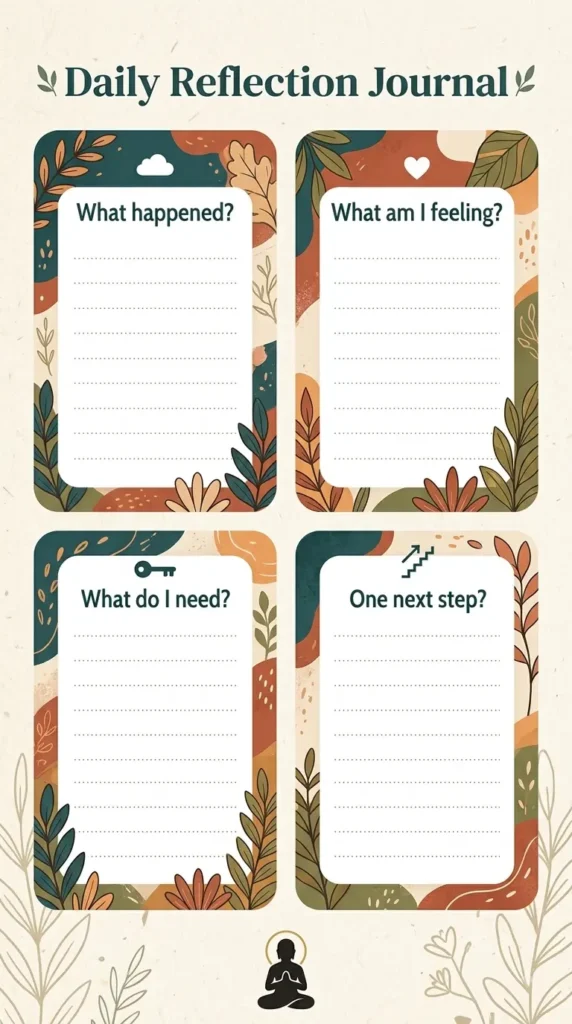
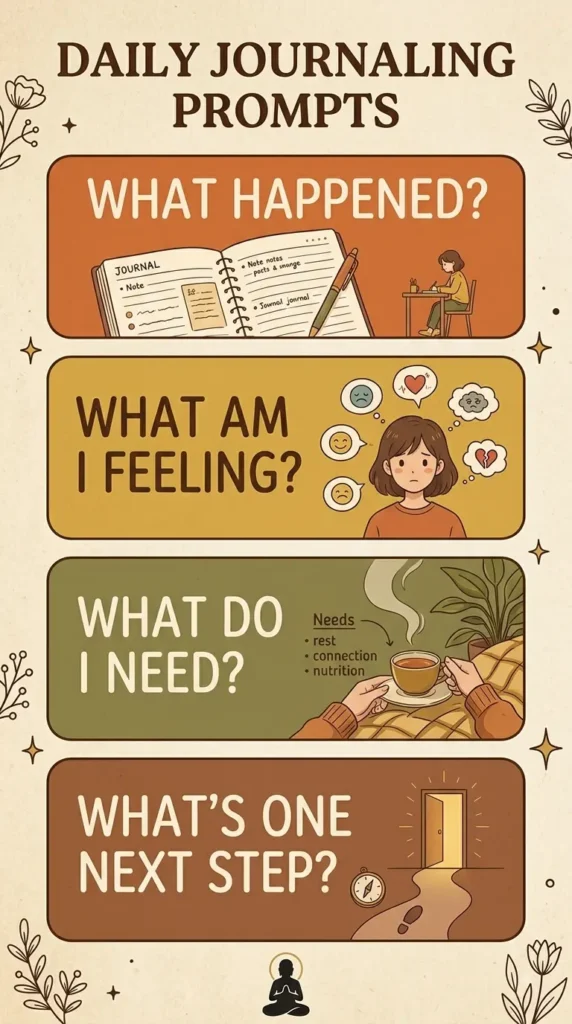
A blank page doesn’t need a brilliant answer. It doesn’t need a clever one either. It just needs four questions.
- What happened?
- What am I feeling?
- What do I need?
- What is one next step I can manage?
You don’t need a deep answer. “I barely slept.” “I feel flat.” “I need less pressure.” “I’m going to shower.” Each one is a perfectly valid entry in a depression journal.
You Don’t Have to Journal Every Day
Daily journaling sounds productive. Then depression turns it into one more obligation you feel guilty for skipping. Build a practice you’ll actually come back to instead.
It’s 9pm, the page is blank, and part of you wants to close the laptop instead. That’s fine. Two lines tonight is still a win.
Five minutes feels doable? Start there. Our Start With 2 to 5 Minutes routine walks through a simpler entry point if you want one.
A perfect streak was never the goal. Somewhere to put your thoughts when journaling emotions actually helps, that’s the goal.
How to Choose a Journal Prompt When You’re Depressed
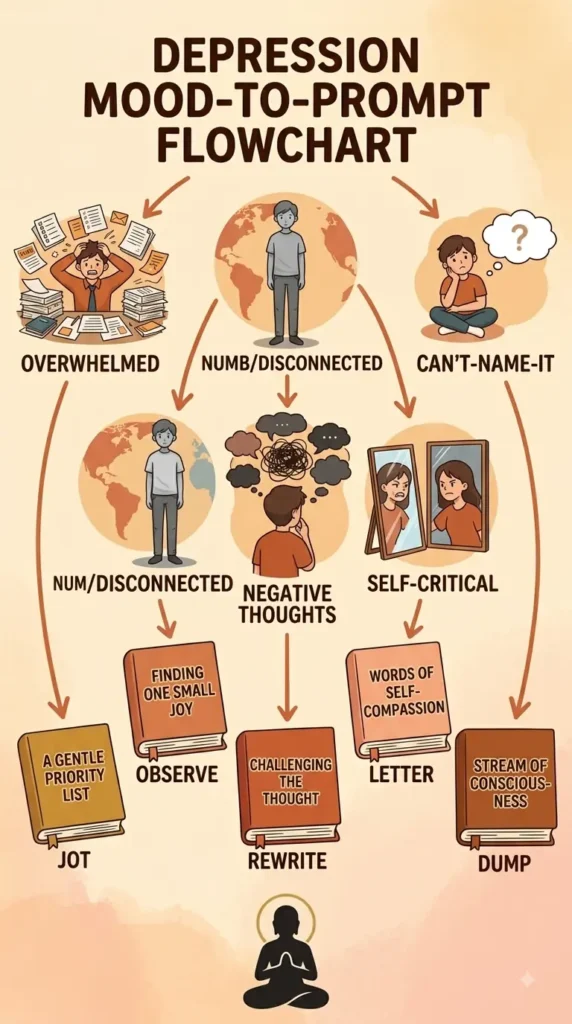
Depression doesn’t feel the same on Tuesday as it did on Monday. That’s the whole problem with picking a journal for depression off a generic list. A prompt that helps when you’re numb can feel pointless when you’re spiraling. One that works mid-spiral can feel like too much when you’re just exhausted. So match the prompt to what’s actually happening in your head right now, not to what depression is “supposed” to look like.
This isn’t guesswork either. A 2023 meta-analysis in the British Journal of Clinical Psychology found expressive writing had a small but real effect on lowering depression, anxiety, and stress symptoms. Small still counts. A depression journal doesn’t need to fix everything. It just needs to meet you where you are.
When You Feel Overwhelmed
Skip the big questions. Today isn’t the day for them.
Overwhelm doesn’t need a prompt that maps out your entire life. It needs one that clears a little space and leaves the rest alone. Ask what’s taking up the most room in your head right now. Not this month. Not the next five years. Just right now. Then ask what would make the next hour slightly less heavy. That’s it. One thread, pulled loose.
When You Feel Numb or Disconnected
This isn’t about naming a feeling that isn’t there.
Numbness makes emotional questions surprisingly hard to answer. You can’t write your way into a feeling that’s gone quiet. So don’t try. Reach for something physical instead. What do you notice in the room around you? What does your body feel like right now, even if the answer is “nothing much”?
A stray memory works too. Small, concrete details tend to loosen numbness faster than forcing an emotion that won’t show up on command. If presence-based questions feel useful here, mindfulness journal prompts go deeper into that same approach.
When You’re Stuck in Negative Thoughts
The same thought on repeat starts to feel like fact. It isn’t one.
Depression loops. Loudly, and often. Journaling emotions like this works by slowing the loop down enough to separate what actually happened from what you’re assuming happened. Write the thought exactly as it showed up.
Then ask what evidence backs it up, and what part is prediction dressed up as certainty. That gap is where the loop starts to lose its grip. This kind of evidence-based questioning is also the backbone of therapy journal prompts, if you want a more structured version once this one clicks.
When You’re Being Hard on Yourself
Most people wouldn’t talk to a friend the way they talk to themselves.
If your internal voice sounds harsher than anything you’d say out loud to someone you love, that’s the prompt to reach for. Not forced positivity. Not an affirmation you don’t believe.
Ask whether your self-judgment is fair. Ask if it’s even based on real evidence, or just a familiar old script. Old, harsh scripts are exactly what healing journal prompts are built to unpack, especially when the self-criticism traces back further than today.
When You Can’t Name What You’re Feeling
You don’t need the perfect word first. Genuinely.
Journaling for depression doesn’t require fluent emotional vocabulary before you start. Begin with what you can actually observe. What happened. What shifted in your body. What you wanted to do and didn’t.
What you’ve been quietly avoiding. Let the feeling surface on its own instead of chasing it. Naming emotions gets easier with practice, and that’s the whole idea behind journaling for emotional intelligence: the vocabulary builds over time, not all at once.
For a broader mood-by-mood breakdown across anxiety, anger, and stress, see our full mental health prompt guide. And if a blank page feels like too much most days, guided journals for mental health can carry more of the structure for you.
50 Therapy Journal Prompts for Depression
A good therapy journal prompt for depression should meet you where you are. Not the version of you with more energy, more optimism, or more clarity. That version isn’t here today, and that’s fine.
The 50 therapeutic writing prompts below are grouped by what you may actually be feeling right now, so you can pick one that fits, skip the rest, and stop when it stops helping.
Naming and Understanding Your Emotions
Depression flattens everything into one heavy blur. Naming the blur beats trying to explain your entire life in one sitting. These prompts focus on journaling emotions without forcing a neat answer by the end of the page. Nothing here needs to resolve.
- What feels emotionally heaviest for me today, and what makes it feel heavy?
- If I couldn’t describe my mood as simply “bad,” what words would come closer?
- What emotion have I been pushing aside because I don’t know what to do with it?
- What changes in my body do I notice when my mood drops?
- What happened before I first noticed myself feeling lower than usual today?
- Is there an emotion underneath my sadness that I haven’t acknowledged yet?
- What do I wish I could say about how I feel without worrying about how someone else would react?
- If my current emotional state could point to one thing I need, what might it be?

Difficult Thoughts and Negative Thinking
This isn’t about arguing with every negative thought that shows up. That fight rarely ends well. Depression makes a thought feel like a fact simply because it repeats often enough. Slow one down long enough to see what’s actually there, and half its power disappears on its own.
- What is the harshest thought my mind has repeated about me lately?
- What happened that triggered this thought, and what meaning did I immediately attach to it?
- Am I describing something that happened, or am I predicting what it means about my future?
- What part of this thought is based on something I know, and what part is an assumption?
- If someone I cared about had this exact thought about themselves, what would I want them to consider?
- What does this negative thought make me believe I have to be, achieve, or prove?
- Is there another explanation for what happened that doesn’t require me to blame myself?
Low-Energy and “Just Get Through Today” Days
Skip the productivity system today. A low-energy depression journal entry doesn’t need one. The goal is smaller than that: figure out what your actual capacity is right now, then find one manageable way through the next hour of it. Not the whole day. Just the next hour.
- What does “getting through today” realistically mean for me right now?
- Which part of today feels most difficult, and can I make that part smaller?
- What basic need might be getting overlooked because I have so little energy?
- What is one task I can make easier, postpone, simplify, or ask someone else to help with?
- What would make the next hour feel slightly more manageable?
- What am I expecting myself to accomplish today that my current energy may not support?
- What is one thing I have managed to do recently despite feeling this way?
Self-Compassion and Self-Worth
Depression adds a second layer of pain most people never talk about. Feeling bad starts to look like proof you’re lazy, failing, behind, or somehow not enough. It isn’t proof of anything. These therapeutic journal prompts separate how you’re feeling from your worth as a person, on purpose, one question at a time.
- What am I using as evidence that I’m not good enough, and is that evidence actually fair?
- What would I say to someone I love who was struggling in exactly the way I am?
- Which mistake or difficult period am I still using to define myself?
- What part of myself have I been judging when I might actually need understanding?
- What qualities do I have that have nothing to do with productivity, appearance, money, grades, or career progress?
- Where have I been comparing my life with someone else’s and quietly deciding that I’m falling behind?
- What would treating myself with reasonable patience look like today?

Triggers, Patterns, and Mood Changes
One entry tells you what happened once. A few weeks of entries tell you something closer to the truth. These therapy writing prompts are built for looking backward without turning your journal into a place where you replay the same hard moment on a loop. Pattern-spotting, not reliving.
- What situations seem to appear repeatedly before my mood gets noticeably worse?
- What changes in my sleep, routine, relationships, or environment tend to coincide with a lower mood?
- Is there a particular time of day when depression feels harder for me, and what is usually happening then?
- What interaction with another person has stayed in my mind longer than I expected?
- What tends to drain me emotionally even when I initially think I can handle it?
- Looking back over the past few weeks, what small change in my mood or behavior have I noticed?
Connection, Loneliness, and Asking for Support
Being online all day doesn’t automatically fix loneliness. Not even close. For a lot of Gen Z adults, reacting to a story is easy. Typing “I’m actually not doing well” to a real person is a different kind of hard entirely. These prompts exist to bridge that exact gap.
- Who do I feel safest being honest with when I’m struggling?
- What do I wish someone close to me understood about my depression without me having to explain everything?
- What stops me from asking for help when I know I need it?
- Do I actually want more social connection right now, or do I need quiet and space without feeling guilty about it?
- If I sent one honest message to someone I trust today, what would I want it to say?

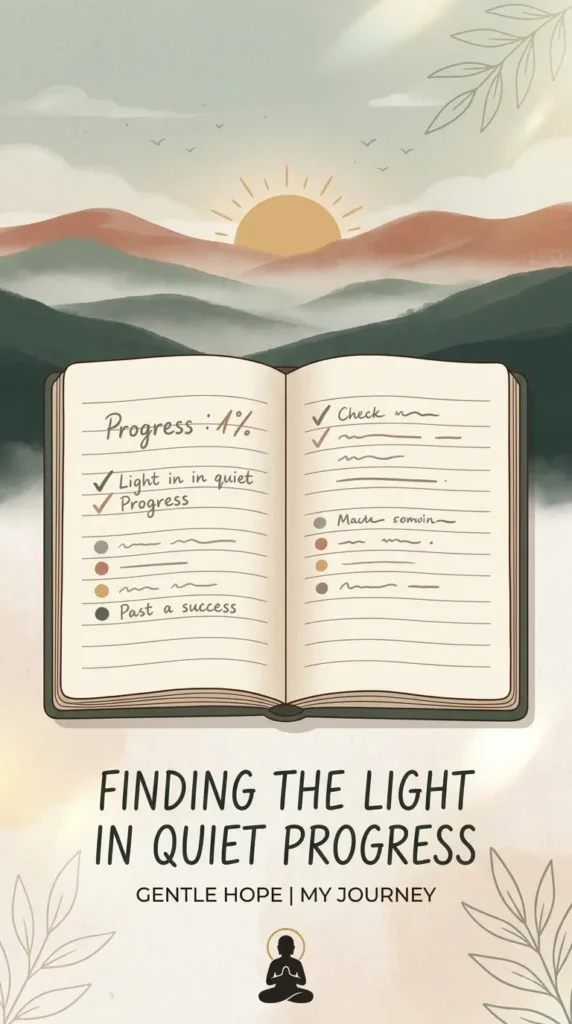
Hope, Progress, and Small Forward Movement
Hope doesn’t require feeling good about everything. That’s not what this is. When depression sits heavy, hope can be as ordinary as noticing something that helped for ten minutes. A change you almost missed. One thing you still want to keep trying at, even now.
- What has felt even slightly easier lately, even if the overall picture still feels difficult?
- What is one moment from the past week when I felt a little more like myself?
- What has helped me get through previous difficult periods that I could gently return to now?
- What is something I want my future self to have more of in everyday life?
- What small part of my life still feels worth protecting, even during a difficult period?
- What is one realistic thing I could do tomorrow that would support the person I want to become?
Talking to a Therapist or Doctor
Here’s an honest take: nobody remembers everything by the time they’re sitting across from a therapist. A journal fixes that. Use these post-therapy journal prompts, or the pre-session version below, to organize what you’ve actually been noticing instead of trying to reconstruct three weeks from memory in real time.
- What symptoms, thoughts, or changes in my daily life have been hardest to manage recently?
- What pattern have I noticed that I want a mental-health professional to know about?
- What question about my mood, treatment, or next steps have I been putting off asking?
- If I could explain one thing about my recent experience that I struggle to say out loud, what would I want my therapist or doctor to understand?

A note on using these prompts: You don’t need to answer all 50. Please don’t. Treating this like homework defeats the point of it. Pick the question closest to what’s happening today. Write for as long as it stays useful. Stop the moment it starts feeling like circling the same drain.
One more thing worth saying plainly. These are therapy journaling prompts meant to support reflection between sessions, not replace one. If a low mood turns into thoughts of harming yourself, or you don’t feel safe, this isn’t something to sit with alone on a page. Reach out to a mental-health professional, or contact the 988 Suicide & Crisis Lifeline if you’re in the U.S.
Want prompts sorted by mood instead of depression specifically? The journal prompts for mental health guide covers anxiety, stress, self-compassion, and mindfulness too. And if a specific wound keeps resurfacing underneath the low mood, the healing journal prompts collection goes further into that side of the work.
A printable therapy journal prompts pdf covering all 50 of these can also live here as a companion download, so you’re not scrolling back through the full article every time you need one.
A Simple Depression Journaling Routine for Gen Z Adults
This routine won’t ask more of you than you actually have some days. Match the length to your energy, not the other way around. One minute when you’re barely upright. Five when there’s a little space to work with. Ten when you actually want to dig into something.
Nobody fails a journal for depression by keeping it short. That’s kind of the whole point.
1-Minute Journaling
On a rough day, one minute covers it. Write what you’re feeling, what you need, and one thing you can actually do next. “Heavy, need food, make toast” counts. It doesn’t need to sound thoughtful.
The goal isn’t a meaningful entry every time. It’s a small record. Nothing more than that.
5-Minute Journaling
Five minutes buys you room to slow down. Start with what happened. Then name the emotion attached to it. Then the thought underneath that emotion. Then what might actually help right now.
This length works well as a default for journaling for depression. Long enough to spot a pattern forming. Short enough that it never turns into an exhausting writing session. If naming the feeling itself feels like the hard part, journaling for emotional intelligence leans into exactly that skill, catching an emotion before it runs the rest of your day.
10-Minute Journaling
Ten minutes gives you room to unpack something that’s been sitting in your head. A hard conversation. A self-critical thought that keeps looping. Something you’ve been avoiding for weeks now.
Feels too heavy today? Skip it. If the 5-minute mental health journaling routine already feels like too much, there’s no prize for pushing through the ten-minute version anyway. Start with one minute instead. Stop the second you’ve said what needed saying.
What to Track Across Several Entries
A single entry rarely shows you much. A few weeks of them will.
Track mood, energy, sleep, big events, recurring thoughts, triggers, and whatever actually helped. Don’t treat the notes as a diagnosis. That’s not what they’re for.
Maybe energy tanks every time sleep slips for a few nights running. Maybe the same situation keeps triggering the same self-critical thought. Small patterns like that turn into something worth bringing to a therapist or doctor, rather than pages you wrote once and forgot about.
Working with a therapist already, or thinking about starting? Therapy-informed journal prompts borrow structure from real therapeutic thinking, built for connecting what surfaces in a quick check-in to something worth bringing into a session.
When Journaling Starts Making You Feel Worse
A journal for depression should give your thoughts somewhere to land. Not another place to punish yourself.
If writing leaves you more shaken than before, that’s a signal. Stuck in the same loop? Feeling less safe than when you sat down? Stop. A depression journal exists to support you. Not deepen what you’re already carrying.
Signs You’re Moving From Reflection Into Rumination
Reflection helps you understand what happened. Rumination just keeps you circling it.
One moves somewhere. The other spins in place. Rewriting the same argument for the tenth time isn’t insight. Asking why you’re broken, over and over, isn’t either. Neither is chasing an answer that never shows up. When that starts happening, the page stops helping. It starts feeding the loop.
Check what happens after you close the notebook. Do you feel a little clearer about what you went through? Or more trapped inside the same three thoughts?
You also don’t have to finish every entry. Paul, writing about his experience of anxiety and depression for Mind, describes moments when his thoughts felt too tangled to write at all. Stopping and coming back later worked better than pushing through.
Want the fuller breakdown? Our reflection vs. rumination guide walks through exactly when journaling emotions helps, and when it just repeats the same loop.
How to Make the Prompt Gentler
Too intense? Shrink it. Make it concrete.
Skip “why am I like this.” That question has no bottom. Try something smaller. What happened. What you’re noticing in your body. What emotion showed up. What would make the next hour slightly easier.
Switch from analysis to observation too. You don’t need to solve your depression in one sitting. Sound too small to matter? It isn’t.
On a hard day, “I haven’t eaten much, I’ve been avoiding texts, everything feels heavier than usual” says more than any grand explanation would. If you want gentler entry points built for exactly this, our mindfulness journal prompts collection sticks to noticing, not analyzing.
When to Pause Journaling and Get More Support
Some prompts don’t just sting. They spiral.
If journaling keeps raising your distress, deepening hopelessness, or surfacing thoughts of hurting yourself or not wanting to be alive, stop. Reach for a person instead. A therapist, a friend, someone real. A journal is a tool. It was never built to carry something this heavy alone.
In the U.S.? Call or text 988 to reach the 988 Suicide & Crisis Lifeline. Free. Confidential. Available around the clock.
You can also text HOME to 741741 to reach Crisis Text Line. Same deal: free, confidential, staffed by trained volunteers, 24/7 in the U.S.
Outside the U.S., use your local emergency or crisis service instead.
And if writing doesn’t feel possible right now? That’s fine too. Paul’s account for Mind is worth remembering here. Sometimes closing the notebook is the healthier move. You can return to the page later. Or not at all.
Depression Journal vs. General Mental Health Journal: What’s the Difference?
Not every mental health journal fits every mood. A journal for depression narrows in tight. Low mood. Heavy days. Thought patterns that loop. Energy that disappears.
Basic tasks that suddenly feel impossible. A general mental health journal casts a wider net. Anxiety, stress, self-esteem, relationships, thanks, mindfulness, all of it lives there.
Sound like a small distinction? It isn’t.
When a Depression-Focused Journal Makes Sense
Your entries keep circling the same place. Persistent low mood. Hopeless thoughts. Low drive. Feeling numb. Even getting through ordinary tasks turns hard. That’s the signal. A depression journal fits here.
Narrow prompts cut the guesswork. Staring at a blank page, wondering what to write? That’s the exact problem this fixes. The question already matches what you’re living through.
Pattern-spotting works well here too. Maybe your energy tanks after a bad night’s sleep. Maybe certain situations trigger harsh self-talk. Maybe small activities hit your mood differently than you’d expect. None of that shows up in one entry. It shows up across several.
Write it down anyway. That pattern becomes something concrete. Something to bring up with a mental health professional, if you have one.
One thing this journal isn’t: a diagnosis. If depression is a real concern, or your symptoms are getting in the way of daily life, journaling belongs next to professional support. Not instead of it.
When Broader Mental Health Prompts May Be Better
Depression rarely shows up alone. Anxiety tags along. So does relationship stress, anger, burnout, shaky self-esteem, or trouble staying present. Restrict yourself to depression-only prompts here, and your journal starts feeling smaller than your actual week.
Broader prompts pull at what’s sitting underneath the low mood, or circling around it. Feeling disconnected from the moment? A mindfulness prompt can help. Can’t shake how hard one conversation hit you? An emotional-intelligence prompt digs into that instead.
This is really just journaling emotions in a wider sense, following whatever’s loudest that day instead of sticking to one fixed lane.
For a fuller set organized by mood and need, the journal prompts for mental health guide covers more ground. It’s a solid starting point when you’re not sure depression is even the main thing you’re dealing with.
If low mood is only part of the picture, that guide’s sections on journaling for emotional intelligence and mindfulness journal prompts round out what a depression-only list would miss.
And if journaling for depression ties back to something specific you’re healing from, healing journal prompts and therapy journal prompts go deeper into that territory.
Conclusion
A journal for depression doesn’t need to turn into another task you’re failing to keep up with. Some days, one honest sentence is enough. Other days, you’ve got the energy to poke at a hard thought, spot a pattern, or write down what you need from someone you trust.
The goal was never to force yourself into feeling better. It’s to build a little space between what’s happening in your chest and whatever you do next. Sound too simple? It is. That’s exactly why it works.
A depression journal earns its place the moment it helps you understand a feeling, catch a pattern, or get ready to ask someone for support. Nothing more elaborate required.
And if journaling emotions makes things heavier instead of lighter, don’t push through it. Close the notebook. Ground yourself first, then reach for a real person, not another page.
If mindfulness feels like a gentler starting point, our mindfulness journal prompts guide walks through prompts built for staying present instead of spiraling. And if gratitude tends to steady you on rough days, these gratitude worksheets are worth a look too.
One more thing. If what you’re carrying feels too heavy to sit with alone, reach out. Call or text 988 to reach the 988 Suicide & Crisis Lifeline. That’s not failure. That’s strength.
Frequently Asked Questions
What to write in a journal for depression?
Write about what you’re feeling, what happened before the feeling appeared, what your body is noticing, and what you need right now.
You can also record difficult thoughts, small wins, daily patterns, or questions to discuss with a therapist. On low-energy days, even a few sentences count.
Is keeping a journal good for depression?
Journaling can be a useful complementary practice for some people with depression. It may help you organize thoughts, recognize emotional patterns, and put difficult experiences into words.
However, journaling isn’t a substitute for professional depression treatment, and it can sometimes increase rumination if writing repeatedly keeps you focused on the same distressing thoughts.
What journal focuses on depression?
A depression-focused journal is designed around emotional awareness, negative thought patterns, self-compassion, daily functioning, triggers, relationships, and gradual progress.
It can be a blank notebook, notes app, guided journal, or collection of prompts. The format matters less than having a structure that feels manageable and doesn’t create another obligation.
How to help yourself fight depression?
Start with manageable actions rather than trying to fix everything at once. Maintaining basic routines, staying connected with people you trust, getting regular movement and sleep, and writing down difficult thoughts can help you notice what you’re experiencing.
If depression is persistent, severe, or interfering with daily life, seek professional support.
What are the 7 causes of depression?
There isn’t a universal list of seven causes because depression usually develops through a combination of biological, psychological, and environmental factors.
These can include genetics, brain chemistry, stressful life experiences, trauma, chronic illness, substance use, and prolonged isolation or other difficult circumstances. A qualified professional can help identify relevant factors for an individual.

It’s Bhaskar!
Well, I am not a psychologist a monk, or a philosopher by training. I’m just an engineering graduate.
‘The Empty Self’ is where I write about that idea, and what it actually means for ordinary life, anxiety, identity, habits, the stories we tell ourselves about who we are. I don’t have a psychology degree, and I’m not offering therapy or clinical advice. What I do have is thought and clarity, and genuine curiosity about why we suffer the way we do and how much of it might loose once we shed this ‘fixed identity’.