
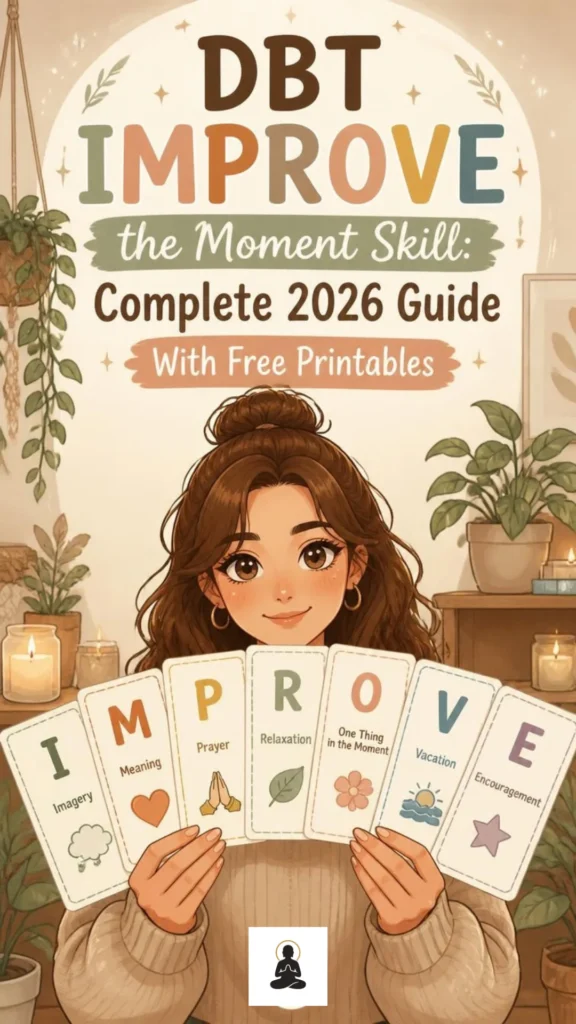
You’re waiting on important results. Or a fight with someone you care about just ended, and nothing useful can be done about it tonight. Your mind replays the conversation on a loop. Your body is tense. What do you do with all that? The urge to act keeps getting stronger.
DBT IMPROVE the Moment is a distress-tolerance skill built for nights like this. It gives you several ways to make a painful moment easier to bear. You don’t have to act on an impulse that could make things worse. It’s one of many practical tools in our DBT skills worksheets.
Quick overview: IMPROVE stands for Imagery, Meaning, Prayer, Relaxation, One thing in the moment, Vacation, and Encouragement. You don’t need all seven. Pick the one that fits what you need right now. Practice it for a few minutes. Then reassess before you act.
Need immediate support? In the U.S., if you’re in danger of harming yourself or someone else, call or text 988 for the Suicide & Crisis Lifeline. You can also text HOME to 741741 to reach Crisis Text Line. Elsewhere, use your local emergency service or a trusted crisis service in your country.
Table of Contents
Disclaimer
This blog is written and edited with the help of AI, then reviewed by me before publishing. As a result, the content is for general reflection only, not therapy or medical advice, and I’m not a licensed mental health professional. If you’re in crisis, please contact 988 if you’re in US or a local crisis service of your country instead of relying on this site.
What Is the DBT IMPROVE the Moment Skill?
DBT IMPROVE the Moment is a distress tolerance skill that helps you get through a painful moment without making it worse. IMPROVE stands for Imagery, Meaning, Prayer, Relaxation, One thing in the moment, Vacation, and Encouragement. Each one changes how you experience the moment, even when the situation can’t change yet. The situation stays put. Your experience of it shifts.
IMPROVE the Moment belongs to DBT distress tolerance, a group of crisis-survival skills for when emotions run intense. You use them to avoid making an already hard situation worse. The focus is deliberately narrow. Get through this moment safely enough to regain your footing. You’ll find more of these tools in our DBT skills worksheets.
Severe distress shrinks your attention. Impulsive actions start to feel urgent. Maybe you fire off the angry message. Maybe you keep refreshing your screen for an answer. Or you make a decision you’ll regret once the intensity drops. Sound familiar? IMPROVE gives you something else to do while the situation is still unresolved.
It is a crisis-survival skill. It isn’t a substitute for treatment or long-term problem-solving. Evidence for individual DBT skills like IMPROVE is more limited than the broader evidence for full DBT programs. So treat it as one practical tool inside the larger DBT framework. Other coping skills worksheets can round out that toolkit.
What Does IMPROVE Stand For in DBT?
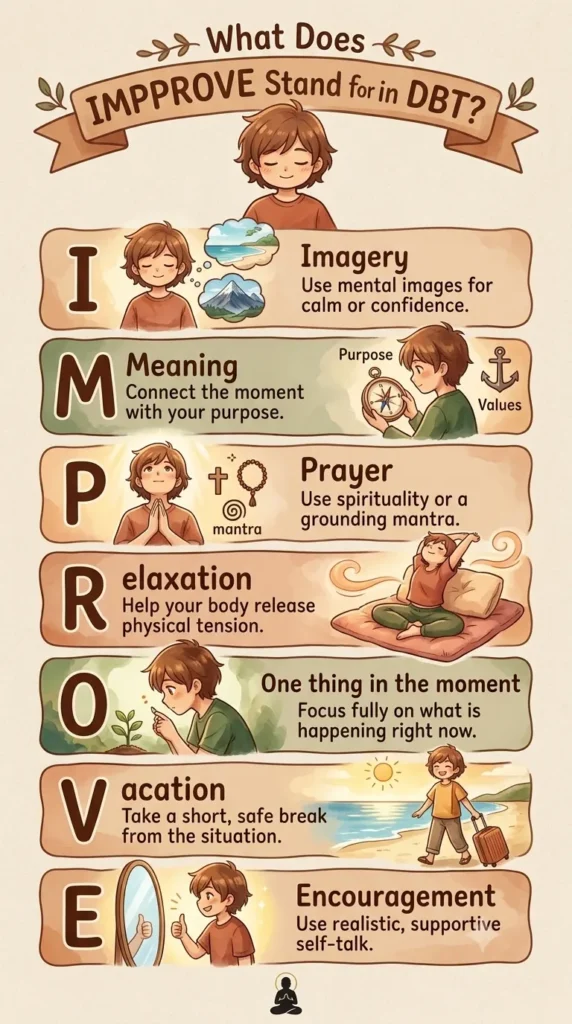
DBT IMPROVE the Moment is a set of seven distress-tolerance strategies. The letters stand for Imagery, Meaning, Prayer, Relaxation, One thing in the moment, Vacation, and Encouragement. Each gives you a different way to make a hard moment more bearable. None asks you to act on the impulse.
| Letter | IMPROVE skill | What it means |
|---|---|---|
| I | Imagery | Use mental images to create calm or confidence |
| M | Meaning | Connect the moment with your values or purpose |
| P | Prayer | Use prayer, spirituality, or a grounding mantra |
| R | Relaxation | Help your body release physical tension |
| O | One thing in the moment | Focus fully on what is happening right now |
| V | Vacation | Take a short, safe break from the situation |
| E | Encouragement | Use realistic, supportive self-talk |
Think of these as options, not a checklist. You don’t have to work through all seven. Some will feel far more natural than others.
Prefer to practice on paper? Try this DBT IMPROVE worksheet, or browse more DBT skills worksheets. You can also compare how different clinicians explain the skill in guides from Charlie Health, DBT Self Help, the Center for CBT, and DBT Tools.
I: Imagery
Imagery uses your imagination to change how a stressful moment feels. Picture a place where you feel safe and calm. Notice the details: temperature, sounds, smells, colors, textures. You can also imagine yourself handling the situation well instead of falling apart in it.
Say you’re waiting for hard news. Picture a quiet lake. Cool air on your skin. Gentle water. Solid ground beneath you. Sound too simple? It is. That’s the appeal.
One caution. Imagery isn’t relaxing for everyone. If an image stirs up painful memories, switch to a neutral scene. Or skip imagery and try another IMPROVE skill.
M: Meaning
Meaning isn’t about calling your pain good. It doesn’t mean the suffering was deserved or secretly a gift. You don’t have to believe it happened for a reason. Meaning simply links the hard moment to something you value.
Picture a parent in an exhausting stretch. They tell themselves, “This is hard, and I’m doing it for my daughter.” The meaning comes from the value behind the effort, not from the pain.
Drop “Why is this happening to me?” Ask “What matters to me while I’m going through this?” instead. Sometimes that small shift is enough to keep you going. If you want to explore it further, these journal prompts for mental health are a good place to start.
P: Prayer
Prayer means turning toward a higher power, a spiritual belief, or any personal source of grounding. For a religious person, that may be traditional prayer. Others use a mantra, quiet reflection, or the idea of Wise Mind.
Marsha Linehan’s DBT materials also include an Acceptance Prayer. It’s a way to acknowledge what can’t be changed right now.
Prayer doesn’t need to look religious to help. Find a form of spiritual or reflective grounding that fits what you actually believe. Nothing forced. If prayer means nothing to you, choose another IMPROVE strategy.
R: Relaxation
Relaxation works on the body first. The aim is to deliberately lower physical tension while you’re distressed. Slow your breathing. Relax your muscle groups. Stretch. Take a warm shower. Perfect calm isn’t the goal. Even a modest drop in tension can make the next decision easier.
After a heated argument, sit somewhere quiet. Slowly lengthen your exhale for a few minutes. Let your shoulders and jaw drop.
Be selective, though. Don’t deliberately tense a muscle that hurts or has been injured. And if watching your breath makes anxiety worse, stop. Pick a different strategy. More options live in this list of coping skills worksheets.
O: One Thing in the Moment
Pick one task. Only one. This skill pulls your attention back to what’s directly in front of you, instead of replaying the past or predicting the future.
It’s late, and an upsetting message sits on your screen. Reading it a twentieth time won’t help. Put the phone down. Wash one dish. Notice the water, the soap, the movement of your hands.
This isn’t pretending the problem is gone. It gives your mind something concrete to do while the intensity settles. Then you can come back to the problem with a clearer head. Mindfulness journal prompts can help you build this habit of staying present.
V: Vacation
A break is not the same as quitting. Vacation means stepping away from a stressful situation, briefly and on purpose. Sit outside for ten minutes. Set your phone aside. Close your eyes. Take a short walk. Then return to what needs your attention.
Two rules apply. The break shouldn’t harm you. And it should stay short. A timer helps.
Here’s a quick test for vacation versus avoidance. Ask yourself: “Will this break help me return to the situation?” Then ask: “Or am I using it to disappear from the problem indefinitely?” If you keep postponing something you need to address, the break may have turned into avoidance.
E: Encouragement
Encouragement is talking to yourself like someone who’s on your side. Distress makes you doubt you can cope. Supportive, realistic self-talk pushes back on that doubt. It doesn’t require pretending everything is fine.
Skip “Everything will work out perfectly.” Try “This is hard, and I can get through the next ten minutes.” That line doesn’t deny the difficulty. It gives you something manageable to hold.
You can also remind yourself of past hard stretches you survived. Recall what you learned. Name what you can control right now. Keep the language believable. Forced positivity sounds hollow when you’re already overwhelmed. Realistic encouragement has a better shot at landing. An emotions worksheet can help you name what you’re feeling first.
When Should You Use DBT IMPROVE the Moment?
Use DBT IMPROVE the Moment when distress is high. The next few minutes feel hard, and you need to get through them without making things worse. It fits best when the problem can’t change right away. Your response still can.
Use It When Distress Is Acute
Reach for IMPROVE when intense emotions make clear thinking or a calm reply feel out of reach. Maybe you’re angry. Maybe panicked, overwhelmed, or ashamed, or desperate to escape the situation. The goal isn’t to make the emotion disappear. It’s to create enough space to choose what you do next.
Use It When the Situation Cannot Change Right Now
Some problems have to wait. You might be waiting on exam results, or sitting in the mess after an argument. Maybe it’s a conflict you can’t settle tonight, or a workload that won’t shrink in the next hour. Nobody enjoys this part. The improve the moment DBT skills make the waiting easier to carry.
Use It When You Are Close to an Impulsive Action
It’s 11pm and your thumb hovers over Send on an angry text. That’s the moment. The same goes for a rushed decision, shutting someone out, or acting on any strong urge. Pause first. IMPROVE gives you something concrete to do while the urge settles.
Don’t Reach for It First When a Quick Problem-Solving Step Is Available and Safe
If a simple action can safely improve things right now, take it. IMPROVE isn’t meant to replace ordinary problem-solving and coping skills. Can you make the phone call? Clear up the misunderstanding? Fix the practical snag? Then do that. It may help more than trying to tolerate a problem you could simply solve.
Don’t Reach for It First When Your Body Is Flooded and Needs TIPP
Sometimes the body needs help before the mind can follow. When physical arousal is extremely high, a faster, body-based tool has to come first. TIPP uses temperature, intense exercise, paced breathing, and paired muscle relaxation. Together they bring acute arousal down. After that, you can move on to gentler distress tolerance strategies.
Don’t Use It as Your Only Response When There Is a Risk of Self-Harm
If you might hurt yourself or can’t stay safe, this is not a worksheet moment. It’s an urgent safety issue. Use the crisis resources on this page. Then reach out right away to a trusted person, a crisis service, or emergency services.
How to Use the IMPROVE Skill Step by Step
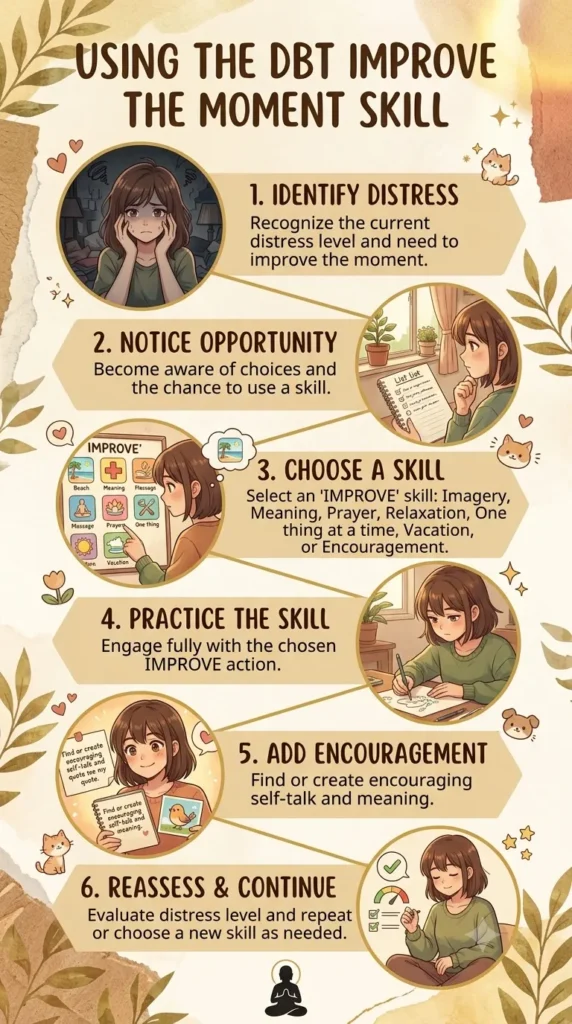
The DBT IMPROVE the Moment skill works best as a short pause. It sits between intense emotion and impulsive action. You figure out what is happening, pick one strategy that fits your current state, and practice it briefly. Then you check in before deciding what to do next. Sound too simple? It is.
1. Identify What Is Making the Moment Difficult
Start by naming the problem in one plain sentence. Then ask whether the situation can actually change right now. If it can, note the next safe action. If it can’t, shift your attention toward getting through the moment without making it worse.
Micro-example: “I’m waiting for an important result, and I can’t get an answer yet.”
2. Notice Your Current Emotion and Urge
Name the emotion as specifically as you can. Then rate your distress from 0 to 10. If feelings are hard to label, an emotions worksheet can give you words to work with.
Now look at the urge riding along with it. You might want to send an angry message, shut down, or check your phone over and over. Leaving, arguing, or avoiding the situation altogether counts too.
Micro-example: “I feel anxious. Distress: 8/10. Urge: refresh my inbox again.”
3. Choose One IMPROVE Strategy
Don’t run through every letter of IMPROVE. Pick the one that matches your body and mind right now. A tense body may call for Relaxation. Racing thoughts may respond better to One Thing in the Moment.
Micro-example: “My thoughts are jumping everywhere, so I’ll try One Thing in the Moment.”
4. Practice It for a Few Minutes
Give the strategy your full attention. Half-doing it while you keep monitoring the problem defeats the purpose. Time-box the practice to about 3–10 minutes. A timer helps, since you don’t have to keep wondering when to stop. The aim is a manageable shift. Not instant calm.
Micro-example: “For five minutes, I’ll wash the dishes slowly and focus only on the plate in my hands.”
5. Add a Second Strategy if Needed
If the first strategy helps only a little, add another. Stop at two, though. IMPROVE isn’t meant to turn into a long list of coping tasks. You’re trying to lower the intensity enough to respond on purpose. A complicated ritual defeats that.
Micro-example: “One Thing helped me focus, but I’m still tense, so I’ll add four minutes of slow breathing.”
6. Reassess Before Acting
Rate your distress again and compare it with your starting number. Lower? Proceed mindfully. Unchanged? Switch strategies. Higher? Stop and ask whether you need extra support instead of pushing through the exercise.
Micro-example: “I went from 8/10 to 6/10. I still feel upset, but I’m less likely to send that message impulsively.”
Build your menu on a calm day.
When you’re already overwhelmed, picking a coping skill feels like one more decision. You may not have the energy for it. DBT Self Help and Center for CBT both stress practicing IMPROVE strategies ahead of intense moments.
So try different options while you’re relatively calm. Keep the ones that work for you in an easy-to-reach list. The coping skills worksheets and DBT skills worksheets are good places to start building that list.
IMPROVE the Moment Examples for Real-Life Situations
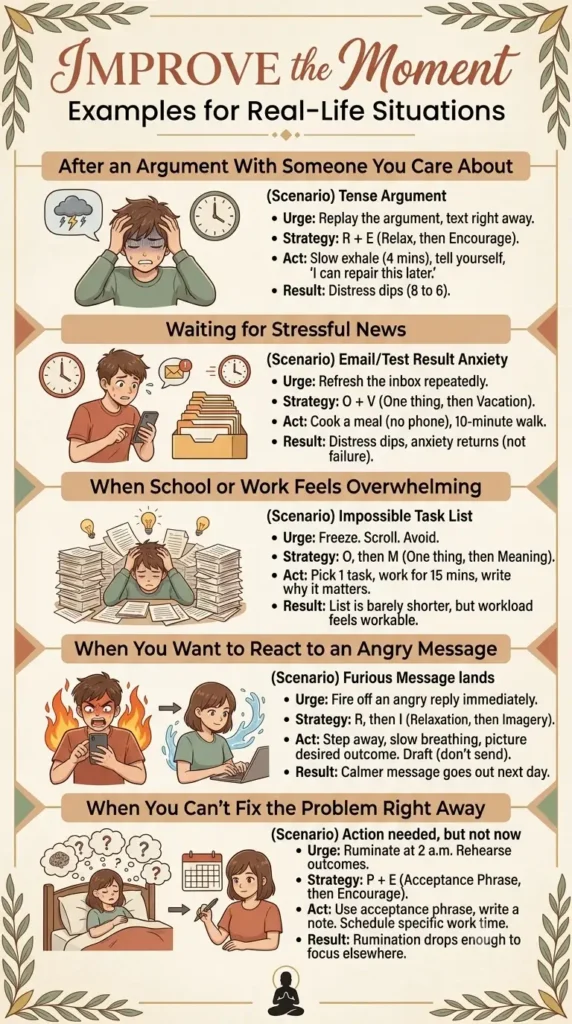
The DBT IMPROVE the Moment skill makes more sense once you see it in an ordinary hard moment. The goal isn’t to make distress vanish on command. You choose a strategy and try it. Then you notice what changes. If the first approach isn’t enough, adjust.
After an Argument With Someone You Care About
Scenario: You’ve just had a tense argument with someone close to you.
Urge: Replay every line of it, then call or text right away.
Strategy: R + E (Relaxation, then Encouragement).
What they actually do: They slow their exhale for four minutes. Then they tell themselves, “I can repair this later. I don’t have to fix it while I’m this upset.” Nobody repairs anything well at an 8.
What happens next: Distress moves from 8 to 6. They decide to wait until the next day before talking.
Waiting for Stressful News
Scenario: An email, a test result, a decision, a phone call. You can’t speed any of them up.
Urge: Refresh the inbox every few minutes.
Strategy: O + V (One thing in the moment, then Vacation).
What they actually do: They cook one full meal without checking their phone. Then they take a 10-minute walk.
What happens next: Distress dips, then returns later. That’s okay. Anxiety coming back isn’t failure. It’s just anxiety. They repeat the strategy instead of treating its return as a sign it didn’t work. A mindfulness journal prompt can help fill the next round.
When School or Work Feels Overwhelming
Scenario: The task list has grown so long that starting feels impossible.
Urge: Freeze. Scroll. Avoid everything.
Strategy: O, then M (One thing in the moment, followed by Meaning).
What they actually do: They pick one task and work on it for 15 minutes. Then they write down why finishing it matters to them.
What happens next: They start moving. Is the list any shorter? Barely. But the workload no longer feels impossible. It feels workable.
When You Want to React to an Angry Message
Scenario: A message lands, and you’re furious.
Urge: Fire off a reply while you’re still heated.
Strategy: R, then I (Relaxation followed by Imagery).
What they actually do: They step away and slow their breathing. Then they picture how they want the conversation to go. Only after that do they draft a reply, without sending it. The angry draft is never the one worth sending.
What happens next: A calmer message goes out the next day. It doesn’t come from the peak of the emotion.
When You Can’t Fix the Problem Right Away
Scenario: The situation needs action, but nothing useful can happen until later.
Urge: Ruminate and rehearse every possible outcome in your head.
Strategy: P + E (Prayer or an acceptance phrase, followed by Encouragement).
What they actually do: They repeat an acceptance phrase and write themselves a short note. Then they schedule a specific time to work on the problem. Worrying at 2 a.m. fixes nothing.
What happens next: The rumination drops enough to let them focus elsewhere. The problem still exists. Now it has a next-step time attached.
A first strategy doesn’t have to work perfectly. Partial improvement counts. Say relaxation only takes distress from 9 to 7. Is that really progress? Yes. It may be enough to make a safer, more deliberate choice. Or it may tell you it’s time to try another IMPROVE skill.
Want to track this on paper? A printable IMPROVE worksheet is a good place to start. The emotions worksheet and coping skills worksheets pair well with it. For the wider toolkit, see our DBT skills worksheets.
Which IMPROVE Skill Should You Try First?
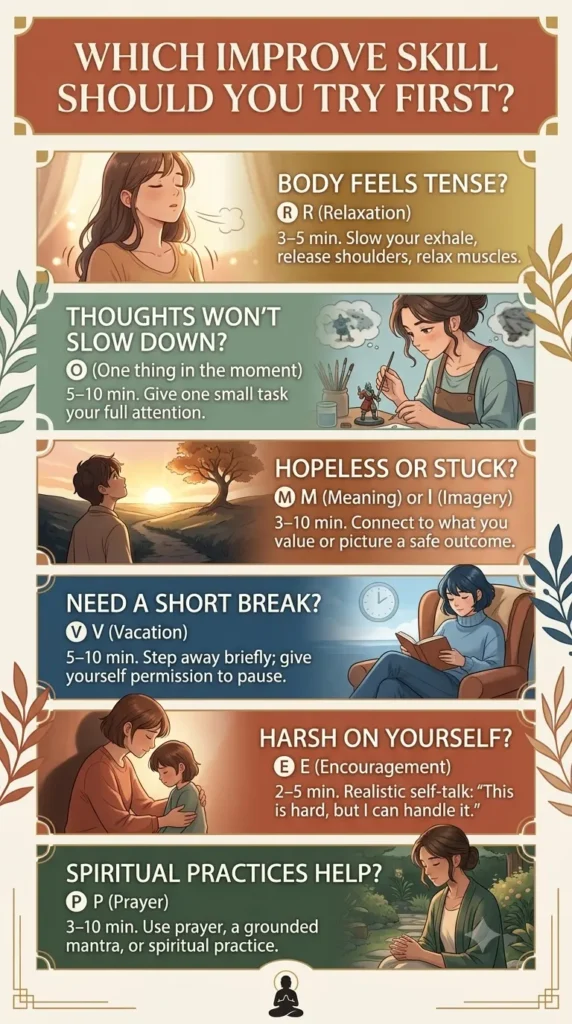
You don’t need every part of DBT IMPROVE the Moment when you’re already overwhelmed. Trying to do that is too much. Match the strategy to what your body, thoughts, or urges are doing right now. Use the table below as a quick starting point, then adjust if the first strategy doesn’t help.
Want a printable version? A DBT IMPROVE worksheet works well, and our DBT skills worksheets collection has more. For a full walkthrough of each step, see the IMPROVE skill guide on DBT Tools or the Improve the Moment page at DBT Self Help.
| Situation | Try first | One-line action | Time |
|---|---|---|---|
| Body feels tense | R (Relaxation) | Slow your exhale, release your shoulders, and gently relax one muscle group at a time. | 3–5 min |
| Thoughts won’t slow down | O (One thing in the moment) | Pick one small task. Give it your full attention instead of following every thought. | 5–10 min |
| Hopeless or stuck | M (Meaning) or I (Imagery) | Connect the moment to something you value, or picture yourself getting through it safely. | 3–10 min |
| Need a short break | V (Vacation) | Step away briefly, set a timer, and give yourself permission to pause. | 5–10 min |
| Harsh on yourself | E (Encouragement) | Replace the attack with realistic self-talk: “This is hard, but I can handle the next step.” | 2–5 min |
| Spiritual practices help | P (Prayer) | Use prayer, a meaningful mantra, or another spiritual practice that helps you feel grounded. | 3–10 min |
If your body is tense
Physical tension makes emotional distress harder to manage. Your shoulders creep up. Your jaw locks. Don’t bark at yourself to “calm down.” Start with something gentle instead. The goal is less strain, just enough to think more clearly. If you’d like a quieter way to check in with your body, try these mindfulness journal prompts.
If your thoughts won’t slow down
A racing mind doesn’t need more thinking. It needs a smaller target. When your mind keeps replaying conversations or guessing what comes next, narrowing your attention can break the loop. Choose something concrete. Wash one dish. Fold one shirt. That’s the whole task.
If you feel hopeless or stuck
Hopeless moments don’t need fake cheer. Meaning helps when you need a reason to keep going through a hard moment. Imagery helps when your mind needs somewhere safer to focus. Neither requires pretending the situation is okay. Not even a little. If writing helps you find meaning, these journal prompts for mental health give you a place to start.
If you need a short break
A brief vacation buys you distance before you respond. Keep it timed and safe. That way the pause stays a coping strategy instead of sliding into avoidance. More pause-friendly options live in our coping skills worksheets.
If you’re being harsh with yourself
Self-criticism rarely makes an already difficult moment easier. So try a different voice. Talk to yourself with the firmness and fairness you’d offer someone you truly want to help. Need words to start with? These journal prompts for self-love can help.
If spiritual practices help you
Prayer can be religious, spiritual, or personally meaningful. If formal prayer isn’t part of your life, that’s fine. A repeated phrase, mantra, or quiet practice can still give you a grounding pause. The Center for CBT overview of IMPROVE the Moment explains how each step fits together, and Charlie Health’s guide to the skill adds more examples.
DBT IMPROVE the Moment Worksheet
Reading about a skill is easy. Using it while your chest is tight is not. A DBT IMPROVE the Moment worksheet closes that gap. It gives you a place to track your distress, choose a strategy, and notice what changed. Over time, it builds your personal coping menu too.
Use it alongside the rest of our DBT skills worksheets. The two together show you which IMPROVE strategies fit you best.
What to Write in Each Section of an IMPROVE Worksheet
You don’t need to fill out every box perfectly. The goal is to capture enough to see what helped. Why does that matter? Patterns only show up once things are written down. Not sure how to name what you feel? Our emotions worksheet can help. Here’s what each box asks for, with a sample entry.
- Situation: What is happening right now? “I received a stressful email from my manager.”
- Emotion: What are you feeling? “Anxious and embarrassed.”
- Urge: What do you want to do? “Avoid the email and shut my laptop.”
- Distress before (0–10): How intense is it? “8/10.”
- Selected IMPROVE skill: Which strategy will you try? “Relaxation.”
- Action: What did you actually do? “Slow breathing for five minutes.”
- Result: What changed? “My body feels less tense.”
- Distress after (0–10): Re-rate the intensity. “6/10.”
- Next step: What happens now? “Read the email again and decide whether I need to respond.”
How to Use the Worksheet During a Difficult Moment
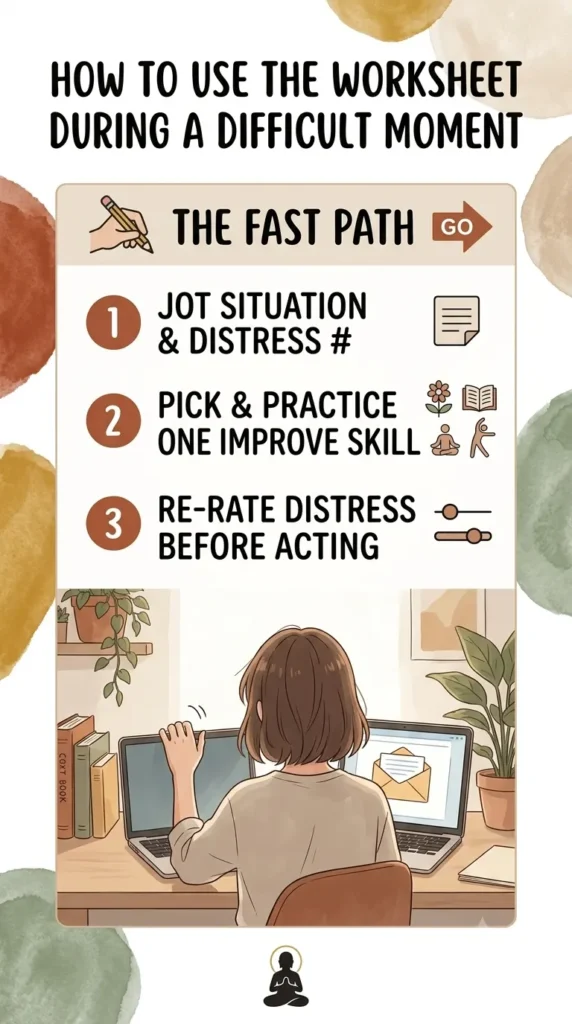
Don’t turn this into another task. Not when you’re highly distressed. Perfect isn’t the goal. So start with the fast path.
- Jot the situation and your distress number.
- Pick one IMPROVE skill and practice it.
- Re-rate your distress before deciding what to do next.
Fill in the emotion, urge, result, and next-step boxes afterward. The email is open. Your hand is on the laptop lid. Write the number, do the skill, then choose. That gap is the point. It puts space between the emotional surge and your next action.
IMPROVE the Moment Worksheet PDF
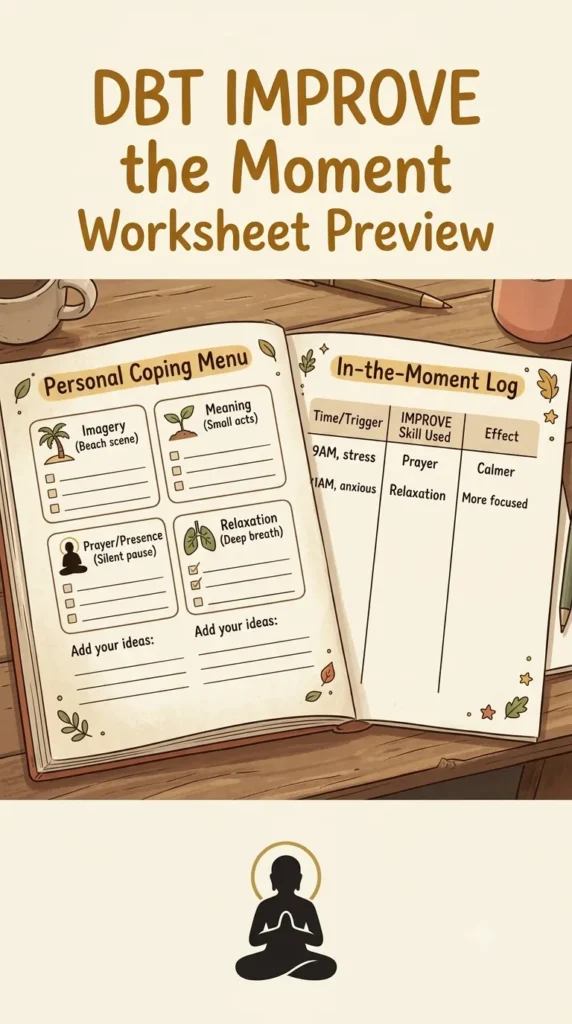
Our improve the moment dbt pdf runs two pages. You can use it both before and during difficult moments.
Page 1: Build your personal IMPROVE menu on a calm day. Write down imagery that works for you. Add meaningful phrases, relaxation methods, and brief vacation ideas. Finish with realistic encouragement statements. Need more ideas to fill it in? Browse our coping skills worksheets.
Page 2: Use the in-the-moment log when distress hits. Record the situation, your distress level, and the skill you chose. Then note what you did and what happened afterward.
Want to compare formats? Try Therapist Aid’s IMPROVE worksheet for another way to practice the skill.
Common Mistakes When Using the IMPROVE Skill
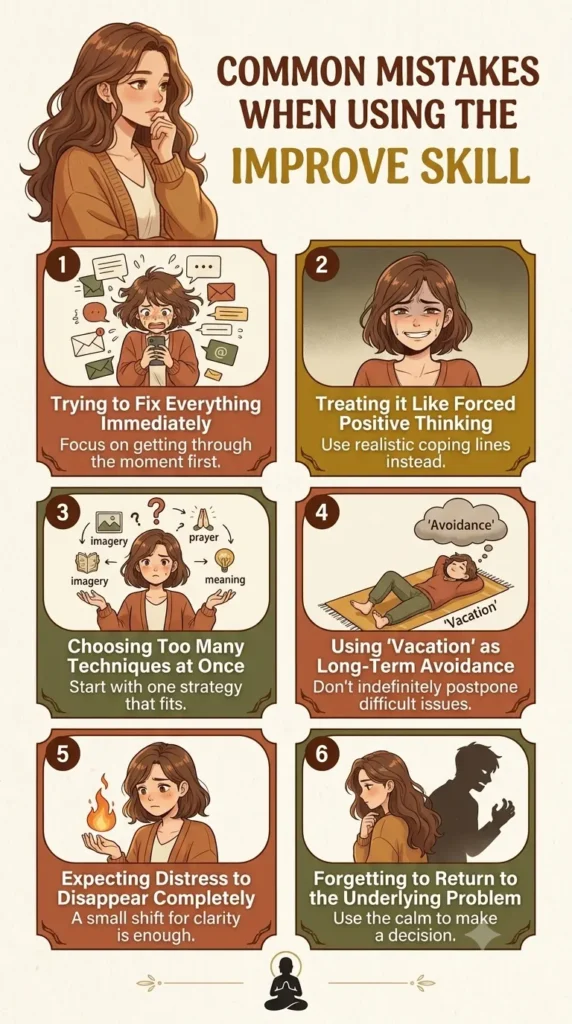
The DBT IMPROVE the Moment skill works best when it makes a hard moment more manageable. It isn’t meant to erase the emotion or dodge reality. A few common mistakes can turn a useful distress-tolerance tool into more avoidance or forced positivity.
Trying to Fix the Entire Problem Immediately
Panic wants everything solved right now. When you’re highly distressed, your brain pushes you to do it all at once. Send the message. Make the decision. Confront someone. Figure out what happens next. Can the problem actually be solved in this moment? If not, get through the moment first. The rest can wait.
Treating IMPROVE Like Forced Positive Thinking
Encouragement and Meaning don’t require you to pretend that something painful is good. Telling yourself “Everything happens for a reason” can feel completely wrong when you’re hurting. It rings false. Try a realistic line instead: “This is painful, and I can handle the next few minutes.”
Choosing Too Many Techniques at Once
More isn’t better here. It’s tempting to run through all seven IMPROVE skills when you’re desperate for relief. That gets overwhelming fast. Start with one strategy that fits your current state. Still not enough? Add one more. A DBT IMPROVE worksheet can help you pick. Just don’t turn the exercise into another task to complete.
Using Vacation as Long-Term Avoidance
A short Vacation gives you breathing room. Avoiding a problem indefinitely does something else. If you keep postponing difficult conversations, responsibilities, or decisions, the break may be feeding the avoidance. Where’s the line? This guide to healthy versus unhealthy coping can help you tell the difference.
Expecting the Distress to Disappear Completely
The goal isn’t necessarily to drop your distress from an 8 to a 0. A small shift can be useful if it gives you enough space to stop reacting on impulse. Slightly calmer? Thinking a bit more clearly? Then the skill already did its job.
Forgetting to Return to the Underlying Problem
IMPROVE gets you through a painful moment. It doesn’t automatically resolve what caused it. Once you’re steady enough to think clearly, go back to the issue and decide what needs attention. Don’t skip that step. A DBT diary card can help you track what happened and which skill you used.
IMPROVE the Moment vs. Other DBT Distress Tolerance Skills
DBT distress tolerance skills overlap. They aren’t interchangeable. The DBT IMPROVE the Moment skill makes a painful moment more bearable. ACCEPTS, TIPP, STOP, and Radical Acceptance each go after a different part of the distress cycle. Pick the wrong one and nothing seems to work. Know the difference and the choice gets easier. Our DBT skills worksheets walk through each one in practice.
| Skill | What it targets | Best when |
|---|---|---|
| IMPROVE the Moment | How you experience and respond to the present moment | You need to make a difficult situation more bearable |
| ACCEPTS | Attention and focus | You need temporary distraction from intense distress |
| TIPP | Physical arousal | Your body is highly activated and you need a rapid downshift |
| STOP | Impulsive action | You need to pause before reacting |
| Radical Acceptance | Resistance to reality | You are fighting a situation that cannot be changed right now |
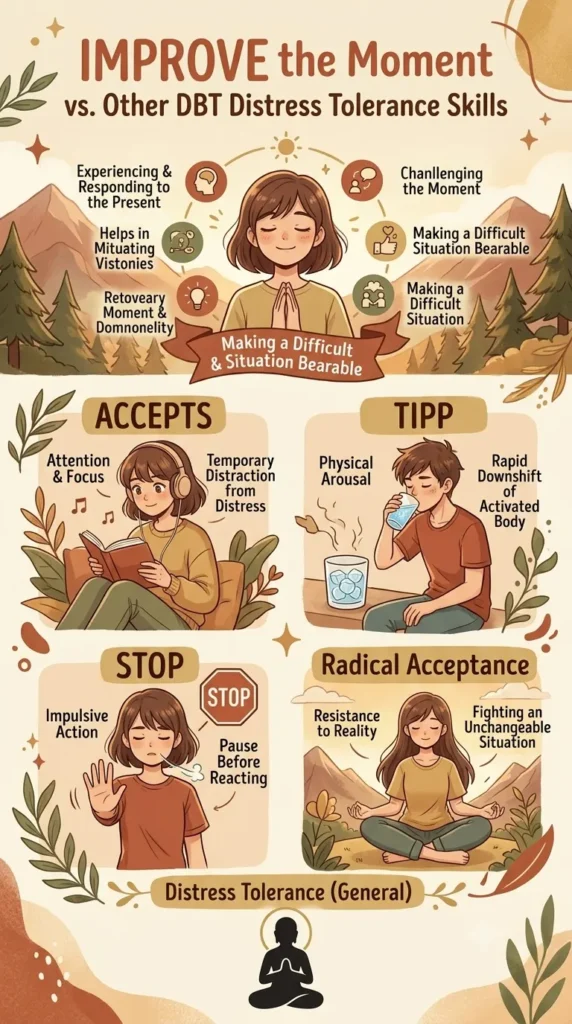
IMPROVE the Moment vs. ACCEPTS
ACCEPTS mostly pulls your attention away from distress. It does this through activities, contributing, comparisons, emotions, pushing away, thoughts, or sensations. Think of it as looking elsewhere. IMPROVE the Moment casts a wider net.
You change your relationship with the moment itself, using imagery, meaning, relaxation, focused attention, a brief vacation, or realistic self-encouragement. Which one fits? If you only need distance from the pain, ACCEPTS.
If you need to shift how the moment feels, IMPROVE. Building a bigger toolbox helps too, and these coping skills worksheets are a good place to start.
IMPROVE the Moment vs. TIPP
Your body usually speaks first. TIPP is built for intense physical arousal, and it can bring that activation down fast. The DBT TIPP skill works on the body, not the thoughts. IMPROVE the Moment is gentler and more flexible.
Too wound up to think clearly? TIPP may come first. Once your body settles, an IMPROVE strategy can help you stay grounded. Sequence matters here.
IMPROVE the Moment vs. STOP
STOP builds a pause between a strong urge and your next action. Stop. Take a step back. Observe. Then proceed mindfully. That gap is short, and it’s easy to waste.
IMPROVE the Moment can fill it with a specific coping strategy, like relaxation or encouragement, so you don’t act on the original impulse. STOP opens the door. IMPROVE gives you something to do once you’re through it.
IMPROVE the Moment vs. Radical Acceptance
This isn’t about choosing a side. Radical Acceptance means facing reality as it is. Fighting facts you can’t change only wears you out. IMPROVE the Moment focuses on coping inside that reality.
You can accept that something happened and still use imagery, relaxation, or encouragement to get through the next few minutes. Both can run at the same time. If naming what you feel is the hard part, this emotions worksheet can help before you pick a skill.
DBT IMPROVE the Moment Quick Reference
Need a fast reminder of what each DBT IMPROVE the Moment skill does? Use this table. You don’t have to work through every letter in order. Not even close. Pick the strategy that matches what is happening in your body, thoughts, or situation right now.
| Letter | Skill | One-line action | Try it when |
|---|---|---|---|
| I | Imagery | Picture a safe place or yourself coping well. | You need mental distance from distress. |
| M | Meaning | Connect the moment with your values. | You feel stuck or hopeless. |
| P | Prayer | Use prayer, Wise Mind, or a grounding mantra. | Spiritual grounding helps you cope. |
| R | Relaxation | Slow your breathing or release muscle tension. | Your body feels tense or activated. |
| O | One thing | Focus fully on one task in front of you. | Your mind is caught in rumination. |
| V | Vacation | Take a brief, timed break from the pressure. | You need space before responding. |
| E | Encouragement | Use realistic, supportive self-talk. | Your inner voice has become harsh. |
Want a printable version? The Therapist Aid IMPROVE worksheet fits this table well. For deeper walkthroughs of each letter, try DBT Tools, DBT Self Help, Charlie Health, or the Center for CBT.
Our DBT skills worksheets cover the rest of the toolkit. Pair them with these coping skills worksheets or an emotions worksheet when you want to name what you feel first. If Meaning or One thing is your pick today, mindfulness journal prompts and journal prompts for mental health can give you a place to start.
Conclusion
DBT IMPROVE the Moment gives you a way through intense distress. You don’t act on the impulse. You don’t make a hard situation worse.
Seven tools sit inside it: Imagery, Meaning, Prayer, Relaxation, One thing in the moment, Vacation, and Encouragement. Pick the one that fits what you need right then. Too upset to think straight? That’s exactly when a single tool beats a long plan.
The goal isn’t to pretend the problem is fine. It’s not fine, and this skill doesn’t say otherwise. It just creates enough space to respond thoughtfully once you’re calmer.
Practice makes it stick. Use the DBT IMPROVE the Moment worksheet to try each tool and track what works for you. Want another take on the skill? The Center for CBT overview is worth a read. For more tools, browse our full library of DBT skills worksheets or try these coping skills worksheets.
Frequently Asked Questions
What is the IMPROVE the Moment skill in DBT?
DBT IMPROVE the Moment is a distress tolerance skill that helps you get through a painful moment without making it worse. IMPROVE stands for Imagery, Meaning, Prayer, Relaxation, One thing in the moment, Vacation, and Encouragement. Each strategy helps change how you experience the moment when the situation itself cannot change yet.
What does IMPROVE stand for in DBT?
IMPROVE stands for Imagery, Meaning, Prayer, Relaxation, One thing in the moment, Vacation, and Encouragement. Each letter represents a different way to make a difficult moment more manageable. You don’t have to use every strategy; choose the one that fits what your body, thoughts, and situation need right now.
When should you use the DBT IMPROVE skill?
Use IMPROVE when distress is high and the situation cannot be changed immediately. It can help while you’re waiting for news, sitting with uncertainty, recovering from an argument, or trying not to act on an intense urge. If a safe, practical solution is available right now, problem-solving may come first.
What is the difference between IMPROVE and TIPP in DBT?
TIPP is a fast physiological reset, while IMPROVE is a gentler, multi-strategy way to cope with distress. TIPP can be useful when your body is highly activated and you need to bring arousal down quickly. IMPROVE can then help you stay with the situation without making it harder.
Can you use more than one IMPROVE skill at the same time?
Yes, you can combine IMPROVE strategies, but keeping it to two at a time usually makes the practice easier to follow. For example, you might use Relaxation to settle your body and Encouragement to steady your self-talk. Afterward, reassess rather than automatically adding more techniques.
Where can I get a DBT IMPROVE the Moment worksheet or PDF?
You can use the DBT IMPROVE the Moment worksheet in the worksheet section of this guide. It is designed to help you record the situation, emotion, urge, strategy, action, and result. A printable improve the moment DBT PDF can make the skill easier to practice before a crisis occurs.

It’s Bhaskar!
Well, I am not a psychologist a monk, or a philosopher by training. I’m just an engineering graduate.
‘The Empty Self’ is where I write about that idea, and what it actually means for ordinary life, anxiety, identity, habits, the stories we tell ourselves about who we are. I don’t have a psychology degree, and I’m not offering therapy or clinical advice. What I do have is thought and clarity, and genuine curiosity about why we suffer the way we do and how much of it might loose once we shed this ‘fixed identity’.
Pingback: DBT Distress Tolerance Skills: Complete Guide With Printables and Worksheets | The Empty Self