
It’s 11 p.m. You’re waiting on an answer that won’t come until morning. Your mind keeps replaying every possible outcome. You can’t fix any of it tonight, but you can make the next few hours easier to get through. That’s where the DBT ACCEPTS skill comes in.
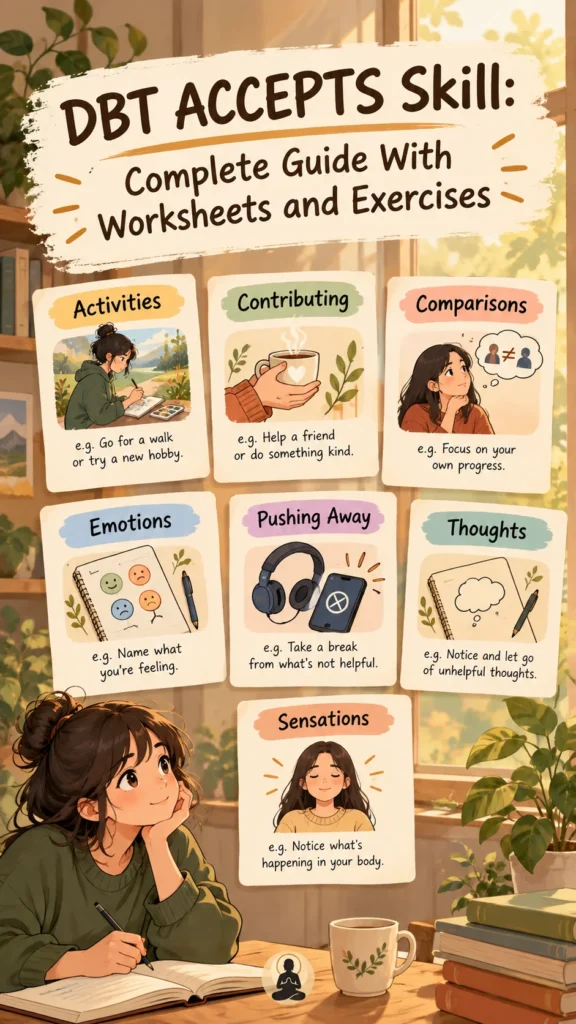
Quick Overview: The DBT ACCEPTS skill is a distress tolerance strategy. It uses temporary distraction to get you through intense emotions when the problem can’t be solved right now. ACCEPTS stands for Activities, Contributing, Comparisons, Emotions, Pushing Away, Thoughts, and Sensations.
ACCEPTS at a Glance:
- A for Activities: Do something absorbing that pulls your attention elsewhere.
- C for Contributing: Help someone or do something kind.
- C for Comparisons: Gain perspective without using comparison to shame yourself.
- E for Emotions: Create a different emotional experience.
- P for Pushing Away: Temporarily set an unsolvable problem aside.
- T for Thoughts: Give your mind a structured task to focus on.
- S for Sensations: Use safe sensory input to shift attention and ground yourself.
A note before you begin: This page is educational information about a DBT skill. It isn’t therapy, and it doesn’t replace professional care. If you are in immediate danger or thinking about harming yourself, contact emergency services or a local crisis service. In the U.S., you can call or text 988. Elsewhere, use your local crisis service or a verified crisis directory.
Want something practical? Jump to the DBT ACCEPTS worksheet and PDF section and start building your own coping list.
For more printable DBT resources, browse the full library of DBT skills worksheets.
Table of Contents
Disclaimer
This blog is written and edited with the help of AI, then reviewed by me before publishing. As a result, the content is for general reflection only, not therapy or medical advice, and I’m not a licensed mental health professional. If you’re in crisis, please contact 988 if you’re in US or a local crisis service of your country instead of relying on this site.
What Is the DBT ACCEPTS Skill?
The DBT ACCEPTS skill is a distress-tolerance tool. It’s for moments when you can’t solve the situation right away. Temporary distraction turns the intensity down. That gives you breathing room and keeps a hard moment from getting worse.
The skill comes from Dialectical Behavior Therapy (DBT), developed by psychologist Marsha M. Linehan. DBT teaches practical skills in four areas. The Linehan Institute lists them as mindfulness, distress tolerance, emotion regulation, and interpersonal effectiveness. Distress tolerance is about surviving painful situations. You get through without reacting in ways that create new problems. ACCEPTS sits in this group.
Think of ACCEPTS as a skill for getting through the next stretch of time. Maybe you’re waiting on news you can’t speed up. An argument might have left you furious.
Or you’re so overwhelmed that any decision right now would be a mistake. Most coping advice assumes you can think straight mid-crisis. You can’t. So don’t try to solve everything. Lower the intensity first, just enough to regain some control.
What Does ACCEPTS Stand For?
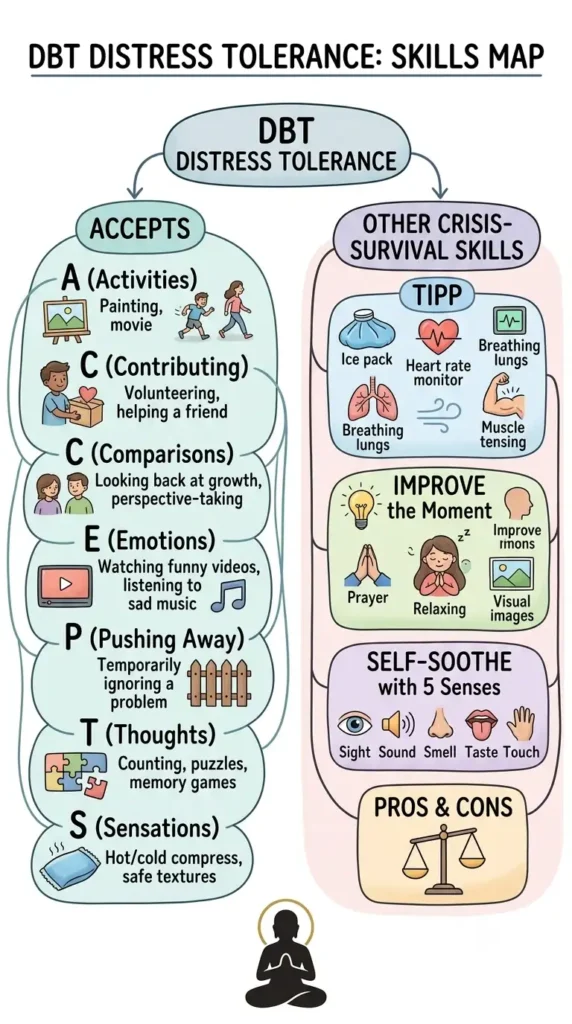
ACCEPTS is a DBT distraction skill with seven strategies. They are Activities, Contributing, Comparisons, Emotions, Pushing Away, Thoughts, and Sensations. Each one is a different way to shift your attention for a while. Use them when distress is too intense to work through productively. Not forever. Just for now.
| Letter | Category | Meaning | 5-word example |
|---|---|---|---|
| A | Activities | Do something that holds your attention. | Clean your room while listening |
| C | Contributing | Help someone or do something kind. | Write someone a thoughtful thank-you |
| C | Comparisons | Use perspective without judging yourself. | Compare yourself with your past |
| E | Emotions | Create a different emotional experience. | Watch something truly funny tonight |
| P | Pushing Away | Temporarily set the problem aside. | Put worry in a box |
| T | Thoughts | Give your mind another task. | Name animals from A through Z |
| S | Sensations | Use safe sensory input to redirect attention. | Hold something cool and textured |
The categories overlap a little. That’s fine. Hunting for the perfect letter mid-crisis wastes energy you don’t have. The useful question is simpler. “What could hold my attention for the next few minutes without creating another problem?”
Linehan’s original DBT skills framework appears in her DBT Skills Training Manual from Guilford Press. It covers distress tolerance alongside the other core skills modules. For practice, try our coping skills worksheets.
What ACCEPTS Can and Can’t Do
ACCEPTS can lower distress enough to give you time and choice. That matters when a surge pushes you toward something rash. It’s 11pm. The angry text is typed, and your thumb hovers over send. Same goes for angry confrontations, unsafe behavior, or anything you’d regret once the intensity passes.
But ACCEPTS is not a magic eraser for difficult emotions. It doesn’t solve the underlying problem. It won’t process grief, resolve a relationship conflict, or treat trauma. It doesn’t replace appropriate mental-health care either. Say your boss just gave you bad news. A comedy might help you get through the next hour. It won’t change what your boss said. Does that make the skill useless? No. When the feeling itself is a blur, an emotions worksheet can help you name it once things settle.
The evidence has limits too. Research has looked at DBT skills use as a broad category. It hasn’t shown that the ACCEPTS acronym alone produces particular outcomes. One study of people with borderline personality disorder looked at skills use overall.
Greater DBT skills use was associated with several improvements. Suicide attempts and depression both went down. But the research didn’t isolate ACCEPTS as the active ingredient. Keep that distinction in mind. You don’t need to oversell one coping skill for it to be useful.
ACCEPTS vs. Acceptance: Clearing Up the Name
The name trips people up. ACCEPTS is an acronym. It isn’t another name for DBT Radical Acceptance. The word sounds like an acceptance skill, but its immediate purpose is distraction during distress.
Radical Acceptance asks you to acknowledge reality as it is, even when you dislike it. ACCEPTS does something different. It redirects your attention for a while. Use it when dealing with the problem immediately wouldn’t help.
These ideas aren’t opposites. In DBT, distraction now and problem-solving later can coexist. Use ACCEPTS to get through an emotionally charged evening. Return to the issue tomorrow, when you can think more clearly. Then decide what needs to change. For the acceptance side, see our DBT skills worksheets.
Distraction gets a bad reputation. Used skillfully, it’s a tool. Does it mean giving up on the problem? Not at all. Temporary distraction isn’t surrender, and people miss that part. It buys you time. Your next move gets to be deliberate.
When Should You Use ACCEPTS in DBT?
Reach for the DBT ACCEPTS skill when emotions run hot. It also fits when the problem can’t be solved right now. Or when an impulse is pulling at you and you need time before acting on it.
Unavoidable waiting counts too. You can’t rush a callback or a test result, but you can get through the hours. Why sit there stewing?
At very high arousal, thinking gets hard. So pick simple options that need almost no thought. Save the complicated ones for later. Browse these coping skills worksheets for ideas you can grab fast.
ACCEPTS Is for the Moment, Not for Avoiding the Problem
This skill won’t make the problem disappear. It’s built to help you get through a difficult moment, not to permanently escape whatever caused it.
Here’s a return-plan rule worth keeping. Whenever you use ACCEPTS, decide when and how you’ll come back to the problem once you’re calmer.
Picture the scene. You’ve just had an argument, and you’re too angry to talk productively. So you pick an activity, or another ACCEPTS strategy, and give it 30 minutes. You aren’t pretending the fight never happened. You’re creating enough distance to return without immediately making things worse.
The table below shows the difference.
| Skillful distraction | Avoidance |
|---|---|
| “I’ll focus on something else for 30 minutes, then revisit this.” | “I don’t want to think about this, so I’ll keep avoiding it.” |
| Uses distraction to lower emotional intensity. | Uses distraction to escape every uncomfortable feeling. |
| Has a planned return to the problem. | Has no intention of returning to it. |
| Helps prevent an impulsive reaction. | May allow the underlying problem to grow. |
Distraction can be skillful without becoming denial. That’s the whole distinction. If the situation can be addressed later, come back once your emotional intensity has dropped enough to think clearly.
Ongoing danger or an immediate safety concern is different. Distraction alone isn’t the right response there. Seek appropriate support instead.
The 7 ACCEPTS Skills Explained With Examples
The DBT ACCEPTS skill gives you seven ways to redirect your attention for a while. It’s built for moments when distress is too intense to solve anything. Activities, Contributing, Comparisons, Emotions, Pushing Away, Thoughts, and Sensations each shift attention differently, so you choose what fits. For the bigger picture, browse these DBT skills worksheets. Want a second take on the seven skills? Try DBT Tools or Dialectical Behavior Therapy.
You do not have to work through all seven ACCEPTS skills when you’re already overwhelmed. You only need one. The goal is to find one safe, realistic way to put distance between you and the emotion. That distance gets you through the moment without making things worse.
A: Activities
What it means: Do something that soaks up enough attention to break the emotional loop. It doesn’t need to be productive or meaningful. It just needs to be absorbing, so your mind has somewhere else to go.
Why it works: Intense distress glues attention to one thought, memory, or problem. A hands-on or mentally busy task gives that attention a new target. The more involved the task, the less mental space you may have left for replaying the same thought. Less room, less replay.
Examples: At home, try reorganizing a drawer or cooking something unfamiliar. You could also shower, sketch, or start a small craft project. At school or work, sort files, finish a simple task, or make a checklist. A short walk during a break counts too. Social options work as well. Play a board game, walk with a friend, or help someone with an ordinary task.
The best activity is one you can actually start while upset. Picture a 9/10 evening with the paint set still buried in the closet. Twenty minutes of setup? Not happening. Pick something you can begin in ten seconds.
Need a broader menu? These coping skills worksheets have plenty of options.
Watch-out: Don’t default to activities that numb you for hours, like endless scrolling or compulsive shopping. If an activity creates a new problem, it isn’t helping you tolerate the first one.
C: Contributing
What it means: Shift some attention toward another person through a small, kind act. Check on someone. Help with a task. Write a thoughtful message.
Why it works: Distress narrows your focus until everything circles around what you feel. A small act of contribution pulls that focus outward. It adds a sense of connection or usefulness.
Examples: At home, you could make tea for someone or feed a pet. At work, help a colleague with a simple task. Or send a thank-you note to someone who helped you recently.
If you write that note, be specific. A bare “thanks” is forgettable. Try this instead:
“I appreciated that you checked in on me last week when I was having a rough day.”
That one means far more. Want more ideas along these lines? These gratitude worksheets can help.
Watch-out: Contributing is not rescuing people, chasing approval, or ignoring your own needs. If helping leaves you resentful, drained, or stuck in people-pleasing, pick another ACCEPTS option.
C: Comparisons
What it means: Comparisons use perspective to loosen an emotion’s grip. You can compare with your past self, with someone facing a similar challenge, or with progress you’ve already made.
Why it works: Distress lies about time. It says this moment is permanent and all-consuming. A realistic comparison reminds you that right now is one point in a larger story.
Examples: You might tell yourself, “I handled a similar conversation six months ago, and I got through it.” Or think of someone you know who faces a comparable challenge and copes well. Another option is to compare your current abilities with where you were a year ago.
Linehan’s original ACCEPTS material includes comparing yourself with people who may be worse off. Don’t make that your default. Why? Telling yourself someone else has it worse can create guilt or shame, not perspective. Guilt creeping in? These self-compassion prompts can help. To notice what’s already working, learn how to practice gratitude.
Watch-out: A useful comparison creates perspective. A harmful one turns into self-criticism, guilt, or “I have no right to feel this way.”
E: Emotions
What it means: Deliberately create an emotional experience that contrasts with what you feel now. Overwhelmed by sadness? Choose something truly funny or uplifting instead of feeding it. Not sure what you’re feeling? This emotions worksheet helps you name it first.
Why it works: Strong emotions feed themselves. Sad music can deepen sadness. Frightening content can intensify anxiety. A contrasting experience points your attention in a different emotional direction.
Examples: Watch a funny show when sadness has you stuck. Play energetic music when you feel flat. Read something inspiring, or look at a lighthearted comic.
Contrast is the whole point. Sad plus sad music is usually not a distraction strategy. And if you’re already anxious, horror or intense content may leave your nervous system more activated. That’s not a mood shift.
Watch-out: Don’t pick something just because it triggers a strong emotion. The aim is a safe shift in how you feel, not swapping one overwhelming state for another.
P: Pushing Away
What it means: Pushing Away means setting a painful problem aside for now. It fits moments when facing it head-on would probably make things worse. Inside the DBT ACCEPTS skill, this is a short pause. It is not a decision to pretend the problem doesn’t exist.
Why it works: Sometimes your emotions run too hot for problem-solving. Arguing, analyzing, texting, or making decisions in that state rarely helps. Usually it adds new consequences to a hard situation. Picture it. It’s 11pm, a friend’s message still stings, and your thumbs are already typing. That’s the moment to stop. The STOP skill builds a similar pause.
A simple container approach helps:
- Name it: “I’m upset about what happened with my friend.”
- Box it: imagine placing the problem in a container and closing it for now
- Set a return time: “I’ll think about this tomorrow after work.”
If naming the feeling is hard, an emotions worksheet or an identifying emotions worksheet can help you find the word. The last step matters most. You’re postponing the problem, not abandoning it. When the return time comes, journal prompts for mental health can give the problem some shape.
Watch-out: Intrusive memories and trauma-related material need a different approach. Deliberately forcing thoughts away can make them more intrusive. Not the goal, and not the result. Grounding strategies may fit better. So may support from a qualified mental-health professional.
T: Thoughts
What it means: Thoughts gives your mind a job. The job is a structured mental task that competes with the distressing thought stream.
Why it works: Some activities demand enough working attention that repetitive thoughts get less room. Worry can’t loop as freely while you’re busy sorting animals by letter. The trick is choosing something engaging without creating a new source of frustration.
Try counting backward by sevens. Do a puzzle. Recite song lyrics or a memorized passage. Name countries alphabetically, or categorize animals from A to Z. You could even name a food for every letter of the alphabet.
Say you’re stuck in a waiting room and the same worry keeps circling. Start with countries. Albania. Brazil. Canada. By the time you hit the Gs, the loop has loosened. A printable ACCEPTS worksheet can hold your go-to tasks so you’re not hunting for ideas mid-spiral. The DBT distract skill works the same way, across every letter of the acronym.
A good mental task should be hard enough to hold your attention. Too hard, and you’ll get irritated and quit. Sound like a fine line? It is. Adjust as you go.
Watch-out: Sometimes the task keeps your mind busy but leaves you more agitated. Switch categories. ACCEPTS is about tolerating the moment. It’s not a contest you have to win.
S: Sensations
What it means: Sensations pulls attention out of your head and into what you can physically notice right now. It uses safe sensory input to do it. Temperature, sound, scent, movement, and texture can all provide competing information.
Why it works: Some distress lives almost entirely in thought. Racing thoughts, rumination, emotional spiraling. You can’t hold a thought in your hand. A cool drink, you can. That’s the idea behind sensory input: it gives attention something concrete to register.
Hold a cool drink. Notice the texture of a blanket. Smell a strong but pleasant scent. Stretch, walk, or listen to music at a safe volume. If noticing is a skill you want to build, mindfulness journal prompts can help.
The key word is safe. Skip anything that causes pain, burns, or injury. Be careful with very hot or very cold temperatures. Discomfort or pain is never the goal. Loud music should stay at a hearing-safe volume, not become an attempt to overwhelm your senses. For a fuller look at healthy versus harmful coping, read positive vs. negative coping skills.
A history of self-harm calls for extra care. Choose sensory techniques carefully and consider discussing them with a mental-health professional. This matters most when a technique resembles something you’ve used to hurt yourself.
Sensory sensitivity matters, too. You don’t have to use intense sensations. A soft fabric may be enough. So may gentle movement, a familiar scent, quiet music, or a textured object to hold.

Watch-out: Sensations and Self-Soothe are related, but they serve different purposes. ACCEPTS uses sensory input mainly to shift and occupy attention during distress. Self-Soothe centers more on comforting yourself through the senses. If an intense technique leaves you more activated, choose a gentler option or use another ACCEPTS category. For another angle on the full skill, see Charlie Health’s ACCEPTS guide and Choosing Therapy’s ACCEPTS worksheet.
How to Choose the Right DBT ACCEPTS Skill When You’re Overwhelmed
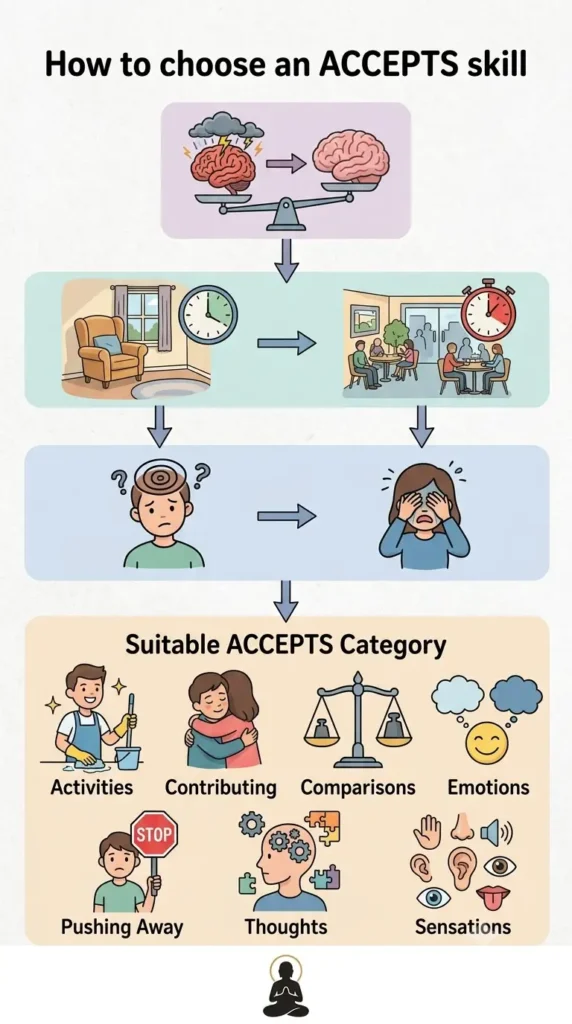
Choosing a coping skill mid-spike can feel like one more problem to solve. It shouldn’t. The right DBT ACCEPTS skill depends on four things: your emotional intensity, your surroundings, your available time, and what you need most. Start with the simplest option you can realistically use.
Start With Your Intensity
Intensity should set how complicated your coping strategy gets. At 9 or 10 out of 10, your attention and reasoning are harder to direct. Body-based options are easier to start with. Safe Sensations or gentle movement both work. Around 5 to 7, you may have enough mental space for more demanding options. Puzzles, counting, and other Thoughts activities fit here.
Not sure where you land? An emotions worksheet can help you put a number on it.

This isn’t a rigid formula. If a strategy feels irritating, out of reach, or unsafe, drop it. Pick something else.
Check Your Setting and Energy
The same ACCEPTS skill won’t fit every situation. Ask yourself three quick things. Are you somewhere private or public? Do you have two minutes or half an hour? Do you have your phone, or do you need something that works without it?
Picture a two-minute wait at work. Counting or noticing the sounds around you fits that gap. At home, you may have the privacy for movement, music, or a more absorbing activity.
Energy matters, too. Most coping advice assumes you have some to spare. You often don’t. When you’re exhausted, an elaborate activity just creates friction. Keep it light.
Match the Need to the Category
Every problem calls for a different kind of distraction. Once you’ve checked your intensity and circumstances, match the problem to the type you need.
| If you need to… | Try… | 5-word example |
|---|---|---|
| Move your attention | Activities | Organize your desk for ten minutes |
| Get outside your head | Contributing | Send someone a thoughtful thank-you |
| Gain perspective | Comparisons | Remember how you’ve handled similar situations |
| Change your emotional state | Emotions | Watch something funny |
| Set the problem aside | Pushing Away | Write it down; revisit tomorrow |
| Occupy your mind | Thoughts | Name animals from A to Z |
| Ground through your senses | Sensations | Hold a cool, comfortable object |
Want these categories on paper? This ACCEPTS worksheet lays them out. You can also browse more DBT skills worksheets or a wider set of coping skills worksheets.
You only need one. When you’re overwhelmed, the most useful ACCEPTS skill is the one you can actually do right now. Not the one that looks best on paper.
ACCEPTS Skill Examples for Common Real-Life Situations
The DBT ACCEPTS skill gets easier once you tie each letter to a moment you actually recognize. Not a textbook scenario. A real one. The right pick depends on what’s making things hard, how strong the feeling is, and what you can actually do right now.
Some nights call for Thoughts. Some arguments call for Pushing Away. The trick isn’t memorizing all seven categories. It’s knowing which one fits the mess you’re actually in.

| Situation | Best-fit ACCEPTS option | Immediate goal |
|---|---|---|
| Waiting for difficult news | Thoughts + Activities | Fill the waiting period |
| After an argument | Pushing Away + Activities | Prevent an impulsive reaction |
| Overwhelmed at school/work | Activities + Thoughts | Reduce immediate overload |
| Overthinking at night | Thoughts + Sensations | Shift attention and settle down |
| Urge to react immediately | STOP → Sensations/Pushing Away | Create space before acting |
When You’re Waiting for Difficult News
Your phone sits face-up on the table. You keep checking it anyway.
Situation: Medical results, an important message, an admissions decision. Something you can’t speed up, no matter how many times you refresh your inbox.
What makes it hard: Nothing concrete to act on. So your mind fills the gap with every possible outcome, on a loop.
Best-fit category: Thoughts + Activities.
Actions: Do a puzzle. Organize a drawer. Watch something familiar. Pick a task that needs just enough attention to crowd out the spiral.
What to do afterward: Set one specific time to check for an update. Not every ten minutes. Once you’ve done that, name what you were actually feeling instead of pretending the waiting didn’t bother you. Fear and anxiety aren’t the same thing, and knowing which one you’re carrying matters. This is where an emotions worksheet helps you put a word to it instead of just white-knuckling through.
After an Argument With Someone
This isn’t about staying calm. It’s about not making things worse in the next five minutes.
Situation: The argument just ended, and your thumb is already hovering over “send another message.”
What makes it hard: Anger, hurt, embarrassment. All three make immediate action feel urgent, even when it isn’t.
Best-fit category: Pushing Away + Activities.
Actions: Put the conversation down. Literally. Take a shower, walk the block, do something absorbing that keeps your hands and phone apart.
What to do afterward: Go back to the issue once the intensity has actually dropped, not just once you’ve stopped shaking. If you still need to say something, run it through the STOP skill first. DEAR MAN can carry the actual conversation once you’re ready to have it clearly instead of reactively.
When You’re Overwhelmed at School or Work
Most advice tells you to “just start.” It skips the part where starting feels impossible.
Situation: The workload has gotten so big you can’t even decide where to begin.
What makes it hard: Overload flattens everything into one giant, unsortable pile. Even opening the laptop feels like a decision you’re not ready to make.
Best-fit category: Activities + Thoughts.
Actions: Pick one small physical task. Open the document. Clear the desk. Then move to a focused mental task that pulls your attention back into the room.
What to do afterward: Break the real workload into smaller steps once the panic has eased. ACCEPTS gets you through the emotional spike. It doesn’t touch the workload itself. That part still needs a plan, ideally one you build from a broader coping skills worksheet rather than winging it at 11pm.
When You Can’t Stop Overthinking at Night
The room is quiet. Your brain is not.
Situation: You’re in bed replaying conversations, planning tomorrow, running worst-case scenarios on a loop.
What makes it hard: Silence leaves nothing to compete with the noise in your head. No distraction, no deadline, just you and the ceiling.
Best-fit category: Thoughts + low-stimulation Sensations.
Actions: Try a simple mental categorization game. Listen to calm audio, low volume. Focus on one soft texture, or a neutral scent nearby.
What to do afterward: Write the concern down. Schedule a short “worry time” for tomorrow, ten minutes, no more. If the overthinking keeps wrecking your sleep on a regular basis, that’s worth raising with a clinician, not just managing alone every night. The PLEASE skill can help with the sleep piece specifically, since exhaustion makes every one of these categories harder to use.
When You Feel an Urge to React Immediately
Here’s an honest take: the urgency is almost always a lie.
Situation: You want to send the angry text, quit on the spot, confront someone right now, no delay.
What makes it hard: The urge feels like it can’t wait. It can. It just doesn’t feel that way in the moment.
Best-fit category: STOP first. Then Sensations or Pushing Away, depending on what you need.
Actions: Pause before acting. Step away physically if you can. Use a grounding sensation, ice water, a strong scent, anything that pulls you out of your head. Set the decision aside, even for twenty minutes.
What to do afterward: Once the intensity drops, use Wise Mind to decide what you actually want, not what the loudest emotion in the room wants. That’s the whole point of the pause. It buys you a say in your own reaction.
DBT ACCEPTS Worksheet and PDF: How to Use One
A DBT ACCEPTS worksheet turns seven distraction strategies into a plan you can actually use. Not a plan for someday. A plan for the next time distress spikes and your brain goes blank.
Most people try to remember coping ideas mid-crisis. That rarely works. The moment is too loud, and thinking clearly is the first thing to go.
This is why you prepare the options beforehand. Test what works on an ordinary bad day, not your worst one. Then keep the ones that actually help within easy reach.
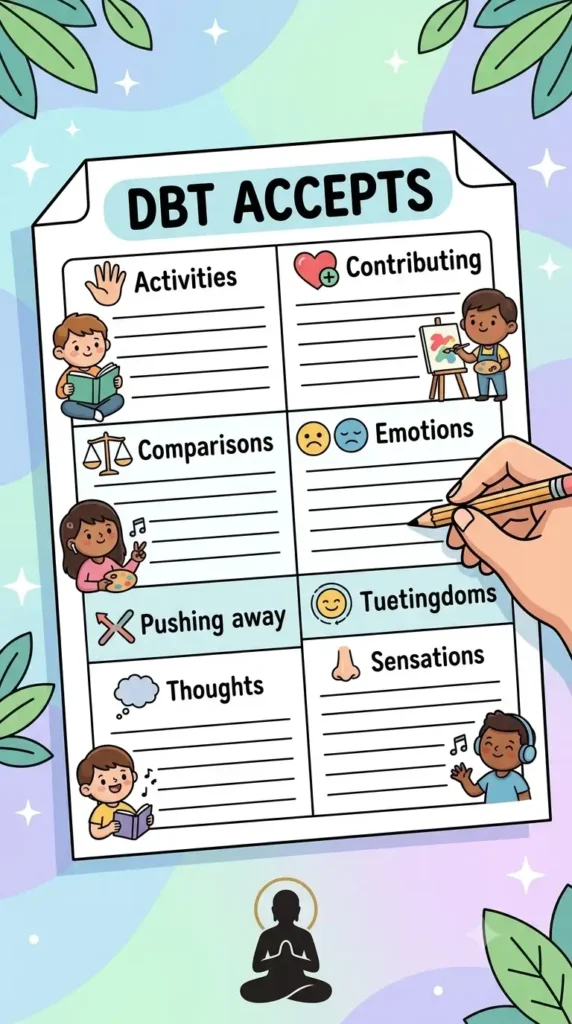
The worksheet below is an original, plain-language resource built around DBT principles. It is not a reproduction of Marsha Linehan’s copyrighted clinical handouts. Worth saying plainly. If you want the original clinical materials developed for DBT skills training, refer to the official DBT Skills Training Handouts and Worksheets published by Guilford Press.
Three formats live here, and each does a different job.
- Printable ACCEPTS worksheet: Use it to work through one specific distressing situation.
- Personal ACCEPTS list: Build your own fillable menu of distraction options.
- Practice tracker: Record what you tried and whether it actually helped.
What to Write on an ACCEPTS Worksheet
“I felt bad, so I distracted myself.” That’s not enough. A useful worksheet needs more detail than that, or you’ll never spot which strategy is actually pulling weight.
| Worksheet field | What to record |
|---|---|
| Situation/trigger | What happened or what set off the distress? |
| Emotion | What emotion were you experiencing? |
| Intensity (0–10) | How strong was it before using ACCEPTS? |
| Category | Which ACCEPTS letter did you choose? |
| Strategy chosen | What specific activity or technique did you use? |
| What happened | What did you notice while using it? |
| What worked | What helped, even slightly? |
| What to try next time | What would you repeat, change, or replace? |
Struggling to name the emotion in that second row? This identifying emotions worksheet can help you put a word to what you’re feeling before you fill in the rest.
How to Build Your Personal ACCEPTS List
A giant list of generic distraction ideas won’t save you at 2am. Your own list will. Aim for two or three realistic options under each letter, then test them before a real crisis hits.
Apply the worst-day test. Would you actually be able to do this when you’re exhausted, upset, short on money, surrounded by people, or without your phone? If the answer is no, it doesn’t belong on the list.
That’s the filter. Everything else is detail.
Good options tend to share a few traits:
- Free or inexpensive
- Private enough to use without explaining yourself
- Available without internet or a phone
- Possible in your usual environments
- Absorbing enough to hold your attention

How to Track Which ACCEPTS Skills Work for You
Rate your emotional intensity before and after using a skill. Don’t expect the number to crash. Moving from a 9 to a 7 is real progress. That’s often enough space to avoid an impulsive reaction.
Once a week, give your tracker five minutes. Keep what reliably helps. Swap out what keeps failing. Retire anything that isn’t realistic for your actual life, not the life you wish you had.
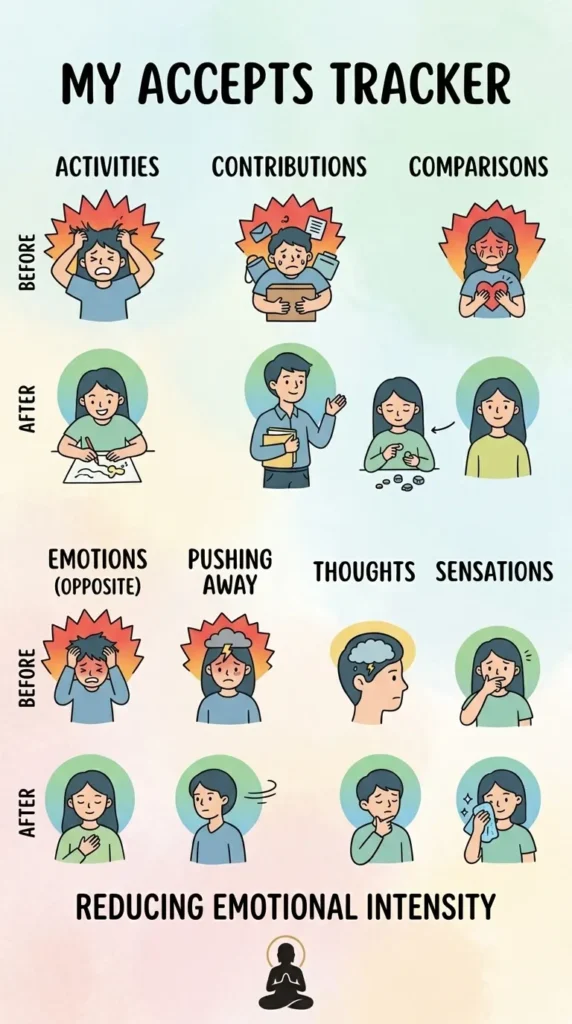
Pair this with a coping skills log if you want one place to review every strategy you’ve tried, not just the ACCEPTS ones.
Printable, Fillable, Cheat Sheet, or Tracker?
Different formats do different jobs. Why would one page do everything? A worksheet helps you process a single situation. A personal list hands you ready-made options. A cheat sheet keeps the acronym close. A tracker shows what actually works over time.
| Format | Best used for |
|---|---|
| Printable worksheet | Working through a specific episode of distress |
| Fillable worksheet | Completing the exercise digitally |
| Cheat sheet | Quickly remembering the seven ACCEPTS categories |
| Practice tracker | Reviewing which skills help over repeated situations |
Before downloading a DBT ACCEPTS skills PDF, check for all seven letters, practical examples, room for your own options, an intensity scale, appropriate safety notes, and a clearly stated source.
Be cautious with sites offering scanned copies of Linehan’s copyrighted handouts without authorization. Stick with original resources or authorized publisher editions instead.
ACCEPTS vs. Other DBT Distress Tolerance Skills
DBT packs several skills for hard emotions into one toolbox. They don’t do the same job. ACCEPTS mainly pulls your attention away from crushing distress for a while. STOP builds a pause before you act. TIPP hits intense physical arousal. Radical Acceptance means accepting reality instead of dodging it.
| Skill | Main Job | Use When… | Pairs With |
|---|---|---|---|
| ACCEPTS | Temporary distraction | You need to get through intense distress | STOP, Wise Mind |
| STOP | Pause before acting | You feel ready to react on impulse | ACCEPTS, TIPP |
| TIPP | Lower physical arousal | Your body is highly activated | STOP, ACCEPTS |
| Self-Soothe | Comfort through the senses | You need calming sensory input | ACCEPTS, IMPROVE |
| IMPROVE | Change your experience of the moment | You can’t change the situation right now | ACCEPTS |
| Radical Acceptance | Accept reality as it is | Fighting reality is adding suffering | Wise Mind |
| Wise Mind (mindfulness) | Integrate emotion and reason | You need to decide how to respond | STOP, other DBT skills |
ACCEPTS vs. STOP
STOP stops you before you act. ACCEPTS gives your mind somewhere else to go during that pause. Say an argument leaves you wanting to fire back an angry text. STOP interrupts that first impulse. ACCEPTS can then occupy your mind until the surge cools down. Want the full walkthrough? The DBT STOP skill guide breaks each step down with examples.
ACCEPTS vs. TIPP
TIPP works the body. ACCEPTS works attention. That’s the split. If your heart is pounding and your whole system feels flooded, TIPP usually comes first. Once the intensity drops a notch, ACCEPTS gives your mind something else to chew on.
ACCEPTS vs. Self-Soothe
These aren’t the same move. ACCEPTS distracts. Self-Soothe comforts you through the senses instead. Losing yourself in a gripping mystery to quiet the ruminating loop? That’s ACCEPTS. Making tea, playing soft music, or wrapping up in a blanket leans toward Self-Soothe. Nothing stops you from combining both.
ACCEPTS vs. IMPROVE the Moment
Attention moves with ACCEPTS. Experience shifts with IMPROVE the Moment. That’s the real difference. Watching a funny show to get your mind off the distress falls under ACCEPTS. Reaching for imagery, prayer, meaning, or a few words of encouragement to make the moment easier to sit with is IMPROVE instead.
ACCEPTS vs. Radical Acceptance
These two aren’t interchangeable. Not even close. ACCEPTS redirects attention for a while, useful when you can’t deal with something effectively right now. Radical Acceptance means acknowledging reality as it stands, even the parts you strongly dislike. Want to go deeper on distress tolerance overall? The full DBT skills worksheets library covers both skills side by side, with printable practice tools for each.
ACCEPTS vs. Wise Mind
Wise Mind isn’t a distraction skill at all. It’s a different concept entirely. Wise Mind is mindfulness, a balanced spot between raw emotion and cold logic. In practice, the two often work in sequence. Use ACCEPTS to cool down enough to stop reacting. Then lean on Wise Mind to decide what actually comes next.
Related: Accumulating Positive Emotions
Here’s an honest distinction worth making. Accumulating Positive Emotions builds good experiences over time. It isn’t built for surviving a crisis in the moment. That makes it part of your longer coping plan, not a first response. ACCEPTS is closer to a bridge. Something you cross once, then leave behind.
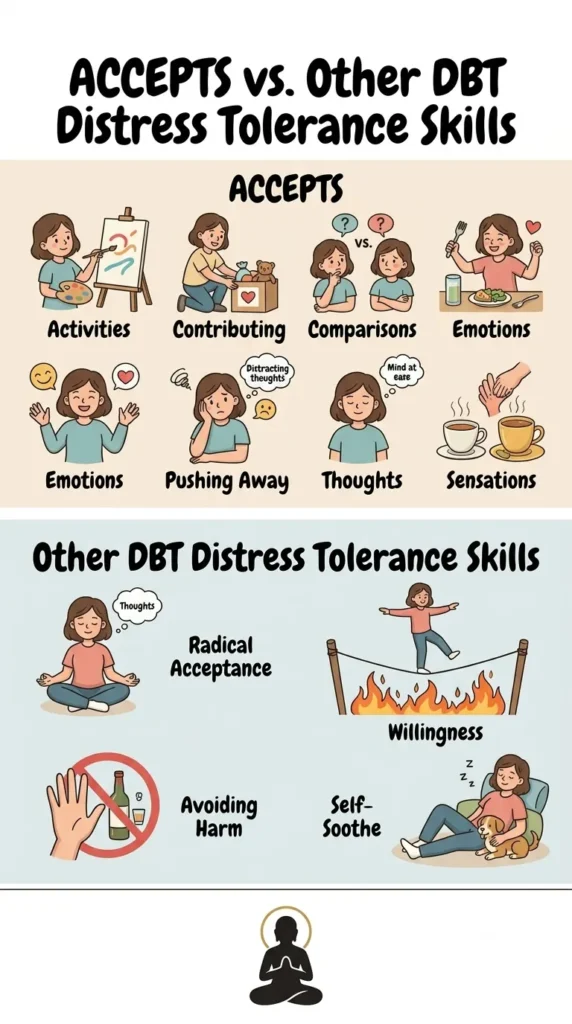
ACCEPTS Activities: Build Your Personal Coping Menu
A personal menu of DBT ACCEPTS activities gives you options before distress gets out of hand. Not after. That timing matters more than people think.
Here’s the problem with deciding in the moment. Your mind is already overloaded. Picking a coping skill from scratch, mid-crisis, adds one more task to a brain that’s already maxed out. A short list fixes that. Match it to your time, your energy, where you are, and how long you can focus.
5-Minute Activities
Only a few minutes to spare? Pick something that grabs your attention fast.
That’s the whole rule. Quick absorption beats a perfect activity every time.
| Setting | ACCEPTS Activity Ideas |
|---|---|
| 5-minute | Make a quick sketch; organize one small drawer; play a short puzzle; water your plants |
| 15–30-minute | Bake something simple; take a shower and change clothes; complete a craft project; watch one episode of a familiar show |
| Social | Send a friend a funny meme; help someone with a small task; play an online game with a friend; write a thank-you message |
| Creative | Make a collage; try a new drawing prompt; rearrange a playlist; write a fictional scene |
| Physical | Stretch to a short routine; walk around the block; do household chores; practice a beginner dance routine |
| Quiet | Read a few pages; do a crossword; sort photos; listen to an audiobook |
| School/work | Format a document; organize tomorrow’s task list; clean your workspace; complete one low-effort administrative task |
| Private | Take a long shower; write a private unsent letter; rearrange your room; do a solo craft or puzzle |
Forget building the world’s most impressive coping list. Nobody needs that. This needs to work on an ordinary bad day, the kind where you’re running on nothing.
Keep the options cheap. Keep them simple. Use stuff you already own, things that still work when you’re tired or emotionally flooded. Fancy plans fall apart under pressure. Boring, reliable ones don’t.
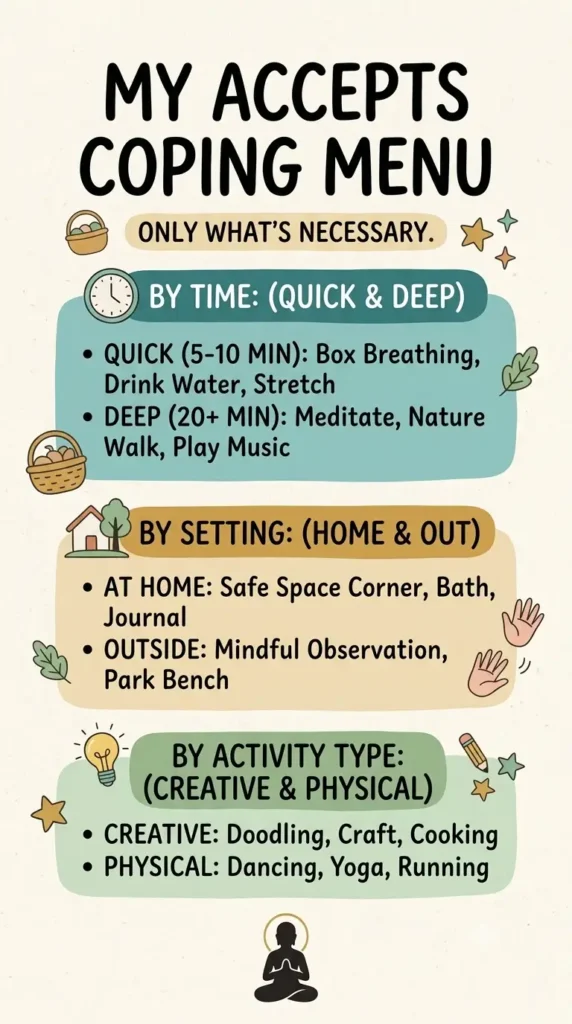
Want the broader version? Check out these coping skills worksheets for more ready-to-use tools beyond this list.
Common Mistakes When Using ACCEPTS
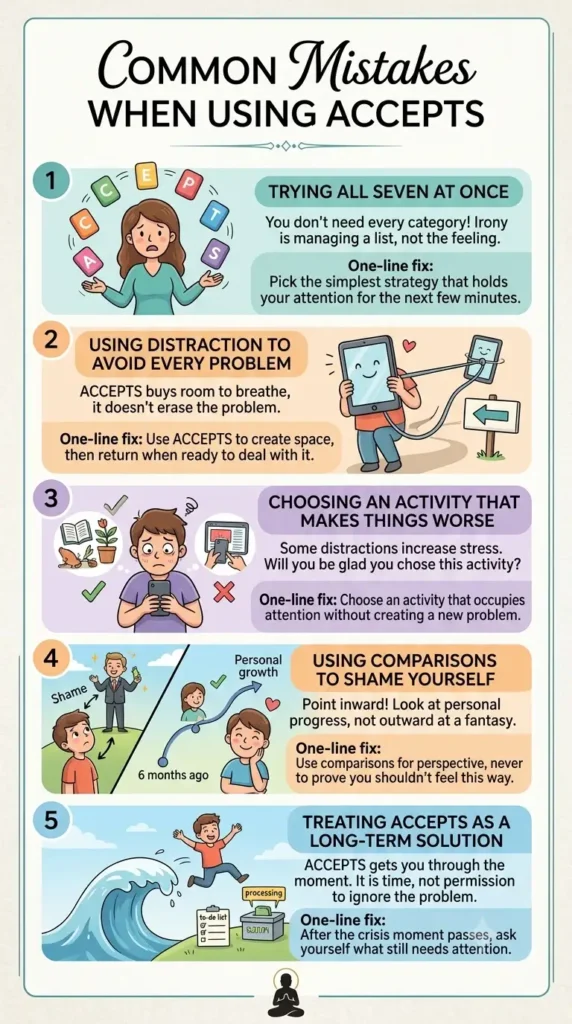
The DBT ACCEPTS skill isn’t a checklist you finish perfectly. It’s a short-term tool for getting through a hard moment. Most people trip up in the same few spots: leaning on distraction for everything, picking a coping activity that backfires, or never circling back once the storm passes.
Trying All Seven at Once
You don’t need every ACCEPTS category in one hard moment. That’s not how it works.
When emotions spike, trying to run through Activities, Contributing, Comparisons, Emotions, Pushing Away, Thoughts, and Sensations turns into its own task. You end up managing a list instead of managing the feeling. The irony writes itself.
Pick one option that’s realistic right now. Not the “best” one. Just one you can actually do. If it doesn’t land, switch to a different letter instead of forcing the first one to work.
One-line fix: Pick the simplest ACCEPTS strategy that can hold your attention for the next few minutes.
Using Distraction to Avoid Every Hard Problem
ACCEPTS buys you room to breathe. It doesn’t erase the problem.
Used well, it stops an impulsive reaction before it happens. Used badly, it becomes the only move you make. If you reach for distraction every time something uncomfortable shows up, the skill quietly turns into avoidance. That’s the trap nobody warns you about.
A return plan fixes this. Decide, right now, when you’ll come back to the conversation, the decision, the task, or the emotion once you’ve settled. Write it down if you have to. A vague “later” rarely happens.
One-line fix: Use ACCEPTS to create space, then return to the problem when you’re ready to deal with it.
Choosing an Activity That Makes Things Worse
Not every distraction actually helps. Some make the night worse.
Doomscrolling can leave you more wound up than when you started. Impulsive spending adds a financial hangover to an emotional one. Using alcohol to escape a feeling swaps one problem for a riskier one. None of that is tolerance. It’s just delay with extra steps. If you’re building out a full list of healthier coping options, it helps to separate what actually settles you from what just numbs you.
Stop asking “does this take my mind off it?” That question lets almost anything through. Ask this instead: will I be glad I chose this once the emotion passes?
One-line fix: Choose an activity that occupies your attention without creating a new problem.
Using Comparisons to Shame Yourself
Comparisons in ACCEPTS aren’t meant to punish you. That’s the opposite of the point.
Stacking yourself against someone who seems happier, richer, or more put-together doesn’t build perspective. It builds shame. Distress turns into “what’s wrong with me” fast when the comparison points outward.
Point it inward instead. Compare where you are now to where you were six months ago. Notice the situation you handled differently back then, or the progress you usually skip past. Pairing this with a few self-love journal prompts can keep the exercise gentle instead of critical.
One-line fix: Use comparisons to gain perspective or notice progress, never to prove that you “shouldn’t” feel this way.
Treating ACCEPTS as a Long-Term Solution
ACCEPTS gets you through the moment. That’s all it’s built for.
It’s not a fix for the thing underneath. Once the intensity drops, the real work usually starts, a conversation to have, a decision to make, something to process. Skipping that part means the feeling just waits for you, and it’s patient. The DBT ACCEPTS skill works alongside other DBT skills worksheets, not instead of them.
Think of ACCEPTS as time, not permission. Time to respond with some skill instead of pure reflex. Nothing more.
One-line fix: After the crisis moment passes, ask yourself what still needs your attention.
How to Practice ACCEPTS Before You Need It
The DBT ACCEPTS skill works better when you practice it before a crisis hits. Once emotions run hot, your brain won’t invent a plan on the spot. So build a personal menu of options now. Make it familiar enough to grab when intensity is high.
Start on paper. Write down two or three realistic options for each ACCEPTS category. Then test them when you’re only mildly stressed, around 2–3 out of 10. Why bother? Some activities sound helpful on paper, then turn out to be annoying, impractical, or flat-out impossible when you’re actually upset. Better to find that out at a 3 than at an 8.
Keep your ACCEPTS worksheet somewhere easy to reach. Your phone, journal, desk, or bedside table all work. Digging for a page while you’re upset defeats the purpose. Need a starting point? Browse this full library of DBT skills worksheets.
Every time you use a skill, track what happened before and after. A simple coping skills log makes the pattern visible. You’ll see which strategies consistently bring your distress down.
Add a short written check-in, too. Five-minute journal prompts work well here. Use them to reflect on what helped and what you might change next time.
Then review your list every week. Keep the options that work. Replace the ones that don’t. Rotate through the categories, so ACCEPTS never shrinks into a single go-to distraction.
Conclusion
The DBT ACCEPTS skill is not about pretending a difficult situation does not exist. It gives you a way to get through a period of intense distress without making the situation harder, especially when you cannot solve the problem right away. The key is to choose one strategy that fits your emotional intensity, surroundings, and available energy.
Use ACCEPTS as a temporary bridge, then return to the underlying problem when you are calmer and able to think clearly. A personal ACCEPTS worksheet can make that easier by turning abstract coping ideas into options you already know you can use when a difficult moment arrives.
Frequently Asked Questions
What does ACCEPTS stand for in DBT?
ACCEPTS stands for Activities, Contributing, Comparisons, Emotions, Pushing Away, Thoughts, and Sensations. The DBT ACCEPTS skill is a distress-tolerance strategy that helps you temporarily shift your attention during intense emotional distress. Each letter represents a different way to redirect your focus until you are calm enough to respond more effectively.
Is the DBT ACCEPTS skill the same as distraction?
ACCEPTS is a structured form of distraction used as a distress-tolerance skill. Instead of distracting yourself randomly, you deliberately choose an activity, thought, emotion, contribution, comparison, temporary mental distance, or safe sensation that can occupy your attention. The purpose is to get through an intense moment without making the situation worse.
Is ACCEPTS meant to help you avoid your problems?
ACCEPTS is meant to create temporary distance from a problem, not help you avoid it forever. If you push a problem away, the goal is to decide when you will return to it. Using ACCEPTS skillfully means coming back to the situation when your emotional intensity has dropped enough to deal with it.
When should I use ACCEPTS instead of Radical Acceptance or TIPP?
ACCEPTS is useful when you need to redirect attention, while Radical Acceptance and TIPP address different parts of distress. Radical Acceptance focuses on acknowledging reality as it is, while TIPP uses body-based techniques to rapidly reduce intense physiological arousal. You can use different DBT skills at different points in the same situation.
Can I use a DBT ACCEPTS worksheet to create my own coping plan?
Yes, an ACCEPTS worksheet can help you turn the seven categories into a personalized coping menu. Instead of relying on generic examples, write down activities, distractions, sensory options, and other strategies that are realistic for you. Include options that cost nothing, require little preparation, and remain available when you’re highly distressed.
What are some safe ACCEPTS activities I can use when I am extremely distressed?
Choose activities that occupy your attention without creating another problem. You might organize a small space, complete a simple puzzle, take a walk, call someone supportive, listen to familiar music, draw, or work through a repetitive hands-on task. When distress is very high, simple and familiar options are usually easier to use.

It’s Bhaskar!
Well, I am not a psychologist a monk, or a philosopher by training. I’m just an engineering graduate.
‘The Empty Self’ is where I write about that idea, and what it actually means for ordinary life, anxiety, identity, habits, the stories we tell ourselves about who we are. I don’t have a psychology degree, and I’m not offering therapy or clinical advice. What I do have is thought and clarity, and genuine curiosity about why we suffer the way we do and how much of it might loose once we shed this ‘fixed identity’.