
I’ll start by reading the skill file.You read a message that stings. Your thumb is already hovering over Send. Thirty seconds, maybe, before you say something you might regret. This is where the DBT STOP skill helps. It creates a brief pause between the urge to react and the action that follows. That gap is the whole point.
This guide walks through the four STOP steps. You’ll see how the skill looks for kids, teens, and adults. Sometimes STOP doesn’t seem to work. The guide covers that too. A free STOP skill worksheet is included as well. Use it to practice on a real-life situation.
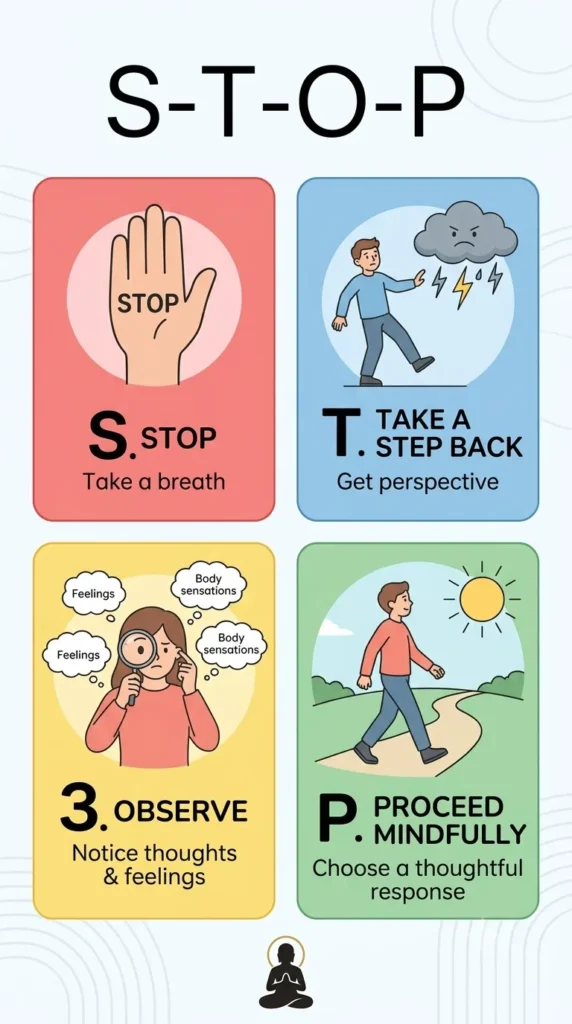
Quick Overview: The DBT STOP skill helps you pause before acting on a strong emotion. STOP stands for Stop, Take a step back, Observe, and Proceed mindfully. It’s most useful when a snap reaction could make things worse.
STOP at a Glance:
- S: Stop. Pause the reaction. Don’t send, say, post, or do anything on impulse.
- T: Take a step back. Create some physical or mental space from the situation.
- O: Observe. Notice your emotions, thoughts, urges, body sensations, and the facts of what is happening.
- P: Proceed mindfully. Choose your next action based on what matters, not the strongest urge.
A note about using this skill: STOP is an educational DBT technique. It isn’t a substitute for mental health treatment or emergency support. Facing an immediate risk of harming yourself or someone else? Reach out for appropriate professional or crisis support. A worksheet or coping skill alone won’t be enough.
Jump to a section
Want more practice tools? Browse the full library of DBT skills worksheets. For more ways to calm a strong reaction, try these coping skills worksheets. Not sure what you’re feeling in the first place? This emotions worksheet can help you name it.
Table of Contents
Disclaimer
This blog is written and edited with the help of AI, then reviewed by me before publishing. As a result, the content is for general reflection only, not therapy or medical advice, and I’m not a licensed mental health professional. If you’re in crisis, please contact 988 if you’re in US or a local crisis service of your country instead of relying on this site.
What Is the DBT STOP Skill?
The DBT STOP skill is a four-step distress-tolerance technique. It’s built for moments when a feeling shoves you toward acting right now. Not later. Now. STOP puts a short gap between the urge and the action. In that gap, you can respond on purpose instead of on autopilot. Even a few seconds count.
STOP Is a Pause Between an Urge and an Action
A pause isn’t a fix. STOP stands for Stop, Take a step back, Observe, and Proceed mindfully. None of it makes an uncomfortable feeling disappear. That was never the goal. The goal is to interrupt the moment when your emotion says, Do something right now.
It’s late, you’re furious, and the text is already typed. Your thumb hovers over Send. You can feel every bit of that anger and still choose not to send it. Sound impossible? It isn’t. Same with rejection. A friend goes quiet, and it stings. You can feel that and still wait before confronting them. Or everything has piled up at once. You can walk out of the room instead of slamming the door.
The original DBT skills training materials call STOP a crisis-survival skill. It exists to help you hold back impulsive actions (Guilford Press).
Where Does STOP Fit in DBT?
STOP lives in distress tolerance, inside the crisis-survival skills. Dialectical Behavior Therapy has four skills-training modules: mindfulness, interpersonal effectiveness, emotion regulation, and distress tolerance (Guilford Press).
STOP has company there. Its neighbors include TIPP, ACCEPTS, self-soothe, IMPROVE, and Pros and Cons. Each one is built for high-distress moments. That’s when acting on an urge is most likely to make things worse. Nobody grabs a fire extinguisher on a calm Tuesday.
For more practice tools, try these coping skills worksheets.

When Should You Use the STOP Skill?
Not every annoyance calls for the STOP skill. It isn’t meant to replace ordinary problem-solving every time something irritates you. So when does it earn its place? When you feel an urge to act now, and you suspect it could backfire. That’s the moment.
STOP also leans on mindfulness practice. The Observe step asks you to notice your thoughts, feelings, and body sensations. It also asks you to notice the situation itself. Maybe your jaw is clenched and your chest is tight. Wise Mind, a mindfulness idea, can help guide what you do next.
STOP delays action. It doesn’t erase emotion. You may still be angry, scared, embarrassed, or overwhelmed afterward. That doesn’t mean it failed. The goal was only ever to buy enough space to choose what happens next. If naming the feeling is the hard part, an emotions worksheet can help.
What Does STOP Stand For in DBT?
The DBT STOP skill steps are Stop, Take a Step Back, Observe, and Proceed Mindfully. Together, they create a brief pause between an emotional urge and your next action. That gap lets you choose a response instead of reacting on autopilot. Some programs word step 2 differently. See STOP vs. STOPP below.
S: Stop
Freeze the reaction before it becomes an action. Keep your hands off the phone, your mouth closed, and your feet still for a moment. Don’t send the message, speak, hit, leave, post, or buy.
Picture it: the text is typed, and your thumb hovers over Send. Stop. This isn’t about shoving the feeling down or acting like all is fine. You’re just delaying the action while you decide what comes next. If it helps, silently name the feeling: anger, fear, embarrassment, disappointment.
T: Take a Step Back
Distance interrupts the automatic response. It can be physical or mental. You might leave the room, get some water, or say, “Let me think about this.” Slow your breathing, especially by making the exhale a little longer.
A pause creates choice. Why does that work? Surprisingly few situations require an instant answer. Give the pause a return time: “I’ll come back to this in 20 minutes.”
O: Observe
Notice first. Conclude later. Observe means noticing what’s happening inside and around you without leaping to conclusions. Start inside: the emotion, body sensations, thoughts, and urges. Then look at what’s actually happening and what other people say or do. Now split fact from story.
Fact: “They haven’t replied yet.”
Story: “They’re angry with me.”
Which one are you reacting to? One caution comes from a clinician at Youth and Family Institute. During intense anger, watching the other person closely can sometimes feed the anger. Reducing input first may be wiser.
P: Proceed Mindfully
Mindfully doesn’t mean being quiet or passive. It means acting on purpose, not on autopilot. Base your next move on what you actually want from the situation.
Ask: What do I want here? What would make this better or worse? What would Wise Mind choose?
Your answer might be a calm assertion, asking for time, or setting a boundary. It could mean walking away or delaying a reply. Maybe it’s another DBT skill. Or doing nothing yet.
Why Does the DBT STOP Skill Work?
The DBT STOP skill works by putting a pause where none existed. It sits between an emotional urge and the action that usually follows. That’s a small gap. Still, it buys enough time to notice what’s happening and weigh the consequences before you act.
Then you choose a response instead of obeying the strongest impulse. Anyone who has sent a text they instantly regretted knows how fast that window shuts.
The Chain From Trigger to Consequence
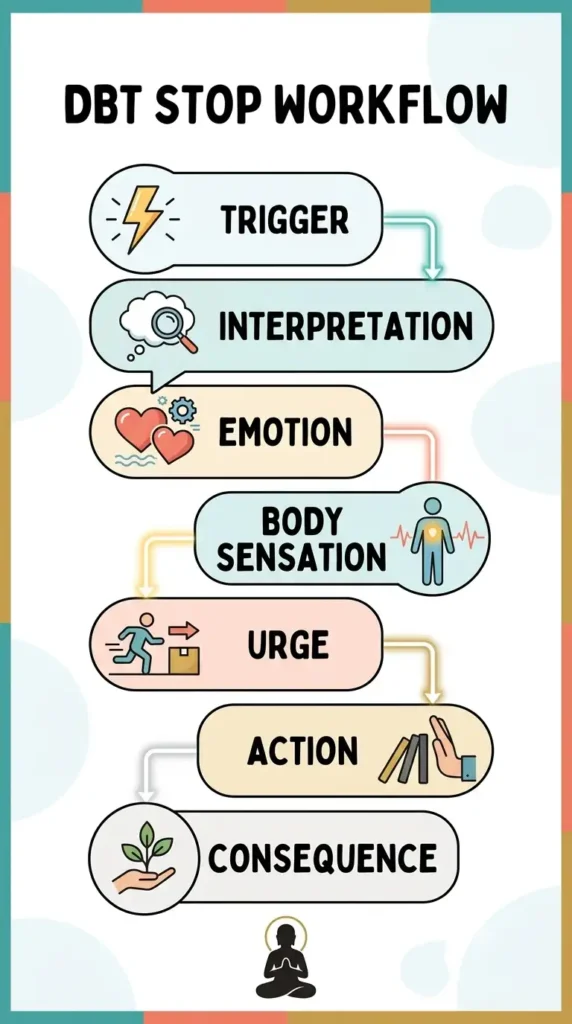
Strong reactions often unfold faster than you’d expect:
Trigger → interpretation → emotion → body sensation → urge → action → consequence.
Say a short message arrives from someone you care about: “We need to talk.” That’s your trigger. Your interpretation might be, “I must have done something wrong.” Anxiety follows. Your chest tightens. The urge hits: send five messages asking what happened. Act on it right away and you may create a situation that’s harder to manage.
The STOP skill doesn’t necessarily remove the trigger, change the emotion, or clear the body sensation. Instead, it creates a decision point between the urge and the action. That’s the entire job.
For the full picture of how emotions unfold, step by step, see DBT techniques and core skills explained.
STOP Creates a Choice Before the Action
An urge isn’t an instruction. That’s the practical value of the skill. Stopping gives you a moment to step back and observe the facts and your inner reaction. From there, you decide what would actually serve your goal.
Sometimes that means replying calmly. Other times it means asking for more time, setting a boundary, or using another DBT skill. Or deciding not to respond yet.
STOP doesn’t promise sudden calm. Sound underwhelming? It shouldn’t. The skill interrupts automatic behavior long enough for a more deliberate choice.
What Does the Research Say About STOP?
Research supports DBT as a treatment approach. Studies also link greater use of DBT skills to better treatment outcomes. One study by Neacsiu, Rizvi, and Linehan found that skills use increased during DBT. It also tied that increase to improvements in several clinical outcomes.
Read that carefully. STOP is one skill inside DBT, not a standalone intervention proven to produce those results by itself. The research on DBT skills doesn’t show that STOP alone will prevent a particular behavior or condition.
Practice still matters. Why start when things are calm? A skill gets familiar in ordinary, manageable situations first. Then it’s easier to remember when emotions run high. So practice STOP before a crisis. The effort pays off.
When Should You Use the DBT STOP Skill?
Use the STOP coping skill the moment an urge to act hits hard and something in you suspects it’ll backfire. That’s the target zone. Not every annoyance. Not every hard decision. Just the moments where emotion is driving and you’re about to hand it the wheel.
Here’s a rough test. Strong emotion, plus an urge to act right now, plus a decent chance of regret later, equals a good time to use STOP. DBT built crisis-survival skills like this one for exactly those moments, when feelings run so hot they crowd out clear thinking. You don’t need STOP because you’re mildly annoyed. You need it when the annoyance is about to become an action.
When You’re Angry
Trigger: someone insults you, misreads you, cuts you off mid-sentence, or lands a comment that hits an old bruise.
Urge: fire back. Slam something. Raise your voice. Hit send on the message you already regret typing.
STOP cue: don’t react yet. Step back. Notice what just happened and what it did to you. Then pick a response, not a reflex.
Anger has a talent for making the first reaction feel like the only reaction. It usually isn’t. STOP buys you the few seconds between the impulse and the apology you’d otherwise owe someone later. If anger is a recurring pattern for you, our anger-focused coping strategies go deeper into what to do in that gap.
When You’re Anxious or Overwhelmed
Trigger: thoughts racing, body running hot, five demands landing at once.
Urge: escape. Cancel the plans. Shut down. Make a fast decision just to make the discomfort stop.
STOP cue: pause the exit. Give yourself a beat of space. Notice what’s actually happening. Then choose one manageable next step.
STOP interrupts the flight instinct. It won’t necessarily calm a body that’s already in overdrive, though. When physical arousal is that high, grounding work or another distress-tolerance tool such as TIPP often has to come first, before STOP has anything to work with. Our present-moment grounding strategies walk through exactly that kind of pre-STOP reset.
Before Sending a Text, Email, or Social Post
Trigger: a message lands and it stings. Angry, embarrassed, rejected, defensive, take your pick.
Urge: reply this second. Post something public. Quote them. Send the paragraph you’ve rewritten four times already.
STOP cue: draft it if you must. Just don’t send it yet. Give yourself room to actually choose the reply.
This is one of the easiest places to practice the skill. Why? Digital messages fake a sense of urgency that almost never holds up. Most texts don’t need an answer inside thirty seconds, even when they feel like they do.
Try the draft-don’t-send rule. Write exactly what you want to say in your notes app. Put the phone down. If nothing’s actually urgent, set yourself a real delay, ten minutes, an hour, overnight. That unsent draft can hold every word you wanted to throw, without making you live with what happens after you hit send.
When You Feel an Urge to Act Without Thinking
Trigger: something’s pulling you toward a decision right now. Spending money you don’t have. Quitting on the spot. Texting an ex. Lashing out. Walking out of a conversation mid-sentence.
Urge: I need to do this now.
STOP cue: I can wait. An urge doesn’t get to run the show just because it feels loud.
The point here isn’t to call the urge bad. An urge is information, not an order. STOP just opens up enough space to ask whether the action actually lines up with what you want, or whether it’s just what feels loudest in the moment.
| Trigger | Urge | STOP Cue |
|---|---|---|
| Angry argument | Retort or walk out | Pause before responding |
| Emotional overload | Escape immediately | Create space first |
| Hurtful text | Send an angry reply | Draft, don’t send |
| Impulsive decision | Act immediately | Give the decision time |
Need more tools for moments like these? Our full list of coping skills covers general strategies for the harder emotional stretches, and our DBT skills worksheets round out STOP with the rest of the DBT toolkit.
DBT STOP Skill Examples for Kids, Teens, and Adults
The DBT STOP skill doesn’t change shape by age. It changes voice. A seven-year-old needs an adult standing next to them. A teenager needs help putting the phone down before the group chat wins. An adult mostly needs five minutes before hitting send. Same four steps. Different stakes.
| Age group | Common triggers | STOP script | Who helps |
|---|---|---|---|
| Kids | Sibling conflict, frustration, embarrassment | “Freeze. Step back. Look and listen. Pick my move.” | Parent, teacher, caregiver |
| Teens | Group chats, friendship conflict, criticism | “Put the phone down. Step back. Check the facts. Choose what helps.” | Parent, counselor, trusted adult |
| Adults | Work conflict, arguments, impulsive decisions | “Pause. Create space. Observe. Respond to the actual goal.” | Self, partner, therapist, trusted person |
STOP Skill for Kids
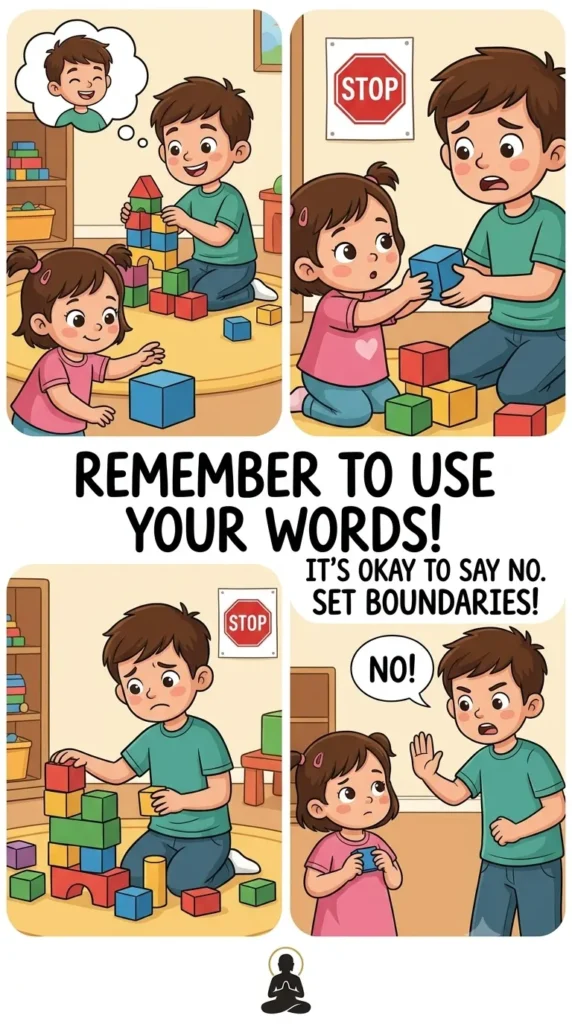
Kids don’t respond to therapy language. They respond to games. So the stop skill for kids works best as an action script: “Freeze like a statue. Take a big step back. Look and listen. Pick my move.” That’s it. No jargon required.
Trigger: A child gets laughed at after giving a wrong answer in class.
Urge: Hide, yell, or say something hurtful back.
S-T-O-P: Freeze. Step back. Notice “I feel embarrassed” and what actually happened. Choose to stay quiet and ask the teacher for help later.
What happened next: No second conflict. The moment just passes.
Trigger: A sibling grabs their favorite toy.
Urge: Grab it back or hit.
STOP: Freeze, step away, look and listen, then ask for the toy back or get an adult.
Trigger: A frustrating game makes a child want to throw the controller.
Urge: Throw it.
STOP: Freeze, put the controller down, step away, then decide whether to take a break or try again.
Parents and teachers can coach it in real time: “I see you’re about to throw it. Freeze. Let’s step back together.” Short, calm, repeatable.
Practice the stop skill for kids when everyone’s calm, not mid-meltdown. Praise the attempt, not the perfect execution. And never turn STOP into a punishment — that just teaches a kid to hide the outburst instead of managing it. Adults should model it too, out loud, so kids see what the skill looks like from the outside. A stop skill poster, a hand signal, picture cards, or even a coloring page makes the sequence stick.
For younger children, this dbt stop skill for kids approach leans hard on adult co-regulation. It has to. Their brains aren’t built for solo self-management yet. If outbursts are intense, frequent, or genuinely disruptive, that’s a signal to bring in professional support.
DBT-C provides clinicians with specific tools for the child’s caregivers, the child, and the child’s extended environment to address severe emotional dysregulation, and the model has been studied with children ages 7–12.
Looking for more ways to practice between episodes? These coping skills worksheets for kids give kids something concrete to work through when things are calm.
STOP Skill for Teens
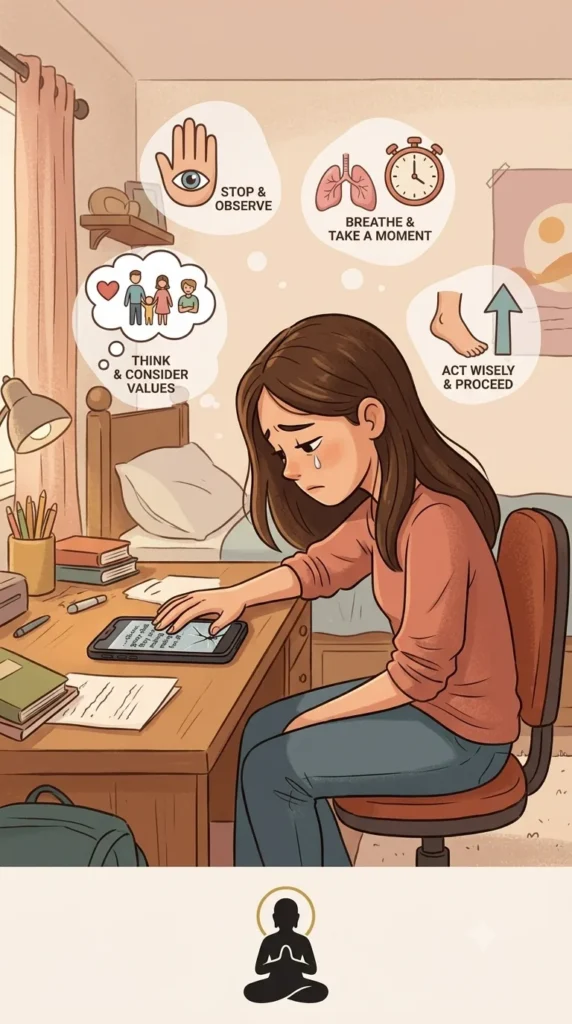
Emotions and phones are a bad mix. This is where the stop skill dbt approach earns its keep for teenagers. Picture this: someone posts a screenshot of your message in a group chat with a joke attached.
Trigger: You see the screenshot.
Urge: Fire back immediately and defend yourself publicly.
S-T-O-P: Put the phone face-down. Leave the room. Take a slow exhale. Observe the facts: “My message was posted, and people are joking about it.” Then separate that from the story: “Everyone is mocking me.” Those aren’t the same thing. Proceed by asking what actually keeps this from growing — maybe that’s messaging one person privately instead of answering the whole group.
For a friendship conflict, STOP can mean waiting until you actually know what happened before confronting anyone. During a parent argument, it might sound like: “I need a few minutes before I answer.” Before posting an angry reply online, it can mean saving the draft and closing the app. Small delay. Different outcome.
This stop technique has made its way into classrooms too. DBT skills have been demonstrated to be effective in helping adolescents manage difficult emotional situations, cope with stress, and make better decisions, and school-based programs now teach them directly.
The DBT STEPS-A curriculum presents an innovative social-emotional learning program designed to be taught at the universal level in grades 6–12, as outlined in Guilford Press’s DBT Skills in Schools.
STOP Skill for Adults
This isn’t about willpower for adults. Not even close. It’s about the fact that a fast reply can outlive the feeling that caused it by weeks.
Trigger: You receive a reassignment email with several coworkers copied.
Urge: Hit reply-all and explain exactly why the decision is unfair.
S-T-O-P: Don’t send anything. Draft the response in a notes app instead. Take a ten-minute walk. Observe what you actually need from this conversation. Proceed the next morning by asking for a short call instead of escalating the thread. One useful line: “Let me come back to you.”
Same logic works in a partner disagreement — pause before one complaint turns into the whole relationship’s history. With parenting stress, STOP can catch the second right before a kid’s refusal turns into yelling. Under financial pressure or work stress, it buys enough distance to delay an impulsive purchase, or quitting on the spot.
Want a version of this you can return to mid-week? These coping activities for adults build on the same idea — small, repeatable tools for the moment before you react.
A Simple STOP Skill Practice Activity
A DBT STOP skill activity works best on something small. Not your worst week. Not the fight that still makes your hands shake. This STOP DBT activity pulls the urge apart from the action. It shows you exactly where a pause could have fit. Then it asks what you’d try differently next time.
Pick One Recent Situation
Start with something mild. A 3 to 5 out of 10 on the intensity scale works well. Maybe a coworker talked over you again. Maybe a text landed wrong. Maybe you almost snapped mid-argument.
Skip the worst thing that happened to you this month. Save that one. If the situation touches trauma memories, work through it with a qualified clinician instead of pushing through it alone. Some moments need a professional in the room, not just a worksheet. If you’re in crisis right now, the 988 Suicide & Crisis Lifeline is available by call or text.
Walk Through S-T-O-P
Replay what actually happened first. Then walk it back through each STOP step, one at a time.
Ask yourself two questions. What did I do? What could Stop, Take a step back, Observe, and Proceed mindfully have looked like instead?
You’re not rewriting the past. Nobody can. You’re finding the exact spot where a pause might have opened up a different option.
Write Down the Urge You Had
Start with the same four words every time:
“I wanted to…”
Finish the sentence honestly. I wanted to send an angry text. I wanted to walk out. I wanted to quit on the spot. I wanted to yell until someone listened.
Then split the urge from the action. An urge can hit hard without you acting on it. Feeling something and doing something are two separate events, even when they show up together. Naming the urge on its own, the way you would on an emotions worksheet, makes that gap easier to see.
Identify the Response You Chose
Write down what you actually did next. Then note what happened right after. Skip the judgment. This part is about the sequence, not a verdict on your character.
For example: “I sent the message immediately. They replied defensively. The argument kept going.” That’s it. No commentary needed yet.
Review What Changed
Rate your intensity twice. Before the pause and after. A 0–10 scale is enough.
Which STOP step gave you the most trouble? What helped, even a little? Write down one thing you’d try in a similar moment next time.
| Situation | What I Wanted to Do | What STOP Could Have Looked Like | What I Actually Did | What Changed |
|---|---|---|---|---|
| A friend left my message unread for hours | “I wanted to send three angry follow-up texts.” | Stop texting → put my phone down → notice “they haven’t replied” vs. “they’re ignoring me” → wait before deciding what to send | I waited two hours and later sent one simple message | Intensity went from 6/10 to 3/10; Observe was hardest |
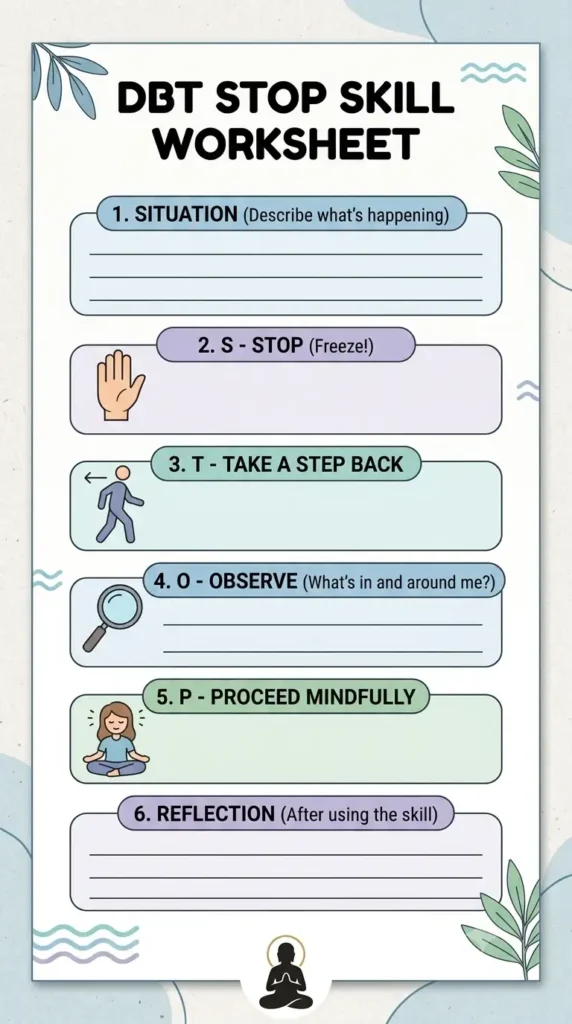
Once you’ve run through one real situation, repeat it with a new trigger next week. A DBT STOP skill worksheet keeps the process simple. It gives you one place to log the situation, the urge, all four steps, your response, and what you learned.
Want more tools beyond STOP? The full DBT skills worksheets library covers the other three modules. A coping skills worksheet or a few journal prompts for mental health work well for the reflection step too.
DBT STOP Skill Worksheet and PDF
A DBT STOP skill worksheet turns the four-step pause into something you can actually practice, not just read about. Downloading a STOP skill PDF and staring at it won’t change much on its own. Use the worksheet instead. Walk through a real moment. Pull apart the urge from the action. Then write down what you’d try differently next time.
What Is a STOP Skill Worksheet?
A STOP worksheet gives you room to record what happened, what you felt, what you wanted to do, and what you actually did. It’s a record, not a script.
It works best right after something real happens. Not as a form you fill out once and file away.
| Resource | Best used for |
|---|---|
| Worksheet | Working through one situation in detail |
| Handout | Learning or explaining the STOP skill |
| Poster | Keeping the four steps visible |
| Quick-reference card | A fast reminder during stressful moments |
Not sure which of these fits your situation? See our full comparison of DBT worksheets, handouts, and diary cards for a side-by-side breakdown.
How to Use a STOP Skill Worksheet
Fill it out when you’re calm enough to think straight. Start with the situation. What actually happened?
Then record the emotion. The body sensations. The thoughts running through your head. The urge to act.
Next, separate the urge from what you did. That gap matters more than people think. “I wanted to send an angry reply, but I put my phone down” is the whole point of the exercise. That’s the moment the STOP skill exists for.
Finish with what happened afterward. And what you’d try next time. Small adjustments count.
Free DBT STOP Skill PDF
You don’t need to sign up for anything. Save the DBT STOP skill worksheet PDF, print it, or fill it out digitally right after a moment where you needed to pause.
Want more than one skill? The DBT skills worksheets library covers the full set, not just this one.
More STOP Skill Resources
Two additions are worth building next. A kids and teens version, with simpler prompts and visual cues. And a one-page quick-reference card, small enough to keep in a pocket or taped to a wall.
Keep filenames clean. Something like “dbt-stop-skill-worksheet.pdf” is easy to organize and easy to find later. One rule matters here: don’t rename an existing PDF unless you also update every page linking to it. Broken links undo the whole point of an ungated resource.
How to Practice STOP Before You Need It
The DBT STOP skill doesn’t help much if the first time you try it is your worst moment. It works because you rehearsed it earlier, on something small. That’s the difference between a sequence you remember on paper and one of the stop skills you can actually reach for once your hands are shaking.
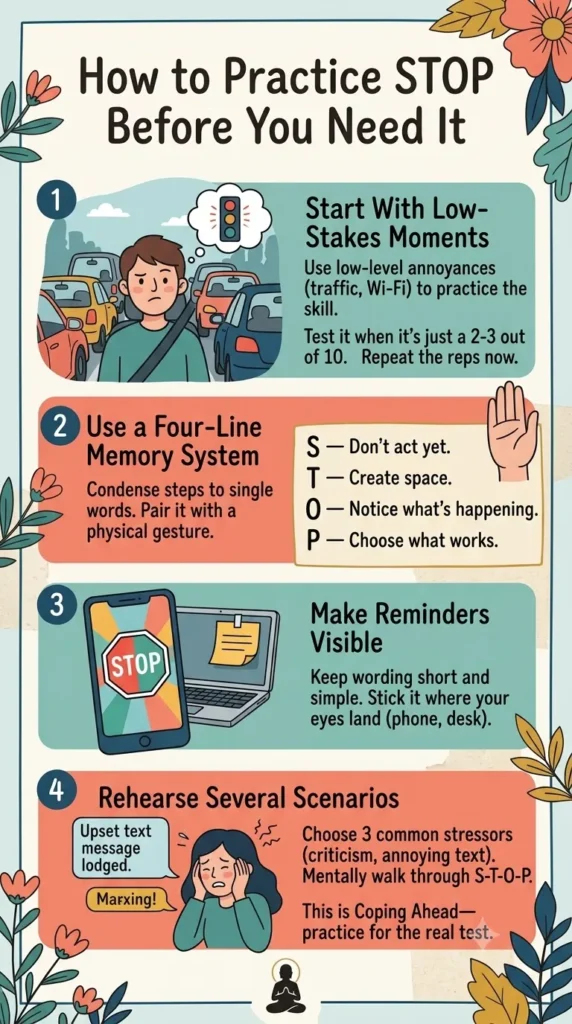
Start With Low-Stakes Moments
Don’t wait for your biggest argument to test this out. Practice it while traffic crawls. Practice it when the Wi-Fi drops mid-call, or a mildly annoying email lands in your inbox. Small stuff. On purpose.
Here’s why that matters. When emotions spike, attention narrows fast. A sequence you barely know gets harder to pull up right when you need it most. That doesn’t mean STOP fails you in a real crisis. It means the reps you put in now are what make the steps easier to find later, when your thinking is already under pressure.
Start with something that feels like a 2 or a 3 out of 10. Notice the urge to react. Pause. Then run through all four steps, even though the stakes are tiny. Especially because the stakes are tiny.
Use a Four-Line Memory System
Four full explanations is a lot to hold onto mid-moment. So shrink it. The dbt STOP skill steps compress down to four lines:
- S — Don’t act yet.
- T — Create space.
- O — Notice what’s happening.
- P — Choose what works.
Pair the words with something physical. Hold one palm out in front of you, like you’re signaling “wait.” Do this enough times and the gesture itself starts doing the reminding. Your hand moves before your brain finishes the sentence.
Make Reminders Visible
A visual reminder carries some of the memory load for you. That’s the whole point of it. Put a stop skill poster near your desk. Save a simple graphic as your phone lock screen. Stick a note beside your laptop, wherever your eyes actually land.
Keep the wording short. Two seconds, tops. “STOP → Pause → Notice → Choose” works harder than a paragraph of explanation, especially on a day when reading a paragraph feels impossible.

Rehearse Several Scenarios
Reading about STOP once won’t make it stick. Rehearsal does. Pick three situations that trip you up on a regular basis. Getting criticized. An upsetting text. Wanting to quit something the second it gets frustrating.
Picture each one for a few seconds. Then walk through S, T, O, P in order. What would you actually notice in that moment? What space could you realistically create? What response would fit what you’re going for, not just what would feel satisfying for five seconds? This mirrors DBT’s Coping Ahead approach almost exactly. You’re rehearsing the skill before life hands you the real version of the test.
If you want a lower-stakes place to build this habit, five-minute journal prompts are a good spot to log which scenarios you practiced and what came up.
What If the STOP Skill Doesn’t Work in the Moment?
STOP falls apart sometimes. Emotion at its peak doesn’t leave much room for careful steps. You might remember the skill too late. You might feel too flooded to Observe anything. You might finish all four steps and still feel angry underneath. None of that means you failed.
Here’s the only question worth asking: what can you do from here?
This Happens to Almost Everyone
Skills fade under pressure. That’s not a personal flaw. It’s how a brand-new skill behaves the first few times you reach for it, especially during your first intense reaction. You catch yourself mid-argument or mid-message. The moment already feels lost. It isn’t.
Put the phone down. Pause mid-sentence. Step away from the room. You can still stop the escalation, even late.
Repair what needs repairing once things settle. Then go back and review what happened on your STOP worksheet. A therapist can walk you through something deeper too, called a behavior chain analysis. It’s a DBT method for tracing exactly what led to the reaction, link by link.
Sometimes Your Body Is Too Flooded to Observe
High arousal makes careful observation nearly impossible. You don’t have to force yourself to sit with your thoughts while you’re furious or completely overwhelmed. That’s asking too much of a nervous system already in overdrive.
Skip Observe for now. Go body-first instead. Leave the room. Cut the noise. Slow everything down, or reach for TIPP. Cold exposure is one piece of TIPP, and it isn’t for everyone. Follow the safety notes in your DBT materials, and skip it entirely if it isn’t safe for you.
Return to Observe once the intensity drops. It will drop.
Taking Space Isn’t Avoiding the Problem
Stepping back and running away look similar from the outside. They’re not the same thing. The real difference comes down to one detail: do you have a return time and a plan?
Don’t just vanish from the conversation. Say something concrete instead. “I’ll come back in 20 minutes” works. Then actually come back, ready to respond instead of react. Write down what still needs discussing so the issue doesn’t quietly disappear along with you.
One exception matters here. If someone is unsafe, leaving isn’t avoidance. Leaving is safety.
STOP Delays Action. It Doesn’t Erase Anger
That’s the whole design. STOP buys you time before you act on impulse. It was never built to make the anger vanish. You can run every step correctly and still feel your jaw tighten, your thoughts race, your irritation sit there for hours.
A chosen action is the goal. Instant calm was never promised.
Start by validating the feeling itself, without automatically obeying whatever it’s demanding. From there, consider opposite action if the urge won’t actually help your situation.
And if anger keeps showing up often, or keeps disrupting your relationships and your days, that’s worth bringing to someone trained to help. A therapist, a support group, or a broader look at your coping skills worksheets can all be a place to start.
Think of STOP as a Doorway, Not the Destination
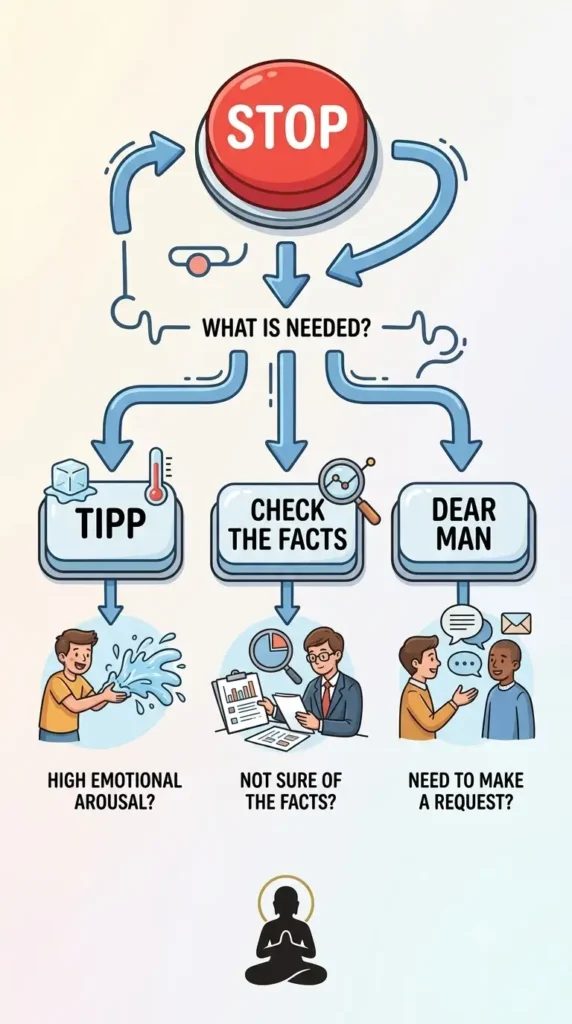
One skill was never going to carry the whole weight. STOP just gets you disengaged from the automatic reaction long enough to choose your next move. A clinician at the Youth and Family Institute describes this using a clutch metaphor: STOP disengages the gears so you can shift into something else on purpose.
In practice, that might look like STOP, then TIPP, then Check the Facts, then DEAR MAN. Nothing says you only get to use STOP once per episode, either. Some situations need it two or three times before the moment actually settles.
STOP vs. STOPP: What’s the Difference?
The DBT STOP skill isn’t always taught the same way twice. DBT STOP, mindfulness STOP, and CBT STOPP share one core move: pause before you react. But they come from separate frameworks, and each one tacks on its own extra step.
Three Versions of the STOP Skill
| Version | Steps | Where it comes from | What’s different |
|---|---|---|---|
| DBT STOP | Stop → Take a step back → Observe → Proceed mindfully | Marsha Linehan’s DBT, distress tolerance | Ends with “Proceed mindfully” to guide the next move |
| Mindfulness STOP | Stop → Take a breath → Observe → Proceed | Mindfulness-based programs | Step 2 focuses on breath instead of stepping back |
| CBT STOPP | Stop → Take a breath → Observe → Pull back → Practice what works | Carol Vivyan, adapted from Ciarrochi & Bailey (2008) | Adds a perspective-taking step before you respond |

Why Are There So Many Versions?
You’ll run into all three sooner or later. The letters are catchy. Easy to remember. That’s exactly why three different fields borrowed them. Each one built its own version on top.
They still overlap on one thing. Create a pause between what happens and what you do next.
CBT STOPP pushes a bit further. It adds “Pull back” and “Practice what works.” That extra step is close in spirit to asking whether your read on a situation actually matches the facts, before you act on it.
Learning DBT with a therapist or a program? Use whichever version they teach you. For this guide, DBT STOP skill means the original: Stop, Take a step back, Observe, Proceed mindfully.
Want the CBT version instead? See Carol Vivyan’s STOPP resource.
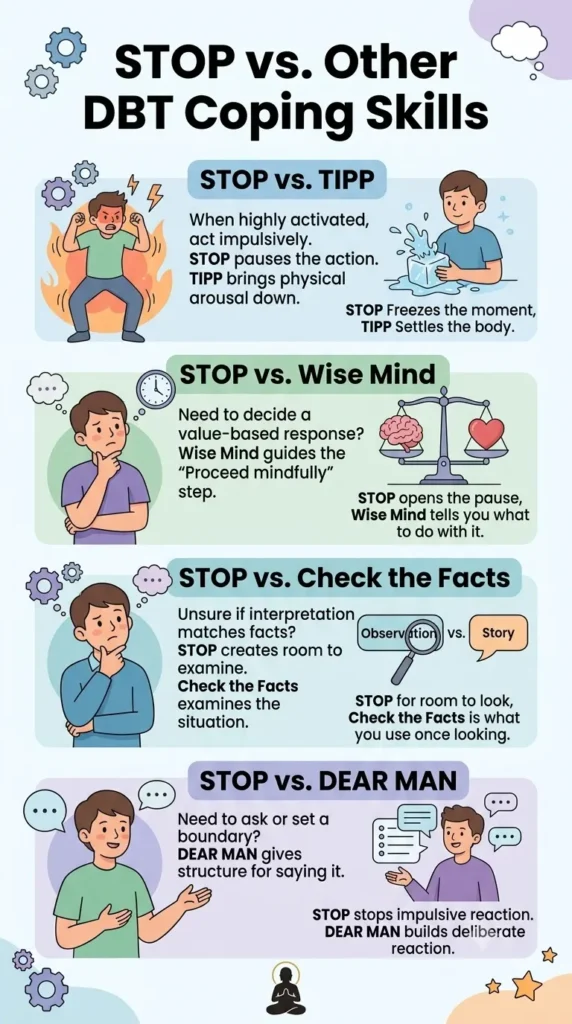
STOP vs. Other DBT Coping Skills
STOP buys you time. It doesn’t tell you what to do with it. That’s the other skills’ job.
This distinction matters more than it sounds. STOP is a first move, not a full solution. Once you’ve paused, you still need to pick the skill that fits what’s happening in your body, your thoughts, or the relationship in front of you. If you want the full set, the DBT skills worksheets lay out each one individually.
| If… | Then consider… | Why |
|---|---|---|
| Your body feels highly activated and you might act impulsively | STOP → TIPP | STOP pauses the action, TIPP brings the physical arousal down |
| You need to decide what response fits your values | STOP → Wise Mind | Wise Mind guides the “Proceed mindfully” step |
| You’re unsure your interpretation matches the facts | STOP → Check the Facts | STOP creates room to actually examine the situation |
| You need to ask for something or set a boundary | STOP → DEAR MAN | DEAR MAN gives you a structure for saying it |
STOP vs. TIPP
TIPP works on the body. STOP works on the pause. Different jobs entirely.
If your heart is racing, your jaw is clenched, or panic is making it hard to string a thought together, TIPP is built for that moment. It brings the physical intensity down fast.
Think of it this way: STOP freezes the moment. TIPP settles the body. They pair well together. You might STOP before firing off an angry text, then run a TIPP strategy to bring your arousal down before deciding what to actually say.
STOP vs. Wise Mind
Wise Mind answers the question sitting inside STOP’s last step. What response actually makes sense here?
STOP opens the pause. Wise Mind tells you what to do with it. Instead of chasing an emotion or shutting it out completely, you weigh both the feeling and the situation before you Proceed mindfully.
STOP vs. Check the Facts
Check the Facts shows up when you’re not sure your read on a situation is accurate.
STOP creates room to look. Check the Facts is what you use once you’re looking. “They haven’t replied” is something you observed. “They’re ignoring me on purpose” is a story your mind built on top of it, and that story might need checking. For more on separating the two, the emotions worksheet walks through how feelings and facts get tangled together.
STOP vs. DEAR MAN
DEAR MAN becomes useful once the spike has passed and you know a conversation is next. Asking for something, saying no, setting a limit, it’s built for all three.
STOP stops the impulsive reaction. DEAR MAN builds the deliberate one. In practice they chain together well: STOP first, then DEAR MAN when the moment calls for an actual conversation. Pair either one with the broader coping skills worksheets if you want printable practice tools to work through on your own.
Conclusion
STOP isn’t complicated. Stop the reaction. Take a step back. Observe what’s happening inside you and around you. Proceed mindfully, picking the response that actually fits your goals.
Four steps. That’s the whole skill.
You don’t need a crisis to test it out. Pick one mildly annoying moment this week and run through all four steps before you react.
Sound too simple to work? It is. That’s the point.
It’s 6pm, and the reply-all email just landed. The urge is to fire something back right now. This is the exact moment STOP was built for.
Want a written version to keep nearby? Use the DBT STOP skill worksheet to walk through each step on paper. Or go deeper with the full DBT skills worksheets library and keep building beyond STOP.
Frequently Asked Questions
What does STOP stand for in DBT?
STOP stands for Stop, Take a step back, Observe, and Proceed mindfully. The skill creates a pause between an emotional urge and your next action.
You stop the immediate reaction, create some distance, notice what is happening, and then choose what to do instead of acting automatically.
Is the DBT STOP skill a distress tolerance or emotion regulation skill?
The DBT STOP skill is primarily a distress tolerance skill. In Marsha Linehan’s DBT materials, STOP is taught within distress tolerance, although some websites place it under emotion regulation. It also relies on mindfulness, especially the ability to observe what is happening before deciding how to respond.
What is the difference between STOP and STOPP in DBT?
STOP and STOPP use similar ideas, but STOPP is a CBT-derived variation rather than Linehan’s DBT STOP skill. STOPP adds steps for gaining perspective and choosing what works. See the STOP vs. STOPP comparison for the three versions side by side.
Can children and teens use the DBT STOP skill?
Yes, children and teens can use the DBT STOP skill when it is adapted to their age and supported by an adult. DBT-based adaptations exist for children and adolescents, including school-based programs. Younger children may need co-regulation and simple visual cues, while intense or frequent difficulties warrant professional guidance.
Do I need to be in DBT therapy to use STOP?
No, you can learn and practice the STOP skill on your own. It is a practical DBT skill that can be used as a self-help strategy, but learning STOP does not equal completing DBT. Full DBT includes a broader treatment structure, skills training, and coaching that a worksheet cannot replace.

It’s Bhaskar!
Well, I am not a psychologist a monk, or a philosopher by training. I’m just an engineering graduate.
‘The Empty Self’ is where I write about that idea, and what it actually means for ordinary life, anxiety, identity, habits, the stories we tell ourselves about who we are. I don’t have a psychology degree, and I’m not offering therapy or clinical advice. What I do have is thought and clarity, and genuine curiosity about why we suffer the way we do and how much of it might loose once we shed this ‘fixed identity’.
Pingback: DBT Interpersonal Effectiveness Skills: Ultimate Module Guide | The Empty Self