
Emotions don’t wait for a good moment.
A rough conversation. A brutal shift at work. One spiraling thought. Any of these can leave you stuck, unsure what comes next.
That’s where DBT self-soothing skills come in. The idea is simple. Use your five senses to find comfort. Sight. Sound. Smell. Taste. Touch. Each one can ground you when things feel too much.
You don’t have to fake happy. You don’t have to pretend everything’s fine either. The goal is smaller than that. Make the distress easier to sit with, without making things worse.
This guide walks through how to practice the skill. You’ll find everyday activities you can try today. There’s also a worksheet built to help you put together your own self-soothing plan.
Quick Overview: DBT self-soothing is a distress tolerance skill. It leans on sight, hearing, smell, taste, and touch. Pick sensations that feel comforting. That’s how you practice tolerating distress, without needing to fix everything right away.
Table of Contents
Disclaimer
This blog is written and edited with the help of AI, then reviewed by me before publishing. As a result, the content is for general reflection only, not therapy or medical advice, and I’m not a licensed mental health professional. If you’re in crisis, please contact 988 if you’re in US or a local crisis service of your country instead of relying on this site.
What Are DBT Self-Soothing Skills?
DBT self-soothing skills use your five senses to get through a hard moment. That’s the whole idea. They’re distress tolerance techniques for moments when emotions spike fast. You reach for comfort, not for perfection.
No pretending the feeling isn’t there, and no acting on the first urge either. They offer a practical way to find some comfort. Nothing gets ignored. Nothing gets acted on without thought.
What Does Self-Soothing Mean in DBT?
Self-soothing in Dialectical Behavior Therapy (DBT) means using safe, comforting sensory experiences to settle emotional distress. Nothing complicated about it. Maybe that’s a familiar song playing in the background. Maybe it’s the warmth of a blanket pulled around your shoulders. Or the smell of a favorite tea, steam still rising. Small things.
The aim is simple: help your body and mind settle when emotions feel like too much. Self-soothing doesn’t erase sadness, anxiety, or anger. It won’t. Instead, it gives you a way to sit with those feelings, not fight them.
It also helps to name what you’re feeling before choosing an activity. An emotions worksheet can help with that. It walks you through naming the emotion and spotting what you actually need in the moment.
How Does Self-Soothing Fit Into DBT Distress Tolerance?
This isn’t a stand-alone trick. Self-soothing sits inside DBT’s distress tolerance module. Distress tolerance skills exist to help people get through painful situations. Not to fix them instantly. Just to survive the moment without making it harder. Self-soothing is one piece of that toolkit. It works alongside other DBT techniques built for emotional crises.
Want more exercises like this? Our DBT skills worksheets guide covers the rest of that toolkit, from STOP to TIPP to ACCEPTS. For more on where DBT came from, Marsha Linehan’s research through the Linehan Institute is a solid place to start.
When Can You Use the DBT Self-Soothe Skill?
Anxiety builds before an exam. Frustration follows an argument and won’t let go. Sadness feels heavy. A stressful transition can leave you drained. Use the self-soothe skill in any of these moments. You don’t have to wait for a crisis, either. Practicing when you’re calm matters just as much, maybe more. That’s when you find out which self soothing techniques actually feel comforting, long before you need them most.
How to Practise DBT Self-Soothing Skills Using the Five Senses
DBT self-soothing skills use your five senses to pull you out of a spiral. Not by fighting the feeling. By giving your attention somewhere else to land. A comforting sight, sound, smell, taste, or touch. Small and specific. One sense at a time, until the moment feels less sharp.
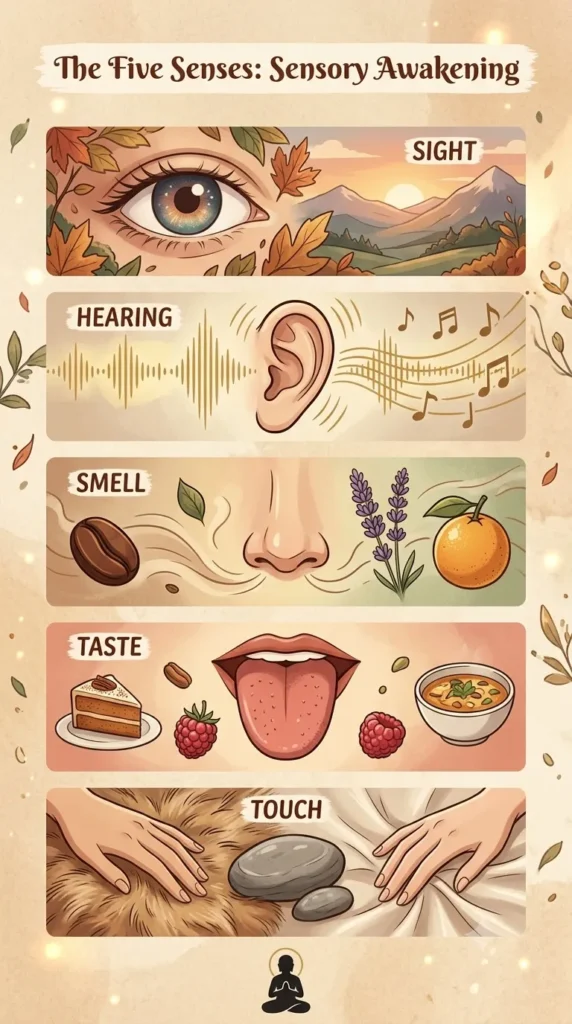
Sight: Self-Soothing Through Visual Experiences
Your eyes find comfort faster than your mind expects. Give them something gentle to rest on and the racing thoughts lose some of their grip. Watch clouds move. Look at a photo of someone you love. Sit with a painting that does something to you.
None of this needs a plan or a budget. Catch the evening sky changing colour from your own window. Study the details in a photo you’ve looked at a hundred times. If staying in feels safer, build a corner that’s just yours. Soft light. A few objects that feel familiar. That’s enough.
Hearing: Find Sounds That Feel Comforting
Sound isn’t just background noise when you’re struggling. It can shift the whole shape of a hard moment. An instrumental track. Birdsong. Rain against a window. A voice memo from someone who makes you feel safe. The trick is actually listening, not letting it play under a replay of the argument you can’t let go of.
But music isn’t automatically soothing. Sometimes it’s the opposite. If noise is already too much, silence might be the better choice. A quiet room. A few minutes with nothing playing at all. There’s no wrong answer here, only the one that works for you right now.
Smell: Use Familiar and Pleasant Scents
Smell goes straight to memory. That’s the point. Fresh air after rain. A lotion you’ve used for years. Flowers. Dinner cooking in the next room. Pause on it. Don’t rush past the scent on your way to the next task.
Skip this one entirely if it doesn’t serve you. Strong smells trigger headaches for some people. Nausea for others. Or a memory nobody asked for. Self-soothing is supposed to help, not become one more thing to push through.
Taste: Pay Attention to Comforting Flavours
Taste-based self-soothing isn’t about eating. It’s about noticing. A familiar snack, eaten slowly. A drink you actually like, sipped instead of gulped. Pay attention to the flavour. The temperature. What’s actually happening in your mouth, instead of eating on autopilot while your mind is somewhere else entirely.
Food is optional here, not required. Dietary needs, medical restrictions, or a complicated relationship with eating can all make this one unsuitable. That’s fine. Pick a different sense. Nothing is lost by skipping it, especially if naming what you’re actually feeling (our emotions worksheet can help with that) matters more right now than what’s on your plate.
Touch: Explore Comfortable Physical Sensations
Touch grounds you faster than almost any other sense. A smooth stone in your palm. A soft jumper. A blanket pulled tight around your shoulders. Warm water running over your hands until your breathing slows down without you trying to make it.
Your preferences decide this one, nobody else’s. Certain textures feel wrong for people with sensory sensitivities. Warmth and contact can carry weight from past experiences too. Don’t force it. Try a few. Keep whatever actually helps.
These five senses are only one piece of the distress tolerance toolkit. For the fuller set, our DBT skills worksheets walk through the rest, and pairing self-soothing with a few coping skills worksheets gives you something to return to on the harder days.
25 DBT Self-Soothing Activities You Can Try
Distress doesn’t wait for a good moment. That’s why the best DBT self-soothing skills are the simple ones, the kind you can reach for mid-meltdown without a manual. These self soothe skills work through your five senses, one at a time. Try a few. Keep what calms you. Drop what doesn’t.
Nothing here is mandatory. These self soothing techniques are options, not a checklist you fail. If an activity feels wrong in the moment, skip it. That’s allowed. For a more structured way to track what works, the DBT skills worksheets walk through each skill step by step.
Self-Soothing Activities for Sight
Your eyes are working overtime during a stress spike, scanning for threats that usually aren’t there. Giving them something slow and simple to land on can quiet that scan. Some of these take less than a minute. None of them require anything fancy.
- Watch aquarium footage — Spend two minutes watching slow-moving fish or underwater scenes. (Free, under 5 minutes)
- Change your screen to a calmer view — Swap a busy desktop or phone background for a simple image, a soft landscape, or a favorite illustration. (No prep)
- Follow a slow visual pattern — Trace the lines of a mandala, a geometric pattern, or a coloring page with your eyes. (Free)
- Look through a memory folder — Open a small collection of photos tied to safe, pleasant memories. Focus on the details instead of scrolling fast. Pairing this with a few lines from these mindfulness journal prompts can slow the moment down even more.
- Dim visual clutter — Turn off unnecessary screens, close extra tabs, clear one small patch of space around you. Sometimes soothing your eyes just means giving them less to process. (Free, under 5 minutes)
Self-Soothing Activities for Hearing
Sound reaches your nervous system faster than almost anything else. A familiar voice, a steady hum, even silence rearranged. That’s why these self soothing skills dbt often lean on hearing when visual options feel like too much.
- Use one familiar song as an anchor — Pick a song already tied to comfort and listen without multitasking. (Under 5 minutes)
- Try brown, pink, or white noise — Test a few steady sounds and keep whichever feels least distracting. (Free)
- Listen to a familiar voice note — A saved voice message from someone you trust can bring a sense of familiarity when things feel unsteady.
- Make a tiny soundscape — Notice five ordinary sounds around you: a fan, footsteps, traffic, birds, a keyboard. Let each one come and go without judging it. (No prep)
- Hum quietly — A slow, comfortable tune gives your attention somewhere gentle to rest. (Free, under 5 minutes)
Self-Soothing Activities for Smell
Smell skips the thinking part of your brain and goes straight for memory. That’s exactly why it works so fast as a self soothe dbt skill. You don’t need candles or anything expensive. Ordinary smells do the job.
- Open a window — Let fresh outdoor air replace stale indoor smells. (Free, under 5 minutes)
- Smell a familiar book — For some people, the scent of paper and old pages carries real comfort.
- Use a favorite unscented-to-you alternative — If fragrances bother you, lean on something naturally familiar instead, like clean laundry or fresh air. The goal is comfort, not perfume.
- Prepare something aromatic — Peel an orange, slice fresh herbs, or cook something warm. Pause and notice the smell before you eat.
- Create a scent memory list — Write down smells tied to comfort: rain, fresh laundry, a particular spice. Keep the list handy for days when you draw a blank. (Free)
Self-Soothing Activities for Taste
Taste is easy to rush past. Most people eat on autopilot, scrolling or half-watching something else. Slowing it down, even for one bite, turns an ordinary snack into a genuine self soothing technique.
- Try a temperature contrast — Slowly notice the gap between a cool drink and the sensation it leaves behind.
- Savor one small piece of food — Take your time with a single bite. Notice its texture, its temperature, how the flavor shifts.
- Make a familiar drink — Prepare something you already enjoy and give yourself a few quiet minutes with it, no scrolling. (Low-cost)
- Try a sour or minty flavor — A small piece of fruit, mint, or gum can give your attention something sharp to focus on.
- Eat without another screen — Put your phone down for one snack. Pay attention to the first few bites. (Free, no prep)
Self-Soothing Activities for Touch
Touch grounds you in your body fast, which matters when distress pulls you out of it. These self soothing activities for adults don’t need special tools. Most of them use what’s already within reach.
- Hold a textured object — Try a smooth stone, a fabric square, a stress ball, or anything else with a texture you like.
- Wash your hands slowly — Pay attention to the water’s temperature and feel instead of rushing through it. (Free, under 5 minutes)
- Change into comfortable clothes — If you can, lose the scratchy or tight layer. Small physical shifts matter more than people expect when you’re already overloaded.
- Give yourself a hand massage — Slowly work your palms and fingers with comfortable pressure. Stop if it feels off. (Under 5 minutes)
- Sit somewhere physically supportive — Adjust your chair, a pillow, or your foot position until your body actually feels held. (Free, no prep)
Pair these with a coping skills worksheet if you want a place to track which ones actually work for you over time.
How to Choose the Right Self-Soothing Technique for the Moment
Your favorite self-soothe skill isn’t always the right pick. Not even close. The real test is simpler: does it fit your setting, your senses, and how distressed you actually are right now? A technique that works at home can fall apart at your desk.
Something else might just feel irritating instead of calming. As DBT.tools frames it, the self-soothe skill runs on the five senses, but which sense you reach for depends entirely on where you’re standing when the wave hits.
Match the Activity to Your Current Environment
Where you are changes what works. That’s the first filter, before sensory preference even enters the picture. At home, you’ve got room to work with. A warm shower. Soft lighting. A scent that already calms you down. None of that travels well into an office.
At work or school, pull back to something smaller. A quiet song through headphones works. So does a familiar object kept in your pocket. In public, go smaller still. Focus on something visually pleasant, or take a few slow sips of a drink.
Can’t leave the situation at all? Pick something discreet, something already within reach. You don’t need a full self-care setup to practice DBT self-soothing skills. If you want a wider menu of options beyond the five senses, the coping skills worksheets collection covers more ground.
What If Sensory Input Makes You Feel Worse?
Not every sensation calms every person down. A strong scent might trigger a headache instead of relief. Certain music can wind someone up rather than settle them. A fabric that feels soft to you might feel unbearable to someone with sensory sensitivity.
Pay attention to what happens after you start. If it turns irritating, overwhelming, or just more uncomfortable, drop it. Right there. You’re not required to push through an activity just because it showed up on a self-soothing list somewhere.
Try a different sense instead, or dial down the intensity. An emotions worksheet can help you catch that shift early, before the irritation builds into something bigger.
How to Tell Whether a Self-Soothing Activity Is Helping
Self-soothing doesn’t have to drop your distress to zero. That’s not the bar. Look for smaller shifts instead. Your shoulders loosen. Your attention steadies. The emotion feels a touch less overwhelming. Or you simply have more room to decide what comes next.
A simple 0 to 10 distress rating before and after makes these shifts easier to catch. Write it down. Your worksheet can hold what worked, what didn’t, and what’s worth trying next time.
Pair that rating with mindfulness journal prompts if you want a fuller record of what shifted and why, and keep the full set of self-soothing techniques close by inside the DBT skills worksheets library for whenever you need to grab one fast.
How to Use a DBT Self-Soothing Worksheet
DBT self-soothing skills sound simple until the moment you actually need them. Your chest is tight, your thoughts are racing, and every calming idea you’ve ever read just vanishes.
That’s the gap a worksheet closes. Instead of hunting for an activity mid-crisis, you build a personal list ahead of time, test it, track what works, and keep your best options ready for the next hard moment.
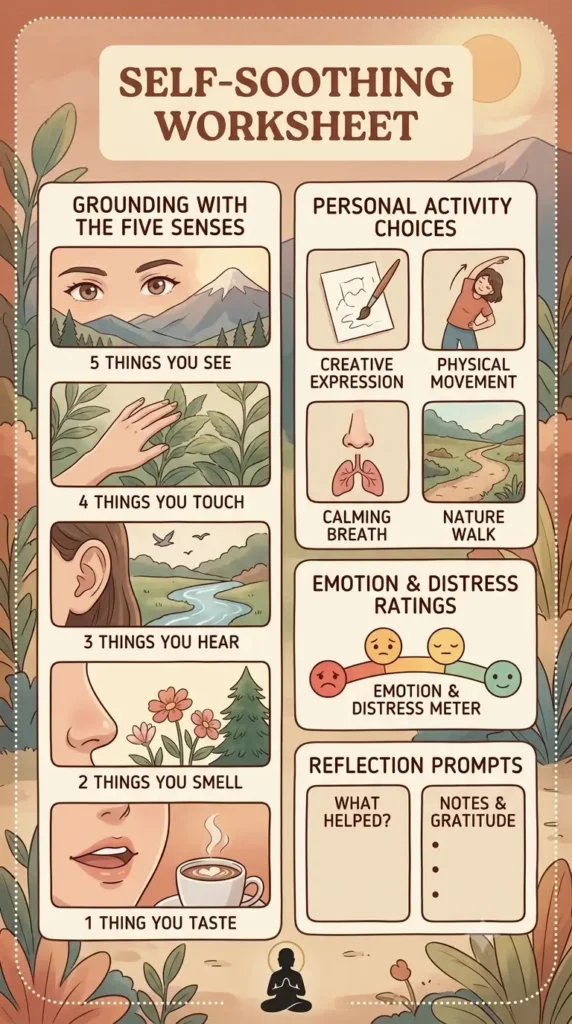
What to Include in Your Self-Soothing Worksheet
A useful worksheet isn’t a generic list of calming activities copied from somewhere else. It’s personal. Start with a five-senses activity menu and write down sensory experiences you genuinely find pleasant, not ones a guide told you to like.
Under sight, maybe it’s a photograph you keep coming back to, or a corner of the room with soft lighting. Under touch, it could be a worn-in hoodie or a warm shower. The point isn’t to finish a checklist. It’s to build options that actually fit you.
Leave room for preferences and activities to avoid, too. A strong scent soothes one person and wrecks another. Same goes for music, certain textures, food, bright lights, or physical contact. Knowing what doesn’t work saves you from reaching for the wrong tool while you’re already overwhelmed.
Add separate spaces for at-home and away-from-home options. Your favorite blanket does nothing for you in a classroom or a waiting room. Headphones, a familiar scent on a tissue, something smooth in your pocket, a quiet visual activity. These travel better than a candle ever will.
Finally, build in a simple before-and-after distress rating, then a few reflection prompts:
- What did I try?
- How did it feel?
- Did my distress change?
- Would I use this activity again?
- What could I try next time?
If you like writing to track patterns in how you feel, pair this with mindfulness journal prompts. Noticing your emotional state first makes the worksheet easier to fill in honestly. An emotions worksheet can help with that part too, especially on days when “fine” doesn’t quite cover it.
How to Complete the Worksheet Step by Step
Walk through five steps each time: notice, choose, practice, reassess, record.
Walk through five steps each time: notice, choose, practice, reassess, record.
1. Notice and name the experience
Start by naming what’s happening. Angry after an argument. Tense before a meeting. Drained after a long day. Naming it gives you a clearer place to start.
2. Choose one activity
Scan your five-senses menu and pick something realistic for where you are. You don’t need the perfect technique. Pick something safe, available, and reasonably pleasant.
3. Practice With Attention
Give it your attention instead of running it on autopilot. Listening to music? Notice the rhythm, not just the sound in the background. Holding something soft? Notice the texture and the temperature against your hand.
4. Reassess
Check in after a few minutes. Has your distress moved at all? A little less tense, a bit more settled, able to think more clearly. That’s enough. The goal was never zero distress.
5. Record what happened
Write it down. If it didn’t help, write that down too. A failed attempt still tells you something useful for next time.
Example of a Completed Self-Soothing Worksheet
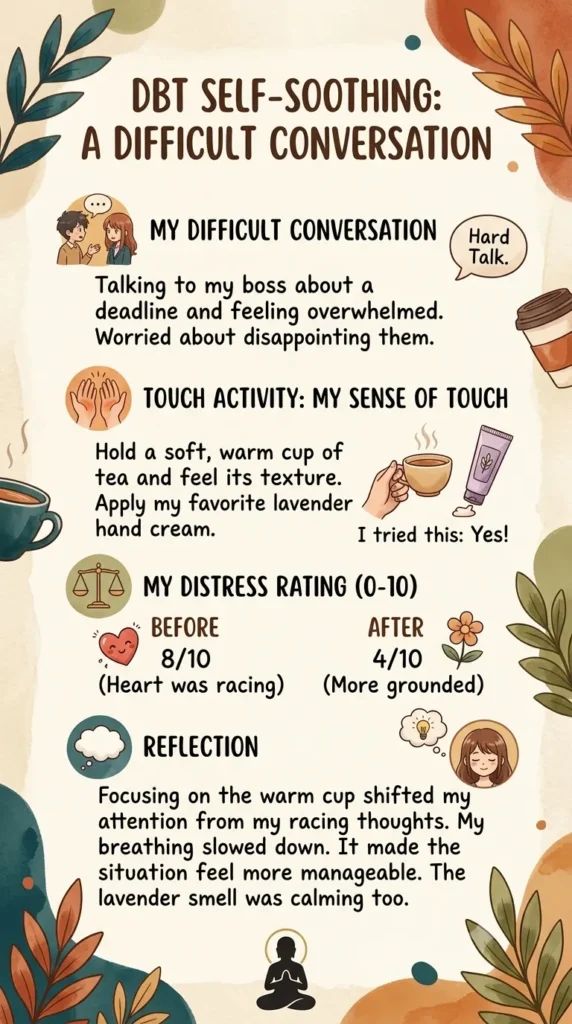
You’ve just had a hard conversation with someone close to you. Your thoughts are racing. You want to send another text right now. Instead, you open your worksheet.
Under current experience, you write: “Angry, rejected, overwhelmed.”
Your distress rating: 8/10.
You pick a touch-based activity this time. No more noise, no more talking. You wrap yourself in a comfortable blanket and sit somewhere quiet for several minutes, paying attention to the warmth and the weight of it instead of replaying the argument in your head.
After a few minutes, your distress drops to 6/10. The problem hasn’t disappeared. You’re still upset. But your body isn’t as tense, and that urge to respond right away has eased off.
Your reflection might read: “The blanket helped more than music would have. I still need to figure out what to say, but it can wait until I’m calmer.”
That’s the whole point of the exercise. Self-soothing was never a promise that distress disappears. It gives you a way to care for yourself in the hard moment, and some space before you decide what comes next.
If you want more tools like this one, the full set of DBT skills worksheets covers the other distress tolerance and emotion regulation exercises that pair well with self-soothing.
How to Create a Personal DBT Self-Soothe Kit
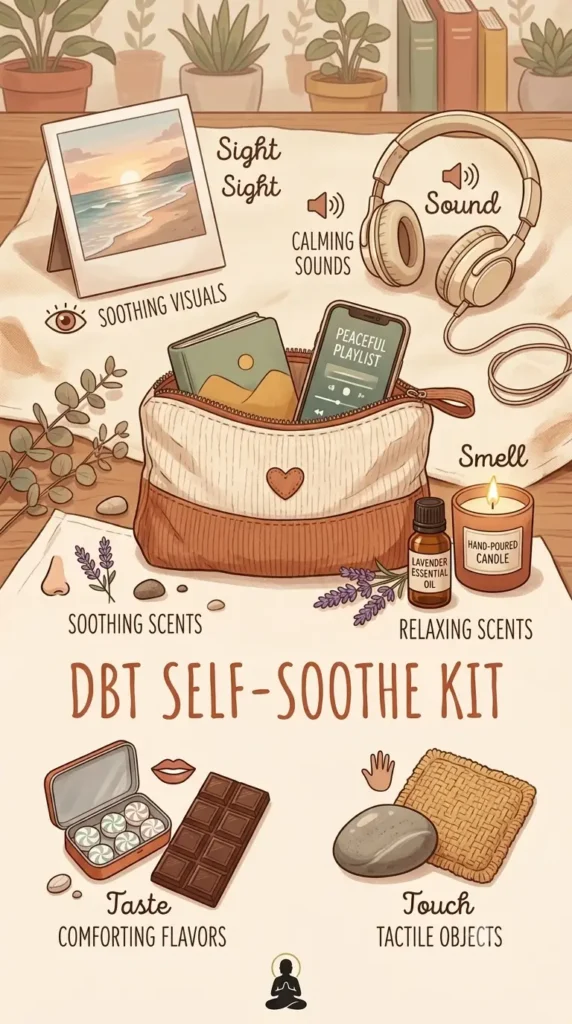
A personal DBT self-soothing kit holds a few familiar comforts within reach for the moments distress spikes. Pick simple items that fit your space, your routine, your actual life. The goal isn’t a giant self-care box. It’s a small kit you’ll actually open.
What Goes in a Five-Senses Self-Soothing Kit
Most people overthink this part. You don’t need five perfect items for five perfect senses. One or two per category is plenty, and skipping a category is fine too. Your preferences matter more than any checklist.
| Sense | Possible kit items |
|---|---|
| Sight | Small photo, postcard, calming image, pocket sketchbook |
| Hearing | Earphones, a downloaded calming playlist, small sound device |
| Smell | Scented hand lotion, a sachet, or a familiar fragrance |
| Taste | Gum, mint, tea bag, or another suitable snack |
| Touch | Soft fabric square, smooth stone, stress ball, or comfortable object |
Safety comes first. If a scent gives you a headache, it doesn’t belong in the kit. If a texture feels wrong under your fingers, leave it out. Self-soothing means choosing comfort, not forcing yourself to tolerate something you dislike.
Make a Portable Kit for Work, School, or Travel
This isn’t about building a visible “therapy kit.” Not even close. A small pouch in your backpack, desk drawer, handbag, or suitcase can hold several discreet self soothe skills without taking up real space.
Earphones give you calming audio on demand. Hand lotion brings a familiar scent and texture in one swipe. A small smooth stone gives your hands something to hold onto when your thoughts won’t settle. Digital options count too. A saved playlist or a calming photo on your phone weighs nothing and goes everywhere you go.
Keep the kit small enough that you’ll carry it. Five items you reach for beat twenty items buried at the bottom of a bag.
Prepare Your Kit Before You Need It
Build the kit when you’re calm. Test each item at different times of day. Notice what actually feels soothing, what feels neutral, and what quietly irritates you. That groundwork pays off later, when you’re not calm and don’t have time to figure it out.
Keep backups too. No headphones handy? Have a silent tactile option ready. Stopped loving that scent? Swap it out. Nothing here is permanent.
Your needs shift over time, so revisit the kit every so often instead of packing it once and forgetting it. Pair it with a broader coping toolkit for the moments a five-senses kit alone isn’t enough, or work through the full set of DBT skills worksheets to build out the rest of your distress tolerance practice.
DBT Self-Soothing Examples for Common Adult Situations
Self-soothing changes shape depending on where you are. A sensory trick that calms you at home might fall apart at your desk, or in the middle of a fight that’s still ringing in your ears. That’s the whole challenge with DBT self-soothing skills: the technique has to fit the moment you’re actually in.
Not some ideal, quiet version of your day. The real one. The goal isn’t fixing the feeling. It’s buying yourself enough comfort and space to get through it without making things worse.
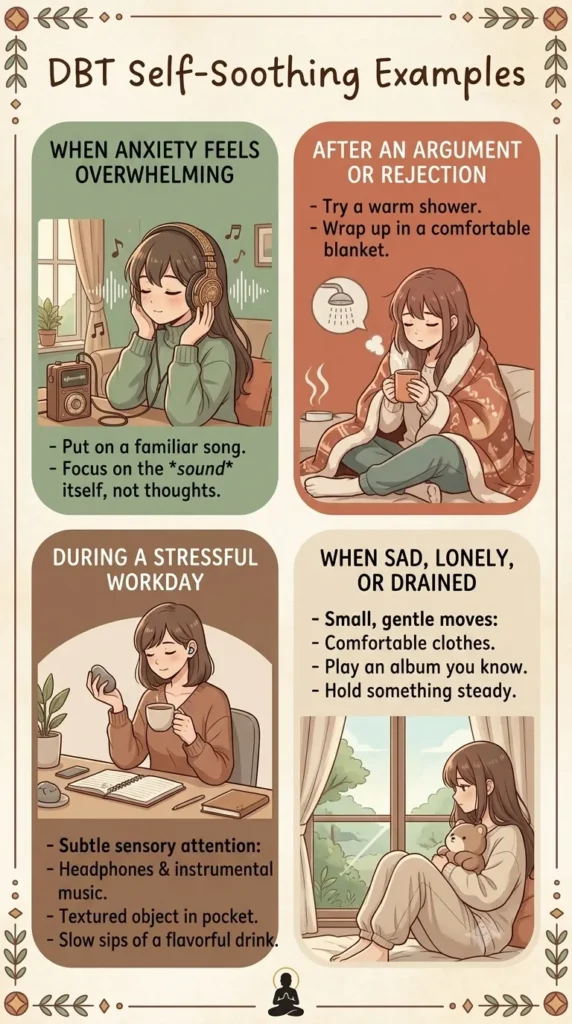
Self-Soothing When Anxiety Feels Overwhelming
Picture this. A big presentation is tomorrow, and your brain won’t stop rehearsing every way it could go wrong. Arguing with each anxious thought rarely works. Most people have tried. Instead, sit somewhere quiet for five minutes and put on a song you already know well. Let your ears do the work. Not your head.
Focus on the sound itself, not the speech you’re still mentally editing. That’s the shift that matters here.
Will the anxiety disappear? Probably not. And that’s not the technique failing. Self-soothing isn’t about erasing the feeling. It’s a way to be kind to yourself while the discomfort is still sitting there, uninvited. Once the five minutes end, you go back to actually prepping for tomorrow, just a little steadier than before.
Self-Soothing After an Argument or Rejection
This isn’t about winning the argument after the fact. Right after a heated exchange, the pull to fire off one more message, one more explanation, can feel almost automatic. A soothing activity breaks that chain. It puts a small gap between the reaction and whatever you do next.
Try a warm shower. Wrap up in a blanket that actually feels good against your skin. Sit somewhere quiet for a few minutes and let your shoulders drop.
None of this resolves the conflict. That’s not the job here. It just gives the intensity room to settle, so the next decision comes from a clearer place instead of a raw one.
Self-Soothing During a Stressful Workday
No private room required. Self-soothing at a desk looks nothing like a spa day, and it doesn’t need to. Headphones and a familiar instrumental track work. So does a small textured object in your pocket, or a drink you sip slowly while noticing its temperature and flavor instead of chugging it between emails.
Stuck somewhere you can’t step away from? Pick something subtle. Something nobody else in the room would even notice. These self soothing techniques for adults don’t need to be dramatic to work.
A single minute of real sensory attention can be the pause between one stressful task and the next one landing on your desk.
Self-Soothing When You Feel Sad, Lonely, or Drained
Sadness doesn’t need to flip into happiness before you’re allowed to care for yourself. That’s a myth worth dropping. Sometimes the kindest move is something small and gentle: changing into clothes that actually feel comfortable, playing an album you know by heart, sitting near a window, holding something that feels steady in your hands.
Keep your expectations low here. You’re not trying to prove the technique worked by suddenly feeling cheerful. That’s not the test. You’re just giving yourself a softer way through a hard stretch of time.
Struggling to even name what you’re feeling? That’s common, and it’s worth sorting out before you pick a coping strategy. A structured emotions worksheet can help you put words to it first, so the self-soothe skill you choose actually matches what’s underneath.
What If DBT Self-Soothing Does Not Work?
DBT self-soothing is a coping skill. It’s not a switch that makes distress disappear. If one activity falls flat, drop it. Don’t force it. Another distress-tolerance skill, a practical fix for the actual problem, or real professional support might fit the moment better.
Try a Different Sense or a Simpler Activity
Self-soothing takes trial and error. A sound that calms one person can grate on another. A scented lotion that felt comforting on Tuesday might feel like too much on Friday. The goal was never doing the skill “correctly.” It’s finding something that helps you sit with the moment instead of making it worse.
Does the technique feel neutral? Irritating? Just plain impractical? Stop. Try a different sense. Turn the intensity down. Or pick something simpler altogether. Swap music for quiet. Swap a heavy scent for fresh air. Swap a complicated ritual for holding something familiar in your hand.
Consider Another DBT Distress Tolerance Skill
Self-soothing is one tool. It’s not the whole box. If it isn’t landing, another skill might.
STOP creates space before you react on impulse. TIPP targets intense physical arousal, the racing heart and the shaking hands. ACCEPTS offers temporary distraction, useful when the problem itself is too much to face head-on right now. IMPROVE the Moment strings together several small strategies to make a painful stretch of time more bearable.
You can explore each of these in more depth, with printable practice tools included, inside our broader DBT skills worksheets collection.
Know When You Need More Than a Self-Soothing Exercise
A self-soothing exercise can carry you through one rough stretch. It won’t fix an ongoing problem. It was never built to. If distress keeps circling back, bleeds into your daily life, or feels harder to manage each time, talk to a qualified mental health professional. That’s not failure. That’s the skill working as intended, pointing you toward more support.
If you’re in India and need help right now, Tele-MANAS is open 24/7. Call 14416 or 1800-89-14416. It runs through the Government of India’s National Tele Mental Health Programme.
If you’re in immediate danger, or you think you might act on an urge to hurt yourself or someone else, get emergency help. Don’t lean on a worksheet or a coping skill alone. Not in that moment.
Self-Soothing vs. Avoidance: What’s the Difference?
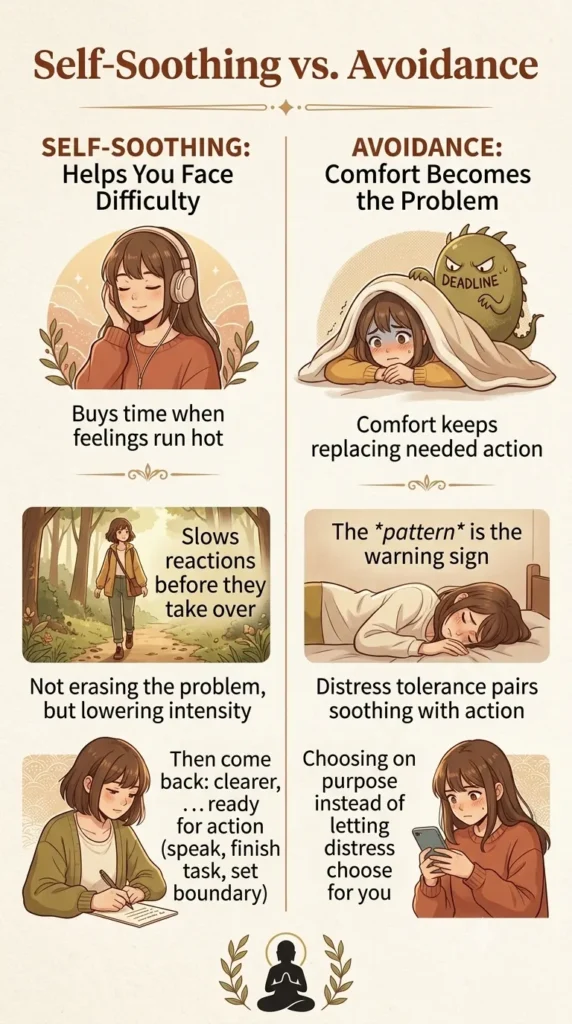
Self-soothing calms you down enough to think straight. Avoidance just helps you dodge what you don’t want to face. The same activity can do either job. What decides it? What you do once the distress eases, and whether you go back to the problem.
When Self-Soothing Helps You Face a Difficult Situation
Self-soothing buys you room when feelings run hot. Maybe you just had a fight. Maybe bad news landed in your inbox. Maybe a deadline is crushing you. A quiet, calming activity can slow the reaction down before it runs the show.
This isn’t about faking cheerfulness. Nothing gets erased. You might play soft music, hold something textured, or step outside for air. Then you come back. Clearer. Ready to figure out the next move.
Think of it as shrinking the moment, not the problem. Once the intensity drops, you get to choose: speak up, set a boundary, finish the task, apologize, ask for help, or just wait a little longer.
When Comfort Becomes a Way to Avoid the Problem
Here’s where it turns. Self-soothing becomes avoidance when comfort keeps replacing action that still needs to happen. A short break after a hard email? Useful. An entire afternoon spent dodging that same email? Different story entirely.
The activity isn’t the warning sign. The pattern is.
Keep pushing off a hard conversation. Keep ignoring responsibilities. Keep reaching for comfort every time a feeling shows up. Eventually the problem just sits there, untouched. That’s why real distress tolerance skills pair soothing with action. Soothe enough to tolerate the feeling. Then decide what the moment actually needs.
You don’t have to jump back into action right away, either. Sometimes rest is the right call. Sometimes it’s support. Sometimes it’s professional help. The goal isn’t speed. It’s choosing on purpose, instead of letting distress choose for you.
For more structured self soothe techniques, our DBT skills worksheets walk through each one step by step. Pair that with the coping skills worksheets for extra tools when emotions spike, or track how you’re feeling day to day with the emotions worksheet.
Conclusion
DBT self-soothing skills give you a practical way to get through difficult emotional moments without demanding that the feeling disappear right away. The five senses offer plenty of options, but the most useful technique is the one that feels safe, accessible, and genuinely comforting to you.
Try different activities when you’re calm, record what helps, and keep a few reliable options nearby for harder days. Self-soothing is not about avoiding problems or pretending everything is fine. Sometimes, creating a little comfort is what gives you enough space to face the problem with a clearer mind.
Frequently Asked Questions
What are the five senses used in DBT self-soothing?
DBT self-soothing uses sight, hearing, smell, taste, and touch to create comforting sensory experiences during distress. You might look at calming scenery, listen to familiar music, notice a pleasant scent, savour a drink, or hold something soft. The goal is to engage your senses in a safe, mindful way.
How do you use the DBT self-soothe skill when you are overwhelmed?
Choose one sensory activity that feels safe and manageable, then give it your attention for a few minutes. Notice the sensation rather than demanding that your emotion disappear. Afterward, check whether your distress, tension, or urge to react has shifted. If it hasn’t helped, try another activity.
What is the difference between DBT self-soothing and distraction?
Self-soothing uses comforting sensory experiences to help you tolerate distress, while distraction shifts your attention away from the painful emotion or situation.
They can overlap, but they serve different purposes. Self-soothing encourages you to stay present while creating a little more comfort during a difficult moment.
Can you use DBT self-soothing skills at work or in public?
Yes. DBT self-soothing skills can be adapted for settings where you cannot take a long break or leave. You might use headphones, focus on a familiar scent, sip a drink mindfully, hold a discreet object, or look at a calming image on your phone. Choose options that fit the setting.
What should you do if self-soothing makes you feel worse or does not help?
Stop the activity if it feels uncomfortable, irritating, or overwhelming. A self-soothing technique does not have to work for everyone. Try a different sense, choose a gentler activity, or use another DBT distress tolerance skill. If intense distress continues, consider additional support rather than repeatedly forcing the same technique.
Is there a free DBT self-soothing worksheet or PDF?
Yes. This article includes a DBT self-soothing worksheet/PDF designed to help you identify activities for each of the five senses, record what you tried, and compare your distress before and after practising. You can use it to build a personal list of self-soothing options for future difficult moments.

It’s Bhaskar!
Well, I am not a psychologist a monk, or a philosopher by training. I’m just an engineering graduate.
‘The Empty Self’ is where I write about that idea, and what it actually means for ordinary life, anxiety, identity, habits, the stories we tell ourselves about who we are. I don’t have a psychology degree, and I’m not offering therapy or clinical advice. What I do have is thought and clarity, and genuine curiosity about why we suffer the way we do and how much of it might loose once we shed this ‘fixed identity’.