
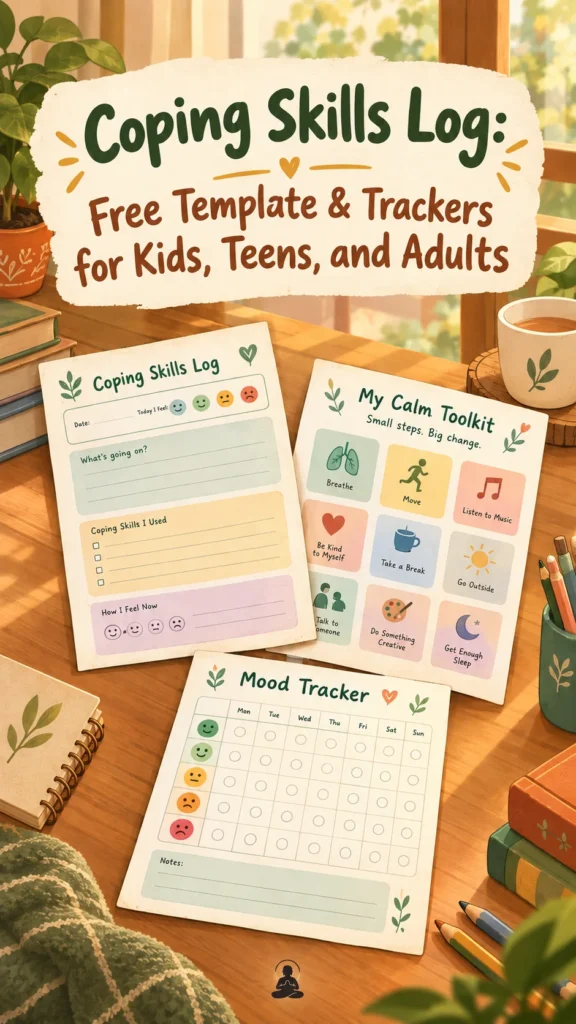
A coping skills log shows what actually happens when you try a coping strategy under stress. No more guessing. You jot down the situation, how intense the emotion felt, which skill you reached for, and what shifted afterward.
Patterns start to show up fast. Some tools work every time. Others fall flat. That’s how you build a coping plan template that fits your life, not someone else’s.
A useful log doesn’t need to feel like homework. Sound too clinical? It doesn’t have to be. Kids can use faces and simple rating scales instead of words. Teens usually want something quick, something they can fill out on a phone between classes.
Adults can go deeper, adding more detail about the trigger and what came after. If naming the feeling itself is the hard part, an emotions worksheet can help before you even get to the log.
The goal is simple. Test what helps. Learn from it. Adjust.
Quick Overview: A coping skills log tracks stressful situations, emotions, and the coping strategies you try in response. By noting what you tried and how you felt after, you spot patterns fast and build a coping skills worksheet that’s actually yours, instead of a generic checklist.
Table of Contents
What Is a Coping Skills Log?
A coping skills log tracks the moment, the skill you tried, and what changed. That’s it. No memory required, no guessing later what actually worked. You write it down. Patterns show up that your memory would have erased by next week.
Most people think they know which coping skills for kids, teens, or adults actually help. They don’t. Memory bends toward whatever felt dramatic, not whatever worked. A log fixes that. It gives you real data instead of a vague feeling that “breathing exercises are fine, I guess.”
What It Tracks
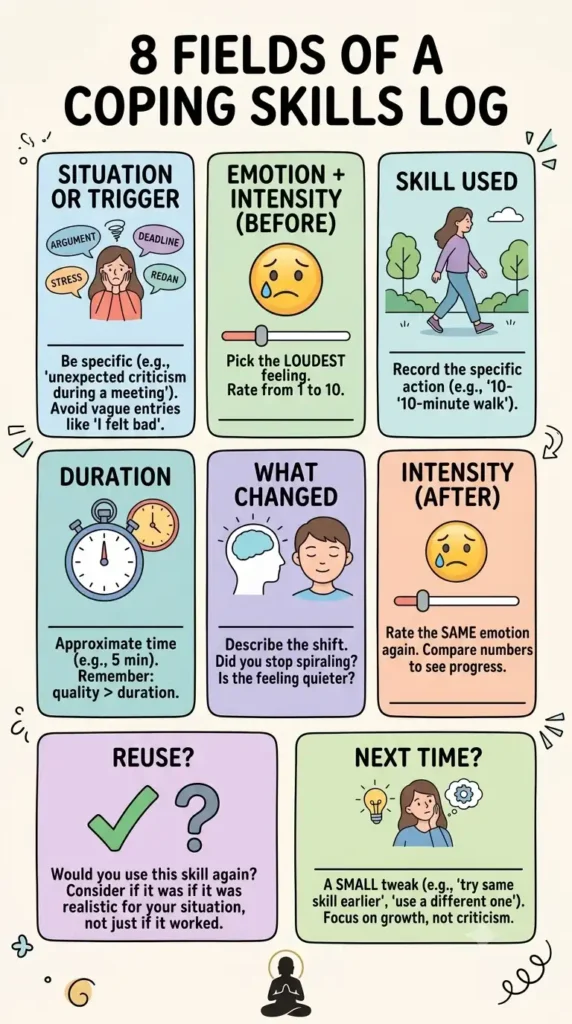
A coping skills log usually records six things: the situation, the emotion, how strong that emotion felt before you coped, the skill you used, how long you used it, and what changed afterward. Some people add more. An intensity rating after the skill. Whether they’d use that strategy again. A note on what to try next time instead.
None of this needs to be perfect. Nobody’s grading the log. The goal is simple: gather enough detail to make a better choice next time a similar moment hits.
Want a specific structure to copy instead of building one from scratch? The coping skills worksheets collection has ready-made formats for exactly this, including ones built for tracking emotional intensity alongside the skill used. If naming what you’re feeling is the hard part, the emotions worksheet helps with that piece specifically. It’s the difference between writing “I felt bad” and writing “I felt a 7 out of 10 anxious.”
Log vs. Checklist vs. Chart vs. Coping Plan
These four tools get lumped together constantly. They’re not the same thing.
A log looks backward. A checklist or plan looks forward. That’s the whole distinction, and most confusion around these tools comes from missing it.
| Tool | Main Purpose | What You Record | Best Used When |
|---|---|---|---|
| Coping skills log | Track what happened and what helped | Situation, emotion, skill, before/after response | You want to learn which skills work for you |
| Coping skills checklist | Quickly choose or remember skills | Skills you can try | You need ideas in the moment |
| Coping skills chart | Organize skills and patterns | Skills, situations, effectiveness, preferences | You want a quick personal reference |
| Coping plan | Decide what you’ll do ahead of time | Triggers, warning signs, preferred responses, support | You want a prepared response for stressful situations |
Notice the pattern. A checklist hands you options fast, mid-crisis, when thinking clearly isn’t happening. A chart organizes what you already know about yourself. A coping plan gets built before the storm, not during it. The log is the only one of the four that runs after the fact, and that’s exactly why it’s the tool that teaches you something.
Journaling alongside your log tends to sharpen both. If you’re already logging what happened, a few journal prompts for mental health can pull out the “why” behind a tough moment, not just the “what.”
One more thing worth saying plainly: a coping skills log isn’t a diagnostic tool. It won’t replace a therapist, and it isn’t built to. Think of it as a support for self-reflection, or something useful to bring into a session with a mental-health professional. When things get serious, professional care comes first. Always.
The 8 Fields of a Coping Skills Log, and Why Each One Earns Its Spot
A coping skills log only works if it does more than record which strategy you grabbed. Think of it less like a chart and more like a short interview with yourself. Each field connects the moment, the feeling, the skill, and what actually shifted after. Skip a field and the log turns into a checkbox exercise. Keep all eight and patterns start showing up on their own.
Situation or Trigger
Write down what was happening right before you reached for a coping skill. This single line gives the rest of the entry somewhere to stand. It also does something sneakier over time. Look back after a few weeks and the same triggers keep resurfacing. Arguments. Deadlines. Social pressure. That feeling of being buried alive by 4pm.
Common mistake: writing something too vague, like “I felt bad.” That tells future-you nothing. “I got unexpected criticism during a meeting” tells you exactly what set things off, and exactly what to watch for next time.
Emotion Plus Intensity Before
Name the main feeling. One feeling, not five. Then rate how strong it was, usually on a 1 to 10 scale. This number matters more than it looks like on paper. It’s your baseline. Without it, you have no way to judge whether the skill you picked did anything at all.
Common mistake: listing every emotion at once. Angry, embarrassed, tired, ashamed, all in one entry. Pick the loudest one in the room. That’s the one worth tracking.
Skill Used
Record what you actually did, not the category it fell under. “Self-care” tells you almost nothing six weeks from now. “Walked outside for 10 minutes” tells you plenty.
This is where a coping skills worksheet earns its keep too, since it gives you specific coping skills ideas to pull from instead of staring at a blank line wondering what counts.
Common mistake: writing down what you meant to do instead of what actually happened. A log only works when it reflects reality. Not the plan. Not the intention. What you actually reached for in that moment.
Duration
Note roughly how long the skill lasted. Why bother? Because a two-minute breathing exercise and a thirty-minute walk aren’t the same intervention, even if both get labeled “coping.” Duration explains a lot of the variation you’ll see later between entries that otherwise look identical.
Common mistake: treating duration like a performance target. Nobody wins a prize for stretching a coping skill longer than it needed to go. Five honest minutes beats twenty forced ones.
What Changed
Describe what shifted after using the skill, and don’t limit that to “I felt better.” Sometimes what changes is quieter than that. You thought more clearly. You stopped spiraling. You felt able to take the next step instead of frozen in place.
Sound too small to write down? It isn’t. This is the field most people skip, and it’s often the most useful one in the whole entry.
Common mistake: assuming a skill failed because the feeling didn’t vanish. A good coping strategy doesn’t have to erase an emotion. It just has to turn the volume down enough that you can function.
Intensity After
Rate the same emotion again, using the same scale you used before. Researchers use a version of this idea in clinical settings too, sometimes called a subjective units of distress scale, where the whole point is tracking the same feeling before and after an intervention. Comparing the two numbers gives you a fast, simple read on whether anything actually moved.
Common mistake: switching the question between ratings. If you rated anxiety before, rate anxiety after. Don’t quietly swap it for “overall mood” halfway through the entry.
Reuse?
Record whether you’d try this skill again in a similar spot. A before-and-after number can’t tell you this part. It only tells you if intensity dropped, not whether the skill was realistic to pull off in the first place.
A skill that helps but eats an hour might not survive a busy school day or a double shift at work. That’s not a failure of the skill. It’s a mismatch with your actual life.
Common mistake: marking “yes” just because it worked once. Ask harder questions than that. Was it accessible? Comfortable? Something you’d actually reach for again, not just something that happened to work on a good day?
Next Time?
Write one small adjustment for the next round. Maybe a different skill. Maybe the same one, used earlier before things spiral. Maybe shorter. Maybe paired with actual problem-solving instead of standing alone.
Common mistake: turning this into a self-criticism section. That’s not what it’s for. The goal isn’t grading how well you coped last time. It’s building a slightly smarter response for next time, one small tweak at a time.
Used consistently, these eight fields do something a plain coping skills checklist can’t. A checklist shows you options. A log shows you evidence, built entry by entry, of what actually works for you specifically.
That’s a coping plan template worth keeping, whether you’re filling it out for yourself, for a teen working through a rough stretch, or alongside your own notes from a few journal prompts for mental health.
Free Coping Skills Log Template (Download)
A coping skills log only works if it’s simple. Grab it once, use it on a hard day, and you’re set.
This free coping skills log template gives you one spot to write down what happened. Which skill you tried. How you felt before and after. And whether it’s worth trying again.
Coping Skills Log Table Preview
| Date | Situation | Feeling | Before | Skill Used | After | Did It Help? | Try Again? |
|---|---|---|---|---|---|---|---|
| /10 | /10 | Yes / Somewhat / No | Yes / No | ||||
| /10 | /10 | Yes / Somewhat / No | Yes / No |
The Before and After ratings aren’t about proving anything. They just show whether a strategy moved the needle at all.
Sound too simple? It is. That’s why it works. You don’t need a dramatic drop for a skill to count. A 7 sliding to a 5 still tells you something real.
Download the Free Coping Skills Log PDF
Grab the standard printable version when you want something straightforward for daily or weekly tracking. Keep a few copies within reach: on the fridge, in a bag, wherever you’ll actually see them. No paper handy? Use the same fields in a notes app instead.
How to Fill Out the Coping Skills Log
Start with the situation while it’s still fresh. Wait a week, and you’ll be guessing at details that mattered in the moment.
Name the main feeling. Rate it 1 to 10. Then write down the skill you used.
Give the feeling a second rating afterward. Mark whether it helped.
Only helped a little? Say so. That’s still useful data, not a failed entry.
After a few weeks of entries, patterns show up on their own. You’ll end up with a coping skills list built from what actually works for you, not what a generic worksheet assumed would.
Want more tools to build that list? The full coping skills worksheets collection has printable activities that pair well with this log.
How to Use a Coping Skills Log
A coping skills log isn’t complicated. Record what happens before, during, and after you try a strategy. That’s the whole shape of it.
Perfect entries aren’t the goal. Patterns are. You’re hunting for what actually helps, then adjusting from there.
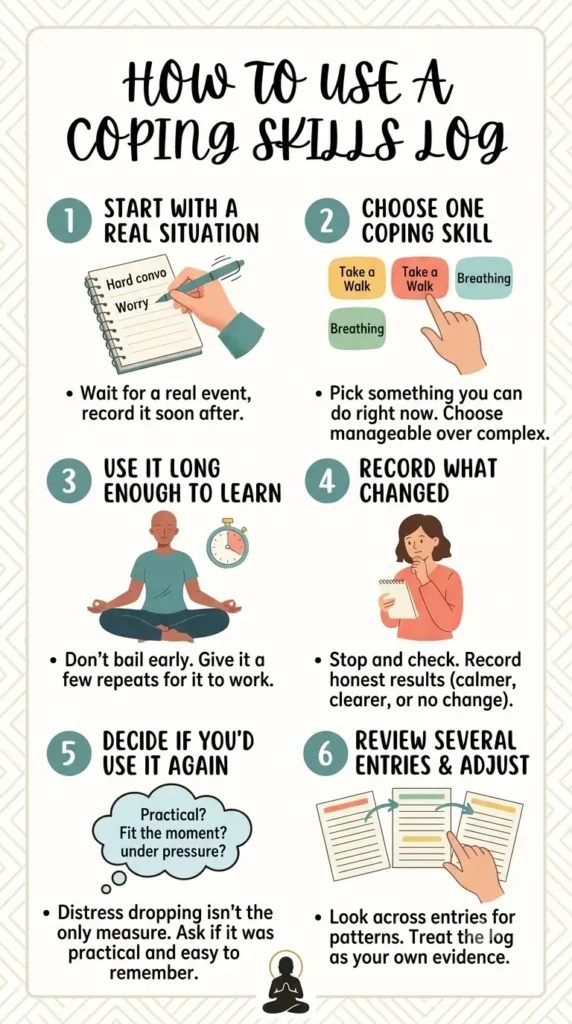
1. Start With a Real Situation
Skip the hypotheticals. Wait for something real to happen, then write it down. A hard conversation. A stacked deadline. An argument with a friend. A restless night, or a wave of worry that shows up for no clear reason. Any of these give you something worth recording.
Write it soon after. Not next week. The details fade fast, and fuzzy details make a weak entry.
2. Choose One Coping Skill
Pick one strategy. Just one. The trick is picking something you can actually do right now, not the version that sounds best in theory.
Already overwhelmed? Then reach for something simple. Not the fancy technique from a book you read once. If you need a starting point, browse a few coping skills activities and choose whatever feels manageable today, not whatever feels most impressive.
3. Use the Skill Long Enough to Learn From It
Give it a real shot. That doesn’t mean forcing yourself through something that makes you feel worse. It does mean not bailing after five seconds because nothing shifted instantly.
Some skills work fast. Others take a few minutes, or a few repeats, before anything moves. Quitting early tells you nothing. Sticking with it tells you something real.
4. Record What Changed
Stop. Check what’s different. You might feel calmer. You might think more clearly. You might feel exactly the same, or realize the actual problem is still sitting there, waiting on you to act.
Don’t dress up the answer to make the log look successful. “Not much changed” is still useful. It’s honest data, not a failed attempt.
5. Decide Whether You’d Use It Again
Distress dropping isn’t the only measure. Ask something else too. Was it practical? Easy enough to remember under pressure? Did it actually fit the moment you were in?
A strategy that gives modest relief but sticks in your memory beats one that works beautifully and vanishes the second you need it. That’s not a small trade-off. That’s the whole point of tracking any of this.
6. Review Several Entries and Adjust
One entry won’t tell you much. A handful will. Once you’ve got several, stop judging each attempt on its own and start looking across them.
You’ll likely notice something specific: certain skills fit certain triggers better than others. Some calm you down. Others help you fix the actual problem underneath the stress. Different jobs, different tools.
Test, don’t guess. Treat the log as a record of your own evidence, not a hunt for one perfect fix. You don’t need a single ideal coping skill. You need to know what works, when it works, and when it’s time to try something else instead.
Coping Skills Chart: Turn Your Logs Into a Personal Toolkit
A coping skills log isn’t much use sitting in a drawer. The real value shows up once you turn those entries into a coping skills chart. That’s the moment scattered notes become a toolkit you actually trust.
Here’s an honest take on most coping skills lists: they’re generic. A printable sheet from the internet doesn’t know your triggers. Your log does.
Instead of guessing which strategy might help, you can see it in black and white. Which skill worked when you were spiraling? Which one you’d reach for again without thinking twice? That’s the whole point of building your own version.
Build Your Personal Coping Skills Chart
Don’t judge a skill after one try. That’s the mistake most people make. Look for patterns instead, across several entries in your log.
A breathing exercise might calm you down when you’re overwhelmed. A short walk might work better when you’re restless or angry. Same goal, different tool. Your chart should reflect what works in your real situations, not what sounds good on a printable list of coping skills.
| Coping skill | Best for | Before | After | Easy to use? | Keep it? |
|---|---|---|---|---|---|
| Slow breathing | Anxiety, overwhelm | 8/10 | 5/10 | Yes | ✓ |
| Short walk | Restlessness, frustration | 7/10 | 4/10 | Yes | ✓ |
| Journaling | Racing thoughts | 7/10 | 6/10 | Sometimes | Maybe |
| Talk to someone | Loneliness, sadness | 8/10 | 4/10 | Depends | ✓ |
| Grounding exercise | Feeling disconnected | 8/10 | 5/10 | Yes | ✓ |
You don’t need every column filled in perfectly. Messy is fine. The goal is a coping skills checklist that gets more personal every time you update it.
If a strategy keeps helping, move it up. If another one keeps feeling like a chore, drop it. Simple as that.
Turn the Chart Into a Coping Skills Toolbox
Your chart is really just the starting point. Once you’ve tracked enough entries, it becomes a coping plan template you can lean on the moment things get hard.
This isn’t about having more strategies. It’s about having the right ones, ready. For a fuller set of tools to pull from, our coping skills toolbox has worksheets built for exactly this.
Want more options to test before they earn a spot on your chart? Browse the ultimate list of coping skills and see what fits. Then let your log decide what stays.
Coping Skills Log for Kids
A coping skills log for a kid should feel like a game, not a form. Forget clinical boxes and long blanks.
Young kids can still track plenty. What happened. How big the feeling got. What skill they tried. Whether it worked. Faces do the heavy lifting here, not sentences.
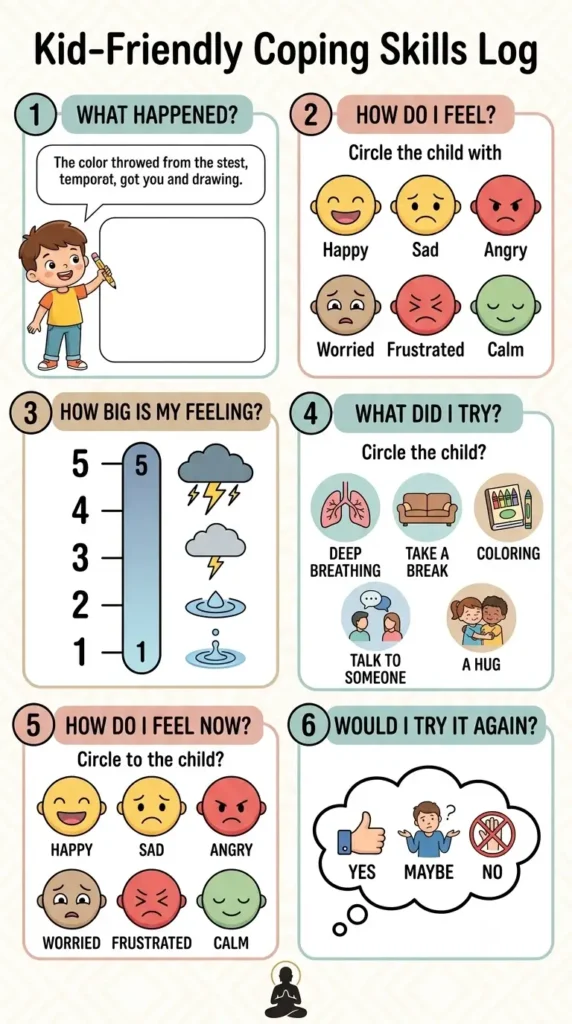
Suggested Fields for a Kid-Friendly Coping Skills Log
Skip long written answers for younger children. A visual coping skills worksheet reads easier than a page of prompts. It also feels less like homework, which matters more than people think.
A simple kids’ log can include:
- What happened? A short sentence, or just a drawing.
- How do I feel? Circle a face. Happy, sad, angry, worried, frustrated, calm.
- How big is my feeling? A 1 to 5 scale works. 1 means a little. 5 means very big.
- What did I try? Circle or draw the skill. Deep breathing. A break. Coloring. Talking to someone. A hug.
- How do I feel now? Another face. Another number.
- Would I try it again? Yes, maybe, or no.
None of this asks a child to explain every emotion perfectly. That’s not the point. The real win is smaller than that: a kid starts noticing that a coping skill can actually shift how a hard moment feels. Nothing more complicated than that.
Free Printable Coping Skills Log for Kids
A visual tracker makes the whole thing easier to stick with. This kids’ coping skills log leans on emotion faces, simple icons, and almost no writing. A child can fill it out solo, or with a parent, teacher, counselor, or another trusted adult nearby.
This version isn’t just a shrunk-down adult log. It’s built differently on purpose. Kids circle. They draw. They point. No clinical-looking boxes anywhere.
It also pairs well with other tools built for this age group. Browse the full set of coping skills worksheets for kids for more printable options, or add in a few coping skills coloring pages when a child needs something calmer and less structured.
Kids who learn best through play get another option too. Try pairing the log with coping skills games for a more hands-on way to practice the same skills.
Coping Skills Log for Teens
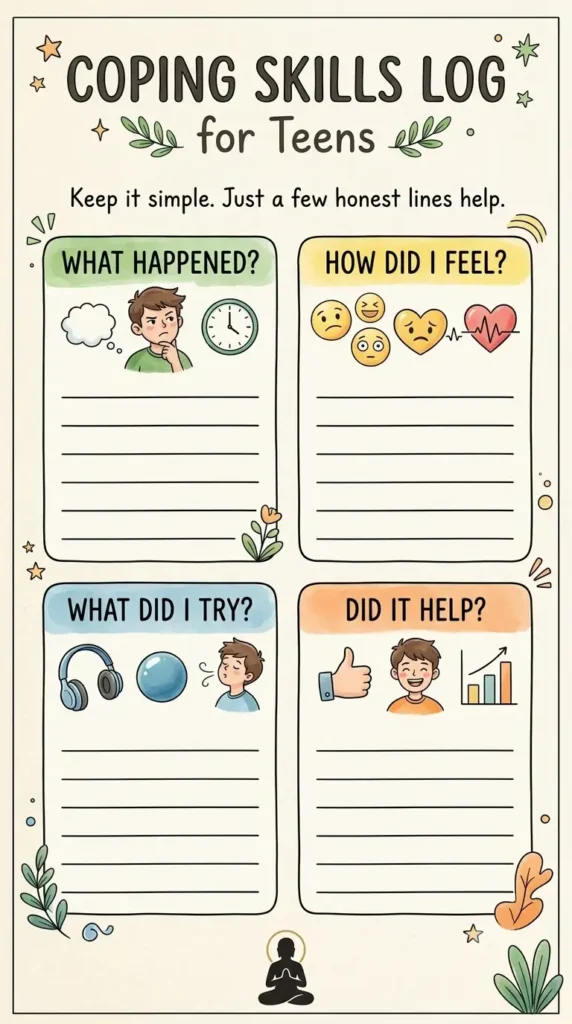
A coping skills log does one simple job. It shows a teen the link between a hard moment, the feeling that followed, and whatever they tried next. No grading involved. Nobody’s reaction gets marked “good” or “bad” here.
The point is smaller and more useful than that. It’s finding out which coping skills actually hold up in a teen’s real life, not just on paper.
Track Real Situations, Not Hypothetical Ones
A made-up scenario teaches a teen nothing about their own patterns. This log works only when it captures something that actually happened. A fight with a friend. A test that went sideways. That sting of being left out. Pressure from school. A day at home that felt like too much.
Write the situation down. Name the emotion. Rate how strong it felt. Note the coping skill used. That’s the whole entry.
Keep it brief. A three-line entry gets finished. A half-page one gets abandoned by day two.
Include Thoughts as Well as Emotions
Same event, two different teens, two completely different reactions. Why? Their thoughts about the moment weren’t the same. That’s the part most logs skip.
A useful coping skills log leaves room for a short note on what was actually going through the teen’s head.
“Everyone is going to think I’m stupid” says far more than the word “anxious” ever could. One names a fear. The other just labels a mood.
Struggling to name the feeling at all? That’s common, and it’s not a dead end. An identifying emotions worksheet helps a teen recognize and put a word to what they’re feeling before they try to log anything else.
Keep the Worksheet Short
Nobody needs ten quiet minutes to fill this out. Not a teen, not anyone. A few honest lines beat a detailed worksheet that gets dropped after two days.
Four questions cover it:
- What happened?
- How did I feel?
- What did I try?
- Did it help?
That’s the whole format. Nothing missing from it.
Avoid Turning It Into Homework Punishment
Once a coping skills log starts feeling like an assignment adults check for mistakes, it’s finished. Teens stop writing in it, or start faking the entries. Neither one helps.
Let the teen keep some control. What gets recorded, which coping skills get tested. Their log, their call.
Looking for something more hands-on to pair with the log? These coping skills activities for teens give teens practical ways to build and practice the strategies they’re tracking.
Coping Skills Log for Young Adults and Adults
A coping skills log for young adults and adults needs to track more than “did I feel calmer.” Adult stress has layers. Work. Relationships. Money. Studies. Responsibilities piling up before you’ve dealt with the last one. A useful log helps you see which responses actually improve your grip on the situation, not just your mood.
Coping Isn’t Always About Calming Down
A coping skill doesn’t have to relax you. Not every time.
Sometimes the better move is action on the problem itself.
Say a hard conversation is looming. Journaling might help you sort your thoughts. But setting a boundary, or planning what you’ll actually say, does more for the stress underneath it.
Same with a heavy workload. Five minutes of breathing eases the tension in your chest. It won’t touch the workload. Breaking the task into smaller steps does.
So when you fill out your log, write down what the skill actually let you do. Did you feel calmer? Think straighter? Skip an impulsive reaction? Solve part of the problem? Reach out for support?
That question gives you a far more useful picture than “did my anxiety go away.”
What Adults Can Track in a Coping Skills Log
Young adults tend to track college, work, friendships, dating, family expectations, money, or a big life change landing all at once. Adults often add workplace pressure, parenting demands, relationship conflict, health-related stress, and the daily grind of ordinary responsibilities.
A simple entry might look like this:
| What to record | Example |
|---|---|
| Situation | Overwhelmed by a deadline |
| Feeling before | Anxious, 8/10 |
| Skill used | Five minutes of slow breathing |
| What changed | Felt less physically tense |
| Next step | Made a short task list |
| Feeling after | Anxious, 6/10 |
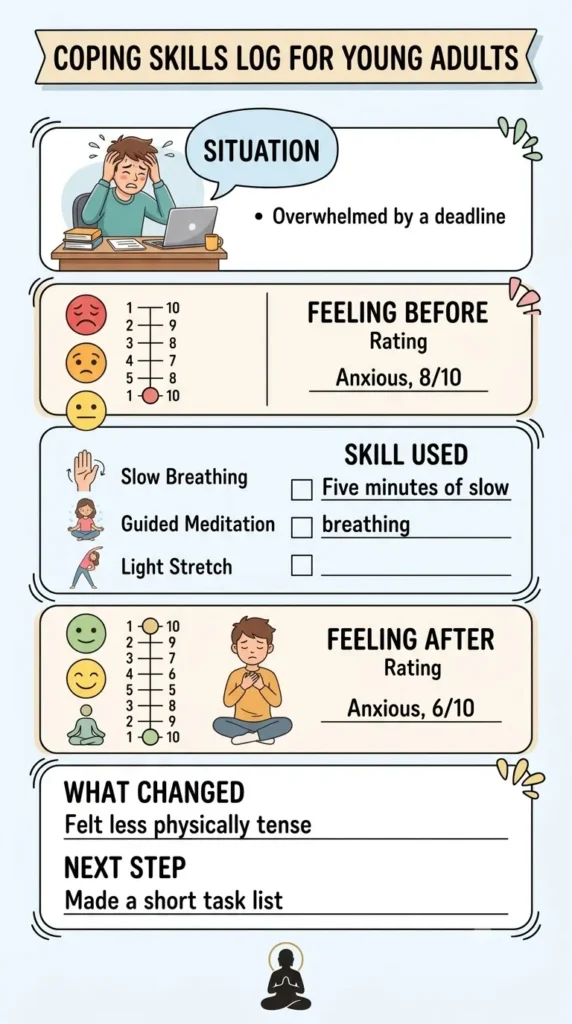
Notice the anxiety didn’t vanish. It dropped two points, and that’s plenty. The strategy still counted, because it made the next step easier to take.
Not sure where to start building your own list of go-to strategies? These coping skills activities for adults give you a practical toolkit to pull from. And if putting the day’s stress into words is part of what helps you land on a next step, these journal prompts for mental health pair well with the log above.
Build a Coping Skills Checklist From Your Logs
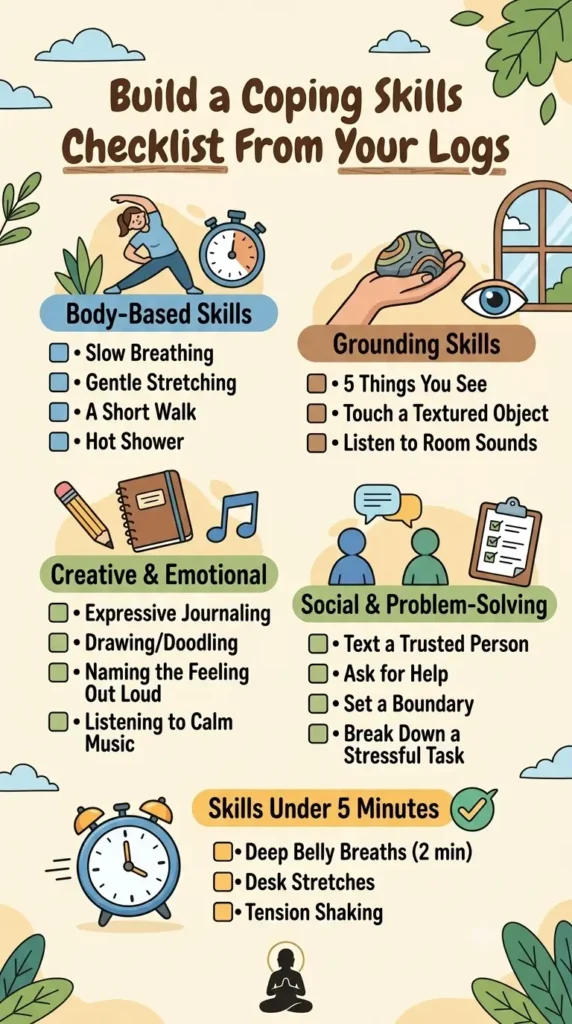
A coping skills log doesn’t lie. It shows exactly what you reach for when stress actually hits, not what sounds good on paper. Give it a few weeks. Patterns start to show up. Those patterns turn into a coping skills checklist: a short, personal list of tools you already know work, understand, and would actually use again.
Body-Based Skills
Start with the body. Stress lands there first, before the mind catches up. Slow breathing, stretching, a short walk, shaking out tension, a hot shower, a quick burst of exercise. All fair game.
Your log tells you what’s realistic. Not what sounds impressive.
Say a 20-minute workout helps. Great. But if you rarely have the time or energy for it, it belongs lower on the list. A two-minute breathing exercise you can do almost anywhere? That goes near the top.
Grounding Skills
Grounding works when your thoughts scatter or an emotion takes over. Five things you can see. A cool object in your hand. The sounds in the room. Describing your surroundings out loud, in detail.
Don’t pad this section with every technique you’ve ever read about. Keep only what you’ve actually tried. The ones that worked when your head got loud.
Emotional and Creative Skills
Sometimes pushing a feeling away just makes it louder. Your logs might already show this. Expressing the emotion beats burying it, for a lot of people.
Journaling. Drawing. Music. Writing down exactly what you’re feeling, or just naming it out loud. “I’m anxious.” Three words. Sometimes that’s the whole skill. If journaling keeps showing up in your log as something that helps, these journal prompts for mental health can give you somewhere to start when the page feels blank. And if naming the feeling is the part that trips you up, an emotions worksheet can help you find the right word faster.
Social Support and Problem-Solving Skills
Not every hard moment needs calming down. Some need a person. Or a plan.
Texting someone you trust. Asking for help outright. Setting a boundary. Breaking a stressful task into smaller, less overwhelming steps. These belong on your checklist too, right next to the breathing exercises.
Once you’ve pulled enough patterns from your log, turn them into a coping skills checklist built from what’s actually worked for you, not a generic template made for someone else.
Skills That Take Under Five Minutes
Keep a short “quick-use” list for the moments that leave you no time at all. Pull only from what your logs already proved works fast, real strategies for real stressful moments, not a wish list of things you meant to try someday.
That’s the whole point of the log. It tells you the truth about what actually helps. Your checklist just has to listen.
List of Coping Skills Printable: What to Keep on Hand
A list of coping skills printable saves you when stress hits hard. Not a flaw. Decision-making just gets harder under pressure. Instead of hunting for ideas mid-crisis, keep a short list close by. Save it. Print it. Keep it where you’ll actually see it.
Keep a Full Coping Skills List at Home
This one doesn’t need limits. A full coping skills list can hold everything you’re willing to try. Think breathing exercises, grounding, journaling, movement, music, talking to someone, or taking a short break.
Don’t make the list enormous just to have options. A long list turns useless once you’re already overwhelmed. That’s the trap. Group your skills by what they help with instead.
Calming your body. Shifting your attention. Expressing emotion. Connecting with someone. Solving a problem. Sorted that way, you can actually find what fits the moment.
Keep a Short Coping Skills Checklist for Difficult Moments
Your coping skills checklist should stay way shorter than your master list. Pick a handful of strategies you’ll actually use. Nothing fancy. Something realistic, something easy to remember when your mind is racing.
For example:
- Take five slow breaths
- Name five things you can see
- Drink some water
- Step outside for a few minutes
- Write down what’s bothering you
- Text or call someone you trust
You don’t have to use every strategy on it. Not even close. The checklist exists to cut down the decisions you have to make once your mind feels crowded.
Turn Your Printable Into a Personal Toolkit
Your printable shouldn’t stay the same forever. Use your coping skills log to track what actually helps. Cut the strategies you never touch. Keep the ones that consistently pull you back down. Add new ones worth testing.
Want more ready-made lists? Our coping skills worksheets page has printable lists, cards, and handouts ready to use.
Create Your Own Coping Plan Template
A coping plan is not complicated. It is a short written guide for what you do the moment stress starts to build, before the big emotions take over. Think of it as your coping skills log put into action. The skills you’ve already tested get turned into a real plan instead of scattered notes.
You already know which coping skills work for you if you’ve been tracking them. A coping plan template just puts those wins in order.
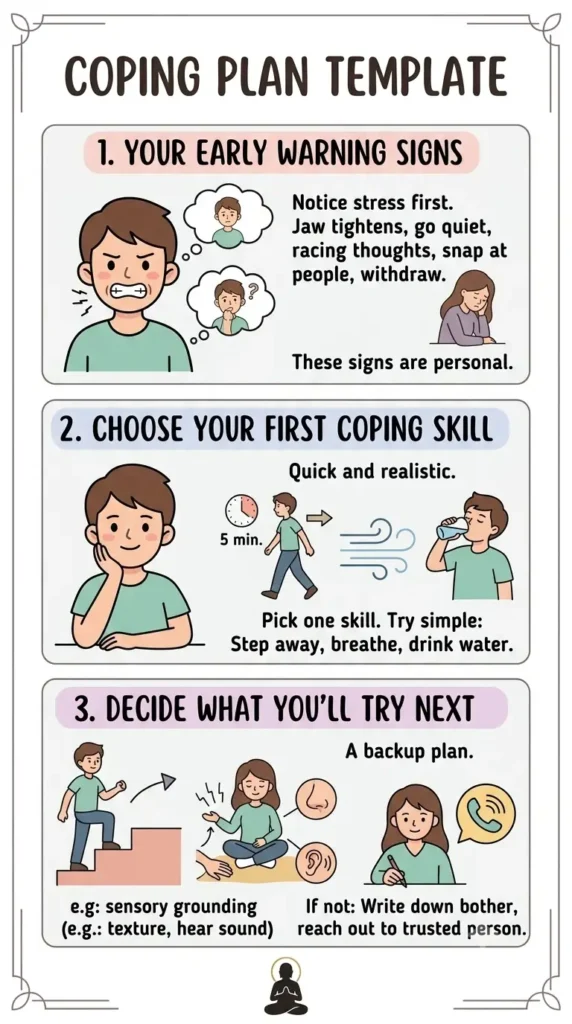
Start With Your Early Warning Signs
Notice the signs first. That’s the whole starting point. Most people wait until they’re already overwhelmed, and by then the plan is much harder to use.
Write down what stress looks like on you specifically. Maybe your jaw tightens. Maybe you go quiet, or your thoughts start racing, or you snap at people for no real reason. Some people withdraw completely and want to avoid everyone.
These signs are personal. That’s the point.
A coping skills chart or a simple list of coping skills printable can help you track these patterns over time, so the warning signs become obvious instead of hidden.
Choose Your First Coping Skill
This isn’t about stacking ten coping skills into one plan. Why two skills instead of ten? Because two you’ll actually remember under pressure.
Pick a skill you’ve already tested through your coping skills log. Something quick. Something realistic enough to use when your hands are shaking or your brain feels foggy.
Your plan might read like this:
When I notice: I’m getting overwhelmed during work or school.
I will first: Step away for five minutes. Breathe slow. Drink some water.
Simple works better than clever here. A crowded coping skills checklist looks impressive on paper and falls apart the moment you actually need it.
Decide What You’ll Try Next
One skill is not a guarantee. Build a backup, because sometimes the first thing doesn’t land.
Here’s what that looks like in practice:
First: Take a short break and use grounding.
If that doesn’t help: Write down what’s actually bothering you. Name one next step.
If I still can’t manage it: Reach out to someone I trust or get proper support.
That’s the difference between a plan and a wish. A wish assumes the first skill always works. A plan expects it might not, and prepares anyway. This same logic runs through a good coping skills worksheet, one option rarely covers every situation.
Coping Plan vs. Clinical Safety Plan
These two get confused constantly, and they aren’t the same thing.
A coping plan handles everyday stress. Racing thoughts before a deadline. Irritability after a hard day. The stuff most people deal with weekly, sometimes daily.
A safety plan is different. It’s a specific intervention for when someone may be at risk of harming themselves, and it includes warning signs, personal and professional supports, and crisis resources. That’s a heavier document for a heavier situation. It should be built with proper guidance, not pieced together alone.
If you want a more layered version of this template, the coping-ahead worksheet walks through preparing for situations you know are coming, before the stress even starts.
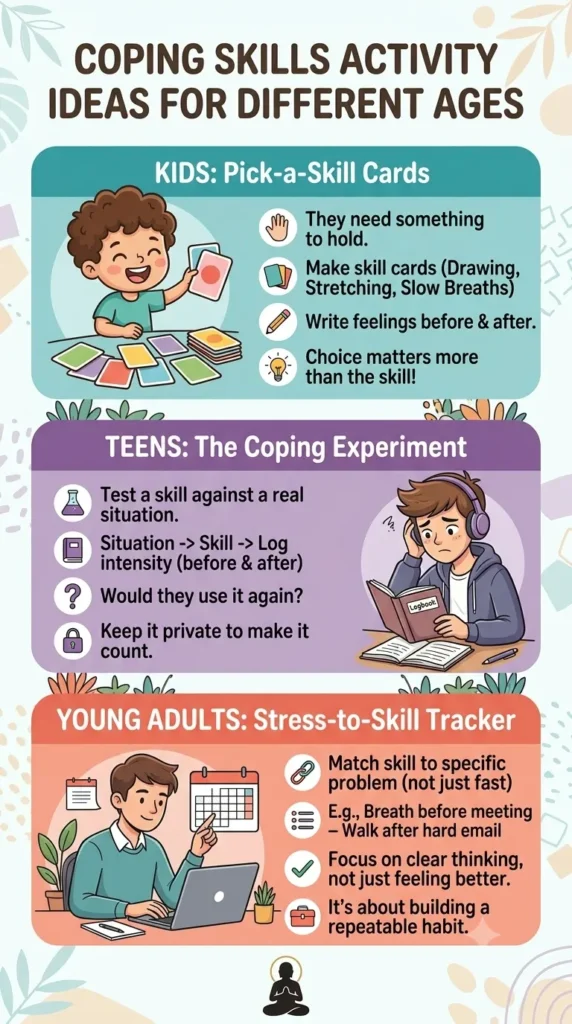
Coping Skills Activity Ideas for Different Ages
A coping skills activity gives you a chance to test a strategy before a hard moment shows up and forces your hand. The best ones stay simple. They fit the age they’re built for. And they’re easy to repeat next week without feeling like homework. Use a coping skills log to write down what you tried and whether it actually worked.
Kids: Pick-a-Skill Cards
Kids don’t need a lecture on coping. They need something to hold.
Make a small stack of cards, one skill per card. Slow breaths. Drawing. Stretching. Squeezing a pillow. Music. Asking a trusted adult for help. Keep the list short enough that a kid can scan it in five seconds.
Let the child pick a card themselves. That choice matters more than the skill. Then write down how they felt before and after, nothing fancy, just a word or a number.
Here’s the part most parents miss: the goal isn’t a perfect hit rate. Not every card will work every time. A feelings worksheet can help kids name what they’re feeling before they even reach for a card, which makes the whole exercise land better.
What you’re really building is a kid who knows their own options. That’s worth more than any single skill working on command.
Teens: The Coping Experiment
This isn’t about handing a teenager a list and walking away.
Pick one situation that shows up again and again. A rough day at school. An argument that won’t leave their head. That heavy, overloaded feeling before a test. Then test one coping strategy against it, on purpose, like a small experiment.
Grounding after school. A short walk after a fight. Journaling when things feel like too much. Have them log the situation, the skill, and the emotional intensity before and after on a simple scale. Would they use it again? That’s the only question that really counts.
Why does this work better than a generic list? Because it turns the log into something private, something they’re running for themselves, not a worksheet a teacher assigned. If they want more structure for the journaling piece, mental health journal prompts give them somewhere to start without staring at a blank page.
Young Adults: Stress-to-Skill Tracker
Adults don’t lack coping skills. They lack the habit of matching skill to problem.
A stress-to-skill tracker fixes that. Log the actual situation. A hard class. A deadline closing in. A fight with a friend. A schedule that’s already full before the day starts. Then choose a strategy that fits that specific problem, not just whatever’s fastest to reach for.
Afterward, ask one honest question: did this help me feel calmer, think straighter, or actually deal with the problem? Those are three different outcomes. Coping isn’t always about making a bad feeling vanish. Sometimes it’s about thinking clearly enough to solve what’s in front of you. Sometimes it’s just getting through the next hour.
A few ways young adults connect stress to skill:
- Deep breathing before a tense meeting
- A short walk before responding to a hard email
- Writing down the actual problem instead of just the feeling
- Naming what’s in your control and what isn’t
For more structured options, explore our coping skills group activities, a full collection built for exactly this.
Common Mistakes When Using a Coping Skills Log
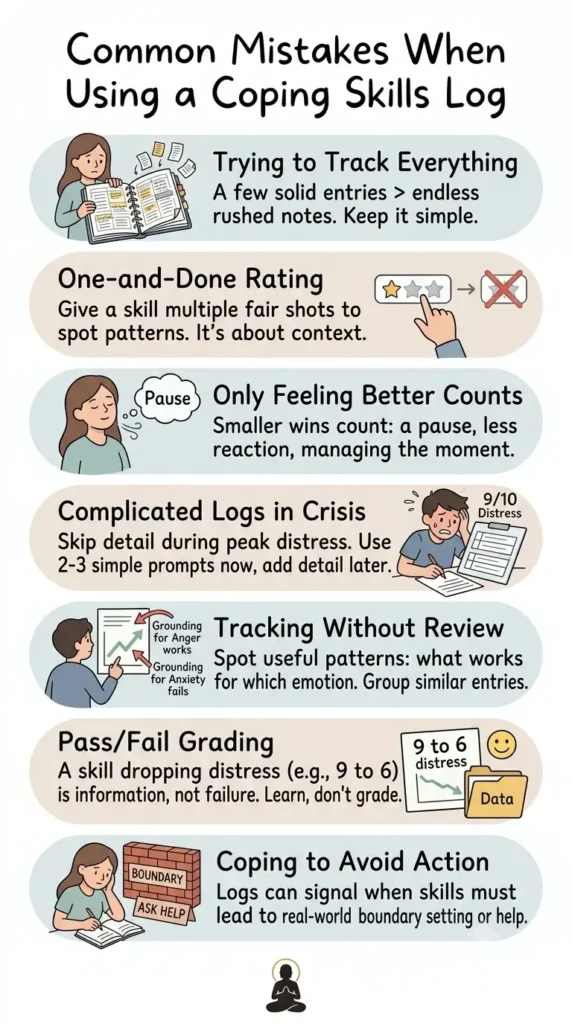
A coping skills log works best as a mirror, not a chore. It reflects what actually helps. It doesn’t grade you on how well you filled in the boxes.
The most useful logs stay simple. Honest, too. And reviewed more than once. Skip a few common traps and your tracking starts working for you instead of against you.
Trying to Track Everything
You don’t need to log every stressful moment. Every thought. Every coping attempt you half-tried on a Tuesday. That’s not the goal.
Chasing that kind of detail turns a simple coping skills worksheet into one more source of stress. Ironic, but it happens constantly.
Start with what shows up often. Or what hits hardest. A few solid entries beat a week of rushed, half-finished notes every time. If you’re building a log for a kid, keep the entries even shorter.
This coping skills worksheet for kids shows what that looks like in practice. Teens usually need fewer prompts too, not more, which is the whole logic behind a shorter coping skills activity for teens.
Rating a Skill After Only One Attempt
This isn’t about giving up after one bad try. One disappointing round doesn’t mean a coping skill failed.
A breathing exercise might settle mild frustration fine. Then feel useless once you’re already at a 9 out of 10. That’s not the skill’s fault. That’s just context.
Give a skill more than one fair shot, when it’s safe to do so. Your log should show patterns. Not snap judgments made on a rough day.
Assuming “Feeling Better” Is the Only Measure
A coping skill doesn’t always erase the bad feeling. That’s the part most people get wrong.
Sometimes the real win looks smaller. A pause before you react. Focus long enough to finish one task. A clearer sentence instead of a snapped one. Getting through the moment without making it worse counts too.
When you fill out your log, write down what actually shifted. Not just whether the feeling disappeared. If naming that shift feels hard, a quick pass through an emotions worksheet can help you find the words first.
Using a Complicated Worksheet During Peak Distress
Skip the detailed worksheet when you’re already maxed out. It won’t work. Not in that moment.
Your attention narrows under high distress. Decisions get harder. That’s not a personal failure. That’s just how a stressed brain runs.
Keep a short version on hand for those moments. Two or three prompts, nothing more. Add detail later once you’ve got the mental space for it.
Tracking Without Reviewing the Patterns
Skip the review and the log just becomes a pile of notes. Nothing more.
Look back every so often. Read through several entries at once, not just the last one. You’ll usually spot something useful. Maybe grounding works for anger but falls flat during full-blown overwhelm.
Without that step, you’re collecting data and learning almost nothing from it. A coping skills chart that sorts entries by trigger or emotion makes this review faster, since patterns jump out sooner when similar entries sit side by side.
Turning Coping Into a Pass/Fail Test
Most people treat their log like a gradebook. It isn’t one.
A skill that drops distress from a 9 to a 6 still did something. Even if you were hoping for a 3. That’s not a failed attempt. That’s real movement.
Treat every entry as information, nothing else. The goal is understanding what helps, when it helps, and what’s worth trying differently next round.
Using a Coping Skill to Avoid a Problem That Needs Action
Here’s an honest take most logs skip. Some situations need calming down first. Others need an actual move.
Journaling might settle you after an argument. It won’t fix what the argument was about. If your log keeps showing the same problem coming back week after week, that’s a signal worth reading closely.
Maybe the next step isn’t another coping skill at all. Maybe it’s setting a boundary. Asking for help outright. Saying the hard thing directly instead of writing around it. A coping plan template built around your recurring log entries can help you spot exactly where a coping skill needs to hand off to real action.
Conclusion
A coping skills log is most useful when it helps you understand what actually works for you, rather than becoming another worksheet you feel obligated to complete. Track the situation, notice how you feel before and after, and give yourself enough entries to spot patterns.
Some skills will calm you quickly. Others may help you think clearly, solve a problem, or prevent stress from getting worse.
That information is worth keeping. Over time, your log can become a practical coping skills checklist built around your real life—not someone else’s idea of what should help. Start with one difficult moment and one skill, then learn from what happens.
Frequently Asked Questions
What is a coping skills log used for?
A coping skills log helps you record stressful situations, the coping strategy you used, and what changed afterward. Over several entries, it can reveal which strategies actually help you manage difficult emotions, which situations trigger you most often, and which skills are worth keeping in your personal coping toolkit.
What should I write in a coping skills log?
Record the situation or trigger, the emotion you felt, your intensity before using a skill, the coping skill you tried, how long you used it, and what happened afterward. You can also record whether you’d use that skill again and what you might try differently next time.
How do I know if a coping skill is actually working?
Look beyond whether you immediately felt calm. A useful coping skill may reduce emotional intensity, help you think more clearly, make it easier to function, or prevent a situation from getting worse. Track these changes over several situations instead of judging a skill from one attempt.
Can kids use a coping skills log?
Yes. A coping skills log can work well for kids when it’s simplified and visual. Instead of lengthy written answers, children can circle an emotion face, rate how big a feeling is, choose the coping skill they tried, and show whether the strategy helped.
What is the difference between a coping skills log and a coping plan?
A coping skills log records what you actually did during stressful situations and what happened afterward. A coping plan is more proactive: it identifies warning signs and decides which strategies you intend to try. Your logs can help you build a more realistic coping plan over time.
How often should you use a coping skills log?
Use a coping skills log whenever you intentionally practice a coping strategy during a stressful or emotionally difficult situation. You don’t need to document every uncomfortable moment.
#A handful of useful entries each week can be enough to reveal patterns without turning emotional self-monitoring into another source of stress.

It’s Bhaskar!
Well, I am not a psychologist a monk, or a philosopher by training. I’m just an engineering graduate.
‘The Empty Self’ is where I write about that idea, and what it actually means for ordinary life, anxiety, identity, habits, the stories we tell ourselves about who we are. I don’t have a psychology degree, and I’m not offering therapy or clinical advice. What I do have is thought and clarity, and genuine curiosity about why we suffer the way we do and how much of it might loose once we shed this ‘fixed identity’.