
Being a teenager comes with stress, anger, anxiety, or just feeling wrecked. That’s normal. Nobody hands teens a manual for the hard moments, though. Most figure it out alone, badly, or not at all.
The CDC found that 4 in 10 U.S. high school students reported persistent sadness or hopelessness in 2023. Four in ten. That’s not a handful of kids having a rough week. That’s most classrooms.
The right coping skills activities for teens change that math. They give a teen something to actually do with a hard feeling instead of just sitting in it. Pause. Notice what’s happening. Pick a next step. This guide sticks to activities that are simple, free, and usable at home, at school, or sitting across from a trusted adult.
One thing first. These are educational tools. They’re not therapy, and they don’t replace a licensed professional. If a teen is stuck in ongoing distress, feels unsafe, or needs more than an exercise can give, reaching out to a mental health professional or a trusted adult matters more than any worksheet.
Quick overview: Coping skills activities for teens are short exercises that help young people handle stress, hard emotions, and racing thoughts. Grounding, journaling, movement, creative expression, breathing, thought-reframing. All of it counts. The goal was never to erase the emotion. It’s to make the emotion easier to carry.
Table of Contents
Quick Guide: Which Coping Skill Should a Teen Try?
Not every coping skill fits every moment. Anxiety at school needs something fast and quiet. Sadness at home might need more space. That’s the whole problem with generic advice. It hands teens one tool and expects it to work everywhere.
This quick list of coping skills for teens skips that trap. Match the feeling to the moment. Match the moment to the setting. That’s it.
| Situation | Try This First | Who’s Around Right Now? |
|---|---|---|
| Anxiety | 5-4-3-2-1 grounding or slow breathing | Alone, at school |
| Anger | Anger reset, stretching, or a short walk | Alone, with a parent |
| Overthinking | Worry dump and sort | Alone, with a parent |
| Sadness | Draw your emotion, journal, or talk to someone | Alone, with a parent |
| Overwhelm | Five-minute check-in and one small next step | Alone, at school |
| Social stress | Thought reframe or reach out to someone you trust | Alone, in a group |
Setting changes everything. A breathing exercise works fine mid-class. Nobody notices. A longer journaling session doesn’t. Save that one for home, where there’s room to actually sit with it. If journaling feels like the right fit for sadness or overthinking, these journal prompts for mental health give a starting point instead of a blank page.
Here’s an honest take on most coping skills for teens content: it acts like one strategy should work for every teen, every time. It won’t. Bodies react differently. Brains process differently. What calms one teen down might make another feel more stuck.
So the goal isn’t a single perfect answer. It’s a small toolkit. A few coping strategies for teens that actually get used, not just written down once and forgotten in a folder.
Want the visual version to keep on hand? Grab the free coping skills worksheets for teens and pair it with an emotions worksheet to name the feeling before picking the tool.
10 Best Coping Skills Activities for Teens
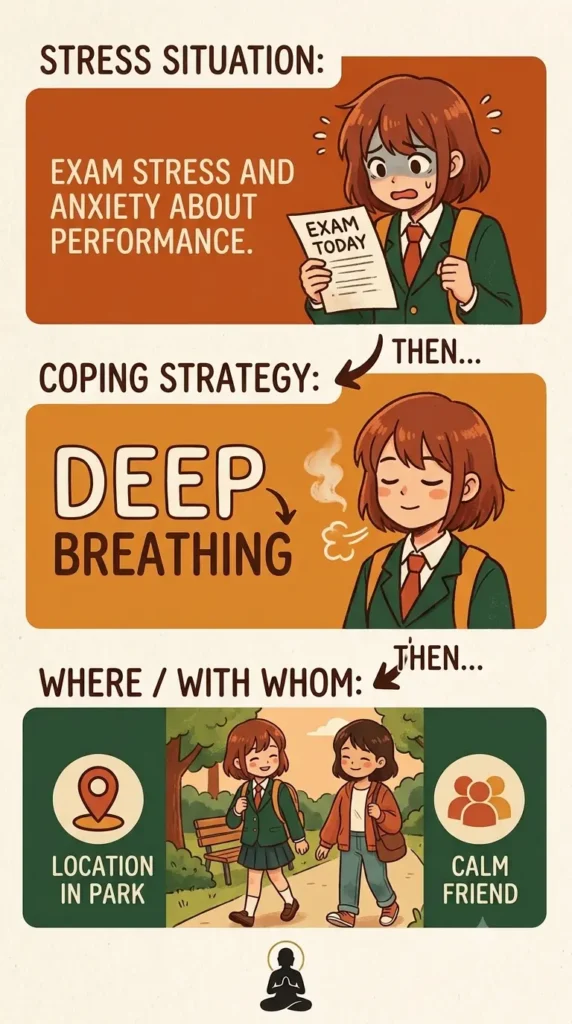
Good coping skills activities for teens don’t need a therapist in the room. They need five minutes and a teen willing to try something small. The five coping strategies for teens below cover emotional awareness, grounding, anger, worry, and creative expression.
Simple enough to use mid-meltdown. Structured enough to actually teach something. For a deeper set of tools, the full coping skills worksheets collection goes further than any single list can.
1. 5-Minute Coping Skills Check-In
This one buys time. A teen slams their door after a bad class, an argument, an awkward hallway moment. Before reacting, they pause. That’s the whole function of a 5-minute coping skills check-in.
Have them scribble quick answers to five prompts:
- What happened? Just the facts, no judgment attached.
- What am I feeling? Name it as specifically as you can.
- Where do I feel it? A tight chest, a racing heart, clenched shoulders.
- What do I need right now? Space, movement, reassurance, distraction, connection.
- What coping skill will I try? Pick one. Give it five minutes.
Nobody needs a polished journal entry here. A few honest words do the job. The check-in just wedges a pause between the feeling and the reaction. That pause is the entire point of most coping skills worksheets for teens, and it starts with naming what’s actually going on.
Our emotions worksheet is a solid companion for that second prompt, especially with teens who freeze at “how do you feel.”
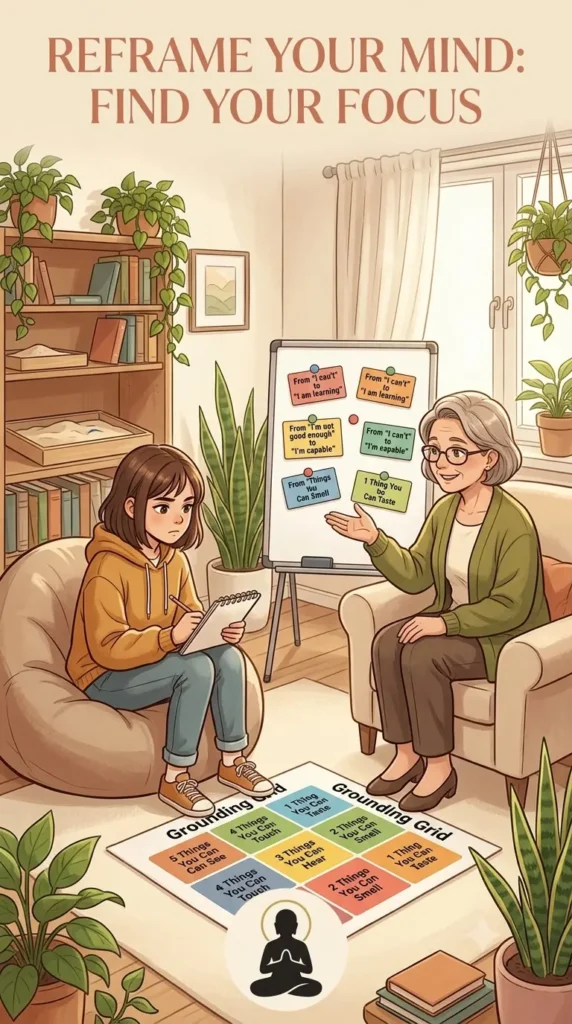
2. Grounding With the 5-4-3-2-1 Technique
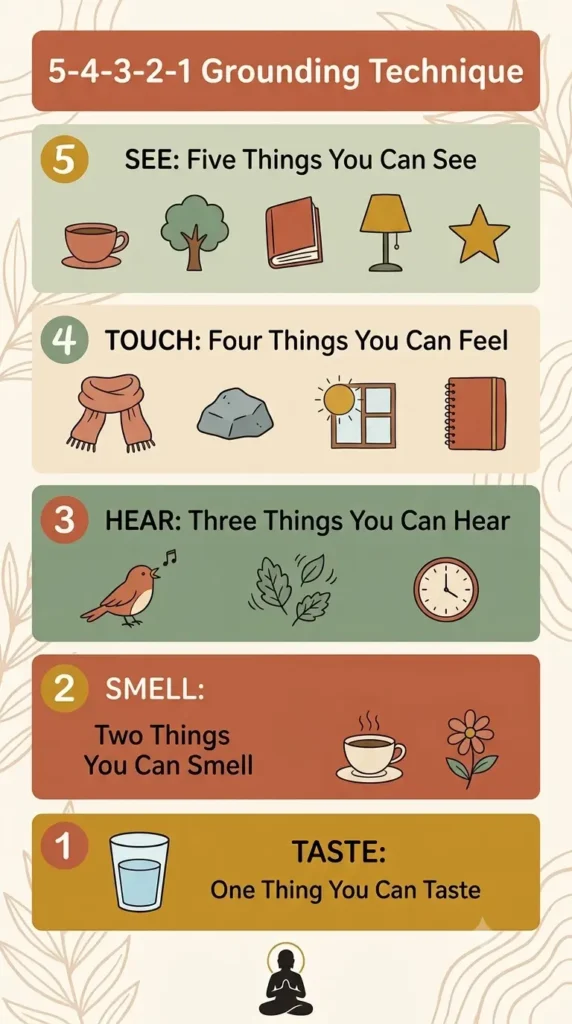
Spiraling thoughts don’t stop because someone says “calm down.” They stop when attention gets pulled somewhere else. That’s what the 5-4-3-2-1 technique does. It routes a teen’s focus through their five senses and back into the present moment.
Ask them to name:
- 5 things they can see
- 4 things they can touch or feel
- 3 things they can hear
- 2 things they can smell
- 1 thing they can taste
No silence required. No privacy either. That’s what makes it one of the more practical coping skills activities for teenagers. In class, a teen can run through five objects on their desk without saying a word. In a crowded hallway, sound and texture work just as well.
3. The Anger Reset Activity
Anger isn’t the problem. Acting on it before it settles is. Anger management activities for teens work best when they build a pause into that gap, not when they try to erase the anger itself. It’s information. The trick is what happens next.
Try this four-part reset:
- Notice: Tight fists, clenched jaw, heat rising, breath speeding up.
- Pause: Step away if it’s safe. Don’t send the text at peak anger.
- Release: Stretch, walk it off, shake out your arms, push against a wall.
- Choose: Once the intensity drops, decide the next move. Talk, write it down, ask for space, find a trusted adult.
Telling a teenager to calm down usually lands flat. It sounds dismissive. “Let’s get the intensity down enough to choose your next move” works better, because it doesn’t ask them to stop feeling something real.
4. Worry Dump + Three-Bucket Sort
Racing thoughts need somewhere to land besides a teenager’s head. A worry dump gives them that place. Hand over a sheet of paper. Let every worry spill out. No editing. No making the thoughts sound reasonable.
Then sort each one into a bucket:
- I can act on this: Write one small step. Stressed about a test? Review one topic for 15 minutes.
- I can’t control this: A friend’s mood, a post online, whether someone changes their mind.
- I need help with this: Bullying, ongoing family conflict, anything that feels unsafe.
Here’s the value in this coping skills activity for teens: not every worry deserves equal weight. Separating them is the skill. Pairing the dump with structured journal prompts for mental health gives a teen somewhere to keep returning when new worries show up.
5. Draw Your Emotion
Some teens go quiet the moment you ask how they feel. Words shut the door. A blank page doesn’t. Draw Your Emotion sidesteps the whole conversation by asking for a picture instead of an explanation.
Pick one emotion. Put it on paper. Realistic, abstract, messy, weird, it doesn’t matter. There’s no grading rubric here.
Once it’s down, a few optional prompts can open things up further:
- What shape would this emotion take?
- Where do you feel it in your body?
- What color or texture fits it?
- What is it trying to tell you?
- What would make it slightly less intense?
Sound too simple for something as heavy as an unnamed emotion? It works precisely because it skips the pressure of finding perfect language. The drawing isn’t the goal.
Giving a complicated feeling somewhere to go is. Pair this with the identifying emotions worksheet for teens who want a more structured way to name what showed up on the page.
6. Build-Your-Own Coping Bingo
A worksheet a teen didn’t choose gets ignored fast. Hand them one they built themselves, and something changes.
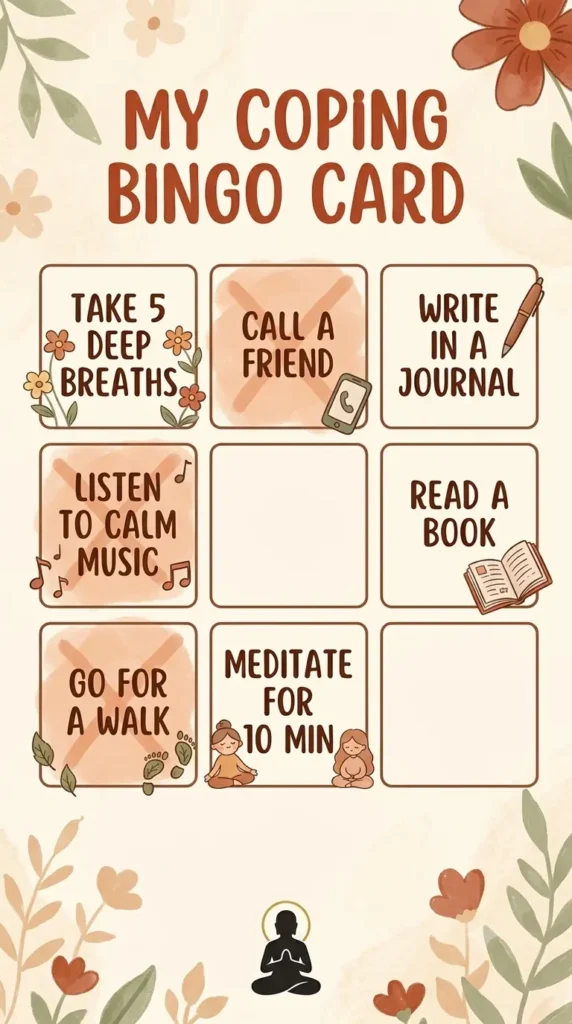
Build-Your-Own Coping Bingo turns a list of coping skills into a personal challenge instead of another handout. Start with a blank 3×3 grid. Let the teen fill it in from a menu that actually fits their week, not a generic list of coping skills for teens copied off a poster.
Possible squares include:
- Take five slow breaths
- Listen to one calming song
- Write down what’s bothering me
- Text someone I trust
- Spend five minutes outside
- Stretch for two minutes
- Draw what I’m feeling
- Put my phone away for 10 minutes
- Name one thing I can control
The teen fills in the rest with their own ideas. Then they aim for one or two squares a day. Nothing fancy required.
For group settings, everyone builds a different card. Comparing them afterward makes this one of the more useful coping skills group activities for teens, and nobody has to compete over who’s “coping correctly.” There isn’t a correct way. There’s just what works for that teen, that week.
7. Create a Coping Playlist That Changes the Mood
Most playlists try to yank a bad mood into a good one immediately. That’s backwards.
A coping playlist works better when it follows an emotional arc instead of fighting the mood head-on. Ask the teen to build a short list that starts where they actually are and drifts toward where they want to land.
The first song can match the frustration or the sadness. Let it. The next few songs ease that emotion down a notch. The last song should feel calmer, lighter, steadier than where the list began.
Different situations call for different playlists. One for anxiety before school. One for a rough commute home. One for winding down after a day that wouldn’t quit.
Here’s the part people miss: a coping strategy doesn’t need to sound cheerful to actually help. Starting with a song that matches the emotion often makes it easier to move away from it, not harder.
8. Body Reset: Stretch, Shake, Walk
This isn’t a workout. It’s not about burning anything off.
When stress shows up in the body, thinking your way out rarely works. A body-based reset can do what logic can’t. The teen picks a short movement that feels safe and doable, not another form of exercise-as-punishment.
Try one of these:
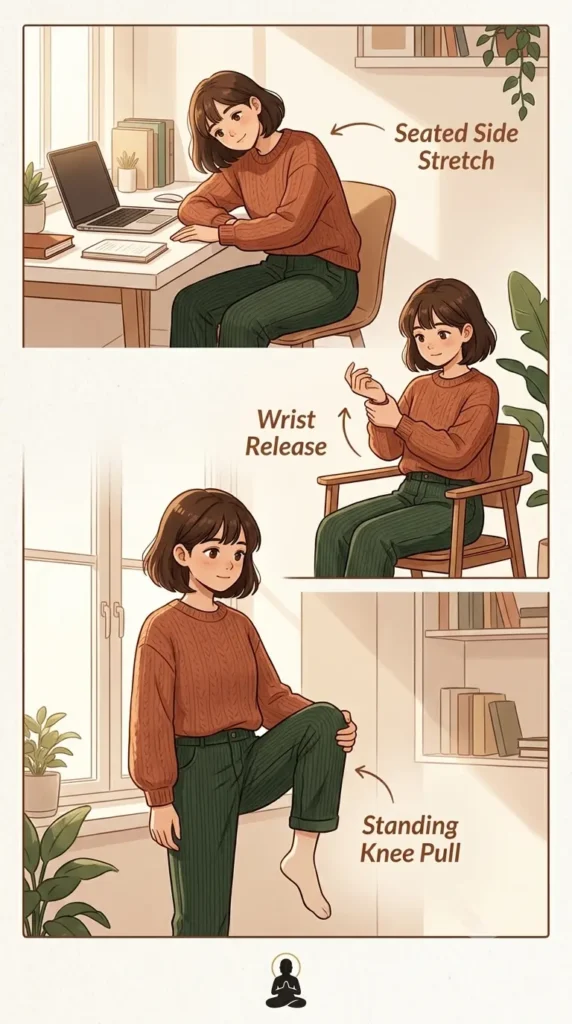
- Stretch the neck, shoulders, and arms for two minutes.
- Walk around the house or outside for five to ten minutes.
- Shake out the hands, arms, and legs to release tension.
- Slowly tense and relax different muscle groups.
- Push both hands gently against a wall for several seconds, then release.
At school, walking away usually isn’t an option. So a teen can quietly roll their shoulders. Stretch their hands under the desk. Press their feet into the floor while breathing slowly. Small moves. Nobody has to notice.
The goal isn’t to burn off a feeling. It’s to give an activated body a different signal, one that says it’s allowed to slow down.
9. “What Would You Tell a Friend?” Thought Reframe
Most teens are harder on themselves than they’d ever be on a friend. Why does that gap exist?
This exercise closes it. Write the harsh thought down. Then imagine a close friend saying the exact same thing about themselves.
For example: “I completely messed up that presentation. Everyone thinks I’m stupid.”
Now ask: what would I say to a friend who told me that?
The answer usually softens on its own. Something like, “You had a rough presentation, but one awkward moment doesn’t tell you what everyone thinks of you.”
Have the teen write four short lines:
- What happened: What actually occurred, no exaggeration.
- What I’m telling myself: The automatic thought, word for word.
- What I’d tell a friend: The honest version, without cruelty.
- A more balanced thought: What’s true and still bearable.
This CBT-style coping activity for teens isn’t about swapping every bad thought for a forced good one. It’s about checking whether the thought is fair before believing it. That’s it. No positivity required, just honesty.
For more structured versions of this kind of exercise, the coping skills worksheets page has printable formats built for exactly this.
10. Build Your Personal Coping Skills Toolbox
A coping skills toolbox is a short list. Nothing fancy. Just a handful of strategies a teen can reach for when stress, anger, or anxiety starts climbing.
Here’s the problem with most advice on this topic. It tells teens to collect every coping skill they can find online. Then the list gets so long nobody actually uses it. The real goal is smaller than that. Find the few strategies that fit an actual life, not a Pinterest board.
Step 1: Pick Your Quick Coping Skills
Start with strategies that take five minutes or less. They need to work almost anywhere. Slow breathing counts. So does grounding, a quick thought dump, one song on repeat, or a short stretch.
Think about where the skill actually gets used. A strategy that works at home might fall apart in the middle of math class. Test it in the place it’s needed, not just in a calm bedroom.
Step 2: Add Body-Based Skills
Stress doesn’t just live in the head. It sits in the shoulders, the jaw, the stomach. Pick one or two moves that give the body something to do. Walking works. So does stretching, progressive muscle relaxation, or shaking out tension like a wet dog.
Step 3: Add Emotional Expression Skills
Distraction has its place. But it’s not the same as processing. Drawing, journaling, making music, or talking to someone you trust does something distraction can’t: it moves the feeling instead of just muting it.
Want a place to start? These coping skills worksheets for teens walk through prompts built for exactly this step.
Step 4: Add Your “Ask for Help” Skill
A toolbox with only solo activities is missing something. Write down a person, not just a task. Name who gets the call when coping alone stops being enough, and write down how you’ll reach them.
A phone number. A “just walk into their office” plan. Something concrete beats a vague intention every time.
How to Choose the Right Coping Strategy for a Teen
The right coping skill depends on the moment. Not the mood.
A slow breath fixes a bad test day. A blowup in the group chat needs something else entirely.
Picking from a list of coping skills activities for teens isn’t about finding one magic fix. It’s about building a small toolkit that flexes with whatever hits next.
When Their Body Feels Overactivated
Shaky hands. A racing heart. Restless legs that won’t sit still.
That’s a body stuck in overdrive. Talking won’t fix it first.
Start with something physical. Slow breathing works, and so does a short stretch or a walk around the block. Simple grounding pulls attention off the stress response before it spirals.
Words come later. The body has to come down first.
This works right after a hallway conflict. Or in the five minutes before walking into a class that already feels loaded.
When Their Thoughts Won’t Slow Down
Racing thoughts don’t need more thinking. They need somewhere to land.
A quick worry dump gets the noise out of the head. So does a thought-sort worksheet, or a short journal entry. Easier to sort once it’s on paper.
What can they actually control right now? What isn’t theirs to fix?
These coping skills worksheets work well here. Pairing them with structured prompts gives a teen a place to start. Try the ones in these journal prompts for mental health. Beats staring at a blank page.
A five-minute journal entry is often all it takes.
When They Need to Express an Emotion
Some teens can’t explain why they’re upset. That’s fine. They don’t have to.
Drawing, writing, building a playlist, or matching a feeling to a color skips the explaining part completely.
An emotions worksheet helps here too, especially for teens who freeze up when asked what’s wrong.
Sound too simple to work? It is. That’s exactly why it does.
When They Need Connection
Sometimes the best coping skill isn’t a skill at all. It’s a person.
A text to a trusted friend can matter more than any worksheet. So can a parent, teacher, counselor, or any adult who’s shown up before.
This matters most after a friendship fallout. Or a group chat that turned ugly fast.
Connection is the coping strategy. Not a backup.
When They’re Too Overwhelmed to Choose
High distress and ten options don’t mix.
Handing a teen a full list of coping strategies for teens in that state adds more to process. Strip it down.
One move: pause, breathe slow, get somewhere that feels safe. That’s it.
Once the intensity drops even a little, they can figure out what fits. What kind of therapy worksheets for teens or activity works best. Not before.
Coping Skills Activities for Teens at Home, School, and Therapy
The right coping activity depends on where a teen is standing. Not just what’s wrong. A trick that works alone in a bedroom can fall apart in a loud hallway between classes. That’s the whole problem with generic advice. So the activities below are built to flex: solo practice, family support, classrooms, therapy rooms.
Activities Teens Can Do Alone
Some coping skills only work with the door closed. No audience, no questions, no explaining. Journaling, grounding, drawing, music, stretching, a two-line emotion check-in. These give a teen room to sort through what they need before anyone else gets involved.
Here’s the rule that actually matters: keep it small enough to start mid-crisis. A teen drowning in exam stress isn’t opening a 20-minute worksheet. Not happening. But two minutes to scribble down the worry, name the feeling, pick one next step? That, they’ll try.

Activities Parents Can Do With Teens
Parents don’t need to turn every hard feeling into a therapy session. Sometimes the most useful thing is sitting nearby. Listening. Helping a teen pick a coping strategy without judging the emotion that triggered it.
The American Psychological Association recommends paying attention to changes in a teen’s behavior and helping young people work through overwhelming stress rather than dismissing or ignoring it. The CDC points in the same direction, encouraging calm, empathetic responses that help teens recognize and manage their emotions.
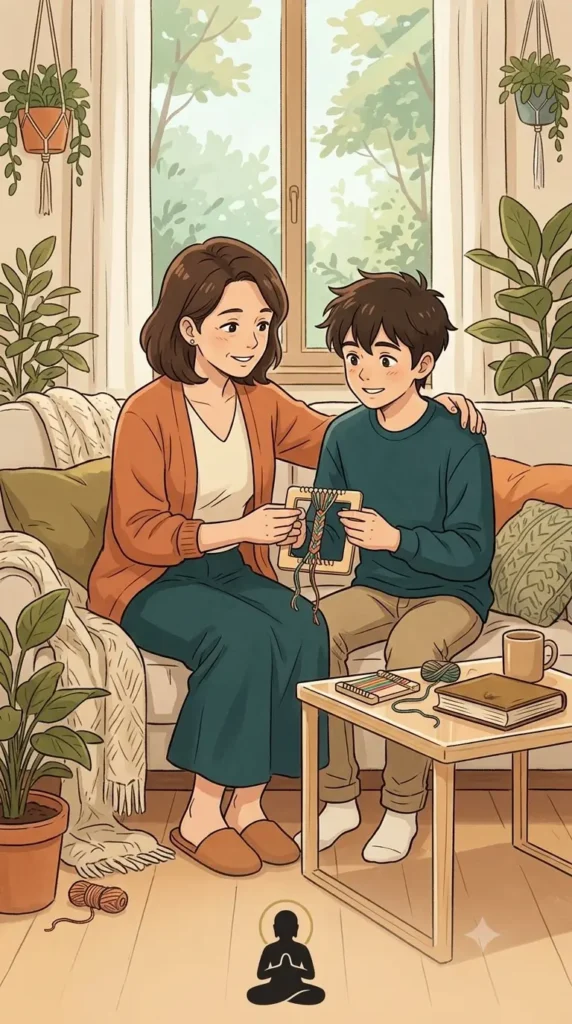
Try the activity with your teen instead of assigning it to them. That distinction changes everything. A short walk, a music reset, a journaling prompt, a breathing exercise. Any of these gets easier when it feels like shared time instead of homework.
Looking for more structured options? The coping skills worksheets for teens section has printable prompts built for exactly this kind of shared practice.
Activities for School or Youth Groups
School is where coping skills get tested for real. A teen can’t leave class after a brutal group-chat message. Can’t take a 20-minute walk between periods. The skill has to fit inside the five minutes they actually have.
Short, discreet tools work best here: sense-based grounding, a private thought dump, a quick body reset, breathing nobody notices. The APA’s student guidance backs this up, recommending self-calming strategies such as breathing, drawing, and journaling when students experience anxiety.
For youth groups, skip the “everyone share something personal” format. It backfires more than it helps. A discussion-card approach works better, and it’s free to build.
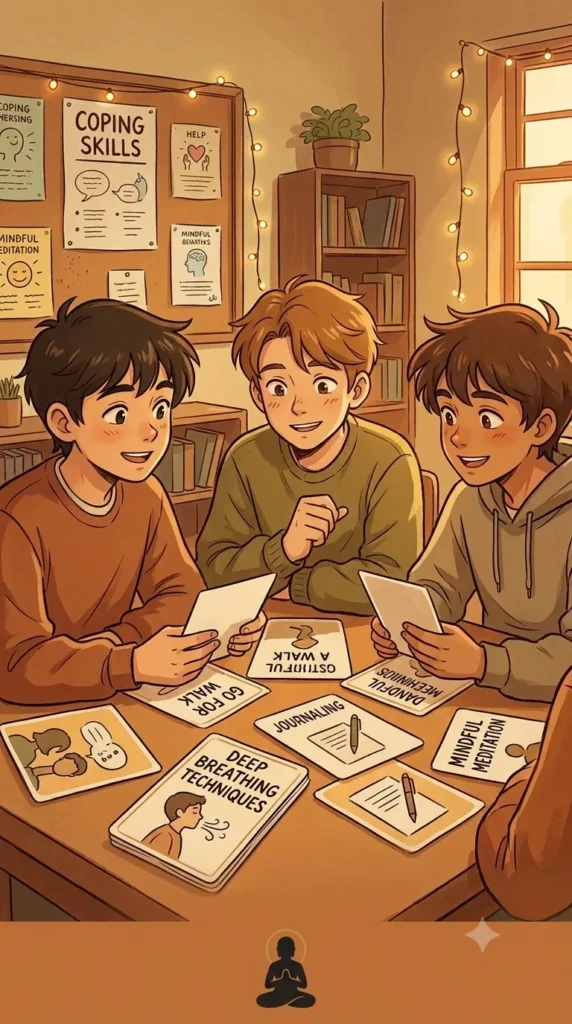
Free discussion-card idea: create 5–8 cards with prompts such as:
- “What usually tells you that you’re getting overwhelmed?”
- “Which coping skill could you use without leaving school?”
- “What helps you calm down before reacting?”
- “Who is one person you can ask for support?”
- “Which coping strategy sounds useful but doesn’t work for you?”
Use these for classroom discussions, youth groups, or any coping skills group activity for teens. Nobody has to disclose anything they’re not ready to share.
Activities for Teen Therapy and Group Therapy
In therapy, coping activities do more than pass the time. They surface patterns. Build regulation skills. Give a teen language for something they couldn’t explain before. That’s the real value, not the worksheet itself.
The activity has to match where the teen actually is. A grounding exercise for someone anxious. An anger-reset for someone who reacts before they think. A thought-reframing worksheet when stuck thinking is running the show.
Group therapy adds another layer. Not every teen wants to talk in front of peers. Why would they? Activities need a way in that doesn’t require performing.
Here’s one that works: build on the discussion cards above. Each teen picks a card, writes a private answer first, then decides whether to share it out loud. That small choice matters more than it seems. It’s the difference between an activity that feels supportive and one that feels like another demand.
For more on identifying what a teen is actually feeling before choosing an activity, the emotions worksheet pillar covers that groundwork in more depth.
Coping Skills Worksheets for Teens
“How do I deal with this?” That question stops most teens cold. A coping skills activities for teens worksheet turns that into steps you can follow. Name the feeling, then spot the trigger. Pick a strategy that fits. Then look back at what worked. That’s the whole shape.
Worksheets are practice. Not a replacement for real support. Think of them as reps between the sessions that matter, not the whole game.
Start With a Teen-Specific Coping Skills Worksheet
This isn’t homework dressed up as therapy. It just works. A teen writes down the situation. Names the emotion. Notices what’s happening in the body. Then picks one strategy that fits the moment, not whatever sounded good on a school poster.
Want something ready to use? Our coping skills worksheets guide has a teen-specific version built in. Print it. Use it more than once. It’s meant to grow into a personal set of coping skills activities for teens, something to return to whenever stress shows up again.
Name the Feeling Before Choosing the Coping Skill
For a lot of teens, the problem isn’t picking a coping skill. It’s naming what’s going on in the first place. A teen says fine. Underneath that word: anxious, embarrassed, angry, lonely, maybe just overwhelmed. Fine hides all of it.
That’s why naming the feeling comes first. Skip that step and the next coping skill picked is usually a guess. Our emotions worksheet helps put a sharper name on it before you decide what to do next. A better label makes the next move obvious. Sometimes that’s the difference between a coping strategy that sticks and one dropped by Thursday.
What If a Coping Skill Doesn’t Work?
A coping skill isn’t a magic fix. Not even close. If one strategy doesn’t help, that doesn’t mean the teen is doing something wrong. The skill might not fit the moment. The emotion might be too big for it. Or the teen might need a different kind of support entirely, one that goes beyond a single coping skills worksheet.
A Coping Skill Doesn’t Have to Make You Feel Good Immediately
A coping skill doesn’t have to erase the bad feeling. Sometimes it just turns the volume down. Enough to think straight. Enough to choose what happens next.
Take slow breaths before a hard conversation. The anger probably won’t disappear. But it might buy enough space to skip the impulsive text. The one you’d regret sending an hour later.
If a strategy keeps making things worse, feels off, or does nothing after real practice, drop it and try something else. A teen who hates journaling might do better with music, movement, grounding, or just talking to someone they trust.
Writing through big emotions works for some teens; when it doesn’t, prompts built for processing feelings on paper aren’t the only door in. There’s no prize for picking the coping skill that looks best written down.
When Coping Skills Aren’t Enough
Sometimes the distress is too much to carry alone. That’s not a failure. It’s just true.
If a teen is struggling to stay safe, thinking about suicide or self-harm, or feels like they can’t cope, bring in a trusted adult or mental health professional. Don’t lean on coping exercises by themselves in that moment.
In the U.S., call or text 988 to reach the 988 Suicide & Crisis Lifeline. Outside the U.S., reach out to a local crisis line or emergency service right away.
Coping skills support mental health. They don’t replace professional care when a teen needs more.
How to Help a Teen Practice Coping Skills Without Making Them Feel Forced
A teen won’t use a coping skill just because you handed it to them. That’s the part most advice skips.
Building coping skills activities for teens works better when the teen has some say in it. Offer choices. Respect privacy. Practice the skill on a calm Tuesday, not in the middle of a blowup. Coping should feel like a tool they picked up, not one more task they can fail at.
Give Them Choices
“You need to calm down” rarely lands. Most teens hear it as a command, not help.
Try this instead. Offer two or three options that actually fit the moment: a short walk, music, five minutes of writing, or a breathing exercise. Small thing, big difference. Teens engage more with a strategy they picked themselves than one handed down from above.
That’s not stubbornness. That’s just how ownership works, at any age.
Practice When They Are Calm
A skill sticks faster when nerves aren’t already maxed out. Teach it on an easy afternoon, not a bad one.
Run through a grounding exercise when nothing’s wrong. Fill out a coping skills worksheet for teens on a quiet Sunday. Then, when the test, the argument, or the group-chat mess actually hits, the skill isn’t new. It’s just familiar.
That’s the whole trick. Nothing more complicated than that.
Don’t Force Them to Explain Everything
A teen can use a coping skill without narrating every detail behind it. If they don’t want to talk, that boundary is worth respecting.
Something as simple as this works: “You don’t have to explain it right now. Do you want space, company, or help finding something that might help?” No pressure attached. Just an open door.
Why does that line work so well? It hands the choice back to them instead of demanding an explanation first.
Let Them Reject What Doesn’t Work
Not every strategy fits every teenager. One kid finds journaling grounding. Another finds it frustrating, maybe even worse than doing nothing.
Treat a failed attempt as data, not failure. Help them test other coping strategies for teens instead of pushing one technique as the answer. A emotions worksheet can help narrow down what a teen actually needs before they pick the next skill to try.
Some strategies just aren’t a match. That’s fine. That’s the whole point of testing more than one.
Model Coping Instead of Lecturing
Teens notice everything, especially how the adults around them handle stress. They catch the pause before a reply. The walk after a rough day. The moment someone names what they need out loud instead of snapping.
The American Psychological Association’s guidance on helping teens manage stress points at the same thing: caregivers who talk openly about how they’ve handled their own stress give kids a working model to copy, not just a lecture to sit through. A coping skill becomes believable once it’s demonstrated. Not just prescribed.
Want a teen to actually try slow breathing before a hard conversation? Let them watch you do it first. If naming what’s underneath the stress is the harder part, a few journal prompts for mental health can give both of you the words before the conversation even starts.
Conclusion
Coping skills work best with options, not pressure. A breathing exercise might help before a test. Journaling makes more sense after a hard talk. Movement helps when anger starts building fast.
Nobody needs every uncomfortable feeling to disappear. That’s not the goal. The real goal is smaller and more useful than that. Give a teen ways to pause, notice what they actually need, and pick what happens next.
So where does a teen actually start? Pick one or two coping skills activities for teens that feel doable. Not ten that feel like homework. Practice them on a calm Tuesday, not mid-meltdown. That’s when they stick. Over time, that short list turns into a real toolbox, built from what actually worked, not what sounded good on paper.
And sometimes the strongest coping skill isn’t a skill at all. It’s a person. When feelings get too big to handle alone, reaching out to a trusted adult or mental health professional counts. That’s not giving up. That’s coping, too.
Frequently Asked Questions
What are the best coping skills activities for teens?
The best coping skills activities for teens are the ones that match the situation and feel realistic enough to use. Grounding can help with anxiety, movement may help with anger or tension, while journaling can help with confusing thoughts. A teen may need to try several strategies before finding the ones that actually work for them.
What coping skills can a teenager use when they feel overwhelmed?
A teenager who feels overwhelmed can start with a simple grounding exercise, slow breathing, a short walk, or writing down what is causing the stress.
The goal isn’t to solve everything at once. A useful coping skill should create enough mental space for the teen to decide what needs attention first.
What are some coping skills for teens who struggle with anger?
Anger coping skills for teens can include stepping away from the situation, slow breathing, stretching, walking, writing down what happened, or using a brief physical reset. It can also help to identify early body signals, such as clenched fists or a racing heartbeat, before anger reaches its peak.
What are good coping skills group activities for teens?
Good coping skills group activities for teens should encourage participation without requiring anyone to share personal information.
Coping Skills Bingo, collaborative discussion cards, emotion-mapping activities, and short grounding exercises can work well. In a therapy or school group, giving teens the option to pass can make participation feel safer and less forced.
Are coping skills worksheets useful for teenagers?
Yes. Coping skills worksheets for teens can make an abstract question—“What helps me when I’m stressed?”—much easier to answer.
A worksheet can help a teenager identify triggers, emotions, physical warning signs, coping strategies, and trusted sources of support. They work best as practical tools, not as a replacement for conversation or professional care.
What’s the difference between a coping skill and therapy?
A coping skill is a strategy someone can use to manage stress, difficult emotions, or strong reactions in the moment.
Therapy is a structured form of professional mental health care that can address underlying patterns, symptoms, relationships, and ongoing difficulties. Coping activities can support therapy, but they aren’t a substitute for professional treatment when a teen needs it.

It’s Bhaskar!
Well, I am not a psychologist a monk, or a philosopher by training. I’m just an engineering graduate.
‘The Empty Self’ is where I write about that idea, and what it actually means for ordinary life, anxiety, identity, habits, the stories we tell ourselves about who we are. I don’t have a psychology degree, and I’m not offering therapy or clinical advice. What I do have is thought and clarity, and genuine curiosity about why we suffer the way we do and how much of it might loose once we shed this ‘fixed identity’.