
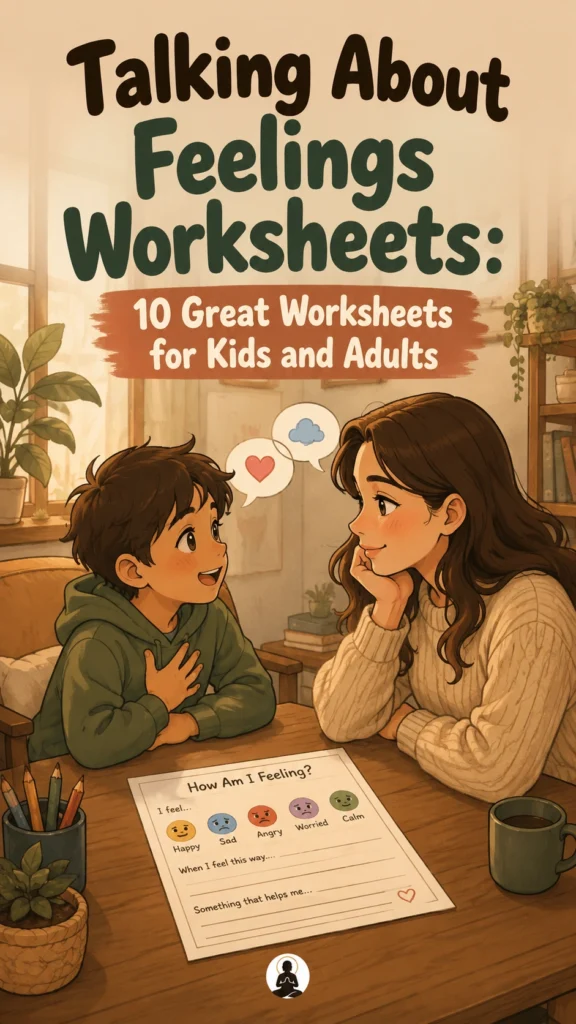
Talking about feelings sounds easy. Then you actually try to do it.
You know something’s off. Naming it is the hard part.
That’s where talking about feelings worksheets come in. They give you a quiet page instead of a blank stare. Slow down. Name the emotion. Trace what set it off. Figure out what you actually want to say.
Kids need a different way in. A big feeling is scary to explain out loud, so these worksheets use drawing, simple prompts, and situations a kid already recognizes. No pressure to perform the right words. Just point at the feeling and start from there.
Adults need something else. A reaction shows up tangled, half thought-out, more heat than words. A worksheet slows that down into clear thoughts, real needs, and language you can actually use. That matters right before a conversation you can’t afford to mess up.
Sound too simple to work? It is simple. That’s exactly why it works.
Quick Overview: Talking about feelings worksheets help you spot what you’re feeling, dig into what’s behind it, and put that into words. They support kids and adults through emotional expression, hard conversations, self-reflection, and emotional regulation. Pair them with journal prompts for mental health or journal prompts for self-love if you want to build the habit past a single hard day.
Table of Contents
Disclaimer
This blog is written and edited with the help of AI, then reviewed by me before publishing. As a result, the content is for general reflection only, not therapy or medical advice, and I’m not a licensed mental health professional. If you’re in crisis, please contact 988 if you’re in US or a local crisis service of your country instead of relying on this site.
What Are Talking About Feelings Worksheets?
Talking About Feelings Worksheets turn a vague feeling into real words. They’re guided prompts built for kids and adults alike, part of the same family as the broader emotions worksheet toolkit. Not just to name an emotion. To explain it.
“I feel bad” isn’t enough. Not for a real conversation. These worksheets ask what happened, what you feel, and what you need. That’s the shift. From foggy to specific.
What Does a Talking About Feelings Worksheet Do?
A talking-about-feelings worksheet gives you room to slow down. You sort through what happened before trying to explain it out loud. No scrambling for the right words mid-argument. Work through the prompts at your own pace instead.
A useful worksheet asks you to name the emotion. Describe the situation. Rate how strong it feels. Notice what’s happening in your body. Then think about what you want the other person to understand.
Some worksheets add sentence starters. Others leave space to draw.
The goal was never to make every feeling sound neat. Feelings get messy. That’s normal. The worksheet just gives the mess some shape.
Talking About Feelings vs. Identifying Feelings
These aren’t the same skill. Identifying a feeling means naming what’s happening inside you. Communicating it means turning that into words, or a drawing, or something someone else can actually follow.
Say you work through an identifying emotions worksheet and realize you’re not simply angry. You’re disappointed. Embarrassed too. Maybe worried about what happens next. Naming the feeling is step one. Talking about it is step two.
Here’s the catch. You can know exactly what you’re feeling and still have zero idea how to say it out loud.
How Worksheets Organize Your Thoughts Before a Conversation
Emotions move faster than language. Always have. Writing down what happened, what you felt, and what you need creates a little distance. Enough to see the situation clearly.
A worksheet also separates feelings from assumptions, and that distinction matters more than it sounds. “I felt ignored when you didn’t reply” describes an experience. “You don’t care about me” makes a claim about someone else’s intentions entirely.
That small difference can change where the whole conversation goes.
When Writing or Drawing May Be Easier Than Speaking
Not everyone processes emotions through talking. Some don’t, and that’s fine. A child might draw an angry red storm before they can explain what set it off. An adult might write three sentences before bringing up a hard relationship issue face to face.
Why does this work when talking doesn’t? Writing and drawing aren’t lesser versions of expressing a feeling. Think of them as a bridge. Between having the feeling and finding the words for it.

How to Use a Talking About Feelings Worksheet
A talking about feelings worksheet works best as a bridge. Not a script. It sits between what’s happening inside you and what you’ll eventually say out loud.
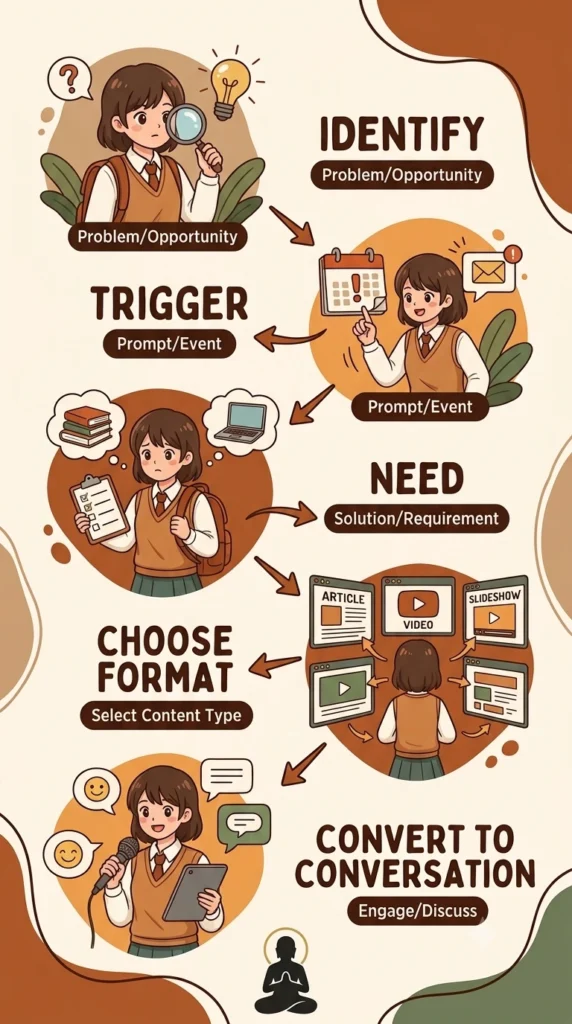
Instead of walking into a hard conversation cold, you use it to name the emotion, trace where it came from, figure out what you need, then choose how to say it.
Step 1: Name the Emotion
Start by dropping words like “good,” “bad,” “fine,” or “upset.” They’re too broad to work with. Push for something closer.
Disappointed. Embarrassed. Lonely. Irritated. Worried. Relieved. Rejected. Overwhelmed. An identifying emotions worksheet can make this part easier, since it hands you a wider bank of words to pick from instead of leaving you to guess.
You don’t need the exact word. Close is enough. An emotion identification worksheet exists for exactly this reason, and most people skip it because naming feels harder than it should be.
Step 2: Notice What Triggered or Shaped the Feeling
This step isn’t about the feeling alone. Look at what surrounded it. What was the situation? What thoughts ran through your head while it happened? Did your shoulders tense up? Chest go tight? Heart start racing?
Context matters just as much as the trigger itself. A small comment lands differently when you’re already worn down or stressed. That’s the whole idea behind mindfulness journal prompts, catching these body signals before they build into something bigger.
Step 3: Decide What You Need
A feeling doesn’t tell someone else what to do. But it usually points toward a need. Understanding. Reassurance. Space. Practical help. Clearer communication. A boundary you haven’t set yet.
Write the need down before the conversation starts. That’s it. It stops you from walking in upset with no idea what you’re actually asking for, which is where most difficult conversations quietly fall apart.
Step 4: Choose Whether to Talk, Write, Draw, or Wait
Talking isn’t always the first move. Sometimes it shouldn’t be. Writing or drawing gives you enough distance to understand a tangled feeling before you try to put it into words for someone else.
And if the emotion is running hot, waiting until it settles is often the smarter call, not the avoidant one.
There’s no single correct way to express a feeling. Some people process out loud. Others need the page first.
Step 5: Turn the Worksheet Into a Conversation
Treat the worksheet as rehearsal, not a script to read from. Sentence starters like “I feel…” or “I found myself feeling…” help you describe your own experience without opening with blame.
From there, say what you need or want to happen. Keep it specific. Then stop talking and leave room to listen. Emotional expression activities like this one work best as a two-way conversation, not a prepared speech nobody gets to respond to.
10 Talking About Feelings Worksheets for Kids and Adults
A good talking about feelings worksheet does more than ask you to slap a label on an emotion. It walks you through what actually happened. Then your reaction to it. Then the words, or the drawings, that get it across. Then what you actually need from the conversation.
That’s the whole difference between a worksheet that helps and one that just sits in a drawer.
1. Feelings Identification Worksheet
Best for: Anyone who struggles to name an emotion
Difficulty: Easy
Age group: Kids, teens, and adults
What it helps with: Building an emotion vocabulary and pinning down a specific feeling before you try to explain it.
“I feel bad” is where most people get stuck. That’s exactly where an identifying emotions worksheet earns its place. Instead of stopping at happy, sad, or angry, it pushes you toward something closer to the truth. Disappointed. Nervous. Embarrassed. Lonely. Irritated. Overwhelmed.
Prompts/structure:
- What happened?
- What emotion am I feeling?
- How strong is it, from 1 to 10?
- Is there another feeling underneath it?
- Where do I notice it in my body?
How to use it: Circle, write, or highlight whatever fits best. Two emotions feel right? Keep both. Mixed feelings are normal, and forcing a single answer usually just makes the exercise less honest.
Suggested follow-up: Take the emotion you landed on and carry it into the next worksheet or conversation.
2. “What Am I Feeling and Why?” Worksheet
Best for: People who know something is bothering them but can’t explain it
Difficulty: Easy to moderate
Age group: Older kids, teens, and adults
What it helps with: Linking the emotional reaction to what actually caused it, so you’re ready to explain it to someone else.
This one pushes a step past simple identification. It doesn’t stop at what am I feeling? It also asks what might have caused it? That makes it one of the more useful emotional expression activities for someone who keeps saying, “I don’t know why I feel this way.”
Prompts/structure:
- What happened?
- What am I feeling?
- How strong is the feeling?
- What contributed to it?
- What do I want someone else to understand?
How to use it: Write the situation as plainly as you can before you start interpreting it. “My friend cancelled our plans” gets you further than jumping straight to “My friend doesn’t care about me.”
Suggested follow-up: Look back at the final prompt. Pick the one point you most want the other person to understand.
3. Feelings and Body Signals Worksheet
Best for: People who notice physical reactions before they recognize the emotion behind them
Difficulty: Moderate
Age group: Kids, teens, and adults
What it helps with: Connecting physical sensations to emotions, and to what you might do next.
Sometimes the body knows before the mind does. A tight chest. A clenched jaw. Restless hands. Heavy shoulders. A sudden urge to leave the room. Those are all clues worth writing down. This worksheet ties them to the situation and the feeling behind them.
Prompts/structure:
Situation → Body sensation → Emotion → Thought → Response
How to use it: Start with something recent. Record what you physically noticed, no judging it yet. Then name the emotion, the thought riding along with it, and what you actually did next.
This structure pairs well with emotional regulation worksheets, too. Catching an early physical signal buys you more time to pause before reacting.
Suggested follow-up: Think about what response you’d prefer if the same physical signal shows up again.
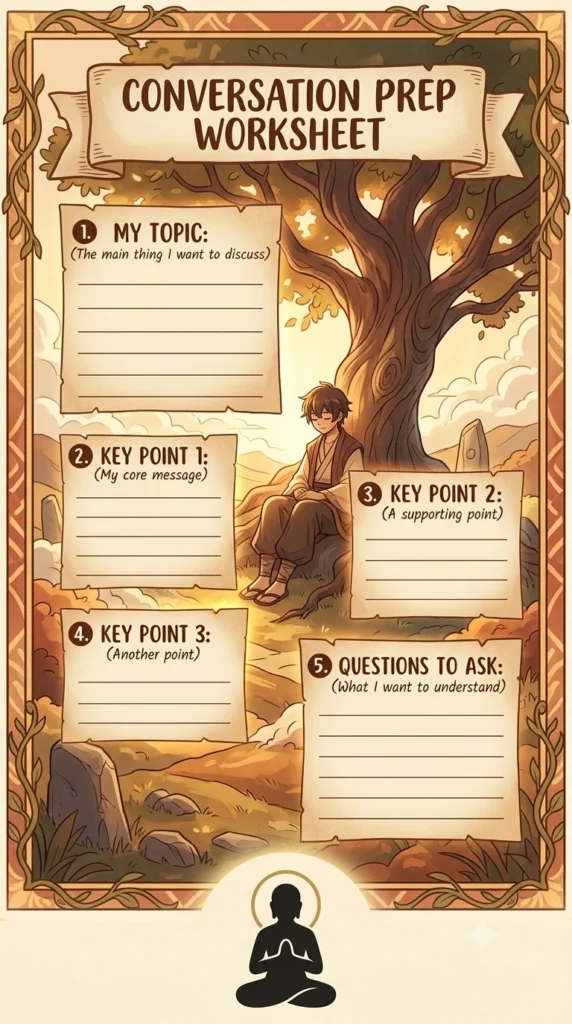
4. “I Feel…” Conversation Preparation Worksheet
Best for: Anyone gearing up for a hard conversation
Difficulty: Moderate
Age group: Teens and adults; adaptable for older kids
What it helps with: Rehearsing what you want to say before an emotionally loaded conversation starts.
This isn’t an emotion-identification worksheet. Not really. The feeling is already reasonably clear by this point. The job here is turning it into words you can actually keep hold of once the conversation gets moving.
Prompts/structure:
- I feel…
- When…
- What I think/understand is…
- What I need…
- What I’d like to happen…
How to use it: Write a rough first version. Don’t worry about polish yet. Then strip out the accusations, the mind-reading, the unnecessary backstory. Keep the part that explains your experience and what you hope changes.
Suggested follow-up: Read it out loud once. If it sounds nothing like something you’d actually say, rewrite it in your normal voice.
5. Feelings Drawing Worksheet
Best for: Visual thinkers and people who can’t easily put feelings into words
Difficulty: Easy
Age group: Young kids through adults
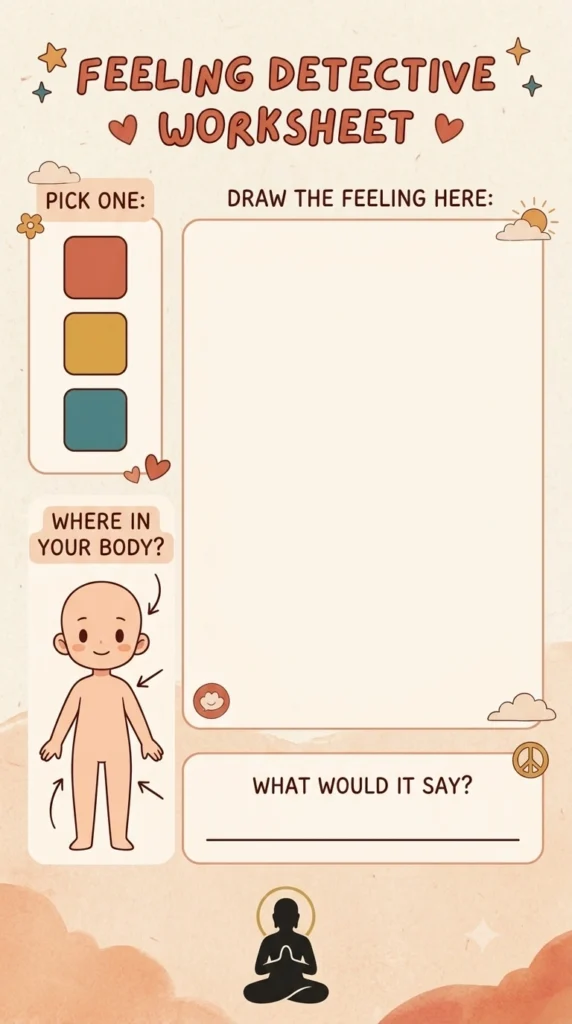
What it helps with: Expressing an emotion through images, color, shape, and body awareness.
Not every feeling shows up as a tidy sentence. A talking about feelings drawing worksheet gives you another way in. It can help a lot with kids who get frustrated trying to explain complicated emotions out loud.
Prompts/structure:
- Draw what the feeling looks like.
- Give it a color.
- Where does it live in your body?
- What would it say if it could talk?
- What would help?
How to use it: It doesn’t need to look good. A scribble, a shape, a character, a weather scene, an abstract splash of color, any of it works. The point of a talking about feelings illustration is expression, not skill.
For a child, this feels a lot less intimidating than a page full of writing. For an adult, it can make private reflection feel less clinical, more like something you’d actually want to do.
Suggested follow-up: Write one sentence beside the drawing explaining what it represents.
6. Feelings and Needs Worksheet
Best for: People who can name a feeling but aren’t sure what they need
Difficulty: Moderate
Age group: Older kids, teens, and adults
What it helps with: Moving from noticing a feeling to making an actual request or setting a boundary.
Knowing “I’m frustrated” doesn’t tell you what to do about it. The more useful question is: what might I need right now?
Prompts/structure:
What am I feeling? → What might I need?
Possible needs: space, reassurance, rest, connection, clarity, support, safety, or a boundary.
How to use it: Name the feeling first. Then run through several possible needs instead of assuming there’s only one right answer. Irritation after an argument might point to needing space. Or it might point to needing clarity about what actually happened.
Suggested follow-up: Turn the need into a real request. “I need some time before we keep talking about this” is a good example.
7. Talking About Feelings in Relationships Worksheet
Best for: Couples, friends, family members, anyone stuck in interpersonal tension
Difficulty: Moderate to challenging
Age group: Teens and adults
What it helps with: Separating what you actually felt from what you assumed, so you know what to say next.
Talking about feelings relationships get complicated fast, because one disagreement can hold a feeling, an interpretation, a request, and a boundary all at once. Pulling those pieces apart makes the whole thing easier to follow.
Prompts/structure:
- What happened?
- What do I feel?
- What am I assuming or interpreting?
- What do I want to ask for?
- Is there a boundary I need to communicate?
How to use it: Keep the observation separate from the conclusion. “You didn’t reply yesterday” is an event. “You don’t care about me” is a story you told yourself about it. That gap matters. The second line can turn a conversation into a fight before the actual feeling gets a chance to come up.
Suggested follow-up: Pick one feeling and one request to bring into the conversation. Don’t hand someone the whole worksheet.
8. Emotional Regulation Before a Difficult Conversation Worksheet
Best for: Anyone who feels too overwhelmed, angry, anxious, or upset to communicate clearly
Difficulty: Moderate
Age group: Teens and adults; adaptable for older kids
What it helps with: Deciding whether to talk now, pause first, or change the conditions of the conversation entirely.
Emotional regulation worksheets aren’t trying to make the hard emotions disappear. Regulation isn’t suppression. Emotional self-regulation is generally understood as staying flexible enough to react spontaneously while still being able to delay a reaction when it counts. The goal here is simpler than it sounds: know your state well enough to actually choose a response, instead of just reacting to it.
Prompts/structure:
- How intense is the emotion?
- Am I ready to talk?
- Do I need a pause?
- What would make this conversation feel safer?
- What do I need to communicate?
How to use it: Rate the intensity. Then look at what would help you get more prepared. That could mean a short break, writing your thoughts down first, picking a calmer setting, or figuring out what you actually want out of the conversation.
Suggested follow-up: Come back to it after the pause. If your main point still holds, move to the conversation-preparation worksheet.
9. Talking About Feelings Worksheet for Kids
Best for: Parents, teachers, counselors, and children learning emotional vocabulary
Difficulty: Easy
Age group: Young and school-age children
What it helps with: Helping kids name feelings, connect them to what happened, and ask for support.
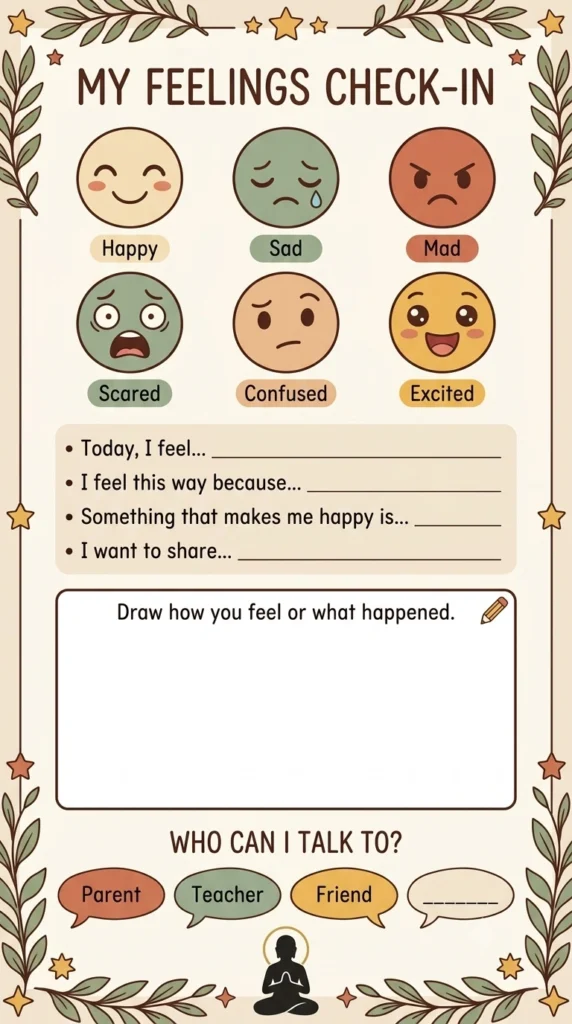
A talking about feelings for kids worksheet shouldn’t just be a shrunk-down adult version. Kids tend to open up more easily with faces, simple words, room to draw, and situations they can actually picture.
Prompts/structure:
- How do I feel? Choose a feelings face.
- I feel ___ when ___.
- Draw what happened.
- What would help?
- Who can I talk to?
How to use it: Read the prompts together for younger kids. Don’t rush to correct their answer. If a child says “angry” but the situation sounds more like disappointment, ask what makes it feel angry instead of swapping in the word yourself.
These talking about feelings activities for kids work best when they open up a real conversation. Not when the worksheet turns into a test with one correct answer.
Suggested follow-up: Ask, “What would help you feel a little better or safer right now?” Then just listen.
10. Adult Feelings-to-Words Worksheet
Best for: Adults preparing to communicate a complicated emotion
Difficulty: Moderate to challenging
Age group: Adults
What it helps with: Turning a layered emotional experience into a clear, respectful conversation.
An identifying emotions worksheet for adults pdf earns its keep when the problem isn’t a shortage of vocabulary. It’s not knowing what to say next. Adult situations usually stack competing feelings, assumptions, needs, expectations, and boundaries on top of each other.
Prompts/structure:
Situation → Emotion → Intensity → Thought → Need → What I want to say → What I want from the conversation
How to use it: Work through it in order. Don’t try to make every line sound polished. A work problem might bring up frustration and embarrassment. A friendship issue might carry disappointment and uncertainty. A family conflict might mix anger with a real desire to stay connected.
The last two prompts matter most. Knowing what you want to say is not the same as knowing what you want from the conversation.
Suggested follow-up: Boil the whole worksheet down to one clear message and one realistic request. That’s usually easier for another person to hear than a page of unresolved thoughts.
If naming the feeling itself is still the sticking point, our emotions worksheet guide is a good place to back up to first. And if you’d rather keep a running record of what comes up over time, an emotions journal or a stretch of journal prompts for mental health can hold the pattern a single worksheet won’t catch.
Emotional Expression Activities to Try Without a Worksheet
Worksheets give feelings a shape. But they’re not the only shape available.
You can draw a feeling. Act it out. Say it out loud to someone who’s listening. These emotional expression activities pull feelings out through drawing, movement, writing, or plain conversation instead of a printed page.
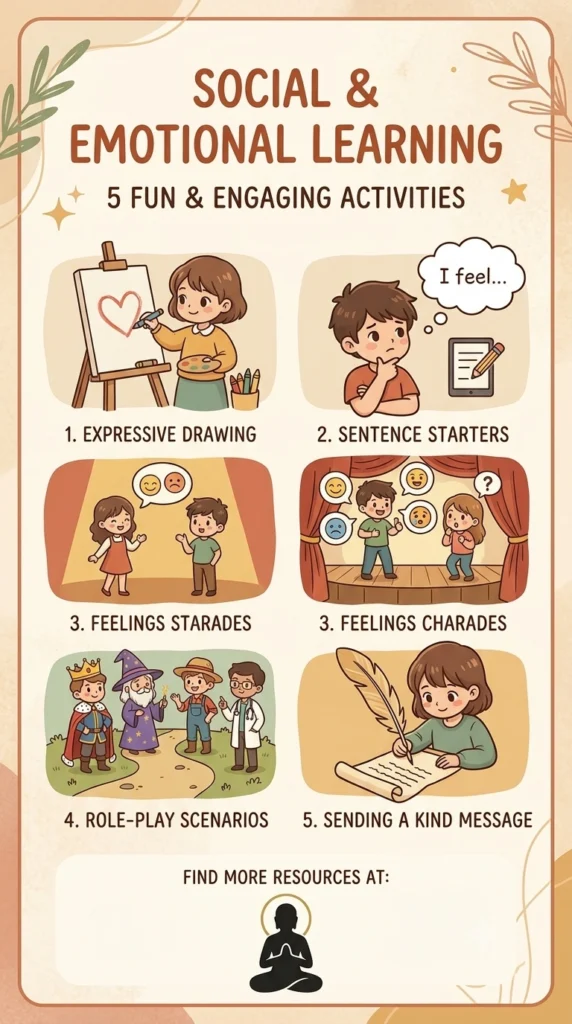
Draw the Feeling
Words don’t always show up on cue. That’s when talking about feelings drawing helps more than talking about feelings directly.
Skip the naming step. Ask yourself, or a child, to draw what the emotion looks like first. Sadness might turn into a dark cloud hanging low. Excitement might come out as bright, jagged shapes with color spilling everywhere.
Nobody’s grading the art here.
The picture just gives the feeling a body. Something you can point at. Once it’s on paper, ask one question: what does this picture tell you about the feeling?
Finish the Feelings Sentence
Vague prompts get vague answers. “I feel happy when…” rarely goes anywhere real.
Use an actual moment instead. Try:
- “When my friend didn’t invite me, I felt…”
- “When Mom said I couldn’t go, I wanted to…”
- “When my partner didn’t reply, I started thinking…”
- “When I finished something I had been worried about, I felt…”
Specific beats general every time. A real event pulls the emotion and the thought behind it into the same sentence, where you can actually look at both.
Emotion Charades for Kids
Feelings move through the body before they ever reach words. Emotion charades makes that visible.
One person acts out an emotion. Face, posture, hands, no talking. Everyone else guesses.
Start simple with younger kids. Happy, sad, angry, scared, surprised, these read clearly on a small face. Older kids can push further into embarrassed, disappointed, nervous, frustrated, or relieved. Harder to act. Harder to name too, and that’s the point.
Among talking about feelings activities kids actually enjoy, this one rarely feels like a lesson. It feels like a game. That’s exactly why it works.
Role-Play a Difficult Conversation
Practice the hard sentence before you need it. That’s the entire idea behind role-play.
Pick a real situation. Telling a friend something hurt. Asking a parent for help. Explaining a boundary to a partner who won’t like hearing it. Say the words out loud first, in a low-stakes room, before the real conversation forces them out under pressure.
Then switch roles.
Hearing your own situation from the other side changes things. Assumptions you didn’t know you were making tend to surface fast.
Write a Message You Don’t Have to Send
Not every hard sentence needs an audience right away.
Write the message exactly as it feels, unfiltered, with zero plan to send it. Let it run messy. Once it’s out, read it back with a different eye. Separate the feeling from the accusation. Separate the emotion from the assumption riding along with it.
This is where talking about feelings paragraph writing earns its place, on the page first, out loud later, if ever.
Want to go further with this on your own? Our journal prompts for mental health guide covers private reflection prompts built for exactly this kind of processing.
How to Talk About Feelings Without Making the Conversation Worse
Good conversations about feelings have one goal. Understanding, not winning. Describe what you feel without blaming. Separate the facts from the assumptions. Say what you need instead of hinting at it.
Pause when things get too hot to think straight. That’s really the whole idea behind talking about feelings worksheets in the first place. They give you a way to slow down and say the true thing, not just the loud thing.
Describe the Feeling Instead of Attacking the Person
This isn’t about picking softer words. It’s about aiming them somewhere useful. Turn the conversation into a judgment of someone’s character, and the door closes fast.
Focus on your own experience instead. “I felt ignored when the message wasn’t answered” gives the other person something specific to respond to. “You never care about me” doesn’t. It just invites defensiveness.
That doesn’t mean flattening every feeling until it means nothing. You can still be direct. Describe the situation fairly, say how it landed, and name what you’re trying to fix. Nothing more complicated than that.
Separate Feelings From Assumptions
Most arguments aren’t really about the feeling. They’re about the story attached to it. A feeling is real even when the explanation you’ve built around it isn’t. Say a friend goes quiet for a day. You might feel anxious. That’s real. “They’re ignoring me because they’re angry” is a guess dressed up as fact.
Keeping those two things apart makes the whole conversation easier. Try this instead: “I noticed you haven’t replied, and I’ve been feeling worried. Is everything okay?” That’s an honest opener, not an accusation.
If naming what you’re feeling in the moment is hard, an identifying emotions worksheet can help you sort the feeling from the assumption before you ever open your mouth.
Say What You Need Instead of Expecting Someone to Guess
Nobody reads minds. Not even close. People can’t reliably work out what you need just from watching you feel it. Want reassurance? Ask for it. Need space? Say so. Want someone to just listen, not fix it? Make that clear too.
A worksheet earns its keep here. It turns “I feel…” into “I need…” before the hard conversation even starts, which is a habit worth building the same way journal prompts for self-love build the habit of noticing what you actually want.
Know When to Pause
Not every feeling needs airtime the second it shows up. Sometimes the timing itself is the problem. If you’re too angry, too overwhelmed, or too raw to actually listen, pushing through rarely helps. A short break usually beats forcing the conversation.
Pausing isn’t avoiding. Not if it’s done right. A useful pause has a return point built in. Something like, “I’m too upset to talk about this properly right now. Can we come back to it tonight?” That one sentence keeps the door open.
Building this kind of pause into daily life is part of what emotional regulation worksheets are designed for, and it pairs well with a quiet mindfulness journal prompts practice for the moments in between.
Make Room for the Other Person’s Feelings
Most people treat this as a one-way download. It isn’t. The other person has their own version of what happened, and listening to it doesn’t mean agreeing with it.
Leave enough space for them to explain how they saw it. Ask a real question. Then actually wait for the answer. Sometimes the win isn’t deciding who was right. It’s understanding why the same moment hit two people so differently, which is exactly the kind of reflection journal prompts for mental health are built to support.
What to Text Instead of a Long Paragraph
Saying it out loud isn’t always possible. That’s fine. A short talking about feelings text can open the door without turning into a wall of text nobody wants to read.
“Something has been bothering me, and I’d like to talk about it when you have time.”
“I felt hurt by what happened earlier. I’m not trying to argue. I just want to explain how it affected me.”
“I’m having a hard time putting this into words. Can I tell you what’s been on my mind?”
“I need a little time to process this, but I don’t want to avoid the conversation.”
You don’t owe anyone every detail in a text. Sometimes the message only needs to do one job: start the conversation. Everything else can wait for the room, the couch, or the walk around the block where the real talking happens.
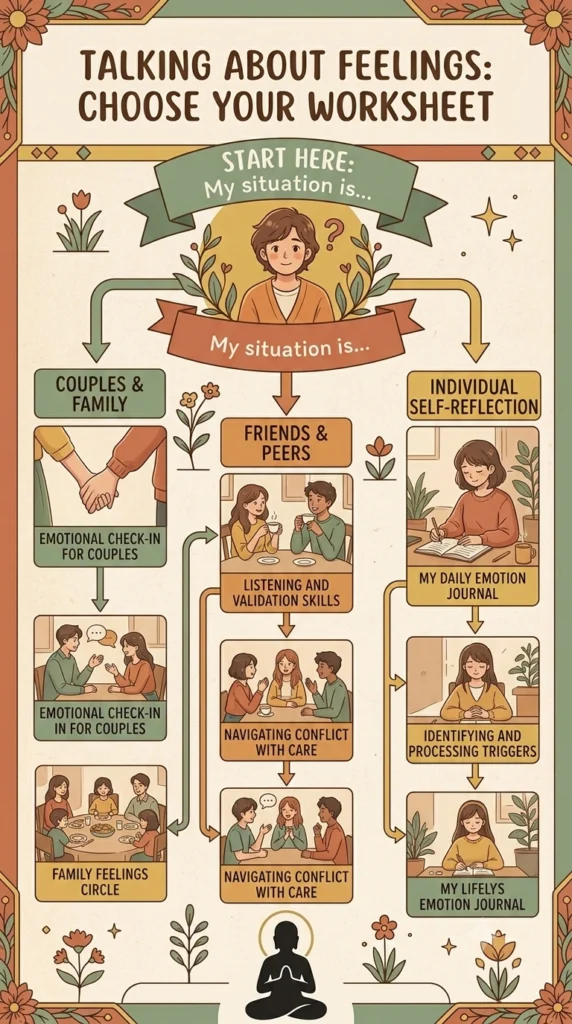
Which Talking About Feelings Worksheet Should You Choose?
Not sure where to start? That’s normal. The right talking about feelings worksheet depends on exactly where you’re stuck, not on how advanced it sounds.
Maybe you can’t name what you feel yet. Maybe you know the emotion but the words won’t come. Maybe your body reacts before your brain catches up. Pick the worksheet that matches your actual roadblock, not the one that looks the most impressive.
| If you… | Start with… |
|---|---|
| Can’t name what you’re feeling | Feelings Identification Worksheet |
| Know the feeling but can’t explain it | What Am I Feeling and Why? |
| Feel emotions physically | Body Signals Worksheet |
| Need to have a difficult conversation | Conversation Preparation Worksheet |
| Prefer visual expression | Feelings Drawing Worksheet |
| Don’t know what you need | Feelings and Needs Worksheet |
| Are dealing with relationship conflict | Relationships Worksheet |
| Feel too overwhelmed to talk | Regulation Before Conversation Worksheet |
| Are a parent or teacher helping a child | Kids Worksheet |
| Are an adult preparing for a complex conversation | Adult Feelings-to-Words Worksheet |
You don’t need to start at the top of that list. Start where you’re actually stuck.
Say you know you’re angry, but the why is fuzzy. The What Am I Feeling and Why? worksheet does more for you than a conversation script ever will. Jumping straight to preparing what to say skips the part where you figure out what’s true.
Already know what happened? Already know what you feel? But you freeze the second it’s time to talk? That’s a different problem. The Conversation Preparation Worksheet fits that gap. Trying to force the identification worksheet onto a freezing problem just wastes your time.
Sound too simple, matching the tool to the actual block instead of the fanciest option? It is. That’s exactly why it works.
If relationship conflict is the pattern underneath most of this, the Relationships Worksheet connects directly to that. And if naming feelings tends to open up bigger questions about what you need day to day, pairing this with journal prompts for mental health gives you somewhere to keep exploring once the worksheet’s done.
Talking About Feelings Worksheets for Different Ages
A worksheet built for a five-year-old won’t work for a fifteen-year-old. Obvious once you say it out loud. Young children need pictures and short words. Teens and adults can handle layered emotions, messy relationships, and hard conversations.
The best talking about feelings worksheets shift with age. The goal stays the same. Make the feeling easier to name, then easier to say out loud.
For Young Children
For young children, talking about feelings for kids should feel like play, not homework. A worksheet with emotion faces, color choices, drawing space, and short sentence starters lets a child show what’s going on before they have the words for it.
That gap between feeling and vocabulary is real. Most adults forget how wide it is. These kinds of talking about feelings activities kids respond well to don’t ask for explanations. They ask for pointing, coloring, circling.
Try prompts like:
- “I feel ___.”
- “My body feels ___.”
- “I felt this way when ___.”
- “I want someone to ___.”
Drawing helps more than most parents expect. A kid says “I don’t know” and hands you a picture instead. Something is clearly there. It just hasn’t found words yet.
A dedicated preschool version of this talking about feelings worksheet is coming soon; link it in once that page is live. Until then, the broader emotions worksheet collection covers similar ground for younger kids.
For Older Kids and Preteens
Older kids can usually name more specific emotions. Not just “sad.” Something closer to “left out” or “embarrassed.” A good set of emotional regulation worksheets at this age splits the moment into parts: what happened, what they felt, what they thought, what they wanted.
This is also the right age for practice talking, not just labeling. Instead of circling “angry” and stopping there, ask the kid to turn it into a sentence they’d actually say to a parent, a teacher, a sibling. That’s a different skill. Circling a word is easy. Saying “I felt left out when you didn’t wait for me” to your sister at dinner is not.
For Teens
Teens need privacy first. Nuance second. A useful talking about feelings worksheet lets them sit with mixed emotions, relationship tension, and boundaries without forcing a conversation before they’re ready. Talking about feelings relationships bring up, especially with friends or a first partner, rarely fit neat labels anyway.
Writing it down first takes the pressure off. Nobody has to find the right words on the spot. It also gives a teen room to decide how much to share. All of it. Some of it. Or just “can you listen for a minute.” That choice matters more than people think.
For Adults
Adults tend to stop at broad labels. “Stressed.” “Upset.” “Fine.” None of those actually explain what’s happening. A real emotion identification worksheet pushes past the label into the emotion itself, the situation behind it, the thought driving it, and the response that would actually help.
An identifying emotions worksheet for adults works especially well before a hard talk with a partner, a parent, or a sibling.
Writing it down first doesn’t mean avoiding the conversation. It means showing up to it clearer. Pair the worksheet with journal prompts for mental health for deeper, private reflection before anything gets said out loud. Short on time? The five-minute journal prompts work just as well as a quick gut-check before a tense conversation.
When a Feelings Worksheet Isn’t Enough
A feelings worksheet can help you name emotions, sort through thoughts, and prepare for a conversation. But it has limits. If emotional struggles keep returning, affect daily life, or involve safety concerns, a worksheet should be one small support, not the only one you rely on.
When you keep having the same emotional reaction
If the same situation keeps triggering an intense emotional response, filling out a worksheet can help you spot patterns. You might notice that certain situations, thoughts, or relationship dynamics repeatedly lead to anger, fear, sadness, or overwhelm.
That awareness is useful, but you don’t have to figure out the whole pattern alone. If completing worksheet after worksheet isn’t changing the situation, consider talking with a qualified mental health professional who can help you explore what’s happening in more depth.
When a conversation feels unsafe
You don’t owe anyone a difficult conversation simply because a worksheet helped you understand your feelings. If you expect threats, intimidation, retaliation, or physical harm, safety comes before emotional expression.
In that situation, focus on getting support and making a safe plan rather than using a worksheet to prepare for confrontation. A worksheet can organize your thoughts; it cannot make an unsafe person respond safely.
When emotions are interfering with daily life
If strong emotions are making it difficult to work, study, sleep, maintain relationships, or manage everyday responsibilities, a worksheet may not provide enough support.
You can still use an emotions worksheet alongside other forms of help. The goal isn’t to complete the “perfect” worksheet. It’s to get the level of support that matches what you’re experiencing.
When you need professional support
A mental health professional can offer personalized support when self-guided exercises aren’t enough. Worksheets can be useful for reflection between conversations or appointments, but they aren’t a replacement for assessment, therapy, or crisis care.
If you’re in the United States and experiencing a mental health crisis or having thoughts of suicide, call or text 988 through the 988 Suicide & Crisis Lifeline. For information about mental health and substance-use services and treatment options, the Substance Abuse and Mental Health Services Administration (SAMHSA) provides additional resources.
Conclusion
Talking about feelings gets easier when you have a little space to sort out what is happening inside you first. Talking about feelings worksheets can help you name an emotion, understand what may be behind it, and find words for what you need.
For kids, drawing, simple prompts, and feeling faces can make expression less intimidating. Adults may benefit from conversation-prep worksheets that help separate feelings from assumptions and turn them into clear requests.
You don’t have to find the perfect words right away. Start with one honest feeling, one reason behind it, and one thing you hope the other person understands.
Frequently Asked Questions
What is a talking about feelings worksheet?
A talking about feelings worksheet is a guided activity that helps you identify an emotion, understand what caused it, and put the experience into words.
It can include prompts about feelings, thoughts, body sensations, needs, and what you want another person to understand.
How can worksheets help children talk about their feelings?
Worksheets give children a concrete way to explore feelings before they have to explain them aloud.
Feelings faces, drawing prompts, simple sentence starters, and “what would help?” questions can make emotional conversations less intimidating. A child can point, draw, write, or talk, depending on what feels easiest.
What is the difference between an identifying emotions worksheet and an emotional expression worksheet?
An identifying emotions worksheet focuses on figuring out and naming what you feel. An emotional expression worksheet takes the next step by helping you communicate that feeling to someone else.
For example, you might first identify frustration and then prepare how to explain what caused it and what you need.
Can emotional regulation worksheets help before talking about difficult feelings?
Yes. Emotional regulation worksheets can help you check your emotional intensity and decide whether you’re ready for a conversation.
They may guide you through noticing body signals, calming down, identifying what you need, and planning what to say. Regulating an emotion doesn’t mean ignoring or suppressing it.
What can I text or say instead of writing a long paragraph about my feelings?
You don’t need to send a huge paragraph to communicate something meaningful.
Try a short message such as:
“Something has been bothering me, and I’d like to talk when you have time.”
Or:
“I felt hurt by what happened. I’m not ready to explain everything yet, but I want to talk about it.”
Is there a video that explains how to talk about feelings?
A video can be useful when you learn better by watching someone model a conversation.
Look for age-appropriate, reputable resources that demonstrate naming feelings, listening, expressing needs, and handling disagreement rather than promising a perfect communication formula.
For children, parents or teachers can watch alongside them and discuss the examples.

It’s Bhaskar!
Well, I am not a psychologist a monk, or a philosopher by training. I’m just an engineering graduate.
‘The Empty Self’ is where I write about that idea, and what it actually means for ordinary life, anxiety, identity, habits, the stories we tell ourselves about who we are. I don’t have a psychology degree, and I’m not offering therapy or clinical advice. What I do have is thought and clarity, and genuine curiosity about why we suffer the way we do and how much of it might loose once we shed this ‘fixed identity’.