

You open your journal and the page just sits there. Blank. What am I grateful for today? sounds simple until you actually try to answer it. Maybe you argued with a friend. Maybe a test wrecked your week. Or maybe an hour of scrolling left you comparing your life to everyone else’s highlight reel. On days like that, gratitude can feel fake. Forced, even.
Sound like a stretch on a bad day? It shouldn’t be. Gratitude doesn’t need a perfect day to show up. Most of the time, it grows out of small stuff, the stuff that quietly makes life easier, safer, kinder, or a little more hopeful. That’s really it. Nothing more mysterious than that.
This guide holds more than 50 teen-friendly ways to answer that question honestly. It works whether today was your best day this year, or just another Tuesday you’re pushing through. And if you want the bigger picture before diving into specifics, this guide to things to be thankful for lays the groundwork first.
So, what am I grateful for today? It could be a person. A tiny moment. A strength you didn’t know you had until you needed it. A chance, a lesson, or something as plain as a warm meal after a long day. Gratitude just means noticing what still holds value. Not pretending everything’s fine when it isn’t.
Table of Contents
Disclaimer
This blog is written and edited with the help of AI, then reviewed by me before publishing. As a result, the content is for general reflection only, not therapy or medical advice, and I’m not a licensed mental health professional. If you’re in crisis, please contact 988 if you’re in US or a local crisis service of your country instead of relying on this site.
What Does “What Am I Grateful for Today?” Really Mean?
What am I grateful for today? Ask yourself that and you’re not filling blank space in a notebook. You’re pointing your attention at something real from the last 24 hours. A kind text. A small win. Just getting through a rough day in one piece.
Gratitude isn’t pretending life is fine when it isn’t. It’s noticing what still holds up, even when everything else feels shaky.
Why this question is more powerful than it seems
This question does more work than it looks like it does. Ask it daily and you’re training your brain to catch things it usually skips past. That shift won’t fix your problems. But it stops one bad hour from becoming the whole story of your day.
Gratitude means noticing the good that’s already there. A person, a moment, a small stretch of luck. Optimism looks forward. Gratitude looks at what’s already true.
Researchers at the Greater Good Science Center at UC Berkeley have found that regular gratitude practice can boost positive emotions, strengthen relationships, and build resilience during stressful stretches of life. Greater Good Science Center — gratitude research The point isn’t forcing a smile. It’s learning that hard days usually hide a few moments worth keeping.
For teens, this question hits different. So much of daily life runs on comparison. Grades. Followers. Looks. Who got invited where. Asking what you’re thankful for pulls the focus back to your own life, not someone else’s highlight reel.
If comparison is already messing with your head, this piece on gratitude and anxiety existing at the same time breaks down why the two aren’t opposites.
You don’t need a perfect life to feel grateful
Here’s a myth worth killing. You don’t need to feel happy first. Gratitude doesn’t wait for good moods.
You can be stressed about a test and still be thankful for the friend who shared their notes. You can lose the game and still laugh with your team on the ride home. You can have a genuinely draining day and still be glad you made it through.
That’s not denial. That’s perspective.
Most teens who say they “have nothing to be grateful for” aren’t actually short on good things. They’re overlooking the small stuff because it doesn’t feel impressive enough. A warm meal after school. Your go-to playlist on the walk home. A dog waiting at the door. Finally getting a math problem that wrecked you yesterday.
None of that goes viral. Most of it will be exactly what you miss later.
- A meal someone made without being asked
- A song that fixed your mood in three minutes
- A pet that doesn’t care how your day went
- A problem you finally solved after struggling with it
For more ideas that go beyond the obvious, this list of unique things to be thankful for is worth a look, and if you want prompts to write with daily, things to be grateful for daily has plenty to work with.
So next time you’re stuck on what you’re grateful for today, stop hunting for something extraordinary. Start with something real. That’s usually where the good answers live.
How to Answer “What Am I Grateful for Today”
Stop hunting for the perfect answer. That’s the fastest way to answer “what am I grateful for today.” Gratitude isn’t a positivity test. It’s just noticing what made today lighter, easier, or a little more real. Focus on what actually happened instead of what should have happened, and the answers show up on their own.
Start with what happened today
Skip the blank journal page. Replay your day instead, start to finish. Look for ordinary moments first. Extraordinary ones can wait. Maybe your bus showed up on time. Maybe you finally got that math problem. Maybe your favorite song played on the ride home, or your dog met you at the door like you’d been gone a year.
Specific beats vague, every time. “I’m grateful for laughing with my friend at lunch” hits harder than “I’m grateful for friends.” One is a memory. The other is a category.
Think about people before possessions
New shoes or the latest phone might land on your list sometimes. Nothing wrong with that. But the answers that actually stick? They’re usually about people, not things.
Who made your day easier today? Who checked in without being asked? Who made you smile and had no idea they did it? Gratitude grows in small interactions, a classmate, a sibling, a teacher, someone who just held the door.
Building this into a daily habit gets easier with the right prompts. This guide on gratitude journaling for anxiety breaks down how gratitude can quiet an anxious brain, not just brighten a good day.
Big moments aren’t the only ones that count
Waiting for something amazing before you feel thankful is the trap. Most people fall into it. Good days rarely come from one big win. They’re stitched together from dozens of small ones.
A cool breeze after school. A quiet night with zero homework stress. Finishing a chapter you didn’t want to put down. Twenty minutes to draw, finally. These count. They’re also the first things we forget, so catch them while they’re fresh.
For more ideas on what counts, this list of things to be grateful for daily is worth a look.
Ask yourself one follow-up question
Still stuck? Don’t force a fake answer. Ask this instead:
“What made today even 1% better than it could have been?”
Small shift. Big difference. You stop chasing perfect and start noticing real. On the hard days, that answer might just be a warm meal, surviving a rough class, or knowing tomorrow’s a fresh start. Some days, that really is enough.
What Am I Grateful for Today? 50+ Ways for Teens to Answer
Some days the question hits you out of nowhere. What am I grateful for today? Your brain goes blank. That’s normal. Being thankful doesn’t require a big moment. It grows out of noticing small stuff, the parts of your day that quietly make things easier.
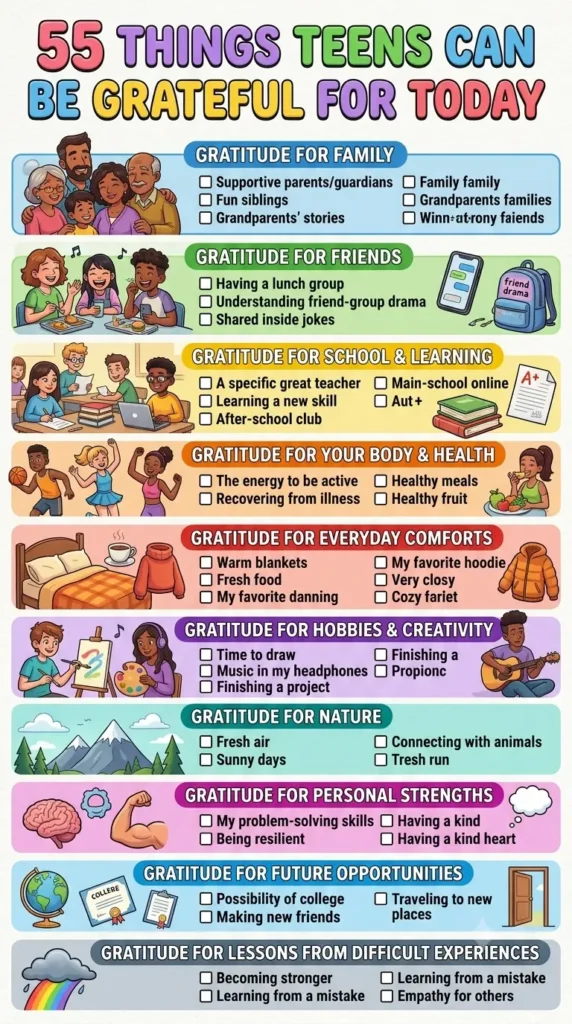
These 55 ideas are built for teens. They’re split into 11 groups of 5, so finding something real takes less digging.
Some days an answer comes fast. Other days, nothing. Don’t force a “perfect” response. Start with what’s already in front of you. Think of these less as a checklist to copy and more as a nudge, something to help you notice what you’d normally scroll past. If you want a broader base to build from first, this guide walks through the idea in more depth.
Being Thankful for Family
Family isn’t perfect. Most teens already know that better than any adult could explain it. Thanks doesn’t mean pretending every relationship is smooth. It means noticing what quietly holds your life together.
You might feel thankful for:
- A parent or guardian who reminds you to eat before school.
- Someone who drives you to practice, appointments, or activities.
- A sibling who makes you laugh when you’re stressed.
- A family tradition you actually look forward to.
- Someone who wants you to succeed, even if they say it clumsily.
Some things happen every day. That’s exactly why they go unnoticed. The ordinary stuff hides in plain sight.
Being Thankful for Friends
Friend groups shift constantly during your teen years. People drift, misunderstandings happen, and everyone grows in different directions. That’s precisely why the friendships that hold up deserve more attention, not less.
Today, you might feel thankful for:
- A friend who saved you a seat at lunch.
- Someone who checked in after a rough day.
- A classmate who explained something confusing.
- The friend who makes a boring afternoon fun.
- Someone you can be yourself around, no performance needed.
One solid friendship usually beats a hundred acquaintances. Quality wins. It almost always does.
Being Thankful for School and Learning
School isn’t everyone’s favorite place. Fair enough. Appreciating learning doesn’t mean loving every homework set or exam.
Instead, try noticing:
- A teacher who actually believes in you.
- Skills your future self will thank you for.
- Access to books, libraries, or free lessons online.
- A subject that pulls your curiosity in.
- The chance to find out what you’re good at.
Education isn’t only grades. Every class, project, and mistake teaches you something, even the ones you won’t understand until years later.
Being Thankful for Your Body and Health
Your body runs thousands of small tasks a day without asking for credit. It deserves more appreciation and less criticism.
Today, you could feel thankful for:
- Walking, running, dancing, or playing your favorite sport.
- Your eyesight, hearing, or sense of taste.
- Getting one solid night of sleep.
- Bouncing back after being sick.
- Having enough energy to do something you love.
Social media pushes you toward comparing appearances constantly. Try shifting the focus. Appreciate what your body lets you experience, not just how it photographs.
Being Thankful for Everyday Comforts
Some of life’s biggest wins are surprisingly plain. They’re so routine that you barely notice them, until they’re missing.
You might appreciate:
- Your favorite hoodie on a cold morning.
- A warm shower after a long day.
- Clean water straight from the tap.
- Your bed after a draining week.
- Your favorite snack waiting at home.
None of this is dramatic. It still makes the day noticeably better.
Being Thankful for Hobbies and Creativity
Hobbies remind you your worth isn’t tied to grades, followers, or trophies. Sometimes making something purely because you enjoy it is enough. Sound too simple? It is. That’s why it works.
Today’s list might include:
- Drawing, painting, or photography.
- Playing an instrument or losing yourself in music.
- Reading a book that swallows your afternoon.
- Playing sports or exercising.
- Writing stories, poems, or journal entries.
Creative hobbies give your brain somewhere safe to land when everything else feels like too much.
Being Thankful for Nature
Nature has a quiet way of slowing you down. You don’t need a mountain hike. A five-minute walk outside can shift how the whole day feels.
Take a second to appreciate:
- A colorful sunset after school.
- Rain tapping against your window.
- Trees changing with the seasons.
- Birds singing early in the morning.
- Fresh air after hours stuck indoors.
Thanks gets easier once you actually look around instead of rushing through the day on autopilot.
Being Thankful for Your Own Strengths
Not everything on this list has to come from outside you. Your own qualities count too.
Maybe today you’re thankful for your:
- Kindness toward other people.
- Sense of humor.
- Curiosity.
- Determination when things get hard.
- Ability to learn from mistakes.
Most teens find it easier to compliment a friend than themselves. Naming your own strengths isn’t bragging. It’s just being honest with yourself.
Being Thankful for What’s Ahead
You don’t need a clear plan to feel thankful that a future even exists.
A few things worth noticing:
- The chance to keep learning.
- Friendships you haven’t made yet.
- Goals you’re chipping away at.
- Places you’ll eventually see.
- The chance to become someone new.
Your story isn’t finished. That alone is worth something.
Being Thankful for Hard Lessons
Some experiences hurt while they’re happening. Thanks doesn’t ask you to pretend those moments felt good.
What it can do is help you notice what they taught you once the dust settles.
You might be thankful for:
- Getting tougher after a setback.
- Finding out who your real friends are.
- Discovering strength you didn’t know you had.
- Becoming more understanding toward other people.
- Realizing hard seasons don’t last forever.
Growth rarely feels good while it’s happening. Looking back usually reveals what you couldn’t see in the moment. If a rough stretch is still weighing on you, this piece on gratitude and anxiety is worth a read.
Being Thankful in a World Built on Comparison
Most gratitude lists skip this part. For teens, it might be the most important one.
Social media makes comparison feel normal. In minutes you can scroll past someone’s vacation, another person’s exam score, a stranger’s clear skin, a classmate’s big win. You know it’s only the highlight reel. That doesn’t stop it from stinging.
Thanks interrupts the cycle.
Instead of asking “Why don’t I have what they have?” try asking “What do I already have that deserves my attention today?” One small shift and your mind stops burning energy on the wrong question.
Today, you could feel thankful for:
- Knowing social media never shows the whole picture.
- Friends who value you offline, not just in likes.
- Moments you actually put the phone down.
- Confidence you’re building from the inside, not from comments.
- The freedom to define success your own way.
The goal was never to quit social media. It’s to stop letting it decide how you feel about your own life.
What If You Can’t Think of Anything to Be Grateful for Today?
Some days your brain just refuses to cooperate. You sit down to write in a journal and nothing comes. That’s normal. Don’t force a perfect answer. Gratitude isn’t about pretending life is wonderful. It’s about noticing one small thing that made today a little easier, calmer, kinder, or just more manageable than it could’ve been.
So when you’re stuck on what am I grateful for today, don’t panic. Lower the bar instead.
Start Incredibly Small
Your mind goes blank. Lower the bar even further.
You don’t need to write “I’m grateful for my entire life.” That’s too big to feel true. Start smaller than that. Maybe your favorite hoodie was clean. Maybe your phone battery survived the whole school day. Maybe the rain held off until after your walk home.
None of that sounds impressive. That’s the point. These moments prove something simple: even rough days usually have a few pockets of comfort hiding in them. Spot one, and the next one gets easier to find.
Borrow Gratitude from Yesterday
Not every day feels memorable. That’s fine.
If today was a blur, look back to yesterday instead. Was there a conversation that made you laugh? A meal that actually tasted good? A teacher who finally explained something so it clicked? Maybe just a quiet evening where you got to breathe.
Gratitude doesn’t expire at midnight. Borrowing from a recent good moment works just as well as inventing a new one on the spot, and it feels a lot more honest.
Focus on What Didn’t Go Wrong
This one flips the whole question.
Instead of asking “what amazing thing happened today,” try asking what problem didn’t happen. Maybe you got to school safely. Maybe an argument cooled down before it turned into something worse. Maybe you finished that stressful test and can finally stop carrying it around in your head.
Sometimes nothing bad happening is the win. It counts just as much as something good showing up.
Accept That Gratitude and Difficult Emotions Can Exist Together
Here’s a common myth: you have to feel happy first, then gratitude follows. Not true.
You can be anxious about exams and still appreciate a friend who checked in on you. You can feel lonely and still be thankful for the one song that got you through the evening. A genuinely hard week doesn’t cancel out the one moment of relief inside it.
Gratitude doesn’t erase what’s difficult. It just stops that difficulty from being the only story you tell yourself. Practicing it actually feels more real when you admit the hard parts instead of hiding them. If this idea interests you, this piece on whether gratitude and anxiety can coexist breaks down exactly why the two aren’t opposites.
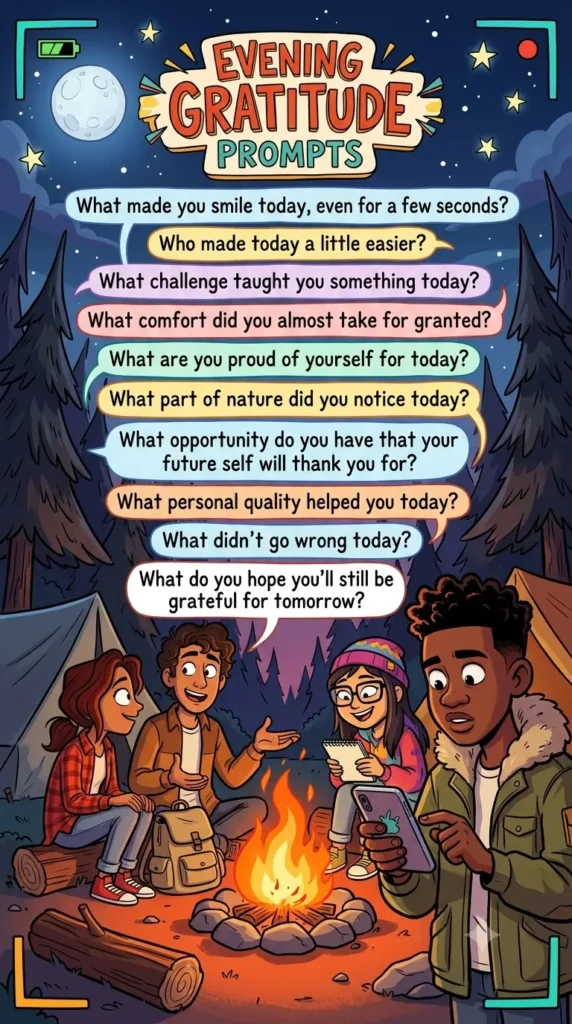
10 Daily Journal Prompts for Answering “What Am I Grateful for Today?”
Some days your mind just goes blank. You sit down to journal and nothing comes. That’s normal. A good prompt gives you somewhere to start when “what am I grateful for today” feels like an impossible question to answer.
These aren’t trick questions. There’s no right answer here. They’re built to help you notice the people, moments, and small wins you walked right past. Even on a rough day.
What made you smile today, even for a few seconds?
Not every good moment sticks in your memory. Someone cracked a joke mid-class. Your dog met you at the door like you’d been gone for years. That one song came on during the bus ride home. Small stuff. Easy to miss. Worth writing down anyway.
Who made today a little easier?
Skip your best friend for a second. Think wider. A teacher who explained the confusing part twice without sighing. A sibling who handed over half a snack. A teammate who yelled “good hustle” when you felt slow. A stranger who held the door. Gratitude often starts by noticing how other people quietly carry your day for you.
What challenge taught you something today?
A group project fell apart. A test came back lower than you hoped. A conversation got awkward fast. None of that feels like a gift in the moment. But instead of asking “why did this happen,” try asking “what did this teach me.” That one shift changes how the whole day gets remembered.
What comfort did you almost take for granted?
Look around your room right now. A warm meal. Clean clothes. Wi-Fi that actually held up long enough to finish homework. A bed that isn’t lumpy. A house where you feel safe. None of it feels exciting. Until it’s gone.
What are you proud of yourself for today?
It doesn’t need to be huge. Maybe you finally raised your hand in class. Maybe you stayed calm during an argument that could’ve blown up. Maybe you finished the assignment you’d been avoiding for a week. That counts. Progress deserves noticing, even when nobody else claps for it.
What part of nature did you notice today?
Gratitude isn’t only about people or stuff. Sometimes it’s the smell of rain hitting pavement. A cool breeze right after school lets out. Sunlight cutting across your bedroom floor. The sky turning orange right before dark. Paying attention to what’s around you slows your thoughts down in a good way.
What opportunity do you have that your future self will thank you for?
Think about what you’re building right now, even if it feels boring today. Learning a new skill. Practicing a sport nobody’s watching you play. Reading more. Saving a little cash. None of it feels thrilling in the moment. But it’s shaping the person you’re becoming, whether you notice it or not.
What personal quality helped you today?
Stop looking outward for a second. Look at yourself instead. Maybe your curiosity got you through a confusing lesson. Maybe your patience kept you from snapping at someone. Maybe your humor pulled a stressful moment back down to earth. Appreciating your own strengths builds real confidence. Way more than comparing yourself to everyone else does.
What didn’t go wrong today?
This one hits different on the hard days. Maybe nothing amazing happened. But the bus showed up on time. Your family was safe. Your phone didn’t crack. The argument didn’t turn into a bigger fight. Gratitude isn’t only about celebrating wins. Sometimes it’s just noticing the disaster that never showed up.
What do you hope you’ll still be grateful for tomorrow?
Close your entry by looking forward instead of back. Pick one relationship worth nurturing. One habit worth keeping. One small piece of your life you don’t want to overlook again. Gratitude gets stronger the moment it stops being just a rearview mirror.
Want more angles to work with? 365 Journal Prompts for Mental Health lays out a full year of them, built for self-discovery, gratitude, and emotional check-ins. Fresh questions mean journaling stops feeling repetitive, and you end up noticing different corners of your life over time.
How to Make Gratitude a Daily Habit Without It Feeling Forced
A gratitude habit works best when it blends into your day. Not another box to check.
The goal isn’t a perfect answer every morning. It’s noticing the good that’s already sitting there, even on a flat, ordinary Tuesday. Asking yourself what am I grateful for today shouldn’t feel like homework. It should feel like a quick glance sideways at your own life.
Keep Answers Short
Most people quit journaling for one reason. They think every entry needs depth.
It doesn’t. Some days your answer is just, “My friend waited for me after class.” Or, “I finally got today’s math lesson.” That’s the whole entry. Short answers often feel more real, too, because they catch what actually stood out instead of straining for something poetic.
Sound too simple? It is. That’s the point.
If writing starts to feel like a chore, you’re asking too much of yourself. Check out our 365 journal prompts for mental health if you want a low-effort way to keep the habit moving without overthinking each entry.
Avoid Repeating the Same Ideas
Being grateful for your family every day isn’t wrong. Say the same line enough times, though, and your brain stops paying attention.
Specificity fixes this. Swap “I’m grateful for my parents” for something you can picture. Try, “My dad stayed up late helping me finish my project.” Or, “My mom made my favorite dinner after a rough day.”
Detail is the whole trick here. Notice more, and each day starts handing you something slightly different to appreciate. For more direction on this, our guide on things to be grateful for daily breaks down dozens of specific, everyday moments worth naming, and our gratitude examples post shows what that specificity actually looks like on the page.
Focus on Noticing Instead of Performing Gratitude
Gratitude isn’t a performance. It’s not a contest for who sounds the most upbeat.
You don’t owe the day forced thanks, especially the hard days. A better approach is just noticing what made things a little easier, kinder, or more interesting. A funny text. A quiet walk home. The relief of finally finishing something you dreaded.
Why does this shift matter? Because performing gratitude burns out fast, and noticing it doesn’t. You’re not pretending life is perfect. You’re training your attention to land on the parts still worth appreciating. If gratitude sometimes feels tangled up with worry or stress, our post on gratitude and anxiety existing at the same time is worth a read.
Common Mistakes People Make When Practicing Gratitude
Gratitude sounds simple. Then people try it daily and it falls apart within a week.
Not because they stop caring. Because they set the bar too high without noticing. A few small mistakes turn what am I grateful for today into a chore instead of a habit that sticks.
Thinking Answers Have to Be Profound
Gratitude doesn’t have to sound deep.
A lot of teens think it should read like a quote card. It shouldn’t. A hot shower before school counts. So does finally getting a math problem after three tries. Small stuff carries more weight than it looks like on paper.
Nobody remembers the fancy journal entry from six months ago. They remember the ordinary Tuesday that felt lighter for no clear reason. If you’re stuck on what counts as “enough,” these deep things to be thankful for are proof that meaning and simplicity aren’t opposites.
Comparing Gratitude with Others
Comparison ruins gratitude fast.
Someone else’s list might read like a travel brochure. Beach trips. Big wins. Yours might just say “good playlist” or “funny lunch with Sam.” Neither one wins. Gratitude isn’t a leaderboard.
Here’s the part people miss: your list is supposed to sound like your life, not someone else’s highlight reel. Scroll through these gratitude examples or a full gratitude list and you’ll notice something. The best ones are specific, not impressive.
Ignoring Difficult Emotions
You don’t need to feel happy first.
That’s the myth that kills the habit fastest. You can be stressed about a test, annoyed after a fight with your mom, and still notice one decent thing that happened at lunch. Gratitude and hard feelings aren’t opposites. Anxiety and gratitude can exist at the same time, and pretending otherwise just adds pressure to an already rough day.
Gratitude doesn’t erase the bad stuff. It just proves the bad stuff isn’t the whole story. If anxiety is part of your daily pattern, gratitude journaling built around anxiety works with those feelings instead of against them.
Writing the Same Answer Every Day
“Grateful for my family” again? Fine. But it goes on autopilot fast.
Ask why instead. What actually happened today. Maybe your sister made you laugh mid-stress. Maybe your dad drove you to practice and didn’t complain once. Maybe your grandma sent one random text that landed at the right time.
Chase the fresh detail, not the safe repeat. A few ways to keep it from going stale:
- Pull from unique things to be thankful for when your brain goes blank
- Rotate through daily gratitude ideas instead of repeating the same three
- Borrow a prompt from this 365-day journal list when today feels like nothing happened
Small variation is the whole trick. It’s what keeps the journal from becoming another box you check without actually looking at your day.
Final Reflection
Gratitude doesn’t ask for a perfect day. It doesn’t ask for a perfect life. It definitely doesn’t ask for everything to be figured out.
Some days, the honest answer to “what am I grateful for today” is small. A text from someone checking in. A laugh that caught you off guard. A skill you’re slowly getting better at. Even just the shot to try again tomorrow.
That’s enough. It really is.
If you want gratitude to stick, don’t chase a long list. Start with one sentence. Write it down, say it out loud, whatever works. Notice one thing worth your attention, and give it that attention fully.
Not five things. Not ten. Just one, said honestly, on repeat.
Some days it’s easy. Other days it isn’t, and that’s fine too. On the harder days, things to be grateful for daily can help you find a starting point even when nothing obvious comes to mind.
Start small. Keep it honest. That’s the whole practice.
Frequently Asked Questions
How to Answer “What Are You Grateful for Today?”
Start small. That’s the whole trick.
Think of one person, one moment, one small comfort that made today easier. Maybe someone texted back right when you needed it. Maybe you got ten quiet minutes before school chaos started. It doesn’t have to be big.
A good conversation counts. So does a favorite show, a lesson you finally understood, or just having a safe room to crash in after a rough day. The answer to what am I grateful for today isn’t a test. Nobody’s grading it.
Pick the first thing that comes to mind. That’s usually the real one.
Why People Write Down What They’re Grateful For Every Day
Most good moments slide right past you. That’s the problem gratitude journaling actually solves.
Writing it down forces your brain to slow down and notice. A friend showed up for you. You made progress on something hard. The day wasn’t perfect, but it had a decent moment in it. Without writing it down, stress just steamrolls right over that stuff.
That’s the whole point.
A daily habit like this trains your attention toward what’s working, not just what’s broken. Not because problems don’t matter. They do. But your brain already obsesses over those on its own.
Can Gratitude Actually Help Your Mental Health?
This isn’t just a feel-good claim.
Gratitude works because it shifts what you pay attention to. Research from groups like the Greater Good Science Center links regular gratitude practice to better well-being, stronger relationships, and more emotional bounce-back after hard weeks.
Not magic. Just repetition.
The catch is consistency. One entry won’t change much. But stacking small entries over weeks builds a real pattern your brain starts to expect.
Is It Okay to Be Grateful and Still Have a Bad Day?
Yes. Completely.
Gratitude doesn’t cancel out sadness, or frustration, or that anxious pit in your stomach before a test. It’s not a costume you wear over real feelings. It sits next to them instead.
You can be thankful for a friend and still feel wrecked about a fight with your parents. Both things are true at once. Nobody said they weren’t allowed to overlap.
How Many Things Should You Write in a Daily Gratitude Journal?
There’s no magic number. None.
Some people write one line and stop. Others list five or six small things before bed. Neither way is more correct than the other.
What actually matters is whether you’ll keep doing it. A short, honest entry you’ll repeat tomorrow beats a long list you abandon by Thursday.

It’s Bhaskar!
Well, I am not a psychologist a monk, or a philosopher by training. I’m just an engineering graduate.
‘The Empty Self’ is where I write about that idea, and what it actually means for ordinary life, anxiety, identity, habits, the stories we tell ourselves about who we are. I don’t have a psychology degree, and I’m not offering therapy or clinical advice. What I do have is thought and clarity, and genuine curiosity about why we suffer the way we do and how much of it might loose once we shed this ‘fixed identity’.