

Picking the best DBT books & workbooks comes down to one question. What do you actually want to practice?
Some books walk you through exercises for mindfulness, distress tolerance, emotion regulation, and healthier relationships. Others got written for therapists running structured skills groups. Pick one of those by accident and you’ll feel lost fast. Dense language. Clinical jargon. Not built for solo reading.
This list compares ten DBT resources for adults, teens, caregivers, and clinicians. Each one gets a real look at its purpose, its strengths, and where it falls short. Start with the quick comparison below. Then read the full review before you commit to a title.
Quick overview: DBT books span a wide spectrum. Practical self-help workbooks sit on one end. Official skills handouts, clinical manuals, and personal memoirs sit on the other. The right pick depends on your age, your goals, and how much support you already have. Compare each resource by audience, format, and focus. That’s how you find a starting point that actually fits.
Still building out your own coping skills worksheets or working through an emotions worksheet on the side? A good DBT workbook pairs well with both. The books on this list won’t replace a therapist. They will give you language for what you’re already feeling, and that’s where most people actually start.
Table of Contents
Disclaimer
This blog is written and edited with the help of AI, then reviewed by me before publishing. As a result, the content is for general reflection only, not therapy or medical advice, and I’m not a licensed mental health professional. If you’re in crisis, please contact 988 if you’re in US or a local crisis service of your country instead of relying on this site.
Best DBT Books & Workbooks: Which One Should You Choose?
Not all DBT books work the same way. Some hand you exercises. Others read like a manual for a therapist. The right pick depends on three things: what you’re trying to learn, your age, and whether you’ve got a therapist guiding you or you’re doing this solo.
That’s the real question before you buy anything.
Quick Picks: The Best DBT Books at a Glance
Best Overall: The Dialectical Behavior Therapy Skills Workbook
This is where most adults should start. It walks you through mindfulness, emotional regulation, distress tolerance, and interpersonal skills, one guided exercise at a time. No clinical jargon standing between you and the work.
Best for Clinicians: DBT Skills Training Manual
Built for the other side of the room. If you’re running a skills group or leading sessions, this is the structured reference you’ll keep reaching for.
Best for Teens: Don’t Let Your Emotions Run Your Life for Teens
Big emotions feel bigger at sixteen. This one meets teenagers where they are and gives them a way to respond that isn’t just reacting harder.
Best Official Materials: DBT Skills Training Handouts and Worksheets
Think of this as the companion piece. Pair it with a DBT therapist or group, and the structured materials actually land somewhere.
Comparison Table: All 10 Titles
| Title | Author(s) | Best for | Type | Edition and year |
|---|---|---|---|---|
| The Dialectical Behavior Therapy Skills Workbook | Matthew McKay, Jeffrey C. Wood, Jeffrey Brantley | Adult self-help | Workbook | 2nd ed., 2019 |
| DBT Skills Training Handouts and Worksheets | Marsha M. Linehan | Structured skills practice | Handouts and worksheets | Revised ed., 2025 |
| DBT Skills Training Manual | Marsha M. Linehan | Clinicians and group leaders | Clinical manual | Revised ed., 2025 |
| Don’t Let Your Emotions Run Your Life for Teens | Sheri Van Dijk | Teenagers | Self-help book | 2nd ed., 2021 |
| DBT Skills Manual for Adolescents | Jill H. Rathus and Alec L. Miller | Teen skills groups and caregivers | Clinical manual | 1st ed., 2014 |
| The Dialectical Behavior Therapy Skills Workbook for Anxiety | Alexander L. Chapman, Kim L. Gratz, Matthew T. Tull | Anxiety-related challenges | Workbook | 2011 |
| The Dialectical Behavior Therapy Skills Workbook for Anger | Alexander L. Chapman and Kim L. Gratz | Anger and emotional reactivity | Workbook | 2015 |
| Calming the Emotional Storm | Sheri Van Dijk | Accessible introduction | Self-help book | 2012 |
| DBT Made Simple | Sheri Van Dijk | Understanding DBT concepts | Introductory guide | 2012 |
| Building a Life Worth Living | Marsha M. Linehan | Understanding DBT’s origins | Memoir | 2020 |
How We Selected These DBT Books and Workbooks
We stuck to established psychology publishers. Authors either developed DBT themselves or carry real clinical weight in the field. That mattered more than popularity.
Past that, we weighed something simpler: does the book actually get used? We looked at the balance between explanation and exercises, who the book is written for, and whether it holds up for someone working alone versus someone in therapist-led training. A DBT skills worksheet only helps if you’ll open it twice.
Edition details should be confirmed against official publisher pages as of October 2026, with particular attention to the revised manuals and adolescent resources. Prices shift. Formats shift. Check the current listing before you buy.
If these skills feel new, start smaller. A coping skills worksheet or an emotions worksheet can bridge the gap before you commit to a full workbook.ion to revised manuals and adolescent resources. Availability, formats, and prices can change, so readers should check the current listing before purchasing.
What Is Dialectical Behavior Therapy (DBT)?
Dialectical behavior therapy, or DBT, teaches people how to manage big emotions. It also builds skills for handling stress and keeping relationships steady. That’s the short version. Psychologist Marsha M. Linehan built the approach. She mixed acceptance of hard moments with real tools for change. Two things pulling in opposite directions. Both can be true at once.
A dialectical behavior therapy book won’t do the work for you. But it shows you what each skill looks like in practice, not just on paper. The best DBT books and workbooks turn ideas into something you can actually try this week.
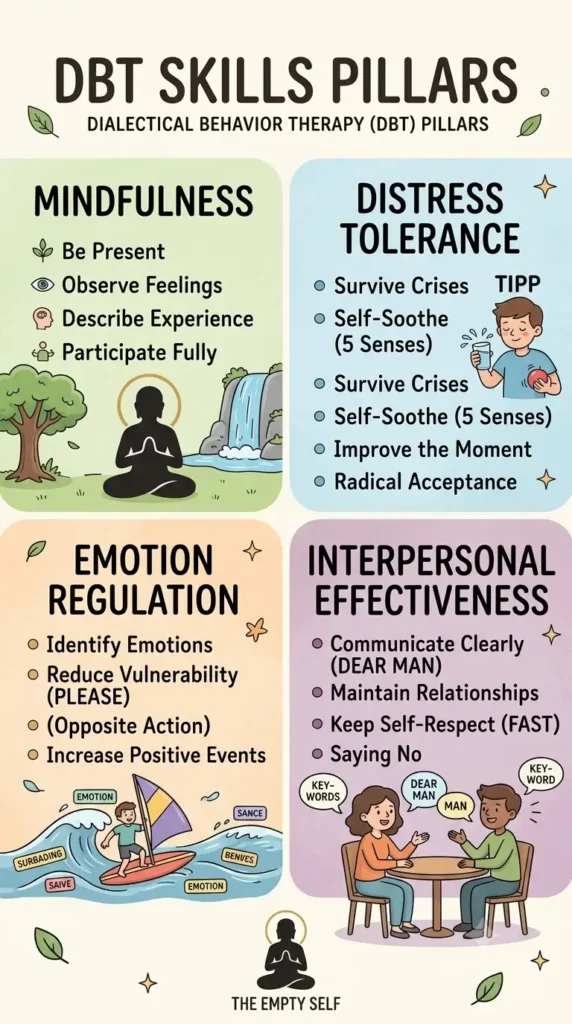
The Four Core DBT Skills
DBT breaks down into four skill areas. Each one covers a different piece of emotional well-being. None of them work in isolation.
Mindfulness means noticing the present moment without judging it. Sounds easy. It rarely is. The skill helps you catch an emotional reaction before it runs the show. Pair it with these mindfulness journal prompts if you want a written way to practice.
Distress tolerance gets you through a hard moment without making it worse. That’s the whole job. Grounding and self-soothing sit inside this skill set, and they’re built for exactly the moments nothing else feels possible. For more practical tools, see these coping skills worksheets.
Not every emotion needs fixing on the spot. Emotion regulation helps you name what you feel first. Then it asks what’s actually driving it. From there, you respond on purpose instead of getting pulled along by the feeling. An emotions worksheet can make that first step, naming the emotion, a lot easier.
Interpersonal effectiveness is the relationship skill. It covers asking for what you need, holding a boundary, and staying clear in a hard conversation. No caving. No blowing up either. The goal is keeping your self-respect while you keep the relationship standing too.
Want the fuller breakdown of all four modules, including the acronyms and worksheets tied to each one? Our DBT skills worksheets guide walks through every skill in that library. The Linehan Institute is also a solid starting point if you want the history behind how DBT came together.
How DBT Books and Workbooks Help You Practice These Skills
A worksheet is just a concept on paper until you use it. DBT books and workbooks close that gap. They turn the four modules into exercises, prompts, and pages you actually fill in. Some are written for independent learning. Others are built for therapists running a DBT skills group.
A good DBT skills workbook might ask you to track an emotional trigger. Or walk through a coping strategy step by step. Or sit with how you responded the last time things got hard. Small reps, repeated often. That’s most of what skill-building actually is.
Here’s the part worth saying plainly: reading alone won’t replace treatment when real support is needed. A dialectical behavior therapy book is a tool, not a therapist.
DBT has been studied closely as a treatment for borderline personality disorder and related struggles. The National Institute of Mental Health (NIMH) has more on BPD and how it’s treated, if you want to go deeper there.
10 Best DBT Books & Workbooks for Teens and Adults
Picking the right DBT book comes down to one question: what are you actually trying to fix? Maybe it’s emotions that spiral fast. Maybe it’s a conversation that keeps going sideways.
Maybe you’re running a skills group and need a real curriculum, not a pamphlet. These 10 picks cover self-help, teen-specific material, clinical training, and the origin story of DBT itself.
1. The Dialectical Behavior Therapy Skills Workbook: Best Overall Self-Help Workbook
Authors: Matthew McKay, Jeffrey C. Wood, and Jeffrey Brantley
Type: Self-help workbook for adults and beginners.
What it covers: Mindfulness, distress tolerance, emotion regulation, and interpersonal effectiveness, with exercises built for everyday situations, not theory.
Why consider it: This is the one to start with. Most people don’t need more explanation. They need a next step. This workbook breaks each skill into something you can actually do today, not just read about.
Potential limitation: It asks something of you. Open it up, and nothing happens on its own. If you want a full therapist-led program, this is a companion, not a replacement.
Edition and format: Second edition, published by New Harbinger Publications in October 2019. Paperback and digital.
2. DBT Skills Training Handouts and Worksheets: Best for Structured Skills Practice
Author: Marsha M. Linehan
Type: Official DBT skills handouts and worksheets.
More than 225 of them, actually. Covering all four core modules. Each one comes with a short, client-facing intro so you’re not left guessing what to do with it.
Why consider it: Good for anyone already in therapy who wants to practice between sessions. You can pull a single worksheet and work it without reading a whole chapter first.
Potential limitation: It’s a lot. Without someone guiding you through it, the sheer volume can bury the point. And if you’re in a skills group already, check which edition your therapist uses before buying your own.
Edition and format: Revised edition, published by Guilford Press in August 2025. The earlier second edition, from 2014, is still in use in some existing programs.
3. DBT Skills Training Manual: Best for Clinicians and Skills Group Leaders
Author: Marsha M. Linehan
Type: Professional training manual.
This isn’t for a quiet Sunday read. It covers skills training principles, how to structure a session, teaching strategies, and detailed guidance across all four modules.
Why consider it: If you teach DBT, or need to understand how the skills curriculum actually fits together, this is the deepest resource available from Linehan herself. Far more instructional detail than any self-help workbook offers.
Potential limitation: Dense. Heavy. Not where you start if you just want exercises for yourself.
Edition and format: Revised edition, published by Guilford Press in August 2025 for the paperback. Hardcover and digital formats are also available.
4. Don’t Let Your Emotions Run Your Life for Teens: Best for Teenagers
Author: Sheri Van Dijk
Type: Teen-focused DBT self-help workbook.
Mood swings. Angry outbursts. Hard relationships. The kind of difficult emotions that don’t come with a manual at fifteen.
Why consider it: Teenagers need examples that sound like their actual life. School. Friends. Family. This workbook speaks to that directly instead of handing a teen the same explanation written for a 40-year-old and hoping it lands.
Potential limitation: It’s built for teens, not as a full clinical treatment plan. Working through it alongside a trusted adult or therapist helps.
Edition and format: Revised second edition, published by New Harbinger Publications’ Instant Help imprint in September 2021. Paperback and digital.
View the teen workbook at Amazon

5. DBT Skills Manual for Adolescents: Best for Teen Skills Groups and Caregivers
Authors: Jill H. Rathus and Alec L. Miller
Type: Clinician-oriented adolescent DBT training manual.
Running a DBT group for teenagers isn’t the same as running one for adults. This manual walks through the adaptations that matter: family involvement, language, pacing, structure.
Why consider it: Built for clinicians and structured teen programs. It draws a clear line between adolescent-focused DBT training and the general adult self-help market.
Potential limitation: Written for professionals. Not meant for a teen working alone.
Edition and format: First edition, published by Guilford Press in November 2014. A second edition is scheduled for December 2026, split into a separate clinician manual and client workbook. Buying in late 2026? Check which one your program actually requires first.
View the original manual at Amazon

6. The Dialectical Behavior Therapy Skills Workbook for Anxiety: Best for Anxiety-Related Challenges
Authors: Alexander L. Chapman, Kim L. Gratz, and Matthew T. Tull
Type: Specialized DBT self-help workbook.
Anxiety rarely waits for a convenient moment. This workbook meets it head-on. It hands readers practical tools for worry, panic, and post-traumatic stress symptoms, built on the same DBT foundation used across the field.
That focus is the whole appeal. Instead of spreading thin across every possible use of DBT, it zeroes in on anxiety-related struggles. Pair it with appropriate anxiety treatment, and readers get a resource built for exactly what they’re dealing with. Not a generic overview.
One thing worth knowing. It was published in November 2011, which makes it older than several other titles here. The exercises work best as a complement to evidence-based approaches like exposure-based CBT. Not a replacement.
Edition and format: New Harbinger Publications, November 2011; paperback and digital editions.
View the anxiety workbook at Amazon
7. The Dialectical Behavior Therapy Skills Workbook for Anger: Best for Anger and Emotional Reactivity
Authors: Alexander L. Chapman and Kim L. Gratz
Type: Specialized DBT workbook.
Anger isn’t something to shove down. This workbook treats it that way from the first page. It leans on mindfulness and emotion regulation skills to help readers catch anger early, respond with more control, and recover once a hard interaction has passed.
What happens when anger steers a decision or a relationship off course? That’s the real question this book is built around. It doesn’t frame anger as the enemy. It frames it as something worth understanding, so a reader can meet it with a response that actually works.
The trade-off is scope. A focused workbook like this one won’t cover all four DBT skill modules the way a general workbook does. Readers wanting the full system will need something broader.
Edition and format: New Harbinger Publications, November 2015; paperback and digital formats.
View the anger workbook at Amazon

8. Calming the Emotional Storm: Best for an Accessible Introduction
Author: Sheri Van Dijk
Type: General-reader DBT guide with practical exercises.
This one isn’t written for clinicians. It’s written for someone standing in the middle of an intense emotion, trying to make sense of it. Van Dijk walks through understanding big feelings, managing tough reactions, practicing acceptance, and building steadier responses to stress.
Plain language does the heavy lifting here. Readers who want to understand what’s happening inside them before committing to a full structured workbook will find this a gentler entry point. A warm-up, not a workout.
It won’t match Linehan’s official materials for depth. This isn’t a comprehensive skills-training manual, and it was never meant to be one.
Edition and format: New Harbinger Publications, March 2012; paperback and digital formats.

9. DBT Made Simple: Best for Understanding DBT Concepts
Author: Sheri Van Dijk
Type: Educational guide for understanding and applying DBT.
Concepts first, exercises later. That’s the order this book follows. It lays out the foundational ideas behind DBT, walks through the four core skills modules, and gives practical direction for applying DBT techniques inside real clinical sessions.
Who gets the most out of it? Readers who want DBT explained clearly, start to finish. It also works well for mental health professionals looking to translate DBT concepts into something a client can actually follow, instead of jargon that loses them halfway through.
It leans clinician-facing. Someone hunting for a workbook packed with independent exercises to complete solo should look elsewhere first.
Edition and format: New Harbinger Publications, 2012. Check the publisher’s listing for current format availability.
View DBT Made Simple at Amazon
10. Building a Life Worth Living: Best for Understanding DBT’s Origins
Author: Marsha M. Linehan
Type: Memoir.
Where did DBT actually come from? This book answers that, and it isn’t a textbook answer. Linehan writes about her own struggles as a young woman and the long path that led her to develop dialectical behavior therapy in the first place.
That personal lens changes how the therapy reads afterward. Readers get the human story behind the history, and a clearer sense of why building a meaningful life, skill by skill, mattered enough to Linehan to make it her life’s work.
One caveat worth stating plainly. This is not a DBT skills resource. It won’t replace a workbook, a set of skills worksheets, or a training manual for anyone looking for structured practice.
Edition and format: Random House, January 2020; ebook, paperback, and audiobook formats.
How to Choose the Best DBT Workbook for Your Needs
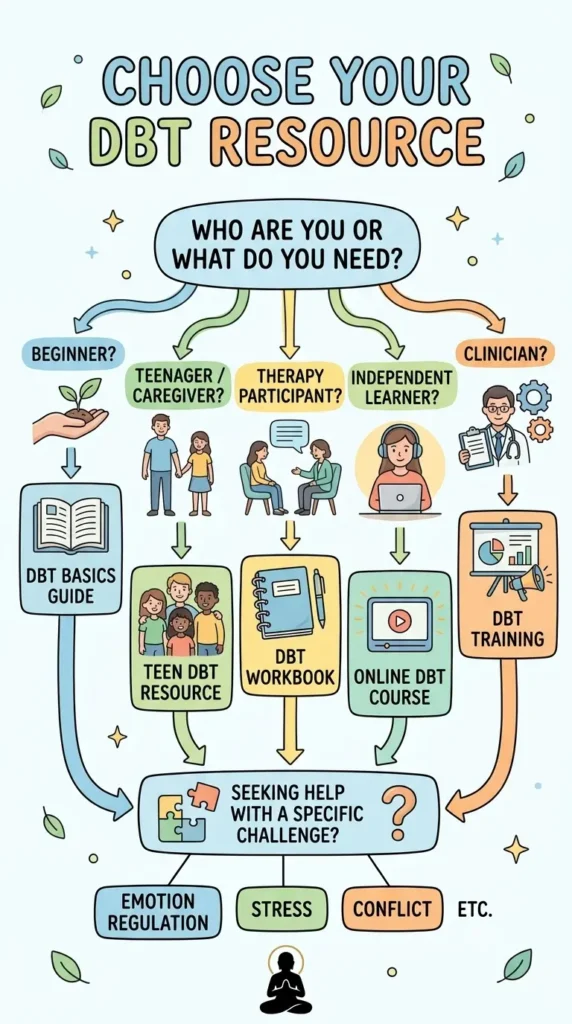
The best DBT workbook isn’t one-size-fits-all. Not even close. Your experience level decides it. So does your goal, and so does how you plan to use the book. Some guides walk beginners through the basics.
Others hand you structured exercises for solo practice. Some exist strictly for therapist-led sessions. Whatever list of best DBT books and workbooks you’re browsing, match the pick to where you actually are right now, not where you wish you were.
If You Are New to DBT
Start simple if DBT is new to you. Find a book that explains dialectical behavior therapy in plain words. It should walk through all four skill areas: mindfulness, distress tolerance, emotion regulation, and interpersonal effectiveness. Skip anything written for clinicians first. That comes later.
The Dialectical Behavior Therapy Skills Workbook by Matthew McKay, Jeffrey C. Wood, and Jeffrey Brantley is a solid place to begin. It pairs plain explanations with exercises you can work through at your own pace. Not rushed. Not overwhelming. One skill at a time.
Why does that pairing matter so much? Reading about mindfulness and actually practicing it are two different things. A workbook format closes that gap from page one. These DBT skills worksheets build on the same idea once you’re ready for more structured practice.
If You Want to Practice Skills on Your Own
This isn’t about reading a textbook cover to cover. Self-practice calls for a DBT workbook for adults with clear instructions, guided exercises, and room to actually reflect. Explanations alone won’t cut it. You need a book that pushes you to apply each skill to something real happening in your week, not just define it on paper.
Pick one skill. Just one. Work through it before moving to the next. Revisit anything that felt useful, skip what didn’t land. That’s the whole method. For extra structure between sessions, pair your workbook with these coping skills worksheets or a quick emotions worksheet to name what you’re working through first.
If You Are Already Working With a Therapist
Working with a therapist changes the question. It’s not “which DBT skills workbook is best” anymore. It’s “which one fits my treatment.” Ask your therapist directly before buying anything.
Marsha M. Linehan’s DBT Skills Training Handouts and Worksheets often fits best here, especially when your therapist or skills group already follows it. Same edition, same page numbers. That matters more than it sounds like it should. Show up with the wrong edition, and you’re flipping through mismatched pages while everyone else stays on track. The same copy keeps assignments and discussions lined up without the friction.
If You Are Choosing a DBT Book for a Teenager
Pick a book written for teens, not adapted for them. Age-appropriate examples matter here. So do exercises a teenager will actually finish instead of abandoning by chapter two.
Sheri Van Dijk’s Don’t Let Your Emotions Run Your Life for Teens is worth a look. It speaks to real teenage situations: mood swings, friend drama, family tension. Not hypothetical adult scenarios dressed up for a younger reader.
Should a teenager work through it alone? Depends on the teen. Some do fine independently. Others need a parent, caregiver, or therapist alongside them. Watch how they respond to the first few exercises. That tells you more than guessing upfront ever will.
If You Are a Clinician or Skills Group Leader
Clinicians need structure, not inspiration. General self-help books won’t cut it in a skills group setting. You need materials built for teaching, not just reading.
Linehan’s DBT Skills Training Manual is designed exactly for that. It supports structured skills training, session by session. The companion handouts and worksheets give you practice materials to hand out alongside it.
One thing before you order a set for your whole group: check which edition your program actually requires. Editions change. Page numbers shift. A mismatched batch wastes everyone’s first session just sorting it out.
If You Want Help With a Specific Challenge
Not every struggle needs the same book. Match it instead. A specialized workbook digs deeper into one problem, like anxiety or anger. A broader DBT skills book covers all four modules at once, which suits someone still mapping out what they even need.
Still not sure which issue is driving things? For hands-on practice across every skill area, explore these DBT skills worksheets to find the exercises that actually fit your situation.
DBT Workbook vs. DBT Skills Manual: What’s the Difference?
A workbook, a training manual, and a stack of handouts look similar on a bookshelf. They’re not the same tool. One is for solo practice. One is for a clinician running a group. One is for drilling single skills between sessions. Pick the wrong one and you’ll spend money on something that doesn’t fit how you actually learn.
Here’s the short version before the details: a self-help workbook walks you through DBT skills on your own, start to finish. A skills training manual is built for the person leading the group, not the person sitting in it. Official handouts and worksheets sit in between. Grab them for focused reps on one skill at a time. Your goal decides which shelf to pull from.
What a Self-Help Workbook Includes
Picture this. It’s late. You’re alone with a feeling you can’t name yet, and no therapist is answering the phone. A self-help workbook is built for exactly that gap. The Dialectical Behavior Therapy Skills Workbook by Matthew McKay, Jeffrey C. Wood, and Jeffrey Brantley does that job well. It covers mindfulness, distress tolerance, emotion regulation, and interpersonal effectiveness in plain language.
No jargon wall to climb first. Instructions are clear. Examples feel like real life, not a textbook case study. And the exercises? Built to revisit, not finish once and shelve. That’s the whole design.
Want a sense of what the practice side looks like day to day? These coping skills worksheets run on the same logic. Pick a skill, try it on a real moment, see what shifts.
What a Skills Training Manual Is Designed to Do
This isn’t a beginner’s book. Not even close. Marsha M. Linehan’s DBT Skills Training Manual was built for clinicians and group leaders, the people responsible for teaching the material to someone else. It lays out session structure, teaching notes, and the full architecture behind running a skills group.
Think of it as the blueprint, not the house. A self-help reader opening it cold will likely find themselves lost in facilitation guidance instead of plain exercises. Why? The audience isn’t you. It’s your therapist, or the group leader across the room. If you’re choosing between DBT books for personal, independent use, this one’s not the match. It earns its place in a professional’s library.
When to Choose Official DBT Handouts and Worksheets
Here’s an honest take: sometimes you don’t need a whole book. You need one sheet for one skill, right now. DBT Skills Training Handouts and Worksheets by Marsha M. Linehan is built for that. The revised edition packs in more than 225 reproducible pages, spread across all four core modules.
It shines brightest alongside therapy or a skills group, where a therapist or leader points you to the exact page that fits your week. Working through the broader DBT skills worksheets library pairs naturally with this approach too, especially if naming the emotion itself is where you get stuck. An emotions worksheet can help with that first.
| Resource | Best suited for | Main purpose |
|---|---|---|
| Self-help workbook | Independent learners | Guided explanations and exercises |
| Skills training manual | Clinicians and group leaders | Teaching guidance and session structure |
| Official handouts and worksheets | Clients, students, and therapy groups | Practicing specific DBT skills |
Still unsure which one to buy? Start with your goal, not the title. Learning on your own points to the workbook. Teaching DBT points to the manual. Practicing specific skills with structure points to the handouts. And if you’re already in a DBT program, check with your therapist before buying the official edition. Programs don’t all use the same one.
Can You Learn DBT From a Book Without Therapy?
Yes. You can learn real DBT skills from a book or workbook, no therapist required. A DBT skills workbook can teach you to understand emotions, manage stress, and talk to people better. Self-guided practice works. It’s just not the same as full DBT treatment.
What Self-Guided DBT Practice Can Help You Learn
DBT self help books hand you practical tools for real problems. Nothing theoretical about it. You’ll pick up mindfulness, the skill of noticing what’s happening right now instead of running on autopilot. Distress tolerance gets you through a rough ten minutes without making things worse. Emotion regulation helps you figure out why a feeling hit so hard. Interpersonal effectiveness teaches you to ask for what you need and actually say it out loud.
A structured dbt skills workbook gives you exercises, not just explanations. You try a skill. Write down what happened. Try it again somewhere a little less stressful. That’s the whole loop. Progress is slow and uneven, and not every exercise fits every person. Some skills will click fast. Others won’t, and that’s normal too.
Want a starting point before you buy anything? These DBT skills worksheets let you test a skill for free, and this emotions worksheet is a solid place to begin naming what you feel before you try to manage it.
When Professional Guidance Matters
A workbook has limits. If you’re dealing with severe emotional distress, recurring urges to self-harm, suicidal thoughts, or anything that’s wrecking your daily life, a book alone isn’t enough. That’s not a judgment. It’s just the reality of what a page can and can’t do.
Full DBT treatment usually includes individual therapy plus structured skills training, with more support layered in depending on the program. For people with borderline personality disorder, the National Institute of Mental Health recommends treatment with a licensed mental health professional. That’s not a casual suggestion. It comes from decades of research on what actually helps.
If you’re in crisis or thinking about suicide in the United States, call or text 988 to reach the 988 Suicide & Crisis Lifeline. If you’re in immediate danger, contact local emergency services right away.
How to Use a Workbook Alongside Therapy
A workbook works best next to therapy, not instead of it. Bring the exercises that confuse you straight to your therapist. Ask how a skill applies to your actual week, not just the example in the book.
Between sessions, use the workbook to log triggers, practice a skill, and jot down what helped. For more practice material, these coping skills worksheets pair well with any DBT routine, and journal prompts for mental health make the between-session reflection easier to stick with.
A dbt workbook for adults is a practical learning aid. That’s its job. It’s not a replacement for the level of care you actually need.
How to Get More From Your DBT Book or Workbook
A DBT workbook only works if you actually use it. Reading every chapter fast feels productive. It isn’t. Real change comes from picking one skill out of your DBT skills workbook and running it through actual situations, over and over, until it starts to stick. Small, steady reps build confidence with these tools. Nothing fancy about it.
Start With One Skill at a Time
Don’t try to learn everything at once. Pick the one skill that matches what’s happening in your life right now. Emotions feel like they’re running the show? Start with emotion regulation. Falling apart the second things get stressful?
Distress tolerance is the one to open first. One skill at a time keeps practice manageable. It also gives you room to actually understand how the thing works before you move to the next page.
Practice Between Reading Sessions
Reading about a skill and using it mid-crisis are two different things. That’s the gap most people trip on. The fix is simple: practice during ordinary moments, before you need the skill for something hard.
Use mindfulness while you’re doing the dishes. Run through the DBT STOP skill before you reply to a message that’s annoyed you. Low-stakes practice now means the skill is actually there when things get loud later.
Track What Works and What Needs More Practice
Keep it simple. Write down the skill you tried, what happened, and what you’d do differently next time. Skip the self-judgment when something doesn’t land right away. It won’t, not every time. That’s not failure. It’s data. The point of tracking isn’t a perfect streak. It’s figuring out which skills fit which situations, and where you still need the reps.
Use Worksheets to Reinforce What You Learn
Reading a skill is one thing. Doing it on paper is where it actually sinks in. Worksheets turn ideas into something you can practice, revisit, and measure yourself against. A few places to start:
- Free DBT skills worksheets — structured exercises for practicing core DBT skills
- Coping skills worksheets — strategies for managing stress and distress in the moment
- Emotions worksheet — build awareness of your emotional patterns and triggers
Pick one exercise. Finish it properly. Come back to it later when you need the refresher. Working through your DBT workbook slowly, with real practice behind every skill, beats racing to the last page with nothing to show for it.
Conclusion
The best DBT books and workbooks are the ones that fit your needs, experience level, and learning style. If you want practical exercises, The Dialectical Behavior Therapy Skills Workbook is a useful starting point. For structured skills training, Marsha M. Linehan’s official manuals and worksheets offer a more comprehensive resource, while teen-focused books address younger readers more directly.
Remember that reading about DBT is only the first step. Practicing the skills consistently helps you apply them in everyday situations. Start with one resource, work at your own pace, and explore free DBT skills worksheets to support your practice.
Frequently Asked Questions
What is the best DBT workbook for beginners?
The Dialectical Behavior Therapy Skills Workbook by Matthew McKay, Jeffrey C. Wood, and Jeffrey Brantley is a strong starting point for adults new to DBT.
Its practical exercises cover mindfulness, distress tolerance, emotion regulation, and interpersonal effectiveness. Beginners can work through the skills at their own pace.
What is the difference between a DBT workbook and Marsha Linehan’s DBT Skills Training Manual?
A DBT workbook typically helps readers learn and practice skills through guided exercises, while Marsha M. Linehan’s DBT Skills Training Manual is designed primarily for clinicians and skills group leaders. Both support DBT learning, but their purposes differ. See the “DBT Workbook vs. DBT Skills Manual” section for a fuller comparison.
Can you teach yourself DBT using a book or workbook?
Yes, a DBT self-help book can introduce core skills and help you practice them in everyday situations.
However, independent reading is not the same as comprehensive DBT treatment, which may include individual therapy, skills training, and other forms of support. Professional guidance can be valuable when difficulties are persistent or severe.
What are the best DBT books for teenagers?
Don’t Let Your Emotions Run Your Life for Teens by Sheri Van Dijk is worth considering for adolescents who want practical ways to manage difficult emotions.
DBT Skills Manual for Adolescents by Jill H. Rathus and Alec L. Miller is another option for structured skills training. Parents and teens should check age suitability and edition details before buying.
Which DBT book is best for adults who want to manage intense emotions?
For adults seeking practical exercises, The Dialectical Behavior Therapy Skills Workbook by Matthew McKay, Jeffrey C. Wood, and Jeffrey Brantley is a useful starting point.
Readers looking for more targeted guidance may prefer a specialized workbook on anxiety or anger. Choose according to your needs, and consider professional support if emotional difficulties interfere with daily life.
Are Marsha Linehan’s DBT handouts and worksheets better than other DBT workbooks?
Not necessarily. Marsha M. Linehan’s DBT Skills Training Handouts and Worksheets provides official skills-training materials, while other workbooks may offer more guided explanations for independent learners.
The better choice depends on your goals and learning style. See “DBT Workbook vs. DBT Skills Manual” for guidance on choosing the right resource.

It’s Bhaskar!
Well, I am not a psychologist a monk, or a philosopher by training. I’m just an engineering graduate.
‘The Empty Self’ is where I write about that idea, and what it actually means for ordinary life, anxiety, identity, habits, the stories we tell ourselves about who we are. I don’t have a psychology degree, and I’m not offering therapy or clinical advice. What I do have is thought and clarity, and genuine curiosity about why we suffer the way we do and how much of it might loose once we shed this ‘fixed identity’.