
Panic hits and your brain stops cooperating. Reasoning your way out doesn’t work here. Not when your heart’s pounding and your thoughts are running in circles.
That’s where the DBT TIPP skill comes in. It skips the thinking part. It goes straight for the body instead.
TIPP is a distress-tolerance skill borrowed from Dialectical Behavior Therapy. Four moves, one goal: calm the body fast. Temperature. Intense exercise. Paced breathing. Progressive muscle relaxation. Each one works on your nervous system directly, not your thoughts.
Anger spikes. Anxiety floods in. An urge to do something impulsive gets loud. This is exactly when TIPP earns its place, and you can find the full breakdown of how each letter works, plus these and other DBT skills worksheets here.
The goal isn’t fixing anything. Not yet. It’s getting your body calm enough that you can actually think again. Once that happens, you get to choose your next move instead of reacting on autopilot.
Quick overview: DBT TIPP is a crisis-survival skill. It’s built for moments when distress spikes fast and hard. Temperature change, short bursts of movement, paced breathing, and muscle relaxation all work on the same target: physiological arousal. Bring that down, and space opens up. Enough space to respond instead of react.
For a clinician-written version of the original protocol, dialecticalbehaviortherapy.com’s TIPP page is a solid reference, and Therapist Aid’s printable TIPP worksheet works well alongside our own coping skills worksheets if you want something to keep on hand.
Table of Contents
Disclaimer
This blog is written and edited with the help of AI, then reviewed by me before publishing. As a result, the content is for general reflection only, not therapy or medical advice, and I’m not a licensed mental health professional. If you’re in crisis, please contact 988 if you’re in US or a local crisis service of your country instead of relying on this site.
What Is the DBT TIPP Skill?
The DBT TIPP skill works fast. It lowers intense emotional arousal by working with your body, not your thoughts first. TIPP stands for Temperature, Intense Exercise, Paced Breathing, and Progressive Muscle Relaxation. Four tools. One job: turn down a nervous system that’s already screaming.
Here’s the problem with “calm down.” When your body is fired up, the words don’t land. It’s 2am, your thoughts are racing, and the usual self-talk isn’t touching it. Telling yourself to relax rarely works mid-wave. TIPP skips the pep talk. It gives you something physical to do while the emotional surge is still cresting.
Distress Tolerance, Crisis Survival, and Long-Term Regulation
TIPP isn’t a cure. It sits inside the distress tolerance module of Dialectical Behavior Therapy (DBT). There, it works as a crisis-survival tool, not a long-term fix. Distress tolerance skills exist for one reason: get through the intense moment without making it worse. That’s the whole job.
As of 2026, DBT skills training still anchors standard DBT. It sits alongside mindfulness, emotion regulation, and interpersonal effectiveness skills, the other three modules covered in our DBT skills worksheets guide.
Other crisis-survival tools from the same module include the STOP skill and ACCEPTS. You’ll also see this skill searched as tip skills DBT, a TIPP worksheet, or a TIPP handout. Same tool, different label.
Why Does TIPP Target the Body Instead of the Thought?
Emotions live in the body first. Intense feelings are physical, not just psychological. Heart racing, muscles locked, breath shallow? Ever tried to reason with a racing heart? Debating the thought that started all this gets surprisingly hard when your system is flooded.
Change the body’s state first, and clear thinking becomes possible again. That’s the whole logic behind TIPP. Shift the physiology. Then choose your next move.
Changing physiological arousal opens space for a better choice afterward. TIPP doesn’t solve what triggered the distress. It gets you through the peak. Nothing more, nothing less. If naming the trigger emotion itself feels hard once the peak has passed, an emotions worksheet can help you separate the feeling from the story your mind added on top. For a wider set of crisis tools beyond TIPP, browse the coping skills worksheets library.
For the clinical foundation of DBT skills training, see the Behavioral Tech Institute’s overview of DBT Skills Training.
What Does TIPP Stand For in DBT?
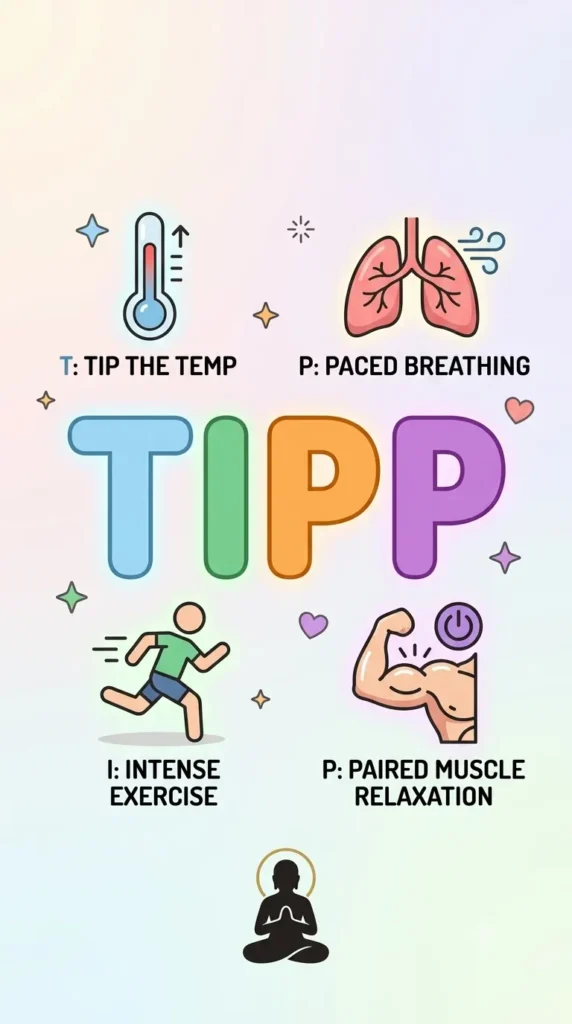
TIPP stands for Temperature, Intense Exercise, Paced Breathing, and Progressive Muscle Relaxation. Four DBT TIPP skill tools, one job: bring the body down before the mind tries to catch up.
Each letter hits a different piece of the stress response. Cold water. Hard movement. Slower breath. Tense-and-release muscle work. Pick the one that matches what’s happening in your body right now.
| Letter | TIPP Skill | Main Purpose |
|---|---|---|
| T | Temperature | A fast, usually cold shift that interrupts intense physical arousal |
| I | Intense Exercise | Short bursts of movement that burn off built-up physical activation |
| P | Paced Breathing | Slower, controlled breaths that pull the body toward calm |
| P | Progressive Muscle Relaxation | Tensing and releasing muscle groups to drain out physical tension |
Ever tried reasoning with a racing heart? It doesn’t work. That’s the whole reason TIPP exists.
When emotions spike this hard, thinking your way out isn’t on the table yet. Not for a minute. TIPP doesn’t ask you to challenge a thought or solve anything. It just gives your body room to settle. Once that happens, the next steps get possible again.
This overlaps with other distress tolerance tools too. If TIPP alone isn’t cutting it, pair it with a skill like STOP or lean on a broader coping skills worksheet for backup options.
TIP vs. TIPP: Are They the Same DBT Skill?
Short answer: basically, yes. The difference is mostly presentation.
TIP covers Temperature, Intense Exercise, and Paced Breathing. Three parts.
TIPP adds Progressive Muscle Relaxation as a second P. That’s the entire gap between them.
You’ll run into both spellings. TIP DBT. TIP skills. TIPP DBT. None of them is wrong. Neither version deserves an automatic side-eye. What actually matters is whether a resource means the three-part version or the four-part one.
Some sources, like DBT Tools, stick with the three-letter TIP. Others, including Therapist Aid, run with the fuller TIPP. Both are teaching the same core skill.
This guide uses DBT TIPP skills throughout. Why the extra P? Because it hands you one more physical option: progressive muscle relaxation. More tools, same crisis-survival goal.
Want a deeper dive into other acronym-based DBT skills before or after this one? The full DBT skills worksheets library covers all four modules, TIPP included, alongside PLEASE and ACCEPTS for when distress needs more than one angle.
When Should You Use TIPP?
The DBT TIPP skill works best in one moment. That moment is when distress spikes so high that clear thinking checks out. Your body takes over. Your brain stops solving problems and starts reacting.
This is where TIPP earns its place among distress tolerance skills. It calms the body first. The mind follows after. Once you’re calmer, better choices become possible.
When TIPP Can Help
You don’t need a full-blown crisis to use TIPP. A sharp spike works too.
Here’s when it helps most:
- A strong urge hits, sometimes tied to self-harm or substance use.
- Panic shows up physically. Racing heart. Shaking hands. Breath you can’t slow down.
- Anger builds until you’re sure you’ll say something you’ll regret.
- You feel numb or far from your own body, like you’re watching yourself from outside.
- Journaling or talking it through just isn’t landing. Your arousal is too high for words to work yet.
That last point matters more than people think. TIPP dbt skills aren’t built to fix what upset you. Not even close. They’re built to get you through the next five minutes.
Think of TIPP as breathing room. Nothing more, nothing less. You still have to decide what happens next. TIPP just makes sure you’re calm enough to decide well.
Am I in TIPP Territory?
Ask yourself a few questions. If several land as true, you’re in TIPP territory.
- Does your distress feel unusually sharp or fast-moving?
- Is your body tense, restless, or wound tight?
- Do you feel a pull to act right now, without thinking it through?
- Can you even focus enough to solve the actual problem?
- Do you need the intensity to drop before anything else will work?
Here’s an honest take: most people wait too long to try this. They push through the spike, thinking they can out-think it. They can’t. Not while the body is still flooded.
A TIPP coping skill isn’t about fixing the situation. It’s about surviving the next few minutes without making things worse. Sound too simple? It is. That’s exactly why it works.
Once your body settles, other tools can take over. Something like emotions worksheets or a structured mindfulness journal prompt works far better once you’re not in the middle of a spike. For a wider set of DBT skills worksheets, that’s the place to build your full toolkit once TIPP has done its job.
The 4 DBT TIPP Skills Explained Step by Step
DBT TIPP skills work through the body first, not the mind. That’s the whole point. Temperature, Intense Exercise, Paced Breathing, Progressive Muscle Relaxation. Four moves, one goal: bring your physical distress down enough that you can actually think again. Not solve the problem.
Just get calm enough to face it. That distinction matters more than people expect, and Dialectical Behavior Therapy frames the whole skill set around exactly that gap between overwhelmed and functional.
If you’re already using coping skills worksheets to track what helps in a crisis, TIPP slots in as the physical-first layer. Here’s how each piece works.
T: Temperature
Cold changes your body faster than any thought can. That’s not an exaggeration. Dropping your face temperature triggers something called the mammalian diving reflex, a switch that dials up parasympathetic activity and slows your heart rate down. Research on the diving response backs this up directly.
The classic move: dunk your face in cold water for a few seconds, focused around the eyes and cheeks. No sink nearby? A cold pack wrapped in a cloth across the face works almost as well. The water doesn’t need to hurt. It shouldn’t. This isn’t a test of how much cold you can take.

Here’s the honest part. Cold facial immersion moves your heart rate, your blood pressure, your whole autonomic system. That’s the mechanism. It’s also the warning.
Anyone with a cardiac condition, blood pressure issues, a history of fainting, or another relevant medical concern should check with a doctor before trying deliberate cold exposure. Some studies on the diving response even show competing autonomic reactions under certain conditions. Not everyone’s body responds the same way.
Want the deeper science? This peer-reviewed review of the mammalian diving response covers the cardiovascular mechanics in full.
I: Intense Exercise
This isn’t about fitness. Not even close. Intense exercise gives your body a place to put the physical charge that builds up during extreme emotion. A short burst does it. Stair climbing, fast walking, dancing, jogging, jumping jacks. Ninety seconds can shift your state.
Intense doesn’t mean unsafe. That distinction gets lost constantly. The movement should push you, not hurt you. Dizziness, exhaustion, real pain? Stop. If running isn’t right for your body, adapt it. Brisk walking works. So do seated movements, gentle resistance work, or whatever your doctor has cleared for you.
Picture the moment: your chest is tight, your thoughts are racing, and the stairs are right there. Ten flights later, something shifts. Not because you solved anything. Because your body burned through what it was holding.
Think of this as a reset button, not a workout goal. You’re not proving anything here.
P: Paced Breathing
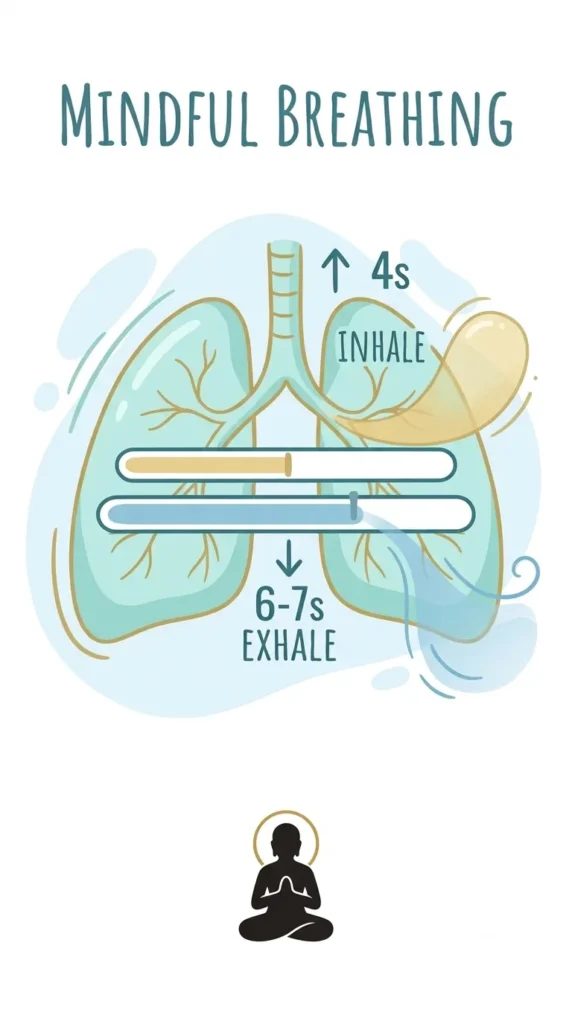
Slower breathing tells your nervous system the danger has passed. That’s the mechanism behind this DBT skill. Inhale gently for about four seconds. Exhale for six to seven. No huge breaths. No forcing the count.
Why does slower exhaling matter more than the inhale? Longer exhales activate the vagus nerve, and that nerve is what pulls your body out of high alert. Try the pattern for a minute or two. Shoulders down. Nothing forced.
Most people mess this part up the same way. They breathe too deep, too hard, chasing some huge lungful of air. Wrong move. You want slow and comfortable, not maximum capacity. Light-headed? Uncomfortable? More anxious than when you started? Stop and go back to normal breathing. This isn’t the moment to push through.
P: Progressive Muscle Relaxation
Tense the muscle. Then let it go completely. That’s the entire technique behind Progressive Muscle Relaxation, and it’s simpler than it sounds. Tighten your hands or shoulders for about five seconds. Notice what tension actually feels like. Then release, fully, for several seconds before moving to the next muscle group.
The contrast is the whole lesson. Your body learns what tight feels like, then gets a clear signal to drop it. That signal is what makes the release stick.
PMR shines when you’re wound tight, clenched, restless, and the last thing you want is another activating technique. Already did the stairs or the breathing? PMR often comes next, once your body is ready to settle rather than ramp up further. Pair it with the rest of your DBT skills worksheets routine, and it becomes the piece that closes things out instead of opening them up.
Do You Have to Use All Four TIPP Skills?
No. You don’t need all four TIPP skills every time. Not even close.
TIPP bends around you. Try one technique first. Watch how your body reacts. Switch it up, or stack two together, whatever the moment actually calls for. The goal isn’t finishing a checklist. It’s dropping the distress enough to think straight again.
That’s the whole job.
Individual Variation Matters
TIPP works through the body. But bodies don’t all answer the same way. One person settles down through paced breathing. Someone else needs to move first, or release the tension sitting in their shoulders.
Your situation matters too. Restless and wired? Intense exercise might beat progressive muscle relaxation here. Already worn out physically? A gentler option probably fits better.
This is exactly why TIPP works best as a toolkit, not a fixed four-step routine you march through in order every time. Pick what fits the moment you’re in. For more ways to build out that toolkit, this coping skills worksheets collection covers options beyond TIPP alone.
Start With One Skill
Match the skill to what’s happening in your body right now.
Breathing fast and shallow? Try paced breathing first. Still buzzing after an argument? A short burst of movement can burn off that charge fast.
Give the technique a real shot. Then check your distress level again. You don’t have to force your way through every part of TIPP just because a worksheet lists all four.
Sound too simple? It is. That’s kind of the point.
Build Your Personal TIPP Combination
With practice, a sequence starts to emerge. Maybe you lead with paced breathing, then move into muscle relaxation after. Someone else might reach for temperature first, then slow their breathing down once the shock passes.
Keep notes. What you tried. Your distress level before and after. What you noticed in your body along the way. A basic TIPP worksheet or a plain notes app works fine for this. It doesn’t need to be fancy.
Over time, that record turns into something useful: a personal TIPP routine that actually holds up when you’re overwhelmed for real, not just one that looks good on paper. Naming what you’re feeling first can help too. An emotions worksheet makes that first step easier before you even reach for TIPP.
Which TIPP Skill Should You Try First?
There’s no single TIPP skill that works for everyone. That’s just how it is. A better starting point is noticing what your body is doing right now, then matching the skill to it. Think of the four as different ways to turn down physical arousal, not four steps you owe yourself.
If Your Body Feels Overheated or Highly Activated
Flushed. Agitated. Maxed out. That’s Temperature’s cue. A safe, cold-temperature technique can shift your body’s arousal fast, sometimes faster than anything else in this list. But cold exposure isn’t right for every body. Follow the safety guidance in the Temperature section instead of forcing yourself to tolerate extreme cold. Pushing past a real limit isn’t grit. It’s just risk.
If You Feel Restless or Full of Physical Energy
Some distress doesn’t sit still. It wants to pace, yell, move, act on impulse. That’s when Intense Exercise fits. A short burst of vigorous movement gives that energy somewhere to go. Nothing more mystical than that. The goal is changing your arousal level, not punishing your body or wearing it out completely.
If Your Breathing Feels Fast or Shallow
Rapid breathing. Chest tightness. That racing feeling under your ribs. Paced Breathing is built for exactly this. Slow it down gradually. Let the exhale run a little longer than the inhale. That’s the whole mechanism. If focusing on your breath makes things worse instead of better, stop. Try a different TIPP skill instead.
If Your Muscles Feel Tight or Clenched
Check your jaw. Your shoulders. Your hands. If tension is sitting there, unspoken, Progressive Muscle Relaxation may be the better door in. Tense one muscle group. Hold it. Release it. Notice the contrast between the two states. That contrast is the whole point, not a side effect.
What If You’re Not Sure?
You don’t need the perfect pick. Choose whichever technique feels safe and doable right now. Practice it briefly. Then reassess your distress. Didn’t help? Switch to another skill instead of forcing the first one to work. Distress tolerance isn’t about getting it right the first time.
For a fuller map of which distress-tolerance skill fits which moment, the coping skills worksheets collection is worth a look, and if naming what you’re actually feeling is the hard part, an emotions worksheet can help with that first.

How to Use TIPP During a Real Emotional Crisis
The DBT TIPP skill works best as a short, structured response to intense distress. Not a slow reasoning exercise. You notice first. Then you lower the heat. Then you reassess. Only after that do you decide what needs your attention next.
Notice
This isn’t about naming every feeling you have. Start smaller than that. Your heart may be racing. Your jaw might be tight. Thoughts speed up. You feel a pull to act right now, immediately, without thinking it through.
That pull is the signal. You don’t need the full story behind it. One line is enough: “This is too much for me to handle normally right now.” Say it plainly. That’s the whole first move.
Rate
Give the distress a number. Zero means calm. Ten means you’re barely holding on. Nobody’s grading this.
It’s not a clinical scale. It’s a gut check, and gut checks are fast. The number matters less than what it does next: it gives you a before, so you can measure the after. Without it, you’re guessing whether the tipp technique actually worked or whether you just got distracted.
Choose
Not every TIPP tool fits every moment. That’s the part people miss.
Restless and wired, body ready to bolt? Intense exercise might be the move. Breath shallow and fast, chest tight? Paced breathing usually comes first. Match the tool to what your body is already doing, not to what worked last time. You don’t need to run through the whole distress tolerance skills tipp list in one sitting. Pick one. Start there.
Practice
Here’s an honest take: rushing the technique defeats the technique. Slow down. Give it your full attention for a short stretch of time. Feel the temperature. Feel the breath. Feel the muscle working. That’s it. Nothing fancier than that.
Reassess
For most people, the mistake isn’t skipping this step. It’s rushing through it. Pause. Rate the distress again. Did the number move? Did your body shift at all, even slightly?
A small drop still counts. Even a two-point change buys you room to think straight. That room is the whole point.
Repeat or Switch
Still at an eight? Still shaking? Try the same skill again, or switch to a different TIPP component entirely.
Sound too simple? It is. That’s why it works. Perfection was never the goal here. The goal is finding whatever brings the number down, even a little, even imperfectly.
Transition Out
Once the intensity eases, stop treating TIPP as the fix for the whole problem. It was never meant to be that. It’s a bridge, not a destination.
Use the calmer state for what comes next. Maybe that’s problem-solving. Maybe it’s another skill from your emotions worksheet. Maybe it’s reaching out to someone, or just giving yourself time to recover. A printable TIPP worksheet can help you track which step actually moved your number, so next time you skip straight to what works.
TIPP Skills Worksheet: Track What Works for You
Reading about a DBT TIPP skill and using it are two different things. A worksheet closes that gap. Not every technique works the same way twice, and it never works the same for two different people. That’s why a TIPP skills worksheet exists. Write down your distress level. Note which technique you tried. See what actually shifted afterward.
Do this a few times and something useful builds up. A record of what actually helps you when things run hot. Not a guess. Not what worked for a stranger on a forum.
Pair this with the wider coping skills worksheets library if TIPP alone doesn’t cover the moment you’re in.
TIPP Worksheet
A useful tipp dbt worksheet asks for more than a pass-fail grade. “Did it work” isn’t specific enough. Record the real details instead:
- Situation or trigger
- Emotion and physical sensations
- Distress level before using TIPP
- TIPP skill selected
- How long you practiced it
- Distress level afterward
- What changed in your body or thoughts
- Would you use this skill again?
- What would you change next time?
Here’s the part most people miss. A 9/10 dropping to a 6/10 still counts as a win. Nobody needs to hit zero. The goal was never total calm. It’s just enough space to choose your next move on purpose, not on autopilot. That distinction matters more than it sounds.
TIPP Skills Chart
Sometimes a full explanation isn’t practical. You need something to glance at, not read. That’s what a tipp skills chart is for.
| TIPP Skill | What You Do | Useful When |
|---|---|---|
| Temperature | Use safe cold stimulation | High physical arousal |
| Intense Exercise | Brief, vigorous movement | Restlessness or strong activation |
| Paced Breathing | Slow down, lengthen the exhale | Rapid or tense breathing |
| Progressive Muscle Relaxation | Tense and release muscle groups | Physical tension |
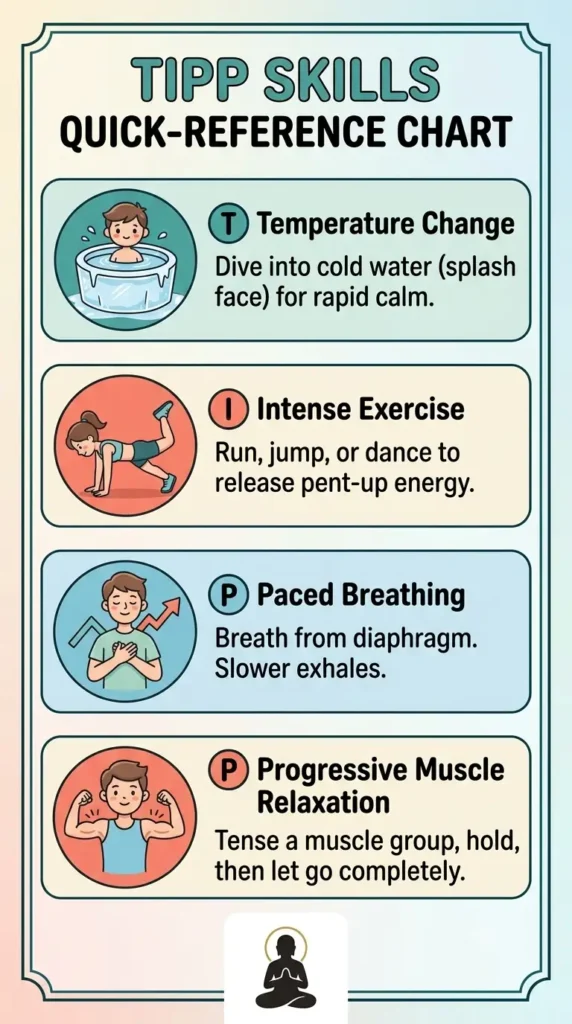
Four rows. That’s it. No paragraph required when the moment calls for speed. If naming what you’re feeling is the hard part before you even pick a skill, an emotions worksheet can help with that first step.
TIPP Handout / PDF
Keep a printable tipp handout or tipp skills pdf somewhere easy to grab. Not buried in a folder. Somewhere your hands find it before your brain has to think.
A good version combines all four skills with short instructions and a little room for personal notes. That’s what makes it double as a dbt tipp skills handout and a dbt tipp worksheet at once. One page, two jobs.
Worth comparing this against how other TIPP resources are laid out. Therapist Aid’s TIPP worksheet takes a similar structured approach, if you want a second format to try.

For more distress-tolerance tools beyond TIPP, the STOP skill and ACCEPTS worksheets sit in the same module and often get reached for right alongside this one. Both belong to the broader DBT skills worksheets library if you want the full set of modules in one place.
TIPP Skills for Kids and Teens
A DBT TIPP skill doesn’t need a clinical wrapper to work for a kid. Strip away the jargon and it’s just a body-based tool. One that helps when feelings get too big to think through. The goal here isn’t compliance. Nobody wants a child forced to “calm down” on command.
Coaching works better. You’re helping a young person notice which strategy actually feels safe and useful to them. Not handing down an order they’re supposed to follow.
How to Explain TIPP to a Child
Skip the acronym lecture. A six-year-old doesn’t need to hear “distress tolerance module.” Describe TIPP instead as body tricks for when feelings get too loud to think straight. That’s it. That’s the whole pitch.
A parent, teacher, counselor, or therapist can show one skill first. Practice it together while the child is calm. Never mid-meltdown. Timing is everything here.
Paced breathing becomes a slow-breathing game. Count together. Make it silly if that helps. Progressive muscle relaxation turns into squeeze-and-soften, pretending to be a snowman melting or a robot powering down. Kids remember games. They don’t remember instructions.
Build familiarity now, before the hard moment shows up. That’s the whole point of practicing early. Waiting until a meltdown is already underway is the hard way to teach anything new.
TIPP Activities for Kids
Keep it short. Keep it simple. Match it to the child’s age, not a workbook’s idea of what should work. Depending on the kid, that might mean slow breathing, a quick burst of safe movement, or gently squeezing and releasing the hands and shoulders.
Jumping jacks for thirty seconds can stand in for intense exercise. A “starfish stretch” can replace formal muscle relaxation. Small swaps like these keep a TIPP skill activity feeling like play instead of homework.
Temperature deserves its own warning label with kids. Don’t have a child put their face in ice water. Don’t push extreme cold exposure without a professional weighing in first. Some guidance for this exact skill flags real risks, like heart conditions or medication side effects, that make certain temperature techniques unsafe for some people. A pediatric-reviewed TIPP handout spells out exactly which conditions call for a doctor’s input first.
A safer stand-in usually works just as well. A cool washcloth on the wrists. A short walk outside. Holding an ice cube wrapped in a paper towel for a few seconds, never bare skin, never the face. Small, age-appropriate, low-risk. That’s the standard.
For a broader toolbox beyond TIPP alone, these coping skills worksheets round out the options by age and situation.
How Parents, Teachers, or Counselors Can Practice TIPP With Kids
With DBT TIPP kids practice, adults model the skill. They don’t bark commands. Big difference. Try the breathing yourself, out loud, in front of the child. Let them watch it work on you first.
Let the child notice what their body feels like before and after. Was the chest tight, then looser? Did breathing slow down? Let them find that out themselves instead of being told what they should feel. Some kids prefer the squeeze-and-release. Others like the slow-breathing game better. There’s no wrong answer.
An emotions worksheet can help a child name what they’re feeling before they even reach for a TIPP skill. Naming it first often makes the rest easier.
Teens need a different angle. More collaborative, less top-down. Skip the flat instruction “use your TIPP skills.” It tends to land like a command, and teenagers push back on commands almost on principle. Practice the skill together instead. Build a personal TIPP reference sheet they can actually keep in a backpack or phone case.
Pair that sheet with a broader DBT skills worksheets library, or start with the STOP skill if a teen needs a first pause before they even get to TIPP. Sound like a lot to track? It isn’t, once the sheet exists. That’s the whole reason to build it before the hard day, not during one.

What the DBT TIPP Skill Can Do (and What It Can’t)
Emotional distress spikes fast. Thinking clearly gets hard. The DBT TIPP skill exists for exactly that moment.
It lowers physical and emotional arousal in minutes. Not hours. Minutes. That’s the whole point. It buys you space to choose your next move instead of getting swept into one. But here’s the honest part: TIPP is a crisis-survival tool. It’s not a fix for whatever caused the crisis in the first place.
What TIPP Is For
TIPP works best during a sharp spike. Rage. Panic. Anxiety that won’t quiet down. A strong pull to act on impulse before thinking it through.
The goal isn’t to erase the emotion. That’s not realistic, and chasing it usually backfires. TIPP brings the intensity down instead. Enough to respond. Not react.
Picture this: you just hung up after a brutal argument, and your hands are shaking. Or an intrusive thought hits and your whole body floods with adrenaline. Or an urge shows up that feels impossible to sit with. These are TIPP moments. Once the spike drops, another DBT skill becomes usable again. Before that point, most people can’t access one at all.
What TIPP Is Not For
TIPP won’t solve the situation that triggered the distress. It was never built to. It also isn’t a substitute for therapy, for ongoing emotion-regulation work, or for medical and mental-health care when that’s what’s actually needed.
Think of it as breathing room. Nothing fancier than that.
Say you’re furious after a conversation that went sideways. TIPP won’t repair the relationship. It won’t hand you the right words to say next. What it can do is get your body calm enough that you don’t fire off the text you’ll regret five minutes later. That’s the win. Small, but real.
For a wider set of tools once you’re past the initial spike, our DBT Skills Worksheets collection covers the full skill set, and the Coping Skills Worksheets page has exercises built for everyday use.
What to Do After Your Distress Drops
Once the wave passes, the job changes. You’re no longer surviving the moment. You’re deciding what comes next.
A few directions, depending on what you need. ACCEPTS works for temporary distraction when you need to step away from the feeling for a while. STOP works when the impulse is still lurking and you need a pause button. Radical acceptance fits when you’re staring at something you can’t change right now, no matter how much you want to. Self-soothing helps when your body is still keyed up and just needs comfort, not strategy.
Struggling to name what you’re actually feeling before picking a skill? That’s common, and it’s worth pinning down first. Our Emotions Worksheet helps put a clearer name to the experience, so the next step actually fits.
TIPP vs. Other DBT Distress Tolerance Skills
TIPP is not the only tool DBT gives you for rough moments. Each skill in the distress tolerance box does a different job. Some interrupt a reaction before it fires. Some just pull your attention somewhere else for a while.
Others help you sit with pain without making it worse. The DBT TIPP skill earns its spot when your body is too keyed up to think straight, not when you simply need a distraction or a beat to pause.
| DBT skill | Main function | When it may help |
|---|---|---|
| TIPP | Quickly reduce intense physiological arousal | When emotions feel too big, or urges feel hard to control |
| STOP | Interrupt an impulsive reaction | When you need a pause before saying or doing something |
| ACCEPTS | Temporarily redirect attention | When you need to get through distress without acting on it |
| Self-Soothe | Use the senses to create comfort | When you need calming, grounding, or comfort |
| Radical Acceptance | Accept reality as it is | When fighting what can’t change is adding to your suffering |
TIPP vs. STOP
TIPP changes your body. STOP buys you space. That’s the real split. TIPP brings down the physical heat: the racing heart, the shaking hands, the tight chest. STOP does something else entirely. It puts a gap between the urge and the act.
Say you’re furious and your thumb is already over “send” on a message you’ll regret. STOP helps you pause there. But if your body is already flooded, if your heart’s slamming and your hands won’t sit still, pausing isn’t enough. You need the arousal down first. That’s TIPP’s job. Sometimes you need both, in that order.
TIPP vs. ACCEPTS
ACCEPTS won’t calm your body down. It was never built for that. It’s a distraction strategy, plain and simple. It gives your mind somewhere else to go while the wave passes. TIPP works underneath that, on the physical layer.
Use TIPP first when your body is running hot. Bring the intensity down. Then use ACCEPTS to hold yourself over before you circle back to the actual problem. One skill cools the engine. The other steers you somewhere else while it cools. Different jobs, same toolbox.
TIPP vs. Radical Acceptance
Radical acceptance isn’t a calm-fast button. It was never meant to be one. It’s not about feeling better in the next five minutes. It’s about naming reality and dropping the fight against what won’t change. That’s a slower, harder kind of work.
Why does TIPP matter here? Because you can’t do that work with a flooded nervous system. When intensity is too high, acceptance and problem-solving both feel out of reach. TIPP clears space for that clearer thinking to happen. Then radical acceptance, or any real coping skill, actually has room to land.
For a fuller breakdown of these tools, along with printable practice sheets, see our DBT Skills Worksheets guide. If you’re building a wider coping toolkit beyond distress tolerance, our coping skills worksheets and emotions worksheet pages are worth a look too.

Common TIPP Mistakes to Avoid
TIPP works best as a short-term distress-tolerance tool. Not a test to ace. Most problems come down to three things: using it too late, pushing too hard, or expecting the DBT TIPP skill to fix the whole situation by itself.
Waiting Until You’re Completely Overwhelmed
You don’t have to wait for distress to peak. Notice your body first. A racing heart. Clenched jaw. That wired, jittery feeling under your skin. Start there. Catching it early makes any tipp skill easier to pull off. Wait too long, and the same four steps feel ten times harder to reach for.
Assuming You Must Complete All Four Steps
TIPP isn’t a checklist. Temperature, Intense Exercise, Paced Breathing, Progressive Muscle Relaxation, you don’t owe all four every time. One piece can drop your distress low enough to think straight again.
Pick what fits the moment. Stop there if it’s working. A lot of people reach for the STOP skill first, then bring in one TIPP step only if that’s not enough. Same idea applies here. Use less. Not more.
Making Exercise Excessively Intense
“Intense” doesn’t mean pushing until you’re wrecked or in pain. That’s not the job. This piece of TIPP exists to shift how activated your body feels, not to prove what you can survive. Match the movement to your own fitness and limits. A short brisk walk counts. So does a set of jumping jacks. The point is the shift, not the suffering.
Using Cold Exposure Unsafely
Temperature deserves more care than a casual internet tip gives it. Skip extreme cold. Skip long exposure too. And don’t put your face in cold water if a doctor has flagged sudden cold as risky for you.
Cardiologists warn that the cold shock response can spike heart rate and blood pressure fast, which is exactly why this step needs more caution than the others. A cool, damp washcloth works fine for most people. Save the ice bath talk for someone with medical clearance.
Expecting TIPP to Fix the Underlying Problem
TIPP won’t resolve the argument. It won’t untangle grief, defuse an anxiety trigger, or make a hard decision for you. What it does is lower the spike enough that you can think again. That’s the whole job.
Nothing more. Treat it as breathing room, not a fix. Once the intensity drops, tools like an emotions worksheet or the ACCEPTS skill can help you deal with what’s actually underneath.
Never Practicing Before a Crisis
Trying a brand-new skill mid-meltdown rarely goes well. Practice matters more than people expect. Run through each TIPP technique on a calm day. Notice which ones actually help you, and which ones don’t.
Keep a tipp worksheet, handout, or a quick tipp pdf somewhere you’ll actually see it, a phone note, a wallet card, a drawer you open daily. For a wider set of tools to build alongside it, browse these coping skills worksheets. Practiced skills stick. Untested ones don’t.

Conclusion
The DBT TIPP skill is most useful when your emotions are running so high that thinking your way through the moment feels almost impossible. Temperature, intense exercise, paced breathing, and progressive muscle relaxation give you practical ways to work with that physical surge before deciding what to do next.
You don’t need to use every technique, and the same approach won’t work equally well for everyone. Practice each skill when you’re relatively calm, use the worksheet to notice what actually helps, and keep your preferred techniques easy to reach. TIPP isn’t about making difficult emotions disappear. It gives you enough breathing room to respond instead of reacting.
Frequently Asked Questions
What is the DBT TIPP skill and when should you use it?
The DBT TIPP skill is a distress-tolerance technique for reducing intense emotional and physical arousal. You can use it during an acute distress spike, such as overwhelming anger, panic, or a strong urge to act impulsively. TIPP is designed for short-term crisis management, not long-term problem-solving.
What does TIPP stand for in DBT?
TIPP stands for Temperature, Intense Exercise, Paced Breathing, and Progressive Muscle Relaxation. These four techniques work through the body to help reduce physiological arousal during intense distress. TIPP is part of the distress-tolerance skills taught in Dialectical Behavior Therapy (DBT).
What is the difference between TIP and TIPP in DBT?
TIP and TIPP refer to closely related DBT distress-tolerance skills. TIP traditionally refers to Temperature, Intense Exercise, and Paced Breathing, while TIPP adds Progressive Muscle Relaxation as the second P. Different DBT resources use both terms, so seeing “TIP” instead of “TIPP” does not necessarily indicate a different skill.
Do you have to use all four TIPP skills at once?
No. You do not have to use every TIPP technique during the same distress episode. Start with the skill that fits your physical state and situation, then reassess how you feel. With practice, you can learn which combination of TIPP skills is most useful for you.
Can kids and teens use DBT TIPP skills?
Yes, DBT TIPP skills can be adapted for children and teenagers, but they should be taught in age-appropriate language and practiced safely.
Younger children may need an adult to guide the activity. Cold-temperature techniques deserve particular caution with children and should not involve extreme or prolonged cold exposure.
Where can I get a TIPP worksheet or printable PDF?
A TIPP worksheet or PDF can help you record your distress level, choose a TIPP technique, practice it, and compare how you feel afterward. A useful worksheet should focus on practice and personal response rather than simply listing the four TIPP skills.

It’s Bhaskar!
Well, I am not a psychologist a monk, or a philosopher by training. I’m just an engineering graduate.
‘The Empty Self’ is where I write about that idea, and what it actually means for ordinary life, anxiety, identity, habits, the stories we tell ourselves about who we are. I don’t have a psychology degree, and I’m not offering therapy or clinical advice. What I do have is thought and clarity, and genuine curiosity about why we suffer the way we do and how much of it might loose once we shed this ‘fixed identity’.
Pingback: DBT IMPROVE the Moment Skill: Complete 2026 Guide With Free Printable | The Empty Self