
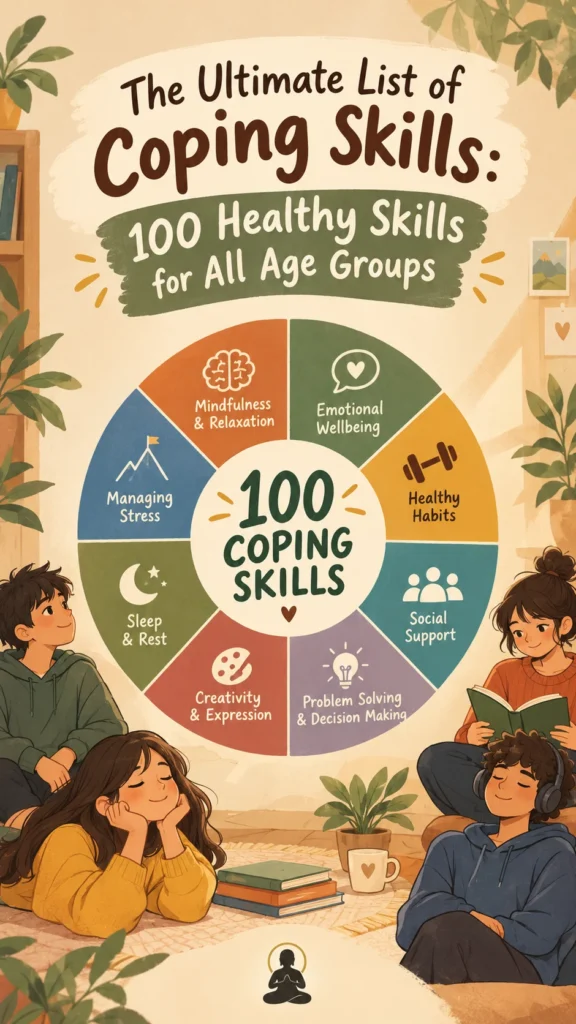
Big feelings hit fast. Knowing what you feel isn’t the hard part. Knowing what to do next, that’s where most people freeze.
That’s why this ultimate list of coping skills exists. It hands you 100 practical options. Some calm your body. Others help you process emotions. A few shift your attention or bring in support when things get hard.
Everything here is organized by type. Scroll less, find something faster. Whether you need coping skills for anger, stress, sadness, or anxiety, there’s an option here. Everyday overwhelm counts too. Kids, teens, and adults will all find something that fits.
Want the short version? Download or use this coping skills printable as a quick-reference checklist. Scan the 100 healthy coping skills. Mark the ones that feel doable for you. Keep that shortlist somewhere close. Emotions rarely wait for a good time to show up.
One honest note first. This content is for education and self-help, not therapy. It’s not a stand-in for professional care. If you’re in crisis or thinking about suicide, reach out. Contact the 988 Suicide & Crisis Lifeline in the U.S. and Canada. Or reach your local emergency service.
Want worksheets to actually work through a feeling? Start with our Coping Skills Worksheets. Need a fast list to scan and pick from right now? You’re already there.
Table of Contents
What Are Coping Skills?
Life throws hard moments at you. Coping skills are the tools you reach for when it does.
They’re simple strategies for handling stress, tough emotions, or situations that feel like too much. A good coping skill can calm your body down. It can help you sit with a feeling instead of drowning in it. Sometimes it just buys you enough space to think straight before you decide what’s next.
What makes a coping skill “healthy”?
Not every coping skill helps. Some just move the problem somewhere else.
A healthy one manages the emotion without leaving a mess behind, for you or for anyone standing near you. It might settle your nervous system. It might give you a safe place to put what you’re feeling. Sometimes it simply helps you name what you actually need in that moment. Want to see the difference laid out side by side? Our Healthy vs. Unhealthy Coping Skills Worksheet breaks it down in detail.
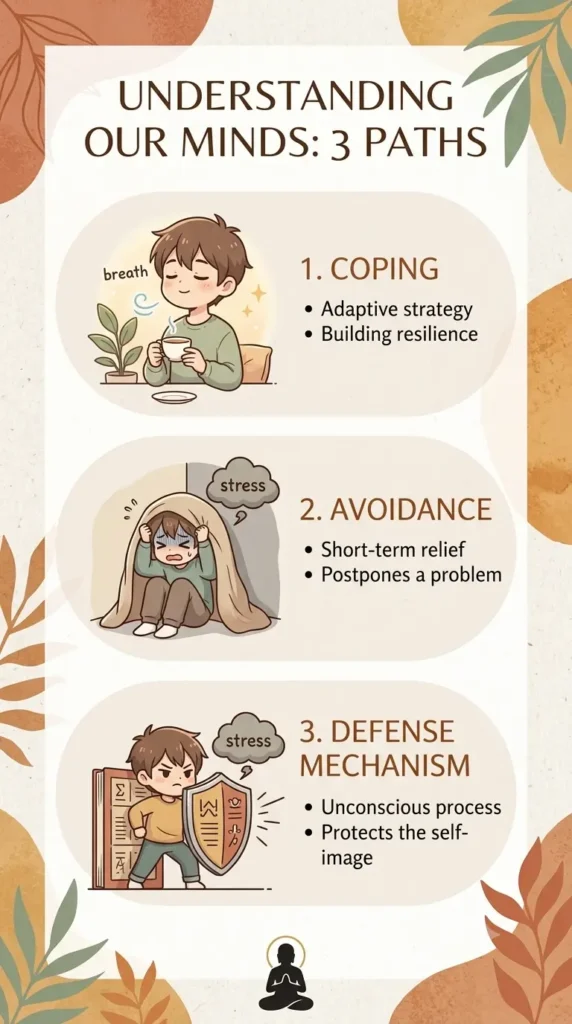
Coping skills vs. avoidance
Here’s where it gets tricky. Coping and avoidance can look nearly identical from the outside.
But they’re not doing the same job. A coping skill helps you steady yourself so you can face the situation. Avoidance just runs from it. Nothing gets solved. Distraction has its place, sure, it can give you breathing room when things get loud. But lean on it too hard, and the real problem just sits there, waiting.
Curious where your go-to habits land? Our coping vs. avoidance comparison table walks through the differences one by one.
Why no single list works for everyone
Here’s an honest take: there’s no perfect coping skill. Not one that works every time, for every person, for every feeling.
A walk might settle you down when you’re restless. It’ll do almost nothing when you’re overwhelmed. One person journals through sadness. Another would rather call a friend and talk it out. Neither is wrong.
That’s why a real coping skills list hands you options. It doesn’t hand you orders.
Before you even pick a strategy, try naming what you’re feeling first. That one step changes everything. An emotions worksheet makes it easier to pin down. Once you know it’s anger, or anxiety, or sadness, or just plain overload, you can grab a coping skill that actually fits. Not one you grabbed at random because it was the first thing that came to mind.
The Ultimate List of Coping Skills: 100 Unique Coping Skills for Kids and Adults
The best coping skill isn’t the one that sounds most clinical. It’s the one you’ll actually reach for when things get loud in your head.
This is the ultimate list of coping skills: 100 of them, split into ten categories. Some fit a bad morning. Some fit a bad year. The idea is simple. Find a handful that match your mood, your age, your energy, and your situation, then keep those close.
So what counts as coping, exactly? The APA Dictionary of Psychology draws a clear line. Coping isn’t about making a problem vanish. It’s about managing the situation, and managing your response to it. Two different jobs. Most people only think about the first one.
How to Use This List
Don’t try all 100. That defeats the point.
Scan instead. Shortlist a few that feel doable, then test them the next time you actually need one. Breathing might work when your body’s wound tight. Journaling might work better when your thoughts won’t sit still. Different tools, different jobs.
Pick five to ten you could see yourself using. This applies whether you’re building a coping skills checklist for adults, a list of coping skills for kids, or something built around coping skills for teens. Then pay attention. Which ones help? Which ones do nothing? Which ones leave you more annoyed than before you started?
Your personal toolkit gets sharper with use. Not with more items. With fewer, better ones.
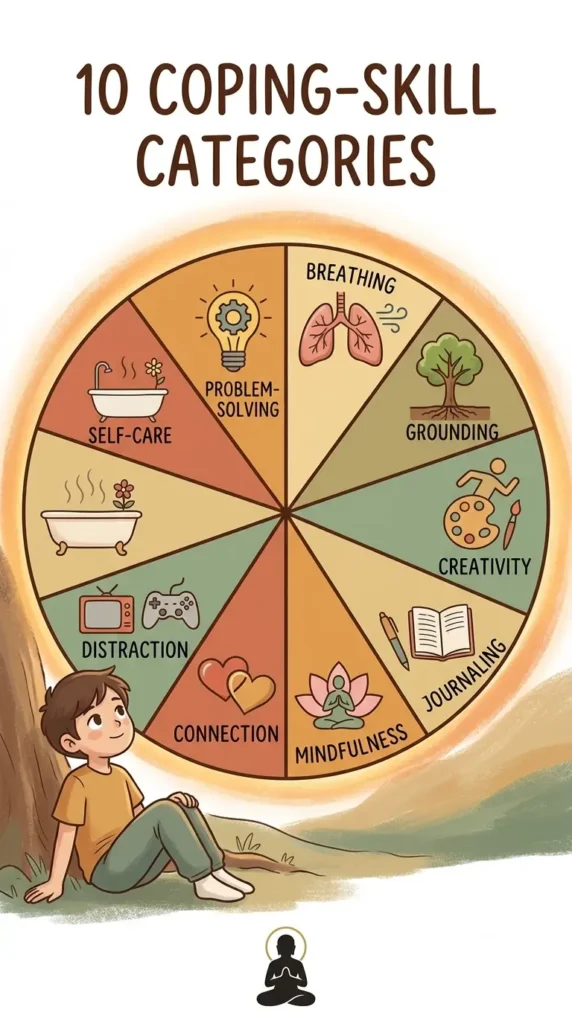
1. Breathing and Body-Calming Coping Skills
Stress shows up in the body first. Tight shoulders. A racing heart. A jaw clenched so hard it aches by lunch. Trying to think your way out of that rarely works. Starting with the body usually does.
Slow diaphragmatic breathing — Breathe slowly into your belly rather than taking quick, shallow breaths into your chest. Best for: anxiety, overwhelm, physical tension
Longer-exhale breathing — Breathe in gently and make your exhale slightly longer than your inhale. Best for: stress, nervousness, agitation
Box breathing — Inhale, hold, exhale, and hold again for roughly equal counts that feel comfortable to you. Best for: acute stress, frustration, concentration
Progressive muscle relaxation — Slowly tense and release different muscle groups, noticing the contrast between tension and relaxation. Best for: body tension, restlessness, bedtime stress
Unclench your jaw — Let your teeth separate, soften your tongue, and deliberately relax the muscles around your mouth. Best for: anger, stress, tension headaches
Drop your shoulders — Take a breath and consciously lower your shoulders away from your ears instead of holding them tight. Best for: tension, anxiety, work stress
Gentle stretching — Spend a few minutes slowly stretching your neck, shoulders, back, arms, or legs without forcing the movement. Best for: restlessness, physical tension
Shake out tension — Stand somewhere private and gently shake your hands, arms, and legs to release some physical stiffness. Best for: agitation, nervous energy, restlessness
Slow your movements — Deliberately make ordinary movements slower for a few minutes, such as walking, reaching, or making a drink. Best for: overwhelm, irritability, racing thoughts
Take a deliberate pause — Stop what you’re doing, put both feet on the floor, and take several calm breaths before responding. Best for: anger, conflict, impulsive reactions
2. Grounding and Sensory Coping Skills
This isn’t about calming down through logic. Grounding works through your senses instead. It pulls your attention back into the room when your thoughts have knotted themselves up.
Five-senses grounding — Name things you can see, hear, feel, smell, and taste around you. Best for: anxiety, panic, overthinking
Hold a textured object — Rub a piece of fabric, a smooth stone, a stress ball, or another safe object and focus on its texture. Best for: anxiety, distraction, sensory grounding
Notice your feet — Press your feet gently into the floor and pay attention to the pressure beneath them. Best for: panic, dissociation, overwhelm
Use cool water — Wash your hands or face with comfortably cool water and focus on the sensation. Best for: intense emotions, anger, feeling overwhelmed
Describe your surroundings — Quietly describe the room around you using concrete details such as colors, shapes, textures, and sounds. Best for: racing thoughts, anxiety
Hold something warm — Wrap your hands around a warm, non-burning drink and focus on its temperature and weight. Best for: sadness, loneliness, nervousness
Listen for distant sounds — Sit still and identify the sounds farthest away from you, then gradually notice sounds closer by. Best for: rumination, anxiety
Notice five physical sensations — Identify sensations such as your clothes against your skin, the chair beneath you, or air moving across your face. Best for: overwhelm, disconnection
Use a calming scent — Smell a familiar, pleasant scent and concentrate on the details rather than letting your mind wander. Best for: stress, grounding
Change your sensory environment — Move somewhere quieter, reduce harsh lighting, put on comfortable clothing, or remove an irritating sound. Best for: sensory overload, irritability, overwhelm
3. Movement and Exercise Coping Skills
Some emotions leave your body with energy and nowhere to send it. That’s what movement is for. Not an hour at the gym. Sometimes five minutes is plenty to open a little breathing room.
Take a short walk — Walk around your home, workplace, school, or neighborhood while paying attention to your surroundings. Best for: stress, frustration, overthinking
Dance to one song — Put on a song you enjoy and move however feels natural for its entire length. Best for: low mood, restlessness, tension
Do jumping jacks — Use a brief burst of movement to channel restless physical energy. Best for: agitation, frustration, restlessness
Go for a bike ride — Ride at a comfortable pace and let the repetitive movement occupy your attention. Best for: stress, mental fatigue
Stretch while listening to music — Combine slow stretches with music that matches the mood you want to move toward. Best for: tension, low energy
Climb stairs — Walk up and down a safe set of stairs for a short period if your body allows it. Best for: restlessness, frustration
Try yoga — Follow a gentle yoga sequence that focuses on breathing and controlled movement. Best for: stress, body tension
Do a quick workout — Spend five to fifteen minutes on simple exercises you already know how to perform safely. Best for: stress, anger, restless energy
Walk somewhere green — Take your walk through a park, garden, or other natural setting when one is accessible. Best for: stress, mental fatigue
Do ordinary chores with movement in mind — Sweep, tidy, fold laundry, or organize a space while allowing yourself to move rather than sitting with the emotion. Best for: frustration, overwhelm, stuck feelings
4. Creative Coping Skills
Most people rule this category out fast. “I’m not creative.” That’s not actually the point. Creative coping isn’t about talent. It’s about giving a feeling somewhere to go without needing to explain it in full sentences first.
Draw what you’re feeling — Use shapes, colors, lines, or images instead of trying to make a recognizable picture. Best for: sadness, anger, confusion
Color a page — Choose a coloring page or fill a blank page with repeated colors and patterns. Best for: anxiety, restlessness
Make a collage — Combine old magazines, printed pictures, words, or drawings around a particular feeling or theme. Best for: self-expression, confusion, reflection
Paint freely — Put colors on paper without deciding what the final picture needs to become. Best for: anger, emotional release
Make something with clay — Shape, flatten, roll, or build with clay while focusing on the physical process. Best for: tension, frustration
Take photographs — Look for interesting colors, textures, shadows, or small details around you and photograph them. Best for: grounding, low mood
Make a playlist — Choose songs that either match your current mood or help you gradually shift toward a calmer one. Best for: sadness, loneliness, emotional processing
Try a simple craft — Knit, crochet, fold paper, make friendship bracelets, or work on another repetitive craft you enjoy. Best for: anxiety, restlessness
Build something — Use blocks, a model kit, LEGO-style pieces, or another construction activity that requires your attention. Best for: frustration, rumination
Create a mood board — Collect images, colors, words, or objects that represent how you want to feel or what you need right now. Best for: self-reflection, low motivation
5. Journaling and Writing Coping Skills
Writing earns its spot on this list for one reason. Some feelings are too tangled to sort out in your head alone. Get them onto paper and the tangle loosens, even if the sentences come out messy. Especially if they come out messy.
Picture this. It’s 11pm, your mind won’t stop looping the same argument, and sleep isn’t coming. That’s not a breathing-exercise moment. That’s a notebook moment.
Brain-dump journaling — Write every thought that comes to mind for five minutes without editing or organizing it. Best for: overwhelm, overthinking
Write an unsent letter — Write everything you wish you could say to someone without intending to send the letter. Best for: anger, hurt, unresolved feelings
Name the emotion — Write down exactly what you’re feeling and what happened immediately before it appeared. Best for: confusion, emotional awareness
Write what you can control — Divide a page into things you can influence and things you cannot change right now. Best for: anxiety, helplessness
Journal about what you need — Instead of asking why you feel bad, ask what your body, mind, or situation may be asking for. Best for: overwhelm, burnout
Write a realistic self-compassion note — Respond to yourself as you would to someone you care about, without pretending everything is fine. Best for: shame, self-criticism
Make a gratitude list — Write down a few specific things you appreciate, including ordinary details such as a favorite meal or a kind message. Best for: low mood, perspective
Write the next tiny step — When a problem feels huge, write only the smallest action you could take within the next few minutes. Best for: overwhelm, procrastination
Use journal prompts — Answer a focused prompt about your feelings, relationships, stress, or needs instead of starting with a blank page. Not sure where to start? These journal prompts for mental health are built for exactly this moment. Best for: emotional processing, self-reflection
Write a coping reminder — Create a short note listing the strategies that have helped you before and keep it somewhere easy to find. Best for: recurring stress, emotional overwhelm
6. Mindfulness and Relaxation Coping Skills
Mindfulness doesn’t mean wiping your mind blank. Good luck with that. It means noticing what’s actually happening right now, without chasing every thought that wanders through. That’s the whole skill. Nothing mystical about it.
Mindful breathing: Follow the physical feel of each breath for a few minutes. When your mind drifts, and it will, just bring it back. Best for: anxiety, stress
Body scan: Move your attention from your feet up to your head. Notice what’s tight, warm, or sore. Don’t try to fix it yet. Best for: tension, emotional awareness
Mindful eating: Slow down. Notice the taste, the texture, the smell. This is the opposite of eating on autopilot. Best for: grounding, distraction
Guided meditation: A short recording gives your brain something structured to follow instead of spinning on its own. Best for: stress, racing thoughts
Visualization: Picture somewhere calm. A beach, a childhood room, anywhere safe. Spend a few minutes filling in the details. Best for: anxiety, overwhelm
Mindful walking: Notice each step. Feel your feet hit the ground. Look at what’s actually around you. Best for: overthinking, restlessness
Observe a single object: Pick something ordinary. A mug, a leaf, your own hand. Study the color and texture for a few minutes. Best for: racing thoughts, grounding
Listen to one song mindfully: Give it your full attention. Notice the drums come in. Notice when the vocals shift. Best for: stress, emotional overload
Practice a short gratitude pause: Stop and name one thing in front of you that you genuinely appreciate. For more structure, how to practice gratitude walks through it step by step, or start from a list of things to be thankful for. Best for: stress, perspective
Do one task without multitasking: Pick something simple. Give it your full attention until it’s done. Just one thing. Best for: overwhelm, scattered attention
Want a slower, more written-out version of this? Mindfulness journal prompts work well right after any of these, while the calm is still fresh.
7. Social and Connection-Based Coping Skills
Isolation makes everything feel bigger than it actually is. You don’t need a deep conversation to fix that. Sometimes a familiar voice is enough. Sometimes it’s just a text.
Text someone you trust: Say you could use some company. That’s the whole message. Best for: loneliness, sadness
Call a friend or family member: Keep it short. You don’t need everything figured out first. Best for: isolation, stress
Ask someone to sit with you: You’re allowed to want company without asking anyone to fix the problem. Best for: sadness, overwhelm
Talk to a trusted adult: Tell a parent, teacher, counselor, or coach what’s going on. This one matters most on any list of coping skills for kids and teens working through something hard. Best for: kids, teens, difficult situations
Spend time with a pet: Sit with them. Play with them. Let the routine of it settle you. Best for: loneliness, stress
Join someone in an ordinary activity: Cook together. Walk together. Watch something together. The activity isn’t the point. The company is. Best for: loneliness, rumination
Ask for a specific kind of support: Tell someone exactly what you need. Advice, distraction, listening, or just company. Best for: conflict, overwhelm
Write a supportive message to someone else: Check in on a friend instead of sitting alone with your thoughts. Best for: loneliness, low mood
Spend time in a supportive group: A class, a club, a support group. Somewhere you feel reasonably welcome. Best for: isolation, low mood
Reach out to a professional: When the difficulty is ongoing, severe, or getting in the way of daily life, a mental health professional is the right call. Best for: ongoing distress, difficult-to-manage emotions
8. Distraction and Absorption Coping Skills
Distraction gets a bad reputation it doesn’t fully deserve. Sometimes an emotion is too loud to process right away. Stepping back from it on purpose isn’t avoidance. Using it to dodge every hard feeling forever is a different story.
Read a book: Pick something absorbing enough to hold your focus for more than a page or two. Best for: rumination, stress
Watch a familiar show: Something comforting beats endless, aimless scrolling. Best for: overwhelm, loneliness
Do a puzzle: Crossword, jigsaw, Sudoku, whatever forces your brain to concentrate. Best for: overthinking, restlessness
Play a game: Choose one that occupies you without leaving you more wound up afterward. Best for: stress, boredom
Complete a small organizing task: One drawer. One shelf. One bag. Nothing bigger. Best for: overwhelm, frustration
Learn something new: A short lesson or tutorial on something you’re actually curious about. Best for: rumination, low motivation
Do a focused hobby: Twenty minutes on something you enjoy, even if you don’t feel like it yet. Best for: low mood, stress
Cook or bake: Follow a recipe simple enough to keep your hands busy and your mind on task. Best for: restlessness, sadness
Sort photos or memories: Organize old pictures or revisit good ones. Just don’t let it turn into an hour of scrolling. Best for: boredom, loneliness
Set a short distraction timer: Give yourself 10 to 20 minutes on something else. Then check back in with what you actually need. Best for: intense emotions, rumination
9. Comfort and Self-Care Coping Skills
Self-care coping skills won’t make a hard feeling vanish. That’s not the job. The job is giving your body and your space a little more support while you get through it.
Take a warm shower: The change in temperature gives you a clean break from whatever came before. Best for: stress, tension, sadness
Change into comfortable clothes: Ditch anything restrictive. Put on something that helps you settle. Best for: sensory overload, stress
Make a comforting drink: Tea, warm milk, anything non-alcoholic. Give yourself a few quiet minutes with it. Best for: stress, loneliness
Tidy your immediate space: Clear your desk or the area around your bed. Not the whole room, just what’s in front of you. Best for: overwhelm, mental clutter
Rest without guilt: Exhaustion makes everything harder to regulate. A real break helps more than pushing through. Best for: fatigue, overwhelm
Get outside for fresh air: A few minutes outside changes the light, the temperature, the whole feel of the moment. Best for: stress, mental fatigue
Make your environment quieter: Turn down the noise. Silence the notifications. Find a quieter corner. Best for: overwhelm, irritability
Prepare something nourishing to eat: If it’s been hours since you last ate, a simple meal helps more than it seems like it should. Best for: fatigue, irritability
Create a comfort corner: Keep a blanket, a journal, headphones, whatever calms you, in one place you can reach easily. Best for: recurring stress, overwhelm
Take a screen break: Put the phone away for a set stretch of time. Replace scrolling with something quieter. Best for: overstimulation, anxiety, mental fatigue
10. Problem-Solving and Practical Coping Skills
Not every hard feeling needs soothing. Sometimes it’s a signal. Something underneath actually needs fixing, and when that’s true, solving the problem is the coping skill.
Name the actual problem: Write one sentence describing what’s wrong. Skip the predictions about everything that could go wrong next. If naming the feeling itself is the hard part, the emotions worksheet is built for exactly that. Best for: overwhelm, anxiety
Separate facts from assumptions: Two columns. One for what you know. One for what you’re guessing or fearing. Best for: overthinking, anxiety
Break the problem into steps: Turn one big problem into small actions you can knock out separately. Best for: overwhelm, procrastination
Choose the next five-minute action: Ignore the whole to-do list for now. Just decide what’s useful right this minute. Best for: paralysis, stress
Make a backup plan: Decide what happens if plan A fails. That way you’re not improvising while already stressed. Best for: anxiety, uncertainty
Set one boundary: Pick one behavior or situation that needs to change. Say it clearly. Best for: resentment, relationship stress
Ask for practical help: Name the exact task or decision you need help with. Not just “I’m overwhelmed.” Best for: stress, overload
Postpone a non-urgent decision: If the decision can safely wait and you’re running hot, wait. Best for: anger, panic, impulsivity
Make a coping plan for a known trigger: Write down your warning signs, your go-to skill, who to call, and a backup, before the next hard moment hits. This is one of the most useful entries on any coping skills for anger checklist. Best for: recurring stress, anger, anxiety
Review what worked afterward: Once things settle, jot a quick note. What helped, what didn’t, what you’d try differently. A few journal prompts for mental health make this easy to keep up with. Best for: building a personal coping skills list, recurring emotional challenges.
Keep this list somewhere you’ll actually see again. Print it. Save it as a coping skills pdf. Turn it into a coping skills checklist you reach for on a hard day, whether that’s anger, anxiety, or plain overwhelm. Want the full toolkit? The coping skills worksheets pull all of this into one printable set you can use again and again.
How to Choose the Right Coping Skill for What You’re Feeling
Different feelings need different tools. Anger asks for movement and room to breathe. Anxiety usually settles faster with grounding or slow breathing instead. Start by naming what you’re actually feeling with an emotions worksheet, then match a skill to that feeling instead of grabbing the first one on the list.
If You’re Angry
Anger wants space before words. When it’s running hot, pick a skill that buys you room before you act or speak. Try Take a brisk walk, Shake out tension, Draw or scribble freely, or Talk to someone you trust. None of this means pretending the anger isn’t there. It just isn’t. The goal is turning the volume down enough to decide what happens next.
If You’re Anxious or Overwhelmed
Anxiety doesn’t wait its turn. It makes everything feel urgent at once, even the stuff that can wait. So start with something that drags your attention back to right now. Try 5-4-3-2-1 grounding, Hold something cold, Slow your breathing, or Take a quiet mindfulness break. Small moves, real effect. The CDC also points to strategies like deep breathing, journaling, physical activity, relaxation, and leaning on people you trust when stress piles up.
If You’re Sad or Lonely
Sadness isn’t something to outrun. Distraction alone rarely touches it. Try Call or message someone, Write about what you’re feeling, Spend time with a pet, or Go somewhere that feels comforting. Sometimes the best coping skill doesn’t push the feeling away at all. It just gives it somewhere to go.
If You’re Frustrated or Restless
Sitting still won’t fix restlessness. Thinking your way out of it usually backfires too. Try Stretch your body, Dance to one song, Clean or organize one small area, or Work with your hands. A quick physical reset does something sitting can’t. It clears enough space to come back to the actual problem with a steadier head.
If You Can’t Stop Overthinking
Overthinking isn’t solved by more thinking. Name the feeling or the problem first, before you try to fix anything. Our emotions worksheet can help pin down what’s actually going on underneath the noise. From there, try Brain-dump your thoughts, Write down what you can control, Practice mindful observation, or Break the problem into one next step. You don’t have to solve the whole thing in your head. One step is enough for now.
Coping Skills by Age: A Quick Reference
A breathing exercise that calms a seven-year-old won’t do much for a stressed-out teenager. And what works for an adult juggling deadlines rarely translates to a kid melting down over homework. Age changes everything here.
Kids need something concrete. Show them, don’t just tell them. Teens want privacy. They’re not doing a coping skill in front of the whole cafeteria. Adults need something that fits into a ten-minute break between meetings, not a retreat weekend.
Same goal. Different tools. Here’s how that breaks down.
Coping Skills for Kids
Kids do best with skills that are simple and fast. Something an adult can guide them through, or something they can grab on their own once they’ve practiced it a few times. Nothing complicated. Nothing that needs a long explanation.
A solid kids coping skills list looks something like this:
- Take slow belly breaths
- Color or draw how you feel
- Squeeze a soft toy or stress ball
- Listen to calming music
- Ask a trusted adult for a hug or chat
None of these need special equipment. That’s the point. A kid in the middle of a hard moment doesn’t need a project. They need something they already know how to do.
Want printable versions of these? Check out our Coping Skills Worksheets for Kids.
Coping Skills for Teens
Teenagers don’t want a coping skill that draws attention. That’s the whole trick. Whatever they use has to work quietly, at school, at home, between classes, without turning into a scene.
A good coping skills for teenagers list leans private and portable:
- Put on headphones and listen to music
- Journal without worrying about grammar or structure
- Take a short walk
- Use a five-senses grounding exercise
- Text or talk to someone you trust
Notice none of these require explaining yourself to anyone. That’s not an accident. Teens are far more likely to actually use a coping skill when it doesn’t cost them their dignity in front of friends.
For more ideas built for this age group, see our Coping Skills Activities for Teens.
Coping Skills for Adults
Adults rarely get a free afternoon to decompress. Life doesn’t pause for that. What actually helps is something that slots into a packed day. Two minutes here. Five minutes there.
A practical list of coping skills for adults might include:
- Step away from a stressful task for a few minutes
- Do slow breathing before responding
- Write down what’s bothering you
- Take a shower or change your surroundings
- Break an overwhelming task into one small action
That last one matters more than it looks. Overwhelm usually isn’t about the task itself. It’s about seeing the whole mountain at once. Break it down. Climb one step.
Looking for a deeper dive? Explore our Coping Skills Activities for Adults
How to Build Your Personal Coping Skills List
A hundred coping skills sounds great on paper. Nobody memorizes all of them. The real goal is smaller: build your own quick-reference menu, one you can actually reach for when things get hard.
Start With 5–10 Skills
Pick 5 to 10 coping skills that feel realistic for you. Not ten versions of the same idea. Mix it up. Slow breathing. A short walk. Journaling. Music. Calling someone you trust. Grounding with your senses. Making something with your hands.
Your list has to survive a bad day. That’s the test. If a strategy needs a free hour and you rarely have one, it doesn’t belong in your first five.
This is really what separates a good healthy coping skills list from a Pinterest board nobody ever opens again. Fewer options, used often, beat a hundred options gathering dust.
Match Each Skill to a Trigger
Don’t just write down what helps. Write down when you’ll use it.
“Take a short walk” might be your answer to restlessness. “Write down what I’m thinking” might fit better when your brain won’t stop looping. Naming the trigger first is what makes the list usable in the moment, not just comforting to read.
Struggling to even name the feeling before it takes over? Working through an emotions worksheet first can make the trigger a lot easier to spot.
Test Your Skills When You’re Calm
Practice before you desperately need them. That’s the only way to find out which ones hold up and which just sound good on paper.
A breathing exercise you already dislike won’t magically become your favorite mid-argument. Test it now. Not during the fight.
If journaling is one of your picks, try a few journal prompts for mental health while you’re calm, so the page doesn’t feel blank the day you actually need it.
Track What Helps
After you use a skill, write down what happened. Helped. No difference. Made it worse. Keep what works. Drop what doesn’t.
A simple Coping Skills Log worksheet makes this part almost automatic.
Here’s a simple starting table you can copy into your own coping skills checklist:
| Feeling | Warning Signs | Skill to Try | Did It Help? | Backup Skill |
|---|---|---|---|---|
| Angry | Tight jaw, racing thoughts | Take a short walk | Yes / No | Slow breathing |
| Anxious | Restlessness, rapid thoughts | 5-4-3-2-1 grounding | Yes / No | Call someone |
| Sad | Low energy, withdrawing | Journal for 10 minutes | Yes / No | Listen to music |
| Overwhelmed | Can’t focus, feeling rushed | Step away and simplify one task | Yes / No | Sensory grounding |
Your list will change. It should. The best coping skills list for adults, teens, or kids isn’t the longest one. It’s the one you’ll actually reach for when it counts.
Free Printable Coping Skills List (PDF)
Sometimes your brain shuts down right when you need it most. A free printable coping skills list fixes that problem before it starts. Print one out. Keep it in your bag, your car, your nightstand. When the moment hits, the strategy is already there.
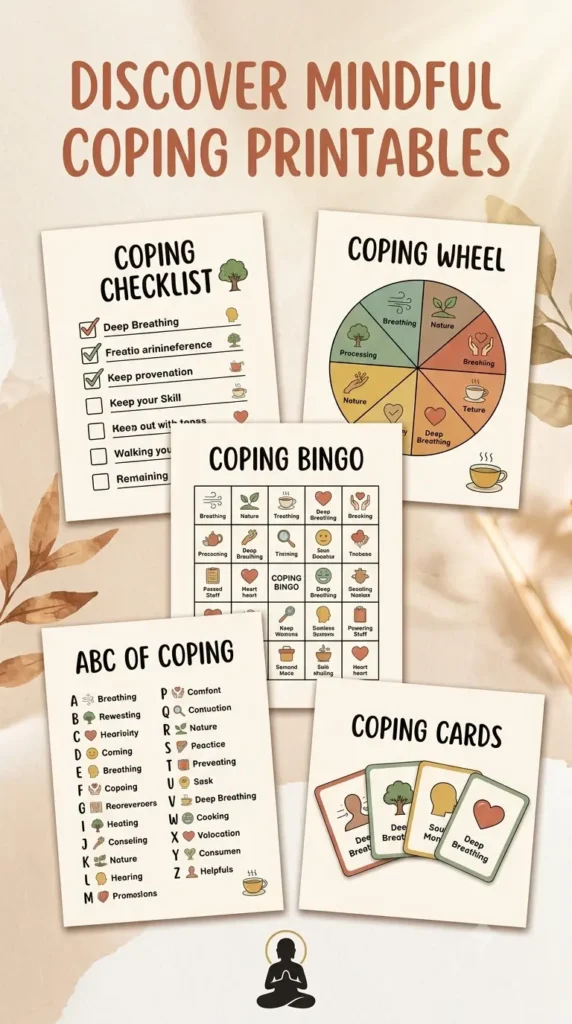
Below are five formats in progress. Each one turns the same 100 coping skills into something you can hold, mark up, or hand to someone else.
The 100 Coping Skills Checklist
This one lists every strategy from this guide in a single coping skills checklist. Check off what you want to try. Circle what actually worked. That’s it. No app, no login, just paper and a pen.
This matters more than it sounds. Most people forget what helped last time. A checklist doesn’t. Over a few weeks, patterns show up on the page, and those patterns become your personal coping plan.
Coping Skills Wheel
A coping skills wheel printable that sorts strategies by feeling instead of by category. Anxious? Spin to that section. Angry? Same idea, different slice.
A long list can freeze you the same way an overloaded brain does. Too many choices, not enough clarity. The wheel skips that step. You start with how you feel, not with a hundred options staring back at you.
Coping Skills Bingo
Coping skills bingo printable turns the whole idea into a game. Five in a row, and you’ve tried five new strategies without even noticing the effort.
This one works well in classrooms. It works in family game night, too, or in a counselor’s office with a kid who won’t sit still for a lecture. Play beats being told what to do. Most kids agree.
ABC Coping Skills Printable
An alphabet-based coping skills alphabet printable, one strategy per letter. A for art. B for breathing. It sounds simple, and it is. That’s the point.
Kids pick it up fast because letters already feel familiar. Adults get something out of it too, mostly because the format forces variety. You can’t just default to your usual three tricks when you’re stuck finding one for Q.
Coping Skills Cards
Coping skills cards you print, cut apart, and stash somewhere close. A drawer. A wallet. Wherever you’ll actually see them again.
Shuffle the deck when you’re stuck. Pull one card. Try it. No decision fatigue, no scrolling through a list trying to pick the “right” one. Sometimes random beats deliberate.
For more printable formats, worksheets, cards, and handouts, see our full guide to printable coping skills lists, cards, and handouts. Pair these tools with our emotions worksheet to connect the feeling to the fix, or start a mindfulness journal practice alongside your coping skills checklist for a fuller routine.
What If a Coping Skill Doesn’t Work?
A coping skill falling flat doesn’t mean you picked wrong. It doesn’t mean coping skills don’t work either. Different situations need different tools. Some strategies take a few tries before they click. Adjust the approach first. Don’t scrap the whole idea.
Give It a Fair Test
Some coping skills work fast. Others need repeats. Try slow breathing once while you’re already spiraling and feel nothing? That’s not proof it’s useless. Try it again when you’re calmer. Follow the steps closely. Notice if your body eases up even a little.
Don’t force something you hate, though. A tool from your list of coping skills only works if you’re actually willing to reach for it twice.
Try a Different Type of Coping Skill
One strategy flops? Switch categories. Don’t just repeat it louder. Journaling stirring up the problem instead of settling it? Grab a grounding exercise instead. Sitting still making the anxiety worse? A short walk might do more than any amount of quiet ever could.
There’s no single “best” coping skill for anger, anxiety, or anything else on a coping skills checklist. There’s only the one that fits what you need right now.
Combine Two Strategies
Sometimes one skill only gets you halfway. Stack two, and coping gets easier. Take slow breaths while you walk. Play calming music while you color. Step outside and run through your senses one by one.
Think of your coping skills list as a toolbox, not a single hammer. You’re allowed to use more than one tool at a time.
- Breathing + walking
- Music + coloring
- Fresh air + a senses check-in
Know When It’s Not Enough
Coping skills are self-help tools. They’re not a stand-in for real mental-health care. If distress keeps crashing into your daily life, feels too big to hold, or you don’t feel safe managing it solo, tell someone. A trusted adult, therapist, doctor, or counselor can help in ways a checklist can’t.
If you’re in the United States and facing a mental-health crisis or thoughts of suicide, call or text 988 to reach the 988 Suicide & Crisis Lifeline. Seek emergency help right away if there’s immediate danger.
Common Mistakes When Using Coping Skills
A coping skill isn’t a magic wand. It’s a tool. Pick the wrong one for the moment, and even a healthy strategy can fall flat. The goal isn’t finding one perfect fix. It’s building a stretched-out list of coping skills you can pull from depending on what the moment actually needs.
Expecting One Technique to Fix Everything
Breathing slows a racing heart. It doesn’t pay the bill that’s stressing you out. That’s the mix-up most people make.
One skill handles one layer of the problem. Nothing more.
So if a breathing exercise didn’t “fix” your stress, that doesn’t mean coping skills are broken. It usually means you grabbed the wrong tool for that particular job. Try another one.
Using Distraction as Permanent Avoidance
A show, a game, a scroll through your phone. All of it can give your mind a real break. Nothing wrong there.
The trouble starts when distraction becomes the only move you make. Difficult feelings don’t disappear just because you looked away. They wait.
A break is coping. Avoidance forever isn’t. What’s the difference? One has an end point. The other doesn’t.
Waiting Until Emotions Reach Their Peak
Here’s the timing problem nobody talks about. Coping skills work best early, not late.
By the time you’re at your limit, your brain is running on stress chemicals, not logic. That’s a hard place to reach for a new skill.
Watch for the early signs instead. Tight shoulders. Racing thoughts. Clenched fists. The urge to shut everyone out. Catch it there, and a simple emotions check-in can help you name what’s building before it spikes.
Picture this. It’s Tuesday afternoon, your jaw is tight, and an email just landed that made your stomach drop. That’s the moment. Not twenty minutes later when you’re already snapping at someone.
Choosing a Strategy You Dislike
Meditation gets recommended constantly. It’s not for everyone.
If sitting still makes you more restless, forcing it won’t build calm. It’ll build resentment toward the whole idea of coping skills.
Walk instead. Draw. Put music on. Try grounding, or journal your way through it. A coping skills checklist only works if the items on it actually fit you.
Never Practicing Skills When You’re Calm
A skill you’ve never tried is hard to remember mid-crisis. That’s just how memory works under stress.
Practice while things are steady. Try a few options. Notice which ones actually shift something in your body or your mood. Keep those close.
Why does this part get skipped so often? Probably because calm moments don’t feel urgent. But that’s exactly when the groundwork gets laid. Build your own short list of coping skills for adults or teens, keep it somewhere visible, and it’ll actually be there when the hard day shows up.
Conclusion
A good coping skill is not the one that looks best on a list. It is the one you can actually reach for when stress, anger, sadness, or overwhelm starts taking over. Use these 100 coping skills as a menu, not a test. Pick a few that fit your life, practice them before you need them, and pay attention to what genuinely helps.
Some strategies will work brilliantly one day and fall flat the next. That is normal. Keep experimenting, build your personal coping skills list, and give yourself more than one way to get through a difficult moment.
Frequently Asked Questions
What are the best coping skills for adults, teens, and kids?
The best coping skill depends on the person, the situation, and the intensity of the emotion. Kids may respond well to movement, sensory activities, drawing, or talking to a trusted adult.
Teens and adults may prefer journaling, exercise, breathing exercises, music, grounding, or time alone.
Where can I get a free printable coping skills list or coping skills PDF?
A printable coping skills list can be useful when you want to keep your options somewhere easy to reach. A good list should include different types of strategies rather than repeating similar activities. Look for resources that let you check off skills, personalize your list, and identify what works for you.
Can coping skills make difficult emotions go away?
Not necessarily, and that isn’t always the goal. Coping skills are mainly tools for managing your response to difficult emotions so you can get through the moment without making things worse. Sometimes the feeling becomes less intense; other times, the skill simply helps you tolerate it and decide what to do next.
What are some coping skills for anger that can help before you react?
Coping skills for anger should create enough space between the feeling and your reaction to make a different choice. Try slow breathing, stepping away from the situation, taking a brisk walk, squeezing a stress ball, writing down what happened, or using grounding techniques before responding.
What should I do if my usual coping skills aren’t working?
Don’t assume that a coping skill has failed simply because one attempt didn’t help. Try a different type of strategy, such as switching from distraction to grounding or from thinking to movement. If distress remains intense or you’re struggling to stay safe, reach out to a trusted person or qualified professional.

It’s Bhaskar!
Well, I am not a psychologist a monk, or a philosopher by training. I’m just an engineering graduate.
‘The Empty Self’ is where I write about that idea, and what it actually means for ordinary life, anxiety, identity, habits, the stories we tell ourselves about who we are. I don’t have a psychology degree, and I’m not offering therapy or clinical advice. What I do have is thought and clarity, and genuine curiosity about why we suffer the way we do and how much of it might loose once we shed this ‘fixed identity’.